IN THIS ISSUE:
GRAPEVINE DEATH AFTER SHOOTING IN CEDAR-RIVERSIDE PAGE 2
MONDAY, MARCH 4, 2019
EARLY WEEK
A SHOOTING IN THE AREA FRIDAY NIGHT LEFT ONE DEAD
MNDAILY.COM
CAMPUS
U limits controversial business
RENAMING
Kaler calls for Coffman renaming Kaler recommended renaming four buildings on campus, but students are split on the issue. BY AUSTEN MACALUS amacalus@mndaily.com
Coffman Union sees thousands of students pass through it every day. The student union is home to an assortment of student organizations — including the University’s nine student cultural centers. Soon, it could have a new name. University of Minnesota President Eric Kaler is supporting plans to rename Coffman and three other buildings named after former administrators who upheld racist and anti-Semitic practices on campus. However, students’ views on renaming the buildings are varied, ranging from mild indifference to staunch support or opposition. Kaler announced his recommendation to strip the names of Coffman Union, Nicholson Hall, Middlebrook Hall and ELLE MOULIN, DAILY
u See COFFMAN Page 3
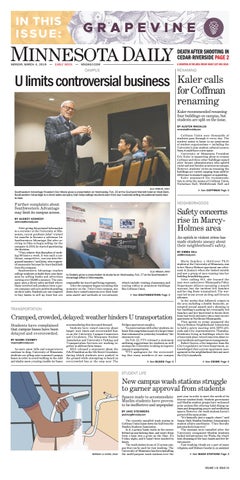
Southwestern Advantage President Dan Moore gives a presentation on Wednesday, Feb. 20 at the Courtyard Marriott hotel on West Bank. Southwestern Advantage is a direct sales company that helps college students start their own business selling educational books door to door.
NEIGHBORHOODS
Further complaints about Southwestern Advantage may limit its campus access.
Safety concerns rise in MarcyHolmes area
BY AUDREY KENNEDY akennedy@mndaily.com
After giving his personal information to a recruiter at the University of Minnesota, recent graduate John* trained for months to become a salesman for Southwestern Advantage. But after arriving in Ohio to begin selling for the company in 2016, he started questioning the decision. “They admire this discipline of working 90 hours a week. It was such a cutthroat, competitive, run-you-into-theground summer,” said John, who requested anonymity because he fears backlash from the company. Southwestern Advantage teaches college students to build their own business by selling books and advertises earning over $8,000 a summer. The company uses a direct sales method where those involved sell products from a parent company and earn profits depending on their sales. Students are not required to buy books to sell up front but are
An uptick in violent crime has made students uneasy about their neighborhood’s safety. BY EMMA DILL edill@mndaily.com
Bridges apartment complex. “In conversations with other students, we know this congestion is part of a larger issue that culminated in yesterday’s incident,” the statement read. On Feb. 22, PTS released a statement outlining suggestions for students as well as steps the University is taking to improve campus transportation. “PTS apologizes for the overcrowding that many members of our campus
Maria Sanchez, a third-year Ph.D. student at the University of Minnesota, was in her Marcy-Holmes apartment one afternoon in January when she looked outside and saw a group of men running into her building brandishing guns. After calling 911, she learned the men were undercover Minneapolis Police Department officers executing a search warrant, but the incident left Sanchez and her dog Rosie traumatized. The warrant led to one arrest on drug and firearm offenses. In the weeks that followed, crimes in the area including a double homicide, attempted sexual assault and a shooting in her building’s parking lot eventually led Sanchez and her boyfriend to break their lease last week and move into a more secure apartment in Northeast Minneapolis. This uptick in crime prompted the Marcy-Holmes Neighborhood Association to hold a safety meeting with MPD officials and City representatives Thursday. Residents living in buildings where the crimes took place voiced concerns about recent incidents and apartment management. Robert Sayers, a fire inspector from the City’s regulatory services department, acknowledged that current apartment management in the neighborhood does not meet the City’s standards.
u See BUSES Page 3
u See CRIME Page 3
ELLE MOULIN, DAILY
AJ Skalsky gives a presentation to students on Wednesday, Feb. 27 at the Southwestern Advantage office in Minneapolis.
responsible for travel and living expenses. After the company began recruiting this semester on the Twin Cities campus, students have raised concerns over their business model and methods of recruitment,
which include visiting classrooms and renting tables at prominent buildings like Coffman Union. u See SOUTHWESTERN Page 3
TRANSPORTATION
Cramped, crowded, delayed: weather hinders U transportation Students have complained that campus buses have been delayed and overcrowded. BY NIAMH COOMEY ncoomey@mndaily.com
As more snow falls and temperatures continue to drop, University of Minnesota students are piling onto crammed campus buses in order to avoid walking in the cold and slushy snow, creating trouble for buses
accommodating this increased demand. Students have raised concerns about longer wait times and overcrowded buses on the University Campus Connectors and Circulators. The Minnesota Student Association and University’s Parking and Transportation Services are working together to address these issues. MSA released a statement about the Feb.19 incident on the 4th Street Circulator, during which students were pushed to the ground while attempting to board an overcrowded bus at the stop near The
STUDENT LIFE
New campus wash stations struggle to garner approval from students Spaces made to accommodate Muslim students have proven to be ineffective and unpopular. BY JAKE STEINBERG jsteinberg@mndaily.com
MORGAN LA CASSE, DAILY
The recently installed wash station in Coffman Union is just down the hall from the Muslim Students Association. In it, a grimy basin waits in the corner behind an non-locking door, and water drips from a hose into a grate on the floor. It’s Friday night, and it hasn’t been touched in hours. The wash station is one of 12 across campus that can be used for foot washing. The University of Minnesota has been installing the multi-purpose wash stations over the
past year in order to meet the needs of its diverse student body. Student governance and Muslim student groups have welcomed prior actions like offering halal dining options and designating prayer and meditation spaces. However, the wash stations haven’t garnered the same praise. “It’s basically just a supply closet,” said Samia Abdi, Muslim Students Association’s student affairs coordinator. “They literally just attached a hose to it.” The stations were installed after the University recognized Muslim students lacked infrastructure for Wudu, the ritualistic cleansing of the face, hands and feet before prayer. Foot washing rituals are a part of many religions, said Mohsen Goudarzi, an assistant u See WASH STATIONS Page 3
VOLUME 119 ISSUE 43
2
MONDAY, MARCH 4, 2019
MN DAILY
EXTENDED WEATHER FORECAST MONDAY TUESDAY 8° 15° 1° 1° Mostly cloudy
Daily Review
MNDAILY.COM
Partly cloudy
WEDNESDAY 20° -4° Partly cloudy
THURSDAY 19° -3° Cloudy
FRIDAY 25° 13°
Monday, March 4, 2019 Vol. 119 No. 43
Mostly cloudy
An Independent Student Newspaper, Founded in 1900. 2221 University Ave. SE, Suite 450, Minneapolis, MN 55414
THIS DAY IN HISTORY
Phone: (612) 627-4080 Fax: (612) 435-5865
2005 Billionaire mogul Martha Stewart is released from a federal prison near Alderson, West Virginia, after serving five months for lying about her sale of ImClone stock in 2001.
Copyright © 2019 The Minnesota Daily. This newspaper, its design and its contents are copyrighted.
HISTORYCHANNEL.COM/TDIH
OFFICE OF THE PUBLISHER Kelly Busche Editor-in-Chief kbusche@mndaily.com (612) 435-1575 Genevieve Locke Business Operations Officer glocke@mndaily.com (612) 435-2761
EVENTS
EDITORIAL STAFF Max Chao Managing Editor mchao@mndaily.com Christine Ha Managing Production Editor cha@mndaily.com Michelle Griffith Campus Activities Editor mgriffith@mndaily.com Madeline Deninger City Editor mdeninger@mndaily.com J.D. Duggan Campus Administration Editor jduggan@mndaily.com Cleo Krejci Features Editor ckrejci@mndaily.com Drew Cove Sports Editor dcove@mndaily.com Sophie Vilensky A&E Editor svilensky@mndaily.com Ellen Schmidt Multimedia Editor eschmidt@mndaily.com Courtney Deutz Assistant Multimedia Editor cdeutz@mndaily.com Molly Tynjala Copy Desk Chief mtynjala@mndaily.com Bailey Davis Assistant Copy Desk Chief bdavis@mndaily.com Desmond Kamas Chief Page Designer dkamas@mndaily.com Abby Adamski Visuals Editor aadamski@mndaily.com Morgan La Casse Visuals Editor mlacasse@mndaily.com =
=
=
=
=
=
=
JASMIN KEMP, DAILY
Tan France, a starring member of Netflix’s Queer Eye, gives a talk at Coffman Union on Saturday, March 2 in Minneapolis. France shared insights about his life and being multicultural and gave fashion tips to students.
One person dies in shooting near the U Minneapolis police responded to report of shots on 300 block of Cedar Avenue.
DAILY FILE PHOTO
Two children walk past police cars parked outside Riverside Plaza on Monday, March 19.
has been released about the victims. One person died after a shooting in the Cedar-Riverside neighborhood Friday night. Police responded to reports of gun shots at the 300 block of Cedar Avenue, according to a Minneapolis Police Department press release. Two gunshot victims were located in a vehicle at 2100 Riverside Avenue and are believed to be related to the Cedar Avenue shooting.
One victim in the vehicle was deceased while the other had non-life-threatening injuries. Police were soon alerted that a third victim of the same shooting had arrived at the Hennepin County Medical Center with nonlife-threatening injuries. All three victims are believed to be adults. No further information has been released about the victims.
Southeast Como reacts to chemical spill on Friday An estimated 600 to 700 gallons of nitric acid spilled in Como from chemical plant. BY DYLAN MIETTINEN dmiettinen@mndaily.com
Minneapolis fire crews cleaned up more than 5,700 gallons of nitric acid that spilled from a Como neighborhood chemical plant Friday morning. The fire department contained the spill, said Bryan Tyner, assistant chief of the Minneapolis Fire Department. Though the environmental implications
The Sexual Health for International Students project is now in its third year. BY GWIWON JASON NAM gnam@mndaily.com
BY IMANI CRUZEN icruzen@mndaily.com
One person died after a shooting in the Cedar-Riverside neighborhood Friday night. Police responded to reports of gun shots at the 300 block of Cedar Avenue, according to a Minneapolis Police Department press release. Two gunshot victims were located in a vehicle at 2100 Riverside Avenue and are believed to be related to the Cedar Avenue shooting. One victim in the vehicle was deceased while the other had non-life-threatening injuries. Police were soon alerted that a third victim of the same shooting had arrived at the Hennepin County Medical Center with nonlife-threatening injuries. All three victims are believed to be adults. No further information
Sexual education for UMN international students expanding
and cause of the spill have yet to be determined by the Minnesota Pollution Control Agency, Tyner said that “there is no life safety concern at this time.” The Minneapolis Fire Department responded around 8:15 a.m. to the spill on the 3100 block of E. Hennepin Avenue. An estimated 600 to 700 gallons of nitric acid have entered the neighborhood’s storm drain system. The fire department said the acid “has been neutralized with soda ash and will be flushed out of the system to mitigate any environmental concerns.”
Nitric acid, a chemical compound, is often found in fertilizers and is known for being highly corrosive. As a result of the spill, a portion of E. Hennepin Avenuewas closed from Talmage Avenue S.E. to 31st Avenue. The acid originated from Hawkins Inc., an industrial chemical manufacturing company in the Como neighborhood. The facility will remain closed until the spill is managed, Tyner said. Insight Brewing and the University of Minnesota’s Como Student Community Cooperative are in the area.
A student-led University of Minnesota group aims to expand culturally inclusive sexual education among international students. Boynton Health has expanded sex education for international students through the Sexual Health for International Students project, which is part of Sexual Health Awareness and Disease Education. The group will help host an event this month for international students that will include presentations and tabling to provide sexual education. “One difference that we try to be very aware of is in language,” said Kate Elwell, an adviser for SHADE and Boynton’s health promotion specialist. “Ensuring that all language is clear for nonnative English speakers as well as for students who may be less familiar with the topics is important, and requires diligence on the part of our student coordinators.” SHADE is a peer health promotion group that works within Boynton to provide sexual education to students campus-wide. The Sexual Health for International Students project is currently in its last year of a three-year grant from the International Student Services Fee committee. “Since the very beginning, this project has employed international students to help guide the process,” Elwell said. Current initiatives include educational presentations and continuing conversations with International Student and Scholar Services to explore new ideas, such as how to effectively provide sex education to international students. The group presented last month at the Small World Coffee Hour — an event where students come together to learn about new cultures, food and customs — collaborating with ISSS and the Thai
Student Association of Minnesota. “About 50 students participated in the events and a lot of them are international students,” said Sophronia Cheung, SHADE coordinator and second-year political science and economics student. They discussed relationships, dating norms and sexual health from a multicultural perspective during the event, with a specific focus on Thai sex culture. This semester, the team is working on a video to add to the International Student Preparation Course, which is required for all international students as they prepare to enter the University of Minnesota. Vinayak Bharadwaj, a SHADE coordinator and third-year finance student, said the video will promote sexual health among international students. In their first year, they hired experts to conduct anonymous online surveys that mainly focused on Chinese students, the largest population of international students. “We realized that because this is something taboo for many international students, it was more like ... people would be able to be to participate actively and fully if their privacy were protected,” Elwell said. She said privacy was a priority among both international and domestic students. But they also found that international students may feel uncomfortable discussing sex or accessing sexual health resources. Last October, the group gave a pilot presentation to international students to discover what messages were most effective. They surveyed the groups afterward and found various levels of receptiveness among different cultures. “I am from Hong Kong and when I was in there, we didn’t learn about sex education. I only took the biology class. It was not enough to understand about sex,” Cheung said. “So, I believe providing sex education to international students here is very important.”
EDITORIAL BOARD Ellen Schneider Editorials & Opinions Editor eschneider@mndaily.com Ariana Wilson Editorial Board Member awilson@mndaily.com Hailey Almstead Editorial Board Member halmstead@mndaily.com Kelly Busche Editor-in-Chief kbusche@mndaily.com BUSINESS Kyle Stumpf Sales Manager kstumpf@mndaily.com David Keane Controller dkeane@mndaily.com =
The Minnesota Daily strives for complete accuracy and corrects its errors immediately. Corrections and clarifications will always be printed in this space. If you believe the Daily has printed a factual error, please call the readers’ representative at (612) 627–4070, extension 3057, or email errors@mndaily.com immediately. THE MINNESOTA DAILY is a legally independent nonprofit 501(c)(3) organization and is a student-written and student-managed newspaper for the University of Minnesota’s Twin Cities campus. The Daily’s mission is: 1) to provide coverage of news and events affecting the University community; 2) to provide a forum for the communication and exchange of ideas for the University community; 3) to provide educational training and experience to University students in all areas of newspaper operations; and 4) to operate a fiscally responsible organization to ensure its ability to serve the University in the future. The Daily is a member of the Minnesota News Council, the Minnesota Associated Press, the Associated Collegiate Press, The Minnesota Newspaper Association and other organizations. The Daily is published Monday and Thursday during the regular school year and weekly during the summer, and it is printed by ECM Publishers in Princeton, Minn. Midwest News Service distributes the 10,000 issues biweekly. All Minnesota Daily inserts are recyclable within the University of Minnesota program and are at least 6 percent consumer waste. U.S. Postal Service: 351–480.
3
Monday, March 4, 2019
Southwestern u from Page 1
The University sent a letter to Southwestern Advantage last week saying if they “receive further reports of deceptive marketing tactics or interruptions in classroom spaces, we will be forced to consider limiting your access to campus.” Southwestern Advantage has worked with students at the University for decades, according to Senior District Sales Leader AJ Skalsky. “We try to be very transparent and do everything by the book of what they teach us to do. But they are very aware of our presence on campus,” he said.
Concerns with oncampus recruitment
Concerns about the company stem from student complaints regarding “misleading marketing” and “sketchy encounters” with representatives, according to a letter sent to
Wash stations u from Page 1
professor of Islamic studies, “but in Islam, they’re particularly important because one of the fundamental obligations of Muslims is to pray five times a day.” Students are likely to be on campus four of those five times. For most Muslim students, this means they have to wash in public bathrooms, a process students say can be messy, awkward and unhygienic. Vice President of University Services Mike Berthelsen said the University noticed students were using sinks in public restrooms to wash. “It’s not
Buses u from Page 1
community have experienced. It is understandably frustrating as a passenger if transportation is needed during one of those trips. PTS strives to provide a frequency of service with a reasonable amount of wait time between buses,” the statement read. Third-year student Katelyn Belden was on the 4th Street Circulator when the incident outside of the Bridges occurred and reached out to MSA in hopes it could advocate for change. Belden said she’s experienced aggression and overcrowding on the campus buses, which sometimes makes her late for work. “I had to miss a bus once … because it was so crowded. I just couldn’t get on,” she said. Lauren Meyers, MSA’s infrastructure committee director, said despite weather conditions, the 4th Street Circulator is frequently the source of many student concerns. “Even before winter even happened, the 4th Street Circulator is easily the topic I hear the most about as far as students [bringing issues] up,” she said.
Southwestern Advantage on Friday by Maggie Towle, interim vice provost for student affairs and dean of students. While the company is not banned at the University, they’re unable to recruit in classrooms and at career events or use the University’s job board GoldPASS, the letter said. For Caroline Pavlecic, a sophomore and atlarge representative for the Minnesota Student Association, the recent attention on Southwestern Advantage pushed her to start drafting a resolution addressing direct sales and multi-level marketing companies on campus. While still a work in progress, the draft calls for the University to educate students and instructors on the topic. “I would like for ... students and faculty to become a lot more aware of these companies and how they operate. Whether or not a ban [on these companies] is feasible, we have to determine
that through consultation with the University,” Pavlecic said.
After multiple interviews, those selected for the program travel to the company’s headquarters in Nashville for a week of training. They then move to another town, frequently in a different state, to sell for the summer. A typical work week for Southwestern Advantage employees is Monday through Saturday, beginning at 8 a.m. and ending at 9 p.m., according to three-time seller Barron Marschall. “[My recruiter] would drop me off in the morning and pick me up on his way back home,” Marschall said. “It was tough … but you get used to the challenges.” A f t e r r e c e n t g r a d uate John* began selling, he started to question if he was taking advantage of people. “Our sales tactics just seemed so predatory. The
company sold me on investing in children and their future, but it doesn’t seem like they care about any of those things,” he said. After five weeks of selling, he left the program without telling anyone. He calculated he made less than $2 an hour. “An hour after I left, my manager and my manager’s boss chewed me out over the phone for not being driven enough. They told me if I didn’t turn around, I was making the biggest mistake I would ever make,” he said. Skalsky, who oversees multiple states in the Midwest, said many of the company’s critics are people who don’t fully understand the program. “People that either quit or have never done our program have a tendency to … go online to try and make us look bad, because it validates why they quit,” Skalsky said. Skalsky sold for Southwestern Advantage for nine summers and met his wife
through the company. For him, the program turned his life around. “I believe every single person deserves opportunity to learn about it. And from the right kid, it’s going to change their life,” Skalsky said.
easy to do and it makes the floor slippery and dangerous,” he said. In addition, he said extra cleaning work is necessary. Facilities Management identified spaces on campus that could be easily retrofitted to function as wash stations. The most readily available spaces turned out to be custodial closets. “We have more of those rooms than we need full of custodial equipment, and we identified a few of those that already have a faucet, already have a drain,” Berthelsen said. Berthelsen said the stations aren’t just for washing feet, or any purpose in particular. Anyone can use them for any purpose. Some of the stations are
converted, standalone single showers that could be used by people who bike or run to campus. A custodian could use them to fill a mop bucket. “We really t h ink of them as multipurpose rooms, which can meet a foot washing need,” he said. MSA secretary Yuristika Salsabila said in an email to the Minnesota Daily that MSA is grateful the University is providing wash stations, but the design is inconvenient. MSA was involved in the location planning of the Coffman space, but not the design. “In the future, we hope to better collaborate with Facilities Management and the departments/offices that
wish to set up foot wash stations,” she said. Abdi said students avoid the Coffman space because it’s uncomfortable and doesn’t feel clean. The practice usually takes several minutes and requires both hands, which isn’t easy when aiming a hose. The water pressure is also an issue. “It’s like 70 miles per hour,” she said. “You basically can’t use it.” Foot washing stations have been contentious accommodations for other public institutions. Minneapolis Community and Technical College’s plan to install footbaths in 2007 faced accusations of a double standard from a state legislator and conservative bloggers.
Critics say the infrastructure caters to a specific religion and violates the separation of church and state. Proponents say anyone is able to use the st at io ns, regardless of their religion, and that the University is safeguarding students’ constitutional right to practice any religion they choose. Private universities have more freedom in religious accommodat ions. Wh en A ugsburg University’s Hagfors Center opened in Jan. 2018, Muslim students gained access to the WuduMate, a device tailored to comfortable and hygienic foot washing. “We did a lot of research around what would fit for
our institution. We found one that was perfectly accessible,” said Fardosa Hassan, Muslim student program associate at Augsburg University. “We had a new building being built, why not put that in there?”
Jacqueline Bass, a spokesperson for P T S , said recent issues have been unique because of this winter’s record-breaking snow and cold weather. “It’s not something that happens every winter,” she said. “As the temperatures warm up, I think this issue will subside.” PTS is aware of the issues and is using every bus possible, monitoring buses and adjusting routes when necessary, Bass said. PTS also has four new buses on order for next fall. Meyers said she is hoping to involve students in the re-evaluation of bus routes on campus so they can best serve the students who use them regularly. “We’re hoping to just really re-evaluate how students are using these routes. … It’s just time that they change because student housing has changed so, so much in the past few years,” Meyers said. Bass said routes are reevaluated on a frequent basis and are intended to serve students as best as possible. The 4th Street Circulator and University Avenue Circulator were introduced only a couple years ago, she said. “There’s a lot of research and thought behind
how the routes are. They are planned to assist students as much as possible,” she said. University junior Jorguino Savio said some of the overcrowding issues are simply due to students’ unw illingness t o m ake room for others. “Some students, they don’t want to move [and] give the space to another student … they don’t care about the other person,” he said. Meyers said when she mentioned the MSA statement to peers, many students agreed that overcrowded buses can get physical, adding that aggression is sometimes necessary to board the bus. Bass recommended students look into other route options and recognize that other buses can take them to the same place in a more timely manner with potentially less crowding. “If [the 4th Street Circulator] is full and they are unable to get on that bus, the University Avenue Circulator is the exact same route, it’s just backw a r ds ,” Ba s s s a id. “We encourage students to think creatively … there is more than one choice.” MSA and PTS are scheduled to meet this week to discuss these recent issues.
Crime
problem tenants and that we’ve had drugs, we’ve had violence, we’ve had possibly some prostitution,” Loining said. Ryan Rainey and Laura Checovich attended Thursday’s meeting. The couple lives across the street from the spot where a University student was assaulted on 8th Street Southeast on Feb. 8. Checovich said the assault was alarming because she regularly walks her dog in that area. “It sounds like this person is just going about their regular daily commute and they were exposed to that level of violence,” she said. The recent incidents have caused the two to reevaluate their perception of Marcy-Holmes. “Living here, especially in this neighborhood, I think it’s fair to say that we always felt very safe. The
events of the last couple of weeks have kind of changed that for us, I think,” Rainey said. Ward 3 Minneapolis City Council member Steve Fletcher said the meeting helped create a necessary dialogue in the neighborhood. “Part of what we need to do in any kind of a response to public safety issues is build community and this meeting is a really good start,” Fletcher said. Sayers said the apartment building at 410 6th St. SE will undergo a full licensure review this year. 2nd Precinct Crime Prevention Specialist Nick Juarez said he plans to meet with the building’s management next week to discuss resident’s safety concerns. In response to the incidents, MPD has increased police presence in the neighborhood, Loining said.
Work after University recruitment
u from Page 1
“Renters are parts of our community, period,” Sayers said. “But oftentimes renters are viewed kind of secondclass here in Minneapolis.” Sanchez said the management of her building at 410 6th St. SE. did not take security concerns seriously. “I do think the problems in our apartment building were exacerbated by the fact that management was not very present and communicative with residents when incidents would happen,” Sanchez said. MPD 2nd Precinct Inspector Todd Loining said the recent criminal activity at Sanchez’s address is part of a long-term problem. “I have heard that in the past 15 years this has been a problem. This has been a problem building with
Complex business models concern some, encourage others
While commonly labeled a pyramid scheme or multi-level marketing company online, Southwestern Advantage President Dan Moore said the company helps college students develop their own businesses. Robert FitzPatrick, an expert in multi-level marketing schemes, pyramid schemes and direct selling, said the company’s model of bringing students to sell in a different state puts them in a vulnerable position. “You’re picked up, taken away from your home turf, away from friends and family. There’s nothing else to do but keep working ...
you’re physically stuck,” FitzPatrick said. Skalsky said that while students who drop out may face money problems, he has always made sure they get home safe. “I always try and leave students in a good place, [even if] they didn’t finish the summer. I have the utmost respect for anybody who tries our program,” Skalsky said. While Southwestern Advantage has plans to recruit throughout the semester, their presence on campus still raises questions for students and faculty. “The whole idea of going to college is that it’s a somewhat protected space,” FitzPatrick said. “[Colleges] should, at the very least, be forcing these companies to make it a real choice for a student and not something they get misled by.” *This University student requested to use another name for fear of backlash from the company.
“[The washing station] is basically just a supply closet. ... They literally just attached a hose to it.” SAMIA ABDI student affairs coordinator, Muslim Students Association
4
Sports
MNDAILY.COM
MEN’S HOCKEY
MN DAILY
MONDAY, MARCH 4, 2019
VOLLEYBALL
Gophers volleyball players travel to Colorado with national team ambitions
DAILY FILE PHOTO
Sophomore opposite hitter Stephanie Samedy eyes the ball as she serves during the game against the Northwestern Wildcats on Saturday, Oct. 13, 2018.
JACK RODGERS, DAILY
Sophomore Scott Reedy keeps the puck away from Arizona State on Friday, March 1 at 3M at Mariucci Arena.
Senior scoring provides lift in sweep over ASU Minnesota scored three times in the first to run away with the game. BY NICK JUNGHEIM njungheim@mndaily.com
While the rest of the Big Ten had conference games on Saturday, the Gophers had one last opportunity to earn a victory against a ranked opponent on senior night. Minnesota (16-15-4, 1110-3-0 Big Ten) got a strong showing from its seniors in its final regular season game. Thanks largely to a fast start to begin the game, the Gophers defeated No. 12 Arizona State (21-12-1) 5-2. “Solid weekend for us, real solid,” said head coach Bob Motzko. “Great for our seniors, a couple of them scoring, Eric [Schierhorn] in the net. Very solid weekend.” Picking up right where they left off after Friday’s 5-1 victory, the Gophers controlled the first period of play. Motzko started all seniors, sending Brent Gates Jr., Tommy Novak, Jack Ramsey, Jack Sadek and Tyler Sheehy, out for the opening face-off with Eric Schierhorn in goal. With that group still on the ice, Ramsey put Minnesota in front just 42 seconds into the game, scoring off assists from Gates and Sadek. For the seniors, it was a storybook way to begin their last regular season
game in front of the home fans. “Picture-perfect,” Ramsey said. “Start six seniors and to have that happen. I was thinking about it before the game when [Motzko] told us the starting lineup, but I didn’t imagine it being myself being out there with those guys.” The Gophers’ domination of the opening 20 minutes didn’t stop there. Another senior, Darian Romanko, redirected a shot from Sadek that found the back of the net at the 10:02 mark. Sophomore Sampo Ranta added another score three minutes later. Minnesota headed into the first intermission with a 3-0 lead and a 15-3 advantage in shots on goal. Just over a minute into the second period, sophomore Brannon McManus scored to give the Gophers a 4-0 lead. On the play, Arizona State sophomore Jacob Wilson received a game-misconduct for checking Ranta above the neck. Despite being given a fiveminute major, Minnesota didn’t score again until the third period. Instead, Arizona State scored a short-handed goal. The Sun Devils added another score at the 13:32 mark to cut the Gophers’ lead to 4-2. The third period featured a long stretch of freeflowing hockey that extended for 6:30 without a stoppage. Despite the backand-forth play, Minnesota
c o u l d n ’ t b r e a k t h ro u g h again until 2:45 remaining in the game. Then, on the penalty kill for the only time of the night, Minnesota got three consecutive excellent opportunities on shorthanded breakaways. After getting denied on the first two, junior Rem Pitlick put the game away with Minnesota’s fifth and final goal, clinching the sweep. “Getting [a sweep] on the last weekend is big for us,” Romanko said. “We have that little edge going into the playoffs. We’re not down on ourselves going into next week. I think we got the ball rolling and we’re going to keep rolling.” With the victory, Minnesota earned their first sweep at home this season. The Gophers, who have struggled with consistency, are peaking at the right time as they head into the postseason. They have won five of their last six, including three straight over ranked opponents. “We feel good,” Ramsey said. “We’re playing the right way. I think everyone’s really buying in to coach’s system right now and it’s showing on the ice.” Minnesota will host a first-round, best-of-three series to begin the Big Ten tournament next weekend, beginning on Friday, March 8. For now, Motzko was glad his team secured a sweep in the seniors’ final home series.
MEN’S HOCKEY RESULTS
SATURDAY Arizona State Minnesota
1 0 3
2 2 1
3 1 1
FINAL 2 5
SOURCE: GOPHERSPORTS.COM
“Getting [a sweep] on the last weekend is big for us. We have that little edge going into the playoffs. We’re not down on ourselves going into next week. I think we got the ball rolling and we’re going to keep rolling.” DARIAN ROMANKO Gophers hockey player and senior
“I’ll give group credit to the seniors,” Motzko said. “From day-one to today, they’ve been respectful, they’ve been respectful to a new coach. They believe in getting better. Sometimes you get seniors who are looking beyond. I think they have stayed focused with this team the entire year. We kept getting better and it set us up for a big weekend.”
Minnesota has 13 players trying out for the team, the most of any school. BY DAVID MULLEN dmullen@mndaily.com
Although the college volleyball season is seven months away, many of the Gophers volleyball team are back in action this weekend in hopes of being selected to the USA National Collegiate Team. Thirteen members of the Minnesota volleyball team headed out west to Colorado Springs, Colorado for the annual open tryout for the USA Collegiate team, which was the most of any school in the country. “People that come here want to be good in college, but they also aspire to be good beyond,” said head coach Hugh McCutcheon. Some of the Gophers trying out include nearly every starter from last season, such as opposite hitter Stephanie Samedy, outside hitters Alexis Hart and Adanna Rollins, middle blockers Taylor Morgan and Regan Pittman and libero C.C. McGraw This is not the first tryout for many of the players. Samedy made the team last year and said she is excited about the opportunity for her and her teammates. “[This] shows how committed to the process we are,” Samedy said. “It gives us a chance to check our progress and the opportunity to see if we’re able to apply outside of the gym in a different environment.” Along with the 13 Gophers players, there will be around 200 other athletes competing for the chance to be apart of the US Collegiate Team, and although the number is high, Hart said she is ready to go up against a competitive field. “It’s a great opportunity to play a different style of
volleyball and gain things from other schools,” Hart said. Many of the players hope to one day represent the United States on the national team. There are currently multiple former Gophers on the team, including Sarah Wilhite Parsons, Tori Dixon, Hannah Tapp, Paige Tapp and Lauren Gibbemeyer. Making the collegiate team it is potentially one step closer to that goal. “I have goals and plans after college and I’d love to play for USA,” Hart said. “But just to see the type of systems they run and their type of culture ... so just getting a taste of USA volleyball.” Even though there are 200-plus try-out attendees, the Gophers’ competitors believe they bring something unique. “Our team is really good at bringing a lot of energy,” Hart said. “I think we bring a lot of good culture ... and with our skills and mechanics that we have, I don’t know, it just seems very consistent.” Samedy and Hart said having some of their teammates with them helps ease their nerves. “Not everyone will be able to have [13] girls with them, so it’s pretty cool to have my teammates with me,” Hart said. Whether or not they make the team, the players said they value the opportunity to learn. “They get a chance to play against different players which I think is go along with being thrown into a different environments where they have to adapt,” McCutcheon said. “I think being able to adapt and show a little resiliency are all really valuable for any athlete.” Minnesota volleyball will return to action later this month when the team takes a trip to Japan, but regular season action will come back in August.
WOMEN’S GYMNASTICS
Two gymnasts lead Minnesota to victory Saturday The Gophers got a season-high score over Pittsburgh in final home meet. BY PAUL HODOWANIC phodowanic@mndaily.com
The Gophers women’s gymnastics team had been trying to put all four events together the entire season, and on Saturday afternoon, the team finally did it. Minnesota scored a season-high and second-best in program hist o r y t e a m s c o r e , b ea ting Pittsburgh 197.500193.400 on Saturday at Maturi Pavilion. “We are really getting better each and every week,” said head coach Jenny Hansen. “It was fun. We put all four events together tonight and we haven’t done that this year and I think that’s why we saw such a jump in the score for us. They were just on, and I know they wanted to send their seniors out in style and they sure did.
JASMIN KEMP, DAILY
Paige Williams is congratulated by her coach after vaulting on Saturday, March 2 at Maturi Pavilion.
The No. 11 Gophers swept the event titles as Paige Williams won the vault and floor exercise with scores of 9.900 and 9.925. Her vault score was
her career-high on the event. “She performed with such confidence, it was so fun to watch her,” Hansen said. “She’s got such big
gymnastics, the amplitude she has makes everyone’s jaws drop.” Lexy Ramler took home the other two event titles, scoring a career best on
beam with a 9.750 and tied her career best with a 9.950 on bars. Ramler put together the top all-around performance of the night scoring 39.650. The score is the third best all-around score in Gophers history. Ramler owns the top score among all Gophers at 39.725. Saturday also saw a breakout performance f ro m f r e s h m a n T i a r r e Sales. Sales competed on three events: bars, beam and vault. She scored her career-high in all three. Her 9.900 on bars earned her third place overall, her 9.850 performance on vault placed her in a tied for third spot, and her 9.900 on beam won her second place. “That’s what she does in practice, so it was so fun to see her exactly what she does,” Hansen said, adding the whole team felt amped up to send the seniors out strong. An announced crowd of 2,698 cheered the team on, standing up and chanting after every routine for Minnesota, which left an
effect on the gymnasts. “We always love a big crowd, this was great for us and we felt the energy for sure tonight, and I know the girls feed off of it,” Hansen said. “They love a big crowd, and it was fun tonight.” Minnesota honored their two seniors following the event, Rachel Cutler and Selena Ung. Cutler didn’t compete due to injury and Ung competed in the floor exercise in her last regular season home meet. This group of seniors was the first recruiting class for head coach Jenny Hansen, now in her fifth year. “We’ve been through the whole process together,” Hansen said. “For them to finish out and be a part of such a great team is pretty special.” Minnesota travel down south to the Elevate the Stage event in Birmingham, Alabama to take on No. 7 Georgia, No. 20 Arkansas and No. 37 Michigan State.
5
MNDAILY.COM
MN DAILY
MONDAY, MARCH 4, 2019
MUSIC
OR PERS F E F I AD L HER RAP R G T POS GOP
ABBY ADAMSKI, DAILY
They worked on establishing a fan-base during their four years at University... but now what? BY SAMIR FERDOWSI sferdowsi@mndaily.com
On Kanye West’s “Graduation,” you find a story about a man’s journey through a college experience of his own. The record holds moments of exploding confidence that shaped the controversial emcee’s career. But what about those rappers who actually did orchestrate their careers during their time in lecture halls? Meet Vessle and Jetley. Both Battle of the Bands participants during their senior years at the
University (Vessle was the winner in 2017 and Jetley was a finalist in 2018), these artists used the resources and people around them to build a following and local clout. Now, they’re continuing their rise in the rap game during post-grad life. “The real world don’t give a fuck about you, when you get out here your constant support isn’t there anymore,” sociology graduate Vessle said. “The organic support is there, you just have to invest in it.” Solidifying support during his time as president of the Black Student Union, Vessle crafted a following that was ride-or-die while at school. Having had a solid number of supporters at shows everywhere from The Whole to The Red Sea on West Bank, the artist says curating friendships is crucial to rap success post-grad. Your music, though, has to slap too.
“I honestly think the music on this new EP could change my life if the right person heard it,” Vessle said. “I feel [this] way about all of my music, but this content especially.” Not a dime is going i n t o p ro m o t i n g t h e s e new tracks, either. The Milwaukee native references 6ix9ine and Bobby Shmurda as examples of careers gone bad, and he’s guaranteeing a different path for himself. “I didn’t know in school what I know now: to capitalize on a release the best way possible is a skill,” Vessle said. “It’s coming around again, and now I know what I’m doing. You need a plan.” Tactfully charging his career with matured precision, Vessle stresses that a slow rise equates to stability. One such calculated move was to gain inspiration on a trip to Nigeria. While the Minnesota scene
is superb for harboring a following, its legacy in hiphop is skewed from fundamental tradition. “Minnesota has a weird relationship with itself [ ... ] that creates this ambivalence and ambiguity to representation,” Vessle said. “How do you reflect something like hip-hop in a place like that? You made it yours, but it’s not yours.” Mixing up recording locales is common for Midwest hip-hop artists. Jetley, a management information systems and marketing graduate, packed his bags for New York City, the homeland of Biggie and the A$AP Mob once his diploma was in hand. “I hustled to get my business degree and put out two full-length projects in music,” Jetley said. “While focusing on music, I still did internships within marketing strategy and consulting to help curate my business prowess.” This grind drew heavily
on Jetley’s upbringing in New Delhi, India. He says location has a massive influence on his music, and moving to a larger city like New York was always the goal to pop-off his career. “Thinking outside of the realm of what is perceived as acceptable and speaking my truth about where I came from is the vibe with all of my tracks,” Jetley said. “I wrote like this in Minnesota, and I’ve stayed true out here.” This one-of-a-kind mentality shows. Fans of both Vessle and Jetley note how the artists’ sounds relate to their unique perspectives. “UMN artists have this boldness to be different,” said Dhruv Methi, a Battle of the Bands-goer and sophomore computer science and management information systems major. “These two are so ready to chart their own path and ready to leave their own impact instead of just trying to replicate what other
people are doing.” Being a citizen of India, the rapper’s tenacious drive has only inspired his music further. “Shit, grinding [the work] out from Minnesota made it even colder,” Jetley said. “I actually doubled down and really got focused on my music during my time at the U.” Like Vessle, Jetley constantly drew on support from the friendships he made at school. “By the end of my four years, I couldn’t walk into a party without someone turning on ‘Jetley’s Back,’” he said. “You just can’t stop. I work on all my crafts every day and don’t take no for an answer.” Jetley wants to hit a new note within the Minnesotan rap scene. Potentially working with Vessle on future collaborations, the two have the potential to flip the switch. “It’s time to put the ‘So on the map,” Jetley said.
THEATER
Review: “Pippin” brings circus vibes to West Bank Filled with dance breaks and quirky costumes, this is a must-see musical.
student audience. His anxiety and overall journey is reminiscent of the transition period between adolescence and adulthood. After Pippin completes college and returns to his kingdom, he wonders what’s next. Although his education broadened his horizons, it didn’t necessarily give him the guidance he so badly wanted — something modern grads still grapple with. Constantly breaking the fourth wall by acknowledging the audience as observers and even venturing into the seats, the cast members personally invited their crowd to join them on this journey, too. As the standing ovation proved at the end of the night, the classic musical still has the power to impress. Drawing upon our inherent love of illusion and spectacle, the show reminds us that fulfillment is never truly out of reach.
BY BECCA MOST bmost@mndaily.com
Armed with a white baton, a manic smile and the air of an experienced ringmaster, the leading player took command of her audience Saturday at Rarig Center. Clad in sparkling pants and a small tipped-tothe-side hat, she promised, like any good host would, a night of magic, sex and intrigue. “Pippin” is the latest allstudent musical put on by the University of Minnesota Department of Theatre Arts and Dance. The appearance of the show is in itself a rarity, as the University only performs a musical every four or so years. The two-and-a half hour production tells the story of a young prince who, although raised in a life of privilege and splendor, ultimately feels unfulfilled. Backed by twenty or so chorus members clad in mismatched pants, pompom dresses and light blue lipstick, “Pippin” capitalizes on the bizarre – and that works in its favor.
MORGAN LA CASSE, DAILY
Led blindly by its ringmaster (played by freshman BA Theatre Performance major Kyra Rahn), the chorus’s odd cheeriness is reminiscent of circus performers whose sole purpose is to make sure the audience has a good time.
Down to its hyper-detailed set and costumes, the show has tremendous character. Although the story takes place in the age of kings and peasants, its themes are reminiscent of similar coming-ofage journeys today.
Pippin, played by sophomore theatre major Bradley Johnson, feels lost and unfulfilled by many of the responsibilities and moral dilemmas in front of him. Disgusted by the bloodshed of war, overwhelmed by
the responsibilities of being a king and struggling to find fulfillment in love, he turns to the ringmaster to lead him in the right direction. Pippin’s quest for a purpose is something not lost on the show’s predominantly
Grade: AWhat: “Pippin” When: Through March 10 Where: Rarig Center, 330 21st Ave. S., Minneapolis Cost: $7 for students, $12 for faculty/staff/alumni, $17 general public
6 MONDAY, MARCH 4, 2019
MN DAILY
MNDAILY.COM
Editorials & Opinions
COLUMN
Refugees are still waiting for refuge reece is across the Ae g e a n S e a from Turkey, and five Greek islands bear about 20,000 refugees and migrants who have escaped conflict zones UMA VENKATA t h ro u g h T u rcolumnist key. One island is Lesbos, which has a few refugee camps. One of those camps is Moria, a repurposed military facility built for a capacity of 3,100 refugees. Currently, it houses more than 8,500 refugees, most of whom come from Afghanistan, Iraq and Pakistan, but mostly Syria. Overcrowding on this scale may make the next details easier to expect, but I’m sure we’d never be able to understand the urgency entirely without having seen or smelled it ourselves. The ratio of persons to toilet is about 70:1 and the ratio of persons to shower is about 80:1. Raw sewage and the stench of unwashed bodies is the marker of Moria. Life is spent in line for food: people line up at 4 a.m. for
breakfast at 8 a.m., at 9:30 a.m. for lunch at 1 p.m. and so on. Taking this environment and extremely strained medical resources into account, you can infer the causes and effects of going without food. These are just the tangible problems. Moria was meant to be a waystation for refugees to stay in for a few days between the harrowing journey between their home country and Europe. Refugees come to escape conflict — direct threats to their lives — in their home countries. They now remain in Moria for around 12 months, completely in the dark about their status with migration authorities and the future for themselves and their children. There are ethnic clashes, knife attacks, sexual assaults and suicide attempts among adults and children on an astronomical scale — all kinds of terror that living in filth, squalor and insecurity can sow. Paradoxically, many charitable NGOs have left the region in protest. Clearly, this is a problem that requires all hands on deck. Moria and others present humanitarian crises, for which wealthy hosts are responsible. I can already hear a counterargument: why help them when all they do is hurt each other? Isn’t that barbaric? Didn’t Amy Winehouse say she can’t help you if you won’t help yourself? She did, and she was right. But that argument and others like it cannot withstand the logic test when they are applied to the refugee crisis. Obviously, not everyone commits these crimes, and it means the people on the receiving end need to be defended and
LETTER TO THE EDITOR
EDITORIAL
Asylum seekers detained under inhumane conditions, and history repeats itself in different places.
G
Tobacco 21 bills in Legislature deserve our support With all the deserved attention that Tobacco 21 has gotten, there are other anti-tobacco bills being considered at the Legislature that are worth our support. Bill HF 350, which would provide funding for tobacco cessation services across the state, is also up for consideration. Quitting tobacco products is one of the hardest things a person can do. While Tobacco 21 is a great step to help prevent young people from starting to use tobacco products, we can’t leave people who are already addicted to nicotine behind. Currently, Minnesotans can access free tobacco cessation services, including counseling, text and email support, and nicotine replacement therapies, through QUITPLAN Services. Unfortunately, QUITPLAN Services will end in early 2020. If QUITPLAN Services expires without new cessation funding in place, Minnesota will be the only state in the country without such a program. This is not a distinction that Minnesota wants or needs. Funding cessation services isn’t just the right thing to do for Minnesotan’s health — helping people quit tobacco is also cost-effective. Research shows the cost of cessation programs can be fully recovered within three years. To put this in perspective, Minnesota spends $3 billion every year on health care costs that are directly related to smoking-related diseases and illnesses. Each year, over 6,000 Minnesotans die from tobacco use. Allocating money to cessation services will save Minnesota a significant amount of money in both the long and short-term. It will literally save lives and improve the health of all Minnesotans. HF 350 is a bill that we can all support. Lastly, Minnesotans for a Smoke-Free Generation held their day the Capitol last week, where community partners and local advocates were able to meet with their legislators to talk about HF 350 and the related other bills. These bills have the potential to do so much for the health of our state. Kate Feuling Por ter is a community health promotion student in the University of Minnesota’s School of Public Health. This letter has been lightly edited for clarity and style.
processed even more urgently. The argument doesn’t work monetarily, either: the European Union gave Athens €1.6 billion ($1.8 billion) to fund refugees between 2015 and the end of 2018, and the EU anti-fraud agency is investigating the Greek government for financial mismanagement. Moria could have been in much better shape, had it received its allocated due. This is shameful for all those who have and had the power to alleviate the pain of refugees, who would not be here if there weren’t something worse at home. Of course, an American can’t read this and forget our own demons. The same populist, xenophobic wave that sweeps Europe is present here as well, though we overwhelmingly tend to call those who seek safety in our country “migrants” instead of “refugees.” Like the Middle Eastern civilians who risk their and their children’s lives on lifeboats across the sea, Central Americans risk their lives on foot to seek asylum here. We have our own Moria in detention centers that separate children from parents and leave refugees stranded, should they be allowed in at all. Honor comes from what you do with your power for someone less powerful than you. Honor matters.
Uma Venkata welcomes comments at uvenkata@mndaily.com.
Lib ed proposal would offer balanced education Revamping the liberal education requirements to boost academic freedoms for University students. Most people at college have experienced the frustration of taking courses that don’t apply to their major. Many see these general requirements, or what a lot of students at University of Minnesota call “lib eds,” as meaningless academic hurdles. The Minnesota Daily reported the University has developed a Liberal Education Redesign Committee, which is working to find a new set of liberal education requirements that better fit the school. The same requirements have been in place for 20 years, and faculty feel it is time for a change. The Daily Editorial Board sat down with professor Sally Kohlstedt from the College of Science and Engineering and chair of the redesign committee, to learn how the committee came to be and how it’s considering students throughout the process. While the group ultimately believes the changes are a faculty decision, students were consulted early in the committee planning process. Committee members also share personal accounts of conversations with students to ensure their voices are continuously heard throughout the process. Kohlstedt expressed interest in bringing the lib ed report to the Student Senate, but is hesitant to share a lot of details until the group reaches a general consensus. We agree students should receive a meaningful education and not feel like they are just checking off boxes. If you taking time to show up to class, study for tests and complete projects, you should be able to walk away from each class with at least one thing you did not know before. But when many students are trying to juggle jobs,
extracurriculars and a major course load, these classes end up taking the back burner. Course “double-dipping” is a common practice for a lot of students. Being able to take one course that fulfills multiple requirements is something the committee is steering away from. Instead, committee members want to have flexible curriculums that allow students to retain certain ways of thinking, while taking classes they are actually interested in. This added flexibility means doing away with current education themes. After finding a course that fits a theme and narrowing it down to available times it’s offered, students are often left with a limited pool of classes. According to Kohlstedt, the committee wants to put students back in the position of making their own academic choices. The committee is not concerned that these changes will affect students financially. For most students, the changes would mean adding a three-credit course or getting rid of one. The minimum credit requirement for a full-time student is 13 credits and any credits added after that are free. If students are already maintaining their full-time status, there should not be any drastic changes to what they are paying. Our biggest suggestion for the board is to take student mental health into account. While it’s important for students to receive a well-rounded education, many are trying to focus on building their careers and ensuring they have successful futures. A lot of these additional requirements outside their major end up being low priority — making them stressors. The curriculum needs to help foster critical thinking skills, which should be delivered in a way that helps students understand the positive impact lib eds can have on one’s learning.
Momo challenge hoax raising valuable questions regarding digital literacy The viral challenge is only viral because of an inability to see through digital misinformation.
S
ometimes adults do stupid things on the internet. (Disclaimer: at one time or another, everyone does something stupid on the internet.) However, concerned parents and media PALMER HAASCH organizations columnist are responsible for the propagation of the now viral “Momo suicide challenge.” In theory, the meme itself — an image of a woman’s face with bulging eyes, greasy bangs and a too-far-stretched grin — spreads among children through YouTube videos or other online media, urging children to commit suicide. Although Momo has successfully made the rounds both on the internet and in the terrified public American consciousness multiple times, one commonality unites each instance. Momo, every time, is a hoax that spreads due to misinformed news stations and media publications. The Atlantic’s Taylor Lorenz
reports hoaxes like this spread in a fairly predictable manner: after a local news station picks up on a “dangerous teen trend,” and worried parents flood social media feeds to warn others. After this, brands and influencers capitalize on the trend while trolls create content that seemingly confirms parents’ fears. Then, Lorenz writes, “actual teenagers and anyone else who lives their life Extremely Online mock them for their naivete.” While the Extremely Online of us who grew up among technology and social media know that the Momo challenge is a blatant hoax, that particular digital fluency doesn’t necessarily carry over to older generations. University of Minnesota senior Gabby Granada first encountered the Momo challenge through a viral Facebook post that her aunt shared in genuine spirit. The Facebook post reads: “Your child could be watching a normal episode of pepper pig [sic], paw patrol, Thomas the tank, when this face will pop warning them that if they ever talk to u about seeing this face they will die and tells them fucked up shit like to commit suicide or your family will die etc!” “The second I saw it I knew it was fake,” Granada said. “My first reaction was an eye roll because ... all of my relatives over 35 weren’t media literate and wouldn’t take me seriously because I’m a college age kid trying to explain media literacy to them.” Granada said that after her aunt shared the post on Facebook, her mother warned her about the
challenge and her step-father circulated an internal memo cautioning against the challenge to other members of the family. However, the fact remains that the Momo challenge is completely fabricated. It’s propagated through social media and media promotion from news outlets and spooked parents alike. However, for anyone who has a certain threshold of internet fluency is easily able to recognize hoaxes like this for what they are. It’s worth noting that suicide challenge hoaxes — including different iterations of the Momo challenge — are nothing new. How can we expect parents or adults without a functional level of digital literacy to teach safe internet skills to kids? There’s a disconnect between tech native kids and parents who are seemingly unable to catch up, resulting in social media fear-mongering over phenomena that are easily seen through. In an age of digital misinformation, it’s imperative all of us are critical of the content we consume online. Momo isn’t coming for us — even if our parents seem to worry she is.
Palmer Haasch welcomes comments at phaasch@mndaily.com.
LETTER TO THE EDITOR Bus overcrowding is a problem? Going green is the solution Quite frankly, the University of Minnesota bus system is a mess. It may appear efficient because multiple buses are circulating, but it is apparent that it suffers from the same problems afflicting any system without prices: an inability to regulate quantity. As a result, buses remain nearly empty for periods during the day, yet become dangerously overcrowded during others. Indeed, this presents a real danger to students; just last week, several students were pushed to the ground in a stampede to get on a bus on West Bank. Prices solve this problem by regulating the relationship between supply and demand. By raising the price to take the bus, fewer people wish to ride it, ending the spells of rider congestion and encouraging students to walk. By lowering the price, more students will want to ride and thereby tend to reduce the obviously wasteful miles traveled in an empty bus. How could this be done? Something as simple as making students scan their U Card would be a start. Imposing a small cost on students will make walking slightly more attractive. Making seats more uncomfortable is another option. But that does not solve the glaring issue of overcrowding. What might solve it is increasing the price of riding the bus to each additional rider. Perhaps prices could be digitally posted outside the bus and students could pay with their U Cards. Alternatively, University buses could simply follow the Metro Transit model and fix different prices for different times of the day. None of these are optimal market solutions, but they are something. However, it is not immediately clear what the solution to empty buses would be. After all, they are running empty at no cost. Consequently, it would be most efficient to run far fewer buses when the expected demand is low. There is another way to approach this: putting skin in the environmental game. Look, most students profess to care about the environment and support political action to fight climate change. At the same time, students ride tremendously wasteful and destructive buses. Why not ask students to put words into action and stop riding? Why not eliminate busing for everything but intercampus rides and use the savings to pay students to walk as a reward for environmental stewardship? There is no perfect way to do this. But anyone who rides the bus regularly knows that a disconnect clearly exists between the realities of the supply-and-demand relationship and what is promised to students. Creating a price system or imposing a cost may be a solution to these problems, and so does recognition of the environmental harm caused by buses. Let us leverage the bureaucratic apparatus for an end to this transportation headache. Jackson Mejia is a junior at the University studying economics. This letter has been lightly edited for clarity and style. EDITORIALS & OPINIONS DEPARTMENT Editorials represent the voice of the Minnesota Daily as an institution and are prepared by the editorial board. SHARE YOUR VIEWS The Minnesota Daily welcomes letters and guest columns from readers. All letters must include the writer’s name, address and phone number for verification. The Daily reserves the right to edit all letters for style, space, libel and grammar. Letters to the editor should be no more than 500 words in length. Guest columns should be approximately 350 words. The Daily reserves the right to print any submission as a letter or guest column. Submission does not guarantee publication.
letters@mndaily.com Fax: (612) 435-5865 Phone: (612) 435-1578 Letters and columns to the editor 2221 University Ave. SE Suite 450 Minneapolis, MN 55414
THE EDIT ORIALS AND OPINIONS DEPAR TMENT IS INDEPENDENT OF THE NEW SROOM
7
MONDAY, MARCH 4, 2019
MN DAILY
MNDAILY.COM
HOROSCOPES Today’s Birthday (3/4): Communication profits this year. Share your affection and kindness steadily. Study to unveil a mystery. Summer glory for your crew comes before physical obstacles alert you to stop and smell the roses. Follow your heart this winter. Express your creativity and passion.
To get the advantage, check the day’s rating: 10 is the easiest day, 0 the most challenging. Written by Nancy Black
Aries (3/21 - 4/19): Today is an 8 — You have more friends than you realized. Expand territory together. Diversity provides greater strength. Share your contributions. Thank people for their gifts.
Libra (9/23 - 10/22): Today is an 8 — Relax, and enjoy the view. Celebrate with people you love. Do something nice for someone. Stay frugal. Savor simple pleasures like a shared sunset.
Taurus (4/20 - 5/20): Today is a 7 — Career opportunities tempt. Review the options. Wait for developments, and hold out for the best deal. Consider the consequences before choosing.
Scorpio (10/23 - 11/21): Today is a 6 — Home and family have your attention. Stay objective, and listen to more than one view. Avoid passing judgment. Make needed repairs.
Gemini (5/21 - 6/21): Today is a 7 — Slow to enjoy the scenery. Avoid traffic by lingering with a scenic detour. Investigate a tempting possibility.. Before compromise, assure balance.
Sagittarius (11/22 - 12/21): Today is a 7 — Practice your creative arts and skills. Issue public comments and promotions. Your greatest strength is love. Find ways to articulate your passion.
Cancer (6/22 - 7/22): Today is an 8 — Reaffirm financial commitments and partnerships. Stick to practical priorities. Review plans carefully before making your move. Everything seems possible.
Capricorn (12/22 - 1/19): Today is a 9 — Your work is in demand. Can you raise your rates? Do the market research. Your morale gets a boost with increased cash flow. Monitor closely.
Leo (7/23 - 8/22): Today is an 8 — Rely on support from a strong partner. Share resources, talents and experiences. Revise plans to suit current circumstances. Find a hidden treasure.
Aquarius (1/20 - 2/18): Today is a 9 — Smile and wave for the cameras. Step into the spotlight and shine. Keep high standards. You can find what you need. Friends provide a boost.
Virgo (8/23 - 9/22): Today is a 9 — Your practice is paying off. Focus on the details, and refine your technique. Avoid distractions, and put your heart into your work. Expand your boundaries.
Pisces (2/19 - 3/20): Today is a 6 — Contemplate your next move. There’s always more to learn. A beautiful transformation is within reach. Make harmony a goal. Peace and quiet soothe the soul.
DR. DATE Dr. Date,
I prepared myself for some pushback when I started dating an older woman, but I didn’t expect it coming from her. I met her when I was moving into my dorm. She was the senior running the front desk. Within a week, we were sleeping in my bunk bed. We’ve always had a slight power imbalance, but lately it’s become out of control. I feel like she’s treating me like a child — and by child, I mean toddler. I’m 18 years old, which she mentioned to all of her friends like it’s an accomplishment that she’s dating a younger guy. While our relationship started with her telling me the rules of my dorm, she has started giving me a curfew and reprimands me when I’m late. When we go to lunch, she thinks it’s funny to pick out my food and attempt to feed me. She even gave me some wooden baby blocks for my birthday last week! I thought it was cute when she called me baby, but she’s going to the extreme. How can I prove I can do things on my own?
—A Legal Adult
Dear A Legal Adult,
It’s nice that she wants to help you out as you start college, but this is really weird. Unless this is something you’re both fine with, pretending your partner is a child perpetuates a power dynamic that’s a little too extreme. Dressing each other after sex could be cute, but baby blocks? You shouldn’t have to prove you can do things on your own. It looks like she’s taking advantage of you, especially because she’s bragging about your age. Talk to her about how she’s been treating you and why it bothers you. College is a time to learn to be independent, not be babied by a partner who doesn’t understand boundaries.
— Dr Date
Dr. Date,
I recently found out I have an STD. It’s nothing serious, but the problem is I don’t know who gave it to me. I have had a few sexual partners since I was last tested, and they’re spread out over a couple years. What is the protocol for telling them? I don’t want to come off as blaming them (although one of them is to blame) for giving it to me, rather I want to be polite and tell them that they might be at risk/ should tell their other partners. How do I go about doing that, especially for the guys I haven’t talked to in a couple years?
—STD FAQ
Dear STD FAQ,
Yo, dawg! Girl, don’t be incredibly ashamed to contact your past beaus — sexually transmitted infections are much more common than one would think. And those of us who are sexually active should be extremely aware of that. You should think of this as a homework assignment, completing it in steps and marking it off. Begin by writing down the names of everyone you have slept with after your last clean checkup. Next on the list is to call each of them up — email is cowardly and a text message would be too ambiguous — and be casual about it. If what you’re harboring is easily curable, then it’s really not that big of a deal. Let them know the steps to take to get checked and apologize for the circumstantial ring. Final step is to take your meds as directed and never again wait years between check-ups. You cray?
— Dr Date
Want advice from the love doctor? Email Dr. Date at drdate@mndaily.com
SUDOKU CROSSWORD
Last Issue’s Puzzle Solved Complete the grid so each row, column and 3-by-3 box (in bold borders) contains every digit 1 to 9. For strategies on how to solve sudoku, visit sudoku.org.uk.
Last issue’s solution
3/4/19
© 2019 Michael Mepham. Distributed by Tribune Media Services. All rights reserved.
8
Monday, March 4, 2019
Walz stresses MN college affordability The U faces tuition increases with Gov. Walz’s State Grants budget proposal. BY ISABELLA MURRAY imurray@mndaily.com
A more robust state grant program took precedence over funding the University of Minnesota’s ask in DFL Gov. Tim Walz’s biennial budget proposal last month, which officials say will help the state look to a more comprehensive approach to higher education. Walz, who campaigned upon the potential of two free years of college for Minnesota students, is prioritizing State Grant funding to tackle college affordability. But the $39.2 million Walz suggested the University receive in his budget proposal would fund around one third of the University’s $87 million ask and contribute to the chance of increased tuition instead. “The governor’s [higher education] increase paired with the additional investments in the State Grant program kind of make up the whole package,” said Minnesota Office of Higher Education Commissioner Dennis Olson. “I don’t think it’s wise to look at any one piece in isolation, but rather understand it’s a comprehensive ask.”
TONY SAUNDERS, DAILY
Gov. Tim Walz announces the state budget to legislators and media at the Minnesota Department of Revenue building on Tuesday, Feb. 19.
In Walz’s biennial budget proposal, higher education makes up about $158 million of the state’s nearly $2 billion investment package. This includes funding State Grant and system investments, in addition to funding to keep up with inflation. The governor’s investment in State Grants is
part of the Walz administration’s effort to increase college affordability, Olson said. “If there was a more robust free college proposal in the future, it would be built on the state grant [program] anyway,” Olson said. “The state grant is really the foundation for any free
college proposal that we would have.” Walz’s budget, which proposes a $54 million increase for the State Grant program over the next biennium, would cover tuition and fees at two and four year Minnesota State colleges and universities for families making up to $45,000 a year,
Olson said. Olson said students in low- and middle-income brackets would see the most significant increase in their State Grants. Selena Thor, a junior at the University majoring in strategic communications, said she is currently taking 15 credits while working
two part-time jobs. “With such a huge workload on my plate, there’s a lot of things I have to sacrifice in order to survive. I’ll sacrifice homework assignments, social relationships, exams,” Thor said. “Money is survival for me, which sucks and is not an ideal situation to be in. But I’ve learned to balance it for three years now.” Thor said she voted for Walz, though not on the grounds of college affordability because she will finish her education soon. But she said she thinks college affordability is still a topic that deserves attention. “I had a feeling that anything he passed would take time ... and wouldn’t affect me,” Thor said. “But I do still think it’s important to think about [college affordability]. We need to reevaluate our system and how we support those who want to succeed but just lack the resources.” Sen. Rich Draheim, R-Madison Lake, said he doesn’t think the state can afford to provide two free years of college. Draheim has instead pushed legislation for loan forgiveness and open source textbooks. “I think that’s the direction we need to go,” Draheim said. “I think it’s pretty bipartisan, so we’ll keep on pushing cost affordability.”
Crime around the U drops with Jan. temperature The neighborhoods around the U saw a slight decrease in nonviolent crimes. BY MOHAMED IBRAHIM mibrahim@mndaily.com
The temperature drop in January coincided with a slight drop in nonviolent crimes around campus, according to last month’s Gopher Watch safety report. The Gopher Watch safety
report, which covers neighborhoods around the University of Minnesota where many students call home, is compiled by the off-campus watch group using Minneapolis Police Department crime data. The report for January was released Feb. 20 and showed small decreases in most types of nonviolent crime across the board. However, it did highlight a trend in burglaries around the Marcy-Holmes neighborhood, as well as thefts from motor
vehicles in the Stadium Village and Prospect Park areas. According to the report, January saw more home burglaries in Marcy-Holmes than the neighborhoods of Cedar-Riverside, Prospect Park and Southeast Como combined. Multiple instances of loud knocking on doors late at night or very early in the morning were reported, presumably to check for occupants. Marcy-Holmes Neighborhood Association board
member Marcus Mills said he has heard about similar incidents from MPD officials in the past. “The perpetrators were generally … staking out a neighborhood, finding houses that had a general pattern of people not being home,” he said. “They’d kind of scope out that pattern [and] utilize that to begin a process.” Mills said similar work schedules of the predominantly middle-class residents may make the area a target for burglars. He believes a solution is socio-economic diversity in the neighborhood. “If you have a lot of people with a lot of different backgrounds and a lot of different economic circumstances and a lot of different needs, then there are eyes on the street at almost all times,” Mills said. “Once they see that there’s no time suspicious eyes couldn’t
be on [the street], they’ll just decide to go somewhere else.” A MHNA crime and safety meeting with residents and MPD and City of Minneapolis officials held Thursday addressed a rash of violent crimes in Marcy-Holmes over the last few weeks, including a Feb. 9 double homicide and an attempted sexual assault of a University student Feb. 8. In response to these incidents, MPD has increased patrols in the area, according to MPD 2nd Precinct Inspector Todd Loining. “We never want to instill unnecessary fear in the hearts and minds of folks that live in this fine city, but we do tell people […] try to practice safety in numbers when you can, try to walk in well-lit areas, try to put your cell phone away,” Loining said at the meeting. The uptick in thefts
from motor vehicles in the Prospect Park and Stadium Village areas may be due to people leaving their cars idling and unattended to warm them up, according to the report. A City ordinance that went into effect June 2008 made it illegal to leave idling vehicles unattended in Minneapolis. Although crime in the University’s surrounding neighborhoods seems to have declined in 2019 so far, oncampus crime has remained generally the same since last year, said University of Minnesota Police Department Chief Matt Clark. “I would say the trends are the same from 2018 for the most part,” Clark said. “A lot of dealings with just folks in the buildings after hours and some property crime events, but again very similar to what we were seeing.”
Coffman
will take time to catch on among students. “Even if it did change, it’s still going to be called Coffman for a lot of students,” she said. “I would still consider this Coffman because I’ve always called it that.” However, other students were more supportive of a possible change. University junior Lilly McLaughlin said, “I think it’s good. The people they’re named after suck.” Melissa Nguyen, a freshman studying finance and marketing, said it’s important to rename Coffman because it serves as the student union. “It’s a very main area of campus where all students are supposed to feel welcome and it’s named after someone who’s racist,” she said. “I think they should [rename buildings] if it offends people on our campus.” Baobai Yang-Her, a sophomore studying early childhood education, agreed. She said removing the names of racist University leaders will help students feel welcome. “I feel like out of all the buildings, Coffman is one of the most culturally diverse,” she said. “I would like to be on a campus where everyone is welcome.” Only 26 percent of alumni who submitted comments to the Task Force supported renaming buildings, compared to 41 percent who expressed opposition. Bradley Pierson, who graduated from the University in 2016, said he thinks “it’s kind of silly” that the buildings have become a controversy. “I remember the names being more than acceptable and no big [fuss] raised when I was a student just a couple of years ago,” he said in a Facebook message. “I think
out of all of the issues the University has to deal with and focus on, this should be the least of their concerns.” Stephanie Mages, a University alumnus who graduated in 2000, had a different stance. “Buildings should be named to honor people the community respects. If Coffman does not live up to that standard, then the name should changed,” she wrote in a Facebook message. Kaler’s proposal follows a lengthy deliberation process about addressing the University’s past and a push by student leaders to rename Coffman. Nearly 5,000 people have signed a petition to rename Coffman that was started by students last year. Kaler has put forth temporary names for the four buildings in question: “Student Union” for Coffman Union; “Agricultural Administration Building” for Coffey Hall; “216 Pillsbury Drive” for Nicholson Hall; and “West Bank Residence Hall” for Middlebrook Hall. The recommendations still must be approved by the University’s Board of Regents. Kaler will present his proposal to the board this week, with a final decision on naming expected before President-Designate Joan Gabel takes over in July. Though some students are praising the University’s efforts, others are less interested in the controversy. Vincent Kancans, a graduate student studying German, said he didn’t have a strong opinion on the issue. “I feel like I don’t know enough of a history behind the names,” he said. “It wouldn’t bother me if they changed or didn’t change.”
u from Page 1
Coffey Hall in a statement last week — building off recommendations in a recently released 125-page report, which supported removing building names. “I entered this process with an open mind, and at this stage I believe that changing the names is the right path for the University of Minnesota,” Kaler said in a statement to the University on Friday. During interviews with students in Coffman, many said they have minimal knowledge about the University’s history and the renaming process, while others expressed firm stances on the issue. Many students reflected views expressed in comments submitted to the Task Force on Building Names and Institutional History. Out of the approximately 275 comments, around 43 percent supported renaming the buildings and about 37 percent said renaming is unnecessary. But responses varied significantly among students, faculty, staff and alumni. Among undergraduate students, 48 percent were opposed to renaming the buildings, while 38 percent who expressed support. That diverged from the overwhelming 81 percent majority of faculty who expressed support for renaming. Multiple students, some of whom asked not to be identified, said they don’t see the need to rename buildings and the University should recognize its history without erasing it. Alayna Meskill, a junior studying human physiology, said a new name for Coffman