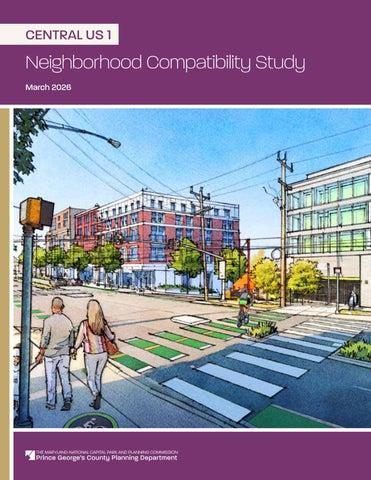
2025 Approved Central US 1 Neighborhood Compatibility Study

Page 1


March 2026

Abstract

Date March 2026

Title Central US 1 – Neighborhood Compatibility Study

Author The Maryland-National Capital Park and Planning Commission

Subject Central US 1 – Neighborhood Compatibility Study

Source of copies The Maryland-National Capital Park and Planning Commission 1616 McCormick Drive

Largo, MD 20774

Series number 108262009

Number of pages 166

The 2025 Approved Central US 1 Neighborhood Compatibility Study envisions North College Park as a more vibrant, walkable, and attractive community where the neighborhood’s unique cultural identity, local economic assets, and natural resources are celebrated. The Study includes recommendations and guidance for further study to address land use, zoning, and development compatibility, to enhance local economic prosperity, to improve multimodal connectivity and safety, to reconcile environmental and flooding concerns, and to celebrate cultural identify and heritage through placemaking.

The Study was formulated over an approximate 12-month period, guided by a robust public engagement effort that included stakeholder meetings, interactive community workshops, a pop-up event, an online survey, a 4-day charrette, and open houses, or town hall-style meetings. The public engagement effort included input from Prince George’s County and City of College Park public agencies, elected officials, SHA, community residents, local businesses, and property owners. The Study describes the community’s vision for North College Park – namely, US 1 (Baltimore Avenue) and the Hollywood Commercial District.

The Maryland-National Capital Park and Planning Commission

Darryl Barnes, Chairman

Officers

William Spencer, Acting Executive Director Gavin Cohen, Secretary-Treasurer

Debra S. Borden, Esq., General Counsel

The Maryland-National Capital Park and Planning Commission (M-NCPPC) is a bicounty agency, created by the General Assembly of Maryland in 1927. The Commission’s geographic authority extends to the great majority of Montgomery and Prince George’s Counties: the Maryland-Washington Regional District (M-NCPPC planning jurisdiction) comprises 1,001 square miles, while the Metropolitan District (parks) comprises 919 square miles, in the two counties.

The Commission has three major functions:

• The preparation, adoption, and, from time to time, amendment or extension of the General Plan for the physical development of the Maryland-Washington Regional District.

• The acquisition, development, operation, and maintenance of a public park system.

• In Prince George’s County only, the operation of the entire county public recreation program.

The Commission operates in each county through a Planning Board appointed by and responsible to the County government. All local plans, recommendations on zoning amendments, administration of subdivision regulations, and general administration of parks are responsibilities of the Planning Boards.

The Prince George’s County Planning Department:

• Our mission is to help preserve, protect and manage the County’s resources by providing the highest quality planning services and growth management guidance and by facilitating effective intergovernmental and citizen involvement through education and technical assistance.

• Our vision is to be a model planning department of responsive and respected staff who provide superior planning and technical services and work cooperatively with decision makers, citizens, and other agencies to continuously improve development quality and the environment and act as a catalyst for positive change

PRINCE GEORGE’S COUNTY PLANNING BOARD
MONTGOMERY COUNTY PLANNING BOARD
Darryl Barnes, Chairman Manuel R. Geraldo, Esq., Vice Chairman
Billy Okoye Brittany Jenkins Lori Matthews
Artie Harris, Chairman Josh Linden, Vice Chair Mitra Pedoeem Shawn Bartley James Hedrick

Prince George’s County

County

The County Council has three main responsibilities in the planning process: setting policy, plan approval, and plan implementation. Applicable policies are incorporated into area plans, functional plans, and the general plan. The Council, after holding a hearing on the plan adopted by the Planning Board, may approve the plan as adopted, approve the plan with amendments based on the public record, or disapprove the plan and return it to the Planning Board for revision. Implementation is primarily through adoption of the annual Capital Improvement Program, the annual Budget, the water and sewer plan, and adoption of zoning map amendments.

COUNCIL MEMBERS

Krystal Oriadha, Chair, 7th District

Jolene Ivey, At-large

Timothy Adams, 4th District

Edward P. Burroughs III, 8th District

Donna J. Brown, Clerk of the Council

Eric C. Olson, Vice Chair, 3rd District

Thomas E. Dernoga, 1st District

Shayla AdamsStafford, 5th District

Sydney J. Harrison, 9th District

Wala Blegay, At-large

Wanika B. Fisher, 2nd District
Danielle Hunter, 6th District

Section

Foreward

The Prince George’s County Planning Board of The Maryland-National Capital Park and Planning Commission is pleased to make the Central US 1— Neighborhood Compatibility Study available in 2025.

This study envisions North College Park, including US 1 (Baltimore Avenue) and the Hollywood Commercial District, as a vibrant, pedestrian- and bike-friendly area where reinvestment in legacy businesses, redevelopment and adaptive reuse of aging properties, and active transportation, streetscape, and placemaking enhancements respect and build upon the economic, transportation, natural, multicultural, and community assets of the neighborhood.

The study includes recommendations for: Land Use, Zoning, and Development; Economic Prosperity; Cultural Identity and Placemaking; Transportation and Mobility; Natural Environment; Housing and Neighborhoods; Community Heritage, Culture, and Design; Healthy Communities; and Public Facilities, specifically tailored to North College Park.

CREDIT: DESIGN COLLECTIVE

SECTION I Blueprint for Tomorrow

Introduction

The Central US 1 Neighborhood Compatibility Study provides recommendations for advancing community-driven goals for the North College Park study area. Goals were informed by a series of stakeholder meetings, community workshops, an online survey, and a 4-day public charrette – all in collaboration with the Prince George’s County Planning Department over a 12-month period. The study will provide recommendations on next steps for M-NCPPC, Prince George’s County, and the City of College Park.

GOALS AND OBJECTIVES

Economics and Development

• Identify economic drivers

• Identify specific uses and investment strategies for the Hollywood Commercial District

Identify strategies to enhance retail and placemaking

• Investigate benefits of the proposed Hollywood Community Center

Planning and Policy

Address development compatibility concerns

Recommend policy and zoning updates to address plan goals

Transportation and Connectivity

Address strategies to address pedestrian safety and traffic conflicts at key intersections

• Develop a network of connected sidewalks and bike lanes

Develop a strategy for streetscape and complete streets infrastructure

Flooding and the Environment

Identify stormwater management techniques and flood mitigation strategies

Community Engagement

Establish and maintain dialogue with residents and commercial property owners

Engage the community and area stakeholders in decision-making

College Park Day 2024

Study Area Boundary, City of College Park Boundary and Neighborhoods

SOURCE: PRINCE GEORGE’S COUNTY PLANNING DEPARTMENT, GIS OPEN DATA

FIGURE 1

Purpose of the Study

Recent and future changes along the US 1 (Baltimore Avenue) corridor, both within the study area and south of the study area, have impacted, and will continue to impact, the surrounding neighborhoods of Cherry Hill, Autoville, Hollywood, Daniels Park, and Oak Springs. Increased traffic congestion, decreased pedestrian and bicycle safety, changes in zoning regulations, and incompatible development and land uses along US 1 are primary concerns. Additionally, the area lacks quality retail, restaurants, and neighborhood services; US 1 has no sense of identity, and some areas are prone to occasional, though isolated, flooding.

Rhode Island Avenue is a north-south corridor, parallel to and 4 to 5 blocks east of US 1, that traverses through area neighborhoods and the Hollywood Commercial District. Visual observations and discussions with tenants in August 2024 suggest there has been modest decline and increased vacancies within The Hollywood Commercial District, a 6-block commercial core along Rhode Island Avenue between Edgewood Road and I-95/495 (the Capital Beltway). Although this decline is eroding the economic vitality of the area, key actions could create a more vibrant commercial core that would better serve the community and enhance the vibrancy of the commercial district.

Study goals and objectives are aimed at reconciling current and future neighborhood impacts and enhancing the quality of life of the community by addressing traffic and intersection safety, pedestrian and bicycle mobility, development, land use and zoning compatibility, local economic prosperity, flooding and stormwater management, and community culture and placemaking. The purpose of the study is to recommend strategies, next steps, and what may need further study to address current and anticipated neighborhood impacts relative to these goals and objectives.

Existing Conditions–The Hollywood Commercial District

North College Park

North College Park is predominantly residential in character and includes several older neighborhoods, dating to the 1920s, with mostly single-family homes along the US 1 (Baltimore Avenue), Autoville Drive, and Rhode Island Avenue corridors between MD 193 (University Boulevard) and the Capital Beltway –the majority of which are east of US 1. The neighborhoods are culturally diverse and safe. The homes are small, well-kept, and affordable, blocks are short and walkable, and the many tree-lined streets of the neighborhood create a shady, pedestrian-friendly environment. There is a strong sense of community in North College Park.

Retail and services along the US 1 corridor and within the Hollywood Commercial District are predominantly auto-centric and provide some, though limited, support for the daily shopping, social, and community needs of the area. Neighborhood amenities, including several playgrounds, parks and recreation facilities, bicycle infrastructure, schools, and churches support a close-knit, family-focused sense of community within the neighborhoods of North College Park. The auto-centric nature of the US 1 (Baltimore Avenue) corridor and the underutilized character of the Hollywood Commercial District are in stark contrast to the community-centric nature of the neighborhoods.

Rhode Island Avenue Bicycle Infrastructure
Exising Neighborhoods
Muscogee Playground

Themes

The Central US 1 Neighborhood Compatibility Study aligns with three guiding themes—Celebrate, Live, and Sustain—underscoring the importance of weighing community identity, quality of life values, and the preservation of unique natural and economic assets when creating land use policy.

CELEBRATE in a diverse, culturally rich community where:

• Community identity is strengthened through events, festivals, public art, and placemaking.

• Legacy businesses and local entrepreneurs offer unique retail, services, and entertainment needs for a multicultural community.

• The new Hollywood Community Center and permanent farmers market support a variety of community activities.

LIVE in a safe, healthy, welcoming neighborhood where:

• Housing for families, seniors, young professionals, and lower- and middle-income households are equally regarded.

• Parks, playgrounds, recreational amenities, schools, and churches are cherished places for neighbors to gather, play, learn, and socialize.

• Trails, sidewalks, marked street crossings, bicycle infrastructure, and wayfinding promote pedestrian safety, connectivity, wellness, and healthy living.

SUSTAIN in a place where local environment, community, and economic assets are respected by:

• Protecting our natural resources, maintaining our valued tree canopy, promoting green building practices, and reconciling flooding and stormwater runoff.

• Improving connectivity and accessibility between important neighborhood assets, destinations, parks, schools, Metro, and the Paint Branch Trail.

• Improving the economic sustainability of communitycentered businesses, retail and services, and enhancing the placemaking character and attractiveness of our commercial areas.

Plan Vision

North College Park will continue to be a vibrant, culturally diverse, family-focused community with a range of affordable housing choices, enhanced multimodal, pedestrian, and bicycle connectivity, and improved retail, neighborhood services, restaurants, and entertainment that celebrates the cultural identity of the neighborhood.

US 1 (Baltimore Avenue) will be an attractive, pedestrian-friendly, tree-lined boulevard with a planted median, widened sidewalks, street-fronting shops and retail, bicycle infrastructure, safe pedestrian intersections, and enhanced signage and placemaking elements. Through preservation of existing legacy businesses, creative adaptive reuse of existing underutilized buildings, and selective new infill, mixed-use development along US 1 (Baltimore Avenue) within the study area will include an organic, authentic, and diverse mix of building types, heights, uses, ages, and architectural character.

The Hollywood Commercial District will be a walkable, attractive, village center and hub of community activity for the neighborhoods of North College Park. The district will celebrate the uniqueness of North Collage Park through enhanced buildings and landscape, neighborhoodserving shops and retail, public art, signage, gateway and placemaking elements, and new places to gather and socialize. The new Hollywood Community Center and permanent farmers market plaza will help transform the Hollywood Shopping Center into a hub of neighborhood activity.

Hollywood Commercial District to front onto and activate Rhode Island Avenue, and to step down in height where adjacent to single-family homes; require incentives (neighborhood benefits) for increased building heights.

ECONOMIC PROSPERITY

• Solidify partnerships, identify targeted business assistance needs, and support streetscape, connectivity, and property beautification enhancements to help small, legacy, and locally owned businesses succeed.

• Promote events, marketing efforts, and improved safety, lighting, and general attractiveness of commercial areas.

CULTURAL IDENTITY AND PLACEMAKING

• Incorporate public art, enhanced sidewalks for outdoor dining, small public spaces for events and social gatherings, street and crosswalk graphics, streetscape enhancements, and gateway identification, branding, and wayfinding within

(Baltimore Avenue), including consolidating driveways and replacing the center turn lane with a permanent and/or planted median. Provide a similar permanent median along Cherry Hill Road to prevent illegal left turns and reduce conflicts at Autoville Drive.

• Enhance pedestrian and bicycle safety along US 1 (Baltimore Avenue) with new, highly visible, and marked crosswalks, bicycle infrastructure, widened sidewalks, and streetscape enhancements similar to what has been completed near the University of Maryland (UMD) campus.

• Improve east-west pedestrian and bicycle connectivity by creating marked and visible connections across US 1 (Baltimore Avenue) at/ along Hollywood Road (linking the Greenbelt Metro pedestrian tunnel to the Paint Branch Trail east of US 1) and at/along Cherokee Street (linking Duvall Field to Autoville Drive).

roadway and streetscape improvements, to install green infrastructure and enhance resiliency in the study area.

• Advocate for Prince George’s County to reestablish funding for essential grant programs to support small- and moderate-scale stormwater management and conservation landscaping projects.

HOUSING AND NEIGHBORHOODS

• Protect existing housing affordability, neighborhood and architectural character, and sense of community within nearby neighborhoods.

• Construct small-scale residential and mixed-use infill projects on key parcels along US 1 and within the Hollywood Commercial District that include affordable and senior housing with first-floor neighborhood-serving retail; discourage largescale student housing.

HEALTHY COMMUNITIES

• Incentivize development to include healthy foods, wellness-focused uses, green construction, and affordable or senior housing.

• Create and/or enhance the trail system, active transportation facilities, community events and programs, and recreational amenities that promote health, wellness, and an active lifestyle.

PUBLIC FACILITIES

• Maintain and enhance existing parks, recreation facilities, and playgrounds within the study area and nearby neighborhoods; improve connectivity and visibility with signage and wayfinding that advances placemaking goals.

• Advance implementation of the proposed Hollywood Community Center together with permanent farmers market location.

• Consider enhanced recreational facilities and offerings at Cherry Hill Road Community Park.

CREDIT: DESIGN COLLECTIVE

SECTION II

Defining the Context

2

Study Area Assets FIGURE

SOURCE: PRINCE GEORGE’S COUNTY PLANNING DEPARTMENT, GIS OPEN DATA PORTAL

Central US-1 Neighborhood Compatibility Study

Study Area Description

The Central US 1 Neighborhood Compatibility Study area encompasses the US 1 corridor, between University Boulevard (MD 193) and the Capital Beltway (I-495). The area is bordered by the Paint Branch to the west, the Cherry Hill Road corridor, College Park Marketplace, and the Capital Beltway to the north, and University Boulevard to the south. The study area also includes the 6-block Hollywood Commercial District along Rhode Island Avenue between Edgewood Road and the Capital Beltway; and the Hollywood Shopping Center between Edgewood Road and Muskogee Street. The study area is mostly within the City of College Park. The areas west of Park Drive and the College Park Marketplace along Cherry Hill Road, including Seven Springs and Knights of Columbus, are not within the city limits.

US 1 (Baltimore Avenue) is the primary north-south corridor connecting the Capital Beltway, Beltsville, and Laurel, to the north, to the University of Maryland campus, and the cities of College Park and Hyattsville to the south. US 1 carries significant traffic, is often congested, and, within the study area, is generally unsafe for pedestrians and cyclists. US 1 south of the study area, between University Boulevard and the University of Maryland campus, has been improved and includes bike lanes, improved sidewalks and intersection crosswalks, and enhanced streetscape with decorative light poles, street trees, and a planted median.

Rhode Island Avenue is a parallel north-south route, east of US 1, that carries significantly less traffic, includes bike lanes and sidewalks, and connects the City of College Park to the Hollywood Commercial District.

The neighborhoods of North College Park are culturally diverse and border the study area to the east and west. The neighborhoods east of US 1, and within the study area, include mostly small, modest, and affordable, but well-maintained single-family homes on quiet, tree-lined streets. Several playgrounds, parks, schools, and churches populate the neighborhoods. The neighborhoods west of US 1, within the study area, border the Paint Branch – a reserved open space that is largely wooded, contains relatively steep slopes, and includes the Paint Branch Trail that connects Cherry Hill Road to the UMD campus.

The study area includes a variety of commercial uses along US 1, several schools and churches, a range of housing types of various heights and scale, several parks, and wooded areas and trails along the Paint Branch –none of which contributes to a strong sense of identity.

Seven Springs Apartment Complex
Neighborhood Character
Hollywood Elementary School
Neighborhood Street
Cherry Hill Neighborhood Park
College Park Marketplace
Mom’s Organic Market - Hollywood Commercial District

Who We Are

North College Park is comprised of several culturally diverse neighborhoods; The Central US 1 Neighborhood Compatibility study area includes Cherry Hill, Autoville, Hollywood, Daniels Park, and Oak Springs.

The marget area encompasses just under

9,400 residents in 3,600 households

40%

of residents 25+ have a bachelor’s degree or higher, compared to 38% countywide.

34,000 residents inhabit the City of College Park in 9,588 households (see Table 1)

CREDIT: M-NCPPC
CREDIT: M-NCPPC
CREDIT: M-NCPPC
CREDIT: M-NCPPC

35%

2.58 household average is

$87,963

Median household income, 16% less than the County median income of $98,760

More than one-third of the market area population in 2024 has Hispanic origins, as compared to 17.5 percent in College Park and 22.6 percent in Prince George’s County persons; two thirds of households average, compared to 2.72 in 2010

3.42 persons and one-third of households live alone.

Area Assets

THE UNIVERSITY OF MARYLAND, COLLEGE PARK

The University of Maryland, College Park (UMD) is a major research university that includes a campus community of approximately 40,000 students and employs approximately 10,000 people. With a focus on research, engineering, innovation, and technology, the UMD campus is a catalyst for economic development, job creation, mixed-use and student housing development (which generates tax base and City of College Park revenue), and drives the need for restaurants, services, and small businesses along the US 1 corridor and within the College Park vicinity. Many of the households within the study area work at the University of Maryland College Park campus. The presence of the University is a primary reason for Plan 2035 designating US 1 as the Innovation Corridor (source: UMD website, Plan 2035, and community survey).

CREDIT: DESIGN COLLECTIVE

CREDIT: DESIGN COLLECTIVE

THE GREENBELT METRO STATION

The Greenbelt Metro Station is less than 1 mile from US 1 (Baltimore Avenue) corridor, and within a 10- to 15-minute walk of the Hollywood Commercial District and nearly 2,500 homes in Hollywood. Although there is no transit parking west of the rail corridor within Hollywood, the intersection of Lackawanna Street and 53rd Avenue serves as an “informal” drop-off location. Improved signage, messaging, and wayfinding, together with existing bicycle infrastructure at the station may help increase transit access, visibility, and use by pedestrians, cyclists, and scooters in North College Park.

THE HOLLYWOOD COMMERCIAL DISTRICT

The Hollywood Commercial District is a compact, 6-block commercial and shopping district in the Hollywood neighborhood along Rhode Island Avenue. The district also includes the Hollywood Shopping Center, home to MOM’s Organic Market, a few small restaurants, an urgent care facility, Proteus Bicycles, the future location of the new Hollywood Community Center, and the current site that supports the Hollywood Farmers Market. The majority of the 6-block district, between Edgewood Road and the Capital Beltway, includes auto-centric businesses, services, the College Park Youth and Family Center, and a gas station. Although the Hollywood Commercial District suffers from underutilization, limited retail, restaurants, and businesses, and includes several vacant and unkempt properties and buildings, it has the potential to be an attractive, walkable, shopping village and neighborhood asset.

ALL PHOTOS CREDIT: DESIGN COLLECTIVE
Rhode Island Avenue Recent Sidewalk Improvement
Bus Stop Hollywood Square
Hollywood Shopping Center

THE PAINT BRANCH TRAIL AND NATURAL RESERVE

The Paint Branch Trail is a 4-mile long paved, shared use trail that traverses through reserved open space along the Paint Branch creek, and through heavily wooded areas west of and parallel to US 1. This reserved open space is mostly wooded, wetlands, floodplain and steep slopes and is a valuable natural asset to the community. The trail connects North College Park and the Cherry Hill Community Park to the Paint Branch Golf Course and to the UMD campus and Lake Artemesia. The trail has limited access points from the study area. Improved signage and connectivity along Baltimore Avenue and Autoville Drive may increase access to and usage of the trail by residents of and visitors to the study area and North College Park.

Paint Branch Trail At Cherry Hill Road
CREDIT: DESIGN COLLECTIVE

Planning Background

PLAN 2035 AND THE INNOVATION CORRIDOR

The 2035 General Plan calls for, among other goals within College Park and along US 1 (Baltimore Avenue): 1) the creation of Regional Transit Districts at the College Park/UMD and Greenbelt Metro stations; 2) the expansion of an “economic submarket” of existing targeted industry clusters supported by the University; 3) new significant multifamily development to support employment generated by industry clusters; and 4) the designation of the College Park and UMD campus area and along US 1 (Baltimore Avenue) as part of the County’s Innovation Corridor.

As the Innovation Corridor, the area is well-positioned to capitalize on the synergies that derive from businesses and job growth, research institutions, incubators, and innovation located in close proximity to one another, near the University, and on existing and planned transportation routes, such as the Purple Line. Plan 2035 recommends focused funding, programmatic support, and coordination with Prince George’s County Economic Development Corporation (EDC), the University of Maryland, and the City of College Park, among other partners, for the Innovation Corridor. This may include tax incentives, targeted infrastructure improvements, multi-modal enhancements, improved amenities, and enhanced access to public transportation.

Plan 2035 does not recommend specific land uses or building heights or indicate the extent to which a Regional Transit District, the Innovation Corridor, or new multifamily development should extend north along US 1 and within North College Park or the study area.

THE 2010 APPROVED CENTRAL US 1 CORRIDOR SECTOR PLAN

2010 Sector Plan goals for the area are to:

1. encourage pedestrian- and bicycle-friendly, transit-oriented, vertical mixed-use development along the US 1 (Baltimore Avenue) corridor;

2. increase residential density to support new commercial and mixed-use development;

3. preserve the natural environment and park system;

4. expand the green infrastructure network; and

5. create new innovative mixed-use zoning.

The Sector Plan vision recommends the US 1 corridor as a connection of memorable places rather than a commercial strip corridor. Higher-intensity, compact, and walkable nodes, spaced about a half-mile to one mile apart along the corridor, should be connected by lower-intensity development of a more residential character in between. Within the study area, the Sector Plan recommends a walkable node at, roughly, the intersection of US 1 and Cherokee Street.

The Sector Plan suggests mixed-use commercial and mixed-use residential along the corridor and within the study area, transitioning to Residential Medium and High (See Figure 5). The Sector Plan suggests building heights for properties fronting US 1, generally, up to 6 stories at “walkable nodes” closer to MD 193 (University Boulevard) near the US 1 and Cherokee Street intersection, up to 4 stories for “corridor infill” elsewhere along US 1 (north of Erie Street) and at the Hollywood Commercial District, and up to 3 stories along Autoville Drive South. (See Figure 6) The Paint Branch corridor is designated Parks and Open Space.

CONFORMANCE TO THE PRINCE GEORGE’S COUNTY ZONING ORDINANCE

The Zoning Ordinance (Subtitle 27: Zoning Ordinance) supports the land use, economic development, and mixed-use development goals of Plan 2035 and the 2010 Approved Central US 1 Corridor Sector Plan. New zone categories call for development investment near transit, along existing commercial corridors, and at key nodes and activity centers, while limiting development where infrastructure and transit do not exist. The study area includes such new zone categories as Local Transit-Oriented (LTO) Zone (Edge) at the Cherokee Street walkable node intersection, Neighborhood Activity Center Zone (NAC) along and fronting the US 1 corridor north of Erie Street, Commercial, General, and Office (CGO) Zone at the Hollywood Commercial District, and Residential, Multifamily-48 (RMF-48) for Seven Springs (the multifamily complex at 9310 Cherry Hill Road) and adjacent to existing single-family neighborhoods. These zone categories support land use and mixed-use development goals.

Permitted Uses: The LTOe, NAC, and CGO Zones permit multifamily housing, student housing, livework, senior, two-family, and townhouse dwellings, office, commercial, retail, and restaurants, among other uses. The RMF-48 Zone permits multifamily housing, student housing, live-work and senior dwellings, office, commercial, retail, and restaurants, among other uses, but does not allow two-family or townhouse dwellings.

Density: Council Bill 15 (CB15), adopted in 2024, increases allowable density in the LTOe Zone from 40 to 120 dwelling units per acre and in the NAC Zone from 30 to 90 dwelling units per acre. These densities are consistent with the goals of the 2010 Sector Plan and Plan 2035. The CGO and RMF-48 Zones both allow 48 dwelling units per acre. These zones may result in development intensities that are less than what is called for in the Sector Plan and Plan 2035 and recommended as part of this study. Seven Springs, which includes buildings with portions that are 10-12 stories, is zoned RMF-48.

Building Heights: Maximum allowable building heights in the LTOe Zone were increased from 70 to 80 feet (typically 7 stories for multifamily mixed-use buildings) and heights in the NAC Zone were increased from 50 to 60 feet (typically 5 stories) as part of CB15. These heights are consistent with the 2010 Sector Plan and Plan 2035. Maximum allowable building heights in the CGO Zone are 86 feet (7-8 stories for multifamily mixed-use buildings) and 110 feet (7-8 stories) for office buildings (which have taller floor-to-floor heights). Maximum allowable building heights in the RMF-48 Zone are 110 feet (9 to 10 stories). The allowed building heights for Seven Springs (the multifamily complex at 9310 Cherry Hill Road) (RMF-48) and for the Hollywood Commercial District (CGO) exceed the 2010 Sector Plan recommended heights of 2 to 4 stories; however, Seven Springs currently includes buildings with portions that are 10 to 12 stories. Allowable building heights for future residential development will also be subject to and impacted by Neighborhood Compatibility Standards.

NEIGHBORHOOD COMPATIBILITY STANDARDS

The Zoning Ordinance includes Neighborhood Compatibility Standards to ensure proper transition and compatibility between existing single-family neighborhoods and new, more intense land uses. These standards include building height restrictions based upon the proposed building’s setback from existing dwellings and/or stepped heights, depending upon the new building’s distance from existing homes (these measurements are not from the property line). The regulations apply to any new development proposed on properties fronting US 1 and within the Hollywood Commercial District, where such properties are adjacent to single-family homes.

The Neighborhood Compatibility Standards also require new buildings over three stories to be broken up into modules or wings, with the smaller and shorter portions of the structure located adjacent to existing

homes. Although this intent is to ensure a new building’s height, scale, and massing is compatible with adjacent existing homes, the language in the regulations is subjective. Further, there are no dimensional criteria that prescribe required massing for modules or wings, façade articulation, building recesses or projections, stepping of heights, or similar. The lack of clarity may result in a new building’s massing that is not compatible with adjacent homes.

PRINCE GEORGE’S PRELIMINARY FUNCTIONAL MASTER PLAN FOR TRANSPORTATION

In February 2025, the M-NCPPC Prince George’s County Planning Department issued Go Prince George’s, a new preliminary functional master plan for transportation facilities in the County. Once approved, Go Prince George’s will replace the 2009 Approved Countywide Master Plan of Transportation. The preliminary plan includes updated transportation policies and strategies to implement Plan 2035, with an emphasis on promoting multimodal transportation options that facilitate the County’s visions for 15-minute communities, equitable transportation outcomes, and sustainability. To that end, Go Prince George’s highlights a variety of strategies to improve active transportation safety and connectivity, leverage the County’s premier transit and trail assets, and invest in Complete and Green Streets.

Approved Future Land Use - 2010 Sector Plan

SOURCE: APPROVED 2010 CENTRAL US 1 CORRIDOR SECTOR PLAN

Recommended Building Heights - 2010 Sector Plan FIGURE

Community & Stakeholder Engagement

The Central US 1 Neighborhood Compatibility Study included robust engagement with residents and businesses of North College Park, government stakeholders of Prince George’s County, M-NCPPC, the City of College Park, and elected officials of Prince George’s County and the City of College Park. Engagement activities included:

• Site visit with M-NCPPC and consultants: May 16, 2024

• Stakeholder Interviews

• An online survey: August 14th, 2024, through Nov. 30th

• Community meeting 1: September 17th, 2024

• Community meeting 2: September 19th, 2024

• College Park Day Pop-Up Event: October 5th, 2024

• Business and property owner interviews

• Four-day Charrette: October 23-26, 2024

• Post-Charrette community meeting: December 11th, 2024

• Community Open House: April 3rd, 2025

All community events included spanish translation services.

STAKEHOLDER INTERVIEWS

The consultant team, in collaboration with M-NCPPC, conducted stakeholder interviews with DPW&T, SHA, the City of College Park, Prince George’s County District 1 Councilmember Thomas E. Dernoga, City of College Park City Council members, the Prince George’s County Economic Development Corporation (PGCEDC), the Revenue Authority of Prince George’s County (RAPGC), and the Prince George’s County Redevelopment Authority (PGCRDA).

A series of questions and topic-based discussions, tailored to each stakeholder’s area of expertise, enabled the team to gather existing conditions information, understand agency and stakeholder plans, goals, available resources, and perspectives for the study area, refine the project’s goals, and secure feasible results.

BILINGUAL SURVEY

On August 15th, M-NCPPC launched a bilingual survey. The survey remained accessible for two months during which a total of 104 responses from the community were collected. The purposes of the survey were to provide an additional opportunity for stakeholder input, to engage with residents unable to attend in-person events, and to understand priority concerns, opportunities, and preferences. Survey questions were focused on the following key themes:

• Demographic and household makeup

• Traffic and transportation

• Environmental concerns

• Pedestrian and bicycle safety

• Zoning and development compatibility

• Neighborhoods and commercial character

CREDIT: DESIGN COLLECTIVE
College Park Day 2024
Community Charette
PHOTO: M-NCPPC

QUESTION 7: Which areas of the map, or intersections, have the greatest pedestrian or bicycle connectivity or safety concerns? Select all that apply. 104 respondents.

I don’t know.

Along Cherry Hill Road. 62 At the Baltimore Avenue and Edgewood/Beltway ramp intersection. 60 At the Baltimore Avenue, Cherry Hill, BP Gas Station intersection. 59 Along all of Baltimore Avenue.

Along Baltimore Avenue, but mostly in the southern portion of the Study Area.

Around the Hollywood Commercial District.

Along Rhode Island Avenue.

QUESTION 13: Of the areas you identified as having the greatest flooding or stormwater issues, how frequently do they occur? Select one. 102 respondents.

QUESTION 15: What are your greatest concerns regarding development compatibility? Select up to three. 103 respondents.

9 None of the above.

32 Building heights are too tall when backing up to, or adjacent to existing homes.

19 Setbacks, buffers, and/or fences are inadequate where adjacent to homes.

40 The general scale and mass of a building backing up to, or adjacent to existing homes, is not compatible.

30 Architectural character and design quality is not of a high standard.

35 Noise or lights are a major impact, especially at night.

71 Traffic or parking impacts on the neighborhood.

QUESTION 18: What would you like to see more of in the Study Area? Select up to three. 102 respondents.

34 Neighborhood serving businesses like convenience stores, salons, dry cleaners, and household goods.

28 Healthy food and unique or ethnic grocery options.

67 Food and drink establishments, restaurants, bars, cafes, arts and entertainment places.

27 Healthcare, wellness, fitness, childcare, and medical businesses.

57 Outdoor public space for community gatherings and festivals, playgrounds, courts, ballfields or active recreation, and/ormarkets and events.

62 Leisure or natural space, trails, community gardens, sitting

and natural environmental features or rain gardens.

COMMUNITY WORKSHOPS

On September 17th and 19th, 2024, the consultant team and the M-NCPPC held two community workshops to share the consultant team’s existing conditions analyses, collect input regarding current conditions and challenges from the community’s perspective, and solicit input regarding opportunities and priorities for the study area. The workshops included topic-based stations with boards, photographs, and maps. Attendees were invited to markup maps, evaluate precedent images and best practices, and provide input with sticky notes. The information gathered during these meetings proved crucial to advancing the project.

COLLEGE PARK DAY

The M-NCPPC and the consultant team participated in College Park Day on October 5th, 2024. The purpose was to replicate workshop activities during a “pop-up” event and solicit input from the community regarding concerns, goals, objectives, opportunities, and priorities. Approximately 250 individuals visited the project booth, marking up base maps, adding sticky notes, and evaluating precedent images and best practices, thereby enabling consultants to gather essential information.

ALL PHOTOS CREDIT: DESIGN COLLECTIVE
College Park Day 2024 Community Charette

FOUR-DAY CHARRETTE

From October 23rd to 26th, 2024, the consultant team, in collaboration with M-NCPPC, facilitated a four-day charrette at the Chinese Bible Church of College Park, 9618 Autoville Drive. During this event, participants were able to work hand-in-hand with the consultant team in developing plans and preliminary draft recommendations to address study goals. Illustrative plans, diagrams, sketches, street sections, and before-and-after artist renderings paired with preferred precedent images were completed during the charrette to help convey the community’s vision for a more vibrant, pedestrian- and bicycle-friendly area that celebrates North College Park’s unique cultural heritage.

CREDIT: DESIGN COLLECTIVE

US 1 (Baltmore Avenue) Charrette Sketches and Artist Renderings

COMMUNITY OPEN HOUSE

On April 3, 2025, the M-NCPPC, in collaboration with the consultant team, hosted a Community Open House to present draft recommendations for the study area and solicit the community’s final thoughts. Generally, the community expressed enthusiastic support for the recommendations.

Community Engagement Key Takeaways

The following summary reflects feedback received from the community through various workshops and meetings with key stakeholders, partner agencies, and elected officials. All community meetings and materials were made available in both English and Spanish.

Zoning and Development

US 1 (BALTIMORE AVENUE)

• Some support for taller buildings, mixed-use, affordable housing, and medical office

• Limited or no support for more student housing

• Building heights should step down adjacent to existing homes

• Support for adaptive reuse and repurposing of existing buildings

• Support for retail, small local businesses, restaurants, and neighborhood-focused services

• Some advocacy for lower height buildings, especially along the east side of US 1

• Concern about environmental and compatibility impacts of potential development adjacent to existing homes, particularly along Autoville Road (PBP North and South)

HOLLYWOOD COMMERCIAL DISTRICT

• General support for two- to four-story buildings, mixed-use, and affordable housing

• Some support for five- to six-story buildings, particularly to the north and closer to Rhode Island Avenue

• Some limited support for seven-story buildings

• Support for beautification, repurposing existing buildings, façade and storefront improvements, streetscape and placemaking enhancements, improved retail and restaurants, and support for retaining and encouraging small local businesses

• Support for making the District more walkable and attractive

• Building heights should step down adjacent to existing homes

Economic Prosperity

US 1 (BALTIMORE AVENUE)

• Small commercial properties along the US 1 (Baltimore Avenue) corridor will be challenging to redevelop; uses will likely remain or be repurposed

• The auto-dealership cluster will likely remain long-term

• The likely scenario is an organic mix of new, but very limited, large-scale infill multifamily and mixed-use development, and small-scale redevelopment or repurposing of existing buildings over time (shops, brewery, eateries may replace auto services, for example)

HOLLYWOOD COMMERCIAL DISTRICT

• There are vacancies, unkempt properties, and a lack of a “cohesive identity”

• Streetscape, placemaking, and branding, façade improvements, and programming (events) could be a catalyst for positive change

• Redevelopment, including mixed-use buildings of an appropriate height, could create a more viable, attractive, and walkable district

Transportation and Mobility

• The Edgewood Road and Cherry Hill Road intersections along US 1 (Baltimore Avenue) are crash hotspots and pose congestion and safety problems

• There are very few crosswalks across US 1 (Baltimore Avenue)

• Safe pedestrian and bicycle connections to/from the Greenbelt Metro Station, the Paint Branch Trail, Cherry Hill Road Park, Community Gardens, and other destinations are limited

• Improve pedestrian and bicycle safety everywhere

Placemaking and Streetscape

• Support for improving neighborhood identity, branding, and sense of place, especially for the Hollywood Commercial District

• Consider public art, signage, and wayfinding, and enhanced bus stops

• Consider outdoor event spaces to support gatherings, festivals, farmers markets, and cultural events

• Support for enhanced streetscapes, painted crosswalks, sidewalks with outdoor dining, and more welcoming retail frontages and storefronts

• Support for continuing the US 1 streetscape similar near the campus with a center median, bike lanes, light poles, and crosswalks

Natural Environment

• Large portions of the study area, along the Paint Branch, west of US 1 (Baltimore Avenue), are zoned Reserved Open Space and cannot be developed

• Desire to preserve the neighborhood’s tree canopy

• Major concerns regarding flooding along Kiernan Road, Park Drive, and behind Seven Springs

• Some concerns regarding flooding of properties that back to the Paint Branch and along Narragansett Parkway

• Desire to enhance the Paint Branch as a preserve

Public Facilities

• Formula 2040, the County’s long-range recreation plan, has identified a deficit of recreation facilities within Service Area 2. Our study area is within Area 2. Several recreation facilities have been completed and/or are planned to address this need

• Support for children’s play areas, small parks, indoor recreation facilities, trails, community gardens, and outdoor recreation

• Support for the planned Community Center at Hollywood Shopping Center

Major Opportunities and Challenges

During development of this plan, the project team conducted a comprehensive analysis of existing conditions and identified major opportunities and challenges.

Land Use

OPPORTUNITIES

• Small, existing, and/or vacant or underutilized buildings, such as auto repair and tire shops, the Piano Super Store, and the Maryland Department of Labor building, are opportunities for adaptive reuse as restaurants, breweries, and neighborhood-serving retail.

• Small, shallow NAC properties along US 1 (Baltimore Avenue) offer potential for small, infill senior and affordable housing.

• The six-block Hollywood Commercial District is an opportunity for longer-term redevelopment as a walkable, mixed-use, neighborhood village.

CHALLENGES

• Small NAC-zoned properties along US 1 will be challenging to redevelop with intense, commercial, office, and research-focused development as envisioned by the Innovation Corridor designation.

• These same small properties are not likely large enough to accommodate student housing, nor is student housing supported by the community.

Economic Prosperity

OPPORTUNITIES

• Revitalize US 1 (Baltimore Avenue), focusing enhancements on encouraging economic growth while prioritizing the safety of residents and visitors alike. Enhance the welcoming atmosphere in the Hollywood Commercial District by providing assistance to legacy and destination businesses to upgrade their facilities.

CHALLENGES

• Vacant commercial spaces and underutilized lots and buildings deter private investment. Customer shopping experience is hampered by security concerns, insufficient lighting, and parking in specific locations.

• Small businesses and property owners may not have the resources needed for façade improvements, attracting tenants, joint marketing.

Cultural Identity and Placemaking

OPPORTUNITIES

• Both the US 1 corridor and the Hollywood Commercial district offer opportunities to include signage, wayfinding, public art, gateway elements, and street/sidewalk/crosswalk graphics within the public realm that celebrate the community’s multicultural identity.

• Public spaces, small green spaces, plazas, and underutilized parking lots can support community events and festivals while creating identity for walkable nodes.

CHALLENGES

• Lack of a business organization or lead entity along both US 1 (Baltimore Avenue) and in the Hollywood Commercial District complicates efforts to sponsor joint community activities.

Transportation and Mobility

OPPORTUNITIES

• Partner agencies with jurisdiction over key roadway corridors in the study area, including MDOT SHA and Prince George’s County DPW&T, have indicated that their ongoing planning and preliminary design for those corridors align with the recommendations identified through this study.

• The study area and vicinity already boast valuable regional mobility assets, the Paint Branch Trail, Rhode Island Avenue Trolley Trail, and Greenbelt Metrorail Station, that can serve as the spine of a robust alternative transportation network.

CHALLENGES

• Substantially improving multimodal safety and connectivity in the study area may require one or more large capital projects with high levels of design complexity, high costs, and relatively long timeframes for design and implementation.

• The existing curb-to-curb footprint of Baltimore Avenue is relatively constrained; as such, Complete Streets treatments on the corridor may require right-of-way acquisition.

Natural Environment

OPPORTUNITIES

• The study area has multiple prized natural amenities, including the Paint Branch stream valley and a mature urban tree canopy, that should be preserved and celebrated as an essential contributor to the area’s quality of life.

• Roadway, streetscape, and redevelopment projects offer an opportunity to substantially increase the area’s green infrastructure and support the City of College Park’s efforts to promote Green Streets.

CHALLENGES

• The area experiences localized flooding, particularly in the western portion of the Cherry Hill neighborhood and along Narragansett Parkway behind Hollywood Shopping Center, during heavy storm events.

• With nearly a third of the study area comprised of impervious surfaces, stormwater runoff creates challenges with flooding and water quality.

Housing and Neighborhoods

OPPORTUNITIES

• Naturally occurring affordable housing exists within the study area and should be preserved.

• Aging NAC, CGO, and RMF-48-zoned properties along US 1, at Seven Springs, and within the Hollywood Commercial District can be redeveloped or renovated to advance affordable and senior housing goals.

• Improved placemaking elements and aesthetics can celebrate and help stabilize area neighborhoods.

CHALLENGES

• Small properties have limited development capacity, making it difficult to advance housing goals. Fractured ownership of multiple small parcels constrains assemblage of opportunity sites and scale of future development.

Community Heritage, Culture and Design

OPPORTUNITIES

• Streetscape enhancements along US 1, consistent with recently constructed streetscape south of the study area, create an opportunity to extend the urban design character north to the Capital Beltway while incorporating design elements that help foster a sense of identity.

• Façade, building signage, and storefront designs, for either new construction or adaptive reuse, frequently contribute to a design identity that celebrates the community’s heritage.

CHALLENGES

• These efforts will require close coordination among the SHA, DPW&T, City of College Park, and existing businesses. Finding the resources needed will be challenging.

Healthy Communities

OPPORTUNITIES

• Expand and create a more visible and functional pedestrian and bicycle network

• Help building owners attract restaurant, food, fitness, and medical office tenants that better serve the community’s needs and advance health and wellness goals

Public Facilities

OPPORTUNITIES

• The study area’s many parks, playgrounds, and neighborhood greens meet the community’s recreational needs and offer an opportunity for further enhancement to expand recreational offerings

• The existing open space along US 1 in front of Plaza GrandMarc could be a small public, activated space, providing identity along the corridor and a catalyst for redevelopment or adaptive reuse of adjacent, underutilized properties.

CREDIT: DESIGN COLLECTIVE

Scenario Planning

As part of the Study, several properties were studied and evaluated for their ability to accommodate meaningful development or adaptive reuse to achieve plan goals. Community feedback as part of the scenario planning exercises during the charrette, October 23 to 26, informed strategies for three key properties and nodes. Community feedback during the charrette, as well as feedback from two subsequent community open houses, December 2024 and April 2025, informed refinement and support for these scenarios.

NORTH COLLEGE PARK GATEWAY: US 1 BETWEEN EDGEWOOD ROAD AND CHERRY HILL ROAD

Several small properties under single ownership could accommodate an approximate 100–120 unit residential, affordable, or senior housing development. Such an approach for this NAC-zoned property would enable the elimination of several curb cuts and driveways, the relocation of parking to the back and tucked under the building, and the extension of the sidewalk and streetscape. An attractive, affordable, or senior housing building will immediately create a pedestrian-focused character at this important gateway location, while providing a needed presence for the recently completed Hollywood Gateway Park.

North College Park Gateway Concept Plan
Figure 5. North College Park Gateway Concept Plan

THE HOLLYWOOD COMMERCIAL DISTRICT

This six-block commercial district along Rhode Island Avenue includes six underutilized one- to two-acre properties; three on each side of Rhode Island Avenue between Edgewood Road and Ontario Road (abutting the Capital Beltway). Currently zoned CGO, the onestory buildings and are mostly covered with asphalt parking. The district includes no community open space or gathering places, no coherent or consistent design characteristics, and provides limited value to the neighborhood. The community identified some tenants as great community assets.

In the short term, the Hollywood Commercial District would benefit from placemaking initiatives, façade improvements, landscape, signage and wayfinding, and joint marketing strategies to improve its attractiveness, leasing success, and tenant offerings. In the longer term, these six properties could be

redeveloped in phases to include needed affordable or senior housing, medical or office uses, and first-floor retail, restaurants, entertainment, and neighborhood services that front onto and activate Rhode Island Avenue. Rhode Island Avenue could be transformed into a more walkable, village main street and, this six-block district, could be better connected to the Hollywood Shopping Center. Redevelopment could potentially accommodate 600 to 1,200 new residential units in 6 to 8 new buildings, with 30,000 to 60,000 square feet of first-floor retail, restaurants, and services, depending upon which properties remain and which are redeveloped. Redevelopment should retain existing legacy businesses. None of the properties are large enough to accommodate more than approximately 80 to 150 units in four- to six-story buildings.

Figure 6. Hollywood Commercial District Short-Term Beautification Plan
Figure 7. Hollywood Commercial District Long-Term Vision Plan
Hollywood Commercial District: Long-Term Vision Plan
Hollywood Commercial District: Short-Term Beautification
Hollywood Commercial District: Existing Rhode Island Avenue: Existing
Rhode Island Avenue & Hollywood Commercial District: Long-Term Vision

Hollywood Commercial District: streetscape, placemaking, and development character examples, selected by the community, convey a sense of place and vision for the hollywood commercial district.

1. Hyattsville, MD
2. The Metropolitan; Columbia, MD
3. Hyatsville, MD
4. Hamilton-Lauraville Main Street; Baltimore, MD; source: Graham Projects
5. Rotunda; Baltimore, MD
6. College Park, MD
7. Damascus, MD
8. Rockville Center, MD
9. Whitlock Street, Baltimore, source: Graham Projects
10. Pike and Rose, MD 11. Bethesda, MD

HOLLYWOOD PLACE: US 1 BETWEEN HOLLYWOOD ROAD, THE PIANO SUPERSTORE, AND PLAZA GRANDMARC, AND THE RECENTLY SOLD RV MARINE CENTER EAST OF US 1

Three primary properties within this area and on the west side of US 1 could accommodate both new mixed-use development and adaptive reuse to create a node of activity at the center of the study area along US 1 at the Hollywood Road intersection. Initially, the current open space owned by Plaza GrandMarc could be improved as a community green, accommodating outdoor dining, small community events, food truck festivals, and other similar uses. The Paint Branch Trail (and trailhead) begins at Autoville Drive and could be extended to US 1 and through this node. Placemaking elements, such as public art, signage and wayfinding, furniture, sidewalk graphics, and streetscape enhancements, could be incorporated in a way that celebrates the unique cultural identity of North College Park.

The Piano Superstore is a tremendous opportunity for adaptive reuse as a mixed-use building with restaurants, a brewery, retail, office and/or neighborhood services that face onto and activate the

community green. The property to the north, including existing auto services buildings, could be redeveloped as a later phase to include an approximate 100 to 120 unit affordable, senior, or market-rate residential building – first floor retail could front and help activate both US 1 and the community green. Longer term, although the current property owner has no plans for future redevelopment, the RV property east of US 1 could accommodate a large, 250- to 350- unit residential building with first floor retail activating US 1.

Together, the improved community green, the redevelopment and adaptive reuse of these three adjoining properties, the existing presence of Plaza GrandMarc and the extension of the Paint Branch Trail from Autoville Drive to Baltimore Avenue would create a vibrant, identifiable node near the Hollowood Road intersection and Paint Branch trailhead.

The Metropolitan; Columbia, MD
Figure 8. Hollywood Node: Placemaking and Development Character Examples
Rotunda; Baltimore, MD

SECTION III

Land Use, Zoning, and Development Activity

Goal

North College Park will continue to be a vibrant and desirable place to live, play, learn, and work, anchored by the transformation of US 1 (Baltimore Avenue) into an attractive, treelined boulevard with identifiable walkable nodes and street-fronting shops, restaurants, and small-scale mixed-use residential buildings. The Hollywood Commercial District has the potential to be transformed into a walkable, attractive, shopping district, and center of community activity with neighborhood serving retail, restaurants, housing, and services.

Existing Conditions

Existing Land Use

US 1 (BALTIMORE AVENUE):

Existing land uses along the corridor are diverse and scattered. There are three large student housing buildings, two large auto dealerships, and numerous, miscellaneous commercial establishments, including destination restaurants like Azteca and auto-services businesses fronting US 1. Three hotels, an IHOP, and a gas station are located between Hollywood Road and the Cherry Hill Road intersection. College Park Marketplace (a grocery, Ross-Dress for Less, and Home Depot-anchored shopping center) and Seven Springs (a large complex with both mid- and high-rise apartments) are accessed from Cherry Hill Road. Small single-family homes, the Chinese Bible Church, and several acres of undeveloped NAC property are located west of US 1 and along Autoville Drive.

All the uses are mostly auto-centric with no discernible clusters of related commercial uses along US 1 (Baltimore Avenue) that would inform a broader land use strategy.

ALL PHOTOS CREDIT: DESIGN COLLECTIVE
US 1 (Baltimore Avenue) – Retail

HOLLYWOOD COMMERCIAL DISTRICT:

Existing land uses at the Hollywood Commercial District include the MOM’s-anchored Hollywood Shopping Center just south of Edgewood Road and, north of Edgewood Road along Rhode Island Avenue, a 6-block area of small properties with a mix of commercial uses. Shopping center tenants include Proteus Bicycles, an urgent care, and a number of retail and restaurant establishments. The 6-block commercial district north of Edgewood Road includes six separate commercial properties, including a few well-known and community supported anchor tenants. Other uses include service businesses, restaurants, a thrift store, a convenience store, a gas station, and health and wellness establishments –many catering to the nearby Hispanic population. There are some vacant buildings and properties.

The uses along the corridor are diverse, and many legacy and older businesses serve the local community. To further support community character, an increased focus is needed on property (buildings and property) maintenance. The revitalization and land use strategy should add additional complementary uses and/ or housing and improve the overall attractiveness, walkability, and connectedness of the district as a whole.

Uses surrounding the Hollywood Commercial District are mostly single-family homes on small lots. The surrounding neighborhoods include several churches, schools, parks, and playgrounds.

US 1 (Baltimore Avenue)
Rhode Island Avenue And The Hollywood Commercial District – Retail
Surrounding Neighborhoods Include Mostly Single-Family

FIGURE 9

Existing Conditions Land Use

SOURCE: ESRI 2024

Existing Zoning

Approximately 30 percent of the land within the study area is zoned NAC; primarily along and fronting US 1 but also including College Park Marketplace and several large undeveloped parcels along and west of Autoville Drive. Properties near the US 1 and Cherokee Street intersection, in the southern part of the study area, are zoned LTOe.

Table 1. Existing zoning regulations

The Hollywood Commercial District is zoned CGO and Seven Springs, in the northwest area of the study area along Cherry Hill Road, is zoned RMF-48. Small portions of the study area, one block east and west of US 1, are zoned RSF-65 and include existing homes on 6,500 +/- square foot lots. The remainder, approximately 25 percent of the study area, is zoned ROS, Reserved Open Space, which does not permit development.

SOURCE: ZONING ORDINANCE

Notes:

• M/U = mixed-use (multifamily, office, grocery, and/or retail/restaurant, service commercial, student housing, and other)

• MF = Multifamily Housing

• TH’s = Townhouses

• P = permitted use

• X = not permitted

• du/ac = number of dwelling units per acre

One of the goals of this study is to evaluate the appropriateness of current zoning relative to Plan 2035, the 2010 Sector Plan, existing conditions, and community feedback regarding development compatibility. Based upon these collective considerations:

• Maximum allowable building heights in the Hollywood Commercial District (CGO) may be greater than what may be appropriate to achieve plan goals and vision.

• Incentives should be considered for new development that meets the goals of the plan.

• Maximum allowable density for the Hollywood Commercial District (CGO) and for Seven Springs (RMF-48) may be less than what is needed to achieve plan goals.

• Maximum allowable building heights and density for a few of the large parcels along Autoville Drive (NAC) that border existing single-family neighborhoods and/or the Paint Branch may be greater than what may be appropriate for plan goals.

Existing Conditions Zoning Map

SOURCE: PRINCE GEORGE’S COUNTY PLANNING DEPARTMENT, GIS OPEN DATA PORTAL

Neighborhood Compatibility Standards

Section 27-61200 of the Zoning Ordinance includes Neighborhood Compatibility Standards. The purpose of these standards is to ensure height, massing, and scale of new, intense forms of development are compatible with adjacent, existing single-family homes. More specifically, the standards require setbacks, stepping of buildings, and for buildings to be “…broken up into modules or wings with the smaller portions located adjacent to single-family dwellings” (2761203(a)(3)). However, community feedback learned from this study, together with observations of recently built projects along Autoville Drive, suggests construction of large, mixed-use, and multifamily buildings on LTOe and NAC properties along US 1 and that border existing one- and two-story single-family homes have created and may continue to create undesirable and unintended impacts due in part to the subjective language of these standards.

Additionally, community feedback suggests support for the future transformation of the Hollywood Commercial District into a more attractive, walkable, and connected multi-block shopping district with mixed-use buildings that add vibrancy, economic value, desired uses, and placemaking characteristics to the neighborhoods of North College Park. Currently, the limit of three- and four-story heights within 50 to 200-foot transitional areas within these CGO-zoned properties may limit the ability to achieve plan goals.

One of the goals of this study is to recommend updates to these standards based upon an evaluation of the standards, observations of built projects, community feedback, and this study’s land use and development goals. Further study should be conducted to consider the following:

• Required setbacks and landscape buffers should be consistent with landscape buffer yard standards as prescribed in the Landscape Manual.

• Setbacks and stepping of building heights should be adjusted to address development compatibility goals and this study’s land use goals – especially for the Hollywood Commercial District’s CGO-zoned properties where the current standards may compromise plan goals.

• Dimensional criteria should be included, together with more precise language, to ensure clarity for both developer applicants and reviewers regarding intent and execution of a new building’s massing.

Table 2. Existing Conditions Setbacks Heights in Transitional Areas

Table 27-61203(a)(2): Maximum Height in Transitional Areas

Distance from SingleFamily Dwelling, TwoFamily Dwelling,or Vacant Land in a Single-Family Zone (1)

STUDY AREA DEVELOPMENT

PAINT BRANCH PRESERVE NORTH:

Paint Branch Preserve North is located at the intersection of Cherry Hill Road and Autoville Drive and backs up to Kiernan Road. Several properties combine between, roughly, 9624 and 9700 Autoville Drive. The proposed 131-unit townhouse development is on hold at the time of publication. The pending development includes several properties that are, collectively, 9.6 acres and zoned NAC.

AUTOVILLE RESIDENCES: Autoville Residences is located at 9621 Autoville Road. The ½-acre property has been approved for eight units, including four stacked townhouses.

PAINT BRANCH PRESERVE SOUTH:

Paint Branch Preserve South is located off Autoville Drive between Plaza Grandmarc and the Paint Branch. Several properties combine between, roughly, 9606 Autoville Drive and 4300 Peru Road. Referred to as the Michael Property, the proposed 97-unit townhouse development is on hold at the time of publication. The pending development is 13.2 acres and is zoned NAC.

HOLLYWOOD COMMUNITY CENTER:

The M-NCPPC Prince George’s County Department of Parks and Recreation has proposed a community center for the southwest corner of the Hollywood Shopping Center. Conceptual designs have been completed and a partnership with the shopping center owner has been agreed upon in principle.

Height

Fronting US 1Between the Northern Corporate Boundaries of the City of College Park and the County’s Boundary with the District of Columbia, and Parcels Fronting 34th St between Shepherd St and Otis St

All Other Areas (This would apply to the Hollywood Commercial District)

11

Study Area Development Activity FIGURE

SOURCE: PRINCE GEORGE’S COUNTY PLANNING DEPARTMENT, GIS OPEN DATA PORTAL

RECOMMENDATIONS

Policy LU 1

Study recommended zoning changes, building heights and density, as part of a future minor plan amendment, to confirm such strategies address development compatibility concerns and this study’s land use goals.

Strategy LU 1.1 Encourage new buildings at Seven Springs (the multifamily complex at 9310 Cherry Hill Road) to transition from 110 feet or 10-stories (per current zoning) nearest Cherry Hill Road to a maximum of 6-stories closer to the Paint Branch.

Strategy LU 1.2 Consider rezoning the NAC-zoned properties along, and west of, Autoville Drive (Paint Branch Preserve North: roughly, 9624 to 9700 Autoville Drive; and Paint Branch Preserve South: roughly, 9606 Autoville Drive and 4300 Peru Road) near, and south of, Cherry Hill Road to RMF-20 to support plan goals for a mix of housing types (townhouses, 2-family dwellings, stacked townhouses, missing middle housing, affordable and senior housing, and surface parked multi-family) and building heights that are compatible with the context. (See Figure 12. Zoning Recommendations Map and Table 3)

Strategy LU 1.3 Consider rezoning the Hollywood Commercial District from CGO to TAC Core to support plan goals. (48 dwelling units per acre, current CGO zoning, will not likely achieve plan goals. 120 du/ac, TAC Core, exceeds plan goals; however, the 80-foot height limit together with Neighborhood Compatibility Standards will limit density to be consistent with plan goals (See Figure 12. Zoning Recommendations Map and Table 3)

Strategy LU 1.4 Limit the maximum allowable building heights at the Hollywood Commercial District to 5-stories and at the Hollywood Shopping Center to 4-stories (as base building heights); however, consider potential incentives that deliver community benefits, such as affordable, workforce, or senior housing, green or net-zero buildings, neighborhood-serving services, retail, or restaurants, and/or local small business opportunities, that would allow increased building heights to a maximum of 86 feet (per current zoning) or 7-stories (or 80 feet per the recommended rezoning),and/or reduced or shared parking.

Strategy LU 1.5 Consider increasing the maximum allowable density for Seven Springs to achieve plan goals. (90 dwelling units per acre, similar to NAC, may be necessary to achieve plan goals; 48 dwelling units per acre, per current zoning, may not achieve plan goals)

Strategy LU 1.6 Study the impact the above considerations may have on the ability to achieve Plan 2035 and countywide housing and affordability goals.

** Two-family: 40 du.acre; three-family: 14 du/acre; townhouse and Multifamily: 20 du/acre

* A full spectrum of housing types, including rental, restaurants, neighorhood services/commercial, grocery stores, and similar are permitted. (Reference the Prince George’s County Zoning Ordinance)

Table 3. Recommended Rezoning and Comparison Matrix
Zoning
Hollywood Commercial District
Paint Branch Preserve North (9624-9700 Autoville Drive)
Paint Branch Preserve North (9606 Autoville Drive to 4300 Peru Road)

Zoning Recommendations Map FIGURE

SOURCE: PRINCE GEORGE’S COUNTY PLANNING DEPARTMENT, GIS OPEN DATA PORTAL

Recommended Building Heights FIGURE

SOURCE: PRINCE GEORGE’S COUNTY PLANNING DEPARTMENT, GIS OPEN DATA PORTAL

Policy LU 2

Study potential updates to the Neighborhood Compatibility Standards within the Zoning Regulations to address development compatibility concerns, provide clarity to massing requirements, and to better support this study’s land use goals.

Strategy LU 2.1 Clarify the requirement for a minimum 20-foot setback and landscape bufferyard from an adjacent property line of a single-family zoned property to a new building on properties fronting US 1 and within the Hollywood Commercial District (this is consistent with bufferyard requirements in the Landscape Manual).

Strategy LU 2.2 Consider, for the CGO properties in the Hollywood Commercial District, allowing new buildings to be up to 5-stories (as a base building height) and for buildings taller than 3-stories to step back at a 1:1 ratio (1 foot of setback for each 1 foot in height) from the property line, up to the maximum allowable base building height (5-stories, as described in LU 1.3). Consider a requirement for incentives and the same stepping at a 1:1 ratio above this base building height, up to a maximum of 86 feet in building height (per current zoning). (Alternatively, consider using the same setback and stepping requirements as prescribed for parcels fronting US 1).

Strategy LU 2.3 In addition to the language requiring buildings “to be broken up into modules or wings” (which is subjective), consider requiring a façade recess, balcony, step back, or projection (or similar element) every sixty feet for the façade that faces a single-family home or lot (or consider similar flexible criteria such as the criteria in the transit-oriented and activity center zones for Building Massing and Scale which also references a 60-foot spacing; 27-4204(a)(b)(F). See Figure 14.

Strategy LU 2.4 Consider adding language that requires interior and exterior lights from parking garages to be screened, shielded, and not visible from adjacent single-family homes.

Figure 14. Proposed Setback Diagram

Policy LU 3

Advance land use strategies that help to achieve plan goals.

Strategy LU 3.1 Work with property owners to redevelop and/or revitalize aging properties. Redevelopment and revitalization should prioritize affordable housing, senior housing, missing middle housing, neighborhood serving retail and services, fast-casual and sit-down restaurants, breweries and neighborhoodand family-focused entertainment, cafes, and similar.

Strategy LU 3.2 Work with property owners to advance property assemblage strategies that would create larger, more impactful development opportunities.

Strategy LU 3.3 Drive-through establishments along US 1 and within the Hollywood Commercial District should be limited to locations where they do not impact pedestrian and bicycle safety, traffic, and other plan goals.

Strategy LU 3.4 Commercial or industrial uses (storage facilities, car washes, for example) should be limited to locations where they do not compromise plan goals for enhancing street level activity, walkability, and vibrancy along US 1 or within the Hollywood Commercial District.

US 1 (Baltimore Avenue) Long-Term Vision
Hollywood District & Rhode Island Avenue Long-Term Vision
ALL PHOTOS CREDIT: DESIGN COLLECTIVE

SECTION IV Economic Prosperity

Goal

Achieve and sustain improvements along the Central US 1 corridor and in the Hollywood Commercial District to nurture legacy businesses and facilitate private investment. The key economic goal is to foster a thriving, active retail environment with high levels of foot traffic and a strong sense of place.

Existing Conditions

Summary

The high volume of traffic along US 1 and, to a lesser extent, Rhode Island Avenue provides visibility for businesses from drive-by commuters, but the road width and traffic speed along US 1 impede local pedestrian and bicycle access to shopping and service operations. The public realm is relatively harsh and sterile with narrow sidewalks interfering with pedestrian and bicycle movements.

It should be noted that some businesses cater more to drive-through traffic (gas stations, etc.) while many of the food and beverage providers attract regional and local customers. Those businesses able to attract from a larger trade area may have higher sales per square foot and longevity in the marketplace.

• Access to capital is a major issue for many small and international businesses. They often lack access to bank financing and may not have the ability to borrow from family and friends to cover start-up and other costs. The City of College Park’s strategic plan and staff efforts seek to provide this assistance but need to be coupled with County, state and federal assistance programs to expand reach and capacity. (EP3).

• Targeted assistance can help legacy and international businesses to shift their merchandising, business focus, facilities and/ or business practices to better appeal to the new customer base (EP3).

• While the College Park Police patrol regularly, business owners concerned about crime have expressed interest in security cameras and private security patrols. These types of initiatives can supplement police efforts and deter certain types of criminal activity (Associated with EP4).

• Legacy and international businesses benefit from preserving at least a portion of the existing stock of older retail space that will continue to be available at the lower rents that can be supported by new independent businesses and those working on tight profit margins. Redevelopment is unlikely to occur all at once up and down the corridor, so some opportunities will continue to exist for some time (EP7).

• In Hollywood, the vacancies along the west side of Rhode Island Avenue dilute retailers’ ability to benefit from cross-shopping at multiple stores and to market themselves cooperatively. Significant gaps in the retail storefront continuity interrupt pedestrian activity and decrease the amount of traffic available to merchants. The distance from roadway and recent streetscape enhancements makes it difficult for passing drivers to understand the nature of the retail offerings. Customers prefer interesting, active, and attractive public environments with commercial businesses on both sides of the street that create an overall experience and promote cross-shopping opportunities (Associated with EP5 and 6).

RECOMMENDATIONS

Policy EP 1

Solidify partnerships and roles for the City of College Park, M-NCPPC, Prince George’s County, EDC, the State of Maryland, and the U.S. Small Business Administration.

Policy EP 2

Improve parks, plazas and public spaces, including sidewalks and outdoor dining experiences, as people are drawn to spaces for entertainment, shopping needs and recreation. Continue to support the Farmers Market and advance construction of the Community Center. This increased spontaneous activity discourages crime. Accessory uses such as sidewalk dining and outdoor seating areas enliven entryways, require little financial investment, and increase the perception of safety.

Policy EP 3

Focus resources and targeted business assistance on property improvements (interior and exterior), capital improvements (working capital and equipment), and capital expansion (growth and strategic demolition). Using the following set of state and local financial assistance programs to support the City of College Park’s OKR number 5 – Plan and facilitate strategic economic development and smart growth to support a variety of businesses that can thrive and serve the diverse needs of our community. The State of Maryland’s Department of Housing and Community Development manages the Sustainable Communities program in which local jurisdictions can apply for designation as a Sustainable Community and access Community Legacy, Neighborhood Business Works, Strategic Demolition and the Smart Growth Impact Fund. The City of College Park already has a designation and receives Community Legacy funding but should continue this practice in the future to meet the needs of businesses and public realm improvements in the study area.

Policy EP 4

Support needs of the customer base, improve security and lighting, and address vandalism, petty crime, and loitering. Security issues along US 1 commercial corridor and Rhode Island Avenue and Edgewood Road (Hollywood Commercial District) affect shopping trends. There is an immediate need to improve night-time lighting and shoppers’ sense of security. Businesses within the study area suffer from random vandalism and petty crime.

Policy EP 5

Create a cooperative marketing strategy for business clusters within the corridor and within the Hollywood Commercial district to help raise their visibility, create a new brand and drive new sales. A group of corridor businesses and/or Hollywood businesses could collaborate on a marketing effort to create a brand for their individual portion of the corridor and district.

Policy EP 6

Showcase the commercial districts with specific branding material from signage to logos to expand business opportunities.

Policy EP 7

Utilize the County’s influence and public assistance to support desired leasing and attract desired tenants for current vacant buildings and in redevelopment projects. Reserve retail spaces for legacy or small businesses at reduced rents in exchange for public investment and to prevent displacement during redevelopment. County funding of a portion of the public/private partnership development costs would then provide a mechanism to offset the burden on the project’s financial feasibility.

Policy EP 8

Consider relocation assistance for legacy and international businesses displaced by redevelopment so that the businesses would not need to go dark for the one to two years of construction. Targeted assistance can help legacy and international businesses to shift their merchandising, business focus, facilities and/or business practices to better appeal to the new customer base.

Examples of how enhanced streetscape, branding, banners, lighting, security, and public space will enhance business viability, support community events and local businesses.

Hollywood Farmers Market
The College Park Diner
Hyattsville, MD
Riverdale Park, MD
CREDIT: DESIGN COLLECTIVE

SECTION V Cultural Identity and Placemaking

CREDIT: THE CITY OF COLLEGE PARK

Goal

Placemaking elements, including public art, signage, street graphics, and branding, as well as public facilities, open space, programming, and events, will add cultural identity to North College Park, US 1 (Baltimore Avenue), and to the Hollywood Commercial District.

Existing Conditions

Currently, there are no identifiable placemaking elements within the study area that contribute to a unique sense of place or identity other than a few small legacy businesses, such as Azteca Restaurant, the College Park Diner, Gailes Violin Shop, and a few other locally owned businesses. US 1 (Baltimore Avenue), within the study area, is a mostly auto-centric corridor with no identifiable streetscape character or land use offerings and the Hollywood Commercial District is a collection of disconnected, somewhat unkempt commercial properties and businesses that have no singular or common identity.

RECOMMENDATIONS

Policy CI 1

There are, however, several unique study area assets that suggest creating a unique identity is achievable. The community’s cultural heritage, the area’s natural resources, and the study area’s unique legacy businesses should inspire strategies for introducing placemaking elements, design themes, land uses, and community-centered events that will help create an identity for North College Park.

Celebrate the community’s unique multicultural identity through branding, signage, public art, and wayfinding strategies.

Strategy CI 1.1 Add monumental gateway signage on Rhode Island Avenue and Edgewood Road to celebrate and provide identity to the Hollywood Commercial District.

Strategy CI 1.2 Add gateway signage and/or placemaking elements along US 1 (Baltimore Avenue), as an additional layer to (not in lieu of) the Phase 1 standard streetscape elements, to celebrate and provide identity to North College Park.

Strategy CI 1.3 Add signage and wayfinding to guide pedestrians and cyclists and create a brand identity for North College Park.

Strategy CI 1.4 Consider working with local artists to include sculpture, artwork, placemaking, and branding strategies for the above recommendations.

Placemaking, Branding, and Wayfinding FIGURE 15

SOURCE: PRINCE GEORGE’S COUNTY PLANNING DEPARTMENT, GIS OPEN DATA PORTAL

Public Art Branding – Columbia, MD
Monumental Gateway Sign – Rockville MD
Wayfinding – Rockburn Park, Howard County, MD
Painted Street Graphics – Hyattsville, MD
ALL PHOTOS CREDIT: DESIGN COLLECTIVE

Policy CI 2

Work with local stakeholders to provide locations, programming, and a schedule for community events, festivals, and markets, including at the new Community Center and Farmers Market at the Hollywood Shopping Center (recommended by this study), at the Hollywood Commercial district, at existing parks, and at planned parks and open spaces (recommended by this study). Include at least one annual event in both Hollywood and the Central US 1 corridor. Include regularly scheduled small, pop-up or other neighborhood events, hosted by local businesses, the City of College Park, or community leaders, to help build capacity and encourage the community to get in a pattern of connecting socially.

Policy CI 3

Work with transit agencies to consider placemaking, art, and branding ideas for enhanced bus stops.

Bus Stop Art Baltimore – Baltimore City, MD
CREDIT: STEVE ADASHEK
Painted Crosswalks At Bus Stops –Baltimore City, MD
CREDIT: DESIGN COLLECTIVE

Policy CI 4

Work with transit agencies to consider placemaking, art, and branding ideas for enhanced bus stops.

Strategy CI 4.1 Consider a consistent and coordinated design strategy for temporary tactical urbanism and/ or use of surplus parking lots, painted sidewalks along storefronts, painted crosswalks, public art and sculpture, tenant signage, façade improvements, site beautification/ landscaping, and streetscape enhancements to improve connectivity from block to block and to create a districtwide, walkable, and identifiable shopping district.

Strategy CI 4.2 Restripe, consolidate, and/or reorganize parking to improve functionality, create temporary painted spaces for outdoor dining or events, and enhance overall attractiveness.

Strategy CI 4.3 Study the potential for street closures and street festivals.

Strategy CI 4.4 Establish a community and business partnership and stewardship plan to address ongoing maintenance, attractiveness, and upkeep of placemaking elements and public spaces.

Policy CI 5

Work with the County’s Placemaking Team to advance placemaking recommendations, events, and festivals for the Hollywood Commercial District.

Policy CI 6

Seek sites to introduce new public art using Art in Public Places (AIPP) program.

Policy CI 4

Work with the County and city to address funding, regulatory, and insurance considerations needed to implement placemaking goals.

Strategy CI 7.1 Streamline and simplify the Department of Permitting, Inspections and Enforcement’s (DPIE) process for Temporary Use Permits for events and activation to reduce review time and advance timely approval.

Strategy CI 7.2 Consider City of College Park insurance riders to provide coverage for temporary users.

Strategy CI 7.3 Seek funding for expanded outdoor branding (sidewalk/parking lot paintings) within the Hollywood Commercial District and the US 1 corridor.

Placemaking festivals, public art, wayfinding, and branding will help celebrate the community’s unique multiculutral identity

Damascus, MD – Placemaking Festival
Charles Street, Baltimore, MD
Painted Façades Hyattsville, MD
Hamilton-Lauraville Main Street, Baltimore

SECTION VI Transportation and Mobility

Goal

North College Park offers high-quality, comfortable transportation facilities that comprise a cohesive and intuitive multimodal network, align with Complete Streets design principles, support choice and equity in mobility, and substantially enhance quality of life for the area’s residents, workers, and visitors.

Existing Conditions

Active Transportation

There are multiple transportation assets within or near the study area that play essential roles in regional multimodal connectivity: the Greenbelt Metrorail Station, the Rhode Island Avenue Trolley Trail and bike lanes, and the Paint Branch Trail, which has a trailhead just west of Baltimore Avenue near the Hollywood Road intersection. However, gaps in the active transportation network, inadequate sidewalk widths and buffering, and a lack of wayfinding make it challenging to reach these locations and other destinations in the area.

The Baltimore Avenue corridor can be characterized as car-centric and generally uncomfortable for walking and biking. The existing sidewalks on both sides of the roadway tend to be narrow, with numerous impediments, such as utility poles, that reduce the effective sidewalk width and inhibit accessibility. For much of the corridor, the lack of a buffer between the sidewalk and the roadway further contributes to pedestrian discomfort, particularly given relatively high vehicular volumes and speeds on Baltimore Avenue. A gap in the sidewalk network limits connectivity on the east side of Baltimore Avenue between Lackawanna Street and Edgewood Road.

Baltimore Avenue itself serves as a significant barrier to east-west connectivity in the area, both physically and psychologically. Crossing Baltimore Avenue can be challenging for a number of reasons: there are only five marked crosswalks along the 1.3-mile corridor; no signalized intersection has a crosswalk on both the north and south legs; and a lack of pedestrian refuges increases pedestrian exposure while crossing the roadway.

The corridor sees very little bike activity, as biking in traffic on Baltimore Avenue is highly stressful due to traffic volumes and speeds, the corridor within the study area lacks active transportation infrastructure, and the sidewalks are inappropriate for bicyclists. The high number of driveways along the corridor create frequent conflict points between bicyclists or pedestrians and vehicles entering and exiting commercial parcels. Most bicyclists in the area opt for alternative north-south routes such as the Paint Branch Trail, the Rhode Island Avenue Trolley Trail, and bike lanes.

The Hollywood Commercial District is relatively walkable, with continuous sidewalk connections along both Rhode Island Avenue and Edgewood Road. The sidewalks along Edgewood Road are narrow, but a grass buffer strip between the sidewalk and the roadway creates separation from vehicular traffic and improves pedestrian comfort. The sidewalks on both sides of Rhode Island Avenue north of Edgewood Road are wide and very comfortable, thanks to recent streetscape improvements implemented by the City of College Park.

The existing bike lanes on Rhode Island Avenue connect to the Rhode Island Trolley Trail south of the study area and serve as a key north-south connection for biking in North College Park.

Existing Bicycle and Trail Network

SOURCE: PRINCE GEORGE’S COUNTY PLANNING DEPARTMENT, GIS OPEN DATA PORTAL

Transit

The Central US 1 study area is reasonably well served by transit, with five local bus routes serving stops on Baltimore Avenue, Rhode Island Avenue, Cherry Hill Road, and Edgewood Road. Those routes connect to key destinations beyond the study area, including the University of Maryland, IKEA, and the College Park, Hyattsville Crossing, Rhode Island Avenue, Glenmont, and North Bethesda Metrorail Stations. Service frequency on Baltimore Avenue recently increased substantially with the rollout of WMATA’s network redesign, which went into effect in June 2025; whereas previously the weekday peak frequency was 30 minutes, that frequency is now 12 minutes, thanks to the addition of a second route on Baltimore Avenue.

• Metrobus Route M42 provides service between the College Park and North Bethesda Metrorail Stations, with peak frequencies of 30 minutes during the week. In the study area, the M42 serves stops on Rhode Island Avenue, Edgewood Road, and Cherry Hill Road. Key destinations served in the study area include Hollywood Commercial District, Seven Springs Village, and Cherry Hill Park.

• Metrobus Route M44 provides service between Hyattsville Crossing and North Bethesda Metrorail Stations, with peak frequencies of 30 minutes. In the study area, the M44 serves stops on Baltimore Avenue.

• Metrobus Route P1X is part of WMATA’s 20-minute Frequent Service Network, with 20-minute headways throughout the day, including weekends. The P1X provides service between the Rhode Island Avenue Metrorail Station and the IKEA Center via Baltimore Avenue.

• Shuttle-UM Route 128 runs weekdays only during the academic year, providing service between the University of Maryland and North College Park via a counterclockwise loop along Rhode Island Avenue, Edgewood Road, and Baltimore Avenue. Route 128 operates from 7:15-11:15 a.m. and 3:15-7:15 p.m. with a 40-minute frequency. City of College Park residents can ride Shuttle-UM buses free of charge.

The Greenbelt Metrorail Station, the terminal station on Metro’s Green Line, is located approximately one mile east of the Baltimore Avenue corridor and provides connections to employment centers and other destinations throughout the region.

Baltimore Avenue (US 1) Bus Stops

Network

SOURCE: PRINCE GEORGE’S COUNTY PLANNING DEPARTMENT, GIS OPEN DATA PORTAL

Roadways/Traffic

In the study area, US 1(Baltimore Avenue) is a five-lane principal arterial that serves as a critical north-south connection for local and regional trips. The roadway, which is signed as US 1 and is maintained by the Maryland Department of Transportation State Highway Administration (MDOT SHA), carries approximately 45,000 vehicles per day. The roadway has a posted speed limit of 30 miles per hour in the southbound direction and 40 miles per hour in the northbound direction.

A notable feature of Baltimore Avenue is the presence of a two-way left-turn lane in the center of the roadway through most of the study area. This lane, which facilitates left turns into the numerous commercial driveways along the corridor, generates confusion among motorists over right-of-way and driver protocol. The two-way left-turn lane, along with the many active driveways, creates an almost innumerable number of potential conflict points for vehicles, bicycles, and pedestrians on the corridor. Based on crash data obtained from the Maryland Department of State Police (MDSP), approximately one-fourth of the reported crashes on the Baltimore Avenue corridor between 2019 and 2023 involved a left-turning vehicle.

The north end of the corridor sees relatively high levels of congestion during peak periods, in part due to heavy volumes entering and exiting the Capital Beltway (I-95/495), and features multiple crash hotspots. The intersections at Baltimore Avenue/Cherry Hill Road and Baltimore Avenue/Edgewood Road have the highest crash incidence on the corridor. These two intersections accounted for nearly half (49 percent) of the 321 reported crashes on Baltimore Avenue in the study area between 2019 and 2023, per MDSP crash data.

Cherry Hill Road, a County-maintained facility, experiences safety challenges at the intersection at Autoville Drive and the College Park Marketplace driveway. The Marketplace driveway is designed for right-in/right-out access and egress; however, motorists leaving the shopping center frequently ignore the leftturn restriction out of that driveway. These illegal left turns pose safety and operational issues for vehicles traveling on Cherry Hill Road, as well as those trying to turn into and out of Autoville Drive. The situation is compounded by the fact that this intersection is located precisely where eastbound Cherry Hill Road transitions from two to four lanes in advance of the approach to Baltimore Avenue. Vehicles turning left into or left out of Autoville Drive must cross an undefined number of lanes on eastbound Cherry Hill Road while also accounting for potential illegal left turns from the Marketplace driveway.

Two-Way Left Turn Lane – Baltimore Avenue (US 1)
US 1 (Baltimore Avenue) and Erie Street
Cherry Hill Road
Cherry Hill Road and Route 1 Intersection

In the Hollywood Commercial District area, Rhode Island Avenue and Edgewood Road are city-maintained roads with posted speeds of 30 miles per hour and 25 miles per hour, respectively. Rhode Island Avenue features buffered bike lanes installed by the City of College Park in 2023 as part of a project to enhance bike safety and comfort while reducing vehicular speeds. Edgewood Road is a boulevard with a planted median, one travel lane and a parking lane in each direction, and speed humps to calm traffic.

The intersection of Rhode Island Avenue and Edgewood Road features three lanes on each approach (each with one dedicated left-turn, through, and right-turn lanes) and a marked crosswalk on each leg. North of the intersection, Rhode Island Avenue is paralleled by a service road that breaks up the street grid and inhibits connectivity and access to businesses in that portion of the Hollywood Commercial District.

Rhode Island Avenue and Edgewood Road
Edgewood Road

18

Existing Conditions Crash Data FIGURE

SOURCE: PRINCE GEORGE’S COUNTY PLANNING DEPARTMENT, GIS OPEN DATA PORTAL

RECOMMENDATIONS

Policy TM 1

Implement Complete Streets strategies on the US 1 (Baltimore Avenue) corridor to improve comfort, safety, and connectivity for all users, in particular for pedestrians, bicyclists, and transit riders.

Strategy TM 1.1 Advocate for MDOT SHA to continue advancing study, design, and implementation of roadway and streetscape improvements centered on Complete Streets principles, consistent with improvements recently installed on US 1 south of University Boulevard. As part of the Phase 2 and 3 effort, support MDOT SHA’s efforts to replace the existing two-way left-turn lane with a median, which should be planted where feasible; consolidating left turns at intersections; adding crosswalks at all four legs of intersections; widening sidewalks to substantially enhance pedestrian comfort and accessibility; including buffered bike lanes (if feasible); and installing pedestrian-scale lighting along the length of the corridor.

Figure 19. Baltimore Ave.Edgewood to Hollywood
Figure 20. Baltimore Ave.Hollywood to Erie
Figure 21. Baltimore Ave.Erie to Cherokee

Strategy TM 1.2 Work with property owners and MDOT SHA, both in the near term and as parcels redevelop over time, to explore opportunities for shared parking at the rear of parcels, driveway consolidation, and location of parking access on side streets to the greatest extent possible to reduce vehicular ingress/egress from Baltimore Avenue and improve bicycle safety.

Strategy TM 1.3 Work with MDOT SHA to study the potential for installing enhanced crosswalks (pedestrian beacons, passive detection, crossing islands/pedestrian refuges) across US 1 at unsignalized intersections (Lackawanna Street, at Plaza GrandMarc or Piano Superstore, Indian Lane, Erie Street, and/or Delaware Street); or, prioritize crosswalks at key intersections to improve connectivity.

Strategy TM 1.4 Work with transit agency partners and MDOT SHA to study the potential for improved functionality, attractiveness, lighting, safety, and accessibility for all bus stops. Study the potential for a signalized intersection at Erie Street with crosswalks to enhance connectivity to Autoville Drive, the Paint Branch Trail, and to the existing bus stop at Erie Street; alternatively, consider relocating the bus stop to Fox Street.

Policy TM 2

Use a combination of intersection improvements, wayfinding, and targeted shared-use path segments to fill network gaps and substantially enhance active transportation comfort and connectivity in the study area.

Strategy TM 2.1 Develop and implement a coordinated active transportation wayfinding strategy to highlight and celebrate the area’s valuable transportation assets and direct active transportation users to preferred, safe, comfortable routes within and through the study area. Work with M-NCPPC’s Transportation Planning Section to identify opportunities to incorporate the study area’s primary active transportation facilities into the County Bikeways Network, in alignment with Go Prince George’s Bike Policy 7 to facilitate bike commuting and connections to regional trail facilities. In particular, sign bicycle connectivity along Greenbelt Road and from the Trolley Trail to Rhode Island Avenue, avoiding the MD 193 bridge, and using Cherokee Street and Hollywood Street (TM 2.2) with connections to Baltimore Avenue. Similarly, sign bicycle connectivity to the Metzerott Road shared use path, avoiding the MD 193 bridge, and to the Paint Branch Trail and/or Autoville Drive (TM 2.2) with connections to Baltimore Avenue.

Strategy TM 2.2 In support of Go Prince George’s Bike Policy 5, evaluate the feasibility of designating Lackawanna Street/ Hollywood Road and Cherokee Street as east-west neighborhood bicycle boulevards to more directly and more comfortably connect, respectively, the Paint Branch Trail, the trailhead on Autoville Drive, US 1, Rhode Island Avenue bike lanes, and Greenbelt Metrorail Station (along Lackawanna/Hollywood Road) and Autoville Drive, US 1, Rhode Island bike lanes, and Duvall Field (along Cherokee Street). Create visible, marked bicycle crossings at these two intersections, similar to crossings provided in Phase 1.

US 1 (Baltimore Avenue) and Azteca Restaurant – Existing and Future

Strategy TM 2.3 If buffered bike lanes are not included as part of MDOT SHA’s Complete Streets improvements for Baltimore Avenue, study the feasibility of establishing a continuous north-south active transportation facility along Autoville Drive, potentially to include a pedestrian/bike bridge over the ravine north of the Mazza GrandMarc parcel; a shared-use path on the west side of the commercial parcels (car dealers) in the 9300 and 9400 blocks of Baltimore Avenue; and bike boulevard treatments on Autoville Drive.

Strategy TM 2.4 Study the feasibility of a new shared-use path segment on the south side of Cherry Hill Road to better connect Seven Springs to the Central US 1 corridor, with tie-ins to the existing shared-use path west of the Paint Branch Trail and to any future active transportation facilities on Baltimore Avenue or Autoville Drive.

Strategy TM 2.5 Coordinate with MDOT SHA to install crosswalks on all legs of signalized intersections on Baltimore Avenue in the study area in the near term, and advocate for retention of crosswalks on all legs of signalized intersections in the design and implementation of Complete Streets improvements in the longer term.

Strategy TM 2.6 In furtherance of Go Prince George’s Pedestrian Mobility Policy 6, request that MDOT SHA study the feasibility of installing enhanced midblock crossings, including advanced safety features such as pedestrian hybrid beacons (PHBs, also known as HAWK signals) or rectangular rapid flashing beacons (RRFBs), at select locations along the corridor where there are long distances between marked crossings.

Strategy TM 2.7 Work with the City of College Park and community members to determine appropriate locations for sidewalks along neighborhood streets where sidewalks are missing.

Bicycle Crossing, Bethesda, MD
Wayfinding and Branding
US 1 (Baltimore Avenue) – Phase One
Boulevard With Bike Lanes and Planted Median, Vancouver, BC

Recommended Pedestrian and Bicycle Network FIGURE 22

SOURCE: PRINCE GEORGE’S COUNTY PLANNING DEPARTMENT, GIS OPEN DATA PORTAL

Policy TM 3

Continue to advocate with Prince George’s County Department of Public Works & Transportation (DPW&T) to implement planned improvements to address safety and operational issues on Cherry Hill Road.

Strategy TM 3.1 Coordinate with DPW&T staff to finalize designs to mitigate conflicts created by vehicles turning left illegally out of the College Park Marketplace driveway. Advocate for a design that is consistent with DPW&T’s current design concept to install a median on Cherry Hill Road that prevents left turns out of the Marketplace driveway while maintaining full movement into and out of Autoville Drive.

Policy TM 4

Coordinate with MDOT SHA to consider improvements to address pedestrian safety concerns at the north end of the US 1 corridor.

Strategy TM 4.1 Request that MDOT SHA evaluate options for increasing protection for pedestrians crossing the southbound channelized right-turn lane at the Baltimore Avenue/Cherry Hill Road intersection, potentially to include installation of a beacon or incorporating the right-turn movement into the signal control for the southbound approach.

Strategy TM 4.2 To reduce the crossing distance on the west leg of the Baltimore Avenue/Cherry Hill Road intersection, request that MDOT SHA study the feasibility of reducing the cross-section on eastbound Cherry Hill Road from four lanes to three lanes, possibly by eliminating one of the two dedicated right-turn lanes. Simultaneously, request MDOT SHA to study improved signage and/or signal timing to address movements in and out of the BP gas station.

Strategy TM 4.3 Request that MDOT SHA consider installing a pedestrian refuge on the south leg of the Baltimore Avenue/Edgewood Road intersection to increase protection for pedestrians navigating this long crossing. Note that MDOT SHA recently installed a lead pedestrian interval on this leg to give pedestrians crossing Baltimore Avenue a head start over vehicular traffic, thereby increasing their visibility to motorists while in the crosswalk.

Figure 23. DPW&T Concept for Cherry Hill Road Improvements
SOURCE: DPW&T

Policy TM 5

Consider improvements to enhance multimodal connectivity and safety in the Hollywood Commercial District.

Strategy TM 5.1 Coordinate with the City of College Park to reestablish the street grid at Rhode Island Avenue and Nantucket Road by eliminating the existing service road and connecting Nantucket Road with full intersection movements, if feasible, or right-in/right-out access at Rhode Island Avenue.

Strategy TM 5.2 Work with the City of College Park to enhance pedestrian safety at the Rhode Island Avenue/ Edgewood Road intersection, including exploring options for painted crosswalks, raised crosswalks and/or a tabled intersection to increase motorists’ awareness of pedestrians and reduce vehicular speeds; and studying the feasibility of reducing the cross-section on one or more approaches to the intersection in order to reduce crossing distances for pedestrians.

Strategy TM 5.3 Work with the City of College Park to evaluate the potential for painted crosswalks at intersections across Rhode Island Avenue, especially at the Edgewood Road intersection. Consider raised crosswalks or a tabled intersection at the Rhode Island Avenue and Edgewood Road intersection.

Strategy TM 5.4 Study the potential for converting existing bike lanes to buffered bike lanes along Rhode Island Avenue.

Figure 24. Reconnect the street grid – Nantucket Road to Rhode Island Avenue

Reconnect the street grid at Nantucket Road, eliminate the service road, extend the streetscape character, and evaluate the feasibility of painted and/or raised crosswalks within the Hollywood Commercial District

SECTION VII Natural Environment

Goal

North College Park features responsible, sustainable development that embraces green infrastructure and green stormwater management solutions preserves the neighborhood’s tree canopy and protects and celebrates the natural environment in ways that substantially enhance the quality of life of the area.

Existing Conditions

Green Infrastructure

The Central US 1 study area lies within two subwatersheds of the Anacostia River watershed, with most parcels west of US 1/Baltimore Avenue located in the Paint Branch subwatershed and all parcels east of Baltimore Avenue located in the Indian Creek subwatershed. On the west side of US 1, the Little Paint Branch converges with the Paint Branch north of University Boulevard; both are tributaries of the Anacostia River. The east side of the stream valley, just west of parcels along Autoville Drive, features steep grades with slopes greater than 25 percent.

A substantial portion of the western part of the study area is located in the floodplain, primarily in the vicinity of Paint Branch and Little Paint Branch. The southernmost part of the Seven Springs complex and several parcels in the western portion of the Cherry Hill neighborhood are located in the floodplain. The western portion of the Cherry Hill neighborhood experiences periodic localized flooding during heavy storm events.

On the eastern edge of the study area, behind the Hollywood Shopping Center, a small, partially culverted stream runs along Narraganset Parkway. This area experiences periodic, localized flooding during heavy storm events.

The Study Area includes robust natural green infrastructure along the Paint Branch

Existing Floodplain and Streams

SOURCE: PRINCE GEORGE’S COUNTY PLANNING DEPARTMENT, GIS OPEN DATA PORTAL

Forest and Tree Canopy/Impervious Surfaces

A substantial portion of the western part of the study area is forested, particularly within the Paint Branch stream valley west of Baltimore Avenue. Much of the North College Park and Hollywood neighborhoods east of Baltimore Avenue feature a mature tree canopy, which, based on input collected through public engagement, is a highly valued natural asset for the community.

Approximately one-third of the study area features impervious surfaces, including more than half of the Hollywood Commercial District. Most of the impervious surfaces in the study area comprise surface parking lots in the commercial parcels along Baltimore Avenue, in the Hollywood Commercial District, and at College Park Marketplace. The College Park Marketplace parking lot alone accounts for more than seven percent of all the impervious surface area in the study area.

Easements

WOODLAND CONSERVATION

In the study area, woodland conversation easements –totaling approximately 60 acres – are centered around the Paint Branch stream valley and abut both the Seven Springs complex and the Cherry Hill neighborhood. There is also a small easement in North Autoville, in the vicinity of the planned townhouse development across from the Chinese Bible Church.

Woodland conservation easements in Prince George's County are legal agreements designed to preserve and protect forested areas within the County. These easements are part of the County’s Woodland and Wildlife Habitat Conservation Ordinance, which aims to balance development with environmental preservation.1

STORM DRAINAGE

MDOT SHA maintains a storm drainage easement between Autoville Drive and US 1 on the south side of Extra Space Storage. Storm drainage easements are essential for managing stormwater runoff and preventing flooding and erosion. The easement grants MDOT SHA and Prince George’s County Department of Public Works & Transportation (DPW&T) the right to access the property for the purpose of inspecting, maintaining, repairing, and upgrading storm drainage facilities.2

UTILITY EASEMENTS

There are multiple relatively small Washington Suburban Sanitary Commission utility easements in North Autoville in the vicinity of TownePlace Suites and Extra Space Storage. Utility easements often grant utility companies the right to access their infrastructure for maintenance, repair, or upgrades.

1 Refer to Prince George’s County Code, Subtitle 25, Division 2, which covers the Woodland and Wildlife Habitat Conservation Ordinance. For any developments, consult Sec. 25-221 to understand the requirements, including general development requirements, woodland and wildlife habitat conservation priorities, and specific woodland conservation requirements.

2 For storm drainage easement details, refer to Subtitle 23, Division 3, Sec. 23-134. Specific easement areas must be requested from DPW&T.

Existing Easements

SOURCE: PRINCE GEORGE’S COUNTY PLANNING DEPARTMENT, GIS OPEN DATA PORTAL

RECOMMENDATIONS

Policy NE 1

Leverage future streetscape investments to install green stormwater management solutions, where feasible.

Strategy NE 1.1 Work with MDOT SHA, Prince George’s DPW&T, and the City of College Park to ensure that streetscape improvements, including for Baltimore Avenue Phases 2 and 3, incorporate green elements such as bioretention cells, tree trenches, permeable paving materials (e.g., Flexi Pave), and native plantings.

Strategy NE 1.2 Advocate for continued funding for the City of College Park’s Green Streets program to identify, design, and install green stormwater management solutions to enhance water quality and quantity control for resiliency in the study area.

Policy NE 2

Proactively manage stormwater management issues.

Strategy NE 2.1 Work with M-NCPPC Prince George’s Parks and Recreation, M-NCPPC Montgomery Parks, and the Maryland Department of the Environment to identify opportunities for upstream interventions – such as stream restoration, erosion control, and outfall stabilization – to mitigate the flooding impacts in the study area, especially along Kiernan Road and Park Drive.

Strategy NE 2.2 In coordination with the City of College Park and Prince George’s County Department of the Environment, work with College Park Marketplace to adopt additional stormwater management practices to reduce runoff into Paint Branch.

Strategy NE 2.3 Building on the findings from the 2019 Hollywood Commercial District Stream Daylighting Feasibility Study, explore opportunities to daylight the culverted portions and further naturalize the stream along Narragansett Pkwy to mitigate localized flooding and improve water quality.

The Metropolitan, Columbia, MD Street Tree Rainwater Planters and Artful Bioretention

Policy NE 3

Promote and support opportunities for small- and moderate-scale interventions to enhance stormwater management resiliency in the study area.

Strategy NE 3.1 Advocate for Prince George’s County to reestablish funding for the Stormwater Stewardship Grant Program. Funding for this program, which previously provided financial support ranging from a few thousand dollars to up to $150,000 for small-scale stormwater mitigation projects, was suspended by the County for FY 2026.

Strategy NE 3.2 As parcels redevelop in the study area, support the U.S. Federal Emergency Management Agency and DPIE standards and higher-standard building practices and sustainable building technologies, including green and blue roof treatments, to reduce flood risk while helping to address resiliency.

Strategy NE 3.3 Work with M-NCPPC’s Environmental Planning Section, the City of College Park, the Prince George’s County Department of the Environment, residents, and community groups to expand the tree canopy in the study area to help mitigate flooding and reduce the heat island effect.

Policy NE 4

Preserve and protect the area’s existing natural assets. Preserve the Paint Branch stream valley by maintaining the Reserved Open Space zoning, and coordinate with M-NCPPC’s Environmental Planning Section and Urban Design Section to ensure development does not adversely impact tree canopy, habitats, and floodplains in the area.

Strategy NE 4.1 Work with residents, community groups, M-NCPPC’s Environmental Planning Section, the City of College Park, and the Prince George’s County Department of the Environment to highlight, celebrate, and promote efforts to preserve the urban tree canopy in North College Park.

Recommended Natural Environment and Floodplain Mitigation FIGURE

SOURCE: PRINCE GEORGE’S COUNTY PLANNING DEPARTMENT, GIS OPEN DATA PORTAL

SECTION VIII Housing and Neighborhoods

Goal

The neighborhoods of North College Park will continue to offer a strong sense of community with a diversity of inclusive and affordable housing options that support seniors, families, young professionals, and the needs of the community.

Existing Conditions

Neighborhood Conditions

The neighborhood area along Kiernan Drive and Park Road, adjacent to Cherry Hill Road, includes approximately 50 single-family detached homes on lots ranging from approximately 1/8th of an acre to 1/3rd of an acre. The neighborhood includes modest, affordable homes and appears to be a relatively safe community with good access to Cherry Hill Road and a small neighborhood park (Cherry Hill Park). Neighborhood streets do not have sidewalks. Conversations during community workshops suggest flooding, particularly at the intersection of Park Drive and Kiernan Road, and in the park, is a concern. There is also the potential concern of worsening flood issues from potential future development along Autoville Drive (Paint Branch Preserve North and South) if mass grading, clearing, and tree removal is approved.

The neighborhood along Autoville Drive, in the southern portion of the study area, includes approximately 50 single family detached homes on lots ranging from approximately 1/8th of an acre to 1 acre. The neighborhood includes modest, affordable homes and appears to be relatively safe. Neighborhood streets do not have sidewalks. Access to US 1, limited cut through traffic, and proximity to the Paint Branch are considered assets. The neighborhood, however, has been impacted by the construction of Monument Village, a large multifamily building along US 1 that backs up to homes on the east side of Autoville Drive. Conversations during community workshops suggest homes in the neighborhood are becoming predominantly rental.

Neighborhoods in the Hollywood area, including Cherry Hill, Autoville, Hollywood, Daniels Park, and Oak Springs, appear to include modest, affordable single-family detached homes on lots ranging from approximately 1/8th of an acre to ½ acre; a few lots may be larger. The homes are well kept, and the neighborhood benefits from a mature tree canopy, limited cut through traffic, and several small community parks and playgrounds. Very few neighborhood streets between US 1 and Rhode Island Avenue have sidewalks. Homes along 47th Place and 48th Avenue back up to incompatible commercial uses along US 1. Neighborhood assets include the Hollywood Elementary School, the Al-Huda School, Hollywood Shopping Center, Hollywood Neighborhood Park, Muskogee and Hollywood Playgrounds, and proximity to Rhode Island Avenue, bicycle trails, and bicycle infrastructure.

The Neighborhoods of North College Park Include Older, Modest Single-Family Homes

Existing Housing Stock Conditions

Review of the existing housing supply lays the foundation for determining the potential for future residential development.

Housing Units by Type

The market area’s housing supply is dominated by single-family detached houses. Detached units represent 56 percent of the total stock with townhouses accounting for less than one percent. Multi-family housing in small apartment buildings of up to 20 units accounts for six percent of units as compared to 38 percent in mid- to high-rise apartments with 50 or more units, as shown on the following pie chart.

Market Area Housing Stock and Year Built

(Incorporates housing stock outside the study area)

to High-Rise Apartments (50

Age of the Housing Stock

More than half, or 56 percent, of the market area housing stock has been built since 1970 with the largest addition to the housing supply from 2010 to 2019 with the addition of 687 new units (15.3 percent of total stock), as shown on chart below (the majority of which are rental apartments and student housing). In comparison, the City of College Park added 1,930 units from 2010 to 2019 and another 1,300 in the preceding decade (2000 to 2009), totaling one-third of housing units in the city. The market area’s median year built is 1966 as compared to 1976 for both the City of College Park and Prince George’s County (Source: Esri, 2024).

Housing Vacancies and Tenure

ESRI (Environmental Systems Research Institute) is a national provider of demographic and economic data used by planners, governments, and researchers. Its estimates and forecasts help illustrate current market conditions and project trends, making it a relevant source for understanding housing occupancy and tenure patterns in the market area. ESRI estimates that 6.9 percent of market area housing units were vacant in 2024 —roughly 269 units not occupied by year-round residents (defined as more than half of each year). The units termed “vacant” by the census include those held for rent or vacant for other reasons, such as renovation, settling an estate, or conditions rendering the units unavailable, and for seasonal or occasional use. Most are reported to be available for rent (63 percent) or rented but not yet occupied. The University of Maryland’s student body occupies a large number of units only during the fall and spring semesters, which affects yearround vacancies (source: ESRI 2024).

The tenure mix between owner-occupied and renteroccupied housing units shows an adjustment in the number of owners within the market area with an increase from 39.6 percent of housing units in 2020 to 44 percent in 2029, as projected by Esri.

Although the study area is predominantly single-family homes, there are some older apartment buildings and newer townhouse and apartment buildings along Baltimore Avenue just north of Route 198

Housing Vacancies and Tenure

Table 4. Population and household trends, 2010-2024

Notes: 1 Central US Rt. 1 Market Area bounded on the north by the Capital Beltway (I-95/I-495), University Boulevard to the south, following the edge of the BARC properties to the west, and the rail line to the east.

Source: Esri, 2024; Partners for Economic Solutions, 2024.

RECOMMENDATIONS

Policy HN 1

Maintain an existing cohesive sense of community, small-scale character, and neighborhood form while also encouraging housing diversity and attainability.

Policy HN 2

Protect the tree canopy of the neighborhood.

Policy HN 3

Study the feasibility and community support for additional sidewalks along neighborhood streets to improve pedestrian safety and connectivity.

Policy HN 4

Encourage small-scale infill residential development on key parcels along US 1 and within the Hollywood Commercial District with a focus on affordable, senior, and workforce housing and mixed-use buildings with firstfloor retail, restaurants, and neighborhoodfocused services; consider reduced and/or shared parking strategies for these housing types that may not require large amounts of parking.

Policy HN 5

Focus larger scale multi-family on US 1 and Rhode Island Avenue with appropriate consideration of neighboring uses.

SECTION IX Community Heritage, Culture, and Design

Goal

North College Park will be recognized by streetscape enhancements, locally owned businesses, signage and storefront thematic design, and branding elements that celebrate the area’s unique multicultural heritage and help create an inclusive, vibrant, and distinctively local sense of place.

Existing Conditions

The study area lacks a cohesive identity due, in part, to a wide range of building types, age, condition, and scale, architectural styles, disconnected land uses and businesses, and inconsistent, disjointed sidewalks and streetscape character – both along US 1 (Baltimore Avenue) and in the Hollywood Commercial District. There are no buildings or structures of any architectural or historic significance. Although nearby neighborhoods include several churches, schools, and parks, the study area does not.

Sidewalks along US 1 vary in condition, many are obstructed with utility poles, some are against the street curb while some are separated from the street, and a few sidewalk segments are missing. There is no cohesive streetscape, sidewalk dining, architectural, cultural, or defining character; US 1 is a predominantly auto-centric thoroughfare.

Although Rhode Island Avenue in the Hollywood Commercial District includes bike lanes and newly installed sidewalks, there are no defining or identifiable street trees, light poles, or streetscape elements to create a consistent and memorable character. Recent streetscape and plaza enhancements between Edgewood Road and Nantucket Road are attractive but rarely used; the plaza spaces are not connected to buildings or shop fronts where pedestrians gather, are not programmed, and do not attract spontaneous activity as envisioned. The Hollywood Commercial District lacks a cohesive cultural and defining character, but has the potential to be an attractive, vibrant, and walkable shopping district.

Baltimore Avenue and the study area lack a sense of identity

RECOMMENDATIONS

Policy HD 1

Work with area stakeholders and SHA to advance US 1 Phase 2/3 streetscape design plans to extend the streetscape character (trees, bike lanes, sidewalks, and light poles) that exists south of the study area, while incorporating public art, gateway elements, artful bus shelters, and design features that add a layer of uniqueness inspired by the heritage and culture of the community.

Policy HD 2

Study longer-term planning and urban design strategies for transforming the Hollywood Commercial District into a more vibrant, walkable, mixed-use, village-like environment and “main street” that celebrates the community’s culture and heritage.

Strategy HD 2.1 Consider phased development with new mixed-use buildings that front onto Rhode Island Avenue with first floor uses, retail, neighborhood services, and restaurants that activate the corridor, and upper level uses that advance land use and affordable and senior housing goals; place parking in the back with landscape buffers, walls, and/or fences adjacent to single-family homes.

Strategy HD 2.2 Consider removing the Rhode Island Avenue frontage lanes and repurpose as sidewalk, streetscape, plaza, and/or open space, similar to what was completed previously, and support outdoor dining, shopping, and street-level activity that will be incorporated into the first floor of new development.

Strategy HD 2.3 Consider adaptive reuse strategies for, and/or the replacement of, the Maryland Department of Labor, Licensing, and Regulation building to advance district-wide land use, connectivity, and urban design goals.

Strategy HD 2.4 Retain and/or include legacy businesses in redevelopment or adaptive reuse strategies.

A sense of identity can be conveyed through artful streetscape elements that celebrate the community’s cultural heritage

St. Paul Street, Baltimore, MD Bethesda, MD
Pike and Rose, MD

Policy HD 3

Connect the 6-block Hollywood Commercial District and the Hollywood Shopping Center through coordinated streetscape enhancements, street and sidewalk graphics, signage and wayfinding, gateway elements, and public art that extends along Rhode Island Avenue from Muskogee Street to Ontario Road and the Beltway.

Policy HD 4

Work with local businesses, property owners, and stakeholders to create a consistent design approach (or guidelines) for façade improvements, adaptive reuse of aging buildings, site, parking, and landscape improvements, storefront signage, placemaking/art, branding and marketing, and overall beautification of commercial areas – both along US 1 and within the Hollywood Commercial District.

Policy HD 5

Incorporate artful storefronts, signage, façade materials, patterns, and colors, and branding elements as part of adaptive reuse, revitalization, and/or new infill development in the Hollywood Commercial District and as a way to celebrate the community’s cultural heritage.

The Hollywood Commercial District can be transformed into a more walkable, vibrant place with creative urban design interventions

Greenville, SC Takoma Park, MD
Takoma Park, MD
Riverdale Park, MD
Mount Ranier, MD
Hyattsville, MD

Goal

The vision for North College Park and the study area suggests an active, wellnessfocused lifestyle where walking and cycling are valued, new uses and tenants advance health and wellness goals, and local events and programs support active recreation for youth and adults.

Existing Conditions

North College Park, today, is an active community. Area residents frequently walk, bike, and use transit; playgrounds are within walking distance and appear to be well used; and the bike infrastructure along Rhode Island Avenue is an important neighborhood asset. Proteus Bicycles, the Center of Health, and

Posh Cycling and Fitness, among others, are valued wellness-focused businesses. MOM’s Organic Market and several healthy food-focused restaurants anchor the Hollywood Shopping Center. The Cherry Hill community garden brings food and community together.

Enhanced Bicycle Infrastructure, Access To Healthy Foods, and Community-Focused Events Will Help Promote Health and Wellness

RECOMMENDATIONS

Policy HC 1

Work with area stakeholders to advance this study’s active transportation goals that advance current fitness and recreation-focused aspects of the community, and better connect area neighborhoods to local destinations, parks, playgrounds, and trail network.

Policy HC 2

Encourage adaptive reuse of existing buildings and new development to include healthy food, dining, wellness, and fitness-focused tenants.

Policy HC 3

Work with area partners and community stakeholders to program existing and new public open spaces, parks, and plazas with community-focused events, festivals, and markets, such as “Friday Night Movies,” yoga in the park, food truck events, 5k or children’s running festivals and similar, to support new or existing community gardens, and to advance socialization, wellness, and healthy living.

Granville Market, Vancouver
Indianapolis Cultural Trail

Damascus, MD

SECTION XI Public Facilities

Goal

The study area anticipates a few modest but meaningful civic and recreation facilities important to achieving the community’s goals for a vibrant, sustainable, and equitable neighborhood and corridor.

Existing Conditions

Parks and Recreation

Recreation facilities seem to be adequate and are being addressed proactively by M-NCPPC’s Prince George’s County Department of Parks and Recreation and by the City of College Park.

Cherry Hill Road Community Park is located along the north side of Cherry Hill Road west of US 1, and across from Seven Springs. The approximately 43-acre County park includes community gardens, parking, and a flexible field for informal active recreation on the west side and tennis courts, parking, and paved trails on the east side.

Hollywood Neighborhood Park, an approximately 22acre M-NCPPC Prince George’s County Department of Parks and Recreation park, includes a playground, ballfields, tennis, basketball, and multi-purpose courts, picnic tables, parking, trails, and a pathway that connects to the Greenbelt Metrorail Station.

Cherry Hill Park is located on Kiernan Road south of Cherry Hill Road and west of US 1. The small M-NCPPC Prince George’s County Department of Parks and Recreation park includes a playground, a basketball court, and an informal open lawn. The park is often used by residents of Seven Springs for small cultural events and gatherings.

Hollywood Gateway Park is a recently built, small passive park located at the intersection of US 1 and Edgewood Road. The park includes an open-air structure, seating, and sidewalks/trails, but it is not frequently used or programmed.

Muskogee Playground and Hollywood Playground are frequently used play spaces, just outside the study area near Hollywood Shopping Center.

Duvall Field is a community park located along Rhode Island Avenue at the end of Cherokee Street. The approximately 7-acre park is owned and maintained by the City of College Park and currently includes lighted

ballfields, parking, picnic tables, a playground, trails, and a small structure with concessions, a kitchen, and restrooms. The park is undergoing phased renovations estimated at $5.8 million.

The Paint Branch Golf Complex is located adjacent to the study area. The 9-hole course includes a heated and covered driving range, practice green, golf simulators, parking, and a pro shop with snack bar and grill.

Cherry Hill Road Community Park and Playground
Cherry Hill Road Community Park ALL PHOTOS CREDIT: DESIGN COLLECTIVE

Formula 2040

Formula 2040 is the County’s 2013 functional master plan for parks, recreation, and open space and includes an assessment of needed recreation facilities within each of Prince George’s County’s nine (9) Service Areas. The Central US 1 Study Area is within Service Area 2, which includes the largest population from among all nine Service Areas. Since the plan’s adoption, several delivered and recommended projects have been studied and/or completed for Service Area 2:

• The Paint Branch Connector Trail and the College Park Woods Connector Trail were recently constructed. Both projects provide critical links to the County’s northern suburban communities from the Anacostia Tributary Trail System.

• A new, approximately 12,000 square-foot North College Park Community Center will soon begin construction at the Hollywood Shopping Center.

• A new, approximately 85,000 square-foot Multigenerational Center is planned for Prince George’s Plaza and will support North College Park recreation needs.

• Consider a new community center to supplement the North Brentwood Community Center. The new center should be located along the US 1 corridor and should have access to public transportation. It will have 55,000 square feet of nonaquatic recreational space.

• Consider a new 12,000 square-foot gymnasium at the Hollywood Elementary School in College Park.

Additionally, the 2022 Land Preservation and Recreation Plan recommends a focus on renovating or enhancing existing parks with ballfields, trails, and picnic facilities and connecting trails to park facilities, schools, activity centers, transit hubs, and areas of new development.

CREDIT: THE CITY OF COLLEGE PARK
The City of College Park is Renovating Duvall Field

CREDIT: NORTH COLLEGE PARK COMMUNITY CENTER FEASIBILITY STUDY

Proposed Hollywood Community Center

SCHOOLS

Hollywood Elementary School is a Prince George’s County Public School that includes pre-kindergarten through 5th grade classes. The school is located at the intersection of Edgewood Road and Rhode Island Avenue, outside the study area. Many children from the neighborhood walk to school.

The Al-Huda School is a College Preparatory School whose mission is to nurture Allah-centric youth and reaffirm Islamic ideology for grades 9 to 12. The school is located at the eastern end of Edgewood Road adjacent to the Metrorail tracks, outside the study area.

The College Park Methodist ChurchMonarch Preschool is for prekindergarten children ages 3 to 5. The church and school are located at the intersection of Rhode Island Avenue and Hollywood Road, outside the study area.

Hollywood Elementary School
Al-Huda School
Bridge to Life Ministries

RECOMMENDATIONS

Policy PF 1

Support the location of the new Hollywood Community Center at the Hollywood Shopping Center.

Policy PF 2

Study the potential for a permanent Farmers Market location (and location for other events) at the Hollywood Shopping Center adjacent to the new Community Center; consider removing some parking (permanent and/or temporary), and adding street/sidewalk graphics, lighting, placemaking elements, and a small events lawn and/or stage.

Policy PF 3

Work with the community to study the potential for Cherry Hill Road Community Park to be improved and accommodate future recreational needs that may help advance Formula 2040 goals and meet community needs.

Policy PF 4

Work with GrandMarc property owner/ property manager and area stakeholders to study the potential for a small community park, “Hollywood Node,” and gathering place on the open space along US 1 (Baltimore Avenue) in front of Plaza GrandMarc. Such a space would connect the planned east-west pedestrianbicycle trail from Hollywood Road to the Paint Branch Trail, support small community events, and support potential redevelopment and/or adaptive reuse of aging properties (the auto repair shops and the Piano Superstore) that border the space to the north and south.

A community park could support a variety of events, festivals, markets, and dining; advancing the transformation of US 1

ALL PHOTOS: THE ROTUNDA, BALTIMORE, MD
CREDIT: DESIGN COLLECTIVE

SECTION XII Implementation Framework and Matrix

Implementation Framework

Introduction

This study serves as a guide for elected officials, government agencies, the community, and other interested parties and stakeholders. Its goals and recommendations will guide next steps, priorities, and further study to be conducted by M-NCPPC, Prince George’s County, and the City of College Park, among others.

Some of the plan’s recommendations will require coordination with, and funding from, the State Highway Administration and Capital Improvement Programs (CIP) from both Prince George’s County and the City of College Park. Public funds are required for infrastructure improvements, maintenance, operations and programming, and business support. Several existing County, City, state, and federal programs could help fund some of the plan’s recommendations, such as:

• MDOT’s Transportation Alternatives Program, which features a reimbursable federal aid funding program for transportation-related community projects. Pedestrian/bicycle projects with green stormwater infrastructure components tend to score highly for this program.

• MDOT’s Kim Lamphier Bikeways Network Program provides grant support for a wide range of bicycle network projects. The Central US 1 study area meets several program criteria, including connectivity to transit, completion of missing links, and the location of the study area in a designated Sustainable Community Area.

• MDOT SHA’s Bicycle and Pedestrian Accessibility Funds, including Fund 33 for sidewalk reconstruction, Fund 79 for new sidewalk construction, and Fund 88 for bicycle facility retrofits.

• U.S. Department of Transportation (USDOT) Safe Streets and Roads for All (SS4A) Grant Program covers comprehensive safety action plans that address all modes but generally have substantial benefits for pedestrian/bicycle safety.

• USDOT Federal Highway Administration’s Highway Safety Improvement Program (HSIP) could be a potential funding source for improvements at high incidence locations like the Baltimore Avenue/Cherry Hill Road and Baltimore Avenue/Edgewood Road intersections.

• USDOT’s BUILD grant program could be a source for large-scale capital projects such as the redesign of Baltimore Avenue.

Successful implementation of this study, including recommendations that require further study, will take time and will require coordinated efforts of all stakeholders. The recommended implementation timeframes are flexible, allowing for implementation to occur as opportunities and resources arise.

IMPLEMENTATION TIMEFRAMES ARE:

Short-term: Strategies intended to be implemented by 2027. These strategies may require fewer resources and may be easier to accomplish in the near-term. Alternatively, they may be high-priority strategies that lay the foundation for the implementation of later strategies.

Mid-term: Strategies intended to be implemented between 2027 and 2032. These strategies may require interagency collaboration or additional resources prior to implementation.

Long-term: Strategies intended to be implemented after 2032. These strategies require complex interagency collaboration, analyses, or resources that may take many years before implementation can begin. They may also require that the regional real estate and employment markets favorably shift to support full implementation.

Acronym Definition

DHCD

Prince George’s County Department of Housing and Community Development

DNR Maryland Department of Natural Resources

DOE Prince George's County Department of the Environment

DPIE Department of Permitting, Inspections and Enforcement

DPW&T Department of Public Works and Transportation

DPR Prince George’s County Department of Parks and Recreation

HAPGC Housing Authority of Prince George’s County

MDOT Maryland Department of Transportation

MHAA Maryland Heritage Areas Authority

M-NCPPC

Maryland-National Capital Park and Planning Commission

MSAC Maryland State Arts Council

MTA Maryland Transit Administration

PEPCO Potomac Electric Power Company

Acronym Definition

PGCAHC

PGCEDC

PGCHHS

PGCPS

PGCMLS

PGCOCS

PGCSCD

Prince George's County Arts and Humanities Council

Prince George’s County Economic Development Corporation

Prince George's County Health and Human Services

Prince George's County Public Schools

Prince George’s County Memorial Library System

Prince George's County Office of Central Services

Prince George’s’ County Soil Conservation District

RAPGC Revenue Authority of Prince George’s County

RDA

Prince George’s County Redevelopment Authority

SHA State Highway Association

TBD To Be Determined

WMATA Washington Metropolitan Area Transit Authority

WSSC Washington Suburban Sanitary Commission

Table 5. Acronyms

£ Lead Entity l Partner Entities

LAND USE, ZONING, & DEVELOPMENT ACTIVITY

Adjust maximum allowable building heights for Seven Springs (RMF-48), NAC-zoned properties along Autoville Drive, and the Hollywood Commercial District (CGO)

Adjust language within RMF-48, NAC, CGO, and LTO zones to suggest varied maximum allowable building heights based upon the context rather than a single allowable height for all conditions

Increase allowable density for Seven Springs and the Hollywood Commercial District

Adjust the Neighborood Comptiblity Standards

Work with property owners and/or adjust the Zoning Code to encourge, incentivize, and/or enable desired uses and redevelopment strategies

ECONOMIC PROSPERITY

Solidify partnerships and city, county, and state roles

Activate and beautify the public realm, sidewalks, and shopping expeirience to support the success of local businesses

Provide targeted business assistance for interior and exterior property improvements, capital expansion, and demolition, and using local financial assistance programs to support local businesses

Improve lighting and security to address concerns of customers and businesses

Develop a cooperative marketing strategy to help raise awareness, create new business, and drive new sales

Create a specific brand awareness for the corridor and/or for the Hollywood Commercial District with signage, logos, placemaking, events, and public art to support local businesses

Leverage the County’s influence and resources to support desired leasing, attract desired tenants, and offset rents for legacy businesses to prevent displacement in redevelopment projects

Consider relocation assistance for legacy businesses to find alternative or temporary locations resulting from redevelopment and to assist in shifting merchandising and business focus to appeal to a changing cusgtomer base.

Review College Park Strategic Plan Objectives and Maryland-National Capital Park & Planning Commission General Plan goals

Continue support by City of College Park staff to expand City investment, access to funds and funding support from the County and State

Continue to seek assistance for the City from State funding sources including Sustainable Communities

Expand support from Prince George’s Economic Development Team with bi-monthly check-ins

Expand City of College Park financial assistance programs to include specific allowances for business security enhancements in addition to exterior and interior improvements to commercial property

CULTURAL IDENTITY & PLACEMAKING

Implement branding, signage, public art, and wayfinging to celebrate the community’s multicultural identity

Implement a schedule for community events, festivals, and markets to support revitalization of the Hollywood Commercial District; include at least one annual event in both Hollywood and the Central US Route 1 corridor

Implement placemaking and branding ideas for bus stops

Work with stakeholders to implement tactical urbanism interventions, enhance overall attractiveness, improve building facades, address overall beautification, and support street closures and festivals

Work with the County’s Placemaking Team to advance placemaking events and festivals

Work with the County, the Arts and Humanties Council, and the City of College Park to seek sites for public art using Art in Public Places (AIPP) program

Improve existing Prince George’s County regulations on temporary space, including both uses & structures, to streamline process

Work with the County and City of College Park to address funding and insurance considerations needed to implement placemaking goals and temporary users

TRANSPORTATION AND MOBILITY

Implement Complete Streets strategies on the Route 1/Baltimore Avenue corridor and advance SHA’s Phase 2/3 to include medians, consolidated left turns, crosswalks, widened sidewalks, buffered bike lanes, consolidated and/ or elimination of driveways and curb cuts, shared parking, and relocated access to improve pedestrian and bicycle safety, traffic congestion, and transit use

Study the potential for enhanced crosswalks at unsignilized intersections along Route 1

Improve functionality, attractiveness, lighting, safety, and accessilbity for all bus stops

Develop and implement a coordinated wayfinding strategy to direct active transportation users to existing, preferred and safe routes

Evaluate the feasibility of designating Lackawanna Street / Hollywood Road and Cherokee Street as marked east-west bicycle boulevards to improve active transportation connecivity within the study area and to/ from Route 1 / Baltimore Avenue

Evaluate the feasibility of designating Autoville Drive as a bike boulevard, constructing a bridge over the ravine just north of Plaza Grandmarc, and constructing a shared use path west of the car dealers to link Autoville Drive (south) to Cherry Hill Road via active transportation

Work with the City of College Park and community members to determine appropriate locations for sidewalks along neighborhood streets where sidewalks are missing.

Implement DPW&T’s planned improvements to address safety and operational issues on Cherry Hill Road.

Coordinate with MDOT SHA to consider improvements to address pedestrian safety concerns at the north end of the Route 1 corridor, at the Edgewood Road and Cherry Hill intersections, and to signage and/or signal adjustments to address movements in and out of the BP gas station

Consider improvements to enhance multimodal connectivity and safety in the Hollywood Commercial District.

NATURAL ENVIRONMENT

Work with MDOT SHA, Prince George’s DPW&T, and the City of College Park to ensure that streetscape improvements for Baltimore Avenue Phases 2 and 3 incorporate green elements such as bioretention cells, tree trenches, permeable paving materials, and native plantings.

Seek funding for the City of College Park’s Green Streets program for green infrastructure solutions to enhance stormwater management and resiliency in the study area

Proactively manage stormwater management and flooding issues by implementing upstream water management interventions, addressing parking lot runoff from College Park Marketplace, and naturalizing the stream along Narragansett Parkway

Advocate for Prince George’s County to reestablish the Rain Check Rebate Program, Stormwater Stewardship Grants, and Community Mini Gardens Grant Program to support small-scale stormwater management interventions and resiliency.

Support FEMA standards and higher standard building practices and sustainable building technologies to reduce flood risk and address resiliency

Preserve the areas existing natural assets, the Paint Branch stream valley, the urban tree canopy, natural habitats, the Reserved Open Space zoning, and the floodplains

HOUSING AND NEIGHBORHOODS

Study the feasiblity of sidewalks along neighborhood streets where sidewalks are missing, needed, and supported by the community

Work with property owners and/or adjust the Zoning Code to encourge, incentivize, and/or enable housing types and mixed-use development in locations suppported by the community

COMMUNITY HERITAGE, CULTURE, AND DESIGN

Advance Phases 2/3 Route 1 / Baltimore Avenue streetscape and roadway improvements

Revitalize the Hollywood Commercial District

HEALTHY COMMUNITIES

Work with stakeholders and property/building owners to implement health and wellness goals

PUBLIC FACILITIES

Implement plans for the new Hollwood Community Center and a permanent Farmer’s Market location that could support more community events

Study the potential and/ or need for Cherry Hill Road Park to be improved to accommodate future recreational needs

Work with area property owners to improve the open space between Mazza Grandmarc and Route 1 / Baltimore Avenue

Appendices

Appendix A

Site Visit Annotated Map

STUDY AREA TOUR

On Thursday, May 16, 2024, the project team joined the M-NCPPC team and a few area residents to tour the Study Area. The following annotated map and notes summarize findings from the tour.

1

During peak times, the Starbucks drive-thru queue frequently spills back into the shopping center internal road.

During extremely busy times, cars entering the Starbucks drive through often back up onto Cherry Hill Road, creating traffic congestion.

2

3

There is no pedestrian signal at SB Route 1 where the channelized right turn merges onto Cherry Hill Rd; is enhanced treatment needed?

• There are frequent Illegal left turns out of the shopping center driveway onto eastbound Cherry Hill Road; there is a No Left Turn sign at the driveway egress, but no median/centerline hardening on Cherry Hill Road to deter this movement.

The Route 1/Cherry Hill/BP Gas Station intersection is confusing and generates frequent illegal left turns from SB Route 1 into the gas station.

• The street lighting is poor. Vehicles traveling eastbound on Cherry Hill Road cut through IHOP parking lot to access southbound US 1 and avoid Cherry Hill Rd/US 1 intersection.

4

The ramp connecting the upper and lower parking levels of the shopping center is very narrow and difficult for large vehicles to navigate. An elevator at the southeast corner of the Home Depot site provides an accessible ped connection between the upper and lower levels.

There is a stairway connection to the Paint Branch Trail and tennis courts southwest of the shopping center, at the corner of Home Depot, but; there is no signage at the top of the stairs indicating where they lead. Signage/wayfinding is needed. 6

Recent improvements to the Paint Branch Trail have encouraged increased usage, primarily for pedestrian and bicycle recreation.

• Are there additional locations along the trail that are part of the Paint Branch Trail branding/wayfinding improvements to be implemented in 2024?

7

The Seven Springs gate is never closed.

• There was a proposal to demolish the 2-story buildings along Cherry Hill Road and replace with a larger MF building; look into the status of this.

Seven Springs is very family oriented and particularly active at night.

On site restaurant, childcare, and bus stops

• Numerous sidewalk network gaps in the Seven Springs complex.

8

• The Seven Springs school bus stop area, pictured here, is full of children and parents in the morning. 9 Recreation and UMD commuters use Paint Branch

images to provide.

Trail.

10

11

Anecdotally, flooding is not frequent for residents in the Cherry Hill neighborhood despite several parcels along Park Drive and Kiernan Road are located in the floodplain and slab-on-grade housing; however, there have been 2-3 flooding events over the past 5 years. Subsequent conversation with a neighborhood resident noted flooding events have caused damage to properties in the past 5 years. Consultant team to inquire more information.

• Consultant teams saw evidence of flooding damage in the area.

Homeowners do not desire sidewalks within the neighborhood; (per a local resident)

The small neighborhood park (Cherry Hill Park) along Kiernan Road is used frequently by the community and by residents of Seven Springs for ethnic events.

12

13

14

• There may be an application pending for 2-over-2 townhouses (10 units), at this location; the team should look into the status of this.

There was some discussion on the tour regarding senior housing planned for this location; the team should look into the status of this.

The community may be opposed to a vehicular connection(s) that connects Autoville Road (2 potential locations) as it would create undesired cut-through traffic; a pedestrian connection and/or shared use path or bridge, may be supported.

• Currently, there is no pedestrian connection or bridge over the stream.

Currently, there are no formal pedestrian connections between the northern and southern segments of Autoville Road.

No images to provide.

15

16

There is a ROW or utility easement that provides informal vehicular and pedestrian connections to/ from US-1 (Baltimore Avenue).

• The existing trail-head (the only trail-head that connects to the Paint Branch Trail in the study area) is hidden, not visible or evident from Baltimore Avenue, in disrepair, and not ADA accessible. The County’s Placemaking and trails team are working on trail improvements, a logo, signage, wayfinding and directions/directories, and connections to nearby parks and destinations

17

18

19

Residents of this southern portion of Autoville Road, between Cherokee Street and Erie Street, were opposed to the MF housing that was built here; the neighborhood is transitioning to rental. There is continued concern about the scale, height, massing, and compatibility of development.

Monument Village parking deck is visible from Autoville Drive and was cited as an example of what residents are hoping to avoid with development along the US 1 corridor; residents opposed this project.

• There are steep grades on the back/west side of Autoville Drive, adjacent to the Paint Branch stream valley, that would make it unlikely to provide trail connections here.

• Many of the properties along the east side of Baltimore Avenue, in the vicinity of Delaware, Erie, and Fox Streets may be for sale, suggesting more MF housing may be coming.

No images to provide.

20

LIST OF ITEMS - ANNOTATED MAP

• There may be a second apartment building proposed for the vacant parcel on the south side of Cherokee Street (Metropolitan townhouses are already constructed on an adjacent parcel); the team should look into the status of this.

21

An apartment building is currently under construction on the north side of Cherokee Street.

22

The commercial properties in this area are narrow and deep, and have a very narrow/limited buffer to the back yards of homes along 48th Avenue.

23

The tire/auto repair shop, typical of commercial in this area, transitions poorly to the neighborhood. 24

Hollywood Road and Lackawanna Street are through streets and connect to the trolley trail; however, Lackawanna does not have full movements at Rhode Island Avenue. Bike facilities in this area and along Rhode Island Avenue are frequently used and there are plans for more network (dedicated facilities, shared streets, signage, and/or cycle tracks).

Critical crossing of US 1 for pedestrians and bicyclists; Hollywood Road is a key east-west connection between Paint Branch Trail, Rhode Island Avenue Trolley Trail, and Greenbelt Metro.

26

LIST OF ITEMS - ANNOTATED MAP

• There may be a proposal for a drive-through car wash. No images to provide.

The Hollywood area is generally very sociable, residential focused, walkable, and active.

• The Hollywood neighborhood is in the process of a multiyear sidewalk installation project that will substantially enhance pedestrian connectivity.

27 Numerous mature trees throughout the singlefamily neighborhoods are abutting the study corridor; this study should take these trees and their root zones into consideration.

28 Hollywood Gateway Park is not frequently used and may not necessarily provide the amenities desired by the community. 29

• Rhode Island Avenue has lots of traffic congestion during peak hours. This important avenue supports frequent bicycle use, including bicycle commuters. Proteus Bicycles is a big supporter of community cycling, safety, and socializing.

• Service roads along Rhode Island Avenue pose challenges to multimodal safety and operations but also may provide an opportunity for creative mobility solutions.

Rhode Island Avenue bike lanes receive relatively heavy use by commuters.

30

31

• The north College Park Community Center will be located west of MOM’s. The team should contact the county and/or Shubah Punase for the Community Center feasibility study and conceptual plans; and, look into the Formula 2040 Plan, the 2022 Land Preservation Parks and Recreation Plan (LPPRP), and the 5-year strategic plan (and PG Atlas) for parks and recreation plans within the study area.

The Hollywood Shopping Center looks tired, seems to have several vacancies, and appears rather inactive. The owner does not appear to be reinvesting in the shopping center. The owner also owns the Calverton Shopping Center.

Proteus Bicycles in Hollywood Shopping Center is a critical amenity and gathering place for the area’s cyclist community.

32 The MPOT should be referenced for planned trails. No images to provide.

33

34

The recently completed hardscape/plaza areas along Rhode Island Avenue do not appear to be used frequently; these areas (or others) may benefit from programming, events, food trucks, pop jet fountains, or similar.

• City of College Park extensive stormwater and streetscape improvement project around Rhode Island Avenue/Edgewood Road intersection completed in 2023.

• The parcel of land at the Edgewood Road and Route 1 intersection, that backs to the beltway ramp, is part of the study area.

35 There may be a proposed townhouse development in this area; the team should look into the status of this

No images to provide.

37

38

• There may be a proposed townhouse development in this area; the team should look into the status of this

• There are a number of small, commercial businesses on this parcel.

39

• The Piano store may be for sale; the team should look into the status of this.

Potential for mixed-use: retail, office and industrial / flex

No images to provide.

These properties appear to be underutilized and include large amounts of surface parking

40

41

42

This commercial property is underutilized and may be for sale; the team should look into the status of this.

This commercial property is underutilized and may be for sale or lease; the team should look into the status of this.

This commercial building appears to be vacant; a former corner store, gas station, and/or dry cleaners.

No images to provide.

No images to provide.

No images to provide. Mattress store

Appendix B

Community Engagement Summary

Community and stakeholder engagement for the Central US 1 Neighborhood Compatibility Study was a foundational aspect of understanding existing conditions, preparing and evaluating options, defining a vision, informing plan recommendations, and building support for the plan. Thoughtful input was provided by residents from several neighborhoods in North College Park, businesses and property owners along US 1 and within the Hollywood Commercial District, elected and appointed officials from both Prince George’s County and the City of College Park, and several key state, County, and city agencies and departments. The plan represents the community’s aspirations. Study recommendations and the implementation plan were meaningfully informed by diverse, in-person, virtual, and inclusive methods throughout the 12-month process. Each community engagement event included a Spanish translator and available headsets; presentation materials were provided in both English and Spanish. Although the community includes numerous Spanish-speaking residents, and the team anticipated the need for robust translation, nearly all attendees spoke English. Those who did not were more comfortable relying on a family member or friend to translate. The following engagement activities ensured input from a variety of stakeholders:

• Stakeholder interviews: throughout the process

• A bilingual online survey: August 14th, 2024-November 30th, 2024

• Community workshop one: September 17th, 2024

• Community workshop two: September 19th, 2024

• College Park Day pop-up event: October 5th, 2024

• Business and property owner interviews throughout the process

• Four-day charrette: October 23rd-26th, 2024

• Post-charrette community meeting: December 11th, 2024

• Community open house: April 3rd, 2025

Stakeholders Meetings - Virtual

The project team invited key stakeholders to participate in one-on-one or small-group Stakeholder Virtual Listening Sessions to collect input and feedback from a variety of perspectives. Key stakeholders included Councilman Dernoga, City of College Park Planning and Economic Development,

Prince George’s County Department of Public Works & Transportation, Redevelopment Authority, Economic Development Corporation, and Revenue Authority, MDOT/SHA, and the Planning Director. For each listening session, the planning team shared a summary of the study’s goals and objectives and provided a list of questions or topic discussions related to their area of expertise. All these stakeholders provided early input to frame the context, share challenges, ongoing plans, and available resources, and discuss opportunities from their perspective; several were engaged later and throughout the process to provide input on recommendations.

Bilingual Online Community Survey

The Online Community Survey was open to the public, hosted on the project webpage, and marketed through social media platforms, County newsletters, and email blasts for 4 months. The survey was open from August to November 2024 and was provided in both English and Spanish. There were 104 unique survey respondents. However, not all respondents answered all the survey questions. Responses were tabulated using the survey software program to help the planning team understand the community’s priorities regarding concerns, neighborhood strengths, and preferred opportunities. Responses to open-ended questions were sorted by the project team. Survey questions were focused on the following key themes:

• Demographic and household makeup

• Traffic and transportation

• Environmental concerns

• Pedestrian and bicycle safety

• Zoning and development compatibility

• Neighborhoods and commercial character

The following are the survey results.

QUESTION 1: Which of the following best describes where you live? Select one. 104 respondents.

I live in Area A (blue): Seven Springs or the portion of the Study Area (within the red outline) west of Baltimore Avenueand north of Erie Street.

I live in Area B (green): the portion of the Study Area (within the red outline) west of Baltimore Avenue, along AutovilleDrive, and south of Erie Street.

I live in Area C (purple); east of Baltimore Avenue and/or within close proximity of the Hollywood Commercial District.

I live within the City of College Park, but outside the Study Area and not in any of these 3 areas.

I do not live in College Park.

QUESTION 2: Which of the following best describes you? Select all that apply. 104 respondents.

None of the above.

I work within and/or adjacent to the Study Area.

I own a business within the Study Area.

I shop, eat, or use services within the Study Area.

I use parks, trails, or recreation facilities within and/or adjacent to the Study Area.

I belong to a faith-based organization within and/or adjacent to the Study Area.

QUESTION 3: Which of the following best describes how you most commonly get to places WITHIN and around the Study Area? Select one. 104 respondents.

QUESTION 4: Which of the following best describes how you most commonly get to places OUTSIDE the Study Area? Select one. 104 respondents.

QUESTION 5: If you use public transportation, which bus routes and stops do you most frequently use? Select all that apply. 88 respondents.

I don’t take public transportation.

Route 17 (The Bus)

Route 83 (Metrobus)

Route 86 (Metrobus)

Route C2 (Metrobus)

Route 141 (Shuttle-UM)

Route 142 (Shuttle-UM)

QUESTION 6: I frequently walk and/or bicycle to/from… Select all that apply. 104 respondents.

I do not walk or bike to any of these destinations.

The Hollywood Commercial District and Shopping Center.

The Marketplace Shopping Center on Cherry Hill Road.

Business establishments on Baltimore Avenue. Bus stops along Baltimore Avenue.

Parks, trails, or recreation areas within and/or nearby the Study Area.

Along the sidewalks on Baltimore Avenue for leisure.

Along the sidewalks or service lanes on Rhode Island Avenue for leisure.

I do not walk or bike to any of these destinations.

QUESTION 7: Which areas of the map, or intersections, have the greatest pedestrian or bicycle connectivity or safety concerns? Select all that apply. 104 respondents.

I don’t know.

Along Cherry Hill Road.

At the Baltimore Avenue and Edgewood/Beltway ramp intersection.

At the Baltimore Avenue, Cherry Hill, BP Gas Station intersection.

Along all of Baltimore Avenue.

Along Baltimore Avenue, but mostly in the southern portion of the Study Area.

Around the Hollywood Commercial District. Along Rhode Island Avenue.

QUESTION 8: Which of these transportation improvements would you consider apriority for the Study Area? Select up to three. 102 respondents.

Increase public transportation service.

Increase micro or other transit options (bike share, car share, scooters, etc.).

Establish additional shared-use paths, trails, and/or bike paths that are better connected to Baltimore Avenue, tonearby communities, to recreation and parks, and to the regional trail network.

Additional traffic calming (speed humps, raised crosswalks, on-street parking, signage, bike lanes, and similar).

Ensure sidewalks, crosswalks, ramps, and pathways are wide, clear, and accessible for all.

Include electric vehicle charging stations in parking areas.

QUESTION 9: What do you believe are the greatest strengths and assets of theBaltimore Avenue Corridor and your neighborhood? Select all that apply. 100 respondents.

The people, my neighbors, the neighborhood, and sense of community.

Walkability and pedestrian and bicycle safety within the neighborhood.

Walkability and pedestrian and bicycle safety along Route 1.

Proximity to local shops, grocery stores, restaurants, and neighborhood-focused services.

Opportunities for small local businesses.

Access to public transportation.

Proximity and access to parks, trails, and recreation facilities.

Proximity to schools.

QUESTION 10: What do you believe are the greatest weaknesses and concerns ofthe Study Area? Select all that apply. 104 respondents.

Incompatibility of recent or potential development density and building heights.

Traffic and/or lack of pedestrian and bicycle safety along Baltimore Avenue.

Traffic and/or lack of pedestrian and bicycle safety on my neighborhood streets.

of quality shops, restaurants, and services. Lack of bus routes where I need to go and/or safety at the bus stop. Flooding and stormwater. Lack of parks, trails, community amenities, and/or recreation.

QUESTION 11: What are your top priorities for the future of the area? Select up to three. 104 respondents.

Attract higher end and neighborhood-serving retail, services, offices, and small locally-owned businesses to the area.

Limit the impact of development on existing neighborhoods.

Increase the variety of housing options in the area.

Increase options for entertainment, leisure, and recreational amenities within the area.

Improve transit connectivity/service, routes, and facilities within the area.

Improve pedestrian and bicycle facilities within the area.

Improve the quality/appearance of streetscapes (with streetlights, shade trees, sidewalks, etc.) within the area.

Improve the environment (flooding, stormwater, tree cover, etc.) of the area

QUESTION 12: Which areas have the greatest flooding or stormwater issues? Select all that apply to you. 98 respondents.

None of the above have major flooding issues, that I am aware of.

Area 1: The area of Seven Springs around and behind the low-rise buildings in the back.

Area 2: Park Drive and Kiernan Road.

Area 3: Along Autoville Road, near Cherry Hill.

Area 4: Along Autoville Road, in the southern portion of the Study Area, between Erie and Cherokee Streets.

Area 5: Along Rhode Island Avenue within the Hollywood Commercial District.

Area 6: Along Narragansett Parkway.

QUESTION 13: Of the areas you identified as having the greatest flooding or stormwater issues, how frequently do they occur? Select one. 102 respondents.

Only when there is a significant amount of rain. Every time it rains, regardless of the amount.

I don’t know.

QUESTION 14: Of the areas you identified as having the greatest flooding or stormwater issues, how quickly does the rainwater dissipate. Select one. 103 respondents.

Almost immediately.

Within a few hours.

Within one day.

Sometimes the water stays for several days.

I don’t know.

QUESTION 15: What are your greatest concerns regarding development compatibility? Select up to three. 103 respondents.

None of the above

Building heights are too tall when backing up to, or adjacent to existing homes.

Setbacks, buffers, and/or fences are inadequate where adjacent to homes.

The general scale and mass of a building backing up to, or adjacent to existing homes, is not compatible.

Architectural character and design quality is not of a high standard.

Noise or lights are a major impact, especially at night.

Traffic or parking impacts on the neighborhood.

QUESTION 16: Which of the following best describes your thoughts regarding the long-term vision for Baltimore Avenue in the Study Area? Select up to three. 104 respondents.

Baltimore Avenue should be more pedestrian and bike friendly.

Baltimore Avenue should continue to emphasize the efficient movement of vehicles.

The development character should include 4 to 6-story residential and mixed-use buildings within a more walkableenvironment.

The development character should limit new buildings to 3 or 4-stories and maintain the current corridor character.

Building heights should transition to lower heights and less density adjacent to existing homes.

I would like to see a mix of uses, including multifamily, commercial, and neighborhood serving retail, restaurants andservices.

I would like to see uses remain predominantly commercial.

Community Workshops

On September 17th and 19th, 2024, the consulting team and The Maryland-National Capital Park and Planning Commission (M-NCPPC) held two interactive community workshops to present study goals, process, and schedule, share the consultant team’s existing conditions analyses, collect input regarding current conditions and challenges from the community’s perspective, and solicit input regarding opportunities and priorities for the Study Area. The workshops included the following topic-based stations with boards, photographs, and maps:

• Traffic, transit, and multimodal transportation

• Mobility, connectivity, and pedestrian and bicycle safety

• Zoning and development compatibility

• Economic prosperity

• Neighborhood culture, identity, and placemaking

• Streetscape and urban design

• Natural environment and flooding

• Neighborhoods and commercial character–US 1

• Neighborhoods and commercial character–The Hollywood Commercial District

Following a brief presentation of study goals, schedule, and existing conditions analyses by the planning team, attendees were invited to visit topic-based stations, markup maps and boards with pens and markers, evaluate precedent images and best practices using colored dots to convey preferences, and provide written input with sticky notes. Each station was facilitated by an expert member of the planning team, relative to the station topic, and included a series of questions or topics to “break the ice” and solicit specific input from attendees. Each workshop included a Spanish translator. Additionally, attendees were invited to provide comments on any topic they deemed important. Comment cards were collected at the end of each workshop.

The information gathered during these meetings was shared at subsequent meetings and proved crucial to advancing priority project recommendations.

College Park Day

The Maryland-National Capital Park and Planning Commission (M-NCPPC) and Design Collective participated in College Park Day on October 5th, 2024. This event enabled the team to proactively reach a broader audience and collect feedback from those unable to attend the workshops. The purpose was to replicate workshop activities during a “pop-up” event and solicit input from the community regarding concerns, goals, objectives, opportunities, and priorities. The same boards and topic-based stations from the workshops were utilized to ensure consistency and transparency. A Spanish translator was available for those who did not comfortably speak English; numerous attendees benefited from this service. Approximately 250 individuals visited the project booth (provided by the City of College Park), marking up base maps, providing comments on sticky notes, and evaluating precedent images and best practices, thereby enabling consultants to gather essential information.

Business and Property Owner Interviews

Partners for Economic Solutions, the planning team’s economic and market consultant, met with more than 15 business and property owners along the US 1 corridor and within the Hollywood Commercial District. Discussions centered around business, marketing, and sales, successes and challenges, storefront vacancies and leasing, and concerns, challenges, and opportunities regarding commercial, retail, and small business owner considerations. The interviews revealed a discrete set of challenges, opportunities, and recommendations reflected in Appendix C: Market & Economic Analysis Report.

ALL PHOTOS CREDIT: DESIGN COLLECTIVE

Community Charrette

From October 23rd to 26th, 2024, the consultant team, in collaboration with the M-NCPPC, facilitated a four-day charrette at the Chinese Bible Church on Autoville Drive. Importantly, the charrette was advertised several weeks in advance and was held in the Study Area, convenient to the community, and hosted by a generous and important community stakeholder. During this event, participants were able to work hand-in-hand with the consultant team to develop plans and preliminary draft recommendations to address study goals. Illustrative plans, diagrams, sketches, street sections, and before-and-after artist renderings, paired with preferred precedent images, were completed during the charrette to help convey the community’s vision for a more vibrant, pedestrianand bicycle-friendly area that celebrates North College Park’s unique multicultural heritage.

The charrette was intentionally structured to solicit community input during pre-scheduled Feedback Loops each day that built upon each other, respected the community’s time and availability, and ensured community dialogue with the planning team and other stakeholders/attendees. The community was invited to attend the charrette at any time during the day to review “work in progress,” but were encouraged to attend the pre-scheduled Feedback Loops to ensure review of completed work products and to dialogue with and hear from other community stakeholders.

DAY ONE: Day one included an evening Visioning Session and small group roundtable discussions with 6 to 8 attendees. Each roundtable group was facilitated by a member of the planning team. Visioning activities included: 1) marking up base maps of the Study Area (intersection improvement priorities, pedestrian and bicycle connectivity preferences, for example); 2) selecting preferred precedent images and best practices examples (streetscape, development character, community identity, and placemaking, for example); 3) dialoguing concerns (safety, development compatibility, traffic, for example) and opportunities (Hollywood sand corridor revitalization, US 1 streetscape, small business support, for example); and 4) taking notes regarding recommendations and preferences and describing their group’s vision. At the end of the visioning session, an attendee (community resident) from each table shared their group’s comments. Day one visioning was the first, and important, Feedback Loop and established a framework for the next three days.

DAY TWO: Day two was focused on advancing ideas that were generated on day one. The planning team prepared study-wide diagrams for improving US 1, establishing a more robust Complete Streets, pedestrian, and bicycle network, addressing development compatibility concerns, and reconciling environmental and flooding concerns. Draft ideas for revitalizing the Hollywood Commercial District, incorporating placemaking, wayfinding and branding strategies, scenario planning, and addressing zoning and policy were also developed. During the day, stakeholder meetings were held with key government stakeholders to ensure DPW&T, SHA, Placemaking, PG Parks and Recreation, and Department of Environment goals and considerations were acknowledged. The second Feedback Loop included informal evening pin ups to share “work in progress” with the community and solicit feedback on draft plans and options.

DAY THREE: Day three was focused on advancing plans, scenario plans, diagrams, street sections, and artist renderings, and compiling community preferred precedent images for streetscape, Complete Streets, pedestrian and bicycle enhancements, placemaking, branding, development character, and community identity (the charrette deliverables)–all to convey a vision for the Study Area based upon what was heard from the community over the previous two days. There were no formal Feedback Loops on day three, so that the planning team was able to complete the charrette deliverables and prepare a formal presentation for day four; although, the community was invited to visit and review “work in progress” at their leisure.

DAY FOUR: The morning of day four focused on completing the charrette deliverables, placing plans, graphics, artist renderings, diagrams, and precedent images on boards, and preparing a formal closing charrette PowerPoint presentation. The third Feedback Loop, a community Open House, included the closing presentation followed by informal community discussions at topic-based stations with boards on easels.

Post-Charrette Community Meeting

The planning team shared the charrette closing PowerPoint presentation on December 11, 2024, at Davis Hall. The purpose of this meeting was, primarily, to share charrette findings and solicit input from community members who were unable to attend the charrette, ensuring an inclusive, transparent, and equitable process. Councilman Dernoga participated in the presentation. Following the presentation, attendees were invited to engage with the planning team at topic-based stations that included boards with the charrette plans, scenario plans, diagrams, street sections, artist renderings, and community-preferred precedent images. Community feedback informed draft recommendations that were subsequently prepared and shared at a final community open house.

Community Open House

Based upon input from the post-charrette community meeting, the planning team prepared a full set of draft recommendations aimed at guiding next steps needed to achieve the community’s stated vision for US 1 and the Hollywood Commercial District. These draft recommendations were shared at an open house, at the Chinese Bible Church, including both a formal presentation and review of boards at topic-based stations. Final input from the community informed the draft and final report.

Appendix C

Introduction

Achieving the proper mix of businesses with supportive zoning for the Central US 1 Study Area to ensure economic prosperity for the business community and area residents requires strategic evaluation of existing economic conditions.

The Central US 1 corridor from University Boulevard to the Capital Beltway (I-95/I-495) is characterized by a series of small locally-owned businesses focused primarily on auto repair services, auto dealers, public storage, restaurants, and retail, as well as several physicians, dentists, real estate, and insurance agent offices. The subset of the Hollywood Commercial District includes more local business services and food and beverage operations.

In considering the demographics of nearby residents, the analysis focuses on the immediately surrounding neighborhoods–the Market Area (shown on Map 1). The demographic profile provides relevant information for the residential and commercial analysis.

Market & Economic Analysis Report

PLAN 2035 ECONOMIC PROSPERITY GOAL

Create a diverse, innovative, and regionally competitive economy that generates a range of well-paying jobs and strategically grows the tax base.

SECTOR PLAN VISION

The Central US 1 Corridor is a vibrant hub of activity highlighted by walkable concentrations of pedestrian- and transit-oriented mixed-use development, integration of the natural and built environments, extensive use of sustainable design techniques, thriving residential communities, a complete and balanced transportation network, and a world-class educational institution.

Market Area Boundary

CREDIT: M-NCPPC

Demographics

Table 6. Population and Household Trends, 2010-2024

Notes: 1 Central US Rt. 1 Market Area bounded on the north by the Capital Beltway (I-95/I-495), University Boulevard to the south, following the edge of the BARC properties to the west, and the rail line to the east.

Source: Esri, 2024; Partners for Economic Solutions, 2024.

Economic Prosperity

COMMERCIAL MARKET CONTEXT

The Study Area has two distinct areas: Central US 1 and the Hollywood Commercial District. These two areas work in concert with each other at times, but offer different groups of business and service establishments for the residential community.

Within the commercial section of the Study Area, the historic patterns of commercial development with relatively small and shallow lots held by multiple owners and constrained by nearby residential uses resulted in older buildings that do not offer space configurations and parking for modern retailers or office tenants. Though parts of the local retail offerings were developed as cohesive shopping centers under single management, other facilities were developed piecemeal, and some of the older buildings show disinvestment.

RETAIL CONDITIONS

The success of retail in any market area depends on the income levels and spending patterns of the area residents, workers, and visitors. It is crucial to understand the dollars available and how area customers spend their disposable income. Such

indicators determine the need for specific types of retail and services based on consumer preferences.

The high volume of traffic along US 1 and, to a lesser extent, Rhode Island Avenue provides visibility for businesses from drive-by commuters, but the road width and traffic speed along US 1 impede local pedestrian and bicycle access to shopping and service operations. The public realm is relatively harsh and sterile with narrow sidewalks interfering with pedestrian and bicycle movements.

It should be noted that some businesses cater more to drive-through traffic (gas stations, etc.) while many of the food and beverage providers attract regional and local customers. Those businesses able to attract from a larger trade area may have higher sales per square foot and longevity in the marketplace.

Ultimately, customers choose retail opportunities based on convenience not only as it relates to their place of residence but also where they work. Customers are mobile and will travel to locations with multiple shopping alternatives and a cluster of stores to meet their retail needs. Typically, neighborhood shopping areas have very limited offerings of general

merchandise, apparel, and accessories, furniture and home furnishings, and other shoppers’ goods. These are goods for which most consumers like to comparison shop, considering choices from several clothing stores, for example. This desire for convenient comparison shopping was the driving force in the creation of downtown business districts and then shopping malls. Few neighborhood business districts can support the number and variety of stores required to offer that comparison-shopping opportunity.

RETAIL INVENTORY AND ASSESSMENT

The College Park retail submarket, as defined by CoStar, includes an estimated 7.7 million square feet including 1.1 million square feet in malls, shown in Map 2. Following national retail trends, these malls

continue to suffer with vacancy rates of roughly 15 percent, while neighborhood commercial retail (2.7 million square feet) remains well occupied with 4.6 percent vacancy. The majority of the College Park submarket space includes general retail consisting of 3 million square feet and a higher-than-average vacancy rate of 7.2 percent. Underperforming strip centers round out the submarket with an estimated 684,000 square feet and a vacancy rate of 9.1 percent.

Retail properties include many types of structures–freestanding stores, shopping centers, open air markets, and clusters of retail stores in districts. Shopping centers include grocery store-anchored neighborhood centers, larger community centers, lifestyle centers, or regional malls.

College Park Retail / Office Submarket

Throughout the nation, community, and neighborhood centers dominate the retail landscape. Neighborhood centers offer daily convenience items and personal service businesses and include a grocery store or other anchor tenant, ranging from 30,000 square feet to a maximum of 100,000 square feet. Community centers range in size from 100,000 to 300,000 square feet and offer a wider range of apparel and other soft goods, often with more than grocery store anchors, including value-oriented big-box (Costco) or discount department stores (T.J. Maxx).

To better understand the competitive retail environment for the Study Area, a review of the 5.6 million square feet of shopping center development within the College Park retail submarket shows the majority of the space is located within the submarket’s 28 neighborhood centers with 40 percent of shopping center supply or 2.2 million square feet. This compares to the two Super Regional Malls with a total of 1.9 million square feet of retail space or 36 percent of the competitive shopping center supply. The following chart breaks down the submarket’s competitive shopping center environment, minus The Station—a lifestyle shopping center anchored by Wegman’s near the University of Maryland (UMD)’s M Square research park in the Discovery District as an outlier in the Study Area’s competitive retail landscape.

Both the Mall at Prince George’s (located at 3500 East West Highway) and Beltway Plaza Mall (6000 Greenbelt Road) are anchored by Target. The Beltway

Plaza Mall represents the closest competitive offering with 923,000 square feet, along Greenbelt Road only two miles from Hollywood Plaza. Beltway Plaza Mall remains well occupied and offers a small AMC theater, discount apparel stores, and many smaller ethnicallyfocused retailers appealing to the diverse makeup of the community.

Outside the College Park submarket and north of the Capital Beltway (I-95/I-495), a retail cluster anchored by furniture store IKEA (with 352,000 square feet) offers nine retail spaces with marginal occupancy at the Village at North College Park neighborhood center. Overall, the 47,909 square-foot shopping center with four separate structures, struggles with occupancy and is anchored by Salon Suites, Verizon, and Chipotle as well as other fast-casual food offerings.

Retail offerings along the US 1 section of the Study Area total 439,000 square feet of space with an overall vacancy rate of 8.7 percent. The College Park Marketplace community shopping center, anchored by Home Depot and Shoppers grocery store, will be joined by Ross Dress for Less and represents the largest center in the Study Area. Notably, the Piano Man Superstore, located at 9520 Baltimore Avenue on 1.67 acres, represents a widely marketed redevelopment opportunity within the existing retail environment.

Competitive Shopping Centers

Retail analysis breaks retailers into three main categories:

• Neighborhood goods and services, which include grocery stores and drugstores;

• Shoppers goods, which includes the type of merchandise typically sold in a department store–general merchandise, apparel, and accessories, furniture and furnishings, electronics, sporting goods, books, and other miscellaneous types of retail (also known as GAFO); and

• Food and beverage, which includes the full range of fast food, carry-outs, and sit-down restaurants and bars.

The Hollywood commercial core of retail space represents 95,400 square feet of space with some vacancies.

The Study Area’s non-mall retail supply suffers from many of the same concerns of other successful suburban commercial corridors initially built as autooriented shopping environments–an overabundance of surface parking, marginalized centers with limited reinvestment but a stable tenancy, dominance of retail chains allowing for limited distinctions from other shopping areas, and congestion and internal circulation delays often caused by too many curb cuts. Older buildings often are not ideally configured for modern retailing, inhibiting their ability to entice further mixed-use high-quality investment in the nearor mid-term.

Existing Office Conditions

The office market in the northern section of College Park represents neighborhood serving office space with a few institutional anchors (government) on

the outskirts of two office clusters (UMD anchor office activity and Greenbelt). The College Park office submarket, shown in Map 2, consists of 4.9 million square feet of office space within which sits the UMD’s M Square research park campus.

In the Central US 1 Study Area, the office market consists of four buildings along US 1 from the Capital Beltway (I-95/I-495) to University Boulevard and a cluster of eight buildings in the Hollywood commercial area. This office space includes general office space and flexible office space in non-traditional office buildings but primarily offers neighborhood-serving office space. Neighborhood-serving office users need to be located close to their customer base and tend to pay for visibility along major traffic routes with dedicated parking for customers.

Classing of commercial space helps to properly evaluate existing supply by differentiating buildings by physical condition and operating performance. Class A represents those buildings that command the highest rents, and Class C represents those properties in average to fair condition receiving lower than average rents. As a result of the buildings’ age and limited private investment in some cases, all offices in the Study Area are classified as Class B or C.

The 81,200 square feet of office space along the US 1 corridor section of the Study Area encompasses four properties with a low vacancy rate of 4.1 percent overall.

In the Hollywood office market segment, the 90,000 square foot inventory in eight properties remains near full occupancy with a 2.8 percent vacancy rate. The Sterling building, constructed in 1980, with 32,000 square feet on Rhode Island Avenue, attracts smallscale tenants renting an average of 700 square feet.

Vacancies are low in both office market segments within the Study Area, compared with the 8 percent standard for healthy markets. Rents generally range from $16 to $22 per square foot for non-medical spaces, rents well below those achieved in Downtown College Park or at the Greenbelt Metro. The area offers affordable spaces for small businesses, which are often difficult to find in larger, newer buildings where the emphasis is on attracting large tenants.

Residential Market Context

The stable business climate within the Study Area can be attributed to the University of Maryland,

surrounding residential communities, heavy traffic, and easy accessibility along both US 1 and Rhode Island Avenue in the Hollywood Commercial District. Real estate trends indicate a growing residential market with favorable resale values for homes and low vacancy rates for rental products. Along the east side of US 1, development potential is limited by the small supply and scale of available developable properties.

Rental Housing

To get a better indication of potential demand and discern multifamily residential market conditions and development trends, this analysis looked at an

Residential Market Area
MAP 3

Central US Rt 1 Rental Market Area Multi-Family Rental Units, 2013-2023

area wider than the North College Park submarket to incorporate key competitive multifamily properties that would be considered by prospective tenants. Shown on Map 3, the residential market area included portions of the Beltsville submarket, omitting multifamily housing across the rail line to the east of the Study Area.

In total, the rental residential market area inventory includes 2,200 market-rate multifamily units and two additional student housing projects with 628 units with an overall vacancy rate of 4.8 percent. The two student housing projects retain near full occupancy with more than half the units (52 percent) listed as four or more bedrooms. Vacancies reached a peak of 13.6 percent in the third quarter of 2016, reflecting the delivery of new units with a positive net absorption of 235 units.

The Study Area includes two market-rate apartment complexes with a total of 1,221 units, both offering ground level retail for a mixed-use environment. One of these apartment complexes built in 197–Seven Springs Apartments–offers 986 units with rents somewhat lower than those of newer developments, averaging $1,876 per month or $2.34 per square foot. In 2016, the Study Area gained 235 units with the construction of Monument Village at College Park, which has rents averaging $2,199 per month or $2.46 per square foot. Occupancies are high, averaging 98.3 percent. While students may live in both communities, these do not represent student-driven rental products.

Competing with the Study Area for future demand are Camden College Park and Wynfield College Park apartment projects located across the Capital Beltway (I-95/I-495), totaling 808 units built within the last decade. It should be noted that recently built multifamily products have a unit mix that relies more heavily on one-bedroom units.

The multifamily housing stock–only market-rate, excluding student–is dominated by one-bedroom units and two-bedroom units, which represent 77 percent of all units. Three-bedroom units account for nine percent of units, and studio units represent 13 percent of the total.

Planned developments in the Study Area include The Flats—a five-story 317-unit affordable apartment project in College Park currently under construction for opening in the spring of 2025. The Study Area itself has no multifamily developments planned.

Ownership Housing

Depending on their life circumstances, prospective homebuyers choose housing based on price; accessibility; quality of schools; house size, configuration, age, and amenities; community amenities; proximity to public transportation; quality of the living environment (e.g., open space, water views); lot size; proximity to support retail and services; proximity to friends and church; neighborhood conditions; investment value; and other factors.

Existing single-family houses in the residential market area sold for a median price of $477,250 or $324 per square foot during the last six months (April to September 2024). These single-family homes (mostly built in the 1950s) with an average of 1,467 square feet tend to offer three bedrooms. During the same time period, only a few townhouses sold, representing a small sample size of newly constructed (last five years) larger homes more than 2,400 square feet each with sales prices ranging from $600,000 to $650,000.

Existing Housing Stock Conditions

Supply conditions in the housing market help understand existing conditions and the potential for future residential development within the Study Area.

HOUSING UNITS BY TYPE

The Market Area’s housing supply is dominated by single-family detached houses. Detached units represent 56 percent of the total stock, with townhouses accounting for less than one percent. Multifamily housing in small apartment buildings of up to 20 units accounts for six percent of units as compared to 38 percent in mid- to high-rise apartments with 50 or more units, as shown on the following pie chart.

AGE OF THE HOUSING STOCK

More than half, or 56 percent, of the Market Area housing stock has been built since 1970, with the largest addition to the housing supply from 2010 to 2019 with the addition of 687 new units (15.3 percent of total stock), as shown on the chart below. In comparison, the City of College Park added 1,930 units from 2010 to 2019 and another 1,300 in the preceding decade (2000 to 2009), totaling one-third of housing

Market Area Housing Stock

Condominiums sold during the same period of time averaged $180,000 or $203 per square foot for twobedroom homes.

Market demand is high for new residential development in the Study Area. Demand is constrained primarily by the limited supply of suitable sites and the negative aspects of living along a high-volume thoroughfare subject to significant congestion.

units in the city. The Market Area’s median year built is 1966, as compared to 1976 for both the City of College Park and Prince George’s County.

HOUSING VACANCIES & TENURE

Esri estimates that 6.9 percent of Market Area housing units were vacant in 2024–roughly 269 units not occupied by year-round residents (defined as more than half of each year). The units termed “vacant” by the census include those held for rent or vacant for other reasons such as renovation, settling an estate, or conditions rendering the units unavailable, and for seasonal or occasional use. Most are reported to be available for rent (63 percent) or rented but not yet occupied. The University of Maryland’s student body occupies a large number of units only during the fall and spring semesters, which affects year-round vacancies.

The tenure mix between owner-occupied and renteroccupied housing units shows an adjustment in the number of owners within the Market Area, with an increase from 39.6 percent of housing units in 2020 to 44 percent in 2029, as projected by ESRI.

Market Area Housing

GOAL: SOLIDIFY PARTNERSHIP ROLES & COORDINATION

Policy HN 1

Solidify Partnership Roles

Strategy HN 1.1 City of College Park Objectives and Key Result (OKR) 8–Foster and sustain an affordable and stable City for individuals and families to live, work, play, and retire here.

Achieving and sustaining improvements along the Central US 1 corridor and in the Hollywood Neighborhood Commercial District will require significant organized support from both the City of College Park and The Maryland-National Capital Park and Planning Commission (M-NCPPC), as well as other County agencies. The City of College Park and M-NCPPC should work together to reach goals and objectives, manage implementation, market the area, and to a certain extent, finance operations, and programs within the Study Area boundaries.

Fortunately, the City of College Park’s five-year Strategic Plan resulted in a series of objectives and key results

(OKRs) that support many of the Study’s planned implementation. The City of College Park’s Five-Year OKR 4–Enhance safety and quality of enforcement to advance our reputation as a safe City–aligns well with the goal for most business security in the Hollywood Neighborhood Commercial District. Another example, OKR 5–Plan and facilitate strategic economic development and smart growth to support a variety of businesses that can thrive and serve the diverse needs of our community–supports the proposed plans to help existing businesses access financial assistance programs offered by the City of College Park that may be coupled with countywide programs (detailed below).

GOAL: ACTIVATE OPEN SPACES AND FOSTER COMMUNITY GATHERINGS

Policy HN 2

Temporary Urbanism–Activate Open Space

Parks, plazas, and public spaces are integral to the vitality of village centers. People are drawn to such spaces for entertainment, shopping needs, and recreation. Accessory uses such as sidewalk dining and outdoor seating areas enliven entryways, require little financial investment, and increase safety.

DO-IT-YOURSELF (DIY) TEMPORARY STRUCTURES & USES

Some of the best activation of space comes from simply allowing community groups to use the space to practice for performances or engaging pedestrians and cyclists to come to the site rather than avoid the area. Intentional designs to pull more people to the site do

not require paying for events. Child-friendly spaces can encourage families to frequent the corridor more often. Do-It-Yourself (DIY) events with education, such as “Learn To” seminars, can be effective programming.

Additionally, small entrepreneurs interested in testing out a concept can activate the site whether the business venture is ultimately successful or a flop. Less expensive temporary structures can be used to allow new businesses to try out their concepts before making a major financial commitment to long-term retail leases. In some communities, adapted shipping containers provide temporary spaces.

Some of the current permitting and regulations should be revisited to allow temporary uses and structures. Flexible temporary space works best as it changes over time and offers a new reason to visit the site. However, this must be publicized from the onset of the efforts, so that the community and the entrepreneurs know what to expect.

Finally, the City of College Park may need to consider

Policy HN 3

additional insurance riders to cover temporary uses in public spaces.

PUBLIC ART

In many ways, public art serves as the visual center of a given area. It can create a sense of place, define an identity, and/or transform an eyesore into a valued amenity. Murals can be painted on building elevations or in alleyways to add a sense of place and vibrancy. Prince George’s County, similar to many jurisdictions across the nation, offers Art in Public Places (AIPP)—a program created in 1988 to install thematic, diverse works of art into various areas within the County. The program requires that at least one percent of construction costs of new County government buildings or major renovations of existing government buildings be designated for the acquisition and installation of artwork. Artwork is commissioned through an open call for entries, invitational competition, direct purchase, or direct selection of an artist.

Legacy Business Support/Targeted Business Assistance

Strategy HN 3.1 City of College Park OKR 5–Plan and facilitate strategic economic development and smart growth to support a variety of businesses that can thrive and serve the diverse needs of our community.

Three major market threats face legacy/international businesses in an urbanizing market–high rents, creditworthiness, and changing market demographics. New construction typically requires much higher rents than older strip shopping centers, limiting the number and types of retailers and service providers that can make the transition into the newly created spaces. Developers of new mixed-use projects are often pressured by their lenders and investors to lease only to credit-worthy tenants (including chain retailers) who can sign longer leases, particularly if the developer is responsible for significant tenant improvements. New higher-income residents may seek different goods and services. Older businesses need to adapt their business offerings and marketing to appeal to new area residents.

Potential responses group into four major categories:

• Access to appropriate spaces/security improvements

• Technical assistance–leases, financing, technology

• Financial assistance

• Marketing, organizing (see policy HN 5 below)

ACCESS TO APPROPRIATE SPACES

Essential to the continued success of brick-andmortar business operations in the corridor is access to appropriate facilities at affordable rents. Pressures associated with urbanization and transit improvements often lead to demolition of low-density, older stores in favor of new mixed-use developments. Newly constructed spaces typically carry significantly higher rents, often beyond the spending capacity of legacy and international businesses.

Legacy and international businesses benefit from preserving at least a portion of the existing stock of older retail space that will continue to be available at the lower rents that can be supported by new independent businesses and those working on tight profit margins. Redevelopment is unlikely to occur all at once up and down the corridor, so some opportunities will continue to exist for some time. As noted earlier, there are many economic incentives for property owners to continue renting out their existing facilities rather than sell or face the challenges and costs of redevelopment. In updating the zoning provisions in these areas, the County should be mindful

of the consequences of incentivizing redevelopment with higher density limits.

Building ownership is one of the most effective tools in giving businesses greater control over their futures. Technical and financial assistance to help businesses purchase their facilities either in total or as a commercial space condominium would empower them. Most retailers are dependent on leased space, whose future is controlled by an often-absentee landlord. The Community Land Trust model used most often for housing could have potential. The concept is to buy commercial facilities and sell the individual spaces at below-market prices subject to a low-cost ground lease. The Land Trust controls the resale of building spaces to keep the rents below market. Successful operation would require an established organization with financial resources and the capacity for long-term management and enforcement of the deed restrictions.

In cases where redevelopment is desirable, the County could provide zoning incentives whereby additional density is made available in exchange for provision of public benefits, including commitments to lease commercial space to legacy/international or small businesses at reduced rents. Deed provisions and mechanisms for long-term enforcement would be needed. This incentive zoning could be modeled on inclusionary zoning for affordable housing. It should be understood, though, that the value created by additional density allowed in mixed-use developments might otherwise be used to support affordable housing.

County influence on leasing in redevelopment projects is much enhanced where public assistance is provided to support redevelopment. The County, in conjunction with the City of College Park, could require that retail spaces be provided for legacy or small businesses at reduced rents in exchange for public investment. County funding of a portion of the public/private partnership development costs would then provide a mechanism to offset the burden on the project’s financial feasibility. Another option would be to require that relocation assistance be provided to legacy and international businesses displaced by the redevelopment so that the businesses would not need to go dark for the one to two years of construction. Targeted assistance can help legacy and international businesses to shift their merchandising, business focus, facilities, and/or business practices to better appeal to the new customer base.

TECHNICAL ASSISTANCE

The overriding reality for small business owners is that there is never enough time to run a business. Most small business owners work long hours in the

store or restaurant, waiting on customers, cooking, managing employees, maintaining the books, ordering, and the hundred different daily tasks essential to successful retailing. Many business owners, particularly immigrant owners, may lack the skills, knowledge, and contacts to negotiate a favorable lease, access financing, successfully navigate County processes, or take their businesses online. Hands-on technical assistance provided by trained professionals can be very effective in helping such businesses survive and thrive. Low-cost legal assistance could be invaluable to business owners in negotiating fair space leases consistent with best leasing practices. Individuals or groups that can provide such services in a culturally appropriate manner can be particularly effective. Local governments often contract with nonprofit organizations, such as the Latino Economic Development Center, to provide targeted services to small businesses. Other communities hire neighborhood equity coordinators to provide similar services to entrepreneurs active in lower-income communities. Outreach is particularly important in reaching individual business owners and gaining their trust.

The COVID-19 pandemic has highlighted the importance of going online. Hands-on technical assistance to help local businesses take full advantage of social media and the internet for online marketing and sales can be invaluable.

As the local customers change with redevelopment, targeted assistance can help legacy and international businesses to shift their merchandising, business focus, facilities, and/or business practices to better appeal to the new customer base. Experienced retail consultants can work with individual businesses to understand the new customers and respond with effective adjustments to their long-time business practices.

FINANCIAL ASSISTANCE

Access to capital is a major issue for many small and international businesses. They often lack access to bank financing and may not have the ability to borrow from family and friends to cover start-up and other costs. The U.S. Small Business Administration provides small business loans for fixed assets; technical assistance can help local businesses to apply and qualify. Over the long term, a revolving loan fund available to businesses not otherwise eligible for private financing could be effective, particularly if provided in conjunction with local lending institutions. Façade improvement grants/loans have long been an important tool in supporting retail businesses to upgrade their buildings and improve their image and customer appeal.

Using the following set of state and local financial assistance programs supports the City of College Park’s OKR 5–Plan and facilitate strategic economic development and smart growth to support a variety of businesses that can thrive and serve the diverse needs of our community.

The State of Maryland’s Department of Housing and Community Development manages the Sustainable Communities program in which local jurisdictions can apply for designation as a Sustainable Community and access Community Legacy, Neighborhood Business Works, Strategic Demolition, and the Smart Growth Impact Fund. City of College Park already has a designation and receives Community Legacy funding, but should continue this practice in the future to meet the needs of businesses and public realm improvements in the Study Area.

Prince George’s County Redevelopment Authority offers a Commercial Property Improvement Program (CPIP) targeting shopping centers and retail storefronts with exterior façade improvements, major building system improvements and placemaking enhancements. CPIP requires applicants to provide a 50 percent match for all funding awarded, with a minimum grant of $50,000

Policy HN 4

Support Customer Base

and a maximum grant of $350,000. Once approved to receive grant funding, the improvements must begin within 90 days. These competitive programs are offered countywide.

Offering a supplemental façade program similar to those offered by the City of Hyattsville or Upper Marlboro may enhance access for businesses along the Central US 1 corridor and Hollywood Neighborhood Commercial District. The City of College Park offers several financial assistance programs for private property or business owners to rehabilitate commercial building facades or exteriors with a maximum grant of $15,000 per building awarded as a 50 percent matching grant. These are competitive grants, but with annual funding allocations from the City of Hyattsville for up to 15 applicants.

The City of College Park received a $150,000 grant from Maryland’s Department of Housing and Community Development for the Project Restore 2.0 program in 2024 and a secondary award of $150,000. The program targets vacant commercial buildings and offers property owners assistance to fill vacant spaces. The City could expand its use of this type of program to activate vacancies within the Study Area.

Strategy HN 4.1 City of College Park OKR 4- Enhance safety and quality of enforcement to advance our reputation as a safe City.

ENHANCING BUSINESS SECURITY

Security issues along the US 1 commercial corridor and Rhode Island Avenue and Edgewood Road (Hollywood Neighborhood Commercial District) affect shopping trends. There is an immediate need to improve nighttime lighting and shoppers’ sense of security. Businesses within the Study Area suffer from random vandalism and petty crime. While the College Park Police patrol regularly, business owners concerned about crime have expressed interest in security cameras and private security patrols. These types of initiatives can supplement police efforts and deter certain types of criminal activity.

Features such as observation cameras, increased presence of foot police, emergency call boxes, security substations and general upkeep and maintenance

of public property can generate positive safety perceptions about the environment. The rear areas of buildings can be made more secure through adequate lighting, surveillance from windows of neighboring buildings, and open-air design. Finally, open and adequately lit storefronts are chief tactics for safety. Storefront windows illuminate public spaces and signage. They contribute to the feeling of safety along sidewalks and curbside vehicles, while also drawing attention to the businesses. Instituting a requirement for storeowners to obstruct no more than 25 percent of window areas and for developers to make 50 percent of the ground floor wall adjacent to public sidewalks transparent may be considerations for development guidelines within the Study Area

Policy HN 5

Market & Organize

Strategy HN 5.1 City of College Park OKR 5–Plan and facilitate strategic economic development and smart growth to support a variety of businesses that can thrive and serve the diverse needs of our community.

MARKETING AND ORGANIZING

Cooperative marketing of business clusters within the corridor can help to raise their visibility, create a new brand and drive new sales. A group of corridor businesses could collaborate on a marketing effort to create a brand for their individual portion of the corridor. Promotional events can be used effectively to attract customers to an area.

In the Hollywood Commercial District and the North College Park residential neighborhood, the community events sponsored by the City of College Park offer opportunities to engage the community, bringing both seniors and students together. The farmers market and other informal pop-up outdoor opportunities help build a more cohesive community. Showcasing the commercial districts with specific branding material from signage to logos could expand these opportunities.

In Hollywood the vacancies along the west side of Rhode Island Avenue dilute retailers’ ability to benefit from cross-shopping at multiple stores and to market themselves cooperatively. Significant gaps in the retail storefront continuity interrupt pedestrian activity and decrease the amount of traffic available to merchants. The distance from roadway and recent streetscape enhancements makes it difficult for passing drivers to understand the nature of the retail offerings. Customers prefer interesting, active, and attractive public environments with commercial businesses on both sides of the street that create an overall experience and promote cross-shopping opportunities.

In Austin, Texas, the Austin Independent Business Alliance (AIBA), a local non-profit, has established independent business zones. Businesses located in these zones choose to become members and benefit from access to staff resources that assist in organizing the management of the zone, particularly focusing on signage and a separate budget for area-wide marketing efforts. AIBA promotes “buy local” campaigns, membership directories, and cross-marketing events and activities. It should be noted that the scale of AIBA far exceeds the Hollywood Commercial District business base and should be modeled more for advocacy, raising the visibility of local business issues and promoting independent businesses to residents and visitors.

In Staunton, Virginia, revitalizing the downtown includes participating in the Small Business Saturday campaign championed and sponsored in part by American Express. Beginning in 2011, Staunton got 15 participating businesses to offer discounts or gifts with purchases and tie into the national campaign promotions. The Staunton Downtown Development Association provides strolling choirs, street entertainment, and carriage rides to generate more foot traffic for participating businesses. Staunton’s DDA not only promotes the event for several weeks prior but features listings of offers and store hours. While the event requires small businesses to accept American Express, over the course of the last decade, this obstacle became less prevalent as mobile payment devices gained popularity.

Acknowledgments

Planning Director’s Office

James Hunt

Gwen McCall-Winston

Katina Shoulars

Core Project Team

PLANNING DIRECTOR’S OFFICE

Acting Planning Director

Deputy Planning Director of Administration

Acting Deputy Planning Director of Operation

Vanessa C. Akins Special Program Management Coordinator

COMMUNITY PLANNING DIVISION, NEIGHBORHOOD REVITALIZATION SECTION

Connor Klein Planner III

Christina Heartsfield Planner III, Placemaking Section*

Lyndsay Clouatre Planner III, Master Plans and Studies Section*

Project Resource Team

OFFICE OF THE GENERAL COUNSEL

David S. Warner, Esq. Principal Counsel

COMMUNITY PLANNING DIVISION

Scott Rowe Planner IV, Master Plans and Studies Section

Sam McCrory Planner II, Placemaking Section

COUNTYWIDE PLANNING DIVISION

Crystal Hancock Planner IV, Transportation Planning Section

Megan Reiser Planner III, Environmental Planning Section

Leah Daniels Planner II, Transportation Planning Section*

DEPARTMENT OF PARKS AND RECREATION – PARK AND PLANNING ENVIRONMENTAL STEWARDSHIP DIVISION

Sean Adkins Trails Planner II, Trails Planning Section

Shubha Punase Lead Park Planner (Northern Area), Park Planning Section

Technical and Administrative Assistance

COMMUNITY PLANNING DIVISION

Tamika Henderson Administrative Assistant III

Judith Franklin Administrative Assistant III

MANAGEMENT SERVICES DIVISION

Dan Hartmann

Jessie Harkcom

Tamu Wright

Consultants

Matt D’Amico

Mayte Ortega Webbert

Department Program Manager

Publication Design Specialist

Publication Specialist

Design Collective, Inc. - Project Manager

Design Collective, Inc. - Lead Urban Designer, Public Engagement, and Translation

MacKenzie Twardus

Angela Devon

Khushalee Inamdar

Abbigail Ferretti

Design Collective, Inc. - Urban Designer

Design Collective, Inc. - Urban Designer

Design Collective, Inc. - Urban Designer

Partners for Economic Solutions. - Market and Economic Analyst

Kevin Keeley, AICP, VHB. Multimodal Transportation Planner

JJ Zanetta Zanetta Illustration. - Illustrator

Special thanks to

Prince George’s County Council District 1

Councilmember Thomas E. Dernoga

Mary Cook - Constituent Services Specialist

City of College Park

Mayor S.M. Fazlul Kabir

City Councilmember Alan Hew, District 1

City Councilmember Jacob T. Hernandez, District 1

Planning Director Miriam Bader

Senior Planner Carlos Nunes

Turn static files into dynamic content formats.

Create a flipbook