ISBN: 9798214044033
Solution and Answer Guide: Nellen, Young, Cripe, Lassar, Persellin, Cuccia, SWFT Corporations, Partnerships, Estates & Trusts 202 6, 9798214044033 ; Chapter 1: Understanding and Working with the Federal Tax Law
ISBN: 9798214044033
Solution and Answer Guide: Nellen, Young, Cripe, Lassar, Persellin, Cuccia, SWFT Corporations, Partnerships, Estates & Trusts 202 6, 9798214044033 ; Chapter 1: Understanding and Working with the Federal Tax Law
N ELLEN , Y OUNG , C RIPE , L ASSAR , P ERSELLIN , C UCCIA , SWFT C
, P
, E STATES & T RUSTS 202 6, 9798214044033 ; C HAPTER 1: U NDERSTANDING A ND W ORKING W ITH T HE F EDERAL T AX L
1. (LO 1) When enacting tax legislation, Congress often is guided by the concept of revenue neutrality so that any changes neither increase nor decrease the net revenues raised under the prior rules. Revenue neutrality does not mean that any one taxpayer’s tax liability remains the same. Since this liability depends on the circumstances involved, one taxpayer’s increased tax liability could be another’s tax saving. Revenueneutral tax reform does not reduce deficits, but at least it does not aggravate the problem.
2. (LO 2) Economic, social, equity, and political factors play a significant role in the formulation of tax laws. Furthermore, the Treasury Department, the IRS, and the courts have had impacts on the evolution of tax laws. For example, control of the economy has been an important economic consideration in passing a number of laws (e.g., rapid depreciation, changes in tax rates). But ultimately the tax law is written by Congress.
3. (LO 2) The tax law encourages technological progress by allowing amortization deductions and tax credits for research and development expenditures.
4. (LO 2) Saving leads to capital formation and makes funds available to finance home construction and industrial expansion. For example, the tax laws provide incentives to encourage savings by giving private retirement plans preferential treatment.
5. (LO 2)
a. Code § 1244 allows ordinary loss treatment on the worthlessness of small business corporation stock (discussed in Chapter 4). Since this stock normally would be a capital asset, the operation of § 1244 converts a less desirable capital loss into a more attractive ordinary loss. This tax treatment was designed to aid small businesses in raising needed capital through the issuance of stock.
b. The S corporation election (see footnote 5 and a detailed discussion in Chapter 11) allows the profits (or losses) of the corporation to flow through to its individual shareholders (avoiding the corporate income tax). In addition, the qualified business income deduction may apply to any flow-through profits (allowing a maximum 20% deduction to the shareholders, which expires at the end of 2025, but may be extended). However, with the corporate tax rate being 21% (and individual marginal tax rates potentially being higher), individuals need to compare the benefits of avoiding the corporate tax rate with the taxes on any S corporation flow-through profits.
6. (LO 2) Reasonable persons can, and often do, disagree about what is fair or unfair. In the tax area, moreover, equity is generally tied to a particular taxpayer’s personal situation. For example, one equity difference relates to how a business is organized (i.e., partnership versus corporation). Two businesses may be equal in size, similarly situated, and competitors in the production of goods or services, but they may not be comparably treated under the tax law if one is a partnership and the other is a corporation. The corporation is subject to a separate Federal income tax of 21%; the partnership is not. The tax law can and does make a distinction between these business forms. Equity, then, is not what appears fair or unfair to any one taxpayer or group of taxpayers. Equity is, instead, what the tax law recognizes.
7. (LO 2) Allowing a deduction for charitable contributions can be explained by social considerations. The deduction shifts some of the financial and administrative burden of socially desirable programs from the public (the government) sector to the private (the citizens) sector.
8. (LO 2) Preferential treatment of private retirement plans encourages saving. Not only are contributions to Keogh (H.R. 10) plans and certain Individual Retirement Accounts (IRA) deductible, but income from these contributions accumulates on a tax-free basis.
9. (LO 2) The availability of percentage depletion on the extraction and sale of oil and gas and specified mineral deposits and a write-off (rather than capitalization) of certain exploration costs encourage the development of natural resources.
10. (LO 2) Favorable treatment of corporate reorganizations provides an economic benefit. By allowing corporations to combine and split without adverse consequences, corporations are in a position to reduce their taxes and possibly more effectively compete with other businesses (both nationally and internationally)
11. (LO 2) Although the major objective of the Federal tax law is the raising of revenue, other considerations explain many provisions. In particular, economic, social, equity, and political factors play a significant role. Added to these factors is the impact the Treasury Department, the Internal Revenue Service, and the courts have had and will continue to have on the evolution of Federal tax law.
12. (LO 2) The deduction allowed for Federal income tax purposes for state and local income taxes is not designed to neutralize the effect of multiple taxation on the same income. At most, this deduction provides only partial relief. The $10,000 overall limitation on state and local taxes also reduces the tax benefit of these taxes (which will expire after 2025, although it may be extended) Only allowing a full tax credit would achieve complete neutrality.
Solution and Answer Guide: Nellen, Young, Cripe, Lassar, Persellin, Cuccia, SWFT Corporations, Partnerships, Estates & Trusts 202 6 , 9798214044033 ; Chapter 1 : Understanding and Working with the Federal Tax Law
a. With the standard deduction, a taxpayer is indirectly obtaining the benefit of a deduction for any state or local income taxes he or she may have paid. The standard deduction is in lieu of itemized deductions, which include any allowed deductions for state and local income taxes.
b. If the taxpayer is in the 10% tax bracket, $1 of a deduction for state or local taxes would save $0.10 of Federal income tax liability. In the 32% tax bracket, the saving becomes $0.32. The deduction approach (as opposed to the allowance of a credit) favors high-bracket taxpayers.
13. (LO 2) Under the general rule, a transfer of a partnership’s assets to a new corporation could result in a taxable gain. However, if certain conditions are met, § 351 postpones the recognition of any gain (or loss) on the transfer of property by Heather to a controlled corporation (see Example 4).
The wherewithal to pay concept recognizes the inequity of taxing a transaction when Heather lacks the means with which to pay any tax. Besides, Heather’s economic position would not change significantly should the transfer occur. Heather owned the assets before the transfer and still would own the assets after a transfer to a controlled corporation. See Chapter 4 for a more detailed discussion of § 351.
14. (LO 2) Yes. Once incorporated, the business may be subject to the Federal corporate income tax. However, the 21% corporate tax rate might be lower than Heather’s individual tax rates, especially if dividends are not paid to Heather.
The corporate income tax could be avoided altogether by electing to be an S corporation. An S corporation is generally not taxed at the corporate level; instead, the income flows through the corporate veil and is taxed at the shareholder level. An S election allows a business to operate as a corporation but be taxed like a partnership. With a partnership, there is no double tax. Income and expenses flow through to the partners and are taxed at the partner level.
15. (LO 2) Examples include like-kind exchanges, involuntary conversions, transfers of property to a controlled corporation, transfers of property to a partnership, and taxfree reorganization.
16. (LO 2) Generally, a recognized (taxable) gain cannot exceed the realized gain.
17. (LO 2) Recognition of gain ultimately occurs when the property is disposed of.
18. (LO 2) One year.
19. (LO 2) The installment method on the sale of property permits the gain to be recognized over the payout period.
20. (LO 2) Requiring a taxpayer to make a contribution to a Keogh retirement plan by the end of the year would force an accurate determination of net self-employment income long before the income tax return must be prepared and filed.
21. (LO 2) The difference between common law and community property systems centers around the property rights possessed by married persons. In a common law system, each spouse owns whatever he or she earns. Under a community property system, one-half of the earnings of each spouse is considered owned by the other spouse. Assume, for example, that Harold and Ruth are husband and wife and that their only
Solution and Answer Guide: Nellen, Young, Cripe, Lassar, Persellin, Cuccia, SWFT Corporations, Partnerships, Estates & Trusts 202 6 , 9798214044033 ; Chapter 1 : Understanding and Working with the Federal Tax Law
income is the $90,000 annual salary Harold receives. If they live in New York (a common law state), the $90,000 salary belongs to Harold. If, however, they live in Texas (a community property state), the $90,000 salary is divided equally, in terms of ownership, between Harold and Ruth.
22. (LO 2) Deterrence provisions include the following:
• Alternative minimum tax.
• Imputed interest rules.
• Limitation on the deductibility of interest on investment indebtedness
• Gift and estate taxes.
23. (LO 3) Under § 482, the IRS has the authority to allocate income and deductions among businesses owned or controlled by the same interests when the allocation is necessary to prevent the evasion of taxes or to clearly reflect the income of each business. As a result, the IRS might allocate interest income to White Corporation even though none was provided for in the loan agreement. See Example 11 and footnote 24.
24. (LO 4) Primarily concerned with business readjustments, the continuity of interest concept permits tax-free treatment only if the taxpayer retains a substantial continuing interest in the property transferred to the new business. Due to the continuing interest retained, the transfer should not have tax consequences because the position of the taxpayer has not changed. This concept applies to transfers to controlled corporations (Chapter 4), corporate reorganizations (Chapter 7), and transfers to partnerships (Chapter 9).
25. (LO 5) False. Federal tax legislation generally originates in the House of Representatives, where it is first considered by the House Ways and Means Committee. Only rarely does Federal tax legislation originate in the Senate. The Tax Equity and Fiscal Responsibility Act of 1982 originated in the Senate; its constitutionality was upheld by the courts.
26. (LO 5) A President’s veto can be overridden by a two-thirds vote in both the House and Senate.
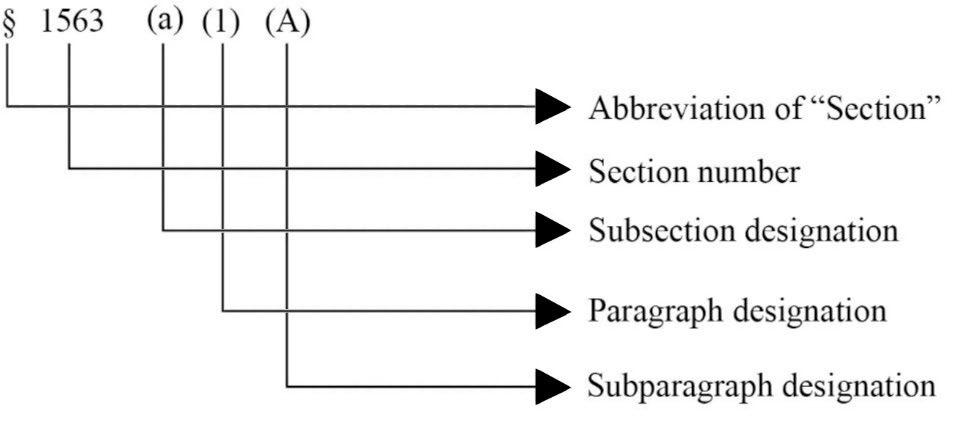
27. (LO 5)
Solution and Answer Guide: Nellen, Young, Cripe, Lassar, Persellin, Cuccia, SWFT Corporations, Partnerships, Estates & Trusts 202 6 , 9798214044033 ; Chapter 1 : Understanding and Working with the Federal Tax Law
28. (LO 5) Yes. Some Code Sections omit the subsection designation and use, instead, the paragraph designation as the first subpart [e.g., §§ 212(1) and 1221(1)].
29. (LO 5) When the 1954 Code was drafted, the omission of some Code section numbers was intentional. This omission provided flexibility to incorporate later changes into the Code without disrupting its organization. This technique is retained in the 1986 code.
30. (LO5) Proposed, Final, and Temporary Regulations are published in the Federal Register (federalregister.gov) and are reproduced in major tax services. Final Regulations are issued as Treasury Decisions (TDs).
31. (LO 5)
a. A Temporary Regulation, with 1 referring to the type of regulation (i.e., income tax), 707 is the related code section number, 5 is the subsection number, T means temporary, (a) is the paragraph designation, and (2) is the subparagraph designation.
b. Revenue Ruling number 11, appearing on page 174 of Volume 1 of the Cumulative Bulletin issued in 1960.
c. Technical Advice Memorandum number 3 issued during the 37th week of 1988.
32. (LO 5) SWFT, LLP 5191 Natorp Boulevard Mason, OH 45040
October 16, 2025
Ms. Jennifer Olde 3246 Highland Drive Clifton, VA 20124
Dear Ms. Olde:
In response to your recent request, the fact-finding determination of a lower trial court is binding on a Federal Court of Appeals. A Federal Court of Appeals is limited to a review of the record of trial compiled by a trial court. Rarely will an appellate court disturb a lower court’s fact-finding determination.
Should you need more information, do not hesitate to contact me.
Sincerely,
Marilyn S. Crumbley Tax Partner
33. (LO 5)
TAX FILE MEMORANDUM
DATE: September 4, 2025
FROM: Sarah Flinn
RE: Telephone conversation with Will Thomas regarding the failure of the IRS to appeal
I explained to Mr. Thomas that there were numerous reasons why the IRS may decide not to appeal a decision it loses in a District Court. For example, the workload may be
Solution and Answer Guide: Nellen, Young, Cripe, Lassar, Persellin, Cuccia, SWFT Corporations, Partnerships, Estates & Trusts 202 6 , 9798214044033 ; Chapter 1 : Understanding and Working with the Federal Tax Law
too heavy. Or the IRS may have decided that this particular case is not a good decision to appeal (e.g., sympathetic taxpayer). Third, the IRS might not want to appeal this case to the appropriate Court of Appeals. I stressed that the failure to appeal does not necessarily mean that the IRS agrees with the results reached.
34. (LO 5, 8)
a. If the taxpayer decides to choose a District Court as the trial court for litigation, the District Court of Utah would be the forum to hear the case. Unless the prior decision has been reversed on appeal, one would expect the same court to follow its earlier holding.
b. If the taxpayer decides to choose the Court of Federal Claims as the trial court for litigation, the decision previously rendered by this Court should have a direct bearing on the outcome. If the taxpayer selects a different trial court (i.e., the appropriate U.S. District Court or the U.S. Tax Court), the decision rendered by the Court of Federal Claims would be persuasive but not controlling. It is assumed that the results reached by the Court of Federal Claims were not reversed on appeal.
c. The decision of a Court of Appeals carries more weight than one rendered by a trial court. Since the taxpayer lives in California, however, any appeal from a District Court or the U.S. Tax Court would go to the Ninth Court of Appeals. Although the Ninth Court of Appeals might be influenced by what the Second Court of Appeals has decided, it is not compelled to follow the Second Circuit’s holding.
d. Since the U.S. Supreme Court is the top appellate court, complete reliance can be placed on its decisions. Nevertheless, one should investigate any decision to see whether the Code has been modified to change the results reached. The rare possibility also exists that the Court may have changed its position in a later decision.
e. When the IRS acquiesces in a decision of the Tax Court, it agrees with the results reached. As long as the acquiescence remains in effect, taxpayers can be assured that this represents the position of the IRS on the issue involved. Keep in mind, however, that the IRS can change its mind and can, at any time, withdraw the acquiescence and substitute a nonacquiescence.
f. The issuance of a nonacquiescence reflects that the IRS does not agree with the results reached by a Tax Court decision. Consequently, taxpayers are placed on notice that the IRS will continue to challenge the issue involved.
35. (LO 6, 7) Aleshia has a number of approaches available, depending on the available materials:
• Aleshia can begin with the index volumes of the available tax services: RIA, CCH, or BNA Portfolios.
• A key word search on an online service should be helpful Thomson Reuters Checkpoint, CCH IntelliConnect, LexisNexis, or Westlaw (or WestlawNext).
• She should browse through IRS publications (available on the IRS website).
Solution and Answer Guide: Nellen, Young, Cripe, Lassar, Persellin, Cuccia, SWFT Corporations, Partnerships, Estates & Trusts 202 6 , 9798214044033 ; Chapter 1 : Understanding and Working with the Federal Tax Law
• Aleshia could explore various tax periodicals (see text page 1-28) to locate appropriate articles written about § 351 transfers to a controlled corporation.
• Additional information might be available on the internet (but she should be cautious regarding sources).
36. (LO 7) Some tax researchers begin with a keyword search on an online tax service. If the problem is not complex, the researcher may bypass a tax service and turn directly to the Internal Revenue Code and the Treasury Regulations (both are available online; see Exhibit 1.7). For the beginner, this process saves time and will solve many of the basic problems. If the researcher does not have access to the Code or Regulations, the resources of a tax service may be necessary. Several of the major tax services publish paperback editions of the Code and Treasury Regulations that can be purchased at modest prices.
37. (LO 5, 8)
a. Primary source.
b. Secondary source.
c. Primary source.
d. Secondary source (but substantial authority for purposes of the accuracy-related penalty in § 6662).
e. Secondary source (but substantial authority for purposes of the accuracy-related penalty in § 6662)
38. (LO 9) The key components of effective tax planning are as follows:
• Avoid the recognition of income (usually by resorting to a nontaxable source or nontaxable event).
• Defer recognition of income (or accelerate deductions).
• Convert the classification of income (or deductions) to a more advantageous form (e.g., ordinary income into capital gain).
• Choose the business entity with the desired tax attributes.
• Preserve formalities by generating and maintaining supporting documentation.
• Act in a manner consistent with the intended objective.
Don’t just focus on tax considerations. Keep generally accepted accounting principles, sound business judgment, and overall economic outcomes in mind as well.
39. (LO 10) Task-based simulations on the CPA exam are case studies that allow candidates to demonstrate their knowledge and skills by generating responses to questions rather than simply selecting an answer. They typically require candidates to use spreadsheets and/or to research authoritative literature provided in the CPA exam (e.g., Internal Revenue Code, Treasury Department Regulations, IRS publications, and Federal tax forms). In addition, the task-based simulations provide increased background material and data that require candidates to determine what information is or is not relevant to the questions.
a. Juniper has a realized gain of $200,000 determined as follows:
Amount received on the exchange:
of real estate received
Amount given up on the exchange:
Basis of real estate (800,000)
Realized gain $ 200,000
Juniper’s recognized gain is limited to the lesser of realized gain of $200,000 or the other property (boot) received of $100,000. As a result, the recognized gain is limited to other property (boot) received of $100,000 [the amount of cash (boot) received by Juniper]. Refer to § 1031.
b. Birch has a realized loss of $300,000, determined as follows:
Amount received on the exchange $ 1,000,000
Amounts given up on the exchange: Real estate (basis)
Realized loss $ (300,000)
None of Birch’s realized loss can be recognized.
c. Under the wherewithal to pay concept, forcing Juniper to recognize a gain of $100,000 makes sense. Because of the $100,000 cash received, not only has Juniper’s economic position changed, but it now has the means to pay the tax on the portion of the realized gain that is recognized.
The disallowance of Birch’s realized loss is consistent with the usual approach of the wherewithal to pay concept. This disallowance is the price that must be paid for tax-free treatment, and a carryover basis and adjustment under § 1031(d) prevents a deterioration of Birch’s tax position. Note: After the exchange, Birch has a basis of $1,300,000 in the real estate received from Juniper [i.e., $1,200,000 (basis in the real estate given up) + $100,000 (cash given up)].
41. (LO 2, 3)
a. W. Wherewithal to pay concept.
b. CE. Control of the economy.
c. ESB. Encouragement of small business.
d. SC. Social considerations.
e. EI. Encouragement of certain industries.
f. AF. Administrative feasibility.
g. SC. Social considerations.
Solution and Answer Guide: Nellen, Young, Cripe, Lassar, Persellin, Cuccia, SWFT Corporations, Partnerships, Estates & Trusts 202 6 , 9798214044033 ; Chapter 1 : Understanding and Working with the Federal Tax Law
42. (LO 2)
a. Louisiana, community property.
b. Virginia, common law.
c. Arizona, community property.
d. Rhode Island, common law.
e. Alaska, community property may be elected by spouses.
f. California, community property.
43. (LO 4) The real question is whether the parties acted in an arm’s length manner. In other words, was the $100,000 selling price the true value of the property?
a. Where the parties to a transaction are related to each other, the IRS is quick to apply the arm’s length concept. The IRS might, for example, find that the value of the property was less than $100,000. In this event, the difference probably is dividend income to Benny.
b. The same danger exists even if Benny (the seller) is not a shareholder in Jet Corporation (the purchaser) as long as he is related to the one in control. If the value of the property is less than $100,000, the IRS could argue for a constructive dividend to Benny’s father of any difference. Because Benny ended up with the benefit, it follows that the father has made a gift to the son of the difference (see discussion in Chapter 5).
c. Since Benny is not a shareholder in Jet Corporation and is not related to any of its shareholders, the IRS probably would not question the $100,000 selling price or the substance of the sale.
d. The student e-mail should summarize the items above. Look for proper grammar and e-mail etiquette in addition to the correct answer.
44. (LO 5) Code § 263A indicates that oil/gas delay rentals paid or incurred are capitalized and added to the depletable leasehold of the property, assuming the lease is held for development (or development is reasonably certain). See also Reg. § 1.263A–2(a)(3)(ii).
The lessor must include the delay rentals in gross income. See Continental Oil Company, 36 BTA 693 (1937) or L.H. Glide v. Comm., 27 BTA 1264 (1933).
45. (LO 5)
a. Letter rulings are issued for a fee by the National Office of the IRS upon a taxpayer’s request and describe how the IRS will treat a proposed transaction for tax purposes. In general, they apply only to the taxpayer who asks for and obtains the ruling, but post-1984 rulings may be substantial authority for purposes of avoiding the accuracy-related penalties.
b. The National Office of the IRS releases technical advice memoranda (TAMs) weekly. TAMs resemble letter rulings in that they give the IRS’s determination of an issue. Letter rulings, however, are responses to requests by taxpayers, whereas TAMs are issued by the National Office of the IRS in response to questions raised by taxpayers or IRS field personnel during audits. TAMs deal with completed rather than proposed transactions and are often requested for questions relating to
Solution and Answer Guide: Nellen, Young, Cripe, Lassar, Persellin, Cuccia, SWFT Corporations, Partnerships, Estates & Trusts 202 6 , 9798214044033 ; Chapter 1 : Understanding and Working with the Federal Tax Law
exempt organizations and employee plans. Although TAMs are not officially published and may not be cited or used as precedent, post-1984 TAMs may be substantial authority for purposes of the accuracy-related penalties.
46. (LO 5)
a. Revenue Procedure number 10 appearing on page 272 of Volume 1 of the Cumulative Bulletin for 2001.
b. Revenue Ruling number 14 appearing on page 31 of the 27th weekly issue of the Internal Revenue Bulletin for 2011.
c. The 10th letter ruling issued during the 25th week of 2024.
47. (LO 5) The IRS maintains a website on digital assets (including virtual currency): irs.gov/businesses/small-businesses-self-employed/digital-assets
In addition, Notice 2014–21 (2014–21 I.R.B. 938) explains how existing tax principles apply to transactions involving virtual currency. In Notice 2014–21, the IRS concludes that virtual currency is property and sales or exchanges of virtual currency result in capital gains or losses. Code § 1031 provides information on the tax consequences of like-kind exchanges. Currently, § 1031 only applies to real property (e.g., land and buildings). As a result, an exchange of cryptocurrencies (e.g., Bitcoin for Ethereum) will result in a capital gain or loss; § 1031 is not available.
Notice 2014–21 also discusses the tax implications of mining a cryptocurrency (see Q–8, Q–9, and Q–10). When a taxpayer successfully “mines” virtual currency, the fair market value of the virtual currency as of the date of receipt is includible in gross income. The question then becomes whether the mining of cryptocurrency is a “hobby” or a “trade or business.” The IRS references a news release from April 2007 (FS–2007–18) to help make this determination.
If a taxpayer’s “mining” of virtual currency constitutes a trade or business and the “mining” activity is not undertaken by the taxpayer as an employee, the net earnings from self-employment (generally, gross income derived from carrying on a trade or business less allowable deductions) resulting from those activities constitute selfemployment income and are subject to the self-employment tax. Consequently, the fair market value of virtual currency received for services performed as an independent contractor, measured in U.S. dollars as of the date of receipt, constitutes self-employment income and is subject to the self-employment tax.
Beginning in 2025, cryptocurrency exchanges will be required to report a summary of any customer’s cryptocurrency transactions to the IRS as outlined in regulations under § 6045. The IRS will require this information to be reported on Form 1099–DA (“DA” for “digital assets”). The form will be similar to the form used by brokers to report transactions involving stocks, bonds, or other investment securities (Form 1099–B). In addition, the Treasury Department has released final regulations to guide cryptocurrency exchanges with this reporting.
The blockchain is a public ledger that records all crypto transactions. While the identities of the parties involved are typically anonymous, the transactions themselves are visible. The IRS has partnered with companies that specialize in blockchain analysis to track cryptocurrency transactions on the blockchain. These companies use
Solution and Answer Guide: Nellen, Young, Cripe, Lassar, Persellin, Cuccia, SWFT Corporations, Partnerships, Estates & Trusts 202 6 , 9798214044033 ; Chapter 1 : Understanding and Working with the Federal Tax Law
advanced software to analyze and trace transactions, allowing the IRS to identify patterns and track down individuals who may be engaging in tax evasion.
48. (LO 5) A letter ruling is a written determination issued by the IRS Office of Chief Counsel in response to a taxpayer’s written request, prior to the filing of a tax return (or other report required by law).
Rev. Proc. 2025–1 (2025–1 I.R.B. 1) provides significant detail regarding this process (the revenue procedure is more than 115 pages long). The IRS will not provide rulings on certain issues [see, for example, Rev. Proc. 2025–3 (2025–1 I.R.B. 143)], and any ruling applies only to that taxpayer. In addition, any ruling can be revoked by the IRS. Rev. Proc. 2025–1 (which is updated annually) provides a schedule of user fees, a sample format for a letter ruling request, and a checklist for the request. Generally, the user fee is not refundable and the user fee can range from $30,000 to $38,000. Of course, the practitioner’s fee must also be factored into this decision. These costs mean that only those tax issues with significant tax costs are considered for a private letter ruling request.
49. (LO 5)
a. IRC.
b. FR, IRB, CB.
c. IRB, CB.
d. FR, IRB, CB.
e. IRB, CB.
f. NA, a court decision.
g. NA, a letter ruling.
50. (LO 5)
a. Fifth Circuit.
b. Tenth Circuit.
c. Eleventh Circuit.
d. Ninth Circuit.
e. Second Circuit.
51. (LO 5)
a. A.
b. T
c. U.
d. T.
e. T.
f. C.
g. N
h. D.
Solution and Answer Guide: Nellen, Young, Cripe, Lassar, Persellin, Cuccia, SWFT Corporations, Partnerships, Estates & Trusts 202 6 , 9798214044033 ; Chapter 1 : Understanding and Working with the Federal Tax Law
52. (LO 6)
a. United States Tax Reporter is published by Research Institute of America (Thomson Reuters).
b. Standard Federal Tax Reporter is published by CCH/Wolters Kluwer.
c. Federal Tax Coordinator 2d is published by Research Institute of America (Thomson Reuters).
d. Mertens Law of Federal Income Taxation is published by Thomson Reuters.
e. Tax Management Portfolios is published by Bloomberg Tax
f. Tax Pro Library is published by Parker Tax Publishing.
53. (LO 5, 8)
a. P.
b. P.
c. P.
d. P.
e. S.
f. P.
g. S.
h. P.
i. B. Primary to the taxpayer to whom issued but secondary for all other taxpayers.
j. P.
k. S. Cannot be cited as precedent.
l. P.
m. S.
n. S. Courts generally do not recognize Proposed Regulations.
o. P.
54. (LO 5)
a. For a regular decision of the U.S. Tax Court that was issued in 1970. The decision can be found in Volume 54, page 1514, of the Tax Court of the United States Reports, published by the U.S. Government Printing Office.
b. For a decision of the U.S. First Circuit Court of Appeals that was rendered in 2007 The decision can be found in Volume 491, page 53, of the Federal Reporter, Third Series (F.3d), published by West Publishing Company.
c. For a decision of the U.S. Second Circuit Court of Appeals that was rendered in 1969. The decision can be found in Volume 1 for 1969, paragraph 9319, of the U.S. Tax Cases, published by Commerce Clearing House.
Solution and Answer Guide: Nellen, Young, Cripe, Lassar, Persellin, Cuccia, SWFT Corporations, Partnerships, Estates & Trusts 202 6 , 9798214044033 ; Chapter 1 : Understanding and Working with the Federal Tax Law
d. For a decision of the U.S. Second Circuit Court of Appeals that was rendered in 1969. The decision can be found in Volume 23, page 1090, of the Second Series of American Federal Tax Reports, published by RIA (Thomson Reuters).
[Note that the citations that appear in parts c. and d. are for the same case.]
e. For a decision of the U.S. District Court of the Virgin Islands that was rendered in 2011. The decision can be found in Volume 775, page 765, of the Federal Supplement, Second Series (F.Supp.2d), published by West Publishing Company.
f. For a decision of the U.S. District Court of Mississippi that was rendered in 1967. The decision can be found in Volume 1 for 1967, paragraph 9253, of the U.S. Tax Cases, published by Commerce Clearing House.
g. For a decision of the U.S. District Court of Mississippi that was rendered in 1967. The decision can be found in Volume 19, page 647, of the Second Series of American Federal Tax Reports, published by RIA (Thomson Reuters).
h. For a decision of the U.S. Supreme Court that was rendered in 1935. The decision can be found in Volume 56, page 289, of the Supreme Court Reporter, published by West Publishing Company.
i. For a decision of the U.S. Supreme Court that was rendered in 1935. The decision can be found in Volume 1 for 1936, paragraph 9020, of the U.S. Tax Cases, published by Commerce Clearing House.
j. For a decision of the U.S. Supreme Court that was rendered in 1935. The decision can be found in Volume 16, page 1274, of the American Federal Tax Reports, published by RIA (Thomson Reuters).
[Note that the citations that appear in parts h., i., and j. are for the same case.]
k. For a decision of the U.S. Fifth Circuit Court of Appeals that was rendered in 2003. The decision can be found in Volume 319, page 732, of the Federal Reporter, Third Series (F.3d), published by West Publishing Company.
55. (LO 5) The U.S. Tax Court can issue three types of decisions:
1. Regular decisions
2. Memorandum decisions
3. Small Cases Division decisions.
Regular decisions involve novel issues not previously resolved by the Tax Court. Memorandum decisions involve disputes that involve only the application of established principles of law. The Chief Judge determines the classification of these decisions.
The Tax Court includes a Small Cases Division that only hears cases involving amounts of $50,000 or less. The ruling of the judge is final (i.e., no appeal is available), and these rulings are not precedent for any other cases (i.e., they are not primary authority and are not citable as substantial authority).
Regular decisions are published semiannually by the U.S. Government in a series called the United States Tax Court Reports. All of these decisions are published online (ustaxcourt.gov).
Solution and Answer Guide: Nellen, Young, Cripe, Lassar, Persellin, Cuccia, SWFT Corporations, Partnerships, Estates & Trusts 202 6, 9798214044033 ; Chapter 1: Understanding and Working with the Federal Tax Law
Here are citation examples for each decision type:
Regular Decision: TBL Licensing LLC, 158 T.C. 1 (2022)
Memorandum Decision: Arthur T. Davidson, T.C. Memo. 1978−167
Small Cases Decision: Larochelle and Larochelle, T.C. Summary 2022−12
1. a. Code § 6694(a) deals with the penalty for understatements due to taking an unreasonable position on a tax return.
b. Reg. § 1.6694–1(b) deals with the meaning of the term tax preparer for purposes of the tax preparer penalties.
c. Revenue Ruling 86–55 deals with tax return preparers and the assignment of refund checks.
d. PLR 8022027 deals with whether a tax return preparer is liable for a § 6694 penalty when they prepare a return claiming an IRA contribution that was not yet made and do not later ascertain that the contribution was made by the due date of the return.
2. a. rev’d 929 F.2d 1252 (CA–8, 1991).
b. aff’d 734 F.2d 20 (CA–9, 1984), cert. den., 469 U.S. 857 (1984).
c. aff’d 341 F.2d 341 (CA–5,1965).
d. aff’d per curiam, 487 F.2d 515 (CA–8, 1973).
e. rev’d 335 F.2d 507 (CA–6, 1964).
3. a. S corporations. § 1374(a)
b. 21%. §§ 1374(b)(1) and 11(b)
c. §§ 1374(d)(1)(A) and (B)
d. Yes, the built-in gains base is limited to the taxable income for the year. §§ 1374(c)(2), (d)(1), and (d)(2)(A).
e. Yes. § 1374(d)(2).
f. The 5-year period beginning with the first taxable year for which the corporation was an S corporation. § 1374(7)(A)(i).
g. Yes. § 1366(f)(2).
h. Yes. § 1374(b)(2).
i. No. § 1375(b)(4) may require another Code section.
j. Yes. § 1374(b)(3)(B).
or
Solution and Answer Guide: Nellen, Young, Cripe, Lassar, Persellin, Cuccia, SWFT Corporations, Partnerships, Estates & Trusts 202 6, 9798214044033 ; Chapter 1: Understanding and Working with the Federal Tax Law
These research problems require that students utilize online resources to research and answer the questions. As a result, solutions may vary among students and courses. You should determine the skill and experience levels of the students before assigning these problems, coaching where necessary. Encourage students to use reliable websites and blogs of the IRS and other government agencies, media outlets, businesses, tax professionals, academics, think tanks, and political outlets to research their answers.
7. Student responses will vary.
Tax Notes Federal published an article in May 2023 titled “The Rise of Generative AI in Tax Research” (papers.ssrn.com/sol3/papers.cfm?abstract_id=4476510). It provides a detailed discussion of generative AI tools, their potential benefits, identifies concerns, and discusses how these tools can be improved.
Here are a variety of websites that students might find during their internet research: ey.com/en_gl/tax/how-generative-ai-might-help-tax-functions-tackle-challenges kpmg.com/xx/en/home/insights/2023/09/the-use-of-generative-ai.html pwc.com/us/en/tech-effect/ai-analytics/generative-ai-insights-for-tax-leaders.html deloitte.com/us/en/pages/tax/articles/pairing-tax-with-artificial-intelligence.html bluej.com/blog/the-rise-of-generative-ai-in-tax-research qz.com/pwc-tax-advice-ai-chatgpt-consultation-bots-payment-1850937429 wsj.com/articles/pricewaterhousecoopers-to-pour-1-billion-into-generative-aicac2cedd
Solution and Answer Guide: Nellen, Young, Cripe, Lassar, Persellin, Cuccia, SWFT Corporations, Partnerships, Estates & Trusts 202 6, 9798214044033 ; Chapter 1: Understanding and Working with the Federal Tax Law
40.a. Realized gain $200,000; recognized gain $100,000.
40.b. Realized loss $300,000; recognized loss $0.
Solution and Answer Guide: Nellen, Young, Cripe, Lassar, Persellin, Cuccia, SWFT Corporations, Partnerships, Estates & Trusts 202 6, 9798214044033 ; Chapter 1: Understanding and Working with the Federal Tax Law
Choosing Cases for Appeal (p. 1-35). The issue is whether it is appropriate for the Government to select a case to appeal because of its potential for success (i.e., a reversal on appeal) rather than purely on its merits.
Without question, the tax laws treat taxpayers differently and often unfairly. Many laws are passed as the result of pressure from various groups (i.e., lobbying). “Don’t tax you, don’t tax me, tax that fellow behind the tree” is an appropriate statement of tax law development in many circumstances.
Part of the IRS’s function is to maximize revenue with the limited time and budget resources at its disposal. By litigating specific cases in order to develop judicial law, the IRS does “save” taxpayers’ dollars by avoiding marginal issues. And if the IRS position is sustained on appeal in Virginia, the judicial precedent might be important should the IRS choose to appeal the Iowa decision.
Certainly, there is an unfairness in this approach. If the IRS decides to appeal the Virginia case, the CPA must bear the burden of litigation expenses (rather than the minister). Further, should the IRS position be sustained on appeal, the CPA’s trusts would be collapsed while the minister’s trusts may be allowed to remain—even though the tax issues are identical.
Instructor Guide: Nellen, Young, Cripe, Lassar, Persellin, Cuccia, Corporations, Partnerships, Estates & Trusts 2026, 9798214044033; Chapter 1: Understanding and Working with the Federal Tax Law
NELLEN, YOUNG, CRIPE, LASSAR, PERSELLIN, CUCCIA, CORPORATIONS, PARTNERSHIPS, ESTATES & TRUSTS 2026, 9798214044033; CHAPTER 1: UNDERSTANDING AND WORKING WITH THE FEDERAL TAX LAW
The following objectives are addressed in this chapter:
1.1 Discuss the importance of revenue needs as an objective of Federal tax law.
1.2 Demonstrate the influence of economic, social, equity, and political considerations on the development of the tax law.
1.3 Explain how the IRS, as the protector of the revenue, has affected tax law.
1.4 Recognize the role of the courts in interpreting and shaping tax law.
1.5 Identify tax law sources statutory, administrative, and judicial.
1.6 List and assess tax law sources.
1.7 Demonstrate the ability to conduct tax research.
1.8 Assess the validity and weight of tax law sources.
1.9 Describe various tax planning procedures.
1.10 Explain the role of taxation on the CPA examination. [return to top]
Instructor Guide: Nellen, Young, Cripe, Lassar, Persellin, Cuccia, Corporations, Partnerships, Estates & Trusts 2026, 9798214044033; Chapter 1: Understanding and Working with the Federal Tax Law
In the outline below, each element includes references (in parentheses) to related content. “CO CH.##” refers to the chapter objective; “PPT Slide #” refers to the slide number in the PowerPoint deck for this chapter (provided in the PowerPoints section of the Instructor Resource Center); and, as applicable for each discipline, accreditation or certification standards (“BL 1.3.3”). Introduce the chapter and use the Ice Breaker in the PPT if desired, and if one is provided for this chapter. Review learning objectives for Chapter 1 (PPT Slides 2–4).
i. While the primary objective of Federal tax law is raising revenue, this is not the sole objective of tax laws.
1. Important in explaining various provisions found in the law are economic, social, equity, and political considerations.
2. The Treasury Department, the IRS, and the courts also have significant impacts on the evolution of Federal tax law.
a. Revenue Needs (1.1, PPT Slides 8–10)
i. Raising revenues to fund the cost of government operations is the primary function of a tax system.
ii. The Congressional Budget Office (CBO) estimates that for fiscal year 2024, the Federal government’s annual revenues total about $4.9 trillion while annual expenditures amount to about $6.8 trillion resulting in a deficit of $1.9 trillion. As a result of these deficits, the amount of debt held by the public has been increasing significantly, reaching more than $28 trillion.
iii. When enacting tax legislation, Congress is sometimes guided by the concept of revenue neutrality.
1. Changes in the tax law should neither increase nor decrease the net revenues received by the government.
2. There are likely to be both “winners” (taxpayers who see a reduction in taxes paid) and “losers” (taxpayers who see an increase in taxes paid).
b. Economic Considerations (1.2, PPT Slides 11–22)
i. Tax law is often used to accomplish economic objectives.
ii. Control of the Economy. Congress has used the tax depreciation rules as one means of controlling the economy.
1. Shorter asset lives and accelerated methods should encourage additional investments in depreciable business property.
2. Longer asset lives and the use of straight-line depreciation should discourage capital outlays.
3. Congress also uses incentives like immediate expensing (§ 179) and bonus depreciation to stimulate the economy when needed.
Instructor Guide: Nellen, Young, Cripe, Lassar, Persellin, Cuccia, Corporations, Partnerships, Estates & Trusts 2026, 9798214044033; Chapter 1: Understanding and Working with the Federal Tax Law
4. When tax rates are lowered, taxpayers retain money that can be used for other purposes.
5. If Congress is using the concept of revenue neutrality, rate reductions may be offset by a reduction or elimination of deductions or credits. As a result, lower rates do not always mean lower taxes.
iii. Encouragement of Certain Activities.
1. Research and development expenditures can be deducted in the year incurred or, alternatively, capitalized and amortized over a period of five years. These expenditures also may generate a tax credit.
2. Inventions (including technological innovations) also are encouraged under tax law. Patents and musical compositions can qualify as capital assets, and under certain conditions, their disposition automatically carries long-term capital gain treatment.
3. Ecology is encouraged by allowing pollution control facilities to be amortized over 60 months (rather than over the 39-year period required for most business buildings).
4. Saving, which leads to capital formation, is stimulated by incentives to increase private retirement plans. The encouragement of private-sector pension plans can be justified under social considerations as well.
iv. Encouragement of Certain Industries.
1. Tax laws favor farming by allowing expensing of soil and water conservation and fertilizers. Also, farmers can defer the gain recognition on crop insurance proceeds.
2. The tax law favors the development of natural resources and provides incentives for clean and renewable energy sources.
3. The railroad and banking industries also receive special tax treatment.
v. Encouragement of Small Business. Several provisions illustrate a desire to benefit small business, including the following:
1. Special treatment of small business corporation stock leads to ordinary (rather than capital) loss treatment (§ 1244 stock).
2. S corporation elections allow the avoidance of corporate income tax and the pass-through of profits (or losses) to the shareholders.
c. Social Considerations
i. Many of the tax provisions passed by Congress can be explained by social desirability.
1. These provisions encourage individuals to work, give to charities, and obtain an education.
Instructor Guide: Nellen, Young, Cripe, Lassar, Persellin, Cuccia, Corporations, Partnerships, Estates & Trusts 2026, 9798214044033; Chapter 1: Understanding and Working with the Federal
2. Employers are encouraged to provide accident, health, and group term life insurance as well as retirement plans for employees.
i. Equity is a relative concept, and people often disagree as to what is equitable. For tax purposes, equity is equal application of what the tax law recognizes. One measure of equity is whether a tax is progressive (e.g., the Federal income tax on individuals) or regressive (e.g., gasoline excise tax). The determination is made by calculating the percentage of a taxpayer’s income that is used to pay a tax.
ii. Alleviating the Effect of Multiple Taxation. Several provisions are intended to alleviate the effect of multiple taxation.
1. Federal tax law allows a taxpayer to claim a deduction for some state and local income taxes. The deduction, however, does not eliminate the effect of multiple taxation.
2. Because double taxation results when the same income is subject to both foreign and U.S. income taxes, the tax law permits the taxpayer to choose either a credit or a deduction for the foreign taxes paid.
3. Triple taxation relief for corporations is provided by a deduction for dividends received from certain domestic corporations. In the case of individual shareholders, they receive a reduced rate of tax (from 0% for lower tax bracket shareholders to 20% for certain high-income shareholders).
4. For the Federal estate tax, several provisions reflect attempts to mitigate the effect of multiple taxation.
(a) A limited credit against the estate tax for foreign death taxes imposed is allowed.
(b) Other estate tax credits are available and can be explained on the same grounds.
iii. The Wherewithal to Pay Concept. This concept is based on equity. It recognizes that it is inequitable to tax transactions when the taxpayer has no ability to pay the tax.
1. Applies only where Congress specifically provides; thus, one cannot conclude that a transaction is nontaxable just because no cash results from the exchange.
2. Most wherewithal to pay provisions in the tax law do not permanently avoid gain or loss but operate on a deferral principle. Because of the basis carryover rules, gain or loss merely is postponed to the future disposition.
iv. Mitigating the Effect of the Annual Accounting Period Concept. For administrative ease, all taxpayers have to file tax returns yearly. However, all taxpayers do not have a one-year business cycle. To
Instructor Guide: Nellen, Young, Cripe, Lassar, Persellin, Cuccia, Corporations, Partnerships, Estates & Trusts 2026, 9798214044033; Chapter 1: Understanding and Working with the Federal Tax Law
mitigate the effect of annual accounting period concepts, taxpayers are allowed the following:
1. Deductions for net operating losses that occur in other tax years.
2. The installment method.
3. Deduction determination after the year-end when it is difficult to accurately assess the proper amount by year-end. Examples are contributions to IRA and H.R. 10 (Keogh) retirement plans.
v. Coping with Inflation. To overcome the impact of inflation in many areas of the tax law, Congress has included an indexation procedure.
e. Political Considerations
i. Special Interest Legislation. Special interest legislation provides benefits to limited groups of taxpayers. However, this legislation should not be condemned if justified on economic or social grounds.
ii. Political Expediency. Congress is sensitive to the general public’s sentiment regarding taxes. Tax provisions like the imputed interest rules and the limitation on the deductibility of interest on investment indebtedness can be explained on this basis.
iii. State and Local Government Influences. State and local influences on Federal taxation may be less apparent. The community property system is an example.
f. Influence of the Internal Revenue Service (1.3, PPT Slides 23–27)
i. The IRS as Protector of the Revenue. The IRS is influential in many areas beyond its role in issuing administrative pronouncements. It is proactive in closing “loopholes” in tax laws.
ii. Administrative Feasibility. Some tax laws are justified on the grounds that they simplify collecting the revenue and administering the law.
1. Such items as the pay-as-you-go basis for collecting taxes and the imposition of interest and penalties on taxpayers for noncompliance with the tax law help ease revenue collection.
2. Laws to aid in the audit process conducted by the IRS.
(a) Standard deduction reduces the number of taxpayers claiming itemized deductions. Fewer deductions to check simplifies the audit function.
(b) The annual gift exclusion is $19,000.
g. Influence of the Courts (1.4, PPT Slides 28–36)
i. Judicial Concepts Relating to Tax Law.
1. Substance over form is one of the most important tax concepts developed by the courts.
2. The step transaction approach (also called the telescoping or collapsing process) allows the tax law to disregard any step in a
Instructor Guide: Nellen, Young, Cripe, Lassar, Persellin, Cuccia, Corporations, Partnerships, Estates & Trusts 2026, 9798214044033; Chapter 1: Understanding and Working with the Federal Tax Law
transaction involving many steps, if the results would be the same.
3. The arm’s length concept suggests that transactions should be constructed such that unrelated parties would have handled the transaction in the same manner.
4. Continuity of interest, which applies primarily to corporation restructuring, has been incorporated into statutory provisions.
5. Business purpose concepts principally apply to corporations. Tax avoidance is not considered to be a sound business purpose.
ii. Judicial Influence on Statutory Provisions. Courts interpret the tax law and may have substantial impact on statutory provisions.
1. Congress generally accepts the decisions of the courts, and those decisions become part of the tax law. In some cases, Congress may see fit to incorporate the result of a decision and make it part of the tax law.
2. On occasion, a decision leads to uncertainty by failing to provide guidelines for similar but not identical factual situations. To clarify the matter, Congress may amend the tax law to establish such guidelines.
3. If Congress does not choose to accept a judicial decision, it can change the tax law to neutralize the result. Congress has the last word on what the Federal tax law should be, barring certain exceptions (e.g., constitutional issues).
II. Summary
i. In addition to revenue raising, the Federal tax law is influenced by economic, social, equity, and political considerations.
ii. Influence of both the IRS and the courts is also instrumental in the development of tax laws.
III. Reconciling Accounting Concepts
i. The vast majority of an entity’s business transactions receive the same treatment for financial accounting purposes as they do under Federal and state tax law. But “book-tax differences” exist. These are differences between Generally Accepted Accounting Principles (GAAP) or International Financial Reporting Standards (IFRS) and tax rules.
IV. Working with the Tax Law—Tax Sources
i. The primary sources of tax law include information from all three branches of government: legislative (or statutory), executive, and judicial.
ii. Learning to work with the tax law involves three basic steps:
Instructor Guide: Nellen, Young, Cripe, Lassar, Persellin, Cuccia, Corporations, Partnerships, Estates & Trusts 2026, 9798214044033; Chapter 1: Understanding and Working with the Federal Tax Law
1. Familiarity with the sources of the law.
2. Application of research techniques.
3. Effective use of planning procedures.
a. Statutory Sources of the Tax Law (1.5, PPT Slides 37–74)
i. Origin of the Internal Revenue Code.
1. Before 1939, the tax law provisions were not codified.
2. The first codification was in 1939 and the recodification was in 1954.
3. The Internal Revenue Code of 1986 was not a recodification of the tax law. To emphasize the magnitude of the changes made by the Tax Reform Act of 1986, the Code title was changed.
ii. The Legislative Process. For an illustration of the legislative process, see Exhibit 1.1 in the text.
1. Committee reports are an important source for ascertaining the intent of Congress when passing new tax laws. These are key for interpreting legislation, especially before Regulations have been issued.
2. The role of the Joint Conference Committee indicates the importance of compromise in the legislative process.
3. Exhibit 1.2 in the text illustrates what happened in the Tax Cuts and Jobs Act (TCJA) of 2017 regarding corporate tax rates and a new qualified business income deduction for noncorporate taxpayers.
iii. Arrangement of the Internal Revenue Code.
1. In referring to a provision of the Code, the key is usually the Section number.
2. Tax researchers often refer to a specific area of income taxation by Subchapter designation.
iv. Citing the Code.
1. Proper citation formats are presented on text page 1-16.
2. Some Code Section citations contain a capital letter (e.g., § 280A to § 280H). This is because certain Code numerical sequences have no space for expansion.
b. Administrative Sources of the Tax Law
i. Administrative sources are issued by either the U.S. Treasury Department or the IRS.
ii. Treasury Department Regulations. Under § 7805, the Treasury Department has a duty to issue rules and Regulations to explain and interpret the Code.
1. Regulations, which carry considerable authority as the official interpretation of tax law, may be issued in proposed, temporary, or final form.
2. Because they interpret the Code, Regulations are arranged in the same manner as the Code but have a prefix indicating the type of tax to which they apply.
Instructor Guide: Nellen, Young, Cripe, Lassar, Persellin, Cuccia, Corporations, Partnerships, Estates & Trusts 2026, 9798214044033; Chapter 1: Understanding and Working with the Federal Tax Law
iii. Revenue Rulings, Revenue Procedures, and Notices.
1. Revenue Rulings (Rev.Rul.) are official pronouncements of the National Office of the IRS and are designed to provide interpretation of the tax law, although they do not carry the same legal force and effect as Regulations.
2. Revenue Procedures (Rev.Proc.) deal with the internal management practices and procedures of the IRS.
3. Notices are issued when immediate guidance is needed by taxpayers and tax practitioners.
4 All serve to provide guidance to IRS personnel and taxpayers in handling routine tax matters.
5. All are published weekly by the U.S. Government in the Internal Revenue Bulletin (I.R.B.).
6. Proper citation formats are presented on text page 1-19.
7. Revenue Rulings and other tax resources may be found at the IRS website: irs.gov/irb.
iv. Other Administrative Pronouncements.
1. Letter rulings (Ltr.Rul. or PLR) are issued by the National Office of the IRS upon a taxpayer’s request and describe how the IRS will treat a proposed transaction for tax purposes.
(a) They apply only to the taxpayer who asks for and obtains the ruling.
(b) The IRS must make letter rulings available for public inspection after identifying details are deleted.
2. Technical Advice Memoranda (TAMs) are issued by the National Office of the IRS and resemble letter rulings. However, they are issued in response to questions raised during audits. TAMs deal with completed rather than proposed transactions.
3. Proper citation format for Ltr.Rul. and TAM with explanations are presented on text page 1-19.
4. Letter rulings and TAMs are issued with multi-digit file numbers (e.g., Ltr.Rul. 202422006).
5. Like letter rulings, determination letters are issued at the request of taxpayers and provide guidance concerning the application of the tax law. They differ from individual rulings in that:
(a) The issuing source is an IRS Area Director (rather than the National Office of the IRS).
(b) Determination letters usually involve completed (as opposed to proposed) transactions.
(c) Determination letters are not published by the government and are made known only to the party making the request.
c. Judicial Sources of the Tax Law
i. The Judicial Process in General.
Instructor Guide: Nellen, Young, Cripe, Lassar, Persellin, Cuccia, Corporations, Partnerships, Estates & Trusts 2026, 9798214044033; Chapter 1: Understanding and Working with the Federal Tax Law
1. Once a taxpayer has exhausted remedies available within the IRS, the dispute can be taken to the Federal courts.
(a) The dispute is first considered by a court of original jurisdiction (trial court).
(b) Appeals may be taken to the appropriate appellate court.
(c) The Federal trial and appellate court system is illustrated in Exhibit 1.4 in the text.
2. The Small Cases Division of U.S. Tax Court hears informal cases involving $50,000 or less. The ruling of the judge is final (i.e., no appeal is available), and these rulings are not precedent for any other cases.
3. The plaintiff is the party requesting action in a court, and the defendant is the party against whom the suit is brought.
Sometimes a court uses the terms “petitioner” and “respondent.” In general, “petitioner” is a synonym for “plaintiff,” and “respondent” is a synonym for “defendant.”
4. American law, following English law, is frequently “created” by judicial decisions. Under the doctrine of stare decisis, each case has precedential value for future cases with the same controlling set of facts.
ii. Trial Courts. Courts in which a taxpayer may pursue a tax conflict are as follows:
1. The U.S. Court of Federal Claims hears tax and other Federal government cases. It has 16 judges.
2. The U.S. Tax Court hears only tax cases. It has 19 regular judges.
3. There are numerous U.S. District Courts based on geographical location. Each court has one judge and taxpayers can have a jury trial.
4. The Tax Court hears only Federal tax cases and is the most frequently used forum for tax cases since its judges have more tax expertise.
5. Concept Summary 1.1 in the text provides a summary of the characteristics of the Federal judicial system.
iii. Appellate Courts. Appeals from trial courts are to the U.S. Court of Appeals for the appropriate jurisdiction. (Exhibit 1.5 in the text illustrates the jurisdictions of the Federal Courts of Appeals.)
1. Generally, a three-judge panel hears a Court of Appeals case, but occasionally the full court decides more controversial cases.
2. If the IRS or taxpayer loses at the trial court level, either or both may appeal. When it loses, the IRS may choose not to appeal for a number of reasons.
3. Appealing from the Tax Court. The Tax Court is a national court, meaning that it hears and decides cases from all parts of the country.
Instructor Guide: Nellen, Young, Cripe, Lassar, Persellin, Cuccia, Corporations, Partnerships, Estates & Trusts 2026, 9798214044033; Chapter 1: Understanding and Working with the Federal Tax Law
(a) Under the Golsen rule, the Tax Court decides a case as it believes the law should be applied only if the Court of Appeals of appropriate jurisdiction has not yet ruled on the issue or has previously affirmed the Tax Court’s rationale.
(b) If the Court of Appeals has ruled on a case similar to the one being heard by the Tax Court, the Tax Court will conform to the Appeals Court decision under the Golsen rule even though it disagrees with the decision.
4. Appeal to the U.S. Supreme Court.
(a) Appeal to the U.S. Supreme Court requires a Writ of Certiorari.
(b) If the Court agrees to hear the case, it grants the Writ but most often, it will deny.
(c) Court grants certiorari to resolve a conflict among the Courts of Appeals or when the tax issue is extremely important.
(d) All individuals and the IRS must follow the decisions of the U.S. Supreme Court.
iv. Judicial Citations. Proper judicial citation formats for all court cases are presented on text pages 1-25 through 1-27 and summarized in Concept Summary 1.2 in the text.
d. Other Sources of the Tax Law
i. Tax Treaties. Tax conventions (treaties) are signed by the United States and foreign countries to render mutual assistance in tax enforcement and to avoid double taxation. Neither a tax law nor a tax treaty automatically takes legal precedence. When there is a conflict, the most recent item will take precedence.
ii. Tax Periodicals. Online sources of various periodicals are listed on text page 1-28.
V. Working with the Tax Law Locating and Using Tax Sources (1.6, PPT Slides 75–81)
a. Commercial Tax Services
i. In the past, commercial tax services could be classified as annotated (i.e., organized by Internal Revenue Code) or topical (i.e., organized by major topics). However, as tax research has become electronic, this classification system is no longer appropriate.
ii. A partial list of the available commercial tax services includes:
• CCH IntelliConnect and CCH AnswerConnect, CCH/Wolters Kluwer. Includes the Standard Federal Tax Reporter (along with other CCH materials).
• Thomson Reuters Checkpoint, Research Institute of America. Includes RIA’s Federal Tax Coordinator 2d and United States Tax
Reporter.
• Practical Tax Expert, CCH/Wolters Kluwer.
Instructor Guide: Nellen, Young, Cripe, Lassar, Persellin, Cuccia, Corporations, Partnerships, Estates & Trusts 2026, 9798214044033; Chapter 1: Understanding and Working with the Federal Tax Law
• Tax Management Portfolios, Bloomberg Tax.
• Parker Tax Pro Library.
• Mertens Law of Federal Income Taxation, Thomson Reuters.
• Thomson Reuters Westlaw and WestlawNext compilations include access to Tax Management Portfolios, Federal Tax Coordinator 2d, and Mertens.
• LexisNexis Tax Center a compilation of primary sources and various materials taken from CCH, Matthew Bender, Kleinrock, and Bloomberg Tax.
b. Using Commercial Tax Services
i. A competent tax professional must become familiar and proficient with commercial research services and be able to use them to complete research projects efficiently.
ii. To simplify the research process, the following suggestions may be helpful:
1. Carefully choose keywords for the search.
2. Take advantage of connectors to place parameters on the search and further restrict the output.
3. Be selective in choosing the data to search.
4. Use a table of contents, an index, or a citation when appropriate.
5. There is no substitute for the original source.
6. Always check for current developments.
c. Using Noncommercial Tax Sources
i. The internet provides a wealth of tax information in several popular forms that allow a tax professional to access a significant amount of information that can aid the research process.
1. Websites are provided by accounting and consulting firms, publishers, tax academics, libraries, and governmental bodies as a means of making information widely available.
(a) One of the best sites available to the tax professional is the Internal Revenue Service’s home page, illustrated in Exhibit 1.6 in the text.
(b) Exhibit 1.7 in the text lists some of the websites that may be most useful to tax researchers.
2. Blogs and RSS sites provide a means by which information related to the tax law can be exchanged among taxpayers, tax professionals, and others who subscribe to the group’s services.
VI. Working with the Tax Law Tax Research (1.7, PPT Slides 82–87)
i. Tax research is the process of finding a competent and professional conclusion to a tax problem. The tax research process is illustrated in Exhibit 1.8 in the text.
a. Identifying the Problem
Instructor Guide: Nellen, Young, Cripe, Lassar, Persellin, Cuccia, Corporations, Partnerships, Estates & Trusts 2026, 9798214044033; Chapter 1: Understanding and Working with the Federal Tax Law
i. Problem identification starts by documenting the relevant facts involved with the issue. All of the facts that might have a bearing on the problem must be gathered; if any facts are omitted, the solution provided will likely change.
ii. Refining the Problem. The problem will be refined during the research process.
iii. Further Refinement of the Problem. The problem will be further refined during the research process as research is an iterative rather than a lineal process.
b. Locating the Appropriate Tax Law Sources
i. Once a problem is clearly defined, the next step is a matter of individual judgment, but most tax research begins with a keyword search using an electronic tax service.
ii. If the problem is not complex, the researcher may turn directly to the Internal Revenue Code and the Treasury Regulations. The Code and Regulations are available in print form (and accessible electronically).
c. Assessing the Validity of Tax Law Sources (1.8, PPT Slides 88–97)
i. The tax sources identified as relevant to the tax problem need to be interpreted and assessed as to their legal weight and validity.
ii. Interpreting the Internal Revenue Code. Language of the Code is often complex; therefore, it must be read carefully, watching particularly for restrictive language and definitions that vary from one Code Section to another.
iii. Assessing the Validity of a Treasury Regulation.
1. Treasury Regulations may have the force and effect of law; however, courts have held a Regulation or a portion invalid if contrary to the intent of Congress. Burden of proof is on the taxpayer to show that the Regulation should be invalidated.
2. Regulations that merely reprint or rephrase what Congress has stated in its Committee Reports are almost impossible to overturn.
3. Through the Code, Congress may give the “Secretary or his delegate” the authority to prescribe Regulations to administer or otherwise provide operating tax rules. Since Congress has delegated its legislative powers to the Treasury Department, these legislative Regulations have the power of law.
4. In 2024, the U.S. Supreme Court gave courts the authority to draw their own conclusions about the correct legal interpretations of ambiguous Federal statutes.
iv. Assessing the Validity of Other Administrative Sources of the Tax Law. While Revenue Rulings issued by the IRS carry less weight than Regulations, they do reflect the position of the IRS on tax matters.
Instructor Guide: Nellen, Young, Cripe, Lassar, Persellin, Cuccia, Corporations, Partnerships, Estates & Trusts 2026, 9798214044033; Chapter 1: Understanding and Working with the Federal Tax Law
v. Assessing the Validity of Judicial Sources of the Tax Law. How much reliance can be placed on a particular decision depends upon the level of the court, the residence of the taxpayer, whether the decision represents the weight of authority on the issue, and the outcome or status of the decision on appeal.
vi. Assessing the Validity of Other Sources.
1. The IRS regards only primary sources as substantial authority. Primary sources include the Constitution, legislative history materials, statutes, treaties, judicial decisions, Treasury Regulations, and IRS pronouncements.
2. While secondary sources are not substantial authority, they still may be very useful. Some, such as letter rulings and Chief Council Advice, can bring protection from accuracy-related penalties. The general explanation of tax legislation prepared by the Joint Committee on Taxation (“Bluebook”) can also provide protection from accuracy penalties.
d. Arriving at the Solution or at Alternative Solutions
i. After evaluating the tax law and applying it to the facts of the tax problem, a solution to the tax issues must be developed by applying professional judgment.
1. The research may not result in a clear solution either because the law is not clear on the issue or due to incomplete knowledge of the tax facts. Thus, alternative treatments may be presented.
2. The personal risk preference and clients’ desired outcome must be considered.
e. Communicating Tax Research
i. Once the conclusions have been reached, they must be communicated to the supervisor and the client.
1. Format may be in the form of a memo, letter, or spoken presentation.
2. Good tax research communication should contain the following elements:
• Clear statement of the issue.
• Short review of the facts that raised the issue.
• Review of relevant tax law sources.
• Any assumptions made in arriving at the solution.
• Solution recommended and the logic or reasoning supporting it.
• References consulted in the research process.
ii. Exhibits 1.9, 1.10, and 1.11 in the text present a sample client letter and memoranda for the tax files based on the facts of The Big Picture.
f Use of Generative AI for Tax Research
Instructor Guide: Nellen, Young, Cripe, Lassar, Persellin, Cuccia, Corporations, Partnerships, Estates & Trusts 2026, 9798214044033; Chapter 1: Understanding and Working with the Federal Tax Law
i. Performing calculations and making observations using data and other information available is an obvious use of generative AI tools.
ii. They can also be used to draft a client letter, brief a court case, or draft a meeting summary based on an audio recording.
iii. Generative AI tools are typically not up to date on the latest tax developments and may not be able to handle complex fact patterns involving complex Federal and state tax rules.
iv. Knowledgeable tax professionals still are needed to identify when the use of a generative AI tool makes sense and have the knowledge and experience to review output from these tools for accuracy and relevance to a particular taxpayer.
v. It is important for tax professionals to keep up to date with technologies that clients may be using and that may enable greater efficiency in their work.
VII. Working with the Tax Law Tax Planning (1.9, PPT Slides 98–102)
a. Nontax Considerations
i. Tax considerations can operate to impair sound business judgment. Tax and nontax considerations should be balanced.
b. Components of Tax Planning
i. The key components of tax planning include the following:
1. Avoid the recognition of income (usually by resorting to a nontaxable source or nontaxable event). For example, passing property by death avoids income tax on any built-in appreciation.
2. Defer the recognition of income (or accelerate deductions). For example, like-kind exchanges (§ 1031) and involuntary conversions (§ 1033) defer gain; installment sales both postpone and spread the recognition of gain.
3. Convert the classification of income (or deductions) to a more advantageous form. For example, converting inventory to investment property may change ordinary income to capital gain; § 1244 converts a stock loss from capital to ordinary.
4. Choose the business entity with the desired tax attributes. For example, partnerships and S corporations avoid double taxation of business income and allow the pass-through of losses. Partnerships allow more flexibility in the allocation of income among owners than do S corporations but may subject them to more self-employment tax.
5. Preserve formalities by generating and maintaining supporting documentation. For example, transfers from shareholders to a corporation treated as a loan rather than as a contribution to capital will allow subsequent distributions to be treated as deductible interest rather than nondeductible dividends.
Instructor Guide: Nellen, Young, Cripe, Lassar, Persellin, Cuccia, Corporations, Partnerships, Estates & Trusts 2026, 9798214044033; Chapter 1: Understanding and Working with the Federal Tax Law
6. Act in a manner consistent with the intended objective. For example, a taxpayer claiming to be a dealer when selling land for a loss cannot later claim to be an investor if a subsequent sale would yield a gain; a taxpayer making lifetime gifts cannot continue to control the property gifted.
ii. There is a fine line between legal tax planning and illegal tax planning tax avoidance versus tax evasion. However, the consequences are as vast as the differences between a lightning bug and lightning.
1. Tax avoidance is merely tax minimization through legal techniques. In this sense, tax avoidance becomes the proper objective of all tax planning.
2. Evasion, while also aimed at the elimination or reduction of taxes, connotes the use of subterfuge and fraud as a means to an end.
c. Follow-Up Procedures
i. Tax planning usually involves proposed, as opposed to completed, transactions. The tax law can change by the time the transaction is completed; therefore, additional research should be performed to check the current status of the tax law.
d. Tax Planning—A Practical Application
i. In reference to The Big Picture scenario, discuss what should be done to help protect the aunt’s bad debt deduction.
VIII. Taxation on the CPA Examination (1.10, PPT Slides 103–109)
i. To become a CPA, a candidate must meet prescribed educational standards, pass the CPA exam, and complete a specific amount of accounting experience. Licensing requirements vary by state.
a. The Redesigned CPA Exam
i. In recognition of the rapidly changing skills and competencies needed by a CPA today and those required in the future, a new CPA licensure process and CPA exam has been implemented.
ii. Candidates must first pass three core exam sections in financial accounting and reporting (FAR), auditing and attestation (AUD), and taxation and regulation (REG).
iii. Then, each candidate must choose a Discipline section in which to demonstrate greater skills and knowledge. The new Disciplines are:
• Business analysis and reporting (BAR).
• Information systems and controls (ISC).
• Tax compliance and planning (TCP).
iv The exam continues to evolve, placing less emphasis on remembering-and-understanding skills, and greater focus on higher-level analysis and evaluation skills.
Instructor Guide: Nellen, Young, Cripe, Lassar, Persellin, Cuccia, Corporations, Partnerships, Estates & Trusts 2026, 9798214044033; Chapter 1: Understanding and Working with the Federal Tax Law
1. Task-based simulations, a highly effective way to assess higherorder skills, are part of each section of the CPA exam.
2. Total testing time is 16 hours (4 hours per section).
3. Multiple-choice questions and task-based simulations each contribute about 50% toward the candidate’s score in each of the Core sections (AUD, FAR, and REG) as well as in the BAR and TCP Discipline sections. In the ISC Discipline section, multiple-choice questions contribute about 60% of the scoring, with 40% coming from task-based simulations. Written communication is no longer tested on the CPA exam
4. Using Bloom’s Taxonomy, the CPA exam tests remembering and understanding, application, analysis, and evaluation.
b. Taxation and Regulation Section (Core)
i. Core knowledge of taxation is tested within the REG section of the CPA exam which assesses the knowledge and skills a newly licensed CPA must demonstrate with respect to professional responsibilities related to tax practice and tax compliance for individuals and entities. The assessment incorporates:
• Data and technology concepts including the verification of the completeness and accuracy of source data used to prepare returns and supporting schedules and the consideration of the outputs of automated validation checks and diagnostic tools that highlight potential errors or anomalies.
• Applied research with a focus on reviewing and using excerpts of source materials to complete a range of tasks including identifying issues, analyzing facts, and determining appropriate responses.
ii. There are five content areas in the REG section of the CPA exam.
1. Area 1: Ethics, professional responsibilities, and Federal tax procedures (weight: 10% to 20%).
2. Area 2: Business law (weight: 15% to 25%).
3. Area 3: Federal taxation of property transactions (weight: 5% to 15%).
4. Area 4: Federal taxation of individuals (weight: 22% to 32%).
5. Area 5: Federal taxation of entities (weight: 23% to 33%).
c. Tax Compliance and Planning Section (Discipline)
i. The four-hour Tax Compliance and Planning (TCP) Discipline exam is a continuation of the REG core and is organized by content areas, content groups, and content topics.
ii. The four TCP content areas are:
• Area 1: Tax compliance and planning for individuals and personal financial planning (weight: 30% to 40%).
• Area 2: Federal tax compliance for entities (weight: 30% to 40%).
• Area 3: Federal tax planning for entities (weight: 10% to 20%).
Instructor Guide: Nellen, Young, Cripe, Lassar, Persellin, Cuccia, Corporations, Partnerships, Estates & Trusts 2026, 9798214044033; Chapter 1: Understanding and Working with the Federal Tax Law
• Area 4: Federal tax compliance for asset dispositions (weight: 10% to 20%).
d. Preparation Blueprints
i. To prepare for the CPA exam, candidates are able to use AICPAdeveloped Blueprints.
ii. The Blueprints provide candidates with clearer information on the material the exam tests and show educators what knowledge and skills candidates need as newly licensed CPAs.
iii. The Blueprints provide candidates with sample tasks that align with both the content and the skill level at which the content will be tested.
iv. Candidates can learn more about the CPA examination at aicpacima.com/resources/toolkit/cpa-exam.
e Foundational Competencies Framework for Aspiring CPAs
i. In November 2022, the AICPA released its Foundational Competencies Framework for Aspiring CPAs to help students acquire the knowledge and develop the skills and abilities that will lead to success in the accounting profession. The framework categorizes these competencies into three areas:
• Technical competencies.
• Organizational competencies.
• Leadership competencies.
ii. These competencies are relevant regardless of a student’s career path or the specific services they will perform.
[return to top]
You can assign these questions several ways: in a discussion forum in your LMS; as whole-class discussions in person; or as a partner or group activity in class.
1. Discussion 1 (1.2, PPT Slides 11–22) Duration 15 minutes.
a. A provision of the Code allows a taxpayer a deduction for Federal income tax purposes for some state and local income taxes paid (with an overall limit of $10,000). Does this provision eliminate the effect of multiple taxation of the same income? Why or why not? In this connection, consider the following:
1. Taxpayer, an individual, has itemized deductions that are less than the standard deduction.
2. Taxpayer is in the 10% tax bracket for Federal income tax purposes. The 32% tax bracket.
i. Answer: The deduction allowed for Federal income tax purposes for state and local income taxes is not designed to neutralize the
Instructor Guide: Nellen, Young, Cripe, Lassar, Persellin, Cuccia, Corporations, Partnerships, Estates & Trusts 2026, 9798214044033; Chapter 1: Understanding and Working with the Federal Tax Law
effect of multiple taxation on the same income. At most, this deduction provides only partial relief. The $10,000 overall limitation on state and local taxes also reduces the tax benefit of these taxes (will possibly sunset after 2025). Only allowing a full tax credit would achieve complete neutrality.
1. With the standard deduction, a taxpayer is indirectly obtaining the benefit of a deduction for any state or local income taxes they may have paid. The standard deduction is in lieu of itemized deductions, which include any allowed deductions for state and local income taxes.
2. If the taxpayer is in the 10% tax bracket, $1 of a deduction for state or local taxes would save $0.10 of Federal income tax liability. In the 32% tax bracket, the saving becomes $0.32. The deduction approach (as opposed to the allowance of a credit) favors high-bracket taxpayers.
2. Discussion 2 (1.2, PPT Slides 11–22) Duration 15 minutes.
a. Heather and her partners operate a profitable partnership. Because the business is expanding, the partners would like to transfer it to a newly created corporation. Heather is concerned, however, over the possible tax consequences of transferring the partnership’s assets to the new corporation. Please comment.
i. Answer: Once incorporated, the business may be subject to the Federal corporate income tax. However, the 21% corporate tax rate might be lower than Heather’s individual tax rates, especially if dividends are not paid to Heather.
The corporate income tax could be avoided altogether by electing to be an S corporation. An S corporation is generally not taxed at the corporate level; instead, the income flows through the corporate veil and is taxed at the shareholder level. An S election allows a business to operate as a corporation but be taxed like a partnership. With a partnership, there is no double tax. Income and expenses flow through to the partners and are taxed at the partner level.
Instructor Guide: Nellen, Young, Cripe, Lassar, Persellin, Cuccia, Corporations, Partnerships, Estates & Trusts 2026, 9798214044033; Chapter 1: Understanding and Working with the Federal Tax Law
3. Discussion 3 (1.3, PPT Slides 23–27) Duration 15 minutes.
a. White Corporation lends $425,000 to Blue Corporation with no provision for interest. White Corporation and Blue Corporation are owned by the same shareholders. How might the IRS restructure this transaction with adverse tax consequences?
i. Answer: Under § 482, the IRS has the authority to allocate income and deductions among businesses owned or controlled by the same interests when the allocation is necessary to prevent the evasion of taxes or to clearly reflect the income of each business. As a result, the IRS might allocate interest income to White Corporation even though none was provided for in the loan agreement. See Example 11 and footnote 24 in the text.
[return to top]
RELATED CENGAGE VIDEO CONTENT
• 1 Show Me How video: PR.01-40, LO 02: Tax Law Development
• Concept Clips/Quick Lessons video (none applicable)
[return to top]