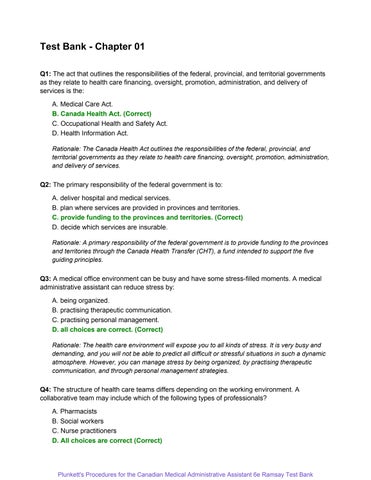
Test Bank - Chapter 01
Q1: The act that outlines the responsibilities of the federal, provincial, and territorial governments as they relate to health care financing, oversight, promotion, administration, and delivery of services is the:
A. Medical Care Act.
B. Canada Health Act. (Correct)
C. Occupational Health and Safety Act.
D. Health Information Act.
Rationale: The Canada Health Act outlines the responsibilities of the federal, provincial, and territorial governments as they relate to health care financing, oversight, promotion, administration, and delivery of services.
Q2: The primary responsibility of the federal government is to:
A. deliver hospital and medical services.
B. plan where services are provided in provinces and territories.
C. provide funding to the provinces and territories. (Correct)
D. decide which services are insurable.
Rationale: A primary responsibility of the federal government is to provide funding to the provinces and territories through the Canada Health Transfer (CHT), a fund intended to support the five guiding principles.
Q3: A medical office environment can be busy and have some stress-filled moments. A medical administrative assistant can reduce stress by:
A. being organized.
B. practising therapeutic communication.
C. practising personal management.
D. all choices are correct. (Correct)
Rationale: The health care environment will expose you to all kinds of stress. It is very busy and demanding, and you will not be able to predict all difficult or stressful situations in such a dynamic atmosphere. However, you can manage stress by being organized, by practising therapeutic communication, and through personal management strategies.
Q4: The structure of health care teams differs depending on the working environment. A collaborative team may include which of the following types of professionals?
A. Pharmacists
B. Social workers
C. Nurse practitioners
D. All choices are correct (Correct)
Rationale: In larger collaborative clinics, such as patient medical homes, the health care team can be much more diverse and include housekeeping staff, building maintenance staff, supply service personnel, nurses, nurse practitioners, physicians, pharmacists, social workers, allied health professionals, and other medical administrative assistants.
Q5: When a physician is delayed or behind schedule, and in order to manage patients as they arrive, a client service approach would be to:
A. check the patient in once you know the physician can see them.
B. inform the patient that the physician is behind schedule and there will be a delay. (Correct)
C. continue with your work until the physician is caught up.
D. reschedule the patient immediately.
Rationale: If the physician is behind schedule, inform patients when they arrive that there is a delay. This will provide optimal client service as most people who visit the doctor’s office are under stress, and it is the role of the medical administrative assistant to do their best to put the client at ease and keep them informed.
Q6: A medical administrative assistant should present a calm, pleasant manner and display equitable treatment and respect for all. Which word would best describe the medical administrative assistant’s approach?
A. Professional (Correct)
B. Robotic
C. Regulated
D. Empathetic
Rationale: At all times the medical administrative assistant should display professional behaviours, including a calm approach, a pleasing personality, equitable treatment, and respect for all.
Q7: A specific personal quality of the medical administrative assistant involves an understanding of how others are feeling in the moment. This is referred to as:
A. integrity.
B. honesty.
C. empathy. (Correct)
D. loyalty.
Rationale: Empathy is the ability to process and understand what another person is experiencing. In the health care environment, health care providers practise empathy in order to be an effective provider and assist all patients.
Q8: This important skill set, which enables medical administrative assistants to complete a variety of medical reports and documents in a timely fashion, is:
A. financial record keeping.
B. speed recognition.
C. basic pharmacology.
D. fast and accurate keyboarding. (Correct)
Rationale: To keep pace with the volume of documentation in a medical setting, the ability to utilize fast and accurate keyboarding skills is essential to manage workload. Accuracy of the documentation has implications for the care of the patient as well as legal implications surrounding the health record of the patient.
Q9: Consideration for professional image should include an awareness of the environmental sensitivities that people may experience. This means the medical administrative assistant must consider which known sensitivity?
A. Fragrances (Correct)
B. Food
C. Design
D. Tattoos
Rationale: The use of fragrances in a medical environment should be avoided due to allergic sensitivities of patients and co-workers.
Q10: Which of the following care settings are accessed by patients when they can no longer be managed in a primary care setting?
A. Secondary care (Correct)
B. Quaternary care
C. Long-term care
D. Community care
Rationale: When a patient’s condition can no longer be managed in a primary care setting, the patient is referred to secondary care for assessment by a specialist physician with advanced expertise. Assessment and treatment may be provided in a clinic environment, a hospital environment, or both.
Q11: A routine task frequently performed by a frontline receptionist includes:
A. greeting patients. (Correct)
B. scheduling physician events.
C. assessing the performance of team members.
D. arranging janitorial services.
Rationale: Frontline reception includes greeting patients, answering the telephones, responding to electronic communications, and communicating messages to patients and staff.
Q12: Although hospitals and clinics may be thought of as the more traditional areas of employment for medical administrative assistants, they may also work for:
A. long-term care facilities.
B. online medical transcription companies.
C. insurance companies.
D. all choices are correct. (Correct)
Rationale: The scope of the medical administrative assistant is broad and allows for employment in many sectors and institution types outside of traditional health care settings. In addition to those noted, they may also work for home care organizations, medical foundations, health care plan offices, dentists, optometrists, and many more.
Q13: When considering the ethical obligations of a medical practitioner as well as their staff, the importance of how personal information is collected, used, maintained, and accessed falls under which of the following areas? (Select all that apply.) (Select all that apply.)
A. Management
B. Confidentiality (Correct)
C. Privacy (Correct)
D. Record keeping
Rationale: It is a medical administrative assistant’s responsibility to ensure that the details of a patient’s medical situation are not passed on to others without patient consent, to uphold confidentiality. Privacy and confidentiality are often used interchangeably; however, privacy is a legal right related to how personal information is maintained and collected, and confidentiality is the ethical obligation to keep information private.
Q14: Physicians have a legal obligation to provide patients with optimum care by avoiding: (Select all that apply.) (Select all that apply.)
A. negligent actions. (Correct)
B. competence.
C. quality care.
D. unprofessional actions. (Correct)
Rationale: Physicians follow professional guidelines that state they must provide the best care possible by avoiding negligent and unprofessional acts. This includes anyone acting as an agent for the physician in their practice.
Q15: Confidentiality ties in closely with the ability of the medical administrative assistant to be: (Select all that apply.) (Select all that apply.)
A. disclosing.
B. discreet. (Correct)
C. private. (Correct)
D. open.
Rationale: Confidentiality requires medical administrative assistants to be discreet in their role; they will be exposed to significant information about a patient and their care. The ability to handle this information with privacy is a key guiding principle.
Q16: In your employment as a medical administrative assistant you will have access to patient records. If you are not involved directly with a patient’s care, you should: (Select all that apply.) (Select all that apply.)
A. have no reason to view the records. (Correct)
B. access them as needed as all patient records are available.
C. not snoop even just once. (Correct)
D. ask others on the team to view the records.
Rationale: A medical administrative assistant should not be accessing any records of patients whose care they are not directly involved in. Staff can have their employment terminated for snooping. Facilities perform audits on their records on a consistent basis.
Q17: Steps a medical administrative assistant can initiate to avoid unnecessary stress in their work environment include: (Select all that apply.) (Select all that apply.)
A. performing several tasks at once.
B. organizing duties. (Correct)
C. focusing on non-urgent duties first.
D. prioritizing tasks. (Correct)
Rationale: Organizing and prioritizing daily tasks helps in effectively dealing with interruptions as they occur.
Q18: Stress can be both healthy and unhealthy.
A. True (Correct)
B. False
Rationale: Healthy stress is the kind that allows you to grow; it moves you forward or excites you. Unhealthy stress holds you back or harms you in some way.
Q19: Maintaining confidentiality and privacy are key components when providing patient care.
A. True (Correct)
B. False
Rationale: Maintaining confidentiality and privacy is essential, as patients trust the reason for a visit will remain the knowledge of that office and within the medical facilities involved directly in their care.
Q20: Preparing and sending diagnostic specimens collected to the appropriate laboratory is never handled by the medical administrative assistant.
A. True
B. False (Correct)
Rationale: The medical administrative assistant will perform a variety of tasks in the work environment, including preparing and handling laboratory specimens to ensure their safe
transmission.
Q21: Some of the nonpatient clients and partners a medical administrative assistant may encounter include pharmaceutical representatives, colleagues, and pharmacists.
A. True (Correct)
B. False
Rationale: The physician will have many health-related touch points, such as colleagues and pharmacists seeking to clarify a prescription that has been written for a patient.
Q22: Written and verbal communication skills are essential for a medical administrative assistant.
A. True (Correct)
B. False
Rationale: Effective, efficient, and accurate communication is needed between the medical administrative assistant and patients, health care providers, and other nonpatient clients in order to avoid errors that may negatively impact patients or smooth operation of the facility.