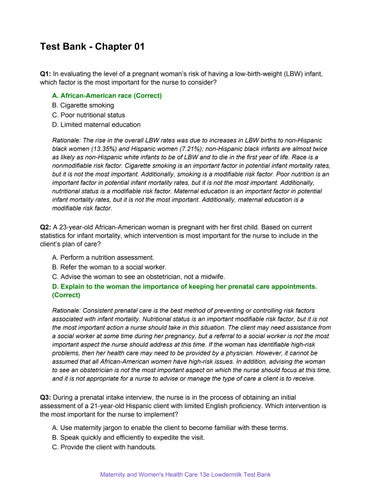
Test Bank - Chapter 01
Q1: In evaluating the level of a pregnant woman’s risk of having a low-birth-weight (LBW) infant, which factor is the most important for the nurse to consider?
A. African-American race (Correct)
B. Cigarette smoking
C. Poor nutritional status
D. Limited maternal education
Rationale: The rise in the overall LBW rates was due to increases in LBW births to non-Hispanic black women (13.35%) and Hispanic women (7.21%); non-Hispanic black infants are almost twice as likely as non-Hispanic white infants to be of LBW and to die in the first year of life. Race is a nonmodifiable risk factor. Cigarette smoking is an important factor in potential infant mortality rates, but it is not the most important. Additionally, smoking is a modifiable risk factor. Poor nutrition is an important factor in potential infant mortality rates, but it is not the most important. Additionally, nutritional status is a modifiable risk factor. Maternal education is an important factor in potential infant mortality rates, but it is not the most important. Additionally, maternal education is a modifiable risk factor.
Q2: A 23-year-old African-American woman is pregnant with her first child. Based on current statistics for infant mortality, which intervention is most important for the nurse to include in the client’s plan of care?
A. Perform a nutrition assessment.
B. Refer the woman to a social worker.
C. Advise the woman to see an obstetrician, not a midwife.
D. Explain to the woman the importance of keeping her prenatal care appointments. (Correct)
Rationale: Consistent prenatal care is the best method of preventing or controlling risk factors associated with infant mortality. Nutritional status is an important modifiable risk factor, but it is not the most important action a nurse should take in this situation. The client may need assistance from a social worker at some time during her pregnancy, but a referral to a social worker is not the most important aspect the nurse should address at this time. If the woman has identifiable high-risk problems, then her health care may need to be provided by a physician. However, it cannot be assumed that all African-American women have high-risk issues. In addition, advising the woman to see an obstetrician is not the most important aspect on which the nurse should focus at this time, and it is not appropriate for a nurse to advise or manage the type of care a client is to receive.
Q3: During a prenatal intake interview, the nurse is in the process of obtaining an initial assessment of a 21-year-old Hispanic client with limited English proficiency. Which intervention is the most important for the nurse to implement?
A. Use maternity jargon to enable the client to become familiar with these terms.
B. Speak quickly and efficiently to expedite the visit.
C. Provide the client with handouts.
D. Assess whether the client understands the discussion. (Correct)
Rationale: Nurses contribute to health literacy by using simple, common words, avoiding jargon, and evaluating whether the client understands the discussion. Speaking slowly and clearly and focusing on what is important will increase understanding. Most client education materials are written at a level too high for the average adult and may not be useful for a client with limited English proficiency.
Q4: The nurses working at a newly established birthing center have begun to compare their performance in providing maternal-newborn care against clinical standards. This comparison process is most commonly known as what?
A. Best practices network
B. Clinical benchmarking
C. Outcomes-oriented practice
D. Evidence-based practice (Correct)
Rationale: Outcomes-oriented practice measures the effectiveness of the interventions and quality of care against benchmarks or standards. The term best practice refers to a program or service that has been recognized for its excellence. Clinical benchmarking is a process used to compare one’s own performance against the performance of the best in an area of service. The term evidence-based practice refers to the provision of care based on evidence gained through research and clinical trials.
Q5: Which statement best exemplifies contemporary maternity nursing?
A. Use of midwives for all vaginal deliveries
B. Family-centered care (Correct)
C. Free-standing birth clinics
D. Physician-driven care
Rationale: Contemporary maternity nursing focuses on the family’s needs and desires. Fathers, partners, grandparents, and siblings may be present for the birth and participate in activities such as cutting the baby’s umbilical cord. Both midwives and physicians perform vaginal deliveries. Free-standing clinics are an example of alternative birth options. Contemporary maternity nursing is driven by the relationship between nurses and their clients.
Q6: A 38-year-old woman vaginally delivered a 9-pound, 6-ounce baby girl after being in labor for 43 hours. The baby died 3 days later from sepsis. On what grounds could the woman have a legitimate legal case for negligence?
A. Inexperienced maternity nurse was assigned to care for the client.
B. Client was past her due date by 3 days.
C. Standard of care was not met. (Correct)
D. Client refused electronic fetal monitoring.
Rationale: Not meeting the standard of care is a legitimate factor for a case of negligence. An inexperienced maternity nurse would need to display competency before being assigned to care for
clients on his or her own. This client may have been past her due date; however, a term pregnancy often goes beyond 40 weeks of gestation. Although fetal monitoring is the standard of care, the client has the right to refuse treatment. This refusal is not a case for negligence, but informed consent should be properly obtained, and the client should have signed an against medical advice form when refusing any treatment that is within the standard of care.
Q7: When the nurse is unsure how to perform a client care procedure that is high risk and low volume, his or her best action in this situation would be what?
A. Ask another nurse.
B. Discuss the procedure with the client’s physician.
C. Look up the procedure in a nursing textbook.
D. First consult the agency procedure manual. (Correct)
Rationale: Following the agency’s policies and procedures manual is always best when seeking information on correct client procedures. These policies should reflect the current standards of care and the individual state’s guidelines. Each nurse is responsible for his or her own practice. Relying on another nurse may not always be a safe practice. Each nurse is obligated to follow the standards of care for safe client care delivery. Physicians are responsible for their own client care activity. Nurses may follow safe orders from physicians, but they are also responsible for the activities that they, as nurses, are to carry out. Information provided in a nursing textbook is basic information for general knowledge. Furthermore, the information in a textbook may not reflect the current standard of care or the individual state or hospital policies.
Q8: A nurse caring for a pregnant client should be aware that the U.S. birth rate shows what trend?
A. Births to unmarried women are more likely to have less favorable outcomes. (Correct)
B. Birth rates for women 40–44 years of age are declining.
C. Cigarette smoking among pregnant women continues to increase.
D. Rates of pregnancy and abortion among teenagers are lower in the United States than in any other industrialized country.
Rationale: LBW infants and preterm births are more likely because of the large number of teenagers in the unmarried group. Birth rates for women in their early 40s continue to increase. Fewer pregnant women smoke. Teen pregnancy and abortion rates are higher in the United States than in any other industrial country.
Q9: A recently graduated nurse is attempting to understand the reason for increasing health care spending in the United States. Which information gathered from research best explains the rationale for these higher costs compared with other developed countries?
A. Higher rate of obesity among pregnant women (Correct)
B. Limited access to technology
C. Increased use of health care services along with lower prices
D. Homogeneity of the population
Rationale: Health care is one of the fastest growing sectors of the U.S. economy. Currently, 19.7% of the gross domestic product is spent on health care. Higher spending in the United States, as compared with 12 other industrialized countries, is related to higher prices and readily accessible technology along with greater obesity rates among women. Approximately 31% of women ages 20–39 are obese. In the population in the United States, 8.5% are uninsured and have limited access to health care. Maternal morbidity and mortality are directly related to racial disparities.
Q10: Which statement best describes maternity nursing care that is based on knowledge gained through research and clinical trials?
A. Maternity nursing care is derived from the Nursing Intervention Classification.
B. Maternity nursing care is known as evidence-based practice. (Correct)
C. Maternity nursing care is at odds with the Cochrane School of traditional nursing.
D. Maternity nursing care is an outgrowth of telehealth.
Rationale: Evidence-based practice is based on knowledge gained from research and clinical trials. The Cochrane Collaboration oversees up-to-date systematic reviews of randomized controlled trials and disseminates these reviews. Telehealth uses communication technologies to support health care.
Q11: What is the minimum level of practice that a reasonably prudent nurse is expected to provide?
A. Standard of care (Correct)
B. Risk management
C. Sentinel event
D. Failure to rescue
Rationale: Guidelines for standards of care are published by various professional nursing organizations. Risk management identifies risks and establishes preventive practices, but it does not define the standard of care. Sentinel events are unexpected negative occurrences. They do not establish the standard of care. Failure to rescue is an evaluative process for nursing, but it does not define the standard of care.
Q12: Using social media technology, nurses can link with other nurses who may share similar interests, insights about practice, and advocate for clients. Which factor is the most concerning pitfall for nurses using this technology?
A. Violation of client privacy and confidentiality (Correct)
B. Institutions and colleagues who may be cast in an unfavorable light
C. Unintended negative consequences for using social media
D. Lack of institutional policy governing online contact
Rationale: The most significant pitfall for nurses using this technology is the violation of client privacy and confidentiality. Furthermore, institutions and colleagues can be cast in an unfavorable light with negative consequences for those posting information. Nursing students have been expelled from school and nurses have been fired or reprimanded by their Board of Nursing for injudicious posts. The American Nurses Association has published six principles for social
networking and the nurse. All institutions should have policies guiding the use of social media, and the nurse should be familiar with these guidelines.
Q13: During a prenatal intake interview, the client informs the nurse that she would prefer a midwife to provide both her care during pregnancy and deliver her infant. Which information is most appropriate for the nurse to share with this client about resulting care?
A. Midwifery care is a good option for clients who are uninsured.
B. She will receive fewer interventions during the birth process. (Correct)
C. She should be aware that midwives are not certified.
D. Her delivery can take place only at home or in a birth center.
Rationale: This client will be able to participate actively in all decisions related to the birth process and is likely to receive fewer interventions during the birth process. Midwifery services are available to all low-risk pregnant women, regardless of the type of insurance they have. Midwifery care in all developed countries is strictly regulated by a governing body to ensure that core competencies are met. In the United States, this body is the American College of Nurse-Midwives (ACNM). Midwives can provide care and delivery at home, in freestanding birth centers, and in community and teaching hospitals.
Q14: While obtaining a detailed history from a woman who has recently immigrated, the nurse realizes that the client has undergone female genital mutilation (FGM). What is the nurse’s most appropriate response in this situation?
A. “This is a very abnormal practice and rarely seen in the United States.”
B. “Are you aware of who performed this mutilation so that it can be reported to the authorities?”
C. “We will be able to restore fully your circumcision after delivery.”
D. “The extent of your circumcision will affect the potential for complications.” (Correct)
Rationale: The extent of the circumcision is important. The client may experience pain, bleeding, scarring, or infection and may require surgery before childbirth. Although this practice is not prevalent in the United States, it is very common in many African and Middle Eastern countries for religious reasons. Mentioning that the practice is abnormal and rarely seen in the United States is culturally insensitive. The infibulation may have occurred during infancy or childhood; consequently, the client will have little to no recollection of the event. She would have considered this to be a normal milestone during her growth and development. The International Council of Nurses has spoken out against this procedure as harmful to a woman’s health.
Q15: Greater than one-third of women in the United States are now obese (body mass index [BMI] of 30 or greater). Less than one quarter of women in Canada exhibit the same BMI. Obesity in the pregnant woman increases both maternal medical risk factors and negative outcomes for the infant. The nurse is about to perform an assessment on a client who is 28 weeks pregnant and has a BMI of 35. What are the most frequently reported complications for which the nurse must be alert while assessing this client? (Select all that apply.) (Select all that apply.)
A. Potential miscarriage
B. Diabetes (Correct)
C. Fetal death in utero
D. Decreased fertility
E. Hypertension (Correct)
Rationale: The two most frequently reported maternal medical risk factors associated with obesity are hypertension associated with pregnancy and diabetes. Decreased fertility, miscarriage, fetal death, and congenital anomalies are also associated with obesity. These clients often experience longer hospital stays and increased use of health services.
Q16: Which statements indicate that the nurse is practicing appropriate family-centered care techniques? (Select all that apply.) (Select all that apply.)
A. The nurse commands the pregnant woman to do as she is told.
B. The nurse allows time for the partner to ask questions. (Correct)
C. The nurse allows the mother and father to make choices when possible. (Correct)
D. The nurse informs the family about what is going to happen.
E. The nurse tells the client’s sister, who is a nurse, that she cannot be in the room during the delivery.
Rationale: Including the partner in the care process and allowing the couple to make choices are important elements of family-centered care. The nurse should never tell the client what to do.
Family-centered care involves collaboration between the health care team and the client. Unless an institutional policy limits the number of attendants at a delivery, the client should be allowed to have whomever she wants present (except when the situation is an emergency and guests are asked to leave).
Q17: Which methods help alleviate the problems associated with access to health care for the maternity client? (Select all that apply.) (Select all that apply.)
A. Provide transportation to prenatal visits. (Correct)
B. Provide child care to enable a pregnant woman to keep prenatal visits. (Correct)
C. Increase the number of providers that will care for Medicaid clients. (Correct)
D. Provide low-cost or no-cost health care insurance. (Correct)
E. Provide job training.
Rationale: Lack of transportation to prenatal visits, child care, access to skilled obstetric providers, and affordable health insurance are prohibitive factors associated with the lack of prenatal care. Although job training may result in employment and income, the likelihood of significant changes during the time frame of the pregnancy is remote.