Test Bank - Chapter 01
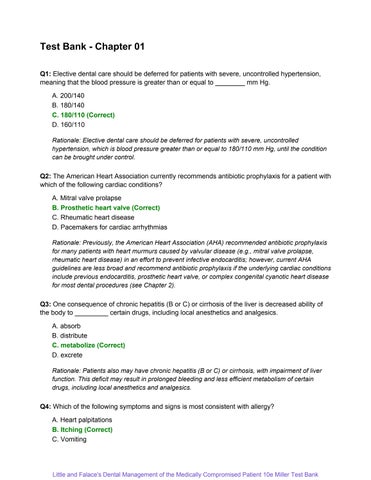
Q1: Elective dental care should be deferred for patients with severe, uncontrolled hypertension, meaning that the blood pressure is greater than or equal to ________ mm Hg.
A. 200/140
B. 180/140
C. 180/110 (Correct)
D. 160/110
Rationale: Elective dental care should be deferred for patients with severe, uncontrolled hypertension, which is blood pressure greater than or equal to 180/110 mm Hg, until the condition can be brought under control.
Q2: The American Heart Association currently recommends antibiotic prophylaxis for a patient with which of the following cardiac conditions?
A. Mitral valve prolapse
B. Prosthetic heart valve (Correct)
C. Rheumatic heart disease
D. Pacemakers for cardiac arrhythmias
Rationale: Previously, the American Heart Association (AHA) recommended antibiotic prophylaxis for many patients with heart murmurs caused by valvular disease (e.g., mitral valve prolapse, rheumatic heart disease) in an effort to prevent infective endocarditis; however, current AHA guidelines are less broad and recommend antibiotic prophylaxis if the underlying cardiac conditions include previous endocarditis, prosthetic heart valve, or complex congenital cyanotic heart disease for most dental procedures (see Chapter 2).
Q3: One consequence of chronic hepatitis (B or C) or cirrhosis of the liver is decreased ability of the body to _________ certain drugs, including local anesthetics and analgesics.
A. absorb
B. distribute
C. metabolize (Correct)
D. excrete
Rationale: Patients also may have chronic hepatitis (B or C) or cirrhosis, with impairment of liver function. This deficit may result in prolonged bleeding and less efficient metabolism of certain drugs, including local anesthetics and analgesics.
Q4: Which of the following symptoms and signs is most consistent with allergy?
A. Heart palpitations
B. Itching (Correct)
C. Vomiting
D. Fainting
Rationale: Symptoms and signs consistent with allergy include itching, urticaria (hives), rash, swelling, wheezing, angioedema, runny nose, and tearing eyes. Isolated signs and symptoms such as nausea, vomiting, heart palpitations, and fainting generally are not of an allergic origin but rather are manifestations of drug intolerance, adverse side effects, or psychogenic reactions.
Q5: Signs and symptoms of diabetes can be recognized in the oral cavity. Which of the following is not a sign or symptom?
A. periodontal disease
B. gingival enlargement
C. xerostomia
D. oral candidiasis (Correct)
Rationale: Signs and symptoms suggestive of diabetes can be recognized by the dentist and include dry mouth, excessive thirst, and hunger, frequent urination, weight loss, poor wound healing, and frequent infections including odontogenic infections, oral candidiasis, and periodontal disease.
Q6: Vasoconstrictors should be avoided in patients who are cocaine or methamphetamine users because these agents may precipitate _________.
A. severe hypotension
B. severe hypertension (Correct)
C. respiratory depression
D. cessation of intestinal peristalsis
Rationale: Vasoconstrictors should be avoided in patients who are cocaine or methamphetamine users because the combination may precipitate arrhythmias, MI, or severe hypertension.
Q7: It has been shown that the risk for occurrence of a serious perioperative cardiovascular event (e.g., MI, heart failure) is increased in patients who are unable to meet a __-MET (metabolic equivalent of task) demand during normal daily activity.
A. 4 (Correct)
B. 6
C. 8
D. 10
Rationale: Daily activities requiring 4 METs include level walking at 4 miles/hour or climbing a flight of stairs. Activities requiring greater than 10 METs include swimming and singles tennis. An exercise capacity of 10 to 13 METs indicates excellent physical conditioning.
Q8: Which of the following alterations in the fingernails is associated with cirrhosis?
A. Yellowing
B. Clubbing
C. White discoloration (Correct)
D. Splinter hemorrhages
Rationale: Alterations in the fingernails, such as clubbing (seen in cardiopulmonary insufficiency), white discoloration (seen in cirrhosis), yellowing (from malignancy), and splinter hemorrhages (from infective endocarditis) usually are caused by chronic disorders.
Q9: The importance of taking vital signs with an initial exam establishes a baseline in case of an emergency. Which of the following vitals may not be taken routinely in a dental office?
A. temperature (Correct)
B. pulse rate
C. blood pressure
D. respiration
Rationale: Despite their importance, vital signs are not frequently or completely recorded in private practice. Many providers do not record height, weight, oxygen saturation levels, or temperature, except when infection or systemic disease is suspected.
Q10: Which of the following is true of a patient classified ASA III according to the American Society of Anesthesiologists (ASA) Physical Status Classification System?
A. Patient has mild systemic disease.
B. Patient’s disease has significant impact on daily activity. (Correct)
C. Patient’s disease is unlikely to have impact on anesthesia and surgery.
D. Patient is moribund.
Rationale: Patient with severe systemic disease is a constant threat to life (e.g., recent myocardial infarction, stroke, transient ischemic attach [<3 months], ongoing cardiac ischemia, severe valve dysfunction, respiratory failure requiring mechanical ventilation). Serious limitation of daily activity; likely major impact on anesthesia and surgery.