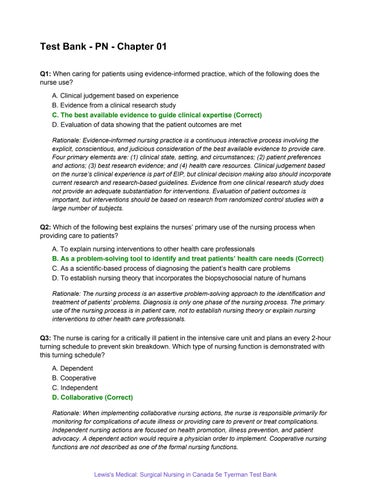
Test Bank - PN - Chapter 01
Q1: When caring for patients using evidence-informed practice, which of the following does the nurse use?
A. Clinical judgement based on experience
B. Evidence from a clinical research study
C. The best available evidence to guide clinical expertise (Correct)
D. Evaluation of data showing that the patient outcomes are met
Rationale: Evidence-informed nursing practice is a continuous interactive process involving the explicit, conscientious, and judicious consideration of the best available evidence to provide care. Four primary elements are: (1) clinical state, setting, and circumstances; (2) patient preferences and actions; (3) best research evidence; and (4) health care resources. Clinical judgement based on the nurse’s clinical experience is part of EIP, but clinical decision making also should incorporate current research and research-based guidelines. Evidence from one clinical research study does not provide an adequate substantiation for interventions. Evaluation of patient outcomes is important, but interventions should be based on research from randomized control studies with a large number of subjects.
Q2: Which of the following best explains the nurses’ primary use of the nursing process when providing care to patients?
A. To explain nursing interventions to other health care professionals
B. As a problem-solving tool to identify and treat patients’ health care needs (Correct)
C. As a scientific-based process of diagnosing the patient’s health care problems
D. To establish nursing theory that incorporates the biopsychosocial nature of humans
Rationale: The nursing process is an assertive problem-solving approach to the identification and treatment of patients’ problems. Diagnosis is only one phase of the nursing process. The primary use of the nursing process is in patient care, not to establish nursing theory or explain nursing interventions to other health care professionals.
Q3: The nurse is caring for a critically ill patient in the intensive care unit and plans an every 2-hour turning schedule to prevent skin breakdown. Which type of nursing function is demonstrated with this turning schedule?
A. Dependent
B. Cooperative
C. Independent
D. Collaborative (Correct)
Rationale: When implementing collaborative nursing actions, the nurse is responsible primarily for monitoring for complications of acute illness or providing care to prevent or treat complications. Independent nursing actions are focused on health promotion, illness prevention, and patient advocacy. A dependent action would require a physician order to implement. Cooperative nursing functions are not described as one of the formal nursing functions.
Q4: The nurse is caring for a patient who has been admitted to the hospital for surgery and tells the nurse, “I do not feel right about leaving my children with my neighbour.” Which action should the nurse take next?
A. Reassure the patient that these feelings are common for parents.
B. Have the patient call the children to ensure that they are doing well.
C. Call the neighbour to determine whether adequate childcare is being provided.
D. Gather more data about the patient’s feelings about the childcare arrangements. (Correct)
Rationale: Since a complete assessment is necessary in order to identify a problem and choose an appropriate intervention, the nurse’s first action should be to obtain more information. The other actions may be appropriate, but more assessment is needed before the best intervention can be chosen.
Q5: The nurse is caring for a patient who has left-sided paralysis as the result of a stroke and assesses a pressure injury on the patient’s left hip. Which of the following is the most appropriate nursing diagnosis for this patient?
A. Impaired physical mobility related to decrease in muscle control (left-sided paralysis)
B. Risk for impaired tissue integrity as evidenced by insufficient knowledge about protecting tissue integrity
C. Impaired skin integrity related to pressure over bony prominence (impaired circulation) (Correct)
D. Ineffective tissue perfusion related to sedentary lifestyle
Rationale: The patient’s major problem is the impaired skin integrity as demonstrated by the presence of a pressure injury. The nurse is able to treat the cause of altered circulation and pressure by frequently repositioning the patient. Although left-sided weakness is a problem for the patient, the nurse cannot treat the weakness. The “risk for” diagnosis is not appropriate for this patient, who already has impaired tissue integrity. The patient does have ineffective tissue perfusion, but the impaired skin integrity diagnosis indicates more clearly what the health problem is.
Q6: The nurse caring for a patient with an infection has a nursing diagnosis of deficient fluid volume related to excessive diaphoresis. Which of the following is an appropriate patient outcome?
A. Patient has a balanced intake and output. (Correct)
B. Patient’s bedding is changed when it becomes damp.
C. Patient understands the need for increased fluid intake.
D. Patient’s skin remains cool and dry throughout hospitalization.
Rationale: This statement gives measurable data showing resolution of the problem of deficient fluid volume that was identified in the nursing diagnosis statement. The other statements would not indicate that the problem of deficient fluid volume was resolved.
Q7: Which of the following represents a nursing activity that is carried out during the evaluation phase of the nursing process?
A. Determining if interventions have been effective in meeting patient outcomes (Correct)
B. Documenting the nursing care plan in the progress notes in the medical record
C. Deciding whether the patient’s health problems have been completely resolved
D. Asking the patient to evaluate whether the nursing care provided was satisfactory
Rationale: Evaluation consists of determining whether the desired patient outcomes have been met and whether the nursing interventions were appropriate. The other responses do not describe the evaluation phase.
Q8: Which of the following would the nurse perform during the assessment phase of the nursing process?
A. Obtains data with which to diagnose patient problems (Correct)
B. Uses patient data to develop priority nursing diagnoses
C. Teaches interventions to relieve patient health problems
D. Assists the patient to identify realistic outcomes to health problems
Rationale: During the assessment phase, the nurse gathers information about the patient. The other responses are examples of the intervention, diagnosis, and planning phases of the nursing process.
Q9: Which of the following is an example of a correctly written nursing diagnosis statement?
A. Altered tissue perfusion related to heart failure
B. Risk for impaired tissue integrity related to sacral redness
C. Ineffective coping related to insufficient sense of control (Correct)
D. Altered urinary elimination related to urinary tract infection
Rationale: This diagnosis statement includes a NANDA nursing diagnosis and an etiology that describes a patient’s response to a health problem that can be treated by nursing. The use of a medical diagnosis (as in the responses beginning “Altered tissue perfusion” and “Altered urinary elimination”) is not appropriate. The response beginning “Risk for impaired tissue integrity” uses the defining characteristics as the etiology.
Q10: Which of the following includes the components required for a complete nursing diagnosis statement?
A. A problem and the suggested patient goals or outcomes
B. A problem, its cause, and objective data that support the problem
C. A problem with all its possible causes and the planned interventions
D. A problem with its etiology and the signs and symptoms of the problem (Correct)
Rationale: The PES format is used when writing nursing diagnoses. The subjective, as well as objective, data should be included in the defining characteristics. Interventions and outcomes are
not included in the nursing diagnosis statement.
Q11: Which of the following refers to a situation that results in unintended harm to the patient and is related to the care or services provided rather than the patient’s medical condition?
A. Negligence
B. Adverse event (Correct)
C. Incident report
D. Nonmaleficence
Rationale: An adverse event is an event that results in unintended harm to the patient and is related to the care or services provided to the patient rather than to the patient’s underlying medical condition.
Q12: When using the Five Steps of the evidence-informed practice (EIP) Process, which of the flowing elements is the final step when constructing a clinical question?
A. Comparison of interest
B. Population of interest
C. Outcome of interest
D. Timeframe of interest (Correct)
Rationale: The order of the nurse’s statements follows the PICOT format with the final step being the “T”, or timeframe of interest.
Test Bank - RN - Chapter 01
Q1: The nurse is caring for a patient with a new diagnosis of pneumonia and explains to the patient that together they will plan the patient’s care and set goals for discharge. The patient asks, “How is that different from what the doctor does?” Which response by the nurse is most appropriate?
A. “The role of the nurse is to administer medications and other treatments prescribed by your doctor.”
B. “The nurse’s job is to help the doctor by collecting data and communicating when there are problems.”
C. “Nurses perform many of the procedures done by physicians, but nurses are here in the hospital for a longer time than doctors.”
D. “In addition to caring for you while you are sick, the nurses will assist you to develop an individualized plan to maintain your health.” (Correct)
Rationale: This response is consistent with the Canadian Nurses Association (CNA) definition of nursing. Registered nurses are self-regulated health care professionals who work autonomously and in collaboration with others. RNs enable individuals, families, groups, communities and populations to achieve their optimal level of health. RNs coordinate health care, deliver direct services, and support patients in their self-care decisions and actions in situations of health, illness, injury, and disability in all stages of life. The other responses describe some of the dependent and collaborative functions of the nursing role but do not accurately describe the nurse’s role in the health care system.
Q2: When caring for patients using evidence-informed practice, which of the following does the nurse use?
A. Clinical judgement based on experience
B. Evidence from a clinical research study
C. The best available evidence to guide clinical expertise (Correct)
D. Evaluation of data showing that the patient outcomes are met
Rationale: Evidence-informed nursing practice is a continuous interactive process involving the explicit, conscientious, and judicious consideration of the best available evidence to provide care. Four primary elements are: (a) clinical state, setting, and circumstances; (b) patient preferences and actions; (c) best research evidence, and (d) health care resources. Clinical judgement based on the nurse’s clinical experience is part of EIP, but clinical decision making also should incorporate current research and research-based guidelines. Evidence from one clinical research study does not provide an adequate substantiation for interventions. Evaluation of patient outcomes is important, but interventions should be based on research from randomized control studies with a large number of subjects.
Q3: Which of the following best explains the nurse’s primary use of the nursing process when providing care to patients?
A. To explain nursing interventions to other health care professionals
B. As a problem-solving tool to identify and treat patients’ health care needs (Correct)
C. As a scientific-based process of diagnosing the patient’s health care problems
D. To establish nursing theory that incorporates the biopsychosocial nature of humans
Rationale: The nursing process is an assertive problem-solving approach to the identification and treatment of patients’ problems. Diagnosis is only one phase of the nursing process. The primary use of the nursing process is in patient care, not to establish nursing theory or explain nursing interventions to other health care professionals.
Q4: The nurse is caring for a critically ill patient in the intensive care unit and plans an every-2-hour turning schedule to prevent skin breakdown. Which type of nursing function is demonstrated with this turning schedule?
A. Dependent
B. Cooperative
C. Independent
D. Collaborative (Correct)
Rationale: When implementing collaborative nursing actions, the nurse is responsible primarily for monitoring for complications of acute illness or providing care to prevent or treat complications. Independent nursing actions are focused on health promotion, illness prevention, and patient advocacy. A dependent action would require a physician order to implement. Cooperative nursing functions are not described as one of the formal nursing functions.
Q5: The nurse is caring for a patient who has been admitted to the hospital for surgery and tells the nurse, “I do not feel right about leaving my children with my neighbour.” Which action should the nurse take next?
A. Reassure the patient that these feelings are common for parents.
B. Have the patient call the children to ensure that they are doing well.
C. Call the neighbour to determine whether adequate childcare is being provided.
D. Gather more data about the patient’s feelings about the childcare arrangements. (Correct)
Rationale: Since a complete assessment is necessary in order to identify a problem and choose an appropriate intervention, the nurse’s first action should be to obtain more information. The other actions may be appropriate, but more assessment is needed before the best intervention can be chosen.
Q6: The nurse is caring for a patient who has left-sided paralysis as the result of a stroke and assesses a pressure injury on the patient’s left hip. Which of the following is the most appropriate nursing diagnosis for this patient?
A. Impaired physical mobility related to decrease in muscle control (left-sided paralysis)
B. Risk for impaired tissue integrity as evidenced by insufficient knowledge about protecting tissue integrity
C. Impaired skin integrity related to pressure over bony prominence (impaired circulation) (Correct)
D. Ineffective peripheral tissue perfusion related to sedentary lifestyle
Rationale: The patient’s major problem is the impaired skin integrity as demonstrated by the presence of a pressure injury. The nurse is able to treat the cause of impaired circulation and pressure over bony prominence by frequently repositioning the patient. Although left-sided weakness is a problem for the patient, the nurse cannot treat the weakness. The “risk for” diagnosis is not appropriate for this patient, who already has impaired tissue integrity. The patient does have ineffective peripheral tissue perfusion, but the impaired skin integrity diagnosis indicates more clearly what the health problem is.
Q7: The nurse caring for a patient with an infection has a nursing diagnosis of deficient fluid volume related to excessive fluid loss through normal route (diaphoresis). Which of the following is an appropriate patient outcome?
A. Patient has a balanced intake and output. (Correct)
B. Patient’s bedding is changed when it becomes damp.
C. Patient understands the need for increased fluid intake.
D. Patient’s skin remains cool and dry throughout hospitalization.
Rationale: This statement gives measurable data showing resolution of the problem of deficient fluid volume that was identified in the nursing diagnosis statement. The other statements would not indicate that the problem of deficient fluid volume was resolved.
Q8: Which of the following represents a nursing activity that is carried out during the evaluation phase of the nursing process?
A. Determining if interventions have been effective in meeting patient outcomes. (Correct)
B. Documenting the nursing care plan in the progress notes in the medical record.
C. Deciding whether the patient’s health problems have been completely resolved.
D. Asking the patient to evaluate whether the nursing care provided was satisfactory.
Rationale: Evaluation consists of determining whether the desired patient outcomes have been met and whether the nursing interventions were appropriate. The other responses do not describe the evaluation phase.
Q9: Which of the following would the nurse perform during the assessment phase of the nursing process?
A. Obtains data with which to diagnose patient problems. (Correct)
B. Uses patient data to develop priority nursing diagnoses.
C. Teaches interventions to relieve patient health problems.
D. Assists the patient to identify realistic outcomes to health problems.
Rationale: During the assessment phase, the nurse gathers information about the patient. The other responses are examples of the intervention, diagnosis, and planning phases of the nursing process.
Q10: Which of the following is an example of a correctly written nursing diagnosis statement?
A. Altered tissue perfusion related to heart failure
B. Risk for impaired tissue integrity related to sacral redness
C. Ineffective coping related to insufficient sense of control (Correct)
D. Altered urinary elimination related to urinary tract infection
Rationale: This diagnosis statement includes a NANDA nursing diagnosis and an etiology that describes a patient’s response to a health problem that can be treated by nursing. The use of a medical diagnosis (as in the responses beginning “Altered tissue perfusion” and “Altered urinary elimination”) is not appropriate. The response beginning “Risk for impaired tissue integrity” uses the defining characteristics as the etiology.
Q11: Which of the following includes the components required for a complete nursing diagnosis statement?
A. A problem and the suggested patient goals or outcomes
B. A problem, its cause, and objective data that support the problem
C. A problem with all its possible causes and the planned interventions
D. A problem with its etiology and the signs and symptoms of the problem (Correct)
Rationale: The PES format is used when writing nursing diagnoses. The subjective, as well as objective, data should be included in the defining characteristics. Interventions and outcomes are not included in the nursing diagnosis statement.
Q12: Which of the following refers to a situation that results in unintended harm to the patient and is related to the care or services provided rather than the patient’s medical condition?
A. Negligence
B. Adverse event (Correct)
C. Incident report
D. Nonmaleficence
Rationale: An adverse event is an event that results in unintended harm to the patient and is related to the care or services provided to the patient rather than to the patient’s underlying medical condition.
Q13: Which of these nursing actions for the patient with heart failure is appropriate for the nurse to delegate to experienced unregulated care providers?
A. Assess for shortness of breath or fatigue after ambulation.
B. Instruct the patient about the need to alternate activity and rest.
C. Obtain the patient’s blood pressure and pulse rate after ambulation. (Correct)
D. Determine whether the patient is ready to increase the activity level.
Rationale: Unregulated care provider education varies according to the type of worker; however, unregulated care providers are able to measure vital signs. Assessment and patient teaching require RN education and scope of practice and cannot be delegated.
Q14: Which action by a newly graduated RN working on the postsurgical unit indicates that more education about delegation and assignment is needed?
A. The nurse delegates measurement of patient oral intake and urine output to an unregulated care provider.
B. The nurse delegates assessment of a patient’s bowel sounds to an experienced unregulated care provider. (Correct)
C. The nurse assigns an LPN/RPN to administer oral medications to several patients.
D. The nurse assigns a “float” RN from pediatrics to care for a patient with diabetes.
Rationale: Assessment requires RN education and scope of practice and cannot be delegated to an unregulated care provider. The other actions by the new RN are appropriate.
Q15: Which of these tasks is appropriate for the registered nurse to delegate to an unregulated care provider?
A. Perform a sterile dressing change for an infected wound.
B. Complete the patients’ initial bath. (Correct)
C. Teach a patient about the effects of prescribed medications.
D. Document patient teaching about a routine surgical procedure.
Rationale: Unregulated care providers are able to provide personal care to patients. Patient teaching and the initial assessment and development of the plan of care are nursing actions that require RN-level education and scope of practice when working with patients that are not stable.
Q16: When using the Five Steps of the Evidence-Informed Practice (EIP) Process, in which order should the nurse construct a clinical question? (Select all that apply.) (Select all that apply.)
A. Comparison of interest (Correct)
B. Population of interest (Correct)
C. Outcome of interest (Correct)
D. Intervention of interest (Correct)
E. Timeframe (Correct)
Rationale: The order of the nurse’s statements follows the PICOT format.
Review Questions - Chapter 01
Q1: The nurse is caring for a patient who has heart failure and encourages the patient to alternate rest and activity periods to reduce cardiac workload. Which phase of the nursing process is the nurse demonstrating?
A. Planning
B. Diagnosis
C. Evaluation
D. Implementation (Correct)
Rationale: Carrying out the specific, individualized plan constitutes the implementation phase of the nursing process. The nurse’s action of encouragement and instruction to the patient is part of carrying out a plan of action.
Q2: The nurse is planning care for a patient and uses a visual diagram of patient problems and interventions to illustrate the relationships among pertinent clinical data. Which format is the nurse using to plan care?
A. Concept map (Correct)
B. Critical pathway
C. Clinical pathway
D. Nursing care plan
Rationale: A concept map is another method of recording a nursing care plan. In a concept map, the nursing process is recorded in a visual diagram of patient problems and interventions. A clinical (critical) pathway is a prewritten plan that directs the entire health care team in the daily care goals for select health care problems.
Q3: Which of the following statements represents the “O” component of the subjective, objective, assessment, plan (SOAP) process for documentation?
A. More pain at present
B. Temperature 39.4°C (102.9°F) (Correct)
C. Risk for infection
D. Notify surgeon
Rationale: “Temperature 39.4°C (102.9°F)” is measurable and objective data which is collected by the nurse, and is the “O” component of the subjective, objective, assessment, plan (SOAP) documentation process. “More pain at present” is subjective. Assessment develops the diagnosis of the risk for infection; notifying the surgeon becomes the plan.
Q4: A nurse who is caring for postoperative patients develops the following clinical question: In adult postoperative patients, how does guided imagery compare with music therapy affects as analgesia use within the first 24 hours after surgery? Applying the PICOT framework, which of the following would be the “I” element in this question?
A. Guided imagery (Correct)
B. Music therapy
C. Analgesia use
D. Adult postoperative patients
Rationale: PICOT is a format for framing a clinical question as part of the evidence-informed practice process. “I” is the intervention of interest which in this example is guided imagery. The “P” is adult postoperative patients, “C” is music therapy, “O” is analgesia use, and “T” is first 24 hours following surgery.
Q5: The nurse is investigating ways in which to improve interprofessional team communication and has chosen the SBAR model. Which of the following reflects the meaning of the “R” in the SBAR model?
A. Risk assessment
B. Recommendation (Correct)
C. Responsibility of action
D. Roles of health team members
Rationale: One structured model used to improve communication is the SBAR (situation, background, assessment, and recommendation) technique.
Q6: A team of nurses have a vision to implement evidence-informed practice (EIP) for care of patients with pressure ulcers. Which of the following sources of evidence would this change in practice encompass? (Select all that apply.) (Select all that apply.)
A. Consulting with the wound care and ostomy nurse (Correct)
B. The preferences of patients and their particular circumstances (Correct)
C. Nurses’ expertise and their bodies of experience and knowledge (Correct)
D. The traditions that surround pressure ulcer practises on the unit
E. Journal articles that address the care of patients with pressure ulcers (Correct)
Rationale: Evidence-informed practice (EIP) draws on research, patient preferences, and clinical expertise. The particular traditions on the nursing unit would not form a component of EIP, nor are we aware of what those traditions are.