Solutions Manual for Economics 2024
Release 1st Edition by Karlan, Morduch
ISBN: 9781266743023
ISBN: 9781266743023
1. Suppose you are shopping for new clothes to wear to job interviews, but you’re on a tight budget. In this situation, what are your wants and constraints? What does it mean to behave rationally in the face of scarcity? [LO 1.1]
Answer: If you are deciding what to buy for a job interview, your want is to buy clothing that looks clean and professional, so you can present the best possible impression to potential employers. Your constraint is the amount of money you can spend on this clothing. A person behaving rationally would buy the nicest clothes they could afford.
2. You are a student with a demanding schedule of classes. You also work part-time and your supervisor allows you to determine your schedule. In this situation, what is your scarce resource? How do you decide how many hours to work? [LO 1.1]
Answer: Your scarce resource is time. You need both time to study and time to work. Presumably, you want to do well in school and also make money. You will try to balance your schedule so that you work as much as possible while still having enough time to study and do well in school.
3. Think about the definition of scarcity that you learned in this chapter. Name three ways that you confront scarcity in your own life. [LO 1.1]
Answer: People face scarcity in many aspects of their lives. Some people love to travel and explore new places, so they face scarcity in both time and money that keeps them from traveling as often as they would like. Others face scarcity in their professional life, in that there are often many worthwhile projects to address, but the available resources are limited in terms of employees, time, and budget.
4. When shopping for your interview clothes, what are some trade-offs you face? What is the opportunity cost of buying new clothes? What are the benefits? How do you balance the two? [LO 1.2]
Answer: The money you spend on clothes for a job interview could be spent on other things instead, so it is one opportunity cost. Another opportunity cost is the time you spend
shopping, which could be spent preparing for your interview or playing Frisbee. The benefits include looking put-together during the interview, which provides a boost to your job prospects. You balance the costs and benefits by accepting costs that are less than (or no greater than) the benefits they provide.
5. You have an 8:30 class this morning but you are feeling extremely tired. How do you decide whether to get some extra sleep or go to class? [LO 1.2]
Answer: If you are behaving rationally, you decide by comparing the trade-offs. The opportunity cost of going to class is missing out on some extra sleep. Depending on what else in on your schedule that day (perhaps an important interview), it may make sense to choose extra sleep over class. The opportunity cost of extra sleep is that you will miss the lecture. If your grade will suffer significantly by your absence, you may want to grab some coffee and go to class!
6. It’s Friday night. You already have a ticket to a concert, which cost you $30. A friend invites you to go out for a game of paintball instead. Admission would cost you $25, and you think you’d get $25 worth of enjoyment out of it. Your concert ticket is nonrefundable. What is your opportunity cost (in dollars) of playing paintball? [LO 1.2]
Answer: The opportunity cost of going to play paintball is whatever amount of enjoyment (in dollars) you would get out of going to the concert. The $30 you paid for the concert ticket is not relevant to the decision, as it is a sunk cost and is nonrefundable regardless of what you do.
7. Suppose you have two job offers and are considering the trade-offs between them. Job A pays $45,000 per year and includes health insurance and two weeks of paid vacation. Job B pays $30,000 per year; it includes four weeks of paid vacation but no health insurance. [LO 1.2]
a. List the benefits of Job A and the benefits of Job B.
b. List the opportunity cost of Job A and the opportunity cost of Job B.
Answer:
a. The benefits of Job A are the extra pay and health insurance. For Job B, the benefit is two extra weeks of vacation.
b. The opportunity cost of Job A is losing out on the extra two weeks of vacation that comes with Job B. For Job B, the opportunity costs are the extra $15,000 in salary and the health insurance that come with Job A.
8. Your former neighbors gave you their lawnmower when he moved. You are thinking of using this gift to mow lawns in your neighborhood this summer for extra cash. As you think about what to charge your neighbors and whether this idea is worth your effort, what opportunity costs do you need to consider? [LO 1.2]
Answer: You need to consider the opportunity cost of your time. Your lawn mowing business would need to cover the opportunity cost of what you could earn in another summer job. You also need to consider the cost of gasoline for the mower and the value of the lawn mower itself. Just because it was a gift does not mean that it has no opportunity cost. The opportunity cost of using the lawnmower for your business is its sale value, if you decide to sell the gift rather than use it yourself. Your lawn mowing business needs to cover all of these costs (the value of your time in another job, gasoline, and the sale value of the lawnmower) in order for it to be a worthwhile endeavor.
9. Think of a few examples of incentives in your daily life. How do you respond to those incentives? [LO 1.3]
Answer: An incentive is something that causes people to behave in a certain way by changing the trade-offs they face. No parking signs encourage people not to park in certain places and speed limit signs encourage people not to drive too fast. The consequence in either case is the risk of getting a ticket. The ability to devote a certain percentage of income to a 401(k) retirement account each month before paying taxes encourages people to save for retirement.
10. You supervise a team of salespeople. Your employees already receive a company discount. Suggest a positive incentive and a negative incentive you could use to improve their productivity. [LO 1.3]
Answer: For a positive incentive, you could offer a reward such as a bonus, a gift certificate, or an extra discount on company merchandise to the most productive employee of the month. For a negative incentive, you could announce that employees who fail to meet targets will lose their company discount.
11. Your boss decides to pair workers in teams and offer bonuses to the most productive team. Why might your boss offer team bonuses instead of individual bonuses? [LO 1.3]
Answer: Your boss is creating a reward system for a project that requires group effort. Even if you are not motivated to compete for an individual bonus, you are likely to feel responsibility to your teammate and make a greater effort to be productive. Your teammate can encourage, pressure, and/or help you to achieve greater productivity.
12. Think of a public policy a local or national law, tax, or public service that offers an
incentive for a particular behavior. Explain what the incentive is, who is offering it, and what they are trying encourage or discourage. Does the incentive work? [LO 1.3]
Answer: The U.S. government places a subsidy on growing corn. This provides an incentive for farmers to plant corn on more of their land instead of alternative crops. The government is trying to encourage the production of domestic corn so that the United States can produce corn-based ethanol more cheaply.
13. Why do individuals or firms usually provide the goods and services people want? [LO 1.4]
Answer: If firms didn’t produce goods that people want, no one would buy their goods. These firms would lose money and go out of business, and would be replaced by firms that did produce goods that customers want.
14. You may have seen TV advertisements for products or programs that claim to teach a surefire way to make millions on the stock market. Apply the Why isn’t someone already doing it? test to this situation. Do you believe the ads? Why or why not? [LO 1.4]
Answer: Guessing which stocks are going to perform well and which are going to tank is a hard, if not impossible, task which makes it very hard to make millions in the stock market. You should not believe the ads for that reason. (If there really was a surefire way to make millions, you can bet everyone would already be doing it!)
15. Describe an innovation in technology, business, or culture that had a major economic impact in your lifetime. [LO 1.4]
Answer: The Internet has completely changed the way people do business. While writing this textbook, we have collaborated with people all over the country, sharing documents online that we once would have had to send through the mail.
16. Why do people confuse correlation with causation? [LO 1.5]
Answer: Correlation means that two events occur together. Since the two often occur together, people often believe that one causes the other, but this is not always true. People once thought that ice cream caused polio, for example. The real relationship was that people ate more ice cream in the summer, and this also happened to be the time of year that the polio virus spread more rapidly.
17. Name two things that are positively correlated and two things that are negatively correlated. [LO 1.5]
Answer: Events that are positively correlated tend to occur together, or move in the same direction. For example, more people tend to carry an umbrella when the risk of rain is high. When one event increases at the same time a related event decreases, then the two events are negatively correlated. According to auto insurers, good grades and the risk of getting in a car accident are negatively correlated. (People with higher grades tend to be safer drivers.)
18. Why is it important for a good economic model to predict cause and effect? [LO 1.6]
Answer: A good model must predict cause and effect so that it can explain something about what we have observed and can help us anticipate what will happen in future observations.
19. Why is it important for a good economic model to make clear assumptions? [LO 1.6]
Answer: A good model must make clear assumptions so we know when the model will do a good job at explaining or predicting our observations and when it will not.
20. What is the difference between disagreeing about a positive statement and disagreeing about a normative statement? [LO 1.7]
Answer: A positive statement is something that is supposed by fact, whereas a normative statement is a value judgment. So disagreeing with a normative statement means you disagree with someone’s opinion. Disagreeing with a positive statement means disputing the truth of fact.
21. Would a good economic model be more likely to address a positive statement or a normative statement? Why? [LO 1.7]
Answer: A good model predicts cause and effect and can be tested with evidence. Thus, positive statements are more likely to be addressed by a good model.
1. Think about how and why goods and resources are scarce. Goods and resources can be scarce for reasons that are inherent to their nature at all times, that are temporary or seasonal, or that are artificially created. Separate the goods listed below into two groups; indicate which (if any) are artificially scarce (AS) and which (if any) are inherently scarce (IS). [LO 1.1]
a. Air of any quality
b. Land
c. Patented goods
d. Original Picasso paintings
Answer: Goods and resources can be inherently scarce at all times if there is a limited or finite supply of the resource, or artificially scarce when access to the resource is restricted.
a. Not scarce. Air (of any quality) is abundant and need not be rationed through prices or some other allocation mechanism.
b. Inherently scarce. Land is finite in supply; land is available for development, but no new land can be created.
c. Artificially scarce. Patented goods are scarce by law; only the patent holder may supply these goods.
d. Inherently scarce. Original Picasso paintings are finite; no new Picasso’s can be created beyond those that currently exist.
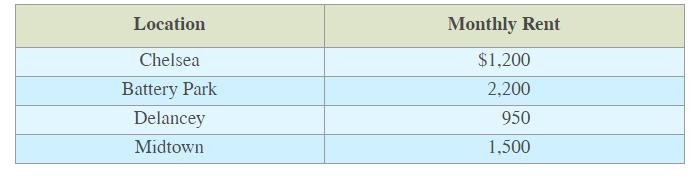
2. You are looking for a new apartment in Manhattan. Your income is $4,000 per month, and you know that you should not spend more than 25 percent of your income on rent. You have come across the listings for one-bedroom apartments shown in Table 1P-1. You are indifferent about location, and transportation costs are the same to each neighborhood. [LO 1.1]
a. Which apartments fall within your budget?
b. Suppose that you adhere to the 25 percent guideline but also receive a $1,000 cost-ofliving supplement because you are living and working in Manhattan. Which apartments fall within your budget now?
Answer:
a. Delancey Your income and income guidelines represent a constraint on the choices available. Under these guidelines, 25 percent of your monthly income is $1,000. So the only apartment you can afford within your budget is Delancey, at $950. All others are unattainable to you.
b. Chelsea and Delancey The $1,000 monthly cost-of-living supplement expands your set of living options. Your income is now effectively $5,000 per month, so you can afford any apartment that costs $1,250 or less (25 percent of $5,000). These choices now include Chelsea ($1,200) and Delancey ($950).
3. Suppose the price of a sweater is $26. Jaylen’s benefit from purchasing each additional sweater is given in the Table 1P-2 He gets the most benefit from the first sweater and less benefit from each additional sweater. If Jaylen is behaving rationally, how many sweaters will he purchase? [LO 1.2]
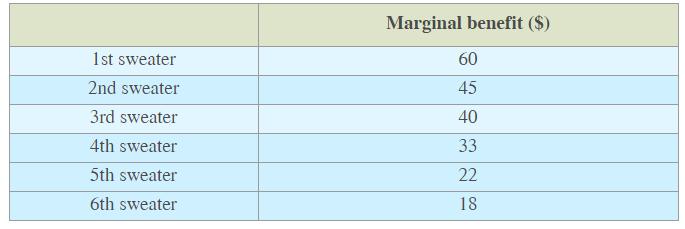
Answer: Jaylen will purchase all of the sweaters for which the marginal benefit is greater than the marginal cost. If the price of a sweater is $26, this is the marginal cost, as each additional sweater will cost $26. For the first four sweaters, the marginal benefit exceeds the marginal cost, so Jaylen will purchase four sweaters. For the fifth sweater, the marginal cost of $26 exceeds the marginal benefit. Marginal
1st sweater $60
2nd sweater
3rd sweater
4th sweater
5
6
4. Sweaters sell for $15 at the crafts fair. Allie knits sweaters; her marginal costs are given in the Table 1P-3. Allie’s costs increase with each additional sweater. If Allie is behaving rationally, how many sweaters will she sell? [LO 1.2]
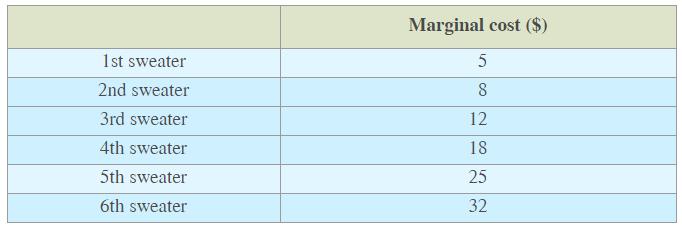
Answer: Allie will sell all of the sweaters for which the marginal benefit is greater than the marginal cost. If the price of a sweater is $15, this is the marginal benefit, as Allie will
receive $15 for each additional sweater she sells. For the first 3 sweaters, the marginal benefit exceeds the marginal cost, so Allie will sell 3 sweaters.
Marginal Cost
1st sweater
2nd sweater
3rd sweater
4th sweater
5th sweater
6th sweater
$5
$8
$12
$18
$25
$32
5. Last year, you estimated you would earn $5 million in sales revenues from developing a new product. So far, you have spent $3 million developing the product, but it is not yet complete. Meanwhile, this year you have new sales projections that show expected revenues from the new product will actually be only $4 million. How much should you be willing to spend to complete the product development? [LO 1.2]
a. $0.
b. Up to $1 million.
c. Up to $4 million.
d. Whatever it takes.
Answer: You should spend up to $4 million. The $3 million you have spent already is a sunk cost and cannot be recovered. Therefore, the $3 million you have spent is irrelevant to the decision of how much to spend going forward. This year, the relevant decision is: How much are you willing to spend to have $4 million in revenue? If you had known that product development may cost you more than you will gain in revenues, you should not have started this project. But at this point, by thinking on the margin, you can see that you should be willing to move forward as long as the costs of going forward are not greater than the benefits of going forward ($4 million).
6. Consider the following examples. For each one, say whether the incentive is positive or negative. [LO 1.3]
a. Bosses who offer time-and-a-half for working on national holidays.
b. Mandatory minimum sentencing for drug offenses.
c. Fines for littering.
d. Parents who offer their children extra allowance money for good grades.
Answer: A positive incentive like bonus compensation or monetary awards makes people more likely to do something. A negative incentive like fines, incarceration, and taxes makes them less likely to do something.
a. Positive.
b. Negative.
c. Negative.
d. Positive.
7. Consider the following events that change prices as described in Table 1P-4. For each one, say whether the opportunity cost of consuming the affected good increases or decreases. [LO 1.3]
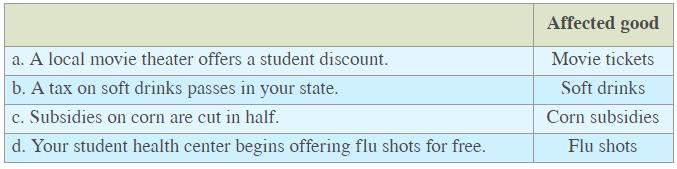
Answer:
a. Decreases.
b. Increases.
c. Increases.
d. Decreases.
8. Your best friend has an idea for a drive-through bar. Indicate the best explanation for why others have not taken advantage of her idea: true innovation, market failure, government intervention, or unprofitablity. [LO 1.4]
Answer: Government intervention. In most places, drive-thru bars are (wisely) illegal.
9. Your best friend has an idea for a long-distance car service to drive people across the country. Indicate the best explanation for why others have not taken advantage of her idea: true innovation, market failure, intervention, or unprofitablity. [LO 1.4]
Answer: Unprofitable. There are alternatives for customers that can be cheaper than car service. For example, buses can offer cheaper prices than a car service could. While a car is less costly to operate than a bus, a bus can more than make up the difference in operation cost by accommodating many more passengers.
10. Determine whether each of the following questionable statements is best explained by coincidence, an omitted variable, or reverse causation. [LO 1.5]
a. In cities that have more police, crime rates are higher.
b. Many retired people live in states where everyone uses air conditioning during the summer.
c. More people come down with the flu during the Winter Olympics than during the Summer Olympics.
d. For the last five years, Punxsutawney Phil has seen his shadow on Groundhog Day, and spring has come late.
Answer:
a. Reverse causation: Cities with higher crime rates will tend to have larger police departments.
b. Omitted variable: Having a large number of retired people live in a state does not cause everyone to use their air conditioner. Retired people tend to move to warmer states and living in a warm-weather state causes everyone to use air conditioning in the summer.
c. Omitted variable: The Winter Olympics do not cause the flu. The flu season falls during Winter months, which increases the incidence of flu cases at the Winter Olympics vs. the Summer (correlation without causation)
d. Coincidence: There is no plausible cause-and-effect relationship here.
11. For each of the pairs below, determine whether they are positively correlated, negatively correlated, or uncorrelated. [LO 1.5]
a. Time spent studying and test scores.
b. Vaccination and illness.
c. Soft drink preference and music preference.
d. Income and education.
Answer:
Two items are positively correlated if both variables increase at the same time, or if both variables decrease at the same time. Two items are negatively correlated if one is increasing while the other is decreasing, or vice versa.
a. Positively correlated. More time spent studying tends to lead to higher test scores.
b. Negatively correlated. More vaccinations result in less illness.
c. Uncorrelated. These preferences are not related in any predictable way.
d. Positively correlated. People who earn higher income tend to have higher levels of education.
12. Each statement below is part of an economic model. Indicate whether the statement is a prediction of cause and effect or an assumption. [LO 1.6]
a. People behave rationally.
b. If the price of a good falls, people will consume more of that good.
c. Mass starvation will occur as population outgrows the food supply.
d. Firms want to maximize profits.
Answer:
a. Assumption. This is an assumption about how people behave.
b. Prediction of cause and effect. This is a prediction of cause and effect because the decline in the price of the good will tend to cause people to consume more of the good, all else the same. One event leads to another.
c. Prediction of cause and effect This is a prediction of cause and effect because if population growth results in the demand for food exceeding the available supply of food, then mass starvation may occur. One event leads to another.
d. Assumption. This is an assumption about how firms behave.
13. From the list below, select the characteristics that describe a good economic model. [LO 1.6]
a. Includes every detail of a given situation.
b. Predicts that A causes B.
c. Makes approximately accurate assumptions.
d. Fits the real world perfectly.
e. Predicts things that are usually true.
Answer: A good model should predict cause and effect (b), describe the world accurately (c), and state its assumptions clearly (e). Economists test their models by observing what happens in the world and collecting data that can be used to support or reject their models.
14. Determine whether each of the following statements is positive or normative. (Remember that a positive statement isn’t necessarily correct; it just makes a factual claim rather than a moral judgment.) [LO 1.7]
a. People who pay their bills on time are less likely than others to get into debt.
b. Hard work is a virtue.
c. Everyone should pay his or her bills on time.
d. China has a bigger population than any other country in the world.
e. China’s One-Child Policy (which limits families to one child each) helped to spur the country’s rapid economic growth.
f. Lower taxes are good for the country.
Answer: A statement that makes a factual claim about how the world actually works is called a positive statement. A statement that makes a claim about how the world should be is called a normative statement. Economics is a field in which people frequently confuse positive statements with normative statements. However, you do not have to adopt a particular moral or political point of view to use economic concepts and models.
a. Positive
b. Normative
c. Normative
d. Positive
e. Positive
f. Normative
15. You just received your midterm exam results and your professor wrote the following note: “You received a 70 on this exam, the average score. If you want to improve your grade, you should study more.” Evaluate your professor’s note. [LO 1.7]
a. Is the first sentence positive or normative?
b. Is the second sentence positive or normative?
Answer: A statement that makes a factual claim about how the world actually works is called a positive statement. A statement that makes a claim about how the world should be is called a normative statement. Economics is a field in which people frequently confuse positive statements with normative statements. However, you do not have to adopt a particular moral or political point of view to use economic concepts and models.
a. Positive
b. Normative
Economists approach problems differently from many other people. A basic principle of human behavior underlies economics the idea that people typically make choices to achieve their goals in the most effective way possible, subject to the constraints they face.
In this chapter we have introduced the basic concepts economists use, as well as four questions they ask to break down problems. Throughout this book, you will see these concepts and questions over and over again:
1. Scarcity: What are the wants and constraints of those involved?
2. Opportunity cost: What are the trade-offs?
3. Incentives: How will others respond?
4. Efficiency: Why isn’t someone already doing it?
In later chapters, as we progress to more complicated problems, try using these four questions to break down problems into manageable pieces. Then you can tackle those smaller pieces using the four fundamental concepts presented in this chapter.
LO 1.1: Explain the economic concept of scarcity.
LO 1.2: Explain the economic concepts of opportunity cost and marginal decision making.
LO 1.3: Explain the economic concept of incentives.
LO 1.4: Explain the economic concept of efficiency.
LO 1.5: Distinguish between correlation and causation.
LO 1.6: List the characteristics of a good economic model.
LO 1.7: Distinguish between positive and normative analysis.
OPENING STORY: MAKING AN IMPACT WITH SMALL LOANS
The Basic Insights of Economics
Scarcity (LO 1.1)
Opportunity cost and marginal decision making (LO 1.2)
BOX FEATURE: WHAT DO YOU THINK? – THE OPPORTUNITY COST OF A LIFE
Incentives (LO 1.3)
Efficiency (LO 1.4)
An Economist’s Problem-Solving Toolbox
Distinguishing between correlation and causation (LO 1.5)
BOX FEATURE: FROM ANOTHER ANGLE – DOES ICE CREAM CAUSE POLIO? Models (LO 1.6)
Using models to interpret data (LO 1.6)
BOX FEATURE: ECONOMICS IN ACTION – WHEN EDUCATION PAYS OFF Distinguishing between positive and normative analysis (LO 1.7)
BOX FEATURE: WHAT DO YOU THINK? – THE COST OF COLLEGE CASH
Class Discussion: Scarcity (LO 1.1)
Have students review this recent TED talk by Peter Diamandis. Peter highlights the impact of human ingenuity on scarcity and argues that we should be optimistic about the use of technology to address problems in the future. This is a great springboard for discussion.
1. Do students think that technology will continue to improve living standards and mitigate the problems associated with scarcity?
2. Despite the fact that technology advancements have greatly improved quality of life and consumption for most people, will we ever eliminate scarcity?
Writing Assignment: Opportunity Cost and Marginal Decision Making (LO 1.2)
Have students review this article by Russell Roberts on opportunity cost. It highlights some basic examples that are familiar to students. Require students to write a brief essay on the opportunity costs associated with decisions in their lives, decisions that firm’s make, or government decisions. This can be used as a catalyst for class discussion as well.
Class Discussion: Opportunity Cost and Marginal Decision Making (LO 1.2)
The class that you teach is most likely 50 or 75 minutes in length. Poll the students (perhaps informally or using software such as Poll Anywhere or clickers) and ask them what they would be doing during this hour if they were not in class. Some possible answers may include sleeping (especially for an early AM class), working out, studying for another course, watching TV, eating, or many others. This is a great introduction to opportunity cost the cost of attending class is giving up the next best alternative of your time. Questions to ask include:
1. Is your opportunity cost the same as other students’ opportunity cost?
2. Does the fact that you chose to attend class today mean that sitting in this economics lecture is the best use of your time during this hour?
Class Discussion: Incentives (LO 1.3)
In order to highlight the importance of incentives, consider discussing Chapter 3 of Freakonomics by Steven Levitt and Stephen Dubner with your students. The chapter provides insight into the career of an individual who is involved in the illegal drug market. You could also ask students to review this Los Angeles Times commentary on the chapter, also written by Levitt and Dubner.
1. Ask students to consider why an individual would be willing to endure the risks associated with the illegal drug market given the relatively low pay and poor working conditions that many workers endure. Students really enjoy this interesting discussion.
2. How does this market compare to other markets? There are surprising similarities and differences between legal markets and the black market.
There are three main purposes to clicker questions. First, they are a great way to do a quick and instant “on demand” test of student understanding of the material. You can cover material, and instantly get feedback on student comprehension. You can see whether you need to explain certain topics again or move on to the next subject. Second, they are a great method to break up the class and take a moment away from lecture. It gets the students actively involved. Finally, certain clicker questions can be framed in a “discussion” manner, in which you can invite students to talk about the possible right answer with their peers. You can instruct students to convince their classmate of a right or wrong answer.
1. What is the result of scarcity of goods and services? [LO 1.1]
A. People can have all the goods they desire at any price.
B. Only government can provide enough goods for the people.
C. People may experience poverty
D. Any economic system must have a method to allocate goods and services.
Feedback: With scarcity, we don’t have enough goods to freely be given to everyone to satisfy all wants. Thus, a method to allocate goods must be used. This could include prices, or other methods. Note that poverty isn’t a direct result of scarcity scarcity affects all people, both rich and poor.
2. “Children eat more ice cream in the summer. Children are more likely to drown in the summer. We can conclude that ice cream consumption causes drowning.” The previous statement is an example of ____________. [LO 1.5]
A. normative economic statements
B. negative incentives resulting in undesirable outcomes
C. confusing correlation with causation
D. opportunity cost creating tradeoffs
3. Which of the following do you think is most likely necessary to create a good economic model? [LO 1.6]
A. Identical to the real world and no simplifications
B. Changing assumptions until all problems are eliminated in the model
C. Finding a lot of experts who agree with my opinions before building the model
D. A set of well-defined variables with data that we wish to study
Feedback: Remember that models by definition are a simplification of reality. We can’t have a model that is identical to the real-world economy. It would require billions of variables, trillions of data points, and multiple supercomputers to analyze the data!
4. Which of the following is an incentive your instructor could provide to get more students to attend class? [LO 1.3]
A. Giving extra credit to students who attend more than 90% of classes
B. Handing out candy to students who attend
C. Failing students who miss a class without a University-approved excuse
D. All of the above
Feedback: Remember that incentives can be positive or negative. We don’t want to ask which incentives we would personally agree with. We just want to ask if the incentive would change behavior.
5. A rational person should only do an activity as long as ______. [LO 1.2]
A. the marginal benefits are greater than the marginal costs
B. there are no costs to the activity
C. it can earn them money
D. the opportunity costs of doing the activity are low
Feedback: People do activities even if opportunity costs are high. One example is going to college and not working for four years during your time as a student!