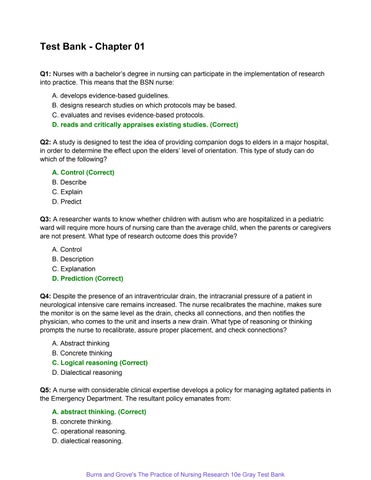
Test Bank - Chapter 01 Q1: Nurses with a bachelor’s degree in nursing can participate in the implementation of research into practice. This means that the BSN nurse: A. develops evidence-based guidelines. B. designs research studies on which protocols may be based. C. evaluates and revises evidence-based protocols. D. reads and critically appraises existing studies. (Correct) Q2: A study is designed to test the idea of providing companion dogs to elders in a major hospital, in order to determine the effect upon the elders’ level of orientation. This type of study can do which of the following? A. Control (Correct) B. Describe C. Explain D. Predict Q3: A researcher wants to know whether children with autism who are hospitalized in a pediatric ward will require more hours of nursing care than the average child, when the parents or caregivers are not present. What type of research outcome does this provide? A. Control B. Description C. Explanation D. Prediction (Correct) Q4: Despite the presence of an intraventricular drain, the intracranial pressure of a patient in neurological intensive care remains increased. The nurse recalibrates the machine, makes sure the monitor is on the same level as the drain, checks all connections, and then notifies the physician, who comes to the unit and inserts a new drain. What type of reasoning or thinking prompts the nurse to recalibrate, assure proper placement, and check connections? A. Abstract thinking B. Concrete thinking C. Logical reasoning (Correct) D. Dialectical reasoning Q5: A nurse with considerable clinical expertise develops a policy for managing agitated patients in the Emergency Department. The resultant policy emanates from: A. abstract thinking. (Correct) B. concrete thinking. C. operational reasoning. D. dialectical reasoning.
Burns and Grove's The Practice of Nursing Research 10e Gray Test Bank