The Value Of Open Files and Open Diagonals in Chess
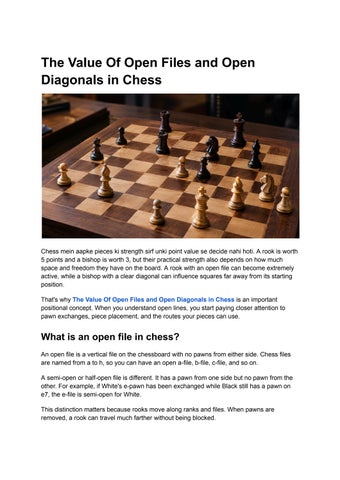
Chess mein aapke pieces ki strength sirf unki point value se decide nahi hoti. A rook is worth 5 points and a bishop is worth 3, but their practical strength also depends on how much space and freedom they have on the board. A rook with an open file can become extremely active, while a bishop with a clear diagonal can influence squares far away from its starting position. That's why The Value Of Open Files and Open Diagonals in Chess is an important positional concept. When you understand open lines, you start paying closer attention to pawn exchanges, piece placement, and the routes your pieces can use.
What is an open file in chess? An open file is a vertical file on the chessboard with no pawns from either side. Chess files are named from a to h, so you can have an open a-file, b-file, c-file, and so on. A semi-open or half-open file is different. It has a pawn from one side but no pawn from the other. For example, if White's e-pawn has been exchanged while Black still has a pawn on e7, the e-file is semi-open for White. This distinction matters because rooks move along ranks and files. When pawns are removed, a rook can travel much farther without being blocked.