Informal Cities
December 16, 2023
W IS W OR K
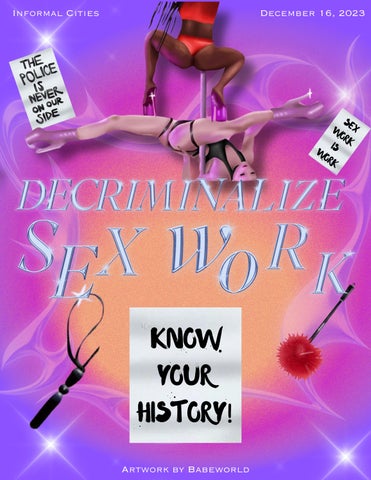
KNOW YOUR HISTORY! Artwork by Babeworld
SE
OR
K
X
OF
Clarifying our language
2
Why History?
3
Timeline of Anti-Sex Work Laws in the United States
5
Focus on an Important Law: ` The Mann Act
7
Timeline of Sex Worker’s Resistance
11
Focus on Important Event: Compton’s Cafeteria Riot
13
Art Gallery
15
Glossary
19
Bibliography
22
OUR
*Before you read this zine, we want to explain our linguistic choices.*
Although it is also a colloquial term, “prostitution” is the legal term used to describe sex work. For the purposes of this zine, we will use “prostitution” when citing laws about sex work. We want to recognize that the word “prostitution” has negative connotations that can be harmful to the sex worker community, and we emphasize that sex work is how this profession should be described.
Additionally, we have made the decision to use the word migrant as a more expansive term that encompasses a fluid status. Immigrant can indicate a certain relationship to the State, and can be used to define a citizen who previously immigrated. In the context of this zine, we want to describe migrants who are noncitizens, which includes those with documentation but are not yet citizens.
*Check out our glossary for more definitions*
2
WHY
HISTORY?
“As an undocumented immigrant and as a sex worker, I am often told that my voice shouldn’t be heard because I’m poor, because I was abused as a child, because I have a “financial incentive”. I am told that I am exploited, and that wanting to earn money makes me “greedy”. But if you aren’t exploited for your labor under this system, you can’t survive…I’m not greedy for wanting to take care of my basic needs and to have a nice life.” – *Gilda Merlot, 2019 YOU MAY BE ASKING YOURSELF, WHY TAKE TIME OUT OF MY DAY TO LEARN ABOUT THE HISTORY OF SEX WORK AND SEX WORKER’S FIGHT FOR RIGHTS IN THE UNITED STATES? HISTORY CAN BE USED AS A TOOL TO GUIDE US THROUGH THE PRESENT AND IMAGINE A MORE JUST FUTURE. HISTORY IS SOMETHING TO BE PASSED DOWN. YOU MAY ALREADY KNOW ABOUT SOME OF THE EVENTS MENTIONED IN THIS ZINE. IF SO, WE HOPE YOU SHARE IT WITH OTHERS OR USE IT AS A RESOURCE TO INSPIRE YOUR OWN PATH FORWARD.
3
4
State of Missouri passes a law that requires “known prostitutes and licensing brothels” to pay doctors for medical examinations
Offenses such as; “night walking”, adultery, and fornication could be punished by torture and death. This targeted women.
Federal law against "prostitution or debauchery, or for any other immoral purpose"
NY bureau that researched the psychology of women “delinquents” (with a large portion on prostitutes)
Federal legislation that banned all Chinese women Concluded that states could regulate prostitution from immigrating to the U.S. differently but Congress (because of a racialized assumption that they were was still concerned when it came to cases of interstate “prostitutes”) travel for prostitution.
5
“Prostitutes” can now travel across state lines as long as the intention is not to prostitute.
Venereal disease was a “threat ”to the US military, so women suspected of sex work were detained and medically examined.
$25 million per year was distributed to police departments to arrests customers of sex work and to create John schools.
Rural counties in Nevada can now license brothels
The State Department’s website publishes an article saying that sex work is inherently linked to human trafficking
6
IMPORTANT LAW:
THE MANN ACT
In 1910, Congress passed the Mann Act (also referred to as the “White Slave Traffic Act”) This law criminalized the transportation of “any woman or girl for the purpose of prostitution or debauchery, or for any other immoral purpose”. The context of this law emerged from a moral panic around “white slavery” which explicitly correlated xenophobia and sex work. Women who engaged in sex work were also assumed to be victims of trafficking, rendering beliefs of impossibility for women to choose sex work as a profession. The law criminalized all women engaging in sex work — even those who were explicit about their consensual engagement with the job. *White slavery: defined as the “practice of tricking or forcing white women to work as prostitutes”. Thus, there was an association between the criminalization of prostitution and the “saving” of white women*
7
Additionally the Act targeted interracial relationships — specifically those between men of color and white women, using the language of “debauchery” as a way to criminalize men of color. This Act was one of the foundational pieces of legislation that tied sex work, racism, xenophobia, and carcerality. We see the effects into the 21st century with the State Department publishing a piece saying, “prostitution is inherently harmful and dehumanizing, and fuels trafficking in persons, a form of modernday slavery”. Although the problem of human trafficking is prevalent within and beyond sex work — the issue lies with the assumption that sex work is “inherently” harmful. This portrays sex workers as part of the problem and easily allows outside justification of their criminalization. 8
ARTWORK BY CARYS BOUGHTON
ARTWORK BY INGRID MOUTH
9
A PROTESTER AT THE DECRIM NY RALLY, NEW YORK CITY, FEBRUARY 25, 2019 BY MOLLY CRABAPPLE
ARTWORK BY ELLA DEVI DABYSING
10
In Greenwich Village, NY, the Carol Leigh coined term police violently raided ‘sex work’ - marking Stonewall Inn (a gay nightclub) which led to 6 days of clashes beginning of a movement between queer people and the by acknowledging the work rather than their cops, many of the organizers status were transgender sex workers
Sex workers and queer patrons at Compton’s Cafeteria resisted arrest when police attempted to clear them from the establishment
The first “prostitute's” rights group in the United States, is formed in San Francisco by Margo St. James
A conference in Amsterdam where ICPR representatives met and drafted the World Charter for Prostitutes’ Rights.
This organization is formed with representatives from the U.S., Canada, & Europe
11
A transnational Latin American group fighting for sex worker’s to have access to adequate health services, work and social benefits.
A group based in Kenya (comprised of 35 different member countries). They strive to “advance the health and human rights of female, male and transgender sex workers”
A South African group which emphasized the They issue the Declaration on importance of decentering a Western the Rights of Sex Workers in Europe, which is the first perspective in the global movement of sex work document that used a human right’s framework to demand for material change
The U.S. underwent this process during which it was recommended to address violence against sex workers
12
COMPTON’S CAFETERIA RIOT
13
Sex workers are not defined by their work, but the criminalization of that work along with a history of xenophobia, racism, and queerphobia causes sex workers to be targeted in all aspects of their life. However, this protest also remind us that there has always been resistance to this criminalization. The rest of the timeline shows us that sex workers continue to show up for one another — building community and fighting for their dignity. It is imperative that we all learn this history so we can properly acknowledge those involved in this fight and how they have helped us imagine new futures. If you are a sex worker, understand that you are part of this history of activism!
And never forget that much of the early organizing in this movement is rooted in the struggles of women of color, migrants, and queer people. There is always more history to learn, use this source as momentum — get involved with a local organization, learn from the elders in the sex worker community, and share your own story.
You are not alone, spread this knowledge and sustain the movement! 14
ART GALLERY
Artwork by Niko This piece of artwork is taken from the International Whore’s Day Zine of 2020. The art was also presented as an example of artmaking as resistance in the Museum of Modern Art, emphasizing the ability of art to shape activism. This piece amongst others in the zine show the everyday struggles of sex workers, honoring resilience of the New York city sex work community that continues to confront violent discrimination.
15
Sketchbook: The First Sex-Worker Town Hall by Molly Crabapple This well-known activist artist compiled a sketchbook that details the interactions between Democratic congressional candidate, Suraj Patel, and two hundred people that included a majority of sex workers. These sketches document an important step in the advancement of sex worker activism as a political figure listened to arguments for decriminalization. Not only does the art depict the daily lives of sex workers who struggle against SESTA FOSTA, but it also documents history.
16
"Live Nude Genitals" (2012) by D’angelo Madsen Minax's
Pictured is a piece from the exhibition On Our Backs: The Revolutionary Art of Queer Sex Work that resided in the Leslie-Lohman Museum of Gay and Lesbian Art in New York. This exhibit recognizes that sex work is at the center of queer cultural production and activism, emphasizing the importance of the sex worker narratives in larger queer activism. This museum exhibition also emphasizes the importance of art to communicate a story of sex worker lives and contributions to other social movements.
17
Sun Kim’s red umbrella installation at Sex Worker PopUp. Photo by Jonna Algarin Mojica courtesy of Sex Worker Pop-Up. This photograph depicts an installation at Sex Workers of the World, Unite: A Pop-Up Museum in New York. The red umbrellas are a classic symbol of the sex workers’ rights movement, as the color symbolizes beauty and the umbrella itself signifies strength and protection. The whole exhibition features art by 22 artists, 17 of whom have backgrounds in sex work. The intended message of the art is a form of advocacy for decriminalization of sex work. This exhibition demonstrates the rise in public sex worker activism and the importance of art to the movement.
18
Brothel: An outdated term that referred to a house or other place where men would go to pay prostitutes for sex White slavery: defined as the “practice of tricking or forcing white women to work as prostitutes”. Thus, there was an association between the criminalization of prostitution and the “saving” of white women John Schools: a “diversion program” for people almost exclusively men arrested for soliciting the services of a prostitute, or another related offense (these “schools” have very high recidivism) 19
M o r a l c r u s a d e : c a m p a i g n c e n t r e d a r o u n d a s o c i a l m o v e m e n t / o r g a n i z a t i o n a n d c o n c e r n e d w i t h a m o r a l i s s u e s u c h a s p r o s t i t u t i o n S t o n e w a l l I n n : a g a y b a r a n d n i g h t c l u b i n t h e G r e e n w i c h V i l l a g e n e i g h b o r h o o d o f L o w e r M a n h a t t a n , N e w Y o r k C i t y . T h e s i t e o f t h e S t o n e w a l l r i o t s o f 1 9 6 9 G a y P r i d e : a p u b l i c e v e n t , t y p i c a l l y i n v o l v i n g a p a r a d e , h e l d t o c e l e b r a t e g a y a n d o t h e r L G B T i d e n t i t i e s , c u l t u r e , a n d e x p e r i e n c e . W h o r e p h o b i a : s o c i a l f e a r , h a t r e d , a n d s t i g m a t i z a t i o n o f s e x w o r k e r s .
20
P u r i t a n i s m : i n t h e c o n t e x t o f U . S . h i s t o r y , t h e P u r i t a n s e s t a b l i s h e d t h e f i r s t c o l o n i e s i n N e w E n g l a n d i n t h e 1 6 3 0 s . P u r i t a n i s m i t s e l f r e f e r s t o C a l v i n i s t m o v e m e n t t h a t e m p h a s i z e d a p e r s o n a l e x p e r i e n c e o f s a l v a t i o n b y C h r i s t ; s t r i c t m o r a l d i s c i p l i n e a n d p u r i t y a s t h e c o r r e c t f o r m o f C h r i s t i a n l i f e ; C a r c e r a l i t y : o f , r e l a t i n g t o , o r s u g g e s t i n g a j a i l o r p r i s o n X e n o p h o b i a : f e a r , d i s l i k e , o r p r e j u d i c e a g a i n s t p e o p l e f r o m o t h e r c o u n t r i e s
21
Scan the QR CODE
22
Written by: Maddalena Ledezma Editing & Graphic design by : Maddalena Ledezma & Annelise Quintero Published through: Informal Cities (ER&M 344)