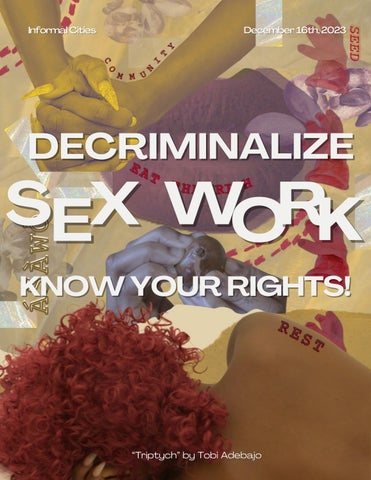
Informal Cities
December 16th, 2023
DECRIMINALIZE
SEX WORK KNOW YOUR RIGHTS!
“Triptych” by Tobi Adebajo
T
of able
C ontents 2 3 4 5 7 8 9 11 13 14 15 16 17 18
Clarifying language
Although it is also a colloquial term, “prostitution” is the legal term used to describe sex work. For the purposes of this zine, we will use “prostitution” when citing laws about sex work. We want to recognize that the word “prostitution” has negative connotations that can be harmful to the sex worker community, and we emphasize that sex work is how this profession should be described.
Additionally, we have made the decision to use the word migrant as a more expansive term that encompasses a fluid status. Immigrant can indicate a certain relationship to the State, and can be used to define a citizen who previously immigrated. In the context of this zine, we want to describe migrants who are noncitizens, which includes those with documentation but are not yet citizens.
*Check out our glossary for more definitions*
2
KNOWLEDGE =
POWER
Welcome! This is the place to learn more about the legal circumstances involved with being a migrant sex worker.
The Criminal Justice System is complicated. It can seem like all of the cards are stacked against you, especially because you face more legal issues as a migrant sex worker. However, don’t worry–you still have rights if you are involved with the Criminal Justice System, even as a migrant.
The best way to protect your rights is to understand the law that criminalizes sex work and the protections you have despite them! 3
WHEN IS SEX WORK A CRIME IN NY?
Sex work, which is considered “prostitution” under the law, is illegal, and therefore a crime, in every state except Nevada in the United States. However, specific “prostitution” laws are determined by each state. In New York, sex work is considered ‘prostitution’ 23 laws define prostitution as illegal and lay out the consequences.
A common way that sex workers are found by police is when a sex worker is in a public place stopping pedestrians or cars and offering sex for a charge. There are also indirect ways that you can be in legal trouble for being involved in sex work.
Artwork by Industrial Workers
For example, if you are helping others do sex work, such as promoting the service of a friend or coworker, you can be accused of “patronizing or promoting a ‘prostitute.’” You can also be accused of overseeing a sex work business or for permitting “prostitution” if your property is used for sex work.
Be aware of this possibility– especially if you live with fellow sex workers! 4
4 s Tip
POLICE INTERACTION
If the police become aware of your sex work, you are now subject to police interaction which can be daunting as a migrant sex worker. Usually, if authorities find out about your sex work, they will often find you and arrest you if they have reasonable belief that you do sex work. If they do not have evidence yet, they might even approach you without a uniform to see if you offer them your services. Remember that they cannot arrest you for having condoms! However, still be aware of the possibility of undercover cops, especially as you do your daily services.
Here are some general tips if you are interacting with police generally! Do not be scared to ask for a translator from the get-go, especially if you are being arrested since there are rights that you must hear in the language you understand. Stay calm and do not freak out! The way you carry yourself can impact police reaction. You always have the right to remain silent, especially since anything you say can be used against you in court.
Artwork by Carys Boughton
Ask if you are being arrested or are free to leave in the beginning. If they say you are free to leave, you can do so. If they do not have a search warrant, they cannot search your car or home. Consider not consenting to a search if they do not have a warrant (even if you have nothing to hide!) because it can hurt your rights later in court. Do not mess with the police because that can result in arrest. You do not need to show your identification to the police at first, but do you need to show it if you are being arrested.
5
Artwork by Industrial Workers
Police officers are not allowed to take off their underwear when they are Make sure to get the badge number or business card from the police,
especially
if
they
are
treating you badly so you can report it later. If you are injured by police, take photos and make sure you get medical attention and document it. If you are interacting with an undercover police officer and it was uncovered later that they were being sneaky, keep these in mind as well!
investigating while undercover. If they do so, make sure you take mental note to report them later on. If you told the police anything incriminating without you knowing they were a police officer, your attorney can get a Huntley Hearing to make
the
statements
you
said
irrelevant in court. If the police try to charge you after a sexual transaction, your attorney can ask for a Wade Hearing to question whether
or
not
they
accurately
identified you which can dismiss your case.
6
What Happens When I Get Arrested? When you are arrested, you are taken to the local jail where they process you by taking your fingerprints and Ask for a lawyer there, which biographical can be provided to you free of information. charge. Do not mention your citizenship status or anything relating to the crime until you talk with your lawyer. You are then taken to a holding cell where you will wait for your arraignment. During this time, if the police present any documents At this same hearing, your to you, do not sign bail is set. Here is when anything without talking to a lawyer first. you have the potential to be released form jail during the time a plea is being negotiated or you go to trial.
7
What rights do I have when being arrested? When you are being arrested for your sex work, you have rights about your case and immigration status. If the police are searching your items, car, or home without a search warrant, you are allowed to resist the search. You can say and if they claim you are resisting, you can say
You have: the right to remain silent. the right to ask about what the police are accusing you of and it will not affect you negatively if you ask! the right to not disclose your immigration status to the police
‘I do not consent to this search,’ ‘I am not resisting, officer.’ this is especially important since, at times, the Department of Homeland Security collaborates with police departments to detain noncitizen people. With that in mind, make sure not to claim you are a citizen or give false documents either, since that can make your legal situation more complicated.
8
9
10
WHAT RIGHTS DO I HAVE AS A
MIGRANT SEX WORKER? If you are being charged for your sex work, it might have immigration consequences if you plea guilty or are found guilty at trial. However, you can advocate for yourself to your lawyer to make sure they are representing you as best as possible, due to your migrant status. When you first meet with your criminal lawyer in jail or during your arraignment, tell them that you are a noncitizen in confidence so they keep that in mind as they advocate for you. The first thing to ask them is if you have a “detainer” on your case, which usually happens after you provide your fingerprints to the jail during processing. If you do not have a detainer on you, try to get someone to pay for your bail/bond as soon as possible before they can place a detainer on you. This is time sensitive and of course, expensive, so if you need bail help, you or your loved ones can reach out to the resources at the end of this zine!
11
As the case continues, ask your lawyer if they can negotiate with the court for an immigration safe plea. This is important because if the court offers you a deal where you have to plead guilty for probation, rehabilitation, or therapy. This seems great on the surface because you get to go home sooner but these deals can come at the price of your immigration status since you are admitting to a crime that puts you at risk for detention and deportation.
Therefore, you should ask your lawyer to negotiate an immigrant safe plea that can still give you less jail time while also preserving your ability to stay in the U.S. Essentially, if you do not plea guilty or officially admit to a crime, you will not have a conviction that can turn into immigration consequences which is important to know since your lawyer can advocate in this way. If your lawyer is not sure if your “prostitution” charge will result in immigration consequences, they can reach out to an immigration lawyer for help. If it is determined that the “prostitution” conviction would result in immigration consequences, your lawyer can request an alternative arrangement for noncitizen defendants, the ability to plead guilty to a different charge, or ask for an immigration safe plea that does not require a guilty plea. 12
How does
human trafficking Differ from sex work? Sometimes “human trafficking” and “prostitution,”, are used as synonyms, but they are extremely different experiences and situations. “Human trafficking” is a crime where someone is forcefully taken advantage of for labor or sex. As mentioned earlier, “prostitution” is exchanging sexual acts for something of value. They are different because “prostitution” is considered an act that does not involve coercion or force, while “human trafficking” does. However, this is under the assumption that sex workers do their jobs out of pure desire when, sometimes, it is out of need.
Although “human trafficking” and “prostitution” are distinct, they overlap and can become complicated in the eyes of the law.
If you work in a network of sex workers or promote their work, there is a potential that your work can be defined as “human trafficking” in a court of law. Your lawyer can fight against you being charged with “human trafficking” if that is not the case, which is important for them to do if you are just a sex worker engaging with your coworkers. “Human trafficking” is a way more serious crime than “prostitution” that would undeniably have consequences for your immigration status and freedom. 13
What are my Protections If i’ve experienced sex trafficking? If you are a victim of “sex trafficking” yourself, it is important to voice that to your lawyer as well because there are legal protections that can shield you from prison time or immigration consequences. If you are being prosecuted for “prostitution” but are being trafficked, you have a defense that is protected under the Trafficking Victims Protection Act. This would eliminate your charges and can impact your immigration status. Being protected under this Act means you can qualify for benefits in the U.S. as a refugee. Please consult with an immigration attorney if this applies to you.
14
WHAT NOW? Conclusion
At the end of the day, the Criminal Justice System is daunting and it is meant to be so. However, you have the rights mentioned above so please make sure that you are doing your best to advocate for yourself to make sure that they are being respected! Of course, this is easier said than done, but it is truly power to know your rights. Be prepared for the risks that come with being a migrant sex worker. You got this!
16
15
Glossary
17
Disorderly Conduct: conduct that is determined to disturb the peace, morals, or safety of the general public or of a class of people Guilty plea: admission to the court that the defendant committed the offense they are charged with, and an agreement to waive the right to trial Crime of moral turpitude: as defined by the Board of Immigration Appeals (BIA) shocks public conscience, inherently depraved and vile, acts against rules about one’s neighbors or society, conducted with evil intent, result of reckless behavior, morally reprehensible, intentionally wrong Aggravated felony: an offense that Congress sees fit to label as such, and today includes many nonviolent and seemingly minor offenses. Prohibits convicted noncitizens from receiving most forms of relief that would spare them from deportation, including asylum, and from being readmitted to the United States at any time in the future Detainer: a federal ICE request that a local law enforcement agency maintain custody of an individual currently in its custody beyond the time he or she would otherwise be eligible for release in order to facilitate transfer to ICE Bail: the money or bond put up to secure the release of a person who has been charged with a crime. Is meant to guarantee the appearance of the defendant in court when required Arrest plan: Plan set in place in case you are arrested to ensure that your job, family, school, and loved ones are cared for if you 18 are incarcerated.
Lawyer: trained and licensed to defend an individual in court and provide advice on legal matters State law: apply to people who live or work in a particular state, commonwealth, territory, county, city, municipality, town, township or village. Adjudicated by state courts Federal law: apply to everyone in the United States Misdemeanor: a lesser crime punishable by a fine and/or county jail time for up to one year Degrees (first, second, third, and fourth): indicate the severity of a crime, often aligning with the equated punishment. Fourth degree is the least severe, while first degree is the worst Obstruction of justice: an attempt to interfere with the administration of the courts, the judicial system or law enforcement officers; including threatening witnesses, improper conversations with jurors, hiding evidence or interfering with an arrest Arrest: to take or hold a suspected criminal with legal authority, as by a law enforcement officer Charge: the specific statement of what crime the defendant is accused (charged with) contained in the indictment or criminal complaint Crime: a violation of a law in which there is injury to the public or a member of the public and a term in jail or prison, and/or a fine as possible penalties
19
Court ruling: decision, statement or interpretation made my court Detained: the individual is held in police custody for a short period of time Change of plea: the decision to change to plead guilty, rather than what the plea was before Deportation Proceeding: hearings held before an immigration judge to determine whether an individual may remain in the United States, challenging the individual’s immigration status Immigration judge: appointed by the Attorney General of the United States to preside over immigration hearings, often decide whether a noncitizen may remain in the U.S. Precedent: a court decision that is considered as authority for deciding subsequent cases involving identical or similar facts, or similar legal issues Conviction: the result of a criminal trial in which the defendant has been found guilty of a crime Non citizen: person who is not a citizen or national of the United States Diversion program: substitute procedure in a criminal case where the defendant and prosecutor make a deal that interrupts the prosecution 20
Immigrant safe plea: negotiation of a criminal conviction to avoid deportation. occurs when the attorney is able to speak with the prosecutor in order to reduce the charge to something that is not an aggravated felony, crime of moral turpitude, or crime of violence Conviction by immigration law: a guilty plea or finding of guilt, plus any imposition by the judge of probation, fine, jail, or even requirement to attend classes, will create a conviction for immigration purposes Problem solving court: focus on one type of offense or type of person committing the crime. An interdisciplinary team works collaboratively to achieve case management and therapeutic jurisprudence to reduce criminal offending
21
Scan the QR CODE
22
THANK YOU FOR READING! WRITTENBY: BY:YAKELEEN YAKELEENALMAZAN ALMAZAN WRITTEN BY: YAKELEEN ALMAZAN WRITTEN
EDITING& &GRAPHIC GRAPHICDESIGN DESIGNBY BY:::MADDALENA MADDALENA EDITING & GRAPHIC DESIGN BY MADDALENA EDITING LEDEZMA& &ANNELISE ANNELISEQUINTERO QUINTERO LEDEZMA & ANNELISE QUINTERO LEDEZMA PUBLISHEDTHROUGH: THROUGH:INFORMAL INFORMALCITIES CITIES PUBLISHED THROUGH: INFORMAL CITIES PUBLISHED (ER&M344) 344) (ER&M 344) (ER&M