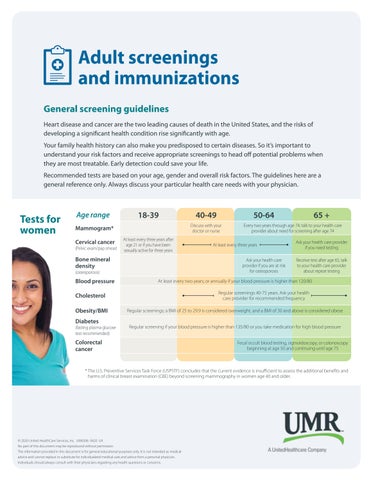
Adult screenings and immunizations General screening guidelines Heart disease and cancer are the two leading causes of death in the United States, and the risks of developing a signifcant health condition rise signifcantly with age. Your family health history can also make you predisposed to certain diseases. So it’s important to understand your risk factors and receive appropriate screenings to head of potential problems when they are most treatable. Early detection could save your life. Recommended tests are based on your age, gender and overall risk factors. The guidelines here are a general reference only. Always discuss your particular health care needs with your physician.
Tests for women
Age range
18-39
(Pelvic exam/pap smear)
At least every three years after age 21 or if you have been sexually active for three years
Bone mineral density
Diabetes (fasting plasma glucose test recommended)
At least every three years
Ask your health care provider if you need testing Receive test after age 65; talk to your health care provider about repeat testing
At least every two years; or annually if your blood pressure is higher than 120/80 Regular screenings 40-75 years. Ask your health care provider for recommended frequency
Cholesterol Obesity/BMI
65 +
Every two years through age 74; talk to your health care provider about need for screening after age 74
Ask your health care provider if you are at risk for osteoporosis
(osteoporosis)
Blood pressure
50-64
Discuss with your doctor or nurse
Mammogram* Cervical cancer
40-49
Regular screenings; a BMI of 25 to 29.9 is considered overweight, and a BMI of 30 and above is considered obese Regular screening if your blood pressure is higher than 135/80 or you take medication for high blood pressure
Colorectal cancer
Fecal occult blood testing, sigmoidoscopy, or colonoscopy beginning at age 50 and continuing until age 75
* The U.S. Preventive Services Task Force (USPSTF) concludes that the current evidence is insufcient to assess the additional benefts and harms of clinical breast examination (CBE) beyond screening mammography in women age 40 and older.
© 2020 United HealthCare Services, Inc. UM0206 0420 UA No part of this document may be reproduced without permission. The information provided in this document is for general educational purposes only. It is not intended as medical advice and cannot replace or substitute for individualized medical care and advice from a personal physician. Individuals should always consult with their physicians regarding any health questions or concerns.
Tests for men
Age range
18-39
Blood pressure
40-49
Diabetes (fasting plasma glucose test recommended)
65 +
At least every two years; or annually if your blood pressure is higher than 120/80 Regular screenings 40-75 years. Ask your health care provider for recommended frequency
Cholesterol Obesity/BMI
50-64
Regular screenings; a BMI of 25 to 29.9 is considered overweight, and a BMI of 30 and above is considered obese Regular screening if your blood pressure is higher than 135/80 or you take medication for high blood pressure
Colorectal cancer
Fecal occult blood testing, sigmoidoscopy, or colonoscopy beginning at age 50 and continuing until age 75 Talk to your doctor about the risks and benefts of screening*
Prostate cancer
* The U.S. Preventive Services Task Force (USPSTF) concludes that the current evidence is insufcient to assess the balance of benefts and harms of prostate cancer screening in men younger than age 75. Given the uncertainties and controversy surrounding prostate cancer screening in men younger than 75, a clinician should not order the PSA test without frst discussing with the patient.
Immunization guidelines Vaccinations work to help your body learn to fght of disease and build immunity to future exposure. Traditional vaccines mimic a natural infection by introducing dead or weakened versions of the germs that trigger a specifc illness. Your immune system can clear these germs from your body, without experiencing common symptoms and complications, and it will “remember” how to protect your body from germs it has encountered before. For additional information on immunizations, visit cdc.gov/vaccines.
Age range
19-26
Tetanus/diptheria
27-49
50-59
60-64
One-time dose of Tdap, then Td booster every 10 years
(Td/Tdap)
Infuenza (fu)
65 + Td booster every 10 years
One dose annually
Pneumococcal vaccine (pneumonia)
One or two doses recommended if risk factor present, based on medical, occupational or lifestyle indications
One dose
RZV (recombinant zoster vaccine) Two doses. This is the preferred vaccine.
Shingles
ZVL (Zoster vaccine live) One dose
Varicella (chicken pox) Human papillomavirus (HPV) MMR (Measles, Mumps, Rubella)
Meningococcal, Hepatitis A, Hepatitis B
Two doses for those who have never had chicken pox or who lack evidence of immunity Three doses for those who lack evidence of immunity*
Gardasil4 to age 26 Gardasil9 to age 45
One or two doses up to age 55 for those who lack evidence of immunity
* Not to be given during pregnancy
One dose
Recommended for those with certain risk factors due to health, job or lifestyle, or who did not receive the vaccine as a child
Sources: Recommended Adult Immunization Schedule 2018, U.S. Department of Health and Human Services, Centers for Disease Control and Prevention; The Guide to Clinical Preventive Services 2010-2014, Recommendations of the U.S. Preventive Services Task Force; U.S. Department of Health and Human Services, Centers for Disease Control and Prevention.