health & benefit accounts
Better together Put your Health Savings Account (HSA) and 401(k) account benefits to work for you
Two is better than one
How the power of two could help you make the most of your savings
An HSA allows you to take tax‑free1 withdrawals for qualified health care expenses. This way, you can preserve your taxable 401(k) account withdrawals for retirement.
Some estimates suggest that a couple may need $301,0002 for out-of-pocket health care expenses in retirement. That’s why a strategy of saving in two tax‑advantaged3 accounts, a 401(k) account and an HSA, could make a real difference to your overall financial wellness.
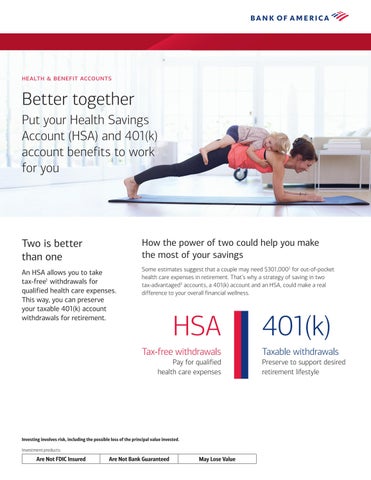
HSA Tax-free withdrawals Pay for qualified health care expenses
Investing involves risk, including the possible loss of the principal value invested. Investment products:
Are Not FDIC Insured
Are Not Bank Guaranteed
May Lose Value
401(k) Taxable withdrawals Preserve to support desired retirement lifestyle
Understanding the benefits of both accounts Potential tax advantages
HSA
401(k) account
Potential for triple tax savings3 • Contributions are tax-free.
• You can make pre-tax contributions.
• Any interest/investment earnings are tax-free.
• Any interest/investment earnings are tax-deferred.
• Withdrawals, when used for qualified health care expenses, are tax-free.
Taxes
Watch the video
Withdrawals are tax-free if used for qualified health care expenses.1
Contributions and investment gains taxed at withdrawal.4
Vesting
Your HSA account is yours for life. You can roll funds over from year to year — you don’t lose funds if you don’t use them.5
Your vested account balance always belongs to you — as adjusted for earnings/losses.
Required minimum distributions
No minimum distributions required.
Required distributions generally must be taken starting no later than April 1 of the year after the year you reach age 72.6
Learn more about how an HSA and 401(k) can work together. https://healthaccounts. bankofamerica.com/bettertogether.shtml
Added benefits of an HSA Use funds now… or later You can use your HSA funds for the current year’s expenses, or you can save them to use sometime in the future — including when you’re retired. Invest for the future Take advantage of the investment feature of your HSA, which provides the potential for you to build your balance so that you’re prepared for health care expenses in the future.7 Withdraw funds after age 65 You can withdraw HSA funds for non-health care expenses (they would be subject to an additional 20% tax if taken before age 65). Make contributions until Tax Day You can make contributions for the prior year up until Tax Day of the current year.
2
Maximizing your benefit accounts Contribute enough to your 401(k) account to get the full company match Maximize the benefit. Max out the HSA contribution limit8 Save on taxes, and benefit from the HSA’s buying power for health care in retirement. Contribute any additional funds to the 401(k) account8
More buying power in retirement John and Maria could need $301,000 to pay for health care expenses in retirement. They can cover those costs by withdrawing that exact amount from their HSA since withdrawals for qualified health care expenses are tax‑free. If they didn’t have an HSA and needed to cover those expenses with their 401(k) account savings, they would need to pay taxes on those withdrawals. This chart shows how much more they would have to pay.*
HSA
$301,000
401(k)
Maximize their tax benefit and build savings for retirement.
$376,250
* E xample is for illustrative purposes only. Assumes a 20% total tax rate in retirement: $376,250 x 80% = $301,000. Consult with your tax or financial advisor to understand the impact federal, state and local taxes specific to your situation.
3
Visit our Learn Center
Download the mobile app
We’re here to help
Find tools and resources to help you manage your health care spending. healthaccounts.bankofamerica.com
Get the “MyHealth BofA” mobile app9 directly from the App StoreSM or Google PlayTM10
If you have questions, please call the number on the back of your debit card.
Withdrawals for non-qualified health care expenses are subject to income tax. Qualified medical expenses include expenses for your, your spouse’s or your dependent’s medical care that generally would qualify for the medical and dental expense deduction but which are not reimbursable by insurance or otherwise.
1
Employee Benefits Research Institute, Issue Brief, no. 481, May 16, 2019. A 65-year-old couple, both with median drug expenses needs $301,000 to have a 90% chance of having enough money to cover health care expenses (excluding long-term care) in retirement. Savings needed for Medigap Premiums, Medicare Part B Premiums, Medicare Part D Premiums and Out-of-Pocket Drug Expenses for Retirement at age 65 in 2019. A 65-year-old man needs $144,000 or a 65-year-old woman would need $163,000 to have to have a 90% chance of having enough money to cover health care expenses (excluding long-term care) in retirement.
2
About Tax Benefits: You can receive tax-free distributions from your HSA to pay or be reimbursed for qualified medical expenses you incur after you establish the HSA. If you receive distributions for other reasons, the amount you withdraw will be subject to income tax and may be subject to an additional 20% tax. Any interest or earnings on the assets in the account are tax-free. You may be able to claim a tax deduction for contributions you, or someone other than your employer, make to your HSA. Certain limits may apply to employees who are considered highly compensated key employees. Bank of America recommends you contact qualified tax or legal counsel before establishing an HSA.
3
With a 401(k) account, taxes are due upon withdrawal of pre-tax contributions, any company contributions and any earnings on pre-tax contributions or company contributions. You may also be subject to a 10% additional federal tax if you take a withdrawal prior to age 59½, unless an exception applies. See your place documents for other types of contributions that may be available in your plan and how they‘re taxed.
4
“You don’t lose funds” refers to account portability and annual rollover of accumulated assets; it does not imply you cannot lose money. The investment portion of the HSA account is not FDIC insured, not bank guaranteed and may lose value.
5
If an individual delays his or her first required minimum distribution until the first quarter of the year after attainment of age 72, he or she would need to take the second required minimum distribution by December 3 of the same year, resulting in two required minimum distributions during that year.
6
See the Investments section of the member website for minimum balance requirements to begin investing.
7
You can contribute up to the annual limit. For 2022, HSA limits for individuals are $3,650 and $7,300 for families. Those age 55 or older can contribute an additional $1,000. For 2021, IRS 401(k) limits are $19,500 or $26,000 if age 50 or over. 401(k) limits for 2022 were not available at time of publication. Your 401(k) plan may impose additional limits. See your plan document for details.
8
Data connection required. Wireless carrier fees may apply. Mobile app is available on most devices.
9
Apple, the Apple logo, iPhone, and iMac are trademarks of Apple Inc., registered in the U.S. and other countries. App Store is a service mark of Apple Inc. Android, Google Play, and the Google Play logo are trademarks of Google, Inc.
10
Investing involves risk, including the possible loss of the principal value invested. Neither Bank of America nor any of its affiliates provide legal, tax, or accounting advice. You should consult your legal and/or tax advisors before making any financial decisions. Mutual Fund investment offerings for the Bank of America HSA are made available by Merrill Lynch, Pierce, Fenner & Smith Incorporated (“MLPF&S”), a registered broker-dealer, Member SIPC and a wholly owned subsidiary of Bank of America Corporation (“BofA Corp.”). Investments in mutual funds are held in an omnibus account at MLPF&S in the name of Bank of America, N.A. (“BANA”), for the benefit of all HSA account owners. Recommendations as to HSA investment menu options are provided to BANA by the Chief Investment Office (“CIO”), Global Wealth & Investment Management (“GWIM”), a division of BofA Corp. The CIO, which provides investment strategies, due diligence, portfolio construction guidance and wealth management solutions for GWIM clients, is part of the Investment Solutions Group (ISG) of GWIM. Certain associates are registered representatives with MLPF&S and may assist you with investment products and services. © 2021 Bank of America Corporation. All rights reserved. | 3619848 | 06/30/2022