Crop Circles Issue IV Fall 2025
W H AT ’ S I N S I D E Dean’s Desk/Interns Pullin’ Pirates A Legacy In Motion Pirates Chatter From Classrooms To Canals Planting Knowledge Cultivating Conversation A Decade Of Retirees Growing The Future Porterville Livestock Show Raising Excellence Learning At The Roots Unleashing Potential In Good Hands Poinsettia Sale Open House & Senior Day Recap Meet Your Writers
3 11 15
2 3 5 6 7 9 10 11 13 14 15 17 18 19 20 21 22
7
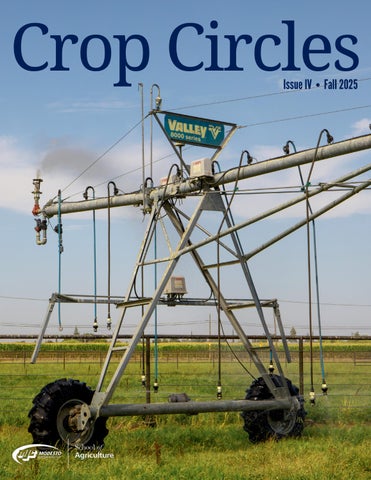
ABOUT THE COVER Stanislaus County is home to approximately 3,400 farms encompassing more than 685,000 acres of farmable land, much of which relies on irrigation. The Modesto Junior College School of Agriculture is dedicated to preparing students with practical skills in irrigation design, installation and maintenance. The center pivot irrigation system is a critical piece of industry-standard equipment, and its use in the program provides students with invaluable handson experience. This real-world training equips graduates with the knowledge and confidence needed to succeed in today’s agricultural workforce while building the next generation of irrigation experts. Pictured on the cover is the Irrigation Unit pivot on MJC West Campus.
FROM THE DEAN’S DESK What a fall semester! It just reminds us why Modesto Junior College School of Agriculture is more than classrooms and corrals—it’s a community with “Deep Roots and Bold Futures.” We packed the ACE Pavilion with the thunder and roar of the 13th Annual Truck & Tractor Pull, California’s only indoor collegiate pull, where students waved the flags, ran safety checks and showcased the craft of power mechanics to a standing-room crowd. Our Dairy Science family celebrated a milestone four decades in the making: the 40th Anniversary Dairy Heifer Sale. Alumni, producers and students came together to honor the program that has launched so many ag careers and to invest in the next generation. We were fortunate enough to have Hal Carlton, Mark Anglin, Bill Hobby and Nicole Morris all on hand for this event—the last four dairy instructors of this amazing program. On the student-life front, the Young Farmers filled the Ag Patio, kicking off the year with meetings and a community Milk Drive that put service at the center of leadership. It’s in these simple, hands-on, united moments that confidence is built and purpose takes root. In the spirit of competition and career readiness, our students kept raising the bar from strong showings at World Dairy Expo 2025, to dedicated performances at the California Farm Bureau YF&R Collegiate Discussion Meet. These events hold proof that MJC grads are ready for what the valley’s most critical jobs may throw at them. Looking ahead, we’ll keep doing what this college does best: celebrating the harvest while planting for tomorrow. To every student, alum, partner and friend—you make this possible. Let’s keep our hands in the soil, our eyes on the horizon and our hearts with the people who feed the world. See you at the next pull, the next sale and the next big idea!
WITH GRATITUDE,
Troy Gravatt
TROY GRAVATT DEAN, SCHOOL OF AGRICULTURE MODESTO JUNIOR COLLEGE
WEST CAMPUS INTERNS
WEST CAMPUS INTERNS
Front Row: Aiden Montgomery, Santa Maria; Justin Genasci, Modesto; Connor Correia, Tulare; Jake Lewis, Tulare; Maddie Zweegman, Lynden, WA; Madison Van Laar, Ripon; Branyon Bliss, Atwater; Ethan Larson, Hughson; Jack Van Warmerdam, Galt; & Jack Fletcher, Placerville | Second Row: Peyton DeCoite, Tracy; Serenity Lopez, King City; Joseph Avila, Hughson; Mykel Mull, Chowchilla; Weston Merriman, Alpine; Mackenzie Phillips, Woodland; Taylor Klein, Galt; & Matthew Bowman, Pleasant Grove | Third Row: Adieson Glass, Auberry; Emma Reis, Woodland; Olivia Love, El Dorado Hills; McClain Blackmon, Lindsay; Jayden Yokom, Smartsville; Maya Morrison, Hollister; Peyton Wood, Yreka; Riley Whisler, Carmel; Betsy Theis, Turlock; & Lexie Alto, Arcata
2
PULLIN’ PIRATES
SEAS-ING THE DAY
Modesto Junior College has long been known for its strong agricultural programs, but few groups capture the spirit and excitement of campus life quite like the MJC Pullin’ Pirates. Founded in 2008, the Pullin’ Pirates are still standing strong—even proudly hosting their very own truck and tractor pull that directly benefits the team at MJC. These students have raised the bar for other clubs on campus by using teamwork, horsepower and a commitment to excellence. Seas-ing the day, this team continues to make its mark across the Central Valley.
RUNNING ON COMMUNITY
The team relies heavily on sponsorships and donations to keep the program up and running. These contributions help cover everything from parts and repairs to travel and competition fees. At the heart of the team’s success is a blend of classroom knowledge and hands-on skills. Students work directly on every part of the truck themselves, turning theory into real-world results. Every pull event is a test of preparation: weight distribution, timing and teamwork.
The Pullin’ Pirates truck, nicknamed “The Mad Professor,” isn’t just machinery; it’s a student-built symbol of passion and pride. A crucial part of this success comes from the team’s advisor, Todd Conrado. He dedicates countless hours and many of his weekends throughout the year to ensure the club thrives. He hauls the team to events, offers guidance in the shop and supports the students through every challenge and victory. His dedication is the steady force behind the students’ passion, but what truly sets the Pullin’ Pirates apart is the community behind them. These students don’t just compete; they represent a legacy of hard work, innovation and mechanical engineering. These efforts are held with the hopes of inspiring future students to get involved and push boundaries.
HORSEPOWER AND BEYOND
Competing in the 5500 Country Modified Class, this team stands out for having multiple students drive “The Mad Professor” at every pull event, giving everyone a chance to represent the MJC School of Agriculture. This rotating-driver system is rare and showcases the club’s commitment to immersive education. What is even more impressive is that MJC is the only community college in the nation to own and operate a competitive pull truck that is both maintained and managed by students. With each event they attend, the Pullin’ Pirates carry more than school colors; they carry the determination to help lead the next generation of agriculture students and performance engineers. They aren’t just a team. They’re a tradition. A powerful reminder that when students unite, they can pull far more than a sled; they can pull their future forward.
WRITTEN BY SERENITY LOPEZ 4
CU LTI VATI NG
CONVERSATION For the second year in a row, Modesto Junior College opened its doors to host the California Farm Bureau Young Farmers & Ranchers Collegiate Discussion Meet on November 15. MJC’s East Campus once again became a central location for students to engage in educational conversations that helped cultivate not only competition but also a community of intentional, courageous young advocates for agriculture. Competitors traveled from up and down the state of California, converging in Modesto to test their knowledge, sharpen their leadership skills and network with peers. MJC was proudly represented by five of our own: Zachary Christianson, Noel Jacobson, Weston Merriman, Destiny Reyes and Madeline Zweegman. Each student entered the contest backed by months of preparation and a determination to make their mark, all while cultivating a lifelong respect for the land that sustains us. Zweegman's advancement to the Elite 8 round marked a notable achievement, highlighting the dedication and thorough preparation demonstrated by all five students who competed. Hosting this contest is more than a point of pride for MJC; it is a commitment to nurturing the next 5
generation of agriculture leaders. The YF&R Discussion Meet challenges students to analyze and understand the most pressing issues facing the agriculture industry today. Months before the event, competitors receive a set of five complex questions. From that moment on, preparation begins: frequent research sessions, conversations with industry professionals and the courage to answer difficult questions about the future of agriculture. This year’s topics covered trending avenues of modern agriculture, including environmental stewardship, digital engagement, new policy challenges and Farm Bureau benefits. These prompts served as catalysts for solutiondriven conversations. Students brought tangible ideas that they could take back to their local county Farm Bureaus, helping spark grassroots change in the communities they serve.
As a grassroots organization, Farm Bureau has always believed that the best solutions rise from the voices of its members. The collegiate Discussion Meet offers a unique perspective from the
AS A GRASSROOTS ORGANIZATION, FARM BUREAU HAS ALWAYS BELIEVED THAT THE BEST SOLUTIONS RISE FROM THE VOICES OF ITS MEMBERS. next generation of agriculturalists. Through these conversations, young leaders reflect on the industry’s past—working to continue its legacy and remain resilient into the future.
BY MADELINE ZWEEGMAN
Pirates chatter Executive Director, San Joaquin Farm Bureau
A.S. Dairy Science - 1997
"Try classes outside your major and get involved on campus, with clubs like Young Farmers. You might discover a new interest, opportunity or connection that shapes your future for years to come."
ANDREW GENASCI Field Representative, Sensient Agricultural Ingredients
A.S. Agricultural Business - 2021
"Diversify yourself: take a variety of classes and attention meetings for as many different clubs as you can. The connections and knowledge you gain by doing so will greatly benefit your future."
Alumni Advice Written By: Kyla Garcia The MJC School of Agriculture has shaped generations of students, and many of our alumni continue to carry the lessons they learned into successful careers across the industry. To help inspire the next wave of students, we asked several alumni what advice they would give to a college freshman just starting their journey. Their words highlight the value of hard work, curiosity and community—core strengths that continue to define MJC School of Agriculture.
JULYESSA STRUCKMEYER
JACKSON DIAS Student, Kansas State University
A.S. Animal, Dairy, & Ag Science - 2025
"Incoming freshmen need to make sure they are not afraid to get involved with anything and everything within the ag department - it'll be worth it in the long run!"
AMANDA OSMUNDSON
Customer Success, Rural Power Systems Teacher/Administrator, Gustine School District
A.S. Animal, Dairy, & Ag Science - 1993
"Find your people, connect with inspiring teachers and get involved at MJC. Celebrate your milestones, trust your journey and enjoy each step—these experiences will stay with you long after you leave."
BARBARA BORRELLI AZEVEDO
A.S. Agricultural Business - 2023 “Building lifelong connections is possible. Absorbing every bit of hands on knowledge is possible. Putting yourself out there is possible. Graduating and transferring is possible. MJC gives you every opportunity - grab them all, chase the hard things and believe in the future you're creating. Hook ‘em!"
6
FROM
TO
CLASSROOMS CANALS Building the Next Generation of Irrigation Experts
The Modesto Junior College Irrigation Unit is strengthening the region’s agricultural workforce by providing hands-on training in modern irrigation practices. As part of the MJC School of Agriculture, the irrigation program focuses on preparing students to install, operate and maintain the systems that growers in the Central Valley rely on. Students gain practical experience both off and on campus and through partnerships with local farms, irrigation
BY TRAVIS HOBBS AND BRODIE MARCHY
districts and utility agencies. These collaborations allow students to work on real projects that give them key career experiences, all while building industry connections that can lead to internship and job opportunities. The Central Valley is one of the world’s most productive farming regions. With dry summers and little rainfall, California agriculture depends on water systems managed by irrigation districts. These local districts jointly operate one of California’s largest human-made bodies of water: Don Pedro Reservoir. This reservoir provides reliable irrigation water, hydropower and flood control for the valley. It delivers precise amounts of
water supplies to farmers and supports hundreds of miles of canals which are all supported by modern monitoring and flow-control technology. With drought and climate pressures growing, these districts continue to innovate—keeping the Central Valley’s agricultural landscape thriving in a water-scarce world. The irrigation program at MJC trains students in a wide range of irrigation methods—from drip and micro-irrigation to flood and pressurized sprinkler systems. Recent updates to curriculum have added instruction in
automation tools, alongside newer water-efficient technologies that are vital to California agriculture. With water scarcity and sustainability at the forefront of farming, the unit emphasizes efficient system design and responsible water management. Students learn to assess distribution uniformity, read flow and pressure data, and interpret soil moisture information. These are crucial responsibilities that directly support smarter water management. Faculty members stay closely connected to industry trends through advisory groups, grower meetings and conversations with irrigation manufacturers to help ensure that coursework reflects current needs
in the Central Valley’s agricultural landscape. Looking ahead, the program plans to expand training in automation, diagnostics and GIS mapping, update demonstration sites and create mobile training kits for outreach. The Irrigation Unit continues to welcome community support through hands-on involvement and collaborative project opportunities. On behalf of the Irrigation Unit and its programs here at the MJC School of Agriculture, thank you to those who have shown up in ways to support and encourage the next generation of irrigation experts. 8
IN GOOD
taking away their own meaningful insight. Student Connor Correia shared, “My favorite booth was Farmers Warehouse because I am interested in becoming a feed representative.” Like Connor, many students’ personal interests and dream connections were satisfied at the event. The MJC School of Agriculture was able to provide a strong selection of ag professionals to build connections throughout the Central Valley.
HANDS WRITTEN BY ALEXIS DIAS
On November 18, the Modesto Junior College School of Agriculture hosted its annual Internship and Career Fair, giving students a valuable opportunity to connect with industry professionals and potential future employers. The Internship and Career Fair highlighted the strength of the ag department and its commitment to student success. With 24 diverse businesses under one roof, the event showcased the countless pathways within agriculture and reminded students that their future in the industry is full of possibility and promise.
The students stayed focused and excited throughout the evening, with everyone
Representatives from Trans Ova Genetics, Garton Tractor, Bobcat Central and California Dairy Farms eagerly shared insights about their work and what they look for in future employees. Many students took advantage of the chance to ask questions, exchange contact information and begin forming professional relationships that could shape their careers. For Abigail Hendley, the event offered
both connection and opportunity; stating that Bobcat Central was her favorite business that she met with. Hendley said, “It was such a positive experience speaking to them. I also gave them my résumé, and they called to offer me an interview for a marketing position!” The pavilion stayed lively as students moved from booth to booth, discovering new areas of interest and building confidence in speaking with employers. Faculty encouraged students to introduce themselves and share their résumés. Each representative was visibly passionate about agriculture—talking to students not just about their career goals, but their personal development as well. Dan Pacheco of Garton Tractor praised several students for their preparation, confidence and professionalism – stating that events like the Internship and Career Fair give him “hope for the future.” Anna Genasci, from the Stanislaus County Farm Bureau, echoed this sentiment, expressing how inspiring it was to meet students who were so passionate about agriculture. Genasci said, “I feel that we are truly leaving agriculture in good hands.”
THANK YOU TO THE COMPANIES THAT MADE THIS EVENT POSSIBLE! Almond Board of California | Alltech | Bobcat Central | California Dairy Farms | Dave Wilson Nursery | East Stanislaus Resource Conservation District | Farmer’s Warehouse | Frantz Wholesale Nursery, LLC. | Garton Tractor, Inc. | Generation Growers | GENEX | i-Cultiver | Joseph Gallo Cheese Company | Meena Packing Company, Inc. | Mid Valley Ag Services | Modesto Irrigation District | Select 9 Sires Member Cooperative | Stanislaus County Farm Bureau | The Greenery Nursery | Trans Ova Genetics | Valley Ag | Waterford Irrigation District | Winters Farming, Inc. | Yosemite Farm Credit
A
PLANTING PLANTING KNOWLEDGE
griculture is the backbone of America, yet many people remain disconnected from the work and traditions that sustain our food system. Across Stanislaus County, efforts to strengthen agricultural literacy are growing rapidly through schools, community programs and local leadership. Agricultural literacy goes beyond knowing where food comes from. What is does is help individuals understand the practices, innovation and people behind agriculture. Learn About Ag’s Program Coordinator for Central California is Morgan Nunes. She explains that many students still believe “food starts at the grocery store,” which highlights the need for meaningful agricultural education. Today, agriculture is being woven into classrooms, libraries and public spaces in ways that make it accessible and relevant. The Stanislaus County Farm Bureau (SCFB) is a leader in this movement. Communications & Education Director Anna Genasci has helped expand youth programs, grower workshops and
WRITTEN BY DESTINY REYES
consumer outreach through the Farm Bureau’s Education Foundation. Her team recently organized a field day for 1,200 third-graders, launched a partnership with the Stanislaus County Library to introduce agriculture-themed books and installed a large agricultural mural at the Vintage Fair Mall in partnership with the Modesto Irrigation District. SCFB was also recognized as the largest county Farm Bureau in California, reflecting strong community engagement. Schools, FFA chapters and youth organizations continue to introduce agriculture through hands-on, ageappropriate learning. Miranda Blagg is the Mobile Dairy Classroom Instructor at the Dairy Council of California, helping bridge the gap in ag literacy among the youth. Blagg emphasizes that ag literacy blends “tradition with innovation,” helping students see both the heritage and future of farming. Activities like planting gardens, caring for animals and visiting farms make agriculture real and memorable for students.
Junior College School of Agriculture, which
is
actively
shaping
the
next
generation of agricultural ambassadors. Through ambassador programs, leadership development, industry tours, livestock units and field internships, MJC prepares students to effectively advocate for the industry. Agricultural literacy grows strongest when the entire community participates— by supporting local farmers, attending agricultural events, joining Farm Bureau or simply sharing personal experiences. As Blagg notes, “storytelling makes agriculture human and relatable.” Thanks to the combined efforts from these community pillars, efforts to demolish ag illiteracy continue to thrive throughout Stanislaus County. By planting knowledge today, we preserve California’s agricultural legacy and strengthen the future of the industry for generations to come.
A key partner in this effort is Modesto
Growing Agricultural Literacy in Stanislaus County
10
2015 2016 E2017 2018 2019 20 CADE O
Retir D A
F
Retir “Each and every lab was important to the education and growth of our students in the industry. It is important to note that without the labs, students would in no way learn the material as well as they do. Every MJC student who transfers to the universities will come back and tell you that their most valued education came from their time at MJC.”
Mark Anglin
11
1997-2004 INSTRUCTOR 2004-2015 DEAN
“Teaching is a privilege, and my impact goes far beyond the classroom. My years of MJC teaching were among the most meaningful of my life. The relationships, the stories, the laughter and the growth, both mine and my students, are gifts I will carry forever.”
Gail Brumley
2005-2017 INSTRUCTOR
“I think if I were to give advice to those now in my position, I would encourage them to always explore ways to expand opportunities for students, introduce new equipment, new technologies and new out-of-class activities that build leadership and allow for career exploration. The mechanized agriculture world is vast, and it is important to expose students to as much as possible.”
Steve Amador
2004-2020 INSTRUCTOR
“Many students would only come to MJC to receive their 2-year degree, gain skills and go to work. As we developed their classroom skills and increased their GPA, many of them went on to fouryear colleges and had more success than they expected. That makes me proud.”
Bill Hobby
2004-2020 INSTRUCTOR
020 2021 2022 2023 2024 202
rees
rees “You have the power to influence the future! Don't be afraid to fail, but learn from your mistakes. It's okay to have a bad day, we all do, but remember why it went badly and do something different next time. The reward is the best feeling in the world the feeling of helping someone be successful and reach their goals.”
Marlies Boyd
1993-2021 INSTRUCTOR
2015 -202 5
“Be prepared to invest the time and effort to be successful in the classroom (that is what you are being paid to do), know your areas of expertise, attend industry conferences and know the local area’s successful people and companies in the industry.”
Dale Pollard
2000-2022 INSTRUCTOR
“The letters MJC are nationally renowned because of our predecessors (don’t forget that). As for retirement, I am enjoying this new chapter in my life. I am very surprised at how busy I am (in a good way) both professionally and personally (I love my grandkids!).”
John Mendes
1991-2024 INSTRUCTOR
“I think the biggest surprise has been how full this chapter of life feels. The days are still busy, but now they’re filled with things I choose rather than things I have to do. I’ve also been surprised by how much I’ve continued to grow. I expected to slow down, but instead I’ve learned new skills and have time for projects and hobbies.”
Donald Borges
2015-2023 DEAN
“Stay current in your area of teaching and challenge the students. Keep your standards high. Every student that completes your course carries MJC’s name with them. MJC School of Agriculture has a reputation of excellence and you want to keep that standard. We want students to perform at their best and be very successful in their career choice. We want them to be highly sought after and a vital asset to all employers.”
Mike Morales
2002-2024 INSTRUCTOR
12
GROWING THE FUTURE DIGGING INTO THE CROP SCIENCE UNIT
T
he Crop Science Unit is a valuable asset to the MJC School of Agriculture, providing students with meaningful hands-on learning opportunities. The Crop Science Unit is essential to the success of MJC crop science students, giving them the chance to develop practical skills and understand the importance of hard work and dedication in the ever-evolving agriculture industry.
PAVING ITS OWN WAY The Crops Science Unit, also known as the Beckwith Ranch, is fully self-sufficient; funding itself year after year. Its operating budget comes directly from the multitude of crops grown on-site. This ranch harvests crops ranging from peaches and grapes to walnuts and alfalfa. When this unit receives grant money, it helps supply students with updated farming equipment or essential infrastructure improvements that keep the program up to date. The Beckwith Ranch plays a vital role across the agriculture department by supplying feed to all of the animal units. This relationship is mutually beneficial— reducing animal unit costs while providing 13
WRITTEN BY BRANYON BLISS
the Crop Science Unit with a reliable market for its products.
Improvements to the MJC Crop Science Unit include:
In a world where farming can change overnight due to shifting markets or unpredictable weather, diversity is the unit’s greatest strength. Andy Alderson is the Manager of Ag Operations. “We grow a range of diverse crops that support others when dips in the market occur,” Alderson explained. “This helps keep a stable income coming in, no matter the time of year or if a crop yield falls below average.” This growing strategy doesn’t just stabilize income—it creates a system where one crop can support the next, protecting the unit from fluctuating prices that define modern agriculture.
-
A major pipeline project that reshaped two fields into one rectangular field, creating a highly efficient plot of farmable land
-
The removal of old grape vines and planting of peach trees that are in contract with Del Monte Foods
-
Installation of new educational grape vines behind the shop
-
Establishment of a new almond orchard
-
Integration of precision agriculture technology, including GPS-guided tractors and modern field management tools
INNOVATION IN EVERY ROW While the land carries decades of agricultural history, Beckwith Ranch is far from being stuck in the past. Recent improvements highlight a commitment to both efficiency and education towards the future. Every improvement feeds directly into student learning, offering real-world exposure to the technologies shaping agriculture’s future.
This unit is, in many ways, a living model of sustainable agriculture: diversified, innovative, interconnected and self-reliant. As students walk the rows of peaches, grapes and walnuts—sometimes muddy, sometimes sunburned, and always learning—they’re stepping into a story of resilience. At the Beckwith Ranch, that story grows a little stronger every season.
PORTERVILLE C O L L EG I AT E L I V E STO C K S H OW WRITTEN AND PICTURED BY JOSEPH AVILA
The Modesto Junior College School of Agriculture delivered an outstanding performance at this year’s Porterville Collegiate Livestock Show, earning top honors across the beef, sheep and swine divisions. From breeding excellence to showmanship success, MJC exhibitors demonstrated the skill, dedication and professionalism that continue to define the program. Their achievements not only highlight individual hard work, but also reflect the strength of MJC’s hands-on training, competitive spirit and commitment to excellence in the livestock industry.
MJC SWINE
BREEDING & MARKET - Supreme Champion Gilt
MJC BEEF
BREEDING & MARKET - Supreme Female & Champion Registered Female
- Reserve Supreme Female & Champion Unregistered Female - Reserve Champion Registered Female - Reserve Champion Unregistered Female - Supreme Champion Market Beef & Champion Steer - Reserve Supreme Market Beef & Champion Market Heifer
SHOWMANSHIP Champion Advanced - Alexa Alto
- Reserve Advanced - Natalie Giuntoli - 3rd Advanced - Peyton Wood - Champion Intermediate - Rylee Schnoor - Reserve Intermediate - Matthew Bowman
- Champion Crossbred Gilt - Reserve Champion Purebred Gilt - Supreme Champion Boar - Champion Crossbred Boar - Grand Champion Commercial Hog - Champion Progress Hog - Reserve Grand Champion Commercial Hog - Champion Market Hog
SHOWMANSHIP - Champion Advanced - Jake Lewis
- Reserve Advanced - Connor Correia - 4th Advanced - Jayden Yokom - 5th Advanced - Weston Merriman - 6th Advanced - Adieson Glass
MJC SHEEP
BREEDING - Grand Champion Ewe& MARKET - Reserve Champion Ewe - Grand Champion Market Lamb - Reserve Champion Market Lamb
SHOWMANSHIP - Champion Advanced - Giana Trindade
- Reserve Advanced - McClain Blackmon - 3rd Advanced - Matthew Bowman - 4th Advanced - Emma Reis 14
Raising EXCELLENCE
BRINGING TOGETHER PASSION, PURPOSE AND PERFORMANCE
T
he Equine Unit is one of the most unique and self-sufficient programs at Modesto Junior College, offering an exceptional level of experience with performance horses and equine reproduction that sets it apart from other junior colleges in the nation. By handling the entire horse breeding process on MJC West Campus, the unit truly runs full circle. From collecting stallions, breeding mares and delivering foals—students gain applied experience at every stage. Equine science students grasp strong skills in independence and comprehensiveness throughout their time in the program; truly defining the MJC School of Agriculture. Through classes like horsemanship, equine reproduction, and large animal dentistry, students are directly connected to the work happening within the Equine Unit. Julie Haynes is the Equine Unit Advisor and plays a key role in shaping these learning opportunities; ensuring that students build confidence in real-world application and advising how to navigate these large animals safely. This unit also houses opportunities for other large programs at MJC and plays a purposeful role by giving
students the space to apply hands-on skills that will prepare them for the future.
alongside any donated horses we
Currently, the Equine Unit houses three stallions. Our senior stud, Obviously Chex, is a 20-year-old Snaffle Bit Futurity money earner and is exceptionally talented in the cow-horse industry. He has been the backbone of our breeding program since arriving at MJC in 2022. Also at this unit is 18-monthold MJC Obviously Sensational. He was sired by Obviously Chex and out of one of our broodmares. This colt is currently contributing to the program as part of the Fall 2025 colt-starting class.
Unit Sale or MJC Barrel Racing
This year the Hagens Ranch generously donated a stud named KM Make It Rain, making him our newest addition to the unit. Coming from elite runninghorse genetics, the unit is very excited to have him join the breeding program next season. While our current focus is breeding American Quarter Horses, the program has also produced American Paint Horses, Warmblood, and Arabian foals in past years. Even with a primary emphasis on raising our own stallions, we’ve maintained a strong and diverse breeding program built on quality and tradition. The offspring raised at the unit—
bring in—are developed, trained, and prepared for our annual MJC Equine Buckle Series. Proceeds from these events go back into the Equine Science Program, benefiting the students and their educational success. The MJC Equine Unit stands as a truly fullcircle,
student-driven
operation—
something few colleges can offer. It’s a program that continues to give students the practical foundation they need to be successful in the equine industry Pictured on the right is Equine Unit resident, Heidi, wearing an Equilume mask. With a 340-day gestation, horses’ heat cycles must be
carefully
managed.
Because
mares ovulate based on daylight, their cycles naturally shut down after summer comes to an end. The Equilume mask delivers blue light to one eye, tricking mares into thinking the days are still long. By putting the masks on in November, we ensure mares come into heat in February, avoiding summer foals when students aren’t on campus–this is crucial for the student-based program.
Written By Betsy T heis & Wyatt Hammerstrom 15
16
LEARNING AT THE ROOTS
D
uring the fall s e m e s t e r, L o r i Marchy’s College Skills 100 class embarked on a service project that would bring agriculture to the greater MJC campus and give back to their peers. Beginning in the second week of school, the students transformed water troughs donated by Valley Ag into thriving gardens on East Campus. The students split into groups, growing a cumulative total of two harvests of broccoli, cabbage and cauliflower. The project prompted conversation on food security within the MJC campus community,
17
adding to the importance of this project for students in the College Skills 100 class. The class’s goal was to deliver high quality, healthy food options for their peers by donating the crops harvested to Pirates’ Pantry, MJC’s on-campus food service. Students learned the fundamental skills of growing produce and cultivated more than just vegetables.
This class taught them that through agriculture they can sow the seeds of community, conversation and connection.
BY MADELINE ZWEEGMAN
MJC NURSERY
T
Poinsettia Sale
h e holiday season roars alive at Modesto Junior College with the annual Poinsettia Sale. Held on
December 5 & 6, the public arrived eager to see what the students and faculty have to offer this year. There were not only a variety of vibrant red, pink and marble poinsettias, but also over 400 varieties of other plants for customers to choose from. All proceeds of the sale went right back into the horticulture program to continue supporting and providing many hands-on opportunities for students. Behind the scenes leading up to the sale, MJC horticulture courses transplanted and cared for the poinsettias throughout the semester. This event brought a fantastic turnout, with a complete sell-out of poinsettias by the end of the weekend. Some customers even bought upward of 30 poinsettias. The horticulture department was grateful for the strong campus-wide support, especially from the Associate Degree Nursing program which purchased multiple poinsettias for their graduation ceremonies. This contributed immensely to the sales’ overall success and showed off what MJC does best: equipping students with the skills they need to succeed.
WRITTEN BY MAECI FIELD 18
Unleashing Potential
THE NEW FACE OF MJC’S VET TECH PROGRAM Written By Ellianah Knott, Noah Yadgari and Olexia Vasquez
Beginning in the fall semester of 2026, the Modesto Junior College School of Agriculture will launch a new veterinary technician program along with an updated veterinary certificate option. Admission to the two-year Veterinary Technology associate degree program will be limited to the top 25 applicants and will include new prerequisites. Previously, the program required more than 4,000 hours of onsite veterinary work, shadowing or internship experience before students could earn a license. This new face of the program allows students to gain the required hands-on experience at MJC during their certification process. One of the biggest changes happening in 2026 to the program gives veterinary technology students the opportunity to take their licensing exam and leave MJC as a licensed technician – as opposed to graduating, completing experience hours and then testing. Additionally, the revamped program features updated technology and hands-on learning opportunities, including a new small-animal X-ray machine and anatomically correct animal manikins. The program also has its own surgery room, where students have the opportunity to observe procedures and surgical techniques right on campus. Working closely with live animals—from small household pets to large livestock—will equip students with a broader range of skills after graduation. Courses will be offered in small groups with a 1-to-8 instructor to student ratio, providing a more detailed and personalized learning environment. Vet tech students will also participate in various events, including the annual pet calendar project, wash-and-fluff services and scheduled lowcost pet vaccine clinics. These experiences go hand-in-hand with the new program being established and will give those interested in veterinary science the opportunity to start living their dreams. Dr. Joel Speiller and Jennifer Gomez, alongside Vicki Hiser and Julie Hanes, are key leaders shaping the vision and success of MJC’s new Veterinary Technology associate degree program. Their expertise and enthusiasm guide students through core animal science concepts and interactive learning that prepares them for real-world careers.
19
"THIS PROGRAM GIVES STUDENTS HANDS-ON, SKILLS-BASED TRAINING THAT REFLECTS CURRENT INDUSTRY STANDARDS AND FURTHER PREPARES THEM FOR CAREERS IN VETERINARY MEDICINE. WITH A LOW 1-TO-8 STUDENT-TO-INSTRUCTOR RATIO AND INSTRUCTION FROM CREDENTIALED VETERINARIANS AND TECHNICIANS, THE PROGRAM WILL SIGNIFICANTLY ENHANCE THE STUDENT EXPERIENCE AND IMPROVE GRADUATES’ EMPLOYABILITY.”Dr. Joel Speiller
A LEGACY IN MOTION
The Modesto Junior College Dairy Science Program has been shaping students since 1984, and this year they proudly celebrated the 40th anniversary of the MJC Dairy Sale. Four decades of handson learning, dedicated advisors and an unmatched commitment to agriculture have helped impact more than 7,000 students. For so many of them, dairy science isn’t just a program—it is the path to their future. This decade is under the leadership of Nicole Morris, who took over the Dairy Unit in 2020. She’s revamped the program in ways that honor its strong foundation, while pushing it toward a more innovative and progressive future. At the MJC School of Agriculture, “learning by doing” isn’t just a motto: it’s how every class operates. Students split their time between curriculum in the classroom and experiential work in the barn, gaining experience that reflects both the commercial and production sides of the dairy industry. One of the most recent changes in the dairy science program comes thanks to a
Strong Workforce Grant. With this funding, MJC is stepping into the world of advanced reproductive technology. The Dairy Unit plans to utilize IVF (In vitro fertilization), purchase a string of genomic heifers, collect embryos and implant them into recipient heifers—all to build and improve MJC’s offspring. If all goes as planned, MJC expects to have its own springers by 2027 and replacement heifers by 2029. Because of this grant, every MJC School of Agriculture dairy science student will now get firsthand experience with modern industry practices and technology. The grant also made it possible to purchase a new, high-tech Ivex Evo 3 ultrasound machine. The new machine brings in technology that’s going to help dairy reproduction be successful. One of the main highlights is the built-in screen, which makes the whole process easier to use and more time-efficient. It also includes a universal probe for use across all of MJC’s animal units, making it a practical and valuable resource for the MJC School of Agriculture. Access to this kind of cutting-
WRITTEN BY BETSY THEIS
edge technology gives students a chance to gain an employable skill set along with current animal reproduction experience. What makes the MJC Dairy Science Program so special is the blend of classroom knowledge and actual career experience. Students don’t just learn about the dairy industry—they live it. Engaged in its breeding decisions, herd health, reproductive management or understanding the economics behind production, students get the chance to step into roles that prepare them for real agriculture careers. Forty years ago, the MJC Dairy Unit began as a hands-on learning space. Today, it continues that tradition while taking big steps into the future of the dairy industry. With strong leadership, modern technology and a commitment to student success, the dairy science program is ensuring that the next generation of agriculture professionals are more prepared than ever.
20
MJC
SCHOOL OF AGRICULTURE
OPEN HOUSE & SENIOR DAY RECAP
WRITTEN BY PEYTON WOOD
21
O PEN H O U S E
SENIOR DAY
The community event featured hands-on activities for over 200 participants and retiree agriculture instructors that attended. Each program had booths set up to interact with attendees and showcase the unique opportunities that their program offers. Community members and families interacted with current students through operating an excavator, overlooking animal units and trying a welding simulator. MJC School of Agriculture programs and clubs helped build excitement toward the educational possibilities at MJC. Open House successfully united students, alumni and local residents to learn more about the ag department at the Agriculture Center for Education.
MJC welcomed over 300 local high school seniors on campus for a day full of discovery. Students rotated through multiple sessions including Orientation, Application and Financial Aid Workshop, West Campus Farm Tour and a School of Agriculture Trade Show. These sessions gave them the opportunity to learn even more about MJC and complete their application. Seniors connected with MJC School of Agriculture students and faculty, experiencing the college’s hands-on learning at stateof-the-art farm units. Senior day highlighted not just the curriculum offered, but the life lessons learned through being actively involved in MJC agriculture.
Meet Your Writers ALEXIS DIAS
BETSY THEIS
BRANYON BLISS
STUDENT WRITER
STUDENT WRITER
STUDENT WRITER
DESTINY REYES
ELLIANAH KNOTT
JOSEPH AVILA
STUDENT WRITER
STUDENT WRITER
MADDIE ZWEEGMAN
MAECI FIELD
BRODIE MARCHY
STUDENT WRITER
KYLA GARCIA
STUDENT WRITER
STUDENT EDITOR
NOAH YADGARI
OLEXIA VASQUEZ
STUDENT WRITER
STUDENT WRITER
STUDENT WRITER
STUDENT WRITER
PEYTON WOOD
SERENITY LOPEZ
TRAVIS HOBBS
WYATT HAMMERSTROM
STUDENT WRITER
STUDENT WRITER
INEKA DYKZEUL ADVISOR
STUDENT WRITER
STUDENT WRITER
LORI MARCHY ADVISOR
22