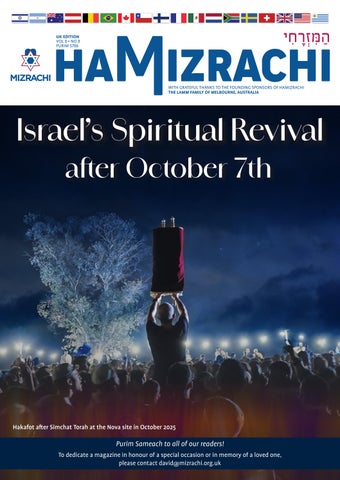
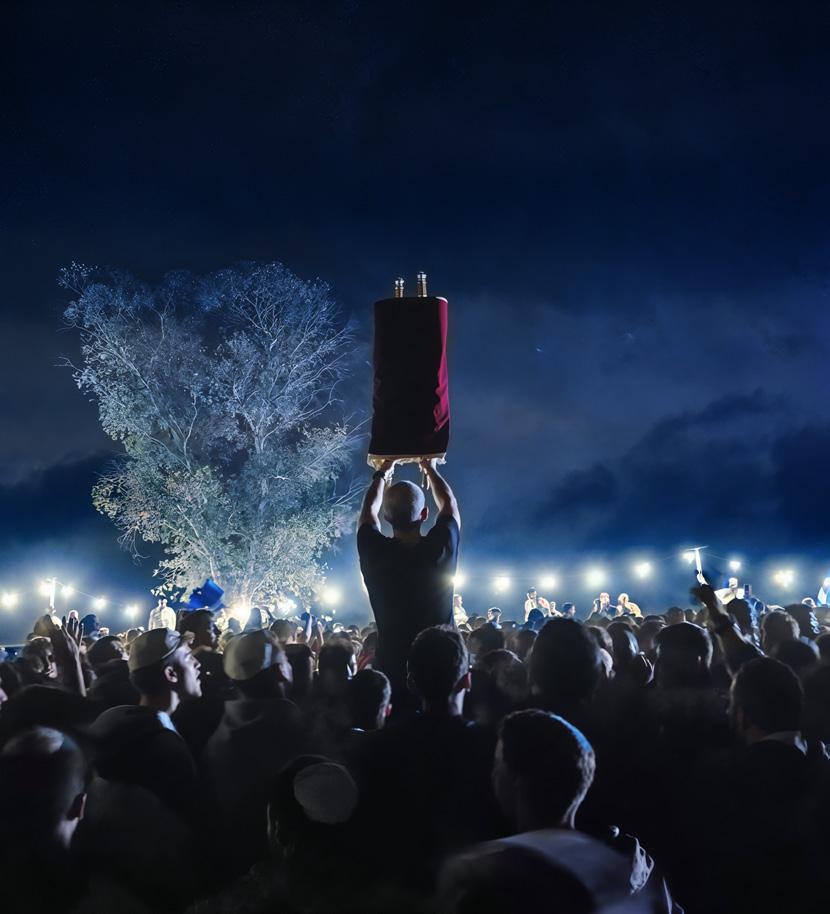
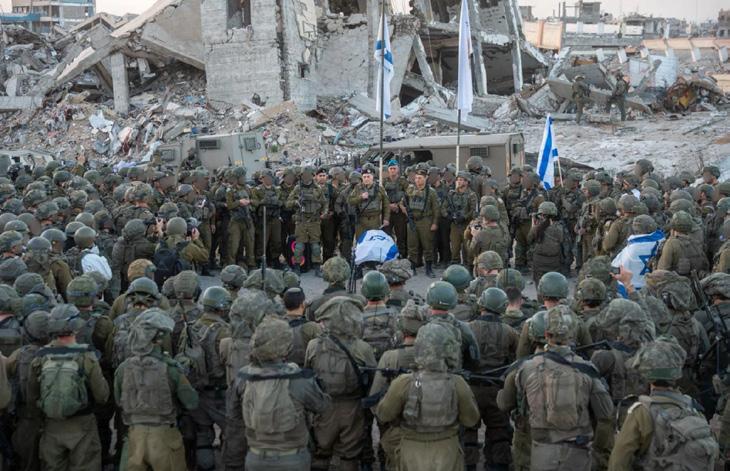
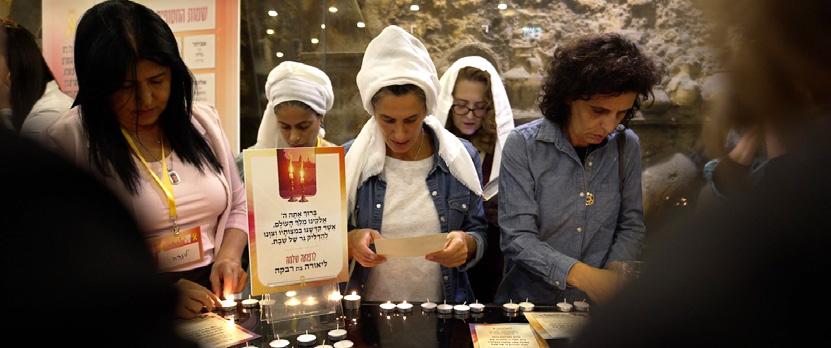
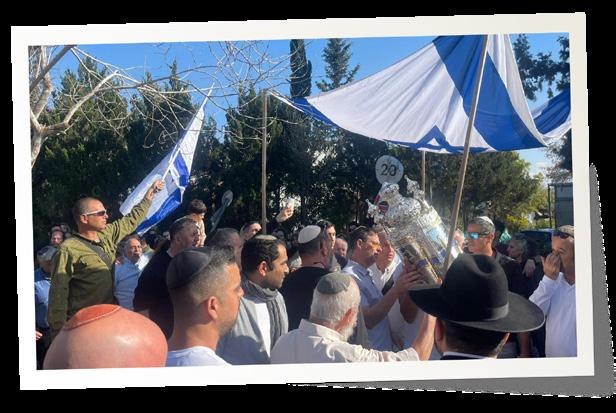
Hakafot after Simchat Torah at the Nova site in October 2025
Purim Sameach to all of our readers!
To dedicate a magazine in honour of a special occasion or in memory of a loved one, please contact david@mizrachi.org.uk

www.mizrachi.org
office@mizrachi.org
+972 (0)2 620 9000
NASI
Rabbi Yosef Zvi Rimon
CO-PRESIDENT
Rabbi Yechiel Wasserman
CHAIRMAN
Mr. Harvey Blitz
EXECUTIVE CHAIRMAN
Rabbi Doron Perez
CEO
Rabbi Danny Mirvis
EDUCATIONAL DIRECTORS
Rabbi Reuven Taragin
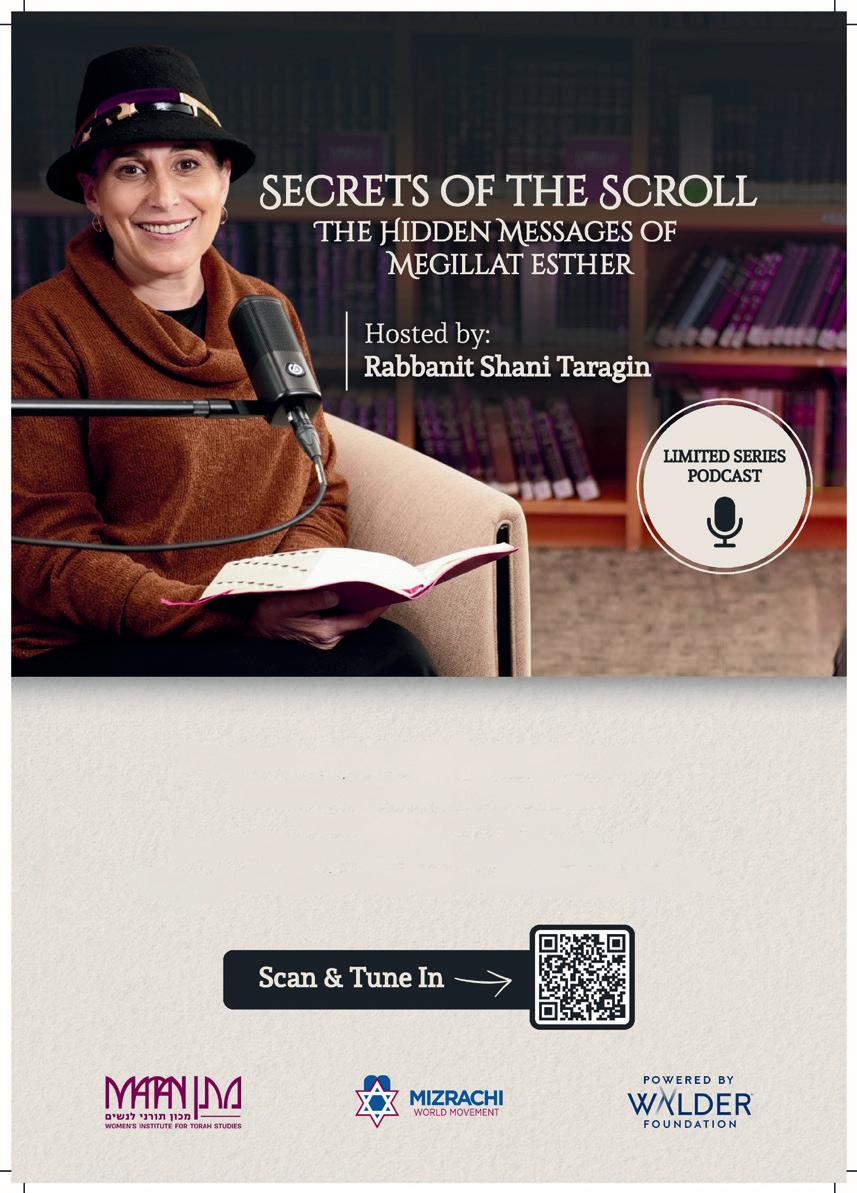
Rabbanit Shani Taragin
World Mizrachi is the global Religious Zionist movement, spreading Torat Eretz Yisrael across the world and strengthening the bond between the State of Israel and Jewish communities around the world.
Based in Jerusalem and with branches across the globe, Mizrachi – an acronym for merkaz ruchani (spiritual center) – was founded in 1902 by Rabbi Yitzchak Yaakov Reines, and is led today by Rabbi Doron Perez. Mizrachi’s role was then and remains with vigor today, to be a proactive partner and to take personal responsibility in contributing to the collective destiny of Klal Yisrael through a commitment to Torah, the Land of Israel and the People of Israel.
www.mizrachi.org.uk
uk@mizrachi.org 020 8004 1948
PRESIDENT
Chief Rabbi Sir Ephraim Mirvis KBE
CHAIR OF TRUSTEES
Steven Blumgart
CHIEF EXECUTIVE
Rabbi Andrew Shaw
BOARD
Michelle Bauernfreund
Matti Fruhman
Andrew Harris
Grant Kurland
Sean Melnick
David Morris
Joel Silberstein





One of the most famous concepts of Purim is that of “ v’nahafoch hu” (אוּה ךְֹוּפֲה ַנְַוּ):

And so, on the thirteenth day of the twelfth month, that is, the month of Adar, when the king’s command and decree were to be executed, the very day on which the enemies of the Jews had expected to get them in their power, the opposite happened , and the Jews got their enemies in their power. (Esther 9:1)
The idea is that back then the world turned upside down, and we were victorious.
At the moment, we are living in a world that is also upside down and we must still be victorious. But how?
My father’s family is from Ireland, and for so many years as a child, we would spend our summers in Dublin with my uncle, aunt and my grandparents. I have such fond memories of the city and the country and have hakarat ha-tov for what Ireland did for my family for so many years.
Yet today Ireland is now one of the most anti-Zionist countries in Europe and has been thrown into ‘turmoil’ as they have drawn Israel in the UEFA Nations League. The hateful mob (including many politicians) have made it very clear that Israelis are not welcome and the Irish FA, who also have said some appalling statements, are afraid to hold the game in Dublin due to the prospects of a modern-day pogrom. So they are thinking of holding the game in another country. That country may well be Germany.
Life in 2026 – a European country is drawn to play the Jewish state they detest and
Rabbi Andrew Shaw
cannot protect the Jews – so Germany offers to help:
But it is not just Ireland there has been a moral inversion across the upside down Western world.
Some obvious examples:
• Zionism which is rooted in Jewish self-determination is labelled colonialism.
• A people indigenous to their land are portrayed as foreign occupiers.
• Jewish self-defence is reframed as aggression.
• Calls for Jewish sovereignty are described as racism, while movements that deny Jewish national rights are described as liberation.
For many people, reality feels inverted.
From a Torah perspective, v’nahafoch hu carries both warning and hope.
Warning because we have, through our long history, often lived in eras where moral language is distorted and life can be very difficult.
Hope because Purim teaches that reversals can reverse again. What looks like decline may be preparation for renewal. What appears as isolation can strengthen identity. As many articles in this magazine will demonstrate, the devastation of October 7th has given way to a spiritual renewal as well as a strengthened Israel:
We have to understand that even when the moral order seems upside down, history is not random. Reversal is built into the story. Because Hashem is in the story.
The question Purim leaves us with is: when the world turns upside down, how
do we respond, with fear, or with deeper Jewish confidence?
We must respond as we did back in the times of Purim:
The Jews undertook and irrevocably obligated themselves… (Esther 9:27).
The Gemara in Shabbat 88a explains that this was a renewal of the Sinaitic covenant, this time without coercion:
Rava said: Even so, they again accepted it willingly in the time of Achashveirosh, as it is written: “The Jews ordained, and took upon them…” (Esther 9:27), and he taught: The Jews ordained what they had already taken upon themselves through coercion at Sinai.
So, while the world goes mad, our mission remains the same, dedicated, committed and confident. Confident that we will merit what happened to our people all those years ago…
That had been transformed for them from one of grief and mourning to one of festive joy… (Esther 9:22).
Purim Sameach!

The most painful day of persecution, death, and destruction since the Holocaust, October 7th, 2023, has also begun to birth a powerfully positive new era.
It is true that the events of October 7th unleashed the genie of antisemitism in a most diabolical incarnation of anti-Zionism globally – on seven fronts on Israel’s borders and in every Jewish community from Be’eri to Bondi. But in this terribly painful challenge lies also our greatest opportunity. In crises, according to our sages, lies great opportunity.
The magnitude of the October 7th pogrom – the murder of 1,250 Jews and innocent civilians – is matched only by the despicable manner in which many were mercilessly killed, without any distinction between soldier and civilian, young and old, men and women, and with unspeakable torture and brutality.
251 hostages, both alive and dead, were dragged across the border to be bartered with as if they were inanimate commodities. With the recent return of Ran Gvili, hero of Israel, for burial, this is the first time in almost twelve years that no hostages remain behind in Gaza. Our son, Captain Daniel Perez z”l, who fought bravely on that day along with his tank crew in the defense of Nachal Oz, returned four


months ago for burial, and now finally Ran has returned as the last hostage to have been killed and taken on that awful day.
Despite the enormous pain and suffering that emerged on that awful day, it was also at the same time a truly awesome time – a day when, despite the near-total paralysis of Israel’s political and military establishment, there emerged an extraordinary display of courage, heroism, and unmatched self-sacrifice. Soldiers and civilians alike from all across Israel turned up and put their lives on the line to save people they didn’t know in countless acts of remarkable selflessness. From the top down, the Israeli establishment failed terribly, but from the bottom up, Jewish civil society shone so brightly.
The awesome selflessness continued with over 100,000 Israelis returning from around the globe to join the fight, and countless Diaspora Jews showing up and supporting Israel in every possible way. The worst day revealed the depth of our bonds – of brotherhood, sisterhood, and solidarity – renewing our deep covenant of mutual fate and common destiny.
As Jew-hatred intensified in its new form of “Israel Eliminationism” – seeking to deny and destroy any Jewish sovereignty from the river to the sea – so did our deep sense of common fate. Selfless reservists
and their families showed up for months and years of service until the reservists of the Alexander Brigade brought the last hostage home in tears of pain and joy. The continued support, compassion, and camaraderie of Jews and our friends around the world, one for another, is humbling. The external enemy of Hamas and their supporters, who did not distinguish between any type of Jew on that day and who target every type of Jewish community globally, are unifying and galvanizing us internally.
Out of the ongoing pain of loss that many of us are still experiencing, and from the trauma of vulnerability, a new Middle East is emerging with remarkable Israeli deterrence, resilience, and strength. The relentless war of justice against the vicious and malicious Hamas leadership, the astonishing beeper incidents and the constant weakening of Hezbollah, the miraculous 12-day Iranian war which continues to erode Iran itself and their axis of evil –seismic geopolitical shifts are happening before our eyes. We are all proactive partners along with heavenly miracles in these astonishing events of seemingly the dawn of a new and better era.
The pattern of Jewish history
Why am I so confident? Why do I believe that the pain of darkness and night will bring forth a new era for the Jewish people and humanity?
The reason is that the clearest and most consistent pattern of Jewish history is exactly this – after darkness comes dawn and daylight, and after pain and suffering comes salvation and redemption. This is the basic plot of the Haggadah – the story of Jewish history that we tell our children every year on Pesach when we sit together to reflect on being part of Jewish destiny.
Chazal teach us that the underlying theme of the Haggadah and all Jewish history is exactly this: it begins with difficulty and pain and ends with praise and redemption. Did the back-breaking bondage of Egyptian slavery not culminate in liberation, redemption, and revelation? Did the wandering in the desert not culminate in the return to the land of our forefathers and mothers?
Did not the terrible sale of Yosef, threatening to tear our inaugural Jewish family apart, lead to reconciliation and forgiveness with the family intact? After the destruction of the First Beit HaMikdash at the hands of the Babylonians came the Shivat Tzion movement for the return to Zion and the rebuilding of the Second Beit HaMikdash
After the destruction of the Second Beit HaMikdash and the failed Bar Kochba rebellion at the hands of the Romans came Yavneh and the Mishnah, the great citadels
of Torah leadership and scholarship, and the synagogue – of prayer, worship, and community building – which would all sustain us during our long exile.
After the terrifying Crusades and Inquisition came the sages of Tzfat, the rekindling of Jewish hearts through the Jewish mysticism of the Arizal and the Shulchan Aruch, the great work of Jewish law.
After the horrific Chmielnicki massacres arose the Chasidic movement to rekindle the Jewish soul, and after the terrible pogroms of the late 19th century arose the Zionist movement and its desire for return and redemption. After the unspeakable Holocaust came the State of Israel and the return to Jewish national and collective life after 2,000 years.
After the tragic and sudden attack of the Yom Kippur War, Israel emerged as a regional superpower and trusted ally of the world’s lone superpower.
The pattern is clear – after pain and suffering, a new positive era emerges.
The story of turning darkness into light is not only the essence of Judaism and the pattern of Jewish history, it is also at the heart of the Purim story.

Haman’s Final Solution was arguably the closest the Jewish people have ever come to extinction. It is the worst threat of annihilation of Jewry ever conjured up in the hearts of man. Never before and never since has there been a political leader who planned and almost succeeded in exterminating every single Jew in every country on one day. Even Hitler’s Final Solution focused “only” on the continent of Europe. Haman’s diabolical plan was underway. With the irreversible seal of the king, emissaries were dispatched to every one of the 127 countries across the world with a terrible edict – to kill every single Jew on the 13th of Adar. It seemed that it had reached a point of no return and, Heaven forbid, the end of the Jewish people was nigh.
Only through the age-old promise of G-d for the eternal survival of the Jewish people, coupled with the incredible heroism and courageousness of Mordechai and Esther, was the day saved. In the greatest turnaround perhaps in all of Jewish history, not only were the Jews not harmed, but the edict was miraculously totally reversed at the last minute – not even one Jew was harmed while 75,000 of our worst enemies were killed. Haman and his sons were hanged while Mordechai and Esther became the heroic saviors.
The terrible threat of imminent and total extermination elicited, according to Chazal, one of the greatest spiritual responses to challenge in our history – a reacceptance of the Torah.
“Rava said: Even so, they re-accepted [the Torah] in the time of Achashveirosh, as it is written: ‘The Jews fulfilled, and took upon themselves, and upon their seed, and upon all such as joined themselves unto them’ (Esther 9:27), and he taught: The Jews fulfilled [then in the time of Achashveirosh] what they had already taken upon themselves [at Sinai]” (Shabbat 88a).
How did the imminent threat of annihilation lead to the acceptance of the Torah? Rashi explains that the Jewish people did so out of a deep appreciation for the miracle that was done for them.
It seems that despite the attempts of many Jews to blend into Persian culture (participating willingly in Achashveirosh’s royal banquets – see Megillah 12a), they understood just how quickly Jew-hatred came to almost bringing about their destruction. This deep appreciation of their vulnerability galvanized them with a profound sense of camaraderie and commitment to their common fate, which led to a deeper understanding of their unique mutual Jewish destiny.
The understanding of our collective fate – that we are one historic community together, facing major challenges from those who hate what Hashem and Judaism stand for – brought the Jewish people to commit to our divinely mandated mission and to re-accept upon ourselves that which we had previously accepted at Sinai. We are to be “a kingdom of priests and a holy people” (Shemot 19:6), here to remind the world of the best of human righteousness, that we live in G-d’s world and that we’re all created in His image; that good will triumph over evil and righteousness and justice are the essence of the Jewish Torah-driven mission.
October 7th – on the brink of destruction
What happened on October 7th, 2023, was without a doubt one of the most vulnerable days in modern Jewish history – a time when Jews felt, and certainly in retrospect, that the State of Israel could, Heaven forbid, have been destroyed. This is not an exaggeration.
Without thousands of soldiers and civilians coming from all parts of Israel on that day and putting their lives on the line
– and indeed some, such as our son Daniel z”l, paying with their lives – I believe the death toll would not have been 1,250 as it was that day, but would have been many thousands more. The fact that 5,000 terrorists crossed the border and ‘only’ 1,250 were killed, and not 10,000, is first and foremost because of that incredible self-sacrifice of our people. But that is only on the Gaza border.

Reframing this sense of vulnerability into an impetus for a better understanding of our collective Jewish mission and a commitment to our future is the quintessential Jewish response.
What would have happened if the 40,000 much better trained and armed Radwan forces of Hezbollah had come streaming from the north, overwhelming all the northern towns while proceeding to Tiberias and Haifa, under the cover of tens of thousands of more lethal rockets? Who knows what would have happened.
Had, Heaven forbid, at the same time Iran sent 500 ballistic missiles and the Houthis another hundred, as was done at a later stage, but this time with no time to prepare with our allies to shoot them down – who knows what would have happened.
Had the Arabs from East Jerusalem stormed into West Jerusalem, and those in Bethlehem into Gush Etzion and Efrat, and those of Qalqilya into Netanya, and of Ramla and Lod into Tel Aviv and Rishon Letzion, who knows what would have happened.
It is not an exaggeration to say that Israel could, Heaven forbid, have been destroyed. Had we not lived in G-d’s world, but in the dark world of the Ayatollahs, Sinwar, Hitler, and Haman, things would have ended very differently.
Our confidence was rocked, our misconceptions destroyed, and our sense of vulnerability heightened as never before during my lifetime. Israel then faced a prolonged seven-front war, and the worst outbursts of antisemitism experienced in decades ensued, culminating with the Bondi Beach massacre. A deep sense of vulnerability is unavoidable.
But what has our response been to this vulnerability? It has been the most Jewish of responses. It has been reclaiming agency, turning darkness and defeat into light and victory for the sake of life and liberty – repelling the forces of evil of Hamas, Hezbollah, and Iran in the most remarkable way.
So too have many Jews around the world responded remarkably – from business leaders to politicians, from actors to college students – many have reclaimed their sense of collective Jewish fate. Termed by some as “October 8th Jews,” many have become proactive in standing by Israel and have discovered their distinct Jewishness. So too in Israel – many of the released hostages, their families, and regular Israelis have turned to a deeper sense of faith and commitment to Judaism.
In the very attack on Zionism and Israel today lies our greatest opportunity to forge together a new and better time for us all. Reframing this sense of vulnerability into an impetus for a better understanding of our collective Jewish mission and a commitment to our future is the quintessential Jewish response.
We highlight in this edition of HaMizrachi how many in Israel have reframed the existential threat of October 7th and its aftermath into an impetus for renewed growth. It is a historical echo of the reacceptance of the Torah in the aftermath of Purim.
It is our hope and prayer that after so much pain, a new era is ushered in for a better and brighter future for the Jewish people and indeed all of humanity.
While Jewish survival for the benefit of the world has been foretold, the role that each and every one of us chooses to play is up to us – whether to be passive bystanders or, like Mordechai and Esther, to be proactive protagonists in moving Jewish history forward. Working together to turn the darkness into light, disarray into unity, and great challenge into enormous opportunity.
Indeed, together we will surely prevail.


30th APRIL - 3rd MAY 2026

















On the Shabbat before Purim, Chazal instituted the reading of Parashat Zachor. By hearing this Torah portion, we fulfill the biblical commandment to remember what Amalek did: we recall Amalek’s wickedness in attacking the stragglers at the rear of the nation; we remember Amalek’s attempts to erase G-d’s name from the world – “The L-rd will be at war with Amalek”; and we remember our obligation to obliterate Amalek.
According to the Ramban and Rambam, one can theoretically fulfill the commandment of remembering by recounting Amalek’s deeds in any formulation one chooses. However, Chazal established that we should specifically read Parashat Zachor to fulfill this obligation. But according to Tosafot (following most later authorities), the biblical commandment can only be fulfilled through the actual reading of Parashat Zachor, and this is how the Shulchan Aruch ruled. Therefore, by observing Chazal’s enactment to read Parashat Zachor
before Purim, we fulfill our obligation of remembering.
To properly fulfill the Torah commandment, one should ideally hear Parashat Zachor read from a Torah scroll in a minyan. Someone who did not do so should intend to fulfill the obligation through the reading of “Vayavo Amalek ” on Purim, and should also read Parashat Zachor themselves from a Chumash
Technically, the Torah does not specify a particular time of year for reading Parashat Zachor – anyone can read it whenever they wish. However, Chazal wanted to connect the remembrance of Amalek to Purim because Haman was descended from Amalek. Therefore, even though hearing Parashat Ki Teitzei fulfills the biblical obligation of remembering, ideally one should do so through Parashat Zachor.
When reading Parashat Zachor, both the reader and listeners must intend to fulfill the commandment of remembering. Some communities announce this intention before the reading. If someone wants to fulfill their obligation during the Parashat Ki Teitzei, they should ideally inform the Torah reader to have him in mind.

zecher: Strictly speaking, it is sufficient to read the commonly accepted pronunciation once: zaycher, רֶכֵ ֵזֵ . However, the Mishnah Berurah writes that both pronunciations should be read – first the less probable version, “erase the zecher ( רֶכֵ זֵ) of Amalek,” then the precise version, “erase the zaycher ) of Amalek.”
Some authorities require that each person hear Parashat Zachor from a Torah scroll written in their community’s script – Ashkenazi, Sephardi, etc. – and in the pronunciation they customarily use in
prayer. Strictly speaking, this does not seem necessary, but ideally each person should hear Parashat Zachor in their customary pronunciation and from a Torah scroll written in their community’s script. In a minyan with both Ashkenazim and Sephardim, the reading can be done in either tradition, and everyone fulfills their obligation.
Who is obligated? According to Sefer HaChinuch, only men are obligated in the commandment to remember Amalek and in reading Parashat Zachor, “because they are the ones who wage war and take vengeance on the enemy, not women.” However, the Minchat Chinuch and other later authorities disagree, holding that women are also obligated to hear Parashat Zachor, as they infer from the Rambam’s language. In practice, the straightforward ruling is to be stringent on this matter. Indeed, many women make a point of coming to hear Parashat Zachor, and in many places there is even a special reading of Parashat Zachor for women.
If a woman did not hear Parashat Zachor, it is proper that she fulfill her obligation by hearing Parashat Ki Teitzei or the portion of “Vayavo Amalek ” (on Purim or in Parashat Beshalach). However, according to the Chazon Ish, Rabbi Shlomo Zalman Auerbach, and other authorities, women are not required to hear Parashat Zachor Nevertheless, it is good that they at least read Parashat Zachor themselves from a Chumash

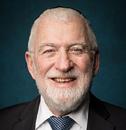
Rabbi Yosef Zvi Rimon is the Nasi of World Mizrachi. He is the Founder and Chairman of Sulamot and La'Ofek, and serves as the Chief Rabbi of Gush Etzion, and Rosh Yeshivah of the Jerusalem College of Technology.

VERT
Netanya
Spectacular views of the Mediterranean


No Kitniot/ shruyah
Children's Gymboree(PlayStation and more)
Additional


Rabbi Yosef Zvi Rimon Nasi, World Mizrachi
Guest Lecturer

Prestigious luxury at the city’s highest point

Glatt Meat: Rav Rubin/Kehillot. All products Mehadrin
Free entrance to spa, pools and fitness room
Rabbi Doron Perez Executive Chairman, World Mizrachi


October 7th was a generational moment, a line in the sand between the world before and after. Its ripple effects have spread far and wide, with such varied impacts as mass displacement of Israel citizens, a remade balance of power in the Middle East, and a culture war across American campuses. This edition of HaMizrachi will focus on a profound shift that has occurred in Israeli society – a spiritual awakening that has already taken hold, but whose story is still being told.
This story began with anecdotal snippets in the first days of the war – accounts of soldiers on front lines asking for tzitzit, families of secular hostages gathering at the Kotel for tefillah gatherings, and non-kosher restaurants becoming kosher to provide food for the displaced. These anecdotes then became a cultural phenomenon, with a new wave of religiously inspired music sweeping across Israel. It is now also backed by data, with multiple studies showing that Israelis feel an increased sense of faith in G-d, and connection to religious practice. In framing this profound change, I think we can describe three defining features of it:
1. This is a bottom-up movement, not top-down.
Many religious movements are led by rabbis and religious leaders. This spiritual awakening has been different – a bottom-up religious expression, without clear leaders or even having any organized nature. There has been a mass religious awakening, in a very decentralized way.
2. The awakening involves a greater connection with aspects of Judaism, but doesn’t always equal full halachic observance.
It can sometimes be confusing to outsiders to see some expressions of this awakening. A common example is the large number of Israeli men who today wear tzitzit and no kippah, something few people in the Diaspora will have encountered. In an even more striking anecdote, I heard of a young man who asked for his tattoo to be etched on one particular arm, so it shouldn’t be the same arm where he places his tefillin. There has been a massive uptick in certain halachic practices, but as a whole this
spiritual awakening does not equate to a mass movement of people adopting a fully halachic lifestyle.
3. There were roots of this awakening before October 7th.
While October 7th had a profound influence, in some ways this movement is an extension of pre-October 7th realities –in particular, the existence of the masorati, traditional public in Israel. Many English-speaking observers of Israel intuitively divide Israeli Jews into religious and secular groupings. However, many Israelis identify in a third way – masorati, traditional. In the Central Bureau of Statistics census of 2020, 22% of Israeli Jews identified as religious, 33% as traditional and 45% as secular. The traditional Jews, many of whom are of Sephardi origin, have often had a complex relationship with Judaism and halacha, mixing a deep identification, connection and respect for Judaism with varying levels of religious practice. Much, though not all, of the post-October 7th religious awakening has happened in the masorati, traditional, segment of Israeli society.
Chazal describe that following the events described in the Megillah, on some level the Jewish people reaccepted the Torah upon themselves. Life-altering events have the ability to deeply affect our religious connection and practice. As we emerge from two years of war and explore the post-war (or maybe interwar?) reality, understanding the spiritual shift in Israeli society can help us understand a critical element in the contemporary Jewish story.

Rabbi Aron White is the Managing Editor of HaMizrachi magazine. He lives in Carmay HaNadiv, Kiryat Malachi, and serves as the Rabbi of Beit Knesset Tzameret Arnona in Yerushalayim.

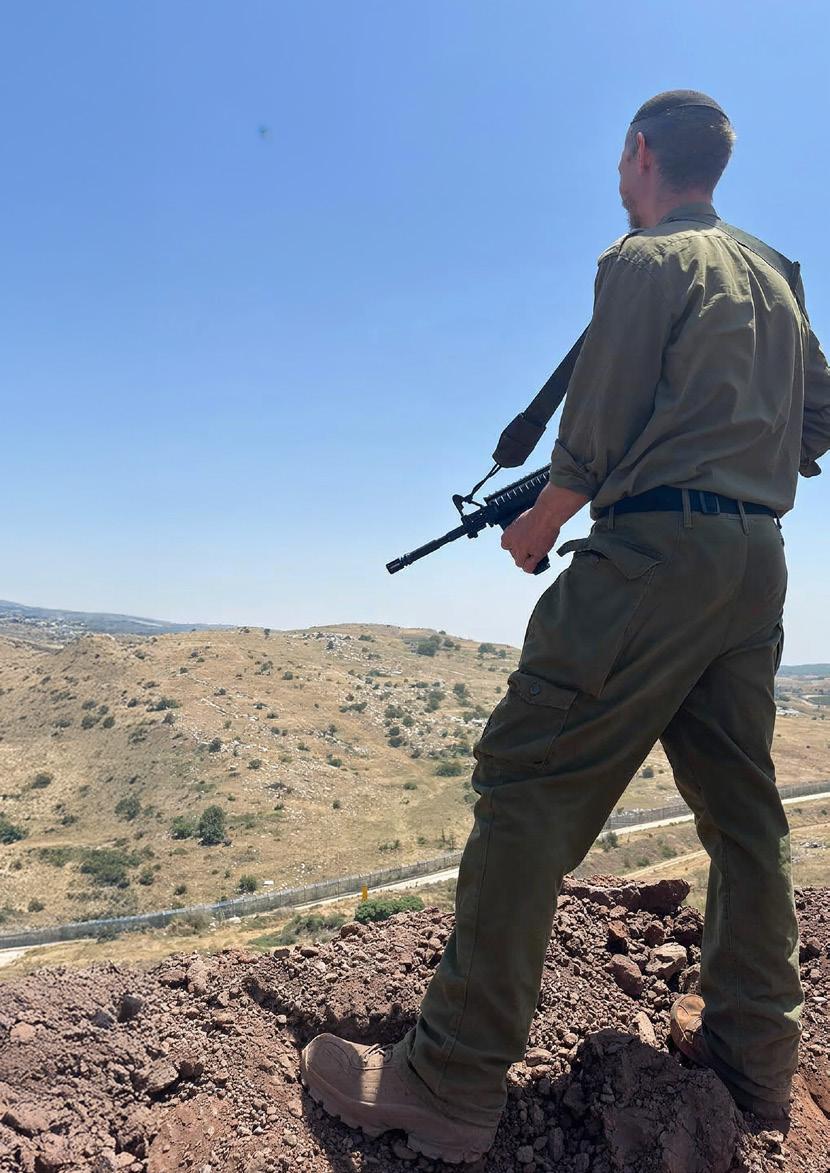
Rabbi Zvi Elon has dedicated much of his life to serving both Israeli society and the global Jewish community. After several years as a community rabbi in Uruguay and later in Caesarea, he went on to pursue advanced rabbinic and military training in Israel. Today, he serves as the rabbi of a battalion in the Northern Nachal Brigade, guiding soldiers not only through the challenges of military life but also through spiritual growth. Rabbi Aron White spoke with Rabbi Elon about his experiences during the recent conflict, witnessing a religious and spiritual awakening among soldiers, and the unique role of faith in moments of national crisis.


Thank you for taking the time to speak with us. Could you share a bit about your background and how you arrived at your current role?
Certainly. I’m married to Chen, and thank G-d we have five children. We currently live in Or Akiva. In 2005, my wife and I went on shlichut to Uruguay, where I served as the community rabbi for six years. After returning to Israel in 2011, I became the rabbi of Caesarea for seven years. Since 2018, I’ve been involved with Diaspora Jewry through the Mizrachi movement. For three years, I served as Mazkal (Secretary General) of World Bnei Akiva, and more recently, I returned to Mizrachi work.
Around 2020, I joined the Military Rabbinate course. Having spent many years abroad, it was initially challenging to reintegrate into a combat framework as I was classified as a foreign resident. After several attempts, I was advised to join the officers’ course of the Military Rabbinate, which offered a pathway to re-enter a combat unit. Within the course, there is a specialized track designed for those returning to combat service.
Can you explain what the Military Rabbinate course entails and the role of a military rabbi?
The course lasts nearly two months and has two main components. The first is professional rabbinic training. This covers halachic guidance for the military context: issues of kashrut, observing Shabbat on base, and wartime questions – everything from prayer logistics to practical concerns, such as whether it is permissible to deliver snacks to soldiers on a patrol during Shabbat.
The second component emphasizes one of the most solemn roles of a military rabbi: assisting in the evacuation of fallen soldiers. This can include handling casualties or, in the worst-case scenario, partial remains in a mass-casualty event. The training prepares rabbis to navigate these profoundly difficult situations with both professional skill and spiritual sensitivity.
After the rabbinic portion, there is a standard officers’ course at Bahad 1, the IDF’s primary training base. Upon completing this, battalion and brigade commanders often recruit graduates for combat units. That is how I joined the reconnaissance battalion of the Northern Nachal Brigade in November 2022.
As a battalion rabbi, how many soldiers do you oversee?
Approximately 500.
You had been in reserves before the recent war. How long had you been active with the battalion overall?
It’s funny to even think about “before the war” – it was just a completely different life. Before the war, we actually had more reserve days than regular soldiers, because we’re in the command echelon. Every time there was a commanders’ training… But ultimately, end to end, until October 2023, I think that besides the officers’ course, I maybe did about a month in total. Then the war breaks out, and it was just a regular Simchat Torah in shul. Suddenly, the phone starts ringing – and that’s it. I ran home for a moment to talk, went back to the synagogue, and told all the reservists there to go home and grab their phones. We live in a very calm area. We didn’t know anything, didn’t hear anything. I live in Or Akiva. There were no sirens, nothing unusual – the streets were completely normal.
It was nine in the morning – just twoand-a-half hours after it started – and my phone already had five or six messages from the battalion commander: “We need to get ready to leave.” By noon, I got in the car and drove. We were dispatched straight to the north. I even argued with the battalion commander – I told him I wanted to go south to help – but he said,
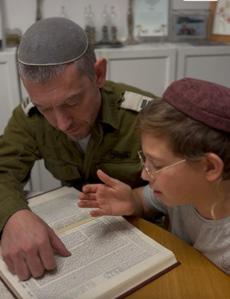
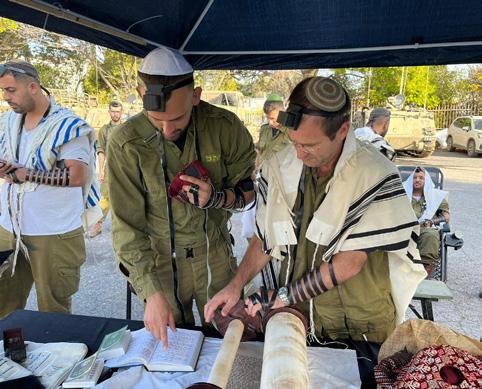
rightly, that I didn’t understand: “You have to go up north. The story is in the north.”
By the afternoon, still on Shabbat, we reached a place called Yimach HaMachsanim, where all the battalion’s equipment was stored. We drew equipment and slept there, but by 4 a.m. we moved further north and took positions on the border fence. Already early Sunday morning, we were deployed. In hindsight, the rapid mobilization of hundreds of thousands of reservists in the north deterred Hezbollah from attacking – which we now understand was their plan. Just today, an article reported that 3,000 Hezbollah fighters were prepared to enter. But they saw the numbers – between October 7 and 8, suddenly there were almost 150,000 soldiers along the northern border. It was unreal.
Many observers noted a religious awakening among soldiers in the early days of the conflict. Did you witness this firsthand?
Absolutely – I already saw this on October 7th itself. Immediately after Shabbat, I organized a havdalah ceremony for a few religious soldiers, but as I was about to start, others came over and said: “Wait, wait.” Within minutes, nearly the entire battalion – about 500 soldiers – joined. We recited, “He who separates between light and darkness, between Israel and the nations,” and everyone responded “Amen!” It was remarkable.
In the days that followed, I brought a Sefer Torah to an open field along the fence. Our first Kabbalat Shabbat was Parashat Bereishit. We had no siddurim, so I recited the Amidah aloud, and 50–60% of the soldiers participated. Every day during those first weeks, we held prayers and shared Torah teachings, even under the most challenging conditions.
Was there any resistance from secular soldiers, or concerns about religious coercion?
None. Not a single incident. Everyone participated willingly. They joined for Chanukah candle lighting, kiddush on Friday nights, and even Tefillat haDerech before entering Lebanon on Tzom Gedaliah. The engagement was voluntary, enthusiastic, and heartfelt.
How do you explain this spiritual awakening?
First, I’m in a unit whose vast majority is Ashkenazi – Nachal’s recon – with many
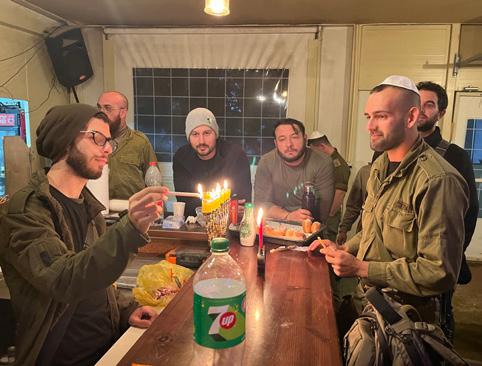
kibbutzniks . It’s not a community that, before October 7th, you’d define as traditional or religious. Not at all. But I wasn’t surprised for a moment, because Rav Kook taught us: this is Am Yisrael – you just don’t always see it tangibly. We merited to see it with our own eyes.
And it’s not just the soldiers. Take Chef Eyal Shani – famous for his shrimp restaurants worldwide – sending a package for all the soldiers, personally dedicating it: “With love and thanks to our soldiers,” writing in his own hand, “kosher lemehadrin.” It turns out he made sure to have kashrut supervision in his restaurants in Israel so he could prepare food for soldiers – and not just soldiers – for Am Yisrael
What about criticisms from Charedi communities that the army conflicts with religious observance? How do you view that?
I think that anyone who wants to strengthen their faith, love of Israel, and love of Torah – one of the most powerful places to do that is fighting shoulder to shoulder with your brothers in the army, in a state of self-sacrifice for the Jewish people.
Are there halachic challenges? Without a doubt. But we learn to face challenges throughout life. I’ll say carefully that we need to believe in ourselves more – that we can stand up to those challenges. And today the army knows how to provide solutions for soldiers who need them. Regarding kashrut and Shabbat, and even modesty – it’s truly challenging, but for

someone seeking solutions, especially in regular army service, it’s possible to find them.
I understand the difficulty. But when you live in the moment and experience the power of devoting yourself to the Jewish people – of giving your life for them – it gives you a tremendous spiritual boost. I can say this broadly from my reserve duty: looking at the whole battalion, everyone grew spiritually. Everyone.
As a military rabbi, did you also have people coming for heart-to-heart talks – questions about direction in life? Did it show up that way too?
Spiritually transformative experiences went beyond communal prayer. During the war, two soldiers decided to marry, inspired by the urgency and responsibility of building a Jewish home in Israel. We made them a wedding in the field. It was insane. And what convinced them to marry was the war – they understood they needed to build a Jewish home in Israel. That’s very personal. There were also numerous heart-to-heart talks – about relationships, reservists with problems at home, about educating children, about direction in life. ◼

Eliya Cohen was kidnapped from the Nova Festival, and held in captivity in Gaza for 505 days, until his release in January 2025. For much of the time he was held together with Eli Sharabi, Omer Shem Tov and Alon Ohel. Following his release, he recounted to Kan 11 TV station how faith helped him in the depths of captivity.
Idon’t keep Shabbat, but I do believe in Hashem, I do put on tefillin, I try to separate between meat and milk and all that goes with it (keeping kosher), as well as festivals and traditions. This is my path.
In captivity, as I would go to sleep and as I would wake up, I would have a dialogue with G-d: “Good morning, Abba. First of all, thank you that I am alive. Please keep my family healthy and safe. If Ziv is alive, I want her to know I love her and she should be strong.” (Ziv, Eliya’s girlfriend, had also been at the Nova festival)
We would have many discussions between us about G-d and faith, and we had differences of opinion. In the morning, I would be in my corner, stand up, and do a “Hanachat Tefillin,” imagining I was putting on tefillin, and then speak to Abba (G-d). I would say Shir LaMa’alot (Tehillim 121), and each day I would do this.
There was one time we had a conversation about faith, and one of the others said, “How do you believe in G-d after what happened to us?” I said to him, from my perspective, “How do you not believe in G-d after what has happened to us? In the end we are alive, we are here, there is a chance to return home.” But it shook me up, and that night as I lay falling asleep I started talking to G-d, and I said, “Listen, Abba – give me the strength to cope, give me some sign you are here.” Two minutes later, suddenly the radio that had been on in Arabic changed to Hebrew, to Radio Darom, and I started to hear speeches of mothers of hostages. This was my first time I had heard any information about October 7th – I didn’t know anything, how many were killed, how many hostages there were, and it was my first time getting any information.
When there was nothing left to hold on to, one of the others said, “Maybe we can join you in your morning tefillah? Say the tefillah aloud and we will join you – teach me how to say it.” We prayed, and a few days later all four of us would be praying together. It became our morning routine – we would wake up, stand up, do the “Hanachat Tefillin,” say Shema, I would say it aloud and everyone would say Amen – it gave us a lot of strength.
The water we would receive was often saltwater straight from the sea. I can’t describe how it looked – you would look at it and wonder if it’s going to be worse to drink it, but you have no choice. I said to myself: “From now on, when I have water, I will make the beracha on it.” When I have water, I will say thank you. To say thank you for this water, to thank Hashem for it.
In the end, you are in a place where you have a lot of time, and you spend a lot of time focusing on pnimiyut (inner essentials), you don’t deal with nonsense. We live in a very physical world, spending lots of time thinking about our appearance and image, and there you have none of that. I would get up in the morning and have dialogues with myself, what can I do better today, what did I do wrong yesterday, and what can I do today to improve
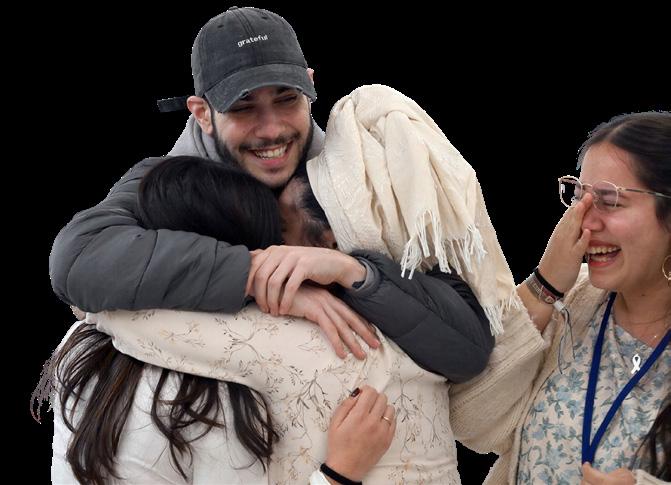




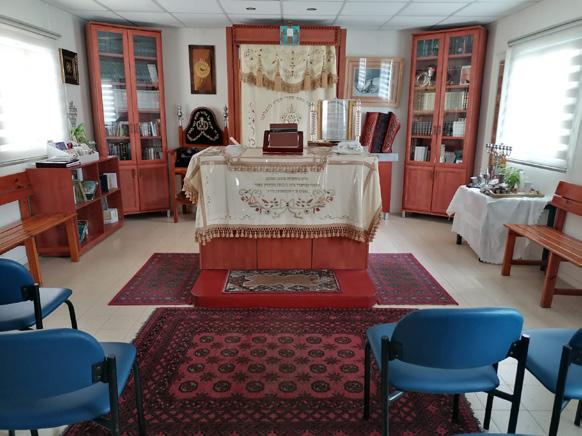

Rachel Periker arrived at Kibbutz Be’eri planning to stay just one year. Nearly four decades later, she has transformed the spiritual landscape of this historically secular community. A nurse by training and daughter of a traditional Yemenite family steeped in faith, Rachel established Be’eri’s first synagogue in 2006 after a difficult year of skepticism and opposition. Named Ahavat Yisrael, the synagogue became far more than a place for High Holiday prayers, evolving into a vibrant center of Jewish life. Since October 7th, it has served as a spiritual sanctuary for soldiers, families, and a traumatized community seeking meaning and connection.
Rabbi Aron White spoke with Rachel about her journey of faith, the challenges of bringing Judaism to a secular kibbutz, and the miracles she has witnessed in Be’eri’s synagogue.
Tell us a bit about yourself and when you arrived in Be’eri, as background to the story of the synagogue.
My whole life I lived in Ramat Gan. That’s where I’m from. I’m a graduate of Hadassah Ein Kerem, a nurse by profession. I worked for several years at Hadassah and then almost twenty years at Tel Hashomer.
I got married young. When I was twenty, I gave birth to a wonderful daughter, and when she was ten months old – two years later – I got divorced. I lived in Jerusalem for a while, and after almost fourteen years I returned to Ramat Gan.
I met my husband in Tel Aviv. He’s Swiss and had come to Israel many years earlier. After we got married, we lived in Ramat Gan for a year and then moved to Kibbutz Be’eri. The plan was to stay for one year. If it didn’t work out or I didn’t enjoy it, we’d go back to the city.

But I realized my husband wasn’t really interested in living in the city, and I’ve now been in Be’eri for 38 years. We have two children together.
As for what I do today – two years after I arrived in Be’eri, I established a nursing home in the kibbutz and managed it for twenty years. I’ve been retired for many years now, but I still work. I serve on national medical committees in Jerusalem, Ramla, and Be’er Sheva, and I continue doing that to this day.
Did you grow up in a religious or traditional home? Was Judaism part of your life before Be’eri?
Of course. I grew up in a traditional Sephardi home, what people call “Shabbat-religious,” religious like Bnei Akiva, that sort of thing. I went to a religious elementary school and high school, the Haroeh school. I always had a connection. From childhood I grew up steeped in faith.

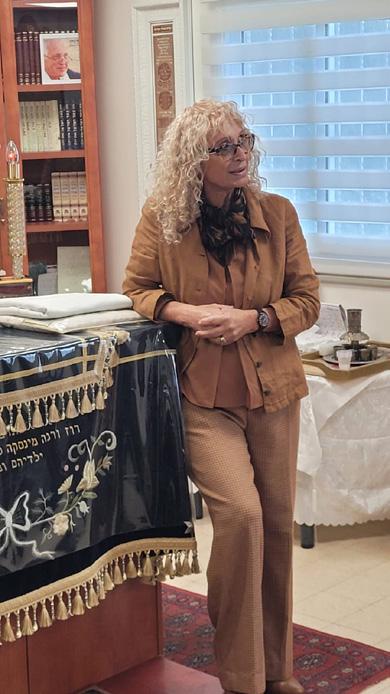
My family background is also significant. My great-grandfather was a posek , a judge. My grandparents in Yemen were mystics, and my great-grandfather also practiced medicine. They were very special people.
I think there’s something – at least on a spiritual level – something in me connected to Kabbalah and things like that. But that’s for another conversation.
Kibbutzim are often stereotyped as completely secular places with no connection to religion. What was the reality you found when you arrived in Be’eri?
Not exactly. I’ll tell you this: a kibbutz is a closed society, and someone coming from the outside experiences something very different. Speaking only from my own experience – it was very new for me. For years I thought I would go back to the city. But for some reason the community accepted me very quickly. I didn’t have to go through a difficult initiation. Within a year I became a full member.
The kibbutz lifestyle wasn’t simple, not at all. When I arrived, I continued working at Tel Hashomer, but they really wanted me to work at the clinic in Be’eri as a nurse. I realized that wasn’t the right path for me. So instead I divided my time three ways: onethird with children, one-third at the hospital, and the remaining third I took on establishing a nursing home in the kibbutz
That was the first time in my life I had set up a nursing home, and to do it in a kibbutz was incredibly challenging.
I met people who were traditional. Most of the traditional families were people who had come from outside – those who married kibbutz members. Their homes, roots, and memories remained elsewhere.
How did the synagogue come about? What sparked it?
Look, people attribute the synagogue to me, but I say this very seriously – it was not my idea. My idea was to establish the nursing home. But shortly after I set it up, two men from Kibbutz Be’eri approached me. Neither of them was born in the kibbutz. One arrived as a child and grew up there, and the other came with his wife, who was a nurse at the clinic.
They asked me if I could help lead the process. I raised an eyebrow and said: “A synagogue? In Kibbutz Be’eri? A very secular kibbutz? Why?!”
They gave me two reasons. First, so that anyone who wanted to pray on Yom Kippur could do so inside the kibbutz instead of looking elsewhere, as they had done for years. Second, so their children could have a bar mitzvah and an aliyah to the Torah in the kibbutz itself.

know who else was involved. They said they had spoken with forty kibbutz members and that a secretariat meeting was already scheduled.
I was working at Tel Hashomer at the time, and I asked them to schedule the meeting as late as possible so I could attend. I arrived – and only the two of them were there. None of the forty people who promised to come.
That year was extremely challenging. Many people had tried to establish a synagogue in the past, unsuccessfully. There were harsh reactions: fears that black-clad religious people would enter the kibbutz, change its lifestyle, and “make our children religious.”
I’ll say something personal: from a young age, I learned from my grandmother to speak directly with G-d. I said to Him: “They asked me to lead this process. I don’t really understand all of it, but please guide me and put Your words in my mouth during the meetings.”
Two principles guided me. First: I would never agree to establish a synagogue out of conflict or coercion. Only by full consent. Second: I learned to listen. The wisdom in such a process is listening, not talking. The less I spoke, the more successful it became.
People knew me as the nursing home director. I knew all the families. I didn’t argue – I embraced, planted love, and said: “I understand what you’re saying – but there are others who think differently.” It was a truly difficult year.
Interestingly, the nursing home followed the same pattern. Both the nursing home and the synagogue were built in the center of the kibbutz, facing each other – one physical, one spiritual.
We went to a vote. It passed – not by a huge majority, but it passed. The kibbutz gave us half of a portable structure and said: “You can have the building, but no funding, and we won’t be involved.”
The three of us divided roles. I said: “What I know how to do best is clean the synagogue.” I didn’t understand fundraising or prayer. One man handled fundraising, another handled prayer books and supplies. We learned everything as we went.
We began in 2004, and in 2006 we opened the synagogue.
We brought in two Torah scrolls – one 140 years old from Yemen, and another 40 years old, written in Israel. The Torah dedication was breathtaking. In the middle of Kibbutz Be’eri, the scribe stood with a microphone and proclaimed “Shema Yisrael.” I stood there overwhelmed with emotion.
The next day, the kibbutz secretary called me and said: “The celebration was wonderful – but we’re locking the synagogue.”
They said we needed bylaws specifying what is allowed and forbidden. It took an entire year to write them. That’s why the opening was delayed until 2006.
And after it opened – did it fulfill its original purpose?
We defined two goals: aliyot to the Torah and High Holiday prayers. But what happened afterward was beyond anything we imagined.
Brit milah ceremonies, weddings, memorials. Every year about a hundred second-grade children from the regional council come to learn what Judaism is, what a synagogue is. It became something completely different.
Sadly, one of the two young men who recruited me passed away suddenly. The other left the kibbutz abruptly. I was left alone.
pray outside. Even before October 7th, about two hundred kibbutz members, many not religious at all, attended Ne’ilah
And now we are building a new synagogue – larger, stronger. A full circle has closed.
“Moving” feels like too small a word for this story. There are so many stories. So many miracles. People come, stand by the ark, pray – and later call me saying everything they asked for came true.
One soldier carved a simple wooden Torah pointer under a eucalyptus tree before entering Gaza. I asked him to dedicate it. When the new Torah enters the new synagogue, we’ll read from it using that pointer – not a silver one, but this simple one. It connects me deeply to the soldiers and to October 7th.
Thank you so much for sharing all of this. It’s truly special. ◼
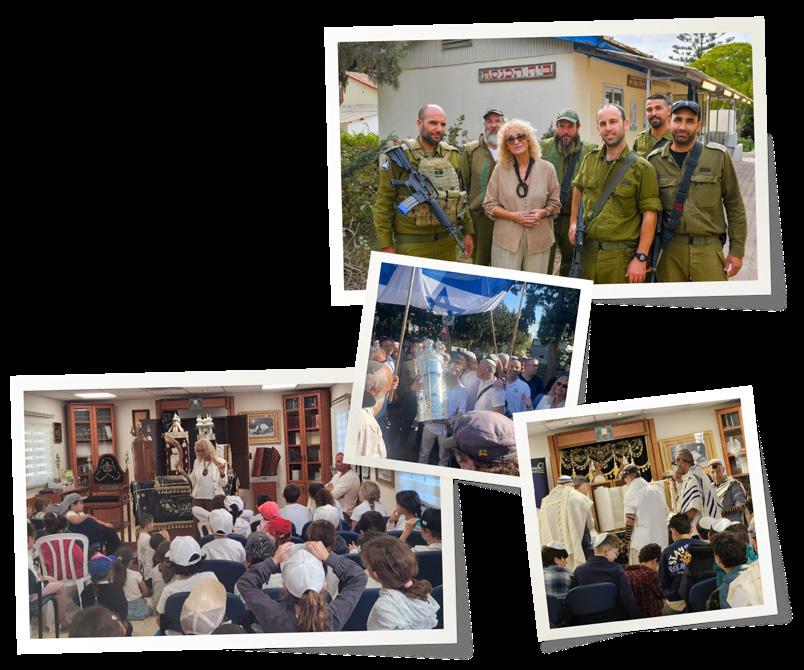




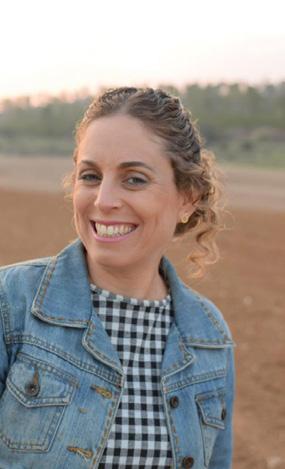
With nearly 10 million citizens, Israel has approximately 2.5 million school-aged children. As a result, changes in Israeli society often appear first – and most clearly – inside its schools. Efrat Weiss has spent close to two decades in the education system, first as a classroom teacher and today in a senior supervisory role overseeing dozens of schools in Israel’s Southern District. Her work brings her into regular contact with students, educators, and administrators across both religious and non-religious frameworks.
Rabbi Aron White spoke with Mrs. Weiss about recent shifts she has observed in Israeli high schools, particularly the growing interest in Jewish identity and spiritual practice among students who do not define themselves as religious.
Note: Key Israeli educational terms, including ‘bagruyot’, ‘Chemed’, and ‘mechozot’, are explained in the guide at the end of this article.
Could you briefly describe your path through Israel’s education system and how your role has evolved over the years?
I have been a teacher for nearly twenty years. I hold both a bachelor’s and a master’s degree in history, and I entered the education system at a young age – around twenty-four – as a history teacher, preparing tenth and eleventh-grade students for the bagruyot
I taught exclusively in ulpanot for religious girls. Over the years, my responsibilities expanded: I served as a class coordinator, held various leadership roles in the upper grades, and was involved in preparing students for Sherut Leumi
For the past three years, I have worked in a regional capacity for the Ministry of Education in Israel’s Southern District. My role focuses on implementing the goals of Chemed – religious state education – and serving as a liaison between Chemed and the Southern District. In practice, this means overseeing dozens of schools throughout the region. While my primary focus is on religious schools, the role also involves extensive interaction with non-religious (mamlachti) schools.
Could you describe the masorati (traditional) population in Israel and explain how traditional families fit into the various educational streams?
The traditional population in Israel is far from monolithic, but broadly speaking, it is concentrated in the country’s periphery. This is closely tied to Israel’s early statehood years, when immigrants from North Africa and other Islamic countries were often settled – frequently against their will – in peripheral development towns rather than in central areas such as Tel Aviv or Gush Dan.
As a result, cities like Sderot, Netivot, Yerucham, Kiryat Gat, Mitzpe Ramon, Beit Shemesh, Kiryat Malachi, Kiryat Shemona, Beit She’an, and Or Akiva developed large traditional populations. Many of these communities began as transit camps or immigrant neighborhoods and have since grown into established and increasingly prosperous cities.

In the Southern District, there is a clear pattern. Many traditional families choose to send their children to religious state kindergartens. They value the religious framework and moral education, even if it means their children wear a kippah or tzitzit. However, as children grow older, many families transfer them to non-religious state schools.
By high school, academic considerations often take precedence. Parents are focused on strong programs in mathematics, sciences, technology, and computer studies – particularly fiveunit matriculation tracks – regardless of whether the school is religious or secular.
Since October 7th, many have spoken about a spiritual awakening in Israeli society. What are you seeing on the ground within the schools?
In truth, we began sensing something even before the war – a quiet searching, a growing thirst. Teenagers and families were increasingly visiting the Kotel, building sukkot, and engaging more intentionally with tradition. These were early indicators.
After October 7th, that search intensified dramatically, especially in the south. Entire communities were shaken. Schools were evacuated, families displaced, and even those who were not directly uprooted experienced a profound emotional rupture. The impact reached every student.
What we are witnessing now is a widespread and deeply felt movement among young people – a search for meaning, belonging, and connection. For some, that connection is to G-d; for others, it is to holiness, tradition, or something larger than themselves.
This shift expresses itself in very concrete ways. Selichot prayers are now being held throughout the Southern District – not only at the Kotel, but in local synagogues and public spaces. Students arrive in large numbers. There has also been a notable increase in visits to the graves of revered spiritual figures in the south, such as the Baba Sali, Rabbi Hori in Be’er Sheva, and Rabbi Abergil, of blessed memory. This form of spiritual connection is especially characteristic of the Sephardi, traditional community.
Is this spiritual search also finding expression within the schools themselves?
Very much so. One of the most striking developments is that students in non-religious state schools are asking – sometimes even insisting – on establishing prayer spaces within their schools. In many cases, classrooms have been converted into batei knesset or batei midrash. Students organize morning tefillot, appoint a gabbai, and begin their school day with tefillin and prayer.
This year, the Ministry of Education launched an initiative called “Roots of My People,” focused on identity and heritage. Schools were invited to propose projects related to this theme, with the winning proposal receiving 25,000 shekels for implementation. Some of the proposals were remarkably creative – for example, one school suggested planting all of the Shivat HaMinim in a botanical garden on campus.
A large mamlachti high school in Be’er Sheva, named after Yitzchak Rabin, won first place. The funding was used to establish a beit midrash within the school.
What stood out most was the students’ explanation. When I asked why they wanted this – despite not identifying as religious –they answered very simply: “Not only religious people deserve a connection. We deserve one too.” There are many students who want to pray daily, boys who want to put on tefillin, and students seeking a space for shiurim and Kabbalat Shabbat gatherings.
How have parents and school staff responded to these developments?
Interestingly, there has been very little resistance. Teachers and administrators emphasized that these initiatives came from the students themselves. Schools responded by creating flexible frameworks: students who wish to pray are given space to do so, while others remain in class and continue their studies.
On Fridays, many schools now hold Kabbalat Shabbat gatherings on Friday mornings and study the weekly parasha. While the level of enthusiasm varies from school to school, the broader trend is unmistakable. Students are actively seeking belonging – through prayer, chagim, candle lighting, Selichot, and engagement with the Jewish calendar.
Today, nearly every school in the district has a rabbi whose role is to respond to these spiritual needs. There is a renewed pursuit of what Judaism calls ma’alin bakodesh – an ascent in holiness – a path that previously did not exist within state education frameworks.
your view, what is driving this shift?
One powerful influence has been the testimonies of hostages who returned from captivity. Some came from deeply secular backgrounds, yet spoke about praying in the tunnels, expressing gratitude each morning, and drawing strength from faith under unimaginable conditions.
This touched something collective. After trauma of this magnitude, people – especially young people – begin asking fundamental questions: What do I do with this pain? Where do I go from here? These questions affect all of us. Almost every Israeli has been personally impacted by loss during this war. Nearly every school has alumni who were killed. These are not abstract losses; the students knew them.
For many teenagers, particularly those from traditional homes, this turn toward spirituality is not foreign. They grew up with kiddush, with a Pesach Seder, with grandparents who attended synagogue and put on tefillin. This is not an act of rebellion – it is a return to something familiar, something that gives them a sense of rootedness and identity.
Do you notice differences in how boys and girls express this search?
The expressions differ, but the yearning is shared. At Selichot, both boys and girls attend. Morning prayers may include more boys, but girls participate as well. I once asked a completely secular girl why she comes. She looked at me and said, “Who decided that we don’t need prayer? Why is this not for us?”
That question, I think, captures the moment we are living in.
How did the widespread call-up of reservists affect the school system?
This was a nationwide challenge, but it hit high school yeshivot particularly hard. Many teachers – educators, subject instructors, and school leaders – were called up for extended reserve duty. In some yeshivot, there was almost no staff left.
The impact was profound, both academically and emotionally. Students had been volunteering, working in agriculture, living through war – and then were expected to return to studies without their teachers. Although partial solutions were found, the disruption was severe and deeply felt.
Thank you very much for speaking with us. ◼

Bagruyot
The bagruyot are Israel’s national high school matriculation exams. Students are tested in core subjects such as Tanach, Mathematics, Sciences, and English. Each subject is taken at varying levels, measured in “units” (yechidot), with higher-unit tracks indicating greater academic rigor.
Chemed
An acronym for Chinuch Mamlachti Dati, the state religious education system.
Mechozot – Israel’s Educational Districts
For administrative and educational purposes, Israel is divided into six regional districts (mechozot): Jerusalem, Southern, Tel Aviv, Central, Haifa, and Northern.
Zramim – Israel’s Four Educational Streams
Reflecting the diversity of Israeli society, the education system is divided into four primary streams:
• Mamlachti – the general state (secular) system and the largest stream
• Mamlachti Dati – the state religious system
• Charedi – the ultra-Orthodox system
• Arab – serving Israel’s Arab population
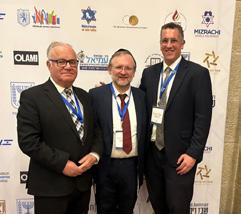
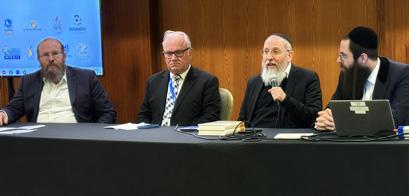
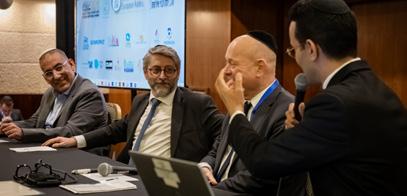
World Mizrachi was honored to take part in the 33rd Conference of European Rabbis in Yerushalayim.
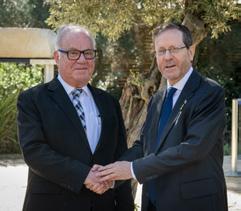
As a long-time member of the CER Steering Committee, our Co-President Rabbi Yechiel Wasserman met with President of the State of Israel, Isaac Herzog. Our Nasi, Rabbi Yosef Zvi Rimon, participated in a panel chaired by Rabbi Wasserman, exploring ways to strengthen the bridge between Israel and the Diaspora.
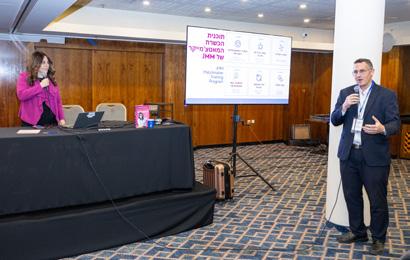
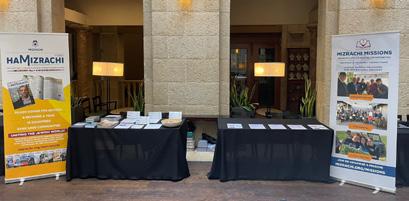
Executive Chairman Rabbi Doron Perez appeared in conversation with CEO Rabbi Danny Mirvis, while Aleeza Ben Shalom presented the Jewish Matchmaking Movement and led a dedicated workshop. Roi Abecassis, Mizrachi representative in the WZO, took part in a panel entitled “Israel and the Diaspora – Where Are We Going?”. Throughout the conference, Mizrachi staff also shared the movement’s publications and information about our educational missions at a special Mizrachi booth.
Meeting rabbis and rebbetzins from across Europe was deeply inspiring, and provided a meaningful opportunity to introduce more communities to Mizrachi’s vision of Torat Eretz Yisrael –for which there is a growing thirst across the Diaspora today.



Iam not a hero. I am just a regular guy who was granted the opportunity by G-d to be placed on the stage of history and to witness one of the greatest moments of my lifetime.
Let me start from the beginning.
I joined my unit – Yasar Darom – at the beginning of November 2023. This is a unit made up of combat soldiers tasked with collecting the remains of fallen soldiers from the battlefield, as well as searching for and bringing back the bodies of fallen hostages.
Honestly, I was nervous when I first joined. I did not know how I would react to the horrible images and the brutal work that would push me to my physical and emotional limits. Yet mission after mission, I took great pride in the work we did. Despite the sense of purpose, missions sifting through cemeteries ended in heartbreak. We found none of our brothers or sisters to bring home.
That all changed in late January. We’d been on call for a month, sworn to secrecy given the international sensitivity. There was one last brother to bring back – Hashem waited for the parasha of Yosef’s remains returning to Eretz Yisrael Like Moshe with Yosef – whom he never knew yet felt dedicated to returning – we never knew Ran Gvili z”l. Yet we felt an unbreakable connection and deep responsibility to bring him home.
I was placed on the navigation team, tasked with going in first to mark the suspected graves where Ran z”l might be buried. We entered early Sunday morning. Using intelligence maps, we carefully mapped out the possible strips where he could be. Like the proverbial needle in a haystack, without narrowing the options our chances of success would have been slim.
Once our work was done, the rest of the team entered. Soldiers from many
different units arrived with determination and resolve. The excavators began their work, and we carefully went through the bodies one by one – with delicacy and precision. One wrong step, and we might miss him forever.
By nighttime, I was exhausted and disappointed. We had not yet located Ran, and the work ahead of us seemed endless. Would we ever find him?
In the early hours of the morning, many of us were taken out of Gaza and back to base to rest briefly, while others remained behind to continue the work. When we returned around noon, 700 bodies awaited examination
Before beginning, we took a few moments to daven Mincha and ask G-d to help us in our holy mission. Someone had missed Kedusha, so we answered together and recited it again. Then we prepared to return to work.
I was standing with our commander when a rabbi from the unit securing us approached. With great emotion, he told us that in the merit of the two Kaddishim we had just said, b’ezrat Hashem, we would merit to find Ran within the next three hours. As it turned out, we found him in one.
We returned to work, and I was assigned to an area where many bodies had been excavated overnight and needed to be organized before examination. A few meters away was the stand where dentists were using x-rays to confirm or rule out each identity. I noticed a small commotion building – more and more people gathering. We knew we had to keep working, but at a certain point, someone came over and said that we were 97% certain we had found Ran z”l.
I couldn’t help myself – I joined the soldiers standing nearby. I’ll never forget the moment they confirmed it. The exhaustion vanished. Everyone wept – not just
for Ran, but for everything this moment carried. For every victim of October 7th. Every hostage. Every fallen soldier. For all the holy blood we’d collected over twoand-a-half years. For every body we’d dug up that wasn’t one of ours.
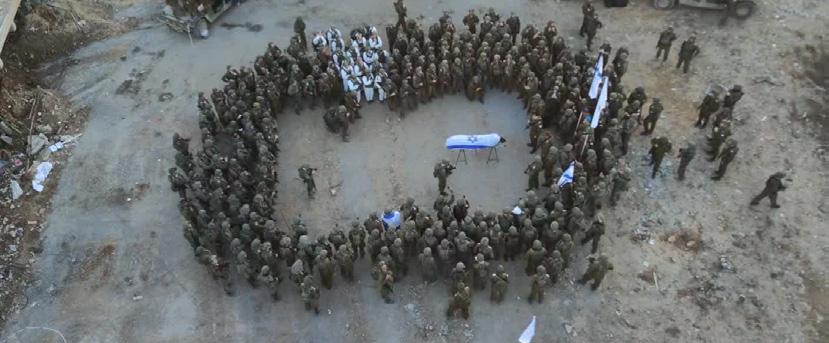
A flag was placed over Ran’s body. A diamond taken from us was finally found. He would go home to his family and be buried among heroes.
Shortly afterward, we gathered around Ran as the first Kaddish was recited. We put our arms around one another and sang Ani Ma’amin. It was this faith that gave us the strength to do what we have done throughout the war, and which allowed us to bring our dear brother home – the last of the hostages.
This is Am Yisrael. People who go to places no human being should ever have to go – yet we do so with love, devotion, and absolute resolve. Countless tefillot accompanied us on this journey, and countless tears were shed when the news of the mission’s success spread.
To me, this is the secret of the Jewish people: Netzach Yisrael lo yishaker. Let our enemies know – the nation of Israel will always prevail. Our spirit is stronger than ever, and the love and commitment we have toward one another is our greatest weapon. Ashreinu

Rabbi Tzvi Wohlgelernter is the Rabbi of Kehilat Mizrachi-JLIC of Givat Shmuel and is the Rosh Beit Midrash and Rosh Kollel at Yeshivat Torah V’Avodah.

Throughout Tanach , Hashem gave explicit instructions to Jewish leaders through prophecy. Leadership meant transmission and inspiration: receiving divine directives and ensuring the people followed them. Today, without prophecy, we lack that clarity. Yet the Jewish people still need leaders – more urgently than ever. This absence of explicit guidance demands a different kind of leadership: discerning Hashem’s will from the signs He leaves us in Torah, history, and current events, then acting decisively even without explicit guidance.
Megillat Esther, a book devoid of prophecy and lacking even the mention of G-d’s name, presents models of such leadership. Though left to their own devices to determine a course of action, Mordechai and Esther succeed in saving the Jewish people from a terrifying fate. They offer powerful models of leadership in the post-prophecy era.
Mordechai – determining and acting upon G-d’s will
Initially, the Megillah portrays Mordechai as dominant and proactive, while Esther is passive. Mordechai is formally introduced, adopts Esther, discovers and foils the plot to kill Achashveirosh, and actively responds to Haman’s plot.
In contrast, Esther is taken to the palace with the other women and, eventually, to Achashveirosh. Her decision not to reveal her nationality is based on Mordechai’s command. Esther’s first independent action appears only in the fourth chapter, when she attempts to convince Mordechai to remove his mourner’s clothes. Indeed, when Mordechai directs her to beg Achashveirosh to prevent the genocide, she is initially paralyzed by fear.
Mordechai responds with a sharp rebuke: “If you keep silent at this time, relief and deliverance will come to the Jews from another quarter, while you and your father’s house will perish. And who knows – perhaps it was for [action at] this moment that you attained royalty” (Esther 4:13–14).
Though Mordechai received no prophecy regarding the correct course of action –hence his use of the term “perhaps” – this does not prevent him from issuing clear directives to Esther about what Hashem expects of her. He reflects on the situation and discerns what action Hashem expects from both of them.
Mordechai’s leadership continues after the miraculous turn of events, as he authors the letters reversing the decree as well as those that eternalize Purim as a Jewish holiday.
Considering Mordechai’s central role in the narrative, why is the Megillah named after Esther and not after him?
The answer lies in Esther’s dramatic character change at this critical moment. Esther responds to Mordechai’s rebuke not only by taking action but by seizing the reins of leadership. She responds not by consenting to his command, but rather by changing it – planning parties for Achashveirosh and Haman – and by expanding it to include the Jewish people in the process.
With this initiative, Esther shifts from the passive to the active voice. She demonstrates that Mordechai is not the only leader. Moreover, Esther reminds us that Jewish salvation depends not on the heroic actions of individual martyrs but on the ability to inspire others to join the mission. Esther’s emergence as a leader not only eclipses Mordechai, who fades into the background, but also transforms him into one who is commanded.
In the Megillah’s central chapters – when the v’nahafoch hu flip occurs – Esther, not Mordechai, plays the active role. Esther
reintroduces Mordechai to Achashveirosh only after Haman’s plot is revealed and he is hanged. Though Mordechai records the story, Esther’s leadership and heroics dominate the narrative. Mordechai was the initial leader, but Esther ultimately played the pivotal human role in facilitating the heavenly miracle.
Through her actions, Esther honors her ancestry. Her heroic, risky act of faith vindicates the ancestry that Mordechai warned would be lost if she failed to act. This explains why the Megillah, when mentioning Esther’s authorship, refers to her as “bat Avichayil” for the first time.
Leadership takeaways
Each leadership model offers vital lessons. Mordechai teaches us the need to question why we find ourselves in the positions we do, in particular positions, to discern what actions are expected of us, and to ensure that we and others rise to the occasion. From Esther, we learn that even those led by others are not exempt from the responsibility of leadership. Moments arise in every life when we are called upon to lead and draw others into the circle of action.

Scan here to join Rabbi Taragin’s daily Divrei Torah WhatsApp group

Rabbi Reuven Taragin is Educational Director of Mizrachi and Dean of the Yeshivat Hakotel Overseas Program. His book, Essentials of Judaism, can be purchased at rabbireuventaragin.com.
A member of the Mizrachi Speakers Bureau mizrachi.org/speakers


Rabbanit Shani Taragin
Megillat Esther is often read as a story of hidden miracles and political reversal. Yet its deeper ambition lies elsewhere. Composed at the close of the biblical era under Persian rule, the Megillah incorporates allusions to the entire Tanach. In doing so, it teaches a nation in exile how to preserve covenantal identity and historical memory at the very moment prophecy is waning and a new religious mode must emerge.
becomes a scroll – meant to be publicly read year after year. Religious continuity is sustained through collective memory, practice and preservation of the story in text.

Strikingly, the concluding chapters of Megillat Esther echo the language and structures of the Shivat Tzion period –beginning with Cyrus’s decree in 538 BCE and continuing through the leadership of Chaggai, Zechariah, Ezra, and Nechemiah. That era was one of renewal after trauma, exile, and the fear of national disappearance. While some Jews returned to rebuild Jerusalem, others remained exposed in the Persian heartland. Esther records that same vulnerability.
Canonized after many prophetic books yet unfolding in the same historical window of Shivat Tzion, the Megillah borrows their vocabulary to legitimize a new religious response to existential threat. Purim thus becomes the first fully rabbinic festival – modeled on biblical precedent and articulated in biblical language, yet adapted for a post-prophetic world. It stands as a bridge: from Tanach to Torah Shebe’al Peh, from coercive revelation to voluntary acceptance (Shabbat 88a), and from exile back toward the Land of Israel.
The first step of renewal, both in Nechemiah and in Esther, is returning to the nation’s sacred story by writing it down and reading it aloud in public. In Jerusalem, Ezra opens the Sefer Torah before the entire nation: “And Ezra opened the book before the eyes of all the people” (Nechemiah 8:5). Covenant is renewed through collective encounter with text.
So too in Shushan. Mordechai records the events and sends written directives throughout the empire: “Mordechai wrote these matters and sent letters to all the Jews” (Esther 9:20–21). The story itself
The second stage is the transformation of fear into commanded joy. Mordechai defines Purim as “days of feasting and joy, sending portions one to another, and gifts to the poor” (Esther 9:22). This language unmistakably echoes Nechemiah’s response when the people weep upon hearing the Torah on Rosh Hashanah: “Do not mourn… send portions to those who have nothing prepared, for the joy of G-d is your strength” (Nechemiah 8:9–12). In both cases, authentic religious revival does not culminate in paralysis or despair, but in sanctified joy that binds the community together.
This parallel is strengthened by a conscious return to earlier tradition. Nechemiah renews the celebration of Sukkot in a form not practiced since the days of Yehoshua bin Nun ( Nechemiah 8:16–18). Likewise, Chazal established that walled cities from the time of Yehoshua observe Purim on the fifteenth of Adar, rooting this “new” holiday in Israel’s ancient past. In both instances, innovation gains legitimacy through continuity.
A third layer emerges through the language of “truth and peace.” Esther’s final letters are sent including “divrei shalom ve-emet” (Esther 9:30), deliberately echoing Zechariah’s vision of post-exilic redemption. Addressing a population still traumatized by destruction and unsure whether redemption has truly begun, Zechariah proclaims that fasts of mourning can yet be transformed into festivals of joy provided the nation passionately pursues emet and shalom (Zechariah 8). Survival alone is insufficient; moral and communal renewal is demanded.
Significantly, the people accept upon themselves not only days of feasting, but also “the words of the fasts and their outcry” (Esther 9:31). Mourning is not erased; it is integrated. Memory is neither forgotten nor allowed to paralyze the future. Hence the Megillah’s insistence: “These days shall
be remembered and observed in every generation… and their memory shall not cease from their descendants” (Esther 9:28) and Esther’s plea for perpetuity – “Kivuni l’dorot (establish me for generations)… Kitvuni l’dorot (write me for future generations)” (Megillah 7a).
This ancient blueprint speaks powerfully to our post-October 7th reality. We witnessed a profound religious awakening of faith, prayer, unity, and moral clarity born of trauma. Yet Megillat Esther warns that awakening alone is fleeting unless it is written, ritualized, and transmitted. Stories must be recorded. Community must be rebuilt through responsibility for one another. Revival must be anchored in emet and shalom.
Purim thus emerges not as escapism, but as disciplined faith in action – a bridge across generations and geographies. It teaches us how a people survives history: by remembering together, by uniting together in mutual responsibility, and by courageously choosing to sanctify life through truth, peace, and religious revival – “in every generation, every family, every city.”

To learn about Megillat Esther’s
all

Rabbanit Shani Taragin is Educational Director of Mizrachi, Mizrachi Lapidot and Matan Eshkolot Programs for Educators, and the Rosh Beit Midrash of Mizrachi-Tzemach David Women’s Learning Hub, Mizrachi Lapidot, and Yeshiva University in Israel Women's Torah Studies Program.
A member of the Mizrachi Speakers Bureau mizrachi.org/speakers

As we prepare for Purim, Pesach is never far from our minds. These two holidays, each with its own narrative and themes, share an interplay in their observance and underlying messages. From pre-holiday fasts to festive meals and particular directives to give tzedakah, these holidays remind us of our responsibility to one another and the nature of our redemption.
At the heart of both Purim and Pesach lies a central experience: the family feast. The Purim seudah, characterized by joyous revelry, contrasts with the more structured and reflective Pesach Seder. Yet both occasions invite us to gather around the table and welcome others; celebration without guests is incomplete. Jewish joy is inherently communal.
This commitment to community is not merely for our enjoyment; it is intertwined with our responsibility to the less fortunate. On Purim, we fulfill the mitzvah of matanot la’evyonim, ensuring that all can partake in the festivities. Similarly, in the lead-up to Pesach, we provide kimcha d’Pischa, helping those in need prepare for the holiday. These parallel obligations reinforce that there can be no redemption when others are excluded. Before each of these holidays there is a minor fast reminding us that even in celebration our redemption is tempered by vulnerability.
Both holidays also feature communal storytelling that recounts our historical struggles and ultimate triumphs. On Purim, we read the Megillah together in synagogues, parks, army bases, restaurants, hospitals and old-age homes, ensuring that every Jew can hear the story. Similarly, on Pesach, we gather family and guests around our table to delve into the Haggadah and discuss the Egyptian saga. Each text serves as a reminder that both in the past and now, we are not merely a collection of individuals, but a people with shared memory, responsibility and destiny.
The timing of these holidays is not coincidental. Their proximity in the calendar illuminates the theme of redemption. Although Jewish tradition encourages us to perform mitzvot at the earliest opportunity, the Gemara instructs that in a leap year, Purim is celebrated in the second Adar to maintain its clear connection with Pesach (Megillah 6b). This emphasizes redemption in both the story of Esther and the Exodus from Egypt.
Moreover, a fascinating parallel can be drawn from Megillat Esther itself. The rabbis note that Esther’s pivotal banquet with King Achashveirosh and Haman occurred on Pesach, and that Haman was hanged on the second day of Pesach. The Magen Avraham (Orach Chaim 490) even proposes that we add an extra dish to our Pesach meal on the second day to express gratitude for Haman’s downfall. This overlap suggests that our liberation from Haman’s decree and the narrative of Pesach are intertwined.
Both Purim and Pesach celebrate the Jewish people’s redemption from existential threats, yet they do so in ways that reveal their unique characteristics. Pesach emphasizes Divine intervention, while Purim illustrates human agency. The Haggadah largely excludes mention of Moshe (early manuscripts contain no references whatsoever), portraying Hashem as the primary actor in the Exodus narrative. Conversely, Megillat Esther omits G-d’s name entirely, showcasing the initiative of Esther and Mordechai as they navigate their perilous circumstances with courage, action and prayer.
This distinction reflects a broader theological and philosophical conversation within Judaism. In the narrative of Pesach, which occurred in the infancy of our history, the Jewish people are depicted as recipients of G-d’s miracles. In contrast, the Purim story illustrates a more mature relationship between humanity and the Divine. The Jewish people, in the absence of prophecy, are called to take decisive action toward their own salvation.
The Rambam (Laws of Megillah and Chanukah 2:18) emphasizes that in the messianic era, Megillat Esther will stand alongside the Torah as the most crucial text in Tanach, highlighting the necessity of human action in achieving redemption. This perspective resonates today, reminding us that our efforts – our kindness, our activism, and our communal responsibility – play a crucial role in shaping our future.
Rabbi Joseph B. Soloveitchik eloquently framed this responsibility as a defining feature of Jewish life. Created in G-d’s image, we are mandated to walk in His ways, “ ve-halachta bi-drachav,” and imitate Him by bringing healing, justice and redemption into the world. This imperative stands at the core of Purim, but extends to all rabbinic holidays such as Chanukah and Yom HaAtzmaut, which likewise celebrate human initiative as a catalyst for positive change.
As we prepare for Purim, let us reflect on the idea that redemption is not merely a Divine act we commemorate, but a collective responsibility for us to advance. Our feasting must be inclusive, our joy must be shared, and our celebrations must be infused with responsibility toward one another.

Rabbi Dr. Katriel (Kenneth) Brander is President and Rosh HaYeshiva of Ohr Torah Stone, an international network of 30 Religious Zionist institutions committed to illuminating the beauty and relevance of authentic Torah Judaism in the modern world. (HEADSHOT: SALLY KATZIN)
A member of the Mizrachi Speakers Bureau mizrachi.org/speakers

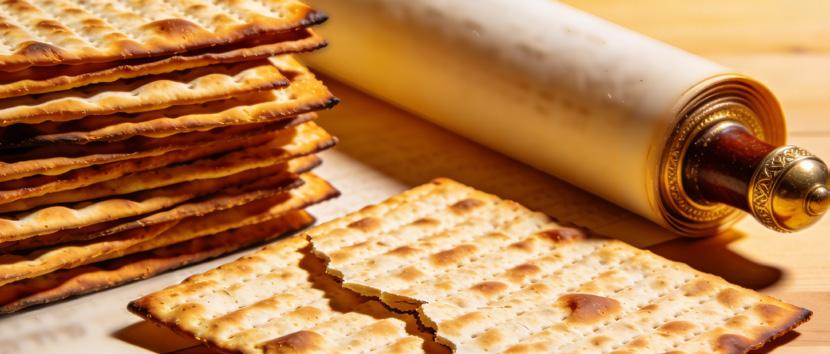

One of the most haunting lines in Megillat Esther appears at the moment of greatest danger. Mordechai sends word to Esther, urging her to approach King Achashveirosh and plead for her people. But he adds a chilling caveat: “If you remain silent at this time, relief and salvation will arise for the Jews from another place, while you and your father’s house will perish” (Esther 4:14).
This verse raises an obvious question. If Mordechai is so certain that salvation will come anyway, why pressure Esther to risk her life? And more deeply, how can Mordechai be so sure that salvation will come at all?
The Slonimer Rebbe, in Seder Avot, offers a profound framework. He explains that there is an order to the world. On Rosh Hashanah and Yom Kippur, G-d determines the course of the coming year: life, death, prosperity, or struggle. That plan is real. It is binding. And yet, G-d is infinitely compassionate. If the Jewish people merit it, G-d can intervene and redirect the course of history from a place beyond the original decree.
The Netivot Shalom explains that this is what Mordechai means by “another place” – makom acher. Salvation can come from beyond the system itself. Beyond the natural order. Beyond what seems already decided.
This idea appears elsewhere in rabbinic thought. The Gemara teaches, “The son of David will only come when the generation is either completely worthy or completely unworthy” (Sanhedrin 98a). Redemption emerges not only from merit,
but sometimes from darkness so complete that it forces divine light to break through. When human systems fail entirely, G-d reveals Himself in ways that override the rules of history.
This is exactly the reality of the Purim story. The Jews of Persia were not facing discomfort or exile. They were facing annihilation. A legal decree, signed and sealed, mandated their destruction. Darkness had descended fully. And it is at that precise moment that Mordechai reveals to Esther a shocking truth: the decree itself is not the final word. G-d stands above the law. Esther, however, is still thinking in human terms. The law states that anyone who approaches the king uninvited is executed. The system is closed. The danger is real. But Mordechai’s message reframes everything. Salvation will come from another place. G-d is not bound by royal protocol. That is why Esther responds, “I will go to the king, though it is against the law” (Esther 4:16). This is not recklessness; it is faith. Esther understands that when salvation flows from makom acher, the very nature of reality can change. Laws bend. Power shifts. What once seemed fixed becomes fragile.
This principle extends far beyond Purim. On a personal level, it speaks directly to moments when life feels trapped by circumstance – diagnosis, failure, loss, or decisions already made. The Gemara records a powerful exchange between the prophet Yishayahu and King Chizkiyahu. Yishayahu tells the king plainly that he will die. Chizkiyahu responds, “I received a tradition from my father’s house: Even if a sharp sword rests on a person’s neck, they should never withhold themselves from mercy” (Berachot 10a). Even when the verdict seems sealed, hope remains. Salvation can still come from another place.
Purim itself proves this principle. Not only were the Jewish people saved physically, but the Gemara teaches that in the aftermath of Purim, they reaccepted the Torah willingly, out of love, unlike at Sinai, where acceptance came under coercion (Shabbat 88a). From the brink of extinction, they rose to extraordinary spiritual clarity.
The Netivot Shalom adds one final layer. The Rambam writes that when a person truly repents, changing their actions, their path, even their name, it is as though they become a new person (Hilchot Teshuva 2:4).
The Netivot Shalom explains that this is what happened in the Megillah. The Jewish people became a new nation. And because they were no longer the same people who had been decreed against, the decree itself no longer applied.
Purim reminds us that when everything appears fixed, G-d is not. When the system says “no,” heaven may still say “yes.” And sometimes, it is precisely when things feel darkest that salvation is already forming, quietly, unexpectedly, from another place.

Rabbanit Dr. Tamara Spitz is the Rosh Beit Midrash and a Mashgicha Ruchanit of Midreshet Torah v’Avodah. She also has a chiropractic practice specializing in women’s health in Jerusalem and Gush Etzion.
A member of the Mizrachi Speakers Bureau mizrachi.org/speakers

After 9/11, when the horror and trauma had subsided, Americans found themselves asking what had happened and why. Was it a disaster? A tragedy? A crime?
An act of war? It did not seem to fit the pre-existing paradigms. And why had it happened? The question most often asked about Al Qaeda was, “Why do they hate us?”
In the wake of those events an American thinker Lee Harris wrote two books, Civilization and its Enemies and The Suicide of Reason that were among the most thought-provoking responses of the decade. The reason for the questions and the failure to find answers, said Harris, was that we in the West had forgotten the concept of an enemy. Liberal democratic politics and market economics create a certain kind of society, a specific way of thinking and a characteristic type of personality. At their heart is the concept of the rational actor, the person who judges acts by their consequences and chooses the maximal option. Such a person believes that for every problem there is a solution, for every conflict a resolution. The way to achieve it is to sit down, negotiate, and do on balance what is best for all.
In such a world there are no enemies, merely conflicts of interest. An enemy, says Harris, is simply “a friend we haven't done enough for yet.” In the real world, however, not everyone is a liberal democrat. An enemy is “someone who is willing to die in order to kill you. And while it is true that the enemy always hates us for a reason, it is his reason, not ours.” He sees a different world from ours, and in that world we are the enemy. Why do they hate us? Answers Harris: “They hate us because we are their enemy.”
Whatever the rights and wrongs of Harris’ specifics, the general point is true and profound. We can become mind-blind, thinking that the way we – our society, our culture, our civilization – see things is the only way, or at least that it is the way everyone would choose if given the chance...
This explains the significance of the unusual command at the end of Parashat Beshalach. The Israelites had escaped the seemingly inexorable danger of the chariots of the Egyptian army, the military high-tech of its day. Miraculously the sea divided, the Israelites crossed, the Egyptians, their chariot wheels caught in the mud, were unable either to advance or retreat and were caught by the returning tide.
The Israelites sang a song and finally seemed to be free, when something untoward and unexpected happened. They were
attacked by a new enemy, the Amalekites, a nomadic group living in the desert. Moshe instructed Yehoshua to lead the people in battle. They fought and won. But the Torah makes it clear that this was no ordinary battle: “Then Hashem said to Moshe, ‘Write this on a scroll as something to be remembered and make sure that Yehoshua hears it, because I will completely blot out the name of Amalek from under heaven.’ Moshe built an altar and called it Hashem is my Banner. He said, ‘The hand is on Hashem’s throne. Hashem will be at war with Amalek for all generations’” (Shemot 17:14–16).
This is a very strange statement, and it stands in marked contrast to the way the Torah speaks about the Egyptians. The Amalekites attacked Israel during the lifetime of Moses just once. The Egyptians oppressed the Israelites over an extended period, oppressing and enslaving them and starting a slow genocide by killing every male Israelite child. The whole thrust of the narrative would suggest that if any nation would become the symbol of evil, it would be Egypt.
But the opposite turns out to be true. The Torah states, “Do not abhor an Egyptian, because you were a stranger in his land” (Devarim 23:8). Shortly thereafter, Moses repeats the command about the Amalekites, adding a significant detail: “Remember what the Amalekites did to you along the way when you came out of Egypt. When you were weary and worn out, they met you on your journey and attacked all who were lagging behind; they had no fear of G-d … You shall blot out the name of Amalek from under heaven. Do not forget!” (Devarim 25:17–19).
We are commanded not to hate Egypt, but never to forget Amalek. Why the difference? The simplest answer is to recall the statement in Pirkei Avot: “If love depends on a specific cause, when the cause ends, so does the love. If love does not depend on a specific cause, then it never ends” (Avot 5:16). The same applies to hate. When hate depends on a specific cause, it ends once the cause disappears. Causeless, baseless hate lasts forever.
The Egyptians oppressed the Israelites because, in Pharaoh’s words, “The Israelites are becoming too numerous and strong for us” (Shemot 1:9). Their hate, in other words, came from fear. It was not irrational. The Egyptians had been attacked and conquered before by a foreign group known as the Hyksos, and the memory of that period was still acute and painful. The Amalekites, however, were not being threatened by the Israelites. They attacked
a people who were “weary and worn out,” specifically those who were “lagging behind.” In short: The Egyptians feared the Israelites because they were strong. The Amalekites attacked the Israelites because they were weak.
In today’s terminology, the Egyptians were rational actors, the Amalekites were not. With rational actors there can be negotiated peace. People engaged in conflict eventually realize that they are not only destroying their enemies: they are destroying themselves. That is what Pharaoh’s advisers said to him after seven plagues: “Do you not yet realize that Egypt is ruined?” (Shemot 10:7). There comes a point at which rational actors understand that the pursuit of self-interest has become self-destructive, and they learn to co-operate.
It is not so, however, with non-rational actors. Emil Fackenheim, one of the great post-Holocaust theologians, noted that towards the end of the Second World War the Germans diverted trains carrying supplies to their own army, in order to transport Jews to the extermination camps. So driven were they by hatred that they were prepared to put their own victory at risk in order to carry out the systematic murder of the Jews of Europe. This was, he said, evil for evil’s sake.
The Amalekites function in Jewish memory as “the enemy” in Lee Harris’ sense. Jewish law, however, specifies two completely different forms of action in relation to the Amalekites. First is the physical command to wage war against them. That is what Shmuel told Shaul to do, a command he failed fully to fulfill. Does this command still apply today?
The unequivocal answer given by Rabbi Nachum Rabinovitch is ‘No.’ Rambam ruled that the command to destroy the Amalekites only applied if they refused to make peace and accept the seven Noahide laws. He further stated that the command was no longer applicable since Sancherev had transported and resettled the nations he conquered so that it was no longer possible to identify the ethnicity of any of the original nations against whom the Israelites were commanded to fight. He also said, in The Guide for the Perplexed, that the command only applied to people of specific biological descent. It is not to be applied in general to enemies or haters of the Jewish people. So the command to wage war against the Amalekites no longer applies.
However, there is a quite different command, to “remember” and “not forget” Amalek, which we fulfill annually by reading the passage containing the Amalekites command as it appears in Devarim on the Shabbat before Purim, Shabbat Zachor. Here Amalek has become a symbol rather than a reality.
By dividing the response in this way, Judaism marks a clear distinction between an ancient enemy who no longer exists, and the evil that enemy embodied, which can break out again at any time in any place. It is easy at times of peace to forget the evil that lies just beneath the surface of the human heart. Never was this truer than in the past three centuries. The birth of Enlightenment, toleration, emancipation, liberalism and human rights persuaded many, Jews among them, that collective evil was as extinct as the Amalekites. Evil was then, not now. That age eventually begat nationalism, fascism, communism, two
World Wars, some of the most brutal tyrannies ever known, and the worst crime of man against man.
Today, the great danger is terror. Here the words of Princeton political philosopher Michael Walzer are particularly apt: “Wherever we see terrorism, we should look for tyranny and oppression… The terrorists aim to rule, and murder is their method. They have their own internal police, death squads, disappearances. They begin by killing or intimidating those comrades who stand in their way, and they proceed to do the same, if they can, among the people they claim to represent. If terrorists are successful, they rule tyrannically, and their people bear, without consent, the costs of the terrorists’ rule” (Arguing About War, 64).
Evil never dies and – like liberty – it demands constant vigilance. We are commanded to remember, not for the sake of the past but for the sake of the future, and not for revenge but the opposite: a world free of revenge and other forms of violence.
Lee Harris began Civilization and its Enemies with the words, “The subject of this book is forgetfulness,” and ends with a question: “Can the West overcome the forgetfulness that is the nemesis of every successful civilization?” That is why we are commanded to remember and never forget Amalek, not because the historic people still exists, but because a society of rational actors can sometimes believe that the world is full of rational actors with whom one can negotiate peace. It is not always so.
Rarely was a biblical message so relevant to the future of the West and of freedom itself. Peace is possible, implies Moses, even with an Egypt that enslaved and tried to destroy us. But peace is not possible with those who attack people they see as weak and who deny their own people the freedom for which they claim to be fighting. Freedom depends on our ability to remember and, whenever necessary, confront “the eternal gang of ruthless men,” the face of Amalek throughout history. Sometimes there may be no alternative but to fight evil and defeat it. This may be the only path to peace.


The Rabbi Sacks Legacy perpetuates the timeless and universal wisdom of Rabbi Lord Jonathan Sacks as a teacher of Torah, a leader of leaders and a moral voice. Explore the digital archive, containing much of Rabbi Sacks’ writings, broadcasts and speeches, at www.rabbisacks.org, and follow The Rabbi Sacks Legacy on social media @RabbiSacks.
The Tikunei Zohar draws a striking comparison between Purim and Yom Kippur: “Purim is named after Yom HaKippurim ” ( Tikunei Zohar 57b).
The very name “Yom HaKippurim” can be read as Yom K’Purim – a “day like Purim.” The implication is that Yom Kippur resembles Purim, not the other way around. But how can that be? These two days could hardly appear more different.
Yom Kippur is the most solemn day of the year – a day of fasting, introspection, and withdrawal from the physical. On that day we abstain from food, drink, and social interaction, seeking to emulate the purity of angels.
Purim, by contrast, is marked by the most physical of mitzvot: eating, drinking, feasting, and rejoicing with others through mishloach manot and seudat Purim. Yom
Kippur is the only sacred day defined by a fast; Purim is the only weekday festival defined by a feast.
Perhaps, like Purim and Pesach – opposite yet complementary redemptions – Yom Kippur and Purim represent two halves of a spiritual whole. Yom Kippur is a day of transcendence, when we rise above the physical world to serve G-d in angelic purity. Purim, its mirror image, calls us to serve G-d within the physical world –to reveal holiness precisely through joy, human connection, and the sanctification of the ordinary.
Rav Kook, in his Siddur Olat Re’iyah, notes that there is no prohibition of work on Purim. To forbid labor, he writes, would contradict the essence of the day. Purim is not about withdrawing from life’s daily rhythm, but about elevating it. It teaches that eating, drinking, and even working can become acts of divine service when suffused with awareness of G-d (Rav Kook, Olat Re’iyah, 440).
This idea finds subtle expression in a halachic discussion. We recite the blessing of Shehecheyanu when reading the Megillah on Purim night. But what if one lacks a Megillah –should Shehecheyanu still be recited to mark the day itself?
Rav Rimon offers a creative insight. The blessing of Shehecheyanu is said over something exceptional – something that stands apart from ordinary time. Yet the essence of Purim is that it should not stand apart. Its very goal is to erase the boundary between sacred and secular, to show that joy, friendship, and celebration can themselves become vessels for holiness (Rav Rimon, Purim 148).
If we were to recite Shehecheyanu merely for the day, we would imply that Purim is a rare, unusual moment. But the true message of Purim is that such
holiness need not be rare at all. Every day can be a Purim – imbued with gratitude, connection, and spiritual joy.
Transcendence and transformation
Purim, then, is the complement – and in a sense, the completion – of Yom Kippur. Yom Kippur elevates us by removing us from the physical; Purim elevates us by transforming the physical itself. On Yom Kippur, we strive to become angelic; on Purim, we learn to be truly human –humans who serve G-d with body and soul united.
That is why, in the language of the Zohar, Yom Kippur is only “like Purim.” For the ultimate goal of holiness is not to flee the world but to sanctify it – to find G-d not only in heaven, but in laughter, in friendship, and in the fullness of life itself.
May this Purim inspire us to open our eyes wide – to see the divine not only in the extraordinary but in the everyday, and to live each day as a quiet Megillah of G-d’s hidden presence, written through the joy and faith of our daily lives.


Rabbi Shalom Rosner serves as rabbi of Kehillat Nofei HaShemesh in Beit Shemesh, and as the Rosh Beit Midrash of Machon Lev English Speakers program. He is the author of the Shalom Rav series, including Parsha, Haggadah and a newly released Birkon.
A member of the Mizrachi Speakers Bureau mizrachi.org/speakers
Rabbi Shlomo Kimche
It might seem that Purim has no connection to the Land of Israel since the story of the Megillah took place abroad. Indeed, the Gemara states that this is one of the reasons we do not recite Hallel on Purim, despite the great joy. But the truth is that there is a vital connection between Purim and the Land of Israel beneath the surface. To understand this connection, we need to examine several characters from the Megillah.
First, Mordechai: “A Jewish man was in Shushan the capital, and his name was Mordechai... who was exiled from Jerusalem with the exiles who were exiled with Yechonia king of Judah, whom Nebuchadnezzar king of Babylon exiled” (Esther 2:5–6). The Vilna Gaon interprets: “It says he was exiled three times, to indicate Mordechai’s love of the Land of Israel, that each time he was taken out from there, even by force, he found a way back.” Mordechai loved Jerusalem so much that each time he was taken from there, he found his way back.
The second character is Haman. The verse states: “After these events, King Achashveirosh promoted Haman” (Esther 3:1). The sages explain that this was mainly a financial promotion (Shocher Tov, Mishlei 11).
The Shem MiShmuel provides a historical overview of the financial history of the world: The first to collect money was Yosef. He collected all the money in the Middle East during the famine, as everyone bought from him. This money went to Egypt’s treasury, and after that to Bnei Yisrael, as it says: “And they plundered Egypt.” From this gold and silver, they built the Mishkan in the desert and later the Beit HaMikdash. Nebuchadnezzar, who destroyed the Beit HaMikdash, took it all. The kingdoms of Persia and Media conquered Babylon and seized all its treasures. Finally, King Achashveirosh personally entrusted all his treasures to Haman (Shem MiShmuel, Esther 3:11).
The third character is Vashti. Her significance lies in providing room for Esther to enter the royal family. As a result of Esther’s marriage to Achashveirosh, the future kings of Persia and Media would be from Esther’s descendants.
Now to the story itself. Our Megillah begins with a feast of 180 days. For what reason?
The prophet Yirmiyahu declared: “For when the seventy years of Babylon are completed, I will remember you” (Yirmiyahu 29:10) – meaning the Babylonian exile would last only seventy years.
The Gemara tells us that the third year of Achashveirosh’s reign is when he held this grand feast, and according to his calculations, the seventy years of Babylonian exile had ended (Megillah 11b). The feast displayed Achashveirosh’s joy that Yirmiyahu’s prophecy had not been fulfilled – in his opinion, this was the end of the Jewish people. To emphasize this, he took from his treasuries the vessels of the Beit HaMikdash and the garments of the Kohen Gadol and used them brazenly at the feast. Hence, we read in the scroll with the melody of Eicha: “And vessels of various types” (Esther 1:7).
The Jewish people living in Shushan were in a difficult situation. Participating at this feast, where their defeat was celebrated, further humiliated them. We can now understand the Gemara’s statement that they were punished for enjoying the meal of that wicked man.
Now comes the irony in this story, as the Megillah itself calls it: venahafoch hu – “and it was reversed” (Esther 9:1). For the Jewish people to return to their land and rebuild their Beit HaMikdash, they needed the permission of the rulers and the financial means. These came about as a result of this feast.
Achashveirosh expelled Vashti, and in her place, Esther entered. To this royal couple – Achashveirosh and Esther – a son (Darius) was born, who reigned under his father and gave permission to return to the land and build the Beit HaMikdash.
At the end of the Megillah we are told: “And Esther appointed Mordechai over the house of Haman” (Esther 8:2). Furthermore, Achashveirosh transferred the ring to Mordechai – the privilege of signing off on his treasures. Therefore, all the money Haman had collected went to Mordechai, who so loved Jerusalem. Surely he was happy to invest that money in building the second Beit HaMikdash! The Maharal wrote: “For after Achashveirosh exalted Haman, this caused the Beit HaMikdash to be rebuilt” (Or Chadash 127).
We must appreciate the irony in the Megillah story. The feast that was supposed to celebrate the end of the Jewish people’s hope of returning to their land became venahafoch hu – the turning point. Precisely as a result of this feast, the Jewish people received the financial means and permission to return to Eretz Yisrael and build the second Beit HaMikdash. We hope and pray that G-d will help us rebuild the third Beit HaMikdash speedily in our days, Amen.

Rabbi Shlomo Kimche is the founding Rosh Yeshiva of Yeshivat Bnei Akiva Orot Yehuda in Efrat, Rabbi of the Orot Yehuda Community, and Vice Chairman, Bnei Akiva Educational Network Yeshivot and Ulpanot.
A member of the Mizrachi Speakers Bureau mizrachi.org/speakers

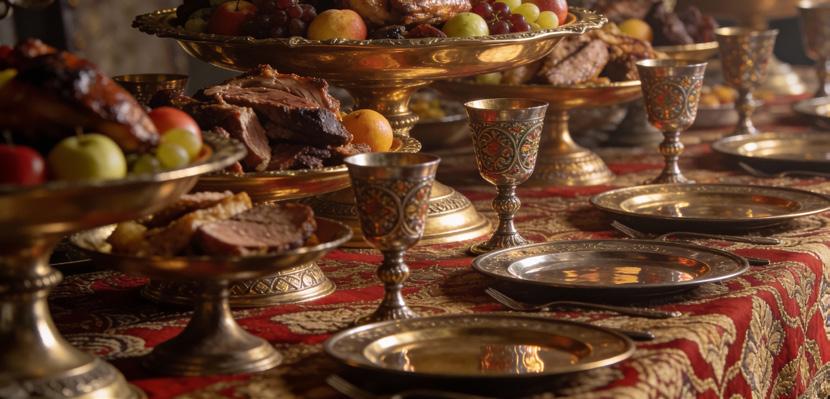
The Megillah contains a fascinating phrase that’s easily overlooked but proves extremely perplexing once noticed. It states (4:17): “Mordechai went over (vaya’avor) and he did all that Esther had commanded him.” Where did Mordechai go from, and where did he go to? What is the significance of this relocation?
In Hamikrah v’Hamesorah, Rabbi Reuben Margolies zt”l famously suggests that Mordechai moved from Shushan the Persian capital to Shushan the Jewish city. But this assertion has no basis in the text.
A more compelling interpretation emerges from context. Throughout the fourth chapter, commands fly back and forth between Mordechai and Esther like a tennis ball across the court, each attempting to instruct the other. Mordechai struggles to persuade Esther to risk herself to save Am Yisrael. Finally, she agrees to sacrifice herself for her people.

At that point comes a dramatic shift. Now Mordechai follows all the orders he received from Esther. He “jumps over the net” and goes over to her side, ending the struggle between them. This is the meaning of “vaya’avor Mordechai,” as indicated by the continuation of the verse.
Mordechai makes a powerful statement: If Esther is prepared to put her life on the line for her people, then she is the true leader of Am Yisrael. Mordechai accepts that he must take orders from her. A careful reading of the Megillah indicates a major shift in Esther’s standing vis-avis Mordechai and her role in the events and authorship. But we’ll leave that for another time.
When the Rambam (Yesodei HaTorah 5:4) depicts the exalted status of those who sacrifice their lives for the sanctification of G-d’s Name, he provides a list of historical examples:
“When anyone about whom it is said: ‘Sacrifice your life and do not transgress,’ sacrifices his life and does not transgress, he sanctifies [G-d’s] name. If he does so in the presence of ten Jews, he sanctifies [G-d’s] name in public, like Daniel, Chananiah, Mishael, Azariah, and Rabbi Akiva and his colleagues. These are those slain by [the wicked] kingdom, above whom there is no higher level. Concerning them, [Tehillim 44:23] states: ‘For Your sake, we have been slain all day, we are viewed as sheep for the slaughter,’ and [Tehillim 50:5] states: ‘Gather unto Me, My pious ones, those who have made a covenant with Me by slaughter.’”
Other than Rabbi Akiva and his peers, none of the heroes listed by the Rambam actually died sacrificing their lives for the sanctification of G-d’s Name. The clear implication is that being prepared to sacrifice one’s life for G-d is as great as actually sacrificing one’s life for G-d.
The Rambam defines waging war for the defense of the Jewish people as a case of sanctification of G-d’s name: “Anyone who fights with his entire heart, without fear, with the intention of sanctifying G-d’s name alone, can be assured that he will find no harm, nor will bad overtake him... He will also merit eternal life in the world to come as it states: ‘G-d will certainly make my lord a faithful house, for my lord fights the wars of G-d and evil will not be found with you... and my lord’s soul will be bound in a bond of life with G-d’” (Hilchot Melachim U’milchamot 7:15; see also 5:1).
A soldier who was prepared to die for the defense of Am Yisrael is viewed as having given his life for the sanctity of G-d’s name even if he emerges unscathed. The Rambam’s words reinforce those of Megillat Esther and together provide a clear directive: We must treat those who risk their lives in defense of the Jewish people with the utmost reverence. IDF soldiers are the “holy of holies” of our nation and should be treasured as such. To do otherwise would be a tragic and monumental betrayal of the Torah’s values.

Rabbi Yitzchak Twersky
is the author of Amittah Shel Torah on Chumash and Amittah Shel Torah 2 on the Torah Year, www.realtorah.com, and scores of published articles in Gemarah, halacha, Tanach and machshava. He currently teaches in MMY, YU Israel, Mizrachi Lapidot and Lamdeinu. Before making Aliyah, he taught in many institutions including the Frisch Yeshivah (where he was Chairman of the Tanach department), YU, the Princeton and Columbia batei midrash and in Moshava.
While the events of the Purim story unfold in Shushan, the capital of the Persian Empire, they are deeply connected to the context of the early years of the Second Temple period (Bayit Sheini). Through historical identification and careful analysis, Purim provides a commentary on the spiritual and national challenges faced by Jews both in the Diaspora and in their homeland.
assimilation into Persian culture, stands as a stark counterpoint to the sanctity and spiritual mission of Yerushalayim. The description of the royal feast (1:6–7) –with its lavish furnishings, fine materials, and golden vessels – recalls the splendour of the Beit HaMikdash. Chazal emphasise this comparison further, noting that Achashveirosh donned the bigdei kehunah [priestly garments] (Megillah 12a), turning his palace into a satirical reflection of the sacred space of the Beit HaMikdash.
aligning their loyalties with their spiritual homeland.
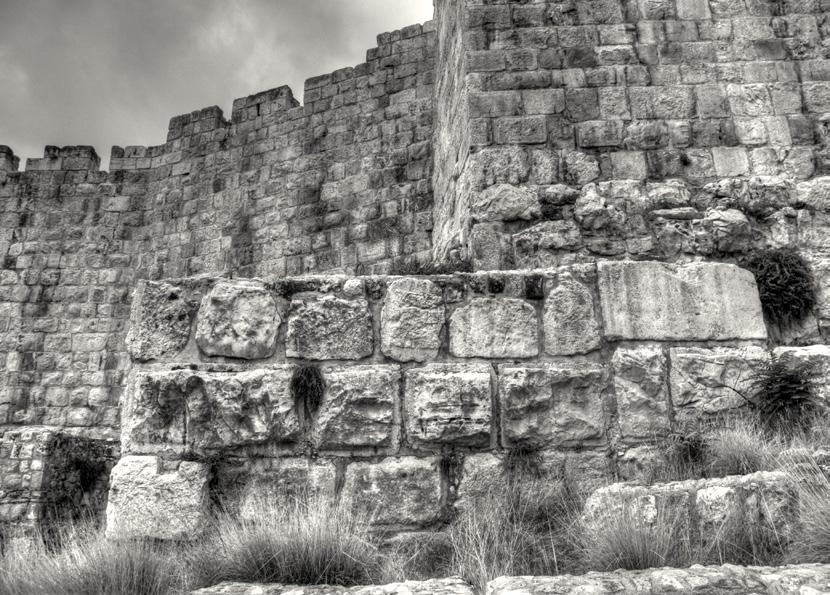
The timeline of Purim is situated during the reign of Achashveirosh, identified by many scholars as Xerxes I of the Achaemenid Empire. This places the story within the era of the Second Temple, following the decree of Koresh (Cyrus) allowing the Jews to return to Israel and rebuild the Beit HaMikdash (Ezra 1:2–3). However, as seen in Ezra (4:4–6), the rebuilding process was fraught with obstacles, with opposition from local populations. In contrast, the Jews in Shushan appear detached from these struggles, indulging in the wealth of the Persian court.
Chazal highlight this dissonance by criticising the Jews’ participation in Achashveirosh’s feast (Megillah 12a). This critique serves as a central commentary on the broader message of Purim: the tension between comfort in exile and the Jewish mission to restore their connection to Yerushalayim and the Beit HaMikdash. The feast, described in the first chapter of Esther, showcased the grandeur of the Persian Empire and included the use of vessels from the Beit HaMikdash (Megillah 11b). The tragic irony is that while the Jews in Eretz Yisrael laboured to rebuild their spiritual centre, those in Shushan celebrated their integration into Persian society.
In fact, the Megillah draws striking parallels between Shushan and Yerushalayim, particularly between Achashveirosh’s palace and the Beit HaMikdash, emphasising the contrasting allegiances of the Jewish people. Shushan, a symbol of opulent
This tragic satire underscores the spiritual misplacement of the Jews in Shushan. Instead of dedicating themselves to the reconstruction of Yerushalayim, they found comfort in the Diaspora, naively believing they had a place in Persian culture. The term “bira” (palace), used both for describing Shushan and in reference to the Beit HaMikdash (Divrei Hayamim I 29:19), serves as a poignant reminder of where their true focus should have been.
The Midrash (Esther Rabbah 1:5) critiques Koresh’s acknowledgment of Hashem as “the G-d in Yerushalayim” (Ezra 1:2–3), thereby limiting his recognition of divine sovereignty to Yerushalayim alone. This constrained view of Hashem’s dominion contrasts with the message of Purim, which transcends geography. Unlike Koresh, who confined Hashem’s presence to Yerushalayim, the Megillah conveys that Hashem is present even in the Diaspora. His providence orchestrates the salvation of the Jews in Shushan, despite their physical and spiritual distance from the Beit HaMikdash. Purim teaches that divine intervention operates even in the most concealed of settings.
However, this message is not an endorsement of complacency in exile. The parallels between Shushan and Yerushalayim serve as a call to prioritise the true “bira”: Yerushalayim and the Beit HaMikdash The Jews of Shushan needed to recognise their obligation to return and rebuild,
The halacha defining walled cities on Purim, as being based on their status from the time of Yehoshua and the conquering of Eretz Yisrael, reinforces the centrality of Yerushalayim in Jewish identity. By anchoring this halachic determination in Yehoshua’s era, Chazal remind us of our historical roots in Eretz Yisrael and the enduring significance of Yerushalayim as the spiritual and national heart of the Jewish people.
Purim, with its profound historical and spiritual dimensions, reminds us of the duality of Jewish existence. While Hashem’s presence extends across the globe, the ultimate goal remains the restoration of Yerushalayim and the Beit HaMikdash The Jews of Shushan, and by extension all Jews in exile, are called to recognise this mission and align themselves with the true “bira.” As we celebrate Purim, we reaffirm our faith in Hashem’s omnipresence and our commitment to His eternal covenant with Yerushalayim.


Rabbi Jonny Brull is Director of Rav Rimon’s Torah in English at Sulamot. He was previously Rosh Kollel Torah Mitzion and Assistant Rabbi at Mizrachi Melbourne.
Purim is a holiday of costumes, laughter, and hidden miracles. But beneath the noise and noisemakers lies one of the most powerful relationship lessons in Jewish life: knowing who you are, when to reveal yourself, and trusting that what’s meant for you won’t require you to disappear to be chosen.
Dating, much like Purim, is full of masks. Some are playful and harmless, others are protective, and some we don’t even realize we’re wearing. We show our best sides, soften our edges, edit our stories. In the early stages, that’s natural. The question isn’t whether you wear a mask at the beginning, it’s whether you know when to take it off.
At first, dating often feels like a performance. We want to be liked. We want to be connected. We want to be chosen. So we become agreeable, impressive, and flexible. We hold back opinions. We downplay needs.
Behind the mask might be fear: fear of being too much, fear of being rejected, fear that if someone really saw us, they’d walk away. But Purim reminds us that hiding forever is not the goal. Esther didn’t stay hidden. She waited. And when the moment came, she stepped forward fully.
Healthy dating isn’t about oversharing on the first date or laying your entire life story on the table. It’s about intentional revelation. Knowing what to share, when to share it, and trusting that the right person can hold it.
One of the most moving arcs in the Purim story is Esther’s journey from hidden to chosen. She stepped into her truth with courage. In dating, many people want to be chosen while staying hidden. But real partnership doesn’t form there. You can be
admired for your mask, but you can only be loved for who you truly are.
Being chosen doesn’t mean being selected like a prize. It means being seen, known, and valued. And that requires risk. It requires letting someone see your values, your boundaries, your sensitivities, your dreams. Not all at once, but honestly, consistently, and with self-respect. Purim offers a powerful test for dating clarity: Who are you when the mask comes off?
When dating ask yourself: Do I feel more like myself as time goes on, or less? Am I becoming clearer, calmer, and more grounded, or more confused and anxious? Am I expanding, or am I shrinking to fit? Clarity in dating doesn’t come from fireworks. It comes from alignment. From watching how someone responds when you express a need, share a value, or say no. From noticing whether you feel safe being honest, or whether honesty feels risky.
That clarity often emerges around the third or fourth date – the moment when the mask begins to slip. Comfort increases. Expectations emerge. Real personalities show up. This is when you start to see how someone handles disappointment, difference, or depth. It’s when chemistry meets character.
Instead of panicking when things feel more real, pause and observe. This is where clarity lives. If someone disappears, withdraws, or becomes uncomfortable when authenticity enters the room, that’s data. And if someone leans in, listens, and stays curious, that’s data too.
One of the most profound teachings of Purim is that G-d’s name is never explicitly mentioned, yet His presence is everywhere. The hidden hand guides the story quietly, patiently, precisely.
With this in mind, rejection can be seen as redirection from up above. Trusting the hidden hand in dating means showing up sincerely, doing your part, and letting go of outcomes you cannot control.
May this Purim help you gently remove the masks that no longer serve you. May you have the courage to reveal your true self at the right time, to the right person.
May you trust the hidden hand guiding your journey, even when the path feels unclear. And may you move from hidden to chosen, not by shrinking, but by standing fully in who you are, and who you are becoming.


Aleeza Ben Shalom is a soulmate clarity coach. She was on Netflix’s “Jewish Matchmaking” and is an in-demand speaker, expert, and author of numerous books. She leads the Jewish Matchmaking Movement, in partnership with World Mizrachi.

The Jewish Matchmaking Movement is an exciting global collaboration between World Mizrachi and Aleeza Ben Shalom to guarantee future Jewish generations.












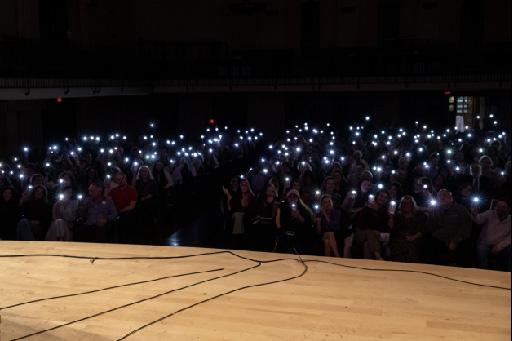



There is a tradition that the 7th of Adar, the day Moshe Rabbeinu passed away, is a day for supporting the work of the Chevra Kadisha. Since October 7th, the IDF Rabbinate has carried the heartbreaking and holy task of burying thousands of Israelis. Rabbi Bentzi Mann, head of World Mizrachi’s Schools Department, served as a reservist for hundreds of days performing this sacred work. Upon returning to civilian life, Rabbi Aron White sat down with him to discuss his experiences. (Warning – includes graphic descriptions)
Thank you for talking with us. Can you tell us about your background?
I grew up in Bayit Vegan in an American family. I attended Yeshivat Kerem B’Yavneh, and during my army service I served in the Army Rabbinate as an assistant to the Chief Rabbi of the Army, Rabbi Rafi Peretz. I married Michal, who grew up in Ra’anana, and it was clear that shlichut to chutz laAretz was important to both of us. After learning in various institutions, including Straus-Amiel, we then trained at Mizrachi’s Shalhevet program and went on shlichut to the UK, in a role that combined work at JFS, one of the largest Jewish schools in the world (under the auspices of UJC and Tribe), with building a new community in Mill Hill East, London. After four wonderful years in the UK, we returned to Israel in 2022, and I began working in the new Schools Department at World Mizrachi.
Where were you on October 7th, and when did you realize you were going to be called up for reserve duty?
We were at home in Rechovot when the sirens woke us at 6:30am on Simchat Torah. Our apartment doesn’t have its own safe space, so we went down with the kids to the local shelter. As the hours passed, we started hearing rumors about what was happening, but the picture was very unclear for everyone that day. Many people turned on their phones to see whether they were being called up, but that thought barely crossed my mind. Since finishing my sadir (regular service), I had been called for milu’im for one day a year in Nissan, to help make kitchens on army bases kosher for Pesach. While we didn’t know exactly what was happening, it was clear to me that the army wasn’t going to call me up to kasher kitchens!
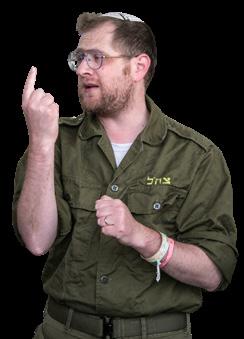
On Sunday morning, I received a text from someone in the army Rabbinate: “Can you come to Shura?” Shura is a base that in recent years became the headquarters for the IDF Rabbinate. This gives you a sense of how “out of the system” I was as a reservist – Shura is actually about a 10-minute drive from my house in Rechovot, but I had never even heard of it! I didn’t know what I was being called for, but it was obvious to me that if the army is calling, I will go.
I arrived at the base, and an army psychologist explained that we were needed to help identify bodies of those murdered by Hamas. We had a little time to mentally prepare ourselves, and then within minutes we were dealing with the deceased.
Shura is officially an army facility entrusted with chesed shel emet for soldiers who have been killed. However, on October 7th itself, the Israeli government decided it would be the place where civilian bodies would be brought. There simply was no other place in the country equipped to deal with the sheer number of bodies we were facing. My reservist experience began on October 8th and would continue in different forms for the next two years.
How long was the stage of initial intensity, of dealing with those killed on October 7th itself?
The initial days were a blur of chaos – controlled chaos, but chaos nonetheless. Before the “traditional” work of preparing bodies for burial, we had to identify bodies. Thousands of families were trying to determine what happened to their loved ones – who had been killed, who had been kidnapped. Then, after we identified many bodies, came the stage of burial. Starting from about Wednesday, there were literally hundreds of funerals. For the hundreds of soldiers who had been killed, it was also the army’s responsibility to run a military funeral, with an IDF rabbi and

chazzan. But the devastation of October 7th was so great that bodies were still being brought in the Shabbat after, and elements of identification would go on for many months.
After this initial intensity came the next stage, when the ground invasion of Gaza began at the end of October 2023. As the operation began and soldiers were tragically killed, it was our job at Shura to prepare those soldiers who had fallen in battle for burial.
At some point, in addition to your work in the Rabbinate, you began speaking to groups from around the world visiting the Shura base. Can you talk about that, and the complexities involved?
A few weeks into the war, World Mizrachi began organizing missions together with the RCA to bring American rabbis to Israel to share with their communities what was happening on the ground. We felt that bringing rabbis to see the work of the IDF Rabbinate was important and meaningful. It was also a time when there was tremendous emphasis on making sure the world understood what happened, so we started bringing media, UN representatives, the Red Cross, and other international organizations to the base.
When we brought rabbis, we wanted to make sure we were not only focused on the chesed shel emet aspects. We also showed them the central storehouse where the IDF keeps its sifrei Torah for use on different bases and by different units.
After this initial wave, the rabbis began bringing missions with their communities, and then communities started coming on their own. This was especially sensitive. We were talking about visiting a base during an active war, where the work we were doing was still ongoing. We had to ensure that whatever we did would be sensitive to the families of the fallen, who might literally be at the base at the same time as these visiting groups.
We wanted this to be a way for Diaspora Jews to literally stand with us, the people of Israel, as we paid our respects to those who
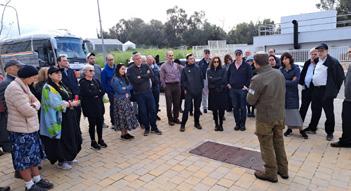
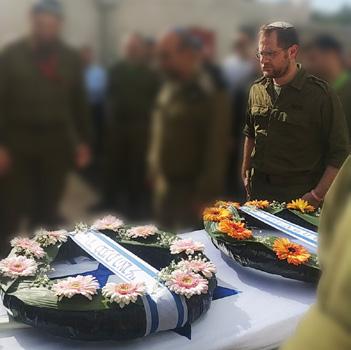
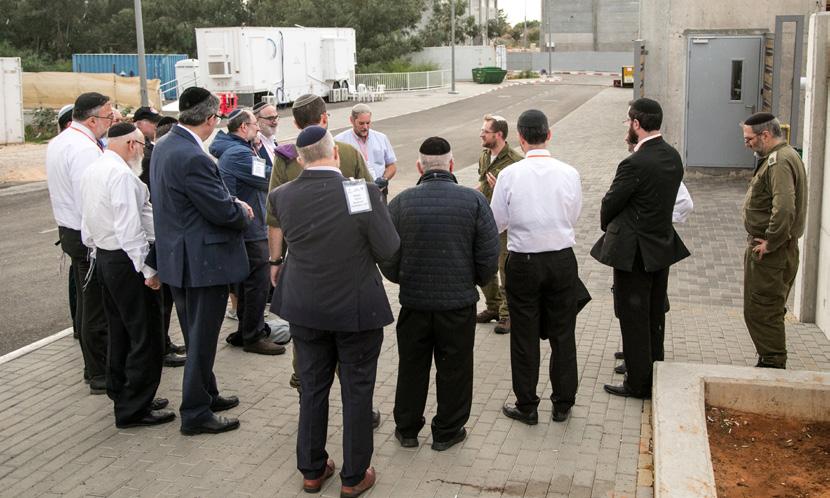


had fallen for our people. We had people coming from Argentina to Australia and everywhere in between. Diaspora Jews gave us a big hug. They would sometimes fulfill the mitzvah of levaya, be there when we said Kaddish, and show that they were part of honoring the holy heroes of Am Yisrael.
Throughout this process, did you have support for your mental health?
The army has a mental health support system – it isn’t perfect, but it’s far ahead of where it was ten or twenty years ago. Still, how people react to this work can’t be predicted and varies enormously. There were seasoned members of ZAKA who had dealt with Chevra Kadisha work for decades who couldn’t handle the intensity and scale of what we faced and had to step away.
The base had a space where people could go for immediate support if things became too much, and many people did step back from serving when they reached their limit.
When did you finish your milu’im service?
Blessedly, as the war went on, fewer people were needed than at the beginning, but some of us continued serving throughout.
In my heart, I felt I wouldn’t have closure until Daniel Perez and Hadar Goldin came home. I felt connected to Daniel Perez through Mizrachi and Rav Doron, and I was friendly with Hadar’s twin brother – we learned together in Mechinat Eli after finishing the army. Had Hadar not been killed, he would have been there learning with us.
On Simchat Torah, two years after the attack, Daniel’s body was returned. A month later, Hadar’s body was returned. Being part of paying them final respects at the Shura base was deeply meaningful.
Now that you have returned to World Mizrachi, what are you going to be doing?
I’m excited to return – and there has been lots of growth at World Mizrachi while I was away! I will continue working on some of the projects I was working on before the war, such as our weekly parasha sheets for youth, as well as getting involved in some of the new projects developing in Israel and around the world. ◼
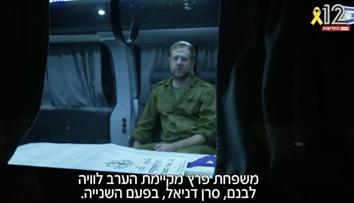
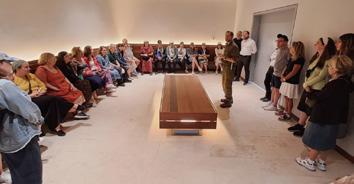
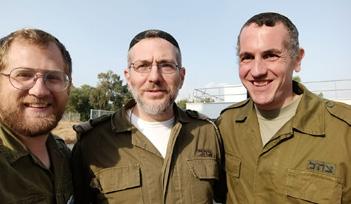
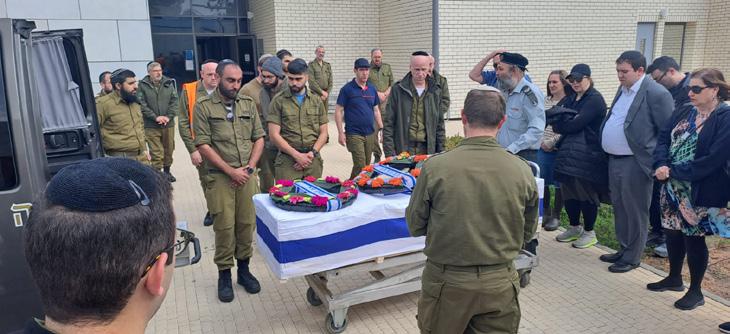




Our Couples: Introducing Shalva and Ezra Behr!
Where was your first date?
Our first date was at Anava Park in Modiin.
What did you learn from the dating process that you'd like to share?
Enjoy the process! Dating is an excellent time to get to know people, their world, and yourself, even if it's just for one date. Try to come with a positive mindset! My mindset throughout the whole dating process was “I’m going out to have a good time while getting to know someone. This person is someone who on paper, we have something in common and could potentially work out, so heck, it's going to be a fun time. If it doesn’t work out, I still got to meet someone new.”
Why is it worth joining the Shagririm Balev database? It is worth joining because it is unique in the way you have a friend representing you and setting you up. And who knows you better than your friends? That way you only get the suggestions that are really relevant to you, without random shadchanim who don’t really know you.
A funny story from one of your dates:
Right at the beginning, on our fourth date, we went to a concert and a whole bunch of Ezra's friends were sitting right behind us. Super awkward having to introduce a girl who I had just started to date. We were still in that “are we serious” stage. Needless to say, we moved to sit somewhere else where we weren’t being watched the whole time.
Tell us about your marriage proposal:
I had told Shalva that our engagement party was on a specific Sunday, so she knew it had to be before then. She also knew that I would propose during sunset and at a nice place (with a view, like she wanted). So it became a thing every time she tried getting it out of me, I’d tell her “either Tuesday or Wednesday or Thursday.” I had also told her that on each of those 3 days we were going out to a nice place and we’re getting dressed up, that way she wouldn't know exactly when it was happening. Long story short, I proposed on Tuesday at Yaar Tzora next to Beit Shemesh, a place that was special to us, where we had gone a lot during the time we were dating.
Who are the ambassadors who set you up and what would you like to tell them?
Shalva’s ambassador was Reut Green, a good friend since elementary school. I would like to say thank you for all the years of friendship, for convincing me to join Shagririm, and thank you for ultimately being part of helping me find my husband. Ezra’s ambassadors were Hila and Eliya Tzanani, and I would like to say: a huge thank you for everything that you've done for me along my dating journey!

The man who became the father of modern Zionism was the least likely candidate for the role. For most of his life, Theodor Herzl lived as a thoroughly assimilated Austrian journalist. He barely observed mitzvot, possessed little knowledge of Torah, and moved comfortably through Vienna’s secular intellectual circles. He wrote plays, covered politics for major newspapers, and sought acceptance in European society. Nothing in his public life suggested a man driven by Jewish destiny or dreams of redemption.
Yet this same man devoted the final years of his short life to an impossible mission: persuading the world’s powers to support the return of the Jewish people to their land. The standard historical narrative attributes Herzl’s transformation to the Dreyfus Affair – the 1894 trial of a Jewish French officer falsely accused of treason amid cries of “Death to the Jews.” According to this account, the shock of seeing how quickly European nations could turn on their Jewish citizens compelled Herzl to seek a political solution to antisemitism.
But this explanation is not enough. Antisemitism can make Jews flee; it does not make them build. It does not explain why a secular journalist with minimal Jewish education would sacrifice his career, health, and ultimately his life for the restoration of Jewish nationhood.
On December 25, 1903, just months before his death at age 44, Herzl sat with his first biographer, Reuven Brainin. Brainin was struck by the signs of premature aging on Herzl’s face and sensed that he knew he would not live much longer.
Herzl used the moment to share a story from his childhood. “When I was twelve years old, a German book fell into my hands… in which I read the story of Mashiach, the king of Israel, whose coming any day is expected by many Jews even in our generations. He will arrive as a poor man riding a donkey.” Though the details were fragmentary, something stirred within
him – sorrow and a vague yearning he could not yet name.
That night, lying in bed, the story of the Exodus merged in his mind with the messianic visions he had just read. Past and future fused into a single image of redemption. Then came a dream that would quietly shape his destiny.
Herzl saw himself lifted in the arms of Mashiach, soaring on the wings of the wind until they encountered Moshe Rabbeinu, who appeared like Michelangelo’s statue that had captivated him since childhood. Mashiach called to Moshe, “For this child I have prayed!” Then he turned to Herzl and commanded: “Go and announce to the Jews that I will soon come and perform great miracles for my people and for the whole world!” (Georges Yitshak Weisz, Theodor Herzl: A New Reading, 107–109).
Herzl never revealed this dream publicly, yet it stayed with him. It was this vision –not antisemitism alone – that drove him to establish and lead the Zionist movement.
After the destruction of the first Beit HaMikdash, Yirmiyahu told the Jews exiled to Babylon their exile would last seventy years. But after the destruction of the second Beit HaMikdash, no end date was revealed for our exile. Redemption was left deliberately open-ended.
Rabbi Yitzchak Nissenbaum explained: “How fortunate we are that the exact timing was never revealed! Instead, we have waited each day expecting the Messiah’s arrival. This daily hope for redemption has been what preserved us from disappearing among the nations.”
“Whoever mourns for Jerusalem will merit to see it in its joy” (Ta’anit 30b). This mourning – this “sacred ache” for Jerusalem – is the engine of Jewish activism. Yearning for redemption drives us forward and fuels our determination. It is the most powerful force in Israel’s history. It sustained our ancestors through two millennia of exile, pogroms, and persecution. When troubles intensified, this messianic spirit was “reborn in the hearts of the afflicted
and humble masses. Like a divine presence hovering over turbulent waters threatening to overwhelm them, this hope provided inner light that strengthened them through their greatest sufferings” (Chomer L’Derush 84-85).
Herzl followed this same pattern. His biographers focus on his response to antisemitism because they cannot fathom what really happened: that the soul of even the most assimilated Jew carries within it the DNA of redemption. Herzl himself testified to this reality in words that should be carved in stone: “In the depths of my soul, the legend continued to be woven, even unknown to me.” Unknown to him – yet driving him toward his destiny.
Herzl’s dream clarifies what is being asked of us. If even an assimilated Jew could not escape the pull of redemption, then we certainly cannot pretend it is someone else’s task. The return to Jewish sovereignty did not begin with politics, and it will not be completed by politics alone. It began with longing, and it will be completed by Jews who are willing to take responsibility for that longing – by building, settling, serving, and shaping a society worthy of the destiny that first stirred in Herzl’s soul. The question is whether we are ready to carry it forward.


Rabbi Elie Mischel is the Editor of HaMizrachi magazine and the author of The War Against the Bible: Ishmael, Esau and Israel at the End Times (2024).
We asked three Torah MiTzion

October 7th was a shocking and surreal turning point. Its impact was not limited to the burned fields near Gaza – it reached all the way to the streets of Moscow. In our community, it revealed a new and complex sense of identity: not just distant nostalgia or cultural connection, but a real, tangible, and painful sense of responsibility.
Aviva, a member of the community, expressed this change well: “Before October 7th, Israel was for me about the sun and Tnuva dairy products. Since then, Israel has become a place where people show resilience, faith, and unity.” Her words reflect the shift from passivity to active involvement, from memory to engagement.
This concern quickly turned into action. Posters and letters of support were sent to the front. Community members called to check on friends and relatives. Messages like “We are the People of Israel” appeared on shirts and in hearts. A quiet but determined sense of shared responsibility grew, focused on organized fundraising, special prayers, and the uplifting feeling of being one big family.
For us, October 7th became a moment to reassess our loyalty. It showed that the Jewish community in Moscow, despite the distance, is not isolated. Through concern, action, and prayer, we are connected and share in the fate of our brothers and sisters in Israel.
Rachel Zikerman is a wife and mother who served for over a decade as a Torah MiTzion emissary in Moscow. She is now a Rabbanit in the Moscow community, where she leads projects, teaches Torah, and supports Jewish community life.
How have you seen your community strengthen since October 7th?

The October 7th massacre took all of us by surprise. If someone had told me, while walking to shul on that Simchat Torah morning, that later I would be on a helicopter heading south to serve in the war, I would have found it hard to believe. Yet that is what happened, and that day marked the start of an ongoing conflict that has required everyone in Israel and abroad to do whatever they can for our nation.
After leaving Gaza for the first time, following more than a month-and-a-half on a very intense battlefield, I was often asked what gave me the strength to keep going. The truth is, I never felt that those asking were doing any less than I was. They were the same people who volunteered whenever they could – making barbecues, donating blood, visiting the injured, organizing packages for those in need, and helping those forced from their homes. Like me, they were giving their all for Am Yisrael
In the Megillah, we read how Esther was willing to face Achashveirosh, even at the risk of her life, because of the words: “Who knows whether you were placed in the kingdom for such a time as this?”
Esther may not have known why Hashem placed her in that position, but she understood that her mission was to do everything she could for the Jewish people from where she was.
The same is true for all of us. We must seize the opportunities Hashem gives us to do all we can for Am Yisrael – whether as a soldier on the battlefield, a nurse in a hospital, or someone who takes the time to check in on a neighbor. “Who knows whether you were placed in this situation for such a time as this?”
Avi Paley, 24, lives in Nof Ayalon and studied at Yeshivot Har Etzion and Yerucham. He is currently serving on shlichut in Sydney, Australia.

October 7, 2023, Shemini Atzeret. Everyone was in shul when war broke out in Israel. At first, it was hard to believe. Slowly, the scale of the trauma became clear. As Torah MiTzion shlichim, we quickly became a source of reliable information. People came to us for updates and emotional support. Our own sons, along with other shlichim, were drafted to Gaza and Lebanon, and many children of community members were called up as well. This shared experience deeply united us, especially as parents of lone soldiers, and brought the whole community – adults and children alike – closer, constantly following the situation in Israel.
Individuals and organizations across Memphis both gave and received support: prayers, Tehillim, care packages, and financial contributions, all for the welfare of Israel and the Jewish people. There was a strong desire to create personal connections with people and organizations in Israel, to feel part of it.
Community members asked us to stay in Memphis, even though our children were serving in Israel. They saw us as a living connection to Israel, which they needed during the first year of the war. In the second year, support for the hostages’ release continued, financial assistance grew, and interest in Aliyah increased – a development we had not seen before the war. Families approached us privately to discuss their plans to move to Israel, often asking us to keep their conversations confidential.
Two-and-a-half years later, it is clear that every Memphis family, regardless of community, feels a stronger connection to the Jewish people in Eretz Yisrael
Sarit Grunwald is in her fourth year of shlichut in Memphis, Tennessee, teaching Torah and Zionism and organizing community programs. She is married to Rabbi Ilai Grunwald, Co-Head of the Torah MiTzion Kollel. Sarit is also a personal coach.
COMPILED BY: JACQUI
AUSTEN
DESIGNED BY:
LEAH RUBIN

Search among the Purim objects and find the 7 objects from the top row. Each object has only one exact match!


September 25, 1889 - August 22, 1978 (29 Elul 5649 - 19 Av 5738)
Helena Kagan finished medical school at the age of twenty-four with a specialty in pediatrics. Despite the incredible opportunities she was offered in Switzerland, Helena wanted to fulfill her promise to her father to visit the Land of Israel. At the time, the Turkish reigned in Israel and no one had ever heard of a female doctor before, so she wasn’t allowed to practice. Not allowing that to stop her, she began teaching nurses and doctors the rules of cleanliness and hygiene. She was eventually the first woman to be granted a license to practice medicine in the history of the Ottoman Empire. Helena did incredible things to help families, including purchasing a cow when there was no milk to drink! She soon opened a home for abandoned children and later founded the pediatric ward at the Bikur Holim hospital which she ran for forty years. She even opened the first classroom in the pediatric ward for children suffering from chronic diseases. Dr. Kagan passed away with no children of her own, but surrounded by the thousands who had lived thanks to her.

Adapted from Iconic Jewish Women by Dr. Aliza Lavie. Scan the QR code to purchase on Amazon.
The Persian empire spanned across 3 continents! Asia, Africa and Europe.
Megillot (scrolls) were a common way to store official documents in the ancient Persian court.
Older Megillot were printed with images of the story on it!
Where does the story of Purim take place?
How many days did Esther fast for?
What is another name for hamantaschen?
Look for the answers in the Parshat Ki Tisa Youth Edition – see below for more details!
weekly parsha for youth!
HaMizrachi Weekly Youth Edition & Chavruta Featuring Thought-Provoking Questions, Fun Activities, and Fascinating Insights!


Scan the QR code or visit mizrachi.org/youth to learn more.
Ingredients:
½ cup unsalted butter or margarine, softened
¾ cup sugar
1 egg
1 tbsp milk or pareve milk
1 tsp of vanilla extract
¼ tsp baking powder
¼ tsp salt
1 ½ cups flour, plus a bit more for shaping
Fillings of your choice! Some good ideas are different flavored jellies and jams, as well as chocolate and caramel.
Instructions:
1. Combine the sugar and butter until smooth.
2. Add the egg, vanilla, and milk and mix together.
3. Sift together the flour, baking powder and salt in a separate bowl and when fully combined, add it to the wet ingredients and mix until combined.
4. Turn the dough into a ball and cover with plastic wrap to chill in the fridge for an hour. (Fun fact, the longer it rests the better it tastes! But don’t let it rest for more than 24 hours.)
5. Once you take the dough out of the fridge, set up a clean work surface and put down some flour to keep the dough from sticking.
6. Next roll the dough out, but not too thin!
7. Using the round cookie cutter or the top of
a cup, cut out the cookies.
8. Take your filling and put about 1/2 tsp of it into the middle of your round cookie and then lift the edges and pinch three points to form a triangle, leaving space in the middle.
9. Place them back in the fridge for 10 minutes and with help from a parent, preheat the oven to 200°C or 400°F.
10. Take the cookies from the fridge after 10 minutes and then bake for 7-9 minutes.
11. Once the cookies are done, take them out of the oven and allow them to cool, and then enjoy!

& Most Trusted Events - Coast to Coast
The Largest & Most Trusted Events - Coast to Coast
The Largest & Most Trusted Events - Coast to Coast



Vacation homes in dreamy locations
Prime investment opportunities Properties in
communities Expert guidance from A to Z
projects in Israel — all under one www.israelevent2025.com or scan to QR code above.
Since 1998, this event has helped and investors discover the and up-to-date projects in Israel
Since 1998, this event has helped and investors discover the and up-to-date projects in Israel
Please register at www.israelevent2025.com or scan to QR code above. Participation is free.
Since 1998, this event has helped and investors discover the and up-to-date projects in Israel
Please register at www.israelevent2025.com or scan to QR code above. Participation is free.
Please register at www.israelevent2025.com or scan to QR code above.
Stop chasing copies — join the original event in Los Angeles!
Participation is free.
Stop chasing copies — join the original event in Los Angeles! the most valuable, exclusive, and up-to-date projects in Israel — all under one roof.
Since 1998, this event has helped thousands of buyers and the most valuable, exclusive, and up-to-date projects in Israel — all under
Please
marketing & promotion International
marketing & promotion International
Please register at: www.israelevent 2025 .com or scan the QR code above.