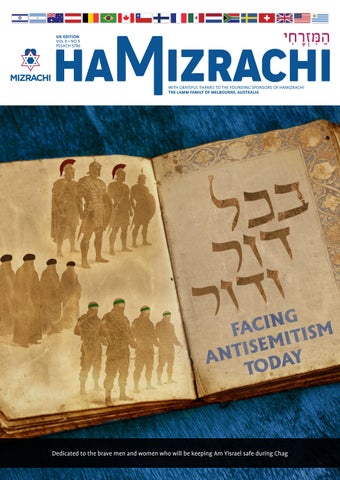
Dedicated to the brave men and women who will be keeping Am Yisrael safe during Chag
WITH GRATEFUL THANKS TO THE FOUNDING SPONSORS OF HAMIZRACHI THE LAMM FAMILY OF MELBOURNE, AUSTRALIA
www.mizrachi.org
office@mizrachi.org
+972 (0)2 620 9000
NASI
Rabbi Yosef Zvi Rimon
CO-PRESIDENT
Rabbi Yechiel Wasserman
CHAIRMAN
Mr. Harvey Blitz
EXECUTIVE CHAIRMAN
Rabbi Doron Perez
CEO
Rabbi Danny Mirvis
EDUCATIONAL DIRECTORS
Rabbi Reuven Taragin
Rabbanit Shani Taragin
World Mizrachi is the global Religious Zionist movement, spreading Torat Eretz Yisrael across the world and strengthening the bond between the State of Israel and Jewish communities around the world.
Based in Jerusalem and with branches across the globe, Mizrachi – an acronym for merkaz ruchani (spiritual center) – was founded in 1902 by Rabbi Yitzchak Yaakov Reines, and is led today by Rabbi Doron Perez. Mizrachi’s role was then and remains with vigor today, to be a proactive partner and to take personal responsibility in contributing to the collective destiny of Klal Yisrael through a commitment to Torah, the Land of Israel and the People of Israel.
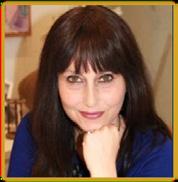
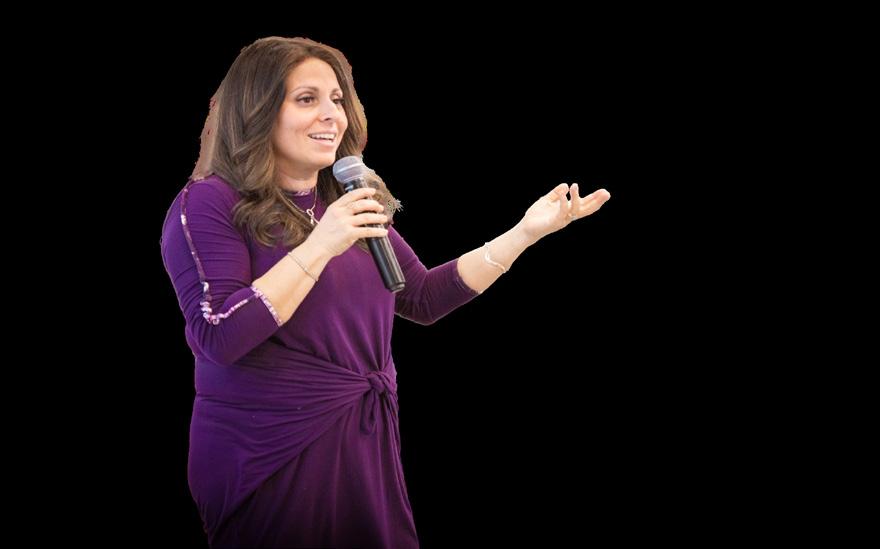
An Interview with Rabbanit Chana Henkin
PAGES 26–28
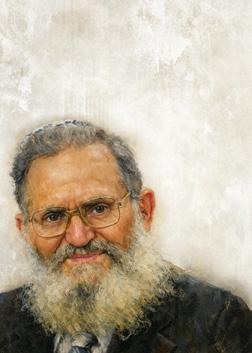
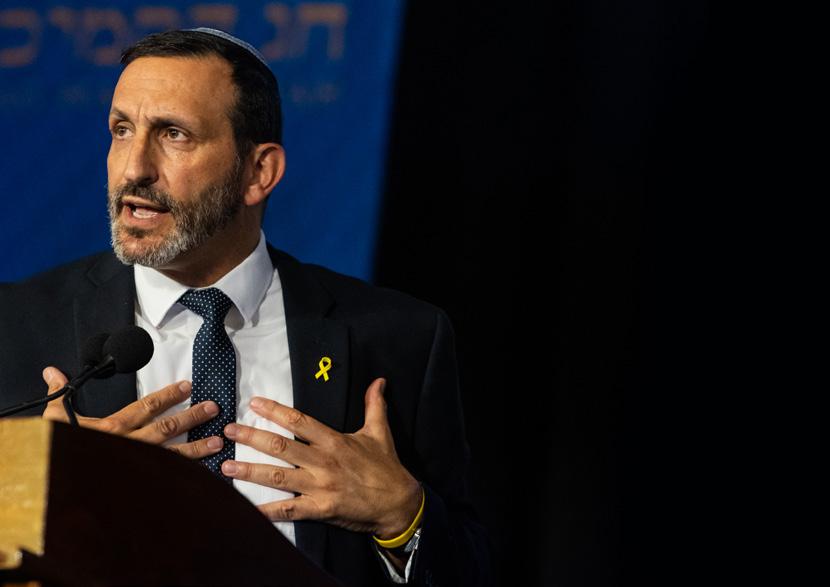
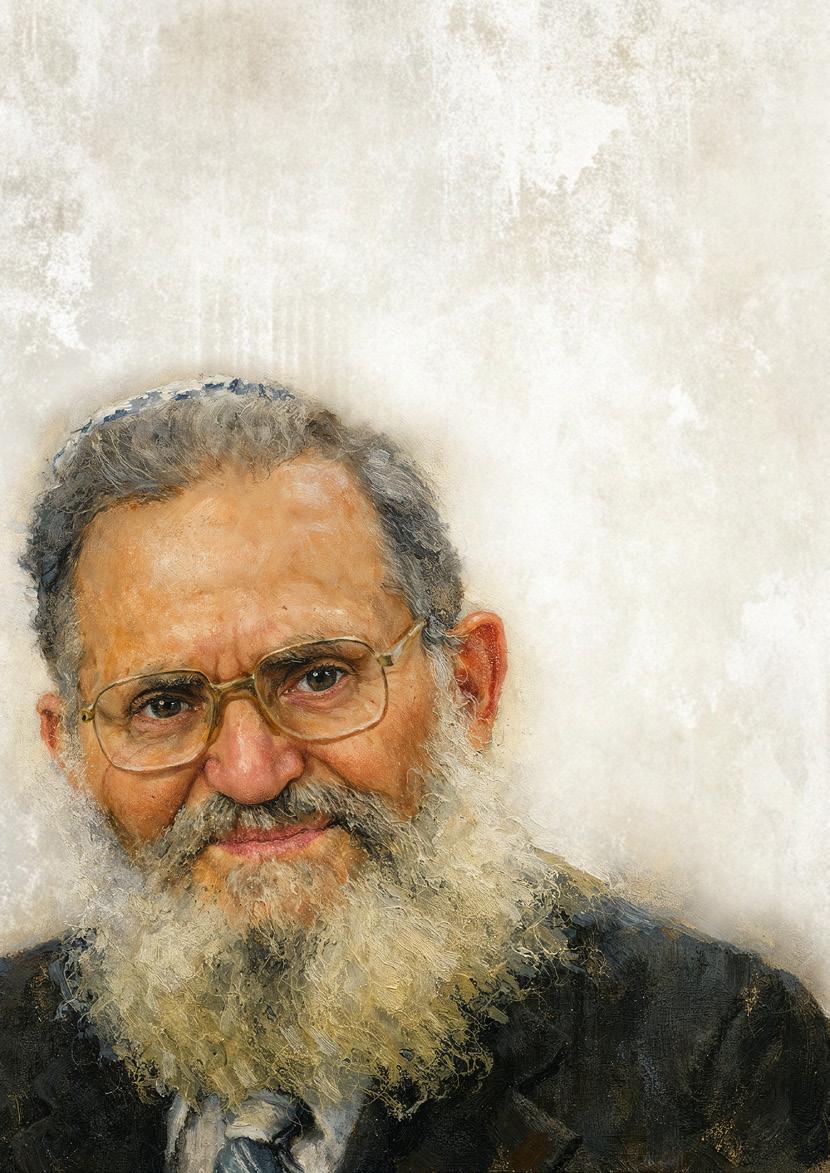
Rabbi Moshe
Neria:
and Fighter
www.mizrachi.org.uk uk@mizrachi.org 020 8004 1948
PRESIDENT
Chief Rabbi Sir Ephraim Mirvis KBE
CHAIR OF TRUSTEES
Steven Blumgart
CHIEF EXECUTIVE
Rabbi Andrew Shaw
BOARD
Michelle Bauernfreund
Matti Fruhman
Andrew Harris
Grant Kurland
Sean Melnick
David Morris
Joel Silberstein
30th APRIL - 3rd MAY 2026
INSPIRATION
The Wayward Sons of our Generation Jewish Anti-Zionists:
Rabbi Doron Perez
The phenomenon of fellow Jews misunderstanding the essence of our unique Jewish mission is, unfortunately, not new.
Jews for Jesus knocked on our doors in South Africa in the 1980s, aiming to convince fellow Jews to become Christians. The argument was simple: you can remain part of the Jewish people – its race, its ethnicity – as long as you wholly abandon Jewish faith and religious practice. This was an attempt to sever the bond between two fundamental tenets of Jewish identity – faith and religious practice on the one hand, Jewish nationhood and peoplehood on the other. A Jewish anti-Judaism, in effect: yes to Jewish peoplehood, no to Judaism.
The nineteenth century saw an ideology that cut this bond from the opposite direction. Yes to Judaism; no to Jewish nationhood. German Jews at the dawn of the Reform movement, at the time of the Emancipation, claimed to be “Germans of the Mosaic persuasion.” Hebrew, the national language of the Jewish people, was stripped from all prayer books, replaced entirely by German. Any reference to a return to Zion and Jerusalem was likewise removed from prayers and ritual. Jewish faith – yes. Jewish nationalism – no.
To fit in with the dominant religious or cultural order, some Jews have been willing to sever parts of their complex identity – cutting the indelible bond between Am Yisrael, the people of Israel, and the Torah of Israel.
Neturei Karta and ‘Not in My Name’ Jews
Today’s Jewish anti-Zionists pursue the same goal – but now that we have collectively returned to Zion and Jerusalem, they do so through the acerbic prism of anti-Zionism.
Zionism, from its inception, was the commitment to the collective return of the Jewish people to their ancestral homeland. The miraculous State of Israel gave expression to this historic promise. Today, roughly half of world Jewry lives in Israel, and over ninety percent of Jews worldwide support Israel as a Jewish state. It is indispensable to Jewish identity and destiny.
There is no authentic way to separate Zionism – the right of the Jewish people to sovereignty and self-determination in their ancestral homeland – from Judaism or Jewish peoplehood.
Yet this is precisely what today’s Jewish anti-Zionists wish to do, an unholy alliance drawn from both ends of the religious and political spectrum. Neturei Karta on the ultra-Orthodox right and the “Not in My Name” crowd on the progressive left claim to be proudly Jewish and anti-Zionist simultaneously – standing shoulder to shoulder with those who call for destroying the Jewish state “from the river to the sea.” They support the cause of terrorists who murdered, maimed, and brutalized innocent Jewish men, women, and children in an unprovoked attempt to annihilate the one and only Jewish state.
I have personally witnessed, in both New York and Toronto, members of Neturei Karta – thankfully numbering no more than a few hundred misguided Jews worldwide – marching side by side with Hamas supporters calling for the annihilation of Israel.
On the progressive left, the numbers are unfortunately larger, though still marginal to mainstream Jewish communities. Incredibly, some Jews feel nothing for the suffering of their own people as they face barbaric terrorist states and organizations bent on their annihilation. In the aftermath of October 7th, they published “not in my name” statements and letters distancing themselves from
the fate of their fellow Jews while siding with their murderous enemies. They form a minyan at campus gatherings calling for the destruction of the Jewish state “from the river to the sea.”
The wayward son – who are you?
These Jews are the wayward sons of our generation – the very figure we read about in the Haggadah
Here is why.
The Haggadah identifies exactly who the wayward son is: “The wayward son asks – ‘What is this service to you?’ ( Shemot 12:26). By saying ‘you’ he excludes himself. And since he excludes himself from the people of Israel (Klal Yisrael), he has denied a fundamental principle of our faith (kafar be-ikar).”
The Haggadah depicts the wayward son as one who sets himself apart from the Jewish people and places himself outside Jewish communal life. His question, “What is this service to you?”, implies that the service does not obligate him in any way. Issues of Jewish identity – our collective fate, destiny, and responsibilities – have no bearing on him. The Haggadah does not mince words: to exclude oneself from the Jewish people is to deny a fundamental tenet of Jewish faith.
What emerges powerfully from the Haggadah is the supreme importance of Jewish peoplehood. The community ethic is a core component of our identity and crucial to the meaning of Jewish life.
Pesach is the story of our people. It is where we explain to ourselves and our children what it means to be part of the collective Jewish experience – the history of a people whose birth was forged in the houses of bondage, in mutual pain and suffering in Egypt. The Covenant of Fate, as Rav Soloveitchik termed it, is the crux of the Pesach story: sharing a common fate
and being part of a historic community. Failure to embrace this reality excludes one from the Jewish community and therefore from being part of that destiny. Faith is not independent of fate, and Judaism is not independent of the Jewish people. One cannot claim to be either a religious Jew or a universalist Jew without being intrinsically connected to the particular fate and fortune of our people. According to the Haggadah, any religious or universalistic interpretation of Judaism that undermines the crucible of Jewish nationhood – the community ethic and our distinct collective historical experience as a people – is antithetical to authentic Judaism.
Those who hold these views commit a tragic mistake, excluding themselves from the Jewish community. They are the wayward sons of our generation – Jews who want Judaism without Jewish peoplehood, faith without fate, universalism without the bonds of brotherhood with their own people.
Our response to the wayward son
What are we to do with the wayward child?
The Haggadah continues by telling us how to respond. There is truth – and necessary harshness – in the response to such misguided views: “You in turn should blunt his teeth and say to him – ‘because of what Hashem did for me when I left Egypt, I do this’ (Shemot 13:8) – implying for me but not for him. Had he been there in Egypt, he would not have been redeemed.”
The wayward son needs to decide which side of Jewish and human history he stands on. If his worldview has no room for this deep sense of Jewish fate – the cry of solidarity with a suffering people, from Pharaoh to the Ayatollahs – he has missed the mark of the Jewish experience.
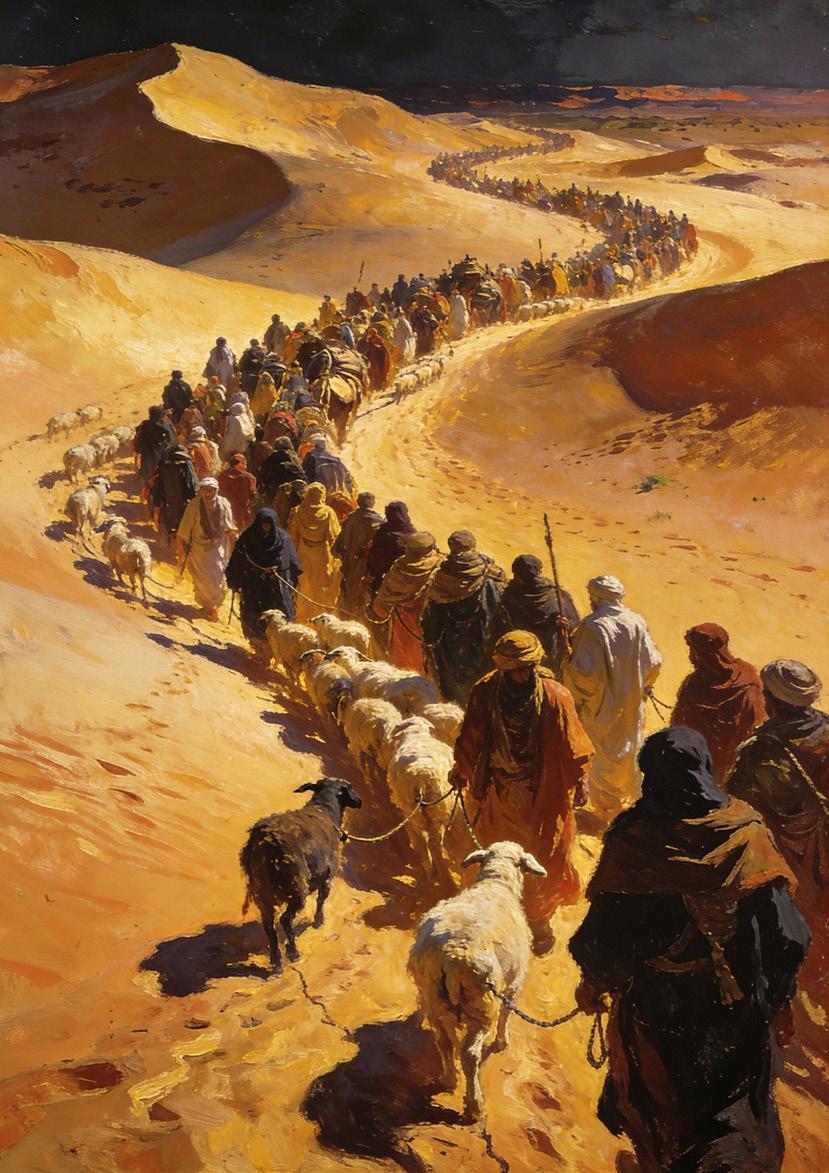
Our Sages tell us that many Jews tragically chose not to leave Egypt, lost during the plague of darkness. These Jews could not come to terms with Moses’ vision of redemption: to journey to the homeland of their forefathers and exercise their divine, religious, historical, and moral right to self-determination in their G-d-given land. Those who left Egypt committed to this narrative. Those who stayed behind rejected it.
Remaining in Egypt – perhaps even prioritizing the suffering of the Egyptians, the very perpetrators of generations of horrific slavery, over the suffering of their own people – sidelined them from Jewish destiny.
Of course, every good Jew must be sensitive to the suffering of all human beings. All are created in the image of G-d, and this is an unquestioned core Jewish value. But how can this possibly override the suffering of his own family, community, and people? Kindness and charity must never end in the home, but they most certainly begin there.
Instead of becoming influential protagonists of Jewish history, they became a peripheral footnote.
The Goldstone Report… and the repentance of a wayward son
Can such a harsh and heartfelt response actually reach a wayward Jew? The answer is a resounding ‘yes.’
I will never forget how a meeting of South African Jewish community leadership played an important role in shifting the views of Justice Richard Goldstone – the man behind the infamous UN Goldstone Report.
Goldstone, a South African-born jurist who had moved to the United States, naively led a harsh and characteristically biased UN report condemning Israel for war crimes and potential crimes against humanity in Gaza during Operation Cast Lead in 2008–9. This three-week operation aimed to stop the barrage of Qassam rockets that had been raining down on Israel since Hamas’ violent seizure of Gaza in 2007.
The Goldstone Report was released in September 2009, triggering outrage in Israel and across the Jewish world. Goldstone believed that leading this libelous report did not disqualify him from being a good Jew – a Zionist, even, as he saw himself.
He did not anticipate the uproar that erupted across South African Jewry, nor the planned communal protests surrounding his scheduled participation in his grandson’s bar mitzvah in Johannesburg in April 2010. An agreement was reached: no protests, on condition that Goldstone meet with the leadership of the South African Jewish community. He agreed, and we met on May 3, 2010.
I had the privilege of serving as the rabbinic representative of a twelve-person leadership committee, led by my friend and colleague Avrom Krengel, then chairman of the South African Zionist Federation and the South African Mizrachi movement.
It was a remarkable meeting. Goldstone and his lawyer sat across from us for nearly two hours, listening to a sharp, unified South African Jewish voice of dismay and contempt for his role in the report bearing his name. Mr. Krengel, himself a leading lawyer, opened with a thorough and brilliant analysis demonstrating both the report’s inherent bias and the enormous damage it had caused Israel and the South African Jewish community. Leaders from left and right, religious and secular, from across all Jewish streams, came together with one clear message: not in our name. You cannot claim to be a faithful South African Jew and Zionist when you have caused greater damage to Israel than arguably any other Jew of our time.
I was the last to speak – rabbinic privilege. Drawing on the proximity to Pesach, I explained to Justice Goldstone – in a similar vein to what I have written above – who the wayward son of the Haggadah is (I chose the word wayward rather than wicked, out of respect) and why his actions had made him such a harmful son of our people. We left that difficult but necessary meeting with the sense that our words had been heard.
Less than a year later, in April 2011, Goldstone astonishingly retracted the key findings of his report in a Washington Post op-ed, stating that the evidence did not support the claim that Israel had intentionally targeted civilians. He expressed regret over the report’s conclusions, noting that Israeli investigations had since shown that many civilian deaths were not part
of a deliberate policy. He concluded that the accusation that Israel intended to kill civilians was unsupported, and that the report had failed to give sufficient attention to Hamas’ targeting of Israeli civilians. Israeli Prime Minister Benjamin Netanyahu responded: “There are very few incidents in which false accusations are taken back, and this is the case with the Goldstone Report.”
Goldstone understood, it seems, that as long as he wished to remain part of the Jewish community, he could not be oblivious to its pain and suffering – certainly not while actively strengthening the hand of its sworn, brutal terrorist enemy. If a wayward son wishes to be embraced by his family and people, he must return to them.
Our responsibility to the wayward son
This fills me with both pause and hope – and with a deep sense of our responsibility to reach the wayward sons of our generation. Yes, there must be an honest harshness about their misguided and damaging views. But there must also be an invitation to sit together at the table of the Jewish family – to share in our pain and our outrage. We want them to come home.
What is telling about the wayward son is that he is present at the table. Despite his distancing from the collective pain of his family, he still wants to be part of it. As long as he values his place at our table, we have both the opportunity and the responsibility to engage him in a way that brings him home.
As his fellow Jews, we bear a responsibility to both embrace and educate him – to
make clear the eternal and indivisible link between the Jewish people, Judaism, and the Jewish state. Universal morality, religious conviction, and Jewish nationhood are not competing loyalties but complementary strands of Jewish identity and destiny.
We are one family and ought to do all we can to preserve that family. The Haggadah reminds us that to be unable to feel the collective pain of our people is to miss something fundamental about Jewish life. It also reminds us that the wayward child is at the table and wants to be part of our family and story. We must be harshly honest about their destructive ideas and actions – without truth they cannot learn. But without love and an open heart, they may never return.
Rabbi Doron Perez is the Executive Chairman of World Mizrachi.
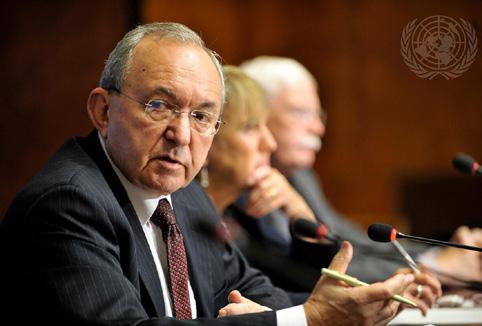
Judge Richard Goldstone, UN Human Rights Council, September 2009. (PHOTO: UN PHOTO/JEAN MARC FERRÉ)
Jewish resilience begins in classrooms.
Study Education and Professional Practice in a way that works for you. This flexible degree gives you a strong foundation in research, policy and practice while building real-world skills. Whether you’re stepping into teaching or exploring wider careers in education, you’ll graduate confident, capable and ready for what’s next. For more infomation or to apply please contact: Suzanne.wayland@lsjs.ac.uk guardian of knowledge. With our BA (Hons) Jewish Education
Pesach –the Blueprint for Geulah
Rabbi Andrew Shaw
What is the difference between this night and all other nights?
These immortal words, uttered for millennia at our Seder table, demonstrate the inquisitive nature of children, who notice the differences between Seder night and all other nights.
Though as Pesach 5786 dawns, we are close to uttering a slightly different phrase: What is the difference between these last few years and all other years? The western world, it seems, has gone mad.
Since October 7th throughout the West, we have seen an outpouring of hatred for the only democracy in the Middle East as well as support for some of the worst terrorist global entities – as I said, the world has gone mad.
With the current war in Iran, many are trying to make similarities to another US war in the Middle East – that with Iraq in 1991. I remember that war very well, I was in Yeshivat Hakotel. I also remember the euphoria on Purim 1991, when the war ended.
I also recall that in 1991, we looked set for a wonderful future, the Berlin Wall had come down, communism had been defeated, there was peace in the offing between Yasser Arafat and Yitzchak Rabin, and radical Islam was not really talked about.
However, today, as we know, communism and socialism are making a comeback, as said above, the nightmare of October 7th has unleashed hatred against Jews and Israel on an unprecedented scale and radical Islam is now a global threat.
However, as Jews, as Torah observant Jews, we must have a much wider view of history and realise that the world is still running to plan, geulah – the final redemption is coming.
I first heard these ideas in 1992, when I was 21 by Rav Matis Weinberg. Every year when I re-read these ideas about the Pesach story, I find they are more and more relevant to the world around us today. These are powerful and challenging ideas about our journey as a nation.
At the end of Bereishit, things were looking good. Yosef was number two in Egypt, all the family was reunited. It was a wonderful end to a difficult story. However, as we know, things took a turn for the worse with the beginning of our slavery in Egypt.
That slavery lasted 210 years, we were redeemed on Pesach, yet during the darkness there was an uninterrupted belief in geulah , that Hashem would redeem us from Egypt, which remarkably was a simple passcode from one generation to the next.
One of the final verses in Sefer Bereishit contain a strange phrase:
Yosef said to his brothers, “I am going to die; Hashem will surely remember you and take you up out of this land to the land that He swore to Avraham, to Yitzchak, and to Ya’akov.” (Bereishit 50:24)
In this verse, for the first time, the phrase ‘ pakod yifkod ’ appears. ‘ Pakod ’ means remember. The idea here is to remember a vision of geulah – redemption, throughout the difficult times. The phrase appears many times throughout the Exodus narrative. It is a ‘secret code’ that is passed on.
When Hashem appears to Moshe at the burning bush, He uses the same phrase:
Go and assemble the elders of Israel, and say to them, “The L-rd G-d of your forefathers has appeared to me, the G-d of Avraham, Yitzchak and Ya’akov saying, ‘I have surely remembered you and what is being done to you in Egypt.’” (Shemot 3:16)
Rashi comments on this:
As soon as you say this expression “I have surely remembered you” to them, they will hearken to your voice, for this password was transmitted to them from Ya’akov and from Yosef, that with this expression they will be redeemed.
It is a secret code that nurtured belief, spanning centuries and sustained the vision of Jewish destiny in Egypt.
Yet we know, after the burning bush and Moshe’s arrival in Egypt to redeem the Jewish nation, that first episode ended in despair! The question is obvious, don’t send hopes soaring and then shatter them!
Bereishit ends with hope for the future, with Yosef giving the code to guarantee our deliverance from Egypt. Yet Shemot begins with things going from bad to worse. We do have darkness but there is no sign of dawn!
The first question we must ask is why did Hashem send Moshe on a futile mission?
The answer is that He didn’t. Hashem’s command was simple and he gave him the code words. However, Moshe insists this is not enough, he needs more.
In the end Moshe claims he is not suitable due to his speech impediment and rejects the whole tactic that Hashem was suggesting. Eventually when he does go to Egypt, he turns what was meant to be an opening statement to Pharaoh into a mass movement.
Eventually after all has failed and Moshe and the people are despondent and in a worse position than before Moshe came to Egypt, does Hashem tell Moshe that now they are going to do it His way!
“Come, speak to Pharaoh, the king of Egypt, and he will let the children of Israel out of his land.”
(Shemot 6:11)
If you compare this instruction by Hashem, it has hardly changed from His initial strategy. It is as if there had to be failure before redemption can happen, that it can’t be smooth sailing.
The understanding is that geulah is a process – pakod is a process. Moshe didn’t fail, that is the nature of pakod. Hashem shows Himself, then goes into hiding. The Midrash compares it to a gazelle; you catch a glimpse – then it is gone. Pakod means to remember, but it is used in a specific way in the Torah.
And the L-rd remembered Sarah as He had said, and the L-rd did to Sarah as He had spoken.
And Sarah conceived and bore a son to Abraham in his old age, at the time of which G-d had spoken to him. (Bereishit 21:1–2)
The Gemara in Rosh Hashanah (11a) explains that Hashem was poked Sarah on Rosh Hashanah. Yet Yitzchak wasn’t born until Pesach. In this case pekida is the conception. Birth is going to happen, but it will take time, there will be pain, there will be difficulties, but birth is coming.
The beginning of geulah, is the conception, the pakod, which is the sudden dawning of a completely different way to think about the future. There is a small seed of freedom and people start to dream. Pakod keeps the memory alive during the dark and dormant years; it is the genetic code for geulah.
The Rambam explains that it is like being lost in a storm. Suddenly there is a flash
of lightning, and you can see clearly where you are heading and what direction you need to take. Then the lightning goes, and it is dark again and the work begins to make your way home, but unlike before, you now have the vision. Yet, still the journey home will be challenging.
The Gemara ( Sotah 11b) states that we were redeemed from Egypt because of the women. They were inspired by the pekida, they never gave up hope.
That first geulah process in Egypt, which we remember every Pesach, is the model for the future. There are three stages. First there is the initial euphoria. That is then followed by despair as redemption seems further away than ever, but then comes recognition of truth!
Today we have once again had the bracha of ‘pekida’ – we have returned to Israel. Yet we understand this is only reishit tzmichat – the beginning of our geulah, we have not fully arrived. However so much of the struggle, the pain, the despair has been experienced by our nation. It was those early Zionists both religious and secular who began to think differently, who began to believe that we could return. Who planted that seed.
However, what makes a Rav Kook different from a Theodor Herzl, is that Rav Kook realised that you cannot exchange the covenant with Hashem for mere love of the land or satisfy our yearning as a nation for meaning and significance with 19th century nationalism. We are far more than that, we are driven by that first geulah and its first stop on the way to Eretz Yisrael –Har Sinai.
As Rav Matis writes back in 1992: “Events now conspire to force us to confront the essence of Jewish identity unclouded by silliness. We either unabashedly confirm the commitments of Yisrael or we must accept an honourable oblivion.”
It is our choice. It is time to recognize the truth. We see, certainly outside of Israel, wherever Jews do not connect themselves to the mesorah – they are tragically disappearing.
As Rav Matis concludes:
“There is only one choice – and eventually it must be confirmed. Still sustained by pakod yifkod, the covenant will not die and history will not leave us alone. There can be nothing counterfeit in geulah and that is why it takes so long. The last myths must run their course, do their damage and expose their sham. The process has begun – gestation proceeds beneath the surface.”
So, as we deal with tremendous darkness:
A substantial rise in antisemitism
A deep-seated hatred of Israel
A western world in crisis
And radical Islam spreading globally, We must stay firmly on our course, on our mission.
So yes, the world is very different from 1991, it seems a dark and dangerous world, but that is all part of the plan. We have to continue to do as we have done for the last three thousand years as Jews and realise that…
The geulah is coming.
Chag Sameach!
Rabbi Andrew Shaw is the Chief Executive of Mizrachi UK.
Rabbanit Rachelle Sprecher Fraenkel UK
Rabbi Zev Leff Lower Merion Synagogue, PA
Mrs. Miriam Peretz Jewish Center of Atlantic Beach, NY
Rabbi Doron Perez Congregation Or Torah, IL and UK
Mrs. Jen Airley Young Israel of East Brunswick, NJ, Young Israel Shomrai Emunah, MD and Congregation Bnai Yeshurun, NJ
Rabbi Assaf Bednarsh Young Israel of Hillcrest, NY and Young Israel of Sharon, MA
Rabbi Dr. Shlomo Brody Young Israel of Oak Park, MI
Rabbi Leo Dee Baron Hirsch Congregation, TN
Rabbi Binny Freedman Ahavat Achim, NJ
Rabbi Dovid Gottlieb Shomrei Torah of Fair Lawn, NJ
Rabbi Dr. Aaron Adler Young Israel of Southfield, MI
Mrs. Miriam Coren Young Israel of Oceanside, NY
Rabbanit Pesha Fischer UK
Rabbi Yishai Fleisher Young Israel of Hollywood-Ft. Lauderdale, FL
Rabbi Shmuel Goldin Congregation Torah Ohr, FL
Rabbi Aaron Goldscheider Congregation Ohr Torah, NJ and Mount Kisco Hebrew Congregation, NY
Rabbi Doron Chitiz UK Rabbi Ari Cutler Congregation Ahavas Achim B'nai Jacob & David, NJ
Dr. Ari Greenspan Young Israel of New Rochelle, NY
Rabbi Jesse Horn UK
Rabbi Shimon Isaacson Keneseth Beth Israel, VA
Rabbanit Noa Lewis UK
Rabbi Yosef Zvi Rimon Young Israel of Great Neck, NY and UK
Rabbi Shalom Rosner Congregation Israel of Springfield, NJ
Rabbi Hershel Schachter Congregation Beth Jacob, GA and UK
Rabbi Moshe Taragin Young Israel of Scarsdale, NY and Young Israel of Lawrence-Cedarhurst, NY
Rabbanit Shani Taragin Young Israel of Teaneck, NJ and UK
Dr. Yael Ziegler Congregation Ahavath Torah, NJ
Mrs. Karen Hochhauser UK
Rabbi Menachem Leibtag UK
Rabbi Anthony Manning UK
Rabbi David Milston UK
Rabbi Reuven Taragin Young Israel of Fair Lawn, NJ and UK
Rabbanit Dr. Yosefa Fogel Wruble Rinat Yisrael, NJ
Mr. Gil Hoffman Beachwood Kehilla, OH
Rabbi Alex Israel UK
Rabbi Benji Levy UK Rabbanit Shira Melamed UK
Rabbi Danny Mirvis UK
Rabbi Aviad Tabory Kemp Mill Synagogue, MD
Rabbi Bentzi Mann UK
Rabbi Eli Reich East Denver Orthodox Synagogue, CO
Rabbi Johnny Solomon Kingsway Jewish Center, NY
Rabbi Binyamin Zimmerman UK
The Mitzvah of Maror
Rabbi Yosef Zvi Rimon
A halachic summary
The mitzvah of maror was a Torah-mandated mitzvah at the time that the Pesach sacrifice was brought. Today it is only a rabbinic mitzvah
The best maror is lettuce, and one must ensure that it is insect-free. One must take a kezayit of maror. It is best to take 27 cc. (0.91 fluid ounces), which is about the size of an average lettuce leaf, but by the technical requirements of the law 19 cc. (0.64 fluid ounces) are enough.
When reciting the blessing on maror, one must keep in mind that the blessing should also include the maror that will be used in korech. Then, dip it in charoset, shake off some of the charoset, and eat it without leaning, eating at a normal pace, but without stopping.
Food for thought
Rambam (8:8) writes that one should dip matzah into charoset: “and he dips matzah into charoset and eats.” Ra’avad (ibid.) disagrees, and Maggid Mishneh (ibid.) cites other opinions that disagree and states that one eats matzah by itself, without charoset
Sefer HaManhig (Hilchot Pesach 79) is surprised by Rambam’s opinion: “I was amazed that he wrote to dip matzah in charoset and I have never seen or heard this custom anywhere. One can even ask how such a combination is logical. If matzah requires leaning because it is a remembrance of freedom, and charoset is a remembrance of the clay of slavery, how can the contradictory values of freedom and slavery be combined? It is possible that Rambam is teaching us that very point – on this night it is important to combine servitude and redemption. Although it is not our custom to dip matzah into charoset, we do express this connection in other ways. When we eat maror directly after matzah, as well as by
eating korech, we demonstrate that slavery and redemption are intertwined.”
When we eat maror we think about the bitterness of slavery in order to instill in ourselves a greater appreciation of the miracle of the Exodus from Egypt. Simply put, in the wake of our thoughts about the difficulty and suffering during slavery, we can better appreciate the greatness of our salvation. Beyond this, eating maror teaches us that everything was planned by G-d – both the slavery and the redemption. Slavery also has a role to play in the process of redemption, and without it we would not have been redeemed. Sadly, on occasion, history has proven that bitterness and antisemitism have even prevented assimilation.
On the Seder night we do not ignore the bitterness and distress, nor do we repress the difficulties of the past. On the contrary, we eat maror and recite a blessing on it. By doing so, we acknowledge that the bitterness that we endured was also part of “He has sanctified us with His mitzvot.”
The mitzvah of eating maror
teaches us to look directly at the difficulties of life, without fear and without evasion. We acknowledge that with every difficulty one grows, and every struggle reveals the powers within ourselves to continue focusing with joy and abundant good.
Rabbi Yosef Zvi Rimon is the Nasi of World Mizrachi. He is the Founder and Chairman of Sulamot and La'Ofek, and serves as the Chief Rabbi of Gush Etzion, and Rosh Yeshivah of the Jerusalem College of Technology.
Picture celebrated chagim with holiness at your feet, right where miracles happened back then and now.
Picture Eden: A vibrant new development nestled right where history happens, creating a cycle of meaning and memories each chag — and every day.
How Antisemitism Comes and Goes
Rabbi Moshe Hauer
In his role as the Executive Vice President of the Orthodox Union, Rabbi Moshe Hauer was one of Diaspora Jewry’s most important voices in the fight against antisemitism. Grounded as always in his Torah scholarship, Rabbi Hauer presented a Torah perspective on this critical issue. Following his tragic and untimely passing on Shemini Atzeret of this year, we republish an article by Rabbi Hauer on this topic, originally published in the Pesach edition of HaMizrachi two years ago.
Antisemitism has never been just about physical attacks on Jews. It is the great conspiracy theory, a narrative portraying the Jewish people as all-powerful and utterly disloyal, a lethal combination that generates hatred and resentment. It is within that climate of demonization that physical attacks are perpetrated against us. It is true now and it was true then.
The original story of antisemitism is described in the story of yetziat Mitzrayim Am Yisrael were originally welcomed to Egypt as heroes, the family of the viceroy who had saved the country from ruin. But all the good and the benefits they brought to Egypt and its rulers was quickly forgotten; “a new king arose over Egypt who did not know Yosef,” and began to portray Am Yisrael as all-powerful and utterly disloyal: “Behold, the people of the children of Israel are more numerous and stronger than we are. Let us deal shrewdly with them lest they increase and when a war befalls us, they will join our enemies and wage war against us and depart from the land” (Shemot 1:8–10).
The demonization of our people was a critical stage in the process of our Egyptian experience. Before a taskmaster cracked his whip or threw a Jewish baby in the Nile, a narrative was constructed to recast us as the Egyptians’ oppressors.
This is why the Pesach Haggadah cites the above verse to illustrate that which is written in the book of Devarim (26:6), “ vayarei’u otanu haMitzrim vaya’anunu vayitnu aleinu avoda kasha, the Egyptians made us bad and afflicted us, and they burdened us with hard work.” The first phrase does not say that they did bad to us, “ vayarei’u lanu,” but that they made us out to be bad. The verse does not describe the Egyptians doing bad to us but rather their creating a
caricature of how we were not friend but foe, scheming against them and awaiting the opportunity to actively turn on them (see commentaries of Orchos Chaim, Rashbatz, Rav Kook, and Rav Soloveitchik on the Haggadah).
We can readily imagine how disorienting this must have been for our ancestors. One of their own had saved Egypt and transformed its economy in Pharaoh’s favor, making him the owner and master of the people, the land, and the treasure of Egypt, and now they were suddenly recast as the enemy. Their contributions to Egyptian society were forgotten or ignored and they were quickly transformed from savior to oppressor.
Their first reaction must have been to blame it on Pharaoh, the person then sitting in the seat of leadership. “Once we are rid of him, things will certainly be better.” As Ramban wrote (2:23), “the custom of all subjects of a wicked tyrant is to hope for and look forward to the day of his death.” Heads will roll, we will sack the coach or the university president and all will be good again. But when they saw that the king died and nothing improved, they realized that conspiracy theories stubbornly survive and do not disappear from society with a change of leadership.
As we consider the familiarity of this story and its reflection in current events, we must ask if there is anything that can come next that could potentially bode well for us? Is the only path forward one of doom, Heaven forbid? Is the painful history of Jewish exile necessarily repeating itself?
The Torah provides three better pathways forward. In Moshe’s Egypt, relief for the Jews came with the tragic collapse of Egypt. In Yosef’s case, he benefited from Pharaoh’s fear that Egypt might collapse.
And in the story of Purim, Achashveirosh simply awoke one night to reopen the history books and read the true story of the Jewish contribution to society, thus resetting the narrative about the Jews. Our Sages taught us to appeal to G-d for the well-being of our country and its government. Those of us living in the United States sincerely pray that the American kingdom of kindness will survive its current challenges and recognize and be responsive to the genuine threats to its future, awakening itself to reread the true story of America and of the Jewish people and fundamentally resetting the narrative to “place in the hearts of all Americans to deal kindly with us and all Israel. In their days and in ours may the Jews be saved and Israel dwell in safety, and may the Redeemer come to Zion. Kein yehi ratzon.”
“Now it came to pass in those many days that the king of Egypt died, and the children of Israel sighed from the labor, and they cried out, and their cry ascended to G-d from the labor. G-d heard their cry, and G-d remembered His covenant with Abraham, with Isaac, and with Jacob” (Shemot 2:23).
Rabbi Moshe Hauer ל”צזְ was the Executive Vice President of the Orthodox Union.
Dispatches from New York: A Conversation with Ofir Akunis
Ofir Akunis served in the Israeli Knesset from 2009, holding roles including Minister of Science and Technology – during which he signed 30 international cooperation agreements – and Minister for Regional Cooperation, under whose watch Israel signed the Abraham Accords with the UAE, Bahrain, Sudan, Morocco, and Kosovo. Since 2024, he has served as Israel’s Consul General in New York.
Rabbi Aron White spoke with him about the Abraham Accords, the shifting political landscape in New York, and his vision for the Jewish future.
Can you tell us about your personal and political background?
Everyone absorbs values from their home. My father’s family came from Greece and settled in south Tel Aviv in the 1930s; my mother’s family immigrated from Poland in the 1950s and settled in Nahariya, at the northern end of the country. They brought with them a real diversity of cultures – and, frankly, a diversity of political views as well.
To a large extent, my political outlook was shaped by my father’s side of the family, which was deeply influenced by Jabotinsky’s teachings and the ideas of Revisionist Zionism. My grandfather served as the chief cantor of a synagogue in the southern Shapira neighborhood of Tel Aviv, and in that atmosphere I also absorbed Jewish tradition.
You served as Minister for Regional Cooperation during the period of the Abraham Accords. What did you witness from the inside – what made that moment so significant?
Let me say this clearly: the Jewish people seek peace. At our core, we want to live in peace with our neighbors. But sadly, many of our neighbors – especially the Palestinians, and others throughout the region – have not always shared that desire.
In the Middle East, peace is achieved through strength. You must demonstrate that you are strong, that you will not bow your head, that you possess economic power, military capability, and the unity of a determined people. Strength is like an iron wall – it does not bend. Only then does peace become possible.
This is the principle Jabotinsky taught: first build the iron wall of strength, and then peace becomes achievable. When your neighbors understand that you cannot be defeated, they seek accommodation. We have seen this over fifty years with Egypt and Jordan, and more recently with the Abraham Accords –the normalization agreements with the United Arab Emirates, Bahrain, and Morocco. These agreements came about because they served the interests of all parties: trade, cooperation, and regional stability benefit everyone.
Our door remains open. We are ready for peace. But there is one fundamental condition: recognition of Israel as the state of the Jewish people. In this region, weakness invites attack; strength earns respect. You cannot expect an adversary to become a partner because you show softness. If Lebanon were to remove Hezbollah from its south, there would be no reason it could not join this expanding circle of peace. As for Saudi Arabia – there is no territorial dispute between us, and the potential for normalization is very real. Strength first, then peace.
You arrived in New York in 2024, and in 2025 Zohran Mamdani – an explicitly anti-Israel candidate – won the mayoral race. How do you make sense of his rise to power?
Let’s begin with the larger picture. Since the early 1990s, Western democracies have undergone a transformation. We see it most clearly in Western Europe – Britain, Belgium, the Netherlands, France – where there has been a steady rise in elected officials who, unfortunately, express support, direct or indirect, for Iran, Hamas, and Hezbollah. Alongside this political shift, we see growing demonstrations that legitimize or defend terrorist
organizations. This must be said openly. It is a political process, and it has consequences.
This process is no longer limited to Europe. It has come to the United States as well. The most visible example is New York City. The number of Jewish residents and Muslim residents is now nearly equal – roughly one million each. Demographic change brings political change, and we have seen that reflected in the rise of leaders like Mamdani, accompanied by aggressive and dishonest propaganda – including covering for rhetoric such as “global intifada,” even after attempts to walk back or deny those words.
A person cannot say, “I am not antisemitic, I am only against the Jewish state.” If you oppose the homeland of the Jewish people, what exactly are you saying? For the first time in New York City’s history – the largest Jewish community outside Israel – a mayor does not recognize Israel as the state of the Jewish people. Criticism is legitimate; disagreement is part of democracy. But denying Israel’s right to exist is something entirely different.
When definitions of antisemitism are weakened and legal protections are removed, Jewish communities feel it immediately. We have seen rising attacks in the subway, assaults on rabbis in Queens, vandalism and violence. People feel less safe – because words create a spirit, and a hostile spirit puts everyone at risk.
In your role as Consul General, you meet regularly with Jewish community leaders across the spectrum. What are you hearing from them?
I spend a lot of my time meeting with leaders from every stream of Jewish life – Orthodox, ultra-Orthodox, Religious Zionist, Conservative, Reform, progressive. I meet with rabbis, community leaders, elected officials, and the next generation of young Jews. My message to all of them is the same: stand up and set the record straight. Confront the lies.
The so-called “Gaza starvation” campaign is a modern blood libel – no different in spirit from the accusations leveled against Jews in Europe a century ago. Israel delivered humanitarian aid even while fighting a bitter war against Hamas – a terrorist organization that must be dismantled. What they did on October 7th was inhuman. They burned children alive, murdered entire families. And yet – where are the international human rights organizations? Where is the outrage? The silence is deafening.
If the anti-Israel movement is driven by hatred rather than honest disagreement, is there any point in engaging with facts and arguments?
That’s an important question. The hardcore agitators? You probably won’t move them. But how many are they, really – a few dozen? And if they weren’t funded by Qatar and others, would their numbers be even smaller? When the money dries up, do the protests continue at the same scale? Ultimately, we are talking about a loud minority.
I’m not trying to convince them. I’m speaking to the average American. There are 350 million Americans. You won’t persuade every single one, but you can speak to the majority – and the majority is reachable. Most New Yorkers, even most Manhattanites, were not at those protests. The people burning Israeli and American flags outside this consulate, chanting Iranian slogans, do not represent America.
What does it mean to shout “Death to America” on American soil? What does it say when people rally in support of regimes that strip women of rights, impose dress codes, and crush dissent? This is, at its root, a failure of education. Perhaps my generation failed to teach the next one clearly enough about freedom,
democracy, and the values that underpin Western civilization. If young Americans can march in support of terrorist organizations and chant against their own country, something went badly wrong in how we raised them.
What specifically do you think your generation got wrong in educating the next?
One clear example is Qatari influence on Western education. We did not recognize it in time – and I say this with real pain, even about the United States, a country I have admired since I was a child. America did not adequately recognize the quiet, strategic flow of Qatari money into university faculties, academic departments, and even public schools. This has been happening for years.
Now you see 18- and 19-year-olds marching at Columbia and elsewhere. They are students at prestigious institutions. But what did they actually learn? If the curriculum is shaped by foreign funding with a clear ideological agenda, the outcome should not surprise us. Qatar has waged a sophisticated, multi-front campaign to promote anti-Israel and antisemitic narratives – through funding, media, social networks, and coordinated online activity.
And Qatar plays a double game. On one hand, it presents itself as a mediator, as constructive and civilized. On the other hand, it has funded Hamas for years. With that money, tunnels were built in Gaza; the infrastructure of terror was constructed. One hand speaks diplomacy while the other feeds extremism. Israel simply does not have the resources to match this kind of sustained influence operation. What can Israel do? Invite journalists and influencers for a week, show them the reality on the ground, and send them home. Meanwhile, others fund permanent propaganda.
This is a genuine struggle, and in such a struggle we need unity. The Jewish people have always had internal arguments – this goes back to Sinai. But in moments of existential threat, we must stand as one. Our enemies do not distinguish between left and
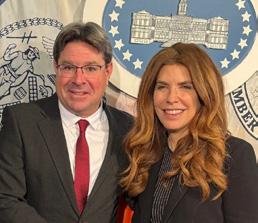
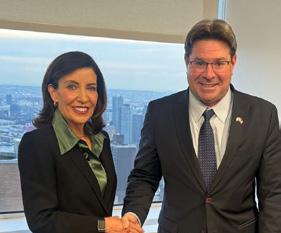
Ofir Akunis with New York Governor Kathy Hochul, and with Julie Menin, a New York City Council Member.
right, religious and secular, Tel Aviv and Judea and Samaria. On October 7th, they did not ask anyone how they voted. They murdered Jews because they were Jews.
“Never again” must mean something. The State of Israel is the greatest miracle in modern history: a dispersed people from North Africa, Poland, England, India, Ethiopia – reviving a dormant language and rebuilding a homeland after two thousand years. Show me another people in history who did that.
And I say to the West, especially Europe: Israel is the front line. Look at Europe in the 1980s and compare it to today. The transformation is dramatic. Israel stands as a barrier against forces that threaten not only us, but Western civilization itself.
When all is said and done, are you pessimistic or optimistic about the Jewish future?
First and foremost, I am a Jew – and a Jew cannot afford to be a pessimist. With everything our people have endured across millennia, if we gave in to pessimism we would never have survived. I have children, grandchildren; we are one link in a long chain of generations. Our responsibility is to ensure the journey continues. The eternal people are not afraid of a long road.
Look at our history. Pharaoh ordered every Jewish male child thrown into the Nile. Haman sought to destroy us entirely. The Greeks, the Romans, every empire that rose – all tried, and all failed. In modern times, Nazi Germany industrialized murder. Who spoke for the Jews then? Almost no one. The world knew by 1942 what was happening, and silence prevailed. One leader stood firm – Winston Churchill. Had he not stood against the Nazis, who knows how history would have unfolded?
I believe Donald Trump’s election was a great blessing for the Jewish people – not for narrow political reasons, but because he has shown genuine support for Israel. In his first term, he moved the U.S. Embassy to Jerusalem, recognized Israeli sovereignty over the Golan Heights, and affirmed that Jewish communities in Judea and Samaria are not inherently illegal under international law. These were historic steps.
Today, after two years of war, Israel stands strong. The economy remains resilient. New immigrants continue arriving from North America and beyond. Communities along the Gaza border, in the Galilee, in Sderot are rebuilding. Consider the Golan Heights – imagine if we had given it up decades ago. When Syria descended into civil war, the fighting came dangerously close. What if hostile forces had stood on the shores of the Sea of Galilee?
I am optimistic about the future of the State of Israel. It is the safest place in the world for Jews. It is home. And I believe Israel’s strength is also the path to regional peace. These past two years have shown our enemies – Nasrallah, Sinwar, the ayatollahs, the Houthis – that Israel is not to be tested lightly. We do not seek conflict. But we will defend ourselves. That strength ensures not only our survival, but the continuation of our ancient journey.
Thank you for speaking with us. ◼
J E R U S A L E M
M e k o r C h a i m
G a r d e n u n i t s &
p e n t h o u s e s
P a r k i n g & S t o r a g e
R e a d y : 2 0 2 8
S t a r t i n g p r i c e :
₪ 3 , 5 0 0 , 0 0 0
N E T A N Y A
O n l y 2 0 % d o w n !
N o b u i l d i n g i n d e x
G r e a t d e a l
3 b e d r o o m s
R e a d y : 2 0 2 9
S t a r t i n g p r i c e :
₪ 3 , 4 0 0 , 0 0 0
C A R M E I G A T
S m a l l b o u t i q u e
b u i l d i n g
O n l y 6 u n i t s
B u y w i t h f r i e n d s
R e a d y : 1 8 m o n t h s
Starting price:
₪ 3 , 4 5 0 , 0 0 0
R A ’ A N A N A
1 1 9 – 1 3 3 S Q M
4 b e d r o o m s
P a r k i n g & S t o r a g e
G a r d e n o r b a l c o n y
R e a d y : 2 0 2 9
S t a r t i n g p r i c e :
₪ 4 , 3 8 0 , 0 0 0
B E I T S H E M E S H
N e v e S h a m i r
3 , 4 & 5 b e d r o o m s
L a r g e A n g l o
c o m m u n i t y
R e a d y : 2 0 2 8
S t a r t i n g p r i c e :
₪ 2 , 4 5 0 , 0 0 0
A S H K E L O N
l a s t u n i t s !
3 b e d r o o m s
S e a v i e w s
P a r k i n g & s t o r a g e
R e a d y t o m o v e i n !
Starting price:
₪ 2 , 9 0 0 , 0 0 0
2ND HAND PROPERTIES ALSO AVAILABLE IN PRIME LOCATIONS: Tel Aviv | Jerusalem | Carmei Gat | RBS
Master Tanakh
with a Master’s Degree in Teaching Tanakh & Parshanut
Learn online with international Tanakh experts from Herzog College in Israel
Study in your own time plus join a two-week semester in Israel in July 2027 for Tanakh & Archaeology courses
Courses include Sefer Shemot, David HaMelech, Yechezkel, Shivat Tzion, Hassidut, Parshanut, Ethics & Morals, Intrinsic Motivation, and Student-Centered Learning
Earn an M.A. in 2 years at a special low price
Expert teaching faculty includes:
Alon Shvut Jerusalem Migdal Oz Founded by Lifshitz College and Herzog College
Rabbi Prof. Daniel Reiser Dr. Yael Ziegler
Dr. Yosefa Fogel Wruble
Rabbi Dr. David Fohrman
Torat Emet and Torat Tzion in a Time of Moral Confusion
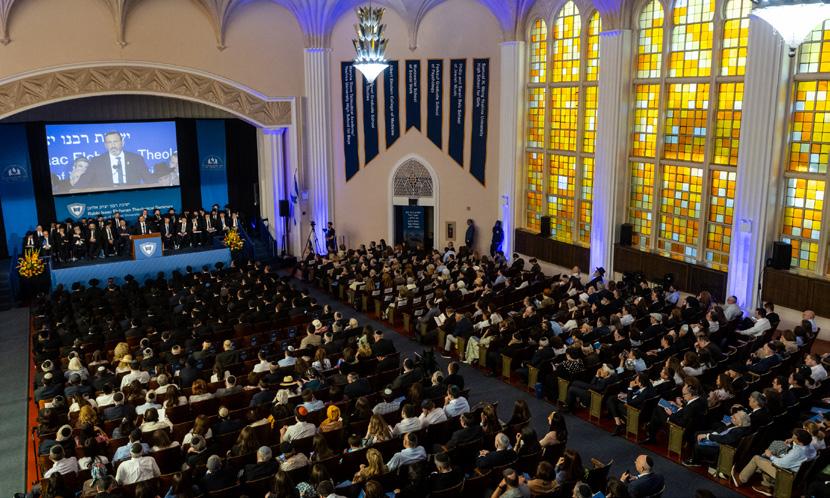
In June 2024, Rabbi Doron Perez was awarded the Torat Tzion Award from Yeshiva University by Rabbi Dr. Ari Berman, at the RIETS Chag HaSemikha. At this occasion, Rabbi Perez spoke to the new Musmakhim about their role, and offered a spiritual, Torah perspective, on the challenges of antisemitism and anti-Zionism in our time. This is an adapted version of that speech.
Two fundamental principles are under threat today like never before, particularly since Simchat Torah: Torat Emet and Torat Tzion
As Rabbi Dr. Ari Berman has written and recently noted in an interview with the Jerusalem Post, we live in a time when institutions that should stand for moral clarity instead project moral confusion. Universities and thought leaders should stand for veritas, for truth, yet too often they stand for the opposite –spineless equivocation, an inability to articulate what should be obvious. How can any reasonable person accuse the State of Israel, our sons and daughters, of genocide? How can people speak of wanton killing of civilians in a way that so completely distorts reality? It is a world of olam hafuch, a world turned upside down, and it boggles the mind.
In an age of moral relativism, with all its weaknesses now laid bare, the need for those who will stand up for truth – for Torat Emet – has never been more critical. Instead of educating community leaders, too many are equivocating. They simply do not know what to say. Where there should be clarity, there is confusion.
But since October 7th, the deeper challenge we face – both in Israel and around the world – is Torat Tzion
Today, Zionism has become the sharpest edge of antisemitism. No longer is hatred directed primarily at Jews as a people, as in the racial theories of Hitler. Nor is it focused on Judaism as a religion, as it was from the time of Chanukah through the Inquisition. Today, it is directed at the Jewish state. A Jew may be tolerated – but a Zionist Jew, one who believes in Jewish sovereignty, is suddenly suspect, guilty of every imagined sin.
This is why distancing oneself from Zionism – saying, “I am religious (or Jewish), but not Zionist” – is so dangerous. Thankfully, groups like Neturei Karta represent only a tiny fringe, yet they manage to walk hand-in-hand with our enemies, claiming Judaism and the State of Israel have nothing to do with one another. That notion defies comprehension. Even more troubling is the phenomenon on the extreme left, where universal values are invoked to justify abandoning Zionism altogether, marching alongside Israel’s enemies, and severing any meaningful connection to Jewish sovereignty.
The message has become disturbingly simple: disconnect Judaism from Zionism, and you will be redeemed in the eyes of the world. That is precisely why Torat Tzion is our greatest challenge today. Torat Emet and Torat Chaim must remain inseparable from the centrality of the Land and State of Israel. This connection has never been more essential to Jewish identity.
An unapologetic commitment
At Yeshiva University, under Rabbi Dr. Berman’s extraordinary leadership, Torat Tzion is unapologetic. The Israeli flag flies there 365 days a year, alongside the American flag. It is a place where Jews are encouraged to grow, to contribute, and to be deeply Zionist in every sense of their being.
The institution has created not only a place of learning, but a place of safety – one where Jewish students can walk proudly on campus. As Rabbi Berman has said so clearly, campuses should be safe for Jews, not free of Jews. His leadership in organizing a coalition of 100 university presidents – taking some to
(
PHOTO: YU)
Poland, and standing in unequivocal condemnation of Hamas – is historic.
This may well be Yeshiva University’s most critical hour. As Jewish communities and campuses around the world are threatened, the need for an institution with moral clarity and courage has never been greater. That it is led by a president who is a shaliach from Israel, who made Aliyah and then returned at great personal cost, is extraordinary. Having children in the army is no small thing. It is a profound sacrifice, and it underscores the living bond between Torah, Zionism, and responsibility.
A charge to the next generation
The next generation of rabbis and educators emerging from Yeshiva University represents an extraordinary opportunity. To learn in the presence of giants – to stand on the shoulders of those who built and guided this institution through difficult times – is a blessing. These future leaders must go into rabbanut, into education, and wherever they serve, remain Jewish leaders. We need klei kodesh today more than at any point in recent memory.
We need families, generations of leadership, carrying the spirit of Yeshiva University – Torat Emet, Torat Adam, Torat Chaim, Torat Chesed, and Torat Tzion – wherever they are needed. Zionism does not only mean living in Israel. If every Zionist moved to Israel tomorrow, who would teach Torat Tzion in the Diaspora? Being a Zionist also means serving as a spiritual ambassador, strengthening that bond precisely when our enemies are trying to sever it.
Oz: a personal reflection
One word captures what this moment demands: oz – strength. Our family’s destiny is tied to a place called Nachal Oz. Both of our sons fought there. Daniel, with his tank crew, fought bravely for two hours and sixteen minutes against wave after wave of attackers. At 9:01 a.m., he was wounded, killed, and
taken hostage. We learned the truth only 163 days later. His body remains in Gaza, along with over a hundred others. (Subsequently, Daniel’s body returned for burial on Simchat Torah 5786, exactly two years to the day since his death and capture.)
Our other son, Yonatan, also fought at Nachal Oz. He was amongst the first commanders to retake the base, saving twenty female soldiers and two male soldiers – amongst the last ones alive there. He was shot and survived. Our lives are forever bound to that place.
In Daniel’s diary – something we did not even know he kept – he wrote what he thought about before going to sleep. One entry asked: What is my role as a soldier and officer? He writes that after visiting Poland in eleventh grade, he understood the price the Jewish people paid when we could not defend ourselves. Now that we can, he wrote, it is our responsibility to do so. He ended with five words that stunned us: “Im lo ani, az mi? If not me, then who?”
Just recently, a senior IDF officer revealed that during the final battle, Daniel was the only officer holding that sector. A division commander was speaking directly to a young platoon commander – something that never happens – because there was no one else. For those hours, he was the final line of defense.
The Mishnah teaches: Hevei az k’namer – be strong like a leopard. The Tur explains (beginning his monumental work with this very teaching as the foundation of Jewish life) that strength is required precisely when standing for truth is uncomfortable, when people mock you, when they accuse you of being on the wrong side of history. Oz does not mean brazenness; it means backbone. It means standing up for what you know is right. Today, we have the zechut to stand for Israel, for Torat Tzion, and for the inseparable bond between Torah, people, and land. If we are a brit am – a covenantal people – then we can truly be an or la’goyim. Every one of us has a role to play.
If not now, when?
If not you – then who? ◼
Awaiting Judgment –And Refusing to Wait in Silence
Menachem Vorchheimer
Western democracies have legal systems that are meant to protect minorities from violence and hate. As antisemitism rises around the world, advocates worldwide are looking to use the power of law to hold to account those who threaten Jewish communities. Menachem Vorchheimer describes his battle for justice in Australia, and offers a perspective that is relevant to communities across the globe.
As I write, I am awaiting a legal judgment in a case I initiated regarding a chant that reverberated through Melbourne’s Central Business District, the city’s main commercial and business area: “All Zionists are terrorists.”
The defendant in this case is Hash Tayeh, a key figure in Australia’s anti-Israel movement, who led the chant and encouraged others to repeat it.
I never imagined I’d one day find myself in court debating the meaning of words. But I was raised to understand that words matter – sometimes more than we’d like to admit.
The chant, the law, and the question before the court
The key question before the court is whether chanting “All Zionists are terrorists” incites hatred, contempt, or revulsion against Jews based on their race or religious beliefs.
Under the Racial and Religious Tolerance Act 2001 (Vic), it is unlawful to engage in conduct that incites hatred or similar extreme emotions toward someone based on their race or religious beliefs. The law encompasses both civil and criminal provisions.
I brought this case under civil law – not because the conduct is minor, but because Victoria Police chose not to pursue criminal charges under this law.
I want to highlight something simple yet powerful: this law exists. It has been upheld in the past. It has protected other communities. And if the government
refuses to enforce it, citizens are entitled to demand an explanation.
The legal analysis here is straightforward. The chant has three components:
• “All” – every member, without exception.
• “Zionists” – in modern protest settings, often used as a stand-in for “Jews.”
• “Terrorists” – arguably the most morally condemned group in contemporary society.
When you label every member of a group as a terrorist, what emotion does that evoke? Respect? Or hatred and contempt?
Two pivotal cases in Victoria provide context. In Cottrell v Ross, a neo-Nazi was convicted for inciting hatred against Muslims. In Catch the Fire Ministries Inc v Islamic Council of Victoria Inc, the court ruled that sermons and publications vilified Muslims based on their religious beliefs.
In both cases, the defendants invoked “freedom of speech.” Yet, in both, the courts held that freedom of speech in Australia is not absolute. It doesn’t protect the right to incite hatred or vilify others based on their race or religion.
If the law protects Muslims from being collectively branded as dangerous or subhuman, it must also protect Jews. This isn’t a partisan issue; it’s a matter of equality before the law.
Burgertory, false claims, and the Caulfield riots
Hash Tayeh first gained significant attention after his business, Burgertory, was
the target of an arson attack in November 2023. Police declared that the attack wasn’t racially or politically motivated, and two non-Jewish men were charged. Reports later indicated that the business had been struggling financially since the Covid pandemic.
Despite the police’s findings, claims spread that “Zionists” were behind the attack. This sparked riots in Caulfield, including an evacuation of a synagogue during Shabbat prayers, with rocks and bottles thrown and slogans shouted.
Under Section 21 of the Summary Offences Act 1966 , disturbing religious worship is a criminal offense – but no one was charged for the evacuation of the Central Synagogue or the disruption of Shabbat prayers.
In May 2024, at the “Never Again Is Now” rally – a Jewish gathering against antisemitism – over 500 police officers were deployed to prevent counter-protesters from breaching police lines. Five people were arrested for assaulting or obstructing police. However, no one was charged for antisemitic attacks, despite the Jewish Community Council of Victoria recording the highest number of antisemitic incidents in its history that day, including eight physical assaults – more than double the number for all of 2022.
Through a Freedom of Information request, I obtained documents showing the government’s awareness of the situation. Correspondence with the Attorney-General and Premier’s office reflected alarm within the Jewish community. Yet, public messaging emphasized non-interference with protests.
The issue isn’t protest; protest is legitimate. The issue is incitement.
These failures by the government and police are also the subject of my civil actions.
The refusal to state the obvious
The most disturbing aspect of my legal proceedings hasn’t been the chants in the streets. It has been the refusal – by the government, police, and public figures – to state plainly what should be self-evident.
In one case, legal representatives resisted affirming that targeting Jewish institutions in Australia over a foreign conflict is wrong and has no place here. In another, a political party refused to unequivocally state that targeting Jews or Jewish institutions is unacceptable.
These are not complicated legal questions. They are basic civic principles: Hatred is never justified, incitement is unlawful, and freedom of speech does not protect racial or religious vilification. Why, then, is it so difficult for some to say so?
If leaders cannot affirm these basic principles, public trust erodes. A democracy weakens not because laws are absent, but when laws exist, yet those entrusted to enforce them lack the will – or the clarity – to do so.
My father’s story, and how words lead to murder
My father was born in Würzburg, Germany, in 1922. In 1938–39, he was one of 10,000 children rescued on the Kindertransport and sent alone to England. Later, despite being a Jewish refugee from Nazism, he was classified an “enemy alien” and interned. Many of his relatives perished.
I grew up understanding that German Jews were not strangers to their country. They were doctors, lawyers, artists, and soldiers who had fought for Germany in the First World War. Within two decades, they lost their rights, their professions, and their humanity.
The Holocaust didn’t start with gas chambers. It began with words. Caricatures, conspiracies, claims that Jews controlled governments, accusations of blood libels, and today, false allegations of genocide.
When I saw Jewish professionals and artists canceled in Australia in 2023 and 2024, I thought of the 1930s. When I saw
Jewish businesses and synagogues firebombed, I thought of Kristallnacht. History may not repeat exactly, but it rhymes loudly for those who are listening.
Absence of law – or absence of will?
I don’t believe Australia lacks laws. I believe it lacks will.
After the events of October 7, Australian Security and Intelligence Organisation Director-General Mike Burgess publicly warned of a direct link between inflammatory language and violent acts. In February 2025, he stated that antisemitism had become the top priority of his agency. Yet enforcement has not kept pace with rhetoric.
The story of Al Capone offers a lesson. Authorities couldn’t initially convict him for violence, but they eventually jailed him for tax evasion. Why? Because they knew he had to be stopped. Where there’s a will, there’s a way.
Zero tolerance isn’t about suppressing dissent, it’s about drawing a firm line: collective demonization of any group corrodes society.
On 14 December 2025, the Bondi Chanukah massacre shattered any illusion that rhetoric has no consequences. Fifteen people were murdered, dozens injured. The perpetrators were Australian, and according to police reports, they condemned “Zionists” as part of their motive for the massacre.
When people are repeatedly told that “Zionists” are evil or deserving of violence – and when “Zionist” is widely understood as “Jew” – the moral barrier erodes.
Politics and the climate of normalization
This issue isn’t unique to Australia. Across Western democracies, progressive politics has created room for anti-Israel sentiment to spill over into hostility toward Jews. Tropes about Jewish power, money, and control have re-emerged, albeit in new forms.
We hear about a “Zionist lobby” controlling media, courts, or governments. We hear claims that Jews kill babies. The language may change, but the pattern remains unchanged.
Many of the staunchest defenders of “free speech” would rightly condemn someone who chanted, “All Muslims are terrorists.”
They would rush to court, and they would be right to do so.
The principle cannot be selective, but in the past two-and-a-half years, it’s become increasingly so.
Why I continue
My legal actions are not about vengeance or silencing legitimate criticism of Israel. They are about affirming that Jews, like Muslims, Christians, Hindus, Buddhists, and atheists, are entitled to protection from collective vilification.
They are about reminding the government that laws passed by Parliament and upheld by the courts must be enforced consistently. They are about empowering ordinary people to understand that we are not helpless.
Yes, litigation is exhausting. It’s slow, uncertain, and expensive. But I think of my father, of the teenage boy sent alone to England and labeled an enemy. I think of the long, painful path from casual dehumanization to catastrophe.
If my actions achieve nothing more than clarifying that chanting “All Zionists are terrorists” has no place in a liberal democracy, and that words matter, then the effort will have been worthwhile.
The Jewish story is one of resilience. But resilience shouldn’t require silence.
We live in a country with good laws –laws that have protected others. Equality demands those laws protect us too. If we insist – calmly, lawfully, persistently –those laws will be enforced.
Because Jewish history teaches us this: silence never saved us. Courage and faith did.
Menachem Vorchheimer is a member of Mizrachi Melbourne, a husband and father, with a background in business, law and community advocacy. He has been involved in efforts to reform discrimination legislation and strengthen sentencing for prejudice-motivated crimes. His work has intersected with a number of significant matters, including the Ocean Grove Football Club case and early landmark convictions in the 2000s addressing hate-based conduct.
Torat Chesed
An Interview with Rabbanit Chana Henkin
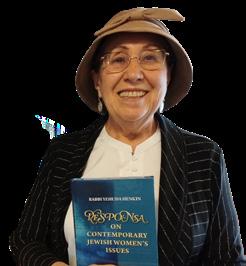
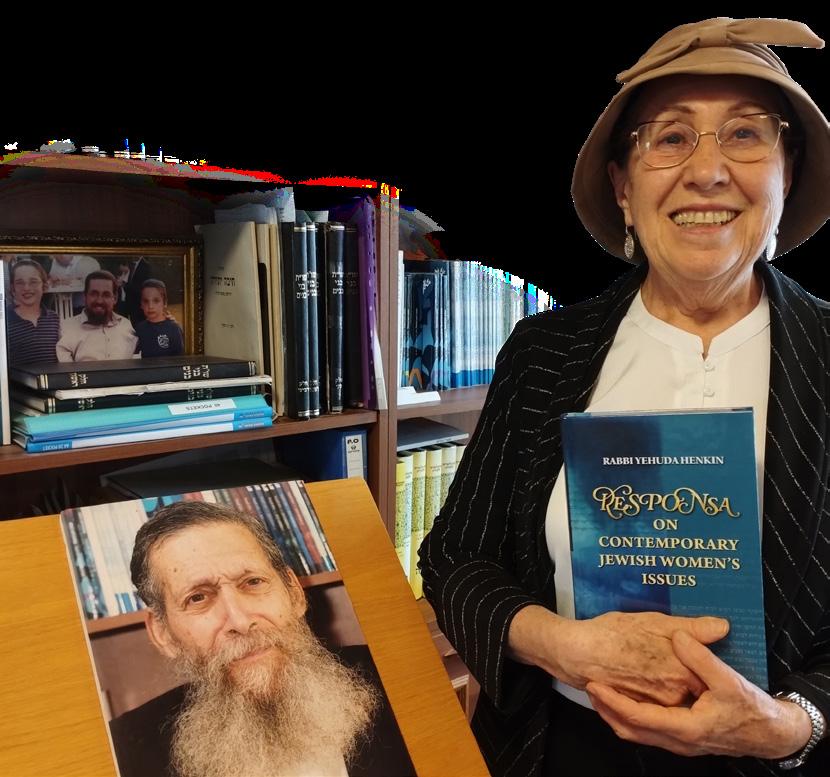
Rabbanit Chana Henkin is the founder and chancellor of Nishmat and one of today’s most celebrated Jewish educators. Together with her husband, the noted halachic authority Rabbi Yehuda Henkin zt”l, she created the role of yoatzot halacha, experts in women’s health and Jewish law, which has transformed how the Orthodox world approaches taharat hamishpacha. A recipient of honorary doctorates from both Bar Ilan University and Yeshiva University, and Israel’s prestigious Agrest Prize for innovative religious education, Rabbanit Henkin lives in Jerusalem, where she devotes her life to advancing Torah and serving Klal Yisrael.
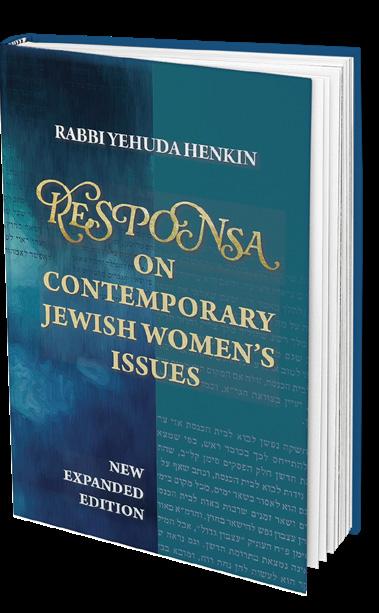
Rabbi Aron White spoke with Rabbanit Henkin to learn about the publication of a new volume of Rav Henkin’s responsa on women’s issues, the halachic challenges facing women since October 7th, and her vision for the contribution of Anglo olim to Israel’s religious life.
Your late husband, Rabbi Yehuda Henkin zt”l, was a leading posek on contemporary women’s issues. Can you tell us about the new volume of his responsa that is now being published?
This is the book that I wish I had for my granddaughters’ bat mitzvahs – the book I would have wanted to learn with them! Even though they are Hebrew-speaking Israeli girls, and I would have had to translate the material back into Hebrew, this book presents Rav Henkin’s teshuvot on contemporary women’s issues in an accessible, user-friendly fashion. These are very important teshuvot from many decades of my late husband’s writings. Some twenty years ago he published responsa in English, and now we have translated additional material for the English-speaking public, combined with some content that is being republished.
issues, and women’s issues. But he quickly became a major address for questions relating to women in contemporary times. Now we are bringing more of this important material to the English-speaking world, for the benefit of women who want to understand more about mitzvah observance.
Could you give us an example of Rav Henkin’s halachic approach?
Halacha reaches us through two channels: Codes of Jewish Law and responsa. Halachic codes – such as the Rambam, Tur, Shulchan Aruch, and modern works like Mishnah Berurah, Aruch HaShulchan, and Shemirat Shabbat Kehilchata, are prescriptive: they teach us the halacha. Responsa literature is reactive: it responds to changes in the world, in the socio-cultural, national, economic, and educational climate. From the teshuvot of the Babylonian Geonim and Rishonim to those of contemporary poskim such as Rav Moshe Feinstein and the Tzitz Eliezer, this is where halacha interfaces with contemporary times. Rav Henkin is so important because he was a Religious Zionist posek, in step with the State of Israel and with the times, and he was a powerful voice on women’s issues.
We made Aliyah to Beit Shean in 1973, and my husband served as the regional rabbi. At the time there weren’t many rabbis in the north of Israel; Rav Shlomo Aviner at Kibbutz Lavi, many miles away, was one of our closest Ashkenazi rabbinic neighbors! As a result, my husband was asked questions on many topics. His responsa collection, Bnei Banim , covers a diverse range of topics: eruvin, Shabbat, the synagogue, kashrut, national
One teshuva that I think captures Rav Henkin’s approach is the question of whether the names of the mothers of the bride and groom may be written alongside the fathers’ names on a ketubah. He begins by acknowledging that he understands why the question is being asked. He was aware that Western social norms make this a fashionable choice today. He then cites the Gemara in Sanhedrin, which discusses a case where a particular practice was also found among non-Jews, raising the question of whether doing so would violate chukot hagoyim – the prohibition against imitating gentile practices. The Gemara responds that since the practice appears in the Torah as well, it was not learned from them.
This psak establishes an important principle: if we have our own Biblical precedent, the fact that the non-Jewish world does something does not make it forbidden. In Tanach, the kings of Judah are listed with their mothers’ names, and so Rav Henkin felt that including the mothers’ names in the ketubah follows Biblical precedent. Moreover, recognizing the mother in a marriage document is fitting, since the mother has an equal, if not greater, part in raising a child from infancy to adulthood. He did add, however, that for an aliyah to the Torah, it would not be correct to use the mother’s name, as the obligation of talmud Torah rests on men. In this teshuva, Rav Henkin is saying that we need not erect walls between ourselves and the surrounding culture – but he also sets clear limits to change, which is critical to sustaining Orthodoxy.
This issue intersects with a personal story from my husband’s family. His grandfather, the renowned sage Rabbi Yosef Eliyahu Henkin, would often include his mother’s name when signing his teshuvot When Rabbi Yosef Eliyahu was fifteen years old, his mother pawned her featherbed quilt – part of her wedding dowry – to pay a wagon driver to take her son to the Mir Yeshiva in Europe. When he
arrived, he was told he was too young to be admitted, whereupon he walked to the synagogue in the nearest village and spent the year learning Masechet Eruvin forty times. Upon hearing that Rabbi Isser Zalman Meltzer was founding a yeshiva in Slutzk, he traveled there and was tested on Eruvin. At the conclusion of the examination, Rabbi Meltzer declared: “This child knows Eruvin better than I do!” And so Rabbi Yosef Eliyahu would sign his teshuvot with his mother’s name, in tribute to the one who had made his Torah learning possible.
What drew you and Rav Henkin to make Aliyah?
I am glad to be speaking with a Mizrachi publication, as my husband and I were profoundly influenced by the Mizrachi movement in the United States! After moving to Israel, we were fully occupied with my husband serving as regional rabbi in the Beit Shean area. After we left Beit Shean, he volunteered for the army. He was in his mid-thirties and enlisted as a regular soldier, not in any rabbinic capacity.
For both of us, our Mizrachi background was fundamental to our desire to help shape Israel’s religious character. I taught in the local school, where the principal wanted me to teach English, but I wouldn’t agree unless I could teach Torah she’be’al peh as well! Looking back over the years, there are abundant illustrations that the dati leumi community does not look over its shoulder to the right, seeking religious authenticity elsewhere. This has been especially true over the last two years, as we have seen who has been fighting for Am Yisrael
My husband’s greatest student, his talmid muvhak , was our son Rav Eitam, who together with his wife Naama was murdered by terrorists a decade ago. When my husband passed away five years ago, just short of our fiftieth wedding anniversary, I felt that his legacy was now in my hands, when it should have been in Rav Eitam’s. That is why I feel such an acute sense of responsibility to publish and translate his halachic writings.
Since October 7th, tens of thousands of husbands have been called up for milu’im for extended periods. What new halachic challenges has this created for women?
There are thousands of women who have been leading their households during their
husbands’ prolonged absences since October 7th, from making havdalah to running a Seder. And, sadly, we now have far too many war widows who have had to take on full parental and religious responsibility on their own. My daughter lives in a yishuv where most of the army-age men were called up. My son-in-law has served four hundred days of reserve duty. He and my daughter have eight children, and rather than haul her children elsewhere to hear havdalah, she, like most women in her community, made kiddush and havdalah herself during his absences. My son-in-law is one of nine brothers, and at one point most of them were serving in Gaza simultaneously, while their wives held down the home front, including religiously.
This reality highlights the importance of women’s talmud Torah. In the modern world, mothers need to be able to impart Torah knowledge alongside fulfilling their traditional role of maintaining a Jewish home. Ensuring that women have the skills and knowledge to learn and teach Torah within their families is more critical today than ever before.
You have spoken about Religious Zionism as a mission to shape the religious character of the State of Israel. Do you believe that Jews making Aliyah today can still contribute to that mission?
Absolutely! Jews from the Diaspora are accustomed to taking responsibility for Jewish life in a way that Israelis often do not. In chutz la’aretz, if we want religious institutions, we have to build them ourselves – we run shul dinners, fundraising committees, the annual mikvah dinner, and so on. Israelis don’t think that way; they are used to religious schools, mikvaot, and religious services being provided by government agencies and local municipalities. This mindset means that Diaspora Jews often take initiative and work proactively to strengthen their communities.
Let me share one of our early experiences. When we arrived in Beit Shean, I was a nursing mother and did not yet need to use the mikvah. A few months later, when I did need to go, I arrived on a Friday night to find it locked. A woman on the street explained: “On Fridays the mikvah lady locks up before Shabbat so she can go home to dress, light candles, and eat with her family.” I was stunned – this was clearly contrary to halacha. I went to the local religious council to have the mikvah attendant dismissed, but moving the bureaucracy took time, and in the
interim it fell to the local rebbitzens to open the mikvah on Friday nights. The next week, I opened it myself while my husband stayed home with the baby. I had spoken with the other rebbitzens, and while they agreed it needed to be done, a sixth sense told me to check on them. I arrived the following Friday night to find the rabbi preparing to leave for shul. I said to him: “Your rebbitzen needs to open the mikvah now!” He stayed home reluctantly. Before long, the religious council hired a new and dedicated mikvah lady and mikvah policies were changed. We also began teaching women about taharat hamishpacha, and within a few years the average number of women using the mikvah each night rose from six to twenty-six.
Little did I imagine that this early experience would set me on a path toward the Yoatzot Halacha revolution that my husband and I, together with Rav Yaakov Varhaftig, would lead decades later. Baruch Hashem , women turned to our yoatzot immediately, with significant rabbinic support. Two-and-a-half decades on, the
yoatzot have collectively addressed more than half a million questions from women about taharat hamishpacha. And in fact, the women’s learning revolution in Israel was itself started by Anglos!
Today there are hundreds of thousands of Anglo-Israelis – first and second generation – who seek religious leaders sensitive to their backgrounds and needs. There is certainly tremendous scope for Anglo olim to continue contributing to the religious fabric of Medinat Yisrael ◼
Rabbi Aron White is the Managing Editor of HaMizrachi magazine. He lives in Carmay HaNadiv, Kiryat Malachi, and serves as the Rabbi of Beit Knesset Tzameret Arnona in Yerushalayim.
by Rabbi Yehuda Henkin, ztz”l
Yakov Hay
The Cup of Hope
Rabbi Lord Jonathan Sacks
As a child, I used to be fascinated by the cup of Eliyahu at the Seder table. Would the prophet come when we opened the door after the meal? Would he be visible or invisible? Did the level of the wine go down, however imperceptibly? The idea of the prophet who did not die, but went to heaven in a chariot of fire (Melachim II 2:11), and who would one day return to bring the good news of redemption was intensely dramatic. Only later did I discover the real significance of Eliyahu’s cup, and found, as so often, that the truth is no less moving than the stories we learned as children.
The Mishnah in Pesachim speaks of four cups of wine. These are the basic requirements of the Seder, and the community must ensure that even the poorest person has sufficient wine to drink these cups. According to the Talmud Yerushalmi, they represent the four stages of redemption listed at the beginning of Parashat Va’era. G-d assures Moshe that despite the fact that his intervention with Pharaoh has initially made things worse, liberation will indeed come:
“Therefore, say to the Israelites: ‘I am Hashem, and I will bring you out from under the yoke of the Egyptians. I will free you from being slaves to them, and I will redeem you with an outstretched arm and with mighty acts of judgment. I will take you as My own people, and I will be your G-d’” (Shemot 6:6–7).
In the Babylonian Talmud, however, there is a strange statement: “The fifth cup: over this one completes Hallel and says Hallel
HaGadol (Tehillim 136, ‘Give thanks to Hashem, His love endures forever’). These are the words of Rabbi Tarfon.”
Rashi is puzzled by these words. Thus far, the discussion has been about four cups, not five. He is therefore driven to the conclusion that the text is a scribal error. It should say, ‘the fourth cup.’
Rambam, however, accepts the text as it stands. After drinking the four cups and completing Hallel, he writes: “One may pour a fifth cup and say over it Hallel HaGadol… This cup is not obligatory, unlike the four cups.”
Ra’avad (R. Avraham ibn Daud), contemporary of Rambam, takes a slightly different view. For him it is a mitzvah to drink a fifth cup. There is a difference between mitzvah and chovah. The latter is an obligation, the former an act which, though not obligatory, constitutes a positive religious deed.
Two questions arise on the views of Rambam and Ra’avad. The first is: why does the Mishnah speak about four cups if there are in fact five? To this the answer is straightforward: The four cups are obligatory, unlike the fifth. That is why the community must provide the poor with the means of fulfilling their obligation, but they do not have to make provision for the fifth cup, which according to Rambam is optional, and according to Ra’avad is desirable but not absolutely necessary.
The second question seems stronger. When G-d speaks to Moshe, He uses four expressions of deliverance, not five. Hence, the four cups. Asking this question, however, takes us back to the text at the beginning of Va’era. It is then that we discover, to our surprise, that there is in fact a fifth expression of deliverance: “And I will bring you to the Land I swore with an uplifted hand to give to Avraham, to Yitzchak and to Ya’akov. I will give it to you as a possession. I am Hashem” (Shemot 6:8)
The drama of the fifth cup now becomes apparent. Pesach represents the start of the great journey of Jewish history, from slavery to freedom, Egypt to the promised land. What then became of it after the destruction of the Second Temple, the failure of the Bar Kochba rebellion, the Hadrianic persecutions and the long, tragic series of events that led to the greatest exile of Jewish history? Could Jews celebrate freedom under such circumstances?
The pathos of this question is evident in the opening words of the Seder: “This is the bread of affliction our ancestors ate in the land of Egypt.” The very festival that spoke of liberty gained became – for almost 2,000 years – a poignant reminder of what the Jewish people had lost: freedom, a land, a home. A new phrase was born: next year. “This year we are slaves; next year we will be free. This year we are here; next year in Israel.” The past became the future. Memory was transfigured into hope. It is not too much to call the Jewish people “the people of hope.” What had happened once would happen again. As the prophets of exile – Yirmiyahu and Yechezkel – said: there would be a second exodus. The loss was only temporary. The Divine promise was forever.
It was in this context that the debate over the fifth cup arose. Jews could speak about the four preliminary stages of redemption – but could they celebrate the fifth: “I will bring you to the land”? That is the debate between Rashi, Rambam and Ra’avad. Rashi
says one should not drink a fifth cup; Rambam says one may; Ra’avad says one should.
Hence the extra cup at the Seder table. Out of respect for Rambam and Ra’avad, we pour it. Out of respect for Rashi, we do not drink it. According to the Sages, unresolved halachic disputes will one day be resolved by Elijah (the word teyku – ‘Let it stand [undecided],’ refers to Eliyahu: ‘The Tishbite [Eliyahu] will come and answer questions and problems’). Hence the fifth cup became known as ‘the Cup of Eliyahu’.
In our times, the Jewish people have returned to the Land. According to the late Rabbi Menahem Kasher, we should now drink the fifth cup. Be that as it may, it is no less moving to think back to the eleventh and twelfth centuries – the age of Rashi, Rambam, and Ra’avad – and know that in the darkest night of exile, the only question was: how far, in the present, do we celebrate hope for the future? Four-fifths? Or all five? The promise G-d gave Moshe spoke not just to that time, but to all time. Pesach kept hope alive. Hope kept the Jewish people alive.
The Rabbi Sacks Legacy perpetuates the timeless and universal wisdom of Rabbi Lord Jonathan Sacks as a teacher of Torah, a leader of leaders and a moral voice. Explore the digital archive, containing much of Rabbi Sacks’ writings, broadcasts and speeches, at www.rabbisacks.org, and follow The Rabbi Sacks Legacy on social media @RabbiSacks.
The Real Reason We Are Hated
Seder night focuses on yetziat Mitzrayim – but antisemitism runs through the entire Haggadah, from episodes that preceded Egypt to those that followed it. It is not incidental. The very first Jew already faced it: the people of Aram attacked Avraham for his beliefs; Chevron’s landowners refused to sell him burial ground. What explains this ancient, relentless hatred?
Rabbi Reuven Taragin
Yitzchak was also hated – because of his success. After their jealousy caused the Plishtim to stuff Yitzchak’s wells, their king, Avimelech, expelled Yitzchak from Gerar: “Leave us, because you are stronger than us” (Bereishit 26:16).
Pharaoh used this same “strength” to convince the Egyptians to enslave and persecute the Jews: “The Children of Israel are greater and stronger than we are. Let’s act wisely with them, lest they become many and join our enemies in the event of a war” (Shemot 1:9–10).
Our continued success generated hate many times since then. Professor Thomas Sowell was once asked what Jews could do to minimize the hatred and hostility towards them. The answer, said Sowell, is one word: “Fail.”
Jews are the most successful minority in history. Because of our remarkable success, we have been the most hated. Given equal opportunities, we have been proactive and resourceful in succeeding more than others. What do others do when this happens? “They can either hate themselves for underperforming, or hate others for overperforming – it is easier to do the latter.”
Ya’akov was hated by both his brother and his father-in-law. The Haggadah , though, focuses not on Eisav but on Lavan – because Lavan had no excuse. Eisav at least had a grievance; Lavan was Ya’akov’s father-in-law, the grandfather of his children, and still sought to destroy him. The Maharal sees this as the defining precedent: we have been hated throughout history even by those with no reason to hate us at all (Gevurot Hashem 54).
Amazingly, Jews have been hated for every imaginable reason – and its opposite. Professor Michael Curtis points out that the uniqueness of antisemitism lies in the fact that no other people in the world have ever been charged simultaneously “with alienation from society and with cosmopolitanism, with being capitalistic exploiters and also revolutionary communist advocators… with being a chosen people and also having an inferior human nature, with both arrogance and timidity, with both extreme individualism and community adherence, with being guilty of the crucifixion of Jesus and at the same time held to account for the invention of Christianity… Everything and its opposite becomes a reason for antisemitism” (Antisemitism in the Contemporary World, 1).
The fact that there are so many reasons, even those that contradict one another, indicates that none of these reasons is the real one. Yechezkel HaNavi explains that Hashem uses antisemitism to stem our assimilation (20:32–34). When Jews see themselves as part of a broader society, Hashem causes that society to remind us that we do not belong. We are the nation that dwells alone because we have a special relationship with Hashem and a unique mission in His world.
The Abarbanel saw this prophecy playing out before his own eyes. For centuries, Jews had flourished on the Iberian Peninsula, feeling genuinely at home in Spanish and Portuguese society, sharing in its Golden Age. Then came persecution –and expulsion. The Abarbanel understood why: Hashem had reminded His people that Spain was not their home.
Anne Frank responded similarly to Nazi oppression. “The persecution reminds us that we are not like the rest of the nations of the world – we have a higher purpose... We can never become just Netherlanders, or just English or representatives of any country for that matter. We will always remain Jews” (Diary of a Young Girl, entry dated April 11, 1944).
We summarize this historical process at a critical turning point on Seder night. After the initial description of the servitude in
and exodus from Egypt (what the Mishnah calls “Mat’chil b’genut u’mesayeim b’shevach”), we take a step back and speak about the hatred of Lavan that predated our arrival in Egypt. Before doing so, we transition by singing Vehi she’amda – a piece that highlights the attempts by the nations of the world to destroy us in every generation.
Before and after describing these attempts, Vehi she’amda credits Hashem with saving us from these consistent threats. As we have seen, Hashem causes our enemies to threaten us in order to distance ourselves from them, and He saves us to bring us closer to Him.
After the past two-and-a-half years since October 7th, this year’s Seder and the recitation of Vehi she’amda should feel especially relevant. Like many generations of Jews, we, too, have been viciously targeted by a vile terrorist group and hated and demonized by its supporters around the world.
Let’s remember what the true cause of our suffering has always been and continues to be. May this realization merit us Hashem’s salvation – bayamim haheim bazman hazeh
Scan here to join Rabbi Taragin’s daily Divrei Torah WhatsApp group
Rabbi Reuven Taragin is Educational Director of Mizrachi and Dean of the Yeshivat Hakotel Overseas Program. His book, Essentials of Judaism, can be purchased at rabbireuventaragin.com.
A member of the Mizrachi Speakers Bureau mizrachi.org/speakers
At the Water’s Edge: Women, War, and the Road to Redemption
Rabbanit Shani Taragin
The Haggadah does not romanticize Jewish history. It articulates a pattern. In every generation, destructive forces arise; in every generation, Divine deliverance accompanies us. This year, as we move from Purim to Pesach against the backdrop of Operation Lion’s Roar, the words “b’chol dor vador omdim aleinu l’chaloteinu… – in every generation they rise against us to destroy us, and the Holy One, blessed be He, saves us from their hand” – feel less ceremonial and more lived. We have confronted brutality, uncertainty, and the resurgence of hatred. The threats differ in form from those of Egypt or Persia, yet the underlying drama is familiar. Jewish vulnerability and Jewish resilience continue to unfold side by side.
Purim and Pesach offer two complementary models of that drama.
In Egypt, oppression was overt and crushing. Pharaoh enslaved, decreed infanticide, and attempted to strangle a nation at birth. Redemption erupted through revealed miracles – plagues, wonders, and the splitting of the sea. By contrast, the Purim story recounts an annihilation plotted through royal edict and political intrigue. G-d’s Name is absent; salvation emerges through hidden reversals, sleepless nights, and courageous human initiative.
Both narratives are indispensable. Sometimes history is thunderous; sometimes it moves beneath the surface. Sometimes the miracle is unmistakable; sometimes it is discerned only in retrospect. Our generation has witnessed elements of both –military strength and strategic brilliance alongside fragility and profound dependence on Avinu SheBaShamayim.
Chazal direct our attention to a deeper current. “In the merit of righteous women the Jews were redeemed from Egypt” (Sotah 11b). Rashi explains that this is the basis for obligating women in the mitzvot of the four cups and Megillah reading, “because they too were part of that miracle” (Pesachim 108b). The redemption from Egypt and from Haman’s decree flowed through the merit of righteous women. This is not
ancillary praise; it is a theological assertion about how geulah germinates.
The midwives defied Pharaoh’s command, fearing G-d more than a tyrant. Yocheved placed her child upon the Nile in an act of faith that fused realism with hope. Miriam stationed herself at a distance, guarding the possibility of a future she could not yet see. Bat-Pharaoh extended compassion across enemy lines. Similarly, in Persia, eight hundred years later, Esther’s courage was neither impulsive nor theatrical. She fasted, prayed, strategized, and ultimately risked her life by entering the king’s chamber unbidden. Her defining moment is captured in Mordechai’s charge: “Who knows if it was for such a moment as this that you attained royalty?” (Esther 4:14). Destiny demands response.
Across these narratives, a shared quality emerges: women who refuse to surrender the future. They nurture life under conditions designed to extinguish it. They imagine continuity when circumstances constrict. They convert private anguish into national responsibility.
To inhabit Jewish history is to stand repeatedly at that shoreline. We know the arc of our story, but we do not control its pacing. We pray, we act, we defend, and we rebuild while awaiting clarity. Waiting, however, is not passivity. It is the capacity to prepare spiritually for redemption even before it is fully visible. Chazal note that the women left Egypt with timbrels, confident that song would yet be needed (Mechilta, Beshalach). They anticipated gratitude amid danger.
Our own moment has demanded similar resolve. Jewish women have steadied homes and institutions under strain. They have translated grief into tefillah, fear into chesed, and bewilderment into deeper attachment to Torah and peoplehood. They have insisted that covenant does not expire under pressure.
The declaration “in every generation” therefore functions not only as reassurance but as mandate. We are summoned to spiritual maturity: to reject naïveté about hostility while refusing despair about
destiny. We build an army and recite Tehillim. We engage diplomatically and deepen our learning. We protect life and cultivate meaning.
At the Seder table this year, our children’s questions may carry added weight. What distinguishes this night? What distinguishes this year? How do we remain visibly, unapologetically Jewish in a world where that visibility can invite danger? The answer will not be delivered as a slogan. It will be transmitted through tone, conviction, and example.
We will recount the narrow straits from which we have emerged, and those we still traverse. We will affirm that history has not been random. And we will train our gaze toward the horizon. As we jour ney from Purim to Pesach amid ongoing struggle, may we merit to witness the fuller unfolding of deliverance. And as we wait at the water’s edge, may we prepare the instruments of song – confident that the One Who redeemed us from Egypt and from Persia has not withdrawn His promise.
For those seeking to deepen their Seder experience through contemporary women’s Torah voices, a newly published Haggadah, Az Nashir: On the Path to Redemption, developed in conjunction with the Shvili Center, The Layers Press, and Matan, offers divrei Torah and reflec tions that continue this legacy of faith-filled leadership.
Rabbanit Shani Taragin is Educational Director of Mizrachi, Mizrachi Lapidot and Matan Eshkolot Programs for Educators, and the Rosh Beit Midrash of Mizrachi-Tzemach David Women’s Learning Hub, Mizrachi Lapidot, and Yeshiva University in Israel Women's Torah Studies Program.
A member of the Mizrachi Speakers Bureau mizrachi.org/speakers
To See a Brother: Vision, Empathy, and Leadership in Shemot Chapter 2
Rabbanit Dr. Yosefa Fogel Wruble
Moshe’s birth story in the second chapter of Shemot introduces the nation’s redemption from Egyptian servitude. The leader is born, then chosen to begin working G-d’s magic in this world. Chapter 2 divides into three sections: verses 1–10 describe Moshe’s infancy and salvation at the hands of three heroic women; verses 11–22 recount three vignettes about his coming of age; and in the final section (23–25), the people finally cry out against their servitude and G-d hears them.
The three short stories about Moshe’s behavior tell us a great deal about his personality and why, one chapter later, G-d will choose him as the nation’s leader.
In the first story, he defends an Israelite slave from an abusive Egyptian taskmaster. Whether or not Moshe intended to kill the Egyptian, what is significant is that the Israelite victim is twice identified as his brother: “Now it came to pass in those days that Moshe grew up and went out to his brothers and looked at their burdens, and he saw an Egyptian man striking a Hebrew man of his brothers .”
Someone has told Moshe of his origins, and this is the first moment in which he identifies with his people as his own – despite having grown up in Pharaoh’s palace. The story also establishes that Moshe is not afraid to use physical force. This instinct for justice connects him to his Levite ancestry, who fought alongside Shimon in Bereishit 34 to avenge the rape of their sister Dina. It also foreshadows the plagues he will later bring in G-d’s name upon the Egyptian people, themselves called makkot – from the same root, הַ כָּ מִ., used here for striking the Egyptian.
In the second vignette, Moshe attempts to mediate between two fighting Israelites. Though they reject his intervention, the scene anticipates his future role as the people’s judge.
The third vignette – in which Moshe defends the daughters of Yitro at the well from harassing shepherds – shows that his drive to protect the vulnerable extends well beyond the bounds of his Israelite “brothers.”
Moshe’s sensitivity to others’ suffering is expressed through the root הַ.א.ר., “to see.” He sees the Israelite’s pain (2:11) and then “sees” that no one else will intervene (2:12). This is his first recorded act as an adult, marking him as someone capable of seeing beyond himself and acting on what he sees.
But Moshe is not the first to “see” in this chapter. His mother “sees” (2:2) that he is “good” and hides him. The commentators debate exactly what she perceives: A soul marked for greatness? A healthy child born prematurely? What matters here is the verb itself. Then Pharaoh’s daughter “sees” the floating basket, and again “sees” that the infant is a Hebrew boy (2:5–6). Miriam, too, watches the scene like a hawk, poised to step in and help Pharaoh’s daughter rescue her baby brother – her own form of keen, caring sight. It is no surprise, then, that Moshe inherits this
compassionate way of seeing from the very women who conspired to save him.
The chapter’s final section returns to the same root (2:25) when describing G-d’s attention to the Israelites’ groaning: “And G-d saw the Children of Israel, and G-d knew.” At first glance the verb seems redundant alongside everything in the preceding verse – “G-d heard their cry, and G-d remembered His covenant with Avraham, with Yitzchak, and with Ya’akov.” But it stands alone in its own sentence for a reason. It marks a shift in G-d’s relationship with the people. After hundreds of years of bondage, G-d sees a people who have finally recognized that enough is enough – that the time has come to leave and become something else entirely. If Moshe’s compassion is shaped by the women who saved him, G-d’s compassion stands as the divine culmination of all the human empathy that preceded it.
Rabbanit Dr. Yosefa Fogel Wruble is a Ramit at the Migdal Oz Women’s Beit Midrash, a faculty member at Matan’s Jerusalem branch, a Tanach lecturer at Herzog College and the host of Matan’s Parsha Podcast and Deracheha/Migdal Oz’s podcast, Women Talking Mitzvot.
A member of the Mizrachi Speakers Bureau mizrachi.org/speakers
Live in Israel, Study in English
CALLING ALL TOURISTS IN ISRAEL
JOIN US FOR AN INFO SESSION ON THE REICHMAN UNIVERSITY CAMPUS
SUNDAY, APRIL 5, 14:00 (Israel time)
Register here >>
The Rafael Recanati International School wishes you a festival of freedom and resilience.
HAPPY PASSOVER
Next Year in the Land of Israel
Eretz Yisrael is a central theme in the holiday of Pesach and the Haggadah we read at the Seder. The entire goal of the Exodus was to enter the Land of Israel, as we say at the end of Maggid: “The Holy One, blessed be He, did not redeem only our forefathers. Rather, He redeemed us with them, as it says, ‘He brought us out of there, in order to bring us, to give us the Land that He swore to our forefathers’ (Devarim 6:23).”
Rav Ya’akov Emden (the Ya’avetz) asks a penetrating question about the Ha lachma anya passage. We read, “Now [we are] here; next year [may we be] in the Land of Israel. Now [we are] slaves; next year [may we be] free men.” The Ya’avetz is bothered by the repetition. If we pray to be in Eretz Yisrael, are we not, by definition, praying to be free, i.e., redeemed?
Rav Eliyahu Kitov cites his answer: “One should not say, what is the purpose of all these displays of freedom that we exhibit on this night? Are we not still in exile? What, then, is the purpose of being happy? Therefore, [the Haggadah] tells us that this is not considered true exile. For even if we live in a foreign land today, next year we could be in Eretz Yisrael by our own free will. No one is stopping us! At least the Jews are not imprisoned in exile today as they were in Egypt, from where no slave was ever able to escape. Even if, G-d forbid, the time of redemption has not yet come, the Land of Israel is before us, to go and dwell there at any time. [Our exile] is not like the Egyptian exile, where we were slaves and veritable captives in prison.”
In other words, we first say, “Next year in the Land of Israel” to demonstrate that
Rabbi Moshe Lichtman
we hope, at least, to be in the Holy Land next year, even if the final redemption does not yet materialize. Then we pray for the complete redemption to arise – in both a physical and spiritual sense – by next Pesach.
This idea underscores an important concept that many people have yet to fully grasp. Many Diaspora Jews explain their refusal to make Aliyah by saying: “What is so special about Eretz Yisrael today? There are so many problems there. I’ll come when Mashiach arrives.” Rav Ya’akov Emden teaches us that there is merit to living in G-d’s chosen Land, even if things are not yet perfect.
There are three levels of exile. One extreme is “Absolute Exile” – when the Jewish people are physically banished from their Land and spiritually exiled as well. They are in galut (a state of exile) and in the golah (the lands of exile). The other extreme is “Absolute Redemption,” which will occur when Mashiach arrives and brings us back to Hashem, both physically (to His Land) and spiritually (complete repentance). However, there is a middle ground, in which the Jewish people – or individual Jews – are in a state of exile but do not live in lands of exile. This is certainly not the ultimate redemption, but it is also not absolute exile, because at least they are physically, and, to a large extent, spiritually, closer to G-d. Jews who live outside the Land of Israel are in both a state and place of exile. Jews who live in Israel, on the other hand, are one step closer to redemption, because they do not live in the golah
There is one more lesson to be learned from the Ya’avetz’s words of wisdom. Rav Emden gave this interpretation almost three hundred years ago, when it was extremely difficult to travel to and settle in Eretz Yisrael, and when the Land was not yet in Jewish hands. Nonetheless, he said: “Next year we could be in Eretz Yisrael by our own free will; no one is stopping us…” What are we to say today, when conditions in the Holy Land are immeasurably better? We have the almost unprecedented opportunity to answer our first plea in Ha lachma anya – “Next year in the Land of Israel.” Perhaps if we make the effort to really be in Eretz Yisrael next year, Hashem will intervene and fulfill our second request –“Next year may we be free men.”
Excerpted from Rabbi Lichtman’s book “Eretz Yisrael in the Parashah.”
Rabbi Moshe Lichtman is the author of Eretz Yisrael in the Parashah and A Drop in the Ocean, and has translated several classic works of Religious Zionism into English, including Eim HaBanim Semeichah, An Angel Among Men (a biography on Rav Kook), A Question of Redemption, and Rise from the Dust. He teaches in several gap-year yeshiva and seminary programs.
A member of the Mizrachi Speakers Bureau mizrachi.org/speakers
Rush and Wait
Dr.
Erica Brown
In the rush out of Egypt, we encounter an unusual demand placed upon all male Israelites. Although everyone was obligated to partake of the Korban Pesach, Shemot 12:48 tells us that in order to eat of it, all males had to be circumcised. Only then could a man become a full member of the Jewish people, as the verse continues: “Then he shall be admitted to offer it; then he shall be as a citizen of the country. But no uncircumcised person may eat of it.”
This is a curious form of citizenship, and it seems almost certain to dampen the spirit of national celebration. The Israelites were anxious to leave Egypt and ate the sacrifice “with sandals on their feet and a staff in hand” (Shemot 12:11). Yet despite the urgency of the moment, everything was effectively put on hold for those seeking full entrance into the community. Men were required to undergo this painful ritual in order to enter the covenant. Why make such a demand at this particular time?
A similar scene appears in the book of Yehoshua, chapter five. Just as the Israelites were preparing to partake of the paschal lamb with the arrival of spring, we are told of another mass circumcision, carried out so that the male members of the nation could once again eat the Korban Pesach. During the years of desert wandering, circumcisions were not performed. Now, on the very brink of entering the Land of Israel, the people were commanded to renew the covenant. Here too, the atmosphere was filled with tension, impatience, and expectation – yet once again, the entire camp was required to stop and engage in this ritual.
Once the circumcisions were completed, G-d said to Yehoshua: “Today I have rolled away from you the disgrace of Egypt” (Yehoshua 5:9). Through the brit, a piece of their painful historical past was
mysteriously removed. Abarbanel explains that the disgrace of Egypt had, in a sense, continued to cling to the people as long as they remained uncircumcised. Their status as former slaves could only be fully shed through the personal and physical imprint of brit milah . Ralbag suggests that Egypt symbolized a culture steeped in excessive sensuality and materialism, from which Israel had to be spiritually divested before eating the Korban Pesach and entering the Land. The moment served as a necessary pause – a reminder that true greatness demands holiness and sacrifice.
In both these stories, milah is connected to the Korban Pesach and to Eretz Yisrael on a continuum of commitment. In tying these mitzvot together in time and symbol, we arrive at a powerful equation. A brit is a ritual act through which Jewish males enter a personal, covenantal relationship with G-d. Through the group sacrifice of the Korban Pesach, every Israelite was expressing a collective readiness as a people to leave Egypt behind and join a community of purpose. Rambam writes in his Guide to the Perplexed that because sheep were revered in Egypt, sacrificing a sheep would have been the ultimate statement that we had broken with our cultural surroundings. We had “passed over” from one life into another.
Once their personal and communal bonds were cemented, the Israelites were finally ready for a homeland to call their own in
which their commitments could be maintained, supported, valued and sanctified. They needed a country where their ideals could take flight. “Believing and doing are part of a single continuum,” wrote my teacher and mentor Rabbi Jonathan Sacks, “and both are a measure of a living relationship characterised by loyalty.”
The message of rush and wait suddenly makes sense to us. In the thrum of activity and expectation, we must always pause to remember who we are. We can never move so fast as individuals and as a nation that we neglect the essential commitments that define us. We stop for what matters. And as we move, we do so with intention and direction.
Dr. Erica Brown is a Vice Provost at Yeshiva University and the Director of its Rabbi Lord Jonathan Sacks-Herenstein Center for Values and Leadership. Her forthcoming book is Mishlei Every Day: 365 Gifts of Ancient Wisdom (Maggid/Koren).
Friends Setting Up Friends
Where was your first date?
Bardak, the pizza store in Jerusalem. We snacked on nachos (a nice change from just a coffee shop).
What did you learn from the dating process that you'd like to share? Communication is not just a language of words! Rather, good communication is a combination of patience and willingness. My wife speaks Hebrew and I speak English, and I didn't know so much Hebrew, but we felt that we had good potential and had fun together despite not always understanding each other. We used the Google Translate app a lot. The communication was there, even without the language.
Do you have any tips?
Don't be afraid to step a bit out of your comfort zone! (And also to go on fun dates sometimes and not just have conversations!)
Why is it worth joining the Shagririm Balev database?
If you want to make an effort for a relationship then this is the place to go!
A funny story from one of your dates:
On one of the dates, instead of playing the game “Double”, Ilan started asking how to say each symbol and shape in Hebrew.
Tell us about your marriage proposal:
In the orchard in Ein Karem, Ilan wrote a song about us and played it based on the melody of the song 'Mechaka' by Rita (which we connected to at that time).
Is there anything else you want to share?
When you're feeling good about yourself, people see and feel it! Be good to yourselves, invest in yourselves during this time, you deserve it! And also no one really teaches you how to go on dates and progress... sometimes professional counseling can really help in the process too.
Who are the ambassadors who set you up and what would you like to tell them?
Jordan Panitch and Ilana Weiner. Thank you for the thought and efforts in the search process!
What Are You Counting?
Dating, Freedom, and the
Days Between Passover
and Becoming
Pesach is not a subtle holiday. It doesn’t whisper themes of growth or gently suggest reflection. It insists. You were slaves. Now you are free. Eat this. Tell that story. Remove the chametz. Begin again.
For couples and families, Pesach often becomes logistical with menus, guests, seating charts. For singles, it’s a very different experience. Another year. Another Seder. Another moment where the questions aren’t only asked by the youngest child, but felt internally. What has changed? What hasn’t?
And then, right after Pesach, we begin counting the Omer. Forty-nine days. One by one. Each day acknowledged. The Omer doesn’t ask how fast you’re getting somewhere. It asks whether you’re paying attention. Because the real question isn’t how much time has passed – it’s what you’re counting, and why.
In dating, time is rarely neutral. Singles often measure time in emotionally loaded ways: years single, dates that didn’t lead anywhere, weddings attended, milestones missed. Time becomes evidence. Proof. Sometimes even a verdict. But Pesach offers a different relationship with time. It marks a transition from bondage to freedom without pretending the transformation is instant. Am Yisrael left Egypt in one moment, but becoming free took much longer. Dating is no different. You can leave unhealthy patterns quickly. Releasing what shaped them takes time.
Slavery isn’t only physical. It’s emotional and relational. In dating, bondage often looks like repeating familiar dynamics that don’t serve you, staying attached to people who can’t meet you, letting fear or urgency dictate choices, or believing your past determines your future. Pesach reminds us that freedom requires intention. Chametz doesn’t remove itself. Neither do outdated beliefs.
For singles, the question becomes: What am I still attached to that keeps showing up in my dating life? Do I confuse intensity with intimacy? Do I avoid hard conversations and hope clarity arrives on its own? Do I stay in a relationship longer than I should because starting again feels exhausting? Do I tell myself stories about timing instead of looking at behavior? These are not abstract questions. They shape real outcomes.
The Omer is often described as a spiritual refinement process. But refinement is deeply practical. It shows up in decisions, communication, and boundaries. Rather than asking “When will this happen for me?” the Omer invites a different focus: “Who am I becoming as time passes?”
Here’s how to use this season intentionally: Awareness: What themes repeat in my dating history? What do I tend to overlook early on?
Responsibility: How do I contribute to the dynamic I say I don’t want? What conversations do I delay?
Boundaries: What am I no longer willing to tolerate? What values matter more than chemistry?
Courage: What action have I been avoiding? Who no longer deserves access to me?
Trust: What would change if I trusted myself more? Trusted clarity instead of potential? This isn’t about perfection. It’s about alignment.
There’s a quiet pain many singles carry, not just about being single, but about watching life move forward elsewhere. Engagements. Weddings. Babies. Announcements. It can feel like time is doing something to you. But the Omer reframes time as something you participate in – not passive, not punitive, but formative. The question shifts from “Why hasn’t this happened yet?” to “What am I building in the meantime?” Because relationships don’t begin at the wedding. They begin with how you
date, how you communicate, how you choose, how you live.
Pesach isn’t about becoming someone new overnight. It’s about becoming free enough to choose differently. Free from old narratives. Free from fear-driven urgency. Free from dating as performance instead of discernment.
As you clean your kitchen this Pesach, consider cleaning something else too. Ask yourself: What belief no longer belongs with me? What pattern has overstayed its welcome? What would dating look like if I trusted myself more? Time will pass either way. The question is not how much time passes, but what you choose to count, notice, and change while it does. That’s how freedom begins.
May we begin again and free ourselves from what truly holds us back.
Aleeza Ben Shalom is a soulmate clarity coach. She was on Netflix’s “Jewish Matchmaking” and is an in-demand speaker, expert, and author of numerous books. She leads the Jewish Matchmaking Movement, in partnership with World Mizrachi. The Jewish Matchmaking Movement is an exciting global collaboration between World Mizrachi and Aleeza Ben Shalom to guarantee future Jewish generations.
Aleeza Ben Shalom
Rabbi Moshe Zvi Neria: Dreamer and Fighter
Rabbi Elie Mischel
“Afighter who does not dream is nothing but a troublemaker. A dreamer who does not fight is nothing but an idler.”
As he often did, Rabbi Moshe Zvi Neria captured a deep teaching in one sentence. Lochem (םֵחָֹוֹל ) and cholem (םֵלֹוֹ
– fighter and dreamer – are the same letters, just rearranged. Though many see them as opposites, fighting and dreaming are two sides of one coin. One without the other is worthless.
When he first arrived in Israel, the situation demanded both. Religious teens walked around ashamed of their kippot. A book on Hebrew education declared that “yeshivot are a heritage of the past that cannot be returned to.” The future, everyone agreed, belonged to the secular pioneers building kibbutzim
In such a time, you must be a dreamer to envision thriving yeshivot and religious youth standing proud. But you also need to be a fighter – ready to build despite the opposition, to stand up for unpopular positions, to refuse the path of least resistance.
Rav Neria was both.
From Minsk to Jerusalem
Born in Łódź in 1913, Moshe Zvi Menkin studied at home with his father after Stalin’s communist regime banned all
public displays of Jewish life. At thirteen, he left home to study in an underground yeshiva in Minsk, run by the Frierdiker Rebbe, the sixth Rebbe of Lubavitch. As a teenager, he drew strength from secret farbrengens and developed a lifelong love of Tanya and Chabad Chassidut
Soviet Russia offered no future for a young Torah scholar. And so in 1930, with an immigration certificate from Rav Kook and financial support from the Rebbe, he set sail for the Holy Land at age 17, completely alone.
Aboard the ship crossing the Mediterranean, the young Moshe Zvi recorded his overwhelming emotions in his diary. “Tomorrow. Tomorrow we return to our Land! For two thousand years we have waited for this tomorrow. Millions – millions – have waited for this day, and we are the fortunate ones who have lived to see it…”
The next morning, he could see the coastline in the distance. “All of exile is one long night, and now the sun is already beginning to rise for us... From afar, the land can be seen. White. Sand upon sand… Ah, how lovely, how beautiful is our Land of Israel. White… Beautiful in her pale whiteness, resting beyond the seas, a thread of modesty drawn gently across her.”
He immediately began studying at Merkaz HaRav, where he became one of Rav Kook’s closest students. Alongside Rav Kook, Rav Ya’akov Moshe Charlap became one of his most important teachers and spiritual mentors. Years later, only two portraits hung in Rabbi Neria’s office – the Alter Rebbe and Rav Charlap.
From Rav Kook, he absorbed a vision of holiness that encompassed the entire Jewish people and the entire land. He learned to see the sacred in the seemingly secular work of rebuilding the nation.
During the final years of Rav Kook’s life, he became his devoted disciple. Years after his teacher’s death, when Rav Neria saw that the public venerated Rav Kook as a Chief Rabbi and great scholar but understood little of his unique approach to Torah, he took action. He published Chayei HaRe’ayah, Moadei HaRe’ayah, Likutei HaRe’ayah, and Tal HaRe’ayah – books that captured his teacher’s personality and vision of redemption.
A dreamer for religious youth
In the summer of 1931, the 18-year-old joined Bnei Akiva as an instructor and coordinator of its only branch – in Jerusalem. When he told Rav Kook about his plan to establish new Bnei Akiva branches,
his teacher said: “You can do nothing more holy than this!”
But why did Bnei Akiva need him so desperately? Rabbi Dr. Michael Zvi Nehorai, one of his students, described those years: “I was embarrassed back then to walk around with a kippah! In pictures from those days, you’ll see young people walking around in berets and caps, so nobody would know they were religious. I remember how they cut off the peyot and beards of the Yemenite immigrants in the transit camps. They saw it as a source of pride – as if they were taking the dirt and disfigurement from their faces.”
Religious teens felt inferior to the secular pioneers building kibbutzim. They were ashamed of their identity and drifting toward secular education and abandoning observance.
More than anyone else, Rav Neria changed this dynamic. He empowered religious youth with faith and confidence that they had the power to create a new reality that would connect the secular to the sacred and unite the good from secular Zionism with the devotion of the Charedi world. He founded the movement’s newsletter, Zera’im (Seeds), composed its anthem and songs, and became its spiritual guide. “We want to grow a sabra without thorns,” he would say constantly. And he succeeded beyond expectation.
The pen name he chose was Neria, which later became his family name. The name came from gematria : “Menkin has the numerical value of 250. Two hundred and fifty equals ner – a candle. Add G-d’s name, Y-H, and you get Neria.” He would devote his life to lighting that candle in the hearts of Israel’s youth.
In the 1930s, most Israeli teens from the new Yishuv didn’t even consider going to yeshiva. The future belonged to the kibbutz, not the beit midrash. Rav Neria decided to establish a yeshiva anyway.
In November 1939, two months after the Nazis invaded Poland, he established the first Bnei Akiva yeshiva in Moshav Kfar HaRoeh with 13 young students. From the start, it was a different kind of yeshiva The rabbis set the educational line, but the students managed the yeshiva’s daily life in full partnership with their teachers, in the spirit of Bnei Akiva. Students learned Gemara and worked in the fields. Rav Neria called it a “Torah Republic” – a place where Torah learning and pioneering spirit weren’t in tension, but in harmony.
Kfar HaRoeh was just the beginning. Rav Neria spent the next decades building a network of dozens of high school yeshivot and hesder yeshivot throughout the Land, all built on the same model. He was also an active partner in establishing the first ulpana for girls in Kfar Pines. He earned, justly, the title: “Father of the Kippah Serugah Generation.”
To sanctify G-d’s name
As independence approached in January 1948, Rabbi Meir Karelitz, brother of the Chazon Ish, wrote to Rav Neria about a temporary arrangement exempting yeshiva students from conscription. He asked for the list of Kfar HaRoeh students so they could be included.
Rav Neria’s response was polite but unequivocal: “Although we too believe that yeshiva students should be exempt from full conscription, regarding partial conscription, it seems that we ourselves should be interested in having them participate. Both for internal spiritual reasons and for the sake of elevating the honor of Torah and sanctifying G-d’s name in public.”
This wasn’t just a disagreement about wartime policy. It was a fork in the road that has shaped Israeli society for decades. Rabbi Karelitz’s approach – exempting yeshiva students from military service –has led to a growing Charedi community that refuses to serve in the IDF even when their manpower is desperately needed. Rav Neria’s approach – encouraging his students to fight for their nation – has created a Religious Zionist community that serves heroically in the IDF, disproportionately filling combat units and officer positions. During the War of Independence, Rabbi Neria didn’t just send his students to fight. He accompanied the 7th Brigade himself, which conquered the eastern Upper Galilee, including Mount Meron, in Operation Hiram. He composed a song as the brigade’s anthem. In early 1949, he organized a mass thanksgiving gathering at Rabbi Shimon bar Yochai’s tomb in Meron on the 7th of Adar, establishing a tradition that continues to this day.
Meron became central to his spiritual life. Rabbi Yisrael Gliss, a Chabad rabbi in Jerusalem who knew him well, remembered: “At Meron, his prayer on the steps was as deep and intense as at the Western Wall. And his dancing – truly otherworldly. When he arrived, everything would stop – though he hated any fuss made in his honor. Then his melody for the liberation
of Meron would begin, and he would rise to another plane.”
A fighter to the end
If Rav Neria was a dreamer when it came to building yeshivot, he was a fighter when it came to the Holy Land. He believed the Jewish people have an obligation to settle all of Eretz Yisrael – and he acted on it. After the Six-Day War, he was among the first to push for establishing a yeshiva in the Old City. He fought for Yeshivat HaGolan. When his students founded Gush Emunim in 1974, he stood by their side.
In December 1975, he stood with his students in Sebastia, where Gush Emunim activists were demanding the right to establish the first settlement in Samaria. The government was trying to prevent it. In the midst of the standoff, supporters lifted the 62-year-old rabbi onto their shoulders. He called out to Defense Minister Shimon Peres, quoting Shimon the Hasmonean: “The land that we have taken to inherit, it is the ancestral possession of our fathers, and no stranger has any portion or inheritance in it.”
The victories were followed by retreats. In 1982, when the Begin government agreed to evacuate Yamit and the Sinai settlements as part of the peace treaty with Egypt, Rav Neria moved to Yamit to protest. He saw what others refused to see – that uprooting Jews from Yamit would set a precedent for uprooting Jews from anywhere. After the evacuation, he withdrew from the Mafdal because it remained in the government after the Yamit withdrawal.
He was right to be concerned. Indeed, with the Oslo Accords in 1993, the government planned even more territorial concessions. Rav Neria fought back, founding the Union of Rabbis for the Land of Israel together with Rav Shaul Yisraeli and Chief Rabbi Avraham Shapira. In 1994, when the government considered evacuating Jews from Hebron, he joined other rabbis in issuing a controversial ruling: soldiers should refuse orders to evacuate settlements. They cited the Rambam: “Even if the King orders you to violate the laws of the Torah, it is forbidden to obey” (Hilchot Melachim 3:9).
Rav Neria died in 1995, having lived to see both the triumphs and the failures. He dreamed of religious youth standing proud when they walked ashamed, and empowered them to do it. He imagined yeshivot thriving when experts declared them finished, and built dozens of them across the Land. He didn’t just send his students to war – he accompanied them. When it cost him, he stood at Sebastia and Yamit anyway.
Lochem and cholem – fighter and dreamer – the same letters, rearranged. One without the other is worthless. Rav Moshe Zvi Neria was both.
Rabbi Elie Mischel is the Editor of HaMizrachi magazine and the author of The War Against the Bible: Ishmael, Esau and Israel at the End Times (2024).
• Commercial Property
• Property Finance and Heter Iska
• Residential Property
• Landlord & Tenant & Property Disputes
• Commercial and General Disputes
• Commercial and Corporate
• Employment
• Family Law
• Reputation Management and Media
• Private Client
Kuma: Building Sanctuaries from the Silence for our IDF Widows
Inbar Gabay Zada
In the narrow window between Purim and Pesach, a specific hum usually fills the streets of Israel. The sound of heavy boxes dragged across tile, the scent of fresh paint – the frantic, hopeful energy of making things new. We call it spring cleaning, but it is actually an act of reclamation: the yearly ritual of turning a house back into a sanctuary.
This year, the hum is interrupted by a sharper sound.
The piercing ring of a phone that makes your stomach drop before your mind confirms it’s a warning app and not the siren – not yet. The boom of an interception overhead, followed by the silent prayer: Please, let it be intercepted. Please, let everyone stay safe. Since October 7th, the Israeli home has been challenged in ways we never imagined. It is no longer just a place of rest. It is a fortress, a shelter, and for some, a place of echoing silence.
I see this every day through the lens of Kuma. When the war broke out, readers of HaMizrachi turned to us at Sulamot with one question: “How can we be there for these women?”
As you prepare your own Pesach homes, I invite you to meet the women behind the widows. Their stories are about the holy, heavy work of rebuilding a sanctuary in the middle of a fire.
For Hadas, widow of Yossi Hershkowitz hy”d, “home as sanctuary” was a literal challenge. Whenever sirens wailed at night, she had to bundle her children into the car and drive three minutes to a public shelter. Picture that drive – the darkness, the adrenaline, the vulnerability of being outside while the sky burns overhead.
Because you chose to act, Kuma was able to provide partial funding for a mamad –a home bomb shelter – for Hadas. Now, as threats from Iran persist, she doesn’t have to run. She can pull her children close within the safety of her own walls. You didn’t just fund a renovation. You gave a mother the ability to breathe through the siren.
Then there is Maayan Mosbacher, whose strength defines the word Kuma – rising. Maayan is building in every sense: waiting to bring a new life into the world, the final,
precious gift from her husband Bezalel hy”d, who fell this past July.
Maayan moved closer to family for support, but the only space within her means had a dilapidated kitchenette. For Maayan, a kitchen is the heart of the home. A renovation, she said, was the only way she could imagine this space ever feeling like one. “I love to cook,” she shared. “Bezalel was the one who loved to eat my food most. Now, I don’t always have someone to cook for, but I still try.”
Through your generosity, Kuma funded that renovation – the gift of warmth, so that she and her children could actually feel at home. “I don’t want to be a ‘survivalist mother,’” Maayan says. “Kuma means I don’t have to fight every day for financial survival. I can focus entirely on my family. Knowing I’m not alone gives me the strength to truly be there for my children.”
For Avital Mash, moving meant doing alone what she had always imagined doing together. Before her husband Uriah hy”d fell in Gaza, they had planned to renovate to accommodate the needs of their six children.
“Moving makes the loneliness so present,” Avital shares. “It is a project that requires a partner – deciding to sell the house where we raised our children, negotiating, organizing. Kuma filled that void, guiding me through the terrifying process of selling and buying.”
Kuma also provided the hands she no longer had: professional packing and unpacking services, so she wasn’t greeted by chaos on the other end. Most importantly, our team member Lirit stayed by her side for two days, helping her pack
their most personal belongings – including Uriah’s – a task too sacred for strangers.
“People ask me how I’m dealing with the boxes,” Avital says. “I tell them: ‘I don’t have any. Kuma took care of everything.’ It wasn’t just logistical help. It was having someone there to hold this together with me.” She adds: “Knowing people want to make this journey easier gives me the strength to move into a home Uriah and I never got to live in together.”
Avital’s words are echoed by hundreds of IDF widows across the country. As families grow, many are finding the courage to plant new roots – because they know they are not doing it alone.
When you look at your own family this Pesach, know that Hadas, Maayan, and Avital – alongside 350 additional widows – are sitting at their tables because you refused to let them sit alone. You stood guard over the Jewish home. On behalf of the Kuma widows – thank you.
Inbar Gabay Zada is Director of Development at Sulamot.
Kuma is a Sulamot initiative founded by Rav Yosef Zvi Rimon in partnership with the World Mizrachi Movement, Mizrachi Canada, and international partners. To join our mission, visit kuma.sulamot.org/en/eng/ or email inbar@sulamot.org.
Avital Mash with her family
Maayan Mosbacher and Bezalel hy”d
COMPILED
BY:
JACQUI AUSTEN DESIGNED BY: LEAH RUBIN
kids corner
Origami Fish Decorations for your seder table!
You need: 1 square sheet of paper (15×15 cm is perfect), plus a marker to draw on details.
Place the paper flat, colored side down (if it has one).
Fold the square in half horizontally to form a rectangle. Crease well, then unfold.
Fold the square in half again, this time vertically. Crease well, then unfold. You will have a large square made up of 4 smaller squares.
Fold the top right corner down to the center of the page into the shape of a triangle.
Fold the bottom right corner up to the center of the paper to make another triangle.
Flip the paper and fold the other two corners to the center so you have a diamond. Then flip back so it looks like the photo above.
Fold the top point of the diamond down to the center point of the top triangle.
Repeat the with the bottom point of the diamond, folding it up to the center point of the bottom triangle.
Fold the left-most point of the diamond to the right side (fold in half).
Flip the paper over.
Draw an eye, gills, and scales. Make multiple fish in different colors for a fun, colorful decoration!
Meet Sarah Schenirer
July 6, 1883 - March 1, 1935 (1 Tammuz 5643 - 26 Adar 5695)
Founder of the Bais Yaakov School System
Sarah Schenirer was a young seamstress when she decided that she wanted to create a Jewish educational framework for girls. Her first classroom was even in her sewing room. Within a few years she had founded hundreds of schools, trained thousands of teachers and educated tens of thousands of girls aged five to twenty. Born and raised in Krakow, Poland, Sarah was not able to get a serious Jewish education, something which she realized was creating distance between women and their heritage. She established herself in Krakow, and decided to begin educating preschool age girls who were not yet negatively affected by societal norms. With the blessing of the Belz rebbe, Sarah began training teachers and creating curriculums. Within a few short years, there were branches of Bais Yaakov all over Poland and from there the institution spread to other countries. After World War II, Bais Yaakov schools were once again established, combining secular and religious studies around the Jewish ultra-Orthodox world. Today there are Bais Yaakov schools in thirteen countries.
Adapted from Iconic Jewish Women by Dr. Aliza Lavie. Scan the QR code to purchase on Amazon.
Voices From the Seder Plate...
Lean on me.
The world’s largest matzah ball was created in 2010 in Arizona, weighing 488 pounds!
Coca-Cola produces a special version of their drink with a yellow cap, indicating it is kosher for Passover (using sugar instead of corn syrup)!
One of the oldest Sephardic Haggadot originated in Spain and is considered one of the most valuable and is currently housed in Bosnia and Herzegovina!
Test
Knowledge
Your weekly parsha for youth!
HaMizrachi Weekly Youth Edition & Chavruta Featuring Thought-Provoking Questions, Fun Activities, and Fascinating Insights!
Which plague came from the dust?
What word begins the Ten Plagues section in the Haggadah?
What is the final word of the Haggadah?
Scan the QR code or visit mizrachi.org/youth to learn more.
I’m the appetizer nobody asked for but everyone eats. No rise, no shine.
I’m the glue that holds history together.
I represent strength… but tonight I’m totally disarmed.
I’m just here to shell-abrate Yom Tov.
I build resilience… and facial expressions.
Look for the answers in the Parshat Shemini Youth Edition – see below for more details!
Give with Confidence
A smarter way to manage your charitable giving.
Think of AAC as a dedicated account for your charity — keeping your giving organised, tax-efficient and simple. We handle the paperwork, compliance and record-keeping for you. Last year alone, we facilitated over £72 million in donations for our members.
Give — and gain
Personal giving: If you are a UK taxpayer, we reclaim 25p in Gift Aid for every £1 you deposit, adding it to your account.
Company giving: Deposits into your account are eligible for corporation tax relief.
Give easily
Use our app, website or vouchers to donate to over 4,000 compliant UK and international charities, as well as fundraising campaigns.
Give with clarity
Your donation records are always up to date and easy to access.
We’re a non-profit community service
100% of our profits are donated to schools and other educational institutions across the UK.
We charge a small commission to provide a reliable and efficient service.