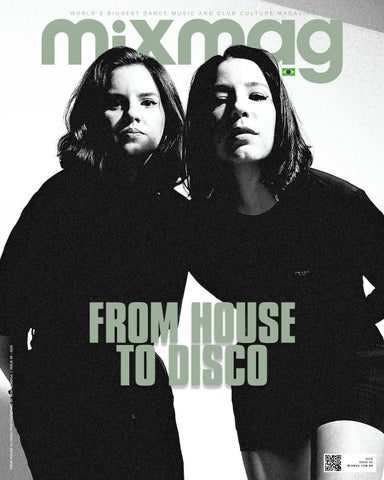
FROM HOUSE TO DISCO PHOTOGRAPHED BY MOA ALMEIDA | ISSUE 95 - 2026
WORLD’S BIGGEST DANCE MUSIC AND CLUB CULTURE MAGAZINE
FROM HOUSE TO DISCO 2026 ISSUE 95 MIXMAG.COM.BR
COVER FEATURE | PORTUGUESE
FROM HOUSE TO DISCO O Encontro Entre Escutas Distintas Que Resultou Em Um Dos Projetos Mais Consistentes Da Nova Geração Da Música Eletrônica Brasileira Por Mia Lunis | Diretor Artístico: Ale Furcolin | Fotos: Moa Almeida
Mais do que um duo, From House to Disco é o encontro de duas escutas formadas em tempos, espaços e silêncios diferentes, mas unidas por uma mesma obsessão: a pista como linguagem viva. A relação da Livia com a música começa cedo, na sala de casa, folheando mentalmente a coleção de discos da mãe: Depeche Mode, New Order, Pet Shop Boys, referências que não apenas moldaram seu ouvido, mas sedimentaram uma sensibilidade pop, melódica e emocional que atravessa gerações.
profundamente consciente, flui entre house e disco sem nostalgia vazia ou apego a rótulos, equilibrando memória e frescor com naturalidade rara. Cada set funciona como um percurso pensado, fruto de curadoria atenta e pesquisa profunda, onde o oldschool dialoga com o agora, e a pista responde sem esforço.
Já Bruna, criança mais introspectiva, encontrou abrigo nas madrugadas guiadas pelo rádio, absorvendo ritmos, grooves e atmosferas até se deparar com uma figura-chave: DJ Marky, cuja precisão e musicalidade abriram uma porta definitiva para o universo da música eletrônica. É desse contraste que nasce o From House to Disco.
Essa abordagem as levou a ocupar alguns dos espaços mais relevantes da cena brasileira, especialmente no eixo Rio-São Paulo, passando por festas e festivais como Selvagem, Gop Tun, Festa Rara, Time Warp, DGTL, Tomorrowland Brasil, D-Edge, Piknic Electronik, Lollapalooza e Glitterbox. No caminho, dividiram line-ups com nomes como Kerri Chandler, Cinthie, Danny Daze, Mall Grab, Krystal Klear, Kettama, Avalon Emerson e Roman Flügel, ampliando ainda mais o alcance e a maturidade de sua leitura de pista.
Originárias de São Paulo, Bruna e Livia constroem, há quase uma década, uma trajetória marcada por coerência estética e liberdade criativa. Seu som dançante, elegante e
Fora do país, a assinatura do duo também encontrou ressonância em pistas europeias como o Amsterdam Dance Event e o Drop Dance Society, em Amsterdã, além de palcos
ISSUE 95 | 2026
emblemáticos em Lisboa, como Rock in Rio e MusicBox. No estúdio, essa mesma personalidade se traduz em lançamentos consistentes por selos de peso como Razor-N-Tape, referência global no disco e house, Basement Discos, Definitive Recordings - hoje sediada em Berlim sob gestão da Get Physical, além de Massa Records (de Renato Cohen), Cocada Music (de Leo Janeiro) e U’re Guay Records, na cena latino-americana. Com uma compreensão aguçada da dinâmica da pista sob múltiplas perspectivas e uma presença fluida, carismática e segura, From House To Disco ocupa hoje um espaço singular entre os talentos emergentes do país. Falamos com Bruna e Lívia em um momento simbólico: após o lançamento do remix de ‘Garota Sangue Bom’ pela Universal Music, clássico de Fernanda Abreu, o duo encerra 2025 com os pés firmes no presente e um horizonte amplo, repleto de novas possibilidades, apontando com clareza para um 2026 ainda mais expansivo.
MIXMAG.COM.BR
COVER FEATURE | PORTUGUESE
“Essa lógica binária entre underground e mainstream fragmenta a cena e simplifica demais algo que, na prática, tem um espectro muito mais rico e diverso.” ISSUE 95 | 2026
Como a música entrou na vida de vocês, não apenas como interesse artístico, mas como um espaço de pertencimento, refúgio e construção de identidade? Livia: A música sempre foi muito presente na minha vida. Meus pais se separaram cedo, cada um seguiu seu caminho e construiu uma nova família, e eu cresci com essa sensação de estar um pouco à parte. De certa forma, a música acabou ocupando esse espaço, no sentido de companhia, que mais tarde virou descoberta. Eu lembro de ser muito pequena e passar horas sentada no chão da sala, ouvindo os discos da minha mãe. Muitas vezes era fim de semana, aquele momento em que meu pai não vinha me buscar, eu ficava triste, claro, e a música era o lugar onde eu encontrava conforto e me distraía. Sou grata, de certa forma, por tudo isso, porque a música teve um papel essencial na construção da minha identidade, inclusive como mulher gay, quando eu ainda nem sabia nomear o que isso significava. Lembro do quanto fiquei mexida com o The Girlie Show, da Madonna, na TV. Acho que foi 1992, eu era muito nova, tinha quatro, cinco anos, não sabia nomear nada daquilo, mas algo ali fez todo sentido, deu um click, sabe? Não era sobre ser artista, cantar ou estar no palco. Era sobre presença, liberdade, corpos se beijando, baila-
rinos se expressando sem medo. Aquilo me atravessou profundamente. Naquele momento eu entendi que a música era um lugar onde as pessoas podiam ser livres. E isso ficou comigo para sempre. A música virou esse território de liberdade, de reconhecimento, de possibilidade de existir sem pedir permissão. É daí que vem a minha ligação com ela, antes de qualquer outra coisa. Bruna: Eu sempre fui uma criança muito tímida, muito introspectiva. E a música era exatamente o lugar onde eu me permitia sonhar, criar, imaginar quem eu poderia ser. Era ali que eu ensaiava outras versões de mim mesma, longe do olhar dos outros. Eu sempre tive um sono muito leve, então acabava passando muito tempo acordada de madrugada. E foi nesse horário que a música eletrônica entrou na minha vida. Eu dormia ouvindo programas de rádio, como o Marky fazendo o “terremoto” na Energia 97fm , ou ficava assistindo MTV no quarto do meu irmão, quando passavam clipes de música eletrônica tarde da noite. A minha relação com a música vem muito desse lugar de identificação. Eu encontrava nela alguém que eu queria ser, uma energia que me ajudava a sair desse estado de timidez. A música funcionava como um refúgio, mas também como uma projeção, um espaço onde eu podia existir de forma mais expansiva, mais segura.
Ela sempre esteve presente na minha vida, não como pano de fundo, mas como um ambiente onde eu podia me construir aos poucos, no meu tempo. Acho que, no fim, foi isso: a música como abrigo, mas também como possibilidade. Vocês se conheceram pela música, mas não de forma imediata. Como esse encontro foi acontecendo aos poucos, entre coincidências, afinidades e caminhos que já se cruzavam antes mesmo de vocês perceberem? A gente frequentava o mesmo grupo de amigos, mas o mais curioso é que eu e a Bruna já tínhamos estado nos mesmos lugares muitas vezes antes de nos conhecermos de verdade. Quando começamos a conversar, era sempre assim: alguém mencionava uma festa ou um show como Skol Beats, Clash, Glória, Vegas, D-EDGE e vinha a surpresa de perceber que as duas tinham estado lá na mesma noite. Eram rolês muito específicos da cena eletrônica, então ficou claro que nossos caminhos já se cruzavam há um tempo. Quando a amizade começou, a música virou imediatamente o centro. A gente trocava referências, falava de DJs, bandas, shows. Tudo sempre flui de forma muito natural. Com o tempo, essa afinidade foi ficando maior. A admiração virou curiosidade, a curiosidade virou envolvimento. Foi intenso desde o início, mesmo com a Bruna morando em Curitiba por
MIXMAG.COM.BR
COVER FEATURE | PORTUGUESE
um período e a gente vivendo um namoro à distância. Naquela época, ainda não existia From House to Disco, eram dois caminhos paralelos. O duo veio três anos depois, como consequência natural de uma conexão que já estava formada. As referências musicais de vocês vêm de lugares diferentes. Como essas formações distintas se encontraram e passaram a dialogar dentro do som do From House to Disco? Bruna: Falando das referências, a minha formação veio muito da pista e do trabalho em clubes. Antes de tocar, eu trabalhei em bar, em produção, e sempre escolhia estar nos lugares onde eu realmente gostava do som. Então eu ia para a Clash, para festivais como o Nokia Trends, para festas onde a música eletrônica tinha mais peso. Era a forma que eu encontrava de estar presente quando não tinha dinheiro pra isso. Isso acabou moldando bastante o meu ouvido. A minha base sempre foi um eletrônico mais minimal, mais deep, com bastante techno, até o tribal dos anos 90. Era uma linha mais pesada, mais crua, que me interessava naturalmente. E a Livia vinha com uma luz completamente diferente. Ela trazia esse disco clássico muito forte, anos 70, uma musicalidade mais quente, mais aberta. Esse contraste foi essencial, por-
ISSUE 95 | 2026
que criou um equilíbrio muito natural entre peso e groove. Ali começou a se desenhar o que viria a ser o nosso som juntas. Livia: A minha formação musical, por mais clichê que pareça, veio muito dos discos da minha mãe e ainda bem que ela tinha um ótimo gosto (risos). Depeche Mode, New Order, Madonna, Pet Shop Boys... eu cresci com esse rock, pop, synthpop cheio de personalidade. Não era exatamente música eletrônica, mas pra mim soava como porque era tudo muito novo. Quando isso se encontrou com o universo da Bruna, foi quase imediato. A gente começou a tocar juntas em casa, sem pretensão, por diversão, misturando referências. Um dia, entre amigos, perguntaram: “mas vocês não têm um nome pra dupla?” e a gente ficou matutando isso. Depois de um tempo, sacamos que o que a gente fazia navegava exatamente nesse espaço, entre a disco e a house, no caminho entre uma e outra. Em algum momento surgiu naturalmente: From House To Disco. Quando o nome apareceu, ele simplesmente ficou. Parecia óbvio, como se sempre tivesse estado ali. Bruna: Quando a Livia veio com From House to Disco, foi imediato. Eu ouvi e pensei: “caralho, isso é muito bom”. Fez muito sentido, soou
verdadeiro, parecia traduzir exatamente o que a gente estava fazendo. E ficou. Vocês transitam por diferentes tipos de festas, públicos e mercados. Como vocês enxergam essa divisão ainda tão presente entre “underground” e “mainstream” na música eletrônica - e o impacto disso na forma como artistas são julgados quando crescem? A gente transita porque é natural, em nenhum momento isso foi pensado pra ser assim, simplesmente aconteceu. Acho que se perde muita energia tentando encaixar artistas nisso ou naquilo. Essa lógica binária entre underground e mainstream fragmenta a cena e simplifica demais algo que, na prática, tem um espectro muito mais rico e diverso. A cena se constrói em muitos contextos diferentes, com públicos, estruturas e linguagens distintas coexistindo ao mesmo tempo. Tratar isso como uma oposição direta empobrece a leitura da cena, quando, na verdade, essa multiplicidade é uma das maiores forças que temos. Para a gente, a cena fica mais interessante justamente quando essas fronteiras são menos fixas. Existe espaço para projetos que circulam em ambientes menores, para quem prefere estruturas maiores, e para quem transita entre
“Quanto menos a gente tenta definir tudo em termos de “ou isso ou aquilo”, mais espaço existe para projetos reais e originais, o que é fundamental para manter a cena mais rica, viva e criativa.” MIXMAG.COM.BR
COVER FEATURE | PORTUGUESE
“A música virou esse território de liberdade, de reconhecimento, de possibilidade de existir sem pedir permissão.” ISSUE 95 | 2026
esses lugares. Nenhuma dessas escolhas invalida a outra. Quando a gente deixa essa lógica binária pra trás e passa a valorizar a diversidade de caminhos possíveis, é que artistas de verdade podem existir. Quanto menos a gente tenta definir tudo em termos de “ou isso ou aquilo”, mais espaço existe para projetos reais e originais, o que é fundamental para manter a cena mais rica, viva e criativa. Que mudanças vocês perceberam na cena nos últimos anos em termos de comportamento, inclusão e diálogo, especialmente em relação à presença de grupos historicamente minorizados? Mudanças nascem de incômodos. Dentro da nossa cena, isso nunca foi impeditivo, muito pelo contrário, sempre serviu de combustível. Quando se fecha uma porta, a galera vai lá e constrói outra, saca? Não fica esperando nada acontecer. E a real é que as portas abertas por artistas e coletivos minorizados acabam sendo muito mais interessantes e originais do que as que já estavam ali. E isso, em algum momento, passou a ser reconhecido também em espaços maiores. Artistas e coletivos se aproximaram, criaram seus próprios eventos e plataformas. Isso contribuiu para que a diversidade nos line-ups
fosse acontecendo de forma mais consistente e acabou sendo um empurrão pro resto da cena. A música é o ponto central desse diálogo, mas essa conversa vai muito além. Quando se pensa em Brasil, com toda essa pluralidade cultural e sonora, chega ser patético sermos binários, não é mesmo? Onde você encaixa o funk hoje em dia? Underground ou mainstream? É sobre isso. Falando em funk, é impossível não chegar à Fernanda Abreu. Como surgiu essa parceria e o que significou para vocês reinterpretar uma artista tão central na música brasileira? A Fernanda é uma referência pra gente há muito tempo. Ela faz parte da música brasileira de um jeito tão profundo que, às vezes, a gente nem se dá conta do quanto ela está presente na nossa memória coletiva. O convite para trabalharmos juntas veio dela, num momento muito especial: a celebração dos 30 anos do Da Lata. Ela já estava preparando o vinil inédito do álbum, o livro e o documentário, e nos chamou para integrar essa comemoração com um remix, alimentando essa relação que ela sempre teve com a pista, com os DJs e com a house e a disco. Trabalhar com a Fernanda é surreal. Ela já fez tudo. Já misturou samba, funk, eletrônico,
pop, sempre com ousadia. A primeira pergunta que a gente se fez foi: o que a gente pode mostrar para alguém que já percorreu tantos caminhos? E, principalmente, como não cair no óbvio? A vontade desde o início era não repetir fórmulas. Então, começamos com a bateria, tentando extrair algo novo dali, algo que tivesse um espírito funk, ousado, mas que não fosse o esperado. O desafio maior era ressignificar “Garota Sangue Bom”, porque aquela música é a própria Fernanda, essa figura da mulher carioca, do charme, da força, da liberdade, da independência. Como atualizar isso sem perder essa essência? Tinha que ser original e a própria identidade da Fernanda foi uma grande referência nesse processo. Quando mandamos o primeiro trecho pra ela, deu aquele frio na barriga. Estávamos prontas para mil ajustes. E a resposta veio simples: “adorei, meninas!”. “Amei como recortaram a voz, amei o som, é pista, é isso, vamos em frente”. Aquilo foi um dos maiores elogios que a gente poderia receber. Não só porque ela é uma artista gigante, mas porque ela entende música num nível muito profundo. Conversar com a Fernanda é ter aula. Então, foi muito gratificante saber que acertamos.
MIXMAG.COM.BR
COVER FEATURE | PORTUGUESE
“Mudanças nascem de incômodos. Dentro da nossa cena, isso nunca foi impeditivo, muito pelo contrário, sempre serviu de combustível.” ISSUE 95 | 2026
A curadoria é um dos elementos centrais no trabalho de vocês. Como funciona esse processo fora do óbvio do “gosto pessoal” e de que forma pesquisa, contexto e leitura de público entram nas decisões de set e estúdio?
casa mesmo. Ou seja, não se trata apenas de tocar o que a gente gosta, mas de criar uma experiência coerente, que conecte pesquisa, sensibilidade e troca com quem está ali, seja uma pista com milhares de dezenas de pessoas ou um lugar mais intimista.
A curiosidade é um ponto central do nosso trabalho. Existe uma vontade constante de aprofundar, pesquisar e descobrir músicas, artistas, selos, produtores e músicos. E temos vontade de compartilhar isso com as pessoas, seja em nossos sets ou em nossas produções originais.
Depois de quase uma década de estrada, o que vocês sentem que desaprenderam como artistas para continuar evoluindo, especialmente em um mercado que muitas vezes recompensa repetição?
Tem muita coisa legal que nem existe em versão digital e essa é a graça. O DJ é um curador por essência, se você não gosta de pesquisa, mude de profissão. E, para além disso, se você é produtor, sair do óbvio dos dias atuais pode ser um prato cheio para redescobrir sonoridades que hoje uma geração inteira não conhece. A gente acredita muito nessa troca entre passado e presente, entre descoberta e resgate, e leva isso pra pista também. Penso que, se a pessoa escolheu estar ali, e não conectada no Spotify dela, ela quer ser surpreendida por nós. Caso contrário, era melhor ela ter ficado em
Uma das primeiras coisas que tentam te ensinar quando você trabalha com música são as fórmulas: para ser tocada, pra viralizar, pra crescer, pra engajar... Não cair nessa armadilha foi a nossa maior ousadia. Não queremos repetir o que já foi sucesso, não repetimos nem setlist. Buscamos o frio na barriga em tudo o que fazemos. E esse frio só vem de algo que a gente ainda não conhece, não de repetições. Vocês dividem pista, vida e criação. O que muda na dinâmica criativa quando o vínculo afetivo também está presente, e como aprendem a preservar o projeto sem diluir a relação pessoal?
Essa é uma pergunta que sempre desperta curiosidade (risos). O interessante é que, embora o From House to Disco exista há quase uma década, a Bruna e a Livia estão juntas há mais tempo. A nossa dinâmica veio antes do projeto. O From House to Disco só surgiu depois de três anos, o que fez muita diferença. Existe muito respeito pelo espaço, pela individualidade e pela identidade de cada uma, e é justamente nesse equilíbrio que o projeto acontece. Talvez por isso a dinâmica criativa flua de forma tão natural. Quando estamos tocando, por exemplo, a gente se fala pelo olhar. É nesse lugar que a mágica acontece (risos). Mas, brincadeiras à parte, isso também funciona porque, individualmente, somos pessoas com muita personalidade. A gente sabe reconhecer os momentos de cada uma e como extrair o melhor disso, seja na produção, seja no palco. Acho que no fim, a nossa intimidade aprofunda o trabalho criativo. O que vocês estão preparando para os próximos meses, seja no estúdio, na pista ou em novos movimentos do projeto?
MIXMAG.COM.BR
COVER FEATURE | PORTUGUESE
“Se apaixonem pela música e não sigam regras. Parece simples, mas é isso. Quando você começa a pensar demais, acaba se afastando do que realmente importa.” ISSUE 95 | 2026
Tem muita coisa legal acontecendo. A mais recente é que a gente acabou de entrar para uma agência internacional, a Metrópole, de Berlim, em parceria com a Atomic Soda. Isso é muito especial pra gente, porque sempre fomos muito movidas pela noite, por viajar, por estar nos lugares, quase sempre por conta própria. Agora é a primeira vez que isso acontece de forma estruturada, profissional, e dá uma sensação boa de amadurecimento do projeto. Outra novidade importante é que a gente está abrindo o nosso próprio selo, o Feed The Fever. Curiosamente, foi algo que até demorou pra acontecer. Muita gente dizia que a gente precisava ter um selo, e toda vez que alguém fala que a gente “precisa” fazer alguma coisa, a nossa reação costuma ser ir na contramão. Sempre foi assim. A gente nunca quis criar um selo por vaidade, por status ou por uma lógica de “agora temos um selo porque podemos”. O Feed The Fever nasceu de forma muito despretensiosa. Um dia, jantando aqui em casa com o Ignácio (Ignácio Live), ele comentou que estava cansado de fazer “coisas para os selos” e nos identificamos muito com aquilo. Naquele momento surgiu a conversa: por que não criar um espaço para lançar as nossas ideias, all in? No dia seguinte, a decisão já estava tomada. A
gente até pensou em criar um alter ego, mas preferiu assumir esses outros lados dentro do próprio projeto From House To Disco. O Ignácio é um parceiro fundamental nesse processo: como músico, como aliado artístico,mas sobret udo como grande amigo que é. O selo vem muito como esse lugar de liberdade criativa pra todos nós e da vontade de experimentar coisas novas. Ao mesmo tempo, seguimos lançando por outros selos. Temos convites muito legais para 2026, incluindo um lançamento pela D.O.C Records (de Gui Boratto), um EP pela espanhola Basement Discos e também um convite para lançar pela label Heels of Love, da Eli Iwasa e Priscila Prestes. Além disso, estamos nos aventurando em algo novo pra gente: a curadoria e produção de showcases. Pela primeira vez, estamos trazendo para o Brasil um festival europeu, a Resonica, em um showcase mais intimista que acontece agora no final de janeiro no Martinelli, em São Paulo, e na D-EDGE (São Paulo e Rio de Janeiro), junto com o L_cio. A ideia é começar a fazer isso com mais frequência em 2026, trazendo festas e festivais menores, com propostas muito consistentes, que ainda não circulam por aqui. A gente sente que existe muito espaço para além dos gran-
des nomes e formatos já consolidados. Queremos ajudar a oxigenar a cena, trazer outras sonoridades, artistas novos, parcerias inesperadas. Usar o privilégio de estar onde estamos para criar pontes e oferecer coisas diferentes e manter a cena em movimento. Pra fechar nosso papo, se vocês pudessem deixar um conselho para quem está começando agora na produção musical, quebrando a cabeça no processo criativo, qual seria? Se apaixonem pela música e não sigam regras. Parece simples, mas é isso. Quando você começa a pensar demais, acaba se afastando do que realmente importa. Música é sentimento. E quando isso sai de cena, talvez seja hora de se reconectar com o motivo pelo qual você começou. Então, se permita se apaixonar de novo e repetir esse processo quantas vezes for preciso. Follow From House to Disco on: Instagram.com/fromhousetodisco Soundcloud.com/fromhousetodisco Fromhousetodisco.bandcamp.com
MIXMAG.COM.BR
COVER FEATURE | ENGLISH
FROM HOUSE TO DISCO The meeting of distinct ways of listening that resulted in one of the most consistent projects of the new generation of Brazilian electronic music Por Mia Lunis | Diretor Artístico: Ale Furcolin | Fotos: Moa Almeida
More than a duo, From House to Disco is the convergence of two ways of listening shaped by different times, spaces, and silences, yet united by the same obsession: the dancefloor as a living language. Livia’s relationship with music begins early, in the living room at home, mentally leafing through her mother’s record collection, Depeche Mode, New Order, Pet Shop Boys, references that not only shaped her ear but also laid down a pop, melodic, and emotional sensibility that crosses generations.
disco without empty nostalgia or attachment to labels, balancing memory and freshness with rare naturalness. Each set functions as a carefully designed journey, the result of attentive curation and deep research, where old school dialogues with the now, and the dancefloor responds effortlessly.
Bruna, on the other hand, a more introspective child, found refuge in late nights guided by the radio, absorbing rhythms, grooves, and atmospheres until encountering a key figure: DJ Marky, whose precision and musicality opened a definitive door to the universe of electronic music. It is from this contrast that From House to Disco is born.
This approach has led them to occupy some of the most relevant spaces in the Brazilian scene, especially along the Rio–São Paulo axis, passing through parties and festivals such as Selvagem, Gop Tun, Festa Rara, Time Warp, DGTL, Tomorrowland Brasil, D-Edge, Piknic Electronik, Lollapalooza, and Glitterbox. Along the way, they have shared line-ups with names like Kerri Chandler, Cinthie, Danny Daze, Mall Grab, Krystal Klear, Kettama, Avalon Emerson, and Roman Flügel, further expanding the reach and maturity of their reading of the dancefloor.
Originally from São Paulo, Bruna and Livia have been building, for nearly a decade, a trajectory marked by aesthetic coherence and creative freedom. Their sound, danceable, elegant, and deeply conscious, flows between house and
Outside Brazil, the duo’s signature has also resonated on European dancefloors such as the Amsterdam Dance Event and Drop Dance Society in Amsterdam, as well as emblematic stages in Lisbon, including Rock in Rio and
ISSUE 95 | 2026
MusicBox. In the studio, this same personality translates into consistent releases on respected labels such as Razor-N-Tape, a global reference in disco and house; Basement Discos; Definitive Recordings, now based in Berlin under the management of Get Physical, as well as Massa Records (by Renato Cohen), Cocada Music (by Leo Janeiro), and U’re Guay Records, within the Latin American scene. With a sharp understanding of dancefloor dynamics from multiple perspectives and a fluid, charismatic, and confident presence, From House to Disco now occupies a singular space among the country’s emerging talents. We spoke with Bruna and Lívia at a symbolic moment: following the release of the remix of ‘Garota Sangue Bom’ via Universal Music, a classic by Fernanda Abreu, the duo closes out 2025 with their feet firmly planted in the present and a wide horizon ahead, filled with new possibilities, clearly pointing toward an even more expansive 2026.
MIXMAG.COM.BR
COVER FEATURE | ENGLISH
“This binary logic between underground and mainstream fragments the scene and oversimplifies something that, in practice, exists across a much richer and more diverse spectrum.” ISSUE 95 | 2026
How did music enter your lives, not only as an artistic interest, but as a space of belonging, refuge, and identity-building? Livia: Music has always been very present in my life. My parents separated early on, each followed their own path and built a new family, and I grew up with this feeling of being somewhat on the outside. In a way, music ended up occupying that space, as companionship at first, which later turned into discovery. I remember being very small and spending hours sitting on the living room floor, listening to my mother’s records. Often it was the weekend, that moment when my father wouldn’t come to pick me up. I would feel sad, of course, and music was the place where I found comfort and distraction. In a way, I’m grateful for all of this, because music played an essential role in the construction of my identity, including as a gay woman, back when I didn’t yet know how to name what that meant. I remember how deeply moved I was by The Girlie Show, by Madonna, on TV. I think it was 1992, I was very young, four or five years old. I couldn’t name any of it, but something there made complete sense, it clicked, you know? It wasn’t about being an artist, singing, or being on stage. It was about presence, freedom, bodies kissing, dancers expressing themselves without fear. That went straight through me. In that
moment, I understood that music was a place where people could be free. And that stayed with me forever. Music became this territory of freedom, recognition, and the possibility of existing without asking permission. That’s where my connection to it comes from, before anything else. Bruna: I was always a very shy, very introspective child. And music was exactly the place where I allowed myself to dream, to create, to imagine who I could be. It was there that I rehearsed other versions of myself, away from other people’s gaze. I’ve always been a very light sleeper, so I spent a lot of time awake late at night. And it was during those hours that electronic music entered my life. I would fall asleep listening to radio shows, like Marky doing the “Terremoto” on Energia 97 FM, or I’d watch MTV in my brother’s room when they aired electronic music videos late at night. My relationship with music comes very much from this place of identification. In it, I found someone I wanted to be, an energy that helped me move out of that state of shyness. Music worked as a refuge, but also as a projection, a space where I could exist in a more expansive, more confident way. It has always been present in my life, not as background, but as an environment where I
could slowly build myself, in my own time. I think, in the end, that’s it: music as shelter, but also as possibility.
You met through music, but not immediately. How did this encounter slowly take shape, through coincidences, affinities, and paths that had already crossed before you even realized it? We were part of the same group of friends, but the most curious thing is that Bruna and I had already been in the same places many times before truly meeting each other. When we started talking, it was always like this: someone would mention a party or a show, Skol Beats, Clash, Glória, Vegas, D-EDGE, and we’d be surprised to realize that both of us had been there on the very same night. These were very specific events within the electronic music scene, so it became clear that our paths had been crossing for quite some time. When the friendship began, music immediately became the center of everything. We exchanged references, talked about DJs, bands, shows. Everything always flowed very naturally. Over time, that affinity grew stronger. Admiration turned into curiosity, curiosity into involvement. It was intense from the beginning, even with Bruna living in Curitiba for a period and us navigating a long-distance relationship. Back
MIXMAG.COM.BR
COVER FEATURE | ENGLISH
then, From House to Disco didn’t yet exist, there were two parallel paths. The duo came three years later, as a natural consequence of a connection that was already firmly in place. Your musical references come from different places. How did these distinct backgrounds meet and begin to dialogue within the sound of From House to Disco? Bruna: When it comes to references, my background came very much from the dancefloor and from working in clubs. Before DJing, I worked at bars and in production, and I always chose to be in places where I genuinely liked the sound. So I’d go to Clash, to festivals like Nokia Trends, to parties where electronic music carried more weight. It was the way I found to be present when I didn’t have the money to be there otherwise. That really shaped my ear. My foundation was always more minimal, deeper electronic music, with a lot of techno, even the tribal sounds of the 1990s. It was a heavier, rawer line that naturally interested me. And then Lívia came in with a completely different light. She brought a very strong classic disco influence from the 1970s, a warmer, more open musicality. That contrast was essential, because it created a very natural balance be-
ISSUE 95 | 2026
tween weight and groove. That’s where what would become our sound together began to take shape. Livia: My musical background, as cliché as it may sound, came largely from my mother’s records, and thankfully she had great taste (laughs). Depeche Mode, New Order, Madonna, Pet Shop Boys… I grew up with this rock, pop, synthpop full of personality. It wasn’t exactly electronic music, but to me it sounded like it, because everything felt so new. When that met Bruna’s universe, it was almost immediate. We started playing together at home, without any ambition, just for fun, mixing references. One day, among friends, someone asked, “Don’t you have a name for the duo?” and we started thinking about it. After a while, we realized that what we were doing navigated exactly that space, between disco and house, on the path from one to the other. At some point it naturally emerged: From House To Disco. When the name appeared, it simply stuck. It felt obvious, as if it had always been there. Bruna: When Lívia came up with From House to Disco, it was immediate. I heard it and thought, “fuck, this is really good.” It made complete sense, sounded true, and seemed to translate exactly what we were doing. And it stayed.
You move through different types of parties, audiences, and markets. How do you see the division that is still so present between “underground” and “mainstream” in electronic music, and its impact on how artists are judged when they grow? We move through these spaces because it feels natural. At no point was this something we planned, it simply happened. A lot of energy gets wasted trying to fit artists into one box or another. This binary logic between underground and mainstream fragments the scene and oversimplifies something that, in practice, exists on a much richer and more diverse spectrum. The scene is built across many different contexts, with distinct audiences, structures, and languages coexisting at the same time. Treating this as a direct opposition impoverishes the way the scene is understood, when in fact this multiplicity is one of its greatest strengths. For us, the scene becomes more interesting precisely when these boundaries are less rigid. There is space for projects that circulate in smaller environments, for those who prefer larger structures, and for those who move between these worlds. None of these choices invalidates the others. When we leave this binary logic behind and
“The less we try to define everything in terms of “either this or that,” the more space there is for genuine, original projects, which is essential to keeping the scene richer, more alive, and more creative.” MIXMAG.COM.BR
COVER FEATURE | ENGLISH
“Music became this territory of freedom, recognition, and the possibility of existing without asking permission.” ISSUE 95 | 2026
begin to value the diversity of possible paths, that’s when real artists can exist. The less we try to define everything in terms of “either this or that,” the more space there is for genuine, original projects, which is essential to keeping the scene richer, more alive, and more creative. What changes have you noticed in the scene over the past few years in terms of behavior, inclusion, and dialogue, especially regarding the presence of historically underrepresented groups? Change is born out of discomfort. Within our scene, that has never been a barrier, quite the opposite, it has always worked as fuel. When one door closes, people go out and build another, you know? No one just waits around for something to happen. And the truth is that the doors opened by underrepresented groups and collectives end up being far more interesting and original than the ones that were already there. At some point, this also began to be recognized within larger spaces. Artists and collectives came closer together, created their own events and platforms. This helped diversity in line-ups happen more consistently and ended up giving the rest of the scene a push forward. Music is the central point of this dialogue, but the conversation goes far beyond that.
When you think about Brazil, with all this cultural and sonic plurality, it’s almost ridiculous to be binary, isn’t it? Where do you place funk today, underground or mainstream? That’s exactly the point. Speaking of funk, it’s impossible not to arrive at Fernanda Abreu. How did this collaboration come about, and what did it mean for you to reinterpret such a central figure in Brazilian music? Fernanda has been a reference for us for a long time. She’s part of Brazilian music in such a deep way that sometimes we don’t even realize how present she is in our collective memory. The invitation to work together came from her, at a very special moment: the celebration of Da Lata’s 30th anniversary. She was already preparing the album’s first-ever vinyl release, along with a book and a documentary, and invited us to be part of that celebration with a remix, feeding that relationship she has always had with the dancefloor, with DJs, and with house and disco. Working with Fernanda is surreal. She’s done it all. She has mixed samba, funk, electronic, and pop, always with boldness. The first question we asked ourselves was: what can we show someone who has already walked so many paths? And, above all, how do we avoid the obvious? From the very beginning, the desire was not to repeat formulas.
So we started with the drums, trying to extract something new from them, something with a funky, daring spirit, but not what would be expected. The biggest challenge was re-signifying “Garota Sangue Bom,” because that song is Fernanda herself: this figure of the carioca woman, of charm, strength, freedom, and independence. How do you update that without losing its essence? It had to be original, and Fernanda’s own identity was a major reference throughout the process. When we sent her the first excerpt, there was that familiar knot in the stomach. We were ready for a thousand adjustments. And her response came simply: “I loved it, girls!” “I loved how you chopped the vocals, I loved the sound, it’s for the dancefloor, that’s it, let’s move forward.” That was one of the greatest compliments we could have received. Not only because she’s a giant artist, but because she understands music on a very deep level. Talking with Fernanda is like taking a masterclass. So it was incredibly rewarding to know we got it right. Curation is one of the central elements of your work. How does this process function beyond the obvious idea of “personal taste,” and how do research, context, and audience reading inform your decisions in both sets and studio work?
MIXMAG.COM.BR
COVER FEATURE | ENGLISH
“Change is born out of discomfort. Within our scene, that has never been a limitation, quite the opposite, it has always been fuel.” ISSUE 95 | 2026
Curiosity is a central point in our work. There’s a constant desire to go deeper, to research and discover music, artists, labels, producers, and musicians. And we want to share that with people, whether in our DJ sets or in our original productions. There’s so much great music that doesn’t even exist in digital form, and that’s part of the beauty of it. A DJ is, by essence, a curator, if you don’t like researching, change professions. And beyond that, if you’re a producer, stepping outside the obvious sounds of today can be a feast for rediscovering sonorities that an entire generation doesn’t even know. We truly believe in this exchange between past and present, between discovery and retrieval, and we bring that into the dancefloor as well. I think that if someone chose to be there, instead of being connected to their own Spotify, they want to be surprised by us. Otherwise, they might as well have stayed at home. In other words, it’s not just about playing what we like, but about creating a coherent experience that connects research, sensitivity, and exchange with those who are there, whether it’s a dancefloor with tens of thousands of people or a more intimate space.
After nearly a decade on the road, what do you feel you’ve had to unlearn as artists in order to keep evolving, especially in a market that often rewards repetition? One of the first things people try to teach you when you work with music is formulas, how to get played, how to go viral, how to grow, how to engage. Not falling into that trap was our greatest act of boldness. We don’t want to repeat what has already been successful; we don’t even repeat setlists. We look for that knot in the stomach in everything we do. And that feeling only comes from something we don’t yet know, not from repetition.
You share the dancefloor, life, and creation. What changes in the creative dynamic when an emotional bond is also present, and how do you learn to preserve the project without diluting the personal relationship? That’s a question that always sparks curiosity (laughs). What’s interesting is that although From House to Disco has existed for almost a decade, Bruna and Lívia have been together for longer. Our dynamic came before the project. From House to Disco only emerged after three
years, and that made a big difference. There’s a lot of respect for space, individuality, and each other’s identity, and it’s precisely within that balance that the project exists. Maybe that’s why the creative dynamic flows so naturally. When we’re playing, for example, we communicate through our eyes. That’s where the magic happens (laughs). Jokes aside, this also works because, individually, we’re people with strong personalities. We know how to recognize each other’s moments and how to draw out the best from them, whether in production or on stage. In the end, I think our intimacy deepens the creative work. What are you preparing for the coming months, whether in the studio, on the dancefloor, or through new moves within the project? There’s a lot of exciting stuff happening. The most recent news is that we’ve just joined an international agency, Metrópole, based in Berlin, in partnership with Atomic Soda. This is very special for us, because we’ve always been deeply driven by nightlife, by traveling, by being in different places, most of the time on our own.
MIXMAG.COM.BR
COVER FEATURE | ENGLISH
“Fall in love with music and don’t follow rules. It sounds simple, but that’s really it. When you start overthinking, you drift away from what truly matters.” ISSUE 95 | 2026
Now, for the first time, this is happening in a structured, professional way, and it brings a really good sense of the project’s maturation.
comes from this place of creative freedom for all of us, and from the desire to experiment with new things.
Another important development is that we’re launching our own label, Feed The Fever. Interestingly, it took a while for this to happen. A lot of people used to say we needed to have a label, and every time someone says we “need” to do something, our reaction tends to be going in the opposite direction. It’s always been like that. We never wanted to create a label out of vanity, status, or a logic of “now we have a label because we can.”
At the same time, we continue releasing music through other labels. We have some great invitations lined up for 2026, including a release on D.O.C Records (by Gui Boratto), an EP on the Spanish label Basement Discos, and also an invitation to release on Heels of Love, the label run by Eli Iwasa and Priscila Prestes.
Feed The Fever was born in a very unpretentious way. One day, having dinner at home with Ignácio (Ignácio Live), he mentioned that he was tired of making “things for labels,” and we really connected with that feeling. In that moment, the conversation came up: why not create a space to release our ideas, all in? By the next day, the decision was already made. We even thought about creating an alter ego, but chose instead to embrace these other sides within the From House To Disco project itself. Ignácio is a fundamental partner in this process, as a musician, as an artistic ally, but above all as a great friend. The label very much
In addition, we’re venturing into something new for us: curating and producing showcases. For the first time, we’re bringing a European festival to Brazil, Resonica, in a more intimate showcase format, happening at the end of January at Martinelli in São Paulo, and at D-EDGE (São Paulo and Rio de Janeiro), together with L_cio. The idea is to do this more frequently in 2026, bringing smaller parties and festivals with very consistent proposals that don’t yet circulate here. We feel there’s a lot of space beyond the big names and already established formats. We want to help oxygenate the scene, introduce new sounds, new artists, unexpected partnerships, using the privilege of being where we are to build bridges, offer different experiences, and keep the scene in motion.
To close our conversation, if you could leave one piece of advice for those just starting out in music production, struggling through the creative process, what would it be? Fall in love with music and don’t follow rules. It sounds simple, but that’s really it. When you start overthinking, you drift away from what truly matters. Music is feeling. And when that disappears, maybe it’s time to reconnect with the reason you started in the first place. So allow yourself to fall in love again, and to repeat that process as many times as necessary. Follow From House to Disco on: Instagram.com/fromhousetodisco Soundcloud.com/fromhousetodisco Fromhousetodisco.bandcamp.com
MIXMAG.COM.BR
WO R LD ’ S
BI G G E S T
D A NCE
MU S I C
MA G A ZI N E
MARKUS SCHULZ PHOTOGRAPHED BY EDWARD ANINARU | ISSUE 93 - 2025
Through the Portal
MARKUS SCHULZ Evolution Into the Future
2025 ISSUE 93 MIXMAG.COM.BR