Oko
Design by LucidiPevere


Oko
Design by LucidiPevere
by Flokk


18 Upfront Products, projects and people through a futurecentric lens.
28 Things I’ve Learnt: Badisha Sinha Associate Director at Zaha Hadid Architects, Badisha Sinha shares her greatest lessons from a career so far.
30 The height of design: Muriel Altunaga Muriel Altunaga, founder of The Flow, shares the object she sees as the pinnacle of good design.
32 Living Better Practicing architect, researcher and artist Itai Palti explores the idea of thinking with our surroundings.

34 Interview: Tara Bernerd Designer Tara Bernerd on experience, cultural inspiration and creating happiness.
42 Interview: James Melia BLOND Founder James Melia on white walls, clear desks and why you will never catch him ‘styling’ anything.
50 Case study: Snap, Paris
Studio Vincent Eschalier creates a Paris HQ for the pioneering tech brand that needs no filters.
58 Case study: Crafted at Powdermills, Sussex
At Sussex hotel and members’ club, Crafted at Powdermills, House of Dré enlists local creatives to bring craft and connection back to modern lives.
64 Case study: Rascal, London
For VFX studio Rascal, dMFK has created an East London home that marries the past and present.
70 Case Study: La Farnatchi, Marrakech In Marrakech, Riad La Farnatchi is the embodiment of place-led design.
78 Case Study:
The Maple, London Conran and Partners draws on hotel design for a BTR scheme in one of London's newest neighbourhoods.
84 Colour Story
Colour designer and forecaster Laura Perryman talks chromatic intelligence and deepening our colour vocabulary.

94


86 Positive Impact
Alex Scott Whitby, founder of ScottWhitbyStudio, explains how reuse shouldn’t be an option, but a default for designers.
94 Fast Forward
Author of Lo–TEK. Design by Radical Indigenism Julia Watson asks: ‘does the future of design mean drawing from Indigenous principles?’
104 Events: Workspace Design Show
We look back on 2026’s Workspace Design Show at London’s Business Design Centre.
106 Guide: Milan Design Week 2026
We spotlight the installations, activations, talks and product inspirations to attend at the 64th edition of Milan Design Week and Salone del Mobile.
122 Guide: Clerkenwell Design Week 2026
The installations, conversations, and product launches to see at Clerkenwell Design Week 2026.
138 Building Narrative
Co-founder and CEO of Artiq Patrick McCrae on understanding whose voices, histories and experiences are present.
140 Mix Talking Point
Creative director of f.r.a
Wesley Meyer explains why wayfinding is the unsung hero of architecture and design.
148 The Making of… Oko LucidiPevere on the release of Oko for Connection by Flokk, material dignity and blurring the lines between contract and domesticity.
152 Material Matters
Irene Kronenberg and Alon Baranowitz, founders of Baranowitz + Kronenberg, share their top material picks.
153 Material Innovation
Manufactura draws from ancient construction techniques to create a bio-based cement from waste corn.
154 Innovative Thinking
Workplace architect Steve Gale muses on ‘the holy grail’ of workplace strategy.

Balcoon Design by Patricia Urquiola
Colophon
The cover Designer Manufacturer

Get in touch
Managing Editor
Harry McKinley harry@mixinteriors.com
Deputy Editor Chloé Petersen Snell chloe@mixinteriors.com
Editorial and
Marketing Executive
Charlotte Slinger charlotte@mixinteriors.com
Editorial Assistant
Ellie Foster ellie@mixinteriors.com
Managing Director
Leon March leon@mixinteriors.com
Account Managers
Stuart Sinclair stuart@mixinteriors.com
Patrick Bowley patrick@mixinteriors.com
Gaia Cafarella gaia@mixinteriors.com
Olivia Biviano olivia@mixinteriors.com
Marketing Manager Paul Appleby paul@mixinteriors.com
Head of Operations
Lisa Jackson lisa@mixinteriors.com
Advertising and Events
Operations Manager
Maria Da Silva maria@mixinteriors.com
Senior Events Manager Rosie Smith rosie@mixinteriors.com
Art Director Marçal Prats marcal@mixinteriors.com
Founding publisher Henry Pugh
Since 2015, London-based studio A-nrd (founded by Alessio Nardi and Lukas Persakovas) has brought a breadth of expertise to the interior and furniture design sector on an international scale, with work spanning public sector projects for Galleries Lafayette and Bloomingdales, as well as hospitality spaces for Locke and Ministry of Sound. Emboldened by a hands-on approach and an experiential style, A-nrd has gained a reputation for creating immersive and transportive spaces that feel surprising yet intimate and familiar.
a-nrd.com
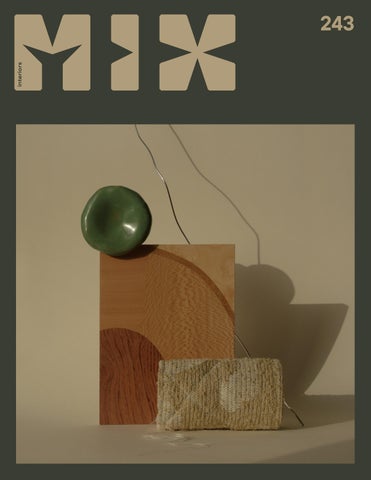
Established in 2017, Flokk self-identifies as a ‘house of brands,’ offering a wide range of seating solutions, tables, dividing systems and accessories for the workplace. Under the Flokk umbrella, Connection believes that spatial design and productivity are interwoven, platforming furniture by global creative practitioners that adapts to ever-changing work practices. For Oko lounge chair, the focus of this issue’s cover artwork, Connection teamed up with Italian-based makers LucidiPevere to bring domestic comfort to professional settings. flokk.com
Subscription
To ensure that a regular copy of Mix Interiors reaches you or to request back issues, call +44 (0) 1161 519 4850 or email lisa@mixinteriors.com
Annual Subscription Charges UK single £45 50 Europe £135 (airmail) Outside Europe £165 (airmail)

Contact
Unit 2 Abito, 85 Greengate, Manchester M3 7NA
Telephone +44 (0) 161 519 4850 editorial@mixinteriors.com www.mixinteriors.com
Instagram @mix.interiors LinkedIn Mix Interiors


Every spring, the design world begins a familiar migration. First, we descend on Milan, where the city’s palazzos and courtyards become a stage for bold ideas; then, a few weeks later, on Clerkenwell, where the scale is substantially smaller, but there’s something of the same energy. What were once primarily trade fairs now look a lot more like festivals –minus the portaloos.
In Milan – arguably the Glastonbury of design fairs – the shift has been years in the making. Product launches still happen, of course, but they often arrive wrapped in installations, performances or immersive environments. Brands increasingly host dinners rather than presentations (no complaints here). Queues form outside grand historic buildings, not just to see a chair or a light fitting, but to experience a moment – more often than not, something suitably photogenic and shareable. The same is true of Salone del Mobile itself, of course. Who doesn’t remember those hour-long queues to see David Lynch’s 2024 installation; the disgruntled on-the-day visitors turned away, because capacity had already been reached for the duration of the fair through preregistrations? Still, a testament to the pull of such activities for design festival-goers.
Welcome
Clerkenwell, while smaller in scale, has embraced a similar spirit. Streets close to traffic, showrooms spill outward and the programme stretches well beyond products into talks, exhibitions and late-night gatherings. For three days, EC1 becomes less a commercial district and more a design neighbourhood –somewhere to wander, discover and to bump into conversations already in progress; often with familiar faces.
It’s tempting to frame this as spectacle overtaking substance, but the ‘festivalisation’ of design weeks says something about the role design now plays. Interiors, workplaces, hospitality spaces – they’re all increasingly about experience as much as specification. It’s only natural then that the industry’s biggest get-togethers have evolved in the same direction.
And yet, between the installations and the street parties, the real purpose of these weeks remains unchanged: ideas circulate, relationships form and, fundamentally, products find their way into projects – and indeed the pages of Mix Interiors.
This issue neatly straddles the two events. Inside you’ll find guides to both, as comprehensive as can be at the time of going to print. Closer to Milan and Clerkenwell, we’ll be supporting these guides with social content and daily digest newsletters spotlighting the most important installations, conversations and inspirations; the products being unveiled or showcased. Follow us on Instagram and sign up to the Mix Interiors newsletter at mixinteriors.com for our curated recommendations.
Next issue and online we’ll take stock of what’s emerging, what’s resonating and what might endure once the lights are packed away and the courtyards emptied. Because beyond the festival atmosphere, the real question remains the same as ever: which of these ideas will actually shape the spaces we design next?
Harry McKinley Managing Editor

New HÅG Tion Mesh
The newest addition to our most flexible task chair family.
With a breathable mesh backrest and the agile, ergonomic design that defines HÅG Tion, it offers a lighter look and even more versatility. Perfect for flexible offices, meeting rooms, or creative studios. The mesh edition delivers comfort, movement, and long-term support.


Elevating spaces.


Sound materials
Autex Acoustics® believes materials can carry more than function—they can carry purpose. Every fibre is part of a bigger story, one where resources are valued, not wasted, and where design becomes a promise to the future. From circular thinking to systems built to last, we’re redefining what our products can give back over a lifetime and beyond. By reimagining what they might become next, we’re working to close the loop with intention and integrity. Because doing good isn’t just what we strive for—it’s who we are.


Elastic Workspaces for Elastic Minds
64% of employees say the office isn’t built for their best work.
Bureau designs workspaces for people, not floor plans. Fixed desks don’t flex. Modular spaces do. When you design for the extremes, focus stops being a luxury and starts being the default, allowing every person to find their daily rhythm.


Introducing Lana, the transformational laptop stand bringing uncompromising ergonomic support to workspaces everywhere.
With intuitive height adjustment and an integrated USB hub, it delivers ergonomic support and seamless connectivity across a wide spectrum of users and workstyles. As leaders in workplace ergonomics, we’ve set a new benchmark for inclusive laptop use with Lana.


Loop-the-loop
In New York, Brooklyn’s Canarsie Pier is reimagined as a phased, floodadaptive urban loop – one that redefines the interface between architecture, infrastructure and climate resilience on a global scale. Proposed as a three-phased delivery, architects Ruxuan Zheng and Haoyuan Wang intended City on the Loop to be an adaptive mixed-use concept of tiered housing, mobility structure and ecological systems which flex and recover with rising sea levels. Based on Federal Emergency Management Agency (FEMA) data, each phase responds to projected 100-year flood levels in Canarsie for the years 2025, 2050, 2100 and 2500
Phase one retrofits Belt Parkway by constructing a new housing and transit spine above it and replacing the existing barrier between neighbourhood and water. Phase two sees additional housing, light rail and water-based transit built on the previous structure, introducing the main components of a liveable neighbourhood to the development. And lastly, phase three factors in a hotel and adjoining commercial district to activate the city edge, bringing public life to the waterfront, while promoting awareness of long-term coastal sustainability.
Rather than fighting the sea with singular barriers, Zheng and Wang envision City on the Loop as a cohabitation system that evolves with its immediate environment. Wetland buffers, suspended gardens and public platforms allow natural and urban systems to coexist, with vegetation growing vertically and infrastructure moving with the tides. Though unbuilt, the project demonstrates how speculative design can address issues concerning social housing, transport and environmental risk, while also reshaping spatial and operational identities of coastal cities at large. City on the Loop is not a standalone solution, but a replicable concept – a system that could create a new paradigm for coastal cities for New York and beyond.
ruxuanzheng.com
Tessel

Design that fits: people, places, purpose.
Designing for the people-centred workplace

Air and craft
A collective of aerobatics, motocross freestylers and skydivers, AEROTIM sought a maintenance space for its growing fleet of light-sport aircraft, as well as hub for crew members to meet and work. Approached by Founder Timur Fatkullin, Kyiv-based design studio +kouple accepted the challenge without hesitation, subsequently delivering a design-led container that now supports the group’s pre- and post-flight routines.
Design lead, Dan Vakhrameyev, took the wheel on the project interiors. Through a vertical raw zinc gate, the main deck comprises repair and storage areas, where mezzanine-level crew facilities occupy the same single volume. Steel trusses, corrugated metal roofing and technical airduct and engineering systems remain exposed, whilst cement particle board panels ensure durability and easy replacement when required.
Suspended above, the crew station features a single, frameless façade. The continuous glazed surface creates a strong spatial effect and helps maintain visual connection to the structure’s
operational core, emphasising the key values of aviation culture: clarity and situational awareness. Inside, a central table and wall-mounted glass boards are positioned for task planning, maintenance scheduling and crew coordination. ProPro sofas, vintage chairs and details fashioned from aluminium offcuts add a subtle retro-futuristic edge, while red-brown upholstery acts as a subtle colour accent within the otherwise monochromatic scheme. Rest and relaxation come in the form of bunk beds, changing amenities and a shower room that overlooks the hangar floor, with sleek hi-fi sound systems – selected by music enthusiast Fatkullin – allowing crew to recharge between flights.
Where Vakhrameyev and the wider +kouple team contributed their thoughtful design expertise, Fatkullin infused the project with his passion for both aviation and music. The resulting AEROTIM hangar is an example of workplace design that is not only professional, but also deeply personal.
pluskouple.com
Image: Andriy Bezuglov

NORAVANT™ TIMBER
RUBBER, REIMAGINED

SUPERIOR PERFORMANCE + DESIGN FLEXIBILITY + ENHANCED SUSTAINABILITY

Engineered to push boundaries, noravant timber redefines what’s possible in rubber flooring as the first PVC-free resilient flooring to combine high performance, woodgrain design, and enhanced sustainability

Pen pal
Celebrating its 75th anniversary, the BIC© Cristal pen maintains its status as the world’s bestselling ballpoint pen, originally conceptualised by ItalianFrench inventor, Marcel Bich. In time for this year’s Maison&Objet, Italian manufacturers Seletti unveiled a brandnew iteration of the writing implement, enlarging it to be a three-pronged line of lighting fixtures, much to the surprise and delight of show floor attendees.
Developed by Mario Paroli for Seletti, BIC© Lamp marks the first time BIC© Cristal has been realised as a large-scale design object, sparking a newfound appreciation for the item that quietly and continually assists our daily lives. BIC© Lamp takes on the exact form of BIC© Cristal at a ratio of 12:1, available in the pen’s most recognisable colours – classic black, blue and red – for added authenticity. Further respecting Bich’s vision, the lamp is made with materials that evoke those of the original pen, delivering an iconic, albeit commonplace, object through Seletti’s signature pop lens.
From schoolchildren to office workers, the BIC© Cristal pen has been a staple in every home and workplace across the globe since it was first conceived in 1950. Known for its unconventional approach, with BIC© Lamp, Paroli for Seletti has transformed a universally recognisable shape – one that lives in memories spanning generations – into something that is functional yet completely unexpected.
seletti.it


Tina
Emotional, functional & timeless
Big shift
From pyramids and cathedrals to statues and skyscrapers, throughout history, humans have created landmarks to unite communities, showcase progress and spark inspiration. Shift – the stewardowned social enterprise aspiring for large-scale societal change – is advancing that tradition with a brand-new typology of ‘the landmark,’ creating structures that make sustainable living tangible, desirable and, most importantly, accessible to all.
Shift’s longer-term ambition is global: a network of landmarks across six continents that are designed to accelerate the transition to a better future. For now, however, its attention turns to its first, Shift Landmark in Rotterdam’s Waterkant, poised to become one
of Europe’s most future-leaning waterfront neighbourhoods. As part of an international competition, Shift asked for a 25-30,000 sq m experience to be conceptualised, with 10,000 sq m given over to a hotel, conference centre and food court that places emphasis on ecoconscious consumption. The challenge: to make this inaugural landmark centred on circular choices that are applicable to everyday life; something to not only consider ‘bucket list-worthy,’ but also to encourage people to think seriously about the future of the planet.
Amongst a wealth of ambitious plans, five proposals for Waterkant stood out from the rest. A regenerative ecosystem and evolving social organism, Ecosistema


Urbano put forward A Living Landmark. For Heatherwick Studio, Urban Reef represents a structure that echoes a reef-inspired ecosystem, gathering people and inspiring lighter ways of living. Mecanoo presented House of Shift Rotterdam (an icon centred on upcycling, carbon storage and joyful exploration). MVRDV also submitted its scheme, Rotterdam ROCKS!, which comprises a stack of porous, living rocks, imagining Rotterdam’s new landmark through an ecological lens. Finally, Office for Political Innovation brought its Planetary Landmark for the Climate Age, a working section where climate is reshaped on a collective level.
competition.shift.world


surface trace® aspect & echo
NEW surface trace® carbon neutral carpet tiles
Made using Universal Fibers® Thrive® matter yarn, the world’s first carbon negative recycled yarn, which is C2C Certified Material Health Certificate™ Silver and our unique BioBase® recycled backing, NEW surface trace® is carbon neutral.
NEW surface trace® delves into our traditional roots and reflects the tactile craft of weaving, available in 12 colours.
Made in the UK with high stock levels and rapid delivery.

2 To learn about our sustainability principles , find inspiration and order samples visit www.burmatex.co.uk/product/surface-trace-carpet-tiles/
Garden-centred

Danish global supply chain company, Dymak, helps plant nurseries, horticulture centres and leaders in the home and garden retail sector to populate their shelves with products and packaging solutions that sell. In the market for a workplace that would reflect this nature of work, Dymak enlisted BIG LEAP –BIG’s in-house architecture, landscape, engineering and product design teams –to create a workplace rooted in high energy performance, while also creating an adaptable work environment that would grow with the company.
Located in Odense, Denmark, the 2,800 sq m headquarters is characterised by a circular shape and grid-like façade which references the Danish
architectural tradition of half-timbering in its construction. At its apex, radial cross-laminated timber frames support approximately 880 PVCs which are angled to harvest solar energy all year round, doubling as a noise pollution deterrent for an open-air courtyard.
Inside, offices, showroom space and shared facilities are orientated for socialising, the circular structure creating a connected office landscape that allows views across floors, with varied spatial types facilitating an environment where employees can set up workstations where they please. Natural and tactile materials such as wood, clay and cork are prevalent throughout, carefully selected to mirror Dymak’s own product portfolio.
Speaking to Dymak’s professional area of expertise, curated gardens were essential for connecting staff to the landscape and championing the company’s ethos of garden products with closed-loop supply chains. Recycled bricks are used to delineate outdoor pathways in the courtyard, which ultimately lead to an amphitheatre that serves as both breakout and event space. Designed by BIG Landscape, the courtyard’s design is repeated in a series of green pockets near the building’s entrance – another considered touch for a staff whose values lie in building honest relationships with the outdoor community.
big.dk


Things I've learnt

Bidisha Sinha is an associate director at Zaha Hadid Architects, joining the practice in 2005 after completing her master’s in Architecture and Urbanism at the Architectural Association Design Research Laboratory under Patrik Schumacher. She was Project Architect for Evelyn Grace Academy, recipient of the RIBA Stirling Prize in 2011 and, for the Mathematics: The Winton Gallery at the Science Museum, awarded a RIBA London Award in 2016. She currently leads large-scale interior architecture and exhibition projects across Europe, Asia and the GCC.
Be ready to unlearn and re-learn
20 years in, I still do not have all the answers; not due to the lack of trying. Every project arrives with its own quirks and challenges. I have learnt that progress starts with better questions, not louder opinions. The real education came from colleagues, consultants and contractors who have quietly solved similar problems before.
‘We’ deliver good design Architecture is not a solo act. Design begins with a problem and matures through collective intelligence. Engineers, clients, contractors, specialists –each leaves fingerprints on the outcome. I have learnt authorship is overrated; orchestration is the real skill.
Communication is a learnt skill
No one graduates fluent in ‘stakeholder’. I certainly did not. Projects demand alignment across personalities, priorities and time zones – sometimes for
years – and sometimes before your first morning coffee. Clear dialogue, calibrated tone and the courage to have uncomfortable conversations have proven as critical as any design review.
Know your brand
Over time, I realised my brand was not a logo – it was my reputation. I became known for navigating complex projects with reliability and integrity. That consistency builds trust and trust builds longevity. In this profession, credibility compounds faster than publicity.
Leadership is about accountability
Leadership is not about occupying the head of the table; it is about steadying it when things wobble. I have learnt that owning decisions – and mistakes – creates clarity. Accountability fosters trust and trust enables teams to take smart risks, solve real problems and perform at their best.

THE SISAL EDIT

Inspired by the timeless beauty of natural materials, this capsule collection reinterprets organic textures for today’s work and living spaces


SCAN TO EXPLORE MORE


The height of design

Muriel Altunaga is founder of The Flow, an independent, boutique practice specialised in space and design strategy for working and education environments. the-flow.space
The item
The Ball Chair, Eero Aarnio
The why:
Eero Aarnio once said, “A chair is a seat, but a seat doesn’t need to be a chair.” This approach is a cornerstone of my projects, and I believe it is the essence of creative thinking: everything we design could have been something else.
When designing what became The Ball Chair, Aarnio observed that when we sit, a round shape surrounds us. Aarnio asked his wife to draw a circle around the shadow of his seated body on the wall. From that simple gesture came the first prototype: a hollow sphere on a stand, open on one side so a person could step inside. Produced in 1963, the chair redefined the sitting experience. It creates a space within a space, an idea we embrace today in workplaces.
The inspiration:
I always enjoyed the idea of a space within the space. As a kid, I used to create my own playing spaces under the dining table or behind the sofas. The chair is also an example of how we can think about familiar or very well-known experiences in new ways. Rethinking the strategy and returning to the user’s experiences and needs is the secret to maintaining a creative, problem-solving approach to our design challenges.
The impact:
I believe in iconic objects that define an era or represent a change. The Ball Chair is, and remains, an iconic design. Today, it not only represents an era of new concepts that expand music, architecture, design and movies, but also represents thinking outside the box. The relevance of the concept has increased with the rise of technology, the rise in

remote communication with humans, and AI partners' demand for more ad hoc solutions within the existing spaces for learning, working and recreation.
The personal connection:
I was around six years old when I went to visit my parents’ friends, who had a version of the Ball Chair on their terrace. It was a very boring meeting with a lot of grown-up conversation. I found my spot inside the chair and fell asleep, cocooned by the sound of the birds, the sight of the trees and the feeling of being protected by the orange carcase around me. This year, a long time after the sleeping event, I sat on a chair sample that was exposed at the Workspace Design Show. I took a call there and the sensation of being protected and unseen reminded me of the little girl I once was, and the peaceful feeling was the same.


Poor air quality—especially elevated CO₂—can quietly reduce cognitive performance, focus, and decision-making. At Vetrospace, we’re on a mission to eliminate brain fog from workplace pods. That’s why we create true all-day acoustic pods with real-time CO₂-controlled ventilation and engineered airflow—maintaining a continuous supply of fresh air.
The result: clearer thinking, sustained energy, and better performance throughout the day.

info@vetrospace.com
www.vetrospace.com
Thinking with our surroundings

Most of us have an object like it: a lamp, a cabinet, a chair that survives every workplace move and clear-out. Rarely is the object particularly valuable or pristine, but it might help you focus, restore calm, get inspired, or be comfortable enough to ‘mindwander’ creatively; it has proven itself a reliable partner in your workday.
As the design world converges this season in Milan and London’s Clerkenwell, it is worth asking a more demanding question of what's on show: not whether designs are beautiful, but whether they are the right collaborators for people to spend their days with.
Productivity is too often treated as something that lives inside the individual; a matter of effort or skill. But thinking is shaped profoundly by setting, our minds extending into the tools and objects that surround us; what sits on a desk, what a chair asks of your posture, how sound moves through a room. Each plays a role in how thought takes form.
Not all work is the same, and neither are the environments that support it best. A space calibrated for deep concentration serves a different cognitive purpose than one designed for collaboration or social ease. Chosen without that distinction in mind, even beautiful objects can work against the people around them. Chosen well, they become something closer to cognitive and emotional infrastructure.
For more collaborative workplaces, design should focus on supporting shared goals. When people work well together, thinking becomes a collective act; ideas build on each other, memory is distributed across a team, and the cognitive load of complex work is shared rather than carried alone. Spaces that support this don't just look collaborative, they are structured to make collaboration feel natural; offering the right balance of visibility and privacy, stimulus and calm. In this sense, the best workplace interiors are not just settings for work, but scaffolding for it.
This is what makes curation a strategic act rather than an aesthetic one. It begins with a clear understanding of who will use the space and what they genuinely need from it; the rhythms of their work, the pressures they carry, the moments of recovery and the nature of their social interactions.
Walking an exhibition with this in mind, the eye settles on different qualities. Not just how a table looks, but what a conversation around it might feel like. Not just the finish of a desk, but whether it offers enough privacy to think. This is a different question from whether something is functional. Functionality is the baseline. The harder question is whether an object plays a positive role in the situation it serves.
The goal, ultimately, is not a fashionable aesthetic. It is a space that actively supports the people within it; their concentration, their collaboration, their capacity to rest and recover as much as to focus and produce. The objects worth bringing back to our everyday spaces are the ones that will still be earning their place years from now.
Itai Palti is a practicing architect, researcher, and multidisciplinary artist focusing on the relationship between people and place. He is director of Hume, a science-informed architecture and urban design practice. hume.space

living painting A
Designer Tara Bernerd on experience, cultural inspiration and creating happiness.
Words: Becky Sunshine
Photography: Courtesy of Tara Bernerd
Tara Bernerd is reluctant to discuss design simply as decoration. Instead, as she speaks from her London headquarters, she muses on atmosphere, movement, light, acoustics, sensation; something felt before it is consciously understood. For a designer whose work stretches from Miami Beach to Milan, from Mexico to Munich, and across a portfolio that includes Rosewood Munich, Maroma, a Belmond Hotel on the Riviera Maya, The Hari Hong Kong and the forthcoming Six Senses Milan, along with multiple residential towers, restaurants and private homes — that distinction
matters. Her interiors are dynamic: rich in material, layered in mood and detailing and often unapologetically glamorous, but the starting point is rarely visual flourish, it’s more life in motion.
“The start of any project we take on is the space planning,” Bernerd explains. “It all begins with the interior architecture: taking into consideration how you might move within a space.” What matters first is not the seductive stone, lacquered joinery, or the tactile softness of a cashmere throw, but the human passage through a room, how it reveals itself

“If I try to explain it too much it takes away the allure and the magic – it’s a process.”
sensorially: “I want to know how I am going to move around that space. What are my vistas? Where am I?” she asks. “If you don’t resolve how something works it won’t matter how beautiful it is.”
This way of thinking helps explain why Bernerd’s work feels composed, warm, inviting and always rooted in place but rigorous, and why her studio is so sought after by many of the world’s leading developers and hotel owners. Her spaces are not simply arranged; they are choreographed and curated in thoughtful layers. She describes the threshold of a home, the greeting sequence of a restaurant, the operational flow of a hotel with equal seriousness. “It is to become as if the place is already alive,” she says, “how you will navigate. How do you feel?”
Since founding Tara Bernerd & Partners in 2002, Bernerd has built a studio of more than 50 people and a formidable reputation for interiors that manage to be polished without stiffness, sensuous without excess, serene but full of vibrancy. The practice operates across an increasingly global field, working on projects that demand not only aesthetic fluency but cultural sensitivity and operational precision. Her recently published second book, A Design Journey (Rizzoli), gathers 11 projects including Four Seasons Fort Lauderdale, Conrad Los Angeles, Zentis Osaka and The Hari Hong Kong. It follows her first volume, Place (Rizzoli, 2017), arriving as a marker of a practice that has expanded not only in scale but also in confidence.


Bernerd is alert to the arc of that growth. “Any creative practice must keep evolving,” she says. “I think as a person, you want to keep evolving and certainly we want that at the studio.” Looking back through the projects assembled in the book, she sees “maybe there is some maturity to the time that’s gone by, but mostly it’s a celebration of some incredible projects.” She adds, “there are some true philosophies of our work that in some ways have always been there.” Those philosophies revolve around materiality, mood and a sharp sensitivity to place; “If I try to explain it too much it takes away the allure and the magic – it’s a process.”
Bernerd is notably resistant to the idea of thematic design in her many projects. Even in locations loaded with strong visual identity, she avoids simply reproducing local motifs. Of Hakone, Japan, for example, where the studio is currently working on a hotel, she explains that the most interesting projects are those where everything about local culture and landscape has been absorbed: “we’re not building something that’s overly themed”. The aim, instead, is “to create a hybrid of something that will speak to its surroundings, but in a contemporary way.”

Left: Hari Hong Kong penthouse. Credit: Dennis Lo
Above: Four Seasons Fort Lauderdale. Credit: Philip Vile
Bottom right: Conrad Los Angeles. Credit: Philip Vile

Travel, then, a key factor in Bernerd’s own life as well as a studio principle, is less about collecting references than building a sensibility. “When you’re travelling and you’re exposed to so many things, they just become part of your mindset,” she says. That accumulated instinct is visible across Bernerd’s international work. Osaka and Mexico, she notes, demanded utterly different responses; Munich brought its own warmth and sophisticated elegance; downtown LA, where she worked with Frank Gehry, called for something “far more industrial and cool.”
That resistance to repetition extends to the way Bernerd defines elegance; she’s interested in how people live. “I think the most important thing is to understand each project, its own story,” she says. “Some will move to something more traditional; some will move to more contemporary. So, we start to feel

Left: Belmond Spa at Maroma, A Belmond Hotel Centre: Woodend restaurant at Maroma, A Belmond Hotel
Right: PP bar and lounge
a DNA of what’s appropriate for that project.” Lifestyle, rather than image, is the real measure. In a hotel restaurant, she says, one of the first conversations may be about whether there will be white tablecloths, because service and atmosphere begin there. In a family home, the crucial question is how the family lives. “It’s about one word: lifestyle. What is the lifestyle of this place?” A formal salon may sit alongside a softer media room; both can be sophisticated, but their sophistication lies in how precisely they answer to use.”
It is also, she says, about layering. Bernerd describes the development of a project almost cinematically: the floorings and walls, the mood boards built from materials and inspirational imagery, the silhouette of a woman in a camel coat used to evoke tone, the progression from threshold to lounge to furniture to fabrics to lighting. “The process is so considered, and it is always about layers,” she says. “We’re creating a painting in a sense that you dip into, you’re living in it.”


“It’s about one word: lifestyle. What is the lifestyle of this place?”

“Elegance is making sure there is attention given to everything, whether it’s a bookcase or joinery.”
Below: Frette by Tara Bernerd. Credit: Kate Martin
Right: Rosewood Munich. Credit: Davide Lovatti
And then there is the detail, which the studio is particularly skilled at. “Defining elegance is making sure there is attention given to everything, whether it’s a bookcase or joinery,” she says. An artisan’s care matters as it signals quality, but also because it gives emotional weight to a room. She returns often to the idea of spaces that are “seductive, sophisticated, warm” and, crucially, inviting.
If Bernerd’s design language is emotionally charged, she is equally frank about design being a business. The studio is offered a substantial amount of work, she says, and turning projects down can be difficult. “Huge considerations are always about people. It all starts with people – owners, operators and the creative teams – because those relationships are years long on a big
project.” She refers to fit, confidence, timing and trust. The right project is one where the studio can genuinely add something, where the client relationship feels sound and where the team can deliver to schedule. “If we can adhere to timings, if we can mobilise the right team, and if the relationship feels in a good place, that is the dream.”
That emphasis on relationships also helps explain Bernerd’s growing body of product collaborations. Her recent work with Frette and Medea 1905 – the debut collections launched during Milan Design Week last year – didn’t emerge from a grand strategic plan, rather it was holistic, through conversation and mutual interest. “Everything is about people for me,” she says. “It was very organic how it came about.”

Left: Guestroom at Maroma, A Belmond Hotel


With Frette, where she is now a creative design partner, the collaboration began with throws and cushions before moving into table linens, trays and tabletop objects which launch this year during Milan Design Week. Bernerd speaks about the pieces with intimacy. The same care, she says, goes into the finish of a tablecloth as into a hotel room: the thread count, the stitching, the feel in the hand. What interests her is the way domestic objects alter the emotional texture of a space. “These things will lift your bedroom or change the feel of a sofa that's been there forever,” she explains. “And like all our things, they're aesthetically driven, but they are crafted, practical, seductive. To be able to jump into the elements that speak to us every day has been wonderful.”
Medea 1905, meanwhile, extends her long-standing involvement with bespoke furniture. Much of the furniture, lighting and fittings in a Tara Bernerd-designed project are custom-designed and site specific. The Medea collection allows that language to be formalised. Last year’s chaise has become a modular sofa, a small side table has morphed into a cluster of coffee tables, the grand bed slimmed down into something more practical. That is perhaps the Bernerd signature: spaces and products with personality, layered with thought and consideration, places and objects that tell stories and make our lives better.
What does Bernerd most hope people take away from one of her spaces, or from living with a product she has designed? Her answer comes without hesitation, rather an emotional response, human and instinctive. “Happiness. If someone’s happy that’s enough for me.”

A place for everything and everything in its place
James Melia on white walls, clear desks and why you will never catch him ‘styling’ anything.
Words: Katie Treggiden
Photography: Courtesy of BLOND
The first thing James Melia did when setting up design consultancy, BLOND, from his bedroom in 2015 was to paint the whole room white, including the floor. “I’ll never forget it because of the pain of sanding it back to the wood when we sold the house,” he laughs. He had resigned from a job he loved at PriestmanGoode, taken out a £15,000 loan against his home, and spent months coming up with a company name that he couldn’t remember the morning after pinning it proudly on his fridge. But, as he speaks from a room he has painted grey in a recently refurbished studio in London’s Hackney, it turns out he was on to something with that paint. I ask him how he came up with the name BLOND, after
his first choice proved so unmemorable. “I was thinking about how art galleries are typically sterile white,” he says, “and how the personality comes from the paintings or installations. Blond is the colour of wood that provides a similarly subtle and unobtrusive backdrop. I wanted the design studio to be a blank canvas and for the work we produced to provide the colour.” When his first client joked that he expected Melia and his team to show up wearing blond wigs, he knew he had, at least, created a memorable name and, having written his dissertation on the impact of mess on creativity, he operates a clear desk policy to maintain that ‘blank canvas’ feeling to this day.

But the fact that Melia would even have a home to take out a loan against by the time he was in his late 20s was far from inevitable. He had a bumpy start to life with financial insecurity and almost 20 house moves before he came of age; he finished his A-levels while living alone.
“My mum did an amazing job of raising two kids on her own, but I honestly don’t know how I passed sixth form,” he reflects. Having struggled with dyslexia throughout school, he had finally found design, technology and graphic design, and was hooked. “I was good with my hands and I remember thinking, ‘This is really cool; I really enjoy this’.” He wanted to study product design at university, but his mother told him there was no
money in it. “I really wanted to please Mum, so I did a foundation in maths and engineering at Loughborough University,” he says. “It was absolutely brutal.”
As unhappy as he was in Loughborough, spending a year away from home built confidence in his own decisions, and securing a place at Nottingham Trent University to study furniture and product design set him on a path from which he’s never looked back. “I fell in love immediately,” he says. “With the town, the creative scene, the people, my classmates, the work I was doing. Something just clicked and I loved everything about it.” He became a selfdescribed ‘workaholic,’ pursuing interests
Above left: Double Vision exhibit by BLOND x Harry’s at MDW 2025
Right: Laboratory exhibit at LDF 2024
“The most common feedback I give my designers is that they’re trying to do too much in one concept.”
such as typography that were beyond the scope of his degree, but fed his passion for design. One lecturer in particular, Leslie Arthur (short-listed by the Times Higher Education Supplement as one of the most innovative in the UK), sparked his imagination. “Until then, I had never sat in a lesson and thought, ‘I want to hear everything you've got to say’,” says Melia. “He was incredibly inspiring and taught me that all design is communication.”
A year in industry followed, during which he worked grindingly long hours for a weekly pay packet that barely covered a tiny flat, above a Vietnamese restaurant, with a permanent leak that the landlord refused to acknowledge. “And I loved all of it,” he grins. “I loved being part of the design consultancy industry. That time moulded me into who I am.” He graduated and spent more time in London design firms, but always knew he would eventually set up his own studio. And 11 years on from that all-white bedroom, his early enthusiasm doesn’t seem to have waned. He speaks passionately about his belief that strategy should drive design.
"Although it’s often what clients initially come to industrial design agencies for, I am allergic to the word styling,” he says. “We don’t even start sketching until at least halfway through the project, because first we have to fundamentally understand the consumer and the problem we can solve for them and then, after some deep thinking, organise our thoughts into a clear set of design guidelines, so that whatever we come up with makes their life more delightful and the world more sustainable. Strategy is the soul of a project and if you get that part right, the outcome almost designs itself.” While those outcomes certainly share a certain understated aesthetic, Melia maintains the only ‘red thread’ that runs through BLOND’s work is a commitment to strategy. However he does concede that he’s got no tolerance for the superfluous: “The most common feedback I give my designers is that they’re trying to do too much in one concept,” he laughs. “I’m always telling them to split one idea out into three different concepts, so each one is crystal clear about what it is trying to communicate.”

James Melia, BLOND

I ask Melia what he’s most proud of, expecting him to tell me about an awardwinning project or a big-name client – perhaps Fussy deodorant or Joseph Joseph – but the word ‘culture’ is out of his mouth before I can even finish the question. “When you start out, you imagine that running a business is about hiring people, paying them and looking after their working hours, but it’s so much more than that,” he explains. “Every single person is different and you have to create a career path for each of them, as well as respecting their time and creating an environment they want to be in, and then structure the company around that. It’s dynamic and constantly evolving, but working out a recipe for how to keep doing that is something I'm really proud of. I even took a short video of the office last week because it just felt so happy and full of people enjoying their work.”
One of the ways in which in which Melia invests in that culture is through Milan Design Week and London Design Festival. With the majority of their work under NDA due to intellectual property restrictions, exhibiting is not as simple as showing their latest projects. And while taking part in design shows is, of course, partly about raising their profile

Above: Entry to BLOND Laboratory Centre: BLOND Laboratory at LDF
Right: Objects on display at LDF exhibit
and showing how they work, if not what they do, exhibitions such as BLOND Laboratory are also about giving the team opportunities to collaborate and play.
“It is lovely for them to be involved in something that we’re not doing for money, but for the design community,” he says. Previous collaborators include Form Us With Love, Pentagram’s Jon Marshall, Julie Richoz and Sony’s Hirotaka Tako.
As we speak, his team of 28 (soon to be 35) is happily working around him in a space that they have recently renovated.
The studio, on a quiet Hackney back street, is designed around the different types of work they undertake on any given day, with a clear purpose for every inch of space. An expanded workshop houses multiple 3D-printing machines that run 24/7, such is the importance of prototyping to the BLOND process. The industrial steel kitchen island around which the team prepare their lunch sits directly underneath an identically sized light box so it can double-up as a photo studio. “It’s been designed to take a beating and yet anything you put on there immediately looks like a professional photo, even if you are using a phone camera,” says Melia. While the workshop is allowed to get messy,


“Every single person is different and you have to create a career path for each of them.”
James Melia, BLOND Interview
Below:
Workshop space at BLOND’s Hackney workspace
Right: Kitchen area at BLOND’s Hackney workspace
extensive storage throughout the rest of the studio enables his clear desk policy and supports client confidentiality with each project returned to its own box at the end of the day. Melia designed the desks himself, hiding powerful computers in their columns, keeping their surfaces as clear as possible. But most importantly, the studio is designed to foster connection and collaboration. “There are lots of online tools now, but we wanted a specific collaboration space for ideation, so we can come together and have conversations about the work,” he says. And there is that understated design aesthetic again: a blank canvas comprising a pared back, industrial
material palette – art-gallery grey in addition to the original white, and a place for everything and everything in its place.
From humble beginnings, Melia’s passion for design and care for people has brought him all the way to this purposebuilt studio surrounded by a dedicated team who want to come in to work every day. “I feel very lucky that I chose the right profession,” he says. “We celebrated 10 years last year and I’m proud that we made it to that milestone and that our clients value our opinions. Now, we just have to keep working hard to ensure that we still deserve to be heard.”


For tech company Snap, Studio Vincent Eschalier has created a Paris HQ that needs no filters.
Words: Harry McKinley
Photography: Jean-Pierre Vaillancourt and Snap

Studio Vincent Eschalier

For many, Snap, the US-founded tech company, is best known for Snapchat –the messaging and photo platform that has generated countless memes, driven in part by its tongue-in-cheek filters. Yet its successes extend far beyond its flagship app – a camera-first technology business spanning visionary augmented reality, software tools and lifestylecentric hardware, including glasses that, in time, are intended to introduce an AR layer into everyday life. It’s all bold and immersive stuff.
Considering Snap’s raison d’être is fostering connection then, the exterior of its Paris HQ – one of over 25 global outposts – is remarkably discreet. Set in the smart 8th arrondissement, I was at first unaware I’d arrived, half expecting to deploy my rusty French in pursuit of directions when pressing the buzzer –beside two heavy and unbranded wooden doors. “We’re not about bragging,” laughs Gregory Gazagne, Snap France’s MD, when we rendezvous at the ground floor café.
The building, which counts Hermés and Cartier among its neighbours, was, until 2019, the home of a prestigious wine body – with some elements said to pre-date the French Revolution. Though Paris is ripe with such anecdotes, there’s even a suggestion Napoleon himself may have hotfooted along some of the tunnels that cluster below.
For Snap, it’s the first time the French team have been pulled together into a single HQ – previously dispersed

across three locations throughout the city. But, as Gazagne attests, creating a single nucleus now allows the team to “better collaborate, be close to clients” and, especially important for younger members, “make use of a really comprehensive suite of amenities.” Beyond facilities, this even includes an in-house pastry chef and a swish lunch served daily in the top floor canteen; which, in appearance, has more in common with a hip neighbourhood bistro.
Noted for its previous work with tech and media companies, Studio Vincent Eschalier was recruited for the design – on a wide ranging brief to bring modernity to an historic building; use the interiors to cultivate culture; and engender a sense of place, lending a US business a discernibly French accent.
Image on previous page: Lobby area and ornate staircase
Above: The conservatory providing additional work and gathering space
Studio Vincent Eschalier


Snap, Paris Case Study
“The vision for us was clear,” explains Vincent Eschalier, the studio’s lead. “We had to create a place that represents the brand while embracing the character of an 18th-century hôtel particulier. So our narrative was to let heritage and timeliness coexist; a Parisian flagship that feels both rooted in the city and aligned with Snap’s creative universe.”
Though a hôtel particulier traditionally suggests a grand private residence, for Snap inspiration has also been drawn from the public variety – Gazagne noting that the ground floor café and lounge evokes something of a boutique hotel lobby; with its easy comfort, book-lined walls and gentle approach to corporate branding. Though the yellow walls flanking the coffee bar and the digital screen in the form of Snap’s Ghost logo are unmistakeably of the company, like the rest of the project, this isn’t simply a standard workplace wrapped in Snap packaging. In fact, beyond that initial arrival statement, there’s little by way of insignia throughout; even that emblematic sunshine hue employed sparingly and carefully by Eschalier and his team.


The majority of the ground floor is designed for hosting – the café and lounge opening out onto a stately courtyard, surrounded by magnificently ornate façades. Across, an augmented reality lab not only showcases Snap’s creative work, but is intended to serve as a centre of AR excellence for Paris; indeed France as a whole. Here posters and weighty tomes highlight some of the most prominent cultural collaborations – AR experiences created with Daft Punk, The Louvre and The Design Museum among the greatest hits. Though the space reflects work completed, it also feels like something of a glimpse into tomorrow’s world – progressive iterations of Snap’s AR spectacles neatly set out, hinting at a technologically integrated future. There’s also a nod to the swanky retail stores that occupy nearby streets, with items artfully peppered for perusal.
Of course, more than a showroom or hosting point, the project spans some 2,900 sq m and was three years in the making – uniting elements developed across the 17th, 18th and 19th centuries into a contemporary whole that includes workspaces, meeting rooms, social spaces and an underground auditorium with seating for around 90. Move past the welcome spaces and the building is a warren.
“In fact, considering the building combines different eras and complex layouts, our first task was to bring coherence,” notes Eschalier. Offices, on the upper floors, tend to be clustered around the central core, with amenities to either side. Tricky spaces have been intelligently repurposed: former stables now house a bicycle room, old laundries have become restrooms and small interior courtyards discreetly conceal technical equipment. Though there’s perhaps scope for new arrivals to disappear down the wrong hallway, after the first circumnavigation a clear layout logic unfolds.
“Snap also wanted authenticity and a strong sense of identity,” continues Eschalier, “and we’ve preserved the building’s historical richness while making it fully functional – with fluid circulation, discreet integration of technology and warm, welcoming atmospheres for teams who often travel from abroad.”
Gazagne also notes that retaining the spirit of the building was a non-negotiable, quipping that Snap is the most ‘Parisian’ of American firms. In practice, that sees double-height spaces where the usual accoutrements of work (classic desks and task chairs) are cocooned by exquisitely restored wood panelling or set aside noble fireplaces; some rooms still host the kind of moulded 18th century ceilings that are usually the preserve of regal dining rooms or opulent hotels. Though Snap is a global brand, there’s rarely an inch of its Paris HQ that doesn’t speak to its home city in some manner.

Below left: Snap’s augmented reality studio
Above left: An outdoor area with yellow benches
Right: Conserved timber mouldings and original details
Flooring
Ad Lucem
FAP Ceramiche
Furniture
K2 Space
MVE-Collection
Lighting
Arkos
Artémide
Luxium
Deltalight
ONOK
MVE Collection
BEGA
Other
Muuto
Hay
Vitra
Kann Design
Zannotta
Sedus
MVE-Collection
Fermob
Bassam Fellow
Petite Friture
&Tradition
Ethino
Logistics and assembly
Jan Krediet

Yet while the building clearly has good bones and gifted Studio Vincent Eschalier remarkable original details, it was equally never intended to be a museum; a belief in preserving the past overriding the need to create a living hub fit for today, as well as the future needs of a growing organisation.
And so, fundamentally, the interiors are a dialogue between both – Eschalier describing the ways in which material choices or furnishing connects old and new, the green marble seen in the building echoed in a modern meeting room table, for example. “Bespoke furnishings were also central to the project,” he continues.
“So the studio designed all of the integrated furniture, paying particular attention to
material selection: terrazzo and oak for workspaces, walnut for reception lounges; lime-based plaster and brushed stainless steel for a refined finish.”
Perhaps one of the most dramatic new interventions is the glass ‘greenhouse’cum-sitting space that clutches one wall of the enclosed garden. Drawing inspiration from a traditional orangery, slender steel framing and expansive glazing blurs the boundary between outdoors and in. It is, in some ways, a shorthand for the project as a whole: the convergence of original details and, well, originality, as well as an expression of Snap’s ethos of constant and meaningful evolution.
Studio Vincent Eschalier
Right: The café area is lined with bar stools
Making visionary designs come alive


How can you make a design into reality?
Jan Krediet Logistics Solutions specialises in high-end installations for leading international brands across offices, hospitality venues, schools, and other complex interiors.
Bringing this venue to life meant coordinating transport, assembling bespoke furniture, and installing meeting pods, all with precision and careful planning.
Our teams navigate complex buildings, installing (tech) furniture, and tight deadlines with a process that ensures both quality and discretion. The result is fully realised interiors where design and functionality seamlessly sales@jankrediet.nl
+31 (0)521 539 539 www.jankrediet.com


Far from the madding crowd
At Sussex hotel and members’ club, Crafted at Powdermills, House of Dré enlists local creatives to bring craft and connection back to modern lives.
Words: Charlotte Slinger
Photography: Milo Hutchings
Less than two hours from Charing Cross, the persistent hum of London’s traffic finds a welcome replacement from the rush of a nearby stream and early evening birdsong. Far from the madding crowd indeed, but we’re not in Hardy’s fictional Wessex; boutique hotel Crafted at Powdermills is tucked away in Battle, East Sussex, a stone’s throw from where the famous Battle of Hastings took place in 1066. Built in the 18th century and operating as a gunpowder manufacturer for over 200 years, the Georgian manor house retained its name since becoming a hotel in the 1980s, with legend even suggesting that the gunpowder used in Guy Fawkes’ plot was made in one of the town’s illicit mills.
History and legend aside, Powdermills now sits at the heart of Crafted: a refreshing, wellness-oriented concept by hospitality entrepreneur, Chris King. King first made waves in the industry with Birch, the popular yet short-lived brand offering trendier takes on the classic country house. This new venture therefore set out to translate everything guests loved about Birch into a concept that would go the distance, tapping East London studio House of Dré to curate a thoughtfully designed retreat for modern lives craving more connection, creativity and calm.


55 guestrooms and three private cottages encircle the main house, itself home to a restaurant, country pub and membersonly areas including lounges, a library and the Old Kitchen – a coworking space where phone booths and charging points meet original stone floors and fireplaces. (In fact, membership to the new Aethos Shoreditch – as featured in Mix #242 –also grants members access to Crafted, as the two are sister brands.) But despite offering these professional amenities, one of the project’s key tenets is unplugging from modern life and reconnecting with nature, a value shared by House of Dré founder and creative director, Andreas Christodoulou. “With AI and things being increasingly automated, there’s this sort of utopian future where the machines do all the hard work and we just set about to create things,” says Christodoulou. “That’s a lovely vision, but I think we're still all so
locked into our screens right now, and all I hear everywhere is a massive craving from people to create and to craft.”
With a seven-acre private lake, ancient woodland and wildflower pastures, guests are spoilt for choice when it comes to digital detox: a boathouse stacked with kayaks and canoes waits by the lake, which is also lined with bookable saunas, hot tubs and cold plunge baths. Two new padel courts are set to host their first tournament of the spring, and as well as a fully equipped gym and heated saltwater pool shaded by scalloped parasols, a curated wellness programme includes yoga, Pilates, barre and trail runs. Guests can also lose themselves in creativity at the Craft Barn and Art Studio, which overlooks the neighbouring Garden Kitchen: an allotment helping the head chef create

Image on previous page: The lounge and library area
Left:
The onsite bar is characterised by old world charm
Centre: The front desk with parquet flooring
Right: The main dining room


a seasonal menu with up to 75% British provenance. Here, classes in ceramics, printmaking and natural dyes are led by local potter and artist Holly Dawes, who proved a key link to the thriving craft scene. “I’m ashamed to say I was completely naïve and surprised at how many talented artists and craftspeople were in Sussex until we found Holly,” admits Christodoulou, who recruited a team of makers with art consultant Despina Wotton. “We didn't have to go far to get loads of local talent and we could have gone on – there just wasn't enough space. There’s a tapestry of underutilised artists and creatives across the country, so from a romantic perspective, it's an amazing feeling to platform local artists, but using local people also helps to bed the business into the area.”
One such maker was Sebastian Cox, one of the UK’s most renowned furniture designers, who created bespoke desks, headboards, bedframes, coffee tables and floating drinks cabinets for the guestrooms, using timber from Powdermills’ own woodland. Cox even leads educational trail runs for guests:
“He knows all about the landscape,” says Christodoulou. “If you go for a walk with Seb, he knows where the timber comes from, how it's seasoned, how it's grown, where the wind was blowing on it. I've always admired his work, so it was a real opportunity to work with him.”
Each bedroom also includes a ‘Meet the Makers’ guide spotlighting each piece, from hand-printed linen artwork and tufted woven blankets to steam-bent oak mirror frames and hand-turned vases repurposing English oak beams from
“We wanted it to feel like a breath of fresh air: indie, homely, warm and fun, and not taking itself too seriously.”


Left: The bar area is defined by murals and low lighting
Above: A living area in a guest suite
Right: Window seating in the conservatory


HS2. “I've been painting and sculpting for years, so if I can help elevate someone’s status as an artist or craftsperson, it feels really nice,” he adds. “We position ourselves as a link or a bridge between the commercial and creative worlds.”
It was also important to Christodoulou that the design communicated quiet luxury without any pretence. “We wanted it to feel like a breath of fresh air: indie, homely, warm and fun, and not taking itself too seriously.” This playful sensibility comes through in the colourful, tactile palette overlaying the heritage site. As a Grade-II listed property encircled by flimsier mid-century extensions, there were plenty of planning permissions required from English Heritage, which the studio navigated alongside Holder Mathias Architects. “I think English Heritage knew we had good intentions and so there was a trust there. A huge amount of cost has gone back into renovating the hotel and making sure that it can be appreciated for another hundred years.” This included replacing laminate flooring with 250-yearold reclaimed hardwood and installing a custom round window as a nod to Georgian architecture.
The studio then injected its own creative flair, with spaces like the snug splashed with vibrant paint shades from floor to ceiling – as well as an eclectic mix of leopard print cushions, vintage fringed lamps, classical figurines and fluffy armchairs. Christodoulou even hand-painted one of the murals in the cocktail bar, while another celestial scene covers the ceiling of a bookable events room. “The inclination is to always respect heritage, and we do… But I wanted to show that these old houses can be contemporary and fun while still having that country hotel feel,” he explains. “There are properties like this up and down the country that have had renovation after renovation as they’re updated to serve a modern purpose. Enhancing those features was the best way to show that they can survive as heritage assets, so we infused a contemporary palette onto older bones.”

Furniture
PS Interiors
Atlas Contract Furniture
Howard Brothers Joinery surfaces
Yarn Collective
Rimex
All About Parquet
lighting
Kaski Lighting
Other
Holly Dawes
Sebastian Cox
Emma Purcell
Burlington
JKI Interiors
Despina Wotton
Evina Diamantara
18fifty
Spirited Projects
Emmaus
Trail Construction

Specialeffects

For VFX studio Rascal, dMFK has created an East London home that marries the past and present.
Words: Dominic Lutyens
Photography: Ed Reeve
The historic yet hip location of postproduction company Rascal’s new East London HQ has heavily influenced its design. Dreamt up by architects dMFK and completed last November, it occupies the ground floor and basement of a handsome 19th-century building with an elegantly old-world fascia in a green-grey shade that references the sober hues of the window frames and metalwork found in local Victorian architecture. Subtly contrasting with the traditional fascia is the company’s moniker painted on it in a contemporary, simple, sans-serif font.
Acknowledging context was a key consideration for dFMK. Joshua Scott, a director at the practice, talks approvingly of the characterful street the HQ is located on, Charlotte Road: “Plus it has a collection of independent, creatively driven businesses.”
The premises Rascal inherited were largely open-plan, cavernous, mostly painted a chilly white. The space had been given a bland, neutral makeover, presumably to make it easier to rent. “It was a sanitised, functional box,” recalls Scott. A key objective of dMFK


Image on previous page: A production studio at Rascal, London
Below left: The café area doubles as a coworking space
Below right:
Bespoke millwork is punctuated by fluted glass panels
was to imbue it with individuality. To the architects’ relief – and delight –there were exposed-brick arches in the basement and bare brick walls upstairs, the latter nodding to the brick facades of local Victorian warehouses.
Rascal, which is also based in Stockholm, specialises in visual effects (VFX), music and sound design for TV ads, feature films, websites and music videos, and has expertise in CGI, sound composition and animation. This is the first time dMFK has designed a post-production studio.
To meet the client’s exacting technical requirements, dMFK collaborated with post-production specialist Outside the Box.
“The space had to reflect the client’s creative personality, too.”
Rascal’s brief was twofold, says Scott: “The client required a number of technical studios that weren’t just an assemblage of technical spaces and apparati. The space had to reflect the client's creative personality, too.”
Rascal’s new home had to fulfil another function. “Its business integrates technical production with hospitality,” says Scott. Its clients include high-fashion big hitters Vogue and Prada, and innovative musicians, such as Stormzy and Charli XCX, and it was important the company could welcome them in inspiring, thoughtfully designed surroundings when meeting to discuss projects.
The nature of the business called for a substantially cellular layout, and dMFK made other structural changes to render the overall space more workable. In the basement now are three VFX suites, two sound suites, three colour suites and a voiceover booth. There’s another VFX suite on the ground floor.
The first space visitors walk into is now an inviting reception doubling as a coffee lounge-cum-bar, stocked with anything from coffee to Campari. A meeting room with reeded-glass windows, ensuring privacy, has been installed here too.
A few steps in, the reception leads to an expansive office, formerly a garage that boasts original timber joists and trusses.

The stairs to the basement were once situated at the far end of this room and hogged space downstairs, so it made sense to replace this. A new staircase adjoining a wall in the reception freed up space in the basement and provided a more direct route to it. Its banister is made of smooth, tactile, unlacquered brass in a rich, oldgold tone. While staff and visitors might not consciously register such touches, they make being in the space pleasant and comfortable, subliminally.
“The project was very craft-driven,” stresses Scott. “The client was keen that the space didn’t feel generic. When deciding if they liked a material, they judged it on how tactile it was, not just on how it looked.”
“Getting the layout right was the most challenging part of the project,” says Scott. The second stage – the transformation of the space into an inviting, atmospheric environment –was just as important, however, and, says Scott, “enjoyable”.
This was partly achieved by furnishing it with reclaimed pieces chosen for their warmth and tactility. Some were sourced from a nearby restaurant that was closing down and selling its furniture and fittings, all in an appealingly old-world style.
“We went to look at what was on offer with the client, who liked to check items out in real life, and we chose pieces together,” says Scott. These included a generously sized, crescent-shaped leather banquette that now graces the reception.
The architects also worked with specialist craftspeople who supplied materials or were on hand to perfect finishes. The bar counter in the reception is made of reclaimed iroko once used in a school’s chemistry lab. “This was sanded just enough to ensure that the patina we loved in the first place wasn’t lost.”
“Storytelling is at the heart of what Rascal does,” concludes Scott. “To ensure our design echoed this, we selected materials that had lived a life or that will age with character and even tell new stories over time.”
Left: Studio rigged with post-production recording equipment
Right: Original brickwork sits alongside custom joinery
Below: The front elevation of Rascal from street level


“We selected materials that had lived a life or that will age with character and even tell new stories over time.”

Flooring
Sphere8
Claybrook Havwoods Fibre Flooring
Furniture
Reclaimed furniture
Boss Design Soho Home
Surfaces
Chapelwood Joinery
Claybrook Retrouvious Autex
Lighting
Reclaimed pendant lights
Astro Lighting
Local essence

In Marrakech, Riad
La Farnatchi is the embodiment of place-led design.
Words: Harry McKinley
Photography: Courtesy La Farnatchi

La Farnatchi Case Study
Image on previous page: Interconnected sleeping and living area
Below: A shaded private balcony
Marrakech was once firmly off the beaten track; the type of destination that drew in the worldly and adventurous. Today, the dusty lanes of its Medina are more well-trodden and the tourists, well, more typical – the major sites now aesthetically sumptuous fodder for Instagram. Yet, even as the city feels more accessible than ever, it hasn’t lost its exotic essence; at once colourful and brash, subtle and romantic.
One of the great pleasures of Marrakech has always been the way in which a new world can unfold from behind the doorways that line those Medina pathways. In the city’s riads, in particular, the vague chaos of the souks is often supplanted by quiet courtyards, trickling fountains and gentle birdsong. Originally developed as houses or palaces, these inward-facing buildings force out the heat and noise, the living and social spaces oriented around central patios; the name derived from the Arabic word for garden, ryad.

James Wix
Yes, it’s wood
Woodio is a Nordic design brand combining tradition with sustainable biomaterial innovation.
Our award-winning bathroom fixtures are made from Woodio®—a fully waterproof, low-carbon wood composite.
Available at West One Bathrooms


www.westonebathroomsonline.com | www.woodio.com | @woodiodesign
La Farnatchi Case Study

Once the preserve of wealthy merchants, and still predominantly private residences, many of these homes have nonetheless been reimagined as chic hotels, sometimes with just a handful of guestrooms. Among the most highly regarded is La Farnatchi – set across nine interlinked buildings, the boutique riad comprising 10 suites arranged around a series of courtyards, terraces and connecting passageways. Opened in 2004 by the Wix family, today it’s under the stewardship of James Wix specifically, whose father pioneered the business and subsequently handed over the reins. He has bold plans for the property, including the impending addition of five new bedrooms – more bijou than the existing suites but drawing on the same design language. Other developments are afoot but, subject to planning permits, not yet ready for public consumption.
La Farnatchi has always been a work in progress, however – starting out with five bedrooms, then adding another four and, ultimately, a tenth (along with the spa), bringing things to the stillevolving iteration we see today. It’s a fundamental part of its charm, reading less as a single, unified structure and more as an aggregation of spaces, each with its own proportions and character. The courtyards are varied in scale and atmosphere, while the circulation between the buildings creates a sequence of compressed and open moments typical of the Medina itself.
The interior design approach is equally layered. From the outset, Wix wanted to avoid the binary previously found in Marrakech hospitality. “When we approached this place, we wanted to do something that was a bit different in the Medina,” he explains. “In those days, a little over 20 years ago, we noticed that
James Wix

“Traditional Moroccan craft with the spatial comfort expected by international guests.”
Below:


a lot of the other properties were either extremely Moroccan in their style or all very European; there wasn't anything that really blended the two.”
Noting that classic Moroccan interiors aren’t traditionally terribly comfortable – “I don't know if you've sat in many Moroccan chairs!” Wix jokes – the aim, in practice, was to mix the look and feel of the region with the ease of Europe; to combine traditional Moroccan craft with the spatial comfort expected by international guests.
This is most evident, perhaps, in the vivid material palette: tadelakt walls, handcut zellige tiles and carved plasterwork appear, alongside cedarwood ceilings and moucharabieh screens. These are paired with capacious beds, softer seating and more generous layouts than would typically be found in a domestic riad.
There’s also little of the cookie-cutter on show. Each of the 10 suites is distinct; no two alike and every one shaped individually by scale, light and materiality. From double-height volumes framed by grand arches to cocooning spaces layered in rich textiles, La Farnatchi still evokes something of a ‘home’ in the way eclectic pieces are assembled or, maybe more accurately, collected. There’s a looseness to the design, nothing too precious or fussy.
“If I walk through the souks one day and see a lovely lamp or something, or a great pot, I instantly imagine where it might work in one of the suites or the reception,” Wix laughs. “Next thing you know, there's a cart winding its way through the streets with my lamp on it and all the staff looking at me going, ‘he’s done it again!’.”
Left: Leather banquette seating in a bar and lounge area
Lap pool and outdoor seating at twilight
Right: Traditional detailing on arched entryways
La Farnatchi Case Study
Though this might all seem a touch ad hoc, there’s a foundationally crucial ethos at play. La Farnatchi isn’t just in a place, but of the place. At a time when hotel designers chase the narrative of locality, of supporting local craft and production, La Farnatchi is its embodiment. Almost all of the furniture and fittings have been made in Marrakech. Tables, lighting, joinery and decorative elements are, bar a few rarities, bought or commissioned locally. “Even down to picture frames,” continues Wix. “And we’ll always continue to do that, partly because it supports the local artisans and helps those skills continue, and partly because there's just such amazing quality here; you don't need to go shopping in Bali or London or Paris for all of these items, when you can get some really wonderful things here, or get them custom made.”

This reliance on local production is, as Wix notes, intentional in terms of storytelling, yet also practical. It allows the interiors to be adjusted over time without relying on external suppliers and it keeps the design process closely tied to the city’s artisanal economy – a feedback loop of sorts. The new rooms will be more ‘modern’ in design, but sit comfortably within the whole; more than 20 years after opening, Le Farnatchi continuing to be refined in small and large ways, shaped by its setting, its makers and its day-to-day use.

James Wix
Below left: Farnatchi Spa lounge area
Below right: Moroccan tiling in the spa spaces


Park life
Words: Charlotte Slinger
Photography: Taran Wilkhu

In Northwest London’s leafy new neighbourhood, Brent Cross Town, Conran and Partners embodies lifestyle-first living with The Maple.
The Maple Case Study
Despite its sprawling urban footprint, London is consistently ranked as one of the greenest cities in the world – and one particularly verdant pocket of our capital is rapidly evolving to usher in the next generation of city living. Responding to widespread demand for more housing, stronger community ties and access to outdoor space, Related Argent has opened the doors to its first build-to-rent project in Brent Cross Town, the property developer’s fledging neighbourhood in North West London. The ambitious masterplan is set to deliver an entirely new park town with its own high street, three public squares, a coliving development, 3 million sq ft of office space, a later living village, a hotel and as many as 50 new shops. Spread over 50 acres of green space, the scheme will also be home to an affordable social housing hub, student accommodation and a firstof-its-kind satellite campus for Sheffield Hallam University, with plans even in motion to build two new schools.
Contributing to Related Argent’s target of building 6,700 new homes, buildto-rent concept The Maple has been brought to life by Conran and Partners, with 600 residences carefully tailored to the dynamic, metropolitan lives of its tenants. “We’re designing to facilitate and enhance people’s lifestyles,” explains studio partner and principal, Simon Kincaid. “Someone might be interested in fitness, or others may want to find private areas like the terraces or quiet zones to be contemplative in. So it’s about ticking the boxes: yes, there's a great cycle park; yes, they can wash their bike, go for a run, or attend community events here.” This holistic approach is inspired in part by the Flourishing Index, a field of study suggesting that our immune system and cognitive function actually thrive in spaces designed around our health and happiness. Related Argent is currently using this index to quantify wellbeing at Brent Cross Town, with the help of engineering consultant Buro Happold and the University of Manchester.


“Designing hospitality spaces you can be more expressive.”
The Flourishing Index is one of the developer’s four pledges for the town, alongside achieving net zero carbon by 2030, championing local sports and strengthening transport connections. The latter has already been achieved with Brent Cross West, a new railway station that commutes to London St. Pancras in just 12 minutes. In pursuit of encouraging community sport, the scheme is also home to vast multifunctional sports fields, bouldering walls, a mini golf course and Europe’s largest softball, baseball and padel facility. At its core, it seems, is a genuine consideration of the diverse, 2,000-strong community who have already moved in since January 2025 –an ethos that guided Kincaid’s team from the outset. “Is it someone who wants a studio apartment to use as a bolthole, a small place to rent but within a big community? Or is it a family looking for a three-bedroom place? Maybe they’re new to the area and they want to bed down somewhere with all these amenities where they can meet other people really easily.”

Image on previous page: Indoor pool area at The Maple Left: Coworking booths and divided tables for focused work Centre: eighth floor bookable penthouse
Right: Dual-tone tiles line the lobby area
Below:
Textile artwork in the lobby area
Right:
Iridescent partition walls with views into the gym
Offering one-, two- and three-bedroom apartments, the scheme aims to accommodate Londoners at every stage of life, with onsite amenities bridging the gaps where needed. For example, residents can book games rooms and even a mini penthouse apartment on the eighth floor (with its own lounge, dining area and kitchen), giving those with studio apartments the additional square footage to host friends and family. And while the scheme’s design elements imbue it with a sense of place and a welcoming, youthful aesthetic, Kincaid credits this space planning and programming with fostering the most tangible moments of community between residents – “some serendipity, some constructed on purpose.”

Anchoring The Maple in its surroundings, its two towers follow their own aesthetic language: the first, designed with architects Allies & Morrison, nods to the neighbouring urban square, with the central lobby featuring a palette of raw, architectural materials including oak alcoves, terrazzo flooring and a Clayworks ceiling. Grey, tactile bricks echo the outdoor architecture, with these external grade elements softened by rounded timber joinery, rich velvet sofas and sculptural coffee tables in the lounge and adjoining coworking space. This blend of inside and out continues in the feature staircase, clad with terracotta tiles and footed by a large planter of indoor greenery. Connecting the two towers, this ‘super lobby’ takes cues from Conran’s experience in luxury hotel design, with the calm, grounded palette enlivened by custom artwork and feature walls tiled in a deep glossy teal. “One of the reasons our team likes designing hospitality spaces is that you can be more expressive with the design – whether that's more confident in colour, materiality or form – because it’s capturing users for a shorter period of time,” explains Kincaid. “You're not going to do that in someone's apartment or even possibly in a private sales scheme, but the intent here is to be a little bit more playful.”
“You’re not going to do that in someone’s apartment or even possibly in a private sales scheme, but the intent here is to be a little bit more playful.”

This hospitality touch goes beyond aesthetics, too, inspiring the way the studio layers the sociability and service of a hotel with the warmth of a home. Behind a concierge desk manned 24-hours by an attentive management team sits concealed security equipment, inspired by the way luxury hotels manage hundreds of guests behind the scenes. This functional nod to hospitality also inspired a longevityled approach, particularly across the apartments, where the studio specified durable, high-grade materials built to last. “Every day, a hotel room wants to look brand new,” says Kincaid. “You want to feel like you're the first person who slept in that bed or used that shower. [The Maple] is similarly designed for any transition between tenants to be both costeffective and efficient.”
Over in the second tower, designed with architects Squire & Partners, a biophilic aesthetic evokes the neighbouring park. Here, an impressive suite of amenities includes a fully equipped gym with vibrant dichroic glazing, yoga and Pilates studios, and a vast indoor pool flanked by saunas, steam rooms and hot tubs. And while this certainly isn’t average fare for most London renters, perhaps The Maple’s greatest luxury is the deceptively simple tenet that the resident comes first – from the young professional cycling to work or the remote worker taking an early morning swim to the young family getting active with their local community. “Related Argent are providing a very practiced, well-developed residential product, with layouts that really work: a great kitchen design with loads of storage, more wardrobes, more flexibility,” concludes Kincaid. “It's not about trying to make the best penthouse or some high concept apartment – it's just about creating something that really works for the tenants.”

Flooring
Domus, Solus, Miliken, Bolon Flooring, Havwoods, Ted Todd, Forbo, Intrasystems
Furniture
The Furniture Practice
Karakter, Audo, Tom Dixon, Carl Hansen, Fredericia, &tradition, Norr11, Artu, Hay, Normann Copenhagen, Andreu World, Arflex, Vitra, Zilio A&C, Kettal, Exporim, Ethinicraft, Fogia, Moroso, Gubi, Resident Ltd Nordic Knots, Floorstory
Surfaces
Foresso, Mass Concrete, Egger, Bauwerk, Clayworks, Porcelanosa, Mundy Veneer, Minerva, Grestec, Florin, Hi-Macs, Durat, Corian, Marazzi, Troldekt, Baux, Formica, Silestone, Caeserstone, Kvadrat, Alma Leather
Lighting Chapmans BDSP & Studio Fractal, Sweco, Marset, XAL, Tom Dixon, Santa & Cole, Vibia, Orluna, Wastberg, Vitra, Flos, Moebe, New Works, Menu, Alma Light Barcelona, Hay, Hand & Eye, Dirk Vander Kooij
Other Safety Letter Box Company, Vado, Kast, Kaldewei
Chromatic intelligence: deepening our colour vocabulary

Laura Perryman is a colour designer and forecaster with over 18 years of experience in CMF design across multiple industries. The author of The Colour Bible, she is interested in material and sensorial experiences of colour. She directs Colour of Saying, a UK-based colour and material futures consultancy.
colourofsaying.com @colour_of_saying
Walk through the halls of Milan or the showrooms of Clerkenwell and you'll hear sophisticated material discussions; tactility, thermal properties, acoustic performance. Yet colour conversations often remain observational: ‘on-trend blue’, ‘calming green’, ‘energising yellow’.
But instead of tracking the hottest colour, I love to encourage everyone to take a moment to pause and consider what that colour is really doing: a pale blue and an intense blue aren't variations – they're fundamentally different tools creating different effects for different activities. Understanding chromatic qualities matters more than knowing this year's trending hue.
I've watched projects specify terracotta and receive everything from pale dusty pink to intense burnt orange. Both technically terracotta; both creating vastly different experiences. The hue name communicates almost nothing about what the colour actually does for people using the space. Because here's what matters: someone doing focused analytical work needs different colour support than someone in a collaborative brainstorm, and both differ from someone seeking restoration between meetings. Same environment, different activities, different colour qualities required.
But what qualities really truly matter? Saturation is about purity versus greyness, and I've found it's one of the most overlooked qualities. Pure colours deliver clarity and energy, they work well in collaborative spaces where interaction and activity matter. But muted or greyed colours do something different: they reduce visual stimulation, which supports the kind of sustained concentration that analytical work requires.
Tone – lightness or darkness – affects how a space feels physically and psychologically. Light tones naturally expand and energise, which serves social spaces beautifully. Dark tones create a sense of enclosure, the kind that supports focused work or intimate conversation. Understanding tone helps you support different activity zones intentionally.
Intensity measures how much a colour demands attention. I've noticed that intense colours work brilliantly in spaces where you need people to orient quickly: circulation routes, wayfinding moments, collaboration zones where energy matters. But ask someone to sustain focus for hours under high-intensity colour and you're creating fatigue. A trading floor operates differently than a focus room and intensity levels need to acknowledge that difference.
Depth is trickier to describe; it's about richness that exists independent of how dark a colour reads. Deep colours do something particular: they ground and comfort without necessarily dimming a space. These work beautifully in restoration areas, the kinds of places where people reset between intense activities. You get psychological warmth without sacrificing light levels, which proves surprisingly valuable in spaces that need to feel both substantial and bright.
Colour associations matter of course, but they work differently depending on quality. Red signals energy, but intense red activates while deep red grounds. Both are ‘red’, both carry cultural and psychological associations, but the quality determines whether that red supports high-energy collaboration or focused determination. The association exists, but the quality determines the outcome.
In summary, understanding qualities transforms how we match colour to human need. Instead of ‘blue for calm’, we specify ‘muted mid-tone blue for sustained focus work’. It’s tuning in and asking: what colours do we really need? The colour intelligence that matters isn't memorising associations, it's understanding which qualities support which activities and specifying precisely.


Words:
Re Reframing use
Alex Scott Whitby, founder, ScottWhitbyStudio and Associate Professor of Architecture, Kingston University
There is a phrase I have been returning to lately: building as quarry. This encapsulates the idea that every existing structure is not an obstacle to be cleared, but a repository of extraordinary materials waiting to be reclaimed and given new purpose. This is not a radical new theory. In fact, it’s one of the oldest principles in architecture, which has been sadly lost in our contemporary consumer culture that constantly pushes for new products with a short shelf life.
The Burghley Room at St John's College, Cambridge brought this idea into sharp focus for our studio. When we began investigating the spaces within the Grade II listed Chapel Court, we uncovered a forgotten collection of historic oak benches, pews and tables, sitting unused in campus storage for decades. Beautifully aged, structurally sound and carrying centuries of institutional memory within their grain, normally these would either have been ignored or quietly catalogued for no discernible purpose. However, we were interested to find out if the new room could be made from the College, for the College.


What followed was an act of architectural reuse that I believe offers a genuine model for how we should be working now and in the future. The timber was carefully dismantled, planed and reworked by the College's own joinery team, craftsmen whose connection to this material is not abstract but physical and daily. The timber became the meeting table, the wall panelling and an exquisitely detailed screen that gives the room its character. The majority of the table itself is made from the old St John's tables. There is a kind of purity here, which reveals a continuity that no showroom catalogue can replicate.
Almost every material used can be passported to within a 15-mile radius of the project. This matters because it points toward the incredibly important fact that we would never have achieved this quality of space with new materials. The repurposed wood is of such a high calibre that it would be extraordinarily difficult, and prohibitively expensive, to source today. Reuse does not have to compromise the outcome, it can elevate it.
Image on previous page: A chair in the Burghley Room.
Credit: Nicholas Worley
Above: The meeting facilities in the Burghley Room.
Credit: Nicholas Worley


Ethically, reuse is simply the right thing to do. In a period of genuine climate uncertainty, it is vitally important that designers assess existing materials and structures before committing to any new vision. Identifying and understanding what’s available is now a fundamental professional skill. It can take more time and require greater ingenuity but the carbon and financial savings are profound. Costs have shifted so dramatically in recent years that what once seemed economically rational (demolish and rebuild anew) is rapidly becoming the more expensive option. Money and environmental principles are no longer necessarily in tension.
We are currently working for St Paul's Cathedral and the evidence of this tradition is written into the very stones of the building. The Cathedral's own records show materials being reused across centuries of successive interventions, showing us how people built before our supply chains became predicated on consumption and disposal. The phrase ‘a stone's throw’ could be derived from the reuse of stone from Roman temples in the City of London, literally passed between neighbouring sites to construct new churches. This heritage of upgrading and reinventing buildings with their own materials runs deep. We chose to abandon it in the twentieth century but now we must reclaim that tradition.


“The phrase ‘a stone's throw’ could be derived from the reuse of stone from Roman temples in the City of London.”
At St John's, the brief was to build something that will last hundreds of years rather than the usual short fit-out cycles. That core belief changes everything about how you design. It demands that you think carefully about what the next generation of occupants will find when they inherit the space. There is something profound about that responsibility, which we don’t take lightly. An organisation like St John's transforms the lives of the people who pass through it. Those people deserve spaces of the highest quality, spaces that carry within them a physical connection to those who came before.
This
Below:
External façade of St John's Collegge. Credit: Nicholas Worley

Left: Timber walls separating the space. Credit: Nicholas Worley
Below left: Table and chair details. Credit: Nicholas Worley
page left: Timber panelling and original windows. Credit: Nicholas Worley
Positive Impact ScottWhitbyStudio
Below
There are technical challenges, of course. Old oak absorbs moisture differently to new timber and not all the products we used were recycled. However, we did want to consider the environmental impact of everything we did, such as a 4mm application of cork sprayed onto walls and ceilings that delivered a 32% improvement in thermal performance, alongside significant acoustic benefits and active carbon sequestration. These solutions do exist and we simply need to look for them.
The project has already begun to shift conversations with clients and set new precedents within the sector. While this is encouraging, we now need a collective drive to treat reuse as the default starting point for every project, not as an interesting niche or a sustainability footnote.
It is time we remembered that the best buildings have always been made from the places they inhabit.
scottwhitby.com


Julia Watson
Why futurethe of design drawingmeans Indigenousfrom principles

Words: Julia Watson, designer, educator and advocate
Photography: Lo-TEK Water (2025), Lo-TEK (2019), both Taschen

Above: Tiered paddies
Would you believe me if I said that for thousands of years, design – specifically the design of our natural environments – has been humanity’s greatest gift to the planet? Across continents and cultures, ancestral TEKnology has long functioned as a master plan for planetary coexistence: producing clean air and water, living soils, abundant food systems, coastal resilience and regenerative ways of living. In landscapes shaped by terraces that slow and hold water, mangrove forests that buffer coastlines, and mollusc reefs that build living underwater scaffolds of protection and productivity, we see design not as an object, but as a living system – one that breathes, adapts and gives back more than it takes.
These systems allowed human societies and ecosystems to thrive together. This knowledge is not a relic of the past but living design intelligence – teaching us
how to work with nature as a collaborator rather than competitor. The systems at their foundation – and at the foundation of our global biodiversity – are not remnants, but blueprints for a future now coming into view, challenging design’s enduring fascination with novelty and the promises of high-tech modernism. Centering this intelligence sits at the heart of my work, and increasingly it must sit at the heart of design itself.
For most of the past century, design has been driven by a belief that progress comes through invention – that newer is always better, that the future must be built from scratch. The discipline prides itself on innovation, yet as climate instability intensifies and ecosystems collapse under development, the limits of this model are becoming clear. The uncomfortable truth is that many of the ‘solutions’ designers are now racing to
Julia Watson
Image on previous page: Water crossing made with stone
BRING IT TO LIFE

NEULAND
BY IPPOLITO FLEITZ GROUP
Loud world OFF, Serenity ON. For spaces with clarity, naturalness, and calm. DUO carpets – Only two materials. Easy to separate. Designed for circularity.
Below Left: Man tending to flood-based systems
Below Right: Water-sensitive infrastructure
Opposite page left: : A person collecting water
Opposite page right: A woman cooking in a decorative outdoor kitchen
develop – water-sensitive infrastructure, regenerative landscapes, climate-adaptive settlements – have existed for centuries within Indigenous knowledge systems. Not as experimental ideas, but as practices refined through long-term relationships with land, water and ecology.
Across the world, Indigenous cultures have shaped landscapes through systems that are simultaneously infrastructural, ecological and cultural. Flood-based farming systems that move and store water across seasonal landscapes, raised agricultural fields encircled by canals that cultivate food while regenerating soil, and forest gardens that sustain biodiversity and communities all reveal design as a living, regenerative system –one that is not fixed, but evolving, attuned to seasonal cycles and environmental feedback, and designed to regenerate over

time. They do not separate performance from beauty, or infrastructure from culture, but hold these qualities in continuous relationship.
Drawing from Indigenous principles, however, is not simply about adopting alternative techniques. It requires rethinking the assumptions that underpin design practice. In many Western traditions, land is treated as a neutral surface onto which development is placed – a blank canvas awaiting form. Indigenous worldviews approach land differently: as a living system with agency, memory and meaning. Rivers, forests, soil and wildlife are not background conditions but participants in shaping spatial systems. Where one model seeks to stabilise and impose, the other listens, responds and co-evolves – design emerging through relationship rather than control.

Julia Watson
“Drawing from Indigenous principles requires rethinking the assumptions that underpin design practice.”
This shift transforms the role of design. Instead of imposing order onto landscapes, design becomes a process of working with existing ecological systems. Sustainability, in this context, is not a technical checklist of materials or certifications but a cultural practice embedded in how settlements grow, how resources are shared, and how landscapes regenerate across generations.
Equally important is how design decisions are made. Indigenous spatial systems rarely emerge from a single author; they are shaped through collective knowledge, observation and community governance. Engaging with Indigenous principles therefore demands more than referencing imagery or borrowing forms – it requires changing the process itself: listening before designing, collaborating with knowledge holders and recognising

communities as experts of their own landscapes. It may mean beginning not with a plan, but with immersion – reading the land, understanding its rhythms and allowing material, climate and community knowledge to guide what is built. Design becomes less about authorship and more about stewardship.
This distinction matters because design disciplines have too often treated Indigenous knowledge as aesthetic inspiration rather than spatial intelligence. Textures are replicated, forms are borrowed, but the relational systems – the governance, ecological intelligence and cultural protocols –are left behind. If Indigenous principles are to shape the future of design, that dynamic must change and the urgency could not be greater.

Below left:
by Julia Watson
Below right:
Lo–TEK. Design by Radical Indigenism (2019)
by Julia Watson
Over the next 15 years, the equivalent of 15 cities the size of London will be built every year until 2040 – roughly 165 new cities of 10 million people each. This is not only urban growth, but planetary transformation – of how land, water and ecosystems will be shaped, or unmade, by the decisions we make now. Yet cities continue to be built from the same extractive template – a spatial logic mirroring machines, optimised to drain, divert and erase water while severing urban life from the ecological systems that sustain it. The question is no longer whether we will build, but how.
Could the urbanism we construct become regenerative rather than extractive? Should we design cities that extract, or cities that restore? Will we continue to treat water as an enemy to be controlled, or begin to see it as a teacher? The answers are not ahead of us. They have been here all along.

The question is not whether we continue to build, but whether we remember how to build – not by looking forward alone, but by recognising the intelligence already embedded in the landscapes and cultures that have resisted extinction, and allowing that knowledge to guide what comes next.
Watson is an award-winning author and leading voice in the global movement toward regenerative design through Indigenous knowledge systems. Her work uplifts ecological intelligence cultivated over millennia – offering a radical rethinking of sustainability, design and our relationship with the natural world. Her award-winning, bestselling books, Lo—TEK, Design by Radical Indigenism and Lo—TEK Water, A Field Guide for TEKnology (both Taschen), are redefining how we imagine the future of cities and communities.
juliawatson.com

Julia Watson
Lo–TEK Water. a Field Guide for TEKnology (2025)
LE CHIC BOHÈME COLLECTION
BOHEMIAN PATTERNS. LE
BOHEMIAN PATTERNS. LE CHIC LIVING.


BOHEMIAN PATTERNS. LE CHIC LIVING. Meaningful Design to Inspire People’s Lives
KITCHEN - RIVIÈRE ROSE
Mix Awards 2026
25 June 2025
Evolution London


Workspace ShowDesign
We look back on 2026’s Workspace Design Show, deploying its signature bevy of talks, installations and trade at London’s Business Design Centre on 24-25 February.
Back at the Business Design Centre (24–25 February), Workspace Design Show returned for its fifth edition, reaffirming its position as the UK’s leading forum for workplace design innovation. Drawing over 5,300 attendees from 40 countries, the event convened an international crowd of architects, designers, developers and specifiers, all changing the landscape of tomorrow’s office interiors.
Themes
Responding to the current cultural climate, this year's Connected Realities theme suggested that tomorrow’s workplace landscape should not be viewed as ‘physical versus digital’ but, instead, a tactful and visual entwinement of the two. The 2026 edition of the show invited exhibitors and visitors to explore this idea, and how hybrid models, immersive technologies and smart environments might be responsible for reshaping the office as we formerly knew it.
Inspirations
More than a conceptual backdrop, this year’s theme was firmly embedded into the design and construction of each exhibitor stand, the industry’s most pioneering brands – such as Interface, Forbo Flooring Systems, Bisley, Pedrali and Impact Acoustic – showcasing solutions fit for next-gen workplace settings. Across two days, over 100 specifiers revealed their respective product innovations, spanning contract furniture, smart materials and acoustic technology, as well as the latest advancements in digital tool design and integration.
Installations
The Circular Hub by MCM and Future Works
Amongst standout features, The Circular Hub acted as a prototype of circularity in motion, answering the question: How can exhibition design employ circular thinking rather than a linear approach?
Conceived by MCM in partnership with Future Works, and supported by the regenerative design studio, Nested Living, the pavilion outright rejected the wasteful nature of temporary events platforms, utilising reused and bio-based FF&E (Gencork, Planteria and Studio Omelette being key contributors) to make its stance on sustainability known. Serving as an incubatory model, visitors engaged with a roster of furniture repair and disassembly activities, educating on the positive impact of hands-on ecological design.
Insights Lounge by Peldon Rose
Providing a contemplative counterpoint to the lively show floor, Insights Lounge showed how computer-operated spaces could be a valuable source of relaxation, despite stronger associations with overstimulation and digital noise. Designed by design and build experts Peldon Rose, Insights employed the use of light and sound to orchestrate a periodic 20-minute-long ‘exhale’ for visitors, illustrating how intangible, techcontrolled spaces can inspire moments of pause and cognitive reset.


Merge Lounge by
M Moser
By contrast, M Moser’s Merge Lounge closed the gap between technology and craft, with attendees being invited to intuit digital interfaces and customise the space around them. Lux levels, lighting type and colour could be augmented to suit individual moods, from bright and uplifting settings tailored to productivityboosting to more subdued, darker environs for calmer workflows.
Through two distinct pathways (one boundaried; the other, subject to discovery and change), Merge Lounge blurred the lines between user and workplace, the interactivity of its makeup demonstrating how tomorrow’s workforce could be automating their own working conditions in real time.
Workspace Design Talks Lounge by Gensler and Area
Designed by Gensler and Area, and featuring acoustic treatments by Autex Acoustics, Workspace Design Talks Lounge acted as the principal gathering point at this


year’s event, with three satellite platforms –Sustainability Talks, Occupiers Forum and FIS Conference – enriching the programme. Transitioning between cosmic colours and gentle gradients, Workspace Design Talks Lounge aimed to be illusory by nature, the stage set drifting between physical and digital states and challenging the perceptions of both speakers and audience members alike. At its core, a circular stage reinforces the notion that human connection still remains paramount, even in an increasingly digital age.
Conversations
Over the course of two days, over 120 experts speakers congregated to address the industry’s prevailing shifts in technology, culture and design as part of a curated lineup of lectures, interviews and panel discussions. On the main stage, Mix Managing Editor Harry McKinley was joined by workplace architect Steve Gale, Casper Schwarz (CEO of the eponymous studio), Gensler’s Elyse Ayoung and Julian de Metz of dMFk to consider ‘If the office is dead, why are we still designing it?’.
Encompassing arguments for and, indeed, against physical working environments, the provocation succeeded in rousing its mixed bag of opinions. Schwarz mulled on the alternative: remote working, especially for the creative industries. “You have to be [together as] a team, right? You can’t just sketch something and hold it in front of the camera, saying, ‘Why don’t you try it like this?’”. He countered this by acknowledging that, actually, in the face of inflation and rising house prices, employee quality of life could, in fact, improve with the freedom to work where they pleased. On the contrary, Ayoung prophesised that a basic human needs for purpose would be the main driver for a mass return-to-office, while Gale mentioned that employers are – perhaps unrealistically – looking for the ‘Holy Grail’ when it comes to office design expectations. de Metz summed up the conversation with his own thoughts on keeping fixed workspaces alive and kicking, “[Designing offices is about] being constantly sensitive to human experience and what people are actually asking for.” He continues, “And if you’re not, you are dead.”
Milan: 21–26 April
Guide: Milan Design Week 2026
The world’s biggest design fair is back. From 21–26 April, Milan Design Week is returning to Italy for its much-anticipated 64th edition, with more than 1,900 exhibitors and 227 brands from 32 countries set to exhibit at Salone del Mobile alone. For the sixth consecutive year,
Salone’s opening night will once again be marked by a performance at the Teatra alla Scala, with an orchestral concert on 21 April setting the scene for five days of worldleading design installations, activations, product launches and panel talks.

Events
Milan Design Week 2026


Getting around Themes New for 2026
Accommodation initiative MiTo Design Connections is back for its second year, helping to ease the pressure on local businesses during Milan Design Week by offering tailored stays in Turin. This partnership with Salone del Mobile, first introduced in 2025, aims to help international visitors enjoy the globe’s most creative week without contending with dynamically priced hotels and often unreliable Airbnbs, and includes transfers between 35–45 minutes from the fair.
Designed by LeftLoft, this year will also see the launch of a neuroscience-based wayfinding and visitor experience to help attendees navigate the sprawling 169,000 sq m exhibition site more easily. The creative studio has devised a system rooted in neurological research and the logic of urban railway networks, ensuring a smoother visitor journey aided by more intuitive signage and accessible design.
This year’s communications campaign, ‘A Matter of Salone’, centres around materiality and explores both the physical and symbolic origins of design.
Developed by Milan-based creative studio Motel409, the multidisciplinary campaign features work by photographers Charles Negre, Eduard Sánchez Ribot and Alecio Ferrari and set designers Studio Végété, Laura Doardo and Stilema Studio. The visuals explore the very fundamentals of design through four raw, naturally occurring materials: stone, petal, wood and sponge. Visual themes were also created for the inaugural Salone Raritas, represented by a rare earth magnet, while Salone Satellite (with this year’s ‘Reimagining Matters’ prompt geared towards talented young designers) is symbolised by an egg.
This year marks the first edition of Salone Raritas, an exhibition space spotlighting curated items, collectibles and ‘outsider’ pieces. Featuring 25 carefully selected suppliers, the exhibit caters to designers executing particularly niche or daring schemes, with international names ranging from Nilufar and COLLECTIONAL to Mouromtsev Design Editions and Salviati x Draga & Aurel.
A soft launch of Salone Contract will also be held ahead of its official 2027 debut, dedicated to the complex and rapidly evolving industry of contract furnishing. With international architecture and urbanism practice OMA leading its research masterplan, on 22 April, initial observations will be shared in a lecture by OMA founder Rem Koolhaas and managing partner David Gianotten at the Drafting Futures Arena, followed by international industry forums.
Superstudio Design 2026 will also introduce a new format, with a ‘diffused map’ that moves beyond the traditional district concept. With 30,000 sq m of exhibition space across Superstudio Più, Superstudio Maxi and the new Superstudio Village, urban hubs will traverse Milan from Tortona to Barona and Bovisa, and 70 projects and 91 brands are set to participate.
Additionally, two major biennials are returning for 2026. EuroCucina’s FTK –Technology For the Kitchen is set to be the international reference platform for kitchen design driven by technology, sustainability and AI integration, while the International Bathroom Exhibition will remain the largest global platform for the sector platforming 163 specifiers from 14 countries.


Events
Milan Design Week 2026


Design districts Installations
One of the core pillars of the wider Milan Design Week, this year’s edition of Salone del Mobile is back at the Rho Fiera Milano exhibition centre. Other fan-favourite design districts, part of the broader umbrella of Fuorisalone, will once again be home to a host of inspiring installations and activations: Brera, the social, creative core known for its showrooms and galleries; Isola, spotlighting sustainable innovations and emerging designers; Porta Venezia, a more recent addition celebrating the diversity of local designers; 5Vie, focusing on craftsmanship, collectibles and the intersection of art and design; and Alcova, where immersive installations are held in historic or even abandoned buildings.
Duravit x Patricia Urquiola –Balcoon-Scapes
Expanding its partnership with architect and designer Patricia Urquiola, Duravit reinterprets the Balcoon collection (first exhibited in 2025) into the realm of sculpture. Urquiola rearranges the collection's round and square volumes into totem-like sculptures and bespoke seating to create an abstract landscape blending object and artwork. The brand is also opening its Milan showroom to the public with milestone collections by designers such as Philippe Starck, introducing a Duravit tram to connect both venues.
When & where:
21 April (10:00–17:00)
22–24 April (10:00–19:00)
Gran Meliá Palazzo Cordusio Piazza Cordusio, 2 20123
A Luxury Way: Aurea –Maision Numéro 20
The platform redefining high-end dwelling, A Luxury Way 2026 features Aurea, an ‘Architectural Fiction’ designed by the Parisian agency of Oscar Lucien Ono, Maison Numéro 20. Comprising the interiors of an imaginary hotel, it rewrites the codes of luxury and hospitality as a theatrical and sensory experience, transforming design into narration and scenography – intertwining Art Deco, surrealism and mythology.
When & where: 21–26 April (09:30–18:30)
Rho Fiera Milano Pavilions 13–15
KALDEWEI – Bubbles of Time
In collaboration with Parasite 2.0 and Forgotten Architecture, KALDEWEI transforms the historic Palazzo Crespi into an immersive stage for the past, present and future of the bathroom. The layered spatial narrative reinterprets iconic collections, demonstrating how the bathroom has evolved from a purely functional space into an integral part of modern residential architecture –shaped by durable materials and technological innovation.
When & where: 20–26 April (11:00–19:00)
Palazzo Crespi
Corso Giacomo Matteotti, 1
Duravit x Patricia Urquiola Bubbles of Time
A Luxury Way: Aurea
Events


Traces –Range Rover
Following its debut installation in 2025, Range Rover has partnered with London and Paris spatial design practice Storey Studio for this year’s event. Reflecting a desire to extend its creative vision beyond the automotive world, the installation explores the intersection of luxury, design and sensory experience, focusing on the brand's pinnacle personalisation service dedicated to custom craftsmanship, Range Rover Bespoke.
When & where:
21 April (10:00–17:00)
22–26 April (10:00–18:00)
Galleria Meravigli
Via Gaetano Negri, 6 20123
MoscaPartners Variations –Metamorphosis in Motion
Created by Paris-based, Lebanese-born architect Lina Gotmeh, the 2026 edition of MoscaPartners
Variations features a selection of designers, creatives and brands curated by Caterina Mosca and her team. Gotmeh’s courtyard installation weaves together memory, landscape and space, inspired by the history of the palace and the courtyard’s role as a place of reception and public representation – a scenographic threshold where ceremonies, encounters and performances unfold.
When & where:
21–26 April (10:00–20:00)
Palazzo Litta
Corso Magenta, 24
Anima Mundi: A Visionary Impulse –Dotdotdot x Geely
At the heart of Porta Venezia, multidisciplinary studio Dotdotdot crafts an interactive, site-specific installation for automotive brand Geely, redefining the role of technology as a tool for connection and improving quality of life. Entering the large hall with its neoclassical organ, visitors are met with five monumental veils that change in response to their physical presence: images and soundscapes are selfgenerated, giving life to an organism that continuously evolves and transforms.
When & where: 19–26 April
Fondazione Istituto dei Ciech Via Vivaio, 7
Bacchanalia: A Ritual in Pleasure –Rockwell Group at L’Appartamento
For the fourth edition of Artemest’s popular L’Appartamento, Rockwell Group creates a theatrical, richly layered dining room, offering a contemporary reimagining of the dynamic character of Naples. Titled ‘Bacchanalia: A Ritual in Pleasure’, the concept is inspired by the triclinium – an ancient Roman dining arrangement uncovered in Pompeii – and is set within the palazzo’s historic oval dining room.
When & where: 21–22 April (10:00–18:00) 23–26 April (10:00–19:00)
Palazzo Donizetti Via Gaetano Donizzeti, 48
Traces
Metamorphosis in Motion
Anima Mundi: A Visionary Impulse
Events Milan Design Week 2026

Drifting Lights
Drifting Lights –Preciosa
Following award-winning installations at Zona Tortona and Euroluce, Czech glass and lighting brand Preciosa returns to Salone to present its signature design Drifting Lights, in a large-scale installation at Brera’s Tempesta Art Gallery. Featuring 60 Drifting Lights glass panels suspended within a striking structure spanning 30 sq m, it is brought to life by Preciosa’s exclusive 3D light effect, which combines RGBW technology with carefully choreographed colour sequences.
When & where:
20–25 April (10:00–22:00)
26 April (10:00–18:00)
Tempesta Art Gallery
Brera, Foro Buonaparte, 68
Closed for private guided tours 22 April.

K-Way

GROHE SPA
Activations
Design Kiosk
First introduced in 2024, Salone favourite Design Kiosk returns to its usual spot at Piazza della Scala for its third iteration. The small-scale popup of curated design publications and design objects sits alongside the iconic three-dimensional Salone del Mobile signage and offers an array of intimate evening talks in tandem with the fair’s wider cultural programme.
When & where: 21–26 April
Piazza della Scala 20121
K-Way
Outdoor clothing brand K-Way has been announced as Milan Design Week’s official fashion partner, unveiling a newsstand in Piazza del Duomo. The newsstand is taken over by the launch of the ‘A Matter of Salone’ collection, with an itinerary curated by Forgotten Architecture: the research project of little-known modern architecture founded by Bianca Felicori.
When & where: 21–26 April
Piazza del Duomo 20122
Aqua Sanctuary –GROHE SPA
GROHE SPA returns to Brera with its most ambitious vision to date. In a unique 72-hour window following the final theatre curtain call, the activation transforms the Piccolo Teatro Studio Melato into an immersive environment dedicated to the brand’s ethos, ‘Wellbeing Through Water’. Visitors step into a carefully curated spatial realm where water, light, shadow and flowing water set the rhythm.
When & where:
22–23 April (10:00–17:00) 24–25 April (10:00–21:00)
26 April (10:00–18:00)
Piccolo Teatro Studio Melato Via Rivoli, 6 20121

IMMERSE YOURSELF IN WELLBEING THROUGH WATER
MILAN DESIGN WEEK | 22 - 26 APRIL 2026 PICCOLO TEATRO STUDIO MELATO | VIA RIVOLI 6, MILAN
Events
Milan Design Week 2026


Tom Dixon AW26 –Mulino Estate
Originally designed in 1929 by Chiodi and Gio Ponti, the historic Mulino Estate has been reimagined as a new hotel concept, MuaMua, previewing during Milan Design Week. Spanning hotel suites, silo galleries and garages, Tom Dixon takes over the estate to debut his AW26 collection as well as brand collaborations with VitrA Bathrooms, Ege Carpets, Kvadrat and more.
When & where:
21–26 April (10:00–19:00)
Mulino Estate
Via Aosta, 2
A Chronicle of Danish Design – Fredericia
This exhibition at the Triennale di Milano museum explores more than a century of Danish furniture design through Fredericia, a pioneering family-owned brand that has shaped Danish modernism. The exhibition, designed collaboratively by Rasmus Graversen and Maria Bruun, showcases original works, rare vintage pieces and archival materials never before shown to the public.
When & where:
20–26 April
Triennale di Milano
Viale Emilio Alemagna, 6 20121
Alphabet –Barber Osgerby
Occupying Triennale di Milano’s Design Platform space, Alphabet is the largest monographic exhibition staged in an Italian museum paying homage to the London designers Edward Barber and Jay Osgerby. The activation, running from April to September, explores three decades of the duo’s international design career and has been curated by Marco Sammicheli, featuring exhibition design by Studio Mille.
When & where: 18 April–6 September Tuesday–Sunday (10:30–20:00)
Triennale Milano
Viale Alemagna, 6 20121
Manufacturing the Future – Andreu World
This year, Andreu World presents its Milan showroom under the theme ‘Manufacturing the Future’, creating a hub where materials, craftsmanship and innovation come together to shape a better future. Discover sustainable materials including FSC® certified wood and BIO® thermopolymers as well as collections designed by Patricia Urquiola, Philippe Starck, Benjamin Hubert and more.
When & where:
21–24 April (09:00–19:00)
25 April (09:00–17:00)
26 April (09:00–14:00)
Via Alessio di Tocqueville, 14 20154
Tom Dixon Alphabet
A Chronicle of Danish Design


Conversations
IOC Project Partners x Migliore+Servetto
Designed by Migliore+Servetto,
IOC Project Partners unveils a new concept for its Giussano showroom. The multisensory, identity-driven space charts the evolution from IOC’s historical roots to its international status today, blending the physical and digital across three narrative moments: The Creative Laboratory, The Agorà and The Telescope on the World.
When & where:
21–26 April
Via dell'Artigianato, 12 Giussano 20833
Drafting Futures. Conversations about Next Perspectives
Marking its fourth edition, Drafting Futures. Conversations about Next Perspectives returns as Milan Design Week’s main culture and talks programme, welcoming some of the most influential speakers in contemporary design thinking. Curated by Formafantasma, it continues to platform discussions on issues relating to innovation, sustainability and anticipated shifts in the future of design.
When & where:
Drafting Futures Arena
Fiera Milano Rho
In conversation with Tosin Oshinowo, Oshinowo Studio
Oshinowo aims to redefine architecture and urbanism from a global perspective and introduce designing beyond abundance. Drawing from her architectural experience in Africa, alongside curatorial work on innovation under scarcity, she advocates for an approach that meets the cultural and climatic imperatives of the 21st century.
When & where: 23 April (11:00–12:00)
Drafting Futures Arena
Fiera Milano Rho Pavilion 14
In conversation with David Barragán
Al Borde co-founder David Barragán explores an architectural approach rooted in local reality and territory, focusing on experimenting with materials, vernacular knowledge, and the matter that anchors us to the site. The talk highlights the environmental and cultural value of constructive knowledge transmitted through oral tradition and artisanal craftsmanship.
When & where: 24 April (11:00–12:00)
Drafting Futures Arena
Fiera Milano Rho Pavilion 14
Manufacturing the Future
Rem Koolhaas, OMA
David Gianotten, OMA
Events Milan Design Week 2026


Inspirations
Home – Place –Feeling
What does the ideal home look like? For millennia, a house has been a house, and yet its form and functions continuously adapt to the outside world. A performance monologue by Matteo Caccia explores the evolution of the concept of home throughout human history and the history of design.
When & where:
25 April (11:00–12:00)
Drafting Futures Arena
Fiera Milano Rho Pavilion 14
Piazza Castello: Milano Gentile –Florim
Florim celebrates its presence between Foro Buonaparte and Piazza Castello in the historic heart of Milan, translating the city’s energy into a design language where surfaces become an expressive medium.
The project takes shape both at Salone and in the brand’s showroom installation, creating a dialogue between exhibition space and urban context, with Nicola Gallizia and Matteo Thun bringing the concept to life.
When & where:
21–26 April (09:00–18:00)
Rho Fiera Milano Hall 24, S. Project Booth D24
20–26 April (10:00–18:00)
Florim Flagship Store Foro Buonoparte 14
Medusa Lamp –Established & Sons
Building on the successful reissue of Gelato by Carlo Nason in 2025, this year Established & Sons once again turns to Nason’s 1960s archives to introduce the Medusa lamp collection at Salone. As well as iconic pieces reinterpreted for contemporary living, new designs will also be unveiled by Raw Edges, Sebastian Wrong, Nathan Martell and more.
When & where:
21–26 April (09:00–18:00)
Rho Fiera Milano Pavilion 24
Booth D03 & D05
Coney barstool –Pedrali
Pedrali unveils the Coney barstool, designed by Mandelli Pagliarulo, adding a new element to a collection that combines functionality, comfort and visual impact. The stool’s curved and strong tubular frame creates clean lines and visual lightness, offering three-dimensional support to ensure structural solidity and ergonomic comfort.
When & where:
21–26 April (09:00–18:00)
Rho Fiera Milano Pavilion 24
Booth C27 & C35
Florim
Coney barstool Medusa Lamp

Events Milan Design Week 2026


Floralis – Art de Vivre x Humberto Campana
For the first time, Art de Vivre is taking part in Milan Design Week and presenting Floralis at 5Vie, a refined collection designed by Humberto Campana. Rooted in his illustration practice, the collection explores the living universe of cellular structures, reproduced on a large scale and translated into handwoven rugs.
When & where:
20–26 April (10:00–18:00)
Teatro Arsenale
Via Cesare Correnti, 11
ONE SPACE –Atlas Concorde
Spotlighting its new ceramic collections and the versatility of porcelain stoneware, Atlas Concorde is spotlighting exclusive collaborations and international projects with ONE SPACE, an immersive experience integrating surfaces, furnishings and materials into a single language and design ecosystem.
When & where:
21–26 April (09:30–18:30) Via del Canaletto, 141 Fiorano
FACES – Jaipur Rugs x Kengo Kuma
Jaipur Rugs, India’s largest artisan of handmade carpets, has collaborated with renowned Japanese architect Kengo Kuma on a 16-piece collection inspired by the intricate facades of Kuma’s buildings, offering visitors a journey through architecture reimagined in textile at the celebrated Crespi Bonsai Museum.
When & where: 21–24 April (09:30–17:30)
Crespi Bonsai Museum
21–26 April
Rho Fiera Milano Pavilion, 22 Stand A28
Sisal Without Limits –Curran
This curated exhibition by Curran showcases the expanded SynSisal® line, inviting visitors to explore new design potential for spaces with demanding practical requirements. With SynSisal®, traditional commercial flooring is reimagined as a textile surface brimming with organic texture and warmth, marking the brand’s debut at Milan Design Week and opening the collection into a modular format.
When & where: 21–26 April
FLOFAB Gallery Via San Marco, 12 Brera
Floralis Curran FACES


Dates: April 21 - 26 Location: Via San Marco 12, Brera Design District
Knotel: Old Sessions House in Clerkenwell, London, UK | Photo by @felixspeller
Events Milan Design Week 2026


EDITION 400 –KEUCO
In Brera, KEUCO joins forces with two complementary German brands Gira and TRILUX to present an installation inspired by the enduring architectural principles of Vitruvius: firmitas (durability), utilitas (functionality) and venustas (beauty). At the centre of the installation is the EDITION 400 collection, bringing tactile elegance and contemporary refinement to the modern bathroom.
When & where:
20–26 April
Corso Garibaldi, 34 Brera, 20121
On the Rocks – VENINI
VENINI unveils a new lighting collection designed by Peter Marino, known for his rigorous approach to materiality and form. The table lamp series is defined by a dialogue between solidity and transparency, with each lamp anchored by a sculptural base in Zimbabwe black marble and contrasted with hand-blown Murano glass cubes that softly diffuse light.
When & where:
21–26 April (09:30–18:30)
Rho Fiera Milano Pavilion 9 Stand C05
21–26 April (10:00–19:00)
Piazza San Babila Via Durini, 27 20121
Meridian –Roca
At Salone’s International Bathroom Exhibition, Roca presents its latest ranges as well as the Meridian collection, reinterpreted by Barcelona-based studio Altherr Désile Park (ADP). Meridian combines the rigor of Mediterranean architecture with a contemporary, vision, reinterpreting a brand icon with balanced proportions and harmonious volumes.
When & where:
21–26 April (09:30–18:30) Rho Fiera Milano Hall 10, Stand B11 & C12
KUMIKI –Giorgetti x HBA
At Giorgetti Spiga – The Place, this year the brand presents KUMIKI, a collection of chairs that combines design culture, savoir-faire and cosmopolitan attitude. Designed by HBA (Hirsch Bedner Associates), the family of Canaletto walnut chairs celebrates the art of interlocking as an architectural and cultural gesture.
When & where: 21–26 April (09:00–19:00) Via della Spiga, 31
EDITION 400 Roca
On the Rocks


London: 19–21 May
Guide: Clerkenwell Design Week 2026
Among the UK’s most creative weeks, CDW returns 19-21 May, introducing two brand-new venues for 2026, as well as its new incentive Design Interventions – an open call aimed at both emerging and established design studios, with the winners’ temporary structures being installed in and around the EC1 postcode.

Clerkenwell


New for 2026
Alongside its signature programme of installations, activations, talks and product launches, Clerkenwell Design Week returns with a host of new additions that reflect the ever-shifting commercial design landscape. For the 2026 edition, there are two brand-new venues, each tailored to fulfil a distinct niche in the current market. Housed within Haberdashers’ Hall, The Luxury Edit will present a curated showcase of high-end contemporary design brands from across the
globe, with a focus on products crafted around the demands of premium schemes. Meanwhile, the Museum of the Order of St John at St John’s Gate will serve as the temporary setting for INTERIORS FROM SPAIN, an ambitious platform spotlighting contemporary Spanish design. Design Interventions is also set to make a splash, following an open call that invited designers and architects to propose innovative installations for various locations across the fair.


LODGE CONNECT POD
Clerkenwell Design Week 2026


RESONANCE
Installations
The Fountain of Technicolour Beads –One Bite Design x Leigei
Representing Hong Kong’s first B-Corp architectural firm, One Bite Design Studio has partnered with stone manufacturers Leigei to transform Clerkenwell Green into a sensory-led experience titled The Fountain of Technicolour Beads. For CDW 2026, the design team will continue its ethos of championing inclusive design in the form of a sculptural seating area, characterised by soaring arches of colourful stone ‘beads’. With its boldly outlined plinths and ridged forms, the installation is set to raise awareness for Colour Vision Deficiency (commonly known as colour blindness), exemplifying how design can be both accessible and aesthetically appealing.
When & where:
19-21 May
Clerkenwell Green
EC1R 0DU
Conran and Partners x YesColours – The Way You Make Me Feel
How does colour shape the way we think, feel and interact with the spaces around us? This immersive installation by Conran and Partners and YesColours aims to answer this question. Bringing together architecture, spatial design and colour science, the project examines how using intentional colour application can enhance user experience and emotional wellbeing, with visitor insights expanding this research over the course of the week. Unveiled at Conran and Partners Clerkenwell studio, attendees will witness first-hand how colour has the power to augment mood, emotions, interaction and change perceptions in real time.
When & where: 19-21 May (10:00-17:00)
30A Great Sutton St EC1V 0DU
RESONANCE –Fung + Bedford
Comprising four four-metre-long illuminated sculptures, each handfolded from a single sheet of Tyvek, Fung + Bedford’s RESONANCE installation will be suspended in the nave of the 900-year-old Church of Design at this year’s CDW. Exploring how complexity gives rise to more simple forms, the work uses integrated LED lighting as both illumination and structure, allowing the pieces to hover with a quiet precision. The architectural origamists responded to the venue’s gravitas and stillness during the design process, drawing inspiration from sound waves to animate the historic stone volume without disturbing its serenity.
When & where: 19-21 May St Bartholomew the Great West Smithfield EC1A 9DS
The Fountain of Technicolour Beads
The Way You Make Me Feel


The Pulse of Becoming – Musab Umair, Amruta Ramesh Pullawar and Sharath Binu John
One of this year’s Design Interventions, The Pulse of Becoming is presented at this year’s CDW by Musab Umair, Amruta Ramesh Pullawar and Sharath Binu John, all of whom are recent design graduates based in Portsmouth. Inspired by the cyclical nature of death, rebirth and life, the piece with take pride of place in front of the new The Luxury Edit at Haberdashers Hall as a reminder that circularity and degradation are essential parts of our existence. Embedded in two opposing crescent shells, chia seeds will sprout from the structure’s bare surfaces, turning them green over the course of the event.
When & Where: 19-21 May
Haberdashers Hall, 18 West Smithfield
EC1A 9HQ
Recreatura
Rooted in Clerkenwell’s rich history of craft, making and storytelling, Recreatura uses binaural recordings captured with local residents and makers to reveal the soundscapes that define – and often go unnoticed – in our day-to-day lives. Through voice, ambience and acoustics, iconic Clerkenwell locations are reimagined as something built, not just from matter, but from felt experiences and narratives. Visitors will listen to site-specific stories through headphones, allowing them to ‘hear’ architecture from another person’s perspective. After listening, they are invited to translate their imagined space with markers on ceramic tiles, either taking their creations home as keepsakes or incorporating into a collective mosaic.
When & Where: 19-21 May
Charterhouse Square
EC1M 6EU
Loom Light – MIMStudios x Ai Build x SEAM Design
Drawing influence from Op Art and the quiet presence of lanterns, MIMStudios have come together with collaborators Ai Build and SEAM Design to create a perspective-shifting column installation at Clerkenwell’s House of Detention. Developed using nonplanar slicing, Loom Light has been fabricated via toolpaths which mediate between physical form and graphics, turning ‘lines’ into a finely textured relief where surface and pattern simultaneously inform one another. Moving around the piece, visitors can detect alignments and misalignments between physical and digital realities, whilst illumination amplifies depth, shadow and translucency.
When & Where: 19-21 May House of Detention
EC1R 0AS
The Pulse of Becoming Loom Light
Recreatura
Clerkenwell Design Week 2026


Activations
Smile Materials –Canary Clock Tower
Presented by Smile Materials, The Canary Clock Tower, located outside the Church of Design, is a tall sculptural beacon that draws on Clerkenwell's rich heritage of clockmaking. Rather than measuring time, this elegant totem uses a series of simple analogue dials (crafted from recycled plastic) to reveal real-time air quality data. The piece speaks directly to Smile's commitment to sustainable, considered materials, prompting both designers and CDW attendees to pause and reflect on the environments we create and the surfaces we choose to build them with.
When & Where: 19-21 May
St Bartholomew the Great West Smithfield EC1A 9DS
Colebrook Bosson Saunders – Rolling Minds Van
Colebrook Bosson Saunders (CBS) will capture the spirit of summer for CDW, rolling out its Rolling Minds ice cream van for the second year in a row. Parked in the picturesque St John’s square, the workplace ergonomics experts encourage Clerkenwell attendees to grab a sweet treat and bask in energy of London’s design epicentre, before heading over to The Sans, where the brand will be showcasing its full product portfolio across the MillerKnoll spaces.
When & Where: 19-21 May
St John's Square and The Sans EC1M 4AH
BinSight Benches –Alexane Quenderff
Continuing the theme of circularity, French designer Alexane Quenderff will unveil the design of five BinSight Benches which are made entirely from the waste materials considered too difficult by local authorities to recycle. Fitted with a QR code, each bench will link to an interactive quiz which will challenge visitors to identify the type of discarded matter each bench is made from, turning a functional object into an education in circularity.
When & Where: 19-21 May various sites across Clerkenwell
The BAUX Floating Pavilion
Positioned outside the entrance of Clerkenwell’s Old Sessions House, The BAUX Floating Pavilion will demonstrate the ways in which acoustic-led design can both shape the built environment around us and how users sensorially interpret space. Inside, the structure is set to be a 360-degree immersive experience for CDW visitors, showcasing the proficiency of the Swedish brand’s X-FELT and the brand-new iteration of the collection, X-FELT Floating.
When & Where: 19-21 May
Old Sessions House, 22 Clerkenwell Green EC1R 0NA
Canary Clock Tower
The BAUX Floating Pavilion
Rolling Minds Van


Clerkenwell Design Week 2026


Conversations
Reddie –new showroom
For CDW 2026, Australian-Indonesian furniture brand Reddie will open its first European showroom, marking a significant milestone for the company. Housed within a former bank-turnedgallery, the 2,000 sq ft space will showcase the brand’s handcrafted, sustainabilityled pieces, including new designs such as the Low Café Chair and popular Stool Series. Mirroring its Sydney contingent, the showroom is set to become a vibrant hub for exhibitions, events and dialogue within London’s design community.
When & Where:
19-21 May
153 Goswell Road
Clerkenwell
EC1V 7HD
Social Spaces –new showroom
This year, Social Spaces London will open its doors, inviting designers, specifiers and clients to explore a showroom built around conversation and collaboration. The launch also coincides with several key Morgan Furniture collections being put back into production, following the 2025 acquisition of the legacy workplace furniture brand. Honouring Morgan’s original designs, Social Spaces debuts a range of renewed collections, integrating them into its new London outpost.
When & Where:
19-21 May
14 St John's Lane
EC1M 4AJ
This year, Conversations at Clerkenwell is partnering with Dulux, commissioning Leigh Bagley (The Graphic Pattern Studio) to create artwork for the talks stage inspired by Dulux's Colour of the Year Palette. Dulux's Creative Director Marianne Shillingford extends the partnership across three sessions over three days, detailing the transformative power of colour, the sustainability and science of modern paint and the palettes poised to define the years ahead.
When & Where:
19-21 May (times TBA)
St Bartholomew the Great West Smithfield
EC1A 9DS
Dulux
Reddie's new showroom
Leigh Bagley's stage design
Social Spaces' new showroom


Conversations at Clerkenwell x Mix Interiors
Hosted inside the atmospheric Church of Design, Mix Managing Editor Harry McKinley will chair a discussion on the design of dining –exploring the convergence of food, design and architecture. More details on speakers to be announced soon.
When & Where:
19 May (16:00)
St Bartholomew the Great West Smithfield
EC1A 9DS
Michael Anastassiades
Award-winning, Cypriot-born British designer Michael Anastassiades opens Conversations at Clerkenwell on Tuesday 19 May, leading the programme’s principal interviews with a discussion on his most celebrated lighting project. Providing further insight into his practice, Anastassiades will also reveal limitededition collections and the inspiration behind many of his internationally exhibited solo shows.
When & Where:
19 May (11:00)
St Bartholomew the Great West Smithfield
EC1A 9DS
Niall McLaughlin
Mid-week, the spotlight will fall on Niall McLaughlin of the eponymous Londonbased studio, who was recently awarded the highly lauded RIBA Royal Gold Medal for 2026. In this 1-to-1 format, McLaughlin will walk through an outstanding portfolio of projects that have contributed to reshaping British architecture over the breadth of three decades.
When & Where:
20 May (11:00)
St Bartholomew the Great West Smithfield
EC1A 9DS
Mix Morning Sessions at CDW, 2025
Niall McLaughlin
Micahel Anastassiades
Clerkenwell Design Week 2026


Inspirations
Lara Bohinc
Rounding off Conversations at Clerkenwell’s main interviews, Slovenian furniture designer Lara Bohinc takes to the stage to reflects on her singular approach to materiality, alongside her wide-ranging creative collaborations and the new collections which are set to push forward her practice.
When & Where:
21 May (11:00)
St Bartholomew the Great West Smithfield EC1A 9DS
Florim –new collections
At its flagship showroom, Florim reveals its reconfigured space which will host several new flooring collections, created in collaboration with some of the industry’s leading international designers. Formatech, developed with Gensler, Rinacenza by Nicola Gallizzia and SensiColore, realised in partnership with Matteo Thun, represent the ceramics material through modularity, tactility and colour respectively.
When & Where: 19-21 May 56-60 St John Street Grant House, Ground floor EC1M 4HG
Interface –Crafted Connections
At this year’s event, Interface will debut Crafted Connections – a new artisaninspired carpet tile collection set to bring warmth and versatility to commercial spaces. From classic weaves to bouclé and batik, Crafted Connections offers three options (Thread Lightly, Bound to Last and Dual Effect) as one coordinated collection. Made for the contract sphere, the collection aims to provide clear zoning and wayfinding opportunities across triad styles.
When & Where: 19-21 May First Floor, Pennybank, 33-35 St John's Square EC1M 4DS
Hawk Furniture –Apex Canopy Table
Hawk Furniture will debut its brand-new London showroom at this year’s Clerkenwell Design Week, bringing its Yorkshire-made workplace furniture to the capital for the first time. Among the highlights is the Apex Canopy Table, a signature design reimagined to have a stronger and cleaner aesthetic, as well as being simpler to assemble, thanks to Hawk’s One Bolt System.
When & Where: 19-21 May 99 St John Street EC1V 4LZ
Lara Bohinc Apex Canopy
Crafted Connections

Clerkenwell Design Week 2026


Edmund Bell & Co –Maverick
At Commercial Interiors on the Green, Edmund Bell & Co reveal Maverick – a recycled blackout fabric designed for hospitality, workplace and public sector interiors. Manufactured from recycled yarns, the product line delivers reliable light exclusion, flame retardancy and a contemporary tactile finish, proving that sustainability and specification performance can go hand-in-hand.
When & Where:
19-21 May
Clerkenwell Green
EC1R 0DP
Smile Materials –Smile Minerals
Smile Materials will be making a bold statement at this year's Clerkenwell Design Week, marking the commercial launch of their latest surface collection, Smile Minerals. In partnership with CDW, the brand will be bringing Smile Minerals and its maximalist core recycled plastic materials to life at key registration desks across the event, giving visitors an immediate, tactile introduction to Minerals from the moment they arrive.
When & Where: 19-21 May various locations in Clerkenwell
Atlas Concorde –Marvel Epic
Revolutionising the concept of porcelain stoneware surfaces, Altas Concorde brings Marvel Epic to CDW. With a decadent colour range and finishes designed to enhance texture, the marble-effect collection is intended to be seamlessly integrated between floors, walls and furnishings, transforming spaces into cinematic visual experiences.
When & Where: 19-21 May
30 St John's Lane
EC1M 4NB
Amtico –Spacia
Flooring specialists Amtico will be joining the CDW fold for 2026, this time at Paxton Locher House, located on Clerkenwell Green. Amongst other key luxury vinyl tile (LVT) products, the brand’s Spacia collection will launch 56 new designs, the expanded collection comprising ‘Woods’ and ‘Stones’, playful terrazzos and a large-scale Piazza style.
When & Where: 19-21 May
Paxton Locher House
Clerkenwell Green
EC1R 0DE
Maverick Spacia
Marvel Epic


Clerkenwell Design Week 2026 Events


Forbo –Tessera Evolve+
Made up of five individual ranges, Forbo will be delivering its Tessera Evolve+ carpet tile series at the 2026 event, the collection focusing on product evolution for low embodied carbon (without offsetting) and utilising innovative yarn systems such as Thrive matter by Universal Fibers or 100% ECONYL regenerated polyamide 6 solution dyed yarn. Combined with Forbo's 100% renewable energy manufacturing, these collections are set to deliver less than 2kg CO2 per sq m eqv. A1-A3 and over 75% recycled content.
When & Where:
19-21 May, 79
St John Street
EC1M 4NR
Verco – Bethan Chair with Upholstered Arms
Expanding its already popular Bethan family, Verco introduces the Bethan Chair with Upholstered Arms – a refined addition that builds on the range launched earlier this year. Providing further versatility for workplace interiors, the new Bethan Lounge Chair will also be unveiled, underscoring the brand’s continued focus on design-led seating solutions for professional environments.
When & Where: 19-21 May
Clerkenwell House, 67
Clerkenwell Road
EC1R 5BL
Ege x Snøhetta –Matter
Nature shows us how randomness can be purposeful, and what may appear as chaotic is often driven by structure, logic and intention. With this in mind, architecture studio Snøhetta and Ege Carpets teamed up to develop Matter – a woven carpet collection breaking free from repetition through digital craft and Ege’s advanced weaving technology. From code to pixel, pixel to thread, thread to carpet, the flooring solution represents how micro-scale design can shape large-scale spaces.
When & Where: 19-21 May, Unit C Dickens Court, 13-16
Britton Street
EC1M 5SX
Bisley –BeSmart
As part of the brand’s BeSmart Innovation Hub, Bisley will showcase its expanding smart locker and intelligent storage offering, demonstrating how technology-enabled storage can support modern offices. For CDW, the event space at the rear of the Bisley showroom will be transformed into a purpose-built environment, demonstrating the growing BeSmart digital storage portfolio as well as the latest in workplace technology.
When & Where: 19-21 May, 32
Dallington St
EC1V 0BB
Tessera Evolve+ BeSmart Matter
LOCKING IN WORKSPACE INNOVATION

As workplaces continue to evolve one thing remains paramount, smart, secure storage is key.
So whether you’re redesigning an office, looking to improve employee experience, provide frictionless storage or simply keep things safe, speak to the experts at Lowe & Fletcher about our locking solutions!
Join us at our partner showrooms during Clerkenwell Design Week to experience how we’re shaping the future of workplace storage together!
E: sales@lowe-and-fletcher.co.uk
T: +44 121 505 0400
W: www.lowe-and-fletcher.co.uk
At the fairground

Patrick McCrae is the co-founder and CEO of Artiq, a London-based art agency that puts art to work in settings outside of the gallery; from workplaces to hospitality.
artiq.com
@artiqgram
When we discuss narrative in design, we often focus on the finished space: how it feels and what it communicates about a brand, building or neighbourhood. But the most meaningful narratives take shape long before a space is realised. They start with the makers, artists and designers whose work gives these spaces meaning.
This is why events like Salone and Clerkenwell Design Week matter. Beyond the showcases, launches and parties, they are where narratives take shape, allowing the industry to discover not just products, but perspectives.
In 2024, the creative industries contributed £123 billion to the UK’s economy. Across the EU, this figure approaches half a trillion euros. Yet despite its scale, the sector remains vulnerable and underfunded.
This is why I continue to champion modern patronage. Historically, patronage meant one wealthy supporter backing an artist. Today, it’s broader and more dynamic: a curator introducing a new voice, a client choosing conviction over convention, or a design festival creating visibility for those
outside the market’s centre. Modern patronage is, at its heart, an act of belief that allows creative narratives to travel further.
When Lani Adeoye won first prize at the 2022 SaloneSatellite Award for RemX, a walking aid reimagined with elegance and dignity, the award recognised more than design excellence. It celebrated a story rooted in care, accessibility and human experience. This is the power of patronage. It doesn’t just elevate a product; it shapes how people live.
I have seen similar stories in my own work. I met Carlos Penalver after a friend spotted him sketching passers-by on Millennium Bridge. His intimate ability to translate our everyday lives led us to give him his first monumental commission: a 150 sq m mural at LSE. Since then, he has exhibited across the USA, Europe and the Middle East. This success came from his own ability of course, but also being given the opportunity to tell his story at a larger scale.
Design festivals magnify this impact. Last year Salone and its connected programme
generated an estimated €278 million of economic impact. In 2024, Clerkenwell Design Week welcomed 43,000 visitors and generated over 100,000 business leads. These events are engines of commerce, certainly, but they are also engines of attention. In the creative industries, attention is often the difference between an idea remaining local or becoming part of a larger cultural story.
For me, that is what building a narrative really means. It is not just about styling; it is about understanding whose voices, histories and experiences are present. So as the industry gathers in Milan and Clerkenwell, the question is not only what trends will emerge, but whose narratives we choose to nurture. At a time when funding is fragile and commercial pressures are high, there is a real responsibility – and opportunity – for all of us to act as modern patrons. When we back emerging artists and independent studios, we aren’t just supporting businesses, we are shaping what endures. The most resonant interiors carry traces of the people who made them.

Acoustic. Inclusive. Modular.
Why wayfinding is the unsung hero of architecture and design

Words: Wesley Meyer, Creative Director, f.r.a.

Mix Talking Point Wayfinding
Italways surprises me that we talk about wayfinding in the context of architecture, as if the built environment gave rise to wayfinding. It’s the other way around. We humans have been making marks on cave walls and stacking stones on the hills for thousands of years longer than we’ve been making buildings. As a species, we’ve always had a need to make our surroundings communicate, which is exactly what wayfinding does. We naturally want to share information, warn others, mark our territory and share our stories. We’re lucky to work in a field that connects with this inherently human behaviour and in a time when the importance of this practice is gaining understanding and attention.

Image on previous page: Borough Yards, London. Credit: Simon Callaghan
Below: f.r.a wayfinding at Angel

Mix Talking Point Wayfinding

At its heart, wayfinding is about human experience. It’s more than just analytical problem solving, it’s emotional communication. It's the layer that helps a place speak to the people who use it, in the way the people who built it intended. Architecture does this too, of course. A well-designed building should guide you intuitively, make you feel something, tell you where to go without saying a word. Perfect architecture would do this perfectly. But (most) architecture isn't perfect. Spaces are complex, users are diverse and intentions get lost in translation. Wayfinding can be a ‘hero’ because it fills these gaps. It looks after people. It communicates a narrative and a brand. It's the voice that whispers when the walls forget to speak.
At f.r.a. we challenge ourselves to think of wayfinding beyond just ‘finding’ things. If we reduce it to arrows and exit signs, we're missing the point entirely. Wayfinding, when done well, is about empowering people to explore. It's about creating the conditions for discovery, for curiosity, for joy. We've started calling this ‘wanderfinding’, and I think it's a more honest description of what we should be aiming for. This is about dealing with the bigger problem that people are bored more often than they are lost. It’s about adapting spaces to invite you to meander, to take the scenic route, to stumble upon something unexpected. It's the difference between being herded through a space and being seduced by it. The difference between efficiency and experience. Our part in this is just to gently nudge people
Left: Signage for BTR project The Goodsyard, Birmingham
Right: Bodelwyddan Castle Park map by f.r.a

“Wayfinding, when done well, is about empowering people to explore.”
in the right direction. Sometimes that’s through signs, but other times it’s through lighting, art and humour. We want them to enjoy the journey, to feel a sense of agency, to make the space their own. The wanderfinding approach works with our naturally human sense of curiosity and drives deep connections with space.
And perhaps that's why wayfinding isn't quite as unsung as it used to be. Design culture has evolved. We've moved away from the idea that buildings are monuments and users are afterthoughts. We're more sensitive now, more attuned to the fact that experience matters; that people matter. I think this shift is part of something bigger. Society is becoming more compassionate, more open to different points of view, more aware of neural diversity and the fact that we all
navigate the world differently. Some of us are visual thinkers. Some of us need clear, literal instructions. Some of us thrive on intuition. Wayfinding, when done well, speaks to all of these people. It doesn't assume everyone experiences space the same way. It creates multiple entry points, multiple ways of understanding. It's inclusive by design. And in a world that's finally waking up to the social and commercial value of inclusivity, wayfinding has found its moment.
So is wayfinding the unsung hero of architecture and design? Maybe it was. But I'd argue it's stepping into the spotlight now and rightly so. It's the discipline that puts people first, that acknowledges our complexity, that makes space for exploration and discovery. It's older than the buildings
Mix Talking Point Wayfinding
Below left: Wayfinding at Multistory, Birmingham.
Below right: Westgate totem signage
we design and more fundamental than we often give it credit for. It's not a nice-to-have. It's essential. And as we continue to build environments that are more human, more thoughtful, more alive, wayfinding will only become more important. Not as a fix for architecture, but as a partner to good design.
Wesley Meyer brings over 20 years of global design experience focusing on the built environment. As creative director of Shrewsbury and London-based f.r.a, he leads a multi-award-winning studio that delivers wayfinding, placemaking and branding projects across all sectors in the UK and Europe. At the heart of every project is a deeply humanistic approach to design that uses emotions, narrative and even humour to overcome complex problems.
fracreative.com

“[Wayfinding] it's not a nice-to-have. It's essential.”

Credit: Tom Bird


Small but mighty
LucidiPevere on Oko for Connection by Flokk, material dignity and blurring the lines between contract and domesticity.
Words: Ellie Foster
Photography: Courtesy of Connection by Flokk
Paolo Lucidi and Luca Pevere first met in 2003 , in the workshops of Italy’s famed Politecnico di Milano. Soon after, they fell into a rhythm of working collaboratively, problem solving an array of folly industrial design projects and, inadvertently, laying the foundations of what would become a very real creative venture.
Backed by a premier education, the pair returned to their home region of Friuli-Venezia Giulia in 2006, setting up LucidiPevere – the eponymous studio which went on to earn accolades from AD100, Compasso D’Oro and NeoCon for its outstanding contributions to furniture design.
Now based in the municipality of Palmanova, Udine, Lucidi muses on the gravitational pull of the town where the studio eventually landed: “This part of Italy has so many creative districts; the wooden chair district, the naval district, the knife district, as well as lots of other studios.” He adds, “It’s like a Luna Park! It is the perfect place to be as designers.”
Despite scope for expansion in the area, it has always been a conscious decision to keep operations small, occasionally taking on a student apprentice and only agreeing to an opportunity if it truly resonated.
“We're very close to being a workshop,” Pevere says, almost pridefully. “Choosing not to have lots of people [working for or


with the studio] preserves the freshness of the objects we design.” Over the past two decades, being this particular about creative partnerships ensured that the dilution of what makes up LucidiPevere’s essence is avoided at all costs.
However discerning, collaborations are, in fact, the lifeblood of the studio’s enduring success, having worked with a swathe of industry powerhouses in the Brianza zone, and across mainland Europe, the UK and the US. Reflecting on the exact moment the two of them initially broke into the American contract furniture circuit, Pevere explains, “It was in 2016 when we got the call from Stylex. That was our first time designing for a US market.” The studio would work closely with the heritage brand (founded in 1956 by the Golden family) for the years that ensued.
A particular standout for LucidiPevere for Stylex, Oko (2023) represented a lounge chair which reinvigorated the idea of domestic comfort in commercial settings. Squat and cylindrical in nature, Oko was intended to bring an informality to corporate breakout spaces, coworking lounges and hotel lobbies, thanks to a marriage of simple, graceful shapes and homely detailing.
Lucidi thinks back to the initial stimulus of Oko and how this formed the basis of the chair’s distinctive silhouette: “The inspiration was from Ochoko – that is a tiny ceramic cup from Japan, usually paired with a bottle of Sake. They are really small; rounded, very cute. We wanted to make an object with the same feeling and proportions. I mean, we chose this as the name, but the main goal was comfort. What we wanted to do with this project is create big comfort in a small space.”
Despite ticking all the brief’s boxes, Pevere speaks to how the design also embraced the unexpected for its thenUS demographic, “We tried to break the rules of the typical American aesthetic, which is usually square, bold and massive [in scale]. So, we tried to reduce [these characteristics], to change the visual language to give a softer appearance. That was probably something that made it interesting for the company.”
Later, Flokk welcomed Stylex into its fold through a long-term acquisition completed in 2024. The intention: to strengthen the European market leader’s position across the pond, whilst expanding its pool of global design talent and expertise. Connection by Flokk –
a fellow contingent of the brand – is dedicated to boosting workplace efficacy across the board. For Connection, Oko was a seating solution that accurately responded to the changing landscape of commercial design – a shift which increasingly sees relaxation and respite as essential components of productivity.
“Connection by Flokk asked us to make a new development of Oko, so we revised the comfort, finishes and some of the inner details. It felt like a double climb for a unique idea,” Lucidi gushes.
Toeing the line between domestic comfort and versatility in shared spaces poses a significant set of challenges.
Pevere puts Oko’s triumph (in both arenas) down to its cup-like shape and enveloping quality. “Oko is easy to integrate because it’s not square. It's possible to position it in multiple ways because there is no real orientation. You don't have one rational setting for it. You don't need it to be parallel to the walls to work,” he comments. One, two, three plus Okos can be clustered, utilised and perceived from any which angle, with options for a fixed or 360-degree swivel base providing further stylistic freedom for interior designers.


“Oko is easy to integrate because it’s not square. It's possible to position it in multiple ways because there is no real orientation.”
Deconstruction was another key aspect of the design, as Oko not only contends with an everchanging workplace terrain, but also the need to address climate concerns within the contract furniture sector. In response, Oko has been composed of just four elements – base plinth, back panel, base cushion and back rest – and is fixed with the help of handy elastic loops and a couple of well-placed screws. Not a drop of glue in sight.
Lucidi touches on the sustainability-led elements of Oko, but also the way in which the chair can grow and change at the same rate as business needs: “We wanted to make it simple to disassemble into waste when the chair had come to the end of its lifecycle, but also make it easy to change the upholstery and restore.”
The aesthetics of the Connection by Flokk edition of Oko don’t stray much from its 2023 predecessor, LucidiPevere notes, but it is now available to purchase in a range of new ply backrest options (oak, wenge or black), aligning with a broader spectrum of colour palettes and brand identities. Fabric options by textile innovators Kvadrat, Camira, Warwick and Panaz are also new.
These upholstery choices were fundamental to the making of Oko. Intentional creases in the backrest serve to embrace the user with a familiar cosiness, acting as the pièce de resistance of what makes Oko intersectional by design. “We introduced wrinkles to a contract object which is not very common. It’s not something that the client usually wants, but in this case, we wanted Oko to take on appearance of, for example, your bedroom pillow,” Pevere explains, detailing this subtle final touch with a certain poetry – one which echoes the theme for this year’s Salone del Mobile (taking place in the city which lit the kindling of LucidiPevere 20 years before).
With ‘A Matter of Salone’ encouraging visitors to consider materiality as something imbued with narrative, meaning and storytelling quality, he also explains the studio’s principal outlook on materials more generally, “The idea with materials is to give them all a specific dignity. Luxury can also be in a ‘poor’ material, like concrete; that’s our approach. We aim to give each material a dignity in each object we’re designing.”
Baronowitz & Kronenberg
Material Matters

Irene Kronenberg and Alon Baranowitz are the founders of Baranowitz + Kronenberg, an internationally acclaimed architecture and interior design studio. With over two decades of experience, B+K specializes in creating narrative-driven spaces that seamlessly blend historical context with contemporary design.
baranowitzkronenberg.com

Aectual
There is something quietly radical about working with a company like Aectual. Not because it speaks loudly of technology, but because it treats material as a living narrative, rather than a disposable resource. In their hands, waste is not an end point, but a beginning — re-entered into a circular loop, shaped through XL 3D printers into floors, furniture and finishes. The result is not simply efficiency, but a built environment that understands where it came from, and quietly improves where it is going.

N8
N8 stainless steel occupies a curious space between reflection and matter. At first glance, it performs like a mirror. Yet linger a moment longer and the illusion softens. Unlike glass, it retains weight. You sense the density beneath the sheen, the discipline of steel holding the surface taut. This is what makes N8 so compelling for us. The polish is immaculate. And because it is steel, it submits to form in ways a conventional mirror never could.

BYBORRE
What distinguishes BYBORRE is its conviction that textile is not surface, but structure. The studio translates digital algorithms into richly dimensional fabrics where colour, density and pattern are engineered rather than applied. The process is transparent, the production responsible, the outcome tactile and architectural. These are textiles with backbone, capable of defining a space as confidently as any wall or floor. We love the uncompromising presence which always feels original.

Rippled Steel
Rippled Steel began as an exercise in restraint — slender strips of metal, bent with precision and assembled side by side in quiet repetition, developed together with the Polish atelier DNA Design & Art. In sequence, the bands form a surface that appears to move. From afar it suggests softness. Up close, the illusion dissolves into cool, exacting steel. In that subtle tension, Rippled Steel establishes a new material language, one that invites the hand to question what the eye believes.
Material Innovation
CORNCRETL
Fusing heritage methods with cutting-edge circularity, Mexican studio
MANUFACTURA
draws from ancient construction techniques to create a bio-based cement from waste corn.

A-maize-ing!

As is the case for many countries across the globe, two core issues are currently impacting Mexico’s construction industry. Firstly, a reliance on conventional, unsustainable materials is contributing to the sector’s vast and ever-growing carbon footprint. Secondly, construction workers are routinely met with precarious labour conditions, limited technical training and even increased mortality rates. As a practice dedicated to preserving cultural heritage through architectural innovation, Mexico-based studio MANUFACTURA has unveiled CORNCRETL: a bio-based concrete alternative designed to combat both these issues and ultimately create a more sustainable, equitable and culturally resonant industry.
A crop native to Mexico, corn has shaped the country’s identity for as long as 7,000 years – even holding spiritual meaning in Aztec mythology. Mexico remains the world’s seventh-largest corn producer and grows up to 23,000 tonnes each year, not only feeding humans and animals, but also acting as a key ingredient in everything from starches and oils to biofuels and alcoholic drinks. However, this industry comes with its own significant footprint in the form of nejayote: a calcium-rich byproduct of nixtamalization, a processing method where corn kernels are boiled in water
with calcium hydroxide. MANUFACTURA therefore saw the potential to transform this abundant agricultural waste into a bioresource, combining recycled nejayote with limestone derivatives and corn to create CORNCRETL.
The studio successfully fused old and new during a 2025 residency at WASP, an Italian 3D printing specialist headquartered in Massa Lombarda. Here, the nejayote, limestone and corn composite, inspired at a material level by pre-Hispanic Mayan techniques, was scaled, prototyped and refined using WASP’s robotic 3D printers. During this residency, modular wall panels were also developed using CONCRETL as an applied solution for lightweight, low-cost housing –responding to the country’s rising need for resilient, affordable housing in a country where over 60% of homes are self-built.
Producing up to 70% less carbon emissions than conventional concrete, MANUFACTURA proposes CONCRETL not only as a biomaterial for future generations, but as part of a broarder circular economy model – one that fosters cultural continuity, mitigates food waste and promotes more inclusive labour practices, both across Mexico and beyond.
@manufacturamx
Image: Dinorah Schulte
The Holy Grail of workplace strategy

For a workplace project, before anything else, a business must agree the amount of floor area needed – and this critical number is deeply dependent on the number and size of constituent parts like open space, meeting rooms and support facilities like cafeterias and reception areas. These vital numbers define the canvas for the design team to work on.
Despite the importance of these estimates, reliable numbers are elusive and surprisingly difficult to arrive at and, whatever the result, they will always be approximations. The difference between a good approximation and a bad one is the Holy Grail of workplace strategy.
Until now we have been stuck with weak analysis using more intuition and experience than scientific method, and even arbitrary rules of thumb enshrined in design guides. These gross approximations have worked in the past for three main reasons. First, the design industry and its facility manager partners are rarely trained to analyse complex data. Second, the processing power for sophisticated data manipulation has not been
cheaply available until now. Third, the cost of real estate, even in prime locations, is an order of magnitude less than the cost of people, so organisations have tolerated rough estimates, so they make-do with inappropriate workspaces, and find ways of adapting to it, never calculating the cost of a bad fit.
The principal reason for the sorry state of space estimation is its complexity, with dependencies and interactions making it impossible to arrive at a single correct answer. Outcomes are dependent on probabilities rather than fixed inputs and solutions for these problems cannot be calculated, they can only be estimated with large data models that run simulations, a bit like weather predictions. You do need a lot of processing power, but you can rent this now very cheaply.
The simulation method can be summarised here, but the details need more space. First, get some high-quality occupancy data from the business as it is working today, forget time utilisation studies with a hapless observer and a tablet – use sensors. Next, tweak
the data to reflect likely future operational changes, then plug them into a data model and ask it for the number and size of spaces needed to serve the business. Important note: this will not be ChatGPT or any other large language model. You need the processing power, but not the vast external data. Here the data and the algorithms will be yours, which makes for robust outcomes and avoids hallucinations.
The findings will be a constellation of options. Some will be close to 100% guaranteed to accommodate all the likely future scenarios, but almost certainly with a painful cost attached (like any universal solution), while other options will solve slightly fewer future probabilities (say 95 – 97.5%) at a dramatically lower cost and space requirement. It is now the job of the organisation to debate where to draw the line on the curve. 100% coverage will be an impractical proposition, but somewhere below this will be some comfortable results, estimated with real data, using tried and tested simulation methods, without the blind spots and prejudices of a befuddled human.
Steve Gale is a practitioner of invisible architecture

The new podcast in which we explore how the inner worlds of designers, architects and creatives shape the world around us.
Listen and subscribe on Spotify and Apple Podcasts
A-nrd X Flokk
For the past 25 years at Mix Interiors, no two covers have been alike. Each issue, we hand over the reins to a different designer and manufacturer to collaborate on a unique piece of artwork – bringing their distinct style and expertise to life.
The concept
For #243’s cover, A-nrd studio proposes a craft-centric still life, inspired by the easy construction and disassembly of LucidiPevere for Connection’s Oko chair. Representing the chair’s individual components, the cover is a sculptural composition of distinct geometric forms, physically crafted by A-nrd alongside selected collaborators to embed a tangible sense of craft into the artwork. A seemingly free-standing arrangement, the design team utilised the skills of marquetry artist Chelsea Vivash to represent Oko’s curved back, while the nonprofit ceramic studio, Westhouse Pottery, was tapped to demonstrate the chair’s material depth and homeliness through the tactility of clay.
The designer
Since 2015, London-based studio A-nrd (founded by Alessio Nardi and Lukas Persakovas) have brought a breadth of expertise to the interior and furniture design sector on an international scale, with work spanning public sector projects for Galleries Lafayette and Bloomingdales, as well as hospitality spaces for Locke and Ministry of Sound.
A-nrd continues to evolve its brand DNA, which is defined by authenticity, conceptual associations, subtle references and reinterpretations, celebrating client individuality through the studio’s unique creative lens. Sustainably minded, the studio’s approach is to reduce the impact of every refurbishment it undertakes, valuing existing features and vintage finds, whilst championing skilled artisans, craftspeople and contemporary artists.
a-nrd.com
The manufacturer
Established in 2017, Flokk self-identifies as a ‘house of brands,’ offering a wide range of seating solutions, tables, dividing systems and accessories for the workplace. Being a market leader, Flokk is committed to a future with a healthy climate and conscious resource consumption, striving to push the standards for sustainable design and production.
Under the Flokk umbrella, Connection believes that spatial design and productivity are interwoven, platforming furniture by global creative practitioners that adapts to ever-changing work practices. For Oko lounge chair, the focus of this issue’s cover artwork, Connection teamed up with Italian-based makers LucidiPevere to bring domestic comfort to professional settings.
flokk.com


Arbour –the dynamic, pole based mulitiscreen system, designed to transform the way you work and play.


CMD is a member of the Luceco Group of companies.