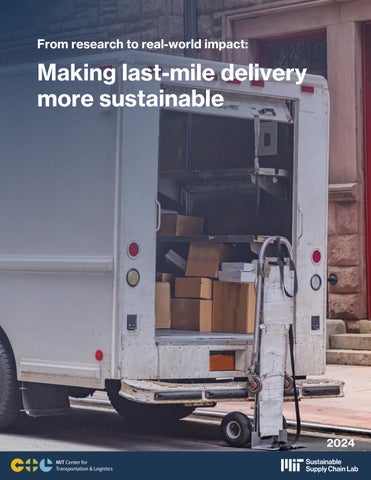
From research to real-world impact:
Making last-mile delivery more sustainable
2024
The Challenge
E-commerce has fundamentally transformed consumer expectations around speed and convenience, but this rapid growth has a significant
environmental
cost.
When
customers opt for fast shipping, they drive up carbon
emissions
through
less
efficient
routing, reduced consolidation, and the need for more frequent deliveries. Many companies lack data on whether consumers would be
willing to delay delivery in favor of more sustainable options, leaving billions in wasted logistics capacity and preventable emissions untapped. Supply chain leaders realize this gap, but recognize that the most impactful environmental gains require changing consumer behavior—specifically, convincing customers to wait longer for deliveries, which could be a dealbreaker.
KEY INSIGHTS
50% of total parcel delivery emissions come from lastmile delivery*
41%
15%
68%
of total supply chain costs are comprised by lastmile operations†
increase in CO2 emissions from fast shipping§
surge in costs from fast shipping§
*Stand.earth, 2020 †Jacobs et al., 2019 §Munoz-Villamizar et al., 2021
The Research MIT
CTL's
Sustainable
Supply
Chain
Lab
environmental
impact
Rather
than
of
choosing
partnered with a leading retailer in Mexico to
shipping.
answer a fundamental question: What if you could
kilograms of CO2 or kilowatt-hours, researchers
frame environmental impact in ways that actually
explored concrete, relatable framings, such as the
change consumer behavior without relying on
number of trees that would be preserved. The
price discounts? The team conducted two large-
findings challenged conventional assumptions
scale field experiments with thousands of real
about
customers at the point of purchase and delivery,
revealed an impactful opportunity to shift demand
testing different ways of presenting the
toward lower-emission delivery options through
sustainable
abstract
slower
consumer
metrics
behavior
choice architecture alone.
Meet the Green Button Project Provides a practical framework for sustainable delivery choice architecture at scale, allowing retailers and shippers to: Present environmental impact in relatable metrics that move consumers beyond abstract carbon calculations Achieve significant participation rates in sustainable delivery programs without costly financial incentives Scale sustainable logistics by shifting demand toward consolidated, lower-emission routes Differentiate delivery options by framing slower choices as tangible environmental contributions
like
and
The Impact For retailers, the implications are transformative: Shift demand toward consolidated delivery routes without expensive discounting or financial incentives Offer sustainable logistics choices across all demographic segments by using concrete, relatable messaging Scale environmental impact improvements by redesigning choice architecture at the moment of purchase, when consumer decisions are most malleable Demonstrate measurable carbon reduction tied to actual consumer behavior change
Research results:
4x
37%
25%
increase in consumer likelihood to choose delayed delivery when environmental impact is framed in terms of trees saved vs. CO2 reduction
longer average waiting period consumers accept when environmental impact is presented in relatable terms
potential reduction in lastmile delivery carbon footprint when companies implement our environmental framing
“The real difference in our research was understanding what makes environmental impact actually stick with consumers at the moment of purchase.” — Dr. Sreedevi Rajagopalan, MIT Sustainable Supply Chain Lab
Interested in shaping what comes next? Visit us at ctl.mit.edu
At the MIT Center for Transportation & Logistics, we deliberately work at the edges of what’s known—tackling supply chain challenges that are too complex, too new or outside the reach of conventional solutions. By combining rigorous research with real-world experimentation, we transform uncertainty into scalable, practical solutions.