From research to real-world impact:
How MIT CTL and Maersk are using AI to forecast maritime shipping delays and improve global supply chain reliability





From research to real-world impact:
How MIT CTL and Maersk are using AI to forecast maritime shipping delays and improve global supply chain reliability
Traditional forecasting methods analyze each shipping leg in isolation, focusing on shortterm predictions at specific ports or segments of the journey. While useful, these approaches do not provide a consistent end-to-end view
across multi-port voyages As a result, shippers lack a reliable way to predict overall transit times when planning shipments, forcing them to overbuffer inventory or risk supply chain disruptions
5.32 days
50-55% average on-time arrival rate in 2024*, leaving half of all shipments unreliable of global trade moves by maritime shipping† of global trade value comes from maritime shipping† average schedule delay for late-arriving vessels*
*Sea-Intelligence 2024 †UN Conference on Trade and Development, Verschuur et al 2022
MIT CTL’s Supply Chain Design Lab, directed by Dr Milena Janjevic, recognized that maritime shipping's low reliability stems not from a lack of data, but from the absence of end-to-end visibility While traditional models predict individual legs with reasonable accuracy, they do not translate into a coherent view of the full journey.
Working with Maersk, a global leader in maritime logistics, the team developed a neural networkbased model designed to predict vessel waiting
and transit times across entire voyages Rather than analyzing isolated segments, the model leverages deep learning to detect complex patterns in historical shipping data and dynamically adjusts predictions using real-time inputs such as port congestion and weather conditions.
The result is a fundamentally more accurate ETA forecasting system that captures the full end-toend complexity of global shipping.
With the neural network model, shippers can:
Predict ETAs with 94% accuracy, explaining past variability across complex, multi-port journeys
Achieve average error rates of less than 1 7 days for vessels visiting up to 4 different ports on a given journey
Select routes before booking based on predicted reliability, enabling proactive service selection
Dynamically reroute shipments in-transit using continuously updated predictions from real-time conditions
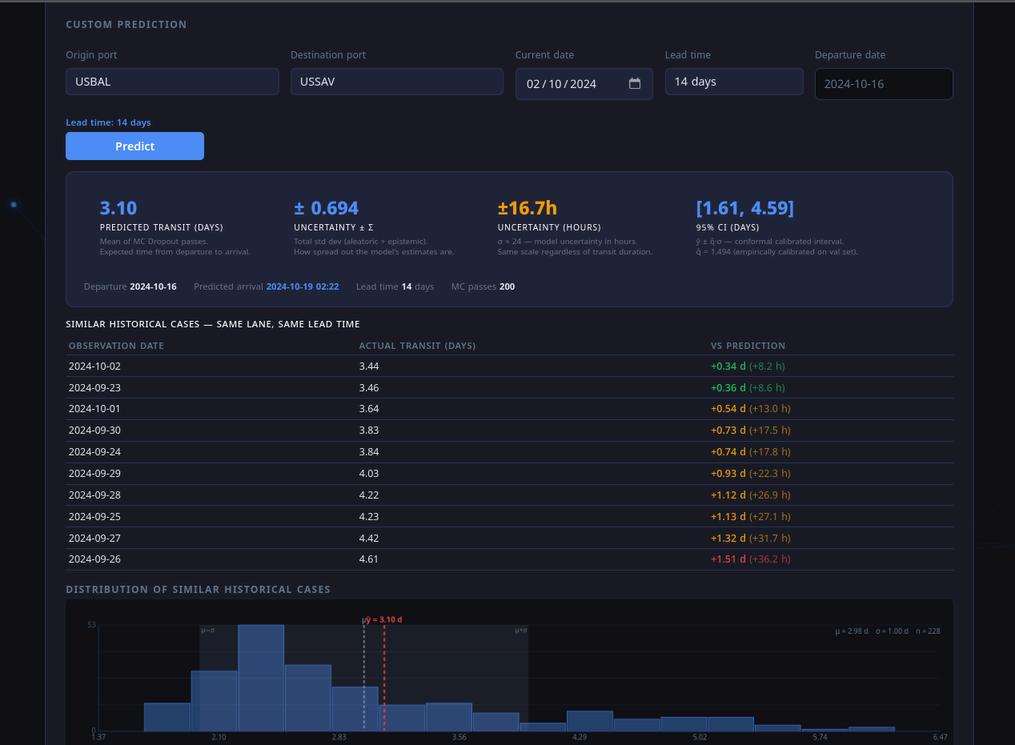
For supply chain companies, the implications are powerful:
Improve planning of downstream operations such as unloading vessels and forwarding cargo
Reduce buffer stocks and bottlenecks by replacing uncertainty with data-driven confidence
Improve delivery consistency and transport capacity utilization across global shipping networks
accuracy rate in explaining past shipping variability
<1.7 days ≤0.51 days
average prediction error for end-to-end transit times of vessels visiting up to 4 different ports on a given journey
average prediction error for vessel transit times on individual legs
“The challenge is not predicting individual shipping legs, but turning those predictions into a consistent, end-toend view of the full journey.”
— Dr. Milena Janjevic, Director of the MIT Supply Chain Design Lab
At the MIT Center for Transportation & Logistics, we deliberately work at the edges of what’s known tackling supply chain challenges that are too complex, too new or outside the reach of conventional solutions By combining rigorous research with real-world experimentation, we transform uncertainty into scalable, practical solutions