Pushing Through or Pushing Too Far? Porter’s Athletes Play Through Pain
Where do student-athletes at Porter’s draw the line when it comes to injuries?
For many student-athletes, injuries develop gradually and become part of daily participation rather than forcing an immediate stop. They become conditioned and learn to adjust to injuries while continuing to compete.
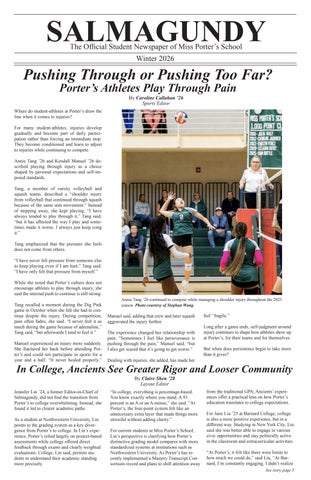
Annie Tang ’26 and Kendall Manuel ’26 described playing through injury as a choice shaped by personal expectations and self-imposed standards.
Tang, a member of varsity volleyball and squash teams, described a “shoulder injury from volleyball that continued through squash because of the same arm movement.” Instead of stepping away, she kept playing. “I have always tended to play through it,” Tang said, “but it has affected the way I play and sometimes made it worse. I always just keep icing it.”
Tang emphasized that the pressure she feels does not come from others.
“I have never felt pressure from someone else to keep playing even if I am hurt,” Tang said. “I have only felt that pressure from myself.”
While she noted that Porter’s culture does not encourage athletes to play through injury, she said the internal push to continue is still strong.
Tang recalled a moment during the Dig Pink game in October when she felt she had to continue despite the injury. During competition, pain often fades, she said. “I never feel it as much during the game because of adrenaline,” Tang said, “but afterwards I tend to feel it.”
Manuel experienced an injury more suddenly. She fractured her back before attending Porter’s and could not participate in sports for a year and a half. “It never healed properly,”
By Caroline Callahan ’26 Sports Editor

Manuel said, adding that crew and later squash aggravated the injury further.
The experience changed her relationship with pain. “Sometimes I feel like perseverance is pushing through the pain,” Manuel said, “but I also get scared that it’s going to get worse.”
Dealing with injuries, she added, has made her
feel “fragile.”
Long after a game ends, self-judgment around injury continues to shape how athletes show up at Porter’s, for their teams and for themselves.
But when does persistence begin to take more than it gives?
In College, Ancients See Greater Rigor and Looser Community
Jennifer Lin ’24, a former Editor-in-Chief of Salmagundy, did not find the transition from Porter’s to college overwhelming. Instead, she found it led to clearer academic paths.
As a student at Northwestern University, Lin points to the grading system as a key divergence from Porter’s to college. In Lin’s experience, Porter’s relied largely on project-based assessments while college offered direct feedback through exams and clearly weighted evaluations. College, Lin said, permits students to understand their academic standing more precisely.
By Claire Shen ’28 Layout Editor
“In college, everything is percentage-based. You know exactly where you stand. A 93 percent is an A or an A-minus,” she said. “At Porter’s, the four-point system felt like an unnecessary extra layer that made things more stressful without adding clarity.”
For current students at Miss Porter’s School, Lin’s perspective is clarifying how Porter’s distinctive grading model compares with more standardized systems at institutions such as Northwestern University. As Porter’s has recently implemented a Mastery Transcript Consortium record and plans to shift attention away
from the traditional GPA, Ancients’ experiences offer a practical lens on how Porter’s education translates to college expectations.
For June Liu ’25 at Barnard College, college is also a more positive experience, but in a different way. Studying in New York City, Liu said she was better able to engage in various civic opportunities and stay politically active in the classroom and extracurricular activities.
“At Porter’s, it felt like there were limits to how much we could do,” said Liu, “At Barnard, I’m constantly engaging. I didn’t realize
Our School Has Grown — Our Gym Hasn’t
By Lisi DeLaO ’29 Staff Writer
Four working treadmills for more than 300 students. Limited weights. Crowded floor space. For many students, the school gym doesn’t meet their needs.
The school gym requires an upgrade in order to accommodate the growing population of student athletes. Although the setup once worked, it is now not fit for our current student body. Much of the equipment is old or out of order, and we lack the proper space and workout gear to effectively use the gym.
Students say the lack of equipment affects both athletes and non-athletes trying to stay active. The gym should be a functional place where anyone from our community feels comfortable and
able to exercise. Currently, this is not the case. “I think the gym doesn’t have enough machines or weights for people to use and get a complete workout,” Gardiner Leavy ’29 said.
Without proper weight machines, many feel that their workout routines are lacking.
Gabby Han ’29 said she wishes there were “more space for lifting.”
Because there are no weight machines, students must use the small supply of hand-held weights in the inadequately small area provided. This greatly limits a student’s ability to workout to their extent and liking.

Is AOF Our Brother School or Rival?
By Liv Minnehan ’26 Opinions Editor
According to the internet, a brother school is an institution that maintains a “close, familial” relationship with a nearby sister institution. But anybody from either Avon Old Farms or Miss Porter’s would be reluctant to call the relationship between the schools close or familial.
Most of the descriptions from Porter’s about AOF are lamentations on their lack of intelligence and self-absorbed nature. Most of the descriptions from AOF about Porter’s are complaints about how we are all lesbians, or simply the use of our affectionate nickname: “Porkers.”
The majority of the upperclassmen are dissuaded from attending activities involving AOF, rather than motivated. This might raise concerns about the developmental consequences from a lack of interaction between sexes for four years. But what can a man do that a woman can’t?
The bare minimum evaluation of the relationship between these two institutions will reveal that we are certainly not rife with inter-school camaraderie. However, maybe the students are fulfilling a different psychological need.
Anybody with siblings will tell you that more often than not, the relationship is antagonistic and mildly excruciating. Maybe by each of the schools having a target in one another, it prevents other animosity within the schools.
Maybe it even pushes the students to do better. Maybe the collective perception of misogyny at AOF further motivates Porter’s in its feminist ways. Maybe AOF’s disdain of Porter’s lack of heterosexuality fuels them to push harder on the sports field.
Members of Winter Running say the limited equipment is especially noticeable during training. With six treadmills available but only four functioning, students often have to wait for access.
The two broken treadmills only take up valuable space in the gym, which is often littered with miscellaneous weights. Equipment left on the floor is not only irritating, they are also a hazard. With such a small area, it is necessary to keep it as neat as possible.
Especially in the winter, staying active should be encouraged. It should not be hard for a student to get the opportunity to exercise in a way they are comfortable. How can “girls win here” if getting a proper workout is a challenge? Strength is encouraged, yet there are very limited opportunities to build it.
The current gym cannot support us; it needs a renovation. If “girls win here,” we need the equipment and space to do so.
Director of Athletics Avi Dubnov agrees. “In my opinion, (the workout area) doesn’t mirror the rest of this beautiful school,” he said.
The issue is expense. Even a recent senior class gift could only cover the purchase of new weights. Our school is due for a bigger, albeit more expensive, renovation project.
Winning doesn’t only happen on the court. A gym upgrade isn’t a luxury — it’s a necessity.
There’s nothing wrong with some healthy competition, and both schools certainly come together and hold hands when it comes time for prom photos.
It’s no question that AOF and Porter’s aren’t going to come up in the dictionary when you search “Kumbaya.” But maybe, just maybe, that isn’t a bad thing.

15 or 35? Are Teenagers Living Like Teenagers or Corporate Professionals?
Teenage years are most definitely romanticized in many 2000s rom-coms. Unlike “10 Things I Hate About You,” students unfortunately don’t cruise around in 1964 Dodge Darts or conduct extravagant stadium serenades.
In theory, it is the ideal time to indulge in undiscovered passions, meander about in open fields, and savor the remaining years of childhood.
Stepping away from the cinematic romanticization of teenage years, adolescence is typically patchy and defined by humbling trial-and-error periods, intense social awkwardness, and discovering the essence of what defines you.
Teenagers today have found a unique in-between. They are now CEOs, lab and finance interns, and have schedules akin to those of a corporate professional. This adolescent excellence is without a doubt impressive–but it comes at a cost. There is horrendous pressure, and competitive high schools cultivate environments where pressure is constant and comparison unavoidable.
Is college pressure the root cause of this phenomenon?
To explore this, accomplished Miss Porter’s School seniors Jade Singhal ’26, Diane Ferragu ’26, and Isabella Kao ’26 shared their extrinsic motivations and whether they still feel there is room to simply be a kid.
Singhal is the founder of two companies. She co-founded RxCupid, a dating app for medical professionals, and an AI video biometric app that predicts a horse’s potential as a top sport and investment prospect using uploaded data and video analysis.
“I felt a lot of pressure to start companies, growing up in a very business-oriented family and a family of high achievers … but I got a little bit more mature going to boarding school, and that’s when I started doing some internships,” Singhal said. “And I think through that I kind of realized that I wanted to do something of my own.”
While Singhal found intrinsic motivation through her projects, others described a more complicated balance between interest and obligation.
Kao was an intern for an affiliate marketing company in New York during the summer of 2023, while also participating in the Asian Children’s Skiing Championship. She interned in the business-to-consumer sector at Apicem Technologies, working on the launch of the company’s first COVID certified consumer filter after it had previously catered primarily to large-scale corporations and government buildings.
“Pursuing internships was genuinely for the purposes of college … it wasn’t something that I would choose to do in my free time,” Kao said. “But of course I was interested in the topics and I learned a lot from it.”
By Arianna Vasson ’26 Editor-in-Chief

Ferragu was an intern this past summer with Massachusetts Institute of Technology professor Manolis Kellis. Alongside Kellis, Ferragu helped create an AI-based cognitive cartography, a tool that helps people visualize and better understand their data.
“I really wanted to do this internship, and I was very intrigued by it because it was a new field for me,” Ferragu said. “But there’s definitely some underlying thing of doing this internship for college because I think that for every student you’re going to have a little bit of that because it’s obviously a stress factor.”
Applying to top colleges now feels like following a strict, unspoken formula, one that takes away from simply being a teenager. Some students truly enjoy engaging in their work, but they also feel a lack of choice in terms of participation with these activities. But should achievement come at the expense of growing up?
“I think that there was definitely less room to be a kid, and much more pressure to not be a kid and kind of feel bad if you’re like ‘Oh my God, like, I’m taking this day off’ when someone else out there is doing some really cool innovative project,” said Ferragu.
The question remains whether achievement should come at the expense of simply growing up.
Teenage years may never resemble the carefree montages of early 2000s films. But today’s students are redefining adolescence on their own terms: not as a period of idle wandering, but as one of ambition, uncertainty, and relentless drive.
Does Porter’s Push a Political Agenda?
By Bea Kibler ’26 & Annabelle Horst ’26 Section Editors
Monica Guzman, Braver Angels, fireside chats at the Quinn’s. These are some of Miss Porter’s many efforts to depolarize the student body and open minds to conservative viewpoints. But why is this depolarization necessary? How did it happen in the first place?
Porter’s has long had a reputation as a progressive institution. Hur-Shiu Webb, a Porter’s math teacher for more than a decade, says that, being an all-girls school, Porter’s is inherently left-leaning. However, after President Donald Trump’s election, Porter’s felt compelled to take a stance against certain viewpoints in an effort to support students. In doing this, did Miss Por-

ter’s unintentionally silence a group of students who feel that they may be ostracized for voicing their opinions?
Clara Goldman ’28, head of Porter’s activism club FaceUp, does not believe Porter’s pushes a certain political view. She said Porter’s “does a good job at politics, provides good support for students, and enforces good character.”
A senior student at Miss Porter’s, whose family supports the Trump administration, believes Porter’s does have a political agenda. She requested anonymity for fear of the social backlash she would face if she were to openly admit her family opposes Porter’s political leanings. The political agenda at Porter’s is so strong, she says, “if I did not go to Porter’s, I would be less liberal.”
Students like this senior are living in constant juxtaposition between their home and school lives.
Goldman is a proponent of involving the Porter’s community in political happenings in the greater Hartford area. She said it is hard for students to get politically involved on campus.
“It is important for them to see what is going on in the community around our school,” Goldman said.
Goldman said that pushing for community members to stay informed and ensuring students feel welcome regardless of identity are crucial for the community; however, she added, purposeful discourse from diverse perspectives without fear of isolation is equally as important.
The senior whose family supports President Trump said that “sometimes teachers really push their political beliefs.”
“Teachers should not so heavily push their political views in order to allow students to form their own beliefs,” she said.
No More Jamon and No More-occo?
New Spain Course Provides Unique Travel Experience
Cold rain poured over Cadiz as umbrellas flipped inside out and students rushed through narrow streets on the class of 2027’s Global Studies Intensive Spain trip — just the beginning of twelve days filled with unexpected challenges and memorable moments.
The trip brought severe weather, illness, and canceled plans, including a scheduled visit to Morocco. Still, students said the experience strengthened friendships and pushed them to adapt in ways they hadn’t expected.
From day one, heavy rain battered the students. The persistent rain and wind led to the cancellation of the trip to Morocco due to a halt in water transportation for safety concerns.
For Shannen Giselle Penn ’27, that change was upsetting. The visit to Morocco meant more than simply checking off another country.
“I was so disappointed; I really looked forward to that trip,” Penn said. “I was hoping to visit my motherland.”
Strong winds broke many students’ umbrellas.
“I kept a strong grip on my umbrella, fearful that it would slip out of my hands due to the persistent winds,” said Charlotte Rose McMahon ’27. However, it didn’t hold up for long. “Soon, I felt the heavy droplets of rain landing on my head instead of my broken umbrella,” McMahon said.
Beyond the weather, illness affected several students within the first few days of the trip.
By Jiayi (Jessica) Lin ’27 Editor-in-Chief

One of our ill students Eliza Mikheev ’27 said, “I was having the most amazing experience when all of a sudden, in the most beautiful cathedral, my stomach started to turn.” Mikheev had to go to the local hospital for treatment.
Through it all, Director of Nursing Georgia Burman was on top of everything, bringing students like Mikheev back to health.
“In the hospital, they were speaking Spanish, while I take French,” Mikheev said. “So Georgia was so helpful not just as a nurse but as a translator, too.”
Daily routines also required adjustment, especially when it came to food. The jamon-heavy meals provided at the Planeta de Cadiz Hostel weren’t favored by the students. Many bought food at nearby restaurants and supermarkets.
“I definitely had to find alternatives for meals,” said Bella McLaughlin ’27. “After a while, I didn’t want to keep spending my parents’ money, so I tried to just eat the hostel food, but I couldn’t do it.”
There were still positives to the new foods, making the experience for some unforgetta-
ble. Teachers also brought the students to local restaurants where they tried local seafood in various tapas dishes.
“The food helped me immerse myself in the culture,” Saige Chisholm ’27 said. “As much as it was different and new, it was so fun to try it with all my classmates.”
As with all the trips, the Spain students were without their phones and technology. This experience made Rashida Sibawie ’27 feel “more
NEWS
connected with people.”
Without devices, students found new ways to connect with each other.
“I really enjoyed playing card games each night with my roommates,” Ellie Riva ’27 said.
Some students played card games such as Dutch Blitz and Uno, while others read, danced, and tried various local snacks. “Jess taught our room a Chinese card game called Guan Dan, and let’s
just say it was a heated rivalry,” Riva added.
Despite the rain, illness, and sudden changes, students said the trip brought them closer together. The students still had fun, made lasting memories, and will continue on their time at Porter’s forever connected by this experience.
Nights spent playing card games, navigating unfamiliar food, and adjusting without phones became some of the most memorable moments of the experience.
Tessa Hulls Urges Porter’s Students to Use Their Voice
By Goodluck Ogbonna ’27 Staff Writer
Pulitzer Prize-winning author Tessa Hulls urged students to embrace storytelling as a tool for identity, healing and self-expression.
Hulls, who visited Miss Porter’s as a part of the Prescott Speaker Series, spoke about her graphic memoir “Feeding Ghosts,” which she described as a deeply personal project shaped by her family history and her journey as a multidisciplinary artist.
During her presentation, Hulls introduced powerful 19th-century women, such as Ada Blackjack, who defied expectations by overcoming barriers. Blackjack, an Iñupiaq woman, went on an Arctic expedition to support her ill son, ultimately surviving alone after the rest of the team perished.
“Strength is in extraordinary women who led their own lives,” Hulls said. “And I found even more strength by encouraging other women to live their lives through my work.”
how much I wanted that until I got here.”
Liu currently serves as a copy editor for the Columbia Daily Spectator and is pursuing a double major in biology and political science.
While the two Ancients highlight the greater rigor and opportunity in college, Lin and Liu still emphasized the support they received during their four years of high school.
For Lin, that support was most visible through athletics. At Porter’s, team commitments created a sense of routine and closeness that proved difficult to replicate in college. Being on the tennis team at Northwestern, Lin said, “there aren’t set practices, and you’re not really part of a tight-knit team in the same way.”
For Liu, the senior-year course Art of Argument was instrumental in developing her confidence to engage with controversial subjects before she went to college. She highlighted the class’s openness to differing opinions.
“That class made me realize I could take on difficult ideas,” Liu said. “I wrote about polarization and openly disagreed with my teacher’s views, and she still took my work very seriously. It was the first experience that inspired me to take on political science as a further step.”
In “Feeding Ghosts,” which earned her numerous prizes, including a Pulitzer, Hulls explores themes of identity, trauma, immigration and family discovery.
Hulls’s grandmother Sun Yi lived with bipolar disorder, and Hulls’s mother, Rose, became intensely protective, worrying her daughter might face similar struggles. Both Hulls’s mother and grandmother survived Communist China and later became refugees in America.
Hulls described an upbringing shaped by silence and fear. Her complex family dynamics contributed to her emotional instability, which is reflected in her work as an artist and storyteller.
To escape this reality, Hulls sought adventure –bicycling alone from California to Maine, traveling to all seven continents, and finding jobs that ranged from tending bar to painting murals.
Hulls ended her talk by encouraging Porter’s students to find strength as they navigate chal-

lenges of identity and societal expectations and to use their voices not only to understand themselves, but also to inspire others.
“Someone has to feed the ghosts, ” Hulls said.

Both Ancients credited Porter’s with fostering a strong sense of community, but said that college provided greater opportunities to apply their skills. Their reflections raise a question for Porter’s community: how can Porter prioritize
preserving its close-knit model while working further toward preparing students for the challenges college demands?
The Male Educators’ Experience at Porter’s
By Eva Bernadel ’28 Staff Writer
Josh Bezdek, photography, filmmaking and digital art teacher at Miss Porter’s, said he has become more mindful of female perspectives since he started teaching at Porter’s.
Teaching at an all-girls school means entering a world unlike any other. For many male teachers, it may be the first time they navigate a system designed around female success, needs and experiences.
When Bezdek began teaching at Porter’s after leaving Kingswood Oxford in 2015, he expected the usual challenges of a new job. What he didn’t anticipate was the shift in atmosphere. Porter’s is a space where girls’ voices, needs and opportunities are centered. Learning how to teach in that environment was an adjustment.
“It felt like people were able to be a bit more authentically themselves at Porter’s,” Bezdek said. He also noted that teaching at Porter’s requires him to “be aware of how my identity as a male teacher comes across.”
Like many male faculty members, Bezdek described having “a lot of blind spots” in understanding the female perspective. This lack of shared experience can create distance between male teachers and their students.
Male teachers are a vital part of the Porter’s community, but at times their presence requires careful navigation. Classroom dynamics, mentorship and even casual interactions are shaped by the awareness that they lack a mutual under-

standing of the lived experiences of students.
Chief Financial Officer Michael Bergin said he feels increasingly aware of the expectations and boundaries on him as a male staff member. “I never respond to a text from a student after 9 o’clock,” he said. “I really work hard to respect the dorm and other spaces to ensure that students feel comfortable.”
This mindfulness extends beyond communication. Bergin and other male faculty emphasize creating supportive classrooms and interactions
while being intentional about their roles.
“I hope that you recognize my support in that effort as a man acknowledges that the male perspective should include support for girls to win and lead and succeed,” Bezdek said.
Like Bezdek, many male faculty members see this awareness as an opportunity to model respect and reinforce the school’s mission of preparing young women to shape a changing world.
Singles Get Ready to Mingle
By Clara De La O ’27 Staff Writer
On the morning of Sept. 3, Old Girls received an email announcing a little-known housing reality that they will soon have to reckon with.
“Please note, because you received a single this year,” the email read, “ you will most likely NOT receive one next year, whether it is your senior year or junior year.”
The email, sent by Dean of Students Ana Calciano Pratt, confirmed what had previously circulated only as campus scuttlebut.
“I feel like I’ve heard about how if you got a single once, it’s less likely you’ll get a single after,” Yida Wang ’27 said. “But then it was only a rumor.”
Calciano Pratt said there’s no hard and fast rule regarding singles and that the Office of Student Life is always open to conversations with students about their rooming options. But, she added, with only 25 singles and more than 50 requests, the OSL cannot honor everyone’s preferences every year.
Complicating matters, Calciano Pratt noted, is that senior dorms have only four single rooms.
As spring approaches, Zora Howard ’27, who lives in a Brick single, said her usual excitement about room draw is now mixed with anxiety about finding a roommate.
“There should’ve been a warning,” Howard said, referring to the timing of the announcement after room assignments were finalized.
Both Wang and Howard said they would have preferred saving the opportunity for a single until senior year if they had known earlier that they would not likely get a single two years in a row.
Calciano Pratt, who has worked in the Office of Student Life for seven years, said the policy is not new.
“We’ve always had that conversation in some capacity with students that get singles,” she said. “This is the first year I’m pretty sure that I’ve sent that email instead of one-on-one meetings.”
The reasoning, she said, is logistical rather than social. Demand for single rooms consistently exceeds supply. In spring 2024, Calciano Pratt said, 55 students requested singles.
To accommodate as many students as possible, OSL has experimented with solutions such as offering triple-sized rooms to a roommate pair who had requested singles. The office has also worked with Buildings & Grounds to identify larger rooms that could be divided into singles by adding a wall.
But the limited supply means that Wang and Howard, along with the other junior single students, now face the challenge of finding a roommate for their senior year.
“I’m not against with rooming with another person,” Wang said “I’m just worried for senior fall.”
Howard said she is not sure what she plans to do.
Though OSL tries to meet all the students’ wishes, students who plan to request singles for the following year should expect similar communications.
But, she noted, “It’s very possible that somebody that has a single this year could get one next year.”
Perilhette Tapping Move Aims to Ease Transition
By Charlotte Hannich ’26 Staff Writer
This year, music director Patrick Reardon made the decision to move the Perilhette tapping to mid-winter to give “babylettes” more time to practice before their end-of-year performance at Little Meeting.
Perilhette tapping, a long-held tradition in which current a cappella singers choose their replacements, usually takes place during a special sit-down dinner in the spring.
“I made the decision to move the dinner from the end of the year to January, after consulting the Office of Student Life and talking casually with some Ancients,” Reardon said, adding that he was sensitive about changing a school tradition he knew to be greatly beloved.
His decision was met with mixed reactions from the community. Many people understood the reasoning behind the earlier date but were left feeling a lack of the typical nostalgia the end-of-year tradition brings.
“I like that Perilhettes get more time to train and work together as a group,” said Liv Minnehan ’26. “But it was also a great event that really fit the vibe of the spring semester and the whole saying goodbye to seniors.”
Isa Kao ’26 said she thought it made sense to train the new a cappella group earlier but also lamented the loss of an end-of-year farewell.
“As a senior, I feel like that unique sit-down dinner is meant to be for the end of the year, almost a hallmark representing things being handed down to the next generation,” Kao said. Current Perilhettes also had mixed feelings about the change.
“I feel complex about it,” said Perilhette Alys-
sa Shi ’26. “I think on one side it was a little unreasonable for us to listen to auditions and choose next year’s Perilhettes so early ’cause we have just become Perilhettes for half a year.”
She added that she does believe the earlier tapping will help the “babylettes” feel less rushed in their preparation for Little Meeting and that the change of date could help them be more mentally prepared.
Perilhette Shravya Sudarshan ’26 agreed. “It gives us time to properly introduce ourselves to them and vice versa,” she said. “It was terrible when we had to rush learning two songs in three days.”
Sudarshan said she felt that the tapping may have been a bit rushed, but that it would alleviate the stress she and others had felt last year with the limited time they had to prepare for
their first performance.
Reardon cited this stressful rush as a key reason for his decision.
“Students are prepping for DoLs, packing for the summer, saying goodbye to friends, participating in other traditions, and trying to enjoy the beautiful weather,” he said. “This forces the ‘babylettes’ into a rushed and frantic rehearsal process.”
Sudarshan said she looks forward to having more time to work with the new Perilhettes.
“My hope is that now we can take the time and patience needed to properly help them learn the ropes,” she said, “so that by Spring German, they are all set with no worries of being unprepared.”

ART, LIFESTYLE & HUMOUR
Park Shows There Is Space for Every Single Style

By Leanne Liang ‘28 Staff Writer
Student artist Ain Park ’27 advocates for the broader acceptance of diverse art styles in her school community and beyond.
Her recent piece, “The Paris Salone,” features a self-portrait holding a paintbrush drawn on a coffin-shaped wooden board, symbolizing the career deaths faced by many impressionist artists.
Park said the piece reflects her belief that, despite its historical significance and impact, impressionism as an art form is being dismissed in contemporary art spaces, making it difficult for aspiring artists like herself to stay true to their preferred style.
“If certain art forms are not respected, young artists may grow up feeling anxious about their work and afraid to experiment,” Park said. “Over time, this mindset can cause students to
lose confidence or stop creating altogether.”
Park also plans to convey her message through a collaborative school art exhibition scheduled for April in Boston.
The exhibition brings together student artists working in diverse media to highlight cultural interconnectedness and encourage appreciation for varied forms of artistic expression. It will be in partnership with Weston Public High School, Lincoln-Sudbury Regional High School, The Rivers School and Walnut Hill School For The Arts.
Through her latest work and leadership in the upcoming exhibition, Park strives to foster an environment of acceptance and open-mindedness within the art community where young artists are free to experiment with their preferred art forms.
ART, LIFESTYLE & HUMOUR
Porter’s Picks: Editors’ Opinions
A few favorites from the Salmagundy team. From comfort shows and documentaries to books and music, these are the things we’ve been watching, reading, and listening to lately and why we think you should check them out.
Watch “Modern Family”
By Steven Levitan and Christopher Lloyd
“Modern Family” is my all-time favorite comfort show, and I’ve watched it all the way through four times because it never gets old. It has the perfect blend of humor and heart, making it a show I’d recommend to absolutely anyone. – Jess Lin, Co-Editor-in-Chief
Comforting, Entertaining, Fun / Lighthearted.
Read “Love for Imperfect Things: How to Accept Yourself in a World Striving for Perfection”
By Haemin Sunim
Reading this book gave me a new outlook on life. Sunim is wise beyond words, which is evident through his lived experiences and life lessons. Every night I read this book, I arose in the morning feeling more tranquil. – Arianna Vasson, Co-Editor-in-Chief
Thought-provoking, Comforting, Inspiring, Powerful.
Watch “Severance”
By Dan Erickson
“Severance” is a really awesome and super underrated show! It is a science fiction dystopian show with a really complex and unique plot and characters. – Bea Kibler, Inside the Bubble News Editor
Thought-provoking, Entertaining. Listen “Seesaw”
By Twice
Anybody with ears will love this song. One in a million! – Liv Minnehan, Opinions Editor
Comforting, Emotional.
Watch “The Salt of the Earth,”
Directed by Wim Wenders and Juliano Ribeiro Salgado
“The Salt of the Earth” is a documentary about famous photographer Salgado and discusses nuanced perspectives on our relationship with war, violence, culture and nature through decades of the photographer’s work. Anyone interested in documentary filmmaking or history should check this out! – Claire Shen, Layout Editor
Thought-provoking, Comforting, Inspiring, Emotional.
Watch “The American Revolution”
By Ken Burns et al.
This six-part documentary explores the American Revolution through multiple perspectives, including those that have traditionally been overlooked (indigenous and Black people and women). – Eileen DeLaO, Advisor
Thought-provoking, Educational.
Watch “The Talented Mr Ripley”
By Anthony Minghella
The perfect movie to brighten the winter months with beautiful, summery scenes of Italy along with a suspenseful, gripping, storyline full of intrigue. – Addy McNear, Art, Lifestyle,

& Humor Editor
Thought-provoking, Entertaining.
Read “Hamnet”
By Maggie O’Farrell
“Hamnet” is a deeply emotional and beautifully told imagining of William Shakespeare and Anne Hathaway’s son, and of the love, grief, and family life that shaped them. The Porter’s community should absolutely check out this wonderful book (and now a movie!) as it is heartbreaking and genuinely moving. – Caroline Callahan, Sports Section Editor
Inspiring, Emotional.
Watch “Pluribus”
By Vince Gilligan
Pluribus is set in a world where humanity has been exposed to an alien virus that has merged nearly everyone on Earth into a single hive mind, leaving only thirteen individuals unaffected. The show is deeply thought-provoking, featuring compelling characters and exploring questions about the importance of individuality, making it an overall excellent watch. – Annabelle Horst, Outside the Bubble News Editor
Thought-provoking, Entertaining.
Watch “White Chicks”
Revolution Studios, Columbia Pictures
A chaotic, quotable comedy that’s perfect if you just want something funny and easy to watch! – Serena Lok, Inside the Bubble News Editor
Thought-provoking, Inspiring, Entertaining, Emotional, Fun, Lighthearted, Powerful.
1. Most seen in dorm fridge
2. Swim will never do this
3. Winter destination for Juniors
6. Home of serious fitness Across
2. Close up shots
4. Furry friends for feet!
5. Content of a pool in Spanish
7. D1 phone hater