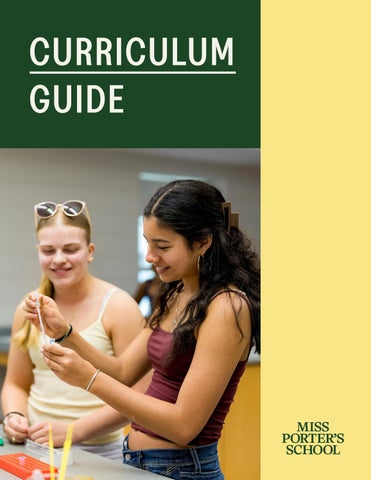
CURRICULUM GUIDE COVER
ABOUT MISS PORTER’S SCHOOL Miss Porter’s School is a college preparatory boarding and day school for girls in grades 9 through 12. Located in Farmington, Connecticut, the school was founded in 1843 by scholar and educator Sarah Porter. In keeping with our founder’s vision, Miss Porter’s School joins tradition with innovation to provide an exemplary education to young women.
Miss Porter’s School educates young women to become informed, bold, resourceful and ethical global citizens.
We expect our graduates to shape a changing world.
Qualified students of any race, color, religious affiliation, national and ethnic origin, ancestry, mental or physical disability, or sexual orientation are welcomed members of the community.
FIND YOUR PASSION 2
Learning at Porter’s
4
Competency-Based Mastery Learning
6
Our Curriculum
10
Humanities
16
Languages
23
Mathematics
26
Science
29
Technology, Innovation and Entrepreneurship (T.I.E.)
32
Visual and Performing Arts
38
Global Education
40
Professional Experience
41
Capstone
This curriculum guide represents course offerings that are current as of September 2026. This guide is intended as a preview of classes, which are subject to change. This guide should not be used as a course selection catalog for enrolled students.
1
MISS PORTER’S SCHOOL IS DIFFERENT . . .
HISTORICALLY, INTENTIONALLY AND SUCCESSFULLY. It is our unique approach and our willingness to change that has allowed us to develop strong female leaders decade after decade. As our curriculum continues to evolve in response to the changing world and the needs of our students, we are focused on establishing courses and programs that are engaging, relevant, interdisciplinary and experiential.
Miss Porter’s School prepares students for the future to come, not the world that was. Our entire academic program is aimed at providing the best possible learning experience for our students and helping them to distinguish themselves in the world. This commitment has led us to reenvision what we teach, how we teach it and the way our students demonstrate their learning.
2
LEARNING BELIEFS
Learning thrives in a community rooted in constant discovery, reflection and support. And the most powerful learning happens when everyone is engaged. Our students, teachers, coaches, administrators and staff come to campus ready to ask bold questions, ready to encounter and engage with different perspectives and ready to learn from one another.
Everyone Is a Learner
Learning Happens Best in a Safe and Healthy Environment
Learning is a continuous process that involves everyone in the community.
Supportive, inclusive environments encourage risk-taking, student agency and holistic development.
Learning Happens Anywhere and at Any Time
Learning is lifelong, extends beyond the classroom and can occur at any time.
Learning Is Collaborative and Experiential Learning is individual and communitybased, requiring active engagement, application and authenticity.
Learning Is a Process
Learning is an ongoing process of exploration, discovery, practice, iteration, feedback, growth and reflections.
INTERDISCIPLINARY & EXPERIENTIAL APPROACH Our curriculum revolves around timeless questions, with the goal that answers to such questions will inform solutions to pressing problems. We believe that these questions and problems are inherently interdisciplinary, and our curriculum reflects that as we bring multiple perspectives to bear on everything we do.
Whether we are studying literature through the lens of coinciding historical events, thinking about how knowledge of chemistry is helpful to a visual artist, or utilizing what one learns from anatomy and physiology in the athletic arena, we are always seeking to break down artificial barriers between academic disciplines. We break down those barriers through learning experiences that take students out of the classroom, because we know the best learning happens through doing.
3
COMPETENCY-BASED MASTERY LEARNING We practice competency-based mastery learning, which focuses on the transfer of knowledge and skills to a real-world context. Mastery learning prepares our graduates to navigate an ever-evolving world with confidence in themselves. A Porter’s education focuses on the development of the skills necessary for girls to be successful in college and in life beyond Farmington.
We educate students for enduring understanding. We galvanize girls for global impact. We prepare our graduates to shape a changing world.
CORE COMPETENCIES Students demonstrate their mastery of skills in five core competencies: • Critical Thinking & Reasoning • Communication & Expression • Problem-Solving & Creativity • Global & Civic Engagement • Leadership & Collaboration
4
Approach to Assessment, Feedback and Grading Research shows that traditional grades tend to reduce students’ interest in the learning itself, their preference for challenging tasks and the quality of their thinking. Porter’s schoolwide competencies include specific, measurable learning outcomes that are supported by: • Engaging, interdisciplinary and experiential classes • Meaningful, growth-oriented assessment • Differentiated, goal-oriented and competency-based feedback • Knowledge creation through the application of learning Students demonstrate their learning through presentations, projects and capstone experiences. We believe learning should be shared and celebrated, so our terms do not finish with exams; they finish with Demonstrations of Learning where students present, perform and display their work for the community.
Portfolios and Conferences Every student builds a competency-based portfolio that gives them opportunities to document evidence of growth across all of their learning experiences—in or out of a classroom. The process of compiling a competency-based portfolio helps students reflect on their learning, set meaningful goals and take ownership of their progress. At the midpoint and end of the year, all students participate in conferences with their advisors to discuss their progress and goals.
Mastery Learning Record In addition, all students have access to a Mastery Learning Record, which allows them to showcase their skills, achievements and growth in ways a traditional transcript cannot capture. In time, it will serve as a powerful complement to their official transcript, giving colleges and future employers a more complete picture of who they are as learners and as people.
5
BE THE ARCHITECT OF YOUR OWN EXPERIENCE. At Miss Porter’s School, our curriculum is designed to provide the foundational education to chart your own path toward making a difference in an ever-changing world. Foundational courses are taught with an interdisciplinary approach. Students begin with foundational courses in STEM and the humanities, and as they move forward, are allowed ample space and time to personalize their education through electives.
Change is our constant; our courses change as the world changes. Miss Porter’s School operates on a modular block schedule. Rather than taking six yearlong classes, students take different classes each trimester, and classes meet in an extended block every day. This allows students to be more focused and engaged with the course material while maintaining a healthy balance of homework and co-curriculars. It also allows students to take more courses overall.
6
9TH GRADE EXPERIENCE
The 9th Grade Experience is a foundational program designed to welcome new students into the Miss Porter’s School community, introduce them to our educational philosophy, and give them an opportunity to establish a shared language around learning, well-being, identity and critical thinking. This seminar program provides new students with an introduction to competency-based mastery learning and focuses on building essential skills for success both in and out of the classroom. The 9th grade seminar program asks students to engage deeply with a journey of selfdiscovery as the foundation for their academic career. Three classes work together to guide students, all focused on the same foundational questions of “Who am I, and what do I need to cultivate and support my own learning journey?”
Introduction to Inquiry In this course, students learn how to ask good questions, seek knowledge and find reliable and valid answers. A heavy emphasis on media literacy enables students to engage with perspectives different from their own and ultimately consider what it means to know something.
Health & Wellness Through hands-on projects, journal reflections and class discussions, students explore multidimensional approaches to health and wellness and consider what the mind and body need to support learning. They also explore skills and strategies for improving their social and emotional well-being and learn about sexual and reproductive health.
9th Grade Academic Seminar This weekly seminar provides students with an overview of the concepts and beliefs that serve as the foundation for the Porter’s academic program. Students will explore who they are as learners, how they can set clear goals for learning and how to track their growth over time.
7
GRADE 9
Developing foundational skills with an interdisciplinary approach. Students begin their journey at Porter’s with courses in core disciplines that develop the skills and habits needed for academic success. Integrated humanities and science courses provide a strong foundation for the depth that comes later in the Advanced Interdisciplinary Seminars (AIS). Students earn a full year’s worth of credit for language and math in trimester-long courses. Our block schedule also allows for an elective of the student’s choice to maintain a healthy balance. FALL
WINTER
World Language Health & Wellness
Intro to Inquiry
SPRING
Humanities 9: Global History and Literature
Mathematics
Art/Elective/Free Block
STEM 9: Environmental Lab Science and Conceptual Physics
Intro to T.I.E.
GRADE 10
Identifying your passions. In Grade 10, students continue to take foundational courses while beginning to explore new subjects or focus their studies on their areas of passion, whether in humanities, science, art, theater or technology. Advisors work with students to identify future courses that deepen their study in their areas of passion. FALL
WINTER
SPRING
Biology
Chemistry
Mathematics
World Language
Art/Elective/Free Block
Elective
Elective
Humanities 10: U.S. History and Literature 8
GRADE 11
Becoming a global citizen. In Grade 11, students move beyond foundational courses and have much more freedom to choose from a variety of electives in multiple disciplines. The signature experience is the AIS Global Intensive course that is a rich interdisciplinary study of a region of the world, issues related to that region and an extended international trip. FALL
WINTER
SPRING
Physics
Advanced Ceramics
AIS Biology: Evolution, Ethics and Research
The Heroic Female Voice (English) Advanced Topics in Spanish: Global Challenges
AIS Global Intensive: Spain - Confluence of Culture, Faith, and Innovation
Precalculus
American Government
Note: The sample courses above are drawn from a wide range of possible electives.
GRADE 12
Preparing to shape a changing world. In Grade 12, students have almost a blank slate in terms of the courses they may choose based on their passions, interests, and future goals. They are also asked to think very deliberately about their futures through our AIS Professional Experience course in their final trimester. FALL
WINTER
SPRING
Statistics 2
Reenvisioning Shakespeare
Popular Music and Diversity in American Society
AIS Philosophy: The Good Life
AIS Environmental Science
AIS French: Discoveries, Inventions and Innovations
AIS Mathematics: Linear Algebra
AIS Professional Experience in Public Health and Medicine
Note: The sample courses above are drawn from a wide range of possible electives. 9
HUMANITIES The mission of the Humanities Department is to engage students in the interwoven and interdisciplinary study of the human condition. Drawing on the value and power of literature, history, philosophy, art, religion and film, students will foster a deeper understanding of the universal and particular stories and complex histories that shape our world. At each grade level, students read, discuss and engage with a variety of thematic topics, time periods and genres and learn to communicate their ideas through multimodal projects and papers. It is the goal of the Humanities Department that our students will be prepared to “shape a changing world” by developing broader perspectives of the narratives and histories that influence human experience.
FOUNDATIONAL COURSES Humanities 9: Global History & Literature This two-trimester survey course examines historical trends and literary developments through primary sources and major works to help 9th grade students build foundational academic and critical thinking skills.
Humanities 10: United States History & Literature In this two-trimester course, 10th grade students explore significant periods of U.S. history and American literature to analyze how diverse perspectives, geography, economics and politics have shaped American identity and values.
10
HUMANITIES
ENGLISH ELECTIVES Classic and Contemporary Poetry Students explore the human condition and social change by reading, analyzing and creatively writing various forms of classic and contemporary poetry.
Contemporary Asian Literature and Voices This course explores the diverse identities, histories and cultures of the Eurasian continent and Pacific Islands through analytical reading, creative expression and contemporary literature from Asian and diasporic authors.
The Heroic Female Voice This course investigates how women writers across different eras and cultures use narrative and the arts to claim power and agency, culminating in an argumentative project on a contemporary issue affecting young women.
Journalism: Getting the Story Students learn about freedom of the press and journalistic ethics by turning the classroom into an active newsroom where they pitch, report, write and edit their own news stories.
The Literature of One Pivotal Author This intensive seminar investigates the profound influence of a pivotal writer on literature and society, focusing on thematic novels, short stories and the activism of the academic year’s selected author.
The Literature of One Pivotal Author: Toni Morrison This intensive seminar examines the literary and societal impact of a major author, focusing on the essays, short stories and novels of Nobel Prize winner Toni Morrison as both a writer and a publisher.
11
HUMANITIES
ENGLISH ELECTIVES CONTINUED Literature of the Environment Students develop an ecocritical lens to analyze how literature and film represent environmental crises and responsibility and craft their own analytical essays, poetry and creative nonfiction in response to climate change.
Multimodal Composition Operating as a creative writing workshop, this course examines how authors connect with audiences across various media to help students develop iterations of their own writing and build college-ready composition skills.
Reenvisioning Shakespeare: Why Shakespeare, Why Now? The Relevance of the Bard Today This course explores William Shakespeare’s place in the literary canon by analyzing his plays and poetry alongside modern adaptations to investigate how these stories provide insight into the contemporary human experience.
AIS Art of the Argument Students learn to decode persuasive messages across various media channels and sharpen their communication skills by researching a chosen topic and presenting an original multimodal argument to a public audience.
AIS Borders and Crossings - Literature of Immigrants, Exiles and Refugees This course challenges students to explore how border crossings impact identity construction by studying the lived experiences of immigrants, exiles and refugees through a combination of literature, media and research projects.
12
American Government This course introduces students to the structure and function of U.S. political institutions while developing their political analysis and argumentation skills through practical projects like portfolios and podcasts.
Feminism and Women’s History Moving chronologically through the 20th century, this course explores key debates in feminism and the global intersections of race, ethnicity, gender and class using film, literature, and scholarship.
Global Social Movements: Africa This course examines the history, theory, and practice of collective action, focusing on how African societies have historically utilized community, art, philosophy and celebration as forms of political assertion and liberation.
The History of One Pivotal Year This special topics course examines the historical turning points of one year and its lasting impacts socially and geopolitically.
History of Place: Farmington This hands-on course invites students to act as local historians by utilizing regional museums and local archives to investigate Connecticut’s complex historical landscapes and stories.
World Religions Students build a working knowledge of the evolution and societal impacts of major global faiths by examining sacred texts, visiting local houses of worship and conducting interviews with practitioners. 13
HUMANITIES
ELECTIVES IN HISTORY, PHILOSOPHY, RELIGION AND GOVERNMENT
HUMANITIES
ELECTIVES IN HISTORY, PHILOSOPHY, RELIGION AND GOVERNMENT CONTINUED AIS American Studies: Sovereignty, Power and Resistance This rigorous interdisciplinary course reevaluates American history by centering Indigenous political sovereignty and cultural power as essential to the continent’s development, exploring Native American diplomacy, matrilineal structures and creative expressions of resistance.
AIS Anthropology: Great Discoveries in Archaeology This advanced seminar introduces world prehistory and archaeological methods, tracing human evolution from the origins of the species through the rise of agriculture, writing and early complex civilizations.
AIS Classics and Ancient Mediterranean Studies: Myth & Meaning This course offers a comparative analysis of ancient Mediterranean myths and contemporary popular culture to explore the origin, nature and enduring power of these narratives in redefining the human experience.
AIS Global Studies: Understanding Culture, Systems, Structures and Social Issues This experiential seminar provides students with the tools to think critically about contemporary global issues by combining the study of current events, systems and culture with action-based research.
AIS International Relations Through role-play simulations and deliberative dialogues, students examine how global events, trade tensions, and international conflicts impact nation-states and local communities while building diplomacy and negotiation skills. 14
AIS Philosophy: The Good Life Students examine what it means to live a fulfilling life by studying historical and contemporary moral philosophy and applying ethical frameworks to pressing personal and systemic issues.
AIS Political Philosophy This reading-intensive course explores the central question of justice by examining ancient and modern political theories and applying them to contemporary economic, political and social institutions.
AIS Race and Identity This college-level seminar offers a rigorous interdisciplinary inquiry into the social, historical, and political construction of race, exploring both institutional hegemony and the radical tradition of joy as a form of resistance.
15
HUMANITIES
ELECTIVES IN HISTORY, PHILOSOPHY, RELIGION AND GOVERNMENT CONTINUED
LANGUAGES The Languages Department at Miss Porter’s School understands that an essential element of global competence is the ability to communicate with respect and cultural understanding in more than one language. Our students develop this competence by exploring the world, by recognizing and weighing perspectives, by acquiring and applying disciplinary and interdisciplinary knowledge, and by communicating effectively in authentic ways in our classrooms, through virtual connections and through everyday experiences. We expect our students to communicate and interact in order to participate in multilingual communities at home and around the world. We seek to develop in our graduates the disposition to explore the perspectives behind the products and practices of a culture and to value these intercultural experiences. All courses are conducted entirely in the target language, with the exception of Foundations A, where some English may be used during the first half of the course. Students who reach the AIS level of their language before Grade 12 may start a new language sequence in lieu of a second year of AIS in their initial language.
LANGUAGES OFFERED
16
Chinese
Latin
French
Spanish
CHINESE Chinese 1
Chinese 2 Students continue developing their interpersonal, interpretive, and presentational language proficiency by learning to discuss hobbies, visit friends and make telephone appointments alongside seasonal cultural celebrations.
Chinese 3 This course builds intermediate language proficiency and syntax through topics such as typical school life, shopping and daily routines, integrated with interactive explorations of major Chinese holidays.
Advanced Topics in Chinese: Climate, Navigation and Housing Students develop advanced listening, speaking, reading and writing skills by studying complex conjunctions, idiomatic proverbs, climate dynamics, navigation and traditional Beijing quadrangle dwellings.
AIS Chinese: Modern Chinese Women This advanced seminar enhances conversation and composition skills by examining the life experiences, global perspectives and societal contributions of influential Chinese women in medicine and architecture.
AIS Chinese: Global Business This advanced seminar enhances language skills within a business context, combining the study of economic conditions and culture to help students understand global business operations in China. 17
LANGUAGES
This course introduces the pinyin pronunciation system, fundamental character writing, and essential grammar while exploring cultural topics like greetings, family and major holidays through three core communication modes.
FRENCH
LANGUAGES
French Foundations A This course introduces the interpersonal, interpretive, and presentational modes of communication in present and future time frames, allowing students to identify themselves and discuss family, school and hobbies while exploring francophone cultures.
French Foundations B Students reinforce novice-level skills and improve their use of circumlocution to communicate about their daily lives across past, present and future time frames entirely in French.
French Intermediate A This course expands grammar and vocabulary skills to help students communicate about the world beyond their immediate environment, focusing on narrating stories, future plans and hypothetical events.
French Intermediate B Students enhance their communicative accuracy and fluency by exploring global themes such as eco-citizenship, identity and art through authentic materials and integrated communication assessments.
Advanced Topics in French: Crossing Boundaries Through critical analysis of diverse literary genres, videos and films, students examine individual and cultural identity while researching the heritage and complicated history of the francophone world.
Advanced Topics in French: Visual Cultures Conducted entirely in French, this course explores history and culture in the francophone world through visual arts—such as painting, architecture, film and photography—to understand how information is transmitted across time and space. 18
FRENCH CONTINUED AIS French: Discoveries, Inventions, and Innovations
AIS French: Women Writing Back This advanced seminar examines how francophone women have used written and spoken texts to challenge dominant narratives, while prompting students to refine their own voices and practice “writing back” to causes they care about.
LATIN Latin 1 This course introduces Latin grammar, vocabulary roots and classical mythology through engaging readings following a young girl’s life in ancient Rome, helping students build a sophisticated English vocabulary.
Latin 2 Students expand their reading and writing skills by learning intensive grammar, such as advanced verb tenses and noun cases, while exploring provincial Roman life and mythological stories from Ovid’s “Metamorphoses.”
Latin 3 This course bridges the transition from adapted stories to authentic Roman literature, guiding students through various historical prose texts on medicine and imperial propaganda before introducing them to the Augustan-era poetry of Virgil. 19
LANGUAGES
This advanced seminar traces the history of inventions and societal progress, highlighting the contributions of women, while students build a reflective learning portfolio entirely in French.
LATIN CONTINUED
LANGUAGES
Advanced Topics in Latin: The Female Gaze This advanced course examines Roman and Byzantine history through primary Latin texts written by or about influential women, highlighting their societal roles, voices and historical impact.
Advanced Topics in Latin: Divine Drama & Roman Myths This advanced course explores the roles, values and cultural identities shaped by Roman mythology through the study of authentic Latin stories, visual art and archaeological findings and examines how these legendary tales manifest in modern culture.
AIS Latin: STEM in Latin This advanced seminar approaches the Latin language as a practical medium for exploring Roman technological, social and architectural systems through a combination of primary texts and material archaeological evidence.
AIS Latin: Damsels in Distress This advanced seminar analyzes the portrayal of iconic female characters in ancient Roman poetry and art to evaluate changing beauty standards, intersectional feminism and potential themes of female empowerment within the ancient world.
20
SPANISH Spanish Foundations A
Spanish Foundations B Students continue building their language proficiency by reviewing previously covered grammar, incorporating complex structures and using authentic materials to navigate and narrate modern Hispanic cultural realities.
Spanish Intermediate A This course refines vocabulary, fluency and grammar by introducing the subjunctive mood and past perfect tenses while exploring diverse traditions, regional language variations and current events.
Spanish Intermediate B Students enhance their communicative accuracy and fluency by exploring global themes such as the environment, media, politics and migration through the lens of short films and authentic articles.
Advanced Topics in Spanish: Global Challenges
This course examines the historical and ethical complexities of regional challenges across multiple Spanish-speaking countries through the critical interpretation of literature, music and the visual arts.
Advanced Topics in Spanish: Sustainability Students investigate sustainable initiatives, renewable energy and the impact of the climate crisis in Spanish-speaking nations while engaging in discipline-specific research, collaborations and formal presentations. 21
LANGUAGES
This course develops interpersonal, interpretive and presentational communication skills from day one, allowing students to identify themselves and discuss family, school and daily routines while exploring cultural materials designed for native speakers.
SPANISH CONTINUED
LANGUAGES
AIS Spanish: Axis of Change Conducted entirely in Spanish, this advanced seminar explores how socioeconomic, political, educational and environmental innovations alter traditional order in Hispanic societies, with a special emphasis on the role of women in driving change.
AIS Spanish: Entrepreneurship Students research the cultural dynamics of Hispanic communities in the United States and collaborate with local businesses to prototype solutions to community needs following an entrepreneurial model.
AIS Spanish: Perspectives in Literature and Cinema Conducted entirely in Spanish, this advanced seminar emphasizes critical analysis and debate surrounding diverse literary texts and films to explore the intersection of artistic expression and cultural identity.
22
MATHEMATICS The Math Department aims to cultivate lifelong problem solvers and critical thinkers by emphasizing understanding, reasoning and prioritizing process over outcome. Our dedicated faculty promotes a mindset that values challenges, perseverance and collaboration. We encourage students to ask questions, explore a variety of pathways and solutions and develop a genuine curiosity. Our goal is to equip students with skills to navigate academic and professional challenges and to inspire a passion for mathematics that extends beyond the classroom.
FOUNDATIONAL COURSES Algebra 1 Focus on strengthening foundational skills and transitioning to abstract thinking by covering real numbers, linear equations, linear regression, absolute value and inequalities.
Geometry Build a foundational understanding of Euclidean and coordinate geometry while learning to apply trigonometry, vectors and logical deduction using discussion-based, investigative problem-solving and collaborative discovery.
Algebra 2 Extend understanding of real numbers and functions. Discussion and peer collaboration build concepts like higher-order polynomials, rational exponents and real-world modeling.
Precalculus Deepen understanding of function concepts by exploring rational, exponential, logarithmic and trigonometric variations through graphical, tabular and algebraic modeling tools.
Statistics Explore how data is gathered, organized and communicated across various professional fields, incorporating data visualization skills and electronic tool integration to culminate in an infographic project. 23
MATHEMATICS ELECTIVES AIS Calculus 1 Grounded in the fundamental theorem of calculus, this course provides an in-depth conceptual study of dynamic systems through limits, continuity, derivatives and integration.
MATHEMATICS
AIS Calculus 2 Students expand their calculus skills through problem-based learning, studying analytic functions, advanced integration techniques and the calculus of parametric and polar equations to solve complex geometric and physical problems.
AIS Mathematics: Discrete Math In preparation for university-level mathematics, students solve advanced combinatorics and graph theory problems using mathematical tools and proofs to investigate noncontinuous relationships.
AIS Mathematics: Linear Algebra This advanced course explores matrices and systems of linear equations, demonstrating the branch’s simplicity and its broad mathematical applications across the sciences, engineering and business.
AIS Mathematics: Multivariable Calculus This course extends calculus theory beyond the two-dimensional plane into three or more variables, covering vector geometry, partial derivatives and multiple integrals to model spatial trajectories and compute volumes.
AIS Mathematics: Number Theory
Students explore college-level integer mathematics using modular arithmetic and prime factorization while investigating the practical applications of number theory in modern cryptology. 24
MATHEMATICS ELECTIVES CONTINUED AIS Mathematics: Postcalculus Through Narrative This course bridges the gap between two seemingly distinct fields by exploring advanced mathematical topics like number theory and abstract algebra through fiction and nonfiction literature while tasking students with writing their own mathematical narratives.
AIS Macroeconomics
AIS Microeconomics This introductory college-level course utilizes economic models to analyze individual actor decision-making, market behaviors, supply and demand, and the impact of government intervention on daily life.
AIS Statistics Using an inquiry-based framework, students apply inferential statistical methods like chi-squared tests and t-tests to real-world research questions drawn from a variety of academic disciplines.
25
MATHEMATICS
Students learn the language, history and methods of macroeconomic analysis to investigate major economic issues such as inflation, unemployment, federal budget balances and international trade.
SCIENCE The science program is designed to prepare students for collegiate study in STEM fields. By offering courses from introductory to collegiate levels, we work to provide students at all levels with a strong understanding of science literacy and the scientific method. Our lab-based courses in biology, chemistry, environmental science and physics encourage students to apply the learned material as well as to work together to solve problems. Our goal is to provide students with a strong scientific background and the skills they will need to succeed in any scientific field.
FOUNDATIONAL COURSES STEM 9: Environmental Lab Science Focus on developing scientific writing and problem-solving skills through the study of Earth systems, soil formation, nutrient flow, climate and biodiversity.
STEM 9: Conceptual Physics Examine the fundamental principles of mechanics, motion and energy through laboratory experiments and mathematical modeling, culminating in a group project analyzing international energy production strategies.
Biology Explore foundational and modern biological concepts, including biochemistry, genetics and evolution, through hands-on experiments that connect the natural world to daily life.
Chemistry Investigate the behavior and particulate structure of matter through intensive laboratory experimentation, mathematical analysis and scientific reasoning.
Physics Use algebra, geometry and laboratory investigations to analyze the physics of motion, forces and energy. Designed for students with a strong mathematical foundation. 26
SCIENCE ELECTIVES Anatomy & Physiology This course explores human structural biology and system cooperation from the cellular level to the musculoskeletal system, requiring consistent memorization and a comprehensive injury rehabilitation project.
Forensics This integrated course applies scientific methods to the legal system by exploring crime scene evidence processing alongside a critical examination of systemic bias and false convictions.
Freshwater Ecology Operating at the intersection of multiple sciences, this student-centered course uses local fieldwork and citizen science to evaluate freshwater ecosystems and environmental dynamics in New England streams and lakes.
This advanced laboratory course explores the foundational principles of molecular genetics through hands-on data analysis and modern biotechnological applications like PCR and CRISPR gene editing.
AIS Biology: Evolution, Ethics, and Research This nonlaboratory interdisciplinary seminar explores evolutionary biology, developmental science, cancer research and bioethics through complex journal readings and a culminating grant proposal project.
AIS Chemistry: Advanced Molecular Lab
This fast-paced seminar investigates rigorous atomic and thermodynamic chemistry topics through complex lectures and advanced laboratory exercises to develop analytical reasoning skills for future science and health professionals. 27
SCIENCE
AIS Biology: Advanced Genetics & Biotechnology Lab
SCIENCE ELECTIVES CONTINUED AIS Chemistry: Materials Science Lab This interdisciplinary hands-on course utilizes engineering design methods and chemical experimentation to explore the composition, properties and manufacturing applications of metals, ceramics, polymers and composites.
AIS Environmental Science This advanced course examines ecological systems and the global impact of human activity on the environment, focusing on resource use, climate change and environmental justice.
AIS Physics
SCIENCE
Utilizing calculus as an analytical tool, this advanced course merges classical wave theory with quantum mechanics to explore topics ranging from probability and uncertainty to quantum computing.
AIS Psychology: Brain, Mind, and Society
This fast-paced project-based course investigates human behavior by connecting neural anatomy and cognitive processes to social experiences, with a specific focus on the science of combating prejudice.
28
TECHNOLOGY, INNOVATION AND ENTREPRENEURSHIP The Technology, Innovation and Entrepreneurship (T.I.E.) Department’s goal is to provide learning opportunities for students within the topics of technology, innovation and entrepreneurship in order to equip them with the skills necessary to shape a changing world. Students are first introduced to these concepts in our required Introduction to Technology, Innovation and Entrepreneurship course in either their 9th or 10th grade year. After the intro course, students are welcome to take a variety of electives. They can explore a breadth of topics in our half-trimester courses, as well as complete deeper dives into certain disciplines through full-trimester and AIS classes. Our classes are categorized as either coding or business/design thinking. Students have the ability to specialize within a category or simply choose any courses that interest them.
FOUNDATIONAL COURSE Introduction to Technology, Innovation and Entrepreneurship This course provides hands-on STEAM experiences by utilizing design thinking, coding, fabrication and entrepreneurial strategies to iteratively prototype and evaluate viable solutions to human problems.
29
T.I.E. ELECTIVES AI Literacy This course examines artificial intelligence as an ethical and creative tool, focusing on prompt design, verification and bias management to help students develop responsible AI-augmented workflows while preserving their critical thinking.
Accounting and Investing This math-heavy course provides a comprehensive foundation in preparing and analyzing financial statements and explores stock market history to equip students with the tools to make informed investment decisions.
Computer Science Using the Python programming language, students build interactive graphical programs to master core coding structures like functions and loops while examining the historical and ethical implications of modern technology.
Digital Marketing Students study marketing fundamentals, SEO, and social media to develop integrated digital marketing strategies, applying their knowledge first to a fictional business and then as marketing consultants for local companies.
Engineering
T.I.E.
Through a combination of exploratory research and hands-on challenge projects, students learn the fundamental theories of various engineering disciplines, including mechanical, electrical and computer science.
Entrepreneurial Design: Craft Shop Utilizing innovation lab equipment, students design and fabricate handcrafted goods from diverse materials while learning the core business principles required to run a profitable small enterprise.
Mobile App Development In this project-based course, students collaborate to learn modern responsive mobile programming techniques, culminating in the creation of a final app that combines their personal interests with the development tools mastered in class. 30
T.I.E. ELECTIVES CONTINUED Programming & Robotics This course introduces fundamental programming logic, variables and loops within the Vex Robotics ecosystem and prompts students to ethically and socially evaluate the physical limitations and societal roles of automation.
AIS Computer Science: Methods in Artificial Intelligence Designed for students with a strong programming foundation, this course explores the mechanics behind search algorithms, neural networks and generative systems, culminating in the creation of an original Python-based AI project.
Virtual and Augmented Reality Students explore the history and applications of immersive technologies using headsets and mobile apps, culminating in a final design project where they use Unity to create an original VR scene, simulator or game.
AIS Data Science This advanced seminar blends mathematics, statistics and computer science to teach students how to clean, analyze and modify powerful data algorithms while building a comprehensive data structures tool kit.
AIS Empathic Design Teams of students immerse themselves in a seven-week advanced design sprint to prototype a minimum viable product for a vulnerable population while applying design thinking methodology to their own personal development. T.I.E.
AIS Web App Development Programmers collaborate in specialized front-end (JavaScript/HTML/CSS) and back-end (PHP/SQL) teams to design, build and deploy a fully functional web application for the broader community.
31
VISUAL AND PERFORMING ARTS Since the founding of the school, Sarah Porter’s vision was to have a strong arts program, so she invited fine artists in each field to teach. Today both the visual and performing arts are led by professional practicing artists whose devotion, commitment and connection to their areas bring vitality and authenticity to the department. Through participation, students discover and develop their own identities as artists. The Arts Department recognizes that creativity and originality are essential to all callings and careers today and encourages a wide foundation of awareness and places of artistic contribution.
ART HISTORY 19th-Century Art History Through guest speakers, museum trips and diverse scholarly perspectives, students learn the language of art appreciation while analyzing major movements from NeoClassicism to Post-Impressionism in their cultural contexts.
20th-Century Art History This survey course explores 20th-century artistic movements from Post-Impressionism to Postmodernism, integrating global perspectives and conversations with curators to examine how modern art history is being reinterpreted.
AIS Museum Studies: Reinvention and Revision in the Art World This advanced seminar investigates systemic disparities, ethical practices and nonEurocentric curation in museums, culminating in a student-led collaborative exhibition organized in partnership with a contemporary artist.
32
VISUAL ARTS - CERAMICS Ceramics This introductory course teaches basic hand-building and wheel-throwing techniques while exploring clay as a sculptural and functional medium through both historical and contemporary contexts.
Advanced Ceramics Students deepen their expertise in either wheel throwing or hand-building by creating cohesive, concept-driven bodies of work centered on the utility and physical placement of their objects.
AIS Ceramics In this advanced seminar, students conduct independent concept development and material research to design, curate and exhibit a solo ceramic show for the school community.
VISUAL ARTS - PHOTOGRAPHY & FILM Black & White Photography Students master 35mm analog cameras, film development and darkroom printing while building foundational compositional skills focused on light and shadow.
Digital Photography This course focuses on color composition, DSLR camera operations and digital editing workflows in Lightroom and Photoshop to produce a final themed portfolio of prints.
Filmmaking
33
ARTS
Students explore film history and theory while gaining hands-on production skills— including screenwriting, directing and editing—to collaboratively produce an original short film.
VISUAL ARTS - PHOTOGRAPHY & FILM CONTINUED AIS Photography This advanced portfolio course guides students in developing their unique artistic style and personal workflow across analog or digital mediums, culminating in a professional gallery of 10 to 20 images and an artist statement.
VISUAL ARTS - STUDIO ART Studio Art 1 This foundational course balances form and content, helping students explore personal identity and visual language through hands-on practice with collage, ink, charcoal and paint.
Studio Art 2 Students deepen their understanding of tonal drawing, painting and color theory while bridging these mediums through printmaking and analyzing masterpieces from the Hill-Stead Museum.
Studio Art 3 Working across portraiture, landscape, still life and abstraction, students study master artists before designing a cohesive series of works focused on a personal subject or creative process.
AIS Studio Art
ARTS
In this advanced portfolio course, students maintain a daily sketchbook and conduct global mentor research to produce a sustained series of works that translate personal meaning into cultural communication.
34
PERFORMING ARTS - DANCE Ballet for Athletes This introductory course uses ballet training to enhance athletic performance by building core strength, flexibility, balance and mental focus. No prior dance experience required.
Ballet for Athletes 2 Building on foundational training, this course introduces advanced ballet techniques and focused practice to target the specific physical demands of competitive athletic performance.
World Dance This course explores global cultures and traditions through the academic study and physical practice of non-Western dance forms, highlighting how movement serves as an all-embracing universal language.
AIS Dance Composition This advanced seminar guides students in conducting deep research to choreograph complex, large-scale dance pieces, collaborating with community dancers to bring their artistic intentions to a final performance.
ARTS
35
PERFORMING ARTS - MUSIC Chorus Welcoming singers of all experience levels, this ensemble builds community and collaborative listening skills while performing a diverse repertoire of pop, gospel, folk and traditional music at various school events.
Introduction to Music Theory This introductory course builds fundamental music literacy, sight-singing, and ear-training skills through the study of scales, melody, diatonic harmony and the foundational structures of Western tonal music.
Orchestra Open to string, wind, brass, and percussion players of all levels, this course develops technical, expressive and sight-reading skills through the study and performance of a diverse global orchestral repertoire.
Popular Music and Diversity in American Society This college-level survey explores 20th- and 21st-century American music genres—such as jazz, blues, rock and hip-hop—to analyze how musical traditions reflect and shape cultural dialogues surrounding race, gender, class and politics.
Songwriting and Music Production
ARTS
Students analyze contemporary popular music to master lyric writing, melody design and song structure and gain hands-on experience with digital audio workstations to record, mix and produce a collaborative class album.
36
PERFORMING ARTS - THEATER Drama Studio: Stage & Film This hands-on adaptive course introduces the foundations of acting, directing and technical production, allowing students of all experience levels to design independent projects across theater and film mediums.
Drama in the 21st Century Advanced students explore modern career pathways in the performing arts and digital media and create professional portfolios or major creative projects tailored to the landscape of contemporary industry and higher education.
Public Speaking Using a practical, experiential approach, this course helps students build confidence and strong communication skills through tailored exercises in presentation, interviewing, self-evaluation and peer critique.
AIS Play Production In this advanced interdisciplinary seminar, students collaborate on every phase of bringing a theatrical production to the stage—from script selection and casting to set design and acting—culminating in a public performance.
ARTS
37
INSTITUTE FOR GLOBAL EDUCATION In Grade 11, students are inspired to be curious about the world, to think critically about how to solve some of the pressing issues we are facing globally, and to understand the role they play in our global community as they learn to become informed, bold, resourceful and ethical global citizens. Our AIS Global Intensive program embeds international travel experiences and global citizenship curriculum into a double-block trimester-long course. This mission-driven program is designed to deepen student learning and enrich students’ experience while immersing them in place-based learning as they travel abroad. Each course explores a regionally relevant and pressing global issue through an interdisciplinary approach. The course of study continues through experiential hands-on learning while students are immersed in a local community. Students participate in one of three regional courses offered during the academic year. Regional offerings may shift from year to year.
AIS GLOBAL INTENSIVES Costa Rica - Culture of Conservation This immersive course examines the complex impacts of global ecotourism by analyzing the intersection of Western science and Indigenous Ecological Knowledge. Students travel to Costa Rica to engage in hands-on fieldwork, which includes monitoring wildlife with camera traps, visiting organic farms and contributing to sea turtle citizen science projects. Throughout the journey, participants also have opportunities to practice conversational Spanish with local research partners and reflect on the social, economic and ethical dimensions of sustainability. The term culminates in a creative research project for which students design localized actionable solutions to major environmental challenges like climate change and habitat conservation. 38
France - Cities of the Past, Present, and Future: Preservation and Innovation Using Hartford, Connecticut, as well as Avignon and Marseille as key case studies, this course explores the evolution of urban spaces and the delicate balance between historic preservation and modern development. Students travel to France to examine monuments, architecture and urban planning structures, learning whose cultural stories are memorialized and how growing cities adapt to tensions between individual and collective needs. Throughout the term, participants analyze authentic regional art, literature and history, which offers French language students a rich opportunity to hone their communication skills in real-world settings. The course culminates in a creative problem-solving project for which students research a critical urban issue—such as elastic design or community-led planning—and propose an actionable solution applicable to modern urban areas.
Germany - Making Change: Art & Social Justice This course investigates how contemporary artistic practices, materials and the physical body can be used as powerful tools to fuel social change and protest global injustices. Students travel to Berlin, Germany, and immerse themselves in the city’s rich contemporary art scene while examining Germany’s complex history through the artistic lenses of memorialization, resistance and reimagination. Throughout the term, participants explore regional history, geography, politics and literature to understand the deep societal impacts of these creative movements. The course culminates in an independent project for which students use their research and fieldwork to design an artistic solution—such as a protest medium or a community memorial—to address an issue within their own communities.
Spain - Confluence of Culture, Faith, and Innovation This immersive course explores how the coexistence and collaboration of diverse cultural and religious groups in Spain have historically driven scientific, mathematical, and engineering breakthroughs. Students travel to Cádiz, Spain, a historic maritime hub, and engage in hands-on engineering activities, local fieldwork and deep cross-cultural study. Through the lens of the Global Citizenship Curriculum, participants examine the intersection of heritage and modern technology to understand how diverse perspectives tackle complex global challenges. The experience culminates in a comprehensive final project for which students synthesize their research and travel observations to propose creative interdisciplinary solutions. 39
PROFESSIONAL EXPERIENCE It is a graduation requirement that all seniors take one of the AIS Professional Experience courses. All AIS Professional Experience courses include exposure to authentic work in professions related to the fields of study addressed in the course. These may include job-shadowing opportunities, site visits, meetings with professionals on and off campus and other experiences. These courses may include travel to nearby cities and overnight stays. In these courses, students will create professional resumes and LinkedIn profiles. They will also learn to effectively communicate in the professional world, including practicing their networking and interview skills. Additionally, each student engages in a series of modules to help prepare them for their lives as adult professionals • Career Planning • Ethics • Finance • Healthy Living
AIS PROFESSIONAL EXPERIENCES Art and Culture
Public Health and Medicine
Education
Science and Technology
Media and Communications 40
CAPSTONE AIS Capstone challenges students in their final year at Porter’s to complete an independent research project in response to a timeless question and/or a pressing problem that they see in the world. The three pillars of AIS Capstone are research, create and present. Students will be expected to connect with experts in their respective fields of study, complete qualitative and/or quantitative research, conduct interviews, reflect on their biases as they pertain to their research and work independently with the support of faculty. By design, AIS Capstone students will be required to work autonomously and must be comfortable with self-directed independent work and the unpredictable and nonlinear nature of the research process as they refine their original research questions. While students will follow their own paths, they must also meet certain course milestones, including a topic proposal, an annotated bibliography, a literature review or another written work, and make a final presentation to the school community. 41
60 MAIN STREET FARMINGTON, CT 06032 PORTERS.ORG