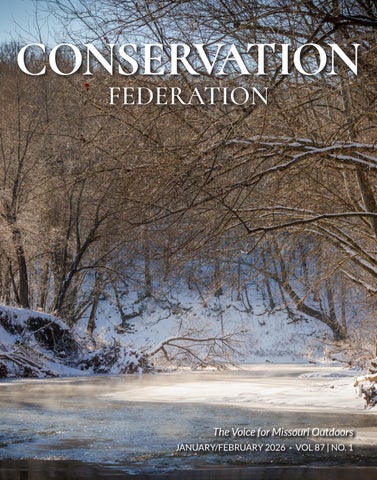
CONSERVATION FEDERATION
The Voice for Missouri Outdoors JANUARY/FEBRUARY 2026 - VOL 87 | NO. 1
FOUNDERS CIRCLE Diamond Level McGeehan Family-2025
PRESERVING OUR CONSERVATION LEGACY For more than ninety years, the Conservation Federation of Missouri (CFM) has served as “The Voice for Missouri Outdoors.” Join in our efforts to secure our stronghold as advocates for our state’s wildlife and natural resources by becoming a dedicated member of our Founders Circle.
Gold Level Abe Phillips-2024
Silver Level David Urich-2023 Anonymous-2025 Tanya Duvall-Haubein-2025
Your contribution will play an influential role in preserving Missouri’s rich outdoor legacy. Each year, earnings from the endowment will be used to support CFM’s education and advocacy efforts. Special recognition will be given to those who reach each level of giving. Additionally, memberships will be recognized at our annual Convention. Make your contribution today, to preserving our state’s conservation legacy.
Founders Circle Levels Diamond - $75,000 or More Gold - $35,000 to $74,999 Silver - $10,000 to $34,999 Bronze - $5,000 to $9,999
Bronze Level Zach Morris-2022 Mike Schallon-2023 Liz Cook-2023 Gene Gardner-2023 Charlie Wormek-2023 Ray Wagner-2023 Bill McCully-2025 Bruce Sassmann-2025 Nicole Wood-2025 Anonymous-2025 Anonymous-2025 Randy Washburn-2025 Mossie Schallon-2025 David Young - 2025
For more information, contact the office at (573) 634-2322 or info@confedmo.org 2
CONSERVATION FEDERATION
Executive Director’s Message
Season Reflections on Family, Tradition, and Conservation
A
s 2025 draws to a close, it is impossible not to reflect on what a remarkable year it has been for the Conservation Federation of Missouri. This year, we reached a milestone commemorating our 90th anniversary. On September 10th, we celebrated nine decades of citizens standing together for Missouri’s fish, forests, and wildlife. It was a moment to honor our founders, recognize our members, and look ahead to the next chapter of conservation leadership in our state. One of the most exciting steps into that next chapter was the rollout of our new logo. The logo feels fresh and clean and represents both our outdoor legacy and the momentum we are carrying into 2026 and the years to come. With your support, the Federation is full steam ahead as we strengthen partnerships, expand our advocacy efforts, and continue working to ensure that the next 90 years of conservation are as impactful as the first.
Norb, Colton, and Tyler Schwartze, three generations of Schwartze deer hunters, share a moment in the field during the 2025 Youth Season. (Photo: Todd Jeremy)
As we reflect on a big year organizationally, Missourians across the state are also closing out another successful deer season. The crisp mornings, the anticipation of the sunrise, and the unmistakable rhythm of deer season remind us why we care so deeply about our outdoor traditions. It was another strong year for Share the Harvest as well. Thanks to the generosity of hunters and the dedication of our partners, thousands of Missourians who need a little help, often our very own neighbors, will have healthy venison on their tables this winter. The program is built on kindness and community, and it continues to show what Missourians can accomplish when we look out for one another.
Seeing him enjoy that moment and sharing it together in the woods reminded me exactly why these seasons matter so much. Family, tradition, time spent outdoors, and stories that will be told, retold, and sometimes stretched, are what it’s all about.
For me, this deer season brought memories I will carry for a lifetime. Both of my two oldest kids, Dalaney and Colton, along with my two nephews, Paxten and Walker, all harvested deer during the first day of youth season. Watching their excitement, pride, and growing connection to the outdoors was a highlight of my entire year. It was a long day of skinning deer for my brotherin-law T.J. and I, but well worth it, and our freezers are full.
As you sit by the fire reading this article, remember that the Conservation Federation’s Annual Convention is right around the corner. It is the perfect chance to reconnect with fellow conservationists, help shape policy, and celebrate the work we have accomplished together. Be sure to get signed up. You can find the details on pages 30 and 31.
Then during the firearms season, my dad Norb, who rarely chooses to pull the trigger anymore, made a spectacular shot to get some meat for his table.
And even though deer season is winding down, winter is far from a time to stay indoors. Missouri offers some of its best natural beauty in the colder months. Whether it is a quiet hike through snow covered timber, a late season small game hunt, birdwatching, or simply breathing in that cold, clean air, there are still plenty of opportunities to enjoy Mother Nature.
Thank you for making 2025 a year to remember. Here is to the seasons behind us, the seasons ahead, and the memories still waiting to be made. Yours in Conservation, Tyler Schwartze CFM Executive Director, Editor JANUARY/FEBRUARY - 2026
3
CONTENTS
Conservation Federation Jan./Feb. 2026 - V87 No. 1
Features
STAFF Tyler Schwartze - Executive Director, Editor Micaela Haymaker - Director of Operations Beth Cowgill - Membership Manager Trisha Ely - Development & Events Coordinator Taylor Hurley - Program & Comms Coordinator Joan VanderFeltz - Administrative Assistant Bill White - Grasslands Coordinator Emma Kessinger - Creative Director
56
60
62
BOARD OF DIRECTORS Executive Committee: Bill Kirgan, President Ginny Wallace, President-Elect Steve Jones, Vice President Benjamin Runge, Secretary Ryan Verkamp, Treasurer
Dana Ripper Zach Morris Lisa Allen Tom Westhoff Mike Schallon Katie Marsh Kyle Carroll Jean Nock
18
The Karkhagne
22
Look Back At Memories, Not Regrets
28
The Honey War
32
The Top 25 of 2025: A CFM Federal Conservation Update
42
60 Dollar Sunglasses
46
Winter Care of Native Gardens
48
Ballard Black Island
Board Members: Richard Ash Mossie Schallon Gary Van De Velde Dick Wood Jake Swafford Emily Tracy-Smith Jim Low Ralph Duren Katherine Brookshire Leanne Tippett-Mosby Adam Sapp Emily Schrader Jennifer Battson-Warren Bill Cooper Governor Jay Nixon Wes Swee David Urich
54
Revisiting the Old Days of Christmas
ABOUT THE MAGAZINE
56
The Adventures of Frank & Ed: Winter Hike
60
Home Economics
62
Wintertime Table Rock Bass
Departments 3 8 11 12 14
4
Executive Director's Message President's Message Business Partners Spotlight Life Members Affiliate Spotlight CONSERVATION FEDERATION
Highlights 6 9 17 30
What is CFM Events Schedule CLC Fall Workshop Convention
Jeff Meshach Kathie Brennan Laurie Wilson William Hall Michael Meredith Alexander Scott Ryan Coovert April Hoffman Eric Rahm Dave Murphy Kaley Brittain John Hickey Cydney Mayfield Dr. Jane Williams Kendra Varns Wallis Pam Bollinger Bill McCully
Conservation Federation (ISSN 1082-8591), Copyright 1938, is published 6 times a year in January, March, May, July, September, and November by the Conservation Federation of Missouri (CFM), 728 West Main, Jefferson City, MO 65101. Of each member’s dues, $10 shall be for a year’s subscription to Conservation Federation. Call (573) 634-2322 to become a member. Periodicals Postage paid at Jefferson City, MO. POSTMASTER: Send address changes to: Conservation Federation 728 West Main Jefferson City, MO 65101
FRONT COVER Dan Bernskoetter took this photo overlooking the North Moreau Creek in Cole County using a Canon R5 camera, Canon RF100-500mm lens at 100mm, 1/4000 sec., f/6.3, ISO 1250.
Member News
Thank you to all of our Business Partners. Platinum
Gold Doolittle Trailer G3 Boats
Pure Air Natives Redneck Blinds
Rusty Drewing Chevrolet Roeslein Alternative Energy, LLC
Mitico Quaker Windows
Starline, Inc. St. James Winery
Drury Hotels HMI Fireplace Shop Hodgdon Powder Company, Inc. MidwayUSA Missouri Wine & Grape Board
NE Electric Power Cooperative, Inc. NW Electric Power Cooperative, Inc. Ozark Bait and Tackle Woods Smoked Meats
Farmer’s Co-op Elevator Association FCS Financial Gascosage Electric Cooperative General Printing Service GREDELL Engineering Resources, Inc. Heartland Seed of Missouri LLC Hulett Heating & Air Conditioning Independent Stave Joe Machens Ford Lewis County Rural Electric Coop.
Marble Graphics II LLC Midwest Mailing Services ModernLitho Jefferson City Moneta Group On Time Toner and Supplies LLC Peapod Learning Center LLC Remembrance Forest Truman’s Bar & Grill United Electric Cooperative, Inc.
Silver Forrest Keeling Nursery Lilley’s Landing Resort & Marina Missouri Wildflowers Nursery
Bronze Association of Missouri Electric Coop. Black Widow Custom Bows, Inc. Brockmeier Financial Services Burgers’ Smokehouse Central Electric Power Cooperative
Iron AJ's Automotive & Air Conditioning Bass Pro Shops (Independence) Bee Rock Outdoor Adventures Best Shot Insurance Big Bear Butcher Shop Boone Electric Cooperative Cap America Central Bank Custom Promotional Branding Dickerson Park Zoo
Your business can benefit by supporting conservation. For all sponsorship opportunities, call (573) 634-2322.
JANUARY/FEBRUARY - 2026
5
"The Voice for Missouri Outdoors" Mission: To ensure conservation of Missouri’s wildlife and natural resources, and preservation of our state’s rich outdoor legacy through advocacy, education and partnerships. In 1935, conservationists from all over Missouri came together to form the Conservation Federation of Missouri (CFM) with the purpose to take politics out of conservation. The efforts of our founders resulted in the creation of Missouri's non-partisan Conservation Commission and the Missouri Department of Conservation (MDC). Since then, CFM has been the leading advocate for the outdoors in Missouri.
Partnerships
Over 100 affiliated organizations Share the Harvest Corporate & Business Partnerships State & Federal Agency Partnerships National Wildlife Federation Affiliate Operation Game Thief Operation Forest Arson David A. Risberg Memorial Grants Missouri Stream Team
Education
Conservation Leadership Corps Missouri Collegiate Conservation Alliance Confluence of Young Conservation Leaders Affiliate Summit Scholarships for youth and students Governor’s Youth Turkey Hunt National Archery in the Schools Grants Conservation Federation Magazine
Advocacy
Legislative Action Center Resolutions to lead change Natural Resource Advisory Committees Conservation Day at the Capitol Staff and members testify in hearings for conservation and natural resources
Young Professionals
Conservation Federation of State Missouri Wildlife and began Forestry Code published
1935
1936
1940
Wildlife and Forestry Act passed
1944
1946
First deer season since 1937
Amendment 4 created Missouri's non-political Conservation Commission
First turkey season in 23 years
1958
1960
First hunter safety program formed
Missouri Department of Natural Resources formed
1969
1974
Urban fishing program formed in St. Louis; first in the nation
Operation Game Thief formed
1976
Design for Conservation Sales Tax passed
1982
1984
Stream Teams formed
1989
Parks and Soils Sales Tax passed
Missouri voters Outdoor renewed Action Parks and Soils Sales Committee formed Tax by 70.8%
Share the Harvest formed
1991
1992
Operation Forest Arson formed
2002
2006
Conservation Leadership Corps formed
2007
2009
Missouri National Archery in the Schools Program formed
CFM Celebrates 90 years
2016
2025
Parks and Soils Sales Tax renewed by voters by the highest percentage to date (80%)
Ways You Can Support CFM Membership
Support our efforts to promote and protect conservation and natural resources in our state. Members will receive our magazine six times a year, event information, our bi-weekly enewsletter, and the opportunity to grow our voice.
Affiliate Membership
CFM provides the platform for a diverse group of organizations to have their conservation voices be heard. Affiliates have the opportunity to apply for grants, receive educational training and promote the mission of their organization.
Scholarships and Grant Support
CFM provides scholarships to graduates and undergraduates. We also provide grant funds to youth education programs and to affiliate projects. Contributing will help future generations initiate boots on the ground projects.
Life Membership
Become a life member for $1,000. Life memberships are placed in an endowment fund that allows us to continue our work in perpetuity.
Business Partnerships
Business partners will enjoy recognition in each magazine issue along with opportunities to reach and engage with our active membership. Ask us about our different Business Partnership levels.
Event Sponsorship and Product Donation
Sponsoring a CFM event is a powerful way to support conservation while gaining visibility for your business. Many events include raffles and auctions, and donated products help raise funds while showcasing your support for Missouri’s outdoors.
Conservation Federation of Missouri 728 West Main St, Jefferson City, MO 65101 Phone: (573) 634-2322 ~ Email: info@confedmo.org www.confedmo.org
Become a Member today! ____ ____ ____ ____ ____
Description Individual Supporter Individual Advocate Individual Sustaining Youth/Student Individual Lifetime
Price $35.00 $60.00 $100.00 $20.00 $1,000.00
Name: E-mail: Phone: Address: Credit Card #: Exp. Date:
Join online confedmo.org/join
President's Message
Reflections
T
his is the last article I will write as the president of CFM. I feel a bit of irony in that I write it on the first morning after turning our clocks back from Daylight Saving Time. When we turn our clocks forward in March, our new president, Ginny Wallace, will be sworn in the morning after our convention. As quickly as the past 20 months have gone by, I am amazed by all they have held. On the legislative front, CFM has supported important new bills, including the Invasive Species Act, and successfully opposed those detrimental to the health of Missouri’s outdoors and the wildlife it contains. Our Legislative Advocacy Action Team, the “A Team,” continues to monitor and react to bills at the federal level, that threaten our environment and wildlife. Our mission to oppose political greed and misguidance continues and is in good hands with the support of our membership. The many ongoing programs that CFM supports continue to grow—the Share the Harvest program providing venison to food banks, developing future conservation professionals through the CLC and Young Professionals, expanding Missouri’s prairies, and supporting Missouri’s parks, to name a few. Our executive director, Tyler Schwartze, has been named cochair of the committee to renew Missouri’s Parks tax, which will be on the 2026 ballot. This is going to be a monumental effort, and we will need all citizens banding together to vote Yes on 1. As CFM continues to live out its mission of being “The Voice for Missouri’s Outdoors,” it could not be done without the support and generosity of its members. I would be remiss if I didn’t mention the John and Mary Risberg Grant supporting our affiliates’ programs in honor of their son, David; Bill McCully, who makes annual contributions to a myriad of programs in his retirement; and Dan and Connie Burkhart, who have gone above and beyond in their generosity to support the efforts of CFM and the Katy Trail well into the future.
8
CONSERVATION FEDERATION
Along with these exceptional benefactors, please look inside the front cover of this magazine for those in the Founders Circle, and on pages 12 and 13 for the names of our Life Members. These individuals, along with our Business Partners and those who donate to our auctions, assure me that the Conservation Federation will remain strong well into the future. Finally, with the leadership and board members who are willing to give of their time and talents, along with our exceptional staff, I know that CFM will be in good hands for many years to come. It has been my honor to serve as CFM’s President, and I thank you for your support. With that, here’s to the next 90 years! Cheers!
Bill Kirgan CFM President
2026 Events Schedule 90 thAnnual Convention - Virtual - Feb. 24-26, March 2-4; In Person - March 6-9
Let your voice be heard at the Annual Convention. The event will include meetings, awards, auctions, and so much more. Held at the Lodge of Four Seasons in Lake Ozark.
Conservation Day at the Capitol - April 1
Join conservationists from across Missouri on the radio for a day of celebrating and supporting conservation and natural resources. The broadcast will air from 6 am to 10 am on 96.7 FM or KCMQ.com.
CFM with the Springfield Cardinals - May 7
Step up to the plate with CFM this May at a Springfield Cardinals game — where conservation meets America’s favorite pastime!
Share The Harvest Golf Tournament - June 22
Tee off for a great cause at our golf tournament at Oak Hills Golf Center in Jefferson City to support Share the Harvest!
CFM Life Member Event - June 27
CFM will be hosting its 4th annual life member only event.
Whiskey & Wildlife Banquet: Kansas City - July
A classic CFM banquet enhanced with whiskey tastings and wild-game appetizers from around Missouri.
Pull for Conservation: Central - August 8
Take your best shot at the 19th annual Central clay shoot at Prairie Grove Shotgun Sports.
Affiliate Summit - September 18
CFM affiliate organizations are invited to network and learn.
Miles for Missouri Outdoors - September 19
Enjoy a morning 5K run/walk and explore conservation booths from our affiliate partners at the river access.
Fall Online Auction - October 12-23
Enjoy a fun and interactive online auction with many great trips and prizes. Event dates are subject to change. Please visit www.confedmo.org or follow us on social media for the most up to date schedule.
Member News
CFM MISSION:
To ensure conservation of Missouri's wildlife and natural resources, and preservation of our state's rich outdoor legacy through advocacy, education and partnerships.
Life Memberships Help All: Bill McGuire
I
t started in childhood while fishing in a stream. Sunny glare obscured what lay below the water’s surface. Then the sun shifted and, through crystal water, a fascinating world of aquatic plants, snails, turtles, fish, and more came into view. I marveled at what I saw and a love affair with the natural world began.
Please join in supporting the natural world through CFM and take time to look beneath the surface.
I went on to earn a BS and MS in wildlife ecology and was fortunate to work summers for Missouri State Parks. After college, I was hired by the Missouri Department of Conservation (MDC) as a conservation agent, then a field biologist, administrator, and I retired as Chief of the Private Land Services Division. However, I wasn’t ready to fully retire, so I consulted for over a decade more on projects across the country for organizations that tend to conservation at the national level. During that time, I discovered the high regard in which both the MDC and Missouri State Parks are held. Both agencies and what they do are Missouri treasures and their continuation should not be taken for granted. Whether a citizen or working in the profession, those with an outdoor interest should consider stepping up to the plate with membership (especially lifetime) in CFM because it advocates vigorously for both MDC and Missouri State Parks. That is why I became a Life Member of the Conservation Federation.
Catching trout at Bennett Spring State Park. (Photo: Norb Giessman)
In Memory & Honor Doug Eiken Mr and Mrs Richard Ash Robert & Janet Dunning Mike Dunning
10
CONSERVATION FEDERATION
Robert Ayres Linda Ayres Henry Azuma Kay Azuma Devin Lause Jacqueline Hoener
Business Spotlight
Forrest Keeling Nursery
F
orrest Keeling Nursery is more than a native plant nursery. With over seven decades of experience, our team has honed our understanding of the natural environment and how to best support and protect it. Our vision is reflected in our corporate mission statement: ‘restoring earth’s ecosystems one tree at a time.’ Quality native plants and their positive impact on the environment are the foundation for Forrest Keeling Nursery's evolution into a champion for conservation, restoration, and agroforestry. Over 25 years of independent scientific validation have made us a benchmark for challenging plantings locally and worldwide. Like CFM, a trusted partner with the goal of restoring healthy plants, a healthy planet, and healthy people. Forrest Keeling Nursery is more than a native plant nursery. With over seven decades of experience, our team has honed our understanding of the natural environment and how to best support and protect it. Our vision is reflected in our corporate mission statement: ‘restoring earth’s ecosystems one tree at a time.’ Our dedication to this mission is reflected in our emphasis on the production of native species and our commitment to sustainability in every aspect of our plant production.
We specialize in native plants and offer over 250 species of native trees and shrubs and more than 100 species of native perennials and grasses. Our patented RPM production process allows us to go from a quality seed to an eight-foot tree in 210 days. The RPM-produced native plants offer unsurpassed survivability, have dense root systems, grow twice as fast, and nurture wildlife with their fruit, nectar, and cover. Quality native plants and their positive impact on the environment are the foundation for Forrest Keeling Nursery's evolution into a champion for conservation, restoration, and agroforestry. Over 25 years of independent scientific validation have made us a benchmark for challenging plantings locally and worldwide, a trusted partner with the goal of restoring healthy plants, a healthy planet, and healthy people through continued improvement of our technologies. For more information about Forrest Keeling Nursery, visit fknursery.com
JANUARY/FEBRUARY - 2026
11
Member News
LIFE MEMBERS OF CFM Charles Abele * R. Philip Acuff * Duane Addleman * Nancy Addleman Tom Addleman Nancy Addleman * Michael Duane Addleman James Agnew Carol Albenesius Craig Alderman * Allan Appell Victor Arnold Bernie Arnold Richard Ash Judy Kay Ash Carolyn Auckley Debbie Audiffred Doug Audiffred Ken Babcock Bernie Bahr Michael Baker * James Baker Dane Balsman Timothy Barksdale Lynn Barnickol Jamie Barton Michael Bass Robert Bass Don Bedell Troy Beilsmith Cooper Bein Thomas Bell David F. Bender Rodger Benson Leonard Berkel Barbi Berrong Jackson Bird Jim Blair John Blankenbeker Amy Bloomfield Tom Bloomfield Andy Blunt Jeff Blystone Kim Blystone Glenn Boettcher Arthur Booth * Dale Linda Bourg Stephen Bradford Marilynn Bradford Robin Brandenburg Mark Brandly Kathie Brennan Robert Brinkmann Michael Brisendine
12
Kaley Brittain Virginia Brizendine Lon Brockmeier Katherine Brookshire Donald R. Brown * Scott Brundage Bill Bryan Misty Bryan Alan Buchanan Connie Burkhardt Dan Burkhardt Charles Burwick Brandon Butler Randy Campbell Brian Canaday Dale Carpentier Joe Cater * Glenn Chambers Bryan Chilcutt Ed Clausen * Edward Clayton * Ron Coleman Denny Coleman Rhonda Coleman Liz Cook Bill Cooper Elizabeth Copeland Mark Corio * Bill Crawford Todd Crawford Andy Dalton DeeCee Darrow Brian Davidson Mike Dempsey Ryan Diener Joe Dillard Randy Doman Tim Donnelly Cheryl Donnelly Ron Douglas Chuck Drury * Charlie Drury Tom Drury Ethan Duke Mike Dunning William Eddleman Karen Edison John Enderle Theresa Enderle Joe Engeln Marlin Fiola Fred First * Mary Louise Fisher Howard Fisher Andrew Fleming
CONSERVATION FEDERATION
Brian Fleming * Charles Fleming David Fleming Howard Fleming Kailey Fleming Lori Fleming Matt Fleming Paula Fleming Sara Fleming X. Daniel Forte Bob Fry Manley Fuller David Galat Gene Gardner Matt Gaunt Jason Gibbs Timothy Gordon Blake Gornick David Graber Tim Grace Jody Graff Richard & Sally Graham Timothy Graven * Joseph Gray Tom Gredell Tyler Green Jason Green Gery Gremmelsbacher Debbie Gremmelsbacher Jason Gremmelsbacher Bernie Grice Jr. Mark & Kathy Haas Tom & Margaret Hall Christopher Hamon * Deanna Hamon J. Jeff Hancock Herman Hanley Keith Hannaman Elizabeth Hannaman Lonnie Hansen Bryan Hargiss John Harmon * Milt Harper Jack Harris David Haubein Tanya Duvall-Haubein Carl Hauser Jessica Hayes * Susan Hazelwood William Heatherly Mickey Heitmeyer * Loring Helfrich * LeRoy Heman
* Randy Herzog Todd Higgins Bill Hilgeman Jim Hill John Hock April Hoffman Mike Holley Rick Holton CW Hook * Allan Hoover Amanda Horne John Hoskins Todd Houf * Mike Huffman Wilson Hughes Larry Hummel * Patricia Hurster Kyna Iman Jason Isabelle Jim Jacobi Aaron Jeffries Robert Jernigan Jerry Jerome Roger & Debbie Johnson * Don Johnson * Malcolm Johnson * Pat Jones Steve Jones John Karel Thomas Karl Jim Keeven * Duane Kelly Cosette Kelly Junior Kerns Todd Keske Robert Kilo * Martin King Bill Kirgan * Judd Kirkham * Ed Kissinger Sarah Knight TJ Kohler Jeff Kolb Chris Kossmeyer Chris Koster Dan Kreher Carl Kurz * Ann Kutscher Larry Lackamp Kyle Lairmore * Jay Law Michael Leach * Gerald Lee Debra Lee Mark Lee Randy Leible Wade Leible * Joel LeMaster
* Norman Leppo * John Lewis Phil Lilley Bill Lockwood Leroy Logan Christine Logan - Hollis Bob Lorance Ike Lovan Wayne Lovelace Kimberley LovelaceHainsfurther Jim Low Mark Loyd Bill Lyddon Mary Lyon Emily Lute-Wilbers Martin MacDonald Michael Mansell Steve Maritz Katie Marsh Danny Marshall Brenda Martien Larry Martien Edward Martin Karen Massey John Mauzey Cydney Mayfield Bill McCully Chip McGeehan Teresa McGeehan Justin McGuire William McGuire Nathan "Shags" McLeod Jon McRoberts Richard Mendenhall Tom Mendenhall Donna Menown John "Mitch" Mertens Cynthia Metcalfe Walter Metcalfe Larry Meyer Stephanie Michels Brooks Miller Mitchell Mills Joshua Millspaugh Davis Minton Bill Moeller Lowell Mohler John Moore, Jr. Gary Moreau Johnny Morris Mary Morris Zachary Morris Butch Morrissey Keri Morrissey John Mort David Mosby Leanne Mosby Steve Mowry Diana Mulick David Murphy * Dean Murphy
Richard Mygatt * Steve Nagle Rehan Nana Robert Naumann Phil Needham J. Roger Nelson Jeremiah (Jay) Nixon Gary Novinger Frank & Judy Oberle Larry O'Reilly Charlie & Mary O’Reilly Beth O'Reilly Anya O'Reilly Jeff Owens Austin Owens Jeffrey Panchot Sara Parker Pauley Scott Pauley Randy Persons Edward Petersheim Albert Phillips Jan Phillips Glenn & Ilayana Pickett Jessica Plaggenberg Becky Plattner Zach Pollock Tessa Poolman * Jerry Presley Albert Price Nick Prough Andrew Raedeke Kirk Rahm Kurtis Reeg John Rehagen David & Janice Reynolds Carey Riley Kevin Riley Mike Riley Dana Ripper John Risberg Mary Risberg Ann Ritter Charles Rock Derrick Roeslein Rudy Roeslein Charles Rogers Kayla Rosen Gerald Ross Pete Rucker Benjamin Runge Tyler Ruoff William Ruppert Tom Russell Jacob Sampsell Bruce Sassmann Jan Sassmann Frederick Saylor Michael Schallon Mossie Schallon * Evelyn Schallon Thomas Schlafly Pamela Schnebelen
Emily Schrader Don Schultehenich Deb Schultehenrich Tyler Schwartze * Ronald Schwartzmeyer Timothy Schwent Travis W. Scott George Seek Arlene Segal * E. Sy Seidler * Sara Seidler Joshua Shadwick Steven Sheriff Anita Siegmund Emily Sinnott Douglas Smentkowski Edward Smith Gary & Susanna Smith Zachary Smith * M.W. Sorenson Jeff Staake * Ed Stegner Jeff Stegner Everett Stokes William Stork Jr. Robert Stout Winifred Stribling Norm Stucky Mary Stuppy * Mark Sullivan Jacob Swafford Jim Talbert Norman Tanner Stephen Taylor Tim Taylor Travis Taylor Richard Thom Don Thomas Tim Thompson Jim Thornburg * Jeff Tillman Robert Tompson Mike Torres Matt Tucker David Urich Jennifer Urich Alex Uskokovich Gary Van De Velde Barbara vanBenschoten Lee Vogel Albert Vogt Frank Wagner Ray Wagner * Julius Wall Ginny Wallace Mervin Wallace Jennifer Battson Warren Randy Washburn Mary Waters * Henry Waters, III. Daniel Weinrich Michael Weir
* Robert Werges Evelyn Werges Bennish Tom Westhoff Gary Wheeler Georganne Wheeler Nixon Rayburn Whitener Mark Williams Dennis Williams Dr. Jane Williams Stephen Wilson Michael Wilson Laurie Wilson Jonathan Wingo Jon R. Wingo James Winn Michael Wiseman Daniel Witter Brenda Witter * Addie Witter Olivia McKinney Witter Owen Witter Shirley Wolverson * Dick Wood Howard Wood Joyce Wood Nicole Wood Charles M. Wormek Brad Wright Evan Wright Suzanne Wright David Young Judy Young Dan Zekor Daniel Zerr Jim Zieger Robert Ziehmer Emily Ziehmer Lauren Ziehmer Colton Zirkle Ethan Zuck Guy Zuck Mark Zurbrick *Deceased
JANUARY/FEBRUARY - 2026
13
Affiliate Highlights
The Missouri Birding Society
F
ounded in 1901 as the Audubon Society of Missouri, the Missouri Birding Society is a statewide organization dedicated to the preservation and protection of birds and other wildlife; to education and appreciation of the natural world; and to effective wildlife and habitat conservation practices. The society tracks birds in Missouri with citizen science contributions through three primary pathways: seasonal reports submitted on eBird (or directly to MBS) are reviewed by eBird reviewers and confirmed reports become a part of the narrative for a season; the Missouri Bird Records Committee of the MBS reviews reports of rare birds and out-of-season occurrences to provide an evidence-based method of determining the status of species in our state; and Christmas Bird Counts, an annual holiday tradition for many birders. As the first citizen science project, the CBC has captured enough data over the years that results are now used by various scientific organizations to document changes in bird populations. Since 2005 MBS has partnered with the Missouri Department of Conservation (MDC) and the Missouri Division of Natural Resources (DNR) to support bird habitat projects and other bird-related projects and activities. MBS birders, through eBird, provide quality bird monitoring data on MDC and DNR lands and in the surrounding areas throughout Missouri.
14
CONSERVATION FEDERATION
Each year MBS provides members with a list of areas to bird. These programs are CACHE (MDC) and SPARKS (DNR), that in turn allows MBS to support a variety of conservation projects like Missouri River Adventure Camp for youth, Motus bird tagging and detection and partnership with DarkSky Missouri. All of the funded projects (totaling more than $169,000) are listed on the MBS website, www.mobirds.org. Through its website and social media, MBS provides the public with an enormous amount of information regarding birds and ways in which people can enjoy them and support conservation. MBS members receive an informative quarterly journal which provides seasonal reports, enjoyable stories, guides to birding areas in the state, peer-reviewed articles, book reviews, and more. Twice each year, in May and September, MBS members gather for a weekend of birding, presentations and socializing with business taking place at each autumn event. The next meeting is scheduled for May 1-3 in St. Louis area when the society will celebrate our 125th year! There will be field trips, presentations and more, details and registration will be available on the MBS website in January.
Affiliate Highlights
Affiliate Organizations Anglers of Missouri Association of Missouri Electric Cooperatives
Missouri Chapter of the American Fisheries Society
Ozark Chinquapin Foundation Ozark Fly Fishers, Inc.
Missouri Chapter of the Wildlife Society
Ozark Land Trust
Basshole Bass Club
Missouri Coalition for the Environment
Ozark Rivers Audubon Chapter
Bass Slammer Tackle
Missouri Conservation Corps
Ozark Riverways Foundation
Burroughs Audubon
Missouri Conservation Heritage Foundation
Ozark Trail Association
Missouri Conservation Pioneers
Ozark Wilderness Waterways Club
Capital City Fly Fishers
Missouri Consulting Foresters Association
Perry County Sportsman Club
Chesterfield Citizens Committee
Missouri Disabled Sportsmen
Pomme De Terre Chapter Muskies
Missouri Ducks Unlimited- State Council
Quail & Upland Wildlife Federation, Inc.
Missouri Environmental Education
Quail Forever & Pheasants Forever
Society of Greater Kansas City
for the Environment Columbia Audubon Society Conservation Foundation of Missouri Charitable Trust
Association
Renew Missouri
Missouri Forest Products Association
River Access Coalition
Dark Sky Missouri
Missouri Grouse Chapter of QUWF
River Bluffs Audubon Society
Deer Creek Sportsman Club
Missouri Hunting Heritage Federation
Scenic Missouri, Inc
Duckhorn Outdoors Adventures
Missouri Master Naturalist
Scenic Rivers Invasive Species
Festus-Crystal City Conservation Club Forest and Woodland Association of Missouri Forest Releaf of Missouri Friends of Rock Bridge Memorial State Park Gateway Sustainable Farmers Alliance Greater Ozarks Audubon Society
- Great Rivers Chapter
Partnership (SRISP)
Missouri Master Naturalist
South Side Division CFM
- Hi Lonesome Chapter Missouri Master Naturalist - Osage Trails Chapter Missouri Master Naturalist - Springfield Plateau Chapter
Southwest Missouri Fly Fishers St. Louis Audubon Society Stream Teams United Student Air Rifle Program The Conservation Fund
Greenbelt Land Trust of Mid-Missouri
Missouri National Wild Turkey Federation
Tipton Farmers & Sportsman's Club
Greenway Network, Inc.
Missouri Native Seed Association
Tri-Lakes Fly Fishers
James River Basin Partnership
Missouri Outdoor Communicators
Turtle Conservation Group
L-A-D Foundation
Missouri Park & Recreation Association
United Bowhunters of Missouri
Lake of the Ozarks Watershed Alliance
Missouri Parks Association
Veterans Outdoor Therapy Foundation, Inc
Land Learning Foundation
Missouri Prairie Foundation
Wild Bird Rehabilitation
Legends of Conservation
Missouri River Bird Observatory
Wild Souls Wildlife Rescue Rehabilitation
Magnificent Missouri
Missouri River Relief
WildHERness
Mid Mo Prescribed Burn Assn.
Missouri Rock Island Trail, Inc.
Wonders of Wildlife
Mid-Missouri Outdoor Dream
Missouri Rural Water Association
World Bird Sanctuary
Mid-Missouri Trout Unlimited
Missouri Smallmouth Alliance
Midwest Diving Council
Missouri Society of American Foresters
Mississippi Valley Duck
Missouri Soil & Water Conservation
Hunters Association
Society-Show-Me Chapter
Missouri Association of Meat Processors
Missouri Sport Shooting Association
Missouri B.A.S.S. Nation
Missouri State Parks Foundation
Missouri Bear Foundation
Missouri Taxidermist Association
Missouri Bird Conservation Initiative
Missouri Trappers Association
Missouri Birding Society
Missouri Trout Fishermen's Association
Missouri Bluebird Society
Northside Conservation Federation
Missouri Bow Hunters Association
Open Space Council of the St. Louis Region
Missouri Caves & Karst Conservancy
Outdoor Skills of America, Inc.
JANUARY/FEBRUARY - 2026
15
It’s Your
SEASON
Shelter Insurance® is a proud sponsor of Share the Harvest & the Conservation Federation.
Contact your local Shelter agent to insure your auto, home, life, farming, hunting & fishing gear. Find an agent near you at ShelterInsurance.com.
Member News
CLC Fall Workshop 2025
E
arlier this year, in September, new and returning Conservation Leadership Corps (CLC) students met at Camp Clover Point for their annual Fall Workshop. The primary goal of the Fall Workshop is to pick out which resolution topics the students will write about. This is done through the process of assigning team leaders and members, and beginning research and drafting. For new students, they are also learning what a resolution consists of and what its purpose will be for Missourians. The Fall Workshop also serves as an introduction to the CLC and Conservation Federation of Missouri (CFM), and how these resources can help them in their future careers. Each year professionals from various different organizations such as Missouri Department of Conservation, Missouri Department of Natural Resources and CFM affiliate organizations, are asked to attend to provide insight into what work is being done in their organizations. This is done to help students be informed when choosing topics based on past resolutions or expiring resolutions that need to be renewed. These professionals also aid in finding contacts within their organization to assist the students gather information and resources to improve their draft resolutions. This year, at Fall Workshop, the professionals who were invited also held professional development sessions to aid students with improvement on skills that will help them in the career fields they are working towards.
CLC students gather at lake dock to relax and appreciate nature. (Photo: CLC Student Jasmine 'Jay' Bunyan)
The skills covered this year included resume and scholarship writing, microphone and presentation etiquette, proper introductions and how to network at professional events, and dress codes for events such as interviews and conventions, as compared to day to day office wear and field work. Fall Workshop is also a great way for CLC students to form friendships; the students are able to get to know each other better through evening activities like volleyball and basketball, searching for wildlife, or watching the sunrise on the dock. CLC students leave Fall Workshop with a resolution team and the tools they need to continue the drafting of resolutions to be presented at CFM’s spring convention, and professional contacts to help them along the way. This is all done to help students work towards making positive impacts on our communities by being a voice for Missouri's outdoors.
Kaley Brittain CLC President
USPS Statement
JANUARY/FEBRUARY - 2026
17
Feature Story
Looking Back
Missouri’s Conservation History
The Karkhagne Many Conservation Federation members have participated in this club, and its accomplishments have lived up to the expectations of its founders. In addition, the Karkhagne is the symbol of professional achievement among members of the Missouri Society of American Foresters, and several Conservation Department foresters have received the Karkhagne Award from that group. Former Assistant State Forester Milton G. (Gus) Hoyer was a founding member of the Karkhagne Club, and he related the story of the Karkhagne to Ramon Gass, who wrote of it in The History of the Missouri Society of American Foresters. The Karkhagne originated in the great logging camps of the sparsely populated northwestern states of Oregon, Washington, Idaho, and Montana during the halcyon days of the late 1800s and early 1900s. To solve the lack of local laborers, many people were brought into the region to work in the woods. Many were from Canada, and with them came the myth of the Karkhagne.
T
hrough the years, many interested conservationists (and particularly foresters) have heard of the Karkhagne, a mythical creature that inhabits the oak and pine forests of the Ozarks. In the late 1940s, a group of these conservationists formed the Karkhagne Club at Salem to share information and promote proper forest management among professionals, landowners, and other interested citizens.
18
CONSERVATION FEDERATION
At first, the Karkhagne was used to pester the new arrivals at the logging camps. No matter which logging circle the new man was assigned to, someone would comment that the Karkhagnes were especially bad in that area, and that just last week two good men were captured by Karkhagnes and haven’t been seen since. After a day or two, the curiosity of the new man would be aroused, and he would ask, “What is this Karkhagne?” This was the opening the old hands were waiting for, and the stories would begin, each one more outrageous than the next.
Feature Story The main storyteller (usually the foreman) would describe the creature as a terrible-looking monster whose hide was a combination of fur, feathers, scales, and armor plate. Its tail consisted of two long antennae, which were extremely sensitive and could detect a mosquito at 100 yards. The antennae could also spurt out lightning with an accompanying thunderbolt. They also served as a sort of radar, since the Karkhagne always traveled backward— it merely wanted to see where it had been. Another henchman would recall the sex life of the beast. Both sexes were contained in the same individual, and residents in the general area would report serious earth tremors when a sexual union occurred. When the Karkhagne finally gave birth to its young, the beast would hide a minimum of 40 miles from land, sea, and air to do so. If the potbelly stoves of the great logging camps had contained recorders, there would be many volumes of Karkhagne fantasies (and perhaps an outright lie or two) to ponder, even unto this very day. The Karkhagne came to Missouri with the arrival of foremen from the northwest logging camps, who were imported to supervise work at the newly formed Civilian Conservation Corps (CCC) camps during the Great Depression of the 1930s. Many of these men were sent to survey the Ozark countryside to locate the boundaries of land acquired for two new national forests in Missouri. Many acquisition crews had trouble finding section corners in this rugged land (especially when the survey notes indicated that the section corner was a limestone rock), and word soon began to circulate that the Karkhagne searched out and ate these limestone corners. Other tales soon followed, and the Karkhagne saga continued in Missouri lore.
It has been said that only two people have seen a Karkhagne in Missouri, and they reported what they saw to artist Ward Degler (the son of former MDC forester Roy Degler), who painted a picture of the brute for all eternity to see. For many years, the painting hung in the Forestry Division’s office at MDC headquarters. It is now in safe storage at a climate-controlled facility. The painting is owned and copyrighted by the Karkhagne Club. A facsimile of the painting is shown above. Eugene L. Brunk The Karkhagne Award was presented to Gene Brunk in 1996, and was hand-carved by J.R. McNeil of the famous Branson Woodcarvers. (Photo: Gene Brunk)
The Voice for Missouri Outdoors
90
THANNUAL CONVENTION
February 24-26, & March 2-4 2026 Virtual
March 6-8, 2026 In-person
LODGE OF FOUR SEASONS, LAKE OZARK, MISSOURI
For more information and to register visit: www.confedmo.org/convention (573) 634-2322
Let your voice be heard! Be a part of the resolution discussions that affect your outdoor passions! Banquet Awards Ceremony Live and Silent Auctions General Assembly Meeting Networking Opportunities Meet the Conservation Leadership Corps Future of Missouri Outdoors Workshop Educational & Entertaining Natural Resource Breakouts
COMMITTED TO COMMUNITY A N D CO N S E R VAT I O N Owned by the members they serve, Missouri’s electric cooperatives do more than provide reliable and affordable electricity. They are active in their communities, concerned for the well-being of their neighbors and devoted to the rural way of life that makes the Show-Me State a special place to live, work and play. Missouri’s electric cooperatives are dedicated to protecting the land, air and water resources important to you and your quality of life.
Learn more at moelectriccoops.com
Feature Story
Look Back At Memories, Not Regrets
M
y wife and I have been married for 56 years. In today’s world, a lot of marriages don’t make it that long. Ours had its rough spots, which I regret, but we didn’t give up. I wish more married couples would do their best and not give up. We are the proud parents of three sons, proud grandparents of seven grandkids, and proud greatgrandparents of four great-grandkids. Our oldest son has battled cancer for several years and is on disability. He has a great attitude. I don’t think I have ever seen him down or depressed. Mom takes him for treatments and doctor appointments.
22
CONSERVATION FEDERATION
He is single and lives alone in the country near us, and loves it there. His kids or grandkids don’t come to visit very often. We hear stories about all the deer and turkey he is seeing from his deck. I was busy trying to make a living when he was growing up. I did not take him hunting and fishing like I did our other two sons. I was also too busy when his kids were little to get them into the outdoors. I regret that all now. I keep my ATV in his garage so he can ride around and enjoy the outdoors. He has had several dogs that kept him company. After the last one died, it hurt. He says he won’t get another one. I think he will change his mind someday.
Feature Story Our middle son also lives nearby. He has his own custom woodworking business and is very busy with that. His wife has a house-cleaning business. Their weekends are spent at church, camping in their RV, or traveling to Kansas or Texas with their dog to visit their kids and all their dogs. They are busy with their own lives. We don’t see them as much as we used to. I have memories of taking him fishing sometimes when he was little. I have a picture of him sitting on my lap as a baby, fishing for trout. Later we went sucker, crappie and bass fishing. We also went dove, rabbit, and squirrel hunting. I wish I had taken him more, but I was too busy. I regret that too. When he got married and started a family, we bought a weekend cabin on a creek surrounded by a National Forest. We spent a lot of time and made plenty of memories there, fishing, playing in the water, and riding our ATVs. We did a lot of deer and turkey hunting together back then. I would hunt with our grandson, and our son would hunt with our granddaughter. We also bought a boat and made many memories on local lakes, fishing, tubing, and enjoying the water. Grandma and I also went to many basketball and baseball games to watch our grandson. We attended many basketball and football games to watch our granddaughter cheer, as well as watch her gymnastic events. Our youngest son married a girl from Wisconsin. That is where they still live. They found they could not have kids of their own. So, they adopted a little boy from Guatemala. A year later, the adoption agency called and told them they now had his little brother. They adopted him, too, so they could grow up together. When they were little, they bought a cabin on a lake and a pontoon boat so those special boys could grow up fishing and enjoying the water. We made many trips to enjoy it with them and make memories. They made many trips to visit us and spend time at our cabin with their aunt, uncle and cousins. We played in the water and on the gravel bar. We fished and rode ATVs together. We sat around campfires and roasted marshmallows. We hiked through the woods. They learned how to shoot a BB gun there.
When they got older I bought them both pellet guns so they could shoot at targets with their Dad back home in Wisconsin. They later got into squirrel and varmint hunting with them. A few years later, I received a call from our son telling me they were seeing a lot of deer on their farm, and the oldest grandson wanted to go deer hunting. A few weeks later, Grandma and I were on our way to Wisconsin with my truck loaded down with tree stands, hunting clothing and deer hunting rifles. The grandson did not get a deer the morning of the hunt. We could not get him out of bed to go that early in the morning. Our son, who had never wanted to hunt deer, did. We stood there looking at his deer, and with tears in my eyes, I hugged him. That is a memory I will never forget. My wife and I rented a condo on a beach in Florida for several years. Both families came to visit us to play in the water and make things in the sand. We all went to Disney World together. They still talk about that time in their life. JANUARY/FEBRUARY - 2026
23
Feature Story Our Missouri grandkids have fond memories of our cabin, which they loved. They both attended Kansas State University. The grandson was a member of the National Championship fishing team. I like to think that those times his Dad and I fished with him on lakes and streams paid off. He is now married and works for a company that makes products for hunting and fishing. They live in Manhattan, Kansas, where they both went to college. His wife is a doctor of Audiology. They hunt deer and go fishing together. He is a lucky man. The granddaughter lives in Dallas, Texas. She is a wedding planner and also teaches gymnastics to kids. Her husband works for a major airline. They don’t hunt or fish. My hope is they will someday. Maybe they will go with her Dad or brother. If not, that’s okay too. They both have their dogs that they treat like kids. They are making their own memories now. One of these days, we will be getting a call telling us we are going to be great-grandparents again. The Wisconsin grandkids are now in college. Both have memories of Grandma and I with them in Missouri and Wisconsin. They have memories of their farm. They have memories of Mom and Dad taking them to their cabin on local lakes and vacations to National Parks. When they both graduated high school, their Mom and Dad asked them what they wanted as a gift. They both said that they wanted to go with them and their brother to a national park they had not been to. Even though our son has been battling cancer for a few years, he did not hesitate. They have now been to every National Park in America. This may all sound good to those of you reading this. You also need to know that I made several mistakes in my life that I deeply regret. If my family and my God had not forgiven me, it could have kept any of this from ever happening.
24
CONSERVATION FEDERATION
Our kids and grandkids are now busy with their lives. Our church family is a big part of our lives. My wife and I share memories of times past. We pray for this broken world, our kids and grandkids are living in. At my age, I am not nearly as active in the outdoors as I used to be. I have many outdoor and family memories that I love to write stories about. I hope that they will touch the hearts of those who read them and help them make their own memories. As Og Mandino once said, “The greatest legacy we can leave our children is happy memories.” I hope this story encourages you to look back at your memories and not regrets.
Larry Whiteley Cover - Our grandson and granddaughter, during deer season long ago. (Photo: Papa Whiteley) Page 23 - Son and Granddaughter with a gift from Papa Whiteley. (Photo: Larry Whiteley) Top - Most of the Whiteley family is in the creek at the cabin. (Photo: Bob Kipfer)
Outdoor News
The Carcass Pile
T
rappers try to utilize all parts of the animals they catch. While the fur is the most valuable part, other parts are used when possible. The meat of some furbearers is used for human consumption. Beaver, raccoon, muskrat, and even bobcat can all be eaten, and many people enjoy it, especially the beaver. Other parts, such as skulls, glands, and bones, are used in limited quantities, but carcasses are often disposed of. I am fortunate to own some acreage in a rural area, and I have a location on my property where I dispose of the carcasses. This may sound wasteful, but in reality, other animals benefit greatly from the furbearer carcasses I put there. My wife and I have observed that there are several eagles around our property in the winter months. Eagles, being mostly scavengers, find my carcass pile quickly. Each year, from two to six eagles spend the winter months feasting on the skinned carcasses. I found a grassy spot surrounded by trees on three sides and placed the carcasses there. This gives the cautious eagles great perches. We set up a blind about 25 feet from the carcasses, and what we found was very interesting. We wanted to see what time the eagles arrived and if other wildlife species fed on the carcasses. The first visitors to arrive at sunrise were various small songbirds, like tufted titmice and sparrows. They feasted on the carcasses, getting mostly the fat. Soon after came several species of woodpeckers and then blue jays, which took their turn to feed. After the blue jays fed for a short while, the crows were next, running off the blue jays and feeding until the red-tailed hawks flew down from their observation perches to replace them. About midmorning, the wary eagles finally arrived and spent the rest of the day feeding and defending “their” food source. We found quite a pecking order as the birds fed on the carcasses. These bird species are diurnal, but what about the nocturnal animals? While we did not observe night visitors, I know by the tracks and trails created that the carcasses were visited regularly by several furbearer species, including coyotes, raccoons, but mostly opossums. One thing was obvious: opossums have a tremendous sense of smell, as they just keep coming. It is not unusual for me to catch 10–20 opossums each year coming to the carcasses. I have also caught a couple of coyotes and a few raccoons.
Occasionally, a bobcat will discover the pile, and that is obvious because bobcats are the only furbearer that feeds on a carcass and, if it is not eaten entirely, will hide the carcass by covering it with grass or leaves—a telltale sign that every trapper wants to see. There is a saying that nothing goes to waste in nature, and this is certainly true at my carcass pile. By March, when the weather starts to warm, the only thing left is the bones. Seeing all the wildlife that uses the pile is always interesting, and helping them through the winter with a constant source of food certainly helps them survive the cold months, ensuring that nothing goes to waste in nature. Tom Westhoff Photo: Pat Westhoff
JANUARY/FEBRUARY - 2026
25
GOOD FOR LAND. GOOD FOR LIFE.
Prairie Prophets is a media platform created by Roeslein Alternative Energy to showcase the stories and objectives of the USDA Climate Smart Commodities Grant. Everything profits from prairie. Soil, air, water - and all kinds of life! Learn how you can make the most of your land with prairie restoration, cover cropping, and prairie strips. Explore the Prairie Prophets podcast, video series, website, and socials. Scan the QR code to learn more.
Feature Story
The Honey War
I
n the end, it was a bloodless dispute between the Territory of Iowa and the new state of Missouri. For a while in the fall of 1839, it was war.
Imagine for a minute the current border between Iowa and Missouri. Now imagine that boundary lying in the middle of a nine-mile-wide strip, with Missouri claiming the northernmost boundary and the territorial government of Iowa claiming the line nine miles to the south. Settlers living in that no-man’s land could always claim they lived in the other state, no matter who came calling to collect taxes. This odd circumstance, according to the National Park Service (NPS), was a result of “imprecise treaty language, inept work by the official surveyor, and territorial rivalry.” The survey in question was done by John Sullivan in 1816. Sullivan surveyed what was referred to as the “Indian Boundary Line.” He relied in part on the wording of past treaties, which were handwritten documents and sometimes imprecise. His survey drifted north in places and was marked only by mounds of dirt. A few years later, when Missouri became a state, it inherited the “wavering and imprecise boundary that Sullivan had created.” But within a decade, the crude earthen mounds Sullivan had left behind had eroded, making the boundary even more imprecise. In 1837, the state of Missouri sponsored a re-survey which adhered to the treaty language—sort of. The original treaty language referred to the “Des Moines Rapids,” a turbulent part of the Mississippi River, as the endpoint of this line, but the new surveyor instead looked for some sort of rapids in the tranquil Des Moines River. If this new line were accepted, the State of Missouri would gain 2,616 square miles of territory at the expense of Iowa. “That was a problem.” (NPS) Both legislatures huffed and puffed but could not come to an agreement. Eventually, Congress was asked to help resolve the dispute. An Iowan, a Missourian, and a federal representative were appointed to find a solution.
28
CONSERVATION FEDERATION
Missouri soon withdrew from the mediation when it became obvious that the state would lose territory in any settlement. In the summer of 1839, Governor Boggs decided to enforce Missouri’s claims by sending a tax collector into the disputed area to collect taxes. “By late August, both states' governments had issued proclamations claiming that the disputed territory was their rightful real estate and that they would use force to maintain it.” (NPS)
Feature Story As the hills and prairies of the disputed land began to take on the colors of October, a Missouri sheriff by the name of Uriah Gregory rode into the northern part of the land in question to collect taxes. Irate settlers weren’t having it. They refused to pay any taxes to Missouri, claiming they were Iowans, forcing the sheriff to return to Missouri or face violence. In retaliation, Missouri settlers went to the same area and cut down three trees known to be storehouses of honey, as a “payment in lieu of taxes,” so to speak. (The trees are said to have been located in what is today part of Van Buren County, Iowa, in Lacey-Keosauqua State Park.) In November, Sheriff Gregory made another attempt to collect the taxes. This time, 11 members of the state militia went along with the sheriff as a show of force. When the commanding officer of the militia wasn’t willing to shed blood, angry Iowans were able to capture and detain the sheriff. He was “…jailed in Muscatine, Iowa for ‘usurpation of authority.’” (NPS) Three valuable bee trees were down, local settlers were furious, and a Missouri sheriff was locked up in the Iowa Territory. Governor Boggs vowed to defend the honor of Missouri and called up the militia. At least 600 men were mustered into service and headed toward Missouri’s northern border—wherever that was. “In response, Iowa created its first territorial militia and mobilized troops of its own, with self-provisioned and outdated weapons, including rusty swords left over from the War of 1812, Revolutionary War muskets, and farming implements refashioned into weaponry, such as a butter churn dasher and a plow blade on a chain. The governor of Iowa supplied five barrels of whiskey to his hastily improvised army, and at their camp, soldiers became eager for vengeance, shouting the battle cry, ‘Death to the invading pukes!’” (NPS) As October turned into November, discontent in both militia camps grew. A November snow dampened the fighting urge of all the men. Nobody had been paid, and it was time to shuck corn and go hunting.
It’s not hard to imagine the talk around the campfires about not blaming the border families for not wanting to pay taxes when no one could decide what territory they were settled in. Eventually, a solution to the situation was arrived at by some ingenious, woodsy-smelling Missouri and Iowa boys. “Militiamen divided a deer carcass into two parts, hung them from trees, and declared each to be an effigy of Missouri and Iowa's governors. The soldiers ‘fired a few rounds at them, until we considered them dead! Dead!!!’ The deer meat was then buried with military honors, including gun salutes from the soldiers who had shot it in effigy. Shortly after this bizarre ritual, the two states’ legislatures agreed to let the federal government mediate the boundary, and both sides demobilized and withdrew without firing a shot.” (NPS) “Without firing a shot,” if you don’t count the gubernatorial deer carcasses. Hostilities ceased. The men packed up and went back to their homes. Congress issued a boundary five years later, but Missouri continued to litigate. Eventually, ten years after the conflict, the Supreme Court determined that the original survey line would become the boundary. The only casualties were the three bee trees. Thus, the Honey War, that almost was, passed into the annals of history. Kyle Carroll Cover - Militia from Iowa and Missouri were sent to the border to resolve the dispute. (Photo: Denny Leonard) Top - Monuments were erected along the Iowa / Missouri line to mark the disputed boundary. (Photo: Kyle Carroll)
JANUARY/FEBRUARY - 2026
29
Feature Story
Your Voice for Missouri Outdoors Shaping The Future
Y
ou are invited to a Special Session at the 2026 Annual Convention from 3:00 to 5:00 p.m. on Friday, March 6, 2026 at Lodge of the Four Seasons.
In 1935, conservationists from across Missouri came together to form the Conservation Federation of Missouri with the purpose of taking politics out of conservation. For 90 years YOU, the members and affiliates of the Conservation Federation of Missouri (CFM), have been the Voice for Missouri Outdoors. Together we have accomplished a great deal for Missouri resources and the opportunities to enjoy them. The issues, challenges, actions, and opportunities facing Missouri natural resources have run the gamut from the creation of the non-political Conservation Commission, to securing adequate funding for fish, forest, and wildlife conservation, to supporting Missouri State Parks and soil and water conservation. We have stopped dams, advocated for clean and healthy water, wetlands, prairies, grasslands and forests. We have provided thousands of pounds of high-quality protein to Missourians in need through Share the Harvest. We’ve offered rewards for the apprehension of poachers through Operation Game Thief and of forest arsonists through Operation Forest Arson. We have advocated for the Department of Conservation when their independence and funding are threatened. And so much more! We have done this. YOU have done this. We have much to be proud of.
Now What? Given CFM’s mission to ensure conservation of Missouri’s wildlife and natural resources, and preservation of our state’s rich outdoor legacy, what do we need to be thinking about and acting on NOW to make sure the resources and experiences we enjoy today will be here in another 90 years for Missourians of the future - our children, grandchildren and great grandchildren, our nieces, nephews and their descendants? To begin the conversation, CFM is holding a Special Session at the 2026 Annual Convention from 3 to 5 p.m. on Friday, March 7, 2026 at Lodge of the Four Seasons. During this session, participants will discuss issues, challenges and opportunities facing Missouri resources. How important are they to you? How urgent? What is CFM’s role in addressing them? We need YOU to contribute to the vision and direction of CFM right now and into the future. Please join the conversation! We’ll be sending a short, pre-session survey in early January to get your input on topics for discussion. Ginny Wallace & the CFM Team
30
CONSERVATION FEDERATION
Your Voice for Missouri Outdoors
Shaping the Future
SPECIAL SESSION
FRID FRIDAY, AY, M MARCH ARCH 6 6
3 P.M. - 5 P.M.
LODGE OF FOUR SEASONS LAKE OZARK, MISSOURI
Identify and discuss the priorities we must address now to ensure Missouri’s natural resources and outdoor legacy endure for future generations. Explore key questions: What are the greatest threats? What opportunities should we be pursuing? Consider CFM’s mission: What role should CFM play in confronting these challenges and advancing solutions? Coming soon: Watch for a pre-conference survey in January to help us make the most of our two hours together.
Feature Story
The Top 25 of 2025: A CFM Federal Conservation Update
I
n April 2025, CFM established the Advocacy Action Team (AATeam) to monitor federal policy changes affecting conservation, public lands, and clean water in Missouri. The team's purpose is to provide a nimble mechanism for responding to rapidly evolving federal actions. The decision to form the AATeam proved timely as federal natural resource management saw a continuous barrage of rule changes, executive and agency orders, budget maneuvers, and rescissions that threaten to dismantle the bedrock conservation laws and institutions that have protected America's fish, wildlife, and communities for generations. Below, we outline 25 of the most consequential federal actions of 2025 the AATeam is monitoring. Taken individually, these actions undermine core principles of stewardship, science, and public trust. Taken together, they represent a generational threat to the conservation framework it has taken more than a century to build. Outdoor Recreation and Public Lands Renewed Push for Public Land Sales: Though removed from the “One Big Beautiful Bill,” provisions to sell off millions of acres of federal land continue to reappear in draft legislation. The intent remains clear: transfer public assets into private hands under the guise of budget savings, undermining hunting, fishing, and recreation access across the West and Midwest. CFM sent action alerts urging members to contact members of Congress to oppose this action and will continue to do so as the situation evolves. Repeal of the “Public Lands Rule”: In late September, the Department of the Interior rescinded the Public Lands Rule, which had placed conservation on equal footing with extractive uses like drilling and grazing. Its repeal reopens millions of acres to degradation without requiring agencies to consider ecological impacts, reversing one of the few policies that sought to balance use and preservation on federal lands.
32
CONSERVATION FEDERATION
The scenic upper Gasconade boasts excellent water quality and provides excellent opportunities for small mouth bass fishing. Proposed changes to water quality laws and rules threaten to undo decades of progress in cleaning up the nation’s rivers, streams, lakes, and wetlands. (Photo: Leanne Tippett Mosby)
U.S. Department of Agriculture (USDA), U.S. Forest Service Roadless Rule Rescission: The 2001 Roadless Area Conservation Rule, which protects over 50 million acres of undeveloped national forest lands, is slated for repeal. This rule had overwhelming public support and was developed in a multi-year process. The USDA has offered little justification for rescinding the rule, beyond citing wildfire risk—an issue better addressed through management and funding. Missouri’s Mark Twain National Forest includes areas that could be affected if this policy expands. CFM submitted comments in response to a notice of intent to prepare an environmental impact statement. A rule proposal is expected in early 2026.
Feature Story Thirteen Million Acres Opened to Coal Leasing: In mid-2025, the Department of the Interior opened roughly 13 million acres of public land to new coal leases, including areas previously withdrawn for conservation. The decision seems contrary to market trends, public sentiment, and economically viable energy sourcing. Misdirection of The Land and Water Conservation Fund: Congress created the Land and Water Conservation Fund (LWCF) in 1964. According to the LWCF Coalition, this was “a bipartisan commitment to safeguard natural areas, water resources and our cultural heritage, and to provide recreation opportunities across the nation.” It is now being used to subsidize private development projects under the banner of “public-private partnerships.” This redirection of funds undermines the purpose of the Act and threatens decades of community recreation investment. Missouri has received over 1400 grants from the LWCF.
The removal of incidental take from the MBTA leaves no incentive for industries to engage in proactive, commonsense measures to avoid killing birds as part of regular operations. Arctic National Wildlife Refuge (ANWR) oil and gas drilling: In October, Secretary of Interior Doug Burgum opened ANWR’s entire 1.56 million acre coastal plain to oil and gas leasing and drilling. This action threatens birds, caribou, polar bears, and other wildlife. Executive Order Approving Ambler Road A controversial executive order directed the immediate approval of all permits for the Ambler Road project in Alaska. This private industrial corridor, closed to public use, would cut through Gates of the Arctic National Park, fragmenting wildlife habitat and setting a dangerous precedent for bypassing environmental review.
Wildlife and Habitat
Environmental Protection
Redefining “Harm” under the Endangered Species Act: The administration has proposed a revision to the definition of “harm” under the Endangered Species Act (ESA) that would effectively exclude habitat destruction as a cause of harm. This seemingly semantic change would upend the law’s logic: species cannot survive without habitat.
Gutting “Waters of the United States” Protections: The EPA has again moved to narrow the definition of “waters of the United States” (WOTUS) under the Clean Water Act, excluding many wetlands and intermittent streams from protection. For Missouri, this means thousands of miles of small creeks—critical for flood control, wildlife, and drinking water—could lose safeguards against pollution and destruction. CFM submitted a comment opposing this action.
For decades, courts and scientists alike have recognized that destroying a species’ habitat is a form of “take.” Removing that link would make it far harder to protect threatened and endangered species and a wide variety of other species whose survival depends on intact ecosystems. CFM submitted comments opposing this change. Migratory Bird Treaty Act – “Incidental Take” Exempted: In April 2025, the Department of the Interior reinstated a controversial 2017 legal opinion (M-37085) concluding that “the prohibitions of the Migratory Bird Treaty Act…do not apply to the accidental or incidental taking or killing of migratory birds.” The new opinion eliminates penalties for nearly all but intentional killing of birds. Currently, intentional take - such as illegally shooting or trapping birds - is vanishingly infrequent relative to the numbers of birds that are killed incidentally during industrial operations such as oil pit entrapment and powerline collisions.
EPA Pulls Back on Enforcement: In March 2025, EPA’s enforcement office deprioritized cases involving fossil fuel and energy production facilities, especially those in historically marginalized communities. This policy shift leaves countless pollution violations unchecked and undermines one of the agency’s most fundamental responsibilities. The PERMIT Act (H.R. 3898): The deceptively named Promoting Efficient Review for Modern Infrastructure Today (PERMIT) Act would make it easier for industries to discharge pollutants, including “forever chemicals,” into rivers and lakes. It weakens state authority, strips protections from intermittent streams and wetlands, and shields polluters from liability. For Missouri’s waterways - and the communities and wildlife that depend on them – the stakes could not be higher. CFM sent letters to the Missouri congressional delegation urging them to vote “no” on this legislation. JANUARY/FEBRUARY - 2026
33
Feature Story Largest EPA deregulatory package in history: In March, EPA leaders announced the “greatest and most consequential day of deregulation in U.S. history.” This package of 31 deregulatory actions seeks to eliminate pollution limits, monitoring requirements, and public transparency provisions. These rollbacks create an incentive for bad actors to pollute with impunity and an economic disadvantage for businesses seeking to protect the environment. EPA Proposes to reverse the 2009 Endangerment Finding: The EPA has proposed rescinding its 2009 Endangerment Finding, which is a rule that found greenhouse gases pose a threat to public health and welfare. The Endangerment Finding provides the foundation for all federal regulation of climate pollution. This finding was affirmed by the U.S. Supreme Court and strengthened by Congress in 2022. Cross Cutting Workforce purges at natural resource protection agencies: Throughout 2025, the administration has cut staff at numerous agencies involved in the nation’s conservation and environmental protection workforce. These cuts jeopardize the science, monitoring, and disaster management capacity that Americans depend on every day and are causing great uncertainty for the delivery of federal programs that protect and conserve America’s natural resources. CFM passed a resolution at the 2025 annual convention condemning this weakening of our core natural resource agencies. Proposed elimination of the USGS Columbia Environmental Research Center: Last year’s reconciliation process nearly eliminated funding for the U.S. Geological Survey’s Ecosystems Mission Area (EMA)—a threat that prompted a member action alert in May and letters from CFM to the Missouri Congressional Delegation. Although EMA funding currently remains in the budget, the administration is now seeking to terminate all employees (approximately 80) at the Columbia Environmental Research Center (CERC), a component of EMA, as part of a proposed reductionin-force. At this writing, a federal judge has issued a preliminary injunction temporarily blocking this action. The CERC conducts world-class research on the effects of toxic chemicals and habitat alteration on aquatic and terrestrial wildlife.
34
CONSERVATION FEDERATION
Cancellation of Congressionally Approved Conservation Funds: Programs and projects that Congress funded - some already contracted - have been abruptly rescinded. Some examples include the Local Food Purchasing and Farm to School initiatives, affecting small family farms, schools, and food banks nationwide; the EPA’s Solar for All program, designed to bring rooftop solar to low-income communities; and, the ClimateSmart Agriculture Partnerships, including 36 Missouri projects. States have filed lawsuits arguing these actions violate the Constitution and the Administrative Procedure Act. Council on Environmental Quality (CEQ) Rescinds National Environmental Policy Act (NEPA) Regulations: Earlier this year, the Council on Environmental Quality, the body that coordinates NEPA environmental reviews across federal agencies, rescinded its regulations in response to a directive from the Trump administration and consistent with some court decisions stating CEQ lacks the authority to promulgate regulations. Further, CEQ directed agencies to adopt “alternative NEPA procedures” that shrink review timelines to as little as two weeks—even for major projects with significant public health or environmental impacts. This change effectively silences communities and scientists who might otherwise raise red flags before irreversible damage occurs. Censorship of Science: Agency staff at USDA, EPA, DOE, and BLM have been instructed to avoid words like climate, emissions, biodiversity, and sustainability. Webpages on climate change, environmental justice, and public health have been deleted. The EPA’s Environmental Justice Screening Tool (EJScreen) was taken offline, and NOAA’s climate.gov stopped publishing. This deliberate erasure of information undermines public understanding and policy accountability. Executive Orders Favoring Extraction Industries: A wave of executive orders now directs agencies to prioritize oil, gas, coal, and mining interests over all other uses of public land. National monuments have been targeted for reduction, and an executive order declaring a “national energy emergency” promotes expanded coal production and liquefied natural gas exports while undermining renewable energy investment.
Feature Story The “One Big Beautiful Bill Act”: Congress passed the wide-ranging reconciliation legislative package in July 2025. Items related to conservation and environmental protection included extreme cuts to clean energy incentives, public health programs, and environmental protection funding. Government Shutdown Fallout: Although the federal government reopened after a record-setting 43-day shutdown, the fallout is far from over. Parks, refuges, and conservation offices continue to operate with significant staffing shortages and growing maintenance backlogs. Permit reviews, enforcement actions, and restoration projects are only slowly resuming, with many still delayed - further compounding the effects of earlier workforce cuts and budget rescissions. The extended lapse in operations also meant missed windows for critical habitat management, consequences that will ripple through the coming seasons. FY2026 Budget Prioritizes Fossil Fuels: The White House’s FY2026 budget proposal slashes EPA and land management programs while boosting subsidies for oil, gas, and coal. While Congress preserved a few scientific programs—like the U.S. Geological Survey (USGS) Ecosystems Mission Area and National Resource Conservation Service (NRCS) technical assistance—the overall trajectory deprioritizes science and stewardship and gives preference to extraction and deregulation. Greatly expanded use of the Congressional Review Act: Congress has used the Congressional Review Act (CRA) more than any previous session to revoke environmental and public health protections, overturning clean air, land management, and wildlife rules without meaningful debate. Such unbridled use of the CRA undercuts the public process, diminishes citizen voices, and undermines decades of bipartisan policy. The cumulative effect: Taken together, these 24 preceding actions, and more not listed here, constitute a generational risk to the values CFM has long worked to uphold. These actions will have profound impacts on conservation and environmental protection as agencies charged with upholding the public trust doctrine are stripped of authority, resources, and expertise.
An American Woodcock photographed in central Missouri. In April, the Department of Interior reinstated a controversial 2017 legal opinion concluding that “the prohibitions of the MIgratory Bird Treaty Act…do not apply to accidental or incidental taking or killing of migratory birds.” This change leaves no incentive for operators to engage in proactive, commonsense measures to avoid killing birds. (Photo: Joe Fasig, grand prize winner of the Missouri River Bird Observatory 2025 photo contest)
In Conclusion Since 1935, the Conservation Federation of Missouri has been the Voice for Missouri’s Outdoors - educating and advocating for the wildlife, waters, and wild places that define our state. In 2025, as we celebrated 90 years of conservation leadership, your voice is needed now more than ever. The AATeam will strive to keep you informed on issues of deep concern to our members along with recommended actions to lend your voice to protecting our proud heritage of natural resource protection. The Advocacy Action Team
JANUARY/FEBRUARY - 2026
35
Agency News
DEPARTMENT OF CONSERVATION MDC Welcomes 20 New Conservation Agents During 2025 Graduation
T
he Missouri Department of Conservation (MDC) congratulates 20 new conservation agents upon their graduation from MDC’s 2025 Conservation Agent Training Academy. The agent class of 2025 took the Conservation Agent’s Oath during a special graduation ceremony Tuesday, Sept. 30 at Runge Nature Center in Jefferson City. MDC Director Jason Sumners reminded agents they’re stepping into a role that requires courage, integrity, and dedication. “From the Bootheel, to the Ozarks, to the prairies of northwest Missouri, not only are you working to protect our natural resources, but to build trust with the public that we serve,” Sumners stressed. “Never forget that your actions, both seen and unseen, shape the future of conservation in this state.” The new agents spent the past six months housed at the Highway Patrol Academy in Jefferson City, where they received more than 1,200 hours of intense instruction both in and out of the classroom. Agents received training in criminal investigations, defensive tactics, firearms qualifications, and technical instruction in fish, forest, and wildlife management. Training also included courses in legal studies, communications and conducting education programs, and First Aid/First Responder and CPR certification. Upon successful completion of this training, agents are issued a Peace Officer Standards and Training (POST) license from the Missouri Department of Public Safety. The conservation agent training program is also certified by the U.S. Department of the Labor’s Office of Apprenticeship.
36
CONSERVATION FEDERATION
The 20 new agents joining more than 170 existing MDC agents in protecting Missouri’s fish, forest, and wildlife include: Sarah Abbott, Dominick Montileone III, Tyler Besaw, Trent Oberg, Dalton DeHart, Joshua Paskiewicz, Lorena Farrell, Erik Lahm, Jacie Hopfinger, Jacob Iman, Cade Petree, Nathan Jobe, Tyler Polley, Bradley Laux, Hutner Ridenour, Bryce Menhennet, Justin Shearman, Joshua Slocum, Andrea Michelson, and Korben Tucker. The new agents have been assigned their counties. However, they will be involved in field training operations and special assignments while under the supervision of veteran agents for a six-week period during which they will acquire vital field experience. For more information on MDC careers, visit jobs.mdc. mo.gov.
Agency News Susan Flader Honored by MDC and the Missouri Conservaton Commission
T
he Missouri Department of Conservation (MDC) and the Missouri Conservation Commission recently honored Susan Flader of Columbia for her lifetime commitment to conservation during a special ceremony on Sept. 12, at the Stoney Creek Hotel in Columbia. Flader was honored with the Department’s Master Conservationist Award. Flader is a professor emerita of American western and environmental history at the University of MissouriColumbia. She has written extensively about Aldo Leopold -- considered by many to be the father of wildlife ecology and modern conservation -- and served as board chair of the Leopold Foundation. Flader also is a founder and past president of the American Society for Environmental History and the Missouri Parks Association (MPA). Flader is best known for her scholarship on Aldo Leopold. In addition to numerous articles, she has authored or edited 10 books including her seminal book, Thinking Like a Mountain: Aldo Leopold and the Evolution of an Ecological Attitude toward Deer, Wolves, and Forests (1974), which established her as a leading voice in environmental history.
Flader's research focuses on the relationship between people and natural ecosystems, and the evolution of conservation thought and practice. Key areas of her research include Aldo Leopold and ecological thought, Missouri conservation history, public lands and park preservation, and conservation policy and water resources.
She has combined her academic work with conservation advocacy, taking on leadership roles in organizations such as the MPA and teaching at the University of Missouri.
“Her research provides a historical lens for understanding contemporary conservation challenges to help policymakers and citizens make more informed decisions regarding natural resource management,” Sumners said.
“Susan Flader has played pivotal roles in advocating for the preservation of our state's natural landscapes through her involvement with the MPA and the Missouri Department of Conservation,” said MDC Director Jason Sumners. “Her efforts have raised awareness about sustainable forest management, water quality, and public land conservation.” Sumners added that as an influential educator at the University of Missouri, Flader has inspired generations of students in environmental history and policy. “Her leadership has extended beyond academia into public service where she has served on numerous conservation boards and commissions, advocating for policies integrating scientific research with conservation practice.”
She has lectured extensively across the United States and internationally, served on numerous professional and environmental boards, and received many awards for her publications and conservation efforts. “Susan Flader is a distinguished historian and conservationist whose work has significantly impacted natural resource conservation in Missouri,” said Sumners. “Her efforts have preserved Missouri's natural heritage and fostered public appreciation for conservation. Through her scholarship, advocacy, service, and education, she has made a lasting impact on Missouri's conservation landscape.”
JANUARY/FEBRUARY - 2026
37
Agency News
MISSOURI STATE PARKS Paving the Road to the Next Century
B
uckle up for the ultimate American road trip through time! The year 2026 is a remarkable convergence of anniversaries and milestones, linking the nation’s fight for freedom 250 years ago with the enduring spirit that drives us all to explore today. In rare alignment of history, the nation celebrates its 250th anniversary of independence, while the year also marks the 100th anniversaries of great institutions of American travel and recreation – U.S. Route 66 and Montauk and Sam A. Baker state parks. “2026 promises to be a landmark year, as we celebrate milestones and the road ahead,” said Laura Hendrickson, director of Missouri State Parks. 1926 – The year of alignment The story begins in 1926. While the U.S. had recently commemorated its 150th birthday, this decade was the birth of the American road trip era, right in the heartland. It was the moment when several defining pieces of our American heritage came together, including the iconic U.S. Route 66 along with the opening of natural treasures – Montauk and Sam A. Baker state parks. When U.S. Route 66 was officially commissioned, it quickly became a national symbol of freedom and mobility. The "Mother Road" that carried generations in search of adventure became symbolic of freedom, mobility and the westward movement.
38
CONSERVATION FEDERATION
“We are very fortunate to have Route 66 State Park along the highway,” Hendrickson said. “It wasn’t just pavement; the road became a pathway for American tourism. Visitors from across the world continue to stop at the visitor center and museum to get a glimpse of the history of Route 66, which remains the ultimate embodiment of road trips.” That same year, Missouri leaders recognized the value and attraction of natural resources and moved to protect them. Sam A. Baker State Park preserved a stunning stretch of the St. Francis River and the rugged St. Francis Mountains. Montauk State Park safeguarded the headwaters of the Current River, later becoming one of Missouri’s best-known trout fishing destinations. “Sam A. Baker and Montauk state parks captured the spirit of exploration and discovery that Route 66 came to represent.” Hendrickson said. “The development of Route 66 fueled the nation’s passion for mobility, while Montauk and Sam A. Baker state parks offered a profound reason to stop, explore and relax.”
Agency News Sam A. Baker State Park, named for former Missouri Gov. Samuel Aaron Baker, showcases the distinctive 1930s craftsmanship of the Civilian Conservation Corps. The beautiful stonework, seen in the cabins, shelters and nature center, along with the historic Mudlick Mountain Store and Grill, adds character to the rugged and scenic park setting. Montauk State Park is forging a comeback after receiving extensive damage from a flood in November 2024. One of the park’s key feature, Montauk Mill, is a historic 1896 gristmill that remains a testament to resilience. The mill is the final survivor of four mills built to harness the power of Montauk Spring. From independence to the open road The 250th anniversary of America celebrates the ideals of liberty and the pursuit of happiness. A century after it was laid, Route 66 still invites travelers to explore.
Route 66 offered the freedom of movement and the ability to pack a car and seek a new life or an adventure, a uniquely American expression of self-determination. It brought the country closer together, transforming a collection of states into a unified national journey. Montauk and Sam A. Baker state parks offered the freedom in nature. They gave people access to rivers, forests, and quite places that restore the spirit. The establishment of these parks alongside the creation of Route 66 signified a coming of age. In 1926, the United States was no longer just building a country; it was shaping what it meant to be American. Celebrating the legacy As 2026 approaches, Missouri State Parks will mark these overlapping milestones with events that reflect on history while moving forward. “The spirit of 2026 unites the visionaries of 1776 and the preservationists of 1926,” Hendrickson said. “Visitors can discover their piece of American freedom along the Mother Road and in Missouri's cherished state parks.” Whether your journey begins on a winding trail or along the storied Route 66, 2026 offers a rare chance to rediscover the shared pursuit of adventure that connects us. More details about special events and celebrations will be available at mostateparks.com. Cover - A misty morning view of the St. Francis mountains at Sam A. Baker State Park. Left - The visitor center and museum remain active attractions for worldwide visitors. Right - A motorcycle that was ridden on Route 66 is a feature of the museum. (Photos: Courtesy of Missouri State Parks)
JANUARY/FEBRUARY - 2026
39
Get Your
Interested in exploring the outdoors, but unsure where to start? It’s as easy as stepping out your door! Join host Jill Pritchard from the Missouri Department of Conservation as she explores everything nature has to offer – from health benefits and wildlife viewing, to outdoor recreation and unbelievable conservation stories. Subscribe and get your own Nature Boost!
Download the podcast at
mdc.mo.gov/natureboost
DOWNLOAD THE
TDOORS MO OPU P TODAY A
DON’T GET LOST!
This FREE app will help you: • Discover conservation areas, accesses, and nature centers • Easily navigate to locations • Explore available features and activities • Download maps for offline use • Stay informed about area regulations and seasonal information • Access hours, images, area closings, and boundary maps Download the MO Outdoors app to your Android or Apple device by scanning the QR code.
Feature Story
60 Dollar Sunglasses
I
retired from the Department of Conservation in 2008 and I spent my initial days of retirement thinking about retirement objectives. There were delayed repairs on the house and Mrs. Urich’s equestrian center. My Labrador had just died and I wanted to train new hunting dogs. I still had a large pack of beagles for rabbit hunting and I needed to keep them active. Mrs. Urich and I thought about travel options plus she was still working and was now the major contributor to family finances.
42
CONSERVATION FEDERATION
After some consideration while sitting under the spreading maple tree in the backyard, I finally decided Mrs. Urich’s happiness plus her assignments were important but behind my enhanced out-of-state hunting and fishing trip schedule as the highest retirement priorities.
Feature Story However, there was still a nagging issue. Safeguarding my existing pair of sunglasses was also an important retirement priority. For my entire adult life, I’ve littered the surface of the planet with sunglasses for other people to wear and enjoy. Since I was no longer diverted by pressing issues for work, children, or other commitments, I could devote time and mental effort to not losing my sunglasses. This was an excellent retirement challenge I could manage without the distractions that plagued me for most of my adult life. A friend gave me a neck strap for my sunglasses to help me be successful with this retirement venture. I could always keep my sunglasses around my neck except when I took a shower or went to bed. Preserving my sunglasses would be a notable effort. Mrs. Urich was skeptical I could succeed given my history with sunglasses, plus cameras and a host of other personal items that turned up missing over the years. She reminded me it only took a couple of months before I lost my first cell phone. I began this retirement project by purchasing new sunglasses for $7 at the drugstore and recording the date. As the months and years melted away, I continued to keep track of the $7 sunglasses. Each year my friend gave me a new neck strap because after a year the old strap was nasty. When I broke the 1,000-day barrier, I took Mrs. Urich out to dinner and I placed the $7 sunglasses with the grungy neck strap prominently in the center of the table. She was appreciative of this nice dinner gesture but couldn’t help noting that during this time I ran over my camera with the truck and dropped my first smartphone into Truman Reservoir after only a few months’ use. She suggested I divert some of the effort spent on my sunglasses to keeping track of the expensive stuff. She continued by noting I could fill the bed of a pickup truck with $7 sunglasses for the cost of the camera and cell phone, lose them all, and be able to find a pair no matter where I went because there would be so many lying around. The waitress agreed. These were caustic remarks but cause for thought. I passed 1,500 days and was considering replacing the $7 sunglasses because they were scratched and difficult to keep on. Unfortunately, on a pheasant hunting trip to Kansas with our oldest son, I left my new camera on the hood of the truck and ran over it. I had another camera, and telling Mrs. Urich about this latest loss would be unproductive. She would never know I was using a different camera.
This wasn’t a deception, just an error of omission, a technique for avoiding consequences of poor judgment I learned from our three sons as they were growing up. I was always better than our sons at deploying this technique for avoiding trouble. But they must have been successful periodically because they kept trying. Most importantly, I came home with the $7 sunglasses undamaged. My annual summer mountain bike trip to Colorado with my oldest son was coming up. For many years, we trained in the late spring and early summer for four to five days of biking in the mountains. We were joined by my brother-in-law who lived in Salida, CO. When we finished on the last day, I suggested a group picture. I placed my camera on a large rock and set the timer. Because of the sun, it was difficult to see the camera screen, so I took off my sunglasses with the neck strap and set them on the rock next to my camera. This action violated protocol, but I figured there was no way I would pick up the camera and forget the sunglasses. They were right next to each other. I realized I left my sunglasses on the rock when we were about 100 miles away. The $7 sunglasses lasted for 1,743 days. It was a proud record, but I was disappointed in losing them because I should never have removed the neck strap, which was my fault.
JANUARY/FEBRUARY - 2026
43
Feature Story Several months later Mrs. Urich and I were in Savannah, Georgia. We traveled to a large city on the East Coast each year as part of my retirement strategy to include features Mrs. Urich enjoyed. I was excellent at nestling these trips in between my hunting and fishing trip schedule. We had just finished a guided walking tour of antebellum homes. We stopped at a restaurant with outdoor seating to sample fried okra, a southern food tradition. Across the street was the Sunglasses Warehouse, a store devoted entirely to sunglasses. Since I had not replaced the $7 sunglasses, I decided to browse through the store while Mrs. Urich finished the fried okra, which I didn’t think was very good. I entered the store and was the only customer. The attendant instantly recognized me as a man with distinctive tastes and directed me to the display case with designer sunglasses, many over $1,000. I didn’t think it was possible to spend this much money on sunglasses. When my gaze drifted toward the display rack in the corner advertising two sunglasses for $20, the attendant diverted me to the display case with aviator sunglasses ranging from $50 to $200, still way too pricey. I agreed to try on a pair and the attendant complimented me on how well the sunglasses accented my distinguished look. I tried a different style and he provided other flattering comments on how well suited I was for the aviator style. There were more words from the attendant as I browsed through the sunglasses. To encourage me, I was told these sunglasses had a lifetime warranty and if there was a problem I could mail them back for a refund. After some consideration, I selected the $60 aviator-style sunglasses for reasons I still don’t completely understand.
44
CONSERVATION FEDERATION
I walked back to the table and sat across from Mrs. Urich. It took her a long time to notice I had new sunglasses, which was a disappointment considering the glowing remarks from the attendant on how these sunglasses enhanced my features. She was shocked to learn I spent $60 given my poor history with sunglasses. I looked at all the packages next to her chair from the antique shopping she had done during the day. There were so many items we would have to mail some home because they would not fit in the suitcases. I was about to offer remarks on her excessive purchases when my little voice popped up in the back of my mind encouraging me to hold this thought. I was almost two decades into our union when I finally realized my little voice was always right and was excellent at helping me avoid marital potholes and strained moments. This time my little voice urged caution and no response would be the prudent path. I smiled and asked if she wanted to visit more nearby antique shops. I offered to carry some of her packages.
Feature Story As we visited several more antique stores, I asked the attendants at each store how they liked my new $60 sunglasses. All responded the sunglasses were very nice and worth the cost. Several times I mentioned Mrs. Urich thought the sunglasses were a poor use of money. None of the attendants agreed. After a few stops, my little voice encouraged me to drop the reference to the cost. I agreed. My point was subtly made.
I tell this story to document how much initial thought I put into retirement ambitions and activities. I have to admit this preliminary planning served me well. I’ve been retired for almost 18 years now and I can’t believe how quickly the time has gone. I attribute this speedy passage of time to my initial retirement planning under the shade of the spreading maple tree in the backyard, my favorite thinking station.
The $60 sunglasses only lasted about a year, although I never lost them. They were poorly made and the hinges malfunctioned. I made repairs, but they never fit well. Finally, the lenses fell out. I didn’t mail the sunglasses back for a refund. Instead, I came up with a new Sunglasses Retention Protocol (SRP). I bought three pairs of cheap, polarized sunglasses from the drugstore. My friend gave me three neck straps. I keep a pair of sunglasses in each of our vehicles and the third pair in my boat. The sunglasses never come out of the vehicles or boat unless the strap is around my neck.
My only regrets at this point are running over my expensive cameras with the truck and dropping my smartphone into the reservoir. Since I solved the problem of disappearing sunglasses, I can devote the remainder of my retirement to figuring out how to keep from losing my reading glasses, which is proving to be a more difficult assignment. Fortunately, most drugstores sell cheap reading glasses next to the cheap sunglasses, which is convenient one-stop shopping for me.
This system serves me well. I have not lost any of these three sunglasses in years. I had to buy a fourth pair for my bicycle. The neck strap doesn’t fit well under my bike helmet, especially if I wear earphones while riding. The lack of a neck strap places these sunglasses at risk, but I’m careful to put the sunglasses in the bike bag when I’m done riding.
David Urich Cover - David Urich (right) with son, Tim, and brother-in-law, Greg, after a Colorado mountain bike trip at the location where David lost the $7 sunglasses. Pg. 43 - David Urich biking on the Katy Trail with the new aviator sunglasses. Pg. 44 - David and Mrs. Urich in Savannah, Georgia with the new $60 sunglasses. Pg. 45 - David Urich in Savannah, Georgia with the new aviator sunglasses. All photos: Courtesy of David Urich
JANUARY/FEBRUARY - 2026
45
Feature Story
Winter Care of Native Gardens
O
ne misconception about native landscaping is that it requires no maintenance. However, all landscaping benefits from horticultural practices, including garden beds and plantings with native trees, shrubs, wildflowers, grasses, sedges, and vines.
46
CONSERVATION FEDERATION
The Missouri Prairie Foundation’s Grow Native! program offers a native plant care calendar to guide your native landscaping stewardship each season, keeping it attractive to you and also providing benefits to wildlife throughout the year.
Feature Story This means during winter too! Don’t fear the cold— native garden winter care activities will warm you up, and you may notice things you don’t see during the growing season. Here are wintertime native gardening tips from the Grow Native! program: •
•
•
•
•
Leaving spent stalks of grass and wildflower stalks standing in winter provides cover, food, and nesting material for wildlife. If you choose to trim a significant amount of spent vegetation, instead of cutting flush to the ground, trim to 8 to 22 inches high so that the following growing season, native bees that nest in stems can lay eggs in them. Brush piles and stumps provide habitat for many overwintering creatures. If leaves continue to fall from trees in winter, leave them where they fall into flower beds, where they provide shelter for moth cocoons and other overwintering creatures. If you planted trees and shrubs last fall, continue watering as necessary through winter drought periods. Many tree root systems continue growing until the ground freezes solid. Throughout the winter, the ground may freeze and thaw multiple times, and during these thaw cycles, roots continue taking up moisture. If adequate precipitation (less than 1 inch of rain or snow) has not occurred for a week, use a hose (or watering can) and soak the soil around each newly planted shrub and tree, pausing over the roots for at least 10 to 20 seconds. This small contribution of moisture will yield a tenfold reward when the tree buds open in spring. Winter is ideal for tree pruning. The lack of leaves reveals the branching structure, making it easier to determine which branches to prune. Continue pruning trees, shrubs, and woody vines through late March before they leaf out in order to maintain the overall aesthetic appearance of the plant, rejuvenate the plant’s growth, or remove dead, dying, or crossing branches. Important: Pruning oaks during the early growing season creates seeping wounds that may invite deadly pathogens into the tree—if you need to trim an oak, always do so during the winter. Prune any branches in parking lots and sidewalks that interfere with public safety, but never prune more than 25% of live growth, or it could prove fatal to the specimen.
•
• •
•
•
•
Check horticulturist Scott Woodbury’s “Last Chance for Winter Tree Pruning” blog post and video here: grownative.org/2022/03/11/lastchance-for-winter-pruning/. If you want to plant bare-rooted trees and shrubs during the dormant season, wait until the ground has thawed in February or early March. If burning grass clumps or prairie plantings, be mindful of local burning ordinances and the surroundings, especially buildings and overhead utility lines. Salt used for deicing streets, sidewalks, and parking lots can be harmful to landscape plants. You may wish to consult the Grow Native! database’s “salt-tolerant” filter for a list of salttolerant plants. Where possible, consider using sand instead of salt. Winter food shortages force rodents and deer to feed on bark, twigs, flower buds, and leaves, injuring and sometimes killing trees and shrubs. Protect young trees and sensitive plants from herbivory. In late February to early March, trim dead sedge foliage before plants leaf out in early spring. Carol Davit
Cover Standing spent stems of hairy mountain mint, New England Aster, and wild bergamot provide visual interest in native garden beds throughout the winter. (Photo: Scott Woodbury) Top - When native sedges resprout in late winter/early spring, trim the past year’s growth. (Photo: Jamie Leahy)
JANUARY/FEBRUARY - 2026
47
Feature Story
Ballard’s Black Island I
’m a lucky guy and I know it. For some couples, hunting and fishing can be a dividing line, something to be tolerated or negotiated. But fortunately this is not the case for my wife and me. I married a Missouri girl, born and raised mostly in the northern Ozarks, a Mizzou grad who studied wildlife biology, and was working at the Conservation Department when we met (yes, I was fishing off the company dock). Common interests made things clear, hunting and fishing would not need permission but rather inclusion. So last April, when I asked her if she might be interested in a trip to The Lake of the Woods (LOTW) in September, she took all of three seconds to answer in the affirmative. One secret to a happy marriage is knowing the answer to questions before asking. Our trip came about when Dan Small, a well-known outdoors personality in Wisconsin, announced on his radio show that he was putting together a trip to Ballard’s Black Island Resort in Ontario. I got to know Dan a few years ago when he came to Branson for an outdoor writers conference. Figuring this would be a great way to grow a friendship and check off a bucket list trip, we signed up. Arguably one of the greatest freshwater fisheries in North America, sometimes called the sixth Great Lake, LOTW is an impressive natural resource. Of course, fishing for walleye, monster musky, and pike is the big draw. But when your gaze rises above the gunwales of your boat you see an expansive wilderness dotted with islands, quiet, wild rice filled bays, eagles, and sandy beaches sprinkled among the exposed rock of the great Canadian Shield. Our border crossing at Baudette, MN was smooth. The Canadian official was friendly and thorough. He reviewed our passports and asked enough questions to glean intentions and simultaneously assess our character.
48
CONSERVATION FEDERATION
Feature Story Watching other border guards inspect a trailered boat ahead of us, we were reminded that crossing borders is serious business and knowing the rules is more than simply good advice. Pick-up time at the marina in Morson, Ontario was late afternoon and after a short wait with time to get acquainted with fellow anglers, we loaded gear and boarded the boat for a quick six-mile trip to the island. Upon arrival, staff reviewed camp operations, dinner plans, and helped us locate our respective cabins. For the next three days our routine would be: Relax, Eat, Fish, Sleep, Repeat. On day one anglers were paired with guides and by 8:30 a.m. boats were on the water. Our guide would be Rueben “The Ghost” Gibbins, a soft-spoken man who grew up on LOTW (his father was a guide). Fishing guides are unique human beings, many of whom deserve sainthood for all that they do and must endure. Sharing a boat with Rueben was an absolute pleasure as he combined service and expertise with great conversation. Our group of 20 blended well. Each cabin shared a table for breakfast and dinner, but everyone mixed and mingled with fish stories during the noon-time beach rendezvous when the entire flotilla gathered and guides prepared a shore lunch from the fish we caught each morning. At the end of each day, dockside chatter continued until dinner and then spilled into the evening around the campfire when stories about the one that got away were interrupted on the second evening by a spectacular display of the Northern Lights. Pole Overboard – From about 75 yards away I watched some commotion in the boat occupied by Dan Small and his son, Jon, a Bayfield, WI sailboat captain and Northwoods Correspondent for Dan Small Outdoors Radio. Dan was trying to stage a moment for recording some element of his fishing experience there in the middle of the lake. Jon laid his rod down, line and bait still deployed on the bottom, and proceeded to position himself for a quick video.
Fish mysteriously know when you are least prepared and this was an opportunity for observation where I would not be the victim, but a bump on my jig pulled my eyes away and our boat celebrated the landing of another nice walleye. Minutes later I watched Jon, a rod now back in hand, using a technique more suitable for snagging paddlefish, and as our boats drifted closer, the sheepish Smalls confessed, a pole went overboard. Jon dredged the bottom hoping to snag the lost pole with no luck. But about 30 minutes later I felt a bump and reeled in my bait to discover braided fishing line draped across my jig. Ruben grabbed the line and pulled it up, a walleye on one end and the lost rod and reel on the other.
The walleye bite had been good that morning and I worried about the risk of leaving a pole out, line still dangling off the bottom, so I kept an eye on Jon’s line.
JANUARY/FEBRUARY - 2026
49
Feature Story A detailed after-action review later narrated by Captain Jon included a description of how a giant walleye violently yanked the rod and reel overboard, nearly swamping their boat and how they were fortunate to survive the ordeal. Sailboat captains are always dreaming about whales or sirens. In realty, the barely conscious barely legal fish had swallowed the jig pretty deep making it a candidate for shore lunch. Two hours later we ate it. Figure Eights – Seasoned musky fishers know about the figure-eight, a technique used boatside as a final enticement to the great toothy hunters of the northern lakes. There had been some discussion about the figure-eight days earlier when a nice sized musky was nearly netted as I reeled a small sauger to the boat. My wife was curious and over breakfast asked one of our camp companions and experienced musky angler, Gerard Hellenbrand, to explain the figure-eight technique. Gerard gave a precise two-minute seminar with enough details for any novice to know exactly what to do. A few hours later, our guide Rueben, casting a large plastic sauger bait, brought a decent musky to the boat and led around the figureeight multiple times as my wife sat in the front row seat watching Rueben’s spellbinding dance with Esox masquinongy. Grunts at Waypoint 11 – Even with the marvels of fish finder technology, it’s still impressive when your guide can pull in behind an island on a massive lake, cut the motor, and put you right on top of the fish. We had hit this spot a day earlier and thought it to be a good option for getting out of the wind and close to where Rueben would send Dan and Jon to search for muskies with their flyrods. So it was at Waypoint 11 when Rueben baited our jigs and voila, the fun began. When you’re catching walleyes as fast as catching crappies on the spawn in Missouri, you know you’re into something special. My wife, who can tell exquisitely detailed stories without terminal punctuation, or running out of oxygen, sat with eyes focused overboard, pitching and bouncing her jig while talking to Rueben.
50
CONSERVATION FEDERATION
Sitting at the bow, I could barely make out her epic story, but I could hear the conversation frequently interrupted by her “fish-on” grunt, a sound something in between an oh and ope. “It’s pretty easy to know when you’ve got a fish,” said Rueben as he reached to net another walleye. I tipped Rueben a little extra for his listening skills. Memories – There’s a pretty good chance I’ll return to Ballard’s, and better than good chance my wife will agree. Her smile as she caught fish after fish makes this prediction safe. When I think about the fishing, the challenge of the wind and waves on the final day, the eagles waiting for handouts, the congestion at the narrows getting to the crappie hole, and the new friends we made, it’s easy to want more. I should also mention I was thankful we were not weighed at the border. The fine folks at Ballard’s Black Island fed us well and our weight differential might have suggested we were carrying more than just a legal limit of walleyes and perch. Dan Zekor Cover - LOTW and Ballards: Boats arrive for shore lunch. (Photo: D. Zekor) Pg. 49 - DeeCee and Rueben "The Ghost”. (Photo: D. Zekor) Top - Northern Lights over Black Island. (Photo: D. Darrow)
Outdoor News
Plant It and They Will Come
W
hen I first scattered seeds across a field of bare soil around our property, I wasn’t entirely sure what would happen. The idea was simple: plant a pollinator plot, a small, intentional garden filled with native wildflowers and nectar-rich blooms—to attract bees, butterflies, and other beneficial insects and birds. What I didn’t expect was how quickly that modest area that I planted would transform both the landscape and my passion for nature photography. About 1 ¼ acres of land was set aside for the planting. It started with advice from a private land specialist from the Missouri Department of Conservation and a box of wildflower seeds promising a mix of 12 varieties of wildflowers which included black-eyed Susans, coneflowers, milkweed, asters, and bee balm. The seeds are native species of Missouri. After spraying the weeds several times, which were mostly fescues, exposing the soil and removing the weeds by burning, I sowed the seeds in December just before a 1-inch snow. Then I let nature take its course. By June, green shoots had pushed through, followed by buds and blooms in vibrant yellows. Lanceleaf coreopsis (Coreopsis lanceolata) was the first to show. The amount of color was amazing as the coreopsis totally blanketed the field. As more wildflowers bloomed, the pollinators arrived— first a few bumblebees and honeybees, then solitary bees I’d never noticed before. Butterflies floated in, pausing on echinacea and milkweed. Even hummingbirds darted through, drawn by the tubular flowers of bee balm. Another surprise in the undertaking is that we now have over 30 species of plants as many from the past have had the opportunity to show up and thrive. Dragonflies hovered like tiny helicopters, and beetles in shiny armor crawled across petals. Watching this living mosaic became part of my daily routine.
Each day brought new visitors: swallowtails, painted ladies, tiny metallic sweat bees, and hoverflies disguised as wasps. What began as a photography project turned into something more profound. The pollinator plot became an oasis—not just for insects, but for me too. It reminded me of the interconnectedness of life and the power of even small patches of habitat to support biodiversity. Neighbors and friends started asking about the flowers, and I shared my knowledge and advice. Each new plot planted becomes additional habitat for these important life forms in the landscape. If you’re thinking about starting your own pollinator plot, don’t hesitate. Even a small area can make a difference. Choose native plants suited to your climate, avoid pesticides, and embrace the slightly untamed look of a pollinator garden. And bring your camera, as you will be amazed at who shows up. Here are resources for learning more! • Dan Bernskoetter - MoOutdoorPhotography.com / danbernskoetter@gmail.com • Missouri Department of Conservation - mdc.mo.gov • Missouri Prairie Foundation - moprairie.org • Grow Native - grownative.org • Missouri Botanical Garden - missouribotanicalgarden.org
Dan Bernskoetter Photo: Dan Bernskoetter
JANUARY/FEBRUARY - 2026
51
Outdoor News
Helping and Hands On Experience
O
n Saturday October 25, 2025, six of our Conservation Leadership Corps (CLC) students took a break from their hard work on the resolution process and a busy time in the school semester. Students from across the state, gathered at CFM board member Tom Westhoff’s property in Montgomery City, Missouri, for Seed Collection Day. With gloves, clean trash cans, and blue suits, the students and volunteers alike set off on their mission! The CLC program prides itself on connecting conservation youth in Missouri with like minded peers and getting them involved with various efforts to improve the outdoors for all. Students are able to shape conservation, share ideas and experience, connect with professionals, and prepare for the next steps in life. Equipping our students- as young as high school juniors up to college seniors- with the tools to make connections and a positive change. While many of our students are interested in working with Missouri’s natural resources, this is not a requirement of the program. CLC students bring their diverse experiences, interests, and concerns to the program, to focus on making the outdoors better for all of us. Seed Collection Day is an example of what this program is all about, donating free time on the weekend to do the work that must be done for our beloved outdoors. This day presents the opportunity for our CLC students to learn and interact with Missouri native prairie species, while also raising funds for the program.
The seeds that are collected are then sold to a local seed distributor, Pure Air Natives, with all profits going to the corps. The impact of volunteer work done that day goes far beyond its monetary value, seeds are distributed across Missouri, improving prairie habitats and soils right here in our home state. When notified, our CLC students enthusiastically leaped at the chance to get outside and volunteer for the program. This year, five first-year CLC students, one CLC officer, Amber Edwards (Youth Conservation Action Committee member), Tom Westhoff and his friends and neighbors joined in on Seed Collection Day. Roughly a month since Fall Workshop, CLC students reconnected with their peers telling tales of college courses, resolution process findings and many more all while walking the prairie. The satisfaction of their labor, put in that morning was not the only thing the students left with. It wouldn’t be Seed Collection Day, without a good homemade meal to wrap up the end of their volunteer work. Students gained the knowledge and experience of working with Missouri native prairie plants along with the opportunity to see how far volunteering goes.Please join us in gratitude and acknowledgment for our CLC students and volunteers on Seed Collection Day. CFM Top - CLC students walk towards seed collection sites on Tom Westhoff's prairie. Left - CLC students pose with their morning's volunteer harvest. (Photos: Courtesy of CFM)
52
CONSERVATION FEDERATION
Outdoor News
CFM Welcomes Two New Team Members in 2025 Beth Cowgill - Membership Manager The Conservation Federation of Missouri (CFM) welcomes Beth Cowgill as the new Membership Manager. Beth brings 25 years of experience in relationship management, business development, donor engagement, and strategic communications, all paired with a lifelong passion and appreciation for Missouri’s natural resources. She is always focused on meaningful interactions with clients and partners, ensuring everyone she works with feels informed, supported, and valued — principles she looks forward to bringing to CFM’s conservation community. In her role, Beth will oversee all aspects of membership operations, including recruitment and retention, developing and executing strategies to engage members, volunteers, affiliates, and business partners while providing customer service and support. She will also work closely with conservation supporters to strengthen CFM’s grassroots network and enhance the value of membership across Missouri. "Beth’s extensive background in relationship-building, communications, and membership-focused leadership makes her an outstanding fit for this role," said Tyler Schwartze, CFM Executive Director. "Her passion for connecting people with purpose — paired with her genuine love for Missouri’s outdoors — will be a tremendous asset as we continue to strengthen and grow our statewide membership." Beth will manage CFM’s Affiliate Program, leading operations for the annual Affiliate Lunch and Summit, as well as coordinating the Conservation Day at the Capitol and inviting Affiliate organizations to participate. She will also administer the Risberg Grant Program and manage Business Partner relationships. "I've had a personal connection to Missouri's outdoors since I was a little girl, starting with following my dad and his Army buddies around at deer camp, exploring local parks and hiking trails, and going on float trips with friends," Beth shared. "I look forward to building relationships with CFM’s members and helping ensure our conservation community remains strong, connected, and prepared for the future."
In her free time, Beth enjoys volunteering for nonprofit organizations, camping, cooking, reading, and spending time with her daughter and her Australian Shepherd. Taylor Hurley - Program & Communications Coordinator Taylor joined the CFM team in September and serves as the Program & Communications Coordinator. Since September, she has assisted in the Conservation Leadership Corps, the Young Professionals program, and their associated committees. In addition to the programs, she has taken over the CFM social media platforms, webpage, bi-weekly newsletter, and assisted with the magazine. "Taylor brings an infectious energy to our team, inspiring everyone around her with her enthusiasm and dedication," shared Executive Director Tyler Schwartze. "Her ability to communicate across generations has already strengthened our programs and deepened our connection with the conservation and natural resource communities." Taylor graduated from the University of Missouri with a B.S. in Natural Resource Science and Management with an emphasis in Human Dimensions. In the past, she has worked for Missouri State Parks, working on invasive species control and interpretive programs, specifically cave tours. Taylor has also worked for the Columbia Parks and Recreation Department, working as an Assistant Camp Director, and in various roles at the Columbia Activity Recreation Center. While in college, Taylor was involved in Sustain Mizzou, the Society of American Foresters, and the Forestry club. When she’s not at work, Taylor likes to go on walks or hikes with her dogs and fiancé, sewing or crafting projects, gardening, traveling, or reading a good book with her cat by her side. "Conservation of the outdoors has always been important to me," said Taylor, " we all live and share these spaces. I know I've done my part when folks feel welcome and connected to nature."
JANUARY/FEBRUARY - 2026
53
Feature Story
Revisiting The Old Days of Christmas
I
lived on a farm by Easton, Missouri, east of Saint Joseph in the 1950’s, and enjoyed a taste of old America, the kind featured in movies or paintings. One of my favorite memories was the old country stores, especially at Christmas time. My parents and grandparents were farmers that butchered their own meats and had gardens. They visited the store for coffee, tea, sugar, and other items we could not produce on the farm. I loved these visits, especially one on Christmas eve in 1959. My great-grandmother’s home was about ½ mile from the Hemple, Missouri store, so we walked in ditches on the roadside made by tractors that scooped off the heavier snow covering. The crisp, cold air felt good on our faces while looking across the landscape of snow towards railroad tracks where Jesse James and his gang once rode. The old store, built in the 1920’s, had a beautiful Christmas wreath positioned over the permanent Wonder Bread advertisement on the outside door. Stepping inside the old brick building was entering another world. Walking from the cold outdoors into the store hit us with a blast of warmth made possible by burning hickory and oak wood. A little bell over the door rang, announcing our arrival. The aroma of different grocery items filled the air, including fresh baked goods made by farmer’s wives that very morning. People purchased the delicacies for their Christmas dinner.
54
CONSERVATION FEDERATION
Wooden shelves were covered with groceries, hardware, fishing and hunting gear, old kerosene lanterns, and items that are antiques today. The store was one long, wide room. Four old retired farmers sat in bib overalls and long-sleeved flannel shirts, playing a card game called pitch while sitting close by two potbellied stoves that burned red hot. Pipe tobacco added to the aroma of burning wood.
Feature Story They knew my family and insisted I come see them. Then one or two of the kind men slipped me a dime or a nickel for some candy, adding to the dime my grandad gave me when the store visit was mentioned. By the front door was a long glass covered candy counter, probably 100 years old then, filled with various chocolates, jaw breakers, Bazooka and Double Bubble chewing gum, candy bars, and a big assortment of penny candies. I took a long look at this counter every time we walked through the door. The older couple that had owned the store for decades, Katie and Bill Snider, always were patient while I decided how to spend each penny of my recently gifted wealth. Once my tough decisions were made, each cherished piece of confection was placed in a brown paper bag carefully tucked in my jacket pocket. Stepping back into the cold air always felt good after soaking in that beautiful wood heat. We carefully walked on the slick packed snow home to grandma and granddad’s warm house that was heated only by wood burning stoves. The Christmas tree freshly cut from a nearby pasture was decorated with old glass bulbs probably purchased 20-years earlier in St. Joseph. Old fashion colored lights with silver icicles completed this tribute to our most cherished holiday. Granddad and I didn’t stay long; he wanted to know if I wanted to take a walk. I didn’t hesitate in accepting, knowing we were going rabbit hunting. Soon we were tromping over snow covered landscapes, kicking clumps of grass. Granddad had an old 16-gauge shotgun, and I carried a BB gun that would shoot the small copper BB about 20 yards. My legs were short then, and walking across the snow-covered field was tough, but there was no other place that I wanted to be. I kicked a likely looking clump of grass and a rabbit exploded out in front of us. I watched granddad take aim, swing on the rabbit a bit and shoot, securing part of our dinner. A few fence lines later a bobwhite quail jumped up and granddad cleanly dropped the bird that I fetched. An hour later we had two rabbits and four quail, none dropped by a BB.
When we got back to the house, granddad told me to go inside and warm up while he prepared the rabbits and quail for dinner. The smell of baking apple cobbler reminded me of how hungry I was. Grandmother sensed this and slipped me an iced Christmas sugar cookie. My sense of smell was soon rewarded by dinner frying on the old stove. That evening we dined on fried rabbit and quail with fried potatoes grown in the garden, green beans canned last summer and cobbler made from apples picked in grandad’s orchard. Later we sat and talked while fire danced over oak wood, the flames visible though isinglass panels. That wood stove easily heated the room. The Christmas tree illuminated presents that were handwrapped and neatly stacked, waiting for my brother and me the next day, when all the family would join us. A single red wreath with a red bulb slightly illuminated snow on their front porch. The old black and white television set was never turned on that evening; we just sat and talked about Christmas past. My grandparents reminisced about surviving the great depression from 1929 to 1939, when the best presents were food and a warm house. Grandmother talked about granddad going out in a blizzard one Christmas Eve night to retrieve a lost calf they later warmed by the same potbellied stove that warmed us. Then they spoke of Christmases in the late 1800’s when they were young. That night I slipped under quilts made by my grandmother and felt the wood heat on my face. I easily drifted off into a deep, peaceful sleep. The following morning sunlight drifted through the windows illuminating the Christmas tree and I could smell bacon and pancakes cooking. Christmas had arrived. Hope everyone had a wonderful Christmas season, and a Happy New Year!
Kenneth L. Kieser
JANUARY/FEBRUARY - 2026
55
Feature Story
The Adventures of Frank & Ed: Winter Hike
I
hum at the breakfast table, "Baby, it's cold outside," after taking a tasty bite of Grandma Kim’s hot pancakes. Frank and Ed agree about the weather and about Grandma’s hotcakes. Frank and I like them plain with maple syrup, but Ed and Grandma like chocolate chips in theirs. Along with some Jimmy Dean sausage, we’re having a hearty breakfast at the farm. “Papa, why do you call it the farm? I don’t see any farm animals except maybe the old barn cat,” Frank asks.
56
CONSERVATION FEDERATION
“You’re right, Frank. I don’t have any cows, pigs, chickens, sheep, or goats on the farm, but Grandma and I do have lots of wildlife, plant life, and forest here. We’re farming for wildlife, so we call it The Farm,” I explain. “What are we gonna do today, Papa?” Ed asks. “We’re all going on a winter hike and will try to identify as many wild things as we can,” I answer. “You mean like deer and turkeys?” Ed shouts.
Feature Story “Yes, we might see those, but mostly we’ll see trees, vines, rocks—and my favorite in the winter are frost flowers,” I say. Frank looks at me questioningly and says, “Papa, did you say frozen flowers?” “No, I said frost flowers, and if we’re gonna find any, we need to get outside soon before the warm sunshine makes them disappear.” Frank and Ed are still trying to figure out what a frost flower is and how it can disappear as we all get dressed in a couple of layers with some hats and gloves—not too much, but enough to keep us warm as we hike on this cold January day. We head out the door and hike toward the creek bottom along the edge of a brushy field. “Papa, why is this called hiking?” Frank asks. “I have no idea, Frank; you’ve stumped me on that one.” Frank answers, “I’ll look it up on my computer when we get back.” Dang, outsmarted by a first grader and his computer again. I’m starting to get used to being outsmarted by a computer, but that computer will never be able to get these boys outdoors to really feel, smell, hear, and experience Missouri’s wild places. That will always take a real person—like a Papa. “Hey, Ed, what kind of tree is this?” I ask. Ed replies, “It looks like a Christmas tree.” “Yeah, it does, but its name is an eastern red cedar tree—or cedar tree for short. It’s the most common conifer tree in Missouri. Conifer trees don’t really have leaves, and most stay green all winter.” We identify a couple more trees along the creek bottom by the color or texture of their bark and their shape. Trees like sycamore and hackberry are easy, but telling the difference between black and white oak trees is more difficult. The Missouri Department of Conservation has several free booklets to help with tree identification. You can find them at your nearest MDC office or nature center, or you can order them online at mdc.mo.gov. The next winter hike lesson for Frank and Ed is poison ivy. Yep, you can still get poison ivy in the middle of the winter. If you see a vine growing up the side of a tree and it looks like it has small, hairy-looking growths attaching it to the tree—do not touch it. The urushiol oil in the stems, vines, or roots of poison ivy will cause a rash even without its leaves on. Wild grapevines are harmless and fun to swing on when you’re a kid.
They often grow on the same tree, so just make sure you know which one to grab. On the lower side of the brushy field, we finally see my favorite wintertime flower—the beautiful frost flower! These wispy, fragile, ribbon-like formations occur when the stalk of a plant with moisture and sap in it splits open as the moisture and sap expand with the freezing temperatures. The tiny cracks in the plant stem allow moisture and sap to escape, where it freezes instantly, creating silvery white petals and ribbon-like formations. The first hard freezing temperatures in November and December are the best times to see them, but you can still find a few in January on those days when it’s cold early with warm sunshine later in the day. Ed touches one and it crumbles in his fingers. “Wow, those things break easy.” “Look at how intricate and different each one is,” I say. “Like a snowflake—each one is unique,” Frank exclaims. “They taste like a snowflake too!” Ed yells. Frank laughs and says, “Look, Papa, I found a frost flower on a stick!” I watch Frank pull a plant stalk from the soft ground, then, with a toothless grin, he tastes the icy ribbon attached to it. Only a few plant species can produce frost flowers. In Missouri, it’s dittany, white crownbeard, yellow crownbeard, and I’ve seen some on ironweed stalks as well. So go take winter hikes—it’s my favorite time of the year to hike because there are no bugs and you don’t get too hot. “Boys, let’s all head back to the house. We can warm up by the wood stove, have some hot chocolate, and watch the birds at the feeder—which are also some of my favorite winter activities.” “Hey, Papa, I googled ‘hike,’ and it comes from the Middle English word hytchen, and that means to move, jerk, or stir,” Frank laughs. “Well, that’s you boys for sure, I’ll admit.” Jeff “Papa” Blystone Photos: Jeff Blystone
JANUARY/FEBRUARY - 2026
57
AND YOU... RESTORING CLEAN AIR, PURE WATER AND RENEWED EARTH.
PURCHASE FROM YOUR FAVORITE RELOADING SUPPLIER OR ORDER FACTORY DIRECT. 88 FORREST KEELING LANE ELSBERRY, MO 63343 800-356-2401 FORRESTKEELING.COM
Missouri Wildflowers Nursery 9814 Pleasant Hill Rd Jefferson City MO 65109 www.mowildflowers.net mowldflrs@socket.net 573-496-3492
The original seed source of our plants is from wild populations found growing in Missouri. Our plants are as “wild” as we can possibly keep them. 3 Flowers, Grasses, Trees, Shrubs, Vines, sedges, pond plants. 3 Plants for full sun, full shade and anywhere in between.. 3 Seed, seed mixes, and custom blends. 3 Expert advice.
100% AMERICAN MADE & OWNED
STARLINEBRASS.COM | 1(800) 280-6660
Feature Story
Home Economics
E
ven though the ground gets further from my hands with every passing year, I have decided to continue heating our 140 year old home with firewood for as long as I can. Every fall as I heft the splitting maul and the chainsaw to bring home the first load of firewood, I have to explain the logic of this considerable effort to myself one more time, in the same way I find myself standing in garden mud in the humid heat of early June, blowing the gnats out of my eyes, questioning the economy of being a grower of vegetables.
60
CONSERVATION FEDERATION
It would be so much easier just to pay to have a warm house and a full pantry. But we garden, then we gather wood—two self-inflicted, mostly-agreeable burdens in our year that are not all that different in their end products or purpose, or in their impact on our lives for good. Growing vegetables and cutting firewood give us the illusion of control and independence for our needs. But in truth we are utterly dependent on the workings of sun-heat, rain-sap, and soil-plus-time.
Feature Story We will carry the heavy pieces of wood one by one from the forest to the truck to the woodpile to the stove; we stoop, bend, tug, water, hoe, weed, lift, and harvest each of a dozen varieties of prolific roots and fruits that nature makes of her own secret raw materials. Our comfort over the winter ahead that will come from filled canning jars and from firewood's warmth depends on the internal wisdom of roots, trunks and leaves. It relies, too, on the integrity of our woodcutter's tools and gardening utensils and on the sustained strength and resilience of these bodies of ours. All must work, together—nature, tools and human hands. Our neatly stacked woodpile and the yellow, green and gold canning jars lined up like functional art in the dark vault of the cellar are testimony that for one more year, we have lived in a precarious harmony with our wits, our own bones and with the land that somehow sustains us. Harvesting a winter's worth of stove wood begins at least a full year ahead of need so that when the five months of perpetual wood stove feeding are ahead of us, the wood is already there-- dry, split, stacked and close at hand. Our wood pile demands attentiveness to the calendar and weather with an urgency and care unknown to someone who merely turns up a thermostat and pays a heating bill. Heating our home with wood and kindling our internal metabolic fires with summer's produce unites our lives with the biology of wood and living soil, with our temperate leafy ecosystem and the climate of changes in the year ahead.
We will stay warm and full only if we are vigilant and prepared, aware of need in a larger frame than the moment’s comfort. Living our parts of these cycles gives us a ‘bigger-picture’ perspective. I count this among the healthy benefits that come from our investments in manual labor on this land. The garden of this year is past. Lessons in the cold months will come from wooded hillsides of our creeks; from the splitting and stacking and stoking that will keep fires throwing flickers of flame through the glass door of the wood stove into this warm room from late September until mid-April. Then, as the days lengthen in the spring and the soil thaws through mud to crumbling dark loam once again, the garden’s care will become the focus of our labors again. Ashes to ashes, dust to dust. And so it goes. We have come to a changing of the guard. Our garden is hibernating, and it is time to go hunt the bare bones of hickory, locust and oak. It is hard work. It is good work. It is our economy, what we do, and in my ledger, there is no better pay for a day’s work than this.
Fred First Cover - Fall mums persist after the leaves of autumn have begun to fall. Bottom - Peas, fence, barn, Sugar Snaps at first light on a cool summer morning. (Photos: Fred First)
JANUARY/FEBRUARY - 2026
61
Feature Story
Wintertime Table Rock Bass
W
hen big bass get hungry in the winter, they look for a super-sized meal rather than an appetizer. The cold causes a bass’s metabolism to slow down, so the fish eat less. A big bass will target a larger meal that can keep its belly full for days. Table Rock Lake guide Pete Wenners offers heavyweight bass a buffet of baits attached to an Alabama rig. “It catches big fish, and it’s actually kind of a fast-moving bait for cold water,” Wenners says. Adorned with multiple swimbaits, the Alabama rig gives the illusion of a meal that will fill a big bass’s stomach for days. “You can take a single swimbait and hardly catch anything, but there’s something about four or five baits being together like that that really seems to trigger those bigger fish,” Wenners says.
62
CONSERVATION FEDERATION
The Missouri guide also favors the A-rig because he can fish it at various depths in the water column—unlike a suspending stickbait or a jig. The A-rig works best for Wenners during the winter when the water temperature drops below 50 degrees. Ideal conditions include a cloudy day with a slight ripple on the surface and water clarity of 3 to 5 feet. Wenners fishes the A-rig down to depths of 35 feet, where big bass usually lurk around standing timber on bluff ends, channel swings next to bluffs, or deep docks near channel swings. “It’s a bait that you can get down deep enough to where the fish are,” Wenners says. His favorite A-rig is the Strike King Tour Grade Titanium Umbrella Rig, which he outfits mainly with swimbaits. “It seems like it has a lot more action when you stop and start your retrieve again,” he says. “It flares out like a spinnerbait then.”
Feature Story The former Bassmaster Opens competitor mixes the brands, sizes, and colors of the swimbaits he attaches to his umbrella rig. “I always put my biggest bait on the center wire—usually a 4.8- or 5-inch lure,” Wenners says. The surrounding wires of his A-rig typically feature 3.8inch swimbaits. His favorite swimbaits for the A-rig are Strike King Rage Swimmers, Keitech Swing Impacts, and Zoom Swimmin’ Super Fluke Juniors. Wenners prefers chartreuse sexy shad or rainbow shad colors for clear water, and when fishing stained water he uses the same hues but dips the lure tails in chartreuse dye. The Missouri guide pairs his swimbaits with 1/8-ounce ballhead jigs he pours himself. He favors this size because it allows him to fish the rig slower in deep water, yet still effective in shallower areas by late winter when bass begin moving into their prespawn stage. When fishing close to standing timber, Wenners makes his baits weedless by covering the jig hooks with Bass Pro Shops Hook Guards. Missouri law restricts anglers to only three lures with hooks on each line, so when fishing his home lake, Wenners equips his A-rigs with three swimbaits with hooks and two smaller “dummy” swimbaits without hooks. He attaches the dummy lures with screwlock clips to the rig’s top wires. Since bass usually attack an A-rig from the bottom, Wenners notes that fish rarely hit the dummy baits riding on top. A 7 ½-foot or 7-foot, 11-inch swimbait rod is Wenners’ choice for throwing the cumbersome A-rig. He retrieves it with a Lew’s SuperDuty Speed Spool baitcasting reel featuring a deep spool, which accommodates the heavy line required for this tactic. His line choices are either 65-pound braid or 20- to 25-pound Suffix Fluorocarbon. When fishing deeper than 30 feet, Wenners prefers braid because it provides a better feel for the rig. However, he switches to fluorocarbon when the weather is below freezing because fluorocarbon wicks water off the line before it enters the reel, whereas water remains on braid and can cause the spool to ice up. After casting, Wenners counts down the rig until it reaches the desired depth. “I usually just start with a slow, steady retrieve, but I like to stop and pause it like a crankbait,” he says.
“With that titanium wire, when you reel the rig it pulls the baits together, then when you stop reeling the titanium spreads out. I think if a fish is following the rig and you pause, a lot of times the fish will react and bite it,” he continued. Using his Garmin Panoptix electronics, Wenners can watch bass follow the A-rig. “If I see a fish coming up and following it but not striking, sometimes I’ll speed up my retrieve like I would with a big spoon or crankbait,” he says. “Then I’ll stop it for a second and speed it up again.” Wenners describes a strike on the A-rig as similar to what he feels when fishing a single swimbait. “Sometimes the fish will hit it two or three times before they actually load up,” he says. The A-rig has produced some big bites for Wenners in recent winters. He’s caught two bass over 9 pounds from Table Rock on the rig and weighed in an 8-pound, 6-ounce fish during a winter tournament. John Neporadny Cover - The Alabama rig produces best for Table Rock Lake guide Pete Wenners throughout the winter when bass are in deep water. Top - Pete Wenners relies on the Alabama rig to catch quality-sized bass looking for super-sized meals during the winter. Photos: John Neporadny Jr.
JANUARY/FEBRUARY - 2026
63
Outdoor News
Thor: The Mighty Wonder Dog
T
hor was a big black Labrador retriever. I mean really big! He came up almost to my waist. Also, unlike many other black labs, Thor was not an overly active dog. Or, as we say in our family, “He’s not lazy, he’s just relaxed.” I mean really relaxed! Thor also had an attitude. One of, “I’m not going to do anything that I don’t want to do, so there!” I mean a real attitude! I first met Thor when I was a fisheries biologist for the Missouri Department of Conservation, working at the research ponds at the Little Dixie Wildlife Area east of Columbia. Thor would come down to the ponds when I seined up fish to check on their growth. He just loved to eat the little bluegill fresh out of the net, and would crunch them up with a sound like eating potato chips: “Crunch, crunch, crunch — crunch, crunch, crunch!” One day Don, his owner (and the area manager at Little Dixie), came down to the ponds and invited me to go duck hunting with him on a private lake just off the conservation area. “Sure,” I said, “That would be great!” So off we went -- me, Don, and Thor, the mighty wonder dog. The ducks were few and far between, and Don and I were not shooting well, so old Thor just laid down for a nap. Then it happened. I whacked down a low-flying duck that went splat right out in the middle of the lake. Don sprang into action encouraging Thor to fetch the duck. Thor’s initial reaction was rather underwhelming, to say the least. He got up, stretched forward, and then backward, with a yawn so big his face almost disappeared. He walked over to the lake’s edge and in slow motion, extended one paw to test the water, and pulled it back immediately, as if to say, “I ain’t going into that cold water for no old stinky dead duck,” and lay back down.
Don became more urgent with a string of increasingly louder commands: “Fetch Thor, fetch, fetch Thor, fetch!” Finally, old Thor got up, and again walked to the edge of the lake, and rather than leap in wildly as most labs are prone to do, he just sort of resignedly collapsed, and fell in. He then swam out to the middle of the pond, neatly scooped up the duck, and rather than coming back, swam with the duck in his mouth to the opposite side and deposited it on the ground. Then he hiked his leg, peed on the duck, and in his best defiant manner, walked triumphantly all the way around the lake back to where we were standing, with a look on his face that said, “There’s your damn duck. If you want it, go get it yourself!” Well, you can imagine the embarrassment and frustration that Don was feeling. He meekly said, “Do you want me to send him back to get it?” “No.” I said quickly, “He might poop on it this time, and I would like to take it home to eat!” Don, Thor and I walked over to get the duck, and, as we did, I asked Don how many times Thor had been duck hunting. Don said, “This is the first and probably the last.” I wholeheartedly agreed with Don’s assessment! Joe G. Dillard
64
CONSERVATION FEDERATION
B R A N S O N ,
M I S S O U R I
Proud to support our outdoor heritage Missouri’s Electric Cooperatives
Boat Rentals
Fly & Tackle Shop
417.334.6380
Fishing Guides
LilleysLanding.com
CFM MEMBERS RECEIVE RATES DISCOUNTED AT
10 %
DR U R Y HOTE L S . COM 80 0- D R U R Y I N N
Free Hot Breakfast Free Hot Food & Cold Beverages at 5:30 Kickback Free Wi-Fi Throughout the Hotel 100% Satisfaction Guaranteed
709 Fay St., Suite 209, Columbia, MO 65201 T 573.442.6146 // TF 888.494.0661 // F 573.442.6154 Greg.Brockmeier@brockmeierfinancialservices.com
we buy
White Oak Logs! Top prices for your logs Professional service Experienced log buyers
Andy Holloway | 6 6 2.6 03.9985 www.independentstavecompany.com
You’ve got it bagged with legendary Hodgdon powders. Phone 913-362-9455 www.hodgdon.com
H170-044538-6_MOWildlifeGuide_Ad.indd 1
6/13/16 4:30 PM
missouriwine.org
BAIT OZARKCKLE & TA
• LIVE BAIT • ARCHERY • TACKLE
• GUNS
• PERMITS
VERSAILLES, MO LAURIE, MO 573-378-2220 573-374-6065 www.edgarssports.com
• AMMO
GRAVOIS MILLS, MO *Storage Only* 30’ & 40’ Storage Units
Planning Your Future? Include the Conservation Federation of Missouri in your estate plans. Leave a legacy for the natural resources and traditions you have valued throughout your life. Make CFM a beneficiary of your will, trust, life insurance policy, or retirement plan. Any amount helps preserve Missouri’s resources and natural history for generations to come. What will your legacy be? Call 573-634-2322 to find out more information.
800SX LE $
15,499 PLUS FREIGHT AND PREP OPTIONAL VSX CAMO MODEL SHOWN
KEY FEATURES 1-TON TOWING CAPACITY 13” GROUND CLEARANCE LOCKING REAR DIFFERENTIAL ELECTRONIC POWER STEERING AND THROTTLE CONTROL
COLORS AVAILABLE STONE GRAY
BUILD YOURS TODAY!
VSX +$5OO
Scan to Find a Tracker Off Road ATV & UTV Dealer Near You!
Bass Pro Shops® and Cabela’s® are proud to stand alongside our customers in support of the Conservation Federation of Missouri. Our partnership has made significant strides in protecting our rich outdoor heritage for future generations. Together, we are supporting the conservation of Missouri’s abundant wildlife and natural resources. Learn more at basspro.com/conservation PROUD PARTNERS