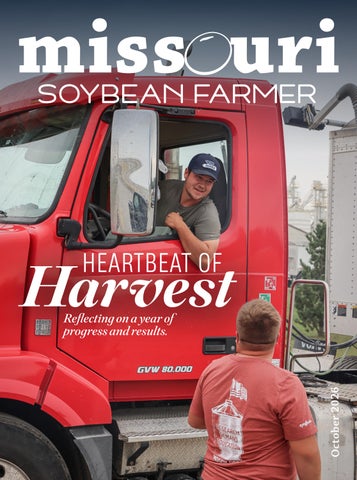
miss uri soybean farmer Harvest HEARTBEAT OF
October 2026
Reflecting on a year of progress and results.
THE ONE YOU TRUST TO LEAD With exclusive genetics, unmatched protective traits, and unprecedented yield potential, Pioneer® brand Z-Series soybeans set new standards for performance. Follow the trail we’ve blazed and experience the Z-Series revolution for yourself. Visit Pioneer.com/LeadWithZ to learn more.
Pioneer® brand products are provided subject to the terms and conditions of purchase which are part of the labeling and purchase documents. TM ® Trademarks of Pioneer Hi-Bred International, Inc., and its affi liated companies. ©2026 Pioneer Hi-Bred. 26649
INSIDE THIS ISSUE OF
Staff Contacts CEO/Executive Director Casey Wasser cwasser@mosoy.org
Chief Financial & Information Officer Kim Hill khill@mosoy.org
Director of Communications & Marketing Samantha Turner sturner@mosoy.org
Assoc. Dir. of Communications & Marketing Ryan Siegel rsiegel@mosoy.org
Comms & Outreach Coordinator Devyn Keller dkeller@mosoy.org
Comms Coordinator, Research & Innovation Abby Shaffer ashaffer@mosoy.org
Director of Market Development Matt Amick mamick@mosoy.org
Sr. Director of Research & Agronomy Blake Barlow bbarlow@mosoy.org
Director of Conservation & Farm Innovation Clayton Light clight@mosoy.org
Assoc. Dir. of Conservation Agronomy Brady Lichtenberg blichtenberg@mosoy.org
Director of Operations & Engagement Baylee Asbury basbury@mosoy.org
SOYBEAN FARMER OCTOBER 2026 | VOLUME 30 | ISSUE 5
Letters from Leadership Policy Update Agronomy Update Membership Highlights Financial Update Policy Update Demand Update Conservation Update Research Update Education Update Communications Update Market Highlights
Grower Engagement Manager
4 6 8 12 16 18 20 24 28 34 40 46 On The Cover...
Dylan Anderson danderson@mosoy.org
The cover photo of the October issue was taken by Devyn Keller at the District 5 Harvest Lunch in Marshall, Missouri.
Director of Policy
Ben Travlos btravlos@mosoy.org
Assoc. Dir. of Policy & Market Development Carley Esser-McLean cessermclean@mosoy.org
Finance Manager Stephanie Rackers srackers@mosoy.org
PRINTED WITH
Senior Executive Specialist Mary Kever mkever@mosoy.org
Office Manager
Amber Meyer ameyer@mosoy.org
Missouri Soybean Association
Contract Compliance Manager
Missouri Soybean Farmer is published six times annually and is an excellent opportunity to reach row-crop farmers.
Faith Smith fsmith@mosoy.org
Missouri Soybean Farmer is a National Agri-Marketing Association award-winning publication
734 S. Country Club Drive Jefferson City, MO 65109 | Phone: (573) 635-3819 | www.mosoy.org
Contact Samantha Turner at (573) 635-3819 or sturner@mosoy.org for advertising information. Copyright Missouri Soybean Association, 2026. All rights reserved. Reproduction or use of any content without the express written permission of the publisher is prohibited.
3
From The Field
Notes from Missouri Soybeans’ Leadership Team
Cody Brock
Kevin Mainord
President's Letter
A
S
s we close another fiscal year at the Missouri Soybean Association, it is worth looking back at what we have accomplished together. This year demonstrated what can happen when Missouri soybean farmers have a strong, unified voice advocating on their behalf.
Chairman's Letter
oybean and corn harvest has begun in southeast Missouri. As fall approaches, farmers — myself included — wait to see what months of hard work, favorable weather and blessings produced. As we look back on the year, we reflect on what we've accomplished for Missouri soybean farmers who trust us with one of their most valuable resources — their checkoff investment. Thanks to that investment, we've delivered meaningful returns through research, demand and innovation that strengthen soybean farming.
One of our biggest accomplishments was seeing the Water Preservation Act signed into law. After years of advocacy, Missouri now has a framework for protecting one of our state’s most valuable resources. We also celebrated the elimination of Missouri’s state capital gains tax, an important victory that can benefit farm families as land, equipment and other assets transition to the next generation.
This year, our efforts created significant wins. Here are just a few: • SOYLEIC: We partnered with Beck's Hybrids to accelerate commercialization of high-oleic soybean technology. • Breakthrough soybean cyst nematode (SCN) research: University of Missouri researchers identified GmSNAP14, a gene associated with SCN resistance. This represents another promising tool to help protect yields against one of soybean's most damaging pests. • Biodiesel: Missouri soybean farmers laid the foundation for one of soy's largest domestic markets through early investments in biodiesel research at the University of Missouri. Today, that legacy continues as we work to expand biodiesel education, adoption and demand across the state. • Long-term research investments: Missouri soybean farmers continue investing in breeding, SCN resistance, drought tolerance, water-use efficiency, high-oleic soybeans and other agronomic research designed to improve yields and farm profitability.
MSA also helped secure $4 million in state funding for the University of Missouri Soybean Cyst Nematode Diagnostic Laboratory, investing in better resources to identify and manage one of the most damaging threats to soybean yields. At the same time, we continued protecting farmers’ freedom to operate by advocating for access to critical crop-protection tools, including glyphosate, and pushing back against unnecessary regulatory burdens. We were also proud to advocate for legislation authorizing Missouri Farm Bureau Health Plans, creating another health coverage option for farmers and sole proprietors. These wins don’t happen in a silo. They come from farmers showing up, building relationships and speaking with one voice. As your MSA president, I am proud of what we accomplished this fiscal year, but our work is far from finished. We will continue showing up in Jefferson City and Washington, D.C., protecting your ability to farm, creating opportunities for Missouri agriculture and making sure policymakers hear from the people who know our industry best — our farmers.
Like every Missouri farmer, we know success isn't measured by effort alone — it's measured by the harvest. As another growing season comes to a close, we're proud of what your investment has helped accomplish, and we're even more excited about what's ahead. Together, we're planting the seeds for stronger yields, stronger markets and a stronger future for Missouri soybean farmers.
Cody Brock Missouri Soybean Association President
4
Kevin Mainord Missouri Soybean Merchandising Council Chairman
Letter from the CEO
Our Boards
T
he past year has been one of meaningful progress for Missouri Soybeans. Our mission is straightforward: Create demand and profitability for Missouri soybean farmers. Throughout the year, we have worked to turn that mission into tangible results while positioning the organization for continued growth.
MSA Board Members:
One of the most significant accomplishments was the Missouri Soybean Merchandising Council’s transfer of its exclusive SOYLEIC license to Beck’s Hybrids. SOYLEIC represents years of investment in soybean research and breeding through the University of Missouri. The agreement provides an opportunity to take that technology to a much larger commercial scale and demonstrates how investments made by Missouri soybean farmers can ultimately create value in the marketplace.
Clint Prange, Shelbyville
This is the type of outcome we want from our research investments. We are not simply funding research. We are working to develop technology, create intellectual property and move those innovations into the hands of farmers. The council also secured funding for a soybean cyst nematode laboratory, strengthening Missouri’s ability to address one of the most significant threats to soybean productivity. Creating new demand for soybeans remains at the center of our work. We advanced opportunities for domestic soybean crush, continued efforts to expand biodiesel and renewable fuel markets and developed new relationships with fleets, fuel suppliers and other end-users. Each new market for soybean oil and meal creates another opportunity to increase the value of the soybean.
Andrew Lance, Barnard C. Brooks Hurst, Tarkio Robert Williams, Henrietta Renee Fordyce, Bethany Cody Brock, Norborne Daniel Carpenter, Norborne Matt Wright, Emden Casey Heiman, Butler Garrett Riekhof, Higginsville Russell Wolf, Tipton Terry Schwoeppe, Labadie Jason Mayer, Dexter Wesley Hodges, New Madrid Tory Meyr, Jackson Ryan Wilson, Portageville
MSMC Board Members: Darrell Aldrich, Excelsior Springs Nathan White, Norborne Marc Zell, Meadville Kyle Durham, Norborne Mark Lehenbauer, Palmyra
Our policy work also produced important results for Missouri farmers. At the federal level, Missouri Soybeans played a leading role in strengthening the 45Z Clean Fuel Production Credit, making key legislative changes to improve soy-based biodiesel demand. In Missouri, we helped advance agricultural tax credits and supported a pro-agriculture voice on the Missouri Clean Water Commission.
Jody Ketsenburg, New London
Perhaps just as important, we have continued to focus on being where it matters most — with Missouri farmers. From winter meetings and farmer appreciation events to harvest lunches and rural outreach, our team has worked to strengthen relationships with producers across the state. Those conversations help us better understand the challenges farmers face and ensure our programs and investments remain focused on their priorities.
Trent Haggard, Kennett
Brad Arnold, Drexel Sarah Kliethermes, Bunceton Denny Mertz, Chesterfield Aaron Porter, Dexter Justin Rone, Portageville Kevin Mainord, East Prairie
USB Board Members: Aaron Porter, Dexter
We have dedicated farmer-leaders, a talented staff and strong partners across Missouri and beyond. Most importantly, we have farmers who are willing to invest in their future.
Tim Gottman, Monroe City
Our responsibility is to make that investment count.
Robert Alpers, Prairie Home
I am proud of what Missouri Soybeans accomplished this year, and I am even more excited about what we can accomplish together in the year ahead.
Kyle Durham, Norborne
ASA Board Members: Renee Fordyce, Bethany Andrew Lance, Barnard
Sincerely,
Matt McCrate, Cape Girardeau
Casey Wasser
Russell Wolf, Tipton
CEO & Executive Director Missouri Soybeans
5
Missouri S ybeans
POLICY
SOYBEAN POLICY UPDATE T
here are no two ways about it — having a toddler at home is both an absolute blast and exhausting at the same time. One minute we are sprinting to pick up the dog’s ball, and the next we are screaming at the top of our lungs because Dada put our snack in the wrong bowl. After winning this monumental argument, the smiles return to our faces, and we are ready to climb atop the coffee table and subsequently launch ourselves into Dada’s arms. I’m sure my fellow parents can relate.
sales and use tax has helped reduce soil erosion and improve water quality, all while maintaining top quality state parks across our state. With a monstrous 82% voter approval, farmers get another 10 years of being able to work with their respective Soil and Water Districts to continue implementing conservation practices on their operations.
Throughout all the campaigns our team is navigating this election cycle, our conversations and advocacy efforts on federal policies continue as well. This past spring, the Missouri Soybean Association (MSA) applauded President Trump and the EPA when they finalized the strongest Renewable Volume Obligations (RVOs) in the history of the Renewable Fuel Standard (RFS). Those volumes provided certainty for soybean farmers, encouraged investment in biodiesel and renewable diesel, captured domestic demand for soybean oil and reinforced the administration’s commitment to American agriculture. Then, toward the end of August, reports began to indicate small refinery exemptions (SREs) for 2025 compliance year exceeding 1.8 billion Renewable Identification Numbers (RINs). This level nearly doubled the exemptions EPA assumed when it finalized its RVO rule earlier this year, effectively erasing gains for soybean farmers.
This feeling of joy paired with wanting to bang our heads against a wall is perpetually felt when working in policy. On one hand, it is a true honor to be on the frontlines dealing with the current issues impacting farmers and their operations. On the other hand, doing so means dealing in the world of politics and the joys that come with it. This last primary election cycle is a prime example. If we are to shape public policy that is favorable for Missouri soybean farmers, we must have legislative champions in positions where they can help craft legislation and regulations that enable our farmers to do what they do best — farm. Looking in the rearview mirror at the primary election results, and the candidates our farmer-leader decided to support, I would say we won some and lost some. But at the end of the day, we stuck to our motto: We support our supporters.
Thankfully, the administration heard the outcry and refocused on supporting American farmers and the role homegrown biofuels play in strengthening both our domestic energy production and ensuring domestic demand for agriculture. Ultimately, EPA granted 1.76 billion RINs but promised to offset the negative impact those increased waivers have on farmers and the biofuel industry by restoring the 770 million RINs (approximately 500 million gallons of biofuel) exempted above the prior estimated 990 million RINs through a
In addition to supporting candidates who have proven to have farmers’ backs, our farmer-leaders also get involved in ballot measures if the results have an impact on farm operations. One of the major wins coming out of the primary election was the passage of Amendment 1, the Soil and Water Conservation/State Parks Sales Tax Renewal. First enacted in 1984, this one-tenth of one percent
If we are to shape public policy that is favorable for Missouri soybean farmers, we must have legislative champions in positions where they can help craft legislation and regulations that enable our farmers to do what they do best — farm.
Ben Travlos, Director of Policy
6
POLICY forthcoming supplemental rule. This means 100% of the RINs that exceeded the EPA’s initial estimates should be reallocated to the volume obligations for 2026 and 2027. EPA must move quickly to follow through on that commitment, fully reallocate these RINs and ensure soybean farmers are not left carrying the cost of these exemptions. The word on the street is we should have the supplemental rule by the end of October, and MSA along with partner organizations continue to advocate for this to come to fruition. Another effort on the federal front resides within the Water Resources Development Act (WRDA). There are numerous provisions MSA supports within this legislation, but a key component is language to stifle water exports out of non-Missouri River states. There has been an ongoing battle between Missouri and North Dakota pertaining to out-of-basin transfers. While that policy debate continues, Section 120 of the House version of WRDA is a potential framework outlining how to protect the entire Missouri River basin by preventing states outside of the basin from accessing Missouri River water resources, unless the governors of all 10 Missouri River states approve. While it seems like common sense and a no-brainer for any legislator along the Missouri River to support, policy discussions always find a way to complicate themselves. As negotiations between the House and the Senate continue, MSA appreciates the leadership of Rep. Graves as the chairman of the House Transportation and Infrastructure Committee, Sen. Schmitt and Sen. Hawley. Just like having a toddler at home, working in agricultural policy comes with duality. But know your team at MSA works every day on current issues impacting you on your farm operations and in your rural communities and will continue to do so.
WANT TO KNOW MORE? MSA federal and state PAC contributors gain access to an exclusive newsletter for updates during the state legislative session on policy and regulatory movement in Jefferson City and anywhere Missouri soybean farmers stand to be affected. The newsletter also provides more details on Missouri elections and the role MSA and you can play to impact the outcomes. Visit MoSoy.org or scan our QR code for more details.
7
"
EPA must move quickly to follow through on that commitment, fully reallocate these RINs and ensure soybean farmers are not left carrying the cost of these exemptions. Ben Travlos, Director of Policy
AGRONOMY
POTENTIAL T IN THE POD
here is something uniquely satisfying about splitting open a soybean pod and finding four beans packed inside. For a soybean grower, a field full of four-seeded pods is an encouraging sight — but also a rarity depending on the growing season.
BY KAITLIN FLICK-DINSMORE, TECHNICAL CONSERVATION AGRONOMIST
A four-seeded soybean pod is the result of several factors coming together, including plant genetics, plant health, adequate moisture and limited stress during reproductive growth.
Soybean plants have a tremendous ability to respond to their growing environment. When conditions are favorable, plants can produce more flowers, retain more pods and potentially fill those pods with more seeds. When conditions turn stressful, the opposite can occur. The University of Missouri Extension soybean growth monitoring program tracks crop development alongside current weather conditions. Water demand is particularly high during pod development and seed fill. Soybeans do not require the same amount of water at every growth stage. Water use increases as the canopy develops and reaches its highest levels during reproductive growth. When moisture is limited during flowering and pod fill, soybean plants may halt flowers and pods. Stress during pod development can reduce the number of seeds that develop, while drought during seed fill can reduce seed size. With sufficient moisture, a healthy soybean plant can continue flowering and setting pods rather than shedding reproductive structures because of drought stress. Adequate moisture also helps the plant move the products of photosynthesis into developing seeds during pod fill. The 2026 growing season brought its own set of challenges, including heavy and uneven rainfall early in the season. MU Extension reported that wet conditions slowed soybean planting in parts of Missouri and created challenges for emergence and early season development.
SOURCE: UNIVERSITY OF NEBRASKA - LINCOLN
Some soybean varieties also have a greater tendency to produce three- and four-seeded pods than others. Variety selection, maturity group and genetics all influence yield potential. But genetics can take a plant only so far. The growing environment ultimately plays a major role in determining how much of that potential makes it into the pod and eventually into the grain tank. One of the soybean plant’s greatest strengths is its ability to compensate for stress. If flowers or pods are lost early, the plant may produce additional flowers and pods when conditions improve. Likewise, favorable weather during critical reproductive stages can help a crop capitalize on the yield potential established earlier in the season. That is what makes those four beans inside a pod more than an interesting find in the field. They are the result of genetics, weather and plant health working togeth-
er throughout the growing season. One four-seeded pod will not make a crop, but across a field, successful pod set and seed fill tell the story of how well a soybean plant was able to turn its potential into yield. For Missouri growers, understanding that story can help turn observations in the field into better management decisions in seasons to come. The soybean growth monitoring report is released twice a month by the Soybean Farming Systems Research and Extension team, with support from the Missouri Soybean Merchandising Council. The program gives growers a closer look at how weather and growing conditions are influencing soybean development across Missouri, helping connect what farmers see in the field with the science happening inside the plant.
SCAN TO ACCESS THE MU GROWTH MONITOR PAGE
There is an important distinction, however, between adequate rainfall and excessive rainfall. Soybeans need moisture, but they do not perform well in saturated soils for extended periods. Waterlogged soils can deprive roots of oxygen, reducing root growth and interfering with nitrogen fixation.
8
POWER THROUGH YOUR DAY
LIKE A BOSS
When the job demands everything you’ve got, BOSS Performance Diesel keeps you going strong. Designed to deliver maximum power and efficiency, it fuels your engine with the energy to conquer long hours and heavy workloads. Stay in control and power through every challenge—like a BOSS. ✓ Increases horsepower and fuel economy over untreated #2 diesel fuel.* ✓ Extends engine life by increasing lubricity, typically by 15%, exceeding the standards of manufacturers and ASTM International. ✓ Keeps engines cleaner by preventing fuel-filter plugging and deposits on nozzles and internal diesel injectors.
Find BOSS Diesel near you at BossPerformanceDiesel.com.
*When used consistently over the life of the engine vs typical rack fuel.
AGRONOMY
10 THINGS YOU MUST DO BEFORE SPRAYING WHAT FARMERS NEED TO KNOW ABOUT THE ENDANGERED SPECIES ACT
D
uring the past two years, the Environmental Protection Agency’s (EPA) approach to the Endangered Species Act (ESA) has undergone one of the most significant changes in agricultural pesticide regulation. The issue centers on the basic legal requirement that when EPA registers or re-registers a pesticide under the Federal Insecticide, Fungicide and Rodenticide Act, it has obligations under the ESA to consider whether that pesticide could harm federally listed threatened or endangered species or the species' critical habitat.
BY KAITLIN FLICK-DINSMORE, TECHNICAL CONSERVATION AGRONOMIST
For years, the EPA faced lawsuits alleging that it had not adequately met those obligations. EPA responded with a broad strategy designed to address endangered species concerns across groups of pesticides rather than handling every pesticide and every species through a separate process. This effort produced a final Herbicide Strategy in August 2024, a final Insecticide Strategy in April 2025 and a draft Fungicide Strategy in May 2026. The fungicide plan is not yet final as of September 2026. EPA says it expects to finalize it by November 2026. For farmers, the most important thing is that the strategies themselves generally do not automatically impose new requirements on every pesticide application. The requirements become enforceable when EPA incorporates them into a pesticide label or geographically specific requirements in Bulletins Live! Two, an online database for a Pesticide Use Limitation Areas (PULA). An example of this is runoff and erosion and spray drift mitigation measure requirements you would find in a pesticide label. Therefore, before the sprayer leaves the shed, here are 10 things every farmer and pesticide applicator should check.
10
AGRONOMY
1
6
CHECK THE CURRENT LABEL
Start with the exact pesticide product you intend to apply. EPA is incorporating new mitigation requirements into pesticide registrations and labels as products go through registration and registration review. An example is Glufosinate-P, registered in October 2024. EPA described it as the first new active ingredient registration using the new Herbicide Strategy framework and included mitigation requirements intended to reduce exposure to listed species. Look for requirements involving:
Before you assume you need to install something new, look at what's already on the farm. EPA's mitigation system gives credit for certain field characteristics and conservation measures, depending on the applicable label and mitigation requirements. You may already have practices that can contribute to mitigation requirements, such as:
Cover Crops | Conservation Tillage | Grassed Waterways | Vegetative Buffers | Terraces | Water-Retention Structures | Irrigation Management
Application Rate | Application Method | Spray Drift | Buffers | Runoff and Erosion | Weather Conditions
2
Several Missouri counties have points associated with them due to low runoff/erosion potential.
FIND OUT WHETHER YOU MUST CHECK BULLETINS LIVE! TWO
If the pesticide label directs you to Bulletins Live! Two, you need to check it before making the application. Bulletins Live! Two will establish geographically specific pesticide-use restrictions to protect threatened and endangered species and the species’ critical habitat. EPA's Bulletins Live! Two system is particularly important because ESA restrictions can vary geographically. A pesticide that can be used one way in one county may have additional restrictions in another area because of the presence of protected species or critical habitat.
3
7
Droplet Size | Nozzle Selection | Boom Height | Application Height | Wind Speed | Wind Direction | Buffers | Application Method
DOCUMENT YOU CHECKED BULLETINS LIVE! TWO
8
DETERMINE WHETHER RUNOFF/ EROSION MITIGATION IS REQUIRE
9
DOCUMENT WHAT YOU DID
Good records help demonstrate that you planned and made the application according to the label requirements.
Cover Crops or Continuous Ground Cover | Conservation Tillage | Vegetative Strips | Grassed Waterways | Vegetated Ditches | Field-Slope Considerations | Soil incorporation | Irrigation Water Management | Water-Retention Systems
10
DO ONE FINAL CHECK
Before the sprayer moves into the field, stop and run through the checklist one more time.
CALCULATE YOUR MITIGATION POINTS BEFORE YOU SPRAY
If the label requires mitigation points, determine how many you need and how you're going to achieve them. EPA now provides the Pesticide App for Label Mitigations (PALM), a tool used for runoff/erosion calculators. EPA also provides a worksheet for documenting the calculation.
CHECK THE MOST RESTRICTIVE REQUIREMENT IN THE TANK MIX
If you're mixing multiple products, check the requirements for each product. One product may have a larger buffer, different application method, different timing restriction or additional mitigation requirement. When looking at several products for runoff/ erosion mitigation points, use the highest value.
Some pesticide labels now require applicators to achieve a specified number of runoff/erosion mitigation points. EPA's Mitigation Menu provides qualifying practices and field application characteristics that can be used to meet those requirements. Depending on the product and field, possible mitigation measures can include:
5
CHECK YOUR SPRAY-DRIFT REQUIREMENTS
Runoff isn't the only concern, the EPA strategies also address spray drift and the PALM tool provides a way to calculate spray drift requirements, so check the label for requirements involving:
If the product label says to check Bulletins Live! Two for any applicable bulletins, document that you have viewed the site within 6 months of making the pesticide application.
4
KNOW WHAT CONSERVATION PRACTICES YOU ALREADY HAVE
ACCESS BULLETIN LIVE! TWO TO STAY UP-TO-DATE! 11
Farmer TESTIMONIALS
Voices Membership looks different from farm to farm, but its value is best told by the farmers themselves. Six Missouri soybean growers share why they stay connected, what they value and what a stronger association means for the future of their farms.
Daniel Carpenter District 2
Brooks Hurst District 1
Clint Prange District 3
Terry Schwoeppe District 6
Jason Mayer District 7 12
Russell Wolf District 5
In Their Own Words TESTIMONIALS
1
As farmers, we’re facing challenges and opportunities that are bigger than any one operation. I support the Missouri Soybean Association because they’re in the room fighting for policies that protect our farms, expand market opportunities and ensure agriculture remains strong for future generations. Membership isn’t just about what it does for my farm today — it’s about investing in the future of Missouri soybean farming. For the cost of membership, the value we receive through advocacy, leadership and representation is well worth it. BROOKS HURST, District 1, Tarkio, Missouri
3
Being a member of the Missouri Soybean Association is about more than a membership card — it’s about having a voice. Every year, there are decisions made in Jefferson City and Washington, D.C., that directly impact my family’s future. My membership helps ensure Missouri soybean farmers have a seat at the table, fighting for policies that protect agriculture and create opportunities for the next generation. That’s an investment worth making DANIEL CARPENTER, District 2, Richmond, Missouri
5
Joining the Missouri Soybean Association means your voice is heard where it matters most — in Jefferson City and Washington, D.C. When farmers come together, we have a stronger voice to advocate for policies that protect our farms, strengthen our rural communities and ensure agriculture has a seat at the table. I encourage every Missouri soybean farmer to join MSA and invest in the future of our industry. CLINT PRANGE, District 3, Shelbyville, Missouri
6
2
One of the things I value most about my MSA membership is staying connected our industry. Farming is changing every day, and MSA helps keep growers informed on the issues, opportunities and challenges that affect our operations. Membership is an affordable way to support an organization led by farmers and focused on helping Missouri soybean growers succeed. If you care about the future of our industry, I encourage you to become a member. RUSSELL WOLFE, District 5, Syracuse, Missouri
7
A membership in the MSA pays dividends far beyond the farm gate. The work MSA does to promote soybeans, expand markets and advocate for farmers has a direct impact on our industry’s future. I can’t imagine where soybean prices would be today without those efforts. That’s why I’m proud to invest in MSA and encourage every soybean grower to do the same.
I look at my MSA membership the same way I look at any investment on my farm — what value does it provide? The answer is clear. Membership helps support the work that keeps soybean farmers informed connected and represented. From educational opportunities to grassroots engagement, MSA is working on behalf of growers across the state. If you’re not already a member, I’d encourage you to join. The stronger our membership, the stronger our voice and our ability to shape the future of Missouri agriculture.
TERRY SCHWOEPPE, District 6, Labadie, Missouri
JASON MAYER, District 7, Dexter, Missouri
13
NEWS
HOW DO YOUR
SOYBEANS STACK UP?
BUILT FOR MISSOURI FARMERS
ENTER THE 2026 MISSOURI SOYBEAN ASSOCIATION YIELD CONTEST
The Missouri Soybean Yield Contest is designed to recognize excellence across the state, not just among the highest-yielding irrigated acres. District competitions allow growers to compete against others farming under similar soil and weather conditions, creating a level playing field while celebrating success in every region of Missouri. Just as importantly, the contest encourages farmers to share ideas that help improve soybean production statewide. Every entry contributes to the conversation around management, innovation and continuous improvement.
Every soybean field tells a story. Some tell a story of favorable weather. Others reflect years of refining management practices, improving soil health and making strategic agronomic decisions. The Missouri Soybean Yield Contest gives farmers the opportunity to share that story, benchmark their operation and earn statewide recognition for outstanding soybean production.
WHY ENTER? Participating in the Missouri Soybean Yield Contest offers more than recognition.
Whether you're chasing 60 bushels or 100-plus, the contest isn't just about winning. It's also about learning what works and celebrating the innovation taking place on Missouri farms.
By entering, you will:
Hosted annually by the Missouri Soybean Association (MSA), the yield contest recognizes top soybean producers from each of Missouri's seven soybean districts while highlighting the management practices that drive exceptional yields. Thanks to the support of the Missouri Soybean Merchandising Council (MSMC) and industry partners, growers compete for district and statewide honors, cash prizes and bragging rights among some of Missouri's best soybean producers.
•
MORE THAN A COMPETITION
Whether this is your first year entering or you've competed before, every season provides new opportunities to learn and improve.
• • • • •
Every year, Missouri farmers continue pushing the boundaries of soybean production. The yield contest provides an opportunity to compare management strategies, evaluate production practices and learn from fellow growers who consistently achieve outstanding results.
Benchmark your operation against other top Missouri producers. Showcase the management practices that make your farm successful. Compete for district and statewide cash awards. Become part of a network of progressive soybean growers. Help advance soybean production knowledge across Missouri. Earn additional recognition for soybean yields exceeding 100 bushels per acre.
READY TO COMPETE? If you've invested the time, management and attention to produce an exceptional soybean crop this season, now is the time to put it to the test.
The contest also helps identify production trends across Missouri, providing valuable information that can benefit soybean farmers statewide. Whether your operation is conventional, no-till or incorporates cover crops, your management story contributes to the broader success of Missouri agriculture.
Enter the 2026 Missouri Soybean Yield Contest, compare your results with the best soybean growers in the state and show what your operation can accomplish.
Newer contest categories continue reflecting the evolution of soybean production, including a dedicated cover crop category recognizing growers successfully integrating conservation practices into their operations.
For complete contest rules, harvest requirements and entry information, visit mosoy.org. We look forward to celebrating another year of outstanding soybean production across the ShowMe State.
14
NEWS
15
FINANCIALS
2026 Financial Overview Association
Farm for Soy Innovation
Magazine & Communications
The Farm for Soy Innovation (FSI) is a cornerstone in Missouri Soybeans’ work to improve the bottom line for the state’s soybean farmers. The nearly 300-acre farm supports and facilitates research, business and market development and educational programs.
To effectively engage with membership and producers, our communications programs through MSA have been enhanced during the past 18 months to fit the needs of the farmer. The communications department, through the Missouri Soybean Farmer magazine and a continually growing sponsorship program, returns more to MSA than the programs require in funding.
Membership & Outreach Members of MSA receive regular policy, regulatory and industry updates, as well as the opportunity to participate in special events and programs throughout the year. It’s critical that Missouri’s soybean producers are receiving the most up-to-date information regarding policy, regulations and political events impacting their operations. Grassroots advocacy is most impactful with an educated membership. That is one of the reasons we started the Missouri Grassroots Fellowship program. In partnership with Iowa soybean growers, the program offers leadership training, networking opportunities and hands-on work with policy, government and legislative processes.
Policy MSA’s policy efforts are at the core of why the association exists. To achieve the MSA Vision — advancing and protecting the interests of Missouri soybean producers — we must be effective with lawmakers in Missouri and in Washington, D.C. We’re proud of our recent wins and are strategically investing and planning to continue to lead Missouri soybean producers into the future through legislative advocacy, communications and outreach.
MSA Budget Breakdown*
42% Policy 26% Magazine/Comms 23% Farm for Soy 8% Membership 1% Admin
16
Breakdowns shown are unaudited and may be subject to change.
FINANCIALS
Research
Checkoff
Administration
This area provides for collaborative work on pest and disease resistance, flood and drought tolerance, and soybean breeding, as well as other work at the Missouri Soybean Association’s (MSA) Farm for Soy Innovation.
This area includes the cost of overseeing and investing Missouri’s soybean checkoff dollars, including management, personnel and facilitating elections and meetings of the MSMC board of directors.
Projects include: breeding programs, fungicide research and SCN research.
Projects include: administration salaries and board costs.
Industry Information
Producer Communications
Initiatives in this area include policy education, commodity support and working with industry partners to identify new management practices and uses for soybeans and soy products. This area encompasses business development and relationship-building programs.
This area includes the many ways checkoff funds are used to connect with soybean growers via radio, grower meetings, field days, educational tours, etc. Projects include: environmental programs, the Missouri Soybean Farmer and producer outreach.
Projects include: biodiesel partnerships and industry relationships.
Consumer Information
Promotion
The Consumer Information area is the home for efforts to connect Missourians not living on a farm or ranch to the importance of soy and agriculture.
This section includes efforts to raise awareness within the market for Missouri soybeans and build demand for Missouri soybeans and soy products around the world.
Projects include: Center for Soy Innovation, Ag Education on the Move and the Missouri State Fair.
Projects include: licensing, commercialization and international and domestic market development.
MSMC Budget Breakdown*
*Soybean checkoff dollars may not be used for lobbying, membership or similar efforts.
32% Research 25% Producer Comms 23% Promotion 11% Industry Info 7% Consumer Info 2% Admin
17
Breakdowns shown are unaudited and may be subject to change.
Power In Policy
POLICY
U.S. SUPREME COURT RULES IN FAVOR OF SOUND AGRICULTURAL POLICY Farmers rely on regulatory certainty just as much as favorable weather, and the 7-2 U.S. Supreme Court decision in Monsanto Co. v. Durnell provided exactly that. The court held that pesticide labeling decisions should remain grounded in the federal regulatory process and the scientific review conducted by the Environmental Protection Agency (EPA), reinforcing a consistent national standard for crop-protection products. Missouri Soybeans supported the petitioner through an amicus brief alongside Missouri elected officials and fellow agricultural organizations because we understood what was at stake for farmers. At the same time, we worked with the Missouri Legislature and our congressional champions as legislation addressing this issue was debated. At its core, the case — and related legislation at both the state and federal levels — came down to a simple question: Should pesticide labeling remain under the federal system, or should it be subject to a growing number of state-by-state lawsuits? That uncertainty can have real consequences for farm operations, particularly when it comes to tools such as glyphosate and other crop-protection products farmers rely on for weed control, conservation practices and strong yields. The court ultimately reinforced what agriculture has long depended on: Labeling decisions belong within the federal regulatory process and should be guided by the EPA’s scientific review. Consistency matters when farmers are already navigating tight margins, rising input costs and the uncertainty that comes with every growing season. This decision helps maintain a predictable regulatory system and ensures federally approved tools are governed by one clear standard across the country.
FEDERAL RELIEF PAYMENTS QUALIFYING FOR MISSOURI TAX SUBTRACTIONS As you prepare to file your taxes this upcoming spring, remember that your team at Missouri Soybeans worked with the Department of Revenue (DOR) to ensure certain federal disaster and economic relief payments would be added to the “Qualifying Agriculture Relief Subtraction Program List.” If you received federal relief payments from an eligible program, work with your tax preparer to take advantage of the state income tax subtraction. Scan the QR to review eligible federal programs
18
POLICY
AGRICULTURE TAX CREDITS AND MO WORKS One of our team’s top state legislative priorities this past session was extending Missouri’s agricultural tax credit programs. Championed by Sen. Kurtis Gregory and Rep. Dane Diehl, the programs were approaching their expiration dates. Our team worked alongside the Missouri Legislature and agricultural partners to extend the sunsets to 2033. We also supported statutory flexibility within the Missouri Works program, expanding its scope to further encourage investment in rural communities. Continuing programs that incentivize investment in value-added agriculture is vital to driving rural economic development. In addition to extending the programs, we helped secure several technical fixes to improve how they work for Missouri agriculture. One important change replaced “and” with “or” in the statutory language, allowing off-road diesel to qualify for biodiesel tax credit programs. They say the devil is in the details, and sometimes a single word can make a significant difference. By addressing those details while extending these programs, we helped ensure they remain effective tools for supporting value-added agriculture, strengthening rural communities and creating opportunities for Missouri farmers for years to come.
SOYBEAN CYST NEMATODE RESEARCH FUNDING During the 2025 state legislative session, Missouri Soybeans helped secure $4 million to renovate the Soybean Cyst Nematode Laboratory at the University of Missouri. Half of that funding was initially withheld as Gov. Mike Kehoe worked to balance the state budget. Missouri Soybean Association leaders continued conversations with the governor and his team about the importance of the investment. In spring 2026, the remaining funds were released, allowing the university to move forward with improvements to the lab. Soybean cyst nematode, or SCN, is one of the most damaging pests affecting soybeans. It attacks soybean roots, reduces yields and costs U.S. soybean farmers an estimated $1.5 billion annually. University of Missouri research found more than 90% of Missouri soybean fields tested in 2024 had detectable SCN, highlighting the need for continued research and testing. The $4 million investment will strengthen a laboratory used by researchers and farmers and help protect soybean production in Missouri for years to come.
19
DEMAND
DEFINING
DEMAND INTERNATIONAL OPPORTUNITIES
As crush capacity grows with positive margins from biofuel demand, excess soybean meal supply has led to opportunities to diversify and build new international markets. With geopolitical challenges with China on the forefront, in marketing year 2024/25, the U.S. set a record with 16.57 million metric tons of soybean meal exports – a 13.8% increase over the previous year. The top five countries were Philippines, Mexico, Colombia, Canada and Vietnam. The Missouri Soybean Merchandising Council (MSMC) partners with U.S. Soybean Export Council (USSEC) on soybean meal market development in the Americas region. Additionally, through a multi-state partnership with Ag Processing Inc., we promoted Midwest soybean meal in the Americas and Asia. Through these partnerships, we have clearly seen results and impact in the form of new demand. Additionally, Missouri Soybeans and farmers hosted several trade teams and traveled on trade missions to build relationships with buyers and share the message of our quality, consistent, sustainable and reliable soybeans. A prime example of a successful trade mission is Colombia. The result of these exchanged missions is that soybean meal exports were up 50%, and Colombia moved into the No. 3 export spot for U.S. soybean meal.
BIOFUELS REACH NEW HEIGHTS FOR MO SOYBEAN DEMAND In the first half of the marketing year, uncertainty with federal biofuels policy hurt the market for biomass-based diesel (BBD - biodiesel, renewable diesel, sustainable aviation fuel). Moving into calendar year 2026, the 45Z Clean Fuels Production Credit was much stronger for soy-based fuels, and we received a final decision on volumes under Renewable Fuel Standard (RFS) Set 2 rule – the strongest renewable volume obligations in history for BBD. With this policy certainty as a catalyst, we returned to pre-2025 levels for BBD demand. In June 2026, EPA reported the strongest one-month volume of domestic production of BBD in history at 494 million gallons. Additionally, monthly use for soybean oil for BBD also hit a record high of 1.5 billion pounds. In Missouri, this increased demand has translated into new opportunities to highlight biodiesel performance, quality and cost-competitiveness for fleets. One success story is Boone Electric Cooperative. Boone Electric has consistently increased its utilization of biodiesel with cost savings, no operations disruptions and overall support for their rural and farmer customer base.
20
DEMAND
DOMESTIC MEAL DEMAND INITIATIVES MAKING PROGRESS
Roughly a quarter of Missouri’s soybean crop was fed to livestock within the state, driven by our partners in the pork, poultry, cattle, dairy and aquaculture industries. As we look for growth opportunities, MSMC is working with other Missouri commodity groups and economic development organizations in a partnership called Yield. Our goal is to grow demand for soybeans through the attraction of feed, food and beverage companies. As a result of this partnership, we supported the recruitment of a large-scale dairy farm to southern Missouri that will bring thousands of cows to the state — and thus more soybean meal demand. While we think of soybean meal consumption for animals, we are also excited for soybean meal for fire suppression in the form of SoyFoam. Developed in conjunction with United Soybean Board (USB), SoyFoam, manufactured by Cross Plains Solutions, is a biodegradable, non-toxic fire suppression foam produced using soy flour. Historically, fire suppression foams have been manufactured using a group of chemicals known as PFAS, often described as forever chemicals, which have been linked to cancer and other illnesses in firefighters. With the commercialization of SoyFoam, a safe, effective alternative to traditional foams is now on the market, providing a new demand opportunity for soybean farmers. Previously, we reported that Boone County Fire Protection District announced it is the first fire protection district to adopt SoyFoam in its operations. Now, we have four distributors in the state, and fire departments are testing the product. This past marketing year, we hosted several events and demonstrations to highlight the safety and performance of SoyFoam for firefighters — and the benefit to soybean demand.
21
PERFORMANCE. Powered by Missouri Biodiesel. A cleaner, cost-smart fuel delivering proven performance for Missouri farms. CLEANER FUEL Lower emissions. Cleaner future.
COST COMPETITVE Smart value for your bottom line.
MISSOURI MADE
Produced right here. Supporting local jobs.
Learn how biodiesel can strengthen your farm. MISSOURIBIODIESEL.ORG
The Call of Conservation
CONSERVATION
A Year of Innovation in the Field This year, the Farm for Soy Innovation (FSI) continued to serve as a place where research, demand and education come together to address the challenges and opportunities facing Missouri soybean farmers. Across 285 acres, the farm provided a real-world environment for testing new ideas, evaluating agronomic practices and demonstrating how research can translate into practical solutions for producers across the state. From planting through harvest, the farm supported 20 research and demonstration projects focused on soybean production, soil health, conservation and emerging agricultural technologies. Throughout the growing season, 87 acres were planted in soybeans, 90 acres in corn and 4 acres in sunflowers. The farm also incorporated conservation practices including cover crops, no-till, pollinator habitat and floating islands, providing opportunities to evaluate their effectiveness and potential role in productive, resilient Missouri farming operations. Together, these projects give Missouri farmers practical information they can apply on their farms. The farm’s impact, however, extends beyond planted acres. Throughout the year, FSI welcomed 1,353 visitors during 40 events, including field days, tours and demonstrations. Farmers, researchers, industry partners, students, policymakers and many others had the opportunity to see research in action and engage in conversations about the future of agriculture. These experiences transformed the farm into an outdoor classroom, connecting the work happening in the field with the people it is intended to serve. The farm also continued to invest in the next generation of agriculture. Two interns, Daniel Moak and Gabrielle Clifton, gained hands-on experience at the farm this year, working alongside researchers and industry professionals and connecting what they have learned in the classroom with the realities of production agriculture. Seventy-five students and three educational groups also visited or took part in programming. These opportunities help develop future agricultural leaders while bringing new perspectives and ideas to the work happening at the farm. Every acre planted, project conducted, conservation practice implemented and visitor welcomed strengthens the connection between research and the farm gate. Looking ahead, the farm will continue to provide a place to explore the latest ideas, share knowledge and pursue innovations that create meaningful value for Missouri soybean farmers.
2026 By the Numbers
181 20 87 15 Acres Farmed
Research and Demo Projects
Soybean Acres Planted
24
Conservation Practices Demos
1350+
40
Visitors to the Farm
Tours and Events
FEATURE
Customizing loans for generations of families.
OPERATING LOANS
REAL ESTATE LOANS
TERM LOANS
CROP & LIVESTOCK INSURANCE
Financial solutions for your operation today and for their tomorrow. Fuel your operation’s success with a customized operating loan, designed specifically for the way you produce and market. We match your cash flow with flexible payment schedules, competitive rate options and multi-year options, while providing easy access to your funds online, by phone, or at a local office. Our deep passion for rural Missouri is backed by unparalleled experience in agricultural financing. Trust the lender that knows your business and is dedicated to your growth. Growing Relationships. Creating Opportunities.TM
800.444.3276 / myfcsfinancial.com Photo by Elise L., Cole County
Equal opportunity provider
CONSERVATION
From Missouri Soybeans to New Markets Creating new demand for Missouri soybeans starts with finding new ways to put soy to work. Through its continued partnership with Airable Research Lab, the Missouri Soybean Merchandising Council (MSMC) is helping advance research and development that turns soybeans into innovative products with real-world applications. Last year, MSMC invested $150,000 in its partnership with Airable, supporting efforts to move promising soy-based technologies from early-stage research toward commercialization. One example of this work is Airable’s partnership with Dynamic Green Products (DGP), a manufacturer of high-performing, biobased lubricants. Airable provides soybean-focused research, formulation and technical expertise, while DGP works to bring those innovations to the marketplace. This collaboration has contributed to a growing portfolio of soy-based lubricants, including six products currently available and five more expected to launch next year. These products create opportunities to replace traditional petroleum-based ingredients with renewable, U.S.-grown soy. In 2026, DGP released its new Multi-Use Aerosol Oil Spray, which is expected to become one of the company’s leading products. The spray was developed with Airable Research Lab and support from multiple state soybean boards working together to advance new uses for soybeans. For Missouri soybean farmers, the connection is especially meaningful. DGP used 200,000 gallons of soybean oil, equivalent to approximately 143,000 bushels of soybeans, in its products this year. Those products are manufactured and processed in Missouri, creating a direct line from soybeans grown in the Show-Me State to value-added products sold in more than 11,500 stores nationwide. With production projected to increase by 50% annually, the amount of soybean oil used and the value returned to farmers are also expected to grow. As these products reach new markets, they demonstrate how soybean checkoff investments can create demand beyond traditional food, feed and fuel uses. Airable and its industry partners, including DGP, continue to develop soybased products for use in lubricants, cleaner, and sealers. Each new application creates another potential market for soybean oil and other soy-based ingredients. By helping move these products from the lab to the marketplace, MSMC is turning new uses for soy into new demand for Missouri-grown soybeans.
Investing in Healthy Soils Missouri soybean farmers continue to show that conservation and productivity can work hand in hand. Through Farmers for Soil Health (FSH), Missouri Soybeans is helping producers adopt practices that build healthier soils while providing financial support to offset initial costs. In 2026, roughly 230 farmers enrolled an estimated 160,000 acres in the program. Participating farmers received $35 per acre to support the implementation of cover crops across their operations. Those acres represent more than participation in a conservation program. Cover crops can help protect soil, improve water infiltration, reduce erosion and build greater resiliency into farming systems. FSH also gives producers access to technical assistance as they determine how conservation practices can work within their individual operations. FSH allows Missouri Soybeans to put resources directly into the hands of farmers while supporting practices that strengthen Missouri agriculture for the long term. By pairing practical conservation with meaningful financial incentives, Missouri Soybeans is helping farmers invest in the health and productivity of their farms for years to come. Funding for Farmers for Soil Health is provided by USDA through the Advancing Markets for Producers (AMP) Initiative.
26
For more information on AMP grant projects, please reach out directly to Clayton Light at clight@mosoy.org or Brady Lichtenberg at blichtenberg@mosoy.org
FROM YOUR FIELDS TO FIREFIGHTERS’ HANDS
NEWS
The more we discover about soybeans, the more valuable they become. One innovative product, SoyFoam™, creates a new, sustainable use for your crop that protects firefighters and the planet. See how your Soy Checkoff is unlocking new markets for soybeans at unitedsoybean.org
27 © 20 25 U NI TE D S OY BEA N BOA R D
BUILT ON
RESEARCH
RESEARCH
SOYBEAN PLANTING IN MISSOURI: MATCHING MATURITY GROUP, ROW SPACING AND SEEDING RATE TO PLANTING DATE Andre Reis and Taya Hale
A
t the end of the 2026 season, the MU Soybean Farming Systems team will conclude three years of the research project, Planting Date in Missouri: How to Adjust Maturity Group, Plant Density and Row Spacing to Optimize Yield and Minimize Risk. As data from the current season is still rolling in, evidence from the previous two seasons already supports statewide recommendations to help farmers make decisions for next season. This project implemented a network of trials across 12 locations from 2024 to 2026. The locations comprised a mix of farmers' fields and the MU research station network. At each location, we tested, on average, three planting dates spaced three to four weeks apart. For each site-year-planting date, we tested combinations of varieties representing five different relative maturity groups relevant to the locations, at two row spacings (15 and 30 inches) and three seed populations (90,000, 140,000 and 190,000 seeds per acre). In total, we planted and harvested roughly 6,500 experimental plots by the end of the 2026 season, representing one of the largest check-offfunded projects recently addressing the topic in the U.S. Among all the factors contributing to soybean yield, environmental conditions, particularly weather, are the most important. However, crop management — represented by planting date, row spacing, plant population and cultivar selection — accounted for 42% of the yield variation. In other words, there is substantial yield to be gained by making appropriate decisions on cultivar selection, when to plant and planting parameters. Some of the management factors investigated are broadly applicable across many regions and farming conditions; others depend on site-specific conditions. The most broadly generalizable result is
28
row spacing. The narrow 15-in row spacing outyielded the 30-in row spacing by ~4.0 bu/acre on average. Another strong association was the negative trend between planting date and yield. On average, soybean yield will decline by about 4.0% per week after the end of April as planting is delayed across all regions. In the southeast, the yield penalty is even stronger starting around April 15. How early a field should be planted is still a topic for further investigation. Super early planting dates are prone to greater risks of flooding and frost, slower stand establishment and the need for replanting. These risks must be considered in the planting date decision, but shifting the entire planting window earlier avoids finishing planting in late May, when the yield-potential penalty is certain. An early planting date in a narrow row is the path most associated with high yields in rainfed systems, but these are not the only important decisions around planting. Cultivar selection and its interaction with the environment are the next most important factors impacting yield. In this research design, we opted to represent cultivar performance by their relative maturity groups (RM). RM is the plant trait describing the cycle length in relationship to daylength, air temperature and to some extent available water. In general terms, an early RM will have a shorter cycle and respond first to daylength changes, whereas a late RM has a longer cycle and longer development time. This relationship suggests that the ideal RM should depend on planting date and change throughout the planting season. How these changes occur in Missouri is one of the most important recommendations from this research project. The optimal relative maturity changed across the planting window. Early in the planting window, the earlier maturities led. For cen-
RESEARCH tral and north Missouri, early planting was associated with higher yield with RM ≤ 3.4. For southeast, RM 3.9 outperformed all other maturities earlier in the season (Figure 1). Early RM performance declined as planting was delayed, so the RM yielding best early in the season ranked last at late planting dates. The crossover date varied by region and was less pronounced in the north. The current conclusion is plant early with an early relative maturity, and as planting season progresses, shift to a later maturity than you would otherwise pick. RM is not the only lever to adjust with planting date. These research results also showed that seeding rate affects yield, but among management decisions, it has the least impact. The rule of thumb is that whenever the combination of cultivar RM, planting date and environment is less conducive to full crop growth, the seeding rate should be increased. For most of the tested scenarios, 190,000 and 140,000 seeds per acre performed similarly. When 190,000 outperformed 140,000, the yield difference was less likely to provide a return on investment. However, both seeding rates resulted in higher yields than 90,000 seeds per acre. For Missouri rainfed conditions, a low seeding rate should be considered with caution. Reducing the seeding rate is recommended only in high-yielding environments where plants can achieve unrestricted growth, but there is little evidence that reducing the seeding rate alone will increase yield.
Taking all the management decisions together may seem daunting. Those decisions that marginally affect production costs could be responsible for the difference between profitability and loss. However, planting environments differ in their responsiveness to management optimization. Early planting dates carry the highest yield potential and the widest spread (19.6 bu/acre), indicating the greatest opportunity for management optimization (Figure 2). Late planting dates reopen the spread to 15.5 bu/acre, where a higher seeding rate and a later relative maturity limit the yield penalty from the delay. Management response is narrowest from mid to late May, where the choice of row spacing, seeding rate and relative maturity has the lowest impact on yield (7-10 bu/acre). By the end of the 2026 harvest, we will have the complete dataset to finalize the analysis and produce the final recommendations. Farmers will be able to access the information through the MU Extension (extension.missouri.edu/programs/soybean) and MU Variety Testing program (varietytesting.missouri.edu) websites, as well as printed fact sheets. For more information, reach out to MU State Soybean Specialist Andre Reis (areis@missouri.edu). FIGURE 2
FIGURE 1
Figure 2: Yield of the best and worst management
Figure 1: Yield response to planting date by relative
combinations across the planting window. Each curve traces the highest and lowest fitted yield across all combinations of row spacing, seeding rate, and relative maturity. Arrows mark the spread between them (bu/ acre) at four selected dates: Apr 09, May 14, Jun 10, and Jul 16.
maturity (RM) and region, expressed relative to the best RM-and-date combination in each region. The ranking of maturities reverses across the planting window: early maturities lead at early planting dates, later maturities lead at late planting dates.
M
issouri's soybean industry contributes more than $8 billion in economic output to the state's economy, but productivity is affected each year by several biotic constraints, including soybean cyst nematode, or SCN, infection. SCN is the primary yield-limiting disease, causing more than twice as much yield loss as other diseases. The estimated yield loss due to SCN infection in the U.S. from 1996 to 2016 was roughly $1.5 billion annually (Bandara et al., 2020). Additionally, SCN is often described as a silent yield robber because of the lack of aboveground symptoms when population densities are low or moderate. The life cycle can be completed in as few as 21 days, allowing nematodes to go through multiple generations in a single growing season and leading to large increases in population densities in a relatively short period.
OUTSMARTING THE SILENT YIELD ROBBER HOW NEW RESISTANCE STRATEGIES COULD HELP MISSOURI FARMERS STAY AHEAD OF SOYBEAN CYST NEMATODE Andrew Scaboo 29
RESEARCH Current SCN management practices rely heavily on growing resistant soybean varieties and rotating soybeans with nonhost crops, such as corn. However, modern U.S. soybean varieties lack diversified genetic modes of action for SCN resistance because of the overreliance on a single gene, rhg1-b, found in plant introduction, or PI, 88788. The prolonged and widespread use of rhg1-b for more than three decades has exerted selection pressure on SCN populations that have developed greater reproduction, or virulence, on this source of resistance. The virulence of SCN populations is measured by the female index, or FI, which is the number of SCN females produced as a proportion of the number of females produced on a completely susceptible soybean variety. In Missouri, 100% of the SCN populations surveyed across the state and published in 2018 had populations that were able to reproduce on resistant varieties with only rhg1-b, and 50% of these populations had an FI greater than 50, up from 15% in 2005. This loss of effectiveness of this single gene has led to the need for the discovery and utilization of novel resistance genes, gene pyramids and resistance rotation schemes as alternative strategies for effective SCN management. To address this need, researchers at the University of Missouri, University of Illinois, University of Georgia and Iowa State University developed a field trial to examine the impact of different combinations of resistance genes and quantitative trait loci, or QTL, on SCN population density and virulence. Researchers used continuous and rotated treatments of soybean genotypes carrying rhg1-b or combinations of different genes, including those found in Peking (rhg1-a, rhg2, Rhg4 and GmSNAP14), wild soybean (cqSCN-006 and cqSCN-007) and PI 90763 (rhg1-a, rhg2, Rhg4, GmSNAP14 and GmSNAP02). This experiment was supported by the North Central Soybean Research Program. Field experiments were established in Illinois, Missouri and central and northern Iowa in 2019 and conducted for four successive growing seasons in microplots. Our results showed that population density and HG types were influenced primarily by the rotation schemes and the genes used in each respective rotation. Although different SCN populations were used to infest the two Iowa locations (HG 1.2.5.6.7 and HG 1.2) and the Illinois and Missouri locations (HG 1.2.5.7), the largest egg population densities in all four experiments occurred in microplots in which rhg1-b and susceptible soybean varieties were grown continuously.
with the resistance genes rhg1-a, rhg2, Rhg4 and GmSNAP14 found in Peking. There is also a concerted effort to include GmSNAP02 with varieties that have rhg1-a, rhg2, Rhg4 and GmSNAP14. This five-gene combination, when rotated with rhg1-b, was one of the rotations that significantly reduced population densities and will be available soon for farmers. We also examined the possibility that SCN populations in our experimental microplots would evolve increased virulence on plant introductions sharing common genes with SCN-resistant rotation treatments. When the same resistance genes are grown continuously, the proportion of virulent nematodes increases in the overall nematode population, shifting the virulence of SCN populations toward more aggressive types. Therefore, the importance of diversifying resistance genes in modern varieties must be focused on implementing strategic rotation schemes to mitigate the evolution and spread of virulent SCN populations. The results of this experiment showed that rotating rhg1-a, rhg2, Rhg4, GmSNAP14 and GmSNAP02 with rhg1-b significantly reduced the shift in virulence on PI 90763. We currently have evidence that soybean varieties available today and those being developed have the potential to both mitigate yield loss and manage virulence shifts in nematode populations, creating a long-term management and production system to maximize productivity and profitability for soybean farmers in Missouri and nationwide. Our findings highlight that continuous planting of soybeans containing resistance genes can lead to shifts in SCN populations toward more virulent types, underscoring the potential risks of relying solely on cultivars with the same resistance genes, regardless of the specific resistance source. Furthermore, we have identified new resistance rotation strategies that effectively reduce nematode population densities without intensifying selection pressure and increasing virulence, which is crucial for mitigating SCN yield losses in soybeans. Future research should focus on investigating the long-term durability of these resistance gene combinations in the presence of highly virulent nematode populations, incorporating nonhost crops and susceptible genotypes into crop sequences, and investigating rotations beyond the four-year timeframe studied here.
Across locations, several rotation schemes significantly decreased SCN population densities when compared with continuously planting rhg1-b. This result indicates that pyramiding resistance genes in a single genetic background enhances resistance, and these pyramids should be deployed strategically depending on the baseline population density and HG type of the field SCN population. Historically, it has been challenging and time-consuming to incorporate these resistance genes into a variety development pipeline without compromising yield for both public and private soybean breeding programs. However, much progress has been made, and today there are a significant number of high-performing varieties Field Plot from Iowa.
30
RESEARCH
IS DEEP SOIL WATER A “FREE” INSURANCE POLICY FOR SOYBEANS? Taya Hale and Andre Reis
I
f soybeans can establish roots deep within the soil profile, those roots may provide access to water not otherwise used by the crop. In a year with adequate rainfall, those additional roots may have little effect on yield. However, when precipitation falls short of crop water demand, deep water reserves could be essential for maintaining growth and attainable yield. Establishing access to deeper water without sacrificing growth of other important plant structures, such as leaves or pods, could therefore provide a nearly free insurance policy against drought.
soil water serves as medium-term storage that soybeans may draw from when rainfall no longer meets crop demand. However, the potential value of that reserve depends on whether the crop can access it. Deep water is only valuable when roots are deep enough to reach it. Soybean roots can explore deep within the soil, with roots reported more than 75 inches deep (Kaspar et al., 1978). How extensively those roots explore the soil profile depends partly on conditions earlier in the season. Many factors can limit root exploration such as physical structure, compaction, oxygen availability and presence of a water table. In Missouri, claypan soils can further restrict root growth but do not necessarily stop roots completely. Root biomass generally declines with depth, yet even a relatively small number of roots within or below a restrictive layer may become important when water in the upper layers is depleted. As drought depletes moisture near the soil surface, these deeper roots may provide access to water that would otherwise remain unavailable to the crop.
Soybeans’ greatest need for water occurs in August and early September when Missouri is historically hot and dry. Water demand changes throughout the season, increasing as the crop develops and reaches reproductive growth. Figure 1 shows the seasonal relationship between precipitation and evapotranspiration in Missouri, with evapotranspiration exceeding precipitation later in the season. Water availability becomes especially important during yield-defining stages such as pod setting and seed filling. By the time drought stress becomes evident during reproductive growth, the crop cannot suddenly develop an entirely new root system in response. The soybeans root development is rarely observed after seed filling begins.
Deeper rooting may offer a way to protect soybean yield when rainfall becomes limited. If deep soil water truly acts as drought insurance, then the value of that water depends on whether roots are already in place to access it when drought develops. Early season conditions may therefore shape the crop’s ability to use stored water later in the season. Improving drought resilience may not begin with the drought itself, but with the root system established long before it arrives.
Soybeans cannot stop using water during a drought. Even under stress, the plant must continue growing, including the development of pods and seeds. During the winter, early spring and even initial vegetative development, water entering the soil contributes to water storage deep in the soil profile. When rainfall exceeds immediate crop demand, some of that water moves downward through the profile and may remain available later in the season. This deeper
Citation: Kaspar, T.C., C.D. Stanley, and H.M. Taylor. 1978. Soybean root growth during the reproductive stages of development. Agron. J. 70:1105–1107. https://doi.org/10.2134/agronj1978.00021962007000060051x
Figure 1: Typical evapotranspiration and precipitation throughout the growing season in Missouri.
FIGURE 1
31
RESEARCH
RED CROWN ROT DISEASE CONTINUES TO EXPAND ITS FOOTPRINT IN MISSOURI SOYBEAN Mandy Bish
R
ed crown rot (RCR) is an aggressive soybean disease historically associated with the southern U.S. That perception changed around 2017 when the disease was confirmed across the Mississippi River in Pike County, Illinois. In 2024, RCR was confirmed in Missouri for the first time and caused an estimated 54% yield loss in symptomatic areas of affected fields. Since that initial confirmation, RCR has continued to spread (Figure 1).
IS IT SPREADING, OR ARE WE BECOMING MORE AWARE? The fungus that causes RCR survives in the soil residue and easily spreads by movement of soil (likely fertilizer knives, planter plates, boots, wildlife, etc.). Because leaf symptoms resemble sudden death syndrome (SDS), brown stem rot, triazole fungicide injury and others (Figure 2), diagnostic accuracy depends on pulling plants to examine the roots and stem base. Distinct red-to-reddish purple stem discoloration or small brick-red structures at the base are associated with RCR (Figure 3). It is possible that the disease has been present in low levels prior to 2024, and increased grower awareness and soil movement are both allowing us to recognize the problem.
WHAT ARE MANAGEMENT AND TREATMENT OPTIONS? Seed treatments are not “silver bullets” but they can reduce early season infections. Products such as ILeVo, Saltro and Victrato currently offer full or FIFRA 2(ee) label coverage for RCR suppression. Preliminary data from our 2026 trials demonstrate how seed treatments can reduce RCR disease severity over time (Figures 4 and 5). Management considerations for 2027 include: • Selecting the right seed treatment is critical. Please note seed treatments that offer RCR suppression do not protect against oomycetes such as Phytophthora or Pythium. Fields with a history of seed decay or seedling blights will require multifaceted management. • Continue screening soybean varieties and selecting providers that offer RCR ratings for 2027. • Cleaning the soil off equipment before leaving an infested field. • Tilling is not recommended as it can spread the fungus throughout the field and hasten the speed at which infected pockets grow. • Make sure corn is non-symptomatic and serves as a viable option.
FIGURE 2
FIGURE 1
Figure 1: Crop-protection Network Map showing Red Crown Rot detections in the U.S. (as of Sept. 2, 2026). For the most up-to-date map visit: https://cropprotectionnetwork.org/maps/red-crown-rotmap
Figure 2: Foliar symptoms such as these can have multiple causes. It is important to inspect entire plants.
32
RESEARCH
FIGURE 4
FIGURE 3
Figure 3: On RCR-infected soybean, the stem base turns bright red to dark reddish purple in color. Small red spheres (perithecia) temporarily form at the base, and significant root rot will occur as plants mature.
Figure 4: Overhead photo of RCR research site shows differences in RCR disease severity between treatments.
Figure 5: Preliminary evaluations of seed treatments on Red Crown Rot Disease Severity over time (2026, University of Missouri).
FIGURE 5 50
30
20
10
Treatment
ra lte Ze
o Vi
ct
Sa
ra t
ltr o
ig a uv N
eV O IL
as
e
0
B
AUDPC (Disease Index)
40
HOW OFTEN DOES CO-INFECTION OCCUR? In 2026, the University of Missouri Plant Diagnostic Clinic monitored co-infections through a free testing program supported by the Missouri Soybean Merchandising Council (MSMC) and the United Soybean Board (USB). Participating farmers submitted up to four free samples to test for RCR, SDS, Brown Stem Rot, Dectes Stem Borer, Charcoal Rot, Phytophthora Stem and Root Rot, and Pythium root rot. Out of the 85 samples processed to date, 41 testing positive for RCR and 81 tested positive for SDS. Thirty-nine of the 41 RCR-positive samples were co-infected with the fungus that causes SDS. Thirteen samples tested positive for RCR, SDS and Phytophthora. Co-infections were widespread in 2026 and highlight the need for accurate diagnostic testing to ensure seed treatment and management strategies target the active pathogens in your soil. Details on soybean sampling can be found at the MU Plant Diagnostic website.
33
EDUCATION
Evolving Education W
ith the transition of education into the Communications and Marketing Department, FY26 provided an opportunity to strengthen existing programs while improving how Missouri Soybeans approaches educational outreach, visitor engagement and future exhibit development. While several new exhibits and materials remain in various stages of planning and implementation, the department continued to build established programs and expand their reach throughout the year.
Youth Education Youth education remains a priority for the department and committee. This year, the focus was on strengthening existing programs, improving educational materials and finding new ways to extend their reach across Missouri.
Soy Innovation Challenge This year’s Soy Innovation Challenge centered on the theme, “Pod to Protein,” with an emphasis on human health, nutrition and the role soy protein can play in personal and environmental health. Participating teams were given a fictional $20,000 budget to develop a real-world project or exhibit that could be implemented in the Center for Soy Innovation. Eight teams submitted concepts. An initial panel consisting of an education professional, Missouri Soybean Merchandising Council board member and soy health expert narrowed the field to five finalists. Boonville, Nixa, Odessa, Republic and Savannah FFA chapters advanced to the final round. Their concepts included a trivia-based vending machine that dispensed soy foods, an interactive table featuring Simon the Soybean, a rotating display following soybeans from pod to processed protein, an educational gym built around five interactive stations and a projected wall experience that allowed students to work through the soy supply chain. Nixa FFA earned first place with “Get Soy Fit,” an interactive concept that moved participants through five stations demonstrating how soy protein helps fuel the body while combining movement with hands-on education.
Learn More About the Soy Innovation Challenge at mosoy.org/sic 34
ADS
Visit CFSI The Center for Soy Innovation makes the latest and greatest from soybean farmers an experience for the whole family. Hands-On Educational Exhibits for All Ages Sustainable & Soy-based Building Materials Water Quality Management & Biodiesel Heating Technology Bioretention Basin
Schedule Your Visit
50+ Species of Native Grasses and Flowers
35
EDUCATION
Activity Books This year, Missouri Soybeans revamped its activity book and took a more intentional approach to the educational content included in the resource. Through partnerships with the United Soybean Board and Barn Light Press, the updated book places greater emphasis on real-world agricultural education and classroom application. The new resource also incorporates a multi-channel approach, including a short educational video teachers can use as a supplemental learning tool. Missouri Soybeans also expanded distribution outreach to include 4-H clubs in addition to the organization’s traditional audience list. As a result, a record of 16,000 activity books were requested for use in classrooms, clubs and educational programs across the state.
Request Your Activity Book Now
Community Engagement Community engagement continues to be a central part of Missouri Soybeans’ educational efforts. From school groups and FFA chapters to state agencies, policymakers, agricultural organizations and community partners, the Center for Soy Innovation (CFSI) continues to serve as a gathering place for conversations around soybeans, agriculture and Missouri farmers.
CFSI Tour and Engagement During FY26, the Center for Soy Innovation recorded 5,103 educational and visitor touchpoints through 166 group engagements. Programming and group visits took place on 131 different days throughout the fiscal year, with an average of nearly 31 participants per engagement. Community organizations represented the largest share of visitors, generating 2,024 touchpoints during the year. State agencies and political groups accounted for another 1,829 touchpoints, while agricultural and industry organizations contributed 1,086. The Center also continued to build repeat relationships with organizations throughout the year. At least 2,505 FY26 touchpoints came through organizations that visited more than once, representing nearly half of all recorded attendance. Reach out to ameyer@mosoy.org to schedule your visit to CFSI!
Request Your Tour Today 36
ADS
37
NEWS
MISSOURI SOYBEANS
WELCOMES ABBY SHAFFER
M
issouri Soybeans is pleased to welcome Abby Shaffer to the team full time as the new communications coordinator, research and innovation. In her new role, Shaffer will help communicate the research, agronomy and innovation investments Missouri soybean farmers are making to advance the industry and create opportunities for producers.
across the soybean industry. Based at the Farm for Soy Innovation, her responsibilities will include developing written and digital content, supporting communications surrounding research projects and field activities, and helping translate technical information into relevant, accessible stories for Missouri soybean farmers and industry partners.
Shaffer is no stranger to Missouri Soybeans, having joined the organization this summer as its policy intern. During her internship, she gained experience working alongside staff and farmer-leaders while supporting policy initiatives and advocacy efforts on behalf of Missouri soybean producers.
“After spending the summer with Missouri Soybeans, I saw firsthand what it looks like to turn ideas into real opportunities for farmers,” Shaffer said. “I’m excited to return to a team that is actively moving agriculture forward and to have the opportunity to contribute to that work. For me, this is a chance to make a meaningful impact in an industry I care deeply about.”
“We are excited to welcome Abby back to Missouri Soybeans in a full-time capacity,” said Casey Wasser, CEO and executive director of Missouri Soybeans. “Throughout her internship, Abby demonstrated an ability to understand complex issues and communicate why they matter to farmers. As our investments in research and innovation continue to grow, having someone dedicated to telling those stories will help us better demonstrate the value of soybean checkoff investments and connect important research back to the farm.” As communications coordinator, research and innovation, Shaffer will work closely with Missouri Soybeans’ communications, research and agronomy teams to develop content highlighting farmer-funded research, emerging technologies and innovations
A native of Troy, Missouri, Shaffer earned her bachelor’s degree in agricultural education with an emphasis in communications and leadership from the University of Missouri. She remains at the university, where she is pursuing a Master of Science in agricultural education, leadership and communication. Her background in agricultural communications, combined with the experience gained during her Missouri Soybeans internship, will support the organization’s efforts to more closely connect research outcomes with the farmers who invest in and benefit from that work. For more information about Missouri Soybeans and its research investments, visit mosoy.org.
After spending the summer with Missouri Soybeans, I saw firsthand what it looks like to turn ideas into real opportunities for farmers. I’m excited to return to a team that is actively moving agriculture forward and to have the opportunity to contribute to that work. For me, this is a chance to make a meaningful impact in an industry I care deeply about.
Abby Shaffer
38
SUPPORT FOR EVERY PART OF FARMING BUILT BY SOYBEAN FARMERS. BACKED BY THE SOY CHECKOFF. READY WHEN YOU NEED IT.
Visit the Soy Farmer Support Hub to find resources for your fields, your operation, and you.
SCAN HERE TO CHECK IT OUT
COMMUNICATIONS
COMMUNICATION CELEBRATIONS
S
trong communication is at the heart of connecting farmers, stakeholders and consumers to the work of Missouri Soybeans. This year, our communications team expanded outreach through in-person events, print and digital platforms to ensure the value of farmer investments is clearly seen and understood. The Missouri Soybean Farmer magazine continues to be a cornerstone of farmer communications, with six issues each year reaching more than 36,000 readers. Now ranked as the second-largest agricultural publication in Missouri, the magazine is driving measurable results: More than half of readers research products after seeing advertisements, and 40% take direct action. Digital engagement also continued to grow. Across platforms, Missouri Soybeans generated more than 4.7 million impressions and 270,000 website visits, amplifying farmer stories, showcasing innovation and providing strong visibility for partners and sponsors. Together, these efforts ensure that Missouri soybean farmers remain informed, connected and represented — whether around the table at a local meeting, in the pages of a trusted magazine or through stories shared online with audiences across the globe.
ELEVATING MISSOURI SOYBEANS THROUGH AWARD-WINNING STORYTELLING This year, Missouri Soybeans continued to strengthen its position as a trusted voice for Missouri farmers through intentional, high-quality storytelling. A major highlight was Missouri Soybean Farmer earning first place nationally through NAMA, recognizing the quality of the magazine’s content, design and overall approach. With a circulation of approximately 36,000, the magazine remains one of our most important tools for sharing farmer stories, communicating checkoff investments and policy priorities, and demonstrating the value Missouri Soybeans delivers to growers. Beyond the magazine, the communications team focused on telling the full Missouri Soybeans story across platforms. From celebrating 60 years of the Missouri Soybean Association and 30 years of the magazine to highlighting research breakthroughs, farmer leaders, conservation efforts and market development, communications helped connect individual programs to the organization’s larger mission. Rather than simply reporting what Missouri Soybeans is doing, our storytelling increasingly focuses on why the work matters to Missouri farmers and the future of the soybean industry.
SOCIAL BY THE NUMBERS
18K
TOTAL FOLLOWERS
108K
TOTAL ENGAGEMENTS
1.61M
TOTAL IMPRESSIONS
5.9K
FACEBOOK FOLLOWERS
2.72K
INSTAGRAM FOLLOWERS
4.3K X FOLLOWERS
3K
LINKEDIN FOLLOWERS
2.05K TIKTOK FOLLOWERS
40
COMMUNICATIONS
EXPANDING OUR DIGITAL REACH AND BUILDING AN ENGAGED AUDIENCE
Missouri Soybeans continued to grow its digital presence this year, reaching farmers, industry partners and consumers where they are. Across our social media channels, Missouri Soybeans generated 1.61 million impressions and 108,000 engagements, while building a combined following of nearly 20,000 and growing. These numbers demonstrate more than visibility — they show an audience actively interacting with Missouri Soybeans content and creating opportunities for us to tell the soybean story beyond our traditional communications channels. The continued development of platforms such as Instagram, LinkedIn and TikTok has also allowed us to tailor content to different audiences rather than relying on a one-size-fits-all approach. Our goal is not simply to increase follower counts but also to build an engaged digital community that understands the value of Missouri soybeans and the organizations representing them.
MAKING COMMUNICATIONS A STRATEGIC DRIVER FOR MISSOURI SOYBEANS
One of the most significant wins of the year has been the continued evolution of communications from a support function into a strategic driver across Missouri Soybeans. Communications is increasingly integrated into policy, research, market development, membership, education, grower engagement and major events from the beginning — not simply brought in at the end to promote the finished product. That approach has allowed us to better communicate major accomplishments, including policy victories, soybean research and commercialization, SCN investments, high-oleic soybean opportunities and the work happening at the Center for Soy Innovation and Farm for Soy Innovation. At the same time, we have expanded Missouri Soybeans' visibility beyond our traditional grower audience through partnerships and experiences such as Mizzou Athletics, the Missouri State Fair, FFA, field days and statewide outreach efforts. These platforms allow us to connect the Missouri soybean farmer with consumers, students, policymakers and industry partners. By strategically connecting communications to the organization's broader priorities, we are building a stronger Missouri Soybeans brand while ensuring farmers can clearly see the return on the work being done on their behalf.
41
MEMBERSHIP
YOUR FARM. YOUR VOICE.
Your Missouri Soybean Association.
E
very day, decisions are made in Jefferson City and Washington, D.C., that directly impact your farm. From taxes and trade to crop-protection tools, water rights, transportation infrastructure and biofuels, these issues shape your profitability and your freedom to farm.
For more than 60 years, MSA has been the unified voice of Missouri soybean farmers — advocating for policies that protect agriculture, expand markets and create opportunities for the next generation of producers. Unlike checkoff dollars, membership dollars can be used for legislative advocacy, ensuring soybean farmers have a seat at the table when critical decisions are being made. Recent policy victories demonstrate what a strong membership can accomplish. Missouri Soybeans has helped advance legislation supporting biofuels, infrastructure, tax policy, conservation, beginning farmers and other initiatives that strengthen Missouri agriculture. Every success is possible because farmers choose to stand together with one united voice.
Why Join? ADVOCACY Strong representation at the state and federal level.
INFORMATION
Timely policy updates and action alerts.
RELATIONSHIPS
Engage with elected officials and industry leaders.
OPPORTUNITIES
Join Today
Exclusive events, leadership programs and education.
Whether you choose a free Farmer Advocate membership, a paid two-year membership or become a Lifetime Member, your support strengthens agriculture across Missouri while providing valuable benefits for your operation. Together, we can continue protecting your farm, growing new opportunities and ensuring Missouri soybean farmers remain the trusted voice of agriculture.
Membership benefits through MSA and ASA.
Join today at mosoy.org/membership. Because your voice matters.
42
BENEFITS
DISCOUNTS
Exclusive savings from trusted industry partners.
LEAD THE FIELD.
HIGH-VELOCITY VERSATILITY. Trouble with your field finish? Fix it with the new Brandt High-Speed Disc and get the best residue management and seedbed preparation in fewer passes.
More Speed
More Uptime
More Options
Spend less time in the field with operating speeds of 10 to 14 mph, and our easy-to-use wing down-pressure system.
Purpose-built components with a robotically welded frame and greaseless bearings ensure near-zero maintenance for more uptime and durability.
Choose from seven unit sizes and a variety of discs and rollers that are perfectly suited to your field, conditions, and desired finish.
brandt.ca 1-866-427-2638
DISTRICT MAP
District 1 District 2 District 3 District 4 District 5 District 6 District 7
Missouri Soybean Merchandising Council Mission
We are committed to serving the Missouri soybean farmer through soybean demand growth, innovative research and proactive education.
Vision
Empowering Missouri Soybean farmers: achieving more together.
Missouri Soybean Association Mission
Empowering Missouri soybean farmers through legislative advocacy, outreach and innovation to achieve prosperity and freedom to operate.
Vision
Be the effective voice for Missouri soybean farmers. 44
Local Dollars. Stronger Farms. Why proposed changes to stablecoin policy could impact the future of rural credit. For farmers, access to reliable credit helps keep an operation moving. Community banks like BTC Bank rely on local deposits to help fund loans for farms and rural businesses. Proposed changes in the CLARITY Act could encourage dollars to move from traditional bank deposits into digital assets, putting additional pressure on the funding available for rural lending.
For BTC Bank, the concern comes at a time when demand for agricultural credit is already growing. From 2022 to 2025, net loans increased reflecting genuine, urgent demand from agricultural borrowers.
WHAT COULD THIS MEAN FOR FARMERS?
$10,000 HIGHER BORROWING COSTS
Fewer local deposits could mean fewer dollars available for agricultural lending.
Replacing local deposts with more expensive funding could increase the cost of agricultural credit.
BTC’s example for a farmer carrying $500,000 in operating credit if replacement funding costs 2 percentage points more
INNOVATION WITH RURAL COMMUNITIES IN MIND. BTC Bank supports financial innovation while advocating for comparable standards for products that function like traditional bank deposits. The goal is to help protect the local funding community banks use to support farmers, businesses and rural communities. KEEPING LOCAL DOLLARS WORKING IN LOCAL COMMUNITIES.
BTCBANK.BANK
LESS ACCESS TO CREDIT
POTENTIAL ADDITIONAL ANNUAL INTEREST EXPENSE
MARKET UPDATE
Top 5 Soybean Meal Export Markets 25/26 Philippines 3.01 MMT Mexico 2.55 MMT Colombia 1.83 MMT Canada 1.22 MMT
Ecuador 0.73 MMT
Top 5 Whole Bean Export Markets 25/26
1
China 12.56 MMT
2
Mexico 4.85 MMT
Egypt 4.33 MMT
3
Indonesia 2.57 MMT
4
Japan 2.19 MMT
5
On Planted Acres MO Ranks No. 5 with 5.95M US Supply & Demand
MO Supply & Demand
4.53 Billion Bushels Production* 4.88 Billion Bushels Supply*
294 Million Bushels Production* 312 Million Bushels Supply*
2%
Crush
6%
2%
5%
Exports 57% 35%
Carryout
42%
51%
Seed/Residual 46
*Estimated
E L E CT R IC CO - OP S BU I L D
COM M U N I TY
The Power of Missouri Electric Cooperatives Your electric cooperative was built by and belongs to the members it serves. From growing suburbs to thriving rural communities, electric cooperatives are energy providers and engines of economic development.
serve
employ
804,580 3,905
Our co-ops meters at homes, farms and businesses.
Average members per miles of line:
6.04
team members statewide.
Cooperatives power
80% of the state.
have donated
$41 million through Operation Round Up since 1989.
The Power of the PAC
PAC
Support the PAC Name
Spouse
Farm/Company
B
Occupation
eing politically engaged helps ensure Missouri soybean farmers have a voice when decisions are made on issues affecting agriculture. The Missouri Soybean Association PAC provides an opportunity for members to collectively support candidates who understand farming, rural communities and the policy challenges facing soybean producers.
E-mail Phone
Address
$50
$100
$250
$500
By the Numbers
Other $ For payment, visit mosoy.org/PAC or call (573) 635-3819
RECEIVED
RECEIVED
$3,500 $63,418
CHECK PAYMENT Please enclose your check, made payable to: Missouri Soybean State PAC
734 S. Country Club Drive Jefferson City, MO 65109
State PAC
$3,600 $80,966
CREDIT CARD PAYMENT
MAIL PAYMENTS TO
Federal PAC
CONTRIBUTED
CONTRIBUTED
Why it Matters
Missouri Soybean State PAC
Decisions made in Jefferson City and Washington can directly affect how Missouri soybean farmers operate, compete and plan for the future. From transportation and trade to regulation, conservation, research, infrastructure and rural development, public policy influences both the day-to-day realities of farming and the long-term strength of Missouri agriculture.
Supporting agriculture in Jefferson City.
The MoSoy PAC gives soybean farmers a collective way to support candidates who understand agriculture and the challenges and opportunities facing producers. That support helps strengthen relationships with elected leaders, keep agriculture part of policy conversations and ensure farmer perspectives are represented when decisions are being made.
Supports candidates and political activities in Missouri that advance agriculture and protect Missouri farmers.
DONATE NOW
PAC participation also gives Missouri soybean farmers another avenue to stay engaged beyond the farm gate. By investing in candidates who are willing to listen, learn and engage on agricultural issues, the PAC helps create opportunities for meaningful conversations around policies that can affect farms, families and rural communities for years to come.
Missouri Soybean State PAC
For more information on Missouri Soybeans’ policy priorities, visit mosoy.org.
Contributions to the Missouri Soybeans State PAC are voluntary and are not tax deductible for federal income tax purposes.
48
Connecting Origins to Opportunities
Bunge is the premier agribusiness solutions company built for the 21st century. With an irreplaceable global footprint, our dedicated team nurtures meaningful relationships with farmers, creating opportunity and value through innovative solutions to provide essential food, feed, and fuel to the world.
For more about us, visit bunge.com
soy snaps... YEAR IN REVIEW
50
YEAR IN REVIEW
MISSOURI WELCOMES
Bertagni 1882 Bertagni 1882, Italy’s oldest producer of filled pasta, has selected Missouri for its first U.S. manufacturing facility. The new operation will create 150 new jobs and strengthen the company’s U.S. presence from a strategic location in the center of the country. Missouri Partnership worked alongside economic development partners at City of St. Charles, Economic Development Council of St. Charles County, the Missouri Department of Economic Development, Missouri One Start, and Greater St. Louis Inc. to attract Bertagni to St. Charles, Missouri.
missouripartnership.com
51
SeedIQ
™
THE NEXT ERA OF YIELD STARTS NOW. We’ve all seen it. Two farmers across the road plant the same hybrid, in the same soil, on the same day, yet their results are drastically different. Why? Because performance isn’t determined by genetics alone. It’s influenced by how that hybrid is managed throughout the season, including population, fertility, stress management, and fungicide timing.
Don’t Just Manage Your Fields. Master Your Product Management.