miss uri soybean farmer From Field to Firehouse p. 24 Planning Starts Now p. 46
Farmer Approved
August 2026
Field Tested,
SeedIQ
™
THE NEXT ERA OF YIELD STARTS NOW. We’ve all seen it. Two farmers across the road plant the same hybrid, in the same soil, on the same day, yet their results are drastically different. Why? Because performance isn’t determined by genetics alone. It’s influenced by how that hybrid is managed throughout the season, including population, fertility, stress management, and fungicide timing.
Don’t Just Manage Your Fields. Master Your Product Management.
INSIDE THIS ISSUE OF
Staff Contacts CEO/Executive Director Casey Wasser cwasser@mosoy.org
Chief Financial & Information Officer
SOYBEAN FARMER AUGUST 2026 | VOLUME 30 | ISSUE 4
Kim Hill khill@mosoy.org
Director of Communications & Marketing
New research explores how soybean meal
Samantha Turner sturner@mosoy.org
reduce feed costs and create new 14 could markets for Missouri soybeans.
Assoc. Dir. of Communications & Marketing Ryan Siegel rsiegel@mosoy.org
Comms & Outreach Coordinator Devyn Keller dkeller@mosoy.org
Director of Market Development Matt Amick mamick@mosoy.org
Sr. Director of Research & Agronomy
24
Soy-based firefighting foam connects local farmers with first responders in an unexpected way.
46
Successful cover crop programs begin before harvest with thoughtful planning, management and long-term goals.
Blake Barlow bbarlow@mosoy.org
Director of Conservation & Farm Innovation Clayton Light clight@mosoy.org
Assoc. Dir. of Conservation Agronomy Brady Lichtenberg blichtenberg@mosoy.org
Director of Operations & Engagement Baylee Asbury basbury@mosoy.org
Grower Engagement Manager Dylan Anderson danderson@mosoy.org
Director of Policy
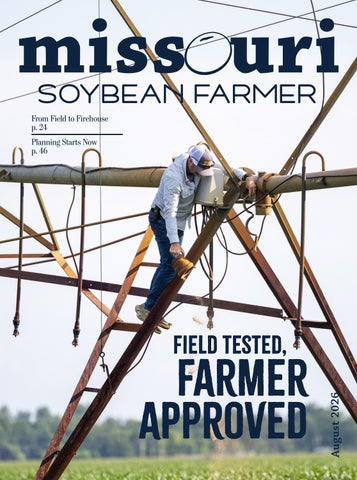
On The Cover...
Assoc. Dir. of Policy & Market Development
The cover photo of the August issue was taken by Devyn Keller at a farm visit in Jackson, Missouri. Pictured is Tory Meyr, MSA board member.
Ben Travlos btravlos@mosoy.org Carley Esser-McLean cessermclean@mosoy.org
Finance Manager Stephanie Rackers srackers@mosoy.org
Senior Executive Specialist Mary Kever mkever@mosoy.org
PRINTED WITH
Office Manager
Amber Meyer ameyer@mosoy.org
Contract Compliance Manager Faith Smith fsmith@mosoy.org
Missouri Soybean Association
734 S. Country Club Drive Jefferson City, MO 65109 | Phone: (573) 635-3819 | www.mosoy.org Missouri Soybean Farmer is published six times annually and is an excellent opportunity to reach row-crop farmers. Contact Samantha Turner at (573) 635-3819 or sturner@mosoy.org for advertising information.
Missouri Soybean Farmer is a National Agri-Marketing Association award-winning publication
Copyright Missouri Soybean Association, 2026. All rights reserved. Reproduction or use of any content without the express written permission of the publisher is prohibited.
3
From The Field
Notes from Missouri Soybeans’ Leadership Team
Cody Brock
Kevin Mainord
President's Letter
A
E
Chairman's Letter
s I write my first letter as president of the Missouri Soybean Association (MSA), I am honored by the opportunity to serve my fellow farmers. It's a privilege to follow the dedicated farmer-leaders who have helped shape this organization, and I'm excited to work alongside our members as we continue building a strong future for Missouri agriculture.
very growing season begins with a decision to invest in the future. Long before the first seed is planted, Missouri soybean farmers invest their time, resources and expertise into producing a crop that will serve communities around the world. That same forward-thinking mindset is what makes the Missouri Soybean Merchandising Council (MSMC) so important.
I want to recognize our outgoing President Renee Fordyce for her outstanding leadership and commitment to MSA. Throughout her tenure, Renee served our organization with integrity, passion and a steadfast commitment to protecting agriculture. She represented Missouri farmers, strengthened our voice on key policy issues and helped position MSA for continued success. On behalf of our board and members, thank you, Renee, for your service and the lasting impact you've made on this organization.
As I write my first letter as chair of MSMC, I am humbled by the opportunity to serve. It is a privilege to work alongside a dedicated group of farmer-leaders who share a common goal: serving Missouri soybean farmers through demand, research and education. I want to express my sincere appreciation to retiring chairman Mark Lehenbauer for his exceptional leadership and unwavering commitment. In his term, Mark guided investments that strengthened soybean research, conservation, market development and farmer education. His leadership has left our organization well positioned, and I thank him for the time and dedication he brought.
As I begin my term, I'm reminded that one of our greatest strengths is that MSA is led by farmers, for farmers. Every decision we make is grounded in the real-world experiences of producers who understand the challenges and opportunities facing agriculture today. That farmer-led perspective ensures our advocacy remains focused on protecting your ability to farm while creating opportunities for future generations.
Looking to the future, our responsibility remains clear: maximize the value of every checkoff dollar entrusted to us. That means investing in research that helps improve yields and profitability, supporting practices that strengthen our natural resources, expanding domestic and international markets and identifying new uses that create additional demand for Missouri soybeans.
We'll continue advocating for sound public policy, strengthening our grassroots membership, expanding farmer engagement and ensuring Missouri soybean producers have a respected voice at both the state and national levels. Just as importantly, we'll continue listening to our members because your input helps shape the direction of this organization.
Innovation will continue to play a critical role in that mission. From research at the Farm for Soy Innovation to partnerships that advance soybean utilization and consumer education, we have the opportunity to continue highlighting Missouri's soybean industry.
I encourage every soybean farmer to stay involved. Whether that's renewing your membership, attending an event, participating in advocacy efforts or simply sharing your story.
Thank you for the opportunity to serve as your chair and for your continued investment in the soybean checkoff. I look forward to working alongside our council, staff and Missouri's soybean farmers in the year ahead.
Thank you for your confidence in me and for your continued investment in MSA. I look forward to working alongside you in the coming year. Cody Brock Missouri Soybean Association President
I wish you and your family a safe harvest season and God's blessings throughout the months ahead.
4
Kevin Mainord Missouri Soybean Merchandising Council Chairman
Letter from the CEO
Our Boards
One of the things I appreciate most about agriculture is that no one succeeds alone. Farming has always been rooted in neighbors helping neighbors, families working side by side and producers coming together to solve challenges that affect us all. If you believe in a higher power, I don't think that's by accident. One of my favorite books of the Bible is Proverbs. In that book comes a lot of wisdom. However, one verse always stands out – Proverbs 27:17: "As iron sharpens iron, so one person sharpens another." This is a reminder that we're stronger together. We all benefit when we learn from one another, challenge each other to improve and work toward a common goal. That truth was evident in a victory for agriculture before the U.S. Supreme Court. Missouri Soybeans joined agricultural organizations in supporting science-based pesticide regulation and consistent federal labeling standards. In a 7-2 decision, the court ruled that federal pesticide labeling requirements under the Federal Insecticide, Fungicide and Rodenticide Act preempt state-law failure-to-warn claims related to glyphosate labels, a decision expected to affect thousands of pending lawsuits. While the legal decision was significant, what stood out to me most was the unity behind it. Farmers and statewide and national organizations came together with one voice because we all understood what was at stake. When agriculture stands united around sound science and common-sense policy, our impact is greater. That same spirit of collaboration drives Missouri Soybeans. Our farmer-leaders bring different perspectives, different experiences and different production practices to the table, but we share one common purpose: serving Missouri soybean farmers and ensuring agriculture remains strong. Whether we're investing checkoff dollars in research, advocating for policies that protect your operation or creating new market opportunities, we're always working to prepare for what's next. At the same time, none of that work happens in a silo. It happens because farmers from every corner of Missouri come together to lead, share ideas and strengthen our industry. On behalf of all of us at Missouri Soybeans, I also want to thank our prior leaders Renee Fordyce and Mark Lehenbauer for their steadfast service, guidance and dedication. Thank you for your commitment to agriculture and your investment in this organization. We wish all our farmers safe harvest season and pray for favorable weather and productive fields.
MSA Board Members: Andrew Lance, Barnard C. Brooks Hurst, Tarkio Robert Williams, Henrietta Renee Fordyce, Bethany Cody Brock, Norborne Daniel Carpenter, Norborne Clint Prange, Shelbyville Matt Wright, Emden Casey Heiman, Butler Garrett Riekhof, Higginsville Russell Wolf, Tipton Terry Schwoeppe, Labadie Jason Mayer, Dexter Wesley Hodges, New Madrid Tory Meyr, Jackson Ryan Wilson, Portageville
MSMC Board Members: Darrell Aldrich, Excelsior Springs Nathan White, Norborne Marc Zell, Meadville Kyle Durham, Norborne Mark Lehenbauer, Palmyra Jody Ketsenburg, New London Brad Arnold, Drexel Sarah Kliethermes, Bunceton Denny Mertz, Chesterfield Aaron Porter, Dexter Trent Haggard, Kennett Justin Rone, Portageville Kevin Mainord, East Prairie
USB Board Members: Aaron Porter, Dexter Tim Gottman, Monroe City Kyle Durham, Norborne Robert Alpers, Prairie Home
Sincerely,
ASA Board Members:
Casey Wasser
Renee Fordyce, Bethany Andrew Lance, Barnard
CEO & Executive Director Missouri Soybeans
Matt McCrate, Cape Girardeau Russell Wolf, Tipton
5
Missouri S ybeans
POLICY
SOYBEAN POLICY UPDATE A griculture is often taught as a system. In my college classes, I learned about plant physiology, markets, trade and the many forces that move food, fiber and fuel from farm to consumer. This summer reminded me that agriculture is also a conversation. It lives in the stories farmers share at field days, the concerns voiced quietly before a meeting begins and the questions raised long after a legislative hearing ends. The science explains how we grow a crop; the stories explain why the policies surrounding that crop matter.
positive manner. Collaboration with surrounding states and key stakeholders remains essential if we are to protect the long-term reliability of the Missouri River system and will require continued partnership and advocacy as WRDA moves through the Senate.
CROP-PROTECTION TOOLS Some policy conversations feel distant until you understand the people affected by the outcome. The recent Supreme Court decision regarding Bayer’s failure‑to‑warn litigation, Monsanto v. Durnell, is one example. In a 7-2 ruling, the court sided with Bayer. This decision helps preserve access to important crop-protection tools, specifically glyphosate, for farmers who rely on products used according to the label and supported by scientific research.
Working alongside the Missouri Soybean Association (MSA), I have listened to farmers, industry leaders, legislators and partners discuss the issues shaping our state’s agricultural future. Those conversations have changed how I view policy. They have shown me that every policy discussion begins with a handful of questions:
Maintaining access to affordable and effective products remains vital for soybean farmers. For that reason, MSA and agricultural partners welcomed Bayer’s decision to reconsider its request for countervailing duties on glyphosate imports. Farmers raised concerns that higher costs could affect access to an already critical input. During the American Soybean Association’s Fly‑In in Washington, a farmer attendee spoke directly to the proposed countervailing duties. His comments were steady and sincere, shaped by years of experience rather than talking points. After Bayer shared updates on glyphosate and the formation of its new entity, Ruveon LLC, the company opened the floor for discussion. The farmer asked why the company was moving so quickly toward a decision to petition for countervailing duties that would raise glyphosate prices, especially so soon after farmers and industry partners stood firmly behind Bayer throughout the failure‑to‑warn case. His question reflected genuine concern about timing and the potential impact on farm operations, and it captured what many producers had been thinking. The soy industry showed up for that discussion, prepared to work through tough questions and ensure farmers’ realities were part of the conversation.
• How will this impact farmers? • How do we protect the tools and resources on which agriculture depends? • How do rural communities ensure their voices are heard?
WATER AND INFRASTRUCTURE One of the most consistent questions this summer pertains to how we protect the resources that keep agriculture moving. Water is at the top of that list. The Water Resources Development Act (WRDA) recently passed out of the United States House of Representatives. This marks an important step forward as the legislation continues through the process. MSA appreciates the leadership of House champions who recognize the importance of protecting and improving the nation’s waterways.
BIOFUELS AND MARKET ACCESS
Among other Missouri and Mississippi River priorities for which MSA advocates, a key component is language to stifle water exports out of non-Missouri River states. There has been an ongoing battle between Missouri and North Dakota pertaining to outof-basin water transfers, and we believe this language continues that conversation in a
Protecting the tools farmers rely on today is only part of the equation. Creating new domestic market opportunities for
6
POLICY
They have shown me that every policy discussion begins with a handful of questions: How will this impact farmers? How do we protect the tools and resources on which agriculture depends? How do rural communities ensure their voices are heard?
Abby Shaffer, Policy and Producer Outreach Intern tomorrow is equally important. MSA continues to focus on the Renewable Fuel Standard (RFS) and the 45Z Clean Fuel Production Credit. Strong biofuel policy increases demand for soybeans and allows producers to capture more value from the crops they grow. The push for maintaining high volumes through the RFS and ensuring there is long-term certainty surrounding 45Z reflects a broader goal. Farmers need reliable markets and opportunities to strengthen their operations. As we well know, decisions made about energy, trade and transportation eventually make their way back to the farm.
success comes from fair markets and reasonable input costs rather than dependence on assistance programs. MSA is committed to carrying their stories, challenges, and perspectives into policy discussions so that the decisions shaping agriculture reflect the realities farmers face every day.
LOOKING AHEAD As summer continues, more questions emerge. Meaningful progress begins with people willing to ask those questions and share their experiences. Policy lives in the hands of the people it touches. It shapes the work farmers do each season, the communities that support them and the future waiting for the next generation. Every bill begins with someone who depends on the land, and every vote carries the story of a farmer who has weathered both challenge and change. Whether that means contacting elected officials, engaging in policy discussions, participating in industry conversations or supporting advocacy efforts through the Missouri Soybean PAC, every voice strengthens our ability to represent Missouri agriculture.
INPUT COSTS AND AG ASSISTANCE Even with strong markets and meaningful policy progress, farmers continue to face significant economic pressure. One conversation this summer stands out. When discussing assistance programs with a young farmer, I asked how those programs helped his operation, his answer was simple: He hoped for a future where farmers did not need them. His perspective was not a desire for dependence but for an agricultural economy where producers succeed because markets are strong, input costs are manageable and opportunities exist.
The work continues because the stories continue.
WANT TO KNOW MORE?
With rising input costs, especially fertilizer, and unpredictable weather, many farmers are facing difficult decisions heading into another growing season. President Trump has requested from Congress additional agricultural assistance for producers in the amount of $11.1 billion. MSA continues advocating for solutions that provide meaningful support while also addressing the challenges contributing to financial pressure on farms. Farmers want a future where
MSA federal and state PAC contributors gain access to an exclusive newsletter for updates during the state legislative session on policy and regulatory movement in Jefferson City and anywhere Missouri soybean farmers stand to be affected. The newsletter also provides more details on Missouri elections and the role MSA and you can play to impact the outcomes. Visit MoSoy.org or scan our QR code for more details.
7
DIVING INTO
POLICY
from Carley Esser McLean
D.C.
W
hat type of dinner guest are you? The one who studies the menu ahead of time and arrives knowing exactly what to order? Or the one who quickly scans the menu after sitting down, only to wish they had chosen something else?
Federal policy works much the same way. At Missouri Soybeans, we strive to be prepared before opportunities arise. Success in Washington, D.C. isn't built in a single meeting or during a committee hearing. It begins months before legislation reaches the House or Senate floors. Washington D.C., can feel overwhelming. With thousands of competing priorities, it's easy to wonder whether the voice of a Missouri soybean farmer can make a difference. The answer is yes, but only if we're engaged before the decisions are made.
8
POLICY
By building relationships, staying engaged and keeping Missouri soybean farmers at the center of every conversation, we're ensuring that when the next opportunity arrives, Missouri agriculture will already have a seat at the table.
The most meaningful conversations happen behind the scenes. Long before a bill receives a vote, lawmakers, congressional staff, administration officials and agency leaders are gathering information, asking questions and weighing the potential impact of policy proposals. Most of these decision-makers have never purchased crop insurance, managed a conservation practice or experienced the financial pressure of rising input costs. They rely on trusted agricultural organizations to help them understand how federal decisions affect family farms.
-Carley Esser McLean, Associate Director of Policy and Market Development
That's where Missouri Soybeans plays an important role. Our goal is to be the organization lawmakers call when they need perspective from soybean farmers. We want committee staff seeking our input before legislation is introduced and federal agencies considering our feedback before regulations are finalized. Those relationships aren't built overnight. They require consistent communication, credibility and a commitment to representing Missouri farmers every day, not just when Congress is in session.
legislation faces an uncertain path in the Senate, the proposal mirrors funding included in President Donald Trump's budget request and could serve as the foundation for future legislation. Missouri Soybeans is working closely with ASA to ensure Missouri soybean farmers remain part of those discussions. Congress also continues working toward a comprehensive farm bill. While recent legislation addressed many commodity and risk management priorities, important provisions related to rural development, agricultural research and other key programs still require action. Missouri Soybeans will remain engaged throughout negotiations to advocate for policies that strengthen Missouri agriculture.
Recent Success
Currently, the U.S. Department of Agriculture (USDA) is working to implement improvements to the farm safety net that we typically see occur in the farm bill, but given the circumstances, were Water policy is another issue we continue to monitor closely. Both instead included in The One Big Beautiful Bill Act (OBBBA) passed the House Transportation and Infrastructure Committee and the in summer 2025. These improvements include more affordable Senate Environment and Public Works Committee recently adcrop insurance, expanded access to disaster programs and farm vanced their versions of the Water Resources Development Act. The House proposal includes language prohibiting out-of-state programs that are more responsive to price and yield risk. transfers from the Missouri River Basin. Although the provision is not yet law, Missouri Soybeans continues working alongside other Additionally, farmers also have a one-time opportunity to update basin-state organizations to protect this critical resource. their base acres. The Farm Service Agency mailed allocation summaries earlier this year, and producers should review those documents carefully to ensure they are accurate before the Aug. 31, 2026, Trade remains a top priority. During our meeting with Rep. Jason Smith, chairman of the House Ways and Means Committee, staff deadline. and farmers discussed the importance of preserving strong trade Missouri Soybeans is working for the day when our farmers do not relationships with Canada and Mexico through the U.S.-Mexineed a safety net. Unfortunately, that is not today’s reality as our co-Canada Agreement. Those two countries remain among Missouri soybean farmers' most valuable export markets, and we apprefarmers must compete in the world market. ciate Rep. Smith's continued commitment to keeping agriculture at Other successes in this bill include preservation of stepped-up ba- the forefront of those conversations. sis and increased tax exemptions. 45Z was also amended to limit eligible feedstocks to those grown in North America, which effec- Policy work rarely makes headlines, and much of it happens long tively excluded products such as used cooking oil from China from before votes are cast. But that's exactly why preparation matters. By building relationships, staying engaged and keeping Missouri receiving U.S. taxpayer funded incentives. soybean farmers at the center of every conversation, we're ensuring that when the next opportunity arrives, Missouri agriculture will already have a seat at the table.
The Next Opportunities
During the American Soybean Association's (ASA) July fly-in, Missouri Soybeans met with members of Congress, congressional staff and federal officials to discuss the next set of priorities for soybean farmers. One issue receiving significant attention is another potential farm assistance package. The House of Representatives is advancing a reconciliation proposal directing the House Agriculture Committee to provide $12 billion in farm assistance. Although the
9
OP-ED
F
or years, Missouri courts have been at the center of a national battle over allegations that glyphosate causes disease. Thousands of individuals have sued Monsanto, which was acquired by Bayer in 2018, in state courts across the country, claiming the company should have put a cancer warning on the herbicide's label. On June 25, the United States Supreme Court put a stop to a large chunk of that litigation, ruling 7-2 in Monsanto Co. v. Durnell that federal law preempts any state lawsuits that required a cancer warning label for glyphosate — a warning label that the EPA itself has never required.
The Durnell case arose out of our own courts in Missouri. John Durnell claimed he used Roundup on his property for about 20 years and was later diagnosed with non-Hodgkin's lymphoma. He sued Monsanto in Missouri court, arguing the company had a duty under Missouri law to warn users that Roundup could cause cancer. A Missouri jury agreed and awarded Durnell $1.25 million. The Missouri Court of Appeals upheld the verdict, reasoning that Missouri's warning requirement was essentially the same thing federal law already required. Monsanto appealed to the U.S. Supreme Court, arguing the case never should have gone to a Missouri jury in the first place. Since 1974, the EPA has reviewed glyphosate again and again, most recently in 2020, and has consistently concluded it is not likely to cause cancer. Because of that finding, EPA has never required Roundup's label to carry a cancer warning. Monsanto's position was simple: If EPA says a warning isn't required, a state jury shouldn't get to punish the company for not including one. Associate Justice Brett Kavanaugh, writing for a seven-justice majority, agreed with Monsanto. The key law is the Federal Insecticide, Fungicide and Rodenticide Act, known as FIFRA, which requires EPA to approve an herbicide label before the product can be sold. FIFRA contains a provision barring states from imposing labeling requirements that are "in addition to or different from" the federal requirement. The court held that once EPA approves a label, Monsanto is legally bound to use that exact label, and EPA's approval itself counts as a federal requirement. Durnell's lawsuit would have forced Monsanto to add a warning that EPA specifically determined wasn't necessary, and that is exactly the kind of additional or different state requirement FIFRA does not allow. This decision creates regulatory certainty for herbicide and pesticide manufacturers and ensures that farmers and ranchers will have ongoing access to important tools in food production. The Missouri Soybean Association and the American Soybean Association have worked hard to ensure the availability of necessary herbicides and pesticides through state and federal regulatory and legislative bodies, and this case signals a significant win. Going forward, it is clear that a single process through the EPA is the appropriate forum to raise safety concerns regarding herbicides, and the Durnell case ensures that the federal process is the only process for setting labeling requirements.
Producers, as always, must remain vigilant and engaged in the policy process to ensure that the safest and best food production system in the world can feed us all. It is unlikely that the Durnell decision is the final round in the ongoing battle over glyphosate, or modern herbicides in general. While the decision is likely to focus the fight at the federal level within EPA’s regulatory process, every change in presidential administration opens the possibility of new interpretations and regulations at EPA, and every flip of control in Congress could lead to changes in the FIFRA statute itself. Producers, as always, must remain vigilant and engaged in the policy process to ensure that the safest and best food production system in the world can feed us all. Your MSA membership helps fund and equip a strong system of advocacy for Missouri soybean growers and agriculture, and it’s a good thing it does. There’s always another battle coming.
10
OPINION:
One Label. One Standard. By Brent Haden Brent Haden is the founder of Haden & Colbert in Columbia, Missouri, where he represents farmers, agricultural businesses and landowners in litigation, regulatory and property-rights matters. Raised on a farm near Mexico, Missouri, Haden earned degrees from the University of Missouri and Harvard Law School. Before founding his firm in 2011, he served as assistant counsel for the Kansas Livestock Association, represented agricultural clients in private practice, and served as chief of staff to the Kansas Speaker of the House.
$ UNCOVER EARNINGS
WITH COVER CROPS
$ $
ITS AND INCENTIVES FARMER BENEF
35
$
TA Support
YEARLY CONTRACTS
Per Acre, Per Year Financial Incentive
Technical Advisor
Flexible Commitment
Earn $35 per acre to help offset the
Get on-the-ground support and
Contracts can be renewed annually for
cost of implementing cover crops,
educational resources from your local
the duration of the Farmers for Soil
regardless of your cover crop history.
Technical Advisor to aid in the transition
Health program.
of your fields.
Enroll now! Visit FarmersforSoilHealth.com for more information.
AGRONOMY
RED CROWN ROT IN MISSOURI: FARMERS SHOULD WATCH OUT FOR THIS EMERGING DISEASE BY KAITLIN FLICK-DINSMORE, TECHNICAL CONSERVATION AGRONOMIST
While both diseases cause the characteristic yellowing (chlorosis) and browning (necrosis) between leaf veins and significantly reduce yields, RCR is an emerging threat in Missouri that requires closer inspection of the stem base and roots for accurate identification. As the disease continues to spread across the state, understanding the critical differences between SDS and RDR has become essential for protecting soybean profitability and making informed management decisions. RCR is caused by the soilborne fungus Calonectria ilicicola. The pathogen survives in soil for many years and infects soybean roots early in the growing season. Once established, it can damage the root system, reducing the plant's ability to take up water and nutrients.
A
s Missouri soybean growers scout fields each summer, symptoms of sudden death syndrome (SDS) become a common concern. However, a new player has entered the game. Red crown rot (RCR) is complicating SDS diagnosis because it produces nearly identical leaf symptoms and develops under many of the same field conditions.
SUDDEN DEATH SYNDROME VS. RED CROWN ROT CHARACTERISTIC
RED CROWN ROT (RCR)
SUDDEN DEATH SYNDROME (SDS)
PRIMARY INFECTION
Roots and crown
Roots
FOLIAR SYMPTOMS
Yellowing between veins, browning, defoliation
Yellowing between veins, browning, defoliation
STEM INTERIOR
Usually remains white
Usually remains white
DISTINCTIVE SIGN
Bright reddish-orange fungal structures (perithecia) on the stem base at the soil line
Blue-gray fungal growth may appear on roots; no red structures
ENVIRONMENTAL CONDITIONS
Warm, wet soils
Cool, wet soils early in the season followed by midsummer stress
• Yellowing between leaf veins • Premature leaf drop • Stunted growth • Wilting during hot, dry weather • Reduced pod set and smaller seed size
RCR thrives in moist soils fields with poor drainage, compacted soils, and continuous soybean rotation. The fungus can also survive in infected crop residue and soil, making it difficult to eliminate once established. Extended periods of saturated soil followed by heat stress can increase symptom severity later in the season. In a year of strong rainfall and high moisture, it is imperative farmers scout their beans to look for these concerns early.
The most distinctive symptom appears at the base of the stem. When soil is removed from the crown, growers may notice bright reddish-orange fungal structures attached to the stem near the soil line. These "red crowns" give the disease its common name and are an important diagnostic feature. Below ground, roots are often darkened, decayed and reduced in size.
If soybean plants show SDS-like leaf symptoms, don't stop at the leaves. Dig plants and examine the crown and roots. The presence of bright red fungal structures at the soil line is an indicator of red crown rot. The absence of bright red fungal structures combined with classic SDS foliar symptoms makes sudden death syndrome the more likely diagnosis.
Aboveground symptoms often resemble other soybean diseases, making diagnosis difficult. Infected plants may show:
12
Since the disease can be mistaken for sudden death syndrome, brown stem rot or other root diseases, proper diagnosis is essential. Laboratory testing may be necessary to confirm its presence. The University of Missouri offers the ability to test RCR for farmers across the state. If you're in Missouri and need a soybean disease diagnosis, whether you suspect sudden death syndrome, red crown rot or another disease, the best place to send samples is the University of Missouri Plant Diagnostic Clinic, 28 Mumford Hall, 1100 University Ave., Columbia, MO 65211. Red crown rot testing is available at no cost to Missouri farmers through support from the Missouri Soybean Merchandising Council and United Soybean Board.
SUPPORT FOR EVERY PART OF FARMING BUILT BY SOYBEAN FARMERS. BACKED BY THE SOY CHECKOFF. READY WHEN YOU NEED IT.
Visit the Soy Farmer Support Hub to find resources for your fields, your operation, and you.
SCAN HERE TO CHECK IT OUT
FEATURE
A
s the aquaculture industry grows, so does the need for affordable protein in fish feed. At Lincoln University of Missouri (LU), researchers are studying whether soybean meal offers a practical way to reduce reliance on fish meal.
The research examines whether soybean meal can replace a portion of the fish meal used in aquaculture feed. Fish meal, a protein-rich ingredient traditionally made from wild-caught fish, has long served as a primary protein source in fish diets. However, limited supplies and high costs have prompted researchers to evaluate alternative ingredients such as soybean meal, which offers high protein content and digestibility, a favorable amino acid profile, wide availability and lower market cost.
LINCOLN UNIVERSITY
Reimagining
Fish Feed WORDS BY: JENNY MARIE LAWRENCE PHOTOS BY: LYNNE HOLSAPPLE
14
FEATURE “Feed accounts for the highest operational cost in aquaculture — often 50% to 70% of total production costs,” said Moureen Matuha, who leads fish nutrition research in LU’s Aquaculture Program. “Using soybean meal as an alternative protein source in aquafeed could lower production costs for fish producers while creating new demand opportunities for soybean growers.”
The goal is to develop practical, sciencebased solutions for aquaculture producers while also supporting local soybean farmers.
-Moureen Matuha
LU first evaluated soybean-based diets with or without taurine supplementation under controlled conditions at its Aquaculture Research Facility. Promising growth performance of juvenile largemouth bass in this initial study supported further testing of the diets under real-world farm conditions.
Researchers continue monitoring fish growth, feeding response and water quality throughout the trial. Beyond growth performance, the LU team also wants to understand how soybean-based diets affect fish health and product quality. Researchers plan to evaluate nutrient composition and conduct sensory analysis to assess taste, texture, aroma and overall appeal.
“The goal is to develop practical, science-based solutions for aquaculture producers while also supporting local soybean farmers,” Matuha said. “What makes our work different is that we are not only working in the lab. We are also validating our findings on farms to ensure they are practical for producers.”
“You cannot introduce a novel fish feed ingredient without understanding its impact on the final product for consumers,” Matuha said. “We are evaluating whether soybean-based diets affect the sensory profile and nutrient composition of largemouth bass.”
LU researchers are now conducting a six-month feeding trial at NuTerra Farms in Dexter, Missouri. The trial began in April and will continue through October.
The research also points to a broader opportunity for Missouri soybean growers. Most soybean meal used in the United States currently goes to poultry, swine and cattle, while aquaculture represents a smaller but growing market. Increased domestic aquaculture production could create additional demand for alternative protein ingredients.
The study compares three diets: a standard commercial feed and two experimental diets that replace 30% or 60% of the fish meal with soybean meal. The trial is part of the project “Optimizing Soy Inclusion in Largemouth Bass Feeds: Balancing Fish Performance, Economic Viability and Environmental Impact.” This research is supported, in part, by the Soy Aquaculture Alliance and the Missouri Soybean Merchandising Council through Missouri soybean farmers’ checkoff investments, which fund research into new uses and markets for soybeans.
Matt Amick, director of market development for the Missouri Soybean Merchandising Council, said practical research plays an important role in developing that market. “Moving more aquaculture production within our borders and inland to the Midwest presents diversification opportunities for farmers, new markets for soybean farmers to use soybean meal in aquafeed and better food security for consumers,” Amick said. “While the market for soy in aquaculture is relatively small at this point, on-farm, practical research such as the partnership between the Missouri Soybean Merchandising Council, Soy Aquaculture Alliance, Lincoln University and NuTerra Farms is vital to expanding awareness and growth for fish and soybean farmers.”
The NuTerra Farms trial allows the LU team to evaluate how the soy-based diets perform in largemouth bass under commercial production conditions. Howard Magill, who operates NuTerra Farms with his family, said the partnership came at the right time. His family had begun preparing ponds for largemouth bass when LU started searching for a producer willing to host the long-term study.
In addition to the NuTerra Farms trial, LU continues related studies involving largemouth bass and rainbow trout at different stages of development. Together, these projects provide a broader understanding of how soy-based products perform across species, production settings and growth stages.
“There’s been concern in the industry about soy-based feed affecting water quality and fish health, so we wanted to be part of something that could either confirm or clear that up,” Magill said. At roughly the halfway point of the trial, measurements indicate that fish fed the 30% soybean meal replacement diet have experienced the strongest growth so far. The standard commercial feed group ranks next, followed by the 60% replacement group.
For more information on this research, contact Moureen Matuha at MatuhaM@lincolnu.edu.
Matuha emphasized that the trial remains in progress and the early pattern may change as the fish continue growing. The research team plans another round of measurements in August before completing the study in October. The on-farm trial also reflects common challenges aquaculture producers face during a growing season, including weather-related feeding disruptions and an aerator failure that affected dissolved oxygen levels in one pond.
15
PARTNERSHIPS
Scoring New
L
ast year, Missouri Soybeans and Mizzou Athletics launched a firstof-its-kind partnership to showcase the many ways soybeans power Missouri — from biodiesel fueling the Tiger Team bus to SOYLEIC high-oleic soybean oil served at concession stands. One year later, that partnership continues to grow, bringing soybean innovation to one of the most recognizable landmarks in college athletics while connecting hundreds of thousands of fans with Missouri agriculture.
16
PARTNERSHIPS As fans return to Faurot Field this season, they'll notice another visible reminder of Missouri soybean farmers' investment in innovation. Soy-based SYNLawn turf has officially been installed around the iconic Block "M" at the north endzone, fulfilling a vision first announced through the partnership between the Missouri Soybean Merchandising Council (MSMC) and Mizzou Athletics. Developed using soybean oil as a renewable alternative to petroleum-based materials, the turf represents another successful example of how soybean checkoff investments are creating new uses and new demand for U.S. soybeans.
The installation of the soy-based turf created another opportunity to engage fans through digital storytelling. Behind-the-scenes videos and photos documented the transformation around the Block "M," offering a closer look at how soybean innovation found its place at the heart of Faurot Field. The campaign celebrated the completion of the project while educating fans that soybeans are much more than food and feed, they're an ingredient in products they encounter every day. "One of the greatest values of this partnership is the opportunity to tell the story of Missouri soybean farmers in a place where thousands of people gather each fall," Light said. "From the Tiger Team bus and now the soy-based turf surrounding the Block 'M,' we're showing fans that soybeans are woven into everyday life. Every game, every social post and every new innovation helps connect consumers back to the farmers who make it all possible." The partnership also reinforces Missouri Soybeans' long-standing relationship with the University of Missouri. For generations, soybean checkoff investments have supported groundbreaking research through the university, leading to advancements in biodiesel, soybean breeding, conservation practices and biobased products. Today, that same spirit of innovation is visible to more than 60,000 fans every game day and reaches countless more through digital and broadcast platforms. As another football season kicks off, the partnership continues to demonstrate that soybeans are much more than a commodity crop. Missouri soybean farmers are proving that innovation doesn't stop at the edge of the field, it continues to create new opportunities, strengthen demand and showcase the value of soybeans long after the harvest is complete.
While the installation is certainly eye-catching on game day, it represents something much larger than a landscaping project. It reflects decades of farmer-funded research focused on developing renewable, biobased products that create additional value for soybean farmers while replacing traditional petroleum-based materials. "The partnership is about more than showcasing innovative products; it's about connecting Missouri farmers with the consumers they serve every day," said Clayton Light, Missouri Soybeans director of conservation and farm innovation. "Every new use for soybeans creates additional demand, and every opportunity to tell that story helps consumers better understand the important role agriculture plays in their daily lives." Beyond the products themselves, the partnership has become a powerful platform for sharing agriculture's story. Throughout the past year, Missouri Soybeans and Mizzou Athletics have collaborated on an integrated marketing campaign that includes social media, video storytelling, in-stadium promotions, LED ribbon boards, radio features, digital advertising and co-branded content. Together, these efforts have introduced hundreds of thousands of fans to the many uses of soybeans while highlighting the innovation taking place because of Missouri farmers' investments.
The partnership is about more than showcasing innovative products; it's about connecting Missouri farmers with the consumers they serve every day. -Clayton Light, Missouri Soybeans
17
AGRONOMY
FROM PLANTING TO POD FILL
The Lasting Impact of a Wet Spring on Soybeans
BY KAITLIN FLICK-DINSMORE, TECHNICAL CONSERVATION AGRONOMIST
R
ain is one of agriculture’s greatest blessings. It fills rivers, nourishes crops and gives life to the land. On the other hand, it can also be devastating. This spring, our Missouri skies wouldn’t clear, and that blessing quickly became a burden for many Missouri farmers during planting. Although rainfall is essential for establishing a healthy soybean crop, excessive moisture can create challenges that persist long after fields dry out. Saturated soils, delayed planting and repeated rainfall events can influence soybean growth from emergence through harvest, affecting plant development, disease pressure, nutrient availability and ultimately yield potential. Understanding how wet conditions impact soybeans helps producers make informed management decisions the remainder of the growing season to minimize potential yield loss. Excessive soil moisture can reduce seed germination and create uneven soybean stands. Uniform soybean stands are important for early canopy closure, which is essential for reducing weed competition, limits evaporation and maximizes soybean leaves to intercept sunlight for photosynthesis. Additionally, wet soils are susceptible to compaction. When equipment compresses soil particles, the pore space necessary for air and water movement is reduced. The compacted soil also restricts root growth throughout the season. Shallow root systems limit the plant's ability to access moisture and nutrients during summer dry periods. Ironically, fields that were excessively wet in spring may become more drought-sensitive later because compacted roots cannot fully explore the soil profile. Nitrogen losses through denitrification become more com-
mon as soil microbes convert nitrate into gaseous forms that escape into the atmosphere. Although soybeans produce much of their own nitrogen through biological fixation, early-season nitrogen shortages can slow growth before nodulation becomes fully established. Wet soils also reduce the availability of sulfur and other nutrients while limiting root uptake due to oxygen deficiency. These conditions also create favorable environments for many soybean diseases. Root rots often become established early and may continue affecting plants throughout the season. Infected plants frequently exhibit reduced vigor, stunting, yellowing and lower pod counts. Foliar diseases may also become more problematic if wet weather continues into summer. Disease severity often depends on weather patterns after planting, variety resistance, drainage and crop rotation history. Waterlogged soils also favor seedling diseases such as pythium and phytophthora. These pathogens can cause seed decay, damping-off and weakened seedlings that never fully recover. Persistent rainfall complicates weed management programs. Pre-emergence herbicides may be activated effectively with moderate rainfall, but excessive precipitation can cause herbicide movement, crop injury or shortened residual activity. Delayed post-emergence applications caused by muddy fields allow weeds to become larger and more competitive stealing the nutrients intended for the soybean crop. Weed competition during early soybean growth can reduce yield potential if not controlled promptly. These excessively moist conditions can present agronomic challenges, but they do not automatically guarantee poor soybean
18
yields. Much depends on management practices and the conditions during the remainder of the growing season. While farmers can't control the weather, they can control how they respond to it. A wet spring may leave lasting effects on soybean fields, but it also reinforces the importance of timely scouting, sound agronomic decisions and adapting management throughout the season. Every field tells a different story. Evaluating stand establishment, monitoring disease development, assessing nutrient deficiencies and staying ahead of weed pressure allows producers to make informed decisions that protect yield potential. Even fields that faced challenging planting conditions can finish strong when favorable weather and proactive management come together. As soybeans move from vegetative growth into flowering and pod fill, continued field observations will be critical. Identifying issues early provides the greatest opportunity to protect plant health and maximize productivity through harvest. Missouri farmers have weathered challenging seasons before, and soybeans are remarkably resilient. With careful management and a little cooperation from Mother Nature during the remainder of the growing season, many fields still have the potential to produce a successful crop. If questions arise, don't hesitate to lean on trusted resources. Your local agronomist, seed dealer and the team at the Farm for Soy Innovation are available to help evaluate field conditions and develop management strategies that keep your crop on track through harvest.
KEEP YOUR ENGINE RUNNING
LIKE A BOSS
BOSS Performance Diesel is built to go the distance, just like you. With advanced detergents that clean your engine as you drive, it helps maximize performance and extend engine life. Don’t let anything slow you down. Keep your engine running stronger, longer—like a BOSS. ✓ Increases performance and fuel economy over untreated #2 diesel fuel.* ✓ Keeps engines cleaner by preventing fuel-filter plugging and deposits on nozzles and internal diesel injectors. ✓ Protects against corrosion throughout the entire fuel system.
Find BOSS Diesel near you at BossPerformanceDiesel.com.
*When used consistently over the life of the engine vs typical rack fuel.
INNOVATION
Building A Better Bridges
cross rural Missouri, county officials face a difficult equation. Hundreds of old bridges need replacing, construction costs continue climbing and available funding cannot keep up. Instead of waiting on additional funding that might not ever come, the Missouri Soybean Merchandising Council (MSMC) is helping counties explore a proven alternative in neighboring Iowa: repurposed railroad flat cars that create safe, reliable bridges at a fraction of the cost of conventional construction.
A Growing Need
“The area of the country where the need is the most severe also happens to be the area of the country where resources are the most scarce,” says Mike Steenhoek, executive director of the Soy Transportation Coalition (STC). This challenge is not unique to Missouri. Rural counties across the country face similar obstacles. “We have 265 bridges in Buchanan County, Iowa, and the funding we receive is basically enough to replace or repair about one bridge a year,” says retired Buchanan County engineer Brian Keierleber. These old bridges play a much bigger role in the soybean value chain than many realize, helping farmers move crops efficiently to market. “Farmers are the ones who are adversely affected if you have a bridge that is closed or load-limited,” Steenhoek says. “Infrastructure is essential because farmers have to be able to move throughout the transportation network.” Without this first step, the soy value chain is at risk. Poor roads and bridges create longer routes, increased costs and reduced access for farming communities. Combined with rising construction costs, these challenges require a two-sided solution. Steenhoek believes solving the problem requires more than simply seeking additional funding. “If the approach is that we just need more money from the federal government, state government or local government, we will be a very disappointed group of people,” he says. “You have to focus not just on the revenue side of the problem, which is getting more money. You also have to focus on the cost side of the problem, which is making existing taxpayer dollars stretch further and getting more bang for your buck.” Finding ways to reduce replacement costs requires counties to look beyond traditional approaches.
20
INNOVATION
"You have to focus not just on the revenue side of the problem, which is getting more money. You also have to focus on the cost side of the problem, which is making existing taxpayer dollars stretch further and getting more bang for your buck." -Mike Steenhoek, Executive Director, Soy Transportation Coalition
Innovative Solutions
Buchanan County Iowa jumped onto this innovative approach. By embracing railroad flat car bridges and other cost-saving techniques, Buchanan County dramatically increased the number of bridges it could replace.
In 2021, the Soy Transportation Coalition examined innovative bridge replacement and repair strategies from across the country. Steenhoek convened a panel of 13 bridge engineers from county governments, state departments of transportation, universities and private engineering firms to identify solutions that could help rural communities do more with limited resources.
“We have replaced 35 of our county bridges using railroad flat cars,” Keierleber says. Because the main structural component is already fabricated, counties can reduce the amount of new steel fabrication and construction time required compared to a traditional bridge replacement.
To make the list, each concept had to provide significant cost savings, meet established safety standards and be applicable across much of rural America.
From Iowa to Missouri
Among the 20 approaches identified, railroad flat car bridges stood out as one of the most promising options for rural bridge replacement.
MSMC became interested in the concept after Keierleber presented at a national soybean transportation conference. Recognizing the potential benefits for Missouri farmers, the MSMC board of directors partnered with the Soy Transportation Coalition to introduce the bridge replacement method to counties across the state.
“In 2001, we started building bridges with retired railroad flat cars as part of a research project with Iowa State University (ISU),” Keierleber says. “We could replace these bridges for about one-third to one-half the cost of standard construction. The rail cars, in essence, are a prefabricated superstructure with the deck attached.”
The effort focuses on rural counties with significant soybean production, where dependable transportation infrastructure is critical for moving grain, farm equipment and agricultural inputs.
After a flat car is removed from service, it can be inspected, purchased and converted into a bridge superstructure. The steel frame provides the structural support needed to carry traffic, while a deck surface is added to create a drivable bridge. Once installed, the structure functions much like a traditional bridge.
“The goal is to assist counties in Missouri to start replacing county bridges with railroad flat cars,” Keierleber says. Steenhoek believes it is an obvious choice for Missouri soybean farmers. They are uniquely positioned to champion innovative solutions because efficiency has always been part of agriculture.
While the concept may seem unconventional, decades of engineering research and real-world use have demonstrated the durability of the design.
“I have never met a successful farmer whose first reaction to a problem is, ‘I know what I'll do, I'll spend more money,’” Steenhoek says. “Farmers first ask, 'Can I fix this problem without spending as much?’ That's just part of their DNA."
“Each one of those cars is rated for 80 to 100 tons,” Keierleber says. “ISU load-tested that bridge, and even an overloaded truck wasn't getting anywhere near the allowable limits.”
As part of this initiative, MSMC is helping connect county officials with engineering expertise, educational resources and best practices developed through more than two decades of successful implementation in Iowa. Keierleber is also working with the Missouri Department of Transportation to ensure counties have the information needed to confidently pursue projects.
We could replace these bridges for about one-third to onehalf the cost of standard construction. The rail cars, in essence, are a prefabricated superstructure with the deck attached.
By helping counties stretch infrastructure dollars further, MSMC hopes more rural bridges can be replaced safely, more roads can remain open and Missouri farmers can continue moving soybeans efficiently from field to market.
-Brian Keierleber, MSMC Contractor and Engineer
It is a partnership built around a simple idea: smarter solutions can help rural communities do more with the resources they have. One bridge at a time.
21
EVENTS
INNOVATION ON DISPLAY MISSOURI SOYBEANS SHOWCASES THE FUTURE OF FARMING
F
rom autonomous equipment to cutting-edge soybean research, Missouri soybean farmers had the opportunity to experience the future of agriculture firsthand during the Crop and Pest Management Field Day and Ag Innovation Showcase on July 8. Hosted by Missouri Soybeans in partnership with the University of Missouri, the event brought together producers, researchers and industry leaders to explore the latest advancements shaping the future of soybean production. Designed to bridge the gap between research and on-farm application, the event showcased practical technologies and management strategies that farmers can implement to improve efficiency, profitability and long-term sustainability. Attendees engaged directly with University of Missouri specialists and agricultural innovators while learning about emerging tools designed to address today's production challenges and tomorrow's opportunities. "Innovation only creates value if farmers can see it, ask questions and understand how it fits into their operation,” said Clayton Light, Missouri Soybeans’ director of conservation and farm innovation. “The Ag Innovation Showcase brings research, technology and industry together in one place so producers can evaluate new ideas firsthand and make informed decisions for their farms." The morning featured the University of Missouri's long-standing Crop and Pest Management Field Day at Bradford Research Farm, where researchers shared the latest findings on weed management, crop production, pest control and agronomic best practices. Those research updates laid the foundation for an afternoon focused on innovation and commercialization at the Farm for Soy Innovation. Throughout the afternoon, farmers rotated through interactive demonstrations featuring technologies that are rapidly changing modern agriculture. Autonomous robotic weed control, precision spray drones and self-driving equipment illustrated how automation continues to reshape crop production by improving efficiency,
22
FROM SAMANTHA TURNER
reducing labor demands and increasing application precision. Attendees also explored new soy-based industrial products developed through Airable Lab, highlighting the continued investment in creating new domestic markets for Missouri soybeans. In addition to technology demonstrations, participants received updates on national soybean priorities from the American Soybean Association and United Soybean Board, along with the latest research on soybean cyst nematode (SCN) — the most yield-limiting pest affecting soybeans. These presentations reinforced the importance of continued investment in research, policy and innovation to ensure Missouri farmers remain competitive in an ever-changing agricultural landscape. The event also highlighted the collaborative efforts driving agricultural innovation. Researchers, industry partners, commodity organizations and farmers came together to exchange ideas, ask questions and discuss practical solutions that can be implemented on operations across Missouri. That collaboration remains at the heart of Missouri Soybeans' mission to connect producers with research and technologies that deliver real value on the farm. "One of the greatest values of this event is bringing everyone together in one place,” said Light. "Farmers have the opportunity to learn from university researchers, connect with industry leaders and hear directly from other producers who are facing many of the same challenges. Those conversations often become just as valuable as the demonstrations themselves." As agriculture continues to evolve, events like the Ag Innovation Showcase ensure Missouri soybean farmers remain at the forefront of innovation. By providing firsthand access to emerging technology, university research and industry expertise, Missouri Soybeans continues to invest in the success of today's producers while helping prepare them for the challenges and opportunities of tomorrow.
Providing the tools you need to be successful.
OPERATING LOANS
REAL ESTATE LOANS
TERM LOANS
CROP & LIVESTOCK INSURANCE
We know what it takes to run a successful farm. Most of us grew up on farms or in rural communities, and many of us still live there today. These experiences give us a real understanding of agriculture and what it takes to build a farm. Our passion for rural Missouri drives us but our experience and knowledge sets us apart from other lenders. Growing Relationships. Creating Opportunities.TM
800.444.3276 / myfcsfinancial.com Photo by Shelby G., Grundy County
Equal opportunity provider
FEATURE
FIELD TO
Firehouse from Brandelyn Twellman
24
FEATURE
F
rom the streets of downtown Columbia to the backroads of rural Harrisburg, Missouri-grown soybeans are playing an unexpected role in helping firefighters protect communities across Boone County. Firefighting foam has long been used to make water more effective by helping it penetrate burning materials, cool fires more quickly and reduce the amount of water needed to extinguish flames. While it is commonly associated with fuel fires, many fire departments use foam on outdoor, structural and vehicle fires as well.
Though foam is not a new tool used by the Boone County Fire Protection District to fight fires, Cross Plains Solutions’ SoyFoam is a new addition to the firefighters' toobox.. “We use foam for every fire,” says Lt. Kaila Pollard, life safety manager for the Boone County Fire Protection District. “Being in a more rural area, foam allows our water to go further.” After seeing the product demonstrated, department leaders decided to make the switch almost immediately. “As soon as we saw how good the product was when it was demoed, we made the switch,” says Norm Hinkle, assistant chief of the Boone County Fire Protection District. Putting out more fire with less water was just the beginning of the benefits the department has experienced since switching to the soy-based foam one year ago. Unlike other types of foam, SoyFoam can be used as a wetting and smothering agent on both Class A (ordinary combustibles) and Class B (flammable liquids) fires. “SoyFoam has replaced the two foams we were previously using,” Hinkle says. The first firefighting foam GreenScreen Certified at the Gold level, SoyFoam is free of intentionally added per- and polyfluoroalkyl substances (PFAS), commonly called “forever chemicals.” This fact makes it cleaner for the firefighters spraying it, as well as the environment where the foam is being sprayed.
It is safe for our firefighters, and that sold me right off the bat.
-Lt. Kaila Pollard, BCFD
“My No. 1 thing is that it is PFAS free,” Pollard says. “It is safe for our firefighters, and that sold me right off the bat. I don’t have to worry about any toxic chemicals in it. We also feel good about what it does for the environment.” SoyFoam breaks down naturally without harming the ecosystem or crops, Pollard says. When this soybean-based foam degrades, it turns into nitrogen and actually improves soil health, making it certified ready biodegradable by the Organization of Economic Cooperation and Development. The foam is also certified as 84% biobased through the U.S. Department of Agriculture BioPreferred program. That matters when considering how much foam the firefighters might use on a single fire. Hinkle estimates the department uses between 20 and 30 gallons of foam on a fully involved large house fire. SoyFoam is also used on natural cover fires, grass fires, vehicle fires and more. With cleaner ingredients at a comparable price point and improved foam coverage and consistency, Pollard and Hinkle agree the switch has been a no-brainer. “From every angle, this foam is a win-win,” Pollard says. “It is good for the environment, it is good for the firefighters who are in it, and it still does just as good of a job as our previous foam.” Made from soy flour, SoyFoam creates a new market for Missouri-grown soybeans while giving firefighters an effective extinguishing tool. Knowing their use of foam supports local farmers is an added benefit for the department, Hinkle says. “We are in central Missouri, and we are surrounded by rural farmland,” he says. "Our friends are farmers and grow soybeans. I think it is awesome that we are able to use this product that is good for our environment and good for Missouri farmers.”
25
MEMBERSHIP
YOUR FARM. YOUR VOICE.
Your Missouri Soybean Association.
E
very day, decisions are made in Jefferson City and Washington, D.C., that directly impact your farm. From taxes and trade to crop-protection tools, water rights, transportation infrastructure and biofuels, these issues shape your profitability and your freedom to farm.
For nearly 60 years, MSA has been the unified voice of Missouri soybean farmers — advocating for policies that protect agriculture, expand markets and create opportunities for the next generation of producers. Unlike checkoff dollars, membership dollars can be used for legislative advocacy, ensuring soybean farmers have a seat at the table when critical decisions are being made. Recent policy victories demonstrate what a strong membership can accomplish. Missouri Soybeans has helped advance legislation supporting biofuels, infrastructure, tax policy, conservation, beginning farmers and other initiatives that strengthen Missouri agriculture. Every success is possible because farmers choose to stand together with one united voice.
Why Join? ADVOCACY Strong represenatation at the state and federal level.
INFORMATION
Timely policy updates and action alerts.
RELATIONSHIPS
Engage with elected officials and industry leaders.
OPPORTUNITIES
Join Today
Exclusive events, leadership programs and education.
Whether you choose a free Farmer Advocate membership, a paid two-year membership or become a Lifetime Member, your support strengthens agriculture across Missouri while providing valuable benefits for your operation. Together, we can continue protecting your farm, growing new opportunities and ensuring Missouri soybean farmers remain the trusted voice of agriculture.
Membership benefits through MSA and ASA.
Join today at mosoy.org/membership. Because your voice matters.
26
BENEFITS
DISCOUNTS
Exclusive savings from trusted industry partners.
ADS
WHY JOIN
FARM BUREAU? Missouri Farm Bureau is directed by grassroots members. Annual dues are only $30 per year and provide access to various benefits, including discounts on products and services!
Scan here to become a valued member!
Missouri Farm Bureau provides value and impact: • ADVOCATES for farmers and ranchers at the local level, in Jefferson City, and in Washington, D.C., working to advance agriculture and strengthen rural communities. • GROWS agricultural education outreach programs that develop the next generation of leaders through agriculture in the classroom, scholarships, grants, and more. • CULTIVATES conversation, community engagement, and leadership development programs that serve both new and experienced farmers. • PROVIDES members access to exclusive services, including quality insurance, market insights, benefits and discounts.
“Farm Bureau Health Plans provide us with the peace of mind of full preventive care coverage for our three kids, while still saving us $600 a month! A better plan with savings? Who can beat that?”
To learn more, contact your local agent or visit mofbhealthplans.com
~ Alexis, Linn County Missouri
Your Health, Our Commitment.
Missouri Farm Bureau Health Plans are not insurance and are not regulated as insurance under Missouri law.
Missouri Farm Bureau Health Plans provide high quality coverage at an affordable rate.
Enrollment requires an active membership for at least 30 days.
You’ve Landed in America’s Food Hub
Missouri Partnership is showing visitors from around the world that Missouri is a top choice for food business with billboards and airport advertising in Kansas City during the World Cup.
27
missouripartnership.com
Stories Rooted in Service PROFILE
from mikaela rojas
Comms and Education Intern
Four newly elected board members discuss how they plan to serve Missouri soybean farmers through leadership, advocacy and stewardship.
E
very producer and their family has a story, and a chapter of service is starting for four Missouri farmers elected to serve on the Missouri Soybean Association (MSA) and Missouri Soybean Merchandising Council (MSMC) boards. During the next three years, they will represent producers, oversee investments and promote Missouri soy and its byproducts. For each, board service is an opportunity to give back to an industry that has shaped their lives while representing soybean farmers across Missouri.
Robert Williams DISTRICT 1, MSA A third-generation row-crop farmer from Henrietta, Missouri, Robert Williams works alongside his father in Ray and Caldwell counties raising corn, soybeans and wheat. Growing up on a family farm taught Williams the value of hard work, stewardship and supporting those around him. He hopes to bring that same perspective to the board as he represents farmers across northwest Missouri.When he is not working in the field, Williams spends his time supporting his four children through local sports, rodeo events and 4-H activities. He looks forward to helping farmers better understand the work the association does on their behalf while advocating for policies that protect family farms and strengthen agriculture for future generations. "Putting others ahead of yourself above all odds, that’s where true service begins," Williams said. "In this role, protecting and caring for our producers is of extreme importance to me."
28
PROFILE
Jody Ketsenburg DISTRICT 3, MSMC After earning an agricultural business degree from the University of Central Missouri, Jody Ketsenburg gained valuable industry experience across Missouri, Illinois and Indiana before returning home to manage his family's New London farm in 2013. Ketsenburg’s passion for agronomic research drew him to the Missouri Soybean Merchandising Council board. He views research investments across the state as critical tools that will continue advancing production practices and innovation for Missouri soybean farmers. "Generosity thrives when there’s no expectation of a return. That mindset is what defines real service," Ketsenburg said. "I am confident our board will work tirelessly to ensure checkoff dollars are invested wisely to benefit every grower." Drawing on his agribusiness background, Ketsenburg aims to help direct checkoff funding toward research and technologies that deliver maximum return on grower investments.
Casey Heiman DISTRICT 4, MSA "Combining genuine concern for others with commitment to a cause is what service is all about," said Casey Heiman. "Supporting policies that develop new market opportunities for our producers is one of the service pieces I am most excited about." Raised in southwest Missouri, Heiman graduated from the University of Missouri College of Agriculture, Food and Natural Resources in 2015 and has spent his career supporting growers. His recent completion of the Missouri Soybeans’ Grassroots Fellowship reinforced his desire to advocate for the agricultural community. He gained firsthand experience engaging with policymakers and other industry leaders through the year-long program. He plans to use his experience and perspective as a young farmer to support policies that create new market opportunities and keep Missouri's soybean industry competitive.
Sarah Kliethermes DISTRICT 5, MSMC Sarah Kliethermes farms with her family in Cooper County, where they operate a soybean, corn, turkey, cattle and feed mill operation. She grew up on her family's century farm in Pike County and remains active in agriculture through the Cooper County Farm Bureau, CommonGround, the ASA Young Leaders program and local FFA and 4-H. In addition to farming, Kliethermes has spent nearly two decades working in crop insurance, giving her insight into the challenges producers face throughout the growing season. "Opening the door for conversation and building relationships on trust is the ultimate form of service," Kliethermes said. "Whether I'm talking to a producer or consumer, it’s about saying 'yes' when given the chance to speak up for agriculture." As both a soybean grower and a livestock producer who relies on soybean meal through her family's feed mill, she hopes to help guide checkoff investments that strengthen both meal and oil markets, while creating lasting value for Missouri soybean farmers. Service looks different for every board member, and while their personal definitions vary, their dedication to Missouri producers remains the same. Through advancing research, expanding market opportunities, supporting sound policy and creating educational opportunities for producers and consumers, they are committed to making decisions that create lasting value. All books must eventually come to a close, but for members of the MSA and MSMC boards, service is the story that never ends.
29
AGRONOMY
AUGUST IS THE MOST OVERLOOKED MONTH IN MISSOURI SOYBEANS A wet start, uneven crop development and a stretch of extreme heat could bring disease, insects and confusing nutrient symptoms to the surface during the final weeks of the season.
B
y August, many soybean farmers feel that the major decisions are behind them. The crop has established a canopy, herbicide applications have mostly ended and farmers have completed or started their fungicide plans.
The fungi that cause SDS infect roots early, sometimes soon after germination. Farmers may not see the familiar yellowing and browning between leaf veins until plants begin setting and filling pods.
The crop, however, still has work to do. Soybeans are setting pods, filling seed and drawing heavily on available water and nutrients. Plants whose roots were infected by diseases months ago may finally show symptoms, while insects can build as pods develop. Heat and drying soils can also create nutrient symptoms that look like fertility problems.
By the time those symptoms appear, farmers cannot reverse the infection with a foliar treatment. They should examine the entire plant before making a diagnosis. SDS damages roots but usually leaves the center of the upper stem white. Red crown rot can create similar leaf symptoms and has become a growing concern in Missouri. MU Extension reported that researchers confirmed the disease in nine Missouri counties during the 2025 growing season after finding the state’s first case in Marion County in 2024.
Missouri enters August with a wide range of crop stages and field conditions. USDA’s July 27 Crop Progress report showed that 72% of Missouri soybeans had reached bloom and 37% had set pods as of July 26. USDA rated 62% of the crop good or excellent and 31% fair.
The disease often appears after the R3 growth stage, especially in low-lying or poorly drained areas. Farmers may find red discoloration near the soil line, white fungal growth and small red fruiting structures around the crown and roots.
Statewide moisture levels remained generally adequate, but averages can hide major differences among fields. Poorly drained areas may still hold excess moisture, while lighter soils and compacted areas can dry quickly under intense heat.
Hot, dry weather can bring charcoal rot into the picture. MU Extension says charcoal rot favors warm, dry soils and often becomes more severe when plants face moisture stress. Fields with lighter soils, compaction or weak root systems may show symptoms first when extreme heat dries the root zone.
That contrast became clear by the end of July, when extreme heat warnings covered much of Missouri. Forecast highs approached 100 degrees in several regions, while heat index values reached 110 to 115 in some areas. Short-term forecasts called for scattered storms and somewhat cooler temperatures later in the week, but NOAA’s July 26 outlook still favored above-normal temperatures and near-normal precipitation across Missouri during the first part of August.
Farmers should look beyond yellow leaves. The location of symptoms, their pattern across the field and the condition of the roots and lower stems can help separate one disease from another. A diagnosis may not save affected plants this season, but it can guide variety selection, seed treatment, drainage work and soybean cyst nematode management next year.
That combination makes August scouting especially important. Similar symptoms may appear across several fields, but they may point to very different problems.
Insects Gain Ground as Seeds Develop
Wet Beginnings Can Produce Late Disease
August also increases the value of soybean plants to insects.
University of Missouri Extension says cool, wet soils early in the season favor the root infections that cause sudden death syndrome, although plants often hide leaf symptoms until reproductive growth begins.
A statewide University of Missouri study sampled 316 commercial soybean fields during 2024 and 2025. Researchers found that stink bug numbers increased during reproductive growth and peaked
30
AGRONOMY near R6, or full seed. Green stink bugs accounted for more than 80% of the insects collected.
MU Extension recommends pairing tissue samples with soil samples. Farmers should also sample healthy and affected areas separately and note differences in soil type, drainage and field history.
Stink bugs feed directly on pods and developing seeds. Their feeding can reduce yield, damage seed quality and delay maturity, but farmers should not treat simply because they find insects in the field.
By August, tissue analysis may offer more value as a diagnostic and planning tool for next season than as a reason to make a rescue application.
MU Extension recommends a treatment threshold of 0.4 stink bugs per sweep, or 40 bugs in 100 sweeps, for grain soybeans. The threshold drops to 0.2 bugs per sweep for seed production fields. Farmers should scout field edges first but also check field interiors before making a treatment decision.
Decide What Still Deserves Action August scouting should help farmers answer two questions: Can they still protect yield this season, or is the field showing a problem that should shape next year’s decisions?
Spider mites respond differently to weather. Rain and high humidity can suppress populations, while hot, dry conditions help them build quickly. Infestations often begin along field borders, waterways and other stressed areas.
An insect population above threshold may justify treatment. A growing spider mite infestation may require action before leaf loss spreads. Tissue and soil tests may identify a correctable nutrient problem, but farmers need enough growing season left for the crop to respond.
Damage starts as small yellow spots or stippling before leaves turn bronze or brown. Rain may temporarily slow an infestation, but populations can rebound if heat and dry weather return.
Disease symptoms tell a different story. Farmers have no foliar rescue treatment that can reverse established SDS, red crown rot or charcoal rot after symptoms appear. They can still document affected areas, submit diagnostic samples and use those findings to guide future management.
MU Extension’s published guidance recommends treatment when mites are present and leaf yellowing reaches 20% before pod set or 10% after pod set. Farmers should also consider crop stage, the size of the affected area and the weather forecast before spraying.
Missouri’s mix of heat, humidity, scattered rainfall and uneven field conditions could bring several problems to the surface at once. Farmers who scout carefully can separate what still warrants an investment from what would only add cost to a crop that cannot respond.
Tissue Tests Need More Context Late-season yellowing often pushes farmers toward tissue testing, but August limits what those samples can reveal and what farmers can still correct. MU Extension identifies first bloom as the ideal time to sample soybean tissue and advises against sampling after the first pods begin filling. Later samples can still help diagnose a field problem, but standard sufficiency ranges become harder to interpret. Weather adds another complication. Dry soil slows nutrient movement toward roots, while root disease, compaction, poor drainage and high soil temperatures can restrict uptake. A tissue test may show low nutrient levels without explaining why the plant cannot access those nutrients.
Bright tomorrows start with doing good today.
That distinction matters before farmers invest in a foliar application. The soil may contain adequate fertility while damaged or stressed roots struggle to take it up. Adding more fertilizer will not necessarily correct the underlying problem or produce an economic return.
AmerenMissouri.com
31
Ameren is working hard to provide more reliable energy, reduce outages and restore power faster than ever before. It’s all part of our ongoing commitment to rural reliability.
NEWS
HOW DO YOUR
SOYBEANS STACK UP?
BUILT FOR MISSOURI FARMERS
ENTER THE 2026 MISSOURI SOYBEAN ASSOCIATION YIELD CONTEST
The Missouri Soybean Yield Contest is designed to recognize excellence across the state, not just among the highest-yielding irrigated acres. District competitions allow growers to compete against others farming under similar soil and weather conditions, creating a level playing field while celebrating success in every region of Missouri. Just as importantly, the contest encourages farmers to share ideas that help improve soybean production statewide. Every entry contributes to the conversation around management, innovation and continuous improvement.
Every soybean field tells a story. Some tell a story of favorable weather. Others reflect years of refining management practices, improving soil health and making strategic agronomic decisions. The Missouri Soybean Yield Contest gives farmers the opportunity to share that story, benchmark their operation and earn statewide recognition for outstanding soybean production.
WHY ENTER? Participating in the Missouri Soybean Yield Contest offers more than recognition.
Whether you're chasing 60 bushels or 100-plus, the contest isn't just about winning. It's also about learning what works and celebrating the innovation taking place on Missouri farms.
By entering, you will:
Hosted annually by the Missouri Soybean Association (MSA), the yield contest recognizes top soybean producers from each of Missouri's seven soybean districts while highlighting the management practices that drive exceptional yields. Thanks to the support of the Missouri Soybean Merchandising Council (MSMC) and industry partners, growers compete for district and statewide honors, cash prizes and bragging rights among some of Missouri's best soybean producers.
•
MORE THAN A COMPETITION
Whether this is your first year entering or you've competed before, every season provides new opportunities to learn and improve.
• • • • •
Every year, Missouri farmers continue pushing the boundaries of soybean production. The yield contest provides an opportunity to compare management strategies, evaluate production practices and learn from fellow growers who consistently achieve outstanding results.
Benchmark your operation against other top Missouri producers. Showcase the management practices that make your farm successful. Compete for district and statewide cash awards. Become part of a network of progressive soybean growers. Help advance soybean production knowledge across Missouri. Earn additional recognition for soybean yields exceeding 100 bushels per acre.
READY TO COMPETE? If you've invested the time, management and attention to produce an exceptional soybean crop this season, now is the time to put it to the test.
The contest also helps identify production trends across Missouri, providing valuable information that can benefit soybean farmers statewide. Whether your operation is conventional, no-till or incorporates cover crops, your management story contributes to the broader success of Missouri agriculture.
Enter the 2026 Missouri Soybean Yield Contest, compare your results with the best soybean growers in the state and show what your operation can accomplish.
Newer contest categories continue reflecting the evolution of soybean production, including a dedicated cover crop category recognizing growers successfully integrating conservation practices into their operations.
For complete contest rules, harvest requirements and entry information, visit mosoy.org. We look forward to celebrating another year of outstanding soybean production across the ShowMe State.
32
HARVEST THE MESSAGE
OF SAFETY
Harvest season often means putting in long hours, which can make it difficult to be on the lookout for potential hazards. Missouri Electric Cooperatives reminds farmers to: • USE a spotter when operating large machinery near power lines. • INSPECT the height of farm equipment to determine clearance. • LOOK UP when moving farm equipment, extending augers or raising the bed of grain trucks when you’re around power lines. • ALWAYS set extensions to the lowest setting when moving loads to prevent contact with overhead lines. • NEVER attempt to move a power line out of the way or raise it for clearance.
Learn more at moelectriccoops.com
THOUGHT LEADER
Ag Lending Lens:
Get Strategic During the Summer Slowdown by Chad Roberts, Chief Marketplace Officer, FCS Financial
S
ummer can feel like a lull. Crops are in. The pace shifts. And if you’re not careful, you fill that space with busy work instead of using it for something more valuable.
I’d argue this is your window to think like a CEO and not just an operator. Start by stepping back and asking yourself a few hard questions. Where are you actually making money? What parts of your operation are dragging you down? Are you truly improving profitability, or just growing acres and bushels? A lot of operations drift simply because no one pauses to evaluate.
drop next year? What about a yield hit? If the answer makes you uneasy, it’s better to address it now than in the middle of harvest pressure. While you’re at it, tighten up your marketing plan. Don’t wait until the combine is rolling. Look back at your decisions — what worked, what didn’t. Then build structure going forward. Set target prices. Plan incremental sales. Decide how you’ll handle risk. The goal here is discipline. It beats emotion every single year.
Pick one or two changes that move the needle. Small improvements, applied consistently, compound faster than you think.
Next, re-run your numbers. Not after harvest. Right now. Update your cost of production. Look at fuel, inputs, rent; everything. Revisit your break-evens. Then compare what you planned versus what’s actually happening. Expenses rarely stay where you expect them. Prices move. Yields shift. This is how you catch margin pressure early, while you still have time to adjust. Then, challenge the way you’ve always done things. It’s easy to stick with the status quo. But this is where profit leaks hide. Review your land rental agreements. Take a fresh look at your input strategy. Ask whether owning every piece of equipment still makes sense or if hiring custom work could improve returns. Big gains often come from rethinking assumptions. Speaking of equipment, dig into it. Hard. Machinery is one of the biggest hidden costs in your business. Are you actually using everything enough to justify owning it? Are repair bills creeping up? Would leasing, or even custom hiring, free up capital? Idle iron might feel safe sitting in the shed, but it might be tying up money that could be working elsewhere. Now shift to your balance sheet. Summer is the right time to look at working capital and liquidity. Review your line of credit. Check your cash reserves. Understand your debt structure. Then ask yourself: Could you handle a price
This is also a great time to sit down with your lender. Don't plan a visit when you need money but before you do. Share updated projections. Talk through risks. Ask how you compare to peers and where your lender sees potential weak spots. A good lender brings an outside perspective that’s hard to see from inside your own operation. Now here’s the key. Don’t try to fix everything. Pick one or two changes that move the needle. Maybe it’s renegotiating rent. Maybe it’s adjusting your seed strategy. Maybe it’s building more discipline into marketing. Small improvements, applied consistently, compound faster than you think. At the end of the day, the farmers who outperform aren’t just better at growing soybeans. They’re better planners. More financially disciplined. And willing to question their own decisions. Use this slowdown wisely. Because the edge you create now is what shows up in your numbers next year.
Chad Roberts Chief Marketplace Officer FCS Financial
34
Roberts joined FCS Financial in 2020 with 20 years in banking and lending. He now serves on the Executive Leadership Team, overseeing lending, insurance, customer service and marketing. A native Texan, he grew up helping on his grandparents’ cattle ranch and holds degrees from Park University, the University of Alabama and the University of Missouri.
Calcium Clarified: Why Calcium is Vital for Your Soybeans ADS
% Plant-Available Calcium
As growers continue to push the envelope to increase yields and improve ROI on soybean acres, a shift is underway in how the crop is managed,
2
crop nutrition program that includes often-overlooked secondary nutrients like calcium. While calcium often gets overlooked as a primary contributor to yield, it is necessary for developing a healthy and productive soybean crop.
The Role of Calcium in Soybeans Calcium is an important player in numerous physiological processes
1.7%
1.5%
NUTRIENT CONTENT
particularly with crop nutrition. The quest for higher yields is no longer just about nitrogen, phosphorus and potassium. It’s about a balanced
Sponsored Content
0 Field A
Figure 1.
Field B
within the soybean plant. Calcium helps soybeans form healthy nodules on their roots, which are needed to turn atmospheric nitrogen into a
With a controlled-release, water-soluble formulation, SUL4R-PLUS
form the plants can use. It helps facilitate cell division and elongation
provides immediate availability and season-long uptake of calcium
to ensure proper growth from the root to the top of the plant. Calcium
and sulfur to help crops maximize yield potential. Recent trial data
also contributes to cell wall strength, which is essential for the plant’s
demonstrates SUL4R-PLUS can increase soybean yields up to
structural integrity and its ability to withstand environmental stress.
12.2 bu/ac, depending on application rate, compared to the untreated
Beyond its structural contributions, adequate calcium levels help the
check (Figure 2).
plant manage abiotic stress and improve disease resistance. In addition,
Grain Yield
calcium helps promote better soil structure, which drives nutrient environment for vigorous plant growth.
Addressing the Calcium Needs of Soybeans Today’s high-yielding soybeans require more calcium than ever before. However, even when soil tests indicate high calcium levels, it does not guarantee optimal plant availability of the essential nutrient. Therefore,
YIELD (BU/ACRE)
availability and uptake, and increased microbial activity to foster an
51.9
it is often necessary to provide soybeans with a supplemental calcium
0
source to meet the crop’s nutrient needs. Supplemental calcium sources can also vary in plant availability. Choosing a plant-available calcium
Figure 2.
55.7
57.4
100
150
61.3
63.3
64.1
61.6
200
250
300
350
SUL4R-PLUS APPLIED (LBS/ACRE)
source helps ensure nutrient uptake is maximized during crucial periods of growth and development, in turn delivering a stronger ROI on the fertilizer application.
Get More from Every Acre with SUL4R-PLUS
Secure SUL4R-PLUS from HELM HELM, a trusted leader in agricultural logistics and distribution, is the exclusive distribution partner of SUL4R-PLUS to ensure efficient delivery to growers across North America. Together, HELM and
Modern high-yielding soybean varieties demand more calcium than
SUL4R-PLUS are committed to offering innovative solutions that boost
ever before. However, even when soil tests indicate high calcium levels,
productivity and contribute to soil health and sustainability.
the nutrient isn’t always readily available to plants. In many cases, less than five percent of the calcium measured in a standard soil test is plant
To secure your SUL4R-PLUS for the upcoming growing season, contact
available. This knowledge is important because soluble (plant-available)
your local retailer.
calcium is often a very small percentage of the overall total calcium reported on a soil test. Field test results illustrated in Figure 1 show soluble calcium only ranged between 1% and 2%.
Always read and follow label directions. SUL4R-PLUS®️ is a registered trademark of SUL4R-PLUS. HELM®️ is a registered trademark of HELM AG. ©️ 2025 HELM Agro US, Inc.
Discover more about SUL4R-PLUS at sul4r-plus.com.
Celebrating 35 years of the national Soy Checkoff Dear U.S. soybean community, For U.S. soybean farmers, the decision to come together 35 years ago and form the national Soy CheckoffSM was a defining moment that would reshape American agriculture for generations. Through collective investments into food, feed, fuel, industrial, exports and sustainable production, U.S. soybean production has grown from 1.8 billion bushels in 1990 to over 4 billion today. Because of what farmers have built together over 35 years, we’ve been able to create entirely new markets from the ground up like biodiesel, expand exports around the world to 90 countries and develop tools that protect yield on the farm. The partnership between farmers and the Soy Checkoff traces back to a pivotal moment in American agriculture. For many soybean farmers, the drought of 1988 exposed the
need for a national checkoff. Soon after, farmer leaders on the American Soybean Association voted overwhelmingly to pursue one, making investments available for international and domestic marketing as well as dedicated research into new uses. USB Secretary and Minnesota soybean farmer Tom Frisch believes the opportunity for every soybean farmer in the country to pool their resources and make a collective impact remains just as important 35 years later. “We need to continue to work together as U.S. soybean farmers and not isolate ourselves. We, as U.S. soybean farmers, need to champion our industry every day, every month, every year,” says Frisch. Qualified State Soybean Boards (QSSBs) have been there every step of the way, serving as the connective tissue between national strategy and on-the-ground reality. “When I view QSSBs, they
USB Past Chairs gather for a photo in the Soy Checkoff booth at Commodity Classic 2026 in Austin, Texas.
USB Past Chair Sandy Ludeman participates in a Soy Checkoff town hall in 1992.
USB is formed from the publication of the Soybean Promotion and Research Order under the 1990 Farm Bill.
are at the grassroots level navigating concerns and opportunities with their farmers across the state. They are in touch with their local agriculture community about what’s happening in their backyard,” says USB Past Chair and Mississippi soybean farmer Philip Good. As the Soy Checkoff thinks about the next 35 years, every investment made aims to grow demand, improve resiliency of the soybean crop and bring additional revenue back to the farm. “The Soy Checkoff isn’t just about dollars invested from the half-million U.S. soybean farmers — it’s about giving them the power to shape their own future and deliver lasting impact,” says Indiana farmer and USB Treasurer Don Wyss. One example of how powerful this partnership has proven to be is the advancement of high oleic soybean research and farmer adoption. We’ve seen over a million acres of high oleic across states like Indiana, Ohio, Missouri and the Delmarva region with QSSBs helping promote premiums of $0.75 to $1.25 per bushel. And there’s potential to reach 5-7 million acres a decade from now. High oleic soybeans have returned nearly $400 million in premium payments to farmers — a direct return on the $130 million checkoff investment through 2025. Another great example of partnership is the lower Mississippi River dredging project which added an additional $461 million in
revenue to U.S. soybean farmers. Through checkoff investment in research, analysis and design, which kickstarted deepening the lower Mississippi River from 45 to 50 feet allowed for an increase of 500,000 bushels per ocean vessel and saves 13 cents per bushel of freight. This investment spanned collaboration with USB, the Soy Transportation Coalition, U.S. Soybean Export Council, the American Soybean Association and multiple QSSBs. “Investing in the research and engineering side of that project was a new venture for us, but it encouraged strategic thinking of how we can use checkoff funds in unique ways to improve all soybean farmers’ bottom line,” says Good. As the United Soybean Board celebrates its 35th Anniversary we are proud of the work we’ve accomplished for every single U.S. soybean farmer. With our continued partnerships with the QSSBs we look forward to what this next chapter brings for the U.S. soybean industry. Together we can continue to deliver sustainable soy solutions to every life, every day. Here’s to the next 35 years of the U.S. soybean industry!
Brent Gatton USB Chair Kentucky
Q&A
Carrying It Forward
Fourth-generation farmer and MSA and ASA board member Andrew Lance shares the values shaping his operation. Q: Tell us a little about yourself.
Q: Who is your favorite farm influencer to follow?
A: I was born and raised in a family of four in the upper
northwest corner of Missouri. I earned my bachelor's degree in agronomy at Northwest Missouri State University. I married my high school sweetheart, Jenny, in 2017 and am the father to three kids, Audrey, Emma and James.
A: Tony Reed and Farmer Dan.
Q: Who is your biggest influence?
A: Some of my fondest memories on the farm are riding with my
Q: Tell us about your favorite memory on the farm. grandpa and dad in the old two-wheel drive ’65 Ford pickup going to the old station in Pumpkin Center, getting lunch or having an afternoon snack and visiting with all the old neighbors. Or the long days riding behind the seat in an old 7000 series Allis Chalmers tractor.
A: At an early age, it was my Grandfather Lance, and now I lean on my father for advice and direction.
Q: What would you tell your kids or next generations to encourage them to be involved in agriculture?
Q: What is your favorite planting or harvest snack?
A: I tell my kids and my yearly college interns, though ag has
A: Iced tea and something baked from my wife.
its stresses and issues at times, there is always a need for smart, driven, dependable people in ag. Whether you’re working for someone or starting your own business, the agriculture industry needs good people and the country needs us. It’s noble work and doesn’t always get a lot of recognition, but there’s not much else I’ve ever experienced so fulfilling than to watch the crop or livestock grow and reproduce.
Q: How do you take your coffee? A: Cold brew, light on the cream unless it’s winter. Then it’s hot brew.
Q: Does your family implement any sustainable practices?
Q: What are you listening to while working?
A: Yes, in the '80s my father worked for the local NRCS office
and implemented terraces and drainage tile into our farms. He moved to no-till early on, and we are currently doing a winter wheat rotation and spring oats for cover. We also own our own tile machine, which allows for further drainage work.
A: Some form of political podcast or sports radio. Q: Should tractors be red or green? A: They have always been orange or yellow on our farm.
Q: Tell us about your involvement in agriculture.
Q: Tell us about your farm.
A: I operate a family ag retail business, Lance Seeds, LLC. We distribute seed and seed treatment, crop-protection chemicals and fertilizers, and soybean seed production to area farmers. This directly involves me with producers’ production needs and concerns on around 150k acres annually. Aside from commercial production, I manage local seed stock production for Stine Seed company as well. Outside of the family business, I am involved in local county ag boards including Farm Bureau, our county Cattlemen’s and the local university farm’s AMP program. I was also recently elected to the board of directors for the American Soybean Association.
A: We operate a fourth-generation farm in the Graham, Missouri, area with my father, Tim, and brother, Brian. We raise mainly soybean and corn crops with a Red Angus cowcalf operation as well. Most seasons, we implement wheat and spring oats for forage and cover crop purposes. We also raise on all our soybean acres one seed stock production for various seed brands. On our row-crop acres, we do all the planting, spraying, fertilizing and harvesting; that way we only have ourselves to blame if something goes wrong.
38
Q&A
39
RESEARCH PORTFOLIO
RESEARCH PORTFOLIO // 2026
RESEARCH
2026
Missouri soybean farmers invest in research that solves today's challenges while creating opportunities for tomorrow. Explore the projects shaping the future of soybean production across the state.
BREEDING AND VARIETY DEVELOPMENT
01 02 03 04
Fisher Delta Center Soybean Breeding Program This project will develop high-yielding soybean varieties adapted for southern Missouri and the Mid-South with improved pest and disease resistance, environmental resilience and seed quality. By advancing herbicide-resistant and conventional breeding lines while expanding the genetic diversity of the breeding program, the research will deliver soybean varieties with broad adaptability and strong agronomic performance. The results will provide Missouri soybean farmers with improved variety options that increase productivity, profitability and long-term genetic advancement.
North Missouri Soybean Breeding Program This project will develop high-yielding conventional and Enlist E3 soybean varieties adapted for northern Missouri with improved disease resistance, seed quality and agronomic performance. By advancing breeding lines with enhanced resistance traits and expanding the development of Soyleic and Soyleic herbicide-traited varieties, the research will deliver soybean varieties that meet both producer and market demands. The results will provide Missouri soybean farmers with more competitive variety options that improve productivity, profitability and long-term market opportunities.
SCN Screening for MO Breeding Programs This project will develop high-yielding soybean varieties with improved resistance to soybean cyst nematode (SCN), the most economically damaging pest affecting Missouri soybean production. By screening soybean breeding lines against SCN populations found in Missouri and across the United States, the research will identify and advance varieties with durable resistance and strong agronomic performance. The results will help Missouri soybean farmers reduce yield losses, improve SCN management and increase long-term profitability.
Utilizing Molecular Markers for Soybean Variety Development This project will accelerate the development of improved soybean varieties by integrating molecular marker technology throughout the breeding process. By using marker-assisted selection to identify desirable traits such as soybean cyst nematode resistance, herbicide tolerance and improved seed quality, the research will increase the efficiency and precision of developing new soybean varieties. The results will help deliver higher-performing soybean varieties to Missouri farmers more quickly, improving productivity, profitability and long-term genetic advancement.
40
RESEARCH PORTFOLIO // 2026
RESEARCH
STRATEGIC PARTNERSHIPS
05
North Central Soybean Research Program The North Central Soybean Research Program (NCSRP) is a farmer-led, multi-state initiative that funds collaborative soybean research to address regional production challenges and advance innovation. It brings together universities, industry and state checkoff boards to support breeding, agronomics, pest and disease management and sustainability efforts. Through strategic partnerships and coordinated outreach, NCSRP delivers research-based solutions that enhance productivity, profitability and long-term viability for soybean farmers across the Midwest.
TRAIT DISCOVERY 06 06
Following the Path of Water: Testing Novel Opportunities for Soybean Improvement This project will improve understanding of how water moves through soybean plants to identify traits associated with greater drought tolerance and yield potential. By evaluating differences in water-conducting tissues and hydraulic function across soybean genotypes in field and greenhouse studies, the research will identify characteristics that can be used in future breeding efforts. The results will help Missouri soybean farmers by supporting the development of higher-yielding, more drought-resilient soybean varieties.
NEW TECHNOLOGY
07 08
Blind Inlets: Innovative Terrace Tile Inlet Technology to Reduce Sediment and Herbicide Losses This project will evaluate the effectiveness of blind inlets in terrace-tiled soybean fields to reduce herbicide, nutrient and sediment losses while maintaining crop productivity on highly erodible soils. By comparing blind inlets with traditional Hickenbottom risers, the research will measure impacts on water quality, herbicide movement, nutrient losses and soybean yield under Missouri growing conditions. The results will provide Missouri soybean farmers with conservation practices that improve water quality and long-term productivity in terrace farming systems.
Future-Focused Weed Management Strategies to Improve Profitability and Sustainability in Missouri Soybean Systems This project is evaluating future-focused weed management strategies that improve weed control while reducing reliance on traditional herbicide programs in Missouri soybean production. By investigating autonomous robotic mowing with cover crops, targeted thermal weed control using vegetable oils and nighttime herbicide applications, the research will identify promising technologies for long-term weed management. The results will provide Missouri soybean farmers with science-based recommendations that improve profitability and preserve herbicide effectiveness.
41
RESEARCH PORTFOLIO // 2026
RESEARCH
AGRONOMIC RESEARCH
09
10 11
12
Do Crop Rotation and Cover Crops Impact Soil Health, Soil Water, Productivity and Profitability in Missouri Soybean Systems? The Next Step This project will evaluate how extended crop rotations, cover crops and no-till practices improve soil health, water infiltration, soil moisture, productivity and profitability in Missouri soybean production systems. By measuring soil health indicators, water dynamics, crop performance and economic returns across long-term field trials, the research will identify management practices that maximize both agronomic and environmental benefits. The results will provide Missouri soybean farmers with science-based recommendations to improve soil health, increase soybean productivity, reduce production risk and enhance long-term profitability.
Planting Date in Missouri: How to Adjust Maturity Group, Plant Density and Row Spacing to Optimize Yield This project will refine Missouri soybean planting recommendations by evaluating planting date, maturity group, seeding rate and row spacing across diverse production environments. Through statewide field trials and ultra-early planting research, the project will develop region-specific recommendations that help farmers maximize yield potential, reduce production risk and improve return on investment.
Improving Management of Soybean Cyst Nematode This project will improve soybean cyst nematode (SCN) management in Missouri by providing free SCN testing to farmers and evaluating Peking-type soybean varieties as an alternative source of SCN resistance. By monitoring SCN populations and assessing the effectiveness of Peking resistance under Missouri growing conditions, the research will develop practical recommendations to better manage SCN while new resistance sources are being developed. The results will help Missouri soybean farmers protect yields, extend the effectiveness of existing resistance and improve long-term profitability.
Enhancing the Impact of the MU Variety Testing Program This project will enhance the University of Missouri Variety Testing Program by expanding the number of commercially available soybean varieties evaluated and improving how results are delivered to farmers. By reintroducing leading varieties from major seed companies and modernizing the reporting platform, the research will provide more comprehensive, accessible and relevant variety performance data across Missouri production environments. The results will help Missouri soybean farmers make more informed variety selection decisions, reduce production risk and improve on-farm profitability.
"
Research is one of the most important investments we can make for Missouri soybean farmers' with our checkoff dollars. Every project we select addresses real in-field challenges and delivers practical solutions that create long-term value for us on our farms.
-Trent Haggard, Research Committee Chair MSMC 42
RESEARCH PORTFOLIO // 2026
RESEARCH
13
Show Me the Money: An On-Farm ROI Analysis of High and Low Input Crop Management Strategies This project will compare high-input, farmer-typical and defensive low-cost soybean management systems to determine which approaches provide the greatest return on investment under Missouri growing conditions. By evaluating yield, input costs and profitability through on-farm strip trials across the state, the research will quantify when additional in-season inputs improve returns and when they do not. The results will help Missouri soybean farmers make more informed input decisions, reduce unnecessary production costs and maximize on-farm profitability.
14
15
Developing Methods to Study and Manage Red Crown Rot in Soybean This project will develop the foundational tools needed to better understand and manage red crown rot, an emerging disease threatening Missouri soybean production. By establishing reliable methods to culture the pathogen, screen soybean varieties for resistance and evaluate fungicide efficacy, the research will accelerate the development of effective disease management strategies. The results will provide Missouri soybean farmers with the knowledge and tools needed to reduce yield losses and improve longterm management of red crown rot.
Enhancing Insecticide Efficacy and Mitigation through Inverted Spray Application in Soybean Production This project evaluates inverted drop nozzle spray systems for soybean insecticide applications to improve pest control while reducing off-target movement. By comparing conventional and inverted spray applications, the research will determine whether targeting soybean fruiting structures improves control of stink bugs, bean leaf beetles, soybean podworm and other economically important insect pests. The results will provide Missouri soybean farmers with more effective insecticide application strategies that support EPA mitigation requirements and preserve access to critical insecticide tools.
16 17
Linking Soil Health Indicators to Fertility Needs in Missouri Soybean Systems This project will develop practical guidelines for incorporating soil health indicators into soybean fertility recommendations for Missouri growers. By evaluating the relationship between soil health, nutrient response and soybean yield, the research will create decision tools that better target fertilizer applications. The results will help Missouri soybean farmers improve fertilizer efficiency, increase return on investment and make more informed soil health management decisions.
Evaluation of Weed Control Utilizing Overlapping Residual Herbicides Impregnated onto Potash and Ammonium Sulfate Applied at Different Timings in Missouri Soybean Production This project evaluates overlapping residual herbicides applied with potash and ammonium sulfate fertilizer to improve season-long weed control in Missouri soybean production. By comparing application timings, the research will identify the most effective approach for controlling Palmer amaranth and other troublesome weeds while reducing reliance on postemergence herbicides. The results will provide Missouri soybean farmers with more efficient weed management options that reduce costs, application trips and preserve herbicide effectiveness.
43
NEWS
SETTING EYES ON
THE INVISIBLE YIELD ROBBER T
he soybean cyst nematode (SCN) remains the most yield-limiting pest of soybeans in Missouri — and across the United States — costing soybean farmers an estimated $1.2 billion in yield losses each year. For Missouri producers, the parasite is no longer a lurking threat; it is a present and persistent yield robber that demands continued investment in research, diagnostics and management solutions. More than 80% of U.S. soybean acres are estimated to be infested, yet many fields show few or no visible aboveground symptoms until yield losses have already occurred. Because the damage begins underground, many farmers may not realize SCN is affecting their crop until profitability has already been reduced.
In 2025, nearly 90% of fields we sampled had detectable levels of SCN. In a statewide survey over the past two years, we detected SCN at pressures that equate to roughly a 9% yield loss. It’s an easy problem to ignore because plants look healthy aboveground; however, we have resources for Missouri farmers who want to attack the problem.
— MANDY BISH Assistant Professor and Crop Pathology Specialist Universty of Missouri
Recognizing the ongoing threat, the Missouri Soybean Association (MSA) worked closely with legislators and state leaders this year — and in previous years — to advocate for state appropriations to renovate the University of Missouri's Soybean Cyst Nematode Diagnostic Laboratory. In a major victory for soybean farmers across the state, Missouri lawmakers allocated $4 million in state funding to modernize the laboratory, strengthening Missouri's ability to diagnose, monitor and research one of agriculture's most damaging pests.
Missouri invests in a new lab to fight soybean cyst nematode — one of agriculture's most damaging and costly pests.
WHY THE SCN LAB MATTERS The University of Missouri's SCN Diagnostic Laboratory is widely utilized not only by Missouri growers but also by researchers, agronomists and crop consultants across the country. However, the previous facility could no longer keep pace with the growing demand for faster, more accurate nematode testing and advanced molecular research. Although SCN was first identified in Missouri during the 1950s, it has since spread to nearly every soybean-producing state. The microscopic roundworm feeds on soybean roots, reducing the plant's ability to absorb water and nutrients while limiting root development and overall plant health. Yield losses often occur long before visible symptoms such as stunting or yellowing appear. Because SCN frequently causes hidden yield loss, soil testing remains the only reliable way to determine whether a field is infested and to understand population levels. Even fields planted with SCNresistant soybean varieties should be tested regularly, as nematode populations can adapt over time and resistance can become less effective. That is why Missouri's diagnostic laboratory is so important. The renovated facility will modernize testing workflows, expand research capacity and improve scientists' ability to monitor changing SCN populations and develop effective management recommendations for farmers. "The lab renovation will allow us to scale up our testing resolution, both for farmers and in research by introducing automated and molecular tools to analyze nematode populations, and help researchers refine in-field management strategies," said Bish.
STATUS OF THE SCN LAB Construction on the renovated laboratory is in its final stages and is expected to be completed in early August. During
44
the following months, the University of Missouri will install new instrumentation designed to significantly increase testing efficiency. The ultimate goal is to scale up the lab’s capacity so that the equipment can process a typical week’s worth of samples in single day, a goal that will allow researchers to serve more farmers across Missouri and beyond. "Farmers can benefit immediately from these updates by submitting samples to the SCN clinic this fall," Bish said. "We offer four free SCN egg counts per farmer each year, and with our new facilities we will be able to expand our testing capabilities while continuing to deliver integrated SCN management solutions to producers." Missouri Soybeans encourages farmers to remain proactive by routinely testing fields for SCN. The best time to collect soil samples is immediately following soybean harvest in the fall or before planting soybeans in the spring, when SCN egg populations are typically at their highest. Testing during these periods provides the greatest opportunity to accurately detect infestations and make informed management decisions for the following crop. While SCN cannot be eliminated once established, early detection allows farmers to implement proven management practices such as rotating to non-host crops, selecting resistant soybean varieties and monitoring population levels over time. Regular soil testing remains one of the most valuable tools for protecting soybean yield potential and long-term profitability. For more information on submitting SCN samples or to locate testing resources, visit scndiagnostics.com or contact scndiagnostics@missouri.edu. Missouri Soybeans will continue providing updates on the SCN laboratory, ongoing research and management recommendations through future issues of Missouri Soybean Farmer, field days and direct communications with members.
ARTICLES
BIODIESEL:
SAME ENGINE.
CLEANER STORY.
Funded by the Illinois Soybean Association Checkoff Program
Biodiesel runs in the engines you already use. With lower emissions
45
Learn more about soy-based biodiesel at at ilsoy.org.
Stronger Crops. Stronger Future.
By Samantha Turner
FEATURE
The best cover crop programs begin long before harvest. Here's how planning today can improve soil health, protect your fields and set the stage for next year's crop.
F
or many Missouri soybean farmers, harvest feels like the finish line. Months of planning, planting and management finally come together as combines roll across the field. But for growers who use cover crops, harvest isn't the end of the season — it's the beginning of the next crop cycle.
As more Missouri farmers adopt conservation practices that improve both profitability and resilience, cover crops continue to prove their value as part of a comprehensive cropping system. Research continues to show that soybeans perform well when planted into properly managed cover crop residue, giving growers confidence to integrate conservation practices into their rotation. Soybeans demonstrate the ability to maintain, or even improve, yield potential when paired with effective cover crop programs.
Why Cover Crops Matter in Soybean Systems Cover crops provide benefits that extend beyond protecting the soil surface. They improve water infiltration, reduce runoff, suppress winter annual weeds, build soil organic matter and support biological activity beneath the soil. Over time, these improvements contribute to healthier, more resilient fields that are better equipped to handle both excessive rainfall and drought. "Cover crops are a common practice in Missouri, and with the advanced developments in technology, better research and increased incentive programs, farmers are much better positioned to succeed with cover crops than ever before,” said Clayton Light, Missouri Soybeans director of conservation and farm innovation. “At Missouri Soybeans, we have been supporting research and testing new technology that help farmers succeed with this popular conservation practice." Every operation has different goals. Some producers are focused on reducing erosion, while others are looking to improve soil structure, manage nutrients, increase water-holding capacity or incorporate livestock grazing. Understanding those objectives is the first step in selecting the right cover crop species or mix.
46
Planning Starts Before Harvest Ordering seed early provides greater availability and often better pricing while allowing growers to select the species that best fit their operation. It also creates time to coordinate aerial application, drone seeding, high-clearance application or drilling after harvest before schedules become crowded. Drone application into standing row crops continues to gain popularity across Missouri. Establishing cover crops before harvest allows species that depend on warmer late-summer and early-fall temperatures — such as many brassicas and legumes — to become established earlier and deliver greater soil health benefits. Harvest weather can change quickly. Delays caused by rain or equipment issues can narrow planting windows, making preparation even more important. Farmers who have already developed a plan are better positioned to take advantage of favorable conditions when they arrive. Planning also means looking beyond this fall. Producers should begin thinking now about next year's cropping system, including herbicide programs, spring termination strategies, planter adjustments and overall management goals. One important consideration is herbicide carryover. Residual herbicides applied during the current crop can significantly reduce establishment of certain cover crop species if they remain active in the soil. Likewise, herbicide programs planned for next season should complement long-term cover crop goals rather than limit future options. The best cover crop programs are designed as part of an entire production system rather than as a stand-alone conservation practice.
FEATURE
Missouri Research Reinforces the Benefits Missouri farmers don't have to rely solely on anecdotal experience when making cover crop decisions. Research conducted through the University of Missouri Strip Trial Program, supported by the Missouri Soybean Merchandising Council (MSMC), continues to provide valuable insights under real-world farming conditions. The 2024 strip trial report found that soybeans planted into a green winter wheat cover crop had a 90% probability of increasing yield by 0.3 to 2 bushels per acre. Researchers also evaluated cereal rye, finding more variable results. Perhaps most encouraging for producers, researchers found that neither the number of years a field had been in a cover crop system nor cover crop termination timing had a measurable impact on soybean yield across the evaluated locations. The findings reinforce an important message: Successful cover crop systems are driven by thoughtful management. Matching species selection, establishment methods and management goals to each operation can help producers maximize both conservation benefits and long-term productivity. "Cover crops are one of the most valuable conservation tools available to Missouri farmers, but success starts with a plan," said Light "Every operation is different, and that's why we encourage growers to think about their goals now — well before harvest begins. Taking the time to develop a system that fits your farm can improve soil health, strengthen resilience and create long-term value for future generations."
Build a System, Not Just a Practice For farmers considering cover crops for the first time, there's no need to plant every acre. Many successful growers begin with one field or a manageable number of acres. A great starting point is cereal rye following corn and ahead of soybeans. This system has consistently performed well across Missouri by providing excellent erosion protection, helping suppress winter annual weeds and producing a manageable amount of spring residue for soybean planting. As a general recommendation, growers may consider planting approximately 30 pounds of pure live seed (PLS) per acre when drilled or 38 pounds per acre when broadcast or aerially seeded, adjusting rates as needed based on local conditions and management objectives. Starting small provides an opportunity to learn what works best without dramatically changing the entire operation. It also allows producers to compare establishment methods, observe spring termination and evaluate how cover crops fit into their management system. The strongest cover crop programs evolve over time. Farmers who document planting dates, weather conditions, species selection, establishment success and termination timing gain valuable information they can use to improve future decisions.
Investing in Long-Term Soil Health Cover crops should be viewed as an investment in the long-term productivity of the farm. While the return may not always be reflected in a single year's yield monitor, healthier soils often become more resilient over time.
47
Cover crops are a common practice in Missouri and with the advanced developments in technology, better research, and increased incentive programs; farmers are much better positioned to succeed with cover crops than ever before.
-Clayton Light, Director of Conservation and Farm Innovation
Improved soil structure can increase water infiltration during heavy rainfall, reduce erosion and improve moisture retention during dry conditions. Those benefits help protect one of a farmer's greatest asset — the soil itself. As producers begin developing budgets and input plans for next season, cover crops deserve a place in those conversations. Evaluating seed costs, planting methods, herbicide programs, termination strategies and available conservation programs now can simplify implementation later and improve long-term success.
Looking Ahead As combines prepare to roll across Missouri this fall, now is the time to think beyond this year's harvest. Cover crop success isn't determined on the day the seed is planted — it begins with the decisions made weeks and even months beforehand. Whether you're planting your first acres or refining a long-established program, planning ahead can improve establishment, reduce stress during harvest and position your fields for greater productivity next season. Every year's experience provides valuable lessons, and those observations can help shape an even stronger cover crop strategy for 2027. Healthy soils aren't built overnight. They're built season after season through thoughtful management. Planning today ensures the next crop starts on the right foot long before the planter enters the field.
Planning Checklist for Fall Cover Crops Before harvest begins, ask yourself these questions: • What is my goal? Whether your priority is reducing erosion, improving soil health, managing nutrients, suppressing weeds or providing livestock forage, defining your objective will guide every other decision. • Have I selected the right species? Choose a cover crop or species mix that complements your crop rotation and long-term management goals. • Have I reviewed my herbicide program? Consider residual herbicides from this season that could impact cover crop establishment, and make sure next year's herbicide program supports your long-term cover crop goals. • Is my seed ordered? Securing seed before harvest provides more options and helps avoid supply shortages or delays. • How will I establish the cover crop? Decide whether drilling, broadcasting, drone application, aerial application or highclearance seeding best fits your operation. • What's my spring termination plan? Consider herbicide programs, termination timing and equipment needs before planting this fall. • Have I explored conservation incentives? Contact your team at the Farm for Soy Innovation, your local Soil and Water Conservation District, USDA Service Center or conservation partners to learn about available cost-share opportunities. • What will I evaluate this year? Keep records of planting dates, weather conditions, establishment success and termination timing. Those observations can help build an even stronger cover crop program next season.
INNOVATION
New Uses, S
New Markets,
New Value
By Barry mcGraw
48
oybeans make an annual contribution of $29.6 billion to the U.S. economy, making them the No. 1 agricultural export, according to the United Soybean Board. Soybeans have long been recognized as a valuable resource in the food and feed industries; however, their potential extends far beyond this. As the demand for biobased industrial products continues to grow, the opportunity and ability to incorporate soy and make use of its versatile properties follows. At Airable Labs, researchers are committed to expanding the capabilities of existing products by integrating soy and replacing many petroleum-derived compounds. Soybean oil and its derivatives are highly versatile materials that can replace or enhance traditional petroleum-based products while providing renewable, biobased alternatives. Their unique chemical structure allows them to be modified into a wide variety of functional materials, making soy an attractive feedstock for applications ranging from lubricants and coatings to specialty chemicals.
INNOVATION As industries continue to prioritize sustainability, there is growing demand for products that offer strong performance while reducing environmental impacts. Many companies are actively seeking materials that lower carbon emissions, incorporate renewable resources, improve worker safety and meet evolving consumer and regulatory expectations. Soybean-derived ingredients are well positioned to meet these needs, offering excellent functionality while increasing the biobased content of industrial formulations. Airable Labs leverages these advantages to develop practical, market-ready technologies that showcase the versatility of soybean chemistry. Rather than simply replacing petroleum with renewable ingredients, the goal is to create products that perform as well as, or better than, traditional alternatives while opening new markets for American-grown soybeans. Through collaboration with commercial companies, Airable continues to demonstrate that soy can provide innovative solutions for real-world industrial challenges, creating additional value for soybean farmers and expanding the role of agriculture beyond traditional food and feed applications. One example is Airable's soy-based asphalt release agent, BioSlide-30. Asphalt is the most widely used paving material in the United States, covering approximately 94% of the nation's 2.8 million miles of paved roads, according to the National Asphalt Pavement Association (NAPA). Asphalt mixtures consist primarily of gravel, stone and sand, with bitumen serving as the binder that holds the aggregate together. During paving operations, the hot bitumen readily adheres to truck beds, paving equipment and tools, making asphalt release agents essential for efficient operation and easy cleanup. To address this need, Airable developed BioSlide-30, an asphalt release agent containing 30% soy and 30% biobased content. The technology has been licensed to Warsaw Chemical, representing another successful commercialization of soy-based innovation. With the global asphalt release agent market currently valued at approximately $1.3 billion, BioSlide-30 demonstrates how renewable agricultural resources can compete in large industrial markets while helping expand demand for soybean-derived products.
Another successful example is Airable's soy-based multiuse oil. Licensed to Dynamic Green Products (DGP), and sold under the DGP and the DeWalt brands, the product is available through Amazon and Do it Best stores. Designed to lubricate, clean and protect metal surfaces, the oil serves as a versatile maintenance product for both professional and consumer applications. The multiuse oil effectively lubricates moving components such as hinges and gears while penetrating and loosening corroded bolts, valves and other seized metal parts. It is compatible with a wide variety of materials, including Delrin, HDPE, PETE, polypropylene, PVC, Nylon 66, Teflon, Viton, nitrile rubber, steel, copper, brass and aluminum. In addition to being VOC-exempt and containing more than 75% soy-based content, the product has demonstrated superior metal wetting compared with commercial alternatives while effectively cleaning grime and helping inhibit corrosion. Building on its commercial success, DeWalt recently introduced an aerosol version of the product, further expanding its market reach. These technologies illustrate how soybean-derived materials are creating new opportunities far beyond traditional agricultural markets. By transforming renewable soybean products and coproducts into high-performance industrial applications, Airable Labs continues to demonstrate that soy can deliver both sustainability and performance. As demand for biobased products continues to grow, innovations such as BioSlide-30 and the DeWalt multiuse oil help increase the value of American-grown soybeans while opening new markets for one of the nation's most important crops. Airable looks forward to discovering additional applications for soybased technologies, expanding collaborations with industry and continuing to develop innovative solutions that strengthen both the bioeconomy and the long-term value of U.S. soybeans.
"
As the demand for biobased industrial products continues to grow, the opportunity and ability to incorporate soy and make use of its versatile properties follows.
-Barry McGraw, CEO of Airable Labs 49
OP-ED
T
he recent U.S. Supreme Court's decision in Monsanto Co. v. Durnell is a positive signal for American agriculture and the growers who rely on trusted, EPAapproved crop-protection tools every season.
In a 7-2 decision, the court affirmed that pesticide labels should be governed by EPA's science-based review, not a shifting patchwork of state-by-state requirements. For farmers, that clarity matters. The job already comes with enough uncertainty. Growers are facing tight margins, rising input costs, unpredictable weather and a long list of pressures that leave little room for error from one season to the next. According to the Modern Ag Alliance's 2026 State of the American Farmer report, 60% of farmers rank stricter product labeling as one of the issues most detrimental to their operations. They should not also have to wonder whether the crop-protection tools they safely use and depend on will remain available. Crop-protection tools help manage weeds, protect yields, keep costs down and support conservation practices such as no-till farming. Without them, yield losses could exceed 50% for major crops such as corn and soybeans. These tools are part of how farmers grow the food, fuel and fiber families rely on every day. Losing access to them, or forcing producers to navigate conflicting labeling rules across state lines, would make an already difficult job even harder and more expensive. The court's opinion reinforces that EPA has a rigorous review process, and that federally approved labels are the law. Before a pesticide reaches the market, EPA evaluates data on human health and environmental risk, and under the Federal Insecticide, Fungicide and Rodenticide Act, it revisits every registered product at least once every 15 years to reflect the latest science. If new questions arise, EPA can require companies to run additional studies, and it opens draft risk assessments for public comment before making a final call. For farmers, that means the label on the shelf reflects years of scientific review, and it means the same standard applies whether a farm sits in Missouri or anywhere across the country.
This issue has always been bigger than one product or one company. It is about whether growers, consumers and the entire supply chain can continue depending on a regulatory system rooted in science, consistency and common sense. This issue has always been bigger than one product or one company. It is about whether growers, consumers, and the entire supply chain can continue depending on a regulatory system rooted in science, consistency, and common sense. The court's decision is an important step toward protecting access to the tools that help keep American agriculture productive, sustainable, and affordable. It also sends a clear message: Science-based regulation should remain the foundation for pesticide labeling decisions. Farmers, industry leaders, and policymakers must keep working together to defend this uniform, science-based regulatory framework that gives growers the certainty they need to do what they do best: feed and sustain the country.
50
OPINION:
A Supreme Court Win for Agriculture By Elizabeth Burns-Thompson Elizabeth Burns-Thompson serves as Executive Director of the Modern Ag Alliance, where she leads efforts to advocate for U.S. farmers’ access to essential crop-protection tools. Her roots run deep in agriculture, having grown up on a family farm in eastern Iowa and held roles with the Iowa Farm Bureau Federation and Iowa Corn Growers Association, as well as industry-leading biofuel manufacturers, farm cooperatives, and supporting innovative carbon management technologies. Elizabeth resides with her family in eastern Nebraska and holds a J.D. in Agricultural Law from Drake University and a B.S. in Agricultural Business from Iowa State University.
NEWS
99.9 KIRK CLASSiC HiTS
101.3 FM AM 1430
V
750 AM
KBNN TALK RADIO
51
Long days ahead.
Handling. Storage. Conditioning. Monitoring. Starting tomorrow there’s a lot to get done and your yard should be ready with the right equipment. For over 30 years, AGI works with farmers to develop exceptionally-designed and built-to-last grain handling, storage and drying solutions for every farm and any yard. Nobody knows yards like AGI.
Build your yard: aggrowth.com-AGI-knows-yards
@aggrowth
AGI knows Yards