
The Weight They Carry
Life as a Teacher in Mississippi
Acknowledgements
Mississippi First extends special thanks to the 988 teachers who completed the 2025 Mississippi Teacher Survey, as well as the colleagues who provided valuable feedback on early drafts of this report. Mississippi First worked with the Survey Research Laboratory (SRL) at Mississippi State University’s Social Science Research Center to obtain survey data for this report. Mississippi First completed all analysis, and SRL does not necessarily agree or disagree with any of the analysis or commentary. This report was made possible by the generous support of the W.K. Kellogg Foundation. The views expressed in this report are those of Mississippi First alone.
Team
Grace Breazeale, Author Director of Research and K-12 Policy
Angela Bass, Editor Executive Director
Micayla Tatum, Editor Director of Early Childhood Policy
Madaline Edison, Editor Consultant
Heather Bruce, Designer
Copyright © 2025 by Mississippi First. All rights reserved. No part of this book may be reproduced in any form without written permission from the publisher. Icons found in this design are from Faticon.com.
Table of Contents
Part One | Compensation
Insight: The value of a teacher’s salary has declined over the past decade and continues to erode in the absence of regular pay raises.
Insight: A significant proportion of survey respondents are not financially secure, evidenced by their lack of ability to afford basic necessities, pursuit of second jobs, and self-reported financial status.
Part Two | Workload and Workplace Support
Insight: Mississippi teachers face unsustainable workloads, reflecting a national trend.
Insight: Educators’heavyworkloadsunderminetheirwell-being.
Insight: Workload pressures are more acute for teachers in high-poverty schools.
Part Three | Student Behavior
Insight: Student behavior plays a critical role in shaping teachers’daily experiences and can significantly contribute to burnout.
Insight: Schools continue to grapple with the long-term effects of the COVID-19 pandemic on student behavior.
Insight: Student behavior challenges tend to be more prevalent in high-poverty schools.
Part Four | School and District Leadership
Insight: School and district leaders play a significant role in teacher satisfaction and retention.
Insight: High-poverty schools tend to have more turnover among school leaders.
Part Five | Who is Most At Risk of Leaving?
Insight: Teachers in the early stages of their careers are more likely than their peers to consider leaving their current role.
Insight: Teachers earning less than $3,000 in local salary supplements are more likely to consider leaving their school district to teach in another one.
Insight: Teachers in high-poverty districts are more likely than their counterparts in other districts to consider every form of exit from their current classroom: teaching in another state, moving to another Mississippi school district to teach, taking another role in education, or exiting education entirely.
Policy Recommendations
Goal 1: Increase teacher compensation to make the profession financially sustainable.
Goal 2: Make teacher workloads more manageable by providing adequate time, staffing, and resources.
Goal 3: Strengthen student behavior supports so teachers feel equipped and empowered to manage classrooms effectively.
Goal 4: Build and retain strong, stable leadership in every school.
FOREWORD


OBy Angela Bass, Executive Director
ver the past decade, Mississippi students have made some of the greatest academic gains in the nation.
But there is another story unfolding alongside this progress, one that is far less visible in headlines and rankings. It is the story of what it costs to be a teacher in Mississippi today.
As we captured the voices of educators across the state, a common theme emerged: the burden they shoulder has grown heavier over time. Even though student achievement has improved, too many teachers are struggling to pay their bills, keep up with mounting responsibilities, manage increasingly complex student needs, and navigate systems that do not always listen to or support them. At the same time, schools, especially those with the highest-need student populations, are losing teachers faster than they can replace them.
This report, The Weight They Carry, is Mississippi First’s effort to name and understand that reality. Building on our previous teacher pipeline work, we surveyed almost 1,000 teachers across the majority of the state’s public school districts and charter schools. Their responses are candid and often painful to think about. They report paychecks that do not cover basic needs, workloads that exceed the hours in a day, classrooms shaped by post-pandemic trauma and behavioral challenges, and leadership that can either lighten or magnify the burden.
Taken together, their voices make one thing clear: Mississippi does not have a generic “teacher shortage.” We have a teacher retention crisis that is concentrated in specific places and driven by specific, solvable problems. Teachers are not leaving because they care less about their students or believe less in their work. They are leaving, and thinking about leaving, because the conditions we have created for them are increasingly unsustainable.
The Weight They Carry does not stop at describing the problem. It offers concrete, targeted policy recommendations for the state legislature, the Mississippi Department of Education, and local school districts. Some of these recommendations require new investments. Others ask us to use existing resources and authority differently. All are grounded in a simple idea: if we want our state to sustain its gains in student achievement, we must make it possible for teachers to build long, stable, and dignified careers in our classrooms.
“Teachers are not leaving because they care less about their students or believe less in their work. They are leaving, and thinking about leaving, because the conditions we have created for them are increasingly unsustainable.”

This foreword is both a note of gratitude and a call to action. We are deeply grateful to the educators who took time, often at the end of long school days, to complete this survey and share their stories. Their honesty is a gift to this state. We also recognize the many leaders, advocates, and community members who have worked for years to improve public education in Mississippi. The progress our state has made shows what is possible when we treat student outcomes as a shared responsibility.
Now we must widen that lens. The next era of Mississippi’s education story cannot be only about student achievement. It must also be about the conditions we create for the people who make that achievement possible. The question before us is not whether we value teachers in theory, but whether we are willing to act in ways that reflect that value in practice, through pay, support, and leadership that honor the complexity and importance of their work.
Our hope is that The Weight They Carry will be used as a practical tool: by legislators weighing budget choices, by state and district leaders designing policy and supports, by school boards setting priorities, and by community members seeking to understand what their local schools are facing. The choices we make in the coming years will determine whether Mississippi’s recent progress becomes a foundation for long-term excellence or a brief moment that is not sustained.
Mississippi has already proven that meaningful improvement is possible in public education. We have done something hard once. We can do it again, this time by ensuring that every teacher who wants to stay and serve Mississippi’s children has an opportunity to thrive.




Executive Summary

Mississippi stands at a crossroads. In recent years, the state has been a national success story in public education, with students making extraordinary gains in reading and math. These achievements are not the result of chance but reflect years of intentional reform, strategic investment, and, most importantly, the dedication of Mississippi’s educators.1
Yet beneath this progress lies a persistent crisis: Mississippi struggles to retain the educators who made these gains possible. Following the 2023-2024 school year, 19.4% of teachers left their positions, the second-highest rate in the past eight years. Midway through the 2024-2025 school year, the Mississippi Department of Education reported 2,964 teacher vacancies across the state.2
In the wake of vacancies, teachers who remain in the profession are often expected to absorb the additional responsibilities that arise from the unfilled positions, contributing to a cycle of burnout and more attrition. Ultimately, students are the ones who bear the consequences of this cycle, as teacher turnover disrupts schools and negatively impacts student achievement.3,4
The Weight They Carry investigates the causes behind Mississippi’s high rate of teacher turnover, building on insights from Mississippi First’s prior teacher pipeline reports published in 2022 and 2023. Drawing on survey responses collected during the 2024-2025 school year from 988 public school teachers across 121 school districts and charter schools, this report identifies four central pressures pushing educators out of the classroom: inadequate compensation, unsustainable workload, challenging student behavior, and disconnect with school leadership. We examine each of these factors in depth and conclude with a set of targeted policy recommendations for the Mississippi Legislature, Mississippi Department of Education, and local school districts.
1 Dan Goldhaber, “In School, Teacher Quality Matters Most,” Education Next 16, no. 2 (2016): 56-62, https://www.educationnext.org/in-schools-teacher-quality-matters-most-coleman/
2 “Mississippi Educator Workforce Shortages and Strategies,” Mississippi Department of Education, December 19, 2024, https://mdek12.org/wp-content/uploads/sites/20/2024/12/24-25_Educator-Shortage-Survey-Results-and-Strategies.pdf
3 Desiree Carver-Thomas and Linda Darling-Hammond, “The Trouble With Teacher Turnover: How Teacher Attrition Affects Students and Schools,” Education Policy Analysis Archives 27 (2019): 36, https://doi.org/10.14507/epaa.27.3699
4 Matthew Ronfeldt, Susanna Loeb, and James Wyckoff, “How Teacher Turnover Harms Student Achievement,” American Educational Research Journal 50, no. 1 (2013): 4-36, https://cepa.stanford.edu/content/ how-teacher-turnover-harms-student-achievement
Table 1. Summary of Policy Recommendations
goal one
Increase teacher compensation to make the profession financially sustainable.
Provide an across-the-board increase to Mississippi’s teacher salary schedule
Pilot a school staffing redesign program
Boost local salary supplements and commit to regular increases
Adopt paid parental leave policies
Provide retention incentives
Proactively explore school staffing redesign models
Suppor t school districts in transitioning to school staffing redesign models
Include local salar y supplement data in annual teacher salary report
goal two
Make teacher workloads more manageable by providing adequate time, staffing, and resources.
Guarantee time for duty-free lunch
Increase pay for assistant teachers
Audit and eliminate unnecessary duties
Adopt aligned high- quality instructional materials (HQIM) and ensure teachers are trained to use HQIM
goal three
Strengthen student behavior supports so teachers feel equipped and empowered to manage classrooms effectively.
Implement clear and consistent behavior policies
Promote access to high-quality professional development on behavior management
goal four
Build and retain strong, stable leadership in every school.
Implement 360-degree feedback systems for principals and use to drive professional development
Prioritize high-quality professional development for principals
Sur vey principals to identify needs and barriers
Establish a statewide task force on school leadership development and retention

Technical Information
Survey Methodology
Mississippi First partnered with the Survey Research Lab (SRL) at Mississippi State University to conduct our 2025 Mississippi Teacher Survey. Mississippi First developed the survey instrument and provided SRL with a contact list containing email addresses for public school teachers across the state. To build the contact list, we sourced publicly available information from the Mississippi Department of Education and school district websites. The final list included 31,103 valid email addresses.
The SRL programmed the survey and generated a secure response link, which was distributed via email to the contact list we provided. Over the course of two weeks, SRL sent three invitations encouraging teachers to participate in the survey. Once the survey closed, SRL returned a dataset of deidentified responses to Mississippi First for analysis.
All data analysis in this report was conducted independently by Mississippi First. The SRL is not responsible for, nor does it necessarily endorse, any conclusions or commentary contained in this publication.
Survey Items
Survey items included questions about respondents’financial well-being, career plans, policy preferences, demographic information, and more. The full survey can be found in Appendix B.
Free Response Items
The survey included an open-ended question allowing teachers to provide additional context about factors influencing their career decisions. Selected responses are featured throughout the report. Some quotes have been lightly edited for grammar, clarity, or length, without altering meaning
A Note on Interpreting Results
This report reflects data from the 988 teachers who completed the 2025 Mississippi Teacher Survey (approximately 3.2% of the state’s public school teachers during the 2024-2025 school year). While the survey sample closely matches the statewide teacher population on key observable characteristics such as gender and race, it is important to note that survey participation was voluntary. As a result, findings may be subject to self-selection bias and should be interpreted with this limitation in mind.
Demographics of Respondents
Note: Percentages in each table may not total 100 percent due to rounding.
Table 2. Gender of Respondents
Source: Data on the public school teacher population was obtained from the Mississippi Department of Education.
Table 3. Race of Respondents
Source: Data on the public school teacher population was obtained from the Mississippi Department of Education.
Table 4. Teaching Experience of Respondents
Source: Data on the public school teacher population was obtained from the Mississippi Department of Education.



Introduction

Over the past decade, Mississippi’s students have made remarkable academic gains. Between 2013 and 2024, the state’s fourth-grade reading scores on the National Assessment of Educational Progress (NAEP) rose from 49th to 9th in the nation, while fourth-grade math scores climbed from 50th to 16th.5 After adjusting for demographics, Mississippi students currently rank highest in the nation in 4th-grade reading, 4th-grade math, and 8th-grade math, and fourth in the nation in 8th-grade reading.6 This turnaround has drawn widespread attention, with news outlets and policymakers across the country citing Mississippi as a model for educational success.
But even as student performance has improved, the state is facing a teacher workforce crisis that has worsened since the COVID-19 pandemic. After the 2018–2019 school year—prior to the pandemic—18.4% of teachers left their school districts. Attrition rose to 19.9% after the 2021–2022 school year and has remained elevated since. After the 2023–2024 school year, the statewide attrition rate stood at 19.4%, with 11 school districts losing more than 30% of their teachers.
While variations in how states define teacher attrition complicate national comparisons, research has found that Mississippi recorded the highest teacher vacancy rate in the country during the 2023–2024 school year, underscoring the severity of its teacher pipeline issues.7 The Mississippi Department of Education, educator preparation programs, and other stakeholders across the state work hard to bring new teachers into the profession, but new entrants into the profession cannot stabilize schools when the teacher pipeline is leaking faster than it can be filled.8
5 NAEP is commonly referred to as the “Nation’s Report Card.” It is administered across the nation every two years in grades 4 and 8. Unlike state-specific standardized tests, the NAEP assessment allows for comparison of student achievement between states and within states over time.
6 Matthew Chingos and Kristin Blagg, “States’ Demographically Adjusted Performance on the 2024 National Assessment of Educational Progress,” Urban Institute, January 29, 2025, https://www.urban.org/research/ publication/states-demographically-adjusted-performance-2024-national-assessment
7 “A Systematic Examination of Reports of Teacher Vacancy and Shortages,” Teacher Shortages in the United States, accessed November 1, 2025, https://www.teachershortages.com/
8 “CMSE Tackles Increasing Teacher Shortage with Middle Math Institutes,” University of Mississippi, accessed November 1, 2025, https://olemiss.edu/news/2024/06/cmse-tackles-increasing-teacher-shortage-withmiddle-math-institutes/index.html; “State Invests in Future Educators with $2.9 Million in Teacher Residency Grants,” Mississippi Public Broadcasting, September 30, 2025, https://www.mpbonline.org/blogs/news/ state-invests-in-future-educators-with-29-million-in-teacher-residency-grants/

Figure 1. Total Teacher Attrition Rate in Mississippi, 2016-2024.
Note that all Mississippi schools moved to remote instruction in March 2020 due to the COVID-19 pandemic, and most continued in a partially or fully remote model for some portion of the 2020–2021 school year.9 Teacher attrition briefly declined during the pandemic, and it has since risen and stabilized at levels higher than the pre-pandemic baseline.
Source: G. Breazeale’s calculations based on data from the Mississippi Department of Education.
9 Kayleigh Skinner, “As Reeves shutters schools, some teachers worry about sustaining distance learning,” Mississippi Today, April 14, 2020, https://mississippitoday.org/ 2020/04/14/as-reeves-shutters-schools-some-teachers-worry-about-sustaining-distance-learning/
Figure 2. Individual District Attrition Rates, 2024.
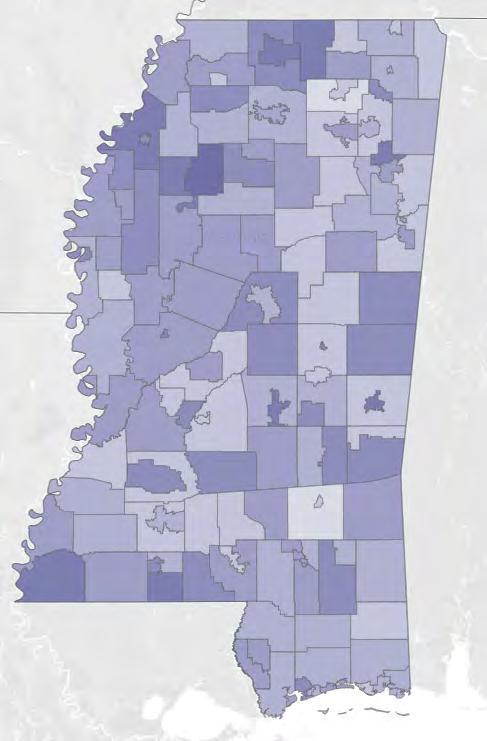

Source: G. Breazeale’s calculations based on data from the Mississippi Department of Education.
Decades of research have shown that teachers are the most important in-school factor influencing student achievement.10 If current patterns of teacher attrition do not improve, the educational progress Mississippi has worked hard to achieve could begin to erode. At Mississippi First, this has raised urgent questions: Why are so many teachers leaving their positions? And what can be done to keep them?
In 2021, we launched the Mississippi Teacher Survey to hear directly from teachers about their experiences, with the goal of identifying policies that could encourage them to remain in the classroom. At the survey’s inception, it was the most comprehensive teacher voice initiative in the state since 2007.11 Findings from this survey, along with a second iteration the following year, helped inform several key policy wins, including the creation and expansion of the Winter-Reed Teacher Loan Repayment Program and the largest teacher pay raise in state history.12, 13
Mississippi First conducted the third iteration of the Mississippi Teacher Survey in February 2025. A total of 988 public school teachers responded, representing the vast majority of the state’s public school districts and public charter schools. Their insights shed light on the stark realities of the teaching profession. Over half of surveyed teachers (54.4%) reported that they are somewhat likely or very likely to leave their current role within the next year to teach in another state, move into a non-teaching role in education, exit education entirely, or teach in another Mississippi district. The percentages of respondents who indicated a likelihood of taking the first three options closely mirrored data from our 2021 and 2022 surveys, indicating a pattern of discontent (the fourth option was new to the 2025 survey). While not all teachers will follow through on these intentions, the responses suggest that a significant share of the state’s teacher workforce is dissatisfied.
10 Jennifer King Rice, Teacher Quality (Economic Policy Institute, 2003), Executive Summary, https://www.epi.org/publication/books_teacher_quality_execsum_intro/
11 Barnett Berry and Ed Fuller, “Final Report on the Mississippi Project CLEAR Voice Teacher Working Conditions Survey,” Center for Teaching Quality, January 31, 2008, https://eric.ed.gov/?id=ED502195.
12 “Teacher Pay Raise A Reality,” Mississippi First, March 25, 2022, https://www.mississippifirst.org/teacher-pay-raise-a-reality/
13 “Winter-Reed Teacher Loan Repayment,” Mississippi Office of Student Financial Aid, accessed on July 1, 2025, https://www.msfinancialaid.org/wrtr/.
Table 5. Teachers’ Intended Career Actions Within the Next Year
Likely to Teach in Another State
Likely to Take Other Education Role
Likely to Teach in Different School District in Mississippi
Likely to Exit Education Entirely 16.6%24.4%22.3%35.9%
Source: Percentage of teachers who responded “Somewhat Likely” or “Very Likely” to the question, “How likely are you to take each of the following actions within the next year?” in 2025 survey.
To better understand intentions, we asked teachers to assess the extent to which various factors influence their professional plans. The figure below illustrates the percentage of teachers who reported that each factor had “some” or “a great deal” of impact on their career plans.
Figure 3. Teachers’ Career Influences
Source: Percentage of teachers who responded “Somewhat Strong” or “Very Strong” to the question, “Whether or not you plan to remain a Mississippi public school teacher, how much of an impact do the following factors have on your career plans?” in 2025 survey.
The results highlight the intersecting pressures that shape teachers’ decisions to stay or leave. In past reports, we have zeroed in on the top factor, compensation, while acknowledging that it is more than just pay that drives teachers out of the classroom.
In this report, we broaden our focus to examine four of the most influential factors shaping teachers’ career decisions: compensation, workload, student behavior, and school leadership.
In Part One, we present updated survey data on teachers’financial situations, making the case that each year without a teacher pay raise is effectively a pay cut.
Parts Two through Four examine research on other key factors influencing teachers’ career decisions: workload, student behavior, and school leadership. These sections draw primarily on external research, as our survey included limited questions on these topics. While future surveys will explore these areas in greater depth, we chose to address them now because they are frequently overlooked in discussions of teacher attrition in Mississippi.
In Part Five, we explore characteristics that appear to be related to teacher attrition, including career stage, district poverty, and local salary supplement size.
We conclude with policy recommendations intended to guide state leaders and district decision-makers toward practical, research-informed solutions that reflect the lived experiences of Mississippi’s educators.

Part One: Compensation
In the 2025 Mississippi Teacher Survey, 93.1% of teachers reported that compensation has a strong impact on their career decisions. In this section, we examine how Mississippi teachers’ salaries have eroded over time and what this has meant for their financial well-being.
insight
The value of a teacher’s salary has declined over the past decade and continues to erode in the absence of regular pay raises.
During the 2021-2022 school year, Mississippi ranked last in the nation for average teacher pay.14 Recognizing the urgency of this issue, state leaders passed the largest teacher pay raise in Mississippi history during the 2022 legislative session, providing an average salary increase of $5,151 per teacher.15
The 2022 pay raise temporarily improved Mississippi’s national ranking in average teacher pay. However, rising inflation quickly eroded those gains. When Mississippi First surveyed teachers at the end of 2022, 92.9% reported that inflation had an impact on their financial well-being, while only 36.2% reported the same about the pay raise.16 In the years since, inflation has remained high.17 As of 2025, Mississippi has once again fallen to 50th in the nation in average teacher pay, largely because other states have taken action to increase teacher pay in the past several years while Mississippi has not.18
Without consistent, meaningful increases, teachers’ salaries lose purchasing power over time. For example, a first-year teacher who entered the profession on a Class A license in 2025 effectively earned less than a first-year teacher on the same license in
14 “Table 211.60,” U.S. Department of Education, National Center for Education Statistics, accessed November 1, 2025, https://nces.ed.gov/programs/digest/d22/tables/dt22_211.60.asp?current=yes
15 Geoff Pender, “Lawmakers pass largest teacher pay raise in Mississippi history,” Mississippi Today, March 22, 2022, https://mississippitoday.org/2022/03/22/lawmakers-pass-largest-teacher-pay-raisein-mississippi-history/
16 Toren Ballard and Grace Breazeale, “Falling Behind: Teacher Compensation and the Race Against Inflation,” Mississippi First, September 1, 2023, https://issuu.com/mississippifirst/docs/teacher-survey-brief_final
17 “12-month percentage change, Consumer Price Index, selected categories,” Bureau of Labor Statistics, accessed on November 1, 2025, https://www.bls.gov/charts/consumer-price-index/consumer-priceindex-by-category-line-chart.htm
18 “Educator Pay in America,” National Education Association, April 29, 2025, https://www.nea.org/resourcelibrary/educator-pay-and-student-spending-how-does-your-state-rank
2024, who in turn earned less than a comparable teacher in 2023. Although the nominal salary was identical in all three years, increases in the cost of living steadily reduced its real value.
Figure 4. Salary of First-Year Teacher Over Time, in 2025 Dollars
While the nominal salary of a first-year teacher has risen over the past decade, inflation has outpaced those increases. As a result, the purchasing power of a first-year teacher’s salary has declined over time.
$50,000
$40,000
$30,000
Base Salary, First-Year Teacher with Class A License (Nominal Dollars)
Base Salary, First-Year Teacher with Class A License (July 2025 Dollars)
Source: G. Breazeale’s calculations based on “FY2025-2026 MSFF Salary Schedule,” Mississippi Department of Education, accessed on September 1, 2025, https://mdek12.org/wp-content/uploads/sites/36/2025/03/Salary-Schedule-for-FY26.pdf; and “CPI Inflation Calculator,” U.S. Bureau of Labor Statistics, accessed on September 1, 2025, https://www.bls.gov/data/inflation_calculator.htm.

“I have a Master’s degree and 14 years of experience. Entry-level jobs at companies like FedEx pay significantly more. With increasing inflation, I debate on leaving education all the time, even though I love what I do.”
–Mississippi Teacher

This problem persists even as teachers move up the salary schedule. While they receive annual step increases as they gain experience, these incremental raises have not kept pace with inflation, resulting in a steady erosion of purchasing power. Teachers may earn more on paper each year they remain in the classroom, but those increases have not translated into greater purchasing power in recent years.
The graph below illustrates this trend for a teacher who began their career in 2022 with a Class A license. Despite moving up the salary schedule, the teacher’s real salary declines each year, leaving them worse off in inflation-adjusted terms.
Figure 5. Decline in the Real Value of a Teacher’s Salary Over Time (Teacher Entering in 2022–2023)
Although a teacher’s nominal salary increases with years of experience, inflation has outpaced these gains in recent years. As a result, a teacher who entered the profession in 2022 has experienced declining purchasing power even while moving up the salary schedule.
$46,000
$45,000
$44,000
$43,000
$42,000
$41,000
$40,000
$39,000
Year 1 (2022-2023)Year 2 (2022-2023)Year 3 (2023-2024)Year 4 (2024-2025)
Base Salary, Teacher with a Class A License (Nominal Dollars)
Base Salary, Teacher with a Class A License (July 2025 Dollars)
Source: G. Breazeale’s calculations based on “FY2025-2026 MSFF Salary Schedule,” Mississippi Department of Education, accessed on September 1, 2025, https://mdek12.org/wp-content/uploads/sites/36/2025/03/Salary-Schedule-for-FY26.pdf; and “CPI Inflation Calculator,” U.S. Bureau of Labor Statistics, accessed on September 1, 2025, https://www.bls.gov/data/inflation_calculator.htm.
insight
A significant proportion of respondents are not financially secure, evidenced by their lack of ability to afford basic necessities, pursuit of second jobs, and self-reported financial status.
The decline in the real value of teacher salaries has direct and serious consequences. Our 2025 survey reveals a stark picture of the financial insecurity facing Mississippi teachers. As in previous years, we asked respondents whether their household income was sufficient to cover four basic necessities: food, housing, transportation, and medical care.
In total, a striking 63.8% of teachers reported that they struggle to afford at least one of these basic necessities, up from 54.1% in our 2022 survey.19 Likewise, the share of teachers reporting difficulty affording each individual necessity has risen since 2022.
6. Teachers with Inadequate Access to Basic Resources
Source: Percentages of teachers responding “Somewhat Disagree” or “Strongly Disagree” to the question, “My household income is sufficient to afford…” in 2022 and 2025 surveys.
19 Toren Ballard and Grace Breazeale, “Eyeing the Exit: Teacher Turnover and What We Can Do About It,” Mississippi First, January 10, 2023, https://issuu.com/mississippifirst/docs/eyeing_the_exit_2023
Table
The Rising Costs of Medical Care for State Employees
Of the four basic needs included in the survey, medical care was most frequently cited as unaffordable. This reflects the growing burden of health insurance costs on Mississippi educators. As we have noted in past reports, the state heavily subsidizes health insurance premiums for employees on individual insurance plans, but premiums for employees on family plans can be prohibitively expensive.20 In 2025, an employee opting to include a spouse and two or more children on their select insurance plan faced a monthly premium of $926, or $11,112 per year.21 This amount is more than a quarter of the current minimum gross salary for a first-year teacher with a Class A license.22

“My spouse and I are both teachers. We currently do not have any children, but want to start a family. However, we already cannot afford to move from our apartment into a better family environment, and I have no idea how we would afford childcare, child-related bills, and all the other necessities for raising a baby, let alone the several children we would like to have. We have decided that one or both of us will have to leave the profession that we both love, just to be able to afford to have a family of our own.”
– Mississippi Teacher
Self-Reported Financial Strain
We asked teachers to characterize their overall financial situation by selecting one of four options: finding it difficult to get by, just getting by, doing okay, or living comfortably. Their responses further underscore the financial strain many educators face. In total, 60.0% reported they were either just getting by or finding it difficult to get by, a sharp increase from 48.4% in 2022.
20 Ballard and Breazeale,“Eyeing the Exit."
21 “State and School Employees’HealthandLifeInsurancePlan, ”MississippiDepartmentofFinanceAdministration,November2024, https://www.dfa.ms.gov/sites/default/files/Insurance%20Home/Publications/Newsletters/KYB%20Newsletter-Nov%202024%20Retiree%20Edition.pdf
22 “FY 2025-2026 MSFF Salary Schedule,”MississippiDepartmentofEducation,accessedJuly1,2025,
https://mdek12.org/wp-content/uploads/sites/36/2025/03/Salary-Schedule-for-FY26.pdf
Table 7. Teachers’ Self-Described Financial Situations
Source: Percentage of teachers selecting each response to the question, “Overall, which one of the following best describes how well you are managing financially these days?” in 2022 and 2025 surveys.
Second Jobs Are the Norm
One of the most direct consequences of inadequate pay is that many teachers are forced to work second jobs to make ends meet. Between 2022 and 2025, the percentage of teachers who reported that they have a second job outside of the school system increased from 35.5% to 41.4%.
Table 8. Percentage of Teachers who Work a Second Job
Source: Percentage of teachers reporting that they receive income from a second job in 2022 and 2025 surveys.
“As of now, I have to work a second job in order to maintain household expenses. In the Mississippi Delta, teacher pay is low, and housing, gas, and food are expensive. “
– Mississippi
Teacher

Mississippi’s teachers are not just underpaid; without regular, meaningful salary increases, they fall further behind financially every year they remain in the classroom. Rising costs and stagnant pay have left many teachers struggling to meet basic living expenses. The state cannot expect to recruit and retain a strong, stable teaching workforce while offering compensation that fails to meet basic living standards.



Part Two: Workload and Workplace Support

In the 2025 Mississippi Teacher Survey, 90.1% of respondents reported that their workload has a strong impact on their career plans. In this section, we explore the breadth of teachers’ responsibilities and the toll this can have on their wellbeing.
insight
Mississippi teachers face unsustainable workloads, reflecting a national trend.
The responsibilities of teachers are expansive and varied. They go far beyond delivering instruction to students. These duties can include, but are not limited to:
Instructional Duties:
Planning lessons; delivering instruction; creating assignments for students; differentiating instruction and assignments for different learning styles and stages; creating formative and summative assessments to monitor student progress; grading and providing feedback on student work and assessments; tracking data; creating anchor charts for walls in classroom; obtaining supplies for lessons; printing and copying assignments.
Classroom Management Duties:
Maintaining communication with parents and guardians; building and maintaining strong relationships with students; creating and managing systems to manage student behavior; implementing disciplinary action when necessary.
Duties Related to Students with Disabilities:
Attending Individualized Education Program (IEP) meetings for students with disabilities23; creating resources to ensure compliance with students’ IEPs; completing Multi-Tiered System of Supports (MTSS) paperwork24; completing Behavior Improvement Plan (BIP) paperwork.25
Professional Duties:
Par ticipating in professional growth opportunities to maintain licensure;
23 Students with identified special needs have IEPs, which lay out the supports and services that they need to thrive in school.
24 The MTSS process is a policy adopted by the Board of Education to ensure that all students’ academic and behavioral needs are met. It involves using focused supplemental instruction (Tier II) and intensive interventions (Tier III) for students who need extra support.
25 Students who exhibit challenging behaviors have BIPs, which lay out strategies to improve their behaviors.
participating in school and district committees; participating in Professional Learning Communities (PLCs) during planning and before and after school.26
Extracurricular Duties:
Working at after-school sports events; sponsoring student clubs.
Operational Duties:
Monitoring students during lunch, arrival, and dismissal; decorating classroom; cleaning classroom.

“There’s
a lack of planning time, huge amounts of paperwork (Tier ll and Tier lll paperwork, data tracking, forms, etc.), lesson plans, and things required on walls (standards posted, ‘I can’ statements, directions to centers with pictures, etc.). The list goes on and on.”
– Mississippi Teacher
Given these numerous responsibilities, teachers receive few, if any, breaks during the school day. Times that might otherwise serve as breaks are often spent supervising students. Many teachers are required to arrive early to monitor student arrival, escort students to lunch and eat while supervising them, and remain with students during dismissal until all have left campus. Even during designated planning periods, teachers are frequently pulled into professional development sessions, administrative meetings, or conferences with parents.

“We are contracted for an 8-hour workday, but I frequently pull a 50+ hour work week. The general public just says you signed up for that. The students’ needs keep me in the classroom, but it is getting harder to stay every year.”
– Mississippi Teacher
The unsustainability of teachers’ workloads in Mississippi reflects a broader national trend. A 2024 survey from the Pew Research Center found that a large majority of U.S. teachers lack sufficient time during the workday to complete essential tasks such as grading, lesson planning, and responding to emails, with 84% reporting that their workload exceeds the hours available.27 Teachers cited being assigned excessive work, including non-instructional duties, supporting students outside of class time, and covering for absent colleagues. Additionally, 70% reported that their schools are understaffed.
26 Professional Learning Communities include groups of teachers who work together to improve their practice. They are typically organized at the school level.
27 Luona Lin, Kim Parker, and Juliana Menasce Horowitz, “How Teachers Manage Their Workload,” Pew Research Center, April 4, 2024, https://www.pewresearch.org/social-trends/2024/04/04/how-teachers-manage-their-workload/
insight
Educators’ heavy workloads undermine their well-being and drive burnout.
A growing body of research underscores the consequences of educators’heavy workloads. A study published in June 2025 surveyed teachers across the United States and examined the increasing dehumanization of the teaching profession, highlighting how unsustainable working conditions harm teachers’mentalandphysicalwell-being. 28 The study also explored how public discourse often disrespects and undervalues the complexity and expertise required to teach, and how this can lead to unrealistic demands on educators with limited support. A significant portion of teachers in the study reported experiencing health issues linked to job-related stress. Though they entered the profession to help others, many educators are being actively harmed by the work. The study concluded that addressing teacher shortages will require not only more material resources, but also respect for teachers’time,energy, and professional knowledge.

“It is difficult to take time off work because it only sets you further behind. This increases an already overwhelming workload that cannot be realistically completed within a typical workday. Every day that I have missed this year was due to having a sick child. Teachers need more support to ensure that they do not have to put their families behind their job.”
– Mississippi Teacher
Similar research has found that the accumulation of responsibilities without corresponding time to complete them negatively affects teachers’health, well-being, and retention. One analysis described this phenomenon as“time poverty,”emphasizing its systemic nature, and concluded that efforts to improve teacher retention or instructional quality will fall short without interventions grounded in a clear understanding of teachers’workloads.29 Put simply, reducing teachers’workloadisessentialtoimprovingretention.
28 Betina Hsieh, Alejandra Priede, and Gaelle Mounioloux, “The Great Resignation in Teaching: Illuminating an Ongoing ‘Crisis’ in Teacher Dehumanization,” Teachers and Teaching (June 2025): 1–17, doi:10.1080/13540602.2025.2526634.
29 Sue Creagh, Greg Thompson, Nicole Mockler, Meghan Stacey, and Anna Hogan, “Workload, Work Intensification and Time Poverty for Teachers and School Leaders: A Systematic Research Synthesis,” Educational Review 77, no. 2 (April 2023): 661–80, doi:10.1080/00131911.2023.2196607.
insight
Workload pressures are more acute for teachers in high-poverty schools.
According to data from the Pew Research Center, staffing shortages are especially common in high-poverty schools. These shortages force existing staff to absorb additional duties, such as covering classes during planning periods, managing behavioral issues without adequate support, or taking on administrative tasks.30 A working paper from the American Educational Research Association underscores this idea, finding that teachers in high-poverty schools are more likely to work longer hours and manage larger class sizes compared to teachers in low-poverty schools.31
In addition to these issues, the instructional challenges in high-poverty schools are typically more complex. An analysis by the Learning Policy Institute found that teachers in these schools report lower levels of parental involvement, higher rates of student absenteeism, and larger numbers of students who arrive “unprepared to learn.”32 Each of these factors increases the time and effort required for teachers to support student learning and classroom management effectively.33
Research makes clear that the teachers’ workload demands are unsustainable, particularly in high-poverty schools. Time constraints, compounded by expectations to assume non-instructional responsibilities, contribute substantially to burnout and can undermine teachers’ willingness to remain in the classroom long term.

30 Lin, Parker, and Horowitz, “How Teachers Manage Their Workload.” https://www.pewresearch.org/social-trends/2024/04/04/how-teachers-manage-their-workload/
31 Motoko Akiba, Soo-yong Byun, Xiaonan Jiang, Kyeongwon Kim, and Alex J. Moran, “Do Teachers Feel Valued in Society? Occupational Value of the Teaching Profession in OECD Countries,” AERA Open 9 (2023), https://www.aera.net/Newsroom/AERA23-Study-Snapshot-Disparities-in-Teachers-Working-Conditions-Qualification-Gap-and-Poverty-BasedAchievement-Gap-in-38-Countries
32 “Unprepared to learn” is phrasing from the survey given to teachers. It is not further defined in the data.
33 Emma García and Elaine Weiss, “Challenging working environments (‘school climates’), especially in high-poverty schools, play a role in the teacher shortage,” Economic Policy Institute, May 30, 2019, https://www.epi.org/publication/school-climate-challenges-affect-teachers-morale-more-so-in-high-poverty-schools-the-fourth-report-in-theperfect-storm-in-the-teacher-labor-market-series/




Part Three: Student Behavior

In our 2025 survey, 88.2% of teachers reported that student behavior impacts their career plans. In this section, we explore the effects of student behavior on teacher well-being.
insight
Student behavior plays a critical role in shaping teachers’ daily experiences and can significantly contribute to burnout.
Teachers spend most of their day engaging directly with students and are responsible for maintaining a learning environment that supports academic growth. This becomes more challenging when students display disruptive behaviors. Even a small number of student disruptions can affect the overall classroom dynamic: teachers are forced to redirect their attention toward behavior management, compromising the academic progress of the entire class.

“I do not feel like I am able to teach adequately due to disruptive student behavior inside of the classroom.”
– Mississippi Teacher
When student behavior is consistently disruptive, it creates an environment that can feel unsafe and unsupportive for educators, undermining their morale and willingness to stay in the profession. A substantial body of research indicates that this challenge is not unique to Mississippi. In RAND’s State of the American Teacher survey, administered annually to educators nationwide, teachers have consistently ranked student behavior among their top three job-related stressors. 34
34 Sy Doan et al., “State of the American Teacher and State of the American Principal Surveys: 2022 Technical Documentation and Survey Results,” RAND, June 15, 2022, https://www.rand.org/pubs/research_reports/ RRA1108-3.html; Sy Doan, Elizabeth Steiner, and Ashley Woo, “State of the American Teacher Survey: 2023 Technical Documentation and Survey Results,“ RAND, June 21, 2023, https://www.rand.org/pubs/ research_reports/RRA1108-7.html; Sy Doan et al., “State of the American Teacher Survey: 2024 Technical Documentation and Survey Results,” RAND, June 18, 2024, https://www.rand.org/pubs/research_reports/ RRA1108-11.html
Student behavior and school climate are therefore strong predictors of teacher retention.35 Teachers are far more likely to remain in schools where behavioral expectations are clear, support systems are in place, and they are not left to manage challenging student behavior on their own. In contrast, schools with higher rates of disciplinary incidents tend to experience greater teacher turnover.36 This dynamic can become self-reinforcing: higher turnover is associated with increased office referrals and suspensions, which in turn contribute to additional turnover.37
Teachers in our survey cited not only escalating student behavior but also a lack of consistent school- and district-level discipline policies as reasons they feel unsupported. Their responses indicate that they often feel unfairly blamed or not adequately supported in managing classroom disruptions. Without support from school leadership, teachers’effectivenessinmanagingstudents’ behaviorhitsaceiling. Teachers are not asking for punitive approaches; they are asking for consistent expectations, follow-through, and support in maintaining a safe and respectful learning environment.
insight
Schools continue to grapple with the long-term effec ts of the COVID-19 pandemic on student behavior.
In the aftermath of the COVID-19 pandemic, teachers across the country reported sharp increases in student misbehavior. During the 2021–2022 school year, schools surveyed by the U.S. Department of Education reported higher rates of misconduct, rowdiness, disrespect toward teachers and peers, and frequent violations of rules related to electronic device use 38 In the same survey, 87% of public schools reported that the pandemic negatively affected students’ social-emotional development, and 84% reported negative impacts on students’ behavioral development. 39 Experts have attributed these trends, in part, to prolonged periods of social isolation, which weakened students’ social-emotional skills and their ability to meet classroom expectations. 40
These challenges persisted in subsequent school years. In a nationally representative 2023 study, 80% of teachers reported that student behavior had worsened following the pandemic. 41 Similarly, a 2025 Education Week survey found that 72% of educators believed student behavior was worse than it had been in fall 2019 42
The severity of these challenges is evident not only in increased classroom disruptions, but in the escalation of harmful behaviors. According to 2023 data from the Pew Research Center, 68% of teachers reported experiencing verbal abuse from students and 40% reported being physically assaulted, with nearly one in ten teachers reported experiencing physical assaults multiple times per
35 Barnett Berry, Kevin C. Bastian, Linda Darling-Hammond, and Tara Kini, “The Importance of Teaching and Learning Conditions,” Learning Policy Institute, January 2021, https://learningpolicyinstitute.org/sites/default/files/produc t-files/Leandro_Teacher_Working_Conditions_BRIEF.pdf
36 Alexander Bentz, “Do Student Behavior Issues Impact Teacher Retention?: Evidence from Administrative Data on Student Offenses,” Department of Economics, University of Colorado Boulder, October 30, 2023, https://www.alexanderhbentz.com/papers/bentz_discipline_live.pdf
37 https://www.journals.uchicago.edu/doi/abs/10.1086/737522?journalCode=aje
38 “More than 80 Percent of U.S. Public Schools Report Pandemic Has Negatively Impacted Student Behavior and Socio-Emotional Development,” U.S. Department of Education, National Center for Education Statistics, July 6, 2022, https://nces.ed.gov/whatsnew/press_releases/07_06_2022.asp
39 “More than 80 Percent of U.S. Public Schools,” U.S. Department of Education, National Center for Education Statistics.
40 Oscar Macias, “Navigating Post-Pandemic Student Behavior: Strategies for Teachers and School Administrators,” Association of California School Administrators, August 26, 2024, https://content.acsa.org/navigating-post-pandemic-student-behavior-strategies-for-teachers-and-school-administrators/
41 Brian Jacob, “The Lasting Effects of the COVID-19 Pandemic on K-12 Schooling: Evidence from a Nationally Representative Teacher Survey,” Annenberg Institute for School Reform at Brown University, August 2024, https://eric.ed.gov/?id=ED660202
42 Caitlynn Peetz Stephens, “Is Student Behavior Getting Any Better? What a New Survey Says,” Education Week, January 8, 2025, https://www.edweek.org/leadership/is-studentbehavior-getting-any-better-what-a-new-sur vey-says/2025/01
month. These trends underscore the intensity of behavioral challenges that educators face and the serious implications for their safety and well-being.

“Teachers are blamed for bad classroom management when students disrupt the classroom. Students have no consequences because they need to be in the classroom for instruction. Teachers are verbally and physically abused on a daily basis.”
– Mississippi Teacher
insight
Student behavior challenges tend to be more prevalent in high-poverty schools.
Students living in poverty are more likely to be exposed to instability, trauma, and chronic stress.44 This can manifest in school through both aggressive behaviors (e.g., talking back to teachers, using inappropriate body language, or showing defiance) and passive behaviors (e.g., withdrawal, slouching, or disengagement from academic tasks).45
It follows that student behavior and school climate tend to be worse in higher-poverty schools than in lower-poverty ones. A 2024 Pew Research study found that 64% of teachers in high-poverty schools rated student behavior as “fair” or “poor,” compared to just 37% of teachers in low-poverty schools.46 Additional findings from the Economic Policy Institute (EPI) illustrate the disparities between school climates in high- and low-poverty settings.47
According to the EPI, teachers in high-poverty schools are:
Twice as likely to report student apathy as a serious issue;
Ten percentage points more likely to report being threatened by a student; and
Five percentage points more likely to report being physically attacked by a student.
The schools where behavior challenges are most severe are also the ones that are most in need of qualified, committed teachers. Yet these schools are often where teachers feel the most unsafe, unsupported, and overwhelmed, leading to high turnover and staffing shortages.
43 Luona Lin, Kim Parker, and Juliana Menasce Horowitz, “Challenges in the Classroom,” Pew Research Center, April 4, 2024, https://www.pewresearch.org/social-trends/ 2024/04/04/challenges-in-the-classroom/
44 Lucine Francis, Kelli DePriest, Marcella Wilson, and Deborah Gross, “Child Poverty, Toxic Stress, and Social Determinants of Health: Screening and Care Coordination,” Online Journal of Issues in Nursing 13 (2018): 2, https://pmc.ncbi.nlm.nih.gov/articles/PMC6699621/
45 Mengying Li, Sara B. Johnson, Rashelle J. Musci, and Anne W. Riley, “Perceived neighborhood quality, family processes, and trajectories of child and adolescent externalizing behaviors in the United States,” Social Science & Medicine 192 (2017): 152-161, https://www.sciencedirect.com/science/article/abs/pii/S0277953617304604
46 Luona Lin, Kim Parker, and Juliana Menasce Horowitz, “Problems students are facing at public K-12 schools,” Pew Research Center, April 4, 2024, https://www.pewresearch.org/ social-trends/2024/04/04/problems-students-are-facing-at-public-k-12-schools/
47 García and Weiss, “Challenging working environments.”
This creates a cycle in which disruptive behavior drives teachers out, creating instability and more work for those who are left, leading to more teacher attrition and a worse learning environment for students.

“Our students are allowed to do as they please with very little consequences. At the high school level, this is very difficult to deal with. I will teach a maximum of five more years.”
– Mississippi Teacher


Part Four: School and District Leadership
In our 2025 survey, 86.5% of teachers reported that school and district leadership impacts their career decisions. In this section, we explore how leaders can shape teachers’ experiences.
insight
School and district leaders play a significant role in teacher satisfaction and retention.
As teachers’ supervisors, school leaders can influence numerous aspects of the job, including class schedules, collaboration time, extracurricular expectations, and discipline policies. Leaders who are out of touch with teachers’ needs can make their jobs more challenging and amplify the challenges we have outlined throughout this report.

“We all feel incredibly micromanaged and have nowhere to turn to. Teachers have no power.”
– Mississippi Teacher
For instance, a leader who fails to enforce behavior standards can undermine a teacher’s ability to enforce a consequence ladder, and a leader who regularly assigns last-minute tasks to teachers can cause an already-unmanageable workload to feel impossible.48 In contrast, principals who advocate for their staff and promote a culture of mutual respect can relieve pressure and foster a more enjoyable and productive working environment.
Research supports the idea that principals can have a significant impact on teachers. Panel data from North Carolina indicate that more effective principals create better working conditions by providing more time during the school day to complete work, greater access to resources, and more meaningful professional development.49 Consistent with these findings, schools with higher-rated principals, based on teacher feedback, tend to experience lower teacher turnover.50
Leadership stability also matters. When principals remain in their roles over multiple years, they have the time and influence to cultivate a positive school culture, build trust with teachers, and implement consistent policies that support effective teaching. Research shows that principal retention improves teacher retention.51 Conversely, frequent leadership changes can disrupt routines, undermine morale, and erode teachers’confidence that their challenges will be addressed. Just as strong, supportive leaders can buffer against the everyday stresses of teaching, inconsistent or transient leadership can exacerbate them, leaving teachers feeling unsupported and isolated. Ensuring both effective and stable leadership is therefore a critical lever for improving teacher satisfaction and fostering professional growth.

“Instead of allowing educators to use their expertise and experience to teach effectively, we are buried under constant assessments and changing expectations that do not benefit student learning.”
– Mississippi Teacher
In our survey, teachers expressed frustration not only with building-level leadership, but also with district-level directives they view as disconnected from classroom realities. District leaders shape the policies, priorities, and expectations that guide school leaders and ultimately affect teachers. When district initiatives are misaligned with school-level needs, they can compound teachers’ frustration.
48 “The Role of Principals in Addressing Teacher Shortages,” Learning Policy Institute, February 27, 2017, https://learningpolicyinstitute.org/product/role-principalsaddressing-teacher-shortages-brief
49 Susan Burkhauser, “How much do school principals matter when it comes to teacher working conditions?” Educational Evaluation and Policy Analysis 39, no. 1 (2017): 126-145, https://www.researchgate.net/publication/308182081_How_Much_Do_School_Principals_Matter_When_It_Comes_to_Teacher_Working_Conditions
50 Jason A. Grissom, Anna J. Egalite, and Constance A. Lindsay, “How principals affect students and schools,” Wallace Foundation 2, no. 1 (2021): 30-41, https://wallacefoundation.org/sites/default/files/2023-09/How-Principals-Affect-Students-and-Schools.pdf
51 Stephanie Levin and Kathryn Bradley, “Understanding and Addressing Principal Turnover: A Review of the Research,” Learning Policy Institute, March 19, 2019, https://learningpolicyinstitute.org/product/nassp-understanding-addressing-principal-turnover-review-research-report
“I feel that there are too many initiatives and directives that do not allow classroom educators to properly identify and correct student shortfalls within the classroom. It seems that everyone has a plan that they think would work great for every educator, but forget that we are not in a mass-production industry. “
– Mississippi Teacher

High-poverty schools tend to have more turnover among school leaders.
Principal quality and stability have an outsized impact on teacher retention in high-poverty schools.52 Yet, these schools are more likely to have less experienced principals and higher rates of leadership turnover. 53 A 2022 study by Mississippi First found that Mississippi schools receiving Title I funding, an indicator of student poverty, experience higher principal turnover than their counterparts that do not receive Title I funding.54 This finding is consistent with national research, which shows that schools with high percentages of low-income students are most likely to experience leadership instability.55 In these environments, teachers face greater student needs and behavioral challenges while also coping with leadership churn and shifting expectations.
52 Levin and Bradley, “Understanding and Addressing Principal Turnover.”
53 Ibid.
54 Grace Breazeale, “The Leadership Shuffle: Exploring Turnover in Mississippi’s Principal Workforce,” Mississippi First, November 11, 2022, https://w ww.mississippifirst.org/leadership-shuffle/
55 Levin and Bradley, “Understanding and Addressing Principal Turnover.”

Part Five: Who is Most at Risk of Leaving?

The challenges we have outlined in this report–compensation, workload, student behavior, and school leadership–are pushing Mississippi teachers toward the exit. But not all educators experience these challenges to the same extent, nor are all educators equally likely to consider leaving.
In this section, we disaggregate our survey data to identify several policy-relevant characteristics that are associated with a heightened risk of attrition.
insight
Teachers in the early stages of their careers are more likely than their peers to consider leaving their current role.
Among the survey respondents who have not yet reached the threshold for full retirement benefits, novice teachers (0-5 years of experience) were the most likely to consider moving to another district within Mississippi or leaving the state to teach. Early career teachers (6-11 years of experience) were the most likely to consider leaving the profession entirely or taking another role in education.
This trend is troubling. Novice teachers and early-career teachers represent long-term instructional capacity. Early-career teachers, in particular, have made it through the steep learning curve of the profession. Losing them represents not only an immediate workforce challenge but a long-term loss of institutional knowledge and expertise.

Figure 8. Likelihood of Taking Another Education
Figure 7. Likelihood of Teaching in Another State, by Career Stage.
Source: Percentage of teachers who responded “Somewhat Likely” or “Very Likely” to the question, “How likely are you to move to another state to teach within the next year?” in 2025 survey.
Figure 9. Likelihood of Exiting Profession Altogether, by Career Stage.
Source: Percentage of teachers who responded “Somewhat Likely” or “Very Likely” to the question, “How likely are you to take another role in education within the next year?” in 2025 survey.
Source: Percentage of teachers who responded “Somewhat Likely” or “Very Likely” to the question, “How likely are you to exit the profession entirely within the next year?” in 2025 survey.
insight
Teachers earning less than $3,000 in local salary supplements are significantly more likely
to consider moving districts.
Local salary supplements, which are funded at the district level, represent one of the most immediate levers available to improve teacher compensation. However, these supplements vary widely across Mississippi school districts, ranging from $0 to $8,700 for first-year teachers holding a Class A license. Districts with stronger local tax bases are generally able to offer larger supplements on top of the state-mandated base salary.
Our data indicate that local salary supplements may play a meaningful role in teacher retention. Compared to teachers who received more than $3,000 in local supplements, those receiving less than $3,000 were nearly twice as likely to report considering a move to another Mississippi school district. As shown in Figure 10, lower supplements appear to be associated with an increased likelihood that teachers will seek higher-paying roles elsewhere within the state.
Sources: Percentage of teachers who responded “Somewhat Likely” or “Very Likely” to the question, “How likely are you to take each of the following actions within the next year?” in 2025 survey; salary supplement data obtained from the Mississippi Department of Education.
Notably, the share of teachers who reported considering teaching in another state, transitioning into another role within education, or leaving the profession entirely was similar across supplement levels. The pattern suggests that while supplements may influence where teachers choose to work within the state, they are less likely on their own to determine whether teachers remain in the profession.
This finding underscores a significant takeaway of this report: compensation matters, but it is not sufficient on its own to address teacher attrition. Other factors, such as workload, student behavior, and school leadership, also play roles in shaping teachers’career decisions, and meaningful retention efforts must address these factors alongside pay.
Figure 10. Percentage of Teachers who Reported Plans to Leave the Classroom, by District Salary Supplement
insight
Teachers in high-poverty districts are more likely than their counterparts in other districts to consider every form of exit from their current classroom: teaching in another state, moving to another Mississippi school district to teach, taking another role in education, or exiting education entirely.
Our survey results show a clear relationship between school district poverty and teacher attrition risk. To measure school district poverty, we used each district’s Identified Student Percentage (ISP) from the 2024-2025 school year. “Identified students” are those enrolled in means-tested programs such as SNAP, Temporary Assistance for Needy Families (TANF), or the Food Distribution Program on Indian Reservations (FDPIR), as well as students identified as homeless, migrant, or runaway. A district’s ISP is calculated by dividing the number of identified students by the total number of students enrolled in the district.
Teachers working in districts with higher ISPs were more likely to report considering every type of career move included in the survey: transferring to another Mississippi district, leaving the state to teach elsewhere, taking a non-classroom role within education, or exiting the profession entirely.
11. Percentage of Teachers who Reported Plans to Leave the Classroom, by District Identified Student Percentage
Sources: Percentage of teachers who responded “Somewhat Likely” or “Very Likely” to the question, “How likely are you to take each of the following actions within the next year?” in 2025 survey; ISP data obtained from the Mississippi Department of Education.
Figure
These self-reported intentions are corroborated by actual attrition data from the Mississippi Department of Education. Following the 2023–2024 school year, districts with higher ISPs experienced higher rates of teacher attrition. According to our analysis, each percentage point increase in a district’s ISP was associated with a 0.22 percentage point increase in its teacher attrition rate.
Our findings mirror national data that we presented earlier in this report. Schools serving students with higher needs often present more complex working conditions, including behavioral challenges, fewer resources, and higher accountability pressures. All of these factors can increase teacher stress and burnout, pushing them to exit the classroom.
Because student poverty and local salary supplement size are often related and may jointly influence teacher attrition, we conducted an additional analysis examining how attrition risk varied by Identified Student Percentage (ISP) across school districts with different supplement levels. We compared districts offering local salary supplements below $3,000 with those offering supplements of $3,000 or more.
In both groups of school districts, the patterns described earlier in this section mostly persisted. Among teachers working in districts with salary supplements below $3,000, those in higher-poverty districts were more likely to report considering every form of exit included in the survey: moving to another Mississippi district, leaving the state to teach elsewhere, transitioning into another role in education, or exiting education entirely. As ISP increased, so did teachers’reportedlikelihoodofleaving,regardlessofthedestination.
Among teachers receiving larger local salary supplements, higher district poverty was also associated with elevated attrition risk, with one notable exception. While teachers in high-poverty districts with supplements of $3,000 or more were more likely than their peers in lower-poverty districts to consider moving to another Mississippi district, taking another role within education, or leaving education entirely, they were not more likely to consider leaving the state to teach elsewhere. This pattern suggests that stronger local financial incentives may help reduce the likelihood that teachers in high-poverty districts seek opportunities outside Mississippi, even if they do not fully offset other pressures associated with student poverty.
Figure 12. Percentage of Teachers who Reported Plans to Leave the Classroom, by Identified Student
Percentage: Districts with Salary Supplement
Below $3,000
Figure 13. Percentage of Teachers who Reported Plans to Leave the Classroom, by Identified Student
Percentage: Districts with Salary Supplement of $3,000 or Above.
Sources: Percentage of teachers who responded “Somewhat Likely” or “Very Likely” to the question, “How likely are you to take each of the following actions within the next year?” in 2025 survey; ISP data and salary supplement data obtained from the Mississippi Department of Education.
Sources: Percentage of teachers who responded “Somewhat Likely” or “Very Likely” to the question, “How likely are you to take each of the following actions within the next year?” in 2025 survey; ISP data and salary supplement data obtained from the Mississippi Department of Education.
Actual attrition data from the Mississippi Department of Education following the 2023–2024 school year further illuminate the relationship between student poverty and teacher turnover, controlling for local salary supplement size.
Across districts with both lower and higher local salary supplements, higher student poverty is associated with higher teacher attrition. However, the relationship is notably stronger in districts offering supplements below $3,000. In these districts, each one-percentagepoint increase in Identified Student Percentage (ISP) is associated with a 0.25-percentage-point increase in teacher attrition. By contrast, in districts offering supplements of $3,000 or more, a one-percentage-point increase in ISP is associated with a 0.10-percentage-point increase in attrition.
While these findings do not establish a causal relationship, they suggest that local salary supplements may help buffer the effects of student poverty on teacher attrition. Higher supplements appear to moderate (though not eliminate) the increased turnover risk associated with serving higher-poverty student populations, underscoring the importance of compensation as part of a broader, multifaceted retention strategy.

Part Six: Policy Recommendations
Meaningfully improving teacher retention will require a coordinated effort across all levels of the public education system. This section outlines four overarching goals and offers corresponding recommendations for the Mississippi Legislature, the Mississippi Department of Education, and local school districts.
To develop these recommendations, we drew on findings from our analyses and reviewed existing research on effective teacher retention strategies to ensure alignment with evidence-based best practices. We also consulted with colleagues in the education policy and advocacy space to gain additional perspectives. Finally, we convened a group of public school educators to review and respond to a draft of this section, ensuring that the recommendations reflect the day-to-day realities of classrooms and schools. Their feedback helped sharpen the specificity, feasibility, and relevance of each recommendation. Together, these steps ensured that the recommendations in this section are both data-driven and grounded in the lived experiences of Mississippi educators.
goal 1:
Increase Teacher Compensation to Make the Profession Financially Sustainable
Low pay remains one of the most powerful drivers of teacher attrition in Mississippi. Too many educators struggle to support themselves and their families on current salaries. Addressing this challenge will require leaders to both raise overall compensation and think more strategically about how excellence is rewarded. Across-the-board increases are essential to making teaching a viable profession, but they should be paired with models that allow highly effective educators to earn meaningfully higher pay in recognition of the impact they deliver. By lifting both the floor and the ceiling of teacher pay, Mississippi can retain its strongest teachers and strengthen the profession over the long term.
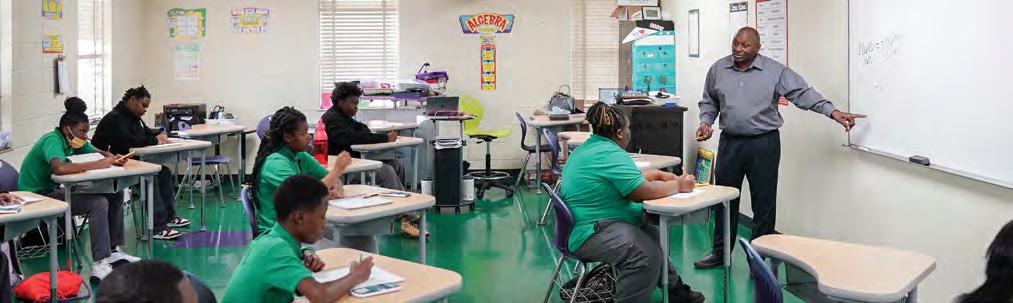
Recommendations for the Mississippi State Legislature
1. Provide an Across-the-Board Increase to Mississippi’s Teacher Salary Schedule
The legislature should provide an across-the-board increase to the statewide base salary schedule for teachers, which is the most straightforward way to improve teacher pay. This would bring Mississippi’s teacher salaries closer in line with current regional figures.
For a teacher’s salary in 2026 to have the same purchasing power it had in 2022, base pay would need to increase by approximately 12.8 percent, or about $5,500 for a first-year teacher holding a Class A license.56
Figure 14. Minimum Base Salary for Teacher with Bachelor’s Degree (2026-2027)
Note: The graph reflects projected minimum base salaries for teachers in the 2026-2027 school year as of December 2025. These could change if any of the states in the graph pass a teacher pay raise in 2026. Source: Data obtained from State Departments of Education; G. Breazeale calculation of Mississippi teacher salary with recommended pay raise.
G. Breazeale calculations, assuming a 2026 inflation rate of 2.5%.
Alabama Arkansas Tennessee
MIssissippi (without recommended pay raise)
MIssissippi (with recommended pay raise)
How much would it cost to increase the teacher salary schedule by 12.8 percent?
Based on our calculations, increasing Mississippi’s state teacher salary schedule by 12.8 percent would cost approximately $267.9 million. A detailed explanation of the methodology used to arrive at this estimate is provided in Appendix A.
It is important to consider how a salary increase would interact with the Mississippi Student Funding Formula (MSFF), the state’s primary mechanism for financing public education. The MSFF is built around a base student cost, which is then supplemented with weighted funding to account for students with additional needs.
The base student cost is recalculated every four years using a statutory formula that includes four components, three of which are directly tied to the average teacher salary. As a result, changes to the teacher salary schedule have a significant impact on overall MSFF funding levels.
We estimate that a 12.8 percent increase in the teacher salary schedule would result in an additional $276 million in MSFF base student cost funding flowing to school districts (see Appendix A for calculation). This figure does not include the additional increase in weighted funds, which would also rise because they are calculated as a function of the base student cost.
Notably, the projected increase in MSFF funding exceeds the estimated cost of implementing the salary increase at the district level. While this report does not attempt to assess or modify the MSFF, this finding suggests that policymakers may wish to revisit how the base student cost is calculated to ensure it accurately reflects districts’actualcosts.
2. Pilot a School Staffing Redesign Program
The Legislature should establish a multi-year pilot program that offers competitive grants to support districts in implementing staffing redesign models that expand the reach and impact of highly effective teachers. Traditional staffing structures often fail to fully leverage top educators’ expertise or provide meaningful career pathways, contributing to teacher turnover. High-quality redesign models create leadership roles in which excellent teachers continue classroom instruction while coaching colleagues, earning substantial salary supplements for their expanded impact.57
North Carolina launched a pilot grant program in 2016, the Advanced Teaching Roles (ATR) Program, to support districts in implementing such models. Consecutive evaluations on the program have found that ATR has a statistically significant positive impact on students’ test scores, and data has also shown that students in ATR schools are more likely to meet or exceed expected student growth than comparable schools not implementing ATR.58, 59 In addition to impacting student achievement, ATR can improve teacher satisfaction: in a 2023 program evaluation, 90% of teachers in leadership roles reported that this role contributed to their
57 “Reimagining the Teaching Role,” National Council on Teacher Quality, accessed on November 1, 2025, https://reimagineteaching.nctq.org/
58 Aaron Arenas et al., “Advanced Teaching Roles: Evaluation Report,” The William and Ida Friday Institute for Educational Innovation, October 2023, https://fi.ncsu.edu/wp-content/ uploads/sites/175/2023/09/ATR-Evaluation-Report-2023-Final.pdf; Sarah Bausell, Shaun Kellogg, and Emily Thrasher, “Advanced Teaching Roles: Annual Evaluation Report,” The William and Ida Friday Institute for Educational Innovation, November 2024,https://fi.ncsu.edu/wp-content/uploads/sites/49/2024/11/ATR-Evaluation-Report-2024-FINAL.pdf; Sergio Osnaya-Prieto, “Advanced Teaching Roles program shows improved test scores, but faces funding concerns,” EdNC, October 7, 2025, https://www.ednc.org/10-07-2025advanced-teaching-roles-program-shows-improved-test-scores-but-faces-funding-concerns/
59 “Advanced Teaching Roles in North Carolina,” BEST NC, accessed on November 1, 2025, https://bestnc.org/advancedroles/
intentions to stay in the teaching profession.60 The positive outcomes of this program led the North Carolina Legislature to make the program permanent in 2020, and it continues to receive an annual budget allocation.
A Mississippi pilot, like the one North Carolina implemented in 2016, would provide districts with the resources to implement these types of models. At the conclusion of the pilot, an evaluation of student outcomes and teacher retention could guide decisions on continuing the program.
Information on the Opportunity Culture® initiative, which is the most widely used redesign model for districts receiving ATR grants in North Carolina, can be found on page 52.
Recommendations for School and District Leaders
1. Boost Local Salary Supplements and Commit to Regular Increases
School districts that do not offer local salary supplements or that offer low local salary supplements should prioritize increasing these supplements. Our survey data suggests that this salary supplement size may be associated with teachers’decision to move school districts within Mississippi, as teachers with lower salary supplements appear to be more likely to move districts. More research is needed to determine the approximate size of salary supplement at which movement between districts begins to decrease, but our data indicate that there may be a meaningful difference in movement from districts that offer a supplement under $3,000 versus those that offer a supplement over $3,000. Looking forward to the future, Mississippi school districts should also consider creating a policy that ties increases in their local salary supplements to inflation. Making regular adjustments to their salary supplements would preserve the value of these salary supplements over time. In many districts, salary supplements have not increased since at least 2001, despite the inflation that has occurred since this time.61
2. Adopt Paid Parental Leave Policies
School districts are not required to provide paid parental leave to their employees. During the 2025 state legislative session, the Mississippi Legislature passed a law that allows eligible state employees to receive six weeks of paid parental leave following the birth or adoption of a child. However, this benefit does not extend to school district employees. The law states that school districts “are authorized to adopt a policy…to provide for paid parental leave,”but stops short of requiring them to do so.62 School districts should consider adopting a paid parental leave policy that mirrors the state law. Doing so would demonstrate districts’commitment to providing an environment that is supportive of working parents.
3. Provide Retention Incentives
Data from the 2025 Mississippi Teacher Survey showed that a significant proportion of teachers have considered switching school districts within the state. This churn does not reduce the overall supply of teachers, but it does deepen inequities by concentrating shortages in districts that already face recruitment and retention challenges. High-turnover districts often lose experienced educators to neighboring systems that offer higher salaries, stronger support structures, or more attractive working conditions, creating a cycle in which the schools most in need of stability are least able to attain it.
60 Arenas et al., “Advanced Teaching Roles: Evaluation Report.”
61 “Supplements To Teacher Pay Ranked By County,” WLOX, June 25, 2001, https://www.wlox.com/story/380751/supplements-to-teacher-pay-ranked-by-county/
62 H.B. 1063, 2025 Reg. Session (MS 2025), https://billstatus.ls.state.ms.us/documents/2025/pdf/HB/1000-1099/HB1063SG.pdf
To address this issue, districts with persistent retention challenges should consider offering targeted retention incentives to teachers who remain in the district for multiple consecutive years. These incentives would not only reward commitment but also signal the district’s investment in teachers’long-termsuccess.Ratherthanprovidingone-timerecruitmentbonusesthatattract teachers only temporarily, multi-year retention incentives encourage educators to build a career in their current district, deepen their relationships with students and families, and grow professionally in the communities they serve.
Districts could adapt this approach by offering incentives based on areas of critical need, such as hard-to-staff schools or subjects.
4. Proactively Explore School Staffing Redesign Models
Districts should actively explore how school staffing redesign could strengthen teacher retention and improve student outcomes. This includes assessing readiness, identifying priority schools, and learning from districts that have already implemented similar models.
Exploring these models now will position districts to respond quickly if the Legislature establishes a competitive grant pilot. If state funding does not become available, districts could pursue philanthropic partnerships or other external resources to support the transition to staffing redesign models.
Recommendations for the Mississippi Department of Education (MDE)
1. Support School Districts in Transitioning to School Staffing Redesign Models
The Mississippi Department of Education (MDE) can advance school staffing redesign by sharing clear guidance with school districts on the design and benefits of these models. This could include highlighting case studies from districts that have successfully implemented staffing redesign and helping to identify philanthropic partners to support transition costs.
If the Legislature were to establish a statewide school staffing redesign pilot, MDE would likely be responsible for administering the competitive grant program. This would include issuing a request for proposals, selecting technical assistance providers, matching them with participating districts, providing guidance throughout planning and implementation, and ensuring participation in an external evaluation.
2. Include Local Salary Supplement Data in Annual Teacher Salary Report
The Mississippi Department of Education should include school district salary supplement data in its annual statewide teacher salary report. Currently, the statewide report provides valuable information about base salaries, but it does not reflect the full compensation landscape that teachers consider when evaluating job opportunities.
Integrating supplement data into the statewide salary report could also encourage districts to evaluate their compensation structures more strategically. When salary supplements are visible and comparable statewide, districts that offer limited or outdated stipends may feel greater pressure to increase or reconfigure them in order to remain competitive in recruiting and retaining educators.
Beyond supporting teachers’ decision-making, publishing supplement data would equip policymakers with a fuller picture of statewide compensation patterns.
What is the Opportunity Culture Initiative?
The Opportunity Culture® initiative, developed by the North Carolina-based organization Public Impact, is a staffing redesign model that provides a pathway for high-performing teachers and their teams to expand their impact and increase their pay without leaving the classroom.63
While the specifications of the model vary based on district context, a cornerstone of the design is the Multi-Classroom Leader® (MCL) educator, who both instructs students and leads a small team of teachers.64 These teacher-leaders are selected through a competitive interview process and must have a demonstrated record of improving student achievement. While continuing to teach part of the time, MCL educators coach and support teams of two to eight teachers. Through this leadership role, they help strengthen teachers’ instructional skills, deepen content knowledge, and build overall professional capacity. Team leaders are accountable for the academic outcomes of all students taught by their teams. Nationally, MCL roles receive pay supplements averaging more than 20% of typical pay, funded through school budget reallocations.65
MCL teams often include additional roles to help extend the reach of excellent teaching. One is the Team Reach Teacher™ (TRT) role, who directly teaches a larger number of students than a typical classroom teacher. This is typically done in collaboration with a paraprofessional to ensure instructional group sizes remain manageable. In recognition of their expanded responsibilities, they receive pay supplements. In the Master Team Reach Teacher™ role, educators reach more students as well as assist with team leadership. Reach Associate™ advanced paraprofessionals support the team, with a focus on providing small-group tutoring, for more pay.
Teaching teams may also include paid teacher residents, who are either new teachers or university students in the final year of their degree programs. Residents support instruction by tutoring small groups of students, planning and delivering differentiated lessons, and receiving regular feedback and coaching from the team leader and other teachers.
To fund Opportunity Culture roles, school design teams may use strategies such as redirecting flexible funds (such as Title I and Title II), transitioning some non-classroom instructional specialists back into teaching roles, or using funds from unfilled teaching positions.
Independent research has demonstrated the positive impact of Opportunity Culture models on student achievement.66 A 2018 study of schools in North Carolina and New York found that the model significantly improved students’ performance. A 2021 evaluation of Texas schools reported “positive, immediate academic gains,” particularly among at-risk students and those with limited English proficiency.67 More recently, North Carolina’s 2024–2025 accountability data showed that schools implementing Opportunity Culture designs were two to three times more likely to exceed student growth targets than schools not using the model.68
During the 2024-2025 school year, more than 1,000 schools across the country implemented or committed to an Opportunity Culture design.69
63 “The Opportunity Culture® Strategy,” Opportunity Culture, accessed September 1, 2025, https://www.opportunityculture.org/the-strategy/
64 “Opportunity Culture® Educator Roles,” Opportunity Culture, accessed September 1, 2025, https://www.opportunityculture.org/opportunity-culture-educator-roles/
65 “Opportunity Culture: Lessons Learned,” Comprehensive Center Network, October 2020, https://region6cc.uncg.edu/wp-content/uploads/2020/10/OpportunityCultureLessonsLearned_RC6_20_008.pdf
66 Ben Backes and Michael Hansen, “Reaching Further and Learning More? Evaluating Public Impact’s” Opportunity Culture” Initiative,” National Center for Analysis of Longitudinal Data in Education Research, January 2018, https://caldercenter.org/publications/reaching-further-and-learning-more-evaluating-public-impacts-opportunity-culture
67 Jessie Garcia, Alexander W. Wiseman, Jacob Kirksey, and Jessica Gottlieb, “Opportunity Culture Update and Program Evaluation,” September 14, 2021, https://meetings.boardbook.org/Documents/WebViewer/1406?file=85d90391-a392-499f-b02c-e4460df99831
68 “Accountability Data Sets and Reports,” North Carolina Department of Public Instruction, accessed on November 1, 2025, https://www.dpi.nc.gov/districts-schools/ accountability-and-testing/school-accountability-and-reporting/accountability-data-sets-and-reports#2024-25Reports-4468
69 “Opportunity Culture Dashboard,” Opportunity Culture, accessed November 1, 2025, https://www.opportunityculture.org/dashboard/
Make Teacher Workloads More Manageable by Providing Adequate Time, Staffing, and Resources
The vast majority of teachers in our survey reported that their workload has a strong impact on their career decisions. In Mississippi, many teachers are expected to take on duties far beyond instruction: covering classes during planning periods, supervising lunch, handling administrative tasks, and more. These expectations can be especially overwhelming for newer teachers and those working in understaffed schools. To improve retention and job satisfaction, leaders must focus on giving teachers the time and resources they need to do their jobs effectively and sustainably.
Recommendations for the Mississippi State Legislature
1. Guarantee Time for Duty-Free
Lunch
Teachers in our survey noted that they have too much to do and too little time. As we described earlier in the report, this can often lead to teachers not having access to common-sense breaks, such as lunch breaks. The State Legislature can demonstrate their dedication to making the teaching profession more sustainable through protecting teachers’ right to a duty-free lunch.
The state can look to Texas for a model. Under Texas law, every classroom teacher and full-time librarian is entitled to at least a 30 minute lunch period that is free from any responsibilities related to the supervision of students.70 Districts can use flexible or rotating schedules to make this possible, or they may use non-teaching staff or community volunteers to supervise students during lunch.
2. Increase Pay for Assistant Teachers
Assistant teachers play an important role in supporting classroom instruction, but the state’s current minimum salary of $17,000 makes it difficult to attract and retain these educators. Like teachers, assistant teachers have not received a raise since 2022, despite high inflation cutting into the value of their salary.71 Increasing their pay is essential to strengthening the assistant teacher pipeline and ensuring that teachers have the support they need to help students succeed. Raising their minimum salary by approximately $4,600 would bring their minimum hourly wage from $11.80 to $15.00 and acknowledge their important roles
Recommendations for School and District Leaders
1. Audit and Eliminate Unnecessary Duties
District and school leaders should regularly audit teacher workloads to identify and eliminate nonessential tasks that take time away from instruction, planning, and collaboration. These audits should include a systematic review of assigned responsibilities, as well as direct input from teachers about which tasks they believe fall outside the core scope of their role or provide limited value to student learning.
Once these tasks are identified, leaders should take concrete steps to reduce the burden on teachers by eliminating unnecessary requirements, streamlining processes, or reassigning responsibilities to other staff where appropriate. By intentionally protecting teachers’ time, districts can help reduce burnout, improve job satisfaction, and allow educators to focus on the work that has the greatest impact on students.
70 “Duty-Free Lunch,” Texas Classroom Teachers Association, accessed November 1, 2025, https://tsta.org/sites/default/files/Duty-FreeLunch.pdf
71 H.B. 530, 2022 Reg. Session (MS 2022), https://billstatus.ls.state.ms.us/2022/pdf/history/HB/HB0530.xml
2. Adopt Aligned High Quality Instructional Materials (HQIM) and Ensure Teachers Are Trained to Use HQIM Teachers spend a significant amount of their time figuring out what content they need to teach, determining the most effective way to teach and scaffold this content to meet students at their levels, and creating instructional materials for their lessons. The adoption of High-Quality Instructional Materials can reduce the amount of time and work this requires. In recent years, the Mississippi Department of Education has pushed for districts to adopt High-Quality Instructional Materials, which it defines as materials that:
Are aligned with the Mississippi College- and Career-Readiness Standards;
Are externally validated;
Are comprehensive; and
Include knowledge-building complex texts, problems, and assessments.72
The state rigorously evaluates curricula and materials using a comprehensive rubric and provides lists of state-adopted materials based on this evaluation process. This effort has proven successful: as of August 2025, the majority of Mississippi school districts are using HQIM.73 We commend the MDE for this accomplishment, and we encourage adoption in school districts where it has not occurred.
Adoption alone, however, is not sufficient. Districts should ensure that teachers receive high-quality training and ongoing support to implement HQIM effectively. Additionally, we encourage districts to meaningfully involve teachers in selecting instructional materials from the list of state-approved options. Teachers bring critical insight into their students’ needs and classroom contexts, and their input can help ensure that selected materials are both effective and practical to implement. Engaging teachers in this process can increase buy-in, improve instructional coherence, and further reduce unnecessary workload.
Recommendations for the Mississippi Department of Education (MDE)
At this time, we do not have specific recommendations related to this goal for the Mississippi Department of Education.
goal 3:
Strengthen Student Behavior Supports So Teachers Feel Equipped and Empowered to Manage Classrooms Effectively
Student behavior challenges are a significant source of teacher frustration, burnout, and attrition, particularly in schools serving the highest-need student populations. While many behavior issues stem from deep-rooted causes that extend beyond the classroom, schools still need effective, responsive systems in place to support both students and educators.
Recommendations for the Mississippi State Legislature
At this time, we do not have specific recommendations related to this goal for the Mississippi Legislature.
72 “Definitions,” Mississippi Instructional Materials Matter, accessed on July 1, 2025, https://msinstructionalmaterials.org/resources/definitions/
73 “HQIM Heat Maps,” Mississippi Instructional Materials Matter, accessed on July 1, 2025, https://msinstructionalmaterials.org/resources/hqim-heat-map/
Recommendations for School and District Leaders
1. Implement Clear and Consistent
Behavior Policies
Schools and districts must establish clear, fair, and consistently enforced behavior policies. In the absence of these, teachers are left to manage discipline without the authority and support they need. Leaders should work with teachers to develop schoolwide behavior systems that prioritize student learning while ensuring teachers have the backing of administration when managing disruptions.
2. Promote access to high-quality professional development on behavior management
District and school leaders should explore professional development opportunities that help teachers manage student behavior more effectively. This training should be hands-on, relevant, and tailored to the needs of different grade levels and school contexts. Topics could include trauma-informed practices, restorative approaches, culturally responsive classroom management, and strategies for working with students with behavioral or emotional needs.
Recommendations for the Mississippi Department of Education (MDE)
At this time, we do not have specific recommendations related to this goal for the Mississippi Department of Education.
goal 4:
Build and Retain Strong, Stable Leadership in Every District and School
Leadership is one of the most powerful levers for improving school culture, teacher retention, and student outcomes. Principals set the tone for instruction, support teacher growth, manage operations, and shape how educators experience their work. Yet across Mississippi, too many schools experience frequent leadership turnover or lack access to well-prepared school leaders.
Recommendations for the Mississippi State Legislature
At this time, we do not have specific recommendations related to this goal for the Mississippi Legislature.
Recommendations for School and District Leaders
1. Implement 360-Degree Feedback
Systems for
Principals
and Use to Drive Professional Development
School districts should adopt 360-degree feedback systems that allow district staff, teachers, and school staff to provide confidential input on school leadership. This data can give principals insight into how their leadership is experienced by others and can direct their professional development. Feedback systems also help build trust and transparency, giving teachers a voice in shaping school culture while reinforcing accountability at all levels.
2. Prioritize High- Quality Professional Development for Principals
Districts should use results from the 360-degree feedback systems described above, along with input from school leaders themselves, to inform the professional development that they provide to school leaders. Districts can seek out aligned professional development for leaders based on common themes that emerge through the feedback systems and conversations with school leaders.
Recommendations for the Mississippi Department of Education (MDE)
1. Survey Principals to Identify Needs and Barriers
The Mississippi Department of Education should conduct regular surveys of school leaders to understand the challenges they face and the support they need. Topics could include workload, staffing, access to professional development, autonomy, and burnout. These insights would allow the state to design more responsive policies and target resources where they are most needed, particularly in districts with high turnover or persistent staffing challenges.
2. Establish a Statewide Task Force on School Leadership Development and Retention
The Mississippi Department of Education should convene a statewide task force that focuses on school leadership, tasked with evaluating Mississippi’s current systems for recruiting, preparing, supporting, and retaining school and district leaders. The task force could bring together stakeholders, including principals, district superintendents, teachers, university preparation programs, and representatives from the Mississippi Department of Education, to provide recommendations for improving leadership pipelines and reducing principal turnover. This body could be tasked with:
Reviewing principal preparation program quality and alignment with job demands;
Examining barriers to retaining effective principals; and
Recommending improvements to evaluation and professional development systems.
Through drawing on perspectives of multiple stakeholders, the task force could help shape a more coherent, statewide strategy for building and sustaining strong leadership across Mississippi’s schools.
Table 9. Summary of Recommendations
The chart below includes a summary of the goals and recommendations that we have presented above.
goal one
Increase teacher compensation to make the profession financially sustainable.
Provide an across-the-board increase to Mississippi’s teacher salary schedule
Pilot a school staffing redesign program
Boost local salary supplements and commit to regular increases
Adopt paid parental leave policies
Provide retention incentives
Proactively explore school staffing redesign models
Suppor t school districts in transitioning to school staffing redesign models
Include local salar y supplement data in annual teacher salary report
goal two
Make teacher workloads more manageable by providing adequate time, staffing, and resources.
Guarantee time for duty-free lunch
Increase pay for assistant teachers
Audit and eliminate unnecessary duties
Adopt aligned high- quality instructional materials (HQIM) and ensure teachers are trained to use HQIM
goal three
Strengthen student behavior supports so teachers feel equipped and empowered to manage classrooms effectively.
Implement clear and consistent behavior policies
Promote access to high-quality professional development on behavior management
goal four
Build and retain strong, stable leadership in every school.
Implement 360-degree feedback systems for principals and use to drive professional development
Prioritize high-quality professional development for principals
Sur vey principals to identify needs and barriers
Establish a statewide task force on school leadership development and retention

Conclusion
Public education in Mississippi is at a crossroads, and the teacher pipeline is a significant determinant of the system’s future. This report has highlighted how challenges related to compensation, workload, student behavior, and school leadership are driving teachers to leave the profession. These issues are interconnected, creating a cycle of strain that undermines educators and the students they serve.
No single policy can solve these issues on its own. However, by adopting a multifaceted strategy that prioritizes fair compensation, manageable workloads, behavioral supports, and resources for school leaders, Mississippi can create conditions that enable teachers to thrive. The investments made today in supporting teachers and leaders will have an impact in future years on the strength of the state’s public education system.
Mississippi’s educators deserve a work environment that respects their expertise, supports their well-being, and acknowledges their significant role in setting students up for success. With targeted and sustained actions, state leaders can send a message to teachers about the important role they play in building a strong future for Mississippi’s children.

Appendix A: Estimated Cost of Teacher Pay Raise
A.1 Estimated Cost of 12.8% Increase in Teacher Salary Schedule
In the 2024–2025 school year, Mississippi public schools employed approximately 30,814 teachers.74 The average teacher salary that year was approximately $52,848, inclusive of local salary supplements. The average supplement was no less than $2,680.75 Subtracting this supplement yields an estimated average state-funded salary of $50,168.
A 12.8% increase to the minimum salary schedule would therefore result in an average salary increase of $6,421. Applying this increase statewide yields an estimated cost of $197,872,224 in additional salary expenditures. Accounting for associated fringe benefits adds an estimated $70,046,767, bringing the total estimated cost of the salary increase to $267,918,991. 76
These estimates assume a uniform application of the increase across all teachers and do not account for potential variation by experience level, district supplementation practices, or changes in staffing levels.
A.2 Impact of 12.8% Teacher Salary Increase on Base Student Cost Calculation
Under current law, the Mississippi Student Funding Formula (MSFF) base student cost is recalculated every four years using a formula with four components77:
1. Instructional: Mississippi’s average teacher salary divided by the statewide average number of students per teacher.
2. Administrative: 20% of the Instructional component.
3. Ancillary: 30% of the Instructional component.
4. Operations and Maintenance: A three-year average cost per 100,000 square feet.
For FY25, the base student cost was $6,695. In the three intervening years between recalculations, statute requires the base student cost to be adjusted by multiplying 25% of the prior year’s base student cost by the 20-year average annual inflation rate, plus any additional adjustments tied to new state requirements.
For the purposes of this estimate, we hold constant the FY25 average number of students per teacher statewide and the FY25 Operations and Maintenance component, and we exclude the statutory inflation adjustment. Under these assumptions, an average teacher salary increase of $6,554 would result in a recalculated base student cost of $7,329, representing an increase of $634 over the FY25 base student cost.
Applying this increase to Mississippi’s public school enrollment of 435,259 students in the 2024–2025 school year yields an estimated $275,954,206 increase in MSFF base student cost funding to school districts. This figure excludes additional increases that would occur through weighted student funding, which is calculated as a multiple of the base student cost and would therefore rise proportionally.
Per statute, the next full recalculation of the base student cost would occur prior to the 2028–2029 school year.
74 Data obtained from the Mississippi Department of Education.
75 Calculations based on data obtained from the Mississippi Department of Education.
76 We make an assumption that fringe benefits are equal to 35.4% of a public teacher’s salary, per a June 2025 analysis from the Bureau of Labor Statistics.
77 “Mississippi Student Funding Formula,” The Parents’ Campaign, accessed on September 1, 2025, https://tpcref.org/mississippi-student-funding-formula/
Limitations
These estimates are intended to illustrate order-of-magnitude fiscal impacts and rely on several simplifying assumptions. Calculations assume a uniform, statewide application of the salary increase and hold constant the number of teachers, average class sizes, district supplementation practices, and facilities costs. The analysis does not account for behavioral or secondary effects, including potential changes in teacher retention, recruitment, staffing composition, or local salary decisions. Additionally, the base student cost estimate excludes the statutory inflation adjustment and assumes no changes to student enrollment or weighting factors. As a result, actual costs will likely differ from these estimates.
I.
Appendix B: Full 2025 Teacher Survey
Education and Teaching Experience
For all respondents:
1. Are you currently employed as a full-time public school teacher for the 2024-2025 school year? 1. Yes 2. No [End survey]
2. In what district are you currently employed as a full-time teacher for the 2024-2025 school year?
[Open-ended response]
3. How many years of experience as a full-time teacher do you have, not including the 2024-2025 school year?
[Drop-down menu of numbers 0-35+]
4. What grade(s) are you teaching for the 2024-2025 school year?
[Select all that apply]
1. Prekindergarten Yes (1) / No (2)
2. Kindergarten Yes (1) / No (2)
3. 1st Yes (1) / No (2)
4. 2nd Yes (1) / No (2)
5. 3rd Yes (1) / No (2)
6. 4th
7. 5th
8. 6th
9. 7th
10. 8th
11. 9th
12. 10th
13. 11th
14. 12th
(1) / No (2)
(1) / No (2)
(1) / No (2)
(1) / No (2)
(1) / No (2)
(1) / No (2)
(1) / No (2)
(1) / No (2)
(1) / No (2)
5. What subject(s) are you teaching for the 2024-2025 school year?
[Select all that apply]
1. Elementary Education
2. Special Education
3. Arts and Music
4. English and Language Art
5. English as a Second Language
(1) / No (2)
(1) / No (2)
(1) / No (2)
(1) / No (2)
(1) / No (2)
6. Foreign Languages Yes (1) / No (2)
7. Health Education Yes (1) / No (2)
8. Mathematics and Computer Science Yes (1) / No (2)
9. Natural Sciences Yes (1) / No (2)
10. Social Sciences Yes (1) / No (2)
11. Career or Technical Education Yes (1) / No (2)
12. Other (please specify): Yes (1) / No (2)
II. Student Debt
For all respondents:
6. At any point throughout your education, did you take out any type of student loans or receive additional types of financial aid to help pay for your undergraduate and/or graduate education?
[Select all that apply]
1. Subsidized or unsubsidized student loans from the federal government Yes (1) / No (2) / DN (3)
2. Student loans from a private loan provider Yes (1) / No (2) / DN (3)
3. Scholarship, grant aid, or forgivable loan Yes (1) / No (2) / DN (3)
4. Other (please specify): Yes (1) / No (2) / DN (3)
5. No for all
6. Don’t know for all
[SHOW Q6a IF Q6 < 3]
6a. Do you still owe all, some, or none of the amount that you borrowed?
1. All
2. Some
3. None
4. Don’t know
6b. How much do you currently owe in student loans?
1. Less than $10,000
2. $10,000 to under $15,000
3. $15,000 to under $20,000
4. $20,000 to under $25,000
5. $25,000 to under $30,000
6. $30,000 to under $35,000
7. $35,000 to under $50,000
[SHOW Q6b IF Q6a < 3]
[SKIP TO Section III. Financial Well-Being]
[SKIP TO Section III. Financial Well-Being]
[SKIP TO Section III. Financial Well-Being]
8. $50,000 to under $75,000
9. $75,000 to under $100,000
10. $100,000 to under $150,000
11. $150,000 to under $200,000
12. $200,000 or more
13. Don’t know
III. Financial Well-Being
For all respondents:
Prompt: The following questions are about the standard of living you can afford when including income from yourself and any additional working adults in your household. Considering your overall household income from all sources, please indicate your level of agreement with the following statements:
7. My household income is sufficient to provide adequate food (i.e., consistent access to nutritionally adequate and safe food for all members of my household).
1. Strongly disagree
2. Disagree
3. Neither disagree nor agree
4. Agree
5. Strongly agree
8. My household income is sufficient to afford adequate transportation (i.e., the ability to reliably transport all members of my household to and from work, school, and other necessary destinations).
1. Strongly disagree
2. Disagree
3. Neither disagree nor agree
4. Agree
5. Strongly agree
9. My household income is sufficient to afford adequate housing (i.e., a house or apartment with reliable electricity and water for all members of my household).
1. Strongly disagree
2. Disagree
3. Neither disagree nor agree
4. Agree
5. Strongly agree
10. My household income is sufficient to afford adequate medical care (e.g., health insurance premiums and deductibles, plus necessary healthcare costs not covered by insurance, for all members of my household).
1. Strongly disagree
2. Disagree
3. Neither disagree nor agree
4. Agree
5. Strongly agree
11. My household income is sufficient to afford adequate child care (i.e., a safe and reliable day-care center, babysitter, or other provider).
1. Strongly disagree
2. Disagree
3. Neither disagree nor agree
4. Agree
5. Strongly agree
6. Not applicable to me
[SHOW Q12 IF Q6a < 3]
12. My household income is sufficient to afford monthly student loan payments.
1. Strongly disagree
2. Disagree
3. Neither disagree nor agree
4. Agree
5. Strongly agree
6. Not applicable to me
13. Have you set aside emergency or rainy day funds that would cover your expenses for 3 months in case of sickness, job loss, economic downturn, or other emergencies?
1. Yes
2. No
3. Don’t know
14. Suppose that you have an emergency expense that costs $400. Based on your current financial situation, how would you pay for this expense?
1. Put it on my credit card and pay it off in full at the next statement
2. Put it on my credit card and pay it off over time
3. With money currently in my checking/savings account or with cash
4. Using money from a bank loan or line of credit
5. By borrowing from a friend or family member
6. Using a payday loan, deposit advance, or overdraft
7. Sell something
8. I wouldn’t be able to pay for the expense right now
9. Don’t know
15. Overall, which one of the following best describes how well you are managing financially these days?
1. Living comfortably
2. Doing okay
3. Just getting by
4. Finding it difficult to get by
5. Don’t know
IV. Attrition and Career Plans
For all respondents:
Prompt: The following questions are about your career plans going forward. As of now, how likely are you to take the following actions?
16. Spend the rest of your career as a classroom teacher in Mississippi.
17. Leave your 2024-2025 position within the next year to teach in a different school district in Mississippi.
18. Leave your 2024-2025 position within the next year to teach in another state.
19. Leave your 2024-2025 position within the next year to take a different type of education role (e.g., principal, guidance counselor, etc.).
20. Leave your 2024-2025 position within the next year to exit the profession entirely.
Prompt: Whether or not you plan to remain a Mississippi public school teacher, how much of an impact do the following factors have on your career plans?
21. Teacher compensation
22. School or district leadership
23. Student loan debt
24. Respec t for the profession from parents and families
25. Respec t for the profession from the general public
26. Respec t for the profession from politicians
27. Respec t from students/student behavior
28. Workplace support and resources
29. Workload of the profession
30. Flexibility of work schedule
31. Are there any factors, other than the ones in the previous question, that have an impact on your career plans for the next year?
1. Yes
2. No
3. Don’t know
[SHOW Q31a IF Q31 = 1]
31a. Please list any additional fac tors that have an impact on your career plans.
V. Public Opinion
For all respondents: Mississippi has been facing a shortage of teachers in recent years. The Mississippi Department of Education has classified two-thirds of Mississippi school districts as critical shortage areas, meaning that these districts struggle to attract qualified teachers.
The following questions are about your opinions on what can be done to increase the supply of teachers. How much of an impact do you think the following legislative actions would have on combating Mississippi’s critical teacher shortage?
32. Offering a $2,000 stipend to teachers employed in school districts that are classified as Critical Shortage Areas.
33. Lowering health insurance premiums for teachers with a spouse and/or children on their state health insurance plan.
34. Providing an across-the-board raise of $5,000 to all teachers.
35. Creating opportunities for effective teachers to assume additional leadership responsibilities (such as coaching less experienced teachers) in return for additional compensation.
The Mississippi Public Employees Retirement System, or PERS, currently provides teachers with a “defined benefit” pension, meaning that, in return for a 9% employee contribution from each paycheck, teachers will receive guaranteed lifetime income upon retirement that includes an annual cost-of-living adjustment (known to some as the “13th check”). However, due to financial concerns about the retirement system, both PERS and the state legislature have considered changing the benefits offered to new teachers.
The following questions are about your opinions on the future of the Mississippi Public Employees Retirement System. What impact do you think the following actions would have on the recruitment and retention of effective teachers in Mississippi?
36. Reduce teachers’ retirement contributions from 9% to 7% (saving the average teacher about $1,000 annually), but also no longer guarantee a cost-of-living adjustment (13th check) for their pension to protect against inflation each year.
37. Replace the “defined benefit” pension that guarantees lifetime income with a “defined contribution” pension that allows teachers to independently invest retirement contributions but does not guarantee lifetime income.
38. Continuing to offer a “defined benefit” pension that guarantees lifetime income with a cost-ofliving adjustment (13th check), even if the state or school districts must pay more to fund these benefits.
Data from the National Center for Education Statistics indicate that a large proportion of schools across the country have observed increases in student misbehavior in recent years, including classroom disruptions, rowdiness outside of the classroom, and disrespect towards teachers and staff members.
The following questions are about your attitudes on strategies to manage student behavior. What impact do you think the following actions would have on student behavior?
39. Increasing the amount of social-emotional learning in the classroom.
40. Pairing new teachers with mentor teachers who can provide coaching in effective classroom management.
41. Enforcing stricter consequences for students who misbehave.
42. Increasing the use of restorative practices, which are an alternative to traditional disciplinary policies. This approach is intended to help students reflect on their behavior and make amends when needed. For example, a student in trouble for bullying may be asked to write a research paper on the harms of this behavior and apologize to the affected students, rather than being put in detention or suspended.
43. Establishing stronger relationships between parents/guardians and the school in order to ensure a parent/guardian is fully informed about their child’s behavior.
VI. Demographic Questions
44. Do you consider yourself Hispanic or Latinx?
Yes
No
Don’t know
Prefer not to say
What is your race?
White
Black/African American
American Indian or Alaskan Native
Asian or Pacific Islander
Other (please specify):
Prefer not to say 46. With what gender do you identify?
Man
Woman
Non-binary
Transgender
Other (please specify):
Don’t know
Prefer not to say
47. Do you hold any of the following degrees?
[Selec t all that apply]
1. Associate’s degree
2. Bachelor ’s degree
3. Master ’s degree
4.
(1) / No (2) / DN (3) / RF (4)
(1) / No (2) / DN (3) / RF (4)
7. Prefer not to say
48. Are you currently pursuing any of the following degrees?
[Selec t all that apply]
1.
4. Other (please specify):
(1) / No (2) / DN (3) / RF (4)
(1) / No (2) / DN (3) / RF (4)
5. Prefer not to say Yes (1) / No (2) / DN (3) / RF (4)
[SHOW Q48a IF Q47=3 OR Q47=4 OR Q47=5 OR Q48=1 OR Q48=2 OR Q48=3]
48a. What was (or is) your motivation for pursuing an advanced degree?
[Selec t all that apply]
1. Higher pay Yes (1) / No (2) / DN (3) / RF (4)
2. Abilit y to pursue a different role in education (e.g., administrator or instructional coach). Yes (1) / No (2) / DN (3) / RF (4)
3. Abilit y to pursue a role in a field other than education. Yes (1) / No (2) / DN (3) / RF (4)
4. Increasing my effectiveness as a classroom teacher. Yes (1) / No (2) / DN (3) / RF (4)
6. Other (please specify): Yes (1) / No (2) / DN (3) / RF (4)
7. Prefer not to say Yes (1) / No (2) / DN (3) / RF (4)
49. In addition to your base salary during the 2024-2025 school year, do you (or will you) earn income from any the following other sources in the school system?
[Selec t all that apply]
1. Local supplement Yes (1) / No (2) / DN (3) / RF (4)
2. Stipend for National Board for Professional Teaching Standards (NBPTS) certification Yes (1) / No (2) / DN (3) / RF (4)
3. School Recognition Program or another form of merit pay
4. Extracurricular activities such as a coaching or leading a student club
5. Mentoring teachers or students
6. Teaching evening classes
7. Other (please specify):
8. Prefer not to say
(1) / No (2) / DN (3) / RF (4)
(1) / No (2) / DN (3) / RF (4)
(1) / No (2) / DN (3) / RF (4)
(1) / No (2) / DN (3) / RF (4)
(1) / No (2) / DN (3) / RF (4)
(1) / No (2) / DN (3) / RF (4)
50. During the 2024-2025 school year, do you (or will you) earn income from working in any job outside the school system?
1. Yes
2. No
3. Don’t know
4. Prefer not to say
51. In the past 12 months, have you or any members of your household received any of the following? [Select all that apply]
1. Earned Income Tax Credit (EITC)
2. Supplemental Nutrition Assistance Program(also known as SNAP or food stamps)
3. Women, Infants, and Children (WIC) nutrition program benefits
4. Housing assistance from government program
5. Free or reduced price school lunches
6. Don’t know
7. Prefer not to say
52 How many children under 18 live in your household? [0-20 drop-down menu with 19 = “Don’t Know” and 20 = “Prefer not to say”]
53. Aside from yourself, how many adults 18 or older live in your household? [0-20 drop-down menu with 19 = “Don’t Know” and 20 = “Prefer not to say”]
[SHOW Q53a IF Q53 > 1 AND Q53 < 19]
/
/
/
53a. Of these adults 18 or older, how many would you consider a dependent (i.e., they do not contribute financially to the household)? [Insert drop-down menu of numbers]
Bibliography

“Advanced Teaching Roles in North Carolina.” BEST NC. Accessed on November 1, 2025. https://bestnc.org/advancedroles/
Akiba, Motoko, Soo-yong Byun, Xiaonan Jiang, Kyeongwon Kim, and Alex J. Moran. “Do Teachers Feel Valued in Society? Occupational Value of the Teaching Profession in OECD Countries.” AERA Open 9 (2023). https://www.aera.net/Newsroom/AERA23-StudySnapshot-Disparities-in-Teachers-Working-Conditions-Qualification-Gap-and-Poverty-Based-Achievement-Gap-in-38-Countries
Arenas, Aaron et al. “Advanced Teaching Roles: Evaluation Report.” The William and Ida Friday Institute for Educational Innovation. October 2023. https://fi.ncsu.edu/wp-content/uploads/sites/175/2023/09/ATR-Evaluation-Report-2023-Final.pdf
Backes, Ben, and Michael Hansen. “Reaching Further and Learning More? Evaluating Public Impact’s” Opportunity Culture” Initiative.” National Center for Analysis of Longitudinal Data in Education Research. January 2018. https://caldercenter.org/publications/ reaching-further-and-learning-more-evaluating-public-impacts-opportunity-culture
Ballard, Toren, and Grace Breazeale. “Eyeing the Exit: Teacher Turnover and What We Can Do About It.” Mississippi First. January 10, 2023. https://issuu.com/mississippifirst/docs/eyeing_the_exit_2023
Ballard, Toren and Grace Breazeale. “Falling Behind: Teacher Compensation and the Race Against Inflation.” Mississippi First. September 1, 2023. https://issuu.com/mississippifirst/docs/teacher-survey-brief_final
Bausell, Sarah, Shaun Kellogg, and Emily Thrasher. “Advanced Teaching Roles: Annual Evaluation Report.” The William and Ida Friday Institute for Educational Innovation. November 2024. https://fi.ncsu.edu/wp-content/uploads/sites/49/2024/11/ATR-EvaluationReport-2024-FINAL.pdf
Bentz, Alexander. “Do Student Behavior Issues Impact Teacher Retention?: Evidence from Administrative Data on Student Offenses.” Department of Economics, University of Colorado Boulder. October 30, 2023. https://www.alexanderhbentz.com/papers/bentz_ discipline_live.pdf
Berry, Barnett and Ed Fuller. “Final Report on the Mississippi Project CLEAR Voice Teacher Working Conditions Survey.” Center for Teaching Quality. January 31, 2008. https://eric.ed.gov/?id=ED502195.
Berry, Barnett, Kevin C. Bastian, Linda Darling-Hammond, and Tara Kini. “The Importance of Teaching and Learning Conditions.” Learning Policy Institute. January 2021. https://learningpolicyinstitute.org/sites/default/files/product-files/Leandro_Teacher_Working_ Conditions_BRIEF.pdf
Breazeale, Grace. “The Leadership Shuffle: Exploring Turnover in Mississippi’s Principal Workforce.” Mississippi First. November 11, 2022. https://www.mississippifirst.org/leadership-shuffle/
Bureau of Labor Statistics. “12-month percentage change, Consumer Price Index, selected categories.” Accessed on November 1, 2025. https://www.bls.gov/charts/consumer-price-index/consumer-price-index-by-category-line-chart.htm
Burkhauser, Susan. “How much do school principals matter when it comes to teacher working conditions?.” Educational Evaluation and Policy Analysis 39, no. 1 (2017): 126-145. https://www.researchgate.net/publication/308182081_How_Much_Do_School_ Principals_Matter_When_It_Comes_to_Teacher_Working_Conditions
Carver-Thomas, Desiree, and Linda Darling-Hammond. “The Trouble With Teacher Turnover: How Teacher Attrition Affects Students and Schools.” Education Policy Analysis Archives 27 (2019): 36. https://doi.org/10.14507/epaa.27.3699.
Chingos, Matthew, and Kristin Blagg. “States’ Demographically Adjusted Performance on the 2024 National Assessment of Educational Progress” Urban Institute. January 29, 2025. https://www.urban.org/research/publication/states-demographically-adjustedperformance-2024-national-assessment
Comprehensive Center Network. “Opportunity Culture: Lessons Learned.” October 2020.
Creagh, Sue, Greg Thompson, Nicole Mockler, Meghan Stacey, and Anna Hogan. “Workload, Work Intensification and Time Poverty for Teachers and School Leaders: A Systematic Research Synthesis.” Educational Review 77, no. 2 (April 2023): 661–80. doi:10.1080/0013 1911.2023.2196607.
Doan, Sy, Elizabeth Steiner, and Ashley Woo. “State of the American Teacher Survey: 2023 Technical Documentation and Survey Results.“ RAND. June 21, 2023. https://www.rand.org/pubs/research_reports/RRA1108-7.html
Doan, Sy et al. “State of the American Teacher and State of the American Principal Surveys: 2022 Technical Documentation and Survey Results.” RAND. June 15, 2022. https://www.rand.org/pubs/research_reports/RRA1108-3.html.
Doan, Sy et al. “State of the American Teacher Survey: 2024 Technical Documentation and Survey Results.” RAND. June 18, 2024. https://www.rand.org/pubs/research_reports/RRA1108-11.html
García, Emma, and Elaine Weiss. “Challenging working environments (‘school climates’), especially in high-poverty schools, play a role in the teacher shortage.” Economic Policy Institute. May 30, 2019. https://www.epi.org/publication/school-climate-challenges-affectteachers-morale-more-so-in-high-poverty-schools-the-fourth-report-in-the-perfect-storm-in-the-teacher-labor-market-series/
Garcia, Jessie, Alexander W. Wiseman, Jacob Kirksey, and Jessica Gottlieb. “Opportunity Culture Update and Program Evaluation.” September 14, 2021. https://meetings.boardbook.org/Documents/WebViewer/1406?file=85d90391-a392-499f-b02ce4460df99831
Goldhaber, Dan. “In School, Teacher Quality Matters Most.” Education Next 16, no. 2 (2016): 56-62. https://www.educationnext.org/ in-schools-teacher-quality-matters-most-coleman/
Grissom, Jason A., Anna J. Egalite, and Constance A. Lindsay. “How principals affect students and schools.” Wallace Foundation 2, no. 1 (2021): 30-41. https://wallacefoundation.org/sites/default/files/2023-09/How-Principals-Affect-Students-and-Schools.pdf
Hsieh, Betina, Alejandra Priede, and Gaelle Mounioloux. “The Great Resignation in Teaching: Illuminating an Ongoing ‘Crisis’ in Teacher Dehumanization.” Teachers and Teaching (June 2025): 1–17. doi:10.1080/13540602.2025.2526634.
Jacob, Brian. “The Lasting Effects of the COVID-19 Pandemic on K-12 Schooling: Evidence from a Nationally Representative Teacher Survey.” Annenberg Institute for School Reform at Brown University. August 2024. https://eric.ed.gov/?id=ED660202
Learning Policy Institute.“The Role of Principals in Addressing Teacher Shortages.” February 27, 2017. https://learningpolicyinstitute.org/ product/role-principals-addressing-teacher-shortages-brief
Levin, Stephanie and Kathryn Bradley. “Understanding and Addressing Principal Turnover: A Review of the Research.” Learning Policy Institute. March 19, 2019. https://learningpolicyinstitute.org/product/nassp-understanding-addressing-principal-turnover-reviewresearch-report
Li, Mengying, Sara B. Johnson, Rashelle J. Musci, and Anne W. Riley. “Perceived neighborhood quality, family processes, and trajectories of child and adolescent externalizing behaviors in the United States.” Social Science & Medicine 192 (2017): 152-161. https://www.sciencedirect.com/science/article/abs/pii/S0277953617304604
Lin, Luona, Kim Parker, and Juliana Menasce Horowitz. “Challenges in the Classroom.” Pew Research Center. April 4, 2024. https://www.pewresearch.org/social-trends/2024/04/04/challenges-in-the-classroom/
Lin, Luona, Kim Parker, and Juliana Menasce Horowitz. “How Teachers Manage Their Workload.” Pew Research Center. April 4, 2024. https://www.pewresearch.org/social-trends/2024/04/04/how-teachers-manage-their-workload/ Lin, Luona, Kim Parker, and Juliana Menasce Horowitz. “Problems students are facing at public K-12 schools.” Pew Research Center. April 4, 2024. https://www.pewresearch.org/social-trends/2024/04/04/problems-students-are-facing-at-public-k-12-schools/
Macias, Oscar. “Navigating Post-Pandemic Student Behavior: Strategies for Teachers and School Administrators.” Association of California School Administrators. August 26, 2024. https://content.acsa.org/navigating-post-pandemic-student-behavior-strategies-forteachers-and-school-administrators/
Mississippi Department of Education. “FY 2025-2026 MSFF Salary Schedule.” Accessed July 1, 2025. https://mdek12.org/wp-content/ uploads/sites/36/2025/03/Salary-Schedule-for-FY26.pdf
Mississippi Department of Education. “Mississippi Educator Workforce Shortages and Strategies.” December 19, 2024. https://mdek12.org/wp-content/uploads/sites/20/2024/12/24-25_Educator-Shortage-Survey-Results-and-Strategies.pdf.
Mississippi Department of Education. “Teachers Yrs Experience, 24-25.” Accessed on November 25, 2025.
Mississippi Department of Finance Administration. “State and School Employees’ Health and Life Insurance Plan.” November 2024. https://www.dfa.ms.gov/sites/default/files/Insurance%20Home/Publications/Newsletters/KYB%20Newsletter-Nov%202024%20 Retiree%20Edition.pdf
Mississippi First. “Teacher Pay Raise A Reality.” March 25, 2022. https://www.mississippifirst.org/teacher-pay-raise-a-reality/
Mississippi Instructional Materials Matter. “Definitions.” Accessed on July 1, 2025. https://msinstructionalmaterials.org/resources/ definitions/
Mississippi Instructional Materials Matter. “HQIM Heat Maps.” Accessed on July 1, 2025. https://msinstructionalmaterials.org/resources/ hqim-heat-map/
Mississippi Office of Student Financial Aid. “Winter-Reed Teacher Loan Repayment.” Accessed on July 1, 2025. https://www.msfinancialaid.org/wrtr/.
Mississippi Public Broadcasting. “State Invests in Future Educators with $2.9 Million in Teacher Residency Grants.” September 30, 2025. https://www.mpbonline.org/blogs/news/state-invests-in-future-educators-with-29-million-in-teacher-residency-grants/
National Association of Secondary School Principals. “Understanding and Addressing Principal Turnover.” Accessed July 1, 2025. https://www.nassp.org/understanding-and-addressing-principal-turnover/
National Council on Teacher Quality. “Reimagining the Teacher Role.” Accessed on November 1, 2025. https://reimagineteaching.nctq.org/
National Education Association. “Educator Pay in America.” April 29, 2025. https://www.nea.org/resource-library/educator-pay-andstudent-spending-how-does-your-state-rank
North Carolina Department of Public Instruction. “Accountability Data Sets and Reports.” Accessed on November 1, 2025. https://www.dpi.nc.gov/districts-schools/accountability-and-testing/school-accountability-and-reporting/accountability-data-sets and-reports#2024-25Reports-4468
Opportunity Culture. “Opportunity Culture Dashboard.” Accessed November 1, 2025. https://www.opportunityculture.org/dashboard/
Opportunity Culture. “Opportunity Culture® Educator Roles.” Accessed September 1, 2025. https://www.opportunityculture.org/ opportunity-culture-educator-roles/
Opportunity Culture. “The Opportunity Culture® Strategy.” Accessed September 1, 2025. https://www.opportunityculture.org/thestrategy/
Osnaya-Prieto, Sergio. “Advanced Teaching Roles program shows improved test scores, but faces funding concerns.” EdNC. October 7, 2025. https://www.ednc.org/10-07-2025-advanced-teaching-roles-program-shows-improved-test-scores-but-faces-funding-concerns/
Pender, Geoff. “Lawmakers pass largest teacher pay raise in Mississippi history.” Mississippi Today. March 22, 2022. https://mississippitoday.org/2022/03/22/lawmakers-pass-largest-teacher-pay-raise-in-mississippi-history/
Rice, Jennifer King. Teacher Quality. Economic Policy Institute, 2003. https://www.epi.org/publication/books_teacher_quality_ execsum_intro/
Ronfeldt, Matthew, Susanna Loeb, and James Wyckoff. “How Teacher Turnover Harms Student Achievement.” American Educational Research Journal 50, no. 1 (2013): 4-36. https://cepa.stanford.edu/content/how-teacher-turnover-harms-student-achievement
Skinner, Kayleigh. “As Reeves shutters schools, some teachers worry about sustaining distance learning.” Mississippi Today. April 14, 2020. https://mississippitoday.org/2020/04/14/as-reeves-shutters-schools-some-teachers-worry-about-sustaining-distance-learning/
Stephens, Caitlynn Peetz. “Is Student Behavior Getting Any Better? What a New Survey Says.” Education Week. January 8, 2025. https://www.edweek.org/leadership/is-student-behavior-getting-any-better-what-a-new-survey-says/2025/01
Teacher Shortages in the United States. “A Systematic Examination of Reports of Teacher Vacancy and Shortages.” Accessed November 1, 2025. https://www.teachershortages.com/
Texas Classroom Teachers Association. “Duty-Free Lunch.” Accessed November 1, 2025. https://tsta.org/sites/default/files/Duty-Free Lunch.pdf
University of Mississippi. “CMSE Tackles Increasing Teacher Shortage with Middle Math Institutes.” Accessed November 1, 2025. https://olemiss.edu/news/2024/06/cmse-tackles-increasing-teacher-shortage-with-middle-math-institutes/index.html
U.S. Department of Education, National Center for Education Statistics. “More than 80 Percent of U.S. Public Schools Report Pandemic Has Negatively Impacted Student Behavior and Socio-Emotional Development.” July 6, 2022. https://nces.ed.gov/whatsnew/press_ releases/07_06_2022.asp
U.S. Department of Education. “Table 211.60.” National Center for Education Statistics. Accessed November 1, 2025. https://nces.ed.gov/programs/digest/d22/tables/dt22_211.60.asp?current=yes
WLOX. “Supplements To Teacher Pay Ranked By County.” June 25, 2001. https://www.wlox.com/story/380751/supplements-to-teacherpay-ranked-by-county/