The Miscellany News
miscellanynews.org
September 24, 2026
Administrative
workers’
Julian Balsley
Union leadership said they are not taking the prospect of a walkout lightly. “It would be a hardship for a lot of us,” said a member of CWA’s bargaining team, who requested anonymity out of fear of retribution. Nonetheless, the union president said the point of no return is fast approaching. “We can’t
Senior Editor
T
he union representing Vassar College’s administrative workers appears ready to go on strike as negotiations with the College continue to fall short of a deal. While the College’s collective bargaining agreement with the union, Communications Workers of America Local 1120 (CWA), has a no-strike clause, the agreement’s current extension is set to expire on Sept. 25. If the parties do not agree to another extension by then, the union can strike. The vast majority of CWA’s members are ready to walk out, said CWA President Jim Gescheidle. On Aug. 24, approximately 99.5 percent of the union voted to strike. Although it is unclear exactly how many of CWA’s 186 employees were present at the strike vote, Gescheidle said it was the largest turnout to a meeting he has ever seen. “I have never had as many members ask me when we’re going on strike or suggest that we should be going on strike…as I’ve had right now,” Gescheidle explained. The union has been in negotiations with Vassar since March. The current bargaining agreement went into effect in July 2022 and expired on June 30, 2026. It has been extended multiple times during negotiations, Gescheidle said. Six months into negotiations, they do not feel that a deal is close. “If you would have asked me before their last offer, I would have said horribly,” Gescheidle said. “Now I’m going to say terribly.”
Vassar College’s student newspaper of record since 1866
union
ready
keep doing this much longer,” Gescheidle said. He added, “Our options are very limited. The College is backing us into a corner where a strike is possibly the only answer.” In the event of a strike, much of the College’s operations could grind to a halt. Library, mail room, facilities office and Vas-
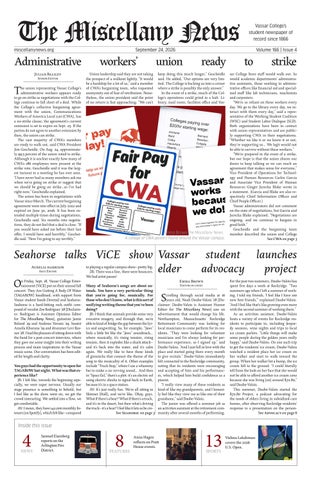
Emma Brown/The Miscellany News. A collage of CWA posters found around the Vassar campus.
Volume 166 | Issue 4
to
strike
sar College Store staff would walk out. So would academic departments’ administrative assistants, those working in administrative offices like financial aid and specialized staff like lab technicians, machinists and carpenters. “We’re so reliant on these workers every day. We go to the library every day, we interact with them every day,” said a representative of the Working Student Coalition (WSC) and Student Labor Dialogue (SLD). Both organizations have been in contact with union representatives and are publicly supporting CWA in their negotiations. “Whether we like it or we know it or not, they’re supporting us… We legit would not be able to survive without these workers.” “We’re prepared in the event of a strike, but our hope is that the union shares our desire to keep talking so we can reach an agreement that makes sense for everyone,” Vice President of Operations for Technology and Human Resources Carlos Garcia and Associate Vice President of Human Resources Ginger Jurecka Blake wrote in a statement. (Garcia and Blake are also respectively Chief Information Officer and Chief People Officer.) Vassar administrators did not comment on the state of negotiations, but Garcia and Jurecka Blake explained, “Negotiations are ongoing, and we continue to bargain in good faith.” Gescheidle and the bargaining team member described the union and College See CWA on page 3
Seahorse talks ViCE show Vassar student launches elder advocacy project Aurelia harrison Arts Editor
O
n Friday, Sept. 18, Vassar College Entertainment (ViCE) put on their annual fall concert: They Are Gutting A Body Of Water (TAGABOW) headlined, with support from Vassar student bands Dovetail and Seahorse. Seahorse is a hard-hitting rock outfit composed of vocalist Zoe Rodriguez ’28 [Disclaimer: Rodriguez is Assistant Opinions Editor for The Miscellany News], guitarists Jamie Boland ’29 and Andreas Vavasis ’29, bassist Ameila Khurana ’29 and drummer Levi Rosner ’28. I had the pleasure of sitting down with the band for a post-concert interview, where they gave me some insight into their writing process and main inspirations in the Vassar music scene. Our conversation has been edited for length and clarity. You guys had the opportunity to open for TAGABOW last night. What was that experience like? JB: I felt like, towards the beginning especially, we were super nervous. Usually our stage presence is something to behold, but I feel like as the show went on, we got the crowd interacting. We settled into a flow, we got comfortable. AV: I mean, they have 142,000 monthly listeners [on Spotify], which felt like—compared
Inside this issue
4
NEWS
Samuel Eisenberg reports on the Arlington Fire District.
to playing a regular campus show—pretty big. ZR: There was a line, there were bouncers. We had artist passes!
Many of Seahorse’s songs are about animals. You have a very particular thing that you’re going for, musically. For those who don’t know, what is this sort of unifying writing theme that you’ve been doing? JB: I think that animals provide some very evocative imagery, and through that, we’re able to kind of bridge the gap between the lyrics and songwriting. So, for example, “Jaws” feels a little bit like the “Jaws” soundtrack… where musically, it’s rising tension, rising tension, then it explodes like a shark attack— and it’s back into the water, and it’s calm again. We really like to have those kinds of gimmicks that connect the theme of the song to the musicality of it. Other examples include “Truck Stop,” where I use a whammy bar to make a car revving sound… And then in “Space Eel,” there’s a plot: it’s an electric eel using electric shocks to signal back to Earth, because it’s in a space station. AV: It’s just really fun. We’re all sitting in Skinner [Hall], and we’re like, ‘Okay, guys. What if there’s a bear? What if there’s a truck, and it’s in the desert, but then what’s driving the truck—it’s a bear!’ I feel like it lets us be creSee Seahorse on page 3
8
FEATURES
Emma Brown Editor-in-chief
S
crolling through social media at 16 years old, Noah Daube-Valois ’28 [Disclaimer: Daube-Valois is Assistant Humor Editor for The Miscellany News] saw an advertisement that would change his life. Northampton, Massachusetts’ Rockridge Retirement Community was looking for local musicians to come perform for its residents. “They were looking for volunteer musicians and I’m always looking for performance experience, so I signed up,” said Daube-Valois. “And I just fell in love with the place and started going there every month to give recitals.” Daube-Valois immediately felt connected to the Rockridge community, noting that its residents were encouraging and accepting of him and his performances, which helped him build confidence as a pianist. “I really view many of these residents as kind of like my grandparents, and I honestly feel like they view me as like one of their grandsons,” said Daube-Valois. The junior was offered a summer job as an activities assistant at the retirement community after several months of performing.
Anna Hagen reflects on Pratt House events.
13 SPORTS
For the past two summers, Daube-Valois has spent five days a week at Rockridge. “Two summers ago when I left a summer of working, I told my friends, ‘I feel like I have 100 new best friends,’” explained Daube-Valois. “And I feel like that's like growing even more with the second summer of working there.” As an activities assistant, Daube-Valois hosts a variety of events for Rockridge residents to participate in, including Jeopardy sessions, wine nights and trips to local ice cream parlors. “Little things will make some people during the golden years really happy,” said Daube-Valois. On one such trip to get the residents’ ice cream, Daube-Valois watched a resident place her ice cream on her walker and start to walk toward the group. When her walker hit a bump, the ice cream fell to the ground. “I could literally tell from the look on her face that she would not be able to afford another ice cream cone because she was living [on] around $72.80,” said Daube-Valois. This summer, Daube-Valois started the $72.80 Project, a podcast advocating for the needs of elders living in subsidized care homes, after observing Rockridge residents’ response to a presentation on the personSee Advocacy on page 6
Vishnu Lakshman covers the 2026 U.S. Open.
September 24, 2026
Page 2
THE MISCELLANY NEWS Emma Brown Darja Coutts Julian Balsley Grace Finke Hadley Amato NEWS EDITOR Samuel Eisenberg ASSISTANT NEWS EDITORS Iggy Gutierrez Madeline Nusbaum Aurelia Harrison ARTS EDITORS Brendan Kennedy Sophia Marchioli ASSISTANT ARTS EDITOR Sydney Jones FEATURES EDITOR Tina Mao ASSISTANT FEATURES EDITORS Jared Palumbo Ian Watanabe OPINIONS EDITOR Zoe Rodriguez ASSISTANT OPINIONS EDITOR Josie Wenner HUMOR EDITOR Noah Daube-Valois ASSISTANT HUMOR EDITOR Holland Kaplan SPORTS EDITOR David Bray ASSISTANT SPORTS EDITORS Armaan Desai Lucas Seguinot DESIGN EDITOR Sylvia Sargent ASSISTANT DESIGN EDITORS Hannah Wells Elliot Evans COPY EDITORS Gabrielle Lyman Julia Weber ASSISTANT COPY EDITOR Aria Kuklinski GRAPHICS EDITORS Charlotte Willenbring Makenna Brown PHOTO EDITOR Aviva Barry ASSISTANT PHOTO EDITOR Olivia Blank GAMES EDITORS Felix Mundy-Mancino Mia Liloia SOCIAL MEDIA MANAGER Fallon Dern LIVE EVENTS CHAIR Vera Giraudo WEBMASTER Eduardo Culmer REPORTERS/COLUMNISTS Noah Duncan Melody Hamilton Isabel Holmes Lora Janczewski Benjamin Kaplan Eli Lerdau Evan Seker Erin Thatcher Amritha Dewan PHOTOGRAPHER Andrew Chu CARTOONIST Catriona Chapman COPY STAFF Cooper Jaffe Ren Nicolau Tanner Johnson DISTRIBUTORS Cailey Metter
EDITOR-IN-CHIEF MANAGING EDITOR SENIOR EDITORS
Image courtesy of Tori Kim '25. MISCELLANY NEWS | VASSAR COLLEGE
NEWS
September 24, 2026
College
and
Continued from CWA on page 1 as still being far apart on many bargaining issues. Wages are perhaps the most significant sticking point—just as they were in the 2025 negotiations between the College and service employees’ union. That remains true after the parties’ most recent bargaining session on Tuesday, Sept. 22. While students, CWA and faculty demonstrators dressed in red gathered outside, chanting “Strike,” the union and College negotiated for nearly five hours. Nonetheless, Gescheidle said, there was no significant movement on wages. “We did make some progress on some non-economic type stuff, but the rest of it, we’re pretty far apart,” he explained. CWA will review the College’s next proposal early next week; the next bargaining session is set for Oct. 9. The lowest-paid workers under the current wage scale make $18.51 per hour, according to CWA members. With annual two percent increases, that position’s rate has risen from $17.45 per hour, when the agreement went into effect in 2022. The bargaining agreement’s wage scale is complex: It has four tiers—K, L, C and D— and each tier includes four levels of merit-based pay raises. Most CWA members are in the two lower tiers, CWA members said. In 2022, the entire lowest tier was under $20, but the highest level on that tier has now passed $20 per hour, CWA members said. (For reference, the starting hourly rate for a general position at Target’s Poughkeepsie location is currently $17.75.) The College’s bargaining team has been very resistant to meaningfully raising the wage, according to Gescheidle. He noted that the base wage in the College’s most recent contract proposal, which CWA received at the beginning of the month, is still under $20 per hour. “We’re aware that starting wages are a central concern in these negotiations, and we are working with CWA representatives to find a fair and sustainable solution,” Garcia and Jurecka Blake wrote.
Vassar
still
Meanwhile, many of Vassar’s peer institutions have a much higher base rate for comparable employees, CWA contends. A flyer that the union has been circulating around campus lists 16 peer institutions, including multiple of the Seven Sisters colleges, that give their employees a base rate over $20 per hour. For example, in August, Service Employees International Union Local 200 United—the same union representing Vassar’s service workers—successfully bargained for a $22.60 base wage for its members at Bard College. Even Bard’s new minimum is below some measures of a living wage in Dutchess County, where both Bard and Vassar are located. Gescheidle and the bargaining team member cited the Massachusetts Institute of Technology’s Living Wage Calculator, which puts the living wage for one individual without children in Dutchess County at $26.24 an hour—nearly $8 more than Vassar’s current base wage. As the Sept. 25 deadline draws closer, wages are by no means the only thing separating Vassar and the union from a deal. Gescheidle contended that throughout the bargaining process, the College’s negotiating team has brought numerous “retrogressive” demands, meaning proposals that CWA feels have fewer benefits than the current agreement. Some of those demands, according to Gescheidle, include scrapping the merit-based wage increases, which were new in the 2022 agreement; less vacation and sick time; a clause allowing the College to reopen bargaining if health insurance costs increased by more than 10 percent. “There was a retrogressive proposal presented by the College in virtually every article that was a benefit to us,” Gescheidle said. Vassar administrators declined to discuss any specific proposals they have made to CWA. “The negotiation process is confidential, so we don’t disclose information about proposals or discussions,” Garcia and Jurecka Blake wrote. They added, “The goal
mathematicians
Grace Finke Senior Editor
[Disclaimer: The author is a Mathematics and Statistics Department Academic Intern.]
O
CWA
n Sept. 8, OpenAI claimed their software had generated a solution for the Navier-Stokes equations, one of seven Millennium Prize Problems established by the Clay Mathematics Institute (CMI) in May 2000. “These problems have been selected by the Clay Mathematical Institute because they stand out as great, unresolved problems of the 20th century,” said mathematician Andrew Wiles during his introduction to the CMI Millenium Meeting in 2000. “They are problems which we believe must one day be resolved…problems which we believe will open up whole new possibilities of mathematics, possibilities which we cannot at this present moment even imagine.” CMI’s Board of Directors pledged for $1 million to be awarded to the first correct solution to each problem. OpenAI published their proof for their solution to the Navier-Stokes equations, which describes the flow of liquids and gases in a three-dimensional space, on Sept. 8. OpenAI shared that, after hearing rumors that two Millenium Prize Problems had been solved, the company decided to focus a new internal model—which had exceeded expec-
far
apart
of each negotiation cycle is to hear from employees—through their union representatives—about their priorities and find common ground.” Another thing keeping the parties from a deal, CWA leadership described, is that members want some form of protection from AI’s effect on their jobs. Gescheidle explained that the union has brought the issue up “numerous” times in negotiations but that the College has continually failed to address it. “That was surprising,” the bargaining team member said of Vassar’s resistance to formalizing AI protections. When it comes down to it, Gescheidle said, CWA is only asking for a few things: “It’s literally looking for some minor gains and a fair wage, and a little bit of protection for AI. I think that’s quite reasonable.” “Our goal is to work with CWA to reach a sustainable agreement that both reflects the current labor market and supports their members’ longstanding commitment to the Vassar community,” wrote Garcia and Jurecka Blake. “It’s funny because I feel like Vassar is an amazing employer in many ways,” the bargaining team member commented, “and yet they are being harsher than I expected.” Taking benefits from CWA members will not significantly improve Vassar’s financial situation, Gescheidle argued. According to the union’s calculations, the entire CWA payroll is under three percent of Vassar’s budget. Furthermore, the bargaining team member noted, any wage or benefit cuts will hit the union’s most vulnerable members the hardest. “The lowest paid workers take it on the chin,” they said. Vassar administrators did not respond to a question about how much of the College’s budget goes to CWA payroll. While they fight for what they see as a living wage, the bargaining team member said, it can be difficult to watch how money moves at the top of the College. “It’s hard when we’re looking at the pay increases that
reflect
tations of mathematical performance—on the remaining unsolved problems. After utilizing Codex, OpenAI’s coding tool, to synthesize work from various agent groups, a group of nearly 10,000 AI agents generated a potential solution to the equations in approximately 88 hours. The solution was then verified in Lean, a programming language used to process mathematical proofs and theorems. Professor and Chair of Mathematics and Statistics Jan Cameron emphasized the importance of the peer-review process. “First of all, it’s not a solution,” Cameron stated in an interview with The Miscellany News. “It’s a claimed solution, and I mean, this is really important because the community needs to be able to decide whether or not to accept whether or not it’s correct and that has to be done in the mathematics community.” While the proof was generated by OpenAI, the work was built atop years of human research. Mathematicians Tristan Buckmaster, a Professor of Mathematics at New York University, and Levent Alpöge, a researcher at the AI company Anthropic, contributed to what became the rumors that motivated OpenAI’s effort. Additionally, Buckmaster and Alpöge credit the work of Spanish mathematicians Diego Córdoba and Luis Martínez-Zoroa for the original findings behind their own results. Vassar alumna Naima Nader ’23, a current third-year Ph.D. student in mathematics at
Page 3
on
on
wages
the higher-ups get every year, year after year…and then they’re telling us, ‘We can’t afford you,’” the bargaining team member explained. For the past four school years, the highest-paid administrators—President Elizabeth Bradley, Vice President for Advancement Tim Kane, Vice President for Finance and Administration Bryan Swarthout and Garcia—have on average received yearly pay increases of just under eight percent, according to public tax documents. All but Bradley received pay increases of over 10 percent in the 2024 to 2025 academic year, the most recent year available. Multiple groups across campus have made their support for CWA clear. The student organizations WSC and SLD are circulating a petition for students to support the union. As of publication, nearly 400 alumnae/i have signed another petition, from a group called Vassar Alumni for CWA. A WSC and SLD representative explained, “As student workers and students, we cannot support our education at the expense of other workers in our community.” Union members will be holding an informational picketing session on Friday, Sept. 25, from 12:30 to 1:30 p.m. at the Bennett Gate on Raymond Ave. and Collegeview Ave. On June 1, Chair of Earth Science and Geography Kirsten Menking sent a letter signed by more than 70 faculty members in support of CWA to Bradley, Garcia and Jurecka Blake. “We are writing to express our strong support for Vassar’s CWA union members as they negotiate a new contract with the College throughout the summer,” Menking wrote, according to a copy of the letter she shared with The Miscellany News. “At this time of extreme income inequality, these vital members of our community deserve wages and benefits that keep up with the ever-increasing cost of living… Without competitive compensation, we risk losing their expertise as they seek out higher remuneration commensurate with their experience.”
OpenAI’s
proof
Aria Kuklinski/The Miscellany News. the University of Illinois Chicago cited a recent panel she attended when explaining to the Miscellany how large language model (LLM) softwares are constantly changing based on what users have fed them. “If you use AI and it gives you an idea that you haven’t seen before, usually that’s just a different human’s idea,” Nader said. “It’s on you to not plagiarize and it’s on you to push AI, to be like, ‘Where is this idea coming from?’”
MISCELLANY NEWS | VASSAR COLLEGE
Buckmaster alleged that OpenAI’s proof used the data from his work in Codex. The company responded in a public statement: “We (the researchers and the agents) did not see any of their work through any means until they released it publicly... While unlikely, we cannot rule out that de-identified data derived from their usage of our products helped improve our models.” OpenAI continues on page 4
NEWS
Page 4
Arlington
Fire
Samuel Eisenberg
Assistant News Editor
Due to a seemingly high number of fire alarm activations on campus, but few actual fires, students have wondered if Arlington Fire District (AFD) could be growing tired of responding, or potentially not have enough resources to respond to a real fire in the district. “I feel like the fire department just gets here, and then after a while, after so many false flags, I feel like they start to take it a little less serious, too,” said Ryan Santos ’29. Despite student concerns, AFD employees emphasized that the department is not overwhelmed by the number of alarm activations at Vassar College; every call is still taken very seriously and alarm activations do not significantly divert resources. “That’s what we do. We’re always ready,” said AFD Public Information Officer Battalion Chief Chris Rinck. AFD Chief of Department Adam Kangas explained that AFD responds to roughly 18 calls per 24 hours, or about 7,000 calls every year. Vassar only makes up about seven percent of those calls. Rinck added that AFD operates 24/7, 365 days a year, and they always staff four fire engines and a ladder truck, complete with firefighters as well as paramedics. Rinck continued, “So, that’s a very unique setup, and it’s robust, and it’s ahead of its time, and it’s ahead of, really, the region.” Rinck also emphasized that AFD takes every call very seriously: “For every fire alarm or every reported fire, we send at least two fire engines and a ladder truck because we have to treat every incident like it’s an actual fire.” As a Miscellany News reporter sat in the firehouse speaking with Kangas and Rinck, two calls went out in the first 20 minutes of their conversation. Kangas explained, “It’s an everyday occurrence.” However, even with two engines out, if a fire alarm at Vassar went off at that moment, Rinck explained, the department would still have been able to respond. Furthermore, AFD ensures that every fire engine is staffed with a paramedic. “Every single fire engine has a paramedic on it with full ALS—advanced life support—capabili-
Vassar
District
handles
ty,” said Kangas “So they have all their medications, their monitors, they can do advanced anything that a paramedic can do on an ambulance.” Kangas added that it is this “robust setup” that allows AFD to manage the high call volume and ensure the safety of all of the district’s residents. According to Kangas, in the last several years, Vassar and AFD have established
Vassar
gas said that Vassar’s share of AFD’s calls has decreased from 10 to seven percent in recent years. Vassar College Vice President for Finance and Administration Bryan Swarthout explained the other half of the partnership: “Vassar’s partnership with AFD has provided the AFD opportunities to train which builds the capacity of the AFD and allows
Charlotte Willenbring/The Miscellany News. a partnership, including giving Vassar House Teams fire safety training. Kangas explained, “As far as overall call volume at Vassar College, because of the positive partnership that has been developed with Vassar College and Arlington Fire District, over the years, to be honest with you, there is a slight decrease in call volume at Vassar College, because of that partnership.” Kan-
community
Continued from OpenAI on page 3 Juliet Whidden ’23, a Vassar alumna and current fourth-year Ph.D. student in mathematics at the Georgia Institute of Technology, noted how this potential usage of intellectual property could impact the mathematical community. “Everyone seems willing to share what they are working on, whether to gain ideas or to just spread knowledge to others,” Whidden wrote by email. “However, it seems that this is exactly how Open AI learned that Navier-Stokes was close to being solved and is what prompted them to solve it.” This tension between Buckmaster and OpenAI led to a greater discussion on how the interaction between intellectual property and LLMs will affect the notion of authorship in the mathematical research community. Vassar Professor of Mathematics Benjamin Lotto told the Miscellany, “Publications have authors. And so the whole reward structure of academia is now feeling a little wobbly, because if producing a proof is the goal, AI can do that for you.” Additionally, Professor of Mathematics Adam Lowrance asserted that OpenAI’s ef-
September 24, 2026
them to be more familiar with the campus in case of an emergency.” Kangas and Rinck both pointed out that this availability for training saves them money, and also allows their firefighters to become familiar with a wider range of building designs and layouts, further ensuring public safety. The decrease in calls is visible when comparing alarm activation data. According to
discusses
fort to solve this problem may have been motivated more by a desire to promote its models’ capabilities than to provide valuable contributions to the mathematical field. “At large, mathematics is thought of as being a particularly challenging and difficult field to have successes in,” said Lowrance. “And so [these companies] are incentivized to produce proofs of famous problems so that they can have press releases that say, ‘Look how far our models have come.’” “You’re not taking differential equations so you can actually solve them. It’s not just about that,” Cai Gordon-Bruno ’27, a fellow mathematics and physics student, said to the Miscellany. “It’s about understanding the tools you use to solve them and how they actually work mathematically. Because this gives you more context, it opens up your mind to new ideas, to new ways of thinking about maths, which is inevitably what results in new progress.” Vassar’s mathematics faculty echoed this sentiment. “The whole point of [the Millenium Prize Problems] was to help generate a lot of research and turn one question into two,” Assistant Professor of Mathematics Trev-
AI
in
or Hyde stated. “The point of setting these problems up on a pedestal was to help direct mathematics in a positive direction. The mathematicians in the Vassar community explained that mathematical and scientific research still contains a level of subjectivity, as it is dependent on questions and interests produced by humans. “I feel like math is very heavily defined by what people find interesting,” said Taj Holliday ’27, a mathematics and computer science student. “There are so many things you could prove that are just completely useless, so I think it’s a very human-defined field in that sense, even if it feels like it's a very objective thing, but it really is people deciding where it goes.” Vassar Assistant Professor of Statistics Daryl DeFord additionally noted that much scientific research is dependent on the context surrounding its practical applications. “One of the reasons [LLMs have] worked out really well for pure math is you have something like Lean that gets to verify you've got the answer right,” DeFord explained. “And for applied problems, modeling problems, statistics data problems, there often isn't
MISCELLANY NEWS | VASSAR COLLEGE
fire
alarms
Vassar Director of Campus Safety Arlene Sabo, the number of alarms went down from 346 between 2023 and 2024 to 287 between 2025 and 2026. AFD reported that Vassar accounted for roughly seven percent of 7,000 total calls in a typical year, which is about 490 alarms. However, AFD’s reported number of calls is approximately 200 higher than Sabo’s number. Sabo attributed this discrepancy to AFD also counting emergency medical calls, whereas Sabo only counted fire alarms. Further, AFD was using an estimation, and the data may have included different College-owned properties than Vassar’s numbers, Sabo wrote. Students expressed that they were growing accustomed to the alarms and were less likely to leave their buildings. Otto Saphir ’29 explained, “I feel like I’m at the point where I’ve been disregarding fire alarms.” Saphir added that he leaves the building when an alarm goes off because of the alarms’ lights and volume rather than out of concern for his safety. What students have seen, Kangas explained, is not a series of false alarms going off for no reason. Rinck added that there has never been a false alarm at Vassar. He noted, “Now, whether or not it’s an actual fire or not, that’s different, but the detector, the devices and the system is working.” In terms of the frequency of alarms, Rinck explained that cooking, incense use and hairspray are some common causes of alarm activations. Rinck made it clear that alarm activations are partly due to Vassar updating and maintaining their systems well, which ultimately helps keep students safe. Sabo emphasized this in an email to the Miscellany: “Vassar has a safe campus. The alarm systems are required to be sensitive which makes them safer.” Gabriella Catalano Malardi ’30 spoke about the impacts of alarms going off in the middle of the night for seemingly no reason: “You gotta be able to sleep to have your brain work.” She continued, “There could be a fire someplace else, and then there could be less fire people there, because they’re here.” When asked about whether any fire alarm or smoke detector changes are needed, Kangas put it simply: “No. All those systems are in place and they work very well. There’s no concern for safety.”
mathematics a [unique] right answer. But there’s a lot of room for knowledge about the context to inform the analysis.” OpenAI shared that they do not intend to claim the $1 million Millenium Prize. The company reflected on the finding’s longer-term implications, writing, “This milestone represents substantial work by mathematicians and AI researchers. However, this is not a culmination, but rather a snapshot in time of progress on AI development.” On Sept. 21, OpenAI launched an advisory group of mathematicians to supervise the verification and publication of any new mathematical results from the internal model that generated the Navier-Stokes proof. Reflecting on AI’s place in scientific research, Garraway said, “I think as we grow to understand AI and its capabilities better, we stay in control. And I think as long as we understand as people what AI should and maybe can do as well as what people are needed for, like diverse perspectives, like sharing our thoughts and ideas with each other, like collaboration… That piece is not going anywhere.”
ARTS
September 24, 2026
Page 5
Seahorse discusses music scene, writing process Continued from Seahorse on page 1 ative, but in a very lighthearted and fun way. So I think it’s a good thing to write around. AK: I feel like it makes [the writing process] a lot more collaborative, because we can all create this story together. We all have a cohesive vision. What was Seahorse’s origin story? What compelled you guys to make the kind of music you make? LR: During freshman year orientation week, I sat down with some people I thought were cool. And I talked to this guitarist named Lucas Fitz-Gibbon [’28], and then he introduced me to another guitarist, Matthew Snyder [’28], who then introduced me to [Rodriguez]... It was kind of like a Theseus’s ship of instrumentalists. We used to be called Divorce Court. AV: But you [Rosner] knew I played guitar, and you were like, ‘We actually have a sudden need for a guitarist.’ So he asked me, ‘Can you come to a jam sometime?’ So I showed up…and Levi was late and walked in eating a big ol’ burger. We played some Green Day, some Hüsker Dü…and then I was like, ‘I actually have two friends that play the guitar and bass.’ And here we are!
beabadoobee Brendan Kennedy Arts Editor
M
uffled, faint voices appear and fade away. An acoustic guitar plucks a calm melody. And then, a soft intimate voice emerges. beabadoobee opens her fourth studio album with her most gentle imagery of love to date: “And when I’m somewhere / At least we’re connected / Like a pylon on an open road.” Her voice glides over a dreamy, hopeful production—a tender sound that gradually builds into a mesh of electric guitar and atmospheric synths. The lyrics pass between exchanges of lovers finding each other miles apart, her sweet voice flipping between melodies. Then suddenly, the song explodes. With the first track on “Pylon,” Beatrice Laus—known professionally as beabadoobee—makes it clear that her newest studio album is nothing like her last. In 2024’s “This Is How Tomorrow Moves,” beabadoobee blended dream pop, folk and jazz elements in an album about self-acceptance and growing up. This combination resulted in a project that boded well for longtime fans and warm acoustic lovers—take buzzy, sugared hit single “Beaches” for instance. However, the hard rock and grunge elements struggle to become fully realized in this project. “Post,” for instance, turns the previous project a bit rowdy with thick guitars and thriving drums. But the production here is only a part-commitment to the hard rock genre. “Pylon” proved to take these subtle rock moments of beabadoobee’s discography much further. On June 24, 2026, she kicked off her newest era with the release of “Sun Has Set,” the first single for her fourth album. The track rushes with aggression, employing raw guitar fuzz and an emotionally furious vocal delivery—a rockstar energy unlike anything listeners have heard from her before. Full of vengeance in the music video, she is smashing car windows and chasing the camera, which seems to be from the point of view of her ex-lover. The lyrics display an even larger, direct attack: “When I say, ‘We’ll never be friends’ /
Since COVID-19, Vassar’s music scene has had to undergo a serious revitalization. Is there anyone or anything in the Vassar music scene now that inspires you? ZR: When I first went to Slush Pit, it was very eye opening. Because there was no music scene anywhere near [me] where I lived. It was like stepping into a whole new world. I’d never seen the scene in real life—I hadn’t been to a concert. It was completely new, and it was mind-blowing because people were into it, and the atmosphere of it. LR: I think StuMU [Student Music Union] events in general, seeing all the bands on campus, is really inspirational—seeing our peers, who are in the exact same situation as us, doing music right now. And I know I personally have my inspirations in my peers on drums that I look up to. AV: I knew that I wanted to join a band when I got here, but I feel like it’s been more of like a reinforcing it with every new thing. I mean, Dovetail last night… I'd never seen Dovetail! The Meek at Slush Pit, Creature at the Bike Shop. One of my favorites was the Tiny Desk with all of the rappers. That was so fun. AK: My roommate last year [Kerala Kim ’29], she’s kind of like a singer-songwriter
gets
heavy
I mean we’ll never pretend / Fuck that, you can never run back to me now / The sun has set.” Playing “Pylon,” it becomes evident that such sonic invasiveness takes precedent in much of the tracklist. On “Switchblade,” beabadoobee sings about navigating insecurity and emotional confusion surrounding relationship problems while coasting along a down-tempo drum-heavy rhythm. Or with “In Motion,”she mixes similar grungy production elements with a more cathartic, “screaming into the void” melody about escaping the overwhelming, anxious thoughts in her mind. This emotional bond she creates between the intense sensations of love and hard rock is very effective in placing the listener within the chaotic perplexity of beabadoobee as a 26-year-old— one who must balance heart-breaking exes, fresh romantic partners and fame all at once. But just in case these production changes did not make beabadoobee’s’ shift in direction clear, in comes Paramore’s Hayley Williams and Turnstile’s Brendan Yates: obvious frontrunners of the modern alternative rock scene. On “Nothing to Prove,” beabadoobee and Williams create a jumpy, beating energy of guitar riffs and smooth harmonies. Here, beabadoobee reinforces her choice to create any type of music she wants, a clear “get lost” to anyone who thinks she is not worthy enough to enter this new scene: “I got it / I flaunt it… / ’Cause I’ve got nothing to prove.” With the track “Powerline,” beabadoobee utilizes Yates to develop a darker, more distant sound by overlaying their melancholic vocals. Nonetheless, “Pylon” certainly still has an older, more tender beabadoobee running through its veins. The album’s cheery third single, “Memories”—which she noted as one of the happiest songs on the project—talks about romanticizing the past. The dream pop production here creates an upbeat, nostalgic feeling, reminiscent of a track that could be placed on her dreamy, eclectic 2022 project, “Beatopia.” The lyricism, however, is still not all that bright: lingering in the past leads beabadoobee to a
type. She doesn’t perform a lot here, but she’s crazy talented. Throughout the whole year, she wrote at least 20 original songs or something… She’s a good writer. She’s also a great songwriter. So when I was being a chud and not writing anything, she would inspire me. JB: I wonder if some of the Brooklyn people, and me—I’m from [Washington] D.C.— felt a bit of a drought actually, when they came to Vassar, and maybe felt like there’s no scene here. D.C. has a history. It’s Fugazi, it’s Bad Brains. There’s a pretty lively scene. Obviously, New York City is the same. So coming here…I felt a kind of hunger for some kind of heavy music to be out there for people who feel this drought to dance too. Is Seahorse planning on recording any of your original music? Where do you see this project going? Any dream gigs? JB: We’ve been emailing back and forth with WVKR because they were discussing collaborating with StuMU in opening up a recording opportunity for student bands. That is still in the works, though there have been complications. But we’re trying to hop on that as soon as possible! We also talked about a goal for this year is playing a show that's not at Vassar, like New York City or Marist. AK: We’re gonna make it happen!
on
'Pylon'
trap of sadness as she wishes she could go back to those happy memories. Similarly, on “Estranged,” she dips into a sunny, The Cure-esque vigor where she embraces a full jangle-pop production that feels a bit lighter than the rest of the record. Still, despite the radiant indie-pop instrumentation here, the lyrics still succumb to her feelings of the isolation and messiness of her mid-twenties: “Feeling estranged, yeah / Gotta mean it, beat it / But I don’t wanna feel it.” This is not to say that beabadoobee’s previous records were depersonalized and spiritless. In fact, she has always been one of the best at meshing catchy bedroom pop with a tactful indie-rock aesthetic. But with “Pylon,” the listener gets the sense that she is at her most comfortable, finally coming into herself as an artist. “It’s Alright” displays her most confident—and earnest— vocals to date. She floats along a blurry electric-stringed beat, creating an obsessive melody you simply cannot get out of your head. In “Radio,” her distorted guitar overpowers with a self-assured style, creating a soundscape the listener is meant to lose themselves in. The highlight of “Pylon” comes with its closing song. “Satellite” begins with a simple, light guitar strum and beabadoobee’s delicate voice. Suddenly, almost out of silence, she cries out. A rush of crushing rock production takes the frame in mere seconds as she sings of a deep desire to reconnect with herself and others. The remainder of the track shifts between bittersweet guitar plucks with ruminating rhythms and more surges of severe, distorted alt-rock production—a final reminder to the listener to embrace her intimate, cosmic sound. The final moments of the album returns to a musical motif listeners have heard once before: a sonic explosion remnant of the one from the opening track. Though this time, the theme does not serve to introduce beabadoobee’s raw, heavy alt-rock framework. Instead, it brings it to a grand fade away: her final display that she is breaking away, triumphantly, from her previous sonic norms, unrestrained at last.
MISCELLANY NEWS | VASSAR COLLEGE
Arts Asks What was your favorite live music experience this summer? “I saw some neighborhood dad bands while I was in Australia.” - Bronte Baxter ’27 “The Buena Vista Orchestra.” - Caroline Winchester ’29 “I saw this piano trio— Suliman Tekalli, Zhenni Li-Cohen and Ismar Gomez—play this composition called “Cafe Music” at the Rushmore Music Festival.” - Eliza Braunschneider ’29 “The Sunday drum circles on Hippie Hill in San Francisco.” - Bella Michaels ’28 “Cannelle.” - Celina Detwiler Grey ’29 “Geordie Greep. I got to play pool with him after the show.” - Linus Barnes ’27 “I saw a music festival called System Activate—a 3 day rave in the woods of Vermont. It was organized by a label of queer DJs called T4T LUV NRG, largely from NYC. Some of my favorite artists who played were Eris Drew, Faited, and Octo Octa.” - Ava Whitney ’27 "I worked the box office for Los Lobos. They played a great cover of La Llorona." - Aurelia Harrison ’28 Arts Editor
FEATURES
Page 6
The
spotted Oli Pape
Guest Columnist
C
arcasses litter the ground. This is the new New York summer, marked by the emergence of the invasive spotted lanternfly, or Lycorma delicatula, which is too lyrical a name to describe such an annoying creature. Spotted lanternflies are a species of planthopper native to parts of East and Southeast Asia, but they first established a population in New York State in 2020. Their main host is the similarly invasive tree of heaven, a stringy deciduous tree slowly taking over the U.S. Northeast, though they will also happily feast on many native trees, like maples and birch trees. Having worked in parks across New York City for four years, I am desensitized to weeding out trees of heaven and smearing spotted lanternflies against the grass. The big summer lanternfly boom has worked its way into my life as a yearly event. The babies—little black-and-red jumping planthoppers—begin appearing in May through July, and slowly grow into the spotted lanternfly we love to hate by the end of the summer. In an attempt to protect our ecosystem, the New York State Department of Environmental Conservation sends out public service announcements encouraging people all over the Northeast to kill spotted lanternflies whenever they see them. In fact, the people of New York City have squashed so many of these bugs that places where you would normally see hundreds of lanternflies on a single sidewalk are now only ravaged by a handful. This success story is not yet mirrored at Vassar College. In Poughkeepsie, a city with
Project
about three percent of New York City’s population, spotted lanternflies still run amok without enough humans to sufficiently smash them. Nowhere is this invasion seemingly worse than Vassar Farm Lane, the road that trails past Central Receiving and leads toward the rugby fields and the Preserve. Whenever I walk back to my dorm from the Preserve, I see hordes of lanternflies sunbathing along the wood posts overlooking the lake. Killing one only encourages three others to take its place. After a relatively calmer summer in New York City, where the lanternfly population had been culled by the sheer number of humans after the initial 2020 boom, returning to a city so markedly under invasion brought me back to the months I had once spent stomping on every grayand-red bug I could. On one such wood post, I attacked the lantern- flies with a recovered vengeance, going so far as to hike my leg up and kick at the ones at even the very top of the poles. One lanternfly in particular proved to be a remarkably good escapee. It fled the rubber
$72.80
Continued from Advocacy on page 1 al needs allowance by Massachusetts State Representative Lindsay Sabadosa. The personal needs allowance is the amount of money that the Massachusetts state government gives each month to residents living in government-subsidized care homes to
lanternfly
advocates
purchase necessities. Massachusetts’ $72.80 allowance was set in 2008, and has not been adjusted for inflation since. The Rockridge Retirement Community is split into three units: the retirement home, the rest home and the memory care unit. While residents of the retirement
Noah Daube-Valois/The Miscellany News. Daube-Valois with a Rockridge resident.
September 24, 2026
must
hammer the soles of my sneakers had become, wedging itself into a rotted hole I could not quite reach. Disgusted, and annoyed at its triumphant evasion of me as I sweat under a baking hot sun, I shoved my foot in a bit further. It cowered. Finally—success! I crushed the little bug as best I could at the awkward angle and pulled back, basking in pride, only to discover that I had failed my mission. It had not died. A chill ran up my bones as it stared into my eyes, bent wings twitching. Turned over onto its back, it could not escape the confines of the very place meant to save it. Remorse began to bubble up in me. This was just a little lanternfly dude, probably trying to get back to his family, and now I have gone and murdered all his friends. His legs squirmed as he tried to turn himself rightside up. It was not his fault that he was invasive. He just wanted to live. I turned the lanternfly over and set it free. Though the spotted lanternfly’s main host is the tree of heaven, they feed on the sap of upward of 70 plant species, making those plants more vulnerable to disease and attacks
for
rights
home pay thousands per month to live in Rockridge, the rest home is subsidized by the government and is only available to individuals who have $2,000 or fewer in assets. Rest home residents pay their rent by turning their Supplemental Security Income or Medicaid checks—which is often their only source of income—over to the state government. If residents would like to purchase toiletries, clothing, gifts, haircuts, entertainment, transportation or any other amenity or service not provided by the rest home, they only have $72.80 per month to spend. “Residents really are just scraping by and cutting corners every day in some of the last years of their lives,” said Daube-Valois. The difference in residents’ income between those living in the retirement and rest homes manifests in a variety of ways. “If you go inside of a residents’ living space in the retirement home, it’s pretty beautiful, it’s pretty large, like where they sleep and where they live,” noted Daube-Valois. “And then if you go inside of a residence living space in the rest home, it’s like a coffin single at Vassar.” Daube-Valois also explained that, while those living in a retirement home are often able to purchase basic amenities of the modern age, such as a phone plan and WiFi, those living in the rest home cannot afford such expenses on a budget of $72.80 per month. Rockridge’s rest home residents have been forced to cut costs where they can to pay for the necessities while staying within their budget. “One of the residents I spoke to can only afford to buy clothes at Goodwill,” explained Daube-Valois. “And that may not sound devastating to some people, but the way he phrased it to me was like, in the last years of his life, he’s wearing somebody else’s shoes and all of his clothes are thrifted, since he only has a few extra dollars each
MISCELLANY NEWS | VASSAR COLLEGE
die
from other bugs. They also excrete honeydew, a sticky substance that promotes the growth of sooty molds, and they threaten New York State’s grape, logging and orchard industries. In short: these bugs are bad news. Too busy being overcome by empathy for the poor lanternfly’s situation, I forgot a very important fact. The life of one lanternfly is not worth the health of our ecosystem. What can we do? Without many natural predators in the United States, humans have become the stand-in for controlling their population. Stomping on lanternflies is the easiest removal method, even though it can get annoying when they continuously try to fly away. Spotted lanternflies cannot fly very far, so consistency is key. For those high up in the trees, a good old-fashioned fly-swatter can work, or even a vacuum. Vinegar is lethal to spotted lanternflies, and the lovely milkweed plant—which butterflies love and which grows in abundance on our Preserve—will kill lanternflies slowly. Overall, keeping a sharp eye and going after lanternflies whenever you see them is equivalent to doing your civic duty. We must momentarily put aside our empathy for living creatures and smush these bugs. Love and respect for animals and nature is important, but it is in fact more respectful to understand and maintain our ecosystem than it is to simply try to keep everything alive. The spotted lanternfly may not have asked to be invasive or to come to the United States, but they still are, and they still did. For the health of our beautiful forests and beautiful Preserve, they need to die.
Graphic by Quinn Stickney '30.
of
elders
month to spend on clothing.” Daube-Valois recounted another conversation with a Rockridge resident: “One of the residents I spoke to wears glasses and his glasses broke, and he could not afford to go to the [optometrist]. And so he has a Band-Aid that holds the glasses together. He didn’t even have tape.” Following Sabadosa’s presentation, Daube-Valois reached out to a Rockridge rest home resident who had asked the representative questions about how the elderly can best advocate for themselves. “I knew I wanted to give a microphone to residents of the rest home,” said Daube-Valois. “I didn’t know what it would look like. And luckily, I found a few elder advocacy groups, which I was able to ask questions to. In my podcast, I speak to a former state senator who was quite high up in the ranks of the state Senate when he used to serve Massachusetts.” Daube-Valois’ podcast has been shared by a variety of outlets and organizations, including Boston 25 News and MassLive. His goal is to raise the personal needs allowance in accordance with the rate of inflation. According to Daube-Valois, by adjusting the allowance for inflation, in his proposed plan, each rest home resident would receive around $115 a month. “That would cost the state $15 million annually to do that raise for all of the residents,” explained Daube-Valois. “That is nothing. Like the state budget is $60 billion. It’s not even like a fraction of a percent to spend 15 million extra dollars on thousands and thousands of residents. There are so few solutions that I feel like are this simple. Yet nobody does anything about it.” Those interested in listening to the first episode of the $72.80 Project can find it on Apple Podcasts, Spotify and a variety of other listening platforms.
September 24, 2026
FEATURES
Page 7
Going to immigration court Copenhagen Chronicles Ch. 3: Thrifting and Thinking Julian Balsley Senior Editor
T
he children do not know that they are in immigration court. One of them keeps running around in the background of the Webex screen, then coming up to the screen, where her parents are sitting at the dining room table. Every time the girl comes up to the camera she is smiling—that smile kids have that is almost laughter. But her parents know where they are. When she comes up to them with her bright eyes, they do not smile back. Her father puts a hand on her shoulder, gentle but tight, as though holding onto her so that she cannot run off. Immigration court is a wind that rips through lives, that threatens to tear this man’s hand off his daughter’s shoulder while she smiles. And he knows it. He holds on tighter. I am covering immigration for the summer at a paper in my hometown of Portland, Oregon. Four days ago, I emailed the Executive Office for Immigration Review (EOIR), part of the Department of Justice, and asked to attend the court of immigration judge Matthew Andrasko. Normally, I could show up to the court without announcing myself. But Andrasko does not seem to have a courtroom. All of his immigration hearings, as best as I can tell, are conducted on Webex. On my screen are about two dozen people on the edge of something. Today they will move one step closer to their future—to a more stable one in the United States, or to what that they know is much more likely. Deportation. “Excuse me everyone. Thank you for your patience,” a man says in Spanish on the Webex call. Andrasko is 15 minutes late. “The hearing will begin soon,” the man says before muting himself. A chorus of responses come crackling through. “No hay problema.” “Todo bien.” What else could they say? Immigration judges are not like other judges. As employees of the Justice Department, they are appointed by the attorney general. They can therefore be treated like other Justice Department employees, which means the president can fire them at will. Since retaking office, President Donald Trump has fired at least 130 immigration judges. As the purge escalated, many more judges resigned or retired early—perhaps in protest, perhaps to go out on their own terms. In their place, Trump has appointed scores of what the government calls “deportation judges.” To facilitate packing immigration courts with judges who will help Trump cleanse this country of Brown immigrants, in August 2025, the government removed the requirement that immigration judges have years of relevant experience. Many of these new judges have no immigration experience at all. Hundreds spent their careers as military lawyers. In short: There is no longer any pretense that these arbiters of the fates of our most vulnerable neighbors will be honest, fair or qualified. They are there for one thing only: to deport, and deport fast. Andrasko was appointed as a permanent immigration judge on May 21, 2026. He was one of 77 judges appointed that day, the most ever on a single day. He became a temporary immigration judge in October 2025 and before that was an attorney advisor for the Air Force, as well as an assistant district attorney and public defender. He also served in the Army and Air Force Reserves, and reached the rank of lieutenant colonel. According to EOIR’s announcement, he continued working for the Air Force while he was a temporary immigration judge from October 2025 until April 2026. He seems to have stopped working as a military lawyer once he became a permanent judge at the Portland Immigration Court.
The day I went to immigration court, I had recently published an article revealing that all four of the Portland Immigration Court’s judges had started their positions there less than a year ago, and that Andrasko was the newest of the four. (There has since been more turnover at the court.) I wanted to see what a deportation judge’s hearings looked like. So I emailed EOIR, and, the next week, found myself on Webex. Unlike a physical courthouse, virtual immigration court offers a small window into each person’s life. I see bookshelves, walls of photos and doorways into other rooms and the rest of their lives. I love walking around a city at night and looking up into the lighted apartment windows above me, seeing the slivers of life in each glowing square. Seeing all of those lives moving above unfurls within me the feeling that we are all in this together—this life. Seeing the little windows of Webex immigration court gives me the opposite feeling. It does not connect the people in the windows to one another, or to me. Instead, it demonstrates just how alone these people are in the colosseum of the U.S. immigration system. At least in a courtroom, they can give each other comfort with their presences. They can affirm to one another that at least for now, they are still here. Andrasko joins the call—he has set a green screen background, so we do not get a slice of his life—and calls the court to order. A mustachioed man wearing thick horn-rimmed glasses and a well-tailored suit repeats Andrasko’s words in Spanish. At first, I think he is the immigrants’ lawyer. But when Andrasko begins hearing individual cases in a breakout room, I realize that he is only a translator. Nobody in the call has a lawyer. They face the brunt of the deportation judge alone. The first case is the couple with the daughter. She nuzzles into her mother’s arm, no longer smiling. I do not know whether she now knows she is in immigration court. But she can tell from her parents’ nervous tone that whatever is happening, it is serious. Do you understand how hard it is to plead with the government to let you remain in your home when the government does not speak your language? It is excruciating to watch Andrasko speak, in what sounds to me like a patently condescending tone, then watch the translator repeat his words in Spanish, then watch the parents respond to the translator, who responds to Andrasko in English, and so on. Assume that you cannot speak Dutch. Now imagine playing telephone in Dutch. This arrangement would perhaps be fine at a restaurant. But Andrasko is asking them about specific immigration documents they should have received, and why they did not fill them out. The fact that they did not fill out these documents may spell the end of their time in this country. Of course, they may just as likely be forced to leave for no reason at all. My Spanish is good enough to understand the basics, but not the details of the parents’ explanation. The father sounds increasingly frightened as Andrasko presses him. I think he is saying they recently moved and never received the document. I cannot be sure. I have been covering immigration, but the humans swirling in the immigration system have been only tangential to my reporting. Now, I cannot stop looking at this girl on Webex, who is looking up at her mother. Will she be able to grow up in Portland, as I did? Will she have to worry about her parents disappearing any day? Does she worry already? When she hears a car racing down her street at night, does she think it is la migra? It is my job as a journalist to answer questions. But I cannot answer these questions.
Lora Janczewski Columnist
I
have been very inspired by the Danish style here; people ooze aura. They wear sunglasses—even in cloudy weather—and lots of bandanas: around the waist like belts and on their heads. People walk in pleated skirts, tailored jorts, wide-barrel jeans. They traverse the old cobblestone streets in ballerina flats or colorful-cool sneakers. I have been silently, and hopefully imperceptibly, staring at them walking past me on the crosswalks or having their morning bolle med ost outside a local cafe. I made it my mission to immerse myself in the fashion part of culture, but how? Copenhagen is not known for being the most affordable city. It is a good thing that Copenhagen has an abundance of thrifting spots. So, these past few weeks I have found myself walking up and down Nørrebrogade, a central street decorated with many thrift stores, second-hand boutiques and vintage shops. I was walking into shops with hundreds of clothes and accessories to choose from. There was a great assortment of colors as well as textures and designs. There were “2000s-style” racks, but also graphic tees and sections dedicated to all types of funky sunglasses—the kind I could not find walking into any regular chain store in the Inner City. Every article of clothing had a story to tell, it seemed. There was so much character in that sequin shirt and those cargo capris. I took my time walking around the aisles to find that there were also staple items: quality jeans, brown boots. All of these items were also much cheaper than I anticipated, too. Nørrebro itself is an interesting neighborhood. It is rich historically: Graffitied buildings bring color into the neighborhood, and the mix of new and old buildings creates architectural contrast. Nørrebrogade serves as a melting pot of cultures; restaurants from all types of cuisines fill spaces in between ethnic grocery shops and studios. Almost one out of every six people living in the neighborhood
MISCELLANY NEWS | VASSAR COLLEGE
has a non-Danish passport. It has also always been a place that attracts a young audience. In 1982, a building called Folkets Hus (The People’s House) and later Ungdomshuset (The Youth House) became a dedicated spot for young people to gather and discuss labor movements and political advocacy and action. However, in 2006 and 2007, riots between the youth in Ungdomshuset and the police ensued as the police attempted to demolish and sell the building. Ungdomshuset does not stand anymore, but the neighborhood is still bright with political advocacy. At the end of my trip, shopping around Nørrebro, I came back to my kollegium with a fire pair of sunglasses and lots of inspiration of what I would keep an eye out for. When I ask Danish people my age where they are getting their clothes from, many say thrift stores and vintage shops. It is common to first look for the article of clothing you want in a more sustainable place. It is also common to have places around the city and within our kollegiums where people can give away their clothes, accessories, appliances and other miscellaneous items in a singular shared space where others can then peruse and pick out anything they need or want for free. It is a concept that closely mirrors our Stop Waste and Promote Reuse (SWAPR) efforts back at Vassar that take place at the end of the year. However, it was so refreshing to see this as a common community incentive. In fact, the rug in my room, which adds so much hygge to our otherwise barren abode, came from one of these sites. I am not surprised to find myself back at Nørrebro time and time again. Even though what first drew me into the neighborhood was its vibrant vintage presence, it became so much more interesting to walk though having learned about its history and significance in the sociopolitical culture of Copenhagen. Furthermore, I cannot help but notice how ingrained the efforts of sustainability are in the community and how important this mindset is to bring back to the United States when I come back from being abroad.
FEATURES
Page 8
Savoring
the
Anna Hagen
Guest Columnist
W
hat initially drew me to Pratt House was its silence. As a cozy brick building nestled behind large evergreens, it is the perfect home for the Office of Religious and Spiritual Life and Contemplative Practices (RSLCP). I first stepped into Pratt to check out a morning Buddhist Sangha meditation. I have since become familiar with the heavy presence of quiet in Pratt—a weighted blanket woven of the sounds of nature outside and muffled footsteps. Since then, I have returned to Pratt for Sangha, but also as a study spot on campus; it is often even quieter than the library. With a steady supply of hot water, I have savored the still moments I have carved out into my schedule at Pratt, whether I am enjoying my own company with a cup of tea or the presence of other people looking for a meditative medium. However, in the past week, RSLCP hosted two events—Coffee House and Interfeast— that intentionally sought to fill that silence and welcome the wider community into Pratt. That is, once people figured out how to open the door: Push the knob really hard! “We aim to offer a welcoming environment where students can be in community, and we’re thrilled students fill Pratt House for these events,” Reverend Callista Isabelle, Associate Dean of the College for Religious and Spiritual Life and Contemplative Practices, emphasized in an interview with The Miscellany News. This past Tuesday evening, I was not sure who would be at Coffee House, but as soon as I passed through the door, I found myself chatting. Before the music even started, I began to find harmony in the connections I formed around me.
silence
True to its name, Coffee House began with coffee, tea and an array of desserts. I was charmed by the tiny white china, carefully clutching a teacup handle as I maneuvered to find a seat in the living room that was filled with rows of chairs. Fairy lights bathed the room in a golden glow that ushered in the fall season and framed the microphone stands at the front of the room with a quasi-angelic halo. “Since the space is a living room, it feels very homey and supportive, and everyone there is genuinely interested in what you have to share,” Hadley Snell ’28 noted. Snell is the president of Vassar Verse, a campus poetry organization, and shared a sweet original poem about oranges at Coffee House. Other performers presented an assortment of music, poetry and even a magic show! “My favorite part of Coffee House is hearing students encourage each other as someone goes to the mic to share a new song or a poem they wrote,” Isabelle mused. The event did not have a strict setlist: When a spot opened in front of the microphone, the room filled with the excited chatter of friends emboldening one another to go onstage. It was not seamless, but that is what I found so amazing. There was beauty in how someone would rush out of the room to find a guitar tuner to share if a performer was missing one. It was sacredly human. Isabelle added, “I think everyone who performs at these Coffee Houses is so brave in how vulnerable their art is, and part of what makes Pratt such a special community is that people feel like they can share work that is very intimate with each other.” As the night went on, audience members—including myself—grabbed more tea in between acts and shuffled back into our seats to hear the first chords of the next song. It was during this time that I spoke with Jack Fred-
of
September 24, 2026
Pratt
erick ’28, who recounted how he initially got involved with Coffee House his sophomore year. As a member of the Student Music Union, he helped set up the sound equipment for the event and stayed for the musical community that Coffee House cultivates. “It’s a great place to workshop new stuff,” he emphasized. “I played one of the first songs I wrote here, and people loved it.” Coffee House ended with a group song— that night, it was “Harvest Moon” by Neil Young. Although I did not know the lyrics at first, I found myself joining in before I knew it, and my voice filled the room along with the taste of chamomile tea and carrot cake. I found more lovely company and food at Interfeast—an evening of dinner with a side of interfaith conversation. This Interfeast marked a year of these gatherings since they began last fall by student initiative. “RSLCP student leaders were excited to host dialogues that brought students from diverse religious and non-religious backgrounds together over meals,” Isabelle recalled. The RSLCP catering was from Gymkhana Cuisine of India, a local restaurant. The rich scent of chicken curry flooded my senses and plate as I found my way to a seat. That night, the dining table I became accustomed to doing my work at was split into triangles spread throughout the room. Among the people I shared dinner with were those I knew from spiritual groups, and others I did not have the joy of knowing yet. To kick off the evening, Vassar Catholic Community President Ben Garrity ’27 imparted some words of wisdom: “Speak your mind, speak your truth, speak your heart.” Over the sound of the clinking of silverware, our table delved into our food and discussions of our spiritual journeys. “Interfaith dialogue helps to increase our understanding
House
of others’ beliefs and perspectives,” Isabelle noted. My group’s discussions included navigating a work-life balance in college, learning to accept difficult emotions and existing unapologetically. However, what I recall most fondly was the moments of silence that blossomed between our conversations. I did not expect to find the same stillness I found at Sangha during Interfeast, but I savored how our shared words hung in the air, a testament to a community built across spiritual backgrounds at Pratt that makes space for both stillness and clamor. While not a member of a faith group on campus, for George Truax ’27, an RSLCP student leader and an organizer for Coffee House and Interfeast, Pratt has been a wonderful catalyst for student engagement. He explained that Pratt was a unique space that students in his class year found as underclassmen before the townhouses, where they ran the programming and had a large say in how Pratt works with the campus community. “Students are often surprised that they also learned more about themselves in the process,” Isabelle recounted, which I took to heart. By marking Coffee House and Interfeast on my Google Calendar, and after feeling rejuvenated walking out of Pratt on Tuesday and Thursday night, I recognized the importance of intentionally carving out time in a busy schedule to connect with oneself, others and the universe. As I am writing this, I am eating leftover carrot cake, and the edges of my nails are still stained yellow with Gymhana curry. Pratt has given me a taste of peace while adjusting to college life. I hope to keep visits as part of my routine: whether for the next Coffee House or Interfeast, a mindfulness session or a simple mug of tea.
The Haiti Project presents the 26th Annual
Haitian Art & Handcraft Sale A benefit online auction and in person sale, featuring 250 original paintings and hundreds of handcrafts
Friday
Sept 25
12 pm - 6 pm
Saturday
Sept 26
10 am - 6 pm
Sunday
Sept 27
9 am - 2 pm
Online Auction! Friday, 9/19 through Sunday, 9/27 Scan barcode to participate: College Center 2nd floor Vassar College
Saturday, Sept. 26 at 4:00 pm Guest Speaker: Père André Wildaine On the ground partner in Haiti
INSIDER’S PERSPECTIVE: “WHAT’S HAPPENING IN HAITI” Supporting over 200 students for primary education www.thehaitiproject.org Individuals requiring accommodation, information, or accessibility should contact the Vassar Campus Activities by calling (845) 437 5270. For any questions, contact us at contact.us@thehaitiproject.org.
MISCELLANY NEWS | VASSAR COLLEGE
Images courtesy of Reverend Callista Isabelle. Students attend a cozy, musical event in Pratt House.
HUMOR
September 24, 2026
Page 9
Breaking News
From the desk of Josie Wenner, Humor Editor
Ahead of Parents Weekend, Vassar Orphans Club stages protest Amazon allowing
to celebrate employees to
Noah Daube-Valois Prime Member
L
ast Friday, Amazon announced Prime Day would take place from Oct. 6 to 7. The company released a video previewing the event. “Prime Day isn’t just about customer discounts—it’s about making the world a better place,” said Amazon CEO Jeff Bezos. “That’s why we’re taking the extraordinary step of allowing our delivery drivers to urinate in a restroom once per shift.” Toward the end of the promo, the billionaire apologized to employees who would be excluded from this “once-in-a-lifetime opportunity,” because an “interruption in their work would disrupt global supply chains and bring about Armageddon.” Since its founding, Amazon has been accused countless times of exploiting its workers. In 2023, three delivery drivers sued the shopping giant for assigning them schedules that left them no choice but to pee in bottles. These allegations of worker abuse compounded pre-existing concerns regarding the harm online shopping inflicts on the
Opinion:
John
Anna Berggren Lesbian
L
environment. Late last year, the shopping titan announced on its website a change that would address the environmental and humanitarian concerns: “We’ve heard your criticism. That’s why we’re proud to introduce Waste Bags. They’re twice as large as cups and 100 percent biodegradable.” Another troubling story, reported in 2019, detailed Amazon’s reliance on child labor. A Chinese factory producing Amazon smart devices was operated by hundreds of children whose overnight hours violated labor laws. A federal judge instructed Amazon’s lead defense lawyer, Alexis Costa, “Alexa, stop.” Amazon countered by requesting amnesty for workers peeing and defecating in bags who were not yet potty-trained. Critics of the Prime Day promotion suspect there are ulterior motives at play. One source told The Miscellany News that the company was “simply going to run out of Waste Bags” by the start of October. For that reason, Amazon issued a memo last month asking employees to avoid drinking water during the day. Water joins a list of discouraged items that includes asparagus, which was banned
ittle is known of John Bradley, Vassar’s enigmatic First Gentleman, and questions about his true nature have plagued the student body for years. What is his middle name? What is his first name? Could John Bradley beat a horse in a fight? Is John Bradley bothering you? I cannot answer any of these questions because my horse guy bailed last minute, but I can reveal a much more important aspect of John Bradley’s personality. Last night, as I was taking a contemplative stroll through campus, I saw John Bradley wearing chinos and a tasteful flannel. As I watched his jaunty silhouette strut into the
Bradley
distance, it hit me: John Bradley might be a lesbian. John Bradley has all the hallmarks of a card-carrying lesbian. He loves the outdoors, he’s married to a woman with a bixie cut and he has performed an Indigo Girls cover at every single campus open mic since his arrival at Vassar in 2017. My conclusions barely need stating: The man has a sapphic ethos rivaled only by the WNBA. John Bradley moves through life with the style and ease of a middle-aged woman named Sam. In fact, if you rearrange the letters in his name, it spells out “Judith Butler.” Well, it might spell Judith Butler, depending on what his middle name is. I’m not saying that means he’s a lesbian, but I am saying that means he could be a lesbian.
Prime pee in
Day by restrooms
Aria Kuklinski/The Miscellany News. last year to “maintain nice-smelling vans.” The recent fears of a bag shortage grew so large that Amazon reportedly debated firing male delivery drivers who were “past their prime” and experiencing “prostate changes.” The event would be called “Prime Layoffs,” and would be celebrated with “discounts and free expedited shipping.” Peeing in bags is something that Bezos holds closely to his heart. His parents split when he was three years old. Bezos’ biological father, Jed Jorgenson, was interviewed by “Inside Edition” in 2008 shortly after discovering
might
be
To supplement my investigation, I asked three accredited lesbians for comment. Lesbian #1: “He’s so into fiber arts. Which is great; I really do believe that men should be allowed to have hobbies. But you know who else is into fiber arts? My great aunt, who’s been living with her ‘best friend’ for the past 28 years.” Lesbian #2: “I think he sat in on my women, feminist and queer studies course one time, like, as a little treat for him. He was trying so hard to look like a student; he had a messenger bag and he was wearing Birkenstocks? But it was like… that’s just straight-up John Bradley. And he’s just here, like, reading Gloria Steinem.” Lesbian #3: “One time I saw him wearing a shirt that said ‘We are the daughters of
MISCELLANY NEWS | VASSAR COLLEGE
that his estranged son was one of the richest people in the world. Jorgenson was a bicycle repairman and said that, despite his humble living style and health issues, he wanted nothing from Bezos other than to “see him, shake his hand, and tell him he’s really done a good job with his life.” Bezos never reached out to his father, who passed away from lung and heart complications in 2015. Sources tell the Misc that Jorgenson begged his son to pay for life-saving heart surgery, but Bezos said he’d only do so if the procedure required a catheter.
a
lesbian
the witches you could not burn.’ And I was like, dude, you are not the daughter of the witches they could not burn, you’re literally John Bradley.” Where I had hoped this very real investigation would give me answers, I am left with more questions than ever. We may never know which member of Boygenius is John Bradley’s favorite, or if he has ever owned a Subaru Crosstrek. But we know that John Bradley would run the fuck out of a small business, and that it would probably sell nipple jewelry. Whether John Bradley is truly a sapphic icon or merely queerbaiting us, he has my full support, unless he’s queerbaiting us. He is himself, he is super butch, and there is nothing wrong with that.
HUMOR
Page 10
HOROSCOPES
September 24, 2026
Finn Buckley Sage Advisor
ARIES
March 21 | April 19
LIBRA
Sept. 23 | Oct. 22
Diarrhea
SCORPIO
TAURUS
April 20 | May 20
Oct. 23 | Nov. 21
Diarrhea
Diarrhea
Diarrhea
SAGITTARIUS
GEMINI
May 21 | June 20
CANCER
June 21 | July 22
LEO
July 23 | Aug. 22
VIRGO
Aug. 23 | Sept. 22
Nov. 22 | Dec. 21
Diarrhea
Diarrhea
CAPRICORN
Dec. 22 | Jan. 19
Diarrhea Your words can be a little sharper this month. Prepare for an important conversation, and watch closely at the people who decide to re-enter your life. They may just be your future. People find you more agreeable when you choose to be honest. If it comes down to it, be sure to choose forgiveness.
AQUARIUS
Jan. 20 | Feb. 18
Diarrhea
Diarrhea
PISCES
Feb. 19 | March 20
Diarrhea
Diarrhea
Investigating Orangegate: The quest for fruit and truth Eli Burke
Fruit Station Patron
D
ear Deece Fruit Czars, Each morning, I anxiously await the selection of fruit that awaits me in that beautiful middle food station island of the Deece. The array of fruits never fails to impress me. The curation is wonderful: a seemingly endless supply of some of the most popular fruits. From pears to apples and everything seedy to the exceptionally moist berries, you guys have outdone yourselves. It would be remiss if I forgot to mention the melon section! It is great how you do not discriminate against your melons. You are right, honeydews and cantaloupes should get equal representation. Even though honeydew is the much less popular melon, it has its own charm, and you have taught me that. Thank you for extending our Vassar education beyond the classroom and into the dining hall. But enough of the pleasantries! I am here to discuss the heartless incident of false advertising I experienced. I will set the scene. After having my fill of
my usual breakfast of Cheerios with raisins and a hearty side of—you guessed it—fruit, I decided to stop by the bowls by the exits. To my delight, my eyes rested on some wonderful, perfectly orange spheres. “Oranges!” I thought to myself with glee. I eagerly picked one up to put on my desk to eat while I FaceTimed with my parents. An hour later, I was back in my dorm, my parents on the phone with bated breath to hear my “orange” review. I began peeling the happy little orange-thing, but I was surprised when a strange odor emitted from it. “It doesn’t smell like an orange,” I reported to my parents, growing more apprehensive of the fruit in my hand each passing second. The conversation went on, and I absentmindedly continued to peel back the “orange” peel, paying little mind to the peculiar odor. When I looked down at my hands, I saw the gravity of the situation. An orange, but with red-
dish flesh, was in my hands. I felt betrayal like I had never felt before. My poor parents could not do anything but stare at their only son trying to rationalize the treachery before him. They were just as shocked as me to see the evil cousin of the orange in their son’s hands. “This has to be an orange; oranges are the eighth most commonly eaten fruit according to the International Fresh Produce Association [fun fact!]. It’s just miscolored! There is no reason for the Deece Fruit Czars to go out of their way to delude the simple fruit lovers into eating a non-top-20 fruit!” I foolishly thought. In a last ditch effort to prove this fruit’s innocence, I put a wedge into my mouth. The flavor that filled my mouth was putrid beyond comprehension. A wave of unpleasantness flooded my taste buds, the acidity too much to bear. Tears in my eyes, I resigned myself to finish the rest of the
MISCELLANY NEWS | VASSAR COLLEGE
grapefruit. This was the consequence of my fruit-popularity-statistics-guided ignorance. The experience was all too overwhelming. I dare say it was worse than eating a deceptively perfect, bright red and firm-to-the-touch apple that turns out to be mealy. After I endured consuming the grapefruit, I decided to dedicate the rest of my life to protesting false advertising, that I should tell anyone and everyone about the potential perfidy of the Deece fruit bowls. I would also like to file a grievance against your coworkers, the Sweets Magnates, because it has been too long since I have gotten my hands on one of those delicious chocolate chip cookies. I should end with an acknowledgement of my own hyperbole. Orangegate was completely my fault; keep it up, Deece Fruit Czars. Sweets, I would still love to see some chocolate chip cookies. Much love, Eli
Graphic by Charlotte Willenbring '29.
September 24, 2026
OPINIONS
Page 11
AI is bleeding us out faster than we even realize Ender Nix
Guest Columnist
I
hate generative artificial intelligence (AI). It is the most dangerous piece of modern technology to be created by humans. I know people say that hate is a strong word, but I actually feel like the word “hate” is not strong enough to describe how I feel. I could rattle off synonyms for days, but none of them would ever be able to completely describe the anger that fills me when I think of AI. The worst part is, it seems like not enough people think it is that big of a deal. I know some people who are annoyed by it but reluctantly use it for a recipe or some other thing, like deciding what tile they should use in their new bathroom renovation. The introduction of AI into our society has vitiated us in a plethora of ways—and we must resist using it—or else we will spell out the end of the human race as a whole. Generative AI has only been available to the public for about four years now, and it has ruined everything. Writing? There is a chatbot for that. Drawing and making art? There is a chatbot for that. Imagining scenarios of your favorite fictional characters before you go to sleep? There is a chatbot for that. Almost everything that requires any ounce of creativity can now be generated by AI with a simple prompt from us. The most insulting part—at least for me, as an artist— is that this algorithm did not come up with what users prompt it for out of thin air. It stole the pieces of the art from a real, breathing, human. Their intellectual property was ripped from their hands and input into a chatbot so that it could produce a fake picture of a dog riding a skateboard. It seems to be rare to know how to create without any input from a robot anymore. Many people are relying more on AI to the point they can’t write an essay or even an email without asking AI for its unnatural input. Our adjustment to asking an algorithm for its rotten input is damaging our brains.
AI is slowly removing our spark of creativity and also contributing to the already low literacy rate. The longer the screen time of a child or infant, the lower the reading volume as they get older, and the increasing prevalence and normalization of AI use is making this statistic more depressing. Ever since I was a kid, I have loved to draw and write, even if it is ugly at first. But, with practice, I have gotten better. There is no AI that could recreate the hard work and time that it took me to be able to get here in my art journey. If getting rid of our creativity were the only vile thing AI has done, it would still be terrible, but it has also hurt everything that makes us human. So many people are turning to AI for connection, whether that be romantic or platonic. It has even gotten to the point where people are “dating” different AIs. People are not seeking out connection with real humans anymore and are isolating in their homes to talk to a bot, which is contributing to the loneliness epidemic and terrible mental health rates. It is terribly sad, especially when it gets to the point of addiction, but I can not help but feel angry at these people. I feel sympathy for them, but when people know better, they do better. And someone using AI to have a fake girlfriend does not just hurt them, it is hurting all of us. AI data centers are using an incomprehensible amount of energy, and the data centers are being built in poor and rural communities. They are spreading like an oil spill. They are also drinking all our water, taking our resources and killing animals—like our polar bears. The carbon emissions on the planet are off the charts, and us gas-guzzling humans do not need help making that worse. We are already running out of water at an alarming rate, with overpopulation and the wasting of fresh water too. Why do we need to give so much of it to soulless machines so that grandma can see what she would look like in the ’80s, which she was alive during! Something that crushes me is that AI has
a kill count. Yes, you read that right. There are many horrific cases of AI contributing to someone either hurting themselves or someone else. When struggling high school student Adam Raine confided in ChatGPT about his suicidal thoughts, the chatbot offered to help him write his note and discouraged him from asking for help. There was another case of a man who was in psychosis and talked to ChatGPT about his paranoia, saying that his mom—who he lived with due to his mental health issues— was trying to kill him. With influence from AI, he and his mom were both found dead in their house. The use of chatbots has been linked to many other suicides and mental health hospitalizations. I know that the people in charge of the
AI companies—and more broadly our society—have their hands too slick with oil and blood to let go of this god forsaken hellish technology. I know I cannot stop everyone from using it, but I can share what I know and hope someone out there reads this and is filled with as much anger as I am. People say that AI is coming and is staying regardless of whether we like it or not, but we can stop this. Our first step is to quit using it for good. I know creativity takes work, but that is what we have brains for. We should take responsibility for this, but we also need to be brave to stop the leaders of our world who are encouraging this in the first place. The people in power might lead us to the water, but we do not have to drink from it— if there is any water left after AI takes it all.
Image courtesy of Wikimedia Commons.
Image courtesy of Luke Jenkins '26. MISCELLANY NEWS | VASSAR COLLEGE
SPORTS
Page 12
September 24, 2026
Brewers
Ballin':
Our goal with Brewers Ballin’ is to feature Vassar athletes who starred for their team the week previous to publishing. If you would like to nominate an athlete, please email hkaplan@vassar.edu.
Sydney Yu excels in upset over #9 Stevens Name: Sydney Yu Team: Field Hockey Year: Sophomore Hometown: South Riding, Virginia
CREDIT CREDIT CREDIT CREDIT CREDIT CREDIT
Last
week
in
Statement: “Our team being able to perform well against such a strong team made it one of the most fun games I've ever played! In that moment, I could feel the energy and support from my team, and I knew I had to capitalize on the opportunity. This year our coach planned a tough schedule against a lot of strong teams. We know it is going to be a lot of work, but we're willing to put in the effort to achieve our goals of going beyond Lib Leagues. I'm so proud of everyone on this team and I can't wait to see what we're capable of!”
Vassar
Brewers
sports
Men's Rugby dominates against Montclair State
Women's Rugby rout Columbia in season opener
Women's Tennis wins four singles matches against Trinity
The Brewers took home a strong 42-0 victory, with senior TJ Usher scoring three tries. Sophomore Rhese Fine also added six cons, helping propel the Brewers back into the win column.
The Brewers absolutely crushed Columbia University 101-5. Senior Nadya LaMarr stuffed the stat sheet with three tries and five cons.
The Brewers finished play at the Bates Hidden Duals on Sunday with four singles victories. Over two days, the Brewers won a total of 19 matches.
Upcoming
Home
Matches Sunday 9/27: • 12PM: MRUG vs Fairfield University • 2PM:WRUG vs Marist University
Saturday 9/26: • 3PM: MSOC vs Ithaca College Senior Night!
MISCELLANY NEWS | VASSAR COLLEGE
SPORTS
September 24, 2026
Wrapping Vishnu Lakshman Guest Columnist
A
s the final weeks of summer drew to a close, the excitement level rose in Flushing Meadows Corona Park in Queens, New York, with the tennis world gearing up for the final Grand Slam of the year: the U.S. Open. As the last weeks of August became the early weeks of September, the tournament progressed from the early rounds with its share of upsets. From Novak Djokovic’s first round loss to Mariano Navone to the final rounds, which brought about some of the most tightly contested games, a historic run and a nearly missed three-peat, the U.S. Open delivered its worth of thrillers that will live in the memories of many for a long time. In the Women’s Tennis Association (WTA), Elena Rybakina was one of the stories of the tournament. The Kazakhstani player defeated Aryna Sabalenka in the final, 6-4, 5-7, 6-2, to win her first U.S. Open. In the process, she ended Sabalenka’s threepeat effort to be crowned U.S. Open champion, but this was known territory for Rybakina. She had already defeated Sabalenka
in the 2026 Australian Open final earlier this year, meaning she won two of the year's four Slams. The icing on the cake was that after she won the U.S. Open, she also confirmed her rise to No. 1 ranking, ending Sabalenka’s 99-week reign. While it may not have been a fairy tale
up
the
finish for the Sabalenka, it was obvious that the Belarusian tennis star was chasing her own records during this tournament. She was attempting to become the first woman since Serena Williams to win three consecutive U.S. Open titles, and had a run of 19 consecutive U.S. Open match wins which was ended by Rybakina in the final. It was no surprise that Sabalenka was given a hard time defending her title, as all the top seeds of the tournament advanced to the later stages. In fact, the top four women’s seeds, Sabalenka, Rybakina, Jessica Pegula and Coco Gauff, all reached the semifinals for the first time at the U.S. Open since 1975. On the Association of Tennis Professionals (ATP) side of the story, Alexander Zverev secured his second Grand Slam of the calendar year with a tightly fought win over the American Ben Shelton, 6-3, 7-5, 5-7, 6-2. Given the year of immaculate form Zverev has been in, it makes perfect sense that he was going to be one of the contenders to win it all. This was Zverev’s third consecutive Grand Slam final, but he only made the US Open final after six long years, in which he lost the 2020 U.S. Open final after leading Dominic Thiem by two sets. Looking back, from that time Zverev has surely come a long way from just a perennial contender to winning two majors in the same season. However, one could argue that he was not necessarily the story of the tournament. In what could be considered the breakout player of the contest, Ben Shelton made it to his first ever Grand Slam final after defeating tournament favourite Carlos Alcaraz in a grueling quarterfinal game that lasted four hours and 28 minutes and lasted till an absurd 3:33 a.m. In the game against Alcaraz, Shelton did not simply let Alcaraz, one of the biggest names in the tennis world today, dictate the game. Instead, he showcased an aggressive,
2026
Page 13
U.S.
Open
CREDIT CREDIT CREDIT high-risk, high-reward style of play and demonstrated that his game could actually withstand the intense pressure of a Grand Slam quarterfinal against an established superstar. In a game where the advantage kept flipping, Shelton proved that he was more than just his serve, forehand and explosive athleticism which he is often credited with. This is so important as in the later stages of the tournament, with skill sets being very similar among players, the game pivots to a mental one as much as a physical one. The decisive win over Alcaraz, 6-7 (5), 6-1, 6-3, 1-6, 7-6 (10-7), gave him the confidence and momentum to defeat Frances Tiafoe in an all-American final, but eventually he fell short. However, the hometown fans must have been glad to have another promising start make it through the ranks on home soil and give them hope of bringing the title
home in the years to come. Looking back at the two weeks of action-packed tennis, the defining feature of the 2026 U.S. Open was transition. On the women’s side, Rybakina displaced Sabalenka at the top of the rankings after two Grand Slam victories over her rival during the season. On the men’s side, Zverev finally converted years of deep Slam runs into multiple titles, while hometown hero Shelton emerged as a major figure in the next generation of American tennis after defeating Alcaraz, one of the favourites of the tournament. And while the conclusion of the U.S. Open signals a wrap of the Grand Slams for the year, we still have the ATP and WTP finals at the end of this year to look forward to and only time will tell what we have in store for that.
CREDIT CREDIT CREDIT
Female athletes respond to Sydney Sweeney’s advertisement Ellen Zwerling Guest Columnist
A
ctress Sydney Sweeney faced backlash this past week following her almost completely naked appearance in an advertisement for sports prediction market app Novig, which was released Wednesday, Sept. 9. Prediction markets like Novig are an alternative form of sports betting, in which individuals place bets against one another based on outcomes of future events. The payout of these bets is determined by the supply and demand of the prediction, as outcomes with a higher probability or predicted chance of winning provide a lower payout. Looking to compete with big name prediction market apps like Kalshi and Polymarket, Novig’s controversial advertising campaign skyrocketed its viewership. Sweeney’s campaign,
composed of three advertisement videos in total, has amassed 6.7 million views on YouTube. Novig currently sits at #10 in Apple's top downloaded sports apps in the App Store. In the commercial, Sweeney partially covers her nude body and poses with sports equipment, while monotonously repeating the word “sports” into the camera. The commercial itself is quite vague, and leaves the viewer wondering if the commercial is for a sports prediction market or an underwear brand. Sweeney tells audiences, “[there is] no betting on wars, or deaths, and no politics.” This comment follows their competitor Kalshi’s current entanglement in multiple political prediction scandals. Responding to Sweeney’s advertisement, female athletes took to social media, sparking a trend of speaking out against the advertisement’s misogynistic perpetuation of women’s relationship to sports. Female ath-
letes, representing a variety of sports, have posted empowering videos highlighting their own competition in sports. Professional Canadian cliff diver and social media influencer Molly Carlson captioned a recent video, “I spent YEARS struggling with the way my body looked in sport…I didn’t think I looked like the athlete I was ‘supposed’ to be.” British sprinter Amy Hunt also called out Sweeney after her 200 meter race in the Ultimate Athletics Championship in Budapest, telling BBC, “This is what women in sport look like–21.4, muscles, hard work, sweat, blood, tears.” Many athletes have shared that this advertisement feels like a step backwards for women’s sports, as women continue to fight to not be sexualized in their sports. On her Instagram story this past week, Sweeney defended her nude advertisement, posting various magazine campaigns in which female athletes have appeared nude.
MISCELLANY NEWS | VASSAR COLLEGE
Online, individuals have drawn a distinction between Sweeney's nude campaign and her example of Serena Williams’ magazine cover on ESPN’s 2009 “The Body Issue.” While ESPN’s “The Body Issue” was used to highlight what a professional female athlete’s body looks like, Sweeney’s appeals to the male gaze in an attempt to promote Novig. Looking beyond this controversial marketing decision, Novig’s advertisement underscores broader concerns with prediction markets, which provide a legal variation of sports betting across the country. The World Health Organization estimates that about 5.5 percent of women and 11.9 percent of men are affected by the gambling worldwide. Sports gambling is destructive to the livelihoods of the American public, as well as the integrity of the sports industry. Female athletes, especially, are targets of severely vile comments from individuals who lose their bets.
SPORTS
Page 14
NFL
cools Ben Kaplan Columnist
F
ollowing the chaotic Week 1, the world turned on their TVs this week to find another baffling and highly entertaining round of football matches. Week 2 began on a Thursday Night Football shootout between the Detroit Lions and the Josh Allen-led Buffalo Bills. Detroit, coming off a disappointing campaign last season and a Week 1 overtime win over the New Orleans Saints, hoped to make a statement this week. That did not happen. Despite the final score showing 41-31 with a Buffalo win, the game never became truly competitive after Buffalo took a 21-0 lead early on in the second quarter. Detroit’s electric offense still showed out, with quarterback Jared Goff having a great 327 passing yards and no INTs statline along with over 100 yards for both wide receiver (WR) Amon-Ra St. Brown and running back (RB) Jahmyr Gibbs. However, the Bills defense was too strong, forcing four sacks on Goff whilst Allen put up an absurd performance of 250 passing yards, three passing touchdowns and two rushing touchdowns. Outside of the stats, Allen and RB James Cook just kept pushing while the battered Lions defense could not get a stop, forcing themselves into an early hole that Detroit just could not dig itself out of. The Sunday slate was wild. To get it out of the way, the tanking Miami Dolphins were smashed 13-35 by the San Francisco 49ers. The same fate befell the Arizona Cardinals who, despite their fun win last week against the Los Angeles Chargers, fell 7-31 against the Drew Lock-led Seattle Seahawks and three touchdowns from WR Jaxon Smith-Njigba, including an 82-yard catch and run to the house in the first quarter. Despite another mediocre showing from quarterback Drake Maye, the Patriots won a clean 20-3 over the Pittsburgh Steelers, largely due to an even worse performance
down
from the oldest quarterback in the league, Aaron Rodgers, and Patriots RB TreVeyon Henderson having an absurd nearly 40yard touchdown run. The biggest stories from this Sunday centered around new injuries, and some aftereffects from some of the more impactful from last season. In the Dallas Cowboys 37-20 win over the Washington Commanders—which saw quarterback Dak Prescott throw four touchdown passes and break the Cowboys all time leading record—Commanders quarterback Jayden Daniels brutally snapped his elbow. This Commanders team was already off to a bad start with their Week 1 loss, and it looks even more downhill from here. Similar tragedy followed into the Bears’ 3-9 loss to the Carson Wentz led Minnesota Vikings. After the Vikings lost Kyler Murray Jr. to an injury last week, it was the Bears time to see their quarterback injured, with Caleb Williams suffering an off-contact hamstring injury that scared the entire windy city to its core. This is especially sad for the Bears, as Williams balled out in Week 1. Luckily, it appears that Williams miraculously avoided any serious injury despite his screaming in pain, and he may even play next week. The Cleveland Browns won. Quarterback Deshaun Watson had a good game and led them to a 23-19 win over a struggling Tampa Bay Buccaneers team. For ethical reasons, this should be his last season playing. The rest of the Sunday slate was fun but nothing overly surprising. The Baltimore Ravens lost to an ascendant Saints team, largely due to an uncharacteristic Lamar Jackson interception. The Carolina Panthers blew the doors off in a 34-3 rout of the truly miserable Atlanta Falcons, who had to bench their 3rd-string quarterback Cooper Rush because of how bad he was. And, in a fun twist of events, the Las Vegas Raiders somehow moved to 2-0 after beating the disappointing Los Angeles Chargers 26-14. And despite over 350 passing yards from
September 24, 2026
in
Week
2
CREDIT CREDIT CREDIT CREDIT CREDIT CREDIT quarterback C.J. Stroud, the Houston Texans had 0 touchdowns and lost 6-20 to the Cincinnati Bengals, who are quietly moving into real talks as superbowl contenders. Sunday Night Football was much-watch television. The Kansas City Chiefs—the once dynasty led by Patrick Mahomes and Andy Reid that has lost its footing since losing the 2025 Super Bowl—faced off against the Indianapolis Colts, who have attempted to resuscitate their franchise around quarterback Daniel Jones. Mahomes suffered a torn ACL and LCL last season, and Jones suffered a torn Achilles himself. What we got was an overtime thriller where Mahomes, aging tight end (TE) Travis Kelce and newly acquired RB Kenneth Walker III went blow for blow with Daniel Jones and star young Colts RB Jonathan Taylor. However, despite the best efforts of the Colts, it just was not enough. WR Alec Pierce went down with an injury and Walker, reigning Super Bowl MVP, ran for an absurd 178 yards to complement Mahomes’s insane 382 passing yards. In overtime, the better play calling from the Chiefs won out and Kansas City won 33-30.
If you want to watch a man very quickly lose his will to live, watch whenever New York Giants Head Coach John Harbaugh appeared on camera in the first half of the Week 2 finale against the Los Angeles Rams. His expressions of true despair were not that surprising considering that, after an incredible start in Week 1, the Giants ended their first drive with star young quarterback Jaxson Dart clutching his knee and morally questionable replacement Jameis Winston having to step up. Winston threw zero touchdown passes and one interception as the Rams offense, despite lacking star WR Puka Nacua to a hip injury, steamrolled past New York. Rams quarterback and reigning league MVP Matthew Stafford had four passing touchdowns and over 300 passing yards whilst WR Davante Adams had nearly 200 receiving yards and two touchdowns. After a rocky Week 1, the Rams offense is finally back up to speed and their defense, though still down Myles Garrett, did get back Aaron Donald for this game. The Super Bowl favorites have a lot to prove but are going in the right direction.
CREDIT CREDIT CREDIT MISCELLANY NEWS | VASSAR COLLEGE
MISCELLANY NEWS | VASSAR COLLEGE
Definition: Together Indicators: Last: referring to the last letter of neighboring fodder Finally: referring to the final (i.e. last) letter of neighboring fodder Heart: referring to the heart (i.e. center letter) of neighboring fodder Fodder: Maya, wins, Brian*
Definition: Ordinary
Together at last! Maya finally wins Brian’s heart (2,3)
Indicators: Gets facelift: neighboring fodder receives a facelift, giving it a renewed (i.e. anagrammed) appearance Before: referring to the positioning of fodder within the answer; some fodder is placed before other fodder Inaugural: referring to the inaugural (i.e. first) letter of neighboring fodder Fodder: manor, landscaping
Ordinary manor gets facelift before inaugural landscaping (6) Definition: huff in shock Indicators: First and second: referring to first and second letters of neighboring fodder Sneak out of: some letters are sneaking out of (i.e. gaetting removed from) neighboring fodder Leaders: referring to the leaders (i.e. first letters) of neighboring fodder Fodder: lady, gala, Socialist Party
First and second lady sneak out of gala, Socialist Party leaders huff in shock (4) Definition: light treat Indicators: Tailless: remove the tail (i.e. last letter) from neighboring fodder Devours: some fodder is devoured by (i.e. inserted into) other fodder Head: referring to the head (i.e. first letter) of some neighboring fodder Fodder: snake, cat
Tailless snake devours cat head as a light treat (5) The cryptic component of these clues lies in their wordplay. Wordplay can be broken down into two smaller categories: indicators and fodder. Think of indicator words as your instructions—they tell you how to manipulate surrounding words, or fodder, to get to your answer. This can be found below every cryptic upside down if you don't want the hints. The definition is typically found at the very beginning or very end of a clue. A clue’s definition is a synonym for its answer, just like you would expect to see in a standard crossword puzzle. This can be found below every cryptic upside down if you don't want the hints. Every cryptic clue has two main parts: Definition Wordplay
HOW TO PLAY By: Olivia Blank
Miscellaneous Cryptics! September 24, 2026
GAMES
Page 15
Page 16
GAMES The Miscellany Crossword
September 24, 2026
Dancing Around By: Phoebe Bergan
ACROSS 1 Globe 6 Egg-shaped lip balm brand 9 Italian mob 14 "___ a million" 15 Q-U connection 16 Toothpaste brand 17 Jeté... or, to make great strides 19 Hollywood it-girl Fox 20 Dandies 21 Something one might get on a date 22 Track and field projectile that killed Hyacinth in Greek myth 23 A tradwife might aspire to do this 25 Expensive Super Bowl purchase for an advertiser 30 Yoko 31 A little bit, in a recipe 32 Like some profs. 34 "That's big" 38 Chainé... or, gaining license to be a legal ballerina?
41 Method, abbr. 42 DJ Steve, with sister Devon 43 "Still ___" (Maya Angelou poem) 44 New Deal pres. 45 Cheap traveler's crash pad 46 Chassé... or, a drag race finish line? 52 Andean herd animal 53 Music genre at many raves 54 Applaud 58 Openly disregard 59 Relevé... or, to ace a task 61 Keep one's ___ the ground 62 Nemesis, in Gen Z slang 63 Rugby player and reality star Maher 64 Translucent 65 Popular newspaper 66 Mode and St. Vincent Millay DOWN 1 Alpha animal 2 Final score in an uneventful soccer game, maybe
3 Harvest what you sow 4 Kissy face parts 5 What makes you you? 6 Standing up straight 7 Tennis star Naomi 8 Reason to get tested at Baldwin, abbr. 9 Lime and mint rum cocktail 10 Feeling for Troye Sivan, maybe 11 Edie of "The Sopranos" 12 Part of the pelvis 13 Humiliate 18 Subj. for Vassar fans of Swift 22 Writer who went to hell? 24 Nintendo dinosaur 25 Dances with loud shoes 26 When the bloodshed ends 27 Freshness 28 "Hey, you!" 29 "___ see now!" (Aha moment) 32 Athenian marketplace 33 Company shares, abbr. 34 Events alluded to in 1-Across and
Answers to last week's crossword By: Olivia Blank MISCELLANY NEWS | VASSAR COLLEGE
54-Down 35 "Pics ___ didn't happen" 36 Tush, to the British 37 Stiletto or wedge, e.g. 39 Pussy Riot co-founder Tolokonnikova 40 A.P. science class 44 Piece of a problem to be solved 45 Religious song 46 Dollar stores? 47 God, to Muslims 48 Mushroom seed 49 ___ couture 50 Adjective for a willow tree 51 Take up, like a friend's mannerisms 54 Temperature descriptor for Alaska or Siberia 55 Big kitty 56 Elsa's sister in Disney's "Frozen" 57 Some book fair organizers, for short 59 "___ appétit!" 60 Baked fruit treat