The Miscellany News


Allison Lowe Editor-in-Chief
Across the country, 2026 marks a significant year for local and national elections. In November, voters will elect the 120th U.S. Congress. As President Donald Trump’s second presidency enters its halfway point, the 2026 midterm elections will determine whether the Republican majorities in Congress will be preserved.
Voters’ ballots will include both local and state-level elections across New York.
Primaries for the New York State Assembly will take place on June 23. For Poughkeepsie residents voting in the Democratic primary, incumbent Assemblymember Didi Barrett will be challenged by Samuel Hodge. In the Republican primary, Gregory Campus is running unopposed. Barrett, Hodge and Campus are each competing for the Assembly seat of New York’s 106th Assembly District, which covers portions of Columbia and Dutchess Counties, including Poughkeepsie. The general election for the Assembly seat will take place on Nov. 3. In anticipation of the upcoming primary, The Miscellany News interviewed both Barrett and Hodge about their legislative priorities, promises to constituents and messages to Vassar College voters. Key issues for both candidates include affordability, healthcare access and immigration rights.
When asked about his motivations for challenging incumbent Barrett, Hodge told the Miscellany, “Right now is a critical
time in our state legislatures to lead, since Washington isn’t.”
Over the course of Trump’s current presidency, New York has combatted several federal policies with local and state-level actions, including initiatives and legislation that defend immigrants’ rights, protect reproductive healthcare data and employ fired federal workers. In January, Governor Kathy Hochul posted across her social media accounts, stating, “I’ll always fight like hell to protect New Yorkers from the Trump administration’s attacks on our rights, our families, and our state.”
“The world is on fire,” Hodge stated. “I don’t think that the Democratic Party is meeting the moment. And I don’t think our leaders are meeting the moment. And so I decided to step forward. I think we need new voices, younger leaders, new ideas at the table where decisions are being made. I don’t think that Didi Barrett is meeting this moment, and it’s time to pass the torch.”
Prior to running for office, Hodge began his career as a special victims prosecutor in Bronx County. He later served as Chair of the Columbia County Democratic Committee.
Barrett, meanwhile, has represented the 106th District since 2012. She is Chair of the Assembly’s Energy Committee, and also serves on the Committees on Agriculture; Environmental Conservation; and Tourism, Parks, Arts and Sports Development.
“Legislatively, my priorities have really focused on human rights, equal rights,

Miller ’26 is a one-of-a-kind campus celebrity who greets everyone she passes with a wave and a smile. She brightens the days of strangers who become warm, familiar faces as she skates around campus. This humble icon has recently made history as the first woman to ever finish the Viper 300 ultramarathon in Memphis, Tennessee from March 9 to 14. Her elaborate running journey is rooted in her experience and well-rounded athleticism, competing as a heptathlete in high school at IMG Academy and on Vassar’s track and field team for one year.
Throughout her first year at Vassar College, Miller’s adventurous spirit, curiosity and adaptive self-discovery led her to explore nature and test her limits through backpacking, hiking and running strenuous-yet-fulfilling distances. Diving right into the deep end, she successfully walked 1,200 miles across America on the Pacific Crest Trail as a freshman in college. Despite the doubt and worry she received from her family since this was her first time camping, she lived to tell the tale. Soloing the trip, Miller became trail friends with some old men who were also hiking and she carried her 55-pound backpack with all her must-haves, including a hair straightener and jeans. While some people take sophomore winter break to rest and recharge, Miller set out to conquer a run/hike adventure from
the Florida Everglades to Alabama, totaling around 350 miles. From this point on, Miller’s love and drive for the longer distances could not be silenced. She was determined to test her limits in all elements of ultra-backpacking runs. Miller’s strong mentality and endurance led her to eventually tackle 100, 200 and 300-mile ultramarathons.
At Vassar, Miller studies philosophy, and balancing life as a full-time student and an extreme athlete comes with its ups and downs. She emphasized her approach to each day with the motto: “What can I do

Kathryn Carvel Senior Editor
On Saturday, April 25, at 2:15 a.m., students received a Vassar Alert stating, “Report of a person w/ weapon near Josselyn. Seek shelter, secure windows & doors. Decide to RUN, HIDE, FIGHT. Monitor alerts & email for updates.” At 2:50 a.m., students received another Vassar Alert that said: “Campus emergency has passed. Suspect in Custody, there’s no longer a threat to Campus.” Students were alerted of the threat by phone call, text message and email.
A Campus Safety Officer first encountered the threat at 1:56 a.m. The officer was driving the campus shuttle back from Raymond House on Josselyn Drive and observed a group of four individuals wearing all black, with two wearing ski masks. Director of Safety and Security Arlene Sabo wrote in an email to The Miscellany News, “One person fit the description of a person involved in bike thefts on campus.” This prompted the Campus Safety Officer to stop and speak to the group at 1:58 a.m. near the
entrance to the Jewett House back parking lot.
Sabo shared, “The officer asked the group what they were looking for. One of the individuals who approached the passenger side window was visibly intoxicated and holding an alcoholic beverage. That individual pulled a handgun out and displayed it to the officer.” An eyewitness to the incident who wished to remain anonymous noted in an email to the Miscellany, “There was a group of teens, but the main one was a White boy in a ski mask. I’m pretty sure the [campus shuttle] driver recognized them from stealing bikes on campus. He tried getting them to leave, and when they claimed to be students, he asked to see their IDs. In response, the main kid flashed a gun.”
The officer then told the individuals that the police would be called, after which the individual with the gun ran towards the tennis courts and off campus. He was eventually located on Fulton Avenue by the police, who had been contacted by the shuttle driver. The other individuals of the group
ran toward Collegeview Avenue. The group is assumed by security to be community members, not Vassar College students. Another source familiar with the matter confirmed this version of events. According to the eyewitness, the incident lasted 15 minutes, and the encounter with the individual with the gun was about two minutes.
In response to the incident, the eyewitness shared, “Moreover, I would like to dissuade people from using this event to defend their complaints about Poughkeepsie.
I am particularly referring to the people I’ve heard use coded racialized language in their reactions. It’s unfortunate that it happened, and I am no expert on American gun laws, but I find many people’s automatic impulse to insult Poughkeepsie rather disconcerting.”
At the same time, they described feeling shaken by the event and reflected on how campus security handled it with caution. “I would like to note that the security officer acted absolutely excellently, and he should be commended for de-escalating the situa-
tion while keeping everyone safe,” they said. Throughout the incident, Campus Safety Officers were sending alerts, checking cameras, communicating with campus and local police, and notifying both on-and off-duty supervisors. Campus Safety would like students and Vassar community members who have information about the incident to call the Town of Poughkeepsie Police at 845-485-3666 or Campus Safety Investigator Joe Chorba at 845-437-7523. Vassar
Emma daRosa plays 20 questions with President Bradley.

EDITOR-IN-CHIEF MANAGING EDITOR
SENIOR EDITORS
CONTRIBUTING EDITORS
Allison Lowe
Luke Jenkins
Kathryn Carvel
Darja Coutts
Madeleine Nicks
Clara Alger
Carina Cole
Soren Fischer

NEWS EDITORS
ASSISTANT NEWS EDITOR ARTS EDITOR
ASSISTANT ARTS EDITORS
FEATURES EDITORS
ASSISTANT FEATURES EDITOR OPINIONS EDITORS
ASSISTANT OPINIONS EDITOR HUMOR EDITOR
ASSISTANT HUMOR EDITORS
SPORTS EDITORS


DESIGN EDITORS
ASSISTANT DESIGN EDITORS
COPY EDITORS
ASSISTANT COPY EDITOR GRAPHICS EDITOR
Hadley Amato
Julian Balsley
Jackson Hrebin
Grace Finke
Aurelia Harrison
Brendan Kennedy
Sophia Marchioli
Yaksha Gummadapu
Sydney Jones
Tina Mao
Jacob Cifuentes
Ian Watanabe
Zoe Rodriguez
Emma daRosa
Wren Buehler
Noah Daube-Valois
Henry France
Casey McMenamin
Molly Delahunty
Lucas Seguinot
Teresa Garcia-Green
Hannah Wells
Sadie Bakken-Durchslag
Paige Hahn
Anabel Lee
Nikola Parker Cooperman
ASSISTANT GRAPHICS EDITORS
PHOTO EDITOR GAMES EDITORS
SOCIAL MEDIA MANAGER LIVE EVENTS CHAIR WEBMASTER REPORTERS/COLUMNISTS
Annie McShane
Noa DeRosa-Anderson
Aria Kuklinski
Charlotte Willenberg
Makenna Brown
Sadie Keesbury
Felix Mundy-Mancino
Mia Liloia
Denver Brown
Hunter Farhat
Eduardo Culmer
Armaan Desai
Noah Duncan
Samuel Eisenberg
Iggy Gutierrez
Melody Hamilton
Isabel Holmes
Lora Janczewski
Eli Lerdau
Madeline Nusbaum
Catherine Phillips
Chloe Rogers
Evan Seker
Erin Thatcher
PHOTOGRAPHER CARTOONIST COPY STAFF
Amritha Dewan
Andrew Chu
Catriona Chapman
Elliot Evans
Cooper Jaffe
Ren Nicolau
Tess Novack
Julia Weber
• The VSA will be holding a town hall hosted by Matcha Thomas on Friday, May 1, from 12 to 2 p.m. in the College Center circle. Attendees will earn stamps by visiting tables at the event. Enough stamps will earn a free matcha.
• The Senate passed a bill codifying Intro to the Fitness Center sessions, which will orient students to the Athletics and Fitness Center.
• The Senate passed a bill codifying an external link to the Speed Queen laundry app being included in the Vassar Mobile app.
Julian Balsley News Editor
Communities at Vassar College and in Poughkeepsie, as well as throughout the United States, continued mobilizing against Immigration and Customs Enforcement (ICE) in April. Many events in and around Vassar centered on the Mandating End of Lawless Tactics (MELT) and New York For All (NY4All) Acts, both of which are currently in committee at the New York State Senate and Assembly.
The MELT Act prohibits all local, state and federal law enforcement officers from wearing masks or personal disguises while engaging with the public and requires officers to have their names or badge numbers clearly visible on their uniforms. The NY4All Act prohibits ICE from using state or local resources for immigration enforcement or entering non-public state and local property; it also blocks authorities from sharing sensitive information with ICE without a judicial warrant.
On April 13, the Dutchess County Legislature passed a memorializing resolution supporting the MELT Act. The Poughkeepsie Town Board passed a similar resolution in February. In an email to The Miscellany News, City of Poughkeepsie Councilman Daniel Atonna explained that he is drafting legislation at the Common Council to ban ICE from City of Poughkeepsie property. “ICE is a threat to my immigrant family and my constituents,” Atonna wrote. In March, the Newburgh City Council passed a similar resolution.
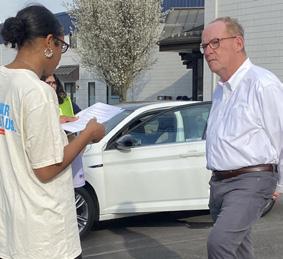
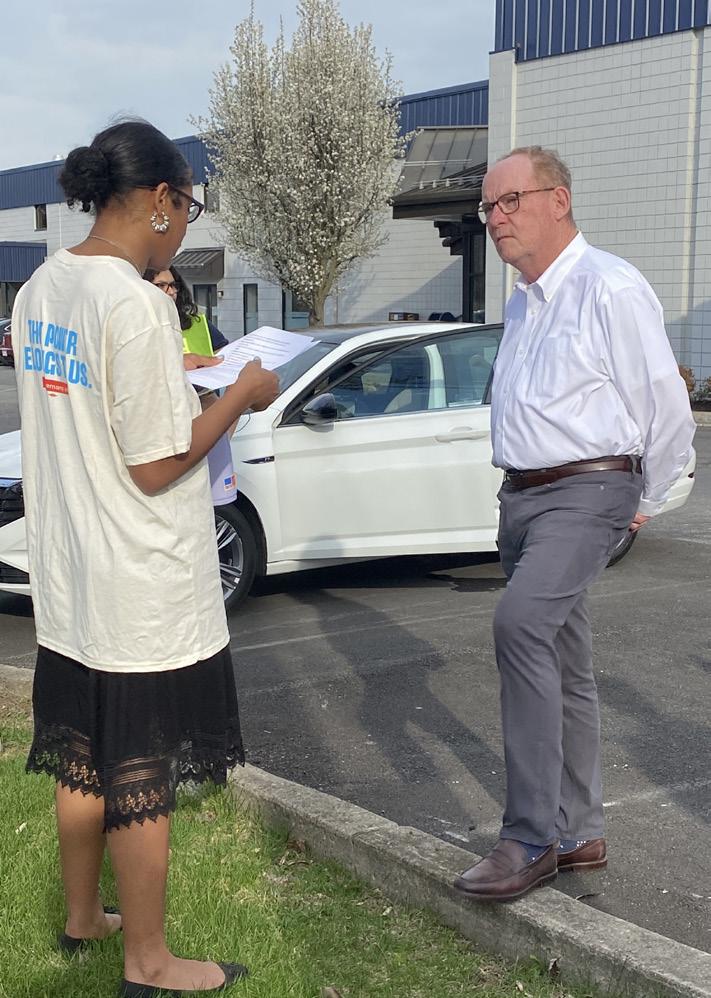
On April 14, Vassar For the Many (VFTM) organized an action in front of State Senator Rob Rolison’s Poughkeepsie office to call on the senator to support MELT and NY4All. According to a VFTM member who requested anonymity, around 40 Vassar and Bard College students and community members attended. Rolison was leaving his car when the group arrived and listened to their comments for about 20 minutes.
An Instagram video posted by VFTM of the action shows Rolison facing a group of students in a semicircle outside of his office. One student, standing directly in front of Rolison, says, “Who here thinks that Senator Rolison should stop being a coward and represent us?” The crowd behind them yells in support. The video then shows another member shouting “Rolison is a coward” through a megaphone as the senator walks into his office. Rolison did not take a position on either bill during the action, citing that he had not read them, said the VFTM mem-
ber who spoke to the Miscellany. When pushed on the fact that For the Many and New York Governor Kathy Hochul have publicly spoken about the bills, according to the VFTM member, Rolison said he worried MELT would impede police officers’ rights. Other state legislators have made similar criticisms. The day after the action, SUNY New Paltz’s chapter of For the Many hosted a similar event supporting the same bills.
VFTM has been organizing in favor of MELT and NY4All all semester, including putting pressure on local and state officials and asking Vassar students to sign a petition of support. The organization tried to meet with Rolison or his staff for months before the action, the member told the Miscellany. His office agreed to a meeting multiple times but never set a date. Democracy Matters Co-President Noah Daube-Valois [Disclaimer: DaubeValois is an Assistant Humor Editor at the Miscellany] wrote that his organization has had similar trouble meeting with Rolison despite extensive email exchanges with his office. On the other hand, after Democracy Matters met with Assemblymember Didi Barrett, who represents Poughkeepsie, she posted on Instagram endorsing MELT. Barrett cosponsors both MELT and NY4All.
On April 16, Hochul released a plan to combat ICE that included MELT’s and NY4All’s provisions. The package also included a law allowing New Yorkers to sue federal officials for violating their constitutional rights and a codification of children’s right to education regardless of immigration status. The announcement did not mention either bill by name. The VFTM member told the Miscellany, “We’ve also been trying to put more pressure on Hochul because she’s been talking about passing a package, and leading up to the last few weeks that became more of a reality, which was kind of exciting.” The state legislators backing MELT in the Senate and Assembly released a statement saying they were “thrilled” that Hochul supported the bill.
Multiple other states have recently passed similar legislation. New Mexico Governor Michelle Lujan Grisham signed a bill analogous to NY4All in February. Oregon Governor Tina Kotek signed eight immigration bills in early April, including provisions similar to both MELT and NY4All. The Philadelphia City Council passed a wide-ranging anti-ICE package on April 23. On April 22, a federal appeals court blocked a California law requiring immigration agents to wear identification.
This legislative push comes as the De -
partment of Homeland Security (DHS) has been partially shut down since mid-February. Federal Democratic legislators have refused to fund DHS without changes to the operations of ICE and Border Patrol, following the killings of Renee Good and Alex Pretti by DHS agents. On April 23, the U.S. Senate voted to adopt a budget plan that would fund ICE and Border Patrol despite Democrats’ objections. Following Good’s and Pretti’s killings, President Donald Trump replaced DHS Secretary Kristi Noem with former Senator Markwayne Mullin and demoted Border Patrol Commander-at-Large Gregory Bovino, who retired soon after. Mullin also recently announced that ICE Acting Director Todd Lyons will resign at the end of May. After peaking at almost 40,000 monthly arrests in December 2025 and January 2026, national ICE arrests have fallen by an average of nearly 12 percent in recent months. Nonetheless, almost 60,000 individuals are currently in ICE detention, including children as young as 5 years old. The Associated Press recently reported that of a sample size of 40 recently hired ICE agents, around 10 had histories of unpaid debts, bankruptcies and lawsuits against them alleging misconduct in prior law enforcement jobs. At least 24 ICE officers have been charged with crimes since 2020, including physically and sexually abusing their partners.
The Vassar Student Association (VSA) has held multiple events surrounding ICE this semester. As the Miscellany previously reported, VSA hosted a “Know Your Rights” workshop by Ulster Immigrant Defense Network (UIDN) Executive Director Victor Cueva in early March. VSA has been fundraising for UIDN this semester and has raised $500 as of publication, according to VSA President Mariya Novosad ’26.
Such events have continued in the past weeks. On March 29 and 30, Amica Center for Immigrant Rights Staff Attorney Sabrina Surgil ’21 gave two “Know Your Rights” and risk assessment workshops, one for organizations and one for individuals. On April 15, DC Peace Team member and Georgetown University Adjunct Lecturer in Justice and Peace Studies Tarek Maassarani gave a workshop on active bystander de-escalation and intervention.
On April 17, Pace University Assistant Professor of Law and Immigration Justice Clinic Director Amelia Wilson gave a lecture on immigration law. VSA has also added a document with law enforcement and immigration information to its website.
“The primary goal of these workshops is to empower the campus community by
providing folks with material skills and legal literacy that help support navigating contemporary issues and systems of oppression,” Novosad wrote to the Miscellany
In an email to the Miscellany, VSA President-elect Nico Reyes Cardozo ’27 wrote, “Nicole [Gao ’27, VSA Vice President-elect] and I have plans to continue the workshops next year. These workshops will be on issues that the student body is interested in and will not only cover immigration rights.”
Student organizations other than VFTM and VSA have held similar events. On April 25, Vassar Refugee Solidarity (VRS) hosted a panel on migrant networks and resources, featuring the local organizations Reunite Migrant Families and Rural Migrant Ministry. “By hosting this panel, VRS aimed to highlight the organizations doing the most for migrants at this time, and share opportunities for students to help repair the damage that is actively tormenting migrants and their communities today,” VRS Social Media Chair Sierra Iames ’27 wrote by email.
On the evening of April 27, the Vassar Law Club hosted a panel of multiple organizations working to protect immigrant rights in the Mid-Hudson Valley, moderated by Assistant Professor of History Daniel Mendiola. Later that evening, the Vassar Asian American Studies Working Group held a workshop on the history of Asian American immigration, coalition building and resistance to ICE.
“The biggest take-away from the panel was this: If ever you are wondering whether to get involved or go do something, ask yourself, ‘Why can’t I do this?’” Iames wrote of the VRS event. “If you don’t have a good or real reason, then do it.”
Hadley Amato News Editor
[Disclaimer: For privacy purposes, all current and former union employees quoted in this article will be referred to anonymously.]
In Fall 2025, Service Employees International Union Local 200United (SEIU) reached a contract agreement with Vassar College. The contract came amidst employee concerns over inadequate wages and reported mistreatment from Vassar’s administration. In interviews with The Miscellany News, a range of current and past kitchen and custodial employees expressed issues with recent firings, uneven pay raises among workers and an overall lack of togetherness felt in the union.
One employee estimated that fifteen union workers have been fired since the contract passed in the Fall 2025 semester. “Some were part-timers, some were in the kitchen, some were in buildings and grounds,” they said. They continued, “We’ve been here all these years and we’ve never had people getting fired like this.”An employee who was fired in December 2025 alleged that the College had not gone through any of the required procedures leading up to their termination. According to Article 13, Section 2 of the contract, “Discipline shall be progressive in nature, with four (4) disciplinary steps as follows: 1. Verbal warning; 2. Written warning; 3. Final Written Warning (which may include suspension); 4. Termination.” The employee told the Miscellany, “They didn’t give me a verbal. They didn’t give me a write-up. They didn’t suspend me. They just terminated me… And the union didn’t do anything to fight it.”
Associate Vice President of Human Resources and Chief People Officer Ginger Jurecka Blake responded to this claim. She wrote via email, “The college consistently applies the terms of applicable contracts to all employment decisions, and the union may engage in the grievance process for actions
they feel warrant consideration.” Blake also cited an additional part of Article 13, Section 2: “The College retains the right to impose a higher level of disciplinary action, up to and including termination, if the circumstances are determined to be sufficiently severe.” She explained, “This may happen, for example, when/if their behaviors impacted the safety of other members of our community [and] crime concerns.”
When asked what the union does to ensure its employees are not wrongfully terminated, SEIU President John Santiago wrote by email, “SEIU leadership and the team of stewards spend a significant amount of time on every case as it transcends through the multiple steps of the grievance process. Many of our stewards have years of experience as stewards and have been through training seminars.”
As for wages, the contract established a blanket three percent raise for all employees. Santiago explained, “Wages are fair and even for all employees. Every full time member in every job classification received a 3% raise retroactive to July 1, 2025. Every member also receives the exact same pension increase and medical insurance. These are the core fundamentals of our contract.” Article 19, Section 2 of the contract also established an increase of wages for certain employees, based on seniority and job classification. For example, union employees who complete a certain number of years of service will be moved to a “Level II” job classification, where they will be eligible for a higher wage. The contract also awards higher wages to specific positions. Article 19 highlights Grounds Maintenance Attendant, Central Receiving Warehouse Clerk, Turf Management Leader, Irrigation Grounds Leader, Chef’s Helper, Gardener Leader and the most senior boiler or operator mechanic as job titles that would receive higher wages. Santiago explained these wage raises in his email. “There were several job classifications that had adjustments made to them because these members took on additional duties.
Ex: the grounds department job classifications were changed significantly increasing the scope of the work they do,” he wrote. He added that the new wage system was created to hire fewer outside contractors, which has been a goal of the union for four years.
Many employees commented that they felt the new wage system was unfair. One said, “They choose a few people [to give higher raises]. That’s not right. We are one union; we work in the same place. So, you are supposed to be treated the same.” A second employee commented, “I think [it is] unfair. Because with everything going on we all need that little extra stepping stone to survive. It’s like, you have to lose something to gain something.” Another commented on their coworkers who got higher raises, “You pay union dues just like I pay union dues. How are you better than me that you got something the rest of us didn’t get, that we all feel like we’re owed because we’re all in the same boat supposedly?”
Employees described a growing rift in the union due to the uneven wage increases. One employee said, “It doesn’t seem like everybody is together when it comes to the union.”
Another employee commented, “Now everybody’s just for themselves. As long as it’s not affecting them, as long as they [are] getting their pay, their overtime, they got their summer job and they don’t care about nobody else. That’s not what a union is supposed to be about.” A third commented on the energy between workers right now: “It’s all this, just nasty, just heavy energy, and it shouldn’t be there.” SEIU workers also highlighted a lack of communication between the union leadership and the employees. Multiple felt that the union did not adequately communicate with them before establishing the changes to the wage system. One employee said of the changes, “That was something they should have talked [about] with the people first. You don’t go to the table and let the College know what’s best for us without the union. [They
are] supposed to sit down and have a conversation with the people first.” Another commented, “What they do with the pay, people don’t have a clue, we just find out later.” SEIU Union Representative and Organizer Sean Collins told the Miscellany via email, “The three year contract we won last October after months of negotiations with Vassar College management was ratified overwhelmingly, with nearly 70% membership participation and 87% voting in favor of ratification. We will continue to ensure the terms of that agreement are implemented and properly administered by management.”According to employees, SEIU has not held a union-wide meeting since January 2026. One employee alleged that it was not until that meeting that employees were informed of the new wage system, which led to disagreement between the workers and union leadership. Multiple employees present at the meeting explained that one of the union heads became frustrated with the workers before leaving the meeting prematurely. One employee explained, “We haven’t had a union meeting since [a union leader] got mad in ACDC and slammed his hand down on the podium and threw the microphone down on the floor.”
Another alleged that in the meeting, this union leader told SEIU members to “shut up.”
In response to a question about the frequency of union-wide meetings, Collins wrote, “Our union is a democratic organization with procedures in place for decades to determine our collective priorities and navigate internal disagreements.”
One employee said of the lack of meetings, “They don’t come down here [to Vassar] either. When we got issues going on, they should come down and fix it. Our union should be built on [a] solid foundation. We should be a lot more stronger than where we’re at right now.” They added, “The union seems to me like they’re more with the College. It’s not for the people no more; it’s more with the College now.”
reproductive rights,” Barrett told the Miscellany. “I passed the Restoration of Honor Bill… It made veterans who had been given other than an honorable discharge the opportunity to actually access the New York state benefits, if their other than honorable discharge was because of Don’t Ask, Don’t Tell, or because they had reported military sexual trauma because they had a traumatic brain injury… New York State was the first state to do that. And that was my bill, and on my watch.”
In terms of what his legislative priorities would be, Hodge said, “As an assemblymember, I think we start with tackling the cost-of-living crisis, which means we tax the rich. The income gap right now in New York State and in this country and in this world has never been wider, and the rich just keep getting richer, and we, every single day, are paying more and more and more.”
“If we want politics to be different, we have to elect different leaders… If we don’t do it now, it might be too late,” Hodge continued. “If we can seize this opportunity, and build a framework, and have a template for what we can do nationally, and use New York State as a laboratory for this sort of progressive change—like a single-payer health care system, affordable housing, tackling the cost-of-living crisis, universal child care, all these really, really important issues—then I think we can still solve problems in a post-Trump world, which is com-
ing much sooner than it feels.”
Hodge’s campaign highlights protection for the district’s immigrant communities as a key priority. Amid the Trump administration’s immigration crackdown, Hudson Valley communities have protested the actions of Immigration Customs Enforcement (ICE). In Albany, legislators have taken numerous steps to support immigrants across the state. This includes the proposal of the New York For All Act, which prevents state and local law enforcement from colluding with ICE, as well as the Mandating End of Lawless Tactics (MELT) Act, which proposes a ban on the use of face coverings and plainclothes by ICE and other federal enforcement agents during civilian immigration actions.
“Didi Barrett voted against New York For All, which is a bill that bans government agencies and law enforcement from colluding with ICE,” Hodge told the Miscellany. “I called Didi Barrett to ask if she was retiring. And, when she told me no, I told her I was running for Assembly. She asked me why. And I said, in part, because of your opposition to New York For All. One week later, she signed on to that bill.”
Barrett denied Hodge’s claims, stating, “First of all, there’s never been a vote on New York For All. So I don’t know where he would even make up that I voted against it. And it was only introduced about a year ago. And I became a sponsor last year.”
In terms of her support for immigrants
over the course of her career as an assemblymember, Barrett told the Miscellany, “I’ve partnered with the Columbia County Sanctuary Movement, years ago, on Green Light legislation, which was getting driver’s licenses for undocumented residents… More recently, I am a sponsor of the New York For All legislation, as well as the MELT Act…[and] Dignity, Not Detention, which prohibits jails from housing ICE detainees and [provides] access to representation.”
In the Assembly, Barrett has cosponsored legislation that seeks to establish the right to legal counsel in immigration court proceedings, prohibit police officers from using bias-based profiling, regulate the disclosure of information relating to immigration status and prohibit governmental entities from entering into agreements to house individuals in immigration detention facilities. In December, Barrett met with Vassar’s chapter of Democracy Matters to discuss her support for the MELT Act.
Vassar Associate Director of the Office of Community-Engaged Learning Jean Hinkley, who helps to coordinate Vassar Votes, wrote to the Miscellany, “State Assembly representatives make decisions about issues that directly affect students and the surrounding community, including housing, education funding, public transit, healthcare access, and local infrastructure. We encourage students to think about voting in local elections not as separate from
larger political participation, but as one of its most direct and meaningful forms. These elections are often decided by far fewer votes, which means individual participation can have a significant impact.”
Hinkley wrote that students may vote in June if they are registered to vote with their Vassar address and registered with a political party participating in the primary. Students living on campus this summer will be able to vote in the Aula on June 23. Ahead of Primary Election Day, voters can also participate at early voting locations across Dutchess County. Students who will not be in Poughkeepsie during early voting, from June 13 to 21, or on Primary Election Day on June 23, may request an absentee ballot by June 13 through TurboVote. Hinkley also emphasized that Vassar Votes is available to assist students with any voting needs.
When asked about why Vassar students should participate in this primary, Hodge stated, “Listen, this is your home. So you should have a say in what happens here. I encourage everybody to register to vote here at Vassar and hopefully vote for me.”
Barrett also encouraged Vassar students’ participation in local politics, saying, “We have an office right on Raymond Avenue… If people have any questions or want to talk about anything—and I know we’ve met with some groups from Vassar on specific legislation—please don’t hesitate to reach out.”
Jackson Hrebin Assistant News Editor
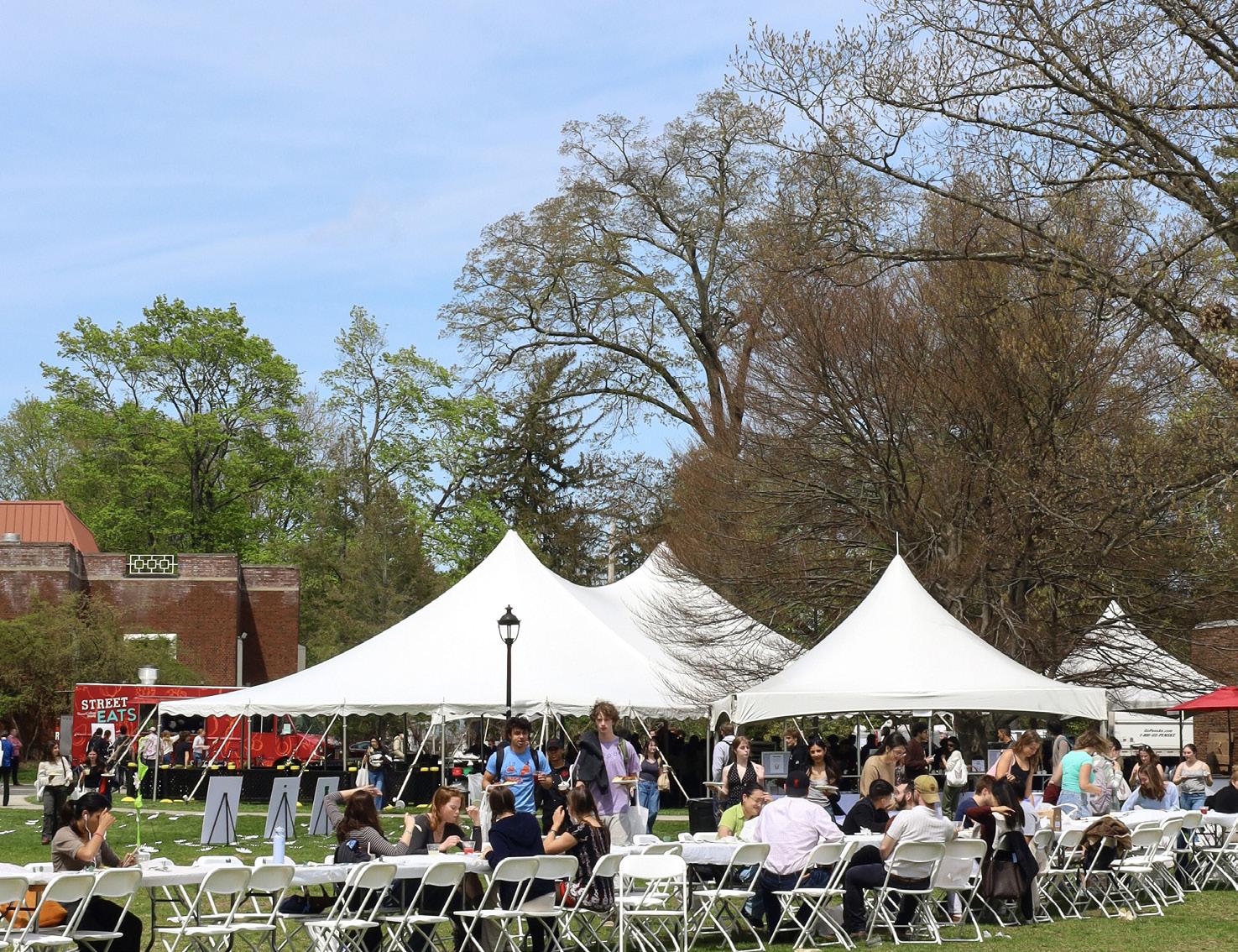
On Thursday, April 23, the Office of the President and Vassar Dining Services organized “The Vassar Table,” a campus-wide event that featured food prepared and served by the Vassar Dining staff and beverages catered by Twisted Soul. Two long rows of tables with seating for hundreds were arranged on Noyes Circle in the shape of a large “V.” Several tents to prepare and serve food were also constructed next to Noyes House. The Vassar Table began at 11:30 a.m. and concluded at 3:00 p.m. To accommodate the event, Gordon Commons was closed starting at 10:30 and reopened in the mid-afternoon. The Retreat was closed all day. Express, as well as the Oasis and Kosher stations in Gordon Commons, remained open for those with dietary restrictions.
Admittance was part of the Vassar meal plan and free for all students. All attendees were provided with gift bags, which contained snacks and beverages, as well as the menu and backstories of the featured dishes. Aside from dessert, all dishes were served buffet-style.
The menu consisted of a variety of food options, including dishes inspired by the history of Vassar and the Hudson Valley. The first dish, the “Three Sisters Stew,” paid homage to the three foundational agricultural crops of the Indigenous peoples of North America: corn, beans and squash. The menu contained information about the Stockbridge-Munsee tribe, which once lived in New York, Pennsylvania and New England, including Vassar’s campus. The event’s main dish, “Brewer Style Ale-Braised Beef,” was inspired by Matthew Vassar’s legacy as a beer brewer.
“The Vassar Devil,” a slice of chocolate cake with a scoop of ice cream, was served as dessert. The cake is a campus tradition that has been served to incoming students since 1887. The treat was paired with two adapted versions: the “Vassar Angel,” made with angel’s food cake instead of devil’s food cake, and the “Vassar Gremlin,” prepared with mint ice cream instead of vanilla. Additionally, included in every gift bag was a piece of choc-
olate fudge along with a recipe. The history of Vassar’s fudge, which was also featured on the menu, refers to a century-old tradition in which Vassar students made homemade fudge in their dorms.
Director of Administrative Affairs Amanda Goodman initially came up with the idea for the Vassar Table and helped lead and organize the event. In an interview with a Miscellany News reporter, Goodman shared that she was inspired by an annual event in New York City called The Longest Table: “It occurs in New York City…they close all the streets, set up a very long table, and make the community come and share a meal together. And I was really inspired by that, and I thought, we have to do something like that for the Vassar community.”
Goodman added, “I hope people come out of this event feeling connected, not just with one another, but also the land and our community here.” Goodman said she wants to make the Vassar Table an annual tradition and recognized the importance of receiving student feedback: “I would love, if we were to continue this, to hear how we could do it differently or what we could do next year for it. And even if it’s like thinking of a theme that we can do. So I would love students’ input.”
Bon Appétit Managing Company Resident District Manager Steven Scardina wrote to the Miscellany about the ways dining has become more creatively and extensively involved in student life and campus events. In addition to the Vassar Table, Scardina referenced Dining Services’ collaboration with the Community Care Team to offer food for wellness-themed programs, educational events and celebrations on the Library Lawn. Scardina also wrote about Bon Appétit’s partnership with the Poughkeepsie Farm Project and local restaurants and catering programs, as well as their commitment to providing fresh, locally grown produce to the community.
When asked how students can get more involved and contribute to future dining-related events, Scardina discussed the dining services’ relationship with the Vassar Student Association (VSA): “Vassar Dining maintains a structured and collaborative relationship with the
VSA, ensuring that student feedback directly influences campus food policies, menu offerings, and quality control.” Though Scardina acknowledged that most of the VSA partnership is facilitated through specific committees and administrative roles rather than direct engagement with the student body, he pointed out that students can leave comment cards in Gordon Commons and offer their ideas in the Bi-Annual Campus Dining Survey.
Several students who attended the event expressed their satisfaction and gratitude with what was offered. Chloe Mendel-Dwork ’26 said, “I thought it was beautiful. They should do it again. It was fun.” Similarly, during the event, Max Frazee ’27 commented, “The food is actually pretty good. I’m enjoying the food. They have a little ice cream station, which is nice.” He added, “I think this could be a cool thing to keep doing… I think if it becomes a regular event, then it’ll be more on people’s calendars.”
Reflecting on what could be improved about the Vassar Table, students had multiple ideas. Stuart Heintz ’26 shared, “I think they should have done it in the fall. I don’t think
this is a great finals or during the end-of-thesemester event. Maybe like a good study week event, or beginning of the year event.” Mendel-Dwork echoed Heintz’s comments, stating, “Yeah, like at the beginning of the semester, it would be a good way to introduce people to all these traditions they’re talking about.” Moreover, Frazee discussed his frustration with the closure of other dining services to accommodate for the event: “I think the thing I’m mainly not enjoying was that this morning they shut down the Deece. It caught me a little off-guard.”
Goodman explained that the College will continue to experiment with new events centered on community care, and will refine and evolve the Vassar Table based on the feedback it receives. When asked what lasting message she hoped to leave students with who attended the event, Goodman said, “Our strength as a campus lies in how we support one another by sharing resources, offering mentorship, and showing care for one another. This reminds us that no member of our community stands alone. The care we show for one another and our campus will have a lasting impact.”
Multiple doors in Davison House were damaged over the weekend of April 11, according to an email by Lathrop and Davison House Advisor Dylan Stratton. “Over the weekend one student room door was punched or kicked, leaving a hole, and the
door and stall door of the basement bathrooms were kicked in,” Stratton wrote in an email sent to Davison House residents. He explained that the cost of the repairs would be split among the residents of Davison. In a second email sent a few hours later, Stratton explained that the cause of the damage to the basement had been discovered, and the charge for that specific issue would be

removed from the total.
In a third email sent on April 15, Stratton wrote, “The estimated cost of the repairs comes out to less than 2 dollars per student.” Therefore, since residents are only charged if the total exceeds around $10, Davison residents would not be charged at all. Stratton did not respond to a request for comment.
In a statement to The Miscellany News, Dean of Student Living and Wellness Luis Inoa wrote, “If damage can be attributed to a specific student, the charge is assigned to that student.” When that is not possible, Inoa continued, repair costs are split among the residents of the house, but only when Residential Life cannot absorb the cost of repairs. “In practice, we would not typically consider charging residents for common-area damage unless the cumulative cost averaged about $10 or more per student in the affected house. It is rare for common-area damage to reach that threshold, and I cannot recall the last time we needed to assess such a charge,” Inoa wrote. In Stratton’s April 15 email, he also mentioned this $10 threshold. Inoa added, “That said, if a student is facing financial hardship, they can always reach out so that we can talk through their situation.” Davison resident Rajveer Singh ’28 com-
mented, “They just told us that somebody broke somebody’s door and then the whole house has to pay for it. Which, I kind of felt like it was unfair because it was not directly us, or we’re not directly involved in the conflict. So why have all the House pay for it?” Inoa explained, “Charging an entire house is not the default practice and would only be considered in rare cases where the responsible party cannot be identified and the cumulative damage is significant enough to warrant it.”
Should the responsible parties come forward after students have already been charged, Inoa stated, “Students would not be able to appeal a common-area damage charge.”
One student had other concerns. In a statement to the Miscellany, Davison House Vice President Noah Pockriss ’28 wrote, “Obviously the first email was a bit worrying, not only because we were being charged but because multiple random doors in Davi were being punched or kicked which is just a little crazy." Pockriss explained that he was aware of the policy to collectively charge House residents if the perpetrator could not be identified and was not concerned about being charged. He stated, “I was more concerned about what happened to cause that damage.”
‘Jet
Emma daRosa Humor Editor
Ithink streaming services have ruined TV. Yeah, so does everyone else, alright, I do not care. They totally have! The joy of waiting a week for a new episode of whatever show my sister was watching was a defining feature of my childhood, despite the fact that she is 15 years my senior and I probably should not have been watching TV with her. In order to fill this anticipation-shaped hole in my heart, I have taken to watching long-form YouTube content that has a set upload schedule. My favorite channel these days makes what I think is truly the best free content on the internet. If you are also a fan of extreme anticipation, fast-paced adventures and laughing, I implore you to pull up YouTube right now and search “Jet Lag: The Game.” “Jet Lag: The Game” is a YouTube channel run by three friends who make videos centered on playing games while they travel together. It’s my number-one recommendation for many reasons, though it has mostly risen to my top ranks thanks to its compelling invitation to be more creative in the ways we spend time with our friends.
“Jet Lag: The Game” is genuinely electric. The channel is run by a group of three men—Sam Denby, Adam Chase and Ben
Doyle—who play games that involve travelling around cities, countries and continents, sometimes trying to find each other, sometimes racing to complete certain challenges or make it to the most train stations or countries. Essentially, they turn parts of the world map into a board and become real-life game pieces. The show is currently on its 17th season, with each season being either a different game or different location and often featuring a guest player or two.
The show is many things, but perhaps primarily an ode to public transit. The players explore new cultures and learn about their surroundings through the various game mechanics, with challenges that force them to travel to different major cultural sites, try local foods or learn about native flora and fauna, all while relying primarily on a public transit system they are often unfamiliar with. We are truly watching them play and try new things together, experiencing the adventure as they do; they generally do not know what is coming any more than we do, thanks to the diligent work of their producer and occasional guest star, Amy Muller, who puts together the challenges and clues they use to move around the “board.” I do not remember the last time I relished in such powerful delayed gratification as the last time I waited all week to find out if the pair of play-
ers I was rooting for caught the train they needed to win.
In a world obsessed with short-term content, I have come to love “Jet Lag: The Game” for its unashamed length and complexity. The creators trust me—and all the other viewers—to come to logical conclusions and engage with the game strategy. I have been known to pull up the occasional German or Taiwanese train schedule and make a prediction of what the next episode will hold. Did you ever play that game as a kid where you close your eyes and point on a map and plan a pretend trip to wherever your finger landed?
“Jet Lag: The Game” is the true embodiment of that childlike wonder at the possibilities travel can hold.
There is more to “Jet Lag” than just the exciting cliffhangers and wonder at how the players are still upright after days of nothing but travel, and, of course, extreme jet lag. “Jet Lag: The Game” is an invitation to play with our friends. When was the last time you played with your friends? I remember every game of werewolf, every round of hide-andseek in the dark, every vicious round of Ticket to Ride I have ever played far better than even some of my favorite moments watching a movie or show with someone I care about.
The “Jet Lag” cast creates content, but they also produce a board game version of their
most popular game, Hide and Seek. You can buy the same decks of cards they use for the hider and seeker and gather up a few people and play your own round in any size city. Throughout the videos, they give you tips on how to play with your friends. There are plenty of moments where the minutiae of different game mechanics are explored, which, on the surface, may seem unnecessary and counterproductive to their goal of entertainment. However, I have found it to be quite the opposite, as it makes the game seem like a real thing that they actually want us to participate in, not just consume. Now, I have not bought Jet Lag: The Game’s “Hide + Seek” transit game (yet), but I am in awe of how they have not only created this outrageous sounding concept, but made it accessible for anyone to play as well. How fun would it be to play Jet Lag: The Game’s “Hide + Seek ” with high school friends in your home city? Or, for my fellow seniors, maybe it is the perfect way to learn the ins and outs of the public transit system of wherever you plan to go next.
“Jet Lag: The Game” is entertaining thanks to its unattainability but also the extreme relatability of the cast. It certainly provides an indirect case for comprehensive, fast and free public transit. Beyond all of this, though, it is a reminder that adult life can be full of wonder and of play, we just have to let it.
Sophia Marchioli Assistant Arts Editor
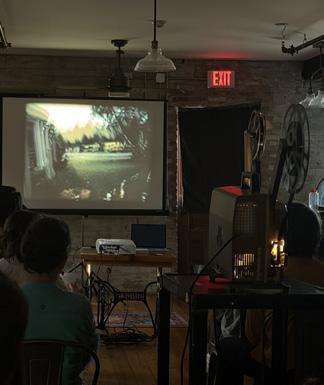
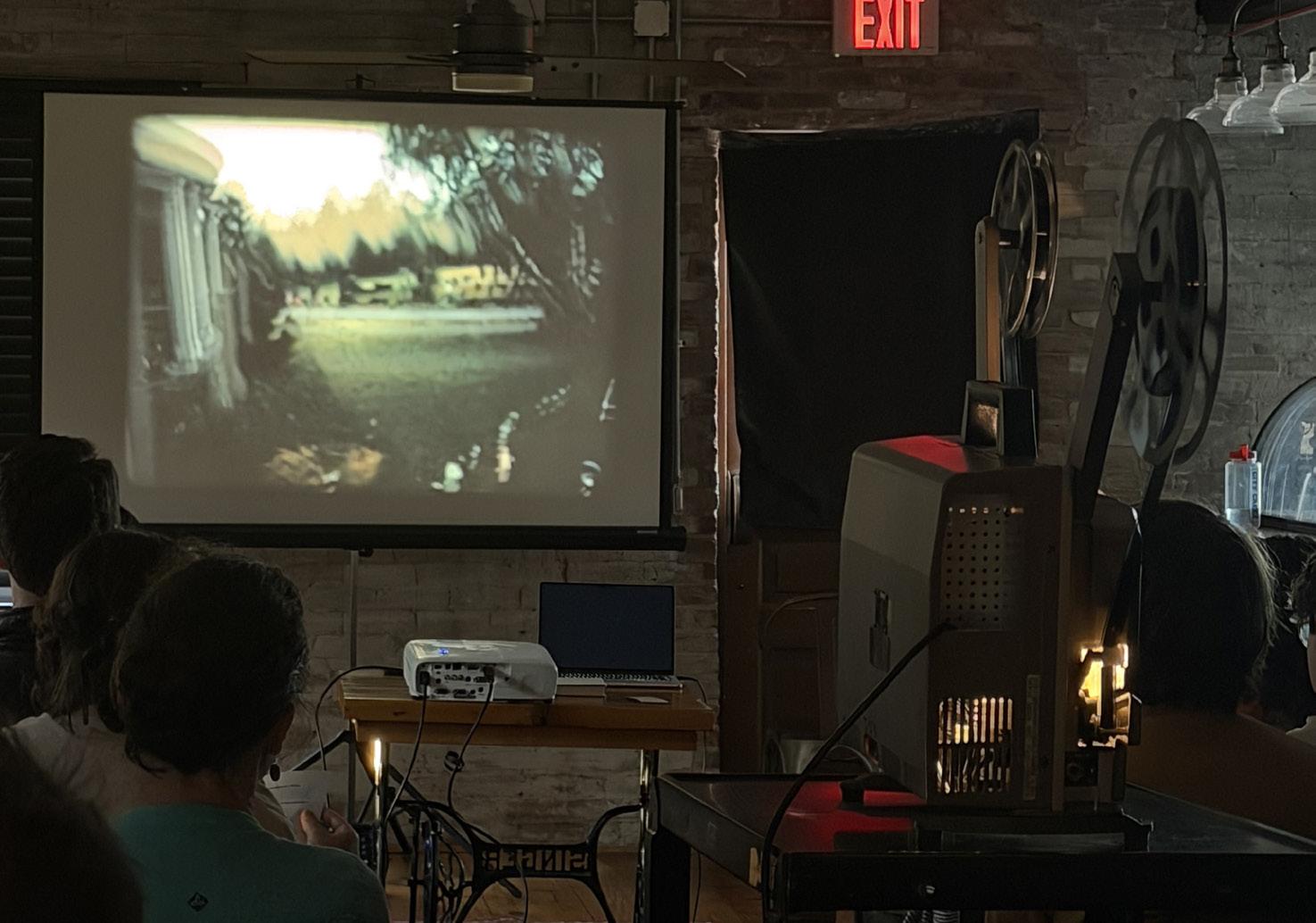
On Friday, April 23, the seven students in Associate Professor and Chair of Film Erica Stein’s film intensive, FILM 222: “Curating Microcinema,” turned the historic Poughkeepsie Underwear Factory, located just off of Main Street, into an avant-garde microcinema. Eight short films by independent filmmakers shot on 16mm film cameras were shown at this collaborative event between the Poughkeepsie community and Vassar’s Film Department. Students were assigned to a role and led the budgeting, outreach, site planning, film distribution and technical needs of the event. By 7 p.m., the small restaurant space on the lower level of the Underwear Factory was packed with students, professors and community members filling in the bar stools, chairs and bean bags that lined the aisle.
While taking FILM 221: “American Avant-Garde Film,” students can opt into this additional intensive which meets for two weeks at the start of the semester and then again in the last four. When paired with the intensive, this class works to expose students to the past and present of avant-garde film, then hoping to have them imagine its future. According to the Vassar Course Catalogue, the course explores what this genre reveals about the American identity, how it provides an alternative to dominant commercial film and why using the 16mm film technology medium is important to avant-garde film. Therefore, while Poughkeepsie does not have its own microcinema, students in FILM 222 created an intimate, temporary space for these films to thrive. The intensive runs on in-class workshops, independent research, group work, meetings with Stein and even sessions with faculty in related departments. The first step students take in planning the event is managing the budget. Budget Coordinator Abbie Zhang ’29 stated that the class was given $2,000 by the Film Department to organize this event. This covered renting physical film reels—an essential step in using 16mm film—as well as digital films from dis-
tributors, refreshments and black curtains to block out daylight during the screening. Site arranging was one of the next steps in the planning process. Site Planner Trevor Picanco ’28 decided, along with other class members, that they would also house their project in the Underwear Factory to keep with the tradition that past intensives have set, as well as the project’s overall emphasis on community accessibility. Picanco added, “We also liked the idea of utilizing a public space that is well-connected with the surrounding community, rather than hosting it somewhere more separated that is less accessible.” Class members were also inspired by the small size of the community restaurant space in the Underwear Factory, developing it in a way that made the event feel cozy and easy for audience members to connect with both the films and each other. On the night of the event, attendees were welcomed into the building and guided into the microcinema. The room was dimly lit by lamps that looked like cameras, or had film reel as lamp shades, and the day’s remaining sunlight snuck in through the cracks between the black shades and the window frame. Audience members shared easy conversation as they stared fascinated at the 16mm projector which was the centerpiece of the room.
This projector, as well as the other technical demands of the event, was operated by Event Technicians Makenna Brown ’28 [Disclaimer: Brown is the Photo Editor for The Miscellany News], Lucia Hornischer ’26 and Vinnie Palazzo ’26. The three were tasked with learning how to project and handle 16mm film in collaboration with Womp Haus (Vassar’s film production and equipment rental house), ordering the films and handling digital projection. Palazzo stated that working with the delicate 16mm prints and projector was the team’s most daunting task, as Vassar only has one of these expensive projectors.
Lastly, students were tasked with outreach, which was led by Outreach Coordinators Lily Siegel ’28 and Cody Siegel ’26. They were entrusted with curating a collaborative space in which Poughkeepsie, greater New York and
Vassar community members could connect over avant-garde film. For Poughkeepsie outreach, the pair asked Main Street and Arlington business owners if they could put their poster up in their storefronts. Additionally, they worked with the Underwear Factory’s kitchen operations coordinator, Jayme Schultz, to publish the event information in a space that would be visible to the building’s residents. To connect with filmmakers all around New York, they contacted art collectives such as The Art Effect, Woodstock Film Festival, Upstate Films in Kingston and Arts Mid-Hudson. Additionly students spoke to the female experimental filmmakers from the Women’s Work Symposium hosted by the Frances Lehman Loeb Art Center, known as the Loeb, earlier this semester. To bring in scholars from greater New York, they reached out to film studies professors at Bard College, Marymount Manhattan College and The New School. Lastly, for Vassar outreach they discussed the event with EngagePK, a program that connects students with local events off-campus, the Film Majors’ Committee, urban studies professors, education professors, art history professors and the Loeb. Lily Siegel stated, “The challenge I en-
countered in the role was trying to make the event sound accessible if folks didn’t have prior Avant-garde film experience (just like me in the beginning of the semester).”
The films that were shown were, at first glance, confusing in their layout and content, but extremely captivating. The audience seemed enthralled by the sometimes indecipherable visuals and audio, formulating their own unique understandings of what each film was about, though with a little help from the pamphlet of film descriptions that was handed to each attendee at the door. One theme that held each film together was the exploration of memory in its meaning and how it is experienced, giving the event the title “Memory Theater.” Audience members were encouraged to digest each film as they watched the reel in the projector being switched by Hornischer and Palazzo, or the digital films being queued up by Brown. After the screening, attendees discussed what they saw and celebrated with refreshments. The event was a spectacle, showcasing avant-garde 16mm film in its most appropriate setting, through a celebration among community members who bring new life to this genre of film.
Aurelia Harrison Assistant Arts Editor
Last Friday night on April 24, WVKR, Vassar College’s independent radio station, hosted their annual event spotlighting femme and queer DJs: Pink Noizes. The night was headlined by singer and DJ Ren Evangeline Gray, known professionally as Ren G, a pop-EDM powerhouse from New York City. Student duo DJ Creature—Naomi Sullins ’27 and Edy Savage ’28—started off the night with their first live set ever. The walls of the Villard Room were decorated with bright pink tulle and glitter, and concert-goers threw pink balloons in the air as they danced.
DJ Creature opened the night with a high-energy set featuring artists ranging from Underworld to Machine Girl. Sporting sunglasses and lacy bralettes, Sullins and Savage came out swinging with a truly impressive Vassar DJ introduction. “I had so much fun,” Savage said. “This was my DJing debut, so I spent the hours before feeling afraid, but the crowd and Ren G made me feel so welcome!”
The duo are close friends outside of the music world and spent several hours rehearsing on Sullins’ board to prepare for the event. Though this was her first official gig, Sullins had some DJ experience under her belt and sometimes plays under the name DJ Roger Sullins. She has previously DJed live at house parties: “My friend sold me their old DJ deck, and I really wanted to learn how to use it because I thought DJing was so awesome,” Sullins said. “I really like electronic music, and I think learning how to DJ would enhance that… I was really excited to play at something that was…hosted by such a cool club… Also, I
love Ren G. I was so excited when they were bringing her to campus and even more excited that I got to open for her.”
After a brief intermission, Ren G took the stage, performing each track with palpable charisma and talking with the crowd between songs. Her set featured several of her hit singles, as well as fan favorites from her EP “Hello!” and her album “Miss 24/7.”
This year is Pink Noizes’ 10-year anniversary, and early versions of the event have been happening for about a decade prior. “We have an incredible amount of femme DJs who have been spinning on our decks for years,” said Haley Brown ’27, WVKR’s Promotions Director and the mastermind behind Pink Noizes.
“We had a great show four years running until they graduated called EDFem, and they were just incredible. We have some pretty notable alums…Frost Children was one. MGNA Crrrta was here two years ago. It's fun, and it's always right before, on the cusp of fame, you know? It always feels like we're finding them at the right time.”
WVKR takes hosting seriously. Ren G’s dressing room was easy to find: Right next to the WVKR office, they had stuck a glittery star with the artist’s name to the door. She had requested a sugar-free Redbull and makeup wipes, and WVKR took the liberty of including a spread of all-pink candy and free Vassar merch in addition.
Ren G is from Huntington, Long Island, and currently resides in Brooklyn. “MTV was still on when I was a kid,” Ren said. “And my dad had a bunch of DVDs of music videos, like the Smashing Pumpkins, The Smiths, No Doubt. So I just kind of listened to a lot of that music growing up. I always wanted to do
something with music, but it always felt like this very mythical sort of thing that only people with, like, magical powers could do.”
Previously, Ren G was a member of the band Club Eat. After they broke up in 2024, she decided to pursue her solo career. As of publication, she has over 16,000 monthly listeners on Spotify. “I actually started DJing before I made music—that was my foray into really just building my taste and learning about even more music, learning about dance music, learning about community,” Ren G said. “In New York, the scene I kind of was playing with…was a lot of people that also loved music, loved alternative electronic music.”
When describing her experience as a queer DJ in New York City, she said, “What I love about New York and the parties in New York is actually all the parties feel like a melting pot of everybody. There’s queer people. There's straight people. And that's the kind of environment I like the most because I don't really like anything feeling exclusive to anybody. I like everybody being able to come together. And New York is a great city for that.”
Ren G has collaborated with artists such as
Isabella Lovestory, Snow Strippers and Dorian Electra, whom she cites as both major inspirations and valuable friends of hers. She told me she was happy to make the trip from New York City to Poughkeepsie to headline Pink Noizes: “I love playing shows. I love meeting new people. And especially if anybody shows any interest in me or my music like that actually means the world to me. And so, like, I'm always down. I'm down to take a train ride… or a plane ride…to have fun.” Brown and the rest of WVKR were particularly excited to be hosting Ren G for this event. “The thing about WVKR is when we throw these events, it's always an artist who wants to be here for the music,” Brown said. “It's never about status, it's never about money, it's never about clout. It's very much artists who are appreciative, and I think it's nice, because the student body can feel what an artist is giving to them…We're small but mighty, and it brings in the right people every time. And Ren [G] has kind of been on my radar for a little bit…she's so kind, she's so camp, she's so Pink Noizes, you know? And it's exactly what we needed.”

April is the time for a reset. With spring fully under way and the imminent liberations that summer brings on the horizon, things are looking up. Perhaps the best activity that comes with the return of the warmth is walking around campus, taking in the arboretum’s vibrant flora. The playlist that follows is for the spring devotees. Roll out that picnic blanket, turn up your speaker and press play on these springtime tunes curated for basking in the fresh, restored sun.
1. “The Path” by Lorde
Perhaps the most obvious place to start in a discussion of quintessential warm weather music is Lorde’s “Solar Power.” This first song on the project is freeing and reassuring. Comforting vocals, striking drums and glowing synths take over your ears. Close your eyes and get lost swimming through crashing ocean waves. I am serious: Revel in the daylight!
2. “Relationships” by HAIM
In classic HAIM form, it is time to go for a walk. Trek towards Sunset Lake, but do not forget to stop and take in the daily-changing flower blooms. Flow into this breezy, dancepop track and skip to the groovy beat. Maybe, like the HAIM sisters, you are sick of modern relationships. Spend your walk debating romance’s ambiguity alongside them.
3. “Just for Love” by Electric Light Orchestra
You find a charming little bench that overlooks the lake. As you watch the tranquil geese sit on the water, the light breeze hits
your face. Plug in those wired headphones and sink into Electric Light Orchestra’s radiating production. Instead of worrying about finals (yikes!), you find comfort in the nature that surrounds you.
4. “BODYGUARD” by Beyoncé
Beyoncé sure knows how to craft a springtime hit. This punchy single is the perfect soundtrack for a windows-down drive through the Hudson Valley. The liberating, country-twanged soundscape meshed with Beyoncé’s smooth vocals results in a lively classic. I am certainly not one for beers, but this track demands cracking open a cold one… or several.
5. “DANCE…” by Slayyyter
After one drink, you end up having five more. It is nice out, so it is granted that you act more relaxed. And besides, it is the weekend. Gather your friends in a dimly lit dorm and dance your heart out to Slayyyter. “DANCE…” is explosive: the perfect infectious pop song to jump around to. As you picture the night ahead, allow Slayyyter’s cracking, high-tempo and seductive production to consume you.
6. “Got to Be Real” by Cheryl Lynn
Boogying with your friends does not stop with Slayyyter. Turn back the clock to the ’70s and let the vibes keep flowing. Cheryl Lynn has you covered for those integral final minutes before you leave the dorm for the party. Let loose and swing, taking in the song before stepping out into the horrifying Vassar party scene. It will probably be lacking good music anyways.
7. “Stars” by PinkPantheress
As expected, the party blows. Yet amidst
the cheesy 2000s pop songs and mediocre rap, there is a glimmer of hope. PinkPantheress’ soft voice overtakes the function, her upbeat instrumental wrapping around you. “Stars” is catchy: Whether you are being pushed around a Town House (TH) or walking to class on a brisk April morning, PinkPantheress is sure to brighten your mood.
8. “drop dead” by Olivia Rodrigo Surprise… your crush just walked into the party! Olivia Rodrigo’s newest single is for those who have their eyes on someone. Not only does its teen-pop sound encapsulate the flawless springtime energy, but it is also plain fun. Rodrigo is in love, and she is not afraid to tell us. Picture yourself running around the Palace of Versailles, daydreaming about your current love affairs as you gaze upon the ornate art. But in reality you are trapped inside a sweaty TH in Poughkeepsie, New York, and your crush is walking right at you.
9. “I Wanna Be Your Lover” by Prince Congrats! They are totally into you and Prince’s classic song is cued up next. Prance along to this jam’s jumpy beat and grab onto your lover’s hands. The infectiousness of this high-energy track lies in its unique funk groove. And the instrumental dance break in the middle of the song certainly aids its slick emotional resonance. Prince knows how to get a party started.
10. “forever” by Charli xcx
My personal favorite Charli xcx song is one that blooms both renewal and growth. “forever” is a perfect mix of self-examination and distorted, crushing synths that her 2020 album, “how i’m feeling now" is known for. “forever” feels deeply personal and—alongside
her raw vocals—the track exudes a characteristic vulnerability that I admire about Charli.
11. “Next to You” by Unflirt
This is an underrated, dreamy track that begs to be played after a long night out. Unflirt’s gleaming indie banger can carry you through a lively spring afternoon to an inebriated night of looking up at the stars. Its production traps you in a world of endless pondering. Or perhaps the drinks are finally catching and, at last, bedtime calls.
12. “Tractor Beam” by Snail Mail Snail Mail’s recent album, “Ricochet,” makes me feel hopeful. While lyrically, this track discusses the struggle of dissociation, longing and remembering a past relationship, “Tractor Beam” sounds like a coming-ofage revelation. You wake up the next day and the sun is shining outside your dorm window. The floral scents of the blooming trees seize your senses. With finals looming, you know your semester is limited. You are ready to conquer what is left of your academic year, whatever that may bring. Allow Snail Mail to offer you some resonances of encouragement.
13. “Bad Girls” by Donna Summers
Summer is upon us. While I can not tell you what the future holds, Donna Summers can supply some disco-driven motivation. I challenge you to let loose. Allow the driving bassline and bright funk stabs to strike some fun. Celebrate that we can finally put away our Carhartt coats and slip into some shorts. It is spring after all, and the time to come awaits: “Toot toot, hey, beep beep!”
This playlist can be found on The Miscellany News website.
today?” Miller speaks to the student-athlete balance by emphasizing the importance of being present. Another strategy Miller uses is controlling what you can: “I just try and give as much [of] myself to my classes and to my training as I can, and sometimes there’s mess ups, sometimes there’s slip ups, just trying to stay consistent.”
The intensity and hardships of ultra running still very much exist for Miller, even with her tenacious mindset. Each race came with its own hiccups. Miller caught the campus stomach virus right before her 300-miler this March, and in previous races has sprained her ankle, dislocated her shoulder, and split her feet open. Nevertheless, what Miller continues to put out into the universe, and receives back, is a gritty and consistent energy of giving 1,000 percent of herself. To wrap her head around long races, Miller follows the “chunking” method as a way to take each challenge as it comes: “[I] spend time with the people I care about…[and I think] how big is this chunk? How much can I run during this chunk?” To not get overwhelmed, she takes things day by day, task by task. Even so, Miller is human, she said that it’s “not to say I don’t get lost in the sauce sometimes… Stress, holy moly. But you just gotta do it, do it, do it…
And do as much if you can.”
When it came time to expand globally—as one does during their summer vacation before junior year—Miller spent 30 days running around Japan, moving about 40 miles a day. This set her on a journey of international connectedness and self-discovery despite the language barrier. On the island of Shikoku, Miller added, “most of my sleep was in those temples…[the monks were] the kindest monks you’ll ever meet, that I’ve ever met. [They’re] the only monks I’ve ever met.”
Then came time for Miller’s semester studying abroad, where she flew to Tanzania and kept on running. Miller explored Tanzania’s beautiful culture and land beyond what her program had to offer. Through running, Miller interacted with people and places she never would have found if she had not let her passion for running, her curious mind and warm friendliness guide her immersion.
After studying abroad, the next country to tackle was Iceland, which Miller completed during the summer of 2025 to get balanced training in challenging and new environments. Through it all, she expresses the freedom of just being—in touch with the elements of the natural world. In Iceland, she traveled between villages for supplies
every few days, since there was no major city around. Miller let the stars, the Arctic Coast and paper maps guide her instead of following a digital GPS. Of course, Miller dealt with the challenges of planning routes off the grid, but her spirits remained high. She said, “I was so lost for a couple days, but [it is] kind of really fun to do that…because what are the stakes, you know? You’ll figure it out where you find a road and you hitchhike back.”
In the fall of her senior year, Miller completed a 200-mile race in Nebraska. Day and night, all she saw were cornfields. Sleeping as little as necessary, Miller fuels herself through these extreme races by grabbing chicken sandwiches, quesadillas and gummies at the aid stations and throwing them into her pack.
Miller continued her solo training through the unkind Poughkeepsie winter and into the spring semester for her big adventure in March: the Viper 300-miler in Tennessee. Miller noted the importance of her support system, her friends here on campus and her family back home in such adventures. She attributes her imagination and drive to chase big goals to her grandfather, who passed away last year. He was her number one fan who always believed in her. She said, “he would tell me that there’s
a strength and a power in seeing the world, the way that I wanted to kind of take it on…I think a lot of what I do now, it’s like, I’m definitely thinking of him and trying to channel that. I think he lived very fearlessly, and I just want to be like him”.
Coming up next for adventures, she has post-grad plans to enter the fastest known time (FKT) space, a global trail competition which consists of hikers tracking how quickly they can complete an entire trail to get a course record. She described it as “kind of like the running with the backpack vibe.” Through the inevitable successes and hiccups, Miller is training to complete the big dream of one day, perhaps by 2028, a full circumnavigation of the world for ecological conservation causes.
Miller’s approach to life is what we need to keep moving forward in our self-discovery and adventure when everyday routine and busyness become too much. Even with the importance of training and repetition, when it comes to the actual events, Miller says, it truly is all a mental game.
She stated, “Everyone’s kind of starting out [on] an equal playing field, as long as you have somewhat of a base.” For people curious to venture down a similar path, her advice is to explore it on your own terms and find your rhythm.
Eduardo Culmer Columnist
At first glance, it barely registers. A low, green cuboid shape emerges from the ground, soft at the edges, almost dissolving into the landscape of the library lawn itself. There are no barricades surrounding it, no plaque instructing passersby to stop and gawk at it. Students cross by it with curiosity, perhaps noticing without truly understanding. It does not demand attention.
It waits.
In 2024, a kaleidoscope of tents once sprawled across “Liberation Lawn,” packed with protestors brandishing homemade banners and hand-stitched keffiyehs. There, students gathered not only to protest, but to question institutions, histories and even each other. Once home to a firestorm of student activism, the quiet grassy lawn outside the Frederick Ferris Thompson Memorial Library is now transformed into a temporary altar to a new form of active resistance. Where the encampment spread, an innocuous shape now holds vigil.
The “Memorial to the Memory of the Encampment” is a block of moss laid painstakingly in the space where Vassar’s encampment—part of a larger pro-Palestine movement on college campuses around the United States during the 2024 academic term—once filled the Library Lawn with the sound of nylon tents flapping in the wind and discontented voices rising in opposition against oppression. To better understand the intentions behind this quiet commemoration, I spoke with student sculptor Gabriel Moss ’27, who put up on the work on April 13. We discussed how his work transforms the ephemerality of protest into something living, growing and deliberately understated:
Eduardo Culmer: “Before we really get into it, can you first explain your sculpture installation? What prompted you to make it?”
Gabriel Moss: “I’m currently in Sculpture II, where, earlier in this semester, we were assigned to create proposals of an imaginary monument or memorial, and I couldn’t get the encampment off my mind. I spent a lot
of time thinking about how to approach the topic. I didn’t want to be attempting to speak on behalf of a larger group on campus, and I was not trying to make my experience more important than anyone else’s.
“I spent a day on the library lawn trying to remember what had occurred. I could still feel the community we built. We were less limited by the social entanglement of life here. I remembered going to sleep at night while others stayed awake to keep an eye out. I remembered what it felt like sitting in a circle and attempting to come to consensus on next moves after administration negotiators returned with their updates. I remembered when Palestinian community members would come visit us with their small children and lead us in dance, reminding us why we were there to begin with. I remember crying while we held Shabbat, reflecting on what it meant growing up illusioned by zionism, now being in the strongest Jewish community I had ever experienced.
“I remembered what the lawn looked like after we had cleared out. While we carefully cleaned, remnants of the encampment remained, flattened grass where tents stood, stake holes, imprints from our tables. In my project, I hoped to create a space of living memory for the encampment. I wanted to construct a physical site for others to come and reflect on their time in the encampment, or a space for individuals not involved to reflect on their responsibility to the movement for Palestinian liberation today. I wanted to remind people that even though the nationwide encampment movement may be in the past, the fight for Palestine is far from over.”
EC: “Can you talk more about your relationship to the 2024 encampments?”
GM: “I joined the encampment the day it was put up. At the time, it didn’t feel like there was an alternative—I was compelled to do it. It was the right thing to do, I had the capacity, so I did. I think of the warmth and support I felt from my peers, but also the threats, the pressure, the strategic manipulation of the institution. It still serves as a stark reminder of the limitations of existing within a private liberal institution like this, in which, despite
their public image, profit will always reign supreme over morality and justice.”
EC: “So, Gabriel ‘Moss,’ why moss? What drove you to utilize the materials you did in this piece?”
GM: “Moss is one of the oldest living materials. Older than trees. Its resilience defines its existence, growing on surfaces hard or soft, through the cold and through the heat. I was hoping that, through this medium, I could convey that even without the physical encampment, the movement continues to grow, and the people of Palestine continue to resist through atrocities most of us will never be able to fully comprehend. Moss existed long before us, and will continue to live on long after us; the same is true of Palestine and its peoples.”
EC: “Due to the College’s rules on student installations on campus and the nature of the building materials you used, your sculpture’s not meant to last forever. Is the ephemeral nature of ‘The Memorial’ part of your message?”
GM: “100 percent. My piece will remain up for about two weeks, or until it collapses. The mud used will rot the wood or the sun will dry the mud out. The rain may tear it down before any of this. The encampment, too, got cut short. Cracks formed, larger powers were at play, and it came down in under two weeks. As my piece changes everyday with the weather, I hope it continues to play out as an encampment memory, even if that includes memories of decay.
“This piece requires constant care. I have been out there watering it up to six times a day, trying to keep it damp, comfortable, and safe. However, no matter how many times I checked on it, or how much time I spent caring for it, it will still eventually fall apart. The moss and mud were never going to last forever, and it was never meant to. Last night the storm caused the first major blow, and the piece has begun to unravel.”
EC: “Toni Morrison once said that ‘All good art is political! There is none that isn’t.’ In her view, art is meant to reflect who’s centered, erased or valued in the larger zeitgeist. As a student activist creating art in a world where the most prominent artists of our generation
often try to distance themselves and their work from the world of politics, what do you think the responsibility of an artist is when it comes to social commentary and strives for social justice?”
GM: “Well, the first thing I will say is that I am an Urban Studies major, Studio Art and Hispanic Studies correlates—”
EC: “Oh, my bad!”
GM: “Art is inherently political. No matter the content, everything can be politicized. I think artists should take the responsibility of controlling their narrative. Without this, art can easily be co-opted, something the school could easily do to my piece, and something I would reject.”
As building plans for the president’s 250ft “Arc de Trump” cast gilded shadows over social media platforms, many Americans are beginning to ask themselves the same host of questions: What is a monument? How do we choose which moments to commemorate? Whose names deserve to be emblazoned in stone for millennia?
Even after conducting this interview, Moss’ memorial offers no easy answers. It does not tower, nor does it proclaim permanence. In contrast to monuments that seek to fix history in place, Moss’ work shuns permanence altogether. It refuses the authority of Neo-Classicizing stone and instead embraces decay, care and continuation. If traditional monuments mark the end of a story, this one insists that the story is still unfolding. The movement it honors has not yet reached its conclusion.
The “Memorial to the Memory of the Encampment” softens, erodes and demands care. Since its installation over a week ago, the sculpture has already begun to deteriorate due to heavy winds and rains: Moss’ vision is unveiling itself to us in real time. In this state, it implores viewers not to look up in awe, but rather down in reflection. In doing so, the “Memorial to the Memory of the Encampment” reimagines the monument not as something that immortalizes power, but as something that insists on the preservation of a collective memory—fragile, collective and alive.
It waits.
Sydney Jones Features Editor
If you are looking for Assistant Professor of Physics and Astronomy Ed Buie outside of the classroom, he is probably baking cookies. On a typical day, he wakes up between 4 and 5 a.m. to start prepping ingredients for the day’s batch, which includes the tedious task of chopping chocolate, before he heads back to campus to teach intro- and upper-level classes on galaxies and stars until about noon. After teaching, he returns home to portion or bake dough and films the process. This abnormal, yet idyllic routine is all for Bliss Bites, a project Buie started in the fall semester to better campus one cookie—or, better yet, boxes of them—at a time.
In the form of weekly cookie “drops,” Buie allows followers to enter a raffle on the Bliss Bites Instagram page, @blissbitescookie, for free boxes in a variety of rotating flavors. Sometimes, the raffle is replaced by a kind of free cookie scavenger hunt where Buie posts a series of hints, riddles or clips that lead students to find the cookies at a different part of campus on a first come, first serve basis. Before Bliss Bites’ inception, Buie began sharing his baking with students in his astronomy classes during finals week. Last year, he formed Bliss Bites to expand the joyous potential of his homemade sweets to all of campus.
But before the complex flavors which frequent the free boxes—like honey matcha white chocolate or ruby chocolate pistachio— could enter the equation as well as the hearts and stomachs of Vassar students, the motivation behind Bliss Bites was born out of the intention to spread good to the community. Buie developed this desire to make a more direct impact while attending grad school, to escape the often isolating realm of research.
“So our science by its nature is selfish. Like
I have to ask for money to do stuff that I think is cool… In the grand scheme of things, a lot of what I do is not helping a person,” said Buie. “You know, it’s not improving the livelihood of anybody. It’s just this thing that I think is really interesting, and so I want to engage in it. And when I was in grad school, I struggled with that.”
During the pandemic, he exercised this intention to do good through baking. He started recreating the cakes made by his granny—a beloved and avid baker who passed away when he was in middle school—with no written recipes left to guide him.
“She was an amazing baker. She could do anything, cakes, pies, whatever,” explained Buie. “And so pandemic times, you know, a lot of bad things are happening. And I was just reflecting on her. And family members were going through things… I refused to believe that her cakes could no longer exist anymore.”
After mastering his granny’s cakes, Buie moved on to cookies while graduating from grad school to capitalize on their shareable nature for friends and family. When he arrived to teach at Vassar College four years ago, the need to make a positive impact remained—but with no clear outlet.
“And then when I came here, it was kind of the same question of, okay, doing astronomy, teaching this, mentoring students, but I feel like I can do more. What is that? And I remember finals week, I baked cookies for my students because there isn’t really any good sweets around,” said Buie. “So I was like, all right, well, I know I can bake good cookies, so do that. And that’s how it started.”
Though before Bliss Bites could reach staple status, the mysterious cookie drops were met with some skepticism from students; understandably, the offer of free baked goods left around campus simply seemed too good to be true.
“I remember I just put up flyers everywhere and just, like, stood outside,” recalled Buie. “And some people came by, of course, everybody was like, what, is this real?”
Eventually, like the cookies in Buie’s overworked oven, students warmed up to the prospect. In addition to posting fliers and conducting regular cookie drops, Buie expanded the amount of content he created for the Bliss Bites Instagram page, which he started at the end of 2024 at the suggestion of his brother. This included filming video testimonials from students lining up at the free drops, shortform glimpses into the behind-thescenes of the baking process and information about Buie and Bliss Bites’ origin story.
Since then, Bliss Bites has taken campus by storm. The Instagram page boasts over 500 followers; in this semester alone, Buie has collaborated at events with campus organizations such as Vassar Refugee Solidarity and Vassar Alliance for Ukraine, and distributed cookies in locations ranging from The Brew to Rockefeller Hall.
Funnily enough, before the pandemic, Buie saw himself as more of a chef than a baker. Though it certainly seemed to me like his scientific background was well suited to developing the patience and trial-and-error testing skills required to reverse engineer recipes for his granny’s cakes and formulate his own unique flavor combinations for Bliss Bites.
“So the weird thing is I used to hate baking. So I like cooking because cooking is a free form. You can kind of like dash this, dash that. In baking you can’t do that,” recalled Buie. “The first time I tried to make cookies they were terrible. They spread way too much, I just didn’t understand ratios of things.”
“That science brain of mine probably delved into it deeper. It was like, okay, all right, if I add more flour, this happens. If I add more sugar, it will spread more, but then
be too sweet. So I don’t want that. So you got to take away some sugar and learn to balance everything.”
In the past two weeks, Buie conducted the first Bliss Bites drops for charity, during which he offered students the chance at one of two boxes of the latest flavors if they could provide a receipt of a $25 donation to any charity of their choice. Each week, both boxes were accounted for, and a diverse set of causes, including Sudan Emergency Relief, the Trevor Project and the United Nations’ Children Fund, received donations.
“And a few of these people, it was their first time donating to a charity,” explained Buie. “They’ve always wanted to, but they just never really had the time to look into things.”
As for the future of Bliss Bites: the plan is full steam ahead into next semester. Buie hopes to continue running and promoting weekly giveaways, including those for charity, and expanding the set of flavors—which always begin with a half batch, for testing purposes. Recently, he experimented with combinations like lavender white chocolate and miso oatmeal raisin. Be on the lookout for the next drops, because an Earl Grey or tahini cookie may also be in the works.
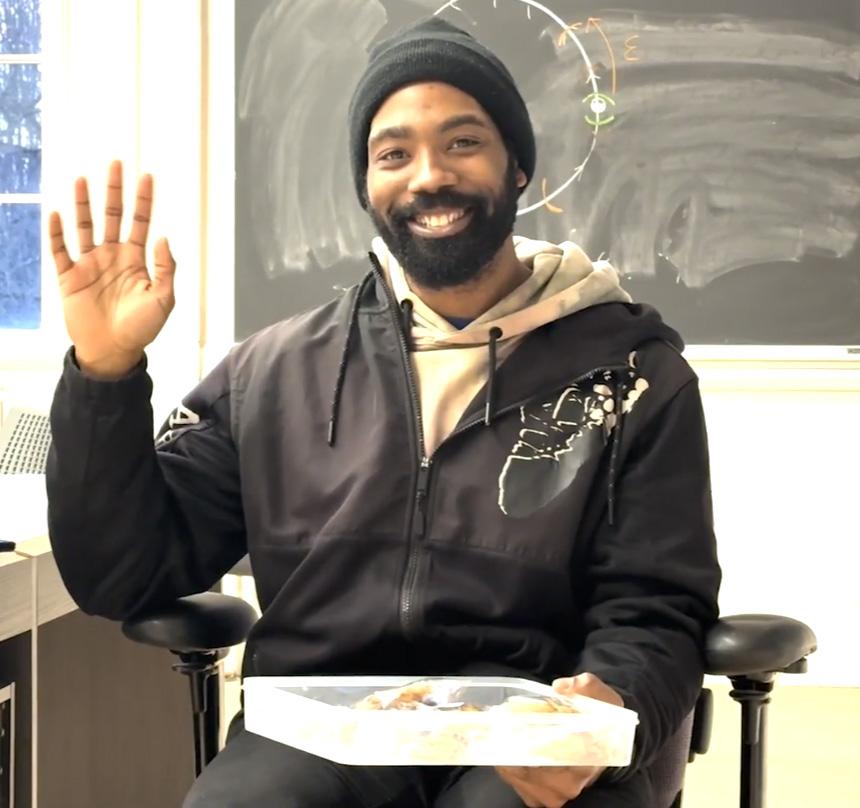
Aidan Dombrosky Guest Columnist
Cancer is not evil. It is, in fact, quite innocent and, to the great dismay of life on Earth, very good at what it does. It grows and expands, it pushes into and forces out of. Cancerous cells are extremely successful at what they do—their mothers must be quite proud. These cells are mutations, minute ones. But cancer continues to mutate. It multiplies, it spreads, suffocates, starves, and massacres. It is cold, ruthless, unforgiving, cruel, perhaps unusual, yet it is not one thing: It is not evil. Cancer has no malice, no idea of vengeance, no enemy to squash, no quarrel with anyone or anything that it inhabits, yet it is nonetheless a warmonger. It stockpiles an enormous reserve, builds fortresses of toxicity, and hits a body with the firepower of a micro-cellular militia. It is a host’s unfortunate burden to bear, to carry, to watch as it grows, colonizes, sacks, plunders, and raids, doing exactly what it is meant to do.
Of course, there are treatments that hinder the cancer’s advances. The cancer does not know better, and the cancer does not know worse. It is scared. It writhes naked and blind in a warm, mushy swamp of a human’s insides. We do not start peace talks with cancer before we are sure we can eradicate it completely. Poor cancer, really. In our utopian vision, it would rarely get the chance to be fulfilled. In the non-utopia that is our reality, if it does achieve self-actualization, it often destroys itself in gross, inflated overconsumption. What a farce.
Cancer knows no morals, no ethics, no poetry, no music, no joy, no sadness. There is no way to plead to cancer, to reason with it, to politely ask it to stop. You cannot, no matter how one may try, make cancer understand the pain that it inflicts on its hosts, on its host’s symbiotes—our families, our friends. My mother’s cancer knows not what it has done to her family, to her body, to her mind. It only knew to grow, to survive in a very strange land that proved hostile to its final goal, oblivious to the well-being of my mother. Humans are no different in our conquest for survival. But humans, the only mangled amalgamations of cells on the planet with conscious choice, are most definitely one thing: evil. There is no force in this universe or in the next that has the inherent capacity for evil except for the force of humanity. Humans are a cancer, a conscious cancerous tumor on the face of our mother, the planet Earth.
A cancer grows here. A cancer has grown here for quite a while, festering. It spreads rapidly and without a reason to cease. A cancer grows on our Earth, in our nation, in my home, in my body. A cancer grows on my father’s skin, in my mother’s chest, in my grandfather’s spine. A cancer grew in my grandmother, Donna. It spread to her pancreas, to her ovaries, to her lungs, to her soul. That cancer fought diligently to grow, to succeed. Donna fought to kill it, to stop it blind, but it had enough munitions to force its host into submission. We had Donna for four years while that cancer raged inside of her. We loved Donna more than her cancer, more than her treatments, more than her
diagnosis. I loved Donna more than I could have ever successfully communicated to her, to you. That is a sorry excuse for the vast volumes of words I regret not saying to her while her cancer stewed. Although small, that cancer conquered. That cancer was not evil. That cancer started as one cell. One cell. Tiny, impossible to see with the naked eye. Not one iota of one quark of one proton of one atom of one molecule of one organelle of one cell of Donna before her cancer had been evil. And even as she endured cancer, evil was not present in the body. But it grew fast, until it devoured its host and killed her. I still dream of Donna, of Grandma before cancer, before I thought of cancer as innocent. Cancer did not take Donna because it is evil, even though I thought it did. Cancer did not take Donna because she was evil. Cancer took Donna because it wanted to survive desperately. It needed to. It needed to spread just as much as Donna needed to banish it from her body, to purge it from its withering host. I needed Donna to do that, to beat her cancerous opponent. I needed my grandmother to vanquish cancer; I needed her to stay alive. I miss her more than I believed I could. I miss her even with that cancer, that non-evil, ever-multiplying cancer. Donna suffered; she endured a lifetime of misery within one-seventeenth of her Earthly existence. Cancer made her suffer. It made her mind weak, her resolve susceptible to collapse. I see Donna at night, in my memories, in photographs, as my grandmother. I see her in cancer, in images of tumors, and in mention of suffering. She chose kindness, she chose humanity, and she knew, above
all, that her cancer was not evil.
On a personal level, one that I hope to never have the displeasure of knowing, Donna got to know her cancer. She was first acquainted with it as a pest in need of immediate extermination, but grew to coexist with her new fickle friend. We are all interconnected with life on this planet. Donna chose not to alienate cancer, but to connect with her parasitic visitor. I only wish cancer could have known Donna like she chose to know it. I wish cancer had known who she was, what she meant to her environment, the niche she filled. What she meant to my father, her son, to her daughter, to her husband, to her grandchildren, to me. I would only hope that if cancer did know Donna, it could have spared her, given her the license to live without its influence, abandoned its purpose, waved its white flag above the smoking battlefield, and chose, on its own volition, to do no more harm.
Donna is no longer here; she passed along with her cancer. My mother’s cancer has retreated; she is still here, but is forever changed from her funny visitor’s all-toolong tenure. With a cancerous tenant dodging rent, it is easy to antagonize, easy to slander and to libel. It is truly a gargantuan feat, however, to know it as a part of one’s being, a part of one's whole. To sit with it, to understand and accept its inability to choose. I find myself choosing great empathy for cancer, as I know it is not evil, but a battle cry, one that I refuse to hush from my barbaric yawps from the rooftops of the world, and one I am willing to share with you here, now, and always: fuck cancer
Natalie Cutforth Guest Columnist
MostVassar students have descended the spiral stairs into The Mug’s dimly lit subterranean lair for some campus event or other. But for the majority of the time, it sits just waiting to be used for an event. If you were to enter The Mug on one of its many off-days, you would never know that it was once the center of campus social life. The only remnant of its history as a student-run pub is the original wooden bartop mounted on the wall, inscribed with the names of student bartenders and patrons from generations past. Following a recent conversation with friends about our shared disillusionment with Vassar nightlife, I was inspired to find out more about The Mug’s past life.
On a rainy night in March, I hopped on a Zoom meeting with four ex-Mug bartenders, one of whom is a close family friend. While at Vassar College, they belonged to a friend group known around campus as “The Bettys,” and had plenty of hilarious anecdotes about working at The Mug in the ’80s to share with me, wine aptly in hand.
I tried to reassure them that the statute of limitations on drunken break-ins to The Retreat 40 years ago has surely passed, and that admitting to a few shots “misplaced” decades prior would not cause Vassar to revoke their diplomas. But despite my best efforts, they wished to remain somewhat anonymous, a request I have honored by printing only their first names.
Though each of these women are now powerhouses in the entertainment and publishing industries, their careers began behind the bar of what was once Vassar’s social hub. But it was not easy to actually secure a position working there. “They had the most insane interview process… You kind of had to be ‘tapped,’” said Jane. Nancy started working there in her sophomore year and described The Mug interview in more detail. “It was almost like a joke where you’d come down, and all the managers were in chairs on the dance floor and then your chair was opposite them, and then they would train the spotlight on you, like shining on your face.”
Few people made the cut of this over-the-top mock-interrogation. It depended heavily on your connections and group of friends. Brigit compared the process to “fraternity hazing.” This exclusive social structure certainly sounded like a tamer liberal arts solution to Greek life.
The job was so hard to get for a reason—it was one of the most fun, coveted on-campus positions. Nancy remembered, “You made so much money compared to other jobs. And I loved bartending because you just get to stand behind the bar and you just have to work really fast.” Jane told me, “Honestly, it was such a fun job. Everyone was dancing all the time. It was just a really joyful place.” Brigit swooped in and added with an eye-roll, “Except when it wasn’t for all those reasons like the guy you liked was with some other girl or whatever.” It is good to know some things never change.
Another perk of working there for these women was access to the nightly insiders-only afterparty. “We’d been working all night so it was just like our time to hang out and do some shots, and then we used to go up to The Retreat and get a little bagel or something. Or break in!” Jane said with a smile. “Ultimately, [the managers] called us all in and they said this is not for profit, but it is not supposed to be a losing venture,” Jane continued, causing an outburst of laughter from all of us.
Back in this heyday, you might have been stuck in line for The Mug for an hour or two; the wait was well worth it for the buzzing atmosphere and music down below. On weekends, students would drink, play games and dance until 3 a.m.
as DJs rotated in and out. I felt like I was crashing a college reunion as I listened to them laugh and reminisce, reconstructing their stories as memories came back in bits and pieces.
“I spent many, many, many hours dancing in The Mug… There was Pete’s place off-campus, which was usually post-Mug, but for sure when there was a DJ, you wanted to be in The Mug,” Brigit shared. “We normally played like punk or new wave, but grunge was just starting to come up,” Nancy said. The dancing was fueled by a steady flow of alcohol. “A pitcher of beer was $2.50, so you would get three or four other people, pool your quarters together, and be able to buy a pitcher,” Brigit told me.
For current students who live in an era of inflation and liquor liability concerns, this sounds too good to be true. Nancy twisted the knife by adding that it was open seven nights a week. “You could go do your work at the library or whatever and then show up at like 11 or 11:30 and go for an hour and a half,” she said.
The Mug also allowed a cross section of Vassar’s student body to come together. Caroline shared a story about a heated debate that broke out in The Mug when Jesse Jackson was running for president: “This woman said to me, ‘Well you’re like in the Rainbow Coalition so that’s why you’re in favor of him…’ I couldn’t get my mind around the fact that I could go to school with somebody who was against the Rainbow Coalition who went to The Mug every night, too.” Brigit continued, “That’s part of growing up and realizing people have other ideas and opinions. They weren’t necessarily our politics or philosophical ideals, etcetera, but they weren’t necessarily bad people.” It might have been tense at times, but The Mug gave Vassar students with a variety of perspectives the chance to exchange ideas, an opportunity not necessarily available in other spaces on campus.
What struck me most about their stories was the spontaneity The Mug offered them in their social lives. “It was just such a different time where we knew we could connect there,” Caroline said. “Now, maybe you would text and be like ‘Let’s go meet at Pete’s’ or ‘let’s do this,’ or ‘Oh, I’m running late.’ But we would just leave notes on our door, we had a notepad that would say ‘went to The Mug.’” This is something unfathomable today in the age of group chats and location sharing. “You would always find a friend there,” Nancy said. It was refreshing to hear about what it was like before technology and social media made us so alarmingly aware of each other’s whereabouts.
The four of them wrapped up by sharing their overwhelming gratitude for The Mug and their friendship.
“Here’s what I will say: whatever it was, we made the best lifelong friends… I’m literally trying to imagine what our experience at Vassar would’ve been like without it,” Jane told me. “We’re a very lucky crew,” Brigit chimed in.
Given the centrality of The Mug to their time at Vassar, it seems a tragedy that it is now such an underutilized space. Its atmospheric lighting and open floor are begging to be turned into something more than just the occasional, often sparsely attended venue for campus events.
Since Vassar is also often criticized by students for being too cliquey, the implementation of more third spaces on campus, like The Mug of yore, might make it easier for students to talk to people outside of their typical circle.
It was hard not to be jealous when hearing their memories of drunken revelry in The Mug, but I loved learning what life was like for past generations of Brewers. Perhaps their stories are an argument for The Mug’s resurgence, and for reimagining Vassar’s nightlife to be more spontaneous, inclusive and laid back. Beer at $2.50 a pitcher would not hurt, either.
Dear Leah,
I think I might have a crush on a guy, but I really thought I was a lesbian. I thought all men were trash, but maybe I have to start giving them a chance now? Any advice on how to figure out if I just want to be friends with this guy or if I should experiment? Even though when they usually say experiment in college they mean in a gay way…
Sincerely, Miss Sparkle
Dear Miss Sparkle,
I have said it before and I will say it again: dip your toes into the bisexual pool. The water’s fine, I promise. “Experimenting in college” can mean a plethora of things. I mean, I say that I’ll give something “the ol’ college try” at least once a week, but I can understand why that “college try” feels a lot more intimidating when it comes to matters of the heart. While you may think that “experimenting” in college inherently means encounters with someone of the same sex, it’s worth recognizing that this idea is a product of a rather heteronormative society. The good news is that the Vassar community is not a particularly heteronormative one, so you should feel free to try whatever you want. My main advice when it comes to matters like this is to remember that your sexuality does not have to be something that is fixed. We are constantly changing and growing, especially at this age. It would be a miracle if you have everything figured out by the time you graduate, and if you do, I think you might need to be giving me advice instead. Genuinely, though, if any of you have figured everything out, please let me know. Serious inquiries only, please.
Anyways, in terms of figuring things out with this specific guy, why not give it a try? The heart wants what the heart wants, so if your gut is screaming at you to act on this, then do it. The venture would, hopefully, be clarifying one way or another. Besides, what’s the worst that could happen? I’m sure that whoever you’re finding yourself attracted to is kind, understanding and incredibly easy on the eyes. If this guy gets weird about it, that’s less a reflection of you not knowing yourself and more a reflection of him not being able to handle a little nuance. Remember, you’re questioning this for a reason, so why keep wondering?
I also think it’s worth it to be transparent and communicative if you decide to dip those toes. If this is something that is really worrying you, do not shy away from letting this guy know how you feel. I’m sure that it might not be the best feeling in the world to get les-bombed, but it’s a far worse feeling to be left in the dark or feel like someone wasn’t being totally honest. You don’t have to deliver a full lecture on your identity, especially if it’s something you’re questioning. But something along the lines of, “hey, I’m still figuring things out, but I like spending time with you and want to see where this goes,” is both honest and low-pressure. Also, I’m a big proponent of simply not labeling yourself and just doing whatever you want. Labels are tools, not contracts. You’re allowed to adjust them, ignore them and try new ones on. If this turns out to be a crush, great. If it turns out to be a friendship with a confusing amount of eye contact, also great. Either way, you’ll learn something about yourself, which is kind of the whole point. At the end of the day, this doesn’t have to be high-stakes. You’re allowed to be curious and to change your mind. You’re allowed to try something and decide it’s not for you without it invalidating everything that came before. As I’m writing this, my coworker Frances Pope ’26 had a great line: “Love is a spectrum, you need to be open to it wherever you may find it.” If anything, the fact that you’re questioning and reflecting on it this much probably means you’re approaching it thoughtfully, which is more than can be said for most people fumbling through their early twenties. Good luck—get to dipping those toes!
Best, Leah

the desk of Emma daRosa, Humor Editor
Seniors prepare for post-grad life: "Do you think we could fit 7 of us in a 2 bedroom in Des Moines? We all have part-time internships!"
Have you ever wondered what’s going on in President Elizabeth Bradley’s head?
I know that I sure have. Don’t worry, you needn’t wonder any longer! I took action last week and asked PB the top 20 big questions on everyone’s mind. I hope that this article fulfills all your wildest dreams about getting into PB’s head.
Ed: If you were a cookie, what kind of cookie would you be?
PB: Chocolate chunk, but it has to be with dark chocolate because milk chocolate upsets my stomach.
Ed: If you had to take over coaching one sports team at Vassar, which would you choose?
PB: Squash, of course! I play squash, it has so much strategy to it. Definitely squash.
Ed: What’s your favorite font?
PB: Oh I can’t remember what it’s called, san something? I like fonts that are clean and modern.
Ed: If you were going to star in a biopic, whose would it be?
PB: What is a biopic?
Ed: Like a biographical movie of your life.
PB: Oh, I don’t know. I have no answer for that.
Ed: Who should star in your biopic?
PB: Lucille Ball.
Ed: How many balloons do you think we could fit in this room?
PB: 10,000.
Ed: What is your favorite Monopoly property?
PB: I guess railroads because it’s the only one I can remember.
Ed: Ok, this is a really important one, I think especially for graduating seniors. Imagine you’re at some kind of social gathering and someone comes up to you and you should know their name but you can’t remember it. What do you do to casually figure it out?
PB: Ok, I do have an answer for this. You need at least two people, you need to be in a group—it’s really tough to figure out if you’re one on one. So you grab someone from your group who doesn’t know the person and you bring them over to the person whose name you can’t remember. You just need to get them to introduce themselves to each other; then the person will say their name and you’re set.
Ed: Do you have a favorite joke?
PB: I don’t really tell jokes.
Ed: What spice do you use most often when you cook?
PB: Well now you’re assuming that I cook, which is not true, but I can tell you what my favorite spice that my husband uses is. It’s curry powder. My kids don’t really like curry, but they’re out of the house now so we have a lot of curry.
Ed: Are you more of a sweet breakfast or savory breakfast person?
PB: Sweet, always sweet.
Ed: Ok, so if you had to choose between French toast, pancakes or waffles what would it be?
PB: Definitely waffles.
Ed: When was the last time you used glitter or glitter glue?
PB: When I had three little kids, so about 10 years ago. There’s always glitter with kids.
Ed: If you woke up tomorrow as a baby but with all of your current memories and knowledge, what would be your first move?
PB: You know, all I can think of is running away from Harold P, who tried to kiss me on the playground in first grade. I can still remember what he looks like.
Ed: Do you think claymation is cute or creepy?
PB: What is claymation?
Ed: It’s like making an animated movie where everything is made out of clay that you move slightly for each frame. There’s some famous claymation Christmas movies you might’ve seen, some people think they’re kind of creepy though.
PB: Oh, sure. I think it’s cute.
Ed: People are doing this thing right now where they eat one hot dog every inning of a baseball game. Could you do that?
PB: No, I couldn’t even eat one bite of a hot dog for one inning.
Ed: What’s your favorite kind of condiment?
PB: Cinnamon sugar.
Ed: If a polite little family of squirrels moved into the walls of your house, would you let them stay or evict them?
PB: Let them stay; you just have to live with them. You know, in the attic of the President’s House, there’s an entire hive of bees. When it gets hot the honey soaks through the wall and down onto the floor. You just see that on the top floor of the President’s House sometimes, we clean it up. You can’t get rid of them; you just have to live with them.
Ed: What are your thoughts on garden gnomes?
PB: It really depends what they’re made of. I don’t like when people throw a bunch of plastic crap into a garden, but if they are unique and come at you being sort of magical, that’s nice.
Ed: Did you ever run a lemonade stand as a child, and if so, was it successful?
PB: I participated in a lemonade stand, I hadn’t really developed my leadership skills yet so I didn’t run it. As to whether or not it was successful, I think it was because we had fun.
Well, folks, there you have it. If a colony of bees ever moves into your attic, you know who to call!
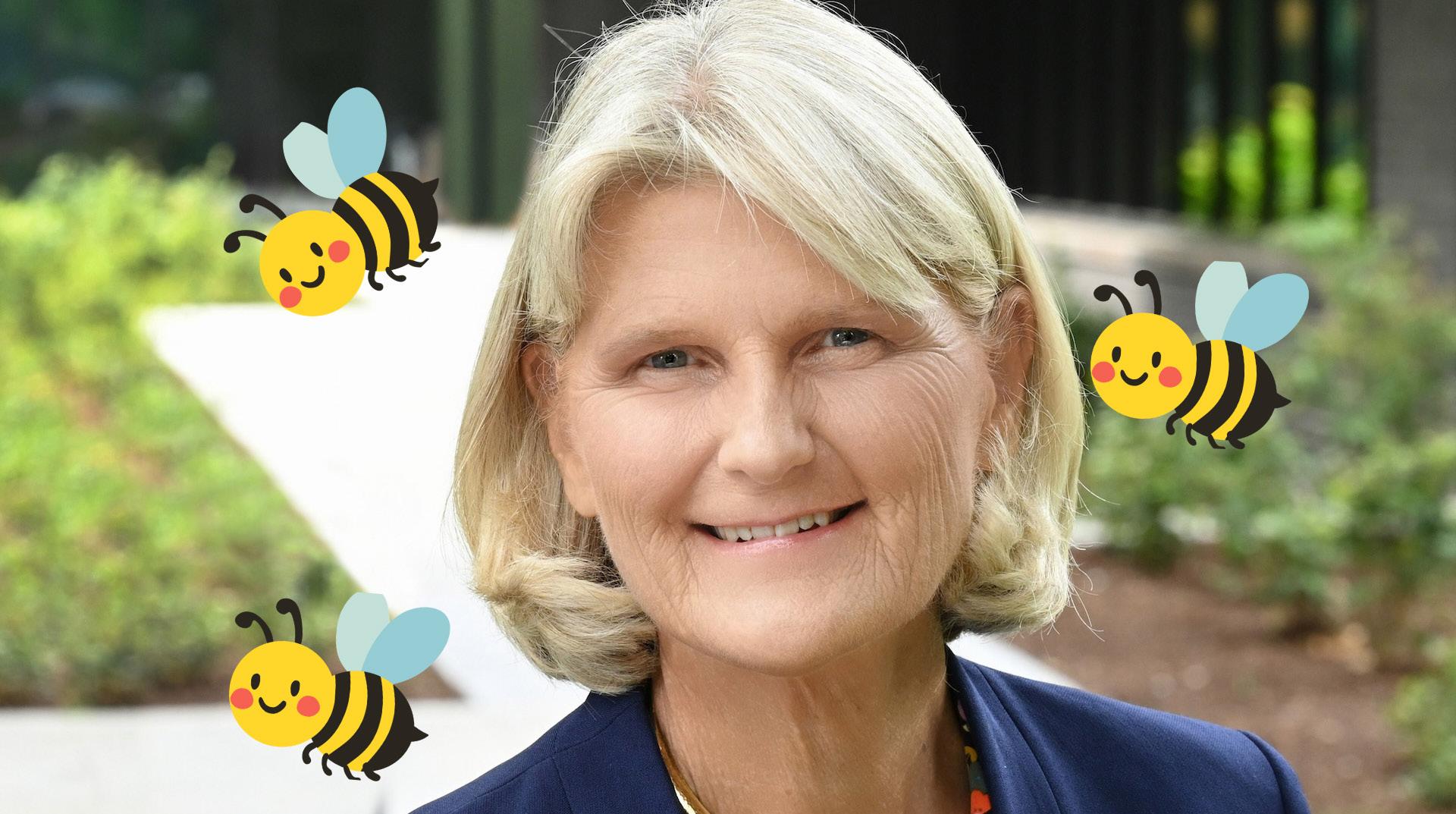
'I can't begin to describe my sadness:' Vassar students mourn the conclusion of the Vassar Table
On Thursday, April 23, at 3:01 p.m., an ear-shattering noise erupted throughout Vassar College. Following rigorous inspections of the campus by first responders and a bomb squad, the deafening roar was determined to have come from hundreds of students, who, as they realized the Vassar Table had concluded, simultaneously screamed in despair.
The Vassar Table was an event where students ate lunch together at a V-shaped table that stretched across the Nircle. Even Vassar’s administration, who filmed several
parts of the event and posted them to their social media afterwards, was surprised by how the event resonated with the student body. Though it was originally sponsored by the President’s Office, the allocated budget went unused after students demanded the Vassar Table be held in their name—and covered by a raise in tuition next year.
The Deece and The Retreat, the campus’ two main dining locations, were closed to accommodate the event’s required staffing. The picnic-style food that was served may have looked ordinary, but it was anything but that. “This is so much better than the food at my college,” said John Miller, a student who came to eat lunch at Vassar be -
fore driving back to the Culinary Institute of America. On Friday, Malcolm Gladwell published a statement announcing a reversal of his long-held philosophy: “It’s time to send your kids to Bowdoin.”
The Miscellany News spoke to students to gauge their reactions to the event. “My screen time over the last week has increased by hours,” said one student, Sarah Reynolds ’29. “I know I should study, hang out with my friends and eat at the Deece. But all I can find myself doing is watching the video of the table from Vassar’s Instagram on repeat. Life after the greatest day of my life is dull.”
“My parents, spending their life savings
on my education, preached that I mustn’t have too much fun at Vassar,” Mary Johnson ’26 said. “I’ve always had the discipline to follow their order, skipping sports games and parties.” The student continued, as a tear began to roll down their cheek, “That discipline ended on Thursday with the Vassar Table. Mom, Dad, I’m so sorry.”
At press time, Vassar’s administration announced that while it would be logistically impossible to continually fund the Vassar Table, it would do everything in its power to respond to the influx of students’ demands to “replicate that magical day.” Going forward, The Deece and The Retreat will be closed seven days a week for lunch.
Emma daRosa Postmodernly Hegemonic

ARIES March 21 | April 19
There’s no need to panic about your final papers. Either you’ll finish them or you won’t. That’s a 50 percent chance!
LIBRA Sept. 23 | Oct. 22

TAURUS April 20 | May 20
If you’re using ChatGPT to write final papers, you should probably refrain from doing it right next to me in the Library while I’m writing the horoscopes. My warning for you extends far beyond this week. You are turning your brain to mush. Also the stars and I both think you’re dumb. Dummy.

GEMINI May 21 | June 20
I think that you’re going to have a really hard time focusing this week. Don’t worry, all you need to do is get naked and go study on the Quad. Everyone will be looking at you, so you’ll get your work done in no time!

SCORPIO Oct. 23 | Nov. 21
Someone is going to throw a banana peel in front of you on the way to the library this week! Sorry, there’s nothing you can do to prevent it, they have really good aim. Hopefully you’ll be able to get a health advisory? You won’t be hurt, but who could study after such a humiliation?
I think you need to try to lighten up your calendar this week. You’ve got too much on your plate! Perhaps you could just go to three fish care conventions rather than four. That should free up some time for paper writing.

SAGITTARIUS Nov. 22 | Dec. 21
I can see you’re preparing for exams coming up. That’s so crazy. My advice for you this week is to register for courses next semester that have final papers instead of exams. There’s just something exciting and sexy about finishing a final paper that an exam can’t offer.

CANCER June 21 | July 22
You’re going to undergo a terrible trial this week. Your fingers are going to get cramps and you won’t be able to type anymore! Now is the time to start finger therapy. Feed each of your fingers a finger-sized banana. Make them do finger stretches. Godspeed, soldier.

LEO July 23 | Aug. 22

VIRGO Aug. 23 | Sept. 22
You need to calm down about the end of the year. Everything is going to be totally fine. Well, except for the snakes. What snakes? Oh! Don’t worry about it!

CAPRICORN Dec. 22 | Jan. 19
It’s going to be a SUPER SLEEPY week for you!!! You’re going to be curling up everywhere. Asleep in the Library. Asleep at the Deece. Asleep on PB’s porch. Asleep on PB’s couch. Asleep in PB’s kitchen.

AQUARIUS Jan. 20 | Feb. 18
You’re just not ever gonna hit a sweet flow of finals preparation this week; you’re going to be wayyy too distracted by your roommate inviting a family of mice to build a modest bungalow in your room. Yeah, sorry, there’s nothing you can do about it. Yeah, squatters’ rights.

PISCES Feb. 19 | March 20
I think you need to step back from your thesis for a day or two this week. I get you’re about to submit it, but I’m worried about you, man. Nobody should be typing the words postmodern and hegemony as often as you are right now. Gotta cut those to once every two sentences, MAX.
This is going to be a really great week for you. One of your professors is going to realize they did NOT give you enough time for your final project and give everyone the extension you were going to ask for RIGHT before you send that humiliating email asking for it.
The Earth has ears. These instruments are aimed towards the sky with colossal reflector dishes, some up to 500m in diameter. Scattered over the globe in China, Australia, South Africa, Europe and North America, these radio telescopes hide from interfering signals, existing in remote locations. What are we listening for? The answer: alien signals.
I know how it sounds, but bear with me. Strap on your tin foil hat for this. We are diving into the question of whether or not to reach out to our strange and unknown neighbors—a heated debate within the scientific community. Ideally, this decision should be international, a global effort with the interests of the people in mind. As one of those people who live on Earth, I believe we must send Messages to Extra-Terrestrial Intelligence (METIs). It is a scientific imperative.
With radio telescopes, we have been passively searching for decades. SETI, or the Search for Extra-Terrestrial Intelligence, started in the ’60s and has only accelerated today with projects like Breakthrough Listen. So far, we have heard nothing. Astrobiologists agree it is likely that extraterrestrials (ETs) are out there due to the vastness of the universe, which is only expanding. Yet, in all of history, we have found zero empirical evidence of ETs. The lack of signals across the universe has been coined “The Great Silence.” The probability of ETs and
the lack of evidence is known as the Fermi paradox, named after physicist Enrico Fermi who famously asked, “Where is everybody?”
METIs have been sent into space for decades, even though these Cosmic Calls are highly controversial. SETI scholars debate: Should we really be sending messages out there, into a universe we barely understand? Astronomer Jill Tarter, Chair Emeritus for SETI Research at the SETI Institute, says we have only dipped a small glass into the vast ocean of outer space. What if, by sending out signals, we are ringing the dinner bell or “shouting in the jungle?” Is reaching out to ETs dangerous? We are not even aware of all the factors to consider. It could be dangerous in outer space. It is possible that the cosmos is a dark and threatening place, full of hostile ET civilizations. Perhaps the “Great Silence” of the universe exists because ETs are all hiding, an idea known as the Dark Forest Theory. There could be competition for resources, predatory motivations or a mutual distrust that leads to aggression.
However, I think these concerns are biased. Humans put a biological lens on ETs with these predator-prey ideas, as if outer space is some Earth-like ecosystem. Tarter theorizes that truly intelligent ETs may have evolved past primitive urges like aggression and developed a moral framework. I think this is also too large an assumption. We do not know if ETs will be aggressive or ethical; we do not know anything about them. Our only frame of reference is our own in-
telligence. I think the true answer lies beyond a human framework, perhaps inconceivable. If ETs exist, they evolved within different physical, chemical and biological conditions—they are fundamentally different from biology on Earth. Therefore, what they are and their intelligence would be beyond our imagination. We have no context on ETs. We know nothing. We must accept that we know nothing. In my opinion, making any assumptions about ETs is inadequate and futile.
With this in mind, the next step is knowing more. We need evidence. Astrobiologist President of METI, Douglas Vakoch says that we have not detected anything after 50 years, and we need a more active approach, like METI. Sending more METIs is urgent. Time is not on our side. Targets of METI signals are light-years away. Our most local targets have taken around 20 years to reach, and our farthest targets take approximately 21,000 years. These are multi-generational projects, and they are, quite literally, a shot in the dark. If we do not start now, we will have to wait even longer for the messages to send, and longer still to theoretically receive anything back.
Now, at the heart of this conversation: Why is it important to send METIs? In the words of Alexander Zaitsev, pro-METI astronomer: “I can not speak for all, but I do not want to live in a cocoon, in a ‘one-man island,’ without any rights to send a message outside, because such life is not interesting!” By staying silent as a planet, we keep ourselves in the dark.
Why do we focus on the potential threats of METI instead of the potential benefits? Some astronomers suggest that not sending METIs could be more dangerous than sending them. We could be missing out on knowledge of not only the existence of ETs but also the knowledge they could impart to us. What if this knowledge could save us from our own destructive patterns? By focusing on the risks, we fall into a “loss aversion” habit, which humans tend to do, as Vakoch points out. But the knowledge we could gain from METIs could reshape humanity.
While I am a massive fan of METI efforts, I think we need to put meticulous consideration into these messages. Science fiction author and astronomer David Brin warns us against recklessness and calls for strict protocols around METI, and I agree. These existential decisions do not come without risk—there are literally scales to measure the risk of a METI. We must be united as a planet in the content of the message, who sends it and what we will do if we make a discovery. With precise protocols, METI could be revolutionary. We must be proactive and curious. We must be real scientists. If we have the power to reach ETs—we must use it.
Regardless of whether we make a discovery with our METIs, it would comfort me to know that humanity tried. Humanity is young, and we may not be around for much longer, but METIs are a beautiful legacy. They mean we tried to reach out in peace, hoping to share life with someone out there.
Anthropologist Savannah Shange’s book
“Progressive Dystopia: Abolition, Antiblackness, and Schooling in San Francisco” proposes an idea of “progressive capacity,” or the limits of what progressive ideology can achieve in practice. Shange’s research centered around students in a so-called “progressive school” that was designed to get them into college. These students are taught ideals of activism and resistance but face severe consequences for putting them into action. This concept narrows in on an unfortunate reality that I feel is obvious in almost all liberal arts colleges, including Vassar College: Progressive ideology, whether in educational environments or elsewhere, can only go so far. There is a fixed capacity for progressivism in institutions of higher learning. This leads to the disavowing of the same progressive theories an institution claims to hold dear when students dare put them into action. In Vassar’s case, this often materializes as advocacy against genocide in Palestine being shut down or otherwise tampered with by the College’s administration. If we put into practice the same theories and methods of resistance that we learn in class, we are punished.
Shange’s work in “Progressive Dystopia” is based on her experiences working in a school in San Francisco well known for its social justice mission and curriculum. She gave the school the pseudonym “Robeson Justice Academy.” Though Shange describes Robeson as a “best-case” scenario for students who have been left behind by traditional schools that teach culturally irrelevant curriculum, it proves to be ineffective in achieving its stated goals. The students are mostly Black and socioeconomically disadvantaged and, Shange argues, are for the most part
failed by the very school that was designed to provide them with more equitable access to education. On paper, Robeson is doing everything right by offering a culturally responsive curriculum that is progressive enough for students to connect with and rigorous enough to secure better higher education outcomes. In practice, though, Shange says that Robeson recreates the ways that Black students, particularly Black girls, are subjugated, racialized and treated poorly by the administration. Racial bias in non-progressive schools punishes them for actively engaging with the progressive theory they are being taught.
Robeson’s progressivism only goes so far. It has not separated itself from the racist ideology that the Black students face every day. In fact, Robeson has the highest suspension rate for Black students of any school in the area. The students there are forced to limit what their progressive beliefs can look like and how extreme they can be if they want to remain in the environment that is supposed to be the best place for them. Shange’s work ultimately underscores where progressive movements of all types, not just in education, fail.
Creating these boundaries for progressive political thoughts and actions allows people—white, upper-class people in particular—to avoid the discomfort that comes from knowing you are complicit in only including some people in the movement that is supposed to be helping everyone. In Robeson’s case, students are treated unfairly and even kicked out by the administration for engaging in acts of protest and civil disobedience. At Vassar, students advocating for a free Palestine receive the same treatment. There is an immediate wariness and desire to silence these students, particularly those affiliated with Vassar Students for Justice in Palestine (VSJP), that reveals a worrying trend in in-
stitutions of higher learning across the country. College administrators are making decisions based on a desire for control, directly conflicting with the work professors do to teach us how to actively engage with the progressive theories and methods of protest.
I was in Gordon Commons during an Admitted Students Day when a woman came up asking me if something on the table was related to VSJP. I told her yes, thinking she was a mother interested in pro-Palestinian activism happening on campus. She promptly took the pamphlet and walked off in quite a huff. Baffled, I told this story to a friend a couple of days later, who shared with me that she heard from a member of VSJP that they were told they were not allowed to pass out flyers on campus during Admitted Students Day. Various Fizz posts echoed this report as well. I was even more baffled upon learning this, as I had no recollection of any rules regarding passed-out flyers. At the start of the year, all tour guides are required to go through a Leadership Training Conference where we learn the various guidelines we must follow. I have since looked through the college rules and regulations and the Programming Resources Guide (PRG) 2025-2026 that organization leaders must follow quite carefully and have been unable to find any policy stating that flyers that are passed out, rather than posted on walls, need to be stamped or are not permitted to be handed out on any particular days. There is, of course, a chance I have missed something in my search, but why would this regulation not be made easily available? And why would it exist at all? What, one must wonder, is the administration so afraid of? If they stand behind the decisions they have made regarding VSJP, why not extend transparency to prospective new students?
This issue is not a new one. I took a class in the History Department last spring titled
HIST/AFRS 175: “Mandela: Race, Resistance and Renaissance in South Africa.” For a project in the class, I did research on Vassar students’ participation in protests calling for Vassar to divest from corporations engaged in business with South Africa. In 1978, one year after the death of Steve Biko, the staff of a since-dissolved student news publication at Vassar, “Unscrewed,” argued, “The Trustees of the college must be confronted by the social consciousness of the people on this campus if the pretention of ‘liberal’ education is to hold any merit at all.” The particularly conservative members of my family and home community are convinced I have been sent off to some sort of far-left indoctrination camp. I am disappointed to report back that while I certainly have learned all the terrifying ideologies they worry about, there is a far firmer hand than they fear that is controlling the political actions of students. I have heard plenty of criticism of VSJP and other student groups for not being progressive enough. I wonder if maybe we have all been lulled into the sense of security a progressive dystopia can offer. It is certainly easier to be complacent. After all, if even passing out flyers to incoming first years has to be stopped, when are we supposed to put our “progressive” education into action?

After a long and eventful regular season, it is time for the best two months of the year for basketball. For those who are not familiar with the format of the NBA playoffs, there are eight teams from the Eastern Conference and eight teams from the Western Conference who make it. Each team will compete in a seven-game series with hopes of winning four games and advancing to the next round. The higher seeds have home court advantage, meaning they get one extra home game in the seven game series (4-3). I will be highlighting the best storylines to follow as well as making predictions for your parlays. With legacies on the line and many dramatic storylines reaching their conclusion, who will come out victorious?
LeBron’s Last Dance?
After a scorchingly hot month for the Los Angeles Lakers, they sit at the No. 4 seed in the West, led by Luka Dončić’s MVP-caliber numbers. In a tragic turn of events, Dončić strained his hamstring with only five games remaining in the regular season—sidelining him for most likely the entire playoffs. The Lakers are also without their other star whiteboy Austin Reaves, so all the weight is falling on the King. LeBron James is the NBA all-time playoff leader in wins, points, steals and minutes to go along with four championships and four finals MVPs. In year 23 of his career, James is still averaging 21 points, six rebounds and seven assists per game on 51 percent shooting. Can the King carry the Lakers to their 18th championship in what could very possibly be his last year?
Defending Champions’ Quest for a Repeat
As we (my loyal readers) know, the hardest task in the modern-day NBA is winning back-to-back titles, as we have had a new champion every year since the Golden State Warriors in 2017 and 2018. Although the Oklahoma City Thunder (OKC) are having a slightly worse season than last year, they still sit atop the NBA with a record of 64-18. Shai Gilgeous-Alexander is the MVP frontrunner yet again, averaging 31.1 points per game on 55 percent shooting. The Thunder have become the NBA’s new “Big Bad,” as fans and players alike have associated their physical play style and affinity for getting fouls called with their abundance of winning. Also, the rich keep getting richer, as the Thunder already own the Los Angeles Clippers’ lottery draft pick for next year. An OKC repeat championship would solidify them as the villains of the NBA.
The Return of Jayson Tatum
The Boston Celtics have been title contenders every year in recent history, but this year was supposed to be their lowest year yet. In their second-round loss last season, star Jayson Tatum ruptured his Achilles tendon—one of the most devastating injuries to their franchise cornerstone. In the offseason, the Celtics had to undergo major roster reconstruction, letting go of many of their 2024 championship team’s core players. Few expected the Celtics to get the second seed in the east (56-26), but even less expected Tatum to make his return in March of this season. This was one of the fastest, most miraculous recoveries from an Achilles tear the sport has ever seen. On top of that, he came back putting up numbers: 22 points and 10 rebounds per game, and the Celtics are 13-3 with Tatum back in the lineup. The Celtics’ other star Jaylen Brown has also been having an exceptional season, averaging 29 points per
game (fourth in the NBA, a career high) as the first option for the first time in his Celtics career. With Eastern conference stars such as Tyrese Haliburton, Giannis Antetokounmpo and Joel Embiid out, the Celtics have a real shot of making it back to the top of the league.
Zohran Mamdani’s Knicks
The New York Knicks fell short of making the NBA finals yet again last season, after being brutally upset by the Indiana Pacers miracle run. However, the Knicks followed their city and elected new leadership, hiring former NBA Coach of the Year Mike Brown. They basically returned their entire roster and had a very similar season to last, finishing third in the East again. Stars Jalen Brunson and Karl Anthony-Towns averaged 26 and 20 points per game respectively, and the Knicks are fully healthy going into the playoffs. The Knicks’ last championship appearance was in 1999, and their last title was in 1973, so the fans are eager for another chance at a major run this year.
Wemby’s World
The San Antonio Spurs have had one of the biggest two-season turnarounds in NBA history, going from 22-60 in 2024 to 62-20 and the No. 2 seed in the west this year. They are one of the youngest teams in the league, having hit on all three recent top draft picks. Victor Wembanyama was widely considered the greatest prospect the league has ever seen, and he has been exceeding expectations this season, averaging 25 points, 12 rebounds, three assists and three blocks. He was the first ever unanimous Defensive Player of the Year, and it is his third straight year of leading the league in blocks; he has only been in the league for three years. The Spurs selected Stephon Castle and then Dylan Harper in the years after Wemby, who have both filled their roles, averaging over 11 points per game each. The Spurs finished only two games behind the Thunder, yet they boasted a 3-1 series record against them this season. Will the young Spurs give the Top Dog Thunder a run for their money this year?
Armaan’s Locks
The first round of this year’s playoffs is
already underway, and some matchups are much closer than expected. The Detroit Pistons are the East's No. 1 seed, but I believe they are the most fraudulent No. 1 seed of all time. They are currently down 1-2 against the eighth seed Orlando Magic. They have gotten extremely lucky with most of their wins, and star Cade Cunningham is coming back from a collapsed lung. I still think the Pistons will win the series, but it will be a closely fought seven games. The Cleveland Cavaliers (Cavs) are tied 2-2 with the Toronto Raptors, but I believe the Cavs will take the series in six games, led by huge offensive performances from James Harden and Donovan Mitchell. The Knicks are also 2-2 after losing two games by one point each to the Atlanta Hawks. I think the Knicks will be able to bounce back and will win the series in seven games. The Lakers are surprisingly up 3-0 against the Rockets, and I believe they will sweep the series. Lebron James has been putting up legacy performances even without his running mate Dončić, and Kevin Durant is still sidelined with a bone bruise. The Denver Nuggets are currently down 1-3 against the Minnesota Timberwolves—a huge deficit to come back from. However, I am predicting that the Nuggets will win the next three straight games and advance. Wolves star Anthony Edwards is out for the rest of the series, and they lost starter Donte Divincenzo to a torn Achilles. The Spurs, Thunder and Celtics will all win their respective series in five games.
In the second round, I can see the Thunder dominating the Lakers in five games. LeBron James has been playing out of his mind, but at age 41, I think the Thunder’s extremely physical playstyle will be able to deter him. The Cavs will upset the Pistons in six games. I think this is finally the year where Mitchell advances past the second round with the help of his new teammate. Harden is often swept under the rug when talking about playoff legends due to his lack of a ring, but he has accomplished the remarkable feat of making the playoffs every year of his 17-year career. Playoff experience is what the Cavs have been lacking these past years, and it is something
that the Pistons definitely do not have. The Celtics and Knicks will be getting a rematch of their heated series last year. With two of the craziest fanbases in the country who also hate each other—we are in for some absolute cinema. On top of that, Tatum will be returning to the same arena and environment where his season-ending injury was cheered for, so I expect him to be out for revenge. I believe the Celtics will win the series in seven, with the Celtics’ 3-point shooting advantage giving them the edge. Lastly, I believe the Spurs will defeat the Nuggets in seven games. Although the Spurs are the No. 2 seed, many are treating them as underdogs in this series due to the youth of their team. However, I believe the bright lights are not going to faze Wembanyama, and he will win the matchup against Jokić.
In the conference finals, I believe the Celtics will handle the Cavs pretty easily in five games. The Cavs are a pretty good offensive team but are 15th in defensive rating, so they will not be able to handle the number two-ranked Celtics offense. The Spurs have had the Thunder’s number this year in the regular season, but I believe the Thunder will win the series in seven. Oklahoma City is one of the biggest home-court advantages in the league, and I believe a strong first two games from the Thunder will rattle the Spurs.
This will set the stage for a Celtics-Thunder finals matchup for the ages. Both teams have compelling storylines, deep rosters and are the last two champions. The Thunder have the top-ranked defense in the NBA, but I think the Celtics will steal a game in OKC due to a three-point barrage. The Thunder have the top-ranked defense but only the seventh-ranked offense. I believe legacy performances from Jaylen Brown will lead to a Celtics victory in six games and Brown’s second finals MVP.
Regardless of the outcome, I am excited for this slate of NBA madness. With young stars fighting to make their mark on the league and veterans fighting to cement their legacy, who will come out on top and take home the title? We will just have to wait and see.

We talked with four senior student athletes from four different teams at Vassar. Jacob Sellitti on Men’s track and field, Lindsey Nihei on women’s soccer, Addie Lee on men’s baseball and Sierra McDermed on women’s basketball. In last week’s issue, we highlighted the stories of Sellitti and Nihei growing to be integral leaders on their teams. This week, we tell the stories of Lee and McDermed and their experiences under shifting team dynamics while at Vassar.
The career of Addie Lee ’26 has overlapped with an inflection point for the Vassar Baseball program. The right-handed pitcher from Manhattan Beach, California has
and underwent Tommy John surgery and months of rehabilitation. Initially devastated, Lee did not let his injury turn him away from his teammates. Instead, Lee recalled, “I think my mindset switched pretty quickly, to ‘how can I still have an impact on the team this year?’” Without Lee on the mound, Vassar struggled in 2025, ending the season with a record of 14-19.
Now in his senior season, Lee is fully recovered and playing the best ball of his career. Through seven outings so far, Lee has 2.97 ERA and 42 strikeouts. Against Bard on April 4, Lee pitched nine innings, allowing two runs on six hits, and tying his career high with nine strikeouts.
As a captain, Lee’s impact extends beyond the baseball diamond, ensuring that the cul-

played for three separate head coaches in his time in Poughkeepsie and has seen the program move in a new direction under Head Coach Tad Skelley. Historically, the Brewers baseball team has not enjoyed much success, and Lee knew this during the recruiting process. However, Lee was drawn to Vassar because of the high academic standing of the school and the opportunity to change the baseball program for the better. “I thought my career here would be pretty successful,” he said, “and I was really hoping to be a part of what turned the team around.”
During Lee’s first year at Vassar, the Brewers won a program record 20 games, including a first-ever sweep over conference foe Union College. Lee pitched in 11 games that season, throwing a 5.40 earned-run-average (ERA) and striking out 48 batters. After the season, the tide seemed to turn against the Brewers. The starting lineup lost key senior players, including All-Liberty League First Team outfielder Andrew Kanellis ’23 and catcher Adam Talwalkar ’23. Then, Head Coach Matthew Righter moved on from Vassar, marking the first coaching change of Lee’s career after just his first year. The following season, the team battled to a 12-21 record under Interim Head Coach Blayne Fuke. Lee started eight games that year and pitched seven shutout innings in a win over Rensselaer Polytechnic Institute, ultimately finishing his second season with a 5.71 ERA and 45 strikeouts. After his sophomore season, Tad Skelley was named Vassar’s Head Baseball Coach and the coaching carousel came to a stop. Throughout those two tumultuous seasons of turnover and uncertainty, Lee noted the glue that held the team together was the bond that he and his teammates continue to share. “The thing that stayed consistent the whole time was family,” he recalled. “I think off the field and on the field, the baseball team has really stayed super close. And it’s the closest team that I’ve ever been on.”
As things were starting to turn around for Lee and the Brewers, Lee suffered a season ending injury in the fall of his junior year. Lee tore his ulnar collateral ligament, one of the most common injuries among pitchers,
win a pair of Liberty League championships. McDermed is from San Antonio, Texas, and is a guard on the women’s basketball team. During her time in Poughkeepsie, she earned a Liberty League Player of the Week and three Liberty League Performer of the Weeks; has been a finalist for Vassar Athletics Iron Brewer Award three times, winning in 2024; and has been named First Team All-Liberty League twice and Third Team All-Region III. But the senior guard’s presence on campus transcends sports. When she is not in the gym getting shots up, she is practicing for her upcoming jazz concert in Skinner Hall or preparing for engineering graduate school after Vassar. McDermed has a double major in applied math and physics with a correlate in music.
The recruitment process for basketball coming out of the COVID-19 pandemic was opaque, with many recruits deferring their commitments and recruitment classes already full. The Northeast was a clear target for McDermed, as she told The Miscellany News, “Coming from South Texas, we walked from the gym to the Deece, which is past the lakes, past the little lakes, past the bridge. It was very much fall time, so I kind of fell in love a lot with just the campus. And so when I left,I could see myself here. I could see myself not just as an athlete, but beyond as a student, walking to class each day and seeing certain students.”
repeated their Liberty League glory in 2025, going 15-3 in league and defeating Ithaca College to take the conference title once again. Mesaris’s success did not go unnoticed, and she was hired by Tufts University to lead their women’s basketball team in the summer of 2025. Head Coach Carly Assimon was hired in September 2025.
McDermed likened the experience of three different head coaches and departing players to any other distraction an athlete might face. Now, just four of the original nine players from the Class of 2026 remain on the women’s basketball team. But McDermed remains unswayed. When asked about how she stayed so consistent over four years of immense change around her, the answer was straightforward: “I think you could kind of compare that to a game; in a game, you're gonna have a lot of noise going on around you. You have fans yelling for you and yelling against you. We got at Skidmore the whole thoroughbred stable is literally right behind the free throw line waving and cheering.”
ture of the team is inclusive and growth-oriented. With a roster full of young talent, Lee has taken on a mentorship role, showing his teammates that there is more to Vassar than just baseball. ”My high school was really athletics focused,” he said. “So when I got to Vassar, it was a completely different switch for me. It was almost nice to have baseball and take it really seriously but being able to explore other things—like, music was a big thing for me. I think it kind of changed even my identity a little bit as a person. It went from being almost entirely baseball to, like, I'm a very diverse person that I have other interests than I was able to explore here.” While the team is still chasing the level of success he envisioned as a freshman, Lee remains optimistic about the direction of the program. “We have a lot of young guys this year that have a chance to be really special,” he said.
When reflecting on his time at Vassar, Lee points to both the big moments and the small ones. The walk-off grand slam during his first year stands out as one of the highlights, but so do the bus rides and the banter in the dugout. Years from now, Lee knows that the friendships and bonds forged between teammates over four years of hard work will stay with him. “The baseball memories will definitely be there,” he said, “but, like, the stupid things, like playing Mario Kart in the dorms and stuff like that. I feel like that’s the stuff that I’ll miss the most 10 years down the road—just, like, having 30 of my best friends within walking distance all the time.”
As Lee takes off the baseball hat and dons the graduation cap this May, he leaves behind a legacy of resilience. His career may not have followed a straight path, but through adversity and growth, Lee helped define what it means to be a Vassar baseball player. There is no doubt that Addie Lee leaves the Vassar baseball program better than he found it.
Sierra McDermed ’26 came to Vassar College, among other reasons, to experience the changing seasons. She had no reason to expect that, during her time here, she would play under three different head coaches and
As a serious competitor, McDermed was excited for the opportunity to push herself at a higher level. The women’s basketball program had come off a 17-8 season in which the team went 16-2 in Liberty League play. “The program at the time had a new coach that had a lot of success the year before,” McDermed continued, “and I knew of a few of the other players in my class, but not all of them. So I was excited for what was to come.”
Entering her rookie season, expectations were high, but there was no way of predicting the success that was to come: “If you had asked me four years ago, if we were gonna go to the tournament two years back to back, I would have said, ‘No, probably not.’” McDermed arrived at Vassar with a nine-player class. The group was eager to build on the momentum of the team’s previous seasons.
This year, McDermed closed her college career starting 26 of 26 games for the Brewers while playing over 33 minutes per game for the third consecutive season. Looking back on her college career, McDermed will certainly remember cutting down the net at home after playing all 40 minutes in the 2024 Liberty League championship game and then doing it again the next year. But it will also be the little things: the quiet and snowy moments over winter break when no one but the basketball teams occupy the campus and the solitary moments in the AFC gym when the only noises are her own squeaking shoes and the ‘swoosh’ing of her shots.
There were a lot of unexpected highs and lows for Sierra McDermed, but she definitely got one thing in her time in Poughkeepsie: she definitely experienced the seasons. While Jacob Sellitti, Lindsey Nihei, Addie Lee and Sierra McDermed all play different sports, come from different parts of the country and have different plans after graduation, they all have one thing in common: they were a Vassar Brewer for the last four years. Over that time, they made unique
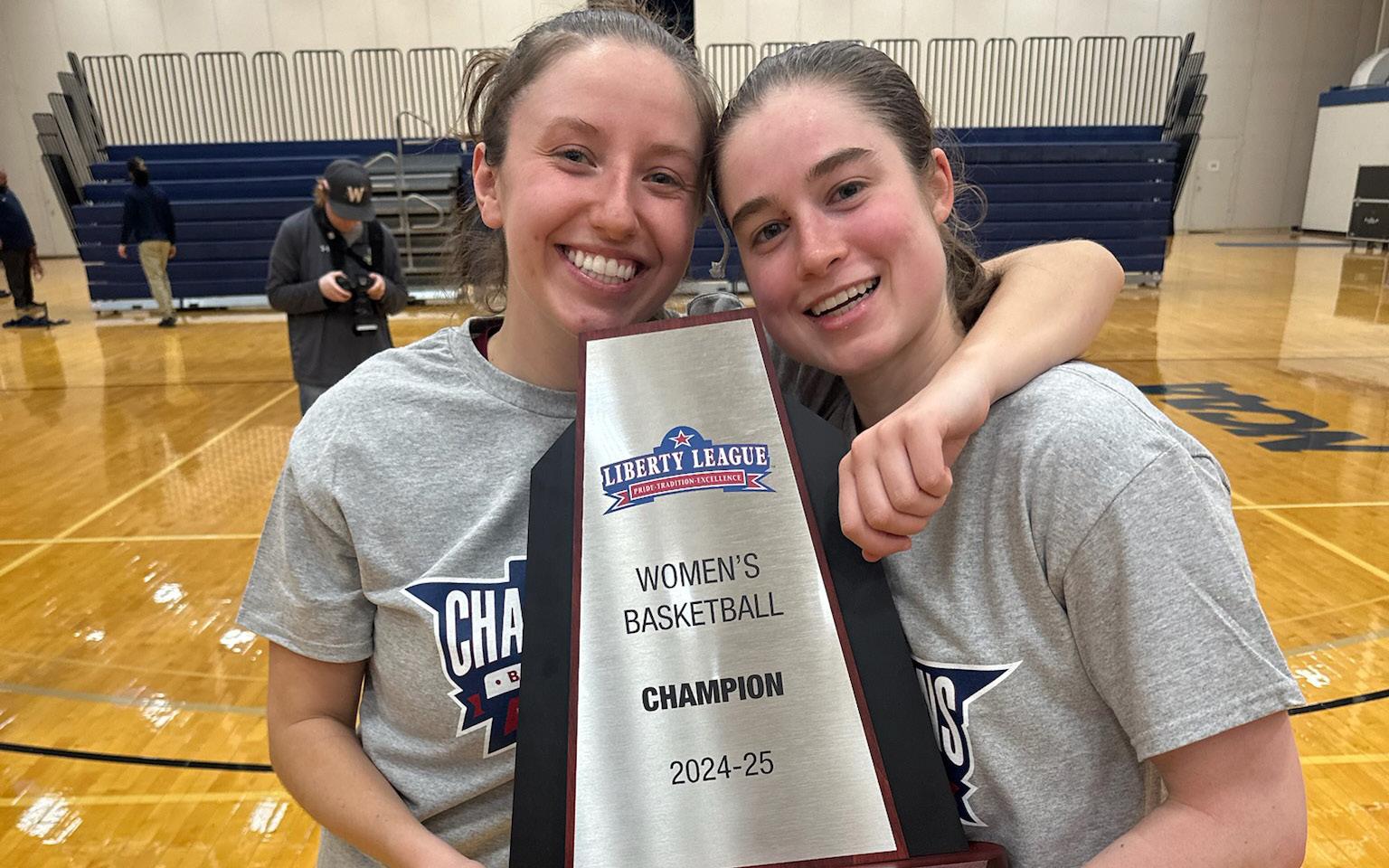
Her rookie season was strong, finishing with a record of 18-9 after getting knocked out in the second round of the Liberty League playoffs. After the season, Head Coach Anthony Mason departed the program and Meredith Mesaris was hired shortly after to take over for Mason. Mesaris had spent time at Williams College, Dartmouth College and Haverford College before taking the head coach position at Vassar. In her first season with the Brewers, Mesaris led the team to a 25-3 record, including a 17-1 conference record and their first Liberty League championship since 2014. Under Mesaris, the squad
memories from long and loathsome bus rides to conference championship victories. The four student-athletes also highlight the beauty of Division III athletics: the ability to excel on and off the track, field and court. The four Brewers work tirelessly at their sports, but when they are not refining their technique or improving their conditioning, they are playing guitar or saxophone, TA-ing a computer science course, working hard in a biochemistry lab and much, much more. These stories show that Vassar Athletics are much more than box scores—they are real people with rich college experiences.
By: Sadie Keesbury

ACROSS
1. Shorten, as pants
4. Double, like income or citizenship
8. Isaac of science fiction
14. Spanish that
15. Come _____ bro!
16. Anastasia of Fifty Shades of Grey
17. Online addresses
18. McEntire of country music
19. Greek god of messengers
20. United States border river
21. Triple, as color pasta
22. H.S. degree equivalent
23. Alley _____
24. She/_____
25. Breeding ground
27. Gun with a long barrel
28. JFK officials
29. Sick
30. Entryway
32. Founded, for short
33. Greek walkway
35. Heart, in Latin
36. Without doubts, or a descriptor of this puzzles shaded entries
42. Colonist?
43. Like memes or basements
44. Negating word
45. Where bears might live
48. Where a bear might live
49. Wax with a wick
50. 56, to Caesar
51. Went on (with ahead)
54. Kennedy's killer, first-name-basis
55. What surrounds us
56. Bear baby
57. Purpose
58. What connects twerps and herpes?
59. Criticize intensely
61. Thin object used for ultimate or golf
62. Who the blueberries are for
63. Very soft, like tofu
64. U.S. Dept. concerned with solar
65. Eated

By: Allison Lowe and Luke Jenkins
By: Grace Finke

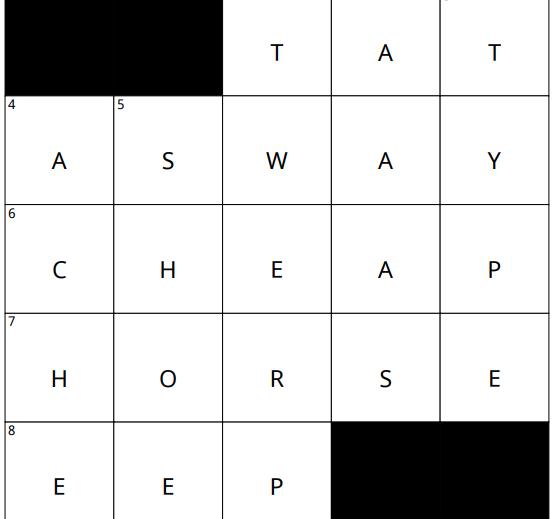
66. French restaurant
67. Hot, desirable
68. Multiple I
DOWN
1. Make taller
2. "It's that me _____"
3. Luxury Italian car
4. Vader or Maul
5. In _____ (unborn)
6. Drive to get things done
7. Michele of Glee
8. Knocked the tip off of a cigarette
9. Got out the clumps, as flour
10. Suffix for a comparative adjective
11. Thought of the past
12. Duplicated futbol chant
13. Evening star
22. Sticky stuff for hair
26. The gall!
30. Kitchen utensil with tines
31. Round shape
33. Federal IDs
34. Body mod
35. _____-man (one who scams)
37. Fairy
38. Cheerfully optimistic
39. Top hat wearing propaganda pointer
40. Put up with
41. Church toppers
45. Like some felonies
46. "Wake Me Up" DJ
47. Diseases, TikToks?
48. Dance move using both arms and the head
51. Spanish good
52. Eastern English county
53. Denounce
56. Person who cuts meat
60. What to buy on the TrainTime app, for short
61. First albums
By: Aurelia Harrison
By: Sadie Keesbury