The Miscellany News
Vassar College’s student newspaper of record since 1866
Vassar College’s student newspaper of record since 1866
Samuel Eisenberg Guest Reporter
[Disclaimer: The author of this article is a resident of Raymond House.]
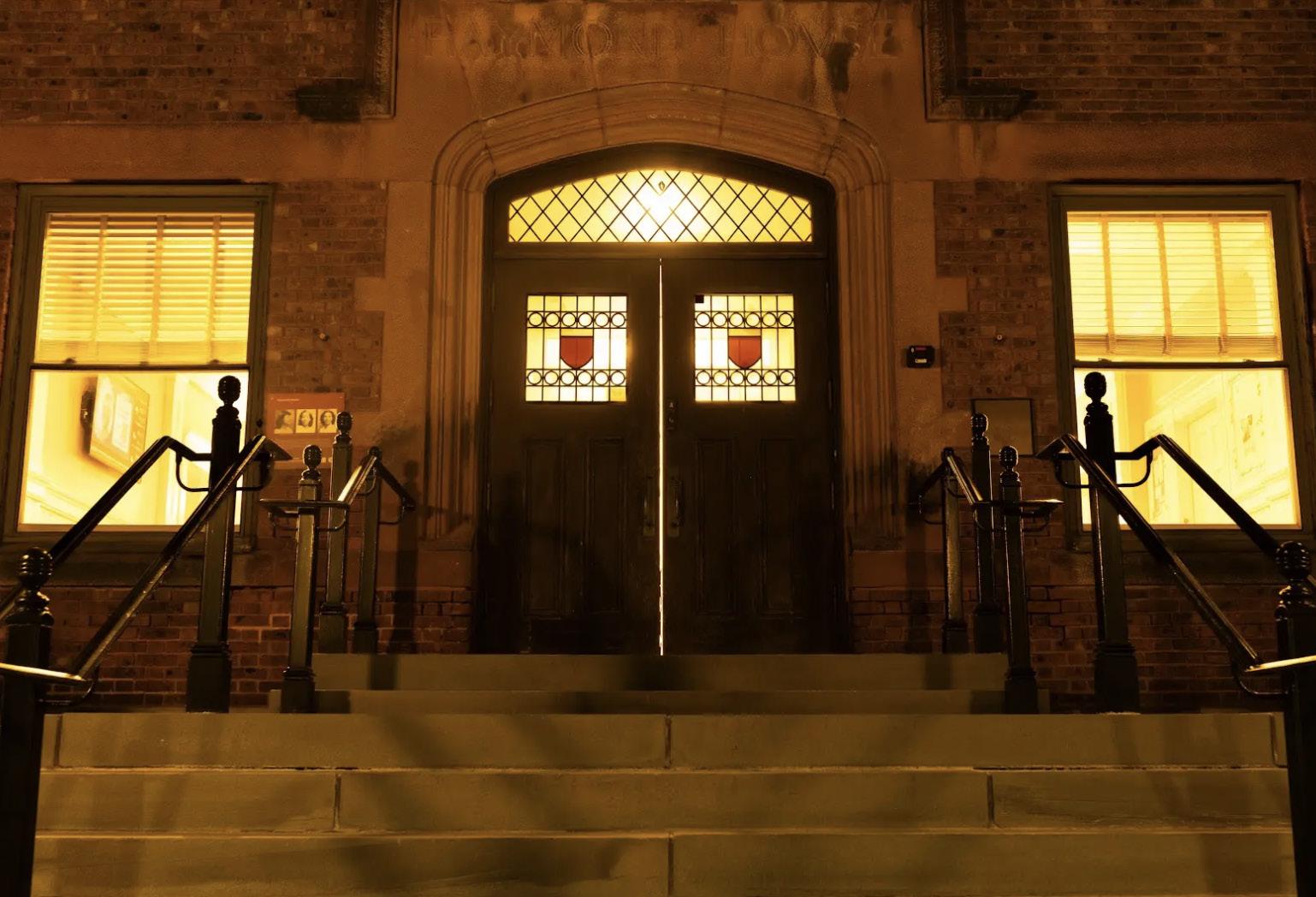
In the face of persistent issues spanning nearly a decade, Vassar College’s administration has pledged to begin renovating Raymond House’s bathrooms and elevator in Summer 2027. Multiple administrators wrote in a joint statement to The Miscellany News, “Improving the Raymond bath-
rooms, to reduce leaks and other problems, is a priority and work will begin summer 2027.” President of the College Elizabeth Bradley notified Raymond House Team members of these plans in an email on March 27.
“Nobody wants to live in Raymond,” said Raymond House President and Vassar Student Association (VSA) Senator Mathias Vieth ’28. “This year alone, we’ve had two sewage leaks. During the wintertime, at least six rooms had extreme water damage, where many of the students had to be relo-
Darja Coutts Senior Editor
Picture this: You want to start anew.
Longing to create real, meaningful connections after a lifetime of short-lived friendships, you ironically run to the dry deserts of southwest America—where the unforgiving, arid climate might lead you to believe that nothing substantial could grow. But you find this diner, and this diner brings you to a motel and then to the town of Calico. At first, it seems like any small, sheltered, tight-knit community. But as you start to build connections, you start noticing that the desert is not all that it seems…
If an introspective yet thrilling science fiction novel sounds enticing, then I have just the book for you. “Calico” by Caleb “D” DiBartolo ’26, recently published on March 6, follows 33-year-old narrator Marc in a transitional period of his life as he searches for meaning out in the desert. Marc is perceptive and witty—exactly the kind of main character you would want for digging up the rich mysteries of a sci-fi novel.
But more on the student who brought this story to life: Other than recently becoming a self-published author, DiBartolo is a Russian Studies major with an Analytic Philosophy correlate. Prior to attending Vassar, he was in the U.S. Army for eight
Julian Balsley reports on composting in
years and now acts as president of the Vassar Veterans Association. Additionally, he is co-chair of the Founder’s Day Wellness Committee, a proud member of the men’s rugby team and a founding member of the Vassar Combat Arts Club, where he teaches boxing fundamentals to faculty and fellow students.
DiBartolo has been wanting to write and publish a novel for a long time. “At first, it was more just trying to challenge myself to do something that I’ve seen,” DiBartolo told me. Many of his close friends and professors had written books, and he wanted to see if he could do it himself.
For a couple of years, DiBartolo was unable to write. He attributed this struggle to a lack of time or focus. But finally, when he came up with the idea for “Calico” last year, he knew he had to follow through. “It clicked after a few chapters,” he remarked. “I was all like, ‘This is fun!’ It got to the point where I was excited to see what happened next.” DiBartolo started writing “Calico” in January 2025 as part of his New Year’s resolution. He finished writing in November 2025—just 11 months after he began. Now, he feels confident in the self-publishing process, and “Calico” can be bought just about anywhere, including his website. Although intimidating for some, the scifi genre came naturally to him as his
See Novel on page 10
cated.” Other ongoing issues include black mold, holes in the walls and ceilings, silverfish, cracks, water damage in rooms and water quality concerns in the water fountains, according to a document compiled by the Raymond House Team. According to the document, many of the holes have been patched since spring break. Facilities concerns have also arisen in Noyes and Jewett Houses, according to residents interviewed by the Miscellany.
VSA Senator and Chair of Residential Affairs Flora Cahill ’28 commented, “These persistent issues get chalked up a lot to the buildings being old, and that’s not really enough of an excuse because people live in there every day.”
When asked about the above issues, Vice President for Finance and Administration Bryan Swarthout only specifically commented on the leaks, and added information about temperature swings. Swarthout wrote, “For the other issues identified in Raymond, work tickets have been generated, and repairs are being scheduled.”
The Miscellany reached out to a number of members of the administration regarding the renovations, including Facilities Operations, the Board of Trustees, the Residential Operations Center (ROC), Swarthout, President of the College Elizabeth Bradley and Dean of Student Living and Wellness Luis Inoa. These branches of the administration collaborated to provide answers, but asked that the statements be
attributed to Swarthout.
In October 2025, Raymond’s House Team created a live document to detail and track current and past issues in the house. This list was then shown to administrators. As of the latest update on April 2, 2026, there are 18 issues listed as “Continuous,” which means that they recur regardless of repair attempts. A further 11 issues are listed as “Unresolved,” but this number is in flux as issues are repaired and more are brought to the attention of the House Team.
Members of the Raymond House Team told the Miscellany that they were proud of the work they did to alert the College of the issues, and are glad the work is being prioritized. However, they emphasized that this process was not easy, and some issues and concerns still persist.
On Feb. 2, 2026, Raymond’s House Team conducted a sit-down meeting, followed by a walkthrough of the dorm, to give administrators a tour of the dorm’s condition. Similar walkthroughs also took place in Jewett and Noyes.
“It seemed as though many of the administrators were not aware of the state of Raymond prior to the walkthrough, so I’m glad they got the experience to see the conditions first-hand,” said Brendan Kennedy ’28, a Raymond Student Fellow [Disclaimer: Kennedy is an Assistant Arts Editor for The Miscellany News]. Vieth said in an interview with the Miscellany that, at a min-
See Raymond on page 3
Aurelia Harrison Assistant Arts Editor
AdnanAhmed Rizal ’28, better known as Rizal, is undoubtedly one of the most prolific artists at Vassar College. A rapper with roots in New Haven, Connecticut, Rizal has brought charismatic performances and lively creative energy to the campus music scene. He has released four albums in the last two years, alongside several EPs and singles, and has played countless gigs around campus. Last week, Rizal released his fifth album: “Theory X.” Colorful, wide-ranging and dynamic, “Theory X” is incontrovertible proof that Rizal is on the up-and-up.
For Rizal, the title of the album is meant to be a unifying message about his personal creative goals and approach. He took a class on music theory, where he felt that many of the traditional guidelines and structures were artistically at odds with the contemporary music in which he was interested. “But I do also think that theory is very, very helpful,” Rizal said. “The idea behind the name is that it’s theory being crossed out, disregarding theory and focusing on the art itself and the creativity aspect. The main theme of the album is that music theory is kind of useless if you can’t apply it, and that technical theory is useless if you don’t have the creativity and the passion to back
it up.”
Alongside contributions from friends like Alex Lewin-Knauer ’27, Rizal does the bulk of his own production and arranging. “It keeps my art true to me,” Rizal said. “It’s my project, and I want the ideas to come from my heart.” He expressed pride in his musical progression from both a production and creative standpoint. “People will tell me that they love ‘sativa,’ a song from this album, because of the way the sound is mixed, which was the first time anyone had said that to me… It’s a step up. ‘That’s Alright’ [Rizal’s previous album] is more of a narrative journey, and ‘Theory X’ is more of a creative experiment.” “Theory X” is expansive in its approach, combining elements of opera, pop and trap. His lyricism is as playful and vibrant as ever, rich with pop culture references and Vassar-specific jokes.
There are a lot of highlights on this album, but for me, there was one song that rose above all the rest: “amisupposedtofeelsorrythatkirkgotshot?!” This song is six minutes and 38 seconds of dynamic political rage, and it really works. Think Death Grips with a structure and approach reminiscent of JID—combined with his screamed refrain, “God bless America,” and his passionately righteous lyricism, this song is Rizal at the absolute top of his
See RIZAL on page 6
Aviva Moss explains the benefits of heat pumps.

EDITOR-IN-CHIEF
MANAGING EDITOR
SENIOR EDITORS

CONTRIBUTING EDITORS
NEWS EDITORS
ASSISTANT NEWS EDITOR
ARTS EDITOR
ASSISTANT ARTS EDITORS
FEATURES EDITORS
OPINIONS EDITORS
ASSISTANT OPINIONS EDITOR
HUMOR EDITOR
ASSISTANT HUMOR EDITORS
SPORTS EDITORS
DESIGN EDITORS
ASSISTANT DESIGN EDITORS
COPY EDITORS
GRAPHICS EDITOR
Allison Lowe
Luke Jenkins
Kathryn Carvel
Darja Coutts
Madeleine Nicks
Clara Alger
Carina Cole
Soren Fischer
Hadley Amato
Julian Balsley
Jackson Hrebin
Grace Finke
Aurelia Harrison
Brendan Kennedy
Yaksha Gummadapu
Sydney Jones
Jacob Cifuentes
Ian Watanabe
Zoe Rodriguez
Emma daRosa
Wren Buehler
Noah Daube-Valois
Henry France
Casey McMenamin
Molly Delahunty
Lucas Seguinot
Teresa Garcia-Green
Hannah Wells
Sadie Bakken-Durchslag
Paige Hahn
Anabel Lee
Annie McShane
ASSISTANT GRAPHICS EDITOR
PHOTO EDITOR
GAMES EDITORS
SOCIAL MEDIA MANAGER
LIVE EVENTS CHAIR
WEBMASTER
REPORTERS/COLUMNISTS
PHOTOGRAPHER
CARTOONIST
COPY STAFF
Noa DeRosa-Anderson
Makenna Brown
Sadie Keesbury
Felix Mundy-Mancino
Mia Liloia
Denver Brown
Hunter Farhat
Eduardo Culmer
Armaan Desai
Noah Duncan
Iggy Gutierrez
Melody Hamilton
Isabel Holmes
Lora Janczewski
Eli Lerdau
Madeline Nusbaum
Evan Seker
Erin Thatcher
Amritha Dewan
Andrew Chu
Catriona Chapman
Nikola Parker Cooperman
Elliot Evans
Cooper Jaffe
Ren Nicolau
Tess Novack
Julia Weber
• Justine Katimbang resigned as ’27 Senator. Junior B-Term applications for her position close on Wednesday, April 8 at 7:30 p.m.
• The VFlow Codification Bill passed unanimously. The bill makes VSA responsible for all sexual health product distribution across campus. Project Period, which previously held this role, will now have more time and resources to conduct off-campus advocacy work.
• The Student Action Commission Bill passed unanimously. The Student Action Center will be replaced by a group of at least three student volunteers who will address equity concerns and work with clubs and organizations to host events related to student activism.
• Club-8 Ball was unanimously confirmed as a student organization. The club will be provided funds to maintain the pool equipment across campus, as well as a space to store the equipment to prevent damage.
imum, Facilities Operations was already aware of the issues. “Facilities, they do a walkthrough with the House Advisor once a month, as well as just on their own,” said Vieth. He continued, “So Facilities has always been aware of these problems, and, especially when we did that sit-down meeting with a lot of administrators, [Assistant Vice President for Facilities Operations] Maxine Coleman, she definitely was like, ‘I have this whole list of things. I already know this is going on.’”
The College has proposed an increase in its budget allocation for repairs and renovations on campus. Over the past five years, the College has spent about $5 million per year to maintain and improve all of the dorm buildings, according to Swarthout. He explained, “Given the needs, particularly in Raymond, and in part due to the success of the capital campaign, we will be increasing this to $8M per year for dormitory building improvements for at least the next three years.”
This increase in the yearly capital budget from $5 million to $8 million will add an additional $3 million annually, a total of $9 million over those three years. However, renovating just Raymond’s bathrooms and elevator is expected to exceed that. “We don’t have solid estimates for the Raymond work, but we anticipate it will likely cost more than $10M,” wrote Bradley, Swarthout and Inoa in a second joint statement. Administrators did not say where additional funding would come from.
While Swarthout confirmed that the planned renovations would be funded entirely by the capital budget, it is still unclear whether the entire extra $9 million would be allotted for renovations. “We have tried to fundraise for it many times and this year have found a way to fund the bathroom renovation through our annual maintenance budget over three years,” Bradley, Swarthout and Inoa wrote.
“Like many colleges, Vassar is managing deferred maintenance while also balancing annual operating needs and long-term capital planning,” wrote Swarthout. In a statement to the Miscellany, President Bradley acknowledged having also been aware of the issues for nearly a decade.
When asked specifically when Bradley became aware of the issues, Bradley, Swarthout and Inoa wrote, “[She became aware] in 2017, when President Bradley first started, and periodically, she has vis-
ited Raymond.” In 2019, some flooring was repaired, furniture was reupholstered and paint work was done. In an article published in the Miscellany on Sept. 12, 2019, Jordi Martinez ’21 said, “I’m a bit disappointed that the bathrooms didn’t get any improvements.” Bradley, Swarthout and Inoa confirmed, “A major renovation was
“We don’t have solid estimates for the Raymond work, but we anticipate it will likely cost more than $10M.”
completed in 2019, but we could not get to the bathrooms.”
Without any major renovations in Raymond since 2019, according to Cahill, Facilities has been focused on maintaining the condition of the dorm, while also managing issues across campus and limited resources.
“It makes students think that Facilities are not doing their job when obviously they are,” said Cahill. “If Facilities can’t do it, it’s not their fault. But can we help create a situation where they have the capacity to solve these issues?” When asked about a potential increase in Facilities’ capacity to conduct repairs, Swarthout wrote, “We actively evaluate how work is coordinated, how students receive updates, and whether additional capacity or operational adjustments would improve responsiveness.” He did not address any specific plans for changes.
Students are currently feeling the effects of Facilities having to address many issues all at once. Raymond resident Hannah McDonnell ’29 said in an interview with the Miscellany, “The doorknob of my closet came off on move-in day, and it wasn’t repaired for a couple of weeks.”
Autumn Dowiak ’29, a Noyes resident, explained that sometimes work gets done very quickly, within several hours overnight, and other times, it doesn’t happen at all. “Consistently, there’s one toilet that doesn’t flush all the way,” she described. “And that’s just gross.”
“Luis Inoa meets with the House Presidents monthly and typically shares updates on projects there. In addition, Residential Life meets every other week with Facilities Operations, and they receive updates in those meetings that can then be communi-
cated to the House Advisor, who can in turn update the House Team,” Bradley, Swarthout and Inoa wrote. However, while Vieth acknowledged these talks between House Team and Facilities, he explained that once a problem has been brought up, communication ceases. “There is talk between us and Facilities sending those service requests, but then Facilities oftentimes will just mark it on a Google spreadsheet… There is no real communication about it.”
As an example, Vieth mentioned a specific incident when bathrooms in the south area of Raymond were closed without any prior notice. Vieth said, “When that happened, we didn’t know about that. Students knew it because they couldn’t go to their bathrooms. So then they told Jared [Hunter], the House Advisor, and then he sent the email to the whole house. That was not Facilities telling us, ‘The bathrooms are shut down.’” McDonnell told the Miscellany that earlier that day she had attempted to take a shower, only to find the water scalding hot. About 20 minutes after submitting a work ticket to Facilities, she recalled, “They canceled the ticket because they said that it was already work that was being done, but nobody knew that the work was happening until after the fact.” She explained that af-
“These persistent issues get chalked up a lot to buildings being old, and that's not really enough of an excuse because people live in there every day.”
ter submitting a ticket, “I get a response that says, ‘We’re cancelling this work ticket, Facilities has shut off cold water in Raymond 3 South.’ And I had no clue that that was happening.” She went on, “We didn’t get any communication from Facilities beforehand or from House Team or anyone until that night after the work had already been going on.” It was after this cold water shut-off that all the water was shut off to the south bathrooms, prompting Hunter’s email. Kennedy’s room suffered a leak in the roof, damaging the space enough that he had to temporarily move out. “When I came back from winter break, the ceiling in my room had fallen down in a small section, wet/brown spots were all over the
ceiling, ceiling pieces on the floor, and the rug of my room was wet with green spots underneath it,” Kennedy wrote to the Miscellany by email. “The room was filled with the smell of sewage; I’m not sure how long the damage was there, but it was clear it was for a while.” Vassar’s Environmental Health and Safety department (EHS) recommended a temporary room switch while Facilities dealt with the leak and repaired the damage, according to a copy of an email from Facilities to Kennedy reviewed by the Miscellany Kennedy wrote, “When repairs were being done in my room, there was no information about how long it would take, so I was constantly emailing the R.O.C. [Residential Operations Center] for updates, so that’s definitely another area for improvement.” He was able to move back into his original room after a month, but has never been informed what caused the leak.
Due to overheating in rooms, especially in Raymond, the College will be installing a steam meter and a few temperature control devices called Cozys in Raymond during Summer 2026, according to Swarthout. “The Cozys are expected to lead to a 20 - 25% reduction in energy consumption in the building and an increase in comfort,” he wrote. In an email to all Raymond residents, the ROC Office explained that temperature and humidity sensors will collect data before and after the Cozys’ installation to determine their effectiveness. If the trial is effective, Cozys will be installed in Strong House and, potentially, other dorms.
Risham Sah ’29 was one of the students who was randomly selected to be part of the trial. In a statement to the Miscellany, Sah wrote that his room regularly experiences temperature swings, even after repairs on the radiator. “Even though the room heaters were set to 0, they were still receiving power and heating the room, making it very uncomfortable to stay inside.” If the Cozys work as intended, they should reduce the occurrence of such temperature swings. When asked about the condition of dorms, and specifically Raymond, Cahill said, “It’s not a huge campus. We don’t have a lot of residential buildings, but we do have a lot of issues.” She continued, “It shouldn’t be a situation where there’s an entire building that no one wants to enter, let alone live in, or that students feel like they specifically should be not paying as much to go to a school because they live in a dorm that’s so fundamentally inferior to the other ones, just based on being in disrepair.”
Julian Balsley News Editor
[Disclaimer: For privacy purposes, all Gordon Commons employees quoted in this article will be referred to anonymously.]
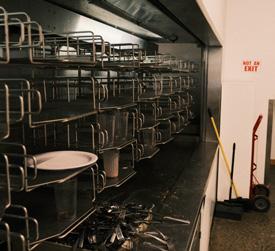
For at least a year, Gordon Commons’ compost has been frequently contaminated by students putting non-compostable items into the compost waste stream. To address these issues, the Vassar administration ran two trial weeks, from March 2 to 6 and March 23 to 27, in which all food scraps in Gordon Commons were scraped and sorted into compost and garbage by workers in the dish room instead of students. “Have I seen the change? Yeah, it’s clean,” said Josephine Papagni, Co-Owner and Operator of Greenway Environmental Services, the composting company Vassar College has worked with for over 25 years. She said that Vassar is one of the leading academic institutions she has seen in separating and composting organic waste.
“We agreed this would be a trial period,” Director of Sustainability Ken Foster and Director of Dining Services Chris Mongeon wrote in a joint email to The Miscellany News. “It is not a permanent change at this time.” The administration plans to evaluate the trial period over the summer, but said there is no current timeline for a final decision.
The main source of contamination, Papagni told the Miscellany, is with “compostable disposables” such as compostable plates, cups and cutlery, which Greenway does not usually accept from regular and large clients. The compostable disposables themselves are not a problem, Papagni explained, but once they are allowed into the composting waste stream, people begin putting similar-looking plastic items into the compost, contaminating the entire load. Foster and Mongeon wrote that despite compostable disposables often bringing contamination, Vassar has continued stocking the dining hall with them, such as when the dishwasher is unavailable or employees are unable to keep up with busy mealtimes. “We’ve been working to balance these operational realities while continuing to move toward more sustainable practices,” they wrote.
When Greenway receives a contaminat-
ed compost load from Vassar—or any other client—a Greenway employee must pick out each piece of garbage by hand. “If you have to put on boots and wade into a huge pile of food waste, even if it’s three pieces [of garbage], it’s too much. You have to get it out,” Papagni explained. “If you don’t get it out, you’re contaminating your whole load.” She confirmed by email that Greenway has received loads of Vassar’s compost that were so contaminated that the entire 35-gallon load had to be thrown in the trash. Foster and Mongeon wrote, “This has often caused all waste (including compost) generated in the dining room to be discarded as trash, nulling a significant portion of composting efforts in Gordon Commons.”
For the past several months, Papagni has been noticing what she called “waves” of contamination in Vassar’s compost. For weeks, there would be no contamination at all. Then, for weeks, she would see trash in the compost load every day. She said that no matter how much signage there is telling people which items are compostable, any unsupervised plate scraping will inevitably lead to some measure of contamination. “People generally don’t read signs,” she commented. Finally, about a month ago, Papagni asked the Vassar administration to move plate scraping to the dish room to stop the contamination.
Papagni, Foster and Mongeon noted that Vassar dish room employees sorted food waste for decades. That changed after renovations to Gordon Commons were completed in 2019, including a “complete renovation” of the dish room, according to the Vassar website. “Many of our employees have worked here for years. They remember scraping plates in the past,” Foster and Mongeon wrote. But according to one Gordon Commons employee, “We used this method years ago, but we also had two dishrooms at that time.” In response to a question about re-implementing dish room waste sorting with only one dish room, Foster and Mongeon wrote, “Again, all of this will be taken into consideration when we evaluate the program and determine the best path forward.”
Papagni said that she only learned that Gordon Commons had moved to student scraping one or two years ago, half a decade after it had begun. The periodic contamination had been an ongoing confusion in
the background—learning that students were scraping their plates unsupervised explained the issue.
On Monday, March 23, Papagni trained dish room employees for two shifts, from 12 to 8:30 p.m. “They got it right away. It was easy,” Papagni said. She continued, “They work really, really incredibly hard. I couldn’t believe it.” When one employee went on break, the others spread out to cover the increased workload and keep the dish room running smoothly. “It’s not a hard job, it’s not a difficult job, but it’s hard work,” Papagni said. “I was just very moved by what a great team [they were].”
Dish room employees who spoke to the Miscellany said that adding waste sorting to their duties made the work unsustainable. “It was terrible,” one employee said. “It was too much,” another described, “and it was less people here to do it.” A third recalled, “To me, it’s like you’re doing three shifts in one.” Employees reported that only one or two people were assigned to remove all of the plates from the dish conveyor belt and sort all of the waste into compost and garbage. To keep up with the work, employees said, three people needed to be assigned to that station. According to Foster and Mongeon, the structure of the dish room only allows one or two employees to remove dishes from the conveyor belt and sort waste at a time.
One employee reported that dish room staffers were moved to other stations, such as serving food, during the trial period. Foster and Mongeon stated that the opposite was true: “For the trial, staff from the front of the dish room was allocated to the back.” Furthermore, employees said that to keep up with the volume of dishes, they had to work too quickly to sort waste effectively. Papagni, Foster and Mongeon reported that there were fewer non-compostable items in the compost during the trial week, but workers said the system was not perfect. “The employees were still putting the garbage inside the compost,” one explained. “It was just that they were rushing to try to do the job.”
Papagni said that despite the increased workload that waste sorting brought, “There was no complaint. They were very friendly and respectful toward me.” She argued, “I think it would have been the perfect opportunity to complain to me. I am a neu-
tral person. They know this stuff comes to my compost facility. They know I’m not the boss. They know I’m not a part of administration.” One employee contested this version of events: “She heard complaints, but she probably said that because she’s the one getting the waste, and she wants her waste to be clean.”
According to Foster and Mongeon, management “frequently” checked in with dish room employees during the trial. They wrote, “A few employees expressed frustration towards the end of the trial period… We are seeking feedback to understand the impact on employees. In the meantime, we will continue to monitor the conditions so composting can remain a viable option.”
Gordon Commons employees told the Miscellany that dish room waste sorting is not feasible with the current staff level.
“The shit they try to implement don’t make sense when we don’t got the manpower,” said one. An employee said they had spoken directly with administrators about understaffing: “I went to them. They looked at me like I got 20 heads. I said, ‘If y’all give us extra work, y’all either give us more people or give us extra pay. Y’all giving us extra work and y’all taking people out of here.”
Administrators said that staffing will be a consideration in future plans for waste sorting. “The trial period allows us to observe the impact of the change and hear from employees to determine if we are adequately staffed and we hope to further evaluate that in the coming weeks,” Foster and Mongeon wrote. One worker did not have faith that more employees would be hired if plate scraping is permanently moved to the dish room. “Whatever they can do not to hire somebody and save money,” he said, “that’s what they do.”
In a statement to the Miscellany, Vassar Students for Equitable Environmental Decisions wrote, “If Vassar is going back to having employees scrape plates, which now seems like the most viable and sustainable solution, the college must ensure that there are enough workers in the dish room and that they have adequate space to do the job safely and effectively.”
For the time being, students will continue to scrape their plates unsupervised. It remains unknown when the administration will make a final decision about the future of Gordon Commons’ composting.
Jane Hurley Guest Reporter
Over 120 years ago, the scholar and activist W. E. B. Du Bois began compiling photographs of Black Americans. As scientists of the day pushed eugenicist explanations for racial difference, Du Bois’ photographs aimed to capture the diversity of Black life. His photographs were a way of expressing double consciousness, a term he coined to describe the way Black Americans are forced to filter their own identities through the dominant narrative of white society.
Safiya U. Noble, a professor at the University of California, Los Angeles and Director of the Center on Resilience and Digital Justice, spoke to a packed audience in Rockefeller Hall on March 26, 2026 about the relevance of Du Bois’ framework to modern technology. “Double consciousness is needed to understand our datafied selves,” Noble argued. Published in 2018, her bestselling book “Algorithms of Oppression: How Search Engines Reinforce Racism” shows how societal power dynamics and the biases that uphold them are reflected in the design of major search engines.
In a talk titled “Data in Society, Not Data as Society,” hosted by the Science, Technology, and Society (STS) Program, Noble proposed that double consciousness could help us rethink the promise of technology like large language models (LLMs). She argued that
AI companies have marketed their products as beneficial for society, drowning out criticism from those they harm. “Oppressed people are narrated at a deficit,” Noble said, citing media and journalism scholar S. Craig Watkins and a lineage of other Black critical data scholars.
Noble’s talk took place just one day after a California jury held Meta and Google liable for harming the mental health of children who used their social media platforms. The decision is a marked shift from litigating content to litigating the design of algorithms. Even still, reports of AI-related mental health crises, from psychosis to chatbot-related suicide, have not resulted in regulation of the industry. “Had these products come out of any other industry with similar impacts, those companies would be out of business,” said Noble.
One question Noble proposed: How have tech companies gotten away with this? Noble, who has a background in product regulation, said that digital algorithms are advertised as infrastructure, not as products. This allows tech companies to blame users for struggling with their addictive and often discriminatory platforms. She argued that Silicon Valley has been in control of its own narrative and, because of this, extends power over its users largely unregulated.
Noble also argued that the unregulated power of Big Tech continues to disproportionately impact marginalized communi-
ties. Residents of a predominantly Black neighborhood in Memphis, Tennessee are fighting against toxic pollution created by Elon Musk’s supercomputer facility. Data centers are being expanded into poor rural communities, where Noble says AI companies know residents will not push back. “They are compounding the kinds of economic crises people feel in those places,” she said.
“Had
these products come out of any other industry with similar impacts, those companies would be out of business.”
Recently, Noble said, corporate America has begun to reject chatbots and LLMs because of their “biases” and “hallucinations.” Instead, tech companies are turning instead to kindergarten through 12th grade and higher education as a consumer market. Universities across the country are adopting institutional AI subscriptions even as studies show risks of cognitive decline. She also spoke about what students can be doing to combat these issues, asserting, “All students should be fighting for the preservation of their own brains.”
In interviews for the Miscellany, Vassar students commented that the campus community is divided on the question of AI. “There are people who are quite pro-AI,” said Vishnu Lakshman ’27, “and there are people who, kind of, believe that they shouldn’t use it extensively.” Lakshman, a biology major with economics and data science correlates, hoped that Noble’s talk would provide students with some clarity in navigating the questions presented by AI. “It’s not necessarily easy to just function without it, without these kinds of tools which are glaring at us, in today’s society,” he said.
“It’s interesting to see the different ways that [AI] is viewed within the more statistical classes that I take versus the more humanities-based classes. It's a very different approach," said Onyx Loewenguth ’28, an economics major with a sociology correlate. Noble closed her talk by calling for data literacy and humanist solutions to the data crisis. She suggested that the future of AI usage was in small-scale, intentional applications of AI rather than large models that often lead to discrimination and harm. Echoing Du Bois’ theory of double consciousness, Noble urged that privacy was an act of resistance. One of her final slides read, “What can we consciously refuse, remake, or redeem that is veiled from the corporation, the nation-state, or the surveillance-state gaze, and how do we elect people and implement policy to protect these desires?”
Iggy Gutierrez, Madeline Nusbaum Reporters
On Thursday, March 30, Consuelo Amat visited Vassar’s Alumnae House to explain her research related to nonviolent resistance. Amat is currently the Stavros Niarchos Foundation Agora Institute Assistant Professor of Political Science at Johns Hopkins University. The event, led by the Engaged Pluralism program, was centered around discussing the definitions of violence, how to build broad coalitions to resist state and local repression, and the role of nonstate agencies in providing aid to communities in conflict.
Amat’s previous research has been centered around state repression, armed and unarmed resistance, political violence, and the development of civil society under authoritarian regimes. Amat was born and raised in Caracas, Venezuela, and then moved to the United States once she graduated high school. She received her Ph.D. in political science from Yale University, holds an M.A. in conflict resolution from Georgetown University, as well as B.A. degrees in international affairs and philosophy from the University of Colorado in Boulder.
Amat started the discussion by highlighting the unique circumstances that led to her family’s migration from Chile to Venezuela before she was born. In the early 70s, Chile was governed by socialist politician Salvador Allende, who was ultimately overthrown in 1973. “My grandfather worked for the Allende government and he was put in a concentration camp when in 1973 there was a coup against the Allende and the rest of my family had to flee as a consequence,” said Amat. In Spain, dictator Francisco Franco's decade-long regime deeply impacted her father’s family, causing them to also move to Venezuela.
Amat then moved into a discussion of her research, starting with her own definition of nonviolent resistance. “Ordinary citizens
get together in a collective and they use nonviolent tactics such as boycotts or strikes, protests marches, vigils; all these are nonviolent tactics that are using collectives, right? And the purpose of those tactics is to get at the pillars of the regime. So if you want to reform a regime and put political pressure on that regime you need to build in part coalitions with the pillars that are sustaining that regime,” she explained. Amat asserted that pillars of regimes can take different forms depending on the country, some being business elites, religious elites or government officials themselves.
The power of a regime is lost when the governed body pushes back against a regime, Amat claimed. “You go from mass participation of these types of tactics that are used in concert. When you have enough people taking part in these tactics then you impose costs on states,” she stated. This shift eventually forces a government to listen to the governed. She noted that the typical notion that lower levels of mobility are not necessarily associated with increased oppression. In Amat’s opinion, this makes the study of mobilization particularly hard to follow.
Amat referenced the book “Why Civil Resistance Works: The Strategic Logic of Nonviolent Conflict” by Erica Chenoweth and Maria Stephan, which examined every maximalist, mass, nonviolent and armed movement from the 1900s to 2006. According to Amat, the fundamental finding of the book is that nonviolent resistance is infinitely more successful due to a lack of military interference, increased participation and an increased likelihood of gathering cross-sectoral coalitions. However, Amat noted that the data is outdated. “We have seen a dramatic decline in the success rate of mass nonviolent movements in the last two decades. So you had the top 65 percent that had the highest success rate of nonviolent movements that occurred in the 1990s. And then today is 34 percent.”
She made the point, however, that it is not just nonviolent movements that have seen a decline. “The success of armed resurgences have also declined from a height of 43 percent in the 1970s to eight percent of armed resurgences today.” According to Amat, this decline can be attributed to the overly accessible, highly saturated climate of social media. “Even though mobilizations become easier, the problem with those mobilizations and why the success rate has sharply declined is because there is no organization behind those protests,” she said. Along with social media’s influence, Amat believes those in power have been benefiting from this influx of mobilizations. “We actually have a lot of evidence that dictators are listening and learning from these tactics.”
In reference to Chenoweth and Stephan’s book, Amat highlighted the role of minority populations when comparing the types of protests. “Their argument is that it makes no difference whether you use violence or nonviolence if you are a minority population. When minority populations lead those protests, people perceive those protests as violent even if people are using nonviolent tactics,” she asserted. Amat then further dissected the levels and intricacies of repression. “Our big finding here is that if you look at the extremely repressive places in the past, we find that there are exactly zero nonviolent movements that emerge in places that have high levels of repression in the past.” It is in these same places where armed resurgences are more likely to occur: “In extremely repressive settings, you see a complete divergence of the emergence of these types of movements. You just don't see mass nonviolent mobilization,” she noted.
She ended her talk with her own theory on the five mechanisms to build social power. “By providing social services autonomously, you are implementing your political project at the local level, ” she began
her proposition. According to Amat, by following this action, populations can break free of the “material dependence” that fuels oppression. It is through this allocation that entire movements and peoples can gain independence and increased social capital. Amat then looked at the infrastructure of power itself. “During an extremely repressive moment, in the history of the country, [the regime is] basically demonstrating governance capacity,” she claimed. According to Amat, this complete release of mass repression causes the complex questioning of government control. “So when you have a repressive setting or state that is controlling information and all these things. Generally, opposition is seen as very threatening, so people start really comparing what they have today, which is bad, but then thinking that the opposition could be worse. So there is a lot of uncertainty about whether supporting an alternative is better for their lives.” Amat’s final mechanism centers around the psyche of those oppressed: “By working with victims during this period, what you’re doing is reducing the level of fear that the most aggrieved population in the country feels and therefore increasing the likelihood that they will end self-censorship,” she concluded.
“One thing I’m thinking about right now is how to create sustainable and connected social movements that aren’t just one-off Instagram posts. Actually connect and intertwine with everyone rather than more surface level resistance,” noted Nathaniel Dover ‘27 when asked about a major takeaway from the event. “I’m just interested in ways to organize around a common goal, especially in their current political climate,” shared Kayla Malcom-Joseph ’26 about her initial attraction to the event. “How to dismantle facism in a way that's productive and beneficial for the greatest number of people,” responded Malcom-Joseph when asked about her biggest takeaway from the event.
Continued from RIZAL on page 1
game. He also has a talent for earworms: I found myself humming “timeless” and “ni hao fine shyte” while writing this article.
In so many ways, “Theory X” is an “Avengers assemble” moment of this current time in Vassar music history. A few months ago, Rizal performed at a Vassar Tiny Desk alongside rappers Coyote Joe (Jolyn Prescott ’27), Cans (Duane Canada) and Carmine (Lance Diaz ’26). This performance was a precursor to much of his work on this album; all of the above rappers appear on “Theory X,” and these collaborations are a true strength of the project. Rizal has a talent for fitting features into his music in a way that feels organic: “open up” would be just as at home on Coyote Joe’s most recent album—“COYOTEJOE!”—as on this one. “no talkin,” featuring Cans, and “rest easy,” featuring Carmine, are easily two of the catchiest songs on the album.
Rizal is also a frequent collaborator with the Vassar band Magnolia, and several members of the band appear on this album. Alden Ormont ’27, who Rizal recruited to play on the song “night in the rose parlor,” is Magnolia’s lead guitar player and primarily a jazz guitarist. “It was a little bit different from the way we have played together in the past in that we weren’t performing live,” Ormont said. “He gave me a proto-beat, which I added my guitar playing to… We started working together when
we submitted an audition for the ViCE Spring Concert last spring, and it’s taught me a lot about what kind of energy you need to be sensitive to when you’re accompanying a vocalist.”
Molly Brown ’27, Magnolia’s lead vocalist, makes an appearance on track seven: “tender love.” I asked Brown how she approaches a collaboration such as this one.
“In terms of writing, [Rizal] had created a beat and written his rap first, so I was able to take thematic inspiration from the song he was envisioning,” Brown said. “I wrote everything that I sang, aside from the chorus, which was all him. It’s a nice writing process because I have the framework and the harmony set in stone; I just have to figure out what might be missing and how I can fill the space… [Rizal] is, at his core, an enthusiastic, supportive person. I rarely get to work on this kind of music, more alternative rap/hip hop, and it was such a joy… I have written alongside him in the past on a couple of songs for my band Magnolia, and so repeating the process with such a passionate, creative and kind person was nothing but fun.”
“Theory X” is proof of a principle that rap as a form is uniquely tuned into: that music is elevated by collaboration, and, for Rizal, music is about community. “Judah [Judah Govine ’27] brings out these aspects that remind me of home, of the rap I would see back in New Haven. Devan [Devan Mc-
Carthy ’28] brings his opera, Coyote Joe brings his rageful energy, [Brown] brings her warm voice and amazing melodies,
[Carmine] brings his relaxed delivery and flow…all these people are my friends, before anything.”

Guneet Hanjra Guest Columnist
There is a peculiar flattening that happens when you open Spotify’s “Rap Caviar” playlist full of the same handful of songs, lacquered into algorithmic sheen. With the likes of Don Toliver, Kanye West, J.Cole and Yeat plaguing the algorithm, mainstream rap in 2026 has come to feel predictable and pre-decided: saturated with collaboration and governed by an audience that rewards familiarity over artistic risk. A new, questionable Lil Baby track will somehow gain traction, Travis Scott will have a (terrible) feature on everyone’s albums and Kanye West will be forgiven for any and all outbursts, as though controversy were just another promotional
cycle. This is not to say mainstream rap lacks craft, but its conditions of possibility—playlist placement, brand alignment, endless soft surveillance of listener data— have rendered it curiously obsolete.
With the conversation of mainstream rap comes the conversation of the genre in its entirety. A few months ago, for the first time since 1990, no rap songs were in the top 40 of the Billboard Hot 100 chart.
And of course, questions arose: Has rap fallen off? Did it peak in 2016, the nostalgia-laden year of maximal invention?
Well, I have come, as the patron saint of rap fans, to say otherwise. The question of rap and its “fall-off” feels like a symptom of algorithmic fatigue mistaken for a cultural decline. Its most vital energies have migrated elsewhere: the “underground”

rap scene. A loose, and volatile, constellation has emerged—Osamason with his incessant homage, Che with blown-out 808s, Nettspend with his Virginian roots and fakemink: London’s savior. The underground rap scene is, dare I say, at its peak. What distinguishes these artists from the mainstream is not simply alleged obscurity, but an attitude towards form or, in the mainstream’s case, form as content. To liken form to style or content, would be reductive; form is, perhaps, a praxis defined by decisions of rhythm, structure, inclusion, and the like. In the upper tiers of rap, form has hardened into expectation. A Drake song is recognizable before it is even memorable, its architecture preceding its feeling. The listener's satisfaction seemingly lies in recognition, hearing Drake “function” as he should. Hence, form—a vessel for artistic expression—has now been usurped by algorithm and comfortability. Mainstream rap is now content. But in the underground, form is inherently unsettled. If the algorithm has created a hegemonic ideal of rap, the underground subverts it through intense experimentation with flow, lyrics, beat and visuals.
Moreover, it is important to consider what constitutes true mainstream dominance. In 2025, despite having zero solo entries on Billboard’s top 20, NBA Youngboy had one of the most successful tours across the United States. Youngboy has seemingly evaded the traditional mainstream, ruled by charts and algorithms, for something instead rooted in audience and a notably huge cult following. This suggests that the mainstream is less a stable category than a contested one.
There is something to be said about the structural disobedience that lies within the genre. Rap, perhaps more than any genre, was never designed for ease; this is why the mainstream can never fully domesticate rap, only temporarily stage-manage it. When one hears mainstream rap, what
we are hearing is rap under constraint, but, historically, the genre resists such. The underground recalls this resistance. There is something radical about not only the distortion and looseness of the underground, but the instability and interruption of the genre. But one must consider how these subversions then circulate from small, knowing audiences to industry gatekeepers, and finally to a mass consumer audience. The underground sound of 2016 has flooded into today’s mainstream; subversion has become “influence.” But is it really influenced if a content-geared industry absorbs and then flattens the genre? Take Yeat, for example, a burgeoning rapper in 2021’s underground that has seemingly made it into the mainstream—his recent album, “ADL”? Flop. The mainstream is a commercialized regurgitation of all the authenticity that the underground has to offer.
Yet it is important to consider the ways in which the underground has failed to measure up. Nettspend, a white 19-year-old teenager from Virginia, rapping about Percocets and Miu Miu? What a dichotomy. There is something to be said about how Nettspend was able to debut on Billboard 200 at number 39, while his peers have not been afforded the same success. Or take fakemink, Algerian-Indian self-proclaimed savior of London and artist, rather than rapper. There is something to be said about how fakemink sees his art and output as extricable from the rap genre and label, as if to say that rap is not art. The question of performance, appropriation and who is permitted to circulate within a scene—even if they disavow it—is one highly pertinent to the rap genre.
So the story is not one of decline, but perhaps rap’s future is. If the mainstream feels exhausted, the underground, for now, offers a counterpoint. It is not pure nor coherent, but it evades capture. It evades “Rap Caviar.”
Lora Janczewski Columnist
If you have classes in New England Building or Rockefeller Hall, you may have noticed that, upon your return from spring break, the trash and recycling units look a little different. No longer are there mono-colored, minimalistic signs that say “landfill” and “recycling”; instead, large posters hang above these bins. They are still color-coded in a traditional way, but they are specific, outlining exactly what can and cannot get recycled and what should be placed in the trash.
This change occurred because, although nearly all of the campus’s gray trash and recycling bins were already labeled respectively, there was a large rate of contamination occurring in the recycling bins. The Office of Sustainability reported that people were disposing many of their trash items into the recycling bins. This included take-out boxes from the Retreat, plastic-looking containers from Express and used tissues and paper towels. All of these items, on first glance, may seem recyclable, but they are not. Soiled containers and tissues cannot get recycled, and neither can compost-labeled items. This posed a significant problem because lots of contamination in the recycling bins causes greater problems than if there were a few recyclables in the trash bins.
In order to solve this problem, the first step was to make the signage clearer. No more minimalistic signs. The new signs show examples of commonly used items specific to Vassar College’s campus. You may notice familiar Retreat coffee cups and Sushi Wednesday trays, and, in the paper section of the sign, you can even see a Miscellany News paper.
The new signs are not everywhere on campus—at least not yet. But out of the select buildings that they are in, have they made a difference? I have noticed that the answer is a resounding yes. Personally, as I pass by the Rose Parlor in Main Building, I see the two trash bins brimming with waste. Though this may seem antithetical, it is significantly better than non-recyclable waste contaminating the recycling bins. Students who frequent the classrooms think positively of the change. Mary Martelo ’28 stated, “[The signs] make it easier to know what to place in the bins so there is less confusion.”
Standardized signage works well when everyone knows exactly what waste goes in what bin, but in cases where there are nuances, such as in our school, where only certain plastic types can be recycled and where some items may seem recyclable but are not,
it becomes necessary to make signs specific to the environment.
The new signage is also a point of curiosity. When something new appears, we are more likely to pay attention to it. Another student, Olivia Trafford ’28, noted, “I think before throwing my stuff away.” The new signs undoubtedly draw attention and make students think twice before possibly tossing their waste into the incorrect bins. Whatever the reason may be for students disposing of their waste in a more deliberate way, what matters is that the signs are doing their job and the recycling seems to be less contaminated.
One of the Office of Sustainability’s interns, Caroline Mozo ’29, who helped put up the signs, explained,“[The Office of Sustainability] is attempting to change the student mindset regarding waste by improving signage and helping spread awareness about what belongs in each bin.” This is especially helpful because there often seem to be attempts at proper recycling. Many seemingly recyclable items can be found in the recycling bins, like the sandwich containers from Express or yogurt cups. And we cannot blame the students; when we look at a clear Retreat coffee cup, we are immediately brought back to elementary school, where we learned that things that look like this are supposed to go into the recycling bins. But in order to properly dispose of our waste, we need to make sure that our items are actually recyclable. So, no, those sandwich containers from Express and unfinished yogurt cups cannot be recycled.
As this is still an ongoing project, time will be necessary to observe the long-term effects of the new signage. However, interns at the Office of Sustainability are optimistic. “We hope that this initiative will give us fruitful results and that in the end, more of Vassar’s waste can get recycled,” Mozo said. In combining a positive mindset and the desire to become a more sustainable campus, they hope that Vassar students will look at these signs and become more mindful of what they are throwing out and where.
This does not only apply to recycling; in our everyday lives, we should strive to be more environmentally conscious and think about the impact our actions have on the well-being of our community and world as a whole. This becomes especially true while looking at the face of climate change; poor recycling habits lead to increases in methane emissions, warming our planet. And although the actions of one person may not make a direct difference, together our ideas can help shape the future for the better.

A Weekly Advice Column by Leah
This hamster needs to hit the hay
Dear Leah,
My roommate and I have very different schedules - we only moved in together this semester and I’ve been having a lot of trouble getting sleep. I wear headphones to bed, but she always gets home late and snores during the night. On top of that, she said she would help with cleaning, but I’m the only one who cleans our shared bathroom, floor, or anything else in our room. She keeps her dirty laundry in an open bin, and sometimes it’s a bit smelly in our room because of it. How should I approach this since we’re only living together for 3 more months?
Best,
Dynamic Hamster
Dear Dynamic Hamster,
This is quite the pickle that you are in. I sympathize with your situation as someone who has had roommates for the better part of my life, from sharing my childhood bedroom with my sister (shoutout to Aislin Nowak ’28) to now living in a townhouse with four beautiful seniors and all the roommates in between. Living with people can be hard, but it is rarely impossible.
First of all, have you brought up your concerns with your roommate? As always, communication is key. It does not need to be made into some huge thing; a conversation could be as simple and direct as “Can you clean our shared bathroom this week?” The same goes for the radical difference in schedules; just ask if your roommate can be a little quieter upon entry, especially late into the night. Do not let these issues go ignored. Maybe you can throw a chore chart at the situation, but I would be surprised if a small request to divide your household labor is outright rejected. Sometimes roommates, especially those not used to living with others, just need a little extra push to know that their behavior is affecting you. But, if that does not work, maybe then you will have to sit your roommate down and have a very stern conversation. There is nothing wrong with outright confrontation when it comes to matters of comfort.
There are really easy ways to fix the snoring. During every major break, I always find myself beginning a new self-care journey to become the best Leah I can be. This past spring break, that journey began with nasal strips to use during my 15-minute morning yoga YouTube videos. While I have fallen off in terms of my yoga journey, the nasal strips have stuck around, and let me tell you, they work. No joke, not sponsored. I do not know if I snore or not, but I have been told that I do on occasion. However, my mom is a big snorer (sorry to put you on blast, mom), so when I got these nasal strips, I gave her half of the pack and said, “You should try these, they’re really good!” Unsure on the status of her snoring, but I do know that it has left her (and me) feeling more energized and well-rested. And, sure, maybe you do not want to buy things for your roommate. That is understandable. You could also just mention it as something you saw online. But maybe if you venture to buy some mouth tape or nasal strips for your roommate under the guise of self-care, you can consider it a gift to yourself. Honestly, for the sake of better sleep, I think it is a price worth paying.
As far as smelly laundry goes, I think an air freshener is your best bet. I have had the same reed diffuser since my freshman year, and it works like a charm. My room gets a lot of compliments with it, too. Again, I am not going to tell you to throw money at the situation. I will say, though, that it's a good investment. I would be surprised if this is not something you have attempted, and if it turns out that you have, I encourage you to once again bring it up to your roommate. Issues regarding smell are a hard topic of conversation to broach with someone, in my experience, but for that reason, I believe that it will be a foolproof way to resolve this aspect of the situation.
So, although you are only living together for three more months, do not be afraid to take action and be honest with your roommate about what you need. It is your living space, and you are entitled to comfort within it. The relative brevity of your remaining time is exactly why you should address these issues as soon as possible. Three months of feeling miserable and sleep-deprived will feel like an eternity. By initiating a kind but firm conversation now, whether about divvying up the household labor or gently suggesting the self-care remedies, remember that you are prioritizing your well-being and ensuring a more peaceful end to your living situation. Good luck!
Sincerely, Leah
Vera Giraudo Guest Columnist
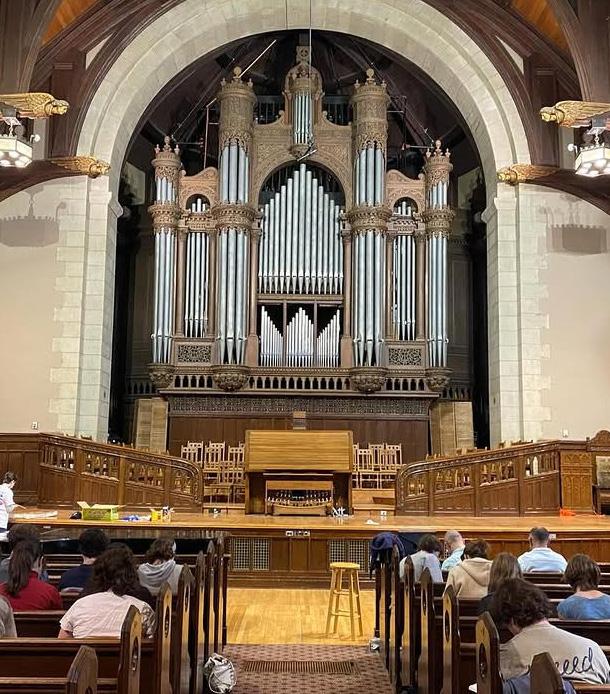
Fueled by Bacio’s pizza, popcorn and mocha-flavored iced coffee, the annual allnight reading marathon of John Milton’s “Paradise Lost” began in the chapel. The reading started at 6 p.m. and was estimated to end around 2 a.m. It ended at 3:56 a.m.— lasting almost 10 whole hours.
“ It's very nerdy in a fun way,” explained Emma Youngblood ’26, the academic intern for the English Department and one of the event’s organizers. “The thought of reading a book out loud all night with your peers in a dark, moody chapel, I think that is very aesthetically enticing, honestly.” She added, “I think intellectually, Milton’s ‘Paradise Lost’ is the foundation for most British literature that you read.”
A highly celebrated and often referenced text, “Paradise Lost” is a cultural and literary touchstone. Written in the 1560s, the epic poem retells and explores Man’s first disobedience: of the Book of Genesis’ Adam and Eve. The Biblical narrative was well-suited for the event’s setting: the chapel.
There to kick off the reading and offer an introduction to the epic was Assistant Professor of English Pasquale Toscano, who specializes in Renaissance literature. In an interview, he explained, “[Milton] is a very helpful interlocutor for a moment where there are so many different claims about what real liberty or what real freedom is.” An anti-monarchist, Milton explores themes of tyranny and authoritarianism in his work.
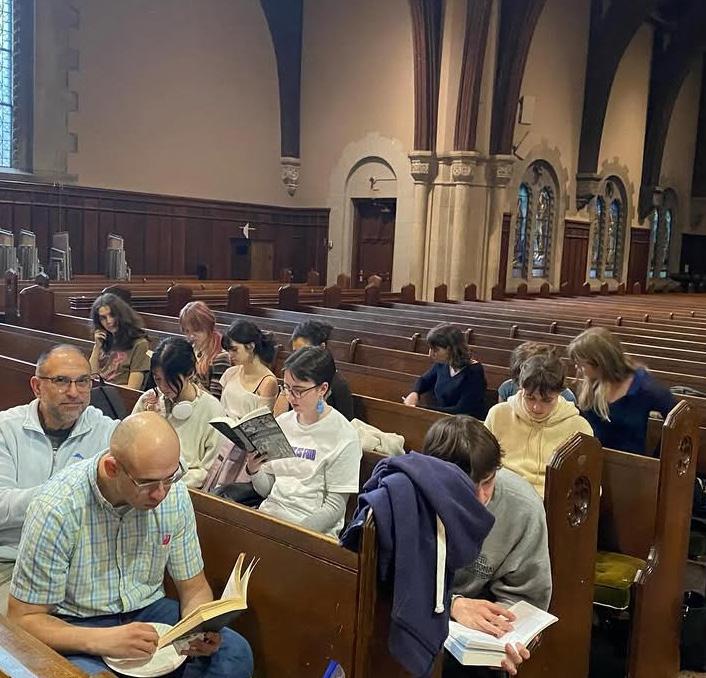
Students and professors came in and out in the evening. There were consistently 25 or so readers at any given time. At the end of the long night, however, there were only 10 remaining students—three of which had stayed for the whole time, without taking a single break. First-year student Charlotte Reeves was among the few to sit through the whole reading. In a text message, she explained, “I didn’t actually think I was going to stay the whole time, but after an hour there sort of felt like I had no reason
to stop. I knew that if I left before the end, I'd never be motivated to finish reading it otherwise.”
And so she stayed for 10 hours, listening and reciting Milton’s poetry. “Reading it all at once reminded me of staying up and reading a book in a single night under the covers like I did when I was younger,” explained Charlotte. “It felt weirdly nostalgic.”
Among the last 10 standing was Zifeng Zhu, a sophomore and member of the English Majors Committee. “ It’s kind of nice to have this condensed period of time to focus on this one text,” she shared almost immediately after the reading ended. “ There's also this sense of community because there’s this group of people who are committed to do this thing and to experience this poem together.”
Zofia Rosciszewski, a first-year student and organizer of the reading, was particularly enthusiastic about the event. Having read part of the work of literature earlier this year in Professor of English on the Henry Noble MacCracken Chair Robert DeMaria’s first year writing seminar: “What Makes a Classic?” Rosciszewski jumped at the chance to finish it during a communal reading—so much so that she joined the English Majors Committee to help organize it.
When asked why she would want to spend her Thursday night reading Milton in the Chapel, Rosciszewski shared, “ The writing is just so beautiful, and I also just love the genre of an epic in general. It's really enjoyable to be read out loud.”
What makes reading Milton’s “Paradise Lost” aloud particularly special is that Milton—with the exception of a couple of sections—dictated the entire epic. While he was writing, Milton was beginning to lose his sight. By 1652, he had gone completely blind. “ I think by reading it out loud,” explained Toscano, “and by reading it in a communal context, we're actually getting back to the very first moments of production for the poem itself. We’re getting back to something fundamentally true about how this poem came to be.”
Before the reading, Toscano advised lis-
teners to sit back and try to enjoy the beautiful language if they got lost in the plot. What the poem manages to accomplish in terms of prosody, in terms of meter, in terms of sound is absolutely amazing,” he explained. “So there's something profoundly musical about the poem.”
Attending students and professors read the epic aloud, popcorn style, each person taking a page or so before passing it on to the next person. “ There are some people in there who are super passionate about this book,” shared Youngblood. “They’re so the -
atrical about it and I think that's really fun.”
Towards the end of the night, the readings got admittedly slower and less emotive as eyes started to droop and coffee ran out. Still, new readers trickled in and out as late as two in the morning, coming in to enjoy the final stanzas of Milton’s epic.
A truly unique experience, the event was a celebration of language, community, caffeine and willpower. Maybe next year we can all read “Moby Dick” along Sunset Lake or “Dante’s Inferno” in the Raymond House basement.

Catherine Phillips Guest Columnist
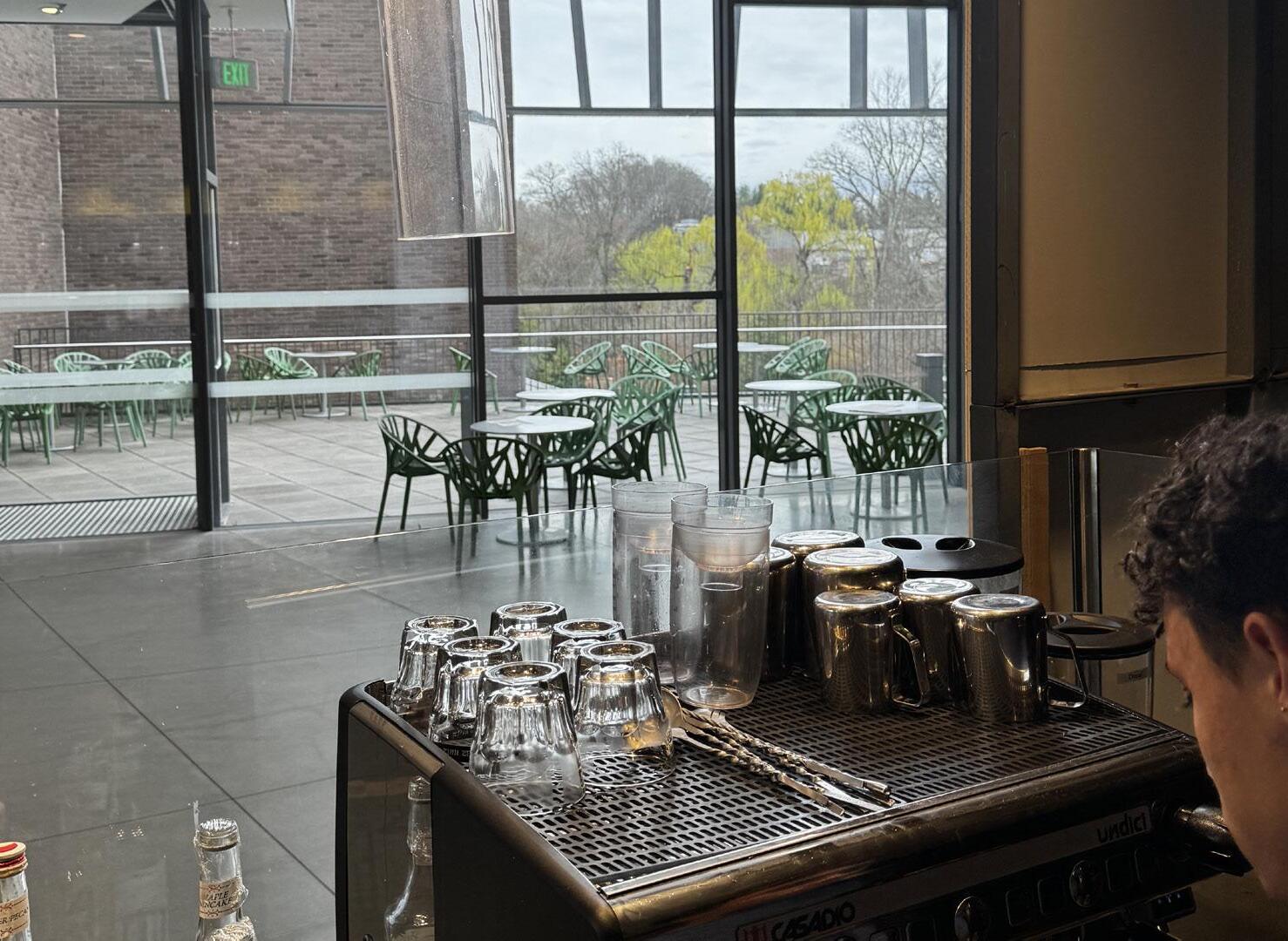
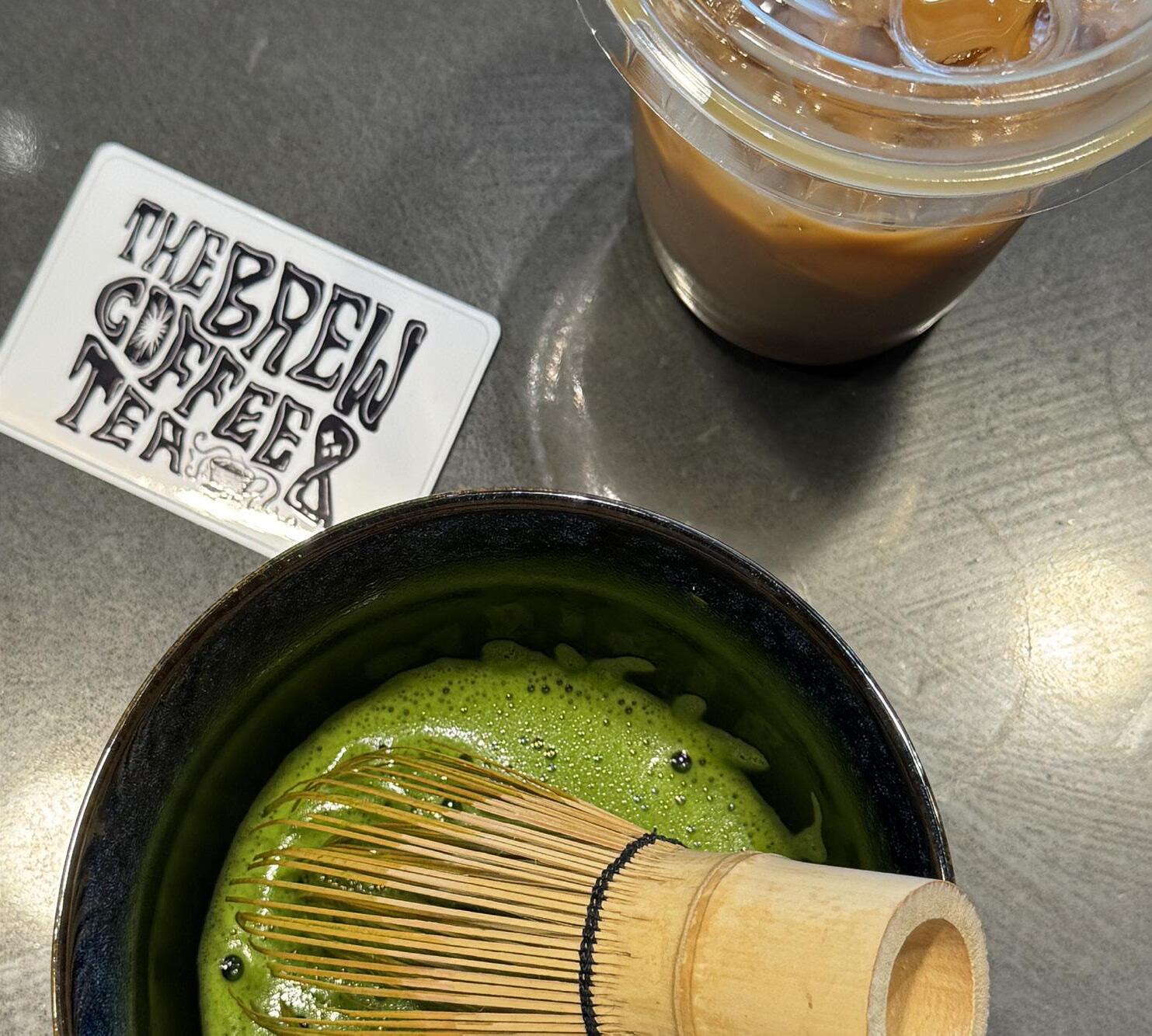
On a college campus, caffeine carries as much weight as your room key or the designated community-friend-group vape. So it is no surprise that the Brew, Vassar College’s student-run coffee and tea cafe, is as popular as it is. It is also no surprise that, when the Brew closed for two weeks and left students strung out and resorting to The Crafted Kup, there were some questions. On our two-week Brew detox, my friends and I reflected on how habitual our walks to get a coffee or tea from the Winton Evans Bridge for Laboratory Sciences (the Bridge) had become.
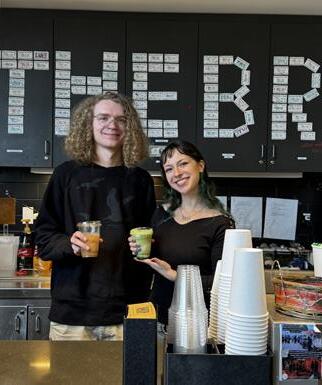
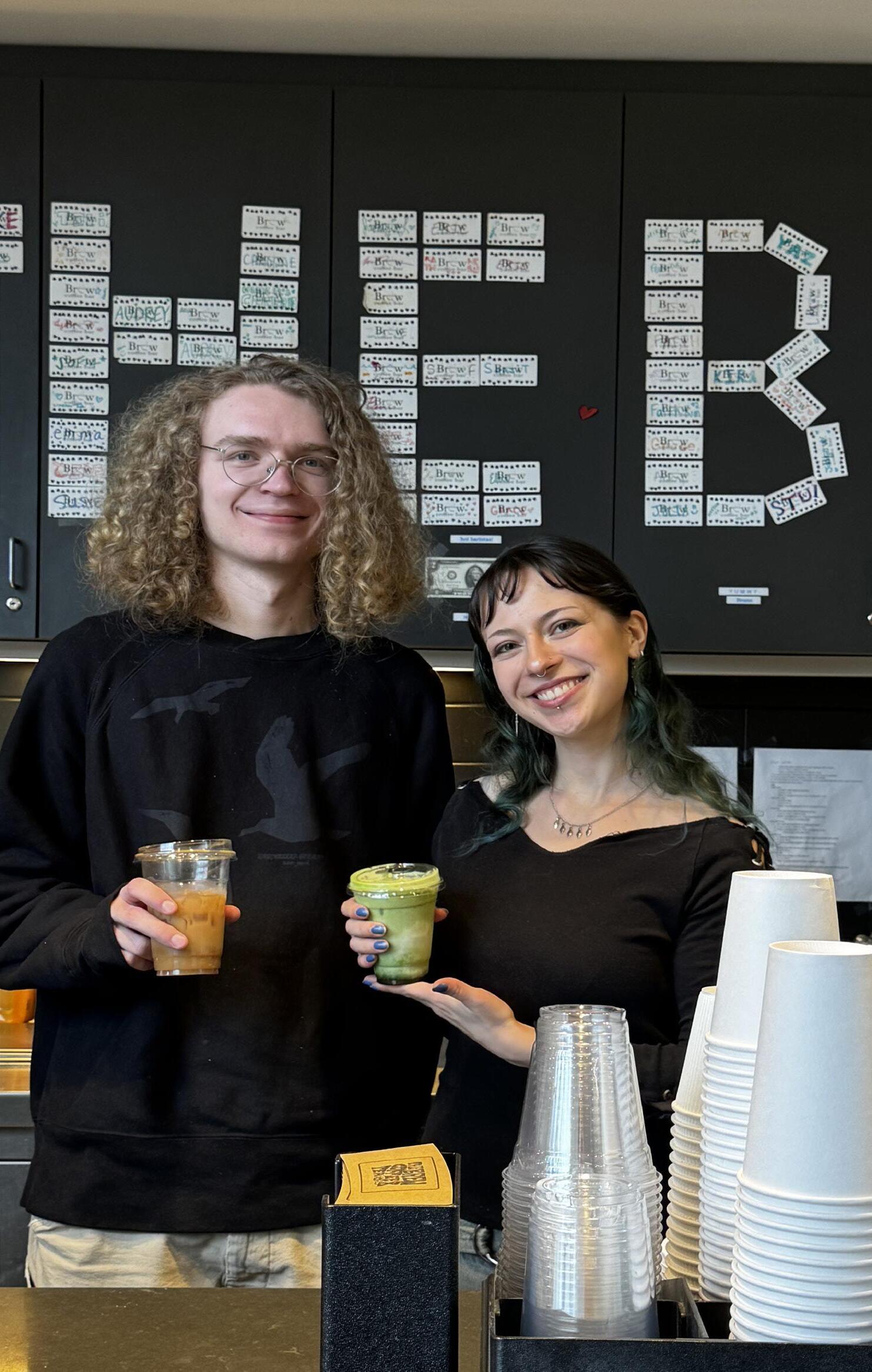
My own caffeine addiction gives me an inherent bias, but it would be hard for anyone to try to argue that the Brew is not a key spot on campus. As a senior, I can recall when the Brew was a rolling island cart in the basement of the Old Bookstore and not the popular cafe in the Bridge it is today. I was curious to know how the Brew evolved into what it is now, and the direction it is heading after I graduate. I sat down with the current Brew manager and assistant manager,Zoe Hoiland’26 and Ezra Graham ’27, to get some answers (and an iced dirty chai).
I started by asking about their own histories with the storied establishment. Hoiland, who is easily recognized by her piercings and frequently changing hair color, started working at the Brew during her first year at Vassar. Despite her initial dislike for the taste of coffee, she now finds herself responsible for crafting the Brew’s
specialty drink menu. You can thank her for the Brewbai special (dark chocolate drizzle with pistachio syrup) and mango matchas. Graham, on the other hand, only started working at the Brew in his sophomore year. He expressed that he was nervous during his initial interview—“‘cause, it’s, like the Brew”—but he got the job and, after putting in some extra hours, found himself quickly rising to the rank of assistant Brew manager.
They both described balancing their time working and socializing at the Brew with their schoolwork as challenging. It is easy to find themselves sucked into the allure of fresh coffee beans mixed with even fresher gossip. Running the Brew requires more than the eight hours a week that Work Study covers, but for Hoiland and Graham, it is about more than just a paycheck. Thankfully, they were able to increase the amount of baristas by a third—divvying up some of the work—but they are still hoping to hire more next year. In terms of scheduling, the increased workforce presented a new puzzle of class schedules, extracurriculars and events; but, according to Hoiland, the passion is strong with the Brew Crew.
With three years of experience, I also wanted to know what Hoiland thought was the biggest difference between when she started and now. She said the biggest difference was that the Brew Crew represented a group of friends, not just coworkers. Compared to when she started, the vibe between the baristas is much more collaborative and friendly. As a customer, I have observed this too. Graham commented on
the community as well, noting, “People hang out outside of [the Brew], and it’s just a lot more dynamic than just, we work together.”
In my opinion, the biggest difference at the Brew is the location. Compared with the Main basement setup, the Brew that greets incoming students now feels more like an establishment. Having a permanent space changed the vibe, too. “We can make decorations, we can actually customize the space, which we never had an opportunity to—which we're taking full advantage of this year,” explained Hoiland. The next time you stop by the Brew, take a look at the “THE BREW” sign made out of customers’ used punch cards—maybe you will even spot the “days since Jeff Buckley has been played” sign.
Finally, I breached the big questions: Why had the Brew been closed and when would they reopen? At this point, they were not sure when reopening would occur, but I am happy to report they started up this past Monday. The reason for the wait? The team was waiting for the installation of a new espresso machine. After expressing how badly my housemates and I had been missing the Brew, Hoiland responded, “The community has felt it too.”
Sympathetic to students missing the Brew, Graham was also thankful that this interview would let students know why they had been closed. He told the same spiel about waiting for the installation of the espresso machine to two different passers-
by since we had sat down for the interview. The Brew Crew had been requesting a new espresso machine for a little over a year, after one of the steam wands on the old machine broke back during Hoiland’s first year at the Brew. They had finally gotten the new machine but were stuck waiting for the College to schedule the installation. Frustrated with the timeline but grateful to soon have a fully functioning machine, we moved on to my next question.
Unfortunately, despite my pleading, neither of them would answer my question of: “Who’s your favorite customer?”
We ended the interview looking toward what was to come. When asked what their hope was for the future of the Brew, the managers offered similar answers. Hoiland, who will graduate this May, is feeling content with how she will leave the Brew. Her main goal was to build the foundation up by creating more of a community and lots of collaboration for the future Brew Crew to inherit. It is clear she has succeeded and is passing the joint over to good hands. Graham, who will continue on as Brew manager next year, also reflected on the community they have established. He shared a story of a barista who graduated last year, stopping by the Brew when he visited campus right before break. To Graham, it speaks to the environment they have cultivated if a barista alumnus feels the desire to stop by and say “hi.” This is the reputation he hopes to keep brewing when he takes over the helm next fall.
ideas grew over time: “At first, it was really just a guy in the desert, just trying to start something new. And then I was like, what if there was something going on? What if it wasn’t just his story? What if this encapsulated the whole town? What if this encapsulated the world? What if it encapsulated everything? You know, the best genre for encapsulating everything is sci-fi.”
For DiBartolo, the writing process was illuminating in a multitude of ways. He recalled that inspiration had struck way earlier than he first realized—influenced in middle school by authors like Ned Vizzini, novels like “Incarceron” and “Sapphique” by Catherine Fisher and, recently, games like “Cyberpunk 2077.” Inspirations like these informed the reflective narrative style of his novel. In fact, Marc’s internal monologue is a key feature of “Calico.” “The thought process that the main character goes through for a lot of the things in the book is kind of how I think on a normal basis,” DiBartolo shared, “and it gave me more clarity on myself while I was writing.”
Lots of things pushed DiBartolo to keep writing, but most of his motivation came intrinsically. Once he started telling the people in his life that he was writing a book, he knew he had to commit to his goal: “I was going to have to follow through, because you can’t just make false promises for a year and then come up with nothing.” DiBartolo often worked on his novel at Underground Coffee & Ales across the river in Highland, New York, where he became a recognizable regular; he recalled to me how the employees were surprised when he actually came in with the finished product one day.
He also felt compelled to continue because the harder he worked, the more his ideas came to life on the page. “When I fi-
nally figured out how to make them [altercations in the story] match exactly what I was trying to see in my head, that would

give me tingles sometimes,” he shared. “I almost teared up!” Magical moments like these allowed him to feel more connected to his characters and gave him a sense of pride in his work.
DiBartolo is only going up from here. In the fall, he will be starting a master’s degree program at Cornell University in Industrial and Labor Relations. Though he will be busy with his master’s, novel-writing remains in his future: He plans to release two sequels to “Calico” by 2028, with “Mastiff” being the second book in the trilogy.
Despite being excited for the future, DiBartolo’s time at Vassar will always hold a special place in his heart. “Vassar itself has probably aged me in the way that I thought that the Army would change me originally,” DiBartolo said. “It was like I never needed a direction because [the Army] was always there for me. And when I got here, I realized that it was me thinking for myself. And after I started really thinking for myself, that’s when I started being involved in everything—wanting to be involved and meeting people and doing stuff. And now it’s like I don’t know why I ever thought I couldn’t.” He continued, “I feel like every chapter of your life could be written in one way or another. I think this is my way of showing how far I’ve come.”
So if you see Caleb “D” DiBartolo around, walking his dogs Jack and Rosie, you should absolutely say hello. And if you want to publish a book yourself someday, DiBartolo is proof that you can do anything you put your mind to. “I believe anybody can do that,” he told me. “Just start telling people you’re gonna do it. Just start putting it out into the universe so that you know that you can do it.”

From the desk of Emma daRosa, Humor Editor
Seniors wrap up bell ringing, preparing to participate in the traditional Senior "John Pantsing." Don't forget your belt next week, Mr. Bradley!
Reports from the Registrar’s Office indicate that five students, Lana Eskape ’29, Quinn Leaven ’26, Brandon Lessgo ’28, Amelia Earhart ’27 and Anatascia Nikolaevna ’29, have “mysteriously disappeared” from the Registrar’s records overnight. They were last seen exiting a mysterious and cloudy portal through Main Gate.
On Feb. 16, 2026, these students’ status changed from “ACTIVE” to “MISSING FROM TIMELINE,” which, in addition to being terrifying, also means their disappearance is certainly going to decrease financial aid packages, possibly even retroactively. When asked by The Miscellany News how the Registrar was able to keep track of students so efficiently at all times, the on-duty Angela-Bot quickly mumbled something about “Deece waffles” before exploding into shrapnel.
Many people around campus have expressed displeasure with the current state of affairs. A group of student protestors from Raymond House, who call themselves “The Leavers,” maintain that Vassar College should cancel all classes one day a year and allow them to experience “a mere simulacrum” of what “The First Leavers” did. Meanwhile, residents of Davison House, alleging that “there’s no good reason to leave,” have formed a coalition called “The
Stayers,” who relentlessly challenge “The Leavers,” insisting all classes should be held every day, “especially weekends.” The Stayers’ other activities include trying to stop climate change and talking about how great of a dorm Davi is, even when it isn’t brought up in conversation.
The President and the President’s Husband, Elizabeth Bradley and Mr. Elizabeth Bradley disappeared overnight, which has sent Vassar College into a state of chaos. Professors in every department have started claiming territories and declaring war against one another, each aiming to take over the Presidential Throne now that PB&J have vanished. The majors in each department have enacted a strange sort of feudalism, ruling as vassals for their favored professors and ordering estates while rousing the Undeclareds for war.
There exist a few safehouses to be found amongst the constant warfare. One of the most populated is Strong House, captained by Dr. Jillian Hoffmann, whose research into the newly discovered Hamburger cells—which are dedicated to imagining the exact image of the McDonald’s 1949 Hamburger—is one of the few things so important to Vassar’s Nouveau Regime that all of the Noble Departments have declared the lands of her realm a safe zone. She enjoys playing violin and writing poetry.
In a secret correspondence, discovered by two wayward members of the Vassar
General Council on their way to important work fighting off the endless legal battles of the POTUS about WOKE, the President was found fumigating Her rage to Her Husband—Mr. Elizabeth Bradley—about the Incident.
“Fifty years in academia, and we missed it? I fear we have, as the children say, truly goofed up this time, my dear John,” wrote the President, referring to Mr. Elizabeth Bradley by his first name. “It’s time for us to leave, to go somewhere far away. Let us make preparations…”
Lana and Quinn were recently seen in the Raymond House basement, doing laundry.
“It’s much cheaper here than Over There, y’know,” said Lana.
“Although I like the Castle a lot more, they’ve got some good architecture Over There,” added Quinn.
“Do you two come back here often?” a reporter asked.
“Yes, every Thursday, because Amelia gets hungry and Anatascia loves getting new photos of the outside world to paint,” said Lana.
The duo described Over There as “basically Heaven; [one] always [has] enough food— Amelia just is a picky eater—the water in the oceans is potable, fresh water, there are these amazing animals, and [one] can fly.” According to them, the only issues are that the laundry service is very expensive, and there’s no WiFi.
“We pop back in every now and then to call our parents, scroll on Instagram and wash our clothes. Everything else is pretty chill, though,” said Quinn, with Lana nodding.
Shortly after this, the duo disappeared. No one seemed to see them leaving. At the time of publication, the Vassar situation is still deteriorating. We at The Miscellany News hope that a student will come who claims the throne of the Missing President, because if not, everything seems quite dire: A new, unruly faction, the “Lessgoes,” have started awkwardly congregating on Joss Beach every night, hoping to summon Brandon’s physical body back from Over There—while also completely disrespecting the Courtesy set up by the other Departments and Houses. The leader of this faction, Alexandra Rinlando ’26 claims that she “desires his Strength, his Power, and his Clash Royale card deck” in her 2026 manifesto Lessgo Alexandra! She is currently ruling over Lathrop and The-Weird-Olmstead-Part-Of-The-Bridge with an iron fist. Karoline Leavitt, Press Secretary of the United States, has taken to Twitter directly lambasting Vassar’s “cartoonish feudalism” and “high concentration of WOKE.” We just think she’s salty she couldn’t come. This is Evan Seker, Columnist for The Miscellany News, signing off. I’m in Strong House; you should come over, we have Panettone!
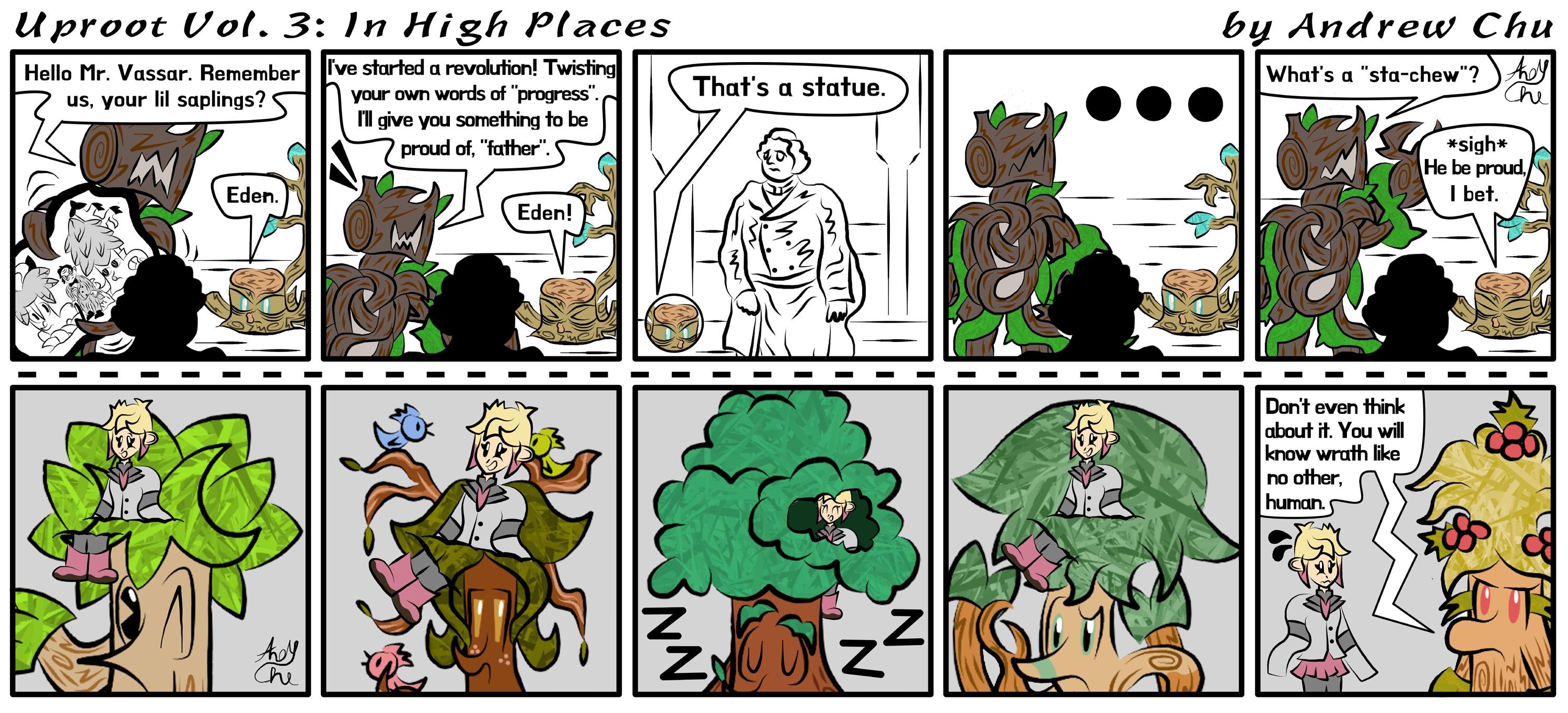

ARIES March 21 | April 19
Emma daRosa NOT PANICKING
Take a deep breath, the semester isn’t ending that soon. There’s no need to panic. Five weeks is plenty of time. PLENTY OF TIME. I REPEAT, THERE IS NO NEED TO PANIC.

TAURUS April 20 | May 20
You’re going to start referring to yourself as “mama” this week. I really hate to be the one to break this to you, but people don’t like that. I mean, I LOVE it personally, but you won’t have such luck everywhere.

GEMINI May 21 | June 20
This week is going to be full of new opportunities for you. Seize them! Try that mysterious-seeming Deece soup, trip that high schooler visiting campus, clap at the end of a lecture, nothing matters!

LIBRA Sept. 23 | Oct. 22
Goodness gracious, terrible news, everyone is going to point and laugh at how large your laundry bag is this week. I know, I know, you never thought it would happen, but it will. It is exactly as stupid and pathetic as you think it is to need to wash a bunch of clothes and linens.

SCORPIO Oct. 23 | Nov. 21
It’s time to stop barking and meowing and whatnot. This week, people are going to get REALLY annoyed at you for doing that. Not me… just people.

SAGITTARIUS Nov. 22 | Dec. 21
You know Sagittarius is one of those tricky star signs to spell. Could be anything really. Sagitarius. Saggittarius. Sajytaryus. Sajjiteareeuhs. Who’s to say? Not me on the first try, that’s for damn sure!

CANCER June 21 | July 22
You should raise your hand at least 40 percent less often during your classes this week. It’s not that people don’t care what you have to say; it’s that they actively dislike hearing what you have to say.

LEO July 23 | Aug. 22

Aug. 23 | Sept. 22
It seems like you might go viral on Fizz this week! DON’T LOOK AT WHAT IT’S ABOUT. Not all it’s cracked up to be, I must warn you.

CAPRICORN Dec. 22 | Jan. 19
It’s going to come to light that you don’t do your class readings. Your friends are going to judge you more harshly than you’d guess. Fuck ‘em! Everyone knows sharing a passionate moment of intimacy is the best way to distract people.

AQUARIUS Jan. 20 | Feb. 18
Gonna be a huge week for you in terms of the quad. You’re going to lay on the quad, you’re going to play spike ball on the quad, you’re going to fall out of the hammock in the quad, you’ll be born in the quad, you’ll die in the quad. What a week, quad-wise!
If you see someone playing “Stardew Valley” on the Nintendo Switch their sibling handed down to them this week in public, leave them be. No staring, please. Whomever you may spot, the valley needs them.

PISCES Feb. 19 | March 20
You might end up at the doctor this week for a constant ringing sound in your ears. Wait… oh no… no no that’s just the bell on top of Main! What a blessed and unirritating tradition. (Don’t worry, when I rang the bell, it sounded very different from when everyone else does it.)
Jacob Cifuentes Opinions Editor
Irememberbeing a middle schooler watching President Trump’s first impeachment trial in Congress. While Trump’s defense that the trial was a “witch hunt” was definitely misleading, there was an element of truth to it. I imagine the feeling I had watching the C-SPAN vote counter is comparable to that of a zealous 14-year-old watching a witch get exorcised by his local church in the 16th century.
I apologize for the gruesome analogy, but the point still stands. There was fervor and faith. There was a feeling that—maybe—justice would be served and that the Democrats were a competent opposition party. Now? Not so much. Since then, I have registered to vote as an Independent, but I want to see progress that will make me change my mind.
A recent poll from Quinnipiac University shows that 56 percent of voters view the Democrats unfavorably, compared to 53 percent unfavorability for the Republicans. That is a small gap, but it shows that there is enough significant dissatisfaction with both the status quo and the opposition.
Compare these statistics to the poll numbers from President Biden’s second year in office—2022—where Republicans were at 63 percent, and Democrats were at 55 percent. In February, AP found that approval among Democrats for their own party fell from 85 percent to 67 percent from September 2024 to October 2025.
These polls show a growing dissatisfaction in a party whose platform is not resonating with its base of support. The Republicans have had a decade-long coalition between the traditional moderates and conservatives and the MAGA populists. Even the younger underground alt-right factions, such as the Groypers and the Manosphere, are consid-
ered part of the in-group. While this alliance is dysfunctional, and cracks are forming due to the Iran War, both antisemitism along with anti-Zionism and the handling of the Epstein Files, the Republican Party is more or less unified.
In the internet’s marketplace of ideas, many prominent conservative commentators and influencers exist in a competitive ecosystem. Talking heads like Tucker Carlson, Ben Shapiro, Candace Owens and Nick Fuentes disagree on specific issues—namely the United States intervention in the Middle East and support for Israel—but still generally align with the Republican Party and the MAGA movement.
Within Congress, voting records show that Republicans rarely break from GOP-supported legislation pushes. Partially, this is due to fear of Trump and his supporters’ wrath, which caused the unsuccessful re-election campaign of former representative Liz Cheney and the resignation of former representative Marjorie Taylor Greene. Democrat agendas, however, seem to be on the defensive due to the Republicans’ slim majority in the House of Representatives.
On March 28, Democrats and Republicans reached a spending agreement to fund TSA during the Department of Homeland Security shutdown. While Democratic Senate Minority Leader Chuck Schumer congratulated his party for not backing down on their demands, this agreement did not include the limitations on Immigration and Customs Enforcement (ICE) and Border Control that the Democrats initially bargained for. The point of the Democrat-led shutdown is to curtail ICE’s horrific actions and lack of internal accountability after lethally shooting multiple U.S. citizens.
However, top Democrats get more excited
when bipartisan deals are made than when their party gets actual electoral victories.
This recent mayoral election in New York City has confused me about the ethos of the Democrats. When I see the Republicans, I see a united campaign against threats—unfortunately, being “Wokeism” and welfare programs—they see as real and imminent. Republicans have a view of a country they are aiming for, while Democrats have contradictory ideals. Zohran Mamdani, the victor of the election, promised a progressive social democracy in New York, featuring free buses, public-owned grocery stores and affordable housing projects. His rival in both the primary and the general election, disgraced former Governor Andrew Cuomo, promised remarkably similar projects, including affordable housing and care for the homeless, but with a tired and moderate flair that failed to rally Democrats against Mamdani. Even though they shared many goals, Cuomo characterized Mamdani’s platform as unrealistic. Also, the former governor’s sexual abuse allegations loomed over his campaign and disturbed voters. Despite Mamdani swinging the party nomination away from Cuomo, House Minority Leader Hakeem Jeffries waited 10 days before the election to endorse the Mayor, and Senator Schumer refused to endorse any of the candidates. Both represent New York in Congress.
This election showcased the progressive-moderate split within the Democratic Party that needs to be addressed before 2028. Personally, I cannot—in good conscience at least—support a party whose champion calls for a continued military global reign of terror as Kamala Harris did two years ago. I cannot follow an ethos that neglects its progressive wing over fears of losing its reach with moderates and conservatives.
Hasan Piker, a prominent online commentator and occasional ally of Bernie Sanders, Ro Khanna and Alexandria Ocasio-Cortez, said in a recent live stream that, “[Establishment Democrat leaders] don’t want these guys that represent a different opinion, that want to actually do right by their constituents.”
Compare this rhetoric with a recent op-ed from USA News that declared, “The Democratic Party’s base wants bold progressive policy, but the general electorate seems more moderate.” What the author, Nicole Russell, missed is that a party’s primary duty is to meet the demands of their base. Doing so is how Mamdani defeated a political dynasty with his pragmatic idealism—not just in a sensationalist manner, but through getting a split base of New Yorkers excited about civic duty and grassroots movements.
This type of populist idealism, which is both radically progressive and willing to compromise, is what the Democrats need if they want to stay relevant and build a left-wing coalition. The younger generation of democratic socialists can take the visionary charge, while the older liberals and moderates can focus on the details and logistics. All for a unified front that is for a progressive vision of America, rather than primarily against whatever MAGA wants to do. If this does not happen, and the two sides of the party are incompatible, then it may just be that there needs to be a new political party to house either side. I believe it is necessary to keep tabs on the party, and if I could vote in a primary with a competition between a progressive and a moderate, then I would gleefully register as a Democrat. However, when the 2028 presidential primary arrives, if the status quo of a waffling, unlikable party is maintained, then I will not be handing my voter registration to the Democrats.
Aviva Moss Guest Columnist
In any capacity, change and progress are rarely glamorous. What comes to mind when you think of eco-friendly technology? Sleek electric cars? Looming wind turbines? Solar panels mounted on roofs, angled toward the sun? Yes, these are all essential climate solutions, but they are also highly visible and familiar. Allow me to introduce you to the unsung hero of climate technology: the heat pump. Decidedly unglamorous, the humble heat pump is an electricity-powered, dual-function unit that can heat and cool spaces. Heat pumps will prove essential in the fight against climate change, as they are the most viable path to decarbonized—aka fossil fuel-free—heating and cooling.
Conventional heating systems like furnaces and gas boilers burn fossil fuels, which release greenhouse gases into the atmosphere. Air conditioners run on electricity, but they require a lot of it, and they also emit greenhouse gases. Heat pumps, by comparison, are fossil fuel-free and highly energy-efficient. Why? Because instead of generating heat, they move it from one place to another. There are two types of heat pumps: groundsource and air-source.
While weather and climates vary across the United States, the shallow Earth’s surface maintains a relatively constant temperature year-round, between 40 and 70 degrees Fahrenheit, depending on the area. Groundsource heat pumps utilize this stable temperature to heat spaces in cold climates and cool spaces in hot climates. One of the most common types of ground-source heat pumps are closed-loop vertical systems. In this system, vertical wells are drilled hundreds of feet underground. Then, a series of parallel pipes are inserted into the wells and connected in a “U” shape at the bottom (see visual). The number and depth of the wells depend on the region’s climate and the building’s heat demand. To exchange heat between the building and the ground, the piping cir-
culates water mixed with anti-freeze. Once above ground, the water enters the HVAC system through the following steps (see visual):
1. The water is channeled into an evaporator, which contains a heat-transferring liquid called a refrigerant. The water and refrigerant are separated so that the water can transfer its heat, turning the refrigerant into a gas.
2. The warm refrigerant gas makes its way into the compressor, which increases the pressure and temperature of the gas.
3. The hot refrigerant gas flows into a condenser, which functions like a reverse-evaporator, warming the water that will serve the building’s heating system.
4. Finally, the refrigerant gas—having transferred its heat—reverts to liquid form. The refrigerant liquid enters an expansion valve to reduce its pressure and temperature before returning to the evaporator to start the cycle again.
The marvel of heat pumps is that the same unit can also work like an air conditioner! When it is hot outside, a heat pump removes the heat from a building. This function requires a coaxial heat exchanger, which transfers heat from the refrigerant in the aboveground heat pump to the circulating water so that it can be absorbed underground. For every kilowatt of energy used by a groundsource heat pump, four kilowatts of energy are outputted as heat—that makes them 400 percent efficient!
You might have heard ground-source heat pumps referred to as “geothermal” heat pumps before, but strictly speaking, that is a misnomer; the prefix “geo” means “earth,” and ground-source heat pumps actually use solar heat stored in Earth’s upper layer. This term may be better suited to the concept of geothermal energy, which is a different technology that uses the high temperatures far beneath Earth’s surface to produce electricity.
Air-source heat pumps function similarly to ground-source ones, but they use—
you guessed it!—air as an input. These heat pumps utilize a fan to suck air into an evaporator, where the refrigerant liquid absorbs heat in the air to become gas. From there, the process continues as it would in a ground-
We are calling for Vassar to finish the first phase of Wendel’s plan by 2030 and commit to fully decarbonizing Vassar’s campus by 2040.
source heat pump. In the warmer months, the refrigerant absorbs heat from the building and transfers it to the outside air, just like an air conditioner. Air-source heat pumps are generally less efficient than groundsource ones because they lack the stable temperature of the shallow earth; however, they are still usually more efficient than traditional HVAC systems.
An important caveat when it comes to decarbonized heating and cooling is electricity. Heat pumps run on electricity, so if a heat pump is not powered by renewables—like solar panels and wind turbines—it will still amass carbon emissions. Even so, a heat pump running on “dirty” electricity will emit significantly less greenhouse gases than a gas boiler or furnace.
When it comes to heating and cooling networks of buildings, like neighborhoods or college campuses, ground-source heat pumps have a broader application: district heating. District systems employ an extensive piping network and a centralized heat exchange station. A number of colleges in the area have projects underway to install these heat pump networks. Fellow Seven Sister Schools Smith College and Mount Holy-
oke College expect to reduce their respective carbon emissions by 80 percent by 2030. Amherst College aims to fully decarbonize its heating and cooling system by 2030. Vassar, on the other hand, continues to burn fossil fuels on campus at the heating plant behind the Shiva Theater. The engineering firm Ecosystem—hired by Vassar to assess options for campus decarbonization—reported that in 2023, Vassar’s total scope one emissions for heating buildings were 10,075 metric tons of carbon dioxide.
In 2016, Vassar committed to carbon neutrality by 2030. As stated in the 2020 Climate Action Plan, the college planned to accomplish this goal by converting two of the central natural gas boilers to biofuel—a dubiously “clean” fuel that combusts plants and wood—which was not a viable solution. Moreover, carbon neutrality is not a commitment to full decarbonization, and often includes shortcuts like “carbon offsets.” With input from the engineering firm Wendel, Vassar’s Climate Action Sustainability Committee (CASC) is writing a new Climate Action Plan that will holistically address campus emissions—including the installation of a ground-source heat pump network. Wendel laid out their findings in a recently completed and soon-to-be-publicized report, but CASC has yet to select a plan or end goal for full decarbonization.
That is why the members of Students for Equitable Environmental Decisions (SEED) are launching a “Decarbonize Vassar Now” campaign! We are calling for Vassar to finish the first phase of Wendel’s plan by 2030 and commit to fully decarbonizing Vassar’s campus by 2040. Vassar’s central heating plant was state-of-the-art when it was built in 1864, but in 2026, we have clearly fallen behind the times. Climate change is real, it is here and it is life-threatening. Just like everyone else, Vassar has a responsibility to mitigate carbon emissions and join the climate fight. From all of us at SEED, we invite you to join us in making the college hear our demands!

Our goal with Brewers Ballin’ is to feature Vassar athletes who starred for their team the week previous to publishing. If you would like to nominate an athlete, please email hfrance@vassar.edu.

'26.
Men's Tennis
W, 7-0 vs. St. Lawrence University
Men's Rowing
5th/5 vs. Wesleyan, Colby, WPI, Hamilton
Baseball Series L vs. Bard College (1-2)
Name: Erin McCusker
Team: Women's tennis
Year: Senior
Stats: McCusker has been dominant since beginning Liberty League play in her senior campaign. She has led the Brewers to two crucial Liberty League victories against St. Lawrence and Union. In doubles, McCusker and Iris Li ’26 won each of their doubles matches, winning 7-5 and 6-0, respectively, against St. Lawrence University and Union College.
Statement: “Tennis has always been a huge part of my life, and with my senior season and the end nearing, I’ve been doing my best to enjoy every moment of it. One of my favorite parts of this season so far has been playing doubles with Iris, another senior on the team. We complement each other very well on the court, and playing together has brought us closer than I could have imagined. As Liberty League play is starting to ramp up, I can see that all of the hard work this team puts in is paying off on the court. I am super excited to see what the rest of the season will bring to this team. Go Brewers!!”

Women's Tennis
W, 5-2 vs. St. Lawrence University
Women's Lacrosse L, 6-18 vs. Ithaca College
Men's Volleyball W, 3-1 vs. #3 Stevens
Armaan Desai ’27 earns second straight UVC Award
The junior middle blocker was named UVC Player of the Week for the second straight week after tallying 20 kills without a single error in the five set loss to #9 NYU and 13 kills in the win over #3 Stevens.
Ruthie Weiss ’29 named Liberty League Rookie of the Week
At the CGA invite, Weiss made the podium with a 10.85 meter leap in the triple jump event. The first year also set a personal record in the 100 meter, finishing in 10th place with a time of 12.89.
Men’s Tennis sweeps Liberty League awards
Following a 2-0 week, Jason Jia ’29 earned Rookie of the Week, Eugene Lee ’27 earned Singles Performer of the Week and the pair of Nolan Kubiak ’26 and Fernando Bauermeister ’26 earned Doubles Team of the Week.
Women's Lacross vs. Union College (SENIOR DAY!)
Saturday, April 11th 12:00 pm @ Gordon Field
By: Phoebe Bergan

ACROSS
1. Restrain
6. Opposite of flows
10. Raised platform
14. Popular party island
15. ___ Novela
16. Color for a Pony Club or a Pantheress
17. * Loaded metaphor for Addison Rae
19. Regular option at Root
20. Poetic before
21. "They can do what they want"
22. ROFL
23. * Label for Lily Allen's new direction
27. Tarzan, e.g.
31. NBA all-star Ming
32. Remove the labe
33. * Metro ride for Chappell Roan
39. Vassar dept. starring profs Buie and Salyk
40. Musician Mann
41. Popular Verdi opera
42. * Real estate offer for Sabrina Carpenter
44. Sicker
45. Island time
46. Without color, say
47. * Magic word for Lady Gaga
53. Feathery accessory
54. "You won!"
55. See 62-Across
58. Jessica of Hollywood
60. * Label in 2025 for the singers of this puzzle's starred clues
62. "Gnarly" drink containing lots of bubbles, with 55-Across
63. "Either that, ___ overslept"
64. Tied, as a French score
65. The largest continent
66. Opening words at many a football game
67. Class you can sleep through DOWN
1. "___ of a Showgirl" (Taylor Swift's newest release)
2. Letter-shaped beam
3. Silent performer
4. Radical ending?
5. Sign of a very happy pup
6. French states
7. Sire
8. Author Judy, known for her children's books
9. Beginning for many California towns
10. HR or PR, in a big organization
11. Garlicky condiment
12. About to receive
13. Head case?
18. Viewed
24. Wall St. workplace
25. Female descendant, abbr.
26. Lose one's hair
27. Wife of Esau
28. Currency in the Philippines
29. Last words for Julius Caesar
30. Drag queen whose name is repeated
x3
33. Uncle, in Spanish
34. "lmk when ur free"
35. Poetic eternity
36. Sneaky, like a coyote
37. "Zip-___-Doo-Dah " ("Song of the South" song)
38. The Front ___ (Vassar student band)
40. "___ girl!"
43. Computer command
44. Playground location for locking lips
46. Vassar summer program for STEM students
47. Addis ___ (African capital)
48. String ties
49. Jewish leader
50. Some luxury gowns
51. Leader, in internet slang
52. One over par, in golf
55. Sisters of 33-Down
56. Slippery
57. In deep water, say
59. Common battery type
60. Word for a potty mouth?
61. Queens airport inits.