The Miscellany News
Vassar College’s student newspaper of record since 1866
March 26, 2026 Volume 165 |
Vassar College’s student newspaper of record since 1866
March 26, 2026 Volume 165 |
Julian Balsley News Editor
Immigration and Customs Enforcement (ICE) is no longer planning to turn a warehouse in Chester, New York, into a detention center, according to State Assem blyman Brian Maher. In a Feb. 20 press re lease, Maher’s Chief of Staff Meghan Hul burt wrote that the plan was abandoned for the time being after Maher, whose district includes Chester, spoke with a senior ICE official.
Maher’s news comes after ICE told mul tiple papers on Feb. 12 that it had purchased the warehouse, a former Pep Boys facili ty at 29 Elizabeth Drive, although Orange County had no record of the purchase. Days later, on Feb. 19, ICE retracted the claim. A spokesperson told the Times Union by email, “ICE has NOT purchased a facility in Chester, New York.”
“I trust Brian [Maher]... I believe that he has had the conversation with an ICE offi cial, and everything that he’s telling us is the truth of his experiences with this ICE official,” Chester Town Supervisor Brandon Holdridge told The Miscellany News. “How ever, I do not believe this administration. They’ve shown themselves to flip flop and lie blatantly about a number of things, in cluding everything that has to do with ICE and its operations.” Holdridge explained that throughout the entire process, he has not had any direct communication with
ICE or the Department of Homeland Secu rity (DHS). He concluded, “As much as I’d like to believe that this is the final word on this situation, I’m only cautiously optimis tic about it, and I’m still staying vigilant.”
In two February meetings, the Pough keepsie Town Board unanimously passed a resolution opposing the Chester ICE cen ter and enacted, six to one, a resolution supporting the Mandating End of Lawless Tactics (MELT) Act at the New York State Legislature. The Act would ban ICE and other federal law enforcement officers from wearing masks or plainclothes while conducting immigration operations in New York. “Resolutions like these ensure that our voices are included in broader coalitions,” Town Councilman Shantha Thangiah wrote by email. “While these ac tions do not create law on their own, they signal where our residents stand and help influence decision‑makers beyond the lo cal level.” The MELT Act resolution will be submitted to the Town’s state represen tative, Assemblymember Didi Barrett, to show the Town’s support for the Act in Al bany. Town Councilwoman Barbara Laird said that the Town Board only passes me morializing resolutions when the topic is of “great importance.”
During public comment, residents over whelmingly spoke in support of both reso lutions. One constituent spoke against the resolutions as irrelevant, since they do not address Poughkeepsie itself. Laird noted
location and get films into theaters and get it seen,’ and we were really interested in those questions.”
to the Miscellany that a facility in Chester would almost certainly hold Poughkeepsie residents detained by ICE. She also argued that both resolutions are relevant to res idents because ICE is already present in Poughkeepsie. Ulster Immigrant Defense Network (UIDN) Executive Director Vic tor Cueva estimated that, since September 2025, around one person has been detained by ICE per week in nearby Ulster County. “Our residents don’t live in isolation—re gional policies, state actions, and federal proposals affect our safety, our economy, and our shared values,” Thangiah ex plained. “When the Town Board takes a position on matters beyond our borders, it is not a distraction from local governance; it is an acknowledgment that what happens
elsewhere in the state shapes the well‑being of our community.”
The Board’s resolutions join opposition to the center from the Chester Town Board, constituents, Orange County Executive Stephen Neuhaus and Representative Pat Ryan.
On March 9, the Dutchess County Leg islature also unanimously passed a reso lution opposing the Chester facility. In an email to the Miscellany, Legislator Lisa Kaul, who co sponsored the bill and rep resents Poughkeepsie, wrote, “Let’s be clear about what these facilities are: Black box sites of horror. People are being held indefi nitely, with no legal protection. There is no oversight. There is no accountability. And
See ICE on page 3
Grace Finke, Brendan Kennedy Arts Editor, Assistant Arts Editor
The “Women’s Work: Preserving Inde pendent Film and Video Histories, Con necting Media Futures” program took place at the Vassar Institute for the Liberal Arts from Feb. 26 to 28. The event spanned three days and was organized in conjunction with an exhibition at the Frances Lehman Loeb Art Center on view from Feb. 25 to March 24.
The program gathered 26 panelists across a wide demographic range, mostly based in New York, from 24 year old filmmaker Zola Ross Gray to 86 year old media activist and filmmaker DeeDee Halleck.
“We wanted to make the invisible visible— to highlight the labor that makes indepen dent filmmaking possible,” said Associate Professor of Film and Urban Studies Steering Committee member Erica Stein in an inter view with The Miscellany News.
As one of the organizers of the event, Stein reflected on the program’s goal of bringing independent filmmakers together in one space: “It’s very different to ask the question, ‘How is this film made, what has to happen in order to learn how to use the equipment, put a crew together, get permission to use a
Jackson Hrebin reports on a recent Vassar Alliance for Ukraine event.
Stein explained that histories like these are often forgotten and that collectives tend to have short life cycles, requiring indepen dent media infrastructures to be continually rebuilt. “Bringing people together to share those histories is an important interven tion,” she said. She noted that cultivating an event where “multiple versions of history” could engage in conversation was particular ly meaningful, making what had once been theoretical into something tangible.
The program featured five panels that explored a variety of topics: “Scholars and Archivists,” “Filmmaking and the Women’s Movement,” “Activist Media,” “Program ming and Curating” and “Experimental Women.” The event concluded with a round table discussion and workshop focused on the preservation of independent film.
During the panel “Filmmaking and the Women’s Movement,” three women film makers and media activists reflected on their introductions to independent film, their ca reer paths and the stakes of working within the field. Speakers included Ariel Dough erty, co founder of Women Make Movies;
See WOMEN on page 4

Sophia Marchioli writes about an ENST trip to Scandinavia.
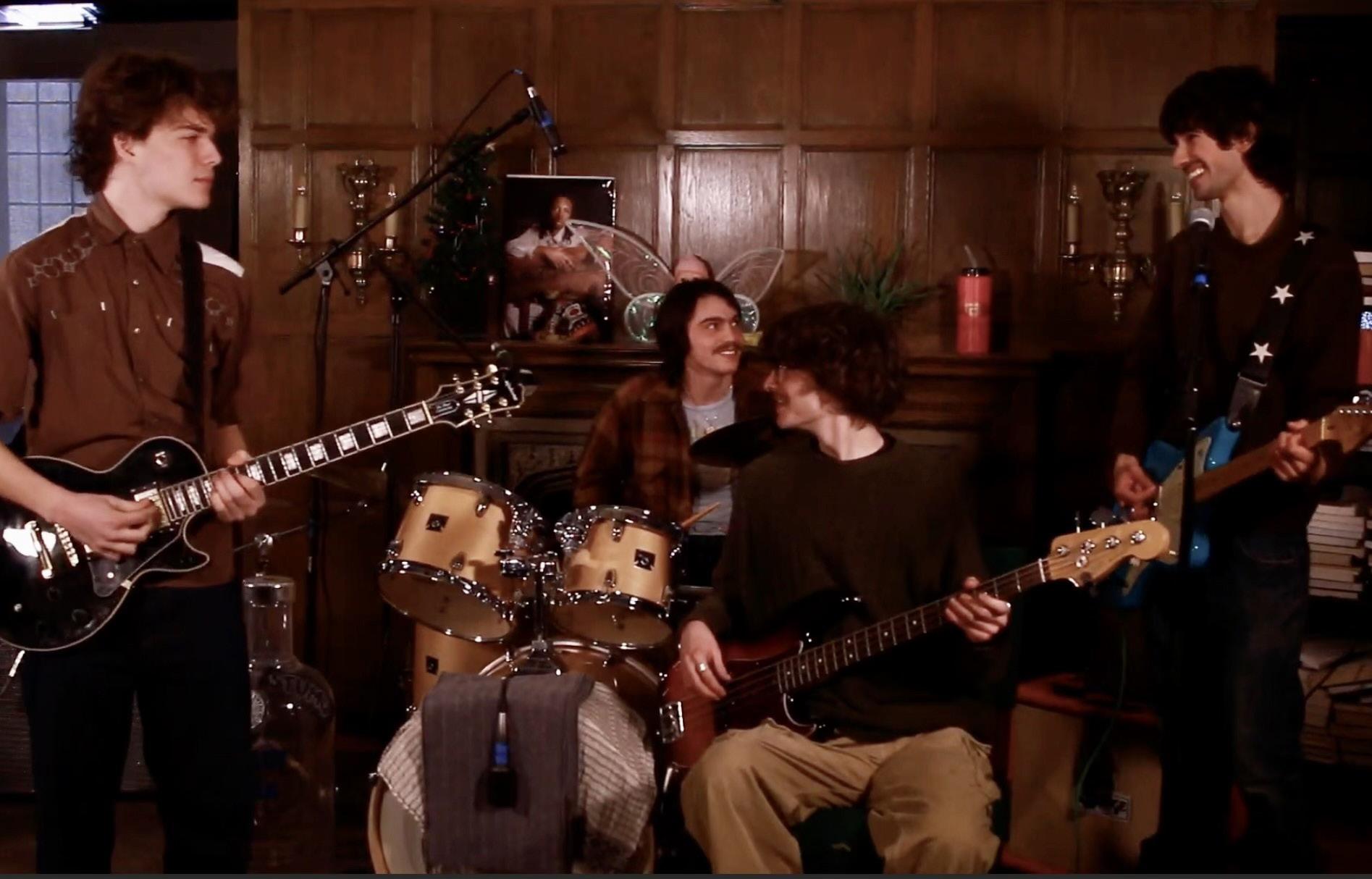
Since Fall 2023, Vassar Tiny Desk—a col laboration between the Student Music Union (StuMU), Vassar College Entertain ment (ViCE), Vassar College Television (VCTV) and The Miscellany News—has been a coveted opportunity for student musicians to record and share their work. On March 1, three performances were filmed in a class room in Blodgett Hall, which was decorated with numerous tiny knick knacks, a static television and a baby doll with sparkly pink fairy wings. The Miscellany News had the opportunity to see the sets live and sit down with all of the performers afterwards.
Anodyne
Anodyne, consisting of sophomores Elliot Evans [Disclaimer: Evans is a Copy Staffer for The Miscellany News], Nikolai Jerrard, Leo Kogan and Joey LaRosa, walked onto the set with a comically oversized vodka bottle and a giant paper sword, which—after play ful banter proclaiming they must shave their mustaches soon—they bestowed upon their drumset. Anodyne, a word they described as meaning “bland,” is an indie rock band aim ing to musically capture their college experi ence. Since meeting during their freshmen orientation, the quartet has experienced the fluctuations of surviving college with the

support of one another. One tactic for doing so is by naming their tracks after the various people they know, or at least know of:
“[The titles] are completely separate from the content of the lyrics…it kind of serves as a time stamp. It also is the people we are connected to at the time the song was writ ten,” the band explained. The first song in their set included tranquil, twangy guitar riffs that eventually dropped into a rough, psychedelic esque melody. They named the tune "Anthony Rosenthal” after former Broadway child actor Anthony Rosenthal ’27 because they thought it would be funny.
The band described their Tiny Desk set as quieter, less inebriated and, thankfully, not as sweaty as their typical campus perfor mances. Audience members bounced their heads and aggressively tapped their feet as the songs flowed between punchy alterna tive beats and smooth, lighthearted gui tar heavy melodies. Though we were bound to the hard wooden chairs, it was evident that everyone wanted to get up and groove. Their typical campus performances—like Slush Pit, the hard rock concert organized by StuMU—are filled with loyal “friends of” and indie rock enthusiasts frolicing around to their noisy rhythms.
Anodyne takes pride in their Vassar Col lege roots. “The entire ethos of the band is we’re from Vassar; we met at Vassar… that
See TINY on page 5
Evan Seker discovers a disastrous chemical.


EDITOR-IN-CHIEF MANAGING EDITOR
SENIOR EDITORS
CONTRIBUTING EDITORS
NEWS EDITORS
ARTS EDITOR
ASSISTANT ARTS EDITORS
FEATURES EDITORS
OPINIONS EDITOR
ASSISTANT OPINIONS EDITORS
HUMOR EDITOR ASSISTANT HUMOR EDITORS
SPORTS EDITORS
ASSISTANT SPORTS EDITOR DESIGN EDITORS
ASSISTANT DESIGN EDITORS
COPY EDITORS
GRAPHICS EDITOR
PHOTO EDITOR GAMES EDITOR
SOCIAL MEDIA MANAGER
LIVE EVENTS CHAIR WEBMASTER REPORTERS/COLUMNISTS
PHOTOGRAPHER CARTOONIST COPY STAFF
Allison Lowe
Luke Jenkins
Kathryn Carvel
Darja Coutts
Madeleine Nicks
Clara Alger
Carina Cole
Soren Fischer
Hadley Amato
Julian Balsley
Grace Finke
Aurelia Harrison
Brendan Kennedy
Yaksha Gummadapu
Sydney Jones
Jacob Cifuentes
Ian Watanabe
Zoe Rodriguez
Emma daRosa
Wren Buehler
Noah Daube-Valois
Henry France
Casey McMenamin
Holland Kaplan
Molly Delahunty
Lucas Seguinot
Teresa Garcia-Green
Hannah Wells
Sadie Bakken-Durchslag
Paige Hahn
Anabel Lee
Annie McShane
Makenna Brown
Sadie Keesbury
Felix Mundy-Mancino
Mia Liloia
Denver Brown
Hunter Farhat
Jordan Alch
David Bray
Eduardo Culmer
Armaan Desai
Noah Duncan
Jackson Hrebin
Lora Janczewski
Evan Seker
Erin Thatcher
Amritha Dewan
Andrew Chu
Nikola Parker Cooperman
Catriona Chapman
Elliot Evans
Rebecca Lubin
Tess Novack
Julia Weber
• The Associate Director of Public Relations and Director of Communications updated the Senate on the Division of Communications’ list of recently accomplished and ongoing VSA achievements.
• The President informed the Senate of a recently-passed resolution prohibiting VSA from purchasing from Amazon or its subsidiaries.
• The President informed the Senate of a recently-passed resolution establishing a fines system for student organizations that repeatedly violate the VSA Governance.
people, including children, are dying in side from lack of medical care and outright physical abuse. There is exactly one way to stop this: prevent it from happening in the first place.”
Meanwhile, ICE has been operating elsewhere near Vassar College. On Feb. 10, WIRED reported that ICE has been operat ing at 843 Union Ave. in New Windsor for almost six months—16 miles southwest of Vassar. “I was not aware of it, didn’t know it was there, had no clue,” New Windsor Town Supervisor Stephen Bedetti told Ra dio Catskill. He told SUNY New Paltz’s The Oracle that about 14 ICE lawyers are using the space part time. On Feb. 16, over 250 people protested outside the New Windsor office.
The New Windsor office is part of ICE’s nationwide search for around 300 new office spaces for new lawyers and offi cers, according to The Washington Post Between January 2025 and January 2026, ICE increased its workforce by 120 percent, from 10,000 to 22,000; it is now the high est funded federal law enforcement agency, with a budget of $85 billion. ICE has asked the General Services Administration—the federal government’s main real estate pro curer—to hide lease listings from the public due to “national security concerns,” which may explain why neither ICE nor DHS has communicated with town supervisors like Holdridge or Bedetti about opening facili ties in their towns.
Alongside new offices, ICE is also un dertaking a nationwide project to turn 23 warehouses into detention facilities, with Maryland and New Jersey suing over plans in their states. On March 11, a federal judge granted Maryland a 14 day stoppage in an ICE warehouse renovation over environ mental concerns about sewage capacity. Holdridge previously told the Miscellany that the lack of sewage capacity was a major
concern for the Chester plan.
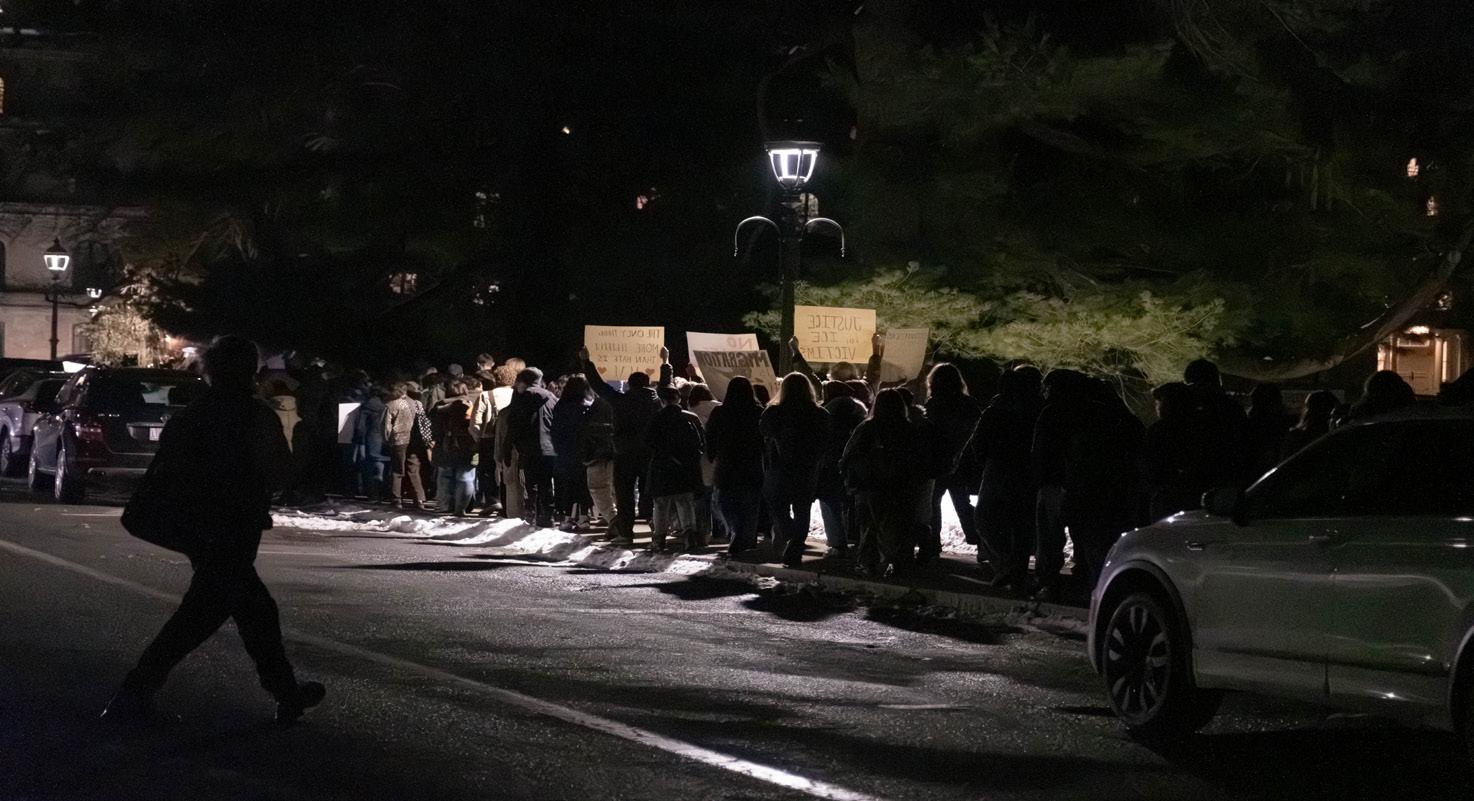
Vassar students recently held multiple events opposing ICE. On March 4, a coali tion of 13 student organizations led by For the Many and Democracy Matters hosted a vigil honoring those detained, injured and killed by ICE. The event included speeches from students, followed by a silent march through campus and an altar with candles and art made at an event the week prior. “We must acknowledge that immigrants are not dispensable. We are human beings worthy of humane treatment and due pro cess, just as anyone else,” said a Latine Stu dent Union member during their speech. Hundreds attended—the marchers filled sidewalks and spilled into the street, ex tending almost the entire length of the quad. “It was really amazing, because we knew that Vassar students feel super pas sionate about immigration, but we nev er could have expected to get such a huge turnout,” said Democracy Matters Co Pres ident Noah Daube Valois ’28 [Disclaimer: Daube Valois is an Assistant Humor Editor for The Miscellany News]. “And if you walk through campus with 50 people, it’s pow erful, and it’s a statement, but it wouldn’t have been as powerful [of] a statement as we felt like we made that day.”
Organizers asked attendees to sign a pe tition calling on New York State Senator Rob Rolison, who represents Poughkeep sie, and New York Governor Kathy Hochul to support the MELT and New York For All Acts. The latter prohibits New York state and local agencies, including law enforce ment, from collaborating with ICE, such as by providing sensitive information or diverting personnel to aid in immigration enforcement. Ninety two attendees signed the petition, according to Daube Valois. Multiple students said that they support ICE being abolished. As of early March,
ICE has “gone too far” as of February. Mia Walker ’28, a For the Many member who helped organize the vigil, supports abolish ing ICE, but added, “Who am I to speak for people who are more directly being impact ed? And who am I to, as a Vassar College student, claim to speak for other people? But I also think that not doing anything and just watching right now is crazy, and so, whatever I can do I want to do.”
“I feel like I’m not doing anything, and I read the news, and it makes me sad, and so feeling like taking some time to even just acknowledge what’s going on and thinking about it was something I wanted to be a part of—and show my support,” commented Caroline Belanger ’28. Iris Kimball ’28 said, “Standing in silence felt good and respectful and holding space for the things that have happened. But when we started march ing—usually when I’m marching, I think of it more as a protest or a demonstration. And since we were silent and not allowed to light the candles, it felt very contained and a little bit off the point.” Walker said that organizers wanted the vigil to have a tone of “reverence,” not protest. She acknowl edged that Vassar’s administration likely would not have been as accommodating to the event if it had been a protest, especially in light of students’ recent protest against Steven Cash ’84 over his involvement in the Central Intelligence Agency, the USA Patri ot Act and the creation of DHS.
On March 4, the Vassar Student Associ ation (VSA) hosted a “Know Your Rights” workshop by UIDN Executive Director Cue va. VSA Senators and Cabinet members were required to attend. At the workshop, Cueva explained how the second Trump administration has made all immigrants a priority for deportation regardless of immi gration status or location—including courts and schools. This surge, he said, is due in
demand that ICE arrest 3,000 people per day. (Trump fired Noem as DHS Secretary on March 5; the Senate confirmed Okla homa Senator Markwayne Mullin as her replacement on March 23.) The best way to help immigrants, Cueva said, is to know one’s rights, organize and share resources, be emotional support for those in need, support local nonprofits and vote.
“This felt like a first step towards pro viding material skills and being able to provide people with tangible things to do,” explained a VSA official. “If you’re going to be a student leader and you’re going to be representing students, you have to know how to protect them, or know how to be able to give them the information they need to know.” VSA will be hosting advocacy risk assessment workshops by Sabrina Surgil ’21, a staff attorney at the Amica Center for Immigrant Rights, on Sunday, March 29 at 2 p.m. in New England Building 105 and Monday, March 30 at 2:30 p.m. in the Col lege Center Multipurpose Room.
During the workshop, Cueva showed an interview in which Border Czar Tom Ho man told CNN, “Sanctuary cities are mak ing it very difficult to arrest the criminals… They call it ‘know your rights.’ I call it ‘how to escape arrest…’ If we gotta play that cat and mouse game, that’s what we’re gonna do ’til every one of them [is] gone.” “I’ll play that game all day long,” Cueva told his au dience. “This works; knowing your rights matter. Please, if you want to do something tangible, you can share this information. You heard it from the Border Czar himself and how ICE wasn’t able to conduct opera tions because people knew their rights.”
“Students need to show up more,” said the VSA official. VSA invited many stu dent organizations to attend the workshop, but only one did. “We all have different strengths. We need to be utilizing all these strengths and working together to be able to make the greatest impact.”

Sandra Schulberg, president of IndieCol lect and founder of the Independent Film Project; and DeeDee Halleck, co founder of Paper Tiger Television. Sheila Page, also a co founder of Women Make Movies, was unable to attend.
Halleck, a filmmaker whose work dates back to the 1960s, described her early expe riences in the medium, recalling the produc tion of her first film, “Children Make Mov ies,” in 1961. “The film was made without a camera, by scratching directly onto the film,” she explained. The experience prompted her interest in national support systems for filmmakers, particularly the National Film Board of Canada (NFB). Although the American Film Institute was established in the United States in 1967, Halleck said, “It ended up functioning more as an adjunct to Hollywood rather than supporting a broad spectrum of independent filmmaking like the NFB.”
She recalled receiving a call from Dough erty, who was starting Women Make Mov ies, and being asked to use a derivation of the film’s title. In 1969, on her first day working with a young filmmakers’ collective, Dough erty described her first encounter with Page as she transferred footage from the second Miss America pageant protest. “We imme diately decided that we would start a film group or collective of some kind,” she said.
The two attended women’s liberation conferences held at the Washington Square Methodist Episcopal Church in New York
City’s Greenwich Village, and through these experiences, their first film, “Mother Amer ica,” highlighting mothers and daughters, was made. After collectively producing five films, Women Make Movies was incorpo rated as a nonprofit organization in 1972, in which Dougherty and Page began communi ty based film teaching with women.
Similarly, Schulberg worked with the nonprofit Open Channel, which was dedi cated to helping community groups make their own television. “My very first job was with Open Channel… The Broadcast Act had just enabled and mandated that cable chan nels dedicate at least one channel for the public to use, but most people had no idea how to make media,” she said. “It was a great way to get in on the democratization of tele vision and media.”
Her career shifted when she became the first story editor for the Vision Series, an ini tiative by the National Endowment for the Arts and Ford Foundation to create original American drama. The series was run by pi oneering female producer Barbara Schultz. However, distribution remained an urgent concern as she wrestled with how these films would be seen. Confronting this chal lenge, Schulberg said, “I wanted to create an alternative film economy that would enable us to do more of our own work under our own control and get it seen.”
Schulberg founded the Independent Film Project in 1979, an organization dedicated to restoring and preserving independent film. She emphasized the importance of creating
access outside of traditional systems, a foun dational value of independent film.
In an interview with the Miscellany, Schulberg expanded on the question of what independent filmmaking is and what it means for a film to be independently fi nanced. She explained that historically, films were either subsidized by institutional support—typically movie studios operating within dominant structures—or financed independently when filmmakers wanted to guarantee final cut and artistic control over their work. Many independently financed films derived support from private individ uals in the United States and abroad, par ticularly in Europe, where American inde pendent cinema was widely supported. This money was often combined with pre sales and co production funds from companies around the world.
“It was not a simple task,” Schulberg said. “You would have three, four, five, six sources of money combined to fund your budget for what was mainly fiction films.” In doing so, filmmakers retained control over the con tent of their films. Independent filmmak ers were, and still are, opposed to corporate filmmaking and funding decisions driven by the so called “bottom line,” rather than the artistic and social objectives.
During the panel, Schulberg emphasized infrastructure as central to the viability of independent cinema, highlighting the dif ficulty of establishing “self help” organiza tions without turning into rigid institutions. “Organizations like Los Angeles’ Film Inde
pendent and Twin Cities Film North have been unable to pivot and take care of the legacy of films made over the past 50 years, which has become my fear and motivation,” Schulberg said.
Dougherty added, “In the feminist com munity this is especially difficult… Of the 30 girl made film teaching programs that exist in the United States from 1995 to today, more than half are gone, though new ones crop up because the need is always there.”
For Lily Siegel ’28, a film and urban stud ies double major currently enrolled in Stein’s FILM 221: “American Avant Garde Film” course, these conversations underscored the importance of attending events of this kind at Vassar College. “It gives us the op portunity to learn about people operating both in and outside of the academic sphere, and to understand film history through a fe male lens in a field that has historically been male dominated,” she said. “I think that’s re ally encouraging and fascinating.”
Toward the end of the panel, Schulberg underscored the importance of preservation among independent women filmmakers, as limited resources have led to thousands of works being lost. “We haven’t got the re sources to get hold of them, move them, inventory them and archive them properly, let alone restore them and get them seen,” she said. “This is the challenge that we face.” Schulberg added, “This is a time to fight back and to counter the restructuring of the uni versities, the restructuring of the funding bodies and to go back to our grassroots.”
Jackson Hrebin Reporter
OnFeb. 24, the Vassar Alliance for Ukraine hosted “Tribute to Ukraine: Childhoods During the War” in the Frances Lehman Loeb Art Center. The event marked the four year anniversary of the Russian invasion of Ukraine. Students, faculty and community members gathered to listen and reflect on the impacts of the Russo-Ukrainian War, sharing their personal experiences and connections to the conflict. The Office of International Services and Office of Religious and Spiritual Life and Contemplative Practices helped organize the event, which included speeches given by several student leaders within the Vassar Alliance for Ukraine, and concluded with a candlelight vigil led by Associate Dean for Religious and Spiritual Life and Contemplative Practices Reverend Callista Isabelle.
Along the entrance of the Loeb were photographs of disabled Ukrainian veterans, refugees fleeing their homes and soldiers marching to battle. These images, as well as captions describing the political, historical and social circumstances of the war, were prominently displayed for attendees.
The event primarily centered around the kidnapping and indoctrination of Ukrainian children. Since the start of Russia’s full-scale invasion of Ukraine in 2022, the Russian government has engaged in a state-organized campaign to forcibly capture, deport and re-educate Ukrainian children, which the United Nations recognizes as a violation of international law. According to Ukrainian President Volodymyr Zelenskyy’s initiative Bring Back Kids UA, Russia maintains control over 1.6 million Ukrainian children. The Yale University School of Public Health has documented Russia’s system of “re-education” camps designed to make Ukrainian children more
pro-Russian.
Vassar Alliance for Ukraine President Karolina Naidon ’26 opened the event by discussing her personal experience as a Ukrainian refugee. She shared, “When the full-scale invasion started, I was still a 17-year-old kid, and three days afterward, officially became an adult.” Naidon continued, “This allowed me to evacuate from my homeland on my own.” The Russian invasion of Ukraine forced seven million Ukrainians like Naidon to flee their country—two million of which were children. Since the initial invasion, the number of internally and external displaced refugees has grown to over 14 million.
Naidon also spoke about the impact of Russia’s military tactics on Ukrainian children, namely Russian attacks on residential areas and educational institutions which inordinately target children: “Russian missiles do not simply kill children and teenagers. They murder someone’s child or grandson, someone’s best friend, or someone’s student…and that is a strategic choice of Russians. They continuously try to wipe out not only Ukraine as a state, but also Ukraine’s future in the face of these children.”
After Naidon, Director of International Services and the Assistant Dean of Student Growth and Engagement Andrew Meade discussed the current diplomatic and political fight for Ukrainian independence, as well as the importance of offering solidarity to the Ukrainian people. He quoted Zelenskyy from a recent meeting of the European Union parliament: “The security of Ukraine is the security of Europe, the freedom of Ukraine is the freedom of Europe and the future of Ukraine lies in Europe.” Meade then told the audience, “Consider all the things you enjoyed doing as a child. Now imagine living without heat, electricity and water when outside temperatures are below zero Fahrenheit, and your stuffed animals are
being used as insulation, and your reality includes a thousand hours of air raids every year.”
Ukrainian Women’s Organizations and Honorary President of the Ukrainian National Women’s League of America Marianna Zajac, the special guest speaker for the evening, spoke about the systematic deportation and forced transfer of Ukrainian children into Russia. She described how Ukrainian children are taken from their homes, provided with Russian citizenship and placed in camps for ideological and political re-education and adopted into Russian families. Zajac explained, “It is a formal charge under international law. Under the Genocide Convention, the forcible transfer of children from one national group to another is explicitly recognized as an act of genocide.”
Zajac emphasized that most of the children who are taken are told their parents do not want them, that their language is backwards and their country does not exist. “This is psychological warfare,” Zajac warned. “It attempts to sever cultural community and continuity, to break lineage, to disrupt the transmission of language, of memory or belonging… The crime is not only the physical removal. It is an attempted erasure of identity.”
Vassar Alliance for Ukraine Treasurer Mary Lemza ’27 and First Year Representative Isabel Zhuravel ’29 spoke about their experiences as Ukrainian refugees. Lemza, a former resident of Kyiv, discussed how unrecognizable her home has become as a result of the war. “I realized maybe it wasn’t normal to be woken up by an air raid alert three times in one night…for the streets to constantly smell like gasoline and to laugh at jokes about having to start a fire indoors because there’s no electricity and heat and water.”
Zhuravel said she feels fortunate that her

family lives in a less violent area of Ukraine, but remains deeply concerned. She explained, “Occasionally, the heating is turned off, which can cause great problems during the winter, especially among the elders in my family.” More importantly, Zhuravel continued, “I feel worried for my family… because of the proximity to Russia and its aggression. It causes great stress among my family for the future of our country.”
Naidon explained to The Miscellany News why she chose to make Ukrainian children the focus of the event: “When talking about war, it is very easy to look over statistics, but those children are not just numbers. This is the future of Ukraine that Russia brutally erases daily.” Naidon also encouraged those interested in helping support the Vassar Alliance for Ukraine to sign up for their newsletter, through which students can volunteer and attend fundraising and awareness events. Finally, when asked what message she hoped to leave Vassar students with, Naidon concluded: “Despite Russian invasion, continuous missile strikes and attempts to demoralize the population, Ukraine still stands strong… They did not manage to break the spirit of my nation, and people still continue to fight for their freedom and independence.”
has something people hold on to,” LaRosa explained. The group ripped through their second song, “Brody Weiss,” named after Brody Weiss ’26, with a forceful, freeing en ergy and sped up the pace with the lighter, though rowdy, third track, “Rosila Elebyji an,” after Rosila Elebyjian ’27. Each song’s thrilling energies were encapsulated by the band’s use of thick harmonic string textures. Evans on the bass and Kogan on the guitar handled their respective instruments with a discreet coolness, moving between their own flairs of jazz, rock and folk sounds. Jerrard tore through tracks with an obvious care towards the drums, carrying the more hard rock leaning elements of the group. And finally, LaRosa handled the soothing vocals as he jammed along on his guitar, taking charge of the simple tenets of an in die rock band while adding his own jangly tones.
Perhaps the band’s most glaring character istic was their clear blend of humor and care towards one another. During their fourth track, “Morgan Wallen,” Evans and Jerrard held hands, twirling around the heavy gui tar melodies and laid back, coming of age akin sounds. Between each track, a playful joke was said into the mic, usually by LaRo sa. “Do you guys like music?” was asked down the line. After the final song of their set, “George from Darter,” per George Traux ’27, each member held up a “banana phone” to their ear and walked away.
Anodyne is excited to make more original music at Vassar and hopes to aid in creating a larger underground band scene on campus. The bunch recently ventured to LaRosa’s home in Long Island, New York—a trip they deemed their “Island Excursion"—to work on their first record. The band recorded their project in LaRosa’s basement in between watching “500 Days of Summer” and help ing heal Kogan’s “deathly” illness.
in his ability to pull a story from sound.
Quigley Howard began his set with “Bor row My Eyes,” an introspective, lightly swung tune. “It’s sort of my frustrations with… the exertion of being alive,” Quig ley Howard said about the song. “It’s so in tense sometimes, and to just let go of that, just in a cathartic way, just a sense of release.”
His next song, “Frost,” is a reflection of an intense high school relationship. Quig ley Howard originally wrote this song to be more upbeat, but alongside his guitar teach er, Adjunct Artist in Music Trevor Babb, he reworked it to become a ballad with a unique harmonic structure. Since coming to Vas sar, Babb has served as a musical mentor to Quigley Howard, guiding him in both his playing and writing. Quigley Howard said, “I would just bring [Babb] a song every week, and we would work through them, and he would sort of pick them apart and make me be more intentional about what I’m doing.”
His next two songs, “I Cut Through the Night” and “Autumn Waltz,” continued to showcase his ability to convey emotional stories through expressive vocal riffs and striking dynamic shifts. He concluded his set with “Song of the Wandering Aengus,” which he arranged while studying abroad in Ireland. During his time abroad, he studied singing with Irish folk musician Karan Ca sey. “On one of her albums, she had done an arrangement of [The Song of Wandering Aengus],” Quigley Howard said. “I didn’t re ally draw that much from her arrangement; I sort of took a different approach because my music is quite different from hers, but that was just a wonderful crash of worlds moment.”
Through his music, Quigley Howard aims to share something that is both reflec tive and curious—something he hopes comes across in his Tiny Desk performance. “I hope that it will make [the audience] be introspec tive,” Quigley Howard said. “I mean, that is

So what is next for Anodyne? While they make final tweaks on their debut album, set to release “very soon,” you can catch them at Davi Prom on Saturday, March 28, in the Aula at 8 p.m. In the meantime, Anodyne will continue goofing around and crafting stirring music as they desperately search for a producer (contact njerrard@vassar.edu if interested). You can also find them on Insta gram, @anodyne9999.
Vaughn Quigley-Howard ’26
At his Tiny Desk session, Vaughn Quig ley Howard ’26 shared a set accompanied by acoustic guitar and gentle banter. He was first inspired to start writing music after the passing of country folk musician John Prine in 2020. He said, “I had heard [Prine] as a kid, and I sort of started listening to his music, and I was suddenly fascinated with how he played guitar and how he interacted with the audience.” Since then, Quigley Howard has continued to cultivate his passion for music, deciding to declare it as his major at Vassar. His love for music is shown not only through his ability as a guitarist and singer, but also
She typically performs in social settings— like PorchFests or Vassar gatherings—so she was thrilled to have an audience actually sit down and listen solely to her.
Winchester has been surrounded by mu sic her whole life, having sung in choir since fourth grade and playing with her broth er, who is a jazz bassist. When writing her original songs, she relies on her own ear and intuition, often being inspired by small improvisations on her guitar. “I play around by ear, and then I kind of conceptualize what it is that I’m actually playing,” Winchester said. “I always end up playing little ideas on my guitar, and the way an idea turns into a song is if I just play something that I happen to like and slowly expand upon it.”
Winchester’s first song, “Get Down,” showed off her talents by utilizing vocal flipping and upbeat, lively guitar melodies. Slow Pulp esque, the song set off a light hearted, bedroom pop liveliness that over took the room; her friends in the audience noticeably watched with smiles brightening their dimly lit faces. Winchester clearly yearns for a connection with the audience, telling sarcastic jokes and silly one liners in between songs. Winchester revealed how “Get Down” was also written as a joke, with its lyrics poking fun at Carrie and Big from HBO’s “Sex and the City.” The track’s cheer ful tone deviates from her typical style. “It’s a more upbeat song for me. In the past, I used to write slow, sad songs, so it’s been fun to transition,” Winchester explained.
and melodic guitar lines beautifully brought it to life. Winchester grew up listening to folk and jazz, mentioning Norah Jones as a musical inspiration, and this stylistic influ ence is made clear in both her original songs and her cover.
Since coming to college, Winchester has found that her writing process has shifted to adapt to dorm living. She said, “I think actually the most different thing about my music making process is that I have a room mate now, and I can’t play my guitar 24/7, so I have to be a little more strategic. I think it made me maybe a bit more economical in my writing because I know that my time is a little more sparing.” However, she has been immersing herself in all corners of Vassar’s music scene, even participating in Music De partment courses and ensembles.
As just a freshman at Vassar, Winchester is merely getting started. She does not have any music currently released, but is opti mistic about the time ahead: “In the future, maybe look up my name on the internet, and there will be something. Just keep hop ing.”
the thing that all my songs come from, it’s just looking inward.”
Quigley Howard takes inspiration from not only the music but the warm stage pres ences of artists such as Adrianne Lenker and Prine, and that was made clear through the anecdotes and jokes he shared during the shooting. He reflected, “I wanted to make it feel warm and like I was bringing the audi ence in with me and into my world a little bit.”
While he is relatively new to the record ing process, Quigley Howard is hoping to release an album as his senior project. In the meantime, you can find his original music and covers on his Instagram, @vh.wav.
Caroline Winchester ’29
Caroline Winchester ’29 approached her set with a pleasant grin and a profuse sense of joy. Dressed in a red skirt and black win ter fur boots, she took the stage with her acoustic guitar and a warm, exciting energy. Winchester has always loved to sing, and after sending her music on a whim, was ecstatic to be a part of the 2026 Tiny Desk.
Winchester presented a slower ballad as her second song. This song was an impres sive demonstration of her creativity, as she mentioned having spent more time on the lyrics and chose an unconventional tuning— CGDFAD—which she later said was inspired by Joni Mitchell’s “Blue Motel Room.” “[It] has these beautiful, beautiful chord progres sions and such a cool sound,” Winchester said. “I ‘stole’ her tuning, and I just played around with it.”
“Swerve It,” Winchester’s third song, was the most upbeat with soft pop elements and an energetic, addictive chorus. Lyrically, she discusses the anxieties that come with having a crush, the title describing a swerve away from a kiss: “You make me nervous.” Winchester wants the audience to gather her genuine passion for music making; it is something that brings her immense joy. During her live performance, this senti ment struck home. She also hopes viewers will contact her to form a band together (a must!).
For her final song, Winchester performed her own interpretation of “Wish I Was A Sin gle Girl Again,” a ballad made well known by American folk musician Tia Blake. This song expresses a longing for a simpler, un married life, and Winchester’s sweet voice
Since coming to college, Winchester has found that her writing process has shifted to adapt to dorm living. She said, “I think actually the most different thing about my music-making process is that I have a roommate now, and I can’t play my guitar 24/7, so I have to be a little more strategic. I think it made me maybe a bit more economical in my writing because I know that my time is a little more sparing.” However, she has been immersing herself in all corners of Vassar’s music scene, even participating in Music Department courses and ensembles.
As just a freshman at Vassar, Winchester is merely getting started. She does not have any music currently released, but is optimistic about the time ahead: “In the future, maybe look up my name on the internet, and there will be something. Just keep hoping.”

Makenna Brown, Sophia Marchioli
Photo Editor, Guest Columnist
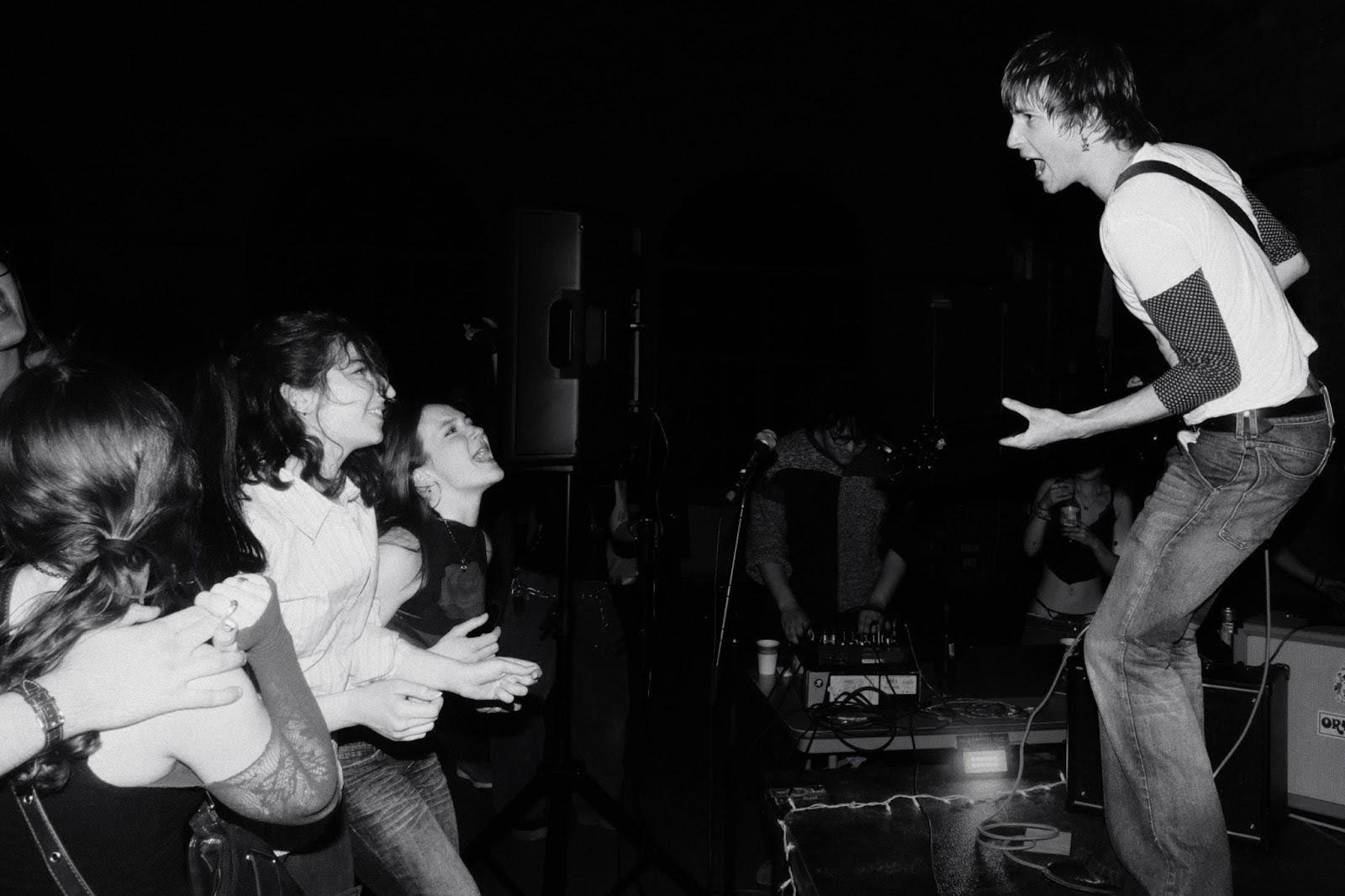
OnSaturday, Feb. 28, Vassar’s Student Music Union, known as StuMU, host ed its second Slush Pit concert in the Aula. The event highlighted a range of student performances that leaned into punk, alter native and grunge sounds, complemented by Monster Energy drinks and slushies at the back tables, which quickly ran out. The space soon filled as coat racks over flowed and the low lit room buzzed with adrenaline. The opening act tuned their instruments as clashing and blaring guitar strums reverberated throughout.
At 8:20 p.m., students gathered closely as Qualia began their opening set. With a raw,
raspy vocal style and high intensity instru mentals, the band performed various alter native covers, including Arctic Monkeys’ “R U Mine?” which evoked a pulsing atmo sphere mirrored by the crowd’s headbanging and unrestrained movements. After Qualia were the bands Oatmilk, Creature, and the all girl group In Due Time. Each brought a diverse selection of covers, with distinct styles that shaped the night, from Oatmilk’s rendition of Nirvana’s “In Bloom,” to In Due Time’s covers of My Chemical Romance’s “Teenagers” and Le Tigre’s “Deceptacon.”
Together, the performances stirred a collec tive momentum that embodied the ideas of youth rebellion and social protest, fusing punk and emo into a shared spirit and allow ing a middle school kind of angst to emerge
Alaina Desautels Guest Columnist
When I first heard the saxophone solo that opens “I LOST MY MIND IN PARIS,” the first track in “FILM NOIR,” I immediately knew that this was not going to be a typical album. “FILM NOIR,” sing er songwriter Faouzia’s debut album, was released in early November 2025. However, I was not aware of it until last month when Faouzia appeared on my Instagram feed, ec statically sharing that the work had entered the top pop albums worldwide. In the past two years, the album as an art form has tru ly grown on me, and I now make it a point to listen to full records in order. So when I found myself on a long bus ride to Ithaca, New York, it felt like the perfect opportunity to dive in and appreciate Faouzia’s creation. The album opens with crime on the mind. Along with the saxophone, “I LOST IN MY MIND IN PARIS” includes siren sounds in its introduction. This leads into a thriller themed song, in which Faouzia all but admits to murdering her lover upon see ing him with another woman. With similar ideas but a completely different execution, “PEACE AND VIOLENCE” has a far bright er tone. The backing track features birds gently chirping, and Faouzia sings with an angelic smoothness as she explains her will ingness to start a war for her lover and hurt anyone who touches them. The song builds to a climactic outro where she sings, “I’d watch the world burn down / Just to see you in the lighting of the embers.” This phrase is repeated with layered vocals and whistle notes as the backing track fades away for a very dramatic finish.
Next comes a powerful, emotional ballad
from hibernation. As the night progressed, the energy of the room remained unabash edly maverick. The crowd inched closer to the stage, voices roared and eyes closed as faces wrinkled and gleamed with sweat. There was no single prerogative. There was only an invitation to be authentic and non conformist, to be whoever you wanted and to let the music take you.
A new band, The Meek, made up of Slush Pit veterans Jack Frederick ’28, Ravin Dhum ale Smyth ’27 and Jaron Ezekiel ’28, took the stage towards the end of the event. Freder ick, the lead singer and guitarist, described their music as a mix between alternative rock, grunge and punk. Their presence was felt as soon as they took the stage, as they paid homage to the modern punk move ment with their Turnstile and Blur covers. They additionally blended in originals such as “tracks” and “Hat” which had the crowd moshing equally as much as the covers. At the end of their set, Frederick announced that student rapper Jolyn Prescott ’27, also known as Coyote Joe, would join them to play a song off of his most recent album, “Kowabunga.” The room became even more electrified by this performance, which seam lessly laid Coyote Joe’s live rapping over The Meek’s instrumentation.
The energy was high going into the last act of the night, Anodyne. As an all soph omore band, Anodyne has performed all over campus in the past two years. They, too, lean into the alternative rock and indie pop genre, playing mostly originals except for their signature finale, “Time to Pretend” by MGMT. Guitarist and vocalist Joey LaRosa ’28 stated, “Every original is named for one of our friends.” He announces this before
every song with the sense of humor trade mark of the band, getting the crowd excited when they hear the name of a Vassar peer. As the night came to a close, LaRosa joked with the crowd once more: “Thank you for sticking around! It’s so late it’s almost mid night!” something that could only be said to students at Vassar College. If you want to witness Anodyne’s effortlessly unique and vibrant sound, you can find them in the Aula once again on Saturday, March 28, for Davi Prom at 8 p.m.
This event could not have been the success that it was without StuMU’s organization, led by club President Sierra Iames ’27. This is only the second year Slush Pit has taken place, rounding up Vassar’s most “punk” bands. Iames stated, “We recognize that Vassar trends towards indie, grunge, and folk music, but we ultimately created Slush Pit to continue our goal of representing and making space for musicians of any and all genres.” StuMU opened up an interest form for bands this year to gauge whether their music style could be blended into the punk rock sound that Slush Pit aims for. Addi tionally, they worked towards this goal by including other on campus musical and ar tistic groups in the event. Iames said, “We in vited ViCE [Vassar College Entertainment], WVKR, VWA [Vassar Writers’ Association], and VCTV [Vassar College Television] to ta ble at the event—selling or advertising mer ch, CDs, zines and more!” The event has achieved widespread success over the past two years, despite budget constraints and other challenges. Iames expressed her grati tude for the support of the StuMU executive and general board in organizing the event and expanding Vassar’s music culture.
anything but black and white
called “UNETHICAL.” Here, Faouzia shows off her incredible ability to transition be tween her chest and head voices as she slides through an impressive range. This song, as well as the entire album, features clever slant rhymes such as “mercy” and “hurt me.” In this track, Faouzia elegantly bemoans the failing relationship she is in and her inabil ity to leave it, ending with a desperate plea for her lover to let her go.
Faouzia’s culture is also front and center within the album. Born in Morocco, she moved to Canada at a young age, allow ing her to become trilingual: “TOUS CET MOTS,” meaning “all these words,” is sung entirely in French. The song is a mere one minute and 55 seconds, and it features the same two lines repeated over and over: “Tous cet mots, tous cet maux, pour rein / Tous cet mots, tous cet maux, en vain,” which translates to, “All these words, all this sor row, for nothing / All these words, all this sorrow, in vain.” Despite the short length, foreign language and lack of lyrical vari ety, the song is far from boring. It starts out slow and sad, but picks up in tempo with string instruments—including an electric guitar—that emphasize her anger and sense of injustice at how her words and emotions fail to amount to anything. She is fluent in French, English and Arabic, something she shows off in this album with her cover of “Desert Rose” by Sting and Cheb Mami. She twists the song into a dramatic, slower tune that once again shows off her extensive range and vocal control, and the Arabic por tion serves as an homage to her Moroccan roots.
“SWEET FEVER” brings a new blend of sounds and a quicker pace. Inspired by a stay in the hospital with a high fever, the song
takes that concept and adds a dose of pas sion, with lines like, “I’ve fallen to find you / My one remedy and it’s you.” This track fea tures many dynamic sections and continues to highlight Faouzia’s tightly controlled vi brato and vocal techniques.
The versatility of this album is on dis play as it takes a techno turn with “DON’T EVER LEAVE ME,” which features an en ergetic rhythm driving the song and spots of noticeable vocal effects. This song has a desperate tone and is deeply captivating.
Perhaps most importantly, Faouzia’s sound is her own, bringing a new blend of melodies, instruments and vocals that stands out against an increasingly monotonous pop scene.
“WEIRDO,” which features similar vocal effects, is another beautifully composed piece with a very unique sound. It places a strong emphasis on Faouzia’s voice as she pulls off impressive extended runs across a large range on the word “weirdo.” She sings almost robotically, matching the song’s lyr ics with the feel of her voice.
Later in the album, “PORCELAIN” and “ORNAMENT” feature similar ideas to “UN ETHICAL,” both utilizing extended met aphors. In the former, Faouzia is delicate porcelain, while her lover continually shat ters her into pieces like “cold cement.” The
latter is more upbeat and is based on the idea of Faouzia’s lover not having any feelings: “Your heart is nothing but an ornament / Nothing but a bit of flesh.” All three songs feature a dramatic build to a climax before quieting back down at the end, giving them a cinematic feel.
Finally, “PRETTY STRANGER” brings the album to a powerful but gentle close. Faouz ia sings softly to a “pretty stranger” who she does not recognize anymore as she contem plates her own happiness. Ultimately, she chooses herself, saying, “Think I’d rather die alone / Think it’s time for me to go / Even if loving you was in vain / Even if I’ll never be the same.” After all the heartache expressed throughout the album, Faouzia gets her own closure, her voice becoming steadier as the song builds to a climactic peak before dramatically cutting off with soft strings. If I had to describe this album in one word, I would say “authentic.” In a world of lip syncing and disappointing live per formances, Faouzia’s amazing vocals easily hold up on stage. Additionally, she is an in dependent artist, as Atlantic Records ended their relationship with her roughly a year before she released “FILM NOIR.” One of her sisters is her manager and the other is her photographer, making her production a family business. She is truly a creative, with five of the 11 songs featuring relatively simple but clever and well executed music videos. Perhaps most importantly, Faouz ia’s sound is her own, bringing a new blend of melodies, instruments and vocals that stands out against an increasingly monot onous pop scene. Although underrated for now, “FILM NOIR” is a refreshing and vi brant listen, bringing the best of what Faou zia has to offer.
Hadley Amato News Editor
Spring break arrived as an explosion. It had been a dark first half of the semester. I spent most of it inside, hemmed in by the brutal cold. Clouds of stress, sadness and anx iety became all too familiar to my Vassar rou tine. So, when break came, I exploded west to California’s Bay Area—searching for new experiences and new meaning in a landscape I knew very little about. Being from Los Ange les, I had spent very little time up North. With Joni Mitchell playing in my ears, I looked out at the jagged landscape of the Bay from my plane's window. The rolling hills, impossibly long bridges and thin skyscrapers lulled me into a romantic stupor: “Will you take me as I am? / Strung out on another man / Califor nia, I’m coming home,” Joni sang sweetly as I daydreamed about the week ahead. Life was to be lived, and here I was, ready to live it.
I spent the trip bouncing around between friends, taking long walks down to the Bay, journaling on the patios of Berkeley coffee shops—grasping as much light from the gold en Californian sun as I could. I tagged along with some friends to classes at University of California, Berkeley, where I sat in on two lectures about Frantz Fanon. “Decolonization does not move towards history, but makes its own history. It rips the order of the world apart,” the professor said to the crowded lec ture hall. I quickly learned that Fanon’s think ing fell on deaf ears to many in the Bay. The constant and overwhelming presence of tech no capitalism and the immense wealth that it produces loomed over me everywhere I went.
Driving into San Francisco at night, I saw the frequent advertisements for AI companies lit up bright and colorful against the dark sky. On walks through the city, I saw tech compa nies operating out of high end buildings in expensive parts of town. I saw the luxury con dominiums and apartments springing up all over the city, their development no doubt bol stered by the intense private land investment carried out by tech fueled private equity. I saw the rideshare companies running rampant across the city landscape, offering privatized transportation and marketed as San Francis co’s leap into the future.
At the same time, I walked through streets crowded with unhoused people—gathered tightly around the entrance of the 16th Street and Mission station or lying motionless on the sidewalk as I walked to dinner with a friend. I visited Horsie’s Market with some friends— a horse themed bar in the Mission District—and talked to the owner about gen trification, the Bay Area housing crisis and the growing wealth disparity he witnesses in his city every day. All of this came in between trips on the Bay Area Rapid Transit (BART), which currently faces extreme budget cuts, and is currently considering a plan to close as many as 15 stations.
The disparity was startling. Capitalism was laid out bare. I once heard a Vassar ge ography professor describe capitalism as being simultaneously “world making” and “world wrecking,” and I felt like the landscape of San Francisco was screaming his words back at me at a deafening volume.
Sitting with a close friend on a bright green lawn beneath the UC Berkeley bell tower, lis tening to the song of birds and eating candy peach rings, we spoke about decolonization, tech companies, and the “progress” that these companies pursue. He told me that the pur suit of a more equitable world must also be one where the “progress” of humanity can
still continue. “The moon landing was amaz ing,” he told me, “and I don’t want to lose the ability for humanity to have big achievements like that.”
I thought about his comments in the con text of the Bay Area landscape I witnessed and American history. Perhaps it is on the back of big progressions, like the moon landing, that the myth of America perpetuates. America has always been a land dominated by “prog ress.” It was the idea of Western “progress” that had catapulted American settlers to expand west across the continent, laying in their wake genocide, destruction and a geog raphy irreparably altered. It was through the logic of “progress” and “development” that the United States government bulldozed entire neighborhoods during the 1960s. “Progress” meant destroying predominantly lower in come communities of color, to create high ways, parking lots and shopping centers—fur ther enshrining racism and segregation into the built environment itself. And it was only through the imperial conquest and periph eralization of entire countries and groups of people into cheap labor, that America, and other Western nations, achieved any of the wealth, success and “progress” that they boast today. Yes, there was the moon landing, but what was left in its wake?
Today, during my trip to the Bay, I saw the tech giants pursuing progress to the same end. They are the extension of the original settlers who killed and pillaged their way westward across the continent. The “progress” they cre ate is rooted in the exploitation, suffering and dispossession of other human beings. The technologies of “tomorrow” that are being pi oneered by these burgeoning techno capital istic industries are rooted in the destruction of the people of today. It makes perfect sense that these companies would then take on massive contracts with the Pentagon, Immigration and Customs Enforcement (ICE) and other branches of genocidal western militarism. They are born of staggering inequality, and thus recreate that same inequality across ev ery inch of the world they affect.
If my trip to San Francisco confirmed any thing to me, it is that we must be willing to destroy the logic and structures of the West as we know them. The poison of America—the poison of the West—is baked into the very root of its creation. Take from Fanon: it will take a radical rupture to defeat this world order. It is only through total upheaval that anything truly new and equitable will begin to be built. What the uneven landscape of the Bay Area shows is that abundance and progress to the level of which the most fortunate of the West are used to must be ripped from them.
“But my heart cried out for you, California / Oh, California, I’m coming home.”
So, when I fled west to California and turned to the Bay Area as my refuge, I saw that there is really no escaping the evils that permeate this country. As much as I would love to give in to Joni Mitchell’s romantic vi sion of California as some divine salvation, to resign myself to the Golden Gates and roaring cliffsides of my home state, I know the truth. It all must go.

Dear Leah: I am a straight woman and cannot find a good relationship at Vassar. The dating apps make me feel dehumanized and I really want to find someone in person. I want a serious relationship not a hookup, and all of the men here are either casual, gay, rude, or in a relationship already. I have been single for years and want to find love!
Signed,
Dear Sleepless in Seattle: You are certainly not alone in your situation, and I’ll admit that the Vassar dating pool certainly looks a whole lot different for straight women. I agree that the apps aren’t ideal. On such a small campus, more often than not, the apps leave you with nothing but awkward Deece eye contact. However, they are not without their perks. I have found that the platforms are a good way to size up the dating pool, even if you don’t take any action within the app. It's able to tell you who’s single, who you find attractive or who might be interested in you. You can use your findings to inform a course of action, maybe even to approach them at a party. I certainly encourage you to get your flirt on.
My first instinct is to advise that you join more student organizations and seek out events. It’s the easiest way to find someone whose interests align with yours. And, even if you don’t find a relationship within those communities, you will still make new friends who can introduce you to other social circles. It's less of a “put yourself out there,” and more of a “put yourself in as many spaces as possible.” The more people you meet, the more likely you are to find someone of interest. But, when you find someone, you must remember to be bold. If there is someone you are interested in, never shy away from asserting yourself. Even though I myself struggle with this, the change you seek requires action, and everyone is capable of it. Also, don’t dismiss your current social circles. Your friends likely know people you don’t and, more importantly, they know you. Make sure to let them know if you’re genuinely interested in someone. Not in a vague way, but directly. Your friends are able to make introductions and vouch for you in ways that make prospective new connections feel more natural and less forced than apps or cold approaches.
Whenever I find myself wishing that a relationship would come falling from the sky, I’m reminded of two, now graduated, Vassar students. They were both super involved on campus, but they had gone three years not knowing that the other person even existed. It wasn’t until their senior year that they finally met and began a relationship. A few years later, they’re still together. I’ve also spoken to alums who met their life partners here at Vassar through my work as a tour guide. The majority of them have similar stories; some of them had even been in classes together before becoming acquainted in a more genuine way.
It’s also worth acknowledging how exhausting it can feel to want a relationship for a long time and not find one. That feeling of being “ready” when your circumstances don’t match up can be extremely frustrating. Do not interpret that gap as a reflection of your worth or desirability. In reality, timing, environment and chance play a much larger role than we’d like to admit.
Within the Vassar bubble, we often allow ourselves to believe that Vassar is the entire world. Just think about the fact that you have so many months, summers, maybe even a semester abroad, to meet new people. Every semester, new faces emerge. Most importantly, remember that life is long. While you may want to be in a relationship right now, know that you have not yet met all of the people you will love throughout your life. You should never be in a relationship just for the sake of being in a relationship, it's a waste of your time.
And, again, while it might feel like you are alone in your situation, remember that many people who eventually find deeply fulfilling relationships also went through long stretches where nothing seemed to work. Love is largely about trial and error. These periods are not wasted time. Rather, they are often when you develop the clarity and self-awareness that make a good relationship possible, even if you don’t realize it at the moment.
Signed, Leah

Over spring break, I traveled with Pro fessor of Geography Mary Ann Cun ningham’s class, ENST 260: “Energy Tech nologies and Local Power,” across Denmark and Sweden for 10 days. Of the trip, Cun ningham stated, “The goal was to observe and discuss decarbonization strategies in a place where there are lots of examples all close together, and where climate pro tection is embedded in a wide variety of practices and policies.” My classmates and I conducted research for our final papers which look at topics such as housing, dis trict heating, biofuels and mobility. In addition to Professor Cunningham, Pro fessor of Physics Jenny Magnes, Associate Professor of Physics Juan Merlo, Research Associate and Adjunct Assistant Professor of Environmental Science Michael Roth and Assistant Professor of Chemistry Tay lor Teitsworth joined the trip, advising our research based on their expertise.
After arriving in Copenhagen, Denmark on the morning of March 7, we dropped our bags at Steelhouse Hostel, caffeinated ourselves and began our adventure. One highlight of our time in Copenhagen was
are both constantly clear cutting forests to ship lumber to Denmark. We also visited CopenHill, a waste to energy power plant, and Professor Charlotte Algreen, a sustain able architecture professor at Danish Inter national Studies (DIS). The DIS visit also stuck out to me, as we learned how housing is viewed as a universal right in Denmark and how, with its welfare state, anyone is eligible for social housing.
On March 11, the class hopped on a train to the industrial hub of Gothenburg, Sweden. After a series of urban renewal projects stemming from its industrial rev olutions, Gothenburg provided a useful lesson in adaptation. Aboveground trams have run the city for over a century, but a new metro system and Western rail are being built underground. Roads are con stantly being dug up to bury new district heating pipes, which are fueled by the new waste to energy power plant and inciner ator located just outside the city. Flawed housing solutions that came from rushed urban renewal efforts are being updated on the local level to support a growing modern society. Additionally, we visited Chalmers University’s HSB Living Lab and learned about housing co ops, which use a self sus taining, non profit model to make housing

taking a fishing boat out to Middlegrund en Wind Co op, an offshore wind farm just off the coast of the city. Gathering around our guide, Hans Christian Soerensen, on the cold, windy boat, we learned about the potential of energy co ops to bridge the divide between energy producers and consumers. The system allows consum ers to buy a share of the energy plant as a partial owner rather than paying for the amount of energy they use as customers. Therefore, they have a say in how their lo cal energy systems are run by making them more aware of where their energy comes from. Another memorable experience in Copenhagen was a morning spent at the Naturhistoriske Onsdags Aftener (NOAH) office, a non profit working to expose the socio environmental threats of burning wood fuels for bioenergy. This is something that is rarely discussed in the United States, as very little of our energy comes from biofuels. We gained a new perspective on how this reliance on wood pellets as biofu el harms important carbon sinks, culture and biodiversity in places like Estonia and even the southeast United States, which

Another portion of the class visited the Max IV Particle Accelerator, which is being used for research by Lünd University.
“The trip was funded by an endowment, given by a generous alumna to support student field experiences in Environmen tal Studies,” Professor Cunningham said. The total budget for the trip was between $48,000 to $50,000, about $2,500 for each of the 20 trip attendees. Cunningham pro posed the trip to the Environmental Stud ies steering committee two years ago, and was approved to teach the class alone with other faculty support on the trip. Cunning ham proposed this trip because“imagin ing different futures is a critical task for students.” Trip attendee Ambica Kale ’26 echoed this sentiment, saying, “I think this
was a wonderful educational opportuni ty to glimpse into another culture and see how the values of the Nordic model actual ly manifest in their policies.”
Overall, the trip brought to light new per spectives on energy technologies, unique economic models that prioritize quality of life over profit and useful policies that reduce carbon footprint at all levels. Ad ditionally, it also brought together the 20 attendees. New connections were formed between students and professors who are motivated by a future run on renewable energy. Professor Cunningham noted that she would like to thank the Environmental Studies program and steering committee, generous alumni, and the faculty and stu dents who came on the trip.
more accessible. Each member of the co op owns a share of the housing project instead of an individual unit, and collective deci sions about the project are made through a voting process to promote a communi ty first mentality. This model is only seen on a small scale in the United States, but has the potential to benefit many individ uals looking for affordable, sustainable liv ing options like those in Sweden.
Our last stop on the trip was to Lünd, Sweden. An ancient Catholic town, Lünd is surrounded by sustainable innovation in new housing developments. We visited Brunnshog, a new neighborhood built on farmland that features maximum green space and minimal road space, encourag ing residents to use public transit and min imize the use of single household vehicles. Additionally, my group visited Lünd’s neighboring city, Malmö, which is home to the now 20 year old Boo01 housing devel opment. Covered in green roofs for storm water collection, fueled by heat pumps and solar and wind power, Boo01 provides a high end, waterfront living experience, proving that luxury can be sustainable.

Tina Mao Guest Columnist
Last summer, I had just hopped off a plane at John F. Kennedy International Airport to head home after a particularly distressing job when a stranger caught my eye. In the crowd rushing toward me was a woman dressed in a graphic hoodie, wide leg pants, heeled boots and a pair of over the ear headphones. When my gaze settled at the face of this stranger, I froze. This was the face of the woman on the cover of “Puberty 2” and “Be the Cowboy.” Waves of panic diffused across my body as I came to the startling realization: Wait, did I just see Mitski? My teenage self stayed up dream ing about a scenario like this, but now that it was happening in the present, I was more paralyzed than thrilled. In the instant that Mitski passed by, I took what felt like the most obvious course of action: I pretended not to recognize her and kept walking.
When I began listening to the album “Nothing’s About to Happen to Me,” I re called that serendipitous moment at the airport last summer with palpable relief that I had left Mitski alone. “Nothing’s About to Happen to Me” is a meditation on the familiar urge to burn it all down and be gin anew. Mitski is known for experiencing repeated invasions of privacy from her in famous fans. In a 2022 feature in Vulture, the interviewer asked Mitski for the names of her cats. Mitski declined to answer this
seemingly innocuous question, respond ing, “‘Mmmm, I shouldn’t say. The kids on the internet now are very savvy. They could type in the names, figure out where I live.’” The new album, which coincidentally fea tures a cat motif, feels like an outpouring of the artist’s grief and rage at the fact that she now desires privacy as if it were a luxury.
On Feb. 27, the day of the album’s release, I clicked on the first track “In a Lake” with the intention of listening to the album all the way through. “I’d never live in a small town / I’ve made too many mistakes,” Mits ki begins. Her lyrics are raw and honest, and they sketch the protagonist’s quiet longing for solitude that intensifies into desperation in the final chorus with a sudden burst of volume. At the end, Mitski sings with full conviction, “And in a big city, you can start over / The lights all around you, the dark safe in the sight / In a big city, you can start over.”
“In a Lake” blasted in my earbuds on repeat that day when I made my routine trips to Gordon Commons, or the Deece. I thought about how Vassar’s campus, and the Deece in particular, has come to feel like a panopticon where one is constantly held up against a magnifying glass. I felt the fa miliar ache for reinvention that Mitski so viscerally brought into light and relished in imagining myself floating on a body of water somewhere far away, enveloped by a gentle darkness.
On the cover of the album, a white cat
stands still in front of yellow wallpaper, un aware that it could be ambushed by a yellow cat at any moment. When I first saw the cover art, I was immediately reminded of the short story “The Yellow Wallpaper” by Charlotte Perkins Gilman. In “The Yellow Wallpaper,” a woman struggling with post partum depression is neglected by her phy sician husband. Eventually, the protagonist descends into madness, believing that there is a woman trapped in the yellow wallpaper of her room, and the woman in the wallpa per is herself.
Indeed, the music video for “Where’s My Phone” is a gothic episode full of distortions and glitches. Mitski, the protagonist, is trapped in a house with yellow wallpaper. She gradually loses her sanity as she makes fruitless attempts to get out, singing the up beat refrain, “I just want my mind to be a clear glass / clear glass with nothing in my head.” The repetition of this joyous tune juxtaposed against the growing suffering of the female protagonist has an alienat ing effect; as a viewer, I felt like I, too, was descending deeper and deeper into this de lirious nightmare that imprisons our pro tagonist. Since she cannot physically leave this harrowing house, her only way out is through numbness.
A similar theme emerges in “Dead Wom en” where the protagonist contemplates if she would be more liked by the “you” she is speaking to if she were dead. Here, the previously understated elements of horror
are plainly displayed: “But since I’m alive, you’ll have to break in as I sleep / When you find my love beside me, choke him dead for having me.” I think “Dead Women” speaks to the fact that female musicians such as Chappell Roan are demonized as “hysteri cal” for demanding that people respect their personal boundaries. Instead, a woman in the public eye is expected to become a ves sel for manipulation like “clear glass with nothing in [her] head.” To me, “Dead Wom en” and “Where’s My Phone” are chilling reminders of the unspoken horrors embed ded in the everyday existence of women at large.
My favorite track by far in the entire al bum is “Instead of Here.” Sonically, “Instead of Here” resembles “Heaven” from Mitski’s previous album, “The Land Is Inhospitable and So Are We.” Unlike “Heaven,” which is an ode to the kind of love that transports you to another world, “Instead of Here” features a conversation with death her self. “I’m not here, I’m where nobody can reach,” the narrator reiterates, as if saying it again and again will make it come true. This song has the classic Mitski themes—ag ony, yearning and death—all explored with relentless vulnerability, embodying every thing I love about Mitski’s art. “Nothing’s About to Happen to Me” is an invitation to stare sadness in the eye, unblinking, and slowly lay bare the intricate realities hidden beneath it. The album offers a special kind of catharsis.
Catherine Phillips Guest Columnist
In January 2025, I fell in love. Not with a person but with a city: Paris, France. From January to May of 2025, I lived in the 15th arrondissement of Paris as part of my Junior Year Abroad (JYA). When my se mester of fresh baguettes came to an end, I returned to Vassar for my senior year. I was excited about senior year, but it was a difficult goodbye. Little did I know that just over a year from when I first arrived in Par is, I would return to play the role of a tour guide for my roommate Luke during our spring break trip. With an itinerary and my skills from being a Vassar summer tour guide, we headed to the City of Love. We arrived at Charles de Gaulle Airport on a Friday night, after spending the first part of break at a wedding in India, and im mediately headed towards our Airbnb in the 19th arrondissement, near Belleville. Our street was lined with Japanese, Chinese and Vietnamese restaurants, highlight ing the diversity of the immigrant built neighborhood. After climbing four flights of stairs with our heavy luggage—Paris is
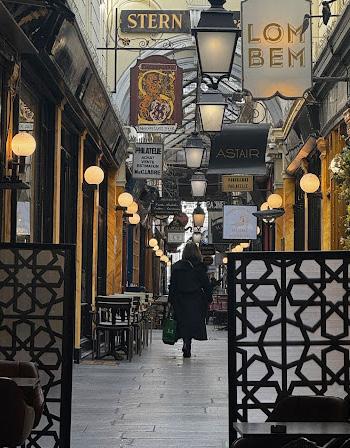
notorious for rarely having elevators—and already jetlagged due to traveling from In dia, we crashed.
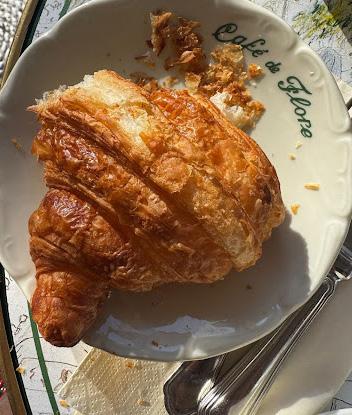
On our second day in Paris, we woke up and headed straight for a boulangerie, and I was eager to introduce Luke to the delicious pain suisse. Spoiler: he loved it. One of my favorite parts about living in Paris was the access to all the fresh food and baked goods. Boulangeries are a cross between a cafe and a bakery, with options ranging from classic croissants to the more extravagant Paris-Brests. The next stop was the Musée d’Orsay. This is my favorite museum in Paris, with its collections of Monets and remnants of the Gare d’Orsay train station. At 10 a.m., there was no line. Lines at mu seums were something I did not have to consider when I was abroad. If there was a long wait, our professor would simply lead us to a specific entrance for students and programs. I took a sketching class, and we often came to museums to sit amongst the crowds and create our own little quiet space to sketch the art around us. This time, with Luke, I showed him where I would usually sit to get the best angles, and the artworks I spent the most time in front of when I was alone.
After we both picked up some souvenirs
from the museum gift shop, we began a walk that would have us in bed at 9 p.m. I have never walked more than I did while I was abroad, so I knew that many walks would be a part of our trip. We walked over 11 miles through the Tuileries Gardens, past the Louvre Museum and along the Seine to another museum: Palais de Tokyo. We were not stopping here for an exhibi tion, but for the American style iced lattes and the photobooth, one of the last of its kind with a film camera that casts visitors in black and white. After our time in front of the camera, we headed up the Champs Élysées towards the Arc de Triomphe. My personal recommendation is to go to the Arc around 10 p.m., as it stays open until 10:30 p.m. The view at night feels like a se cret bit of Paris, but it is still pretty magical in the daylight, too. For lunch, I treated Luke to the formulaire dejeuner, or lunch combo, where you can get a sandwich, beverage and dessert for 14 euros at most boulangeries. We took some more tour isty photos to send to family and then we embarked on the long metro ride back to the Airbnb, where we showered and got in bed—quite the Saturday night in Paris. As I drifted into sleep under the warm duvet, I thought about how I spent the very first weekend I arrived for JYA. I had gone to three different clubs and consumed some thing too similar to absinthe… It is safe to say I now prefer the duvet.
The rest of our stay was spent taking more walks through parks, indulging in sweet pastries, visiting my favorite restau rants and even showing Luke where my homestay and classes were. Seeing Paris through my seasoned lens while also expe riencing it all for the first time with Luke was a beautiful experience. I had changed a lot in the year since I had been there and the city had too. More restorations of No tre Dame de Paris had been completed, an entire building next to my homestay had
been erected, certain shops had closed and new TikTok viral spots had claimed fame. Returning to Paris also meant I had a sec ond chance to try things I did not have the chance to last year, such as the famous Café de Flore. Croissants definitely were not seven euros when Simone de Beauvoir ate there, but we did have a good meal and a perfect table for Parisian people watching.
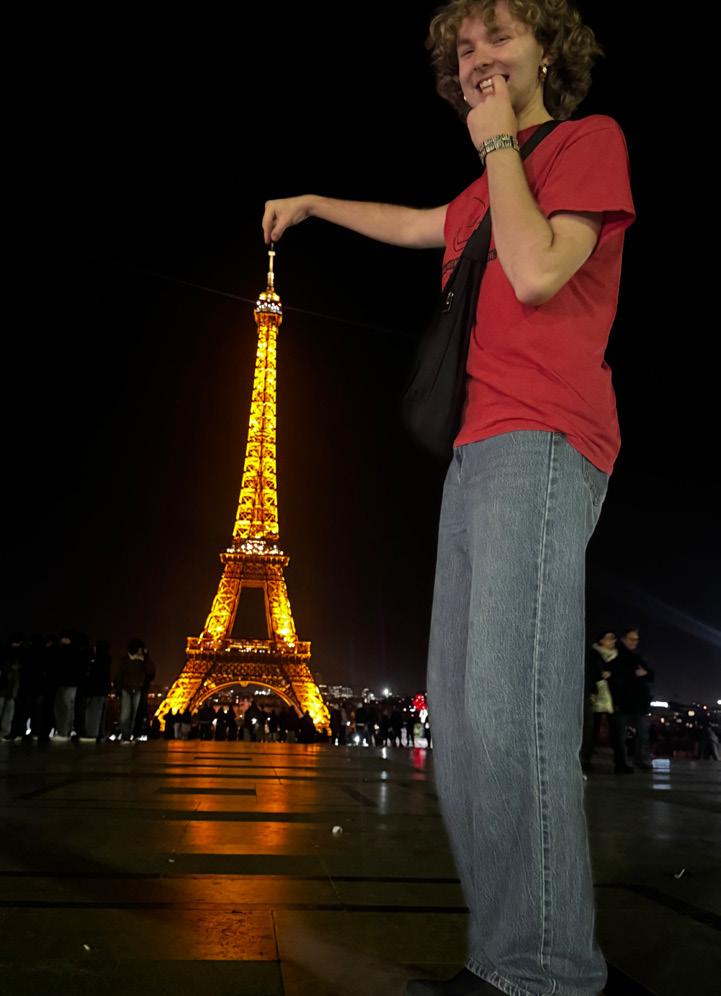
As we approached the gate for our Jet Blue flight back to John F. Kennedy Inter national Airport, the familiar feeling of re turning to the United States hit me. When they called our group number, I made a last minute call to buy a sandwich from the Pret A Manger. It was no boulangerie, but I was not ready for the immediate tran sition from Paris food to airplane meals. I turned off my roaming data as I pressed play on “Paris” by The 1975. I sat back and closed my eyes as we took off. Leaving was much easier this time since I knew return ing to Paris was not as impossible as it seemed when I left for the first time back in May of 2025. "But oh, how I’d love to go to Paris again "– The 1975.
From the desk of Wren Buehler, Assistant Humor Editor
Deece to replace ice cream section with slop trough, trash cans with fermented slop trough, salad bar with healthy slop trough
Evan Seker Hiding From Chemical C
An unfortunate Vassar College student has discovered a catastrophic chem ical, known as Chemical C (Chemical Catastrophus or Catastrophe if you’re not the International Union of Pure and Ap plied Chemistry), which, without fail (and in a strongly unethical manner), produces a reaction that ruins your lab. Frequently pre ceded by desperate pleading, and proceeded by angry swearing, the synthesis of Chemical C, which is completely unknown due to its tendency to make you forget synthesizing it always, is calculated to occur in 13 percent of all experiments, although it could occur in 41 percent—or even 83 percent of all ruined ex periments.
Chemical C’s reaction, referred to as The Very Big and Bad Reaction in most of Vas sar’s Lab Manuals, has several detrimental effects: Anyone who knowingly synthesizes the chemical will immediately forget about its synthesis, and any experiment they are performing in the vicinity, even if it has no way of possibly reacting with Chemical C, will fail. Whether by spontaneous combus tion, a negative percent yield or the acciden tal synthesis of methamphetamine leading to the chemist’s immediate arrest (Chemical C can apparently notify police of one’s exact location), Chemical C hates being created and loves doling out sadistic punishment as revenge.
Chemical C can also be created unknow ingly, in which case the consequences tend to be annoying, instead of ruinous. Students tend to wake up the next day with very itchy hands, or constantly have a song in their head they can’t remember the name of (they don’t dare sing it out of fear of being called a chron ic Instagram reel scroller). However, the un
intentional synthesis of Chemical C will still result in one’s lab failing, as well as the forget ting of the reagents one added.
In response, Dr. Jennifer Appawu, Lab Co ordinator, has banned the synthesis of Chem ical C or any compounds that could create it, saying, “We simply can’t tolerate the risk that an evil chemical continues to endanger stu dent wellbeing. I am currently in the process of trying to communicate with Chemical C; however, it’s being really stubborn. Labs will be resumed when we can make the chemical knock it off. On the off chance it’s reading this, we have jobs too, you know. Do you see any of us blowing things up when we’re tired of working?”
As a result, every single chemistry exper iment has been cancelled for the foreseeable future, URSI will no longer be occurring this summer, and students will have to actually pay attention in class instead of relying on labs to boost their grade.
The Biology Department is currently tack ling a similar crisis, known as Enzyme E (the “E” stands for “Evil”). The two departments are working closely to end this problem, but as of publication, all efforts have ended in fail ure. It seems students will have to do without weekly four hour labs that absorb all of their free time without giving anything in return. Oh well.
Also, someone burned down the Bridge Building. It was probably Chemical C.

Wren Buehler Schedule Brewer Shaman
WFQS 329 - Radical Autoerotism
OLB 200
Queer Studies is often delegitimized as a “masturbatory” field, but radical self love is among the most powerful tools used by gen der minority and gender variant communi ties. This seminar draws on examinations of onanism by commentators like Judith Butler and PornHub commenter CumGuzzler86 to determine the utility of “self defilement” as self liberation. Stephanie Lazarus.
MATH 002 - QuantAnal for Humanities
Majors
Rocky 312
In this lecture course, students who need to fulfill their quantitative analysis require ments but cannot count will be given a re fresher on concepts like “addition,” “number lines” and “shapes.” Attendance will be op tional. Please, guys, we’re making this easy for you. It’s just one credit. Thomas Wiggles.
GNCS 239 - Readings With a Narrow Focus
Swift 101
This course will act as an introduction to literature on the various straits and narrows of the world, from the Danish Straits of Eu rope to the North Channel of Europe and even the Straits of Dover of Europe. You will sign up for this class expecting it to be an easy A and come out of it wanting to study straits for the rest of your life. One or maybe two non British authors will be featured. Anna Thimblewimble.
DRAM 214.5 - Going Joker Mode
Vogelstein 110
What, you think you’re fucking funny?
Oh, yeah, look at Mrs. Biology major, on her high horse, making fun of the Drama De partment for our clowning class. Well guess
what, buddy, clowning is a well respected art form, and unlike wildlife conservation, it has federal job openings right now. This class will teach you to just flip the fuck out, really go Joker mode on ’em. Jack Napier.
ESCI 389 - Meteorological Persistence Ely Roof
The most important part of a meteorol ogist’s skillset is persistence, and in this course, required as part of the Earth Science major, students will be put to the test. Um brellas, long sleeved coats and boots are not permitted. By taking this course, you accept responsibility for any electrocutions, broken bones or roof related injuries. Bert Knuckle. HIST 001 - The First Modernities Cave on Preserve
In this, the longest offered course in Vas sar’s catalogue, students will learn of the first dawn of modernity—the advent of the Neo lithic—from a professor who was up and coming in the field approximately 10,000 years ago. Expect no readings, but plenty of questionably tasteful comments about Den isovans. Thag Simmons.
MEDS 101 - Introductory Piracy Your Dorm
This course is intended for students who want to learn common methods of piracy, which is illegal, so that they can avoid doing them, because they are illegal. Recommend ed for anyone who wants to avoid spending 50+ dollars on a textbook. Guy from Your StuFel Group Who Knows How to Torrent. CLCS 999 - The Perfect Course
Wouldn’t You Like To Know
Offered only once every four years, this course—which would fulfill all of your ma jor requirements, equip you with the skills you need for your dream job and allow you to navigate the world as a more informed person—happens while you’re abroad. Angie Therese.
'Proud to celebrate' Women's History Month, Vassar eliminates gender pay gap for month of March
Noah Daube-Valois Feminist Figurehead
Citing decades as a leader in gender equality, Vassar College announced on Wednesday, March 25, that the school would “heroically and fearlessly consequen tially” pay female professors equal wages to their male counterparts during Women’s History Month. The College’s gender pay gap received national attention in 2023 when five professors sued the Seven Sisters col lege, alleging that discriminatory practices are behind the school’s average female pro fessor earning $13,900 less than their male colleagues. As a result of the bonuses, the
women professors will be required to teach an unpaid course next semester.
These salary bonuses will be one of the many ways the month will be celebrated. A spokesperson for the College revealed that male professors would be encouraged to at tend a paid workshop titled "The Importance of Acknowledging Privilege.” Meanwhile, female professors will be required to go to a panel on the history of harassment, which the spokesperson regrettably shared would be uncompensated.
“We’ve been working hard to find out of the box ways to solidify gender equality,” the spokesperson continued. “Next April, we’re honored to launch the inaugural Men’s His
tory Month. We hope it catches on.” Vassar students have been extremely concerned by the recent rise in the school’s tuition, which—at over $2,000—largely exceeded the expected hike. The spokesperson reassured students that these funds would be used only for the best of reasons: “to double male professors’ salaries during their very special month.”
This is the first time Vassar has acknowl edged the institution’s pay gap. It argued, however, that the inequality was maintained with good intentions. “To the women profes sors of Vassar: This pay gap was for you. We handed the Women, Feminist, and Queer Studies Department a once in a lifetime op
portunity to teach about what we’ve inflicted at Vassar instead of the typical theoretical studies.” The institution finished by plead ing to the plaintiffs: “We’re asking for you to drop the lawsuit, and, most importantly, to show some grace and apologize to your male colleagues who weren't given the same gift.” At press time, a report emerged that con tradicted Vassar’s earlier announcement: While the average paycheck in March for all women employees was equal to that of the men’s, there had been no temporary increase in professors' salaries. Instead, the mean had been offset earlier this month by a one time, $20 million bonus handed out to President Bradley.






ARIES March 21 | April 19
Emma daRosa Idaho Itinerant
I want you to know, nobody cares about your thesis as much as you do. Maybe you could talk about anything else. Asking people about their plans postgrad would go over better at this point.
TAURUS April 20 | May 20
GEMINI May 21 | June 20
CANCER June 21 | July 22
LEO July 23 | Aug. 22
VIRGO Aug. 23 | Sept. 22
It’s time for you to stop telling people you’re “eepy.” You’ve been having trouble making friends? That’s why. It’s annoying. Move on.
Did you enjoy New Orleans during break? Yeah, I know you went to New Orleans. Didn’t have to consult the stars. Everyone went to New Orleans. Or Montreal. Or Myrtle Beach. Or California. Whatever. I went to Idaho.
This week, you’re going to have a major slip-up in a conversation. Like, you might accidentally say “principle” when referring to the head administrator of a public school. Embarrassing!
This is going to be a great week! Well, that is if you consider tripping and falling in the Deece eight times to be great. At least it’s not nine!
Applying for jobs getting you down? I know just the thing to perk you up this week. Just put on a nice suit, print out a copy of your resume, go to the office you want to work in, ask to see the guy in charge, then throw yourself on the floor and scream PLEASE PLEASE PLEASE!
LIBRA Sept. 23 | Oct. 22





SCORPIO Oct. 23 | Nov. 21
This week, a bunch of spiders are going to get into your room. Not for anything weird, just business. They accidentally wrote your address for the annual spider business conference and it’s too late to change it. Sorry!
You’re going to have to venture into uncharted waters this week. That’s right. Your professor is going to make you take a swim test in Sunset Lake in a last ditch effort to stop AI use on class assignments. Sucks to be you.
SAGITTARIUS Nov. 22 | Dec. 21 CAPRICORN Dec. 22 | Jan. 19
Someone might ask you to do a keg stand this week. Just kidding. I don’t know why I thought I could fool you. Nobody at Vassar would ever be able to figure out tapping a keg.
You should try to worry less about getting a summer internship. I can assure you that you’ll either get one or you won’t get one. That’s a 50 percent chance! That’s an F on a paper! Feel better?
AQUARIUS Jan. 20 | Feb. 18
PISCES Feb. 19 | March 20
This week, all your friends are going to try to convince you to do a group Founder’s Day costume. “Oh it’ll be so fun to dress up together,” they’ll say. Don’t fall for it. You’re not anybody’s clown.
I’ll never understand beer drinkers, and I’ll never understand Pisces. There’s no point in even trying. I don’t care, I give up, they don’t pay me enough to care about Pisces.
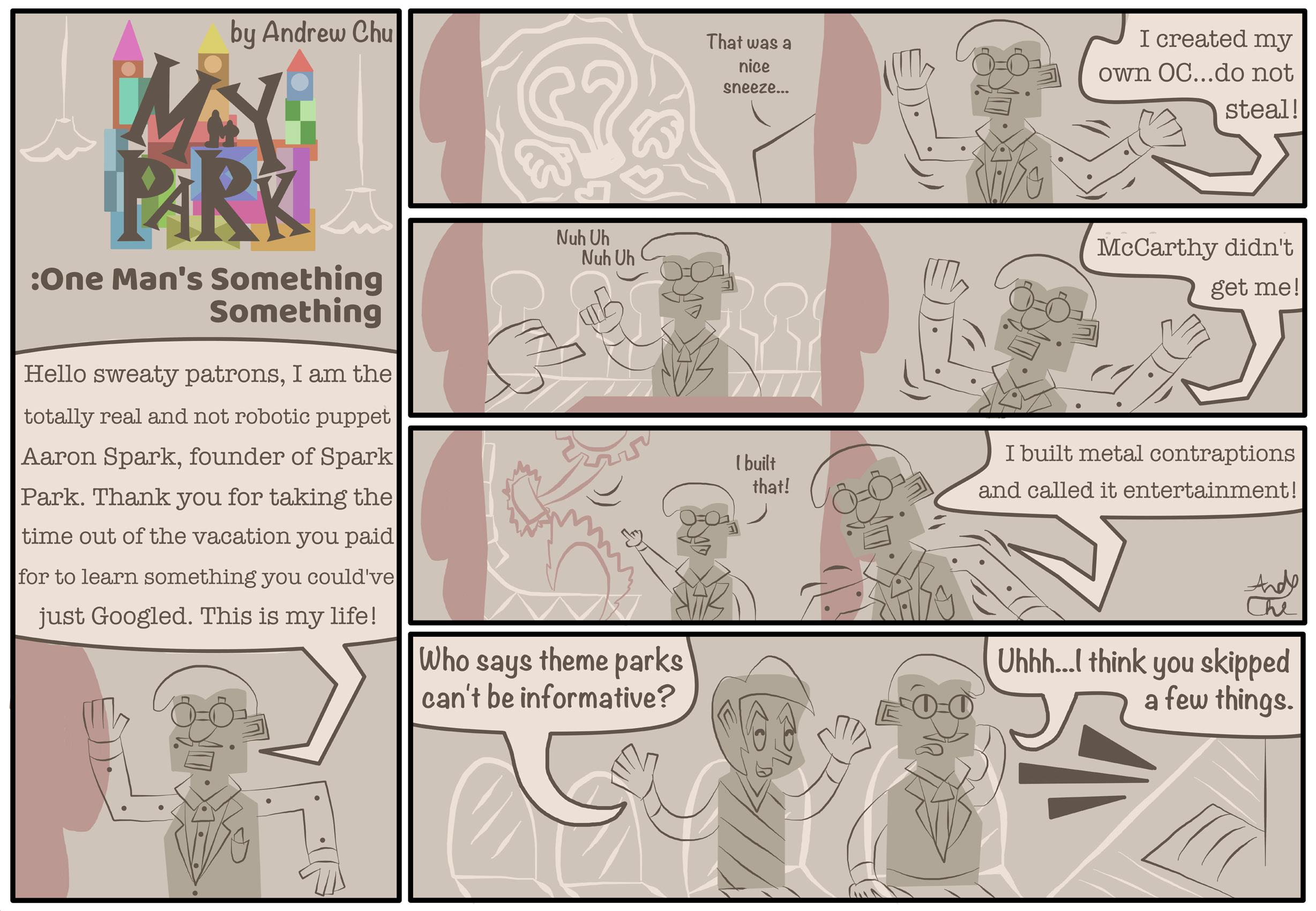
In the early 20th century, few groups defined the struggle against hatred to the extent of the Anti Defamation League (ADL). Found ed in 1913 in response to the lynching of Leo Frank, a Jewish man falsely accused of rape in Georgia, they fought for civil rights and an ti hate crime legislation. Now, over a century later, the ADL has changed. The ADL today is a partisan organization that distracts from the true fight against antisemitism. We must oppose this organization.
The ADL moved from an organization directed towards combatting antisemitism through legal means to blatantly engaging in illegal surveillance. An LA Times article pub lished in 1993 alleged that an ADL agent had shared information he gathered with Israeli consular officials. The original affidavit from this case further accused the ADL of acquiring illegal information on thousands of activists, including members of the American Civil Liberties Union and more. The LA Times further states how the ADL kept a record of every Arab American in the Los Angeles re gion with “anti Israel” leanings, even spying on members of Congress.
The definition of antisemitism that the ADL uses to justify everything from attack ing colleges to illegal surveillance is broad, partisan and dangerous. Following the Oct. 7 attacks, the ADL changed the way in which it publicized allegations of antisemitism, focusing more intensely on anti Israel activ ism. They, like many organizations, adopted the International Holocaust Remembrance Alliance (IHRA) definition of antisemitism, which defines antisemitism as attacks on
IEli Lerdau Guest Columnist Anonymous
Jewish people, comparisons of Israel to Nazi Germany and opposing Zionism. This is an aggressive and expansive definition that tar gets political dissidence and is routinely at tacked by groups including Jewish university faculty. Jewish Currents, a Jewish magazine, published a counter report to the 2024 ADL
All of these issues within the modern ADL stem from one crisis: its focus on anti-Zionism and anti-Israel rhetoric.
antisemitism report, which posited a vast number of issues held within the ADL report, all of which have been repeated in yearly re leases by the Anti Defamation League. First, the report was littered with contradictions; the ADL initially states that they do not con sider swastikas targeting non Jewish minori ty groups under the antisemitism label, yet the report is full of allegations of antisem itism based on the usage of the swastika to target non Jews. Further, Jewish Currents identified 36 percent of ADL allegations of an tisemitism as explicitly due to the alleged acts tied to anti Zionism. This includes phrases supporting resistance to Israel’s oppression, solidarity with Palestinian rebel groups, and anything else that espouses “opposition to Zi onism.” The counter report alleges nearly 20 percent of the recorded acts of antisemitism were not explicitly antisemitic, rather they were simply anti Zionist or anti Israel. The ADL claims that it only considers anti Israel messages spread towards non partisan Jewish
organizations as antisemitic, but they include in their report allegations of antisemitism with no details and simply vague terminol ogy such as “Jewish event.” When we under stand this as an organization with a history of lies and contradictions, we are right to be suspicious of its claims of non partisanship. The Jewish Currents report alleges a simple crisis in the ADL yearly report; nearly half of their claims of antisemitism are either false or wholly unsubstantiated. The simple fact is, the data demonstrates the ADL as a poor orga nization for tracking and combating antisem itism, due to its inability to correctly identify it.
This inability to identify antisemitism goes beyond its mere targeting of anti Zion ism or anti Israel activism under the guise of antisemitism; in its adherence to the IHRA definition, the ADL fails to target legitimate antisemitism from the right. Its yearly re ports rarely mention the antisemitic words from Nicholas Fuentes, one of the far right’s leading social media figures. Jonathan Greenblatt, the CEO of the Anti Defama tion League, continues an allyship with Elon Musk, despite Musk’s intense antisemitism and blatant spreading of racial hatred. This partnership with antisemites and bigots ex tends to President Trump, whom the ADL defended after he suggested Jews would not support him as he would refuse their money.
This issue of Elon Musk became so drastic that an ADL executive resigned, as she could not tolerate working for Greenblatt when he ignored right wing antisemitism, cozied up to pro Israel antisemites and expanded the definition of antisemitism to the point of it becoming effectively moot.
All of these issues within the modern ADL
stem from one crisis: its focus on anti Zion ism and anti Israel rhetoric. It has become an organization infected with a sense of tunnel vision, obsessed with ensuring the survival of a genocidal state even if this means abandon ing their principles. However, anti Zionism is not antisemitism, nor is criticism of Israel. Opposition to Zionism comes not out of a ha tred for Jewish people, but a love of all people. Anti Zionists, generally, do not oppose Zion ism because they oppose Jews, but because they oppose Israel imposing its will upon the Palestinian people. Simply ask the numerous Jewish groups and students who oppose Zi onism if they hate Jews. The ADL’s insistence of prioritizing Israel has turned a once stark defender of civil rights into a dangerously partisan organization that divides rather than protects the Jewish people.
The Anti Defamation League was created with the goal of defending people from op pression and racial subjugation, but it now de fends the forces it once sought to destroy. I am Jewish, I am anti Israel and I am anti Zionist. According to the ADL and its CEO, I must be self hating. The ADL has willingly participat ed in the division inside the Jewish communi ty surrounding Israel and pushed young Jews away from our communities. In its failures to identify right wing antisemitism, constant attacks on activists and fixation on anti Zion ism, they have failed themselves. This failure has left us with one choice: to distance our selves from the ADL. Institutions must not follow the ADL’s lead blindly, as many have in the past. Only through pushing back against the ADL’s partisanship and alienation of an ti Zionist and anti Israel Jews and activists can we mend the wounds that have so deeply infected our nation.
n my time at Vassar College, I have found that many are unsure of how to feel about the ongoing conflict in Gaza. A popular consensus on campus seems to be that “Israel is bad” or it is correct to say “free Palestine,” but more often than not, we are left with questions that have no singular answer. Being an echo chamber of ideas, the Vassar student body reflects the anti Israel sentiment, and one is hard pressed to find a difference of opinion. My goal is not to convince you that either side is “good” or “bad,” but to answer two specif ic questions from my perspective as a Jew ish liberal, who is both in support of Israel, the country, as well as incredibly critical of its government.
The bombing itself is certainly a major issue, but it must be noted that an attempt to preserve life is made, and by definition, counters the genocide label.
Are you a Zionist?
If you were to ask me this question five years ago, the answer would be a resound ing yes, and, while my opinions on Israel have changed since it launched its of fensive, the main reason my answer has changed is that the meaning of that word has evolved. Simply put, a Zionist, by its original meaning, is a person who supports
the existence of a Jewish State in what was formerly Judea, the homeland of the Jew ish people. Anecdotally, the word Zionist is used as a slur on both college campuses and the internet, sometimes shortened to “Zio.” Since Israel began its offensive in Gaza as a response to the Oct. 7th terror at tack, “Zionist” has increasingly been used to refer to a “white colonizer” whose ide ology is based on Jewish supremacy, and who has extreme disdain for the Palestin ian people. However, those who proclaim themselves to be Zionist are rarely using the racial definition imposed on the word. Martin Luther King Jr. is often referred to as a Zionist himself after he is quoted in a 1967 interview saying, “The world and all people of good will must respect the ter ritorial integrity of Israel. We must see Israel’s right to exist and always go out of the way to protect that right to exist." The point of this paragraph is to say that the la bel of “Zionist” is not traditionally tied to racist ideologies.
Is Israel committing genocide?
For many, this is the number one ques tion surrounding Israel’s war with Hamas. As you can see from my previous sentence, I do not qualify the actions of the Israel Defense Forces (IDF) as genocidal. Let me clarify that I believe there to be awful injus tices inflicted on the people of Gaza during this war, several of which constitute war crimes. While it is easy to cast that off as semantics, the difference is important, for reasons such as legal accountability, historical accuracy. Genocide is the most heinous and inhumane act imaginable; it is the attempt to erase an entire people. The term genocide was created to describe
the Holocaust and has since been used sparingly to describe unfathomable events such as the Native American genocide, in which 15 million people native to the United States were slaughtered, which, by some estimates, encompassed 95 percent of Native Americans between 1500 1700.
Being an echo chamber of ideas, the Vassar student body reflects the anti-Israel sentiment, and one is hardpressed to find a difference of opinion.
Despite the unquestionable decimation of Native Americans, this label of genocide is a point of debate, due to the question of intent on the part of the oppressors. So why do I not consider the actions of Israel’s military to be genocidal? I will first direct your attention to the leaflets. For those who are unaware, Israel drops thousands of paper leaflets in the area they plan on bombing ahead of time to alert civilians and give them an opportunity to flee. The bombing itself is certainly a major issue, but it must be noted that an attempt to preserve life is made, and by definition, counters the genocide label. Frequent re sponses to the leaflets by anti Israel groups are that they are either a political specta cle or that they are ineffective. I ask you to consider any modern war and ask how it might have been different if the parties involved were given 24 hours’ notice be fore air strikes. The logical response is
that Gazens may have warning but have nowhere to go. Honestly I do not have a good response other than to say that even an attempt to save lives that is futile, is still an attempt to save lives.
A compelling example of behavior that contradicts genocidal intent is the 2024 po lio vaccination campaign. During an espe cially brutal period of the Gaza war, a case of polio appeared in Gaza. Israel agreed to temporarily pause fighting in Gaza and to provide over one million vaccines that were then distributed by the World Health Organization. Providing hundreds of thousands of children with life sav ing vaccination is contrary to the idea of genocide. Detractors of this argument will likely respond that Israel's actions were a political spectacle, and further question Israel's ability to distribute vaccinations when it has struggled to do the same for basic needs such as food and water. The last argument I will introduce is that Is rael’s stated intentions are not consistent with genocide. From the onset of the war, Israel has had two established goals: the re turn of hostages and the dismantling/dis armament of Hamas. Even if Israel has not prioritized the safety of Palestinian, be cause Israel has made its intentions clear, and that intention is not the erasure of the Palestinian people, for many, the claim of genocide is moot.
Let me reiterate that I am not pushing the narrative that one side is good or bad. This topic is convoluted, old, and everyone on both sides has lost loved ones. My point is simply that it is important to hear out the “other side,” and to accept that those who disagree with us are not the monsters we sometimes believe them to be.
Zoe Rodriguez Assistant Opinions Editor
There is something missing in biolo gy. As an almost English major who switched to neuroscience, biology lectures are frustrating. Take something simple we learned in class, for example. The so dium potassium pump is a protein lodged in the cell membrane of all animal cells. It pumps specific ions in and out of the cell. In neurons, they make sure the electrical charge in your cells is just right so that electrical signals can fire in your brain. It is a mundane, microscopic detail that you would not be able to live without. Biology is full of that junk. There is a mind numb ing amount of insanely complex, tiny ma chinery pumping away, like a jigsaw puzzle with a billion pieces.
How is this happening? It all begs the obvious philosophical question: How does biology exist? We learn all of these techni cal details—where is the professor asking us for our analysis? Where is the authorial intent? Where is the meaning behind it?
Every week in biology lectures, I wait for the professor to say something like, “Oh, and the reason all these puzzle pieces even bother to come together is…” But they nev er explain or explore these questions. Is this the humanities student in me, looking for deeper meanings? Why is “life” so organized? Is there really a “why” out there that is grounded in science? Before I found an answer to this annoying ques tion, walking around campus felt ironic. Everywhere you look on Vassar’s campus
there is greenery—gigantic trees, flowers and teeming wildlife, reminding me just how much I do not know about life itself. Every squirrel seemed to look me in the eyes and say, “You do not even know why I am here, do you?”
The answer came unexpectedly, when I took a cognitive science class last fall, COGS 211: “Perception and Action.” We read an excerpt from a book called “The Vital Question” by Nick Lane, in which the very first two lines are, “There is a black hole in the heart of biology… we do not know why life is the way it is.” He goes on to describe the exact same existential question that I found myself asking: “What laws gave rise to the universe, the stars, the sun, the earth, and life itself?” This cogni tive science class actually gave me the an swer I was looking for.
The answer: randomness. This made no sense to me at first. How can complex ity come from nothing? But organized sys tems can come from total randomness. In the class, we learned about a 2024 study called “Computational Life,” a computer programming experiment which asked, “How does life emerge?” All life that we know of is self replicating. DNA copies it self and cells divide; reproduction is what we are known for. It turns out, when you put random computer programs together and have them “run in” to one another with no goal or function, they also randomly start self replicating. Even when not pro grammed to do so, the programs create “self replicators” spontaneously. Life prob
ably emerged the same way—self replica tion from randomness.
As the book “The Vital Question” points out, the evolution of life is also a somewhat random process. Natural selection, a major component of evolution, is not random— features are selected for a reason. But other major components of evolution, like muta tion, environmental pressures and genetic drift, are random. Genes are accidentally duplicated, environmental accidents occur and these accidents randomly shape ge netic variation. We like to think evolution formed the “fittest” creatures, but it is not optimal. There are accidental byproducts, bugs and accidents. The entire process of how we evolved was largely accidental. Physics is involved, too. In class, we learned about entropy, the measurement of randomness itself. The classic law of entropy states that in a closed system, ev erything goes from a state of order to a state of disorder, or low randomness to high randomness. If everything is supposed to barrel towards disorder, and life is super organized, how did we get here? Actually, life contributes to entropy. We receive en ergy from the sun, we become organized in our local Earth bubble, and then we produce waste, change our environment and convert energy into less concentrated forms. We make everything more spaced out, more chaotic and more random—this is exactly what the law of entropy wants us to do. We fit right in.
So is life just pure randomness? No, there are plenty of things about life that are im
pacted by logic, pattern and purpose. I am saying life represents organization from randomness. Randomness and organiza tion push and pull. Random conditions create organization; an atmosphere forms and a cell is assembled; a bird inherits the right color pattern; the wind blows and we breathe. The two swirl together However, randomness is crucial: Life is impossible without it.
I do not want to assert this as fact: I only gathered some evidence to come to my own hypothesis about life. Randomness is a classic scientific philosophy, but it is al ways seen as dark, cold and impersonal. I do not see it that way at all. Rather, this philosophy of randomness actually gives me hope.
Now, when I walk around campus and stare up at trees with their branching connections, all I can think about is how beautiful randomness is. The way a flow er blooms is randomly beautiful, and is that not more interesting than purpose? Is that not more magnificent than inten tion? Your heart is beating and your veins connect and your brain is full of electric ity because of the power of randomness. To me, that means possibility is innate in everything. Meaning can come from the meaningless. If life is random, and inten tional design does not exist, it is up to us to organize it. Just like life itself, we can take the random factors given to us and orga nize them in our own way. It is freedom. No tree’s branches are the same. Random ness says, “You are anything.”
M any of us on the Left owe an apol ogy—sort of—to the QAnon move ment that was influential during the first Trump term. If you forgot or were un aware, QAnon is an online movement that originated on 4chan. QAnoners believed that a cabal of Satan worshipping Demo crats was in control of every facet of Amer ican society and secretly running a canni balistic child sex trafficking ring, which was—ironically—to be exposed by Trump, a close friend of sex offender and financier Jeffrey Epstein.
While these claims caused horrible re al world violence—namely, the “pizza gate” shooting at a restaurant in Washington, D.C. and the Jan. 6 riots at the Capitol—the recent releases of files related to Epstein have revealed that there actually might have been a cabal of pedophiles, albeit a bipartisan one. Emphasis on the “might” here. According to the FBI, it cannot be confirmed that any person was involved in sexual abuse, besides Epstein and his part ner, Ghislaine Maxwell.
However, we do not need to pin the horrifying behavior of Epstein and friends on some sort of occult religion.
Despite the unconfirmed nature of these claims, according to PBS, there is overwhelming evidence that others were involved: namely, Epstein’s emails with billionaires such as Elon Musk, Bill Gates and Howard Lutnick, collected by the FBI.
We know that as many as one thousand young girls were forced into sex acts by Epstein in the ’90s and ’00s. Whether or not the billionaire class worships Satan is another question.
Internet conspiracy theorists have thrown around the idea of a cult worship ping Moloch, a dark false idol from the Old Testament. This figure, usually de picted in statue form as a man with a bull’s head, was condemned in the Book of Le viticus as a god of the Ammonites whose worship included sacrificing babies in fire. The only evidence supporting Moloch worship is from a separate 2015 email leak, in which an email to Hillary Clinton men tioned sacrificing a chicken to the deity. Whether or not this was a joke is unclear. The through line is that sacrificing babies is similar to the sexual abuse of underage girls uncovered in the Epstein case.
However, we do not need to pin the hor rifying behavior of Epstein and friends on some sort of occult religion. That is not fair to the victims, who were traumatized and violated by human beings with free will. No demon possession or antisemitic trope is necessary to explain what hap pened, or what continues in sex trafficking around the world. The real devil is not in a hidden file waiting to be redacted, but in the details of what is already apparent, and he has a name.
Buddhist mythology offers a much less mysterious view of the devil. In the Lal itavistara Sutra, this deity is known as Mara, and he was instrumental in the Buddha’s final tribulation before reaching awakening. The night before his experi ence of Nirvana, Mara appeared before the Buddha with an army of “a zillion” demons. Previously, he had a nightmare where, upon the Buddha’s awakening,
his heavenly regime crumbled due to the gods converting to Buddhism and moving away from hedonism. To prevent this fate, he sought to avert the awakening, first by attacking the Buddha, then by threatening to enslave him, then by sending his daugh ters to seduce the Buddha and then by vi olence again. After all of these attempts failed, Mara surrendered. Throughout the rest of the Buddha’s lifetime, Mara would haunt him, often in further attempts to in still desire in the Buddha’s heart.
Whether or not the billionaire class worships Satan is another question.
Desire, or Tanha in Pali, is seen as a de structive force, as it hypnotizes all of us into thinking there is something beyond us that we need to be happy. It can also be a response to the fear of impermanence, such as the fear that Mara had in the sutra. In traditional Buddhism, Mara is both the incarnation of this desire and a high god in heaven. The concept of Mara can be viewed as both a metaphor and a literal cosmological being who rules our world and others.
Instead of placing the blame on Satan or Moloch, it is much more realistic to blame Mara as desire itself. Epstein, An drew Mountbatten Windsor and others sought to exert their power over vulnera ble girls. That is an expression of Tanha. Behind closed doors, they decided to give in to a disgusting hedonism. Unfortunate ly for them, their crimes against dignity are coming to light. Even without looking at the Epstein case, it is apparent that the
world is governed by desire.
An example is this recent war with Iran, which, based on Secretary Marco Rubio’s explanation, seems to be pointless. So far, the American and Israeli aggressors’ justi fication has been a confusing preemptive retaliation, which is totally unaccept able grounds to bomb a girls’ elementary school, where 180 were killed. Around 1,500 are dead as a consequence, with many more injured in the region. This war is being waged out of the United States’ fear of a multipolar world, and out of Israel’s desire for greater dominance over the Mid dle East. It is that simple: Tanha on a geo political scale. In reality, every “casualty” is an informal sacrifice to Mara.
Whether Mara is merely a psychologi cal reality or a literal supernatural entity is irrelevant. This clinging to desire fuels the exploitation and violations of human rights and dignity we see today. If Mara truly rules the world, then the way to fight against him is illustrated in the Lalitavis tara Sutra. While the Buddha sat under the tree, beaming with a radiant wish for all beings to be free from suffering, he said to the Evil One, “The king of mountains, Mount Meru, may move and all beings may cease to be; All the stars, the plan ets, and the moon may fall from the sky to the earth; It is possible that all beings may think and act in unison and the great oceans may dry out; But it is impossible that someone like me would ever move from the king of trees.” If we are commit ted to preventing another Epstein Island or an imperialistic forever war, we must be unshakeable in our compassion towards all beings. We must eternally recognize our neighbor’s worth as a living being and put that recognition over our desires and fears.
Our goal with Brewers Ballin’ is to feature Vassar athletes who starred for their team the week previous to publishing. If you would like to nominate an athlete, please email hfrance@vassar.edu.

Men's Volleyball W, 3 0 vs. Hunter College
Men's Rugby
L, 7 24 @ Bermuda II/ Int. Sevens
Men's Tennis
W, 4‑3 vs. Franklin & Marshall College
Name: Armaan Desai
Team: Men's Volleyball
Year: Junior
Stats: The junior middle blocker earned his first UVC Player of the Week honor after a strong week where the Brewers posted an im pressive 4 0 record. Desai recorded 25 kills over the week, hitting an impressive .632. In the win over Sage, Desai hit a perfect 1.000 on nine kills, along with two aces and five total blocks, of which three were solo blocks. Hoping to continue a strong junior campaign, Desai now sits fifth in the country in blocks per set, while leading the UVC in hitting percentage.
Statement: "This season got off to a rocky start, with injuries plaguing our team left and right and some bad losses hitting us early on. Howev er, what makes our team special is our ability to handle adversity and bounce back from it. Winning the last 4 games was a step in the right direction, but the job is not finished. Our team still has a lot left to prove and we are super excited for conference playoffs and the NCAA tourna ment."
Women's Lacrosse L, 8 15 vs. University of Rochester

Baseball L, 6 10 @ RPI
Women's Tennis W, 6‑1 @ Occidental College
Eugene Lee ’27 earns Liberty League Honor
The Junior on the men’s tennis team was named Liberty League Singles Performer of the Week for a 3 0 week in Orlando, Florida.
Men’s basketball finishes historic season
The men’s basketball team fell to #16 Hood College in the opening round of the NCAA tournament, finishing the year as Liberty League champions with a program record of 20 wins.
Haley Schoenegge ’27 adds to trophy count
The junior track star defended her national title in the mile event and finished with the fourth best time in Division III history. This is Schoenegge’s fourth national title. The junior is now a nine time All American.
Baseball vs. Union College
Saturday, March 28th 12:00 pm @ Prentiss Field
Vishnu Lakshman Guest Columnist
As Dominik Szoboszlai walked down the tunnel after receiving a red card for de nying a goal scoring opportunity, he proba bly realized that he had just become a victim of yet another Video Assistant Referee (VAR) controversy. Meanwhile, referee Craig Paw son announced his decision to overturn the on field decision of a goal and instead give a red card to Szoboszlai and a free kick to Manchester City. In that moment, all Paw son should have been thankful for was that this decision did not affect the result that the match was headed toward. It just meant that on Feb. 8, City beat Liverpool by two goals rather than three in the English Premier League for the first time at Anfield (Liver pool’s home stadium) since 2003. VAR’s pes ky interventions in this crucial encounter between two English giants in the final few months of the Premier League’s season add to the enormous list of controversies that have built up over the season.
I think we have had enough time to figure out that VAR has, unfortunately, not been the ultimate authority for neutrality and ac curate decisions that it promised to be when it was first introduced. While many can argue that in this instance, VAR was cor rect due to the fact that when a team plays advantage, the result of a play cannot be counted if the team committed a foul after playing the advantage. In this case, I agree that it was probably more a shortcoming of the rules rather than VAR itself. However, without a VAR intervention that took the game beyond 90 plus 13 minutes of stoppage time, a decision that would allow the goal to stand seemed like an acceptable one since the foul that Erling Haaland and Szoboszlai committed on each other would cancel out. Honestly, I think the decision to just award
Manchester City a goal would have probably caused less controversy.
VAR’s letdown appears to be a unique problem associated with soccer. In fact, other sports have greatly benefited from such advances with tennis introducing the Hawk Eye line calling system, rugby adding the Television Match Official and cricket welcoming the Decision Review System (DRS) in attempts to help these sports make more accurate and impartial decisions.
With this in mind, I highlight three main issues that are part of the reason for VAR’s controversial status and offer potential changes that could rebrand it, presenting it as a reliable tool that promotes impartial ity instead of dominating headlines for the wrong reasons.
The first problem is that it is too slow. In a fast paced game such as soccer, stop pages for VAR stick out like a sore thumb. Unlike sports such as tennis, which have natural pauses after each point, soccer can go on continuously for 45 minutes, so these breaks can ruin the flow and momentum of the game. Statistics from earlier in this season show that an average of 45 minutes and 35 seconds in every game in the Premier League was lost to stoppages. While this is obviously not entirely a result of VAR, it is safe to assume that VAR stoppages are responsible for a significant fraction of it. However, progress with semi automated offsides and goal line technology has helped speed up the “checks” while ruling out any subjectivity in these matters.
The second issue is that VAR is used too often. It is supposed to be used only when there are clear and obvious errors—for ex ample, if there is a clear handball in the penalty box that the on field referee missed. However, there is often confusion over what constitutes a clear and obvious error. Nonetheless, I think there are some ways to
navigate this. One high potential idea is to introduce the concept of “challenges” that has become commonplace in other team and individual sports. It would mean that each team would be given a certain num ber of predetermined challenges per half or game. The disruption these challenges would cause would not look very different from what the current stoppages look like. Additionally, it could actually reduce the number of stoppages because the team will only challenge when they genuinely believe an incorrect decision was made, rather than VAR checks for every sketchy goal scor ing related opportunity. In this system, there could be a problem of running out of challenges, but that is also a problem other sports face and have learned to circumvent. If anything, this would force teams to value their challenges more and maybe even save them for the later part of their game. This would also mean that referees have to stay attentive and accountable and cannot expect VAR to proofread every decision they make. The only thing to consider here is how good players will be at recognizing fouls. In soc cer, players are so used to adding dramatic theatrics to get the referee's attention to try and convince them to call in their favor. However, I do have faith that, come the time to challenge a decision, players will be able to accurately recognize when an appeal is empty and worthless and when it is not. An example of this can be seen in cricket. The Leg Before Wicket (LBW) appeals by players and decisions made by umpires are similar in theme to soccer player theatrics and ref ereeing decisions. However, since the intro duction of the DRS, which is the LBW chal lenging system, teams have grown wiser in their decision making on whether to take a review or not. While they may appeal anything and everything, when it comes to deciding to take a review or not, teams have
exercised significantly good decision mak ing.
Lastly, there is a very low margin for er ror, which is one of the primary reasons why VAR was so optimistically welcomed into the soccer world. A bad decision could cost the team a goal or a red card, and this could jeopardize their ability to win a match. However, it seems there needs to be an offi cial way to recognize the element of human judgment in these VAR calls, which is the root cause of most of the controversy. To call on cricket again as an example, it has the “umpire’s call,” which is a call that essential ly says that the system is not precise enough to predict the outcome, so it chooses to stay with the decision made by the on field um pire. While there could be shortcomings of that in soccer due to the low margin of error, I think it could be a handy tool if in troduced, as there are often times in soccer games where the decisions are too tight to call and overturn. A “referee’s call” could shift scrutiny away from VAR and let it pass as a moment of on field referee judgment. While one could argue this is technically the current logic of VAR, it is not followed often enough. VAR officials need to be more willing to give the on field referee the bene fit of the doubt, and as fans of the game, so do we.
VAR—the reason for why a soccer referee’s job is becoming an unattractive profession— has caused countless incidents that have cast the system in a bad light, angering fans and making one always check whether it is safe to enjoy themselves while watching their team's successes. However, it also comes with its positive moments. Professional Game Match Officials Limited estimates that over 200 incorrect decisions are made without the use of VAR. While it cannot fix all problems, it seems to be able to take care of at least a few.
Henry France, Casey McMenamin Sports Editors
This is March! After another marathon college basketball season, “The Big Dance” has arrived. After a rollercoaster opening weekend full of upsets, excitement and classic March Madness moments, we are ready for more. Without further ado, let us dive in and break down the tournament so far.
One of the most exciting moments of the opening weekend came on Wednesday night during the First Four matchup between Southern Methodist University (SMU) and Miami (OH). As SMU’s Corey Washington stepped to the free throw line in the second half, a red hoard of Miami fans stormed down the aisles behind the basket wearing nothing but speedos and body paint. The wave of scantily clad fans was actually Miami’s Men’s Swim team. They screamed and flailed their arms, trying to distract Washington. To the delight of the speedo crew, Washington missed his first shot. The stadium absolutely erupted in commotion. Fortunately, Wash ington made his second shot and calmed the crowd, but it was not enough, as the Ponies fell to the Redhawks 79 89. Miami (OH) has had a storybook season, winning their first 31 games before falling to the University of Massachusetts in the Mid American Confer ence tournament. However, the Redhawks earned the final at large bid to the Dance, and they seized the moment. This is the first
NCAA tournament win for the Redhawks since 1999. Unfortunately, Miami’s March magic ran out, as they fell in the next round to Tennessee, but this moment will live on in the memories of Redhawks fans for years to come.
On the women’s side, the most surprising upset has been the lack of upsets altogether. Historically, the women’s NCAA tourna ment tends to be more chalky than the men’s tournament, but this year is especially so. In the first round, only three lower seeded teams won their matchups, and two of those upsets were in the eight seed nine seed game. The third and most intriguing upset was the nine seed USC Trojans’ victory over the eight seed Clemson Tigers in an overtime instant classic where star freshman Jazzy Davidson carried her squad to victory with 31 points.
On the men’s side, 11 seed Virginia Com monwealth University’s (VCU) takedown of six seed University of North Carolina (UNC) was an unexpected upset. Though there were nine total lead changes, it looked as if the Tar Heels had this game in hand for most of the duration, leading from 9:37 left in the first half, until VCU tied the game with just 11 seconds left in the second half. At one point in the second half, UNC led by as many as 18 points, before the Rams mounted an im pressive comeback. Another shocking upset occurred late Sunday night, as the nine seed Iowa Hawkeyes upset the defending national champion Florida Gators. Iowa’s Alvaro Fol
gueiras drilled a 3 pointer in the final seconds of the game to give the Hawkeyes a one point lead, but the Gators still had 4.5 seconds left to go the length of the floor and re take the lead. Iowa’s defense swarmed, preventing the Gators from even attempting a shot. Florida is the first one seed to lose in the tournament so far. With Iowa’s win, the Big Ten Confer ence continues to dominate the tournament, sending six teams to the Sweet Sixteen.
Our dark horse women's team is Mich igan. The two seed Wolverines will have home court advantage for the first two rounds, which is huge: The Wolverines are 14 1 at home this year. The star sophomore duo of Olivia Olson and Syla Swords is one of the most potent tandems in the country. Together, they average nearly 35 points and 10 rebounds per game. This Michigan squad is also battle tested and unafraid of the mo ment. In late November, they were one pos session away from upsetting No. 1 ranked University of Connecticut, eventually falling 69 72. This young team has grown a lot since that November matchup, and if they hit their stride, they will be a tough matchup for any team later in the tournament.
For the men, our dark horse is the Figh tin’ Illini. Coach Brad Underwood’s squad has been dealing with injuries and illness all season long, but the squad is finally at full strength. Illinois is loaded with pysical over seas talent and can shoot the lights out of the basketball. In their 105 70 win over the Uni versity of Pennsylvania in the first round,
Illinois won the rebounding battle 48 25. In their second round victory over VCU, the Illini dominated once again, winning 76 55. Maybe the greatest strength of this team is its depth. Underwood can get meaningful min utes from players at the far end of the bench without letting the intensity let up. In the win over VCU, four Illini players scored double digits with Andrej Stojakovic exploding for 21 points off the bench. The greatest obstacle preventing this Illinois squad from compet ing for a championship are themselves. At times during the regular season, they would fall flat, let their defense ease up and blow games. Hopefully, the added pressure and pageantry of March Madness will keep the team focused throughout the tournament.
Roundup
At the time of this writing, the first two rounds have wrapped up play, and stu dent athletes return to the classroom before picking up in the Sweet Sixteen on Thursday, March 26 and Friday, March 27. There are plenty of storylines to watch. My favorite matchup heading into the Sweet Sixteen is a high caliber dual between No. 1 Michigan and No. 4 Alabama. The teams have won their first two matchups by an average of 22 and 22.5 points respectively, dominating compe tition. March Madness is only heating up. For college basketball fans, there are many late nights ahead of us: There will be late game heroics, matchups between blue blood programs and antics from iconic coaches. Grab your nitroglycerin pills, and strap in for the rest of the tournament. We sleep in May.
By: Aidan McEachern

Answers to last week's puzzles: