The Miscellany News
5,
Vassar College’s student newspaper of record since 1866

5,
Vassar College’s student newspaper of record since 1866
to President Donald Trump during the first Trump administration.
[CW: This article discusses killings by federal agents.]
Immigration and Customs Enforcement (ICE) is planning to open a detention center in Chester, Orange County, 30 miles southwest of Vassar College. The proposal has drawn widespread condemnation from community members in and around Chester, as well as town, county and national elected officials. “I’m strictly against it,” Chester Town Supervisor Brandon Holdridge told The Miscellany News. “You see what’s happening around the country. I don’t want any of that here. I don’t want massive protests, or federal agents abusing civil liberties and killing people in the streets. I don’t want my residents being hurt or harmed by this nonsense that the federal government is taking part in.”
On Jan. 8, the Department of Homeland Security (DHS), which runs ICE, confirmed the plan with a mandatory environmental notice of activity in a floodplain. “ICE is proposing to purchase, occupy and rehabilitate a warehouse property at 29 Elizabeth Drive, Chester, NY in support of ICE operations,” the statement read. The property is a warehouse in the Village of Chester formerly run by the automotive service chain Pep Boys. It is currently owned by businessman Carl Icahn, who served as a special advisor
“There’s very little power we actually have,” Holdridge explained. “Pep Boys is a private entity, a private company who owns that building. If they want to go into business with the federal government and lease it out, or sell it to the federal government, there’s not anything the Village of Chester can really do to stop that.” The Village’s population is about 4,000; the Town’s is about 12,000. (The Village of Chester is entirely encompassed by the Town of Chester. All Village residents are also Town residents, but the two municipalities have separate governing bodies.) ICE did not respond to a request for comment from a Miscellany reporter.
The Chester renovation is part of ICE’s nationwide project to turn 23 industrial warehouses into “mega” detention centers. In total, the centers would be able to hold over 80,000 individuals prior to their deportation. The Washington Post first reported the project in late December 2025, naming seven major centers that would each hold 5,000 to 10,000 people and 16 smaller centers designed to hold up to 1,500 people each. The Chester facility would be one of the smaller centers. “We need to get better at treating this like a business…like [Amazon] Prime, but with human beings,” ICE Acting Director Todd Lyons said at the 2025 Border Security Expo.
The Town and Village of Chester, as well as Orange County, submitted letters of oppo-

sition to ICE before the Jan. 16 deadline listed in the environmental notice. In its letter, according to a copy obtained by the Miscellany, the Town listed seven reasons for its “unanimous opposition” to the project, including that such a facility would endanger public safety due to its proximity to two sports facilities frequented by children; that the Village does not have the water or sewage capacity to accommodate a facility designed to hold 1,500 detainees plus guards; and that converting the site to federal ownership would shift a heavy tax burden onto local residents. ICE had not responded to the letters as of publication.
This nationwide project comes as Americans across the country continue to protest ICE’s seizures, detentions and deportations of hundreds of thousands of people. Since
Noa DeRosa-Anderson, Annie McShane Guest Columnist, Graphics Editor
’Twasthe night before the snowstorm, and all through Vassar College, students prepared for the frosty tempest that they had been warned about. With a blizzard oncoming, tension loomed in the air. Something had to fall. Probably snow, and a lot of it.
On the eve of last Sunday, each student prepared for the individual battle they would wage against the imminent 34inch onslaught of snow. The shelves of My Market were cleared of all non-perishable items. Groceries were balanced in bulky coat arms and constricting mittens. Students awaited the oncoming blizzard with concerns circling through their minds: Would classes be canceled? Would we make it out alive? What if the Gordon Commons is closed?
Amongst these students, repentant and subject to the snow, is Fia Marrison ’28, sporting purple snowflake-print snow pants with an eager smile on their face. You can find them on Noyes Circle, famously renowned as the Nircle, constructing an ever-expanding igloo. For Marrison, the snow is a resource, an opportunity to expand the igloo. No snow is too much—no igloo is large enough.

In light of the heavy snowfall this winter, Marrison has built an igloo bigger than ever before. However, this is not their first rodeo. In fact, Marrison has been in the igloo business since they were eight years old.
“I’ve built igloos since I was a little kid because my dad showed me how,” Marrison said. “Over the years, I got more invested, and we built bigger ones. But we were only

able to make ones with one chamber because it was just the two of us using shovels in our yard.”
Since coming to Vassar, Marrison has wanted to bring their igloo-building expertise to campus. The first snow in mid-December provided the necessary material. With a Noyes frying pan, a Deece cup and a dream, the journey began.
“I’ve been wanting to make this,” Marri-
Benji Boyd reports from 'Sad Night at the Mug.'

the second Trump administration began last January, ICE has deported some 230,000 people who were arrested within the country and another 270,000 detained at the border. Seventy-three percent of people ICE detained in 2025 had no criminal conviction and only five percent had a violent conviction. The majority of those with criminal records had only vice, immigration or traffic violations. In January 2026, ICE was detaining 73,000 individuals, a record-breaking high—84 percent higher than January of last year.
Over 30 people died while in ICE custody in 2025. Eight people have already been killed by ICE agents or because of the conditions in detention facilities in 2026. Among them are two American citizens. On Jan. 7, Renée Good, a mother of three, was shot to
See ICE on page 3
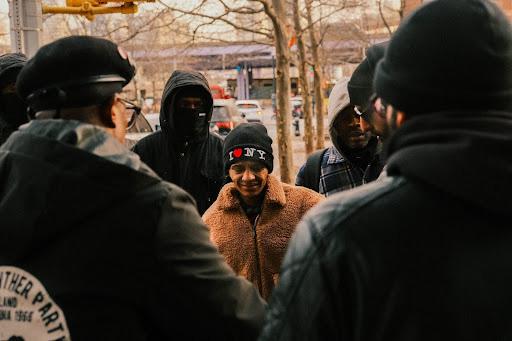
On Jan. 7, 2026, federal law enforcement, while conducting an immigration roundup, executed 37-year-old Renée Good. Good had been attempting to drive away from the officers when one stepped up and fired three shots into her. In the days after this daytime execution, Chairman Paul Birdsong of the then Black Panther Party of Philadelphia went viral on social media as he posed with assault weapons, proclaiming the party’s resurgence and resistance to the growing government overreach. We reached out to the New York chapter of the group over Instagram to ask for an interview, hoping to learn more about their organization, their goals and their message. That same day, they responded, “We can make it work.”
We took an early train down to the city and made our way to the project buildings of Two Bridges, Manhattan. Our contact, Comrade Lu, dressed in a black puffer jacket, black jeans and a beanie bearing the name of the Black Panther Party, came around a corner and brought us into the lobby of one of the nearby buildings. There, See Lion on page 7
Ian Watanabe investigates products combatting screen addiction.

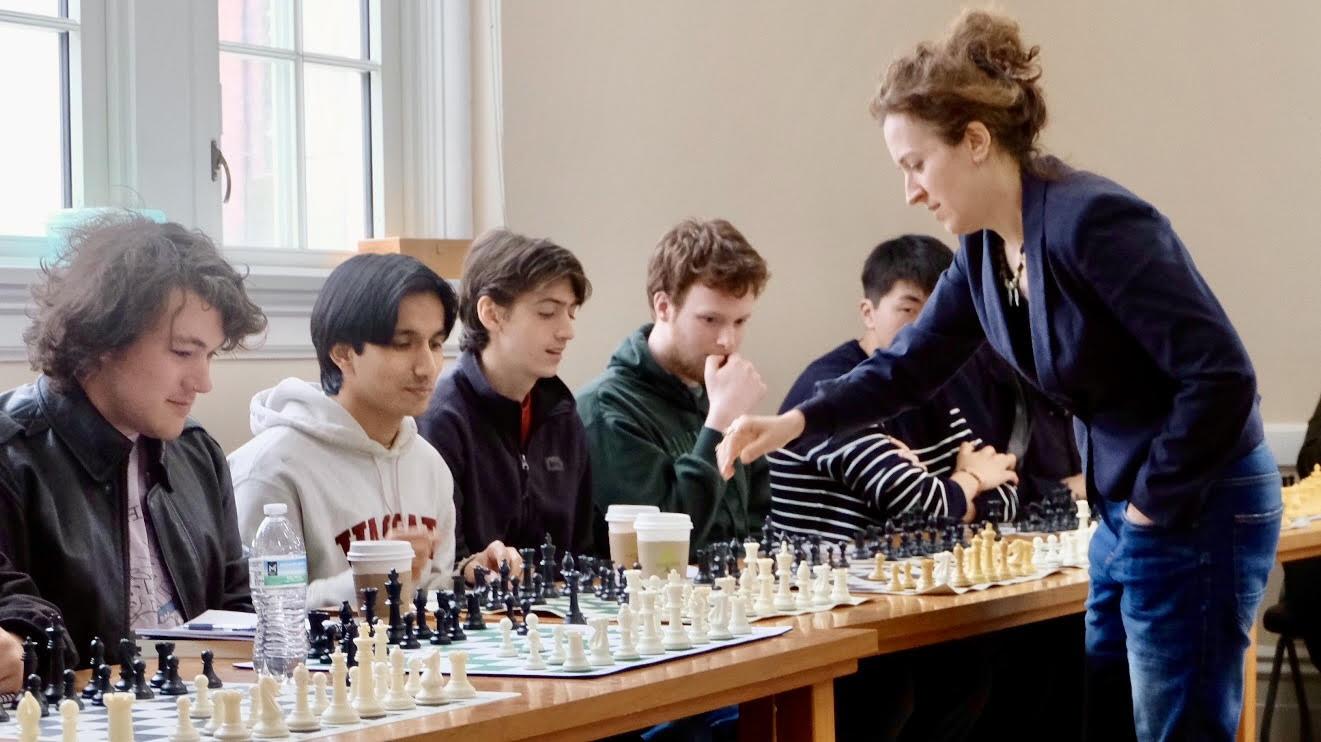
Vassar Chadwick, which has met on the Vassar campus since the 1970s, draws both Vassar students and staff as well as people from around the mid-Hudson Valley, including youngsters, working folk from the community and retirees.
Come play tournament chess in a supportive community at 7pm on Mondays in Rockefeller Hall Rooms 101 & 104.
EDITOR-IN-CHIEF
MANAGING EDITOR
SENIOR EDITORS
CONTRIBUTING EDITORS
NEWS EDITORS
ARTS EDITOR
ASSISTANT ARTS EDITORS
FEATURES EDITORS
OPINIONS EDITOR
ASSISTANT OPINIONS EDITORS
HUMOR EDITOR
ASSISTANT HUMOR EDITORS
SPORTS EDITORS
ASSISTANT SPORTS EDITOR DESIGN EDITORS
ASSISTANT DESIGN EDITORS
COPY EDITORS
GRAPHICS EDITOR GAMES EDITOR
ASSISTANT GAMES EDITOR
SOCIAL MEDIA MANAGER
LIVE EVENTS CHAIR
WEBMASTER REPORTERS/COLUMNISTS
CARTOONIST
COPY STAFF

Allison Lowe
Luke Jenkins
Kathryn Carvel
Darja Coutts
Madeleine Nicks
Clara Alger
Carina Cole
Soren Fischer
Hadley Amato
Julian Balsley
Grace Finke
Aurelia Harrison
Brendan Kennedy
Yaksha Gummadapu
Sydney Jones
Jacob Cifuentes
Zoe Rodriguez
Ian Watanabe
Emma daRosa
Wren Buehler
Noah Daube-Valois
Henry France
Casey McMenamin
Holland Kaplan
Molly Delahunty
Lucas Seguinot
Teresa Garcia-Green
Hannah Wells
Sadie Bakken-Durchslag
Paige Hahn
Anabel Lee
Annie McShane
Sadie Keesbury
Olivia Blank
Mia Liloia
Denver Brown
Hunter Farhat
Eduardo Culmer
Armaan Desai
Noah Duncan
Jackson Hrebin
Lora Janczewski
Evan Seker
Erin Thatcher
Andrew Chu
Nikola Parker Cooperman
Elliott Evans
Cooper Jaffe
Ren Nicolau
Tess Novack
Julia Weber
• The VSA President plans to submit a proposal to the Board of Trustees for increased student and faculty representation on the Board.
• A Class of 2028 Senator proposed that VSA review the College Committee on Admission and Financial Aid.
• Academic Affairs decided to review the Dance Department to get perspectives on the new dance major and identify problems before students begin declaring the major in Fall 2026.
• Academic Affairs is seeking comments on Dean of Studies Thomas Porcello and the Office of the Dean of Studies in light of Porcello’s expressed interest in re-appointment.
death by ICE agent Jonathan Ross in Minneapolis—Ross shot Good four times, including once in the head, while she sat in her car. On Jan. 24, also in Minneapolis, border agents Jesus Ochoa and Raymundo Gutierrez beat and killed Alex Pretti with 10 gunshots after he tried to place himself between an agent and two civilians. Pretti was carrying a lawful firearm but approached filming on his phone—not holding a weapon—and was disarmed and pinned to the ground before agents began firing. Good and Pretti are two of at least 13 people ICE agents have shot in the past year. Border Czar Tom Homan said on Jan. 13 that Ross had gone into hiding out of fear for his life. Ochoa and Gutierrez have been put on administrative leave.
Vanessa Cid, an Organizer for the progressive grassroots activism non-profit For the Many, wrote in an email to the Miscellany that a detention center in Chester would impact more than just the local area. “It’s the only proposed location in New York State and would likely be used to detain people from around the state, not just the Hudson Valley,” Cid explained.
Vassar President Elizabeth Bradley declined to either oppose or support the plan. “As a nonprofit organization, Vassar cannot take a political position on this project,” she told the Miscellany via email. “I defer to the elected officials and am happy to see a healthy debate to fully explore and understand all the possible implications of this project.” On whether a detention center so close to Vassar would increase the chances of ICE entering campus, Bradley wrote, “That is difficult to say and I cannot speculate.” The
College’s policy is to only provide ICE with student or employee information if presented with a judicial subpoena and to notify the community if agents are on or near campus.
Community members and officials have loudly condemned the proposed center. Holdridge described his community’s reaction as “overwhelmingly negative.” He continued, “Of the email communications that I have received since the beginning of all this, literally 100 percent of them have been negative against any sort of ICE facility or presence in Chester.”
At multiple town meetings, residents strongly opposed ICE setting up shop near their homes. Outside, hundreds stood in the cold, protesting and waiting for a chance to speak. Holdridge told the Miscellany, “One hundred percent of the people who spoke at those meetings were in opposition to the facility coming in.” Representative Pat Ryan, whose district includes both Poughkeepsie and Chester, launched a petition on Jan. 13 aiming to stop the renovation. In one week, Ryan reported, over 10,000 Hudson Valley residents signed the petition. Orange County Executive Steven Neuhaus told The Times Union that a detention center in Chester would be “catastrophic” for the community.
Cid noted to the Miscellany that Ryan received over $134,000 from the software defense contractor Palantir, the most money of any Democrat in Congress and the third most of any congressperson. In April 2025, ICE signed a $30 million contract with Palantir to develop an “ImmigrationOS” software that will use artificial intelligence and data mining to find, track and deport suspected noncitizens. El País reported that

the project violates Palantir’s own human rights policy. “We’re calling on Pat Ryan to reject Palantir money and call for ICE to be abolished,” Cid wrote.
On Wednesday, Jan. 28, the Chester Town Board passed two anti-ICE resolutions. The first formally opposed the ICE facility and reiterated the opposition letter’s reasoning, according to a copy reviewed by the Miscellany. The second resolution called on the New York State Legislature to pass the Mandating End of Lawless Tactics (MELT) Act, which would ban ICE and other federal law enforcement officers from wearing masks or plainclothes while conducting immigration operations in New York.
On Thursday, Jan. 29, between 600 and 800 Chester and Hudson Valley residents gathered in Chester Commons Park to protest the proposed facility, according to Holdridge and Cid, respectively. Speakers at the rally included Holdridge, Ryan, Rural and Migrant Ministry Executive Director Rich-
ard Witt and Orange County Legislator Genesis Ramos.
Holdridge first heard of the proposed facility through constituents sending him the Washington Post article, then through DHS’s environmental notice. Likewise, Orange County Executive Neuhaus told CBS News that he had only learned of the plans through the environmental notice.
“ICE, or DHS or anybody from the federal government has not proactively reached out to either the Village or the Town of Chester since the beginning of all this,” Holdridge told the Miscellany. Village of Chester Mayor John Bell told constituents at a recent meeting that ICE had not submitted any permit applications. “[It’s] definitely more scary,” Holdridge said, of the fact that ICE had not communicated with local governments about its plans. “It doesn’t really help our confidence in them for working with the local community and being cooperative or collaborative.”

Iggy Gutierrez, Madeline Nusbaum Guest Reporters
Last summer, the incoming Class of 2029 was asked to read Kali Fajardo-Anstine’s short story collection “Sabrina & Corina” and answer a series of questions as a way to connect with their fellow incoming peers.
On Jan. 27, 2026, Fajardo-Anstine—a bestselling author, a finalist for the National Book Award, the PEN/Bingham Prize, The Story Prize and the winner of the American Book Award—came to Vassar College to speak with students about her book and her journey to becoming an author.
At the beginning of her discussion, Fajardo-Anstine shared the story of her upbringing in Denver, Colorado. She stated, “Like many children, I grew up in a house and a world that felt chaotic and violent.” She described a crowded house of seven siblings, which she felt contributed to her own diagnosis of depression at the age of 11. “I very much felt powerless to the whims of adults. I didn’t like how they lied. I was often angry, and I was frustrated at how invisible and incurred I felt as a child.”
For Fajardo-Anstine, reading emerged as a way to escape this environment and the mental health issues that it brought. After being taught to read by her older sister, Fajardo-Anstine began to read anything she could get her hands on: “I was reading the shampoo bottle, I was reading the Kleenex box.” This passion for reading guided her
understanding of her purpose in life, knowing she wanted to be surrounded by books. Though she loved to read, Fajardo-Anstine described struggling in high school. She would often miss class and assignments due to her mental health, and eventually dropped out to pursue her General Education Development (GED) certificate.
Fajardo-Anstine credits literature for giving her an alternative path in life, claiming, “If I wouldn’t have dropped out and continued on with my schooling, it’s possible that the whole trajectory of my life would have changed, and I would not have been standing before you. I would not have written these books.”
After she earned her GED, she studied English and Chicano studies at Metropolitan State University of Denver, where she began to write short stories. She later earned her Master’s of Fine Arts in fiction from the University of Wyoming with her graduate thesis becoming “Sabrina & Corina.”
Fajardo-Anstine tied the purpose of her book to an experience she had when working at a neighborhood bookstore.
“Look around you, a man once told me, as we stood in the bookstore where I worked throughout college. There are thousands and thousands of books, what could you possibly contribute that has not already been said?” Fajardo-Anstine recalled responding to him: “A lot. My people, for the most part, we aren’t in any of these books.”
Fajardo-Anstine shared that, growing up, she struggled to find representation in not only society but in literature due to her “woven” ancestry as an Indigenous, Jewish and Filipina woman. She wanted to write “Sabrina & Corina” to shed light on unrepresented, Indigenous stories, loosely basing the work on her own life experiences and familial oral tellings.
This idea of highlighting underrepresented voices was the inspiration behind selecting “Sabrina & Corina” for the Class of 2029 summer reading. At the lecture, former Dean of First-Year Students Lioba Gerhardi was quoted as having stated: “I was looking for underrepresented voices that highlight aspects of society that we don’t often encounter at Vassar, I found a combination of immigrants and native perspectives and found the stories fascinating.”
Professor of English and Director of American Studies Molly McGlennen was also quoted at the event, having explained that she had selected “Sabrina & Corina” as a book in her First-Year Writing Seminar. “Students loved reading it, it gave them guidance on how to write about personal narrative, culture and aspects of home,” she explained.
At the end of the talk, students shared their insights about the book and the particular stories that resonated with them. Tess Korenberg ’29 shared, “I do think ‘Sabrina & Corina’ was my favorite story. Just the way they were written because it’s a tragic story,
but it’s not inherently a totally sad story, I think. So just something about that one just stuck with me as my favorite.”
Seren Staples ’29 also gave her thoughts on her favorite story: “I liked the chapter called ‘Sugar Babies’ because it told the story of a complicated family dynamic in an interesting way through the lens of a middle schooler. The story didn’t necessarily conclude in a well-rounded ending for the protagonist, but painted a picture of how a middle schooler might deal with the complexities of life.”

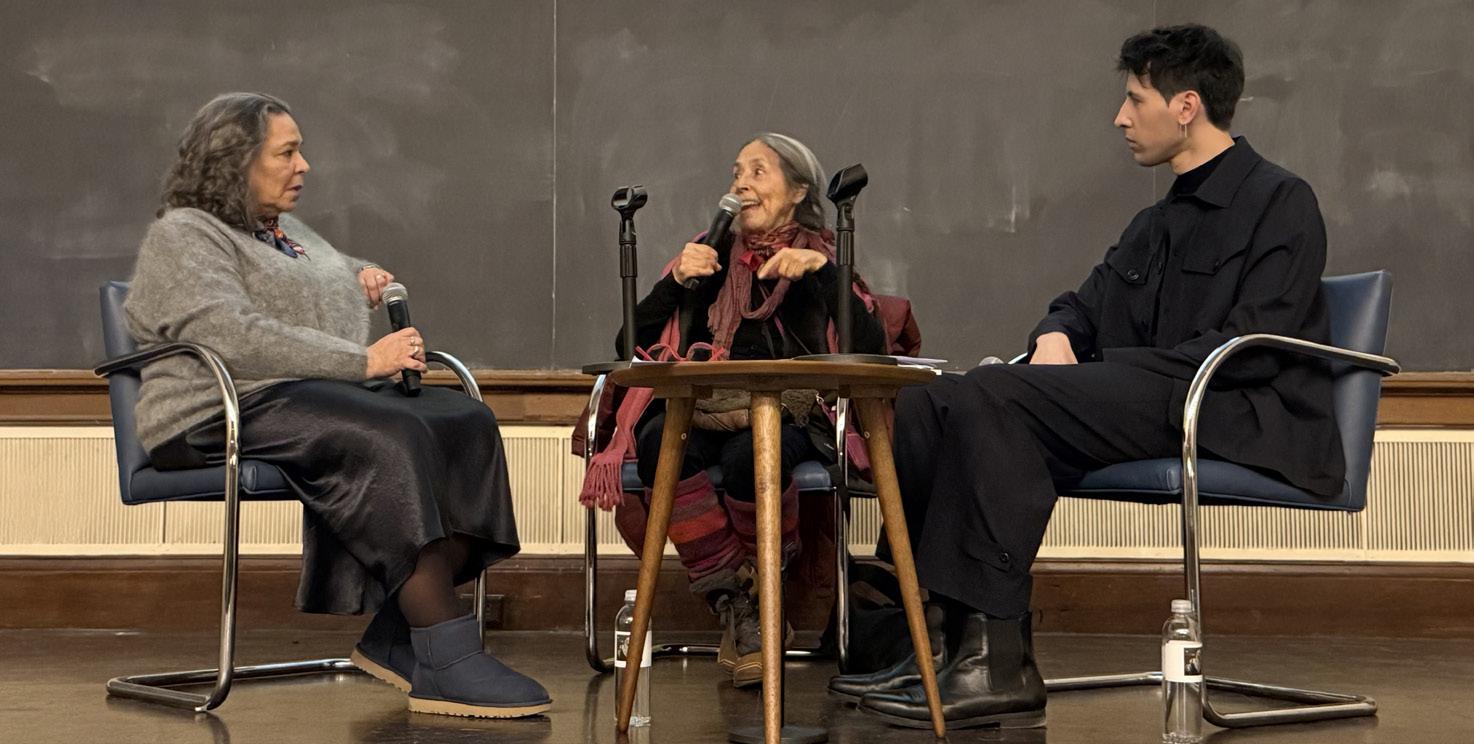
On Thursday, Jan. 29, renowned visual artist, poet and activist Cecilia Vicuña took the stage in Taylor Hall 102. After a military coup against democratically-elected President Salvador Allende of Chile in 1973, Vicuña lived in self-imposed exile from her home country until her eventual return. She now divides her time between Santiago and New York. Her work has been created and exhibited in various locations around the world and has earned her awards such as the Premio Velázquez de Artes Plásticas, one of Spain’s top visual art awards. Vicuña’s 1980 film “What is Poetry to You?” (“¿Qué es para usted la poesia?”) was part of the “Chronostasia: Select Acquisitions 2020-2025” exhibit featured in the Frances Lehman Loeb Art Center from Sept. 4, 2025, to Feb. 1, 2026. The film, a clip from which was shown at the talk on Thursday, features everyday citizens of Bogotá, Colombia, answering the title question. Vicuña explained, “The last question I asked was to… this group of policemen, and they couldn’t say the word poesía, poetry, without saying policía.” Similarly, Cecilia said, “I go to sleep for the sake of poetry, I get up for the sake of poetry.” To her, “Poetry is the original tradition of mankind.”
Her speech focused on this ability to take one backwards through time, particularly to the days of Indigenous origin. She dismissed the idea that time is linear and instead encouraged the recovery of ancestral memory, asserting, “We are all indigenous to this earth.” Vicuña shared that her art is sometimes subversive, particularly when created in a society that does not share her love for free expression and when. As she said, “People are willing to be controlled.” Such barriers opposing her expression have existed around her for many years. “My poetry was censored because I was an inde -
cent author. I’m still an indecent author,” she joked, one of many instances where her sharp sense of humor shone through onstage. Though now internationally renowned, she described how she feels free expression continues to be at risk. Vicuña’s latest concern is artificial intelligence, by which she believes we are being “enslaved.”
With this, Vicuña worried, “Poetry is being stolen from us.” She quoted from a book by the 18th century author Novalis, “Is it possible that man himself gradually created absolute wickedness, and so gradually creates absolute evil, that both are artificial products?” She pointed out that it is particularly relevant in the discussion of artificial intelligence. Though Novalis was not alive to see events happening in the world today, Vicuña said, “He foresaw what is happening now, because it was happening back then too.”
To be authentic to herself, Vicuña has pursued her passion for environmental activism through her art from a young age. In recognition of decades of activism, she was awarded the Museum of Contemporary Art’s Eric and Wendy Schmidt Environment and Art Prize in 2024. Vicuña remembered, “Little Cecila, when I was running, the soles of my feet would turn black. So I was a little black-footed girl, even at that age.” As a teenager, Vicuña read one edition of a magazine dozens of times. “It said humanity was destroying the planet,” she recalls, “and I read that, and it’s all I needed to read to understand what I was seeing.” The ecological viewpoint she developed from her connection to the natural world has deeply affected her artistic work. “The evidence of that in my poetry,” she said, “was invisible to the culture until very recently…but in truth is present from the very beginning.”
Vicuña now lives in New York City. When asked about how she deals with being so disconnected from nature in its urban landscape, she replied, “Well, I live next to the
Hudson River… There is sky, that is enough for me.”
Vicuña explained the importance of “tension” to her life and art. It is the catalyst for some of her earliest work: “What is Poetry” stemmed from the desire to understand the tension she felt between her own love for poetry and others’ apparent apathy. She wondered, “Why is it that you can love something so intensely while nobody [else] cares for it?” She explained that she has always had a deep love for language and that this tension must exist because, for her, language is a reason to get up, while for others it can be a means to lie or control.
Vicuña has consistently focused her art on heavy topics, and she explained, “Being able to be aware of what is happening and not giving in to the sorrow is really an artwork. The artwork is the way you see yourself,” she said. “The real artwork is how you speak to yourself and to others… The stupidity and lightness, that is our resource.” Her writing process also includes maintaining an “open channel,” as opposed to sitting down and deciding to think about something specific. “I keep myself empty, hollow,” she says.
This idea resonated with Vassar Chair and Professor of Hispanic Studies on the Randolph Distinguished Professor Chair
Lisa Paravisini-Gebert, who moderated the talk. “I was impressed with…the idea of allowing yourself time and patience,” Paravisini-Gebert said in an interview, “the process of going through your daily life and thinking deeply about various things you’re doing and how that can be converted into a creative act.” Referencing this creative process, she added, “I think that can help bring out the best in our students.” For those who like Vicuña’s work, Paravisini-Gebert recommended Carolina Caycedo, Vik Muniz, Sebastião Salgado and Sandra Vásquez de la Horra.
Sophie Cosgrove ’29, who attended the talk, wrote to The Miscellany News, “I was in awe of Ms. Cecilia’s ability to look for and nurture understanding in the most unexpected of places… The overwhelm of political corruption and injustice feels all consuming at this particular moment, but…her art work brings people together, reminding us that we are more alike and more capable than the dominant narrative perpetuated by institutions of power.”
When asked if there was one thing she wanted Vassar students to know, Vicuña told The Miscellany News, “Stick to your own thoughts, and make sure they are your own thoughts.”
Aurelia Harrison Assistant Arts Editor
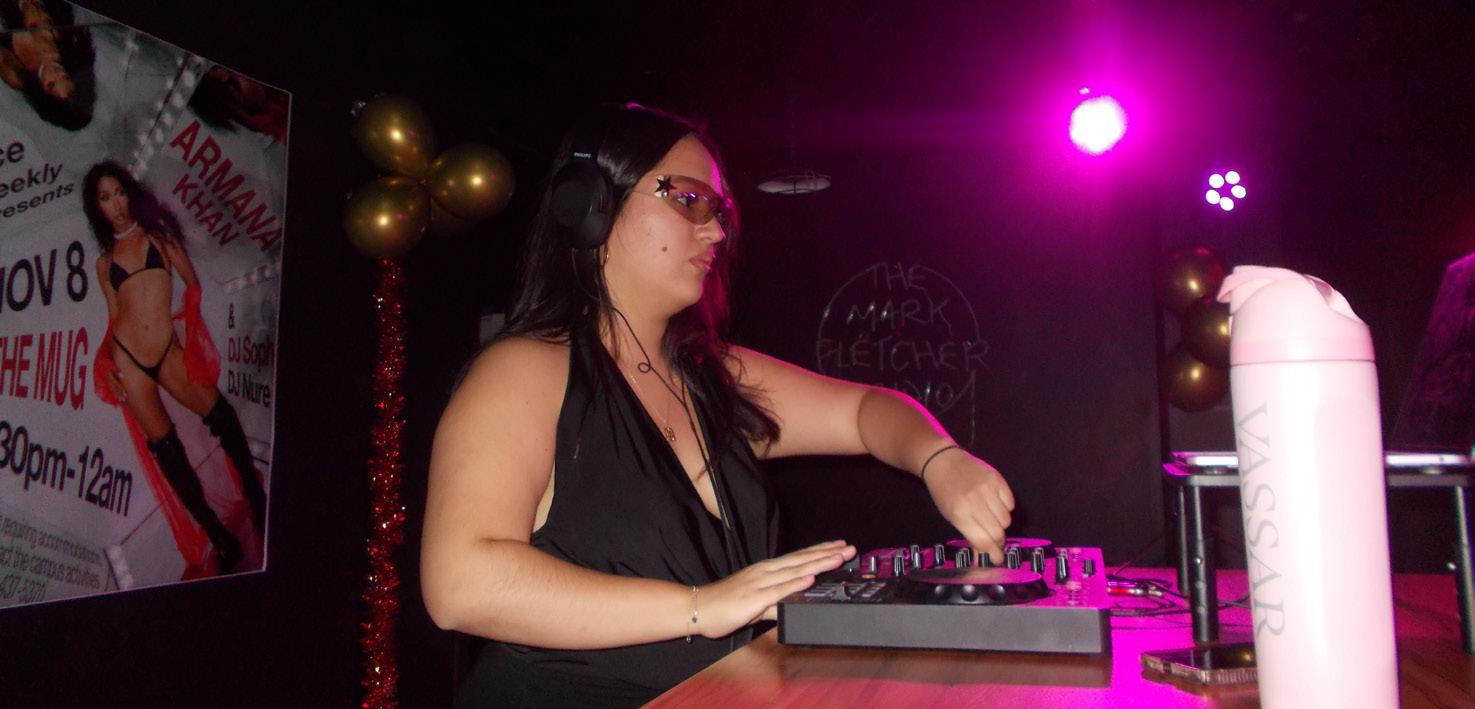
DJs are the backbone of any college party scene. DJ Soph (Sophie Varela ’28) is an energetic new voice on campus, bringing pop and reggaeton-infused soundtracks to Vassar’s nightlife. I sat down with Varela for a conversation on the world of Vassar DJing, the importance of community-building and the work that goes into making an event fun and worthwhile. Our conversation has been edited for length and clarity.
We’ll start simple: how did you get into DJing?
“I’ve always had an interest in DJing. I thought it would be cool; if there’s ever a time to do it, why not college? So I’ve always had it in the back of my head, but it really started when I went to the first VCSS [Vassar College Sound System] meeting, which is our DJing club on campus. I went to their first meeting [my] freshman year… and I was so scared to touch the decks… When I was first playing with the controller, I couldn't get it out of my head. I was researching, Googling, trying to figure out how much a beginner board costs. I found one for $150 on Amazon, and I bought it in Oct. 2025. I started playing around with it…and I guess the rest is history.”
What has your progression looked like here at Vassar, in terms of playing gigs?
“My first real gig was Valentine’s Day of last year… I did this first event with LSU [Latine Student Union]. I told them I wanted to DJ for Latin Night, and they told me I could do the first hour and we’d see how it goes. So I reached out to DJ Delahoz [Derek De La Hoz ’28], because he had played Latin Night before, and asked him for advice. I also reached out to another campus DJ, The Rezalution [Reza Hall ’27], and he helped me a lot with the behind-the-scenes stuff. I opened at that event for DJ EZ [Ezequiel Castellanos],
and we became good friends. He told me if I was ever interested in checking out the other DJs in Poughkeepsie and widening my network, that I could talk to him about that… I think that’s one of the secrets of becoming a DJ: You really can’t do it without a community. If I hadn’t had these relationships, I wouldn’t have done half the events I’ve done.
Lots of the events I’ve done are thanks to VCSS. I signed up to play Pink Noizes, which we did in partnership with WVKR [Vassar’s radio]. It was with two Brooklyn DJs, and it was really cool to be able to talk to them about what the experience is like being a female DJ. I played 50 Nights at The Academy in Poughkeepsie, but there wasn’t a huge crowd. I think that’s something important about DJing: when you start, and even when you make it big, you’re not guaranteed a crowd. I feel like those moments, while frustrating, are a good chance to try and figure things out, getting your practice in. Even if I don’t get a crowd, I like to play as if I do.
My first event, where I was headlining, was the Latin Night last semester. That event has been my biggest hit so far. I knew what I was doing at that point, I felt so much more comfortable. It’s Latin music. I grew up in Costa Rica, I lived there for six years, and that’s where I learned most of my Spanish music and Caribbean music. It’s just cool to be able to share that part of me with everyone. It’s cool to see what lands and what doesn’t. Sometimes I think a song is going to hit and then no one knows it, where back in my country everyone knows it. At every event, I want people to have fun, I want people to learn something and I want to be able to transport them.”
What’s your process like pre-event? How much work goes in beforehand, and how do you plan your sets?
“It depends on the event. The first time I was prepping for Latin Night, it took me hours. I was a beginner; I didn’t have a lot of music in my repertoire. I like to try and do a sample set before, so I can see what it’s
going to sound like. I’m always trying to find new songs—I never want someone to come to one of my events and feel bored. I like to make Spotify playlists for my sets, and then I listen to it the whole week beforehand. Then, the day of, I don’t listen to any music related to the event, so I can come in fresh.”
To you, what makes a song worth including in a set? Where do you find new musical inspiration?
“I have one really big playlist, where if I’m just listening to songs, I add them to my playlist. It’s called ‘The Ultimate DJ Mix.’ I look at what I already have, and if I need more songs, I go into Spotify and look through already-curated playlists. I also watch a lot of DJ reels and TikToks and get inspiration from there. I download songs through a Spotify to MP3 converter. A lot of other people buy their music using platforms like Beatport, but it’s expensive. The economic side of DJing isn’t really talked about enough. I’m not doing this for the money; I’m doing it for the love of the game. At the same time, my equipment costs money, and I don’t even think I've made half of it back. I’m Vassar’s VSA [Vassar Student Association] student DJ, so I get paid through Workday, but it’s minimum wage and only for the time of the event. I do everything myself. I don’t have a team, and as of right now, I don’t need one, but it’s hard. I really want to branch out and go into the
community of Poughkeepsie, but money is an obstacle. I’ve talked to people in the community, and I think there’s this sense that Vassar students stick to their bubble, and local businesses suffer for it… People used to go out into the community to local bars more, and that doesn’t really happen now. I really want to be a part of changing that, of bringing Vassar people back to local businesses, and I want to figure out how to do it in spite of the obstacles.”
You are one of a few working female DJs on campus. Has that fact affected your experience as a performer here?
“I think we get taken less seriously. People tend to say, ‘the music you play has to be catered to the girls, because where the girls are, the guys are.’ So if it’s gonna be like that, who better to do that than a female DJ? I tend to see online that the guy DJs are always playing the same stuff, and it’s good stuff, but there needs to be more diversity.
I know at least what I want to hear and what my friends want to hear. I’m always collecting thoughts, and I always love to learn from requests. It’s hard as a female DJ, and since I understand that, I also want to help other female DJs and anybody who’s interested in getting into the game. For example, my friend Ayami opened for me last Latin Night; I was able to give her that spot and I had so much fun listening to her play. I think it’s so important to support one another.”
While the dark, bitter cold of winter trudges on, we can look to music for fresh sounds to get us through. The start of a new year also marks the start of “single season” when artists begin to tease their new albums and drop long lists of tour dates on their Instagrams. Artists such as Harry Styles, Noah Kahan, Mitski, Snail Mail and Courtney Barnett have kicked off the season by releasing new songs these past couple of weeks. This time of year is when I decide what concert tickets are worth purchasing, so here is my very personal guide to what you should tune into this “single season.”
Lindsey Erin Jordan, commonly known as Snail Mail, released her single “Dead End” from her upcoming album “Ricochet” on Jan. 20. The song is in typical Snail Mail fashion with nostalgically broken-hearted lyrics moaned over bright, repetitive guitar riffs. In the late 2010s, Snail Mail emerged as a fresh voice in bedroom pop, and her sound has slowly matured since. Her most recent album “Valentine” was sharper with a noticeable edge: there was a slight rasp in her voice, rageful lyrics and powerful guitar leading the charge. However, I do not feel “Dead
End” is an adequate example of all Snail Mail has proven she can accomplish. Vocally, as she describes an old love that flourished on the cul-de-sacs of her hometown, her voice sounds thinner and more whiny than ever, lacking the complexity and fullness her voice has proven on past records. Even more, “Dead End” is predictable, lacking an exciting shift in the melody. The song’s simple bridge is unsatisfying and gives way to some repetitive “Na, na, na-na, na, na”s which finish off the song; it feels less passionate than Snail Mail’s usual. Although, with the song’s simplicity comes a great deal of playfulness. The chords she has chosen to reverberate throughout the song are light and springy, making way for her March album release. Ultimately, I will be curious to see how this song fits into her new album “Ricochet.”
Courtney Barnett released two singles on Jan. 20, one featuring indie-country artist Waxahatchee. “Site Unseen (feat. Waxahatchee)” and “Stay In Your Lane” are extremely promising singles for her upcoming album, “Creature of Habit.” Both showcase two completely different sides of Barnett’s artistry. “Site Unseen (feat. Waxahatchee)” is twangy in nature with Katie Crutchfield of Waxahatchee and Barnett harmonizing over the droning, echoey electric guitar. The
song’s lyrics are contemplative but ultimately indecisive: “Let’s figure out the rest another day,” Barnett promises at the end of the song. “Site Unseen” feels light and free-spirited, starkly contrasting the harshness of her second single, “Stay in Your Lane.” This song is more classically Barnett, starting out with a punch of dark chords bellowing from her rumbling bass guitar. Her voice lazily pierces through the sharp production, talking to listeners in her typical tone of nonchalance. Barnett speak-sings about things not going her way, which she attributes to her own mistakes. She regretfully shouts, “This never would’ve happened if I stayed in my lane.” The noisy guitar keeps listeners on their toes as the chords move in all directions throughout the song. Both of these songs hooked me right away. They feel fresh, but as Barnett sings, “I stayed in my lane.” I look forward to “Creature of Habit,” which is to be released on March 27. Additionally, Mitsuki Laycock, or Mitski, returns from a two-year hiatus with the single “Where’s My Phone?” from her upcoming album, “Nothing’s About to Happen to Me.” This song is punchy, like Barnett’s “Stay In Your Lane,” but with a uniquely ominous tone that Mitski has mastered across her decade-long music career. She sings eerily in minor chords as her lyrics meld from worried
questioning—“Where’s my phone?”—into poetic contemplation about the blankness of her mind in the age of the smartphone: “I'll stay out until my mind is like a clear glass.” Mitski has always been an expert at deeply examining issues that her listeners can relate to with her metaphorical lyrics. This single is a great example of this expertise, as it is a frightening reminder of our worsening disconnect from reality. The song ends with the roar of her distorted, muffled electric guitar, possibly symbolizing the frustration she feels with her addiction to technology. “Where’s My Phone?” is a powerful single in both meaning and sound, hopefully making way for some of Mitski’s best work on “Nothing’s About to Happen to Me.”
It is 2026, and some of your favorite 2010s bedroom pop artists are back with new sounds. While “single season” is in full swing, now is the best time to snatch up concert tickets before they disappear and become impossibly expensive. Tours have been announced by Barnett, Snail Mail and more artists who provide smaller, more intimate concert experiences as opposed to the larger tours and residencies announced by artists like Harry Styles and Bruno Mars. Now, we can eagerly look to early spring for “album season” to kick off.
Grace Finke Arts Editor
How much does sound shape our viewing experience of a film? “Rescoring Richter” explores this question by reimagining and re-sonifying films from a century ago.
“Rescoring Richter” came to Vassar on Jan. 31 in the Martel Recital Hall. This multimedia event was a part of MODfest 2026: “Sounding the Visionary.” This year’s MODfest theme is centered around celebrating people, such as Richter, who have made an impact on creativity, culture and society. This event featured selections from the project—which uses contemporary sound design to reinvent Richter's films—including screenings and short documentaries following the involved artists’ process, as well as accompaniments of some of the films.
As a project, “Rescoring Richter” began in 2013, accompanying filmmaker Dave Davidson’s 2013 documentary, “Hans Richter: Everything Turns, Everything Revolves,” which worked to uncover the broader impact of German artist and filmmaker Hans Richter. Richter’s avant-garde work—heavily informed by the absurdist and anticapitalist Dada movement—influenced film and art with its abstract imagery and inherent political messages. “Rescoring Richter” pairs new soundtracks by contemporary sound artists with Hans Richter’s films from the 1920s.
According to Davidson, a key element of Richter’s work was abstracting not only
space but also time. Richter’s films rely less on conventional means of storytelling and more on using bizarre and shocking visual motifs to evoke an emotional response. One example of this is in Richter’s 1928 short film, “Inflation.” This abstract collection of shots portrays a narrative of economic unrest in 1920s Germany through floating faces, counted currency and numbers and dollar signs rapidly overtaking the screen. Shots and images are rotated, inverted and fragmented in an unintuitive yet incredibly rhythmic manner, contributing to the building emotional intensity of the film.
“Rescoring Richter” featured a combination of Richter’s original images and visual remixes created by Davidson. “Ballet Entropique” (2025)—my personal favorite piece from this event—utilized shots from multiple of Richter’s films, including “Inflation,” to tell a story of Germany’s political landscape in this economically unstable time. This screening featured live accompaniment from sound artists Lin Esser and Bruce Odland on their custom instruments—Dr. E’s Box of Doom and Green Lady, respectively—that focus on creating music where it may not be expected.
In the first documentary, “A Subtle Exchange of Information Across Time,” Davison works with musicians Esser, Odland and Vassar’s own Professor Emerita Annea Lockwood to explore how to best sonically represent Richter’s art. Inspired by the sound sculptures and experimental instruments created by the Baschet Brothers, Esser, Odland and Lockwood created a surreal
soundscape with delicate glass rods, suspended strings and resonant metal planes, each sound overlapping and cascading into the next to illuminate the projected imagery.
This event also focused on Richter’s 1929 film “Everyday,” which abstractly portrayed the mechanization of everyday life. This screening featured an original soundtrack by composer and pianist John Musto as well as jazz musician Vince Giordano’s reinterpretation of Irving Berlin’s 1918 song, “Oh! How I Hate to Get Up in the Morning.” “Everyday” splices various people’s daily routines together, showing their morning routines, time at work and nightlife. This film emphasizes the mundanity of life, chopping and sequencing footage to increase the intensity and sheer discontentment as the days pass by.
In “Clock-In Dehumanize Repeat,” Davidson explains that Richter’s technique of reusing and reinterpreting footage follows the “theme and variation” form, commonly found in music. Richter’s artistic vision is rhythmic and precise, with time carefully given and taken with each shot. This is incredibly conducive to music and soundtracking, something Musto and soprano Amy Burton demonstrated in the next screening, “EVERYDAY Variations 25.” Visually remixed by Davidson, “EVERYDAY Variations 25” featured live performances by Burton and Musto of three songs: “Buddy on the Night Shift” by Kurt Weill and Oscar Hammerstein, “Berlin Im Licht” by Bertolt Brecht and Weill and “Oh! How I Hate to
Get Up in the Morning.” While these pieces were not composed for this work, the brilliant synchronicity of this jazz-inspired set list with the pulse of the shots created a compelling visual and sonic experience that truly transported me into the spirit of Richter’s work. The syncopation and harmony allowed me to be more aware of visual motifs and how they paired with the music and gain a deeper understanding of Richter’s abstraction of time.
The final film of this event, “Ghosts Before Breakfast” (1928), was played without sound. The program said, “The audience is invited to imagine their own sound environment.” As a musician, I found focusing on the visuals and letting the soundtrack come to me to be an enjoyable and engaging exercise. My perception of the film was quickly subverted during the repeat showing, which now featured a pop-rock song of the same title by singer-songwriter Rob Morsberger. At times, Morsberger’s lyrics directly narrate the shots and encouraged me to broaden my view on how a soundtrack can function.
“Rescoring Richter” is a fascinating project that explores elements of sound and how it can be used to illuminate a story. Being able to experience the experimental music of Esser and Odland live was transformative and helped me see the intricacies of Richter’s innovative films. More than anything, “Rescoring Richter” reminded me that one of the most beautiful things about art is its ability to be interpreted in infinite ways.
WhenI asked my dear friend Ruby Shang ’28 if I could interview her for an article about the artists in my life, she laughed. She replied simply, “I don’t think I’m talented enough for that, Melody.” Regardless of her love for singing and appreciation for crochet, Shang was still holding on to a notion that many of us have: art and technical skill must go hand in hand. I hope you will read along with me as I untangle this notion, attempting to convince you not to begin making art but to instead recognize and appreciate the art you and your loved ones have already been making.
When we hear the word “art,” oftentimes, a certain image can come to mind. It is easy to imagine a dedicated artist meticulously measuring ratios and learning color theory to perfectly capture an image. And indeed, this is one way to be an artist. Mason Wilkins-Lanier ’28 draws and paints realistic faces and objects. His work is sometimes eerie, often whimsical and always as visually accurate as possible. “I like seeing the result look like the reference,” he told me. While his pursuit of proficiency is certainly one valid approach to making art, many other artists have different priorities when they create.
Songwriter Jessie Cai ’28 is less concerned with the technical intricacy of her music than she is with the emotional effect of her lyrics. Cai started writing songs in middle school as a way to work through difficult feelings. She often writes for acoustic guitar, layering her cozy harmonies over carefully curated lyrics in GarageBand. Cai explained to me that her songs are very personal, so
she rarely shares her work. Instead, she takes pride in making art that feels right for herself. “As a songwriter, of course, I focus on the melodies and the lyrics,” she prefaced, “but the [songs] I felt most satisfied when writing were the ones where the words were most genuine.”
There is no doubt that art has the ability to capture human emotions. Once these emotions are caught, however, the artist can make decisions about what to do with them. While artists like Cai gain quiet, independent fulfillment from their craft, others, like poet Sophia Rubin ’28, find that art’s joy also lies in the connections that are made by sharing it. Rubin’s poems, like Cai’s songs, are often a medium to process complicated emotions. But for Rubin, the emotional discovery does not end when the poem is finished. Instead, they find further satisfaction when someone else relates to their poem. “I love when I can share the same specific feeling with someone, and sometimes, the only way to get that across is through art,” they explained. “I love when I write something and someone goes, ‘That is how it feels!’”
What we decorate says a lot about what we love. An empty Google Doc, the walls of a dorm room or the end of a curvy hallway are all perfect venues for a shrine. And just as places can be shrines, so can people. This truth is exemplified by my beloved roommate Claire Blisard ’28. Blisard has a magically colorful way of decorating: this sense of style exudes from her walls, out of her closet and onto her being every day when she gets dressed. The bright colors, interesting textures and funky earrings that are essential to Blisard’s outfits convey the essence of her whimsical personality. In taking a few moments to check in with herself before she starts her day, Blisard’s dress-up time
is a profound act of self-love which I am grateful to join her in each morning. Still, I know self-love like this can be a terrifying endeavor for many. To break down this fear in others, Phoebe Bergan ’28 makes pins and friendship bracelets which she distributes regularly to her loved ones. If you are not yet ready to take the time to adorn yourself, it is such an honor to be adorned by a friend instead. When I received a handmade bracelet from Bergan, it was such a simple yet special gesture that meant the world to me. Accepting a piece of Bergan’s art told me, “I think you’re worth decorating.”
The aforementioned Shang may not regularly “do art” in any physical medium. Yet upon a bit of reflection, I recalled her wonderful knack for telling stories. Whenever we meet to catch up over lunch, I know I am about to experience a theatrical production specially curated for an audience of one. So, it made perfect sense to learn that she intentionally structures her stories to maximize sus-
pense and humor. “I think it’s magical to turn an experience into a fun thing, or a humorous thing,” she explained. “Telling and retelling events really connects people.” And this, I believe, is the true essence of art: It does not need to be about skill and discipline but instead about what we say and how we say it.
So, despite her hesitations, it seems that Shang is an artist after all—one who works in spoken words. Still, words are one of many ways to get a point across. So, as I have asked her, I am asking you: How do you tell your stories from day to day? I promise, there is a tale to be told in the ways you decorate your space, your self or the margins of your notebook. And once you have gone looking for the artist in yourself, I implore you to find the artists that surround you every day. Get curious about their craft. What is their medium, and why do they love it? Ask them nicely to tell you their stories, and offer some of your own—this is what it is to be human. Thank goodness you are!

Continued from snow fort on page 1
son said. “So I started piling and then had friends join, and we made one chamber and then a second one.”
Once the initial structure had been carved out, Marrison had to retreat indoors to do some planning. As the primary architect, they make drawings in their sketchbook to plan out what the rooms of the snow fort—or the “Snort”—will look like.
“I’m an environmental science major with an art correlate, but literally the past couple of days, I’ve been thinking of making it an art major,” Marrison said. “I’m thinking about doing architectural drawing or something.”
However, the blueprints are not the only technical component of the igloo construction. Marrison expertly calibrates the space during the building process, crawling through the chambers and ensuring that each section is the correct size.
“If you have one single room that’s too big, it’ll collapse,” Marrison said. “So we made one room and caved it out to be a space and then basically piled a lot of snow
onto the side and then tunneled forward.”
Logistics do not just come into play with the internal structure. Marrison takes great measures to ensure that enough snow is packed outside the igloo. This process requires Marrison to enlist fellow craftsmen to ensure that the structure is of the highest quality.
“You can test on the inside if people block the entrances and light comes through because then, you know you should pack more snow on. Definitely don’t dig there,” Marrison said. “But also, I had this plastic pipe that we’d push through the wall, but it broke. So hopefully, I can get a metal pipe to use.”
Evidently, building an igloo of this caliber is no small feat. Luckily, Marrison has more than just expertise: They have passion.
“Once I start doing it, I can’t stop,” Marrison said. “I’m digging for ages. There’s something about building it with my hands. You can always add a bit more or dig a bit more or fix it up more.”
All this digging eventually required a
material upgrade. Marrison had to outsource an icepick from the Vassar Outing Club and assistance from Facilities Operations. After all, it takes a village to build an igloo.
“It snowed eight inches one day over break and I wasn’t in New York,” Marrison said. “So I emailed Dean Jaeger of Grounds Services and asked him really, really nicely if they could maybe plow some of the snow to protect it. And so they did.”
Even as the head architect for this impressive structure, Marrison remains humble in their gratitude for each and every person who has helped maintain their frozen fortress.
“It was so nice,” Marrison said. “I want to talk to the individual people who plowed it. I emailed asking if I could so hopefully we will soon.”
With the help of Dean Jaeger and the Facilities team, the igloo has become a hub for community building. When they are not busy working on expansions, Marrison enjoys spending time in the igloo with their friends.
“Over break, I came to do a snow fort sleepover with some friends,” Marrison said. “We didn’t actually sleep in the fort, but I worked on it from 1 p.m. to 3 a.m.”
The fort has an array of foraged decor adorning its exterior. In the future, Marrison plans to decorate the interior as well.
“I brought these thin logs that you can see in the first chamber because my plan is, for the third chamber, to make it really big and carve out half seats and put the logs there, so it’s like a council room,” Marrison said.
While Marrison is immensely proud of what they have accomplished thus far, they are aware of the potential dangers that the structure poses.
“I want to try and keep it up as long as possible, but I don’t want it to collapse on a student,” Marrison said.
Although the igloo will not be here forever, Marrison sees the silver lining in the inevitable loss.
“If it’s getting really gross, and I’m worried it will collapse, I might just walk over it and jump on it,” Marrison said. “We can have a snort destroying party.”
Continued from lion on page 1
we greeted the four or five other members of the party present. The men referred to each other as comrades and often quoted the original Black Panther founders and members on ideological fronts. As we talked, members of the group stood by the door ready to help anyone entering from the cold. The group we met takes inspiration from the Black Panther Party for Self Defense (BPPSD), formed in 1966 by Bobby Seale and Huey Newton. Founded on a 10-point program emphasizing civil rights, community outreach, anticapitalism and resistance to police violence, the BPPSD organized a free breakfast program, sponsored and created schools, distributed clothes and operated armed patrols. At its peak, the group had thousands of members and became a large figure in discussions of civil rights.
While the defining image of a Black Panther remains that of a Black man in a leather jacket, beret and a long gun, thanks in large part to their armed patrols and protests, their “survival programs,” which consisted of a set of welfare initiatives, were their main focus. In 1970, Fred Hampton, then Deputy Chairman of the BPPSD in Illinois, united street gangs and other ethnic movements under the Rainbow Coalition to fight poverty, inequality and police violence irrespective of race. The next decade saw the decline, primarily due to increased police intervention and infighting, of the BPPSD, and in 1982, the last Panther-backed school closed.
In 2020, current Chairman Paul Birdsong was vetted and given consent by Aaron Dixon, an original member and leader of the first original chapter outside of Oakland, to create a new Black Panther Party. Due to an internal feud, the organization announced a sudden name change on Jan. 26, mere days after our interview. The movement, and all of its chapters across the United States, will now continue under the name of the “Black Lion Party for International Solidarity.”
However, the “Black Lion Party” remains dedicated to the same ideals as it did before this name change. The party will continue its free breakfast program, currently operating in New York City and Philadelphia. Additionally, the Black Lions hand
out warm winter clothes and run mid-day food stands. The party also remains loyal to its original ideology. They maintain a 10-point program, which is remarkably similar to the 20th-century BPPSD program from 1972. Some points are nearly copied and pasted from the older program. In our discussion with members of the Party, they outlined an ideological dedication to international justice and freedom for all oppressed people. One member proclaimed that the organization stands for a wide variety of people, describing, “The little kids growing up, to the grandpas, to you college kids…we’d even stand up for ET’s cousin.” Just like the organization of the 60s and 70s, the Black Lions are committed to self-defense and maintaining firearms. The Lions in Philadelphia have been seen on armed patrols. Comrade Lu, our main contact, stated their opposition to fighting violence with more violence, yet he maintained their willingness and ability to meet violence on its level, saying, “You have to touch us first for us to act in any way.” He also said, when asked about their stance on firearms, that “It’s all about self defense, defense.” He emphasized the organization’s commitment to protecting themselves. When asked if they worry about growing violence, Lu posited, “We ready more than worry.”
The Black Lions have recently amassed a large following on social media through viral clips featuring members in public carrying firearms. These videos have reached a wide audience, appealing to those with pent-up anger about the ongoing slide into authoritarianism. While the Philadelphia chapter is the largest, the group is also present in Baltimore and New York, with many other cities applying to open chapters. Comments on the BLP social media posts indicate willingness to join with the cause, with many people asking how and where to sign up. At the meeting we attended, 10 new recruits were present, all of whom indicated excitement and a sense of confidence in the movement. This comes as the organization is going through a period of intense strife.
This conflict came to a head on Jan. 26, as the organization changed its name, caused by dissension from Dixon. Publicly, the official given reason comes out of ideological
differences and a difference in the treatment of members of the organization. In a video announcing the name change, Chairman Birdsong alleged that the party’s rejection of black nationalism and embrace of internationalism, as well as Mr. Dixon’s attacks on the organization, motivated the change. A source informed us that much of the ideological conflict came down to former Black Panthers believing “you shouldn’t be fighting for internationalism, when it [the Black Panther Party] was originally created for internationalism.” Mr. Dixon released a statement on social media, claiming the issue came down to a perceived sense of egoism and Chairman Birdsong violating a critical promise.
For all this discussion of ideological difference and personal feuds, we were informed of members of the community echoing suspicions that elders from the Black Panther Party who had previously endorsed Chairman Birdsong’s organization may have been bribed. Believers in this theory are concerned with how support was so quickly withdrawn, just as the party is beginning to gain notoriety. A source stated to us, “We as a whole, as a community, don’t know what to believe. We don’t know why they’d withdraw their backing and support after six years.” Upon pressing the subject of government payoffs, we were told, “There are suspicions within the com-
munity that elders are having to be paid off by the government, because just nothing makes sense.” Further, a multitude of other organizations call themselves “Black Panthers,” but none have faced public criticism. While the BLP is still in the fledgling phase, the group carries a lot of momentum. One member stated, “Nobody cared about the Black Panthers a year ago, but the work continued.” Even as the movement grows, the Lions made it abundantly clear that they were and would always be for the people. While some, especially in online activist spaces, may criticize the BLP as a form of role-playing, revolutionary fantasy or unnecessary incitement, the work the Lions do for their communities is something sorely missing from today’s politics. Furthermore, the party seems to provide a solid foundation for real reform and passion, something that has long been seen as missing from the Democratic Party. Interviews with members of the party indicate the desire to continue working despite the drama of the name change. One member stated, “We don't do it for the back and forth rhetoric... it’s irrelevant to us.” The BLP continues to patrol streets, run food assistance programs and give out clothes to the needy. At a time when people are as disillusioned with activism as now, the BLP provides an outlet and opportunity for those interested in directly helping people.
Vera Giraudo Guest Columnist
Tucked away in the Jewett basement is a closet full of pads, tampons and other period products. Marked by a paper sign, this is the Project Period headquarters.
First launched in April 2017, Project Period is the Vassar Student Association (VSA) initiative that funds and distributes free pads and tampons to the Vassar College student body.
Projects like these have become increasingly common across college campuses in the past decade as the result of a national movement with the slogan “If condoms are free, why aren’t tampons?” Vassar joined this attempt to combat period inequity and started putting out little clear boxes filled with pads in tampons in bathrooms across campus.
Access to necessary period products remains a pertinent issue for students across the nation. A survey commissioned by Thinx & PERIOD in 2025 found that nearly a quarter of surveyed teens struggled to afford period products. Similarly, a survey conducted in 2019 found that 14.6 percent of menstruating college students in the
United States struggled to afford period products at some point in the past year, and 10 percent experienced period poverty monthly.
Vassar first-years Samari Nedderman and Yaritza Reyes Contreras are employed by the VSA to keep every bathroom stocked. From the Rockefeller Hall basement to the Athletic and Fitness Center’s (AFC) locker rooms and even the dorms' laundry rooms, there are over 30 places to restock.
“Before, when I was doing academic and dorm buildings [on the same day],” Nedderman explained, “I could start at 11 a.m. and wouldn’t finish till like 4 p.m.”
Navigating the job in the first weeks of school while also being new to campus was tricky, Nedderman shared, but the rewarding nature of the job was felt immediately as well.
After trekking up to the AFC for the first time, she was met with enthusiasm from the people running the front desk: “ She was like: ‘Oh my gosh, thank you! We've been waiting to get the dispenser filled up. The girls use it a lot.’” Their appreciation and excitement made Nedderman feel like she was making a real impact.
“In my old [high] school, we didn't have
access to pads like that. We had the dispensers, but they were never filled,” Nedderman explained. “I thought this was something I could do to make a change.”
Despite the fact that access to menstrual products remains a rampant issue for students, experiences like these are common. Only 20 states have mandated that public schools provide period products, and less than 10 of them provide funding for said products. New York State, for example, mandates schools to provide free products but does not set aside the funding necessary for a project of this size, a legislative discrepancy that results in empty pad and tampon dispensers across the state. Moreover, California and New York, as of now, are the only states that mandate public colleges to provide free menstrual products. Lack of access to proper health care can affect menstruators’ emotional and physical well-being. The same 2019 study conducted by George Mason University found that undergraduate students who experienced period poverty were more likely to be depressed.
Moreover, inaccessibility to this healthcare is often linked to declining academic performance in both high school and
collegiate settings. Without the proper care, menstruating becomes a financial, emotional and physical burden—one that disproportionally affects low-income students.
Nedderman shared that, more often than not, the boxes and dispensaries are empty within two weeks. “I know people are using it. I know there’s a need for it,” she said. “That motivates me.”
I, along with many other students, have often relied on the pads in the bathrooms. The bin in the Sanders Classroom has saved me from certain doom on many occasions. So thank you, Samari and Yaritza!
The bathroom dispensers and clear boxes are not the only places to access free period products on campus. Students can also get free tampons and pads, along with other reproductive care products, contraception and over-the-counter pain medications, in the VSafe vending machine in the Old Bookstore in the College Center. These resources are all completely free of charge. When your cycle catches you off guard in class, or you are low on cash for pads— thanks to the work of Nedderman, Contreras and the VSA—there is a place on campus for you to go.
with beautiful and vibrant sarees, and Yaksha’s mother immediately got down to business.
Ihad the great privilege of spending the entirety of winter break with my best friend, Yaksha Gummadapu ’26, and her family in India [Disclaimer: Gummadapu is a Features Editor for The Miscellany News]. When we finally disembarked from the more than 27-hour journey to Hyderabad, my first thought was: How does she do this every break? I was tired, cramped and desperately needed a shower, but these feelings were quickly overcome by the adrenaline I felt in the backseat of the speeding car we were driven to her house in. The driver was a friend of Yaksha’s from school. He drove as if he were the only thing on the road. We found ourselves in the backseat of a car for the majority of our break, and I became more acquainted with the feeling of both weaving through and sitting in India traffic than I would like to be. But, I also used these hours to people watch and try to understand the structure of the vast city.
In the first long car ride we took, I was amazed at how different streets could look with just two turns. I was also impressed by the architects’ ability to fit so many restaurants and shops into such dense quarters.
Our first stop was a cafe right off a major road, and from the inside, you would never guess that if you went out the exit and walked just 10 feet, you would be standing in the middle of a highway. The vibe of the cafe was extremely familiar, like those that you would find in Manhattan or any major city, but the menu had an Indian flair by incorporating common spices and dishes.
The food was amazing. I credit both my friend’s great taste and the fact that Hyderabad is a well-known “foodie” city in saying I do not think I will ever eat better than I did during that month.
After I had my second coffee of the meal, the chauffeur took us to our next stop: a specialty saree shop. This was the first of many shopping trips we made while in India in preparation for Yaksha’s sister’s wedding in March. We entered the shop filled
I walked around the shop and sat with the reality that I was in India and that I was experiencing so many things I would not if I was there as “just a tourist.”
The classic Hyderabad tourist locations that we did visit included the Charminar and Golconda Fort, which are a part of the “old city.” Over 500 years old, these sites document the rule of Muhammad Quli Qutb Shah, the fifth sultan and founder of the city of Hyderabad. We went to the Charminar first, where the beautiful 16th-century Indo-Islamic architecture meets the 21st-century vendors who fill the streets. Among these vendors, you can find bangles, chai, children’s toys and an assortment of different street foods. Yaksha bought us some Kaccha Aam (raw mango sprinkled with chaat masala), and while I was eager to try any food offered to me, the bitter tartness of the raw mango was the only food I ended up having an aversion to.
We took a rickshaw to Golconda Fort next, and it was there, wearing a kurti from Yaksha’s closet, that I felt both an immense joy and gratitude to be in her home city and experience the history and life that she knows.
My favorite memory from this monthlong voyage fell on my 22nd birthday. Yaksha spent her last birthday with me, in Paris, so it seemed only fair for me to spend mine with her. We had cake that tasted as good as the pastries in Paris, and her family took turns feeding me a bite. In the evening, we had dinner at the Falaknuma Palace. The meal was four courses, and I got to try an assortment of South Indian dishes. Although I still have a bias for North Indian food, I do understand the hype behind Hyderabadi biryani.
When we finally landed back in the cold Garden State, I recalled the first thought I had once landing in India—how does my friend complete this journey every break?—and I had my answer: the people, places and maybe even the food alone made the grueling travel more than worth it.

tested every
night at 9 p.m., 12 a.m., 3 a.m., 6 a.m.
As snowstorms, busy schedules, seasonal depression and the general state of affairs infect us all with their nasty vibes, the mood here on the Vassar College campus has been dropping as low as the temperature. Though the party scene has suffered due to the weather (or at least that’s what we’ve all decided to tell ourselves), Vassar administrators decided last weekend that a function is just what the student body needs to get us out of our freezing dorms and into the warm embrace of community. However, after receiving the advice from a random psychology major to “not invalidate our feelings,” they opted to avoid forcing a festive atmosphere on an unwilling crowd and ultimately chose a more fitting theme for the coldest weekend’s hottest event: Sad Night at the Mug.
The doors opened at a crisp 7 p.m. to allow students plenty of time to leave early and cry themselves to sleep, and from the very start the venue was packed. This was due to a mixup with a concurrent campus event involving music and dancing and general vibes of joy and whimsy, which the administration had no role in organizing.
Once the throngs of mistaken partygoers cleared out, a scattered crowd of the stressed and depressed were left to tolerate the festivities. The evening’s activities included a
cry-dye station, where burned-out students could soak their paper assignments in pitiful tears; start of semester bingo, where contestants competed to be the first to cross off “evil professor,” “already slept through class” and “fucked over by CourseMatch;” and a “dance floor” where students could stare in existential dread at rave visuals of their calendars and upcoming Moodle assignments.
“This is kind of really bad,” commented one anonymous attendee. “I don’t know why I thought going to a sad-themed party would make me less sad, but I feel a lot worse now.”
“I thought when they said ‘Sad Night’ they meant they’d play, like, Clairo and Lana Del Rey,” said another irritated student, in the process of storming out the door. “This stuff is, like, actually depressing.”
A common complaint amongst the attendees was the absence of alcohol served at the function, paired with the invasive searches of bags, pockets and baggy jean folds conducted at the door to ensure no illicit substances entered the event.
“We want to teach our student body a valuable lesson about handling mental health crises without drugs or alcohol,” commented one of the administrators behind the decision. “Shit’s tough, but sometimes you just gotta raw-dog it.”
The highlight of the evening arrived at just past 9 p.m., when campus security was
called in with an anonymous complaint that Sad Night was “endangering students’ well-being.” As security guards swarmed the premises, all seven of the remaining attendees were forced to return to their dorms. It has since been revealed that this stunt was part of the night’s schedule all along.
“It was a perfectly horrible way to end a perfectly horrible evening, moohooheeheeha!” commented event planner Stu D. Enthater, rubbing his hands together like an evil little fly. “I bet their whole semester was ruined! Mwaaahooheeheehahoo!”
“I was going to leave anyway, but getting kicked out just made me feel extra chud,” commented one student, who left the event to return to their dorm to hit cart and rewatch “Heated Rivalry.” They continued, “but I do admit my night got significantly better after I left.”
In the wake of Sad Night’s smashing failure, admin has announced plans for more unconventional events such as Hunger Wednesdays at the Deece, the Gruel Ball at the Aula and the Celibaccanal, a sex-free Dionysian romp through the Preserve. In response to the subsequent comments that the administration is completely out of touch with what students actually want, they released the following statement: “Why the hell would we take party advice from Vassar students? Throw a decent TH party and then we’ll talk, losers.”


vital information” on how to steal
laughable in the Land of the Free.”
Citing his own ethics, ex-Venezuelan
President Nicholas Maduro refused on Wednesday to provide Trump with a stepby-step guide for how to rig an election modeled on the 2024 election in his home country, which independent queries determined was rigged.
“I can give you all the oil you want or fabricate intelligence about a drug smuggling operation for the press, but aiding in the destruction of the world’s greatest democracy would be going one step too far!”
Maduro cried, as Secretary of State Marco Rubio slapped him across the face. “I can’t bear to go into any real detail, but to steal
"I can give you all the oil you want or fabricate intelligence about a drug smuggling operation for the press, but aiding in the destruction of the world's greatest democracy would be going one step too far!"
Maduro cried, as Secretary of State Marco Rubio slapped him across the face
an election, you’d have to send armed thugs onto the streets, appoint loyalists to independent agencies and stack the Supreme Court—all of which worked extremely well in our measly autocracy but would be
While many aides have described the torture as intentional, the accounts have been disputed. Several sources close to the state department have revealed that Maduro was only tortured after being mistaken for a Venezuelan who peacefully took photos at an ICE protest earlier in the day.
Maduro is currently being held in the Metropolitan Defense Center in Brooklyn, where his treatment includes sleep deprivation. Despite the abuse he’s faced, he revealed he’s enjoying his stay. “I’m in the greatest city in the greatest country in the world. What can I complain about?” the Venezuelan said to reporters. “I’m in the city that never sleeps.”
While Maduro has remained defiant about withholding crucial details to overthrow a democracy, he has reportedly warmed up to the Trump administration. According to sources, when Maduro first found out that he would be tortured, he entered a panic attack that lasted nearly two days, being so in shock that the United States would break international law.
Liz Cheney, a prominent Republican who campaigned with Kamala Harris in swing states more than even Harris’ vice-president, has called for unity. “I’m hoping this is a time for our country to come together,” she said. “As Americans, we must agree that torture is necessary treatment for evil. I know Pops is looking down at us with a proud smile.”
Trump has defended reports of torture, saying that he believes in it for the “worst of the worst.” When asked if he would like to extend this behavior towards anybody else, he said he had one person in mind: “Sleepy Joe Biden, for rigging the 2020 election.”
With the chances of getting intelligence out of Maduro waning, the Trump administration has already secured other avenues. At press time, the State Department announced they found a new chief advisor

Emma daRosa Five Syllables First

ARIES March 21 | April 19
Go pee in a bush
Or not, could pee on a shrub
Pee on greenery

TAURUS April 20 | May 20

GEMINI May 21 | June 20
You are crazy girl
Don’t be so crazy this week
Drink more cups of tea
Don’t cry this week, k?
You are an ugly crier Or so people say

CANCER June 21 | July 22
Horoscopes are hard
The stars, my fickle mistress Cancers might be fucked

LEO July 23 | Aug. 22
Online gambling
Have much fun, lose all money
One of god’s small tests
LIBRA Sept. 23 | Oct. 22
Libra, libra, ah!
You should chant things more this week Libra, libra, ah!

SCORPIO Oct. 23 | Nov. 21
This week? Go on walks. Exercise and have much fun
DON’T FORGET CROSSWALK

SAGITTARIUS Nov. 22 | Dec. 21
Sagittarius
So many syllables, huh?
Attention seeking

CAPRICORN Dec. 22 | Jan. 19

AQUARIUS Jan. 20 | Feb. 18

VIRGO Aug. 23 | Sept. 22
Don’t skip class this week
Or do skip class this week, fine I’m not your mommy!

PISCES Feb. 19 | March 20
Your week will be rice Plain, yummy, best with a sauce
Find your sauce this week
Take up a hobby
Collecting petrified goop? Or geocaching
penis Vagina
The world always says sex sells genitalia
Eli Lerdau Guest Columnist
On Jan. 7, 2026, Immigration and Customs Enforcement (ICE) attempted a kidnapping operation in a suburb of Minneapolis. In the demonstration by peaceful protestors, Renée Good, a 37-year-old mother of three, was accosted by federal agents. The agents gave her confusing commands, some ordering her to exit the vehicle while others demanded she drive away. The woman began attempting to drive away, as officers told her to do. Jonathan Ross, an ICE agent, stepped in front of her car, firing a round into her throat. He then stepped to the side, leaned in the window and fired two more rounds, executing her in broad daylight.
In response to this murder, the federal government rushed to Ross’ defense, and so did the Republican Party. Republican legislators across the board support the killing and have continued to call for expanding ICE funding in the weeks since. We are in a historical moment in which we face a mob of legislators and officials who have made supporting a murderous institution a hallmark of their personal and political identities. This has troubled me; I am divided between my desire to punish those responsible and the politics of unity and love that have dominated liberal identity for generations.
For decades, if not centuries, liberals like myself have been obsessed with some vague sense of “love thy enemy” and a seeming need to reject any form of retribution. We have been plagued by the idea that to move on from crisis, we must show our love, find common ground and somehow build anew. Why are these politics—which are without
a doubt beautiful and well-meaning—so counter-productive and often dangerous? To answer these questions, we can turn to our past, and the past of Europe.
Following the Civil War, many held the belief that there was a need for a sense of “unity” and reignition of “brotherly love” among Americans. This perception, motivated by exhaustion from four years of war, led to a relaxed policy towards former Confederates. Confederate President Jefferson Davis saw no court, and within 20 years of the war’s end, the South effectively went back to normal, reintroducing systemic white supremacy. This reluctance to punish Confederates who had led a vicious war of secession—motivated by a commitment to slavery and white supremacy—allowed them to regain power, institute brutal Jim Crow laws and restart white supremacist militant power. Nathan Bedford Forrest, a Confederate commander who played a direct role in the massacres of hundreds of surrendering Union troops, was set free after the war and founded the Ku Klux Klan (KKK). George Gorden, a Confederate General from Tennessee, would also go on to play a founding role in the KKK, and successfully ran for Congress in 1907. There, he vigorously promoted violent Jim Crow laws and racial violence. One could easily write a book about the number of Confederates who, after being pardoned out of “unity” and “brotherhood,” came to lead the horrific world of post-war Southern politics. For all we may discuss unity in the wake of the Civil War, our forefathers’ focus on it only led to more violence, more destruction and the reinstitution of white supremacy. A similar story can be seen in the wake of
the Second World War and the Holocaust. The vast majority of Nazi war criminals, from low-level Schutztaffel (SS) soldiers who personally committed the massacres to camp leaders and scientists, were never punished. This came out of a sense of strategic necessity, and, more importantly, a widespread desire within Germany to simply move on and rebuild. An estimated 150,000 people, primarily members of the SS, took part in administering extermination camps, slave labor camps, concentration camps, ghettos and mobile death squads. Of this massive number, less than 10,000 were convicted in the post-war period. Men who committed atrocities to an extent unimaginable simply walked away and rejoined society. Heinz Reinefarth, who led the slaughter of 60,000 people over the course of two days, was elected to the state legislature and received a military pension. Franz Six, who was convicted of war crimes
Men who committed atrocities to an extent unimaginable simply walked away and rejoined society.
but was released within a few years, would go on to take part in a conspiracy to restore Nazism. The list goes on: As amnesty laws went into effect in the decades following the war, untold thousands of people who had knowingly and willingly participated in the Holocaust were allowed to go free. Of the men in charge of West Germany’s ministry of justice, the majority were former Nazis,
including a man who had taken part in the planning of the Holocaust. Now, over 70 years later, the Nazis are back in Germany. The Alternative for Deutschland, a party that happily associates itself with Neo-Nazis and whose senior members attended a secret Neo-Nazi conference to plan the return of Nazism, is now predicted to win majorities in two state legislatures and is tied with the ruling Christian Democratic Union in national opinion polls. Germany allowed its Nazi war criminals to go free so they could rebuild, and now they are back.
In the aftermath of the Civil War, we allowed Confederate leaders to go free, so they simply rebuilt the structures of white supremacy. The United States issued pardons for all Confederates, and they attacked our country a second time. Denazification, a joke of a process in and of itself, ended in 1951 with an untold number of Nazis rejoining society. These Nazis became doctors, teachers, judges, politicians and the overwhelming majority of them felt little, if any, sense of guilt. Now, over 75 years later, Nazism has reared its ugly head again in Germany and in America. Yet, we only have ourselves to blame. We have, for too long, let ourselves be dominated by an unwillingness to truly fight fascism. If we are to ever move beyond the crisis of today’s U.S. federal government, we must be willing to punish the ringleaders and foot soldiers of this fascism. They must see a fair trial, the type of trial we never gave Jefferson Davis or Nathan B. Forrest. If we refuse to take these people to trial—whether they be legislators, officials or the agents of injustice themselves—we will be repeating the same mistake we have been making for nearly two centuries.
Jacob Cifuentes Opinions Editor
The term “religion” is often used loosely. It is difficult to discriminate between what is considered religious and what is “spiritual” or even “philosophical.” In a secular liberal society where religious plurality is not only present but actively evolving, the exact formula that makes something not religious is unclear. One of these categorical ambiguities is the case of Buddhism, a system of thought that has been labeled as all of the above.
America’s first encounter with Buddhists was in the mid-1800s, when Chinese and Japanese immigrants settled on the West Coast and Hawaii. If you fast forward a century to the passage of the Immigration Act in 1965—which allowed immigrants from various Buddhist-practicing countries to move to the United States—Buddhism became less of a foreign mystery and more of a blossoming movement encompassing both immigrant and white-American communities alike. Many of these white people who grew up with Christianity and Judaism decided to convert to Buddhism during the Hippie Movement for its departure from the perceived harshness of Western Abrahamic religion.
Now in the present, I hear plenty of people—usually members of, again, largely white, secular mindfulness culture—say something along the lines of, “Buddhism is actually a philosophy or a way of life rather than a religion.” My reason for writing is to pinpoint where this thought arises from and explain why it is ridiculous.
Buddhism is essentially the movement rooted in the teachings of the Buddha,
known as Siddhartha Gautama or Shakyamuni. The word Buddha translates into English as “awakened one,” and serves more as a title than a name for a specific person. There is Shakyamuni, who is the historical Buddha, but there are also between 29 and an infinite number of Buddhas, depending on who you ask. Some believe that you and your dog are Buddhas. Some believe that Buddhas will magically save them from burning or drowning if they chant their names and recite their teachings. Buddhist literature, art and even practice not only features Buddhas—whether they be presented as mundane or transcendental— but also dragons, demons, forest spirits, aliens, interdimensional travel, superpowers and much more that one would assume belongs more in the fantasy genre rather than the self-help aisle.
The common argument from the camp that claims Buddhism is not a religion is rooted in the idea that a religion is an ideology or practice that primarily involves the worship of a deity. This is a misconception rooted in Christianity and Islam’s dominance over much of the worldplanet. The idea stems from the First Commandment in the Torah, where God tells Moses that there shall be no gods held above Him. Abrahamic religions demand worship in a monotheistic God with a specific canon—or book—of teachings.
This is not the norm. You may be asking, “Well, if worshiping a god is not the definition of religion, then what is?” to which I would answer, “I do not know.” There is no scholarly consensus on religion, and any non-academic source you can find will likely give a vague, biased or circular definition for the term. For the sake of the
discussion, I will have to use a vague definition: Religion is the attitude towards the sacred, around which a group or individual may center themselves existentially. This means that not only is worshiping a deity a form of religion, but also acts like ritual cleansing, meditation or a belief in cosmic supernatural forces.
So why do many claim that Buddhism does not fit the bill for a “religion”?” The answer can be found in Buddhism’s historical central canon, containing the teachings of Shakyamuni, the Pali Canon. In the Brahmajala Sutta, Shakyamuni tells his followers, "‘Whereas some recluses and brahmins, while living on the food offered by the faithful, earn their living by a wrong means of livelihood, by such debased arts as…worship of Mahabrahma.” Mahabrahma here means a great sovereign god, falsely believed to be the creator of the universe.
This is a departure from the centrifugal position of the Abrahamic religions, that one must worship Mahabrahma. Instead, Shakyamuni tells his followers that they must free themselves from the ignorance stemming from holding mistaken views, leading to the unvirtuous practices outlined in the sutta. This juxtaposition between monotheism and non-theism is not a mark of a categorical difference; it is a theological disagreement. Abrahamic religions inherently demand something that Buddhism does not, but that does not make one more of a “religion” than the other.
If I, a Buddhist, arbitrarily defined religion as “a belief in the compassionate power of Amitabha Buddha,” or even more specifically, “any practice or ritual that includes the recitation of Amitabha’s name,” then something like Christianity would
automatically be excluded. Is that not absurd?
I beg anyone who persists and continues to view Buddhism as something other than a religion to visit a real Buddhist congregation and tell me it is simply a philosophy about mindfulness. A few years ago, I visited Koyasan Beikoku Betsuin, a Shingon Buddhist temple in Los Angeles. Upon entering, I was confronted with a remarkably church-like setup of pews facing a central stage. The first person I saw was a man sobbing and, I assume, praying during the Goma fire ritual occurring in front of him. What better image of religion can be painted?
Sam Harris, a notable atheist writer, paints religion as a load of shit! According to RNS, “‘My goal,’ he writes in the book, ‘is to pluck the diamond from the esoteric dunghill of religion.’” Harris is essentially extracting “spiritual” mindfulness from its religiously supernatural, and apparently worthless, context. This is not only an intellectually wrong way of understanding Buddhism, as I have already outlined, but it is hard to exclaim how painfully awful it is to steal from religion in this manner. What Harris clearly does not understand is that Buddhism’s most sacred and influential teaching—the one that even made his “mindfulness” relevant—follows a simple logic. Suffering is inevitable in life. Life cannot be ended even in death, for even death is impermanent. Suffering does not end with death, and thus we must embark on a spiritual path to end suffering. If there were no life after death, as atheists like Harris hold, why is ending one’s life somehow a worse solution for ending suffering than spiritual practice?
Ian Watanabe Assistant Opinions Editor
I, like many others, struggle with an undiagnosed addiction to Instagram reels. I put an hour limit on the app, but clicking the “ignore for the day” button under the warning has become a habit that I could do blindfolded. It was during one such rotting session that an interesting ad came up, sandwiched between a “Family Guy” highlight reel and an AI edit of President Donald Trump inviting me to gamble with him. It was an ad for the Brick, a square fridge magnet that locks certain apps when you tap your phone on it. To unlock them, I would need to bring my phone back to the physical magnet to tap it again. The website shows pictures of smiling customers studying without distraction and spending time with their children, with the tagline: “Take Back Your Time,” all for $59. Phones and apps like social media are designed to be addictive, because all companies want people to use their product more, not less. This business model has largely grown unchecked due to the government being slow to regulate the technology industry. Products that block phone usage are a means of self-regulation. It simultaneously helps people in the absence of government regulation, and acts as a substitute for government regulation.
Brick is not the only product that regulates phone use. Apps and devices that aid in focus by limiting phone use are selling well and generating hype. They are advertised on social media, a remarkable strategy that both saves money and targets their ideal customer: a doomscroller who wishes they could quit but cannot. Nobody likes scrolling, deep down; they recognize it as something their brain compels them to do. I have seen a wide range of ads, ranging from general-use devices like the Brick, to more specialized ones, like an app that will not unlock your social media unless you do pushups in front of it, to whole new phones without internet capabilities. I am going to use “dumbphone” as a blanket term to describe all these products that limit phone usage. Most of the businesses ap -
pear to be start-ups, but the demand for their product is so high that they may become a thriving industry, with a consumer base that grows symbiotically with the consumer base of smartphone users. Furthermore, they are unlikely to be bought out by larger technology companies, because their product makes people use technology less, not more. These start-ups are not only profitable, but they can also maintain their independence.
The dumbphone industry has an advantage partly because cell phones and social media are heavily unregulated. The Trump administration has made it clear that it wants to deregulate technology companies to increase our country’s Gross Domestic Product and compete with China. In his administration’s AI Action Plan, there was little talk of ensuring the well-being of citizen’s health or well-being. Even without Trump, the United States has not yet included any technology-related addictions in the DSM-5. Meanwhile, the World Health Organization incorporated Gaming Disorder as an addictive behavior, while many countries around the world have tried to tackle tech addiction in policy.
This is not to say that other countries have “figured it out” in terms of technology regulation either. A lot of the existing tech regulation is aimed at protecting children’s safety and mental health. While many medical journals describe it as an addiction for adults and children, the laws on the books clearly convey more urgency for children. The most famous example is Australia, which recently barred children under 16 from using social media and fined technology companies that allow this. Time will tell if this works well or not, but once a person is 16, so long as they do not post or view illegal content, they are free to use their phone as much as they want. Adults get addicted just like kids can, but there are no regulations for them. I am not saying that the U.S. federal government will never tackle the issue of phone addiction, but there are A) many more obstacles at present, and B) the legal impetus to stamp out specifically phone addiction in adults barely even exists anywhere
in the world.
While solving an immediate problem that would otherwise get little attention, it is possible that the dumbphone industry may hinder regulation in the future. Products like the Brick have been invented because technology companies have deliberately made their technology addictive, while the government has not attempted to regulate it. Dumbphones will have customers so long as these things remain true. A helpful way to understand why this is problematic could be to watch a short video of Dagestani Imams criticizing Batman. In a nutshell, they ask why Batman, with his vast fortune, does not stop crime systemically by funding social programs, instead opting to fight individual criminals in a costume. The Imams go so far as to accuse Batman of not wanting crime to disappear, because then he would have no reason to be Batman anymore.
Applying this metaphor, it seems that dumbphones from the private sector could hinder systemic solutions, and fewer citizens would call for regulation because they can simply buy a dumbphone product. It may even be in the best interest of the dumbphone industry for regulations to be weak, so that their industry can grow its services to meet all the unmet needs. For example, a dumbphone startup could launch a phone-blocking device for schools to reduce phone addiction and distraction. However, implement an Australia-style social media age ban, and this start-up idea—with all its earning potential—evaporates into thin air. The dumbphone industry is effectively racing with the government to solve screen addictions, and they are winning.
With the Brick, the private sector has created more than a quirky way to stay offline. It has effectively made a replacement for government regulation that they can profit from. Some may be alarmed at this precedent for health and well-being to be privatized. I am too, but I also do not trust the current government to regulate technology responsibly due to its heavy involvement with larger technology industries. The cure to capitalism may, for the time being, be more capitalism.

Question: What has been your favorite class at Vassar?
"CHEM 125. It gave a good understanding of the basic principles of chemistry."
-Emmanuel Assopiah ’28
"Unlocking the Bible showed me the Bible from a scholarly point of view rather than a religious point of view, which is what I grew up with."
-Jake Schachter ’28
"Organic Chemistry. I took it with Herrera and think she was an amazing teacher. It was a class where you get to solve puzzles, like a New York Times puzzle."
-Eamon Smithsimon ’26
"Intro to French Literature. My high school French classes have mostly been about language acquisition, but this class studied literature, film and poetry."
-Marius Kruse ’29
"International Politics . I’m excited to take this class because my professor seems really interesting."
-Ava Vu ’29
"Intermediate Jazz, because the teacher was awesome and it was exercise in the middle of the day, fun music, fun vibes."
-Moria Donahue ’28
"Dancing to Connect, it was a CEL course where we taught Poughkeepsie High School students."
-Jada Duggins ’28
Our goal with Brewers Ballin’ is to feature Vassar athletes who starred for their team the week previous to publishing. If you would like to nominate an athlete, please email hfrance@vassar.edu.

'27.
Women’s Basketball W, 65-53 @ Clarkson U.
Men's Basketball W, 70-51 @ Clarkson U.
Men's Swim & Dive 1st/5 - VC Sprint Invite
Name: Haley Schoenegge
Team: Women's Track and Field
Year: Junior
Stats: All-American Haley Schoenegge ’27 continues her stellar career by setting a new Division III record in the 1,000 meter at the John Thomas Terrier Classic at Boston University on Friday Jan. 30. Schoenegge’s time of 2:50:14 bests the previous record of 2:51:13 set by St. Olaf’s Isabel Wyatt in 2024. Schoenegge currently holds eight individual school records and contributed to the indoor distance medley relay school record.
Statement: "Late last semester the indoor track and field season got underway, and coming back from winter break we truly hit the ground running. Each week, our focus has been on preparing for the Liberty League meet and the rest of championship season. This winter has been especially challenging, with below-freezing temperatures and icy conditions limiting our ability to train outdoors. We’ve made the most of the situation by using the bays in the Field House and spending plenty of time on the treadmills in the gym. Despite the tough conditions, the team has already seen a number of personal records this season! ... I am excited to see what we can accomplish throughout the upcoming indoor and outdoor seasons!"

Women’s Squash L, 2-7 vs. William Smith College Men's Squash W, 6-3 vs. Hobart College
Women’s Fencing W, 27-0 vs. Yeshiva University
Abigail Ford ’29 awarded Liberty League honor
Women’s Swim & Dive First Year Abigail Ford ’29 was named Liberty League Rookie of the Week following a win in the 100-yard medley and a runner-up finish in the 50-yard freestyle at the Vassar Sprint Invite.
Henry Bonney ’28 tabbed UVC Player of the Week
In the Men’s Volleyball team’s nail biting defeat against #1 Springfield College, Bonney exploded for a career-high 21 kills on a scorching .488 efficiency.
Lindsey Shoulders ’29 earns 7th Liberty League Honor
Shoulders ’29 was named Liberty League Rookie of the Week, as the forward averaged 12.5 points and 4.5 rebounds during the Women’s Basketball team’s road trip to the North Country.
Men's Volleyball vs. Carthage College @ Kenyon Hall Volleyball Gym, Feb. 7 @ 12:00 P.M.
11 years ago, we witnessed one of the craziest endings in Super Bowl history. The Seattle Seahawks had taken a 24-14 lead over Tom Brady’s New England Patriots in the fourth quarter. The Seahawks had the number one-ranked defense in the league, dubbed the “Legion of Boom” due to their heavy hitters. However, Brady pulled off some late-game heroics—stringing together two straight touchdown drives to Danny Amendola and then Julian Edelman, giving the Patriots a 28-24 lead with two minutes left in the game. The Seahawks, led by quarterback Russell Wilson, were appearing in their second straight Super Bowl after blowing out the Denver Broncos 43-8 the year before. Wilson led a quick, methodical drive leading up to a 33-yard pass down the sideline to receiver Jermaine Kearse, who appeared to have dropped the ball but kicked it up and caught it while lying on the ground. Star running back Marshawn “Beast Mode” Lynch took the ball to the oneyard line, and things were looking bleak for New England. Brady was appearing in his sixth Super Bowl, but he had not won since 2005, after losing in both 2008 and 2012 to the New York Giants. Now, it looked like Brady was going to come up short in the big game again. However, on second and goal from the one-yard line with 28 seconds left, the Seahawks called one of the most controversial plays of all time and threw the ball, which was intercepted at the goal line by undrafted rookie Malcolm Butler. Fans, commentators and critics condemned the decision to not hand the ball to the borderline unstoppable running back on the oneyard line, and the Patriots won their fourth title.
Now, this historic matchup will reunite on the big stage for Super Bowl LX in Santa Clara, California. In a somewhat unlikely outcome, these two teams have had exceptionally quick turnarounds. One year ago, the Seahawks were the eighth seed in the NFC and had just missed the cutoff for the playoffs. Current Seahawks quarterback Sam Darnold was leading the Vikings to a 14-3 record, but they were blown out by the Los Angeles Rams in the first round of the playoffs. The Vikings went on to draft a quarterback in the first round and trade Darnold to the Seahawks. This turned out to be a great move for the Seahawks, as Darnold led them to a 14-3 record and the NFC’s top seed. However, the true X-factor of this team is the defense, ranked first in the league in efficiency and points allowed. Analysts have described the 2025 Seattle defense as the best thing since the Legion of Boom. In the divisional round of the playoffs, the Seahawks annihilated their rival, the San Francisco 49ers, 41-6. They moved on to play their other staunch division rival, the Rams, in the NFC championship. In a fairly back-and-forth game, the Seahawks took an 11-point lead in the fourth quarter. The Rams cut it to seven points, but the Seahawks’ defense was able to ice the game by stopping Los Angeles on their last drive, winning 31-27. The Seahawks advanced to their first Super Bowl since 2015. On the other side, just one year ago, the New England Patriots were 4-13 and almost at the complete rock bottom of the NFL. Rookie quarterback Drake Maye had shown some flashes, but the Patriots had a very weak roster and coaching staff. Head Coach Jerod Mayo was fired, and Mike Vrabel was brought in. Vrabel was the coach of the Tennessee Titans for many years, but more importantly, he was a former linebacker for
the Patriots during the Tom Brady era, even winning two Super Bowls. The Patriots went on a spending spree in free agency, acquiring wide receivers Mack Hollins and Stefon Diggs as well as defenders Milton Williams, Harold Landry and Carlton Davis. In the draft, they also snagged offensive lineman Will Cambell and star running back Treveyon Henderson. At the start of the season, the Patriots were 1-2, and it seemed like another year of missing the playoffs was on the horizon. Somehow, the Patriots went on a 10-game winning streak and finished the season at 14-3—the two seed in the AFC. Maye was an MVP candidate, breaking Brady’s completion percentage record and becoming the first Patriots 4000+ yard passer since Brady. In the wildcard round, the Patriots handled the Los Angeles Chargers 16-3 in a defensive game. They moved on to face the Houston Texans in the divisional round, who had the first-ranked total defense in the NFL, yet the Patriots handled business again, winning 28-16. They were set to face the number one ranked Broncos in Denver for the AFC championship, but Broncos starting quarterback Bo Nix broke his ankle in the divisional round. Jarrett
Stiddam, a former Patriot, was set to make his first start of the season for the Broncos in the conference championship game. Blizzard conditions and sloppy football led to a 10-7 Patriots victory.
Matchup of the Day:
This Super Bowl features my matchup of the day, between Patriots cornerback Christian Gonzalez and Seahawks wide receiver Jaxon Smith-Njigba (JSN). Gonzalez is only in his third year, yet he has already received All-Pro honors. He has locked down opposing wide receivers this year, allowing only 25 yards per game and one total touchdown this entire season. On the other side of the ball, JSN has been putting up unreal numbers with 119 catches for 1793 yards (leads the NFL) and 10 touchdowns. In the NFC championship game, he posted 10 receptions for 153 yards and a touchdown. Will JSN be able to keep his stellar streak alive, or will an unstoppable force meet an immovable object in Christian Gonzalez? I believe whichever side wins this matchup will dictate the outcome of the game.
My Predictions:
This matchup has everything it takes to be an instant classic. The Seahawks opened as 4.5 point favorites, with 75% of wagers in most sportsbooks on Seattle to cover the spread. I expect the Seahawks to come out of the gate with a hot defensive start. However, I think that once Drake Maye settles in, the Patriots will be able to close the gap. Drake Maye has been the first QB to beat three top-five total defenses in one playoff run, so he should be able to find his groove. The Patriots’ D-line has been terrorizing teams in the playoffs, so they will be keeping Sam Darnold under pressure. However, I predict that JSN will win the matchup of the day, and torch the Patriots defense.
Armaan’s Locks
[Disclaimer: This is not gambling advice. The author is not responsible for anyone’s monetary loss.]
Seahawks : -4.5 point spread (-115)
Kayshon Boutte : anytime touchdown scorer (+310)
Drake Maye : OVER 39.5 rushing yards (-114)
Sam Darnold : longest completion OVER 35.5 yards (-115)

By: Sadie Keesbury
In the word bank below, there are 16 words that belong to four categories. Each word belongs to only one category. You don’t know which words belong together, nor do you know what the categories are! Try to find similarities between them, and place them into four categories below. Answers (which words belong together, as well as the categories they belong to) will be revealed in next week’s issue. Have fun!
Example category:
1: Toyota Car Models COROLLA PRIUS TACOMA HIGHLANDER

WORD BANK
DAY RAKE SIGN QUAKE SAW
CAKE SIGN MAKE HAMMER GIFT
SHOVEL CANDLE FABRICATE WORM FORM CARD
WORD BANK
EDUCATION SENIOR SOX TRANSPORTATION FLIPPERS HERRING FAMILY CROSS SHOES MILITARY
STATE SOCKS SEA BOOTS STUDENT AGRICULTURE
Answers to last week's crosswords: "Heated Rivalry" "Keeping it Froggy" "First Crossword of 2026" "Red Square"