Dutchess County residents push for free buses
Hadley Amato News Editor
On Jan. 20, the Dutchess County Legislature met to discuss their plans for the upcoming year and hear from constituents. The Tuesday night session was packed tightly with newly elected and re-elected legislators fresh off of November elections, as well as dozens of community members who braved the cold to make their demands known.
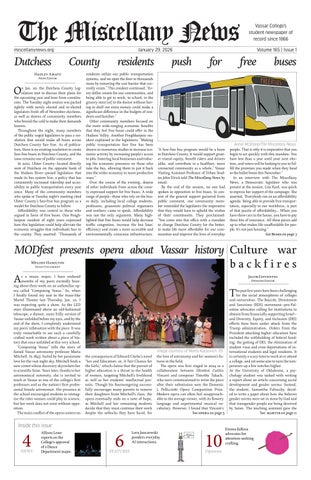
Throughout the night, many members of the public urged legislators to pass a resolution that would make all buses across Dutchess County fare free. As of publication, there is no existing resolution to create fare-free buses in Dutchess County, and the issue remains one of public comment.
In 2022, Ulster County—located directly west of Dutchess on the opposite bank of the Hudson River—passed legislation that made its bus system free, a policy that has consistently increased ridership and accessibility to public transportation every year since. Many of the community members who spoke at Tuesday night’s meeting cited Ulster County’s fare-free bus program as a model for Dutchess County to follow.
Affordability was central to those who argued in favor of free buses. One Poughkeepsie resident of eight years expressed how this legislation could help alleviate the economic struggles that individuals face in the county. They asserted: “Thousands of
residents utilize our public transportation systems, and we open the door to thousands more by removing the cost barrier that currently exists.” This resident continued, “Every dollar counts for our communities, and being able to get to work, to school, to the grocery store [or] to the doctor without having to shell out extra money could make a significant difference in the budgets of residents and families.”
Other community members focused on the more wide-ranging economic benefits that they feel free buses could offer to the Hudson Valley. Another Poughkeepsie resident explained to the legislators: “Making public transportation fare free has been shown in numerous studies to increase economic activity by increasing people’s access to jobs, fostering local businesses and reducing the economic pressures on those who take the bus, allowing them to put it back into the wider economy in more productive ways.”
Over the course of the evening, dozens of other individuals from across the county expressed support for free buses. A wide range of people—those who rely on the buses daily, including local college students, professors, grassroots political organizers and workers—came to speak. Affordability was not the only argument. Many highlighted that free buses would help decrease traffic congestion, increase the bus lines’ efficiency and create a more accessible and environmentally conscious infrastructure.

“A fare-free bus program would be a boon to Dutchess County. It would support greater transit equity, benefit riders and drivers alike, and contribute to a healthier, more connected community as a whole,” Vassar Visiting Assistant Professor of Urban Studies John Elrick told The Miscellany News by email.
By the end of the session, no one had spoken in opposition to free buses. In context of the general support garnered from public comment, one community member reminded the legislators the imperative that they would have to uphold the wishes of their constituents. They proclaimed: “You come into this office with a mandate to change Dutchess County for the better, to make life more affordable for our communities and improve the lives of everyday
MODfest presents opera about Vassar history
Melody Hamilton Guest Columnist
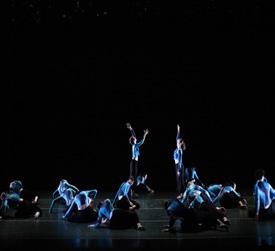
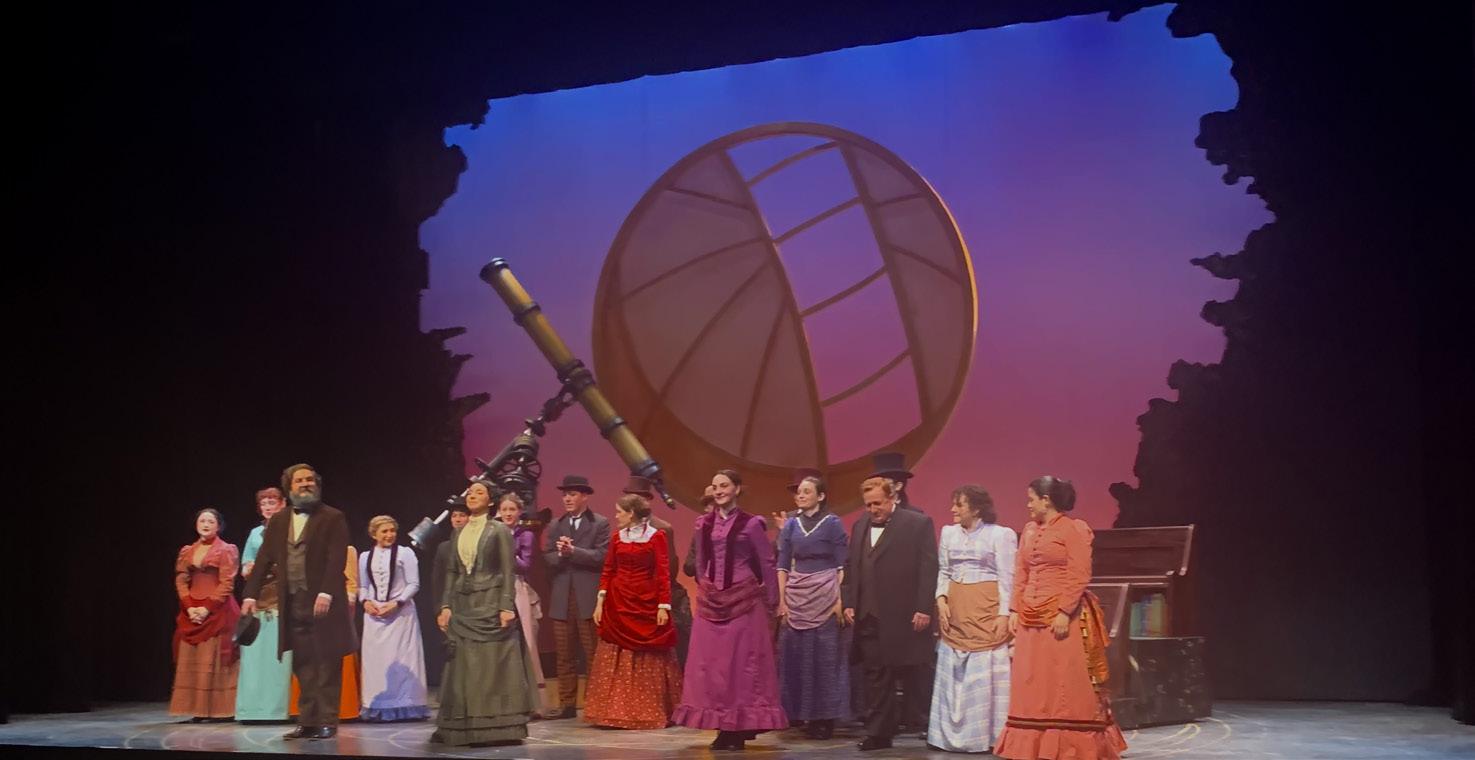
As a music major, I have endured months of my peers excitedly buzzing about their work on an unfamiliar opera called “Computing Venus.” So, when I finally found my seat in the maze-like Martel Theater last Thursday, Jan. 22, I was expecting quite a show. As the LED stars illuminated above an old-fashioned telescope, a distant, more frilly version of Vassar unfolded before my eyes, and by the end of the show, I completely understood my peers’ infatuation with the piece. It was truly remarkable to see such a carefully crafted work written about a piece of history that once unfolded at this very school.
“Computing Venus” tells the story of famed Vassar astronomy professor Maria Mitchell. In 1847, fueled by her passionate love for the vast night sky, Mitchell finds a new comet whose discovery skyrockets her to scientific fame. Years later, thanks to her astronomical notoriety, she is invited to teach at Vassar as one of the college’s first professors and as the nation’s first professional female astronomer. Her presence at the school encouraged students to reimagine the roles women could play in science, but her work does not exist without opposition.
The main conflict of the opera centers on

the consequences of Edward Clarke’s novel “Sex and Education: or, A Fair Chance for the Girls,” which claims that the pursuit of higher education is a threat to the health of women, targeting Mitchell’s livelihood as well as her students’ intellectual pursuits. Though his fearmongering successfully encourages many parents to remove their daughters from Mitchell's class, the opera eventually ends on a note of hope, as Mitchell and her remaining students decide that they must continue their work despite the setbacks they have faced, for
the love of astronomy and for women’s futures in the field.
The opera was first staged in 2024 as a collaboration between librettist Caitlin Vincent and composer Timothy Takach, who were commissioned to write the piece after their submission won the Domenic J. Pellicciotti Opera Composition Prize. Modern opera can often feel unapproachable to the average viewer, with its flowery language and experimental musical vocabulary. However, I found that Vincent’s
people. That is why it is imperative that you begin to act quickly with this mandate. You have less than a year until your next election, and voters will be looking to you to fulfill the promises you made when they head to the ballot boxes this November.”
In an interview with The Miscellany News, a Democratic legislator who was present at the session, Lisa Kaul, was quick to express her support of the campaign. She asserted, “Everybody ran on an affordability agenda. Being able to provide free transportation, especially to our workforce, is part of that puzzle of affordability… When you have three cars in the house, you have to pay three bits of insurance. All these pieces add up to what makes life unaffordable for people. It’s not just housing.”
See Buses on page 3
Culture war backfires
Jacob Cifuentes Opinions Editor
The past few years have been challenging for the social atmospheres of colleges and universities. The Boycott, Divestment and Sanctions (BDS) movement—pro-Palestine advocates calling for institutions to abstain from financially supporting Israel— and Diversity, Equity, and Inclusion (DEI) efforts have been under attack from the Trump administration. Orders from the President attacking higher education have included the withholding of federal funding, the gutting of DEI, the elimination of student visas and even deportations of international students and legal residents. It is certainly a scary time to work at or attend a college, and yet some aim to turn the temperature up a few notches higher.
At the University of Oklahoma, a psychology student was tasked with writing a report about an article concerning social development and gender norms. Instead, the student, Samantha Fulnecky, decided to write a paper about how she believes gender norms were set in stone by God and that transgender people are being deceived by Satan. The teaching assistant gave the
See martyr on page 11

Image courtesy of Marta Karpovich '29.
Annie McShane/The Miscellany News.


THE MISCELLANY NEWS
EDITOR-IN-CHIEF
MANAGING EDITOR
SENIOR EDITORS
CONTRIBUTING EDITORS
NEWS EDITORS
ARTS EDITOR
ASSISTANT ARTS EDITOR FEATURES EDITORS
OPINIONS EDITOR
ASSISTANT OPINIONS EDITORS
HUMOR EDITOR
ASSISTANT HUMOR EDITORS
SPORTS EDITORS
DESIGN EDITORS
ASSISTANT DESIGN EDITORS
COPY EDITOR
ASSISTANT COPY EDITORS
GRAPHICS EDITOR GAMES EDITORS
SOCIAL MEDIA MANAGER
LIVE EVENTS CHAIR WEBMASTER REPORTERS/COLUMNISTS
CARTOONIST
COPY STAFF
Allison Lowe
Luke Jenkins
Kathryn Carvel
Darja Coutts
Madeleine Nicks
Clara Alger
Carina Cole
Soren Fischer
Hadley Amato
Julian Balsley
Grace Finke
Aurelia Harrison
Yaksha Gummadapu
Sydney Jones
Jacob Cifuentes
Ian Watanabe
Zoe Rodriguez
Emma daRosa
Wren Buehler
Noah Daube-Valois
Henry France
Casey McMenamin
Molly Delahunty
Lucas Seguinot
Teresa Garcia-Green
Hannah Wells Anabel Lee
Sadie Bakken-Durchslag
Paige Hahn
Annie McShane
Sadie Keesbury
Felix Mundy-Mancino
Mia Liloia
Denver Brown
Hunter Farhat
Eduardo Culmer
Armaan Desai
Noah Duncan
Lora Janczewski
Brendan Kennedy
Evan Seker
Erin Thatcher
Andrew Chu
Nikola Parker Cooperman
Elliott Evans
Cooper Jaffe
Gabrielle Lyman
Ren Nicolau
Tess Novack
Julia Weber
MISCELLANY NEWS | VASSAR COLLEGE
Image courtesy of Karen Mogami '24.
VSA Senate Highlights, Jan. 25
• VSA welcomed its new members: Sustainability Executive Caroline Robinson ’27, Senator Hana Afiz ’27, Senator Kenzy Aldaher ’27 and Senator Justine Katimbang ’27.
• Senator Dhino McLean ’28 resigned his position. An election for McLean’s position is ongoing and closes Wednesday, Feb. 4.
• The VSA President announced an upcoming Brewer’s Night on Thursday, Jan. 29, from 9 p.m. to 1 a.m. in The Mug.
• The Residential Affairs Chair suggested holding an open Residential Affairs Committee meeting in the future to hear comments on campus accessibility.
Community members support free bus resolution
Continued from Buses on page 1
“I think it’s completely feasible,” she said of the potential transition to a fare-free system. “There’s no resolution as of yet for how we’re going to address this and what we’re going to do, and that takes a long while. You have to work through the [federal] administration, and there are financial implications for it. But the effort is there and has been there for a long time,” she explained.
Kaul also pointed out that, though not available to everyone, free busing in Dutchess County does already exist for certain sectors of the population. She highlighted that Vassar students, for example, are able to board any Dutchess County bus for free with their ID card, saying, “It is ironic that, of all the people who have access to fare-free buses, it’s Vassar kids. The institution is made for it, but it’s not like fare free doesn’t exist right now.”
Vassar students have been able to ride Dutchess County buses for free ever since 2017, when the College agreed to reimburse the county for the full $1.75 price every time one of its students swipes their ID on board. Vassar Urban Studies major Leo Kogan ’28 commented on this tension, lamenting, “It appears that [the buses] are reserved for a group that might not utilize the system as much as local residents, and that seems pretty unfair to me.” In the context of this, Beatrixe Bagin ’27, another Urban Studies major, expressed her support of the farefree bus plan. Bagin asserted, “I certainly support making buses fare free and more widely accessible across Dutchess County… Dutchess County’s history of redlining and urban renewal has led to barriers to accessible public transportation, but fare-free buses would be an invigorating step toward reform and mobility equity.”
With this context in mind, Kaul thought about the ways in which wealthier institutions could help support the cause of free buses. She asked, “Are we going to try to get more people to pay the fare on behalf of others? Or are we going to keep asking the Poughkeepsie city school district to pay the fare for its students, but we’re offering free services to others.” Thinking specifically of Vassar College, Kaul concluded: “That’s the least Vassar can do, is pay for its share, get more people to use the lines.”
The push for free buses also reminded Kaul of what she felt was the importance of maintaining buses and other forms of public transportation in American culture. Kaul explained, “When you look at why denser spaces or cities are more democratic, it is because people engage with a lot more things that are common goods… [and] you are constantly encountering people you
don’t know.” To Kaul, buses are not just instruments of transportation but foundational to the collective consciousness of the community. She concluded, “In suburban areas like this, the bus is one of the ways in which we actually build a democracy, or that sense of community.”
Kaul’s statement resonated with Bagin, who offered her own perspective on the sentiment: “The bus is a bubble of experience in the suburbs where people cannot be independent; they must democratically rely on other humans.” To Bagin, the prospect of free buses in Dutchess County represents a moment of hope. “It’s an inspiring reminder to me that even when planning policies have attempted to segregate people and delegate them to distinct communities, people have fought for access to public transportation to uphold a shared space for people to encounter people they don’t know,” she concluded.
Vassar honors MLK with community breakfast
Jackson Hrebin Reporter
On Monday, Jan. 19, dozens of students, faculty and community members gathered in the Villard Room for Vassar College’s annual Martin Luther King Jr. Day Breakfast. President of the College Elizabeth Bradley, Deputy to the President and Secretary of the Board of Trustees Wesley Dixon and Associate Dean of the College for Student Growth and Engagement Wendy Maragh Taylor organized the event and delivered remarks. The speakers shared personal stories, discussed their desire to foster a more inclusive college community and spoke about the significance of King’s legacy.
Also speaking at the event were Poughkeepsie Children’s Cabinet Executive Director Jill Gomez, Professor of Drama Shona Tucker and Associate Dean of the College for Religious and Spiritual Life and Contemplative Practices Reverend Callista Isabelle. Additionally, several Vassar students wrote and recited poetry about King and his work.
Taylor opened the event by welcoming Poughkeepsie residents and Vassar students back to campus following winter break. She then spoke about how diversity is crucial for shaping a compassionate and supportive community. “How wonderful to have different perspectives based on our varying experiences and identities, and how this beautiful world would be lacking if that did not exist,” Taylor said. Dixon, who followed Taylor, echoed her comments. Reflecting on those in the audience, Dixon noted, “[This event] reminded me of
one of my favorite proverbs, which is ‘a single bracelet alone does not jingle,’ and hearing you all talk and be together and coming together from diverse backgrounds—our community partners, students, faculty, administrators—I’m hearing some of the jingling of your presence together in this room.”
Taylor stressed the importance of hearing and respecting all perspectives in a community, especially challenging or unpopular ones. She argued, “If [diversity] did not exist in our classrooms, on our college campuses, in our churches, in neighborhoods, in synagogues, in mosques, in our places, in our neighborhood, the world would not be quite so lovely.” Over the past year, the Trump administration has rolled back Diversity, Equity and Inclusion policies within the federal workforce, and has targeted colleges, organizations and private contractors. In this context, Taylor urged students to not only remember King but embody his work and enact his message in their own lives and actions: “And so I invite you on this MLK Day, not only to be here, to reflect on his legacy, but to think about how we might participate and be engaged in it. In the kind of service he was engaged in. To contribute to a new world.”
Bradley touched on similar points and emphasized her commitment to unite the Vassar and Poughkeepsie communities: “We have so many different backgrounds, different roles, different areas of expertise, different ideas about what the world is and should be. But we’re also deeply tied, one way or another, to this local community. Vassar, Poughkeepsie, the area around you.” Bradley acknowledged that differ-
ences in perspective and agenda have at times divided the Vassar administration from its student body and community members. In December, the Miscellany reported that Vassar, through a real-estate subsidiary, planned to demolish and redevelop over two acres of land in downtown Arlington, which would displace many local businesses and residents. The plan sparked backlash among students and Poughkeepsie residents. In her remarks, Bradley suggested that by embodying King’s legacy, the College aims to prioritize collaboration and overcome disagreement: “I think we demonstrate, as a collective, that in a diverse setting we can really work towards common goals. Sometimes that has required us to let go of our little, petty disagreements. Other days, it’s really about collaboration in our conceptual teamwork. And within Vassar and beyond Vassar.”
Exploring the continued relevance of King’s message, Bradley quoted Rumi, a 13th century Persian Islamic scholar, poet and mystic: “Out beyond ideas of rightdoing and wrongdoing, there is a view. I’ll meet you there.” Bradley also shared what she believes is the purpose of honoring King, and how he can teach us to overcome our own struggles and achieve a brighter future: “MLK Day reminds me of the forever struggle to find wholeness amid brokenness, to promote love and care even when we disagree and when differences in worldviews try to separate us. The memory of Martin Luther King Jr. can fuel us to always build that loving community.”
In an interview with The Miscellany News, students who attended the event shared their takeaways and commented
on connections they saw to recent political news. Iesha DeSilva ’28 said, “It really made me think of ICE… That was a really big current event that drew me in.” On Jan. 7, 2026, Renee Nicole Good, a 37-year-old American citizen, was shot to death by ICE agents. Multiple ICE agents shot ten times and killed a second American citizen, 37-year-old Alex Pretti, on Jan. 25, 2026. Both killings incited national outrage and cast doubt on the Trump administration’s commitment to protecting American citizens, regardless of their political beliefs. Similarly, Hannah Straub ’28 said, “I think they did a good job holding an awareness for how urgent change is currently and how it’s really hard to hold out hope right now because things seem to be very bad.” Straub added, “I think they were able to make space for anxiety while also having a call to action.”
Though many speakers referred to broad ideals and systemic injustices, all presentations emphasized the importance of strengthening the existing bonds within the local Vassar and Poughkeepsie communities and honoring the differences between them. Straub shared, “I was inspired by how many different people there were with different backgrounds, like people from the Poughkeepsie community, people who work at the College, students.” When asked what she felt like could be done to combat divisiveness and promote a stronger sense of belonging, she explained, “I feel like there’s a lot of urgency right now, but I think [this event] represented that there’s also change going on as a community and I think individuals have a responsibility to get out and get involved with one another.”
College approves dance major
Allison Lowe Editor-in-Chief
Vassar College recently approved a new major in dance. In the coming years, the Dance Department will expand its offerings beyond its current correlate sequences in Dance Performance and Dance Studies, allowing students to declare a dance major. Prior to this decision, the Dance Department had been the only performing arts department at Vassar to not offer a major.
“It has been a long time coming,” Lecturer in Dance Leslie Sachs told The Miscellany News. When Sachs arrived at Vassar in 2018, she was surprised to discover that the College did not offer a major or correlate in dance. “It was really treated more like an extracurricular or a hobby,” she said.
Despite this lack of official recognition, the practice and study of dance have a long history at Vassar, with the first formal class being offered in 1898. However, dance operated as part of the Athletic and Physical Education Department until 2005. The correlates in Dance Performance and Dance Studies were approved in December 2021.
Vassar’s program emphasizes the dual importance of academics and dancing, with Fiora Hogan ’28 writing, “Vassar is a secret gem of the college dance world. I was immediately drawn to the strong dance program at Vassar that also allowed me to explore my academics. It’s hard to find a school that has both!”
The Dance Department decided that the correlates and prospective majors were necessary for students’ dedication to be fully recognized. “The dance faculty believes that students should have acknowledgement of their work on their transcripts, on their resumés, and anywhere else this credit could be useful. The students’ work in dance is as serious and comprehensive as it is in other disciplines, and we feel strongly that it should be recognized as such,” Lecturer and Chair of Dance Miriam Mahdaviani-Goldstone wrote to The Miscellany News via email.
Tara Sweeney ’28 echoed a similar sentiment, writing, “The faculty have been dedicated to operating the dance department with the rigor of a major for years, so
I’m glad we are receiving recognition. The dancers of the Vassar Dance Department constantly push themselves creatively and physically, and earning the dance major will benefit students hoping to pursue professional dance careers as performers, choreographers, teachers, or arts administrators.”
Mahdaviani-Goldstone noted that, in recent years, students have begun creating their own opportunities to comprehensively research and analyze dance topics. To her, this development signaled the necessity of a dance major. She wrote, “Several students incorporated dance topics into their Senior theses, in disciplines ranging from Sociology and Cognitive Science to English and Film. A few years ago, the senior prize in Multidisciplinary Studies went to a Dance student who was a Greek and Roman Studies major. This student choreographed her senior thesis and presented her dance in a fully-produced performance.”
Clara Alger ’26, a history major and dance performance correlate, is incorporating dance research into her senior thesis [Disclaimer: Alger is a Contributing Editor for The Miscellany News]. “Because I have spent so much of my Vassar time on dance, I thought that, for a culminating project, it would be really nice if I could combine my two primary modes of study—dance and history—together,” she told the Miscellany “My history thesis is about one woman who was a dancer, choreographer and political activist in the 1930s. One of the things I’m arguing is that she really showed how dance education is vital. And I’m in a dance pedagogy class right now, so it’s been really fun to see all those connections come to light.”
Sachs similarly described the expansive and multidisciplinary nature of dance, emphasizing that this quality would naturally lend itself to a robust course of study. “The overarching mission of a liberal arts education is the education of the entire human being,” she said. “Which means not just the intellect, it means the spirit, the emotional, the physical—all of it works together. It’s like the body—all the systems in the body function to create a harmonious union and whole. So, the arts are, in that way, essential for education and a growing human being.”
Current dance students have also ex-
pressed excitement for the major. “When I got here as a freshman the dance correlate still felt fairly new and even though now as a junior I will not be declaring a dance major, I am glad that the sophomores and freshmen now have the opportunity,” Zoë LaCheen-Fine ’27, Assistant to the Director of Vassar Repertory Dance Theatre, wrote to the Miscellany
Several students have expressed interest in becoming dance majors. Annabelle Fields ’27, an Art History Major, stated that she is considering declaring a double major in dance, writing, “I’m very excited that this has become a new opportunity for those of us that chose to dance so many hours a week and are really passionate about pursuing dance.”
The formal process for developing the major began after the Dance Performance and Dance Studies correlates were approved. The Dance Department subsequently introduced new courses to broaden its offerings. “The faculty worked to develop courses such as Global Dance, Dance Pedagogy, Musical Theater, Dance History, and Perspectives in Dance and Society. We also introduced some cross-listed courses (with Sociology, Drama and Cognitive Science) and a Community Engaged Learning intensive,” Mahdaviani-Goldstone explained.
To approve the major, the Dance Department worked with Vassar’s Committee on Curricular Policy. Mahdaviani-Goldstone
wrote, “We worked with the committee to ensure that a Dance major could be meaningful, attainable, and meet the high standards Vassar sets for all its Majors. I am pleased to say that when we were ready to present our proposal to the full faculty for a vote, it passed unanimously!”
When asked how the dance major would differ from the Dance Department’s correlates, Mahdaviani-Goldstone wrote, “The Dance major will be more comprehensive and include two requirements: a course in choreography and a Senior Capstone project.
Sachs also stressed the importance of theoretical coursework, which has been growing in the Dance Department and would be an important component of the major. “Students who will be Dance majors will be really educated in the art form, which has so many legs to it,” she said.
LaCheen-Fine expressed hope for what the new major would bring, both to the Dance Department and Vassar as a whole. “I think it will attract more students who are serious about dancing professionally and only add positively to this campus,” she wrote.
While Vassar has approved the major, the College will still need to obtain final approval from New York State. If the process goes as expected, students will be able to declare a dance major beginning in the Fall 2026 semester.


Image courtesy of Miranda Shandell ’29.
style of writing combats this masterfully, striking a wonderful balance between vernacular and poetic language. Meanwhile, Takach’s background as a choral composer shines through in the show’s stunning harmonies and lyrical instrumental lines.
The production’s scale was unlike anything I had seen before at Vassar, combining the best talents of the Drama Department and the Music Department. The two departments were brought together seamlessly by co-directors Drew Minter and Christopher Grabowski. The Martel Theater was a stunning venue for the story, providing plenty of space for sets and elaborate costumes, which animated the setting so magically.
Each scene was a beautiful tableau of life at a time in Vassar College’s history that feels so far away nowadays. Meanwhile, the emotional elements of the story were elevated through the work of the Music Department. The score was played by an 11-piece pit of current and former Music Department faculty, conducted by Chris-
tine Howlett, while the chorus was filled with some of the finest singers I know. Additionally, two principal roles were sung by Grace Finke ’27 [Disclaimer: Finke is the Arts Editor for The Miscellany News] and Sarah Dworman ’27.
While the show involved many of Vassar’s current professors, performers and crew members, the production team also invited some talented alumni back to the stage to tell Mitchell’s story. John Raymond was played by Michael Hoffman ’13, star student Mary was played by Beatrix Postley ’24 and the role of Miss Mitchell herself was sung by Eden Bartholomew ’23.
The presentation marks the opening of “MODfest 2026: Sounding the Visionary,” an event which seeks to emphasize the power of creative vision to impact culture and incite productive change. Maria Mitchell’s story is surely a testament to the power of vision. As a viewer from the modern day, it was sometimes laughable to watch the show's villain decry the presence of women in higher education in the name of women’s health. Today, we know
that his claims were totally unfounded and therefore seem trivial at a school like Vassar. Not long ago, however, his words had very real effects on collegiate women, and it is only thanks to the visions of people like Mitchell that we feel so secure in our equal right to an education.
Additionally, though, I think there is another vision to be seen here: that of the countless storytellers—directors, writers,
“Computing Venus” opera is a reminder to dream together “Marty Supreme” comically critiques blind ambition
Grace Finke Arts Editor
The key to success is a combination of self-confidence, charisma and a creative hustle. That is, at least, according to champion table tennis player Marty Reisman. Reisman’s notoriety is due to both his talent and the extreme measures he took to achieve success. His eccentric life has recently been dramatized in Josh Safdie’s 2025 film, “Marty Supreme,” a brilliant mess of overlapping storylines that cleverly satirizes extreme desperation in the name of ambition.
“Marty Supreme” is set in the ’50s, but has an ambiguous vintage atmosphere that creates instant timelessness; it was shot primarily on 35-millimeter film and accompanied by a soundtrack heavily inspired by ’80s synth-pop.
French-American actor Timothée Chalamet plays Reisman’s fictional counter-
We get to know the characters intimately through extreme close-ups of their faces that reveal their scars, blemishes and birthmarks. The audience experiences everything that makes them human: their breathing, imperfections and emotions. Every triumph or misfortune becomes all the more meaningful, as we can see even the most subtle shifts in their emotional presentation.
part, Marty Mauser—a hotheaded, overly ambitious 23-year-old New Yorker with a dream of winning the World Table Tennis Championships. We meet Marty as he is
leaving his job at a family shoe store, full of blind confidence that he will take home the trophy for the British Open. After robbing his family’s shop at gunpoint, demanding more luxurious accommodations and seducing retired actress Kay Stone (Gwyneth Paltrow), Marty is defeated by Japanese player Koto Endo (Koto Kawaguchi), left with nothing but the consequences of his own actions.
The rest of the film follows Marty as he attempts to redeem his own ego at the championship in Japan. Over the course of the next year, Marty embarks on an extensive scramble to gather the funds he needs, scamming and manipulating everyone in his life, including his friends, family and businessman—and Kay’s husband—Milton Rockwell (Kevin O’Leary). Marty’s antics are incredibly comical, ranging from morally dubious to incredibly illegal.
“Marty Supreme” is one of the most chaotic films I have ever seen. The combination of the interwoven subplots and Darius Khondji’s frantic, detail-oriented cinematography is overwhelming yet engaging. Khondji focuses on short shots that let us in on the urgency of a given situation. During the table tennis scenes, the perspective rapidly switches between the players, the ball and the paddles, allowing us to feel as if we are actually playing rather than spectating. We get to know the characters intimately through extreme close-ups of their faces that reveal their scars, blemishes and birthmarks. The audience experiences everything that makes them human: their breathing, imperfections and emotions. Every triumph or misfortune becomes all the more meaningful, as we can see even the most subtle shifts in their emotional presentation.
Throughout the film, we learn about Marty through his friends. Rachel played by Odessa A’Zion, is a married childhood friend with whom he is having an affair, and Wally, played by Tyler Okonma—who is better known by his stage name, Tyler, the Creator—Marty’s close friend and fellow table tennis player who works as a taxi driver.
Rachel discovers she is pregnant with Marty’s child, and feels trapped in her marriage. Wally needs to provide for his family, but finds himself becoming entangled
in Marty’s ridiculous schemes. Rachel and Wally are both compelling characters who reveal more about Marty and his interpersonal relationships. Their stories slowly unfold as their problems become more relevant to Marty’s life. Their conflicts not only add more complications to Marty’s plan but also force the viewer to see them
Marty is the epitome of an antihero. I found him to be incredibly unsympathetic; his blind ambition and lack of respect for the basic needs of others establish him as selfish and reckless. Yet I also found myself invested in his story, not because I wanted him to succeed, but simply out of morbid curiosity about what might happen next.
through his eyes.
Marty is the epitome of an antihero. I found him to be incredibly unsympathetic; his blind ambition and lack of respect for the basic needs of others establish him as selfish and reckless. Yet I also found myself invested in his story, not because I wanted him to succeed, but simply out of morbid curiosity about what might happen next. Chalamet’s performance was effective not only because of his talent as an actor, but also because of the effort he put into realizing the character both on and off screen.
Before the movie was released, Chalamet posted an 18-minute video on X. This was a staged Zoom call with the marketing team from A24, discussing potential promotional materials for “Marty Supreme.”
Chalamet’s behavior was bizarre, to say the least. He was overly enthusiastic about his rather absurd ideas, which included putting an image of himself on a Wheaties box, painting the Statue of Liberty orange
designers, cast, crew and more—who gave their time and effort to this production. Their hard work brought Mitchell’s struggle to life in a way that enabled viewers to contextualize her plight in this day and age. Thanks to them, “Computing Venus” is a reminder that in times where peoples’ rights are actively being taken away, uniting around a common vision is not as futile as it may feel—some days, it is all we can do.
and flying a fleet of blimps with the “Marty Supreme” logo printed on the side.
xThe mediocre concepts paired with his unbridled confidence set a precedent for Marty’s character, and this strange post, which quickly became the source for numerous internet memes, proved to be an effective way to publicly merge Chalamet’s persona with Marty’s character.
Part of what makes “Marty Supreme” such an effective film is its ability to indirectly place the audience into the story. Many of the plot points are unexpected and unsatisfying, yet nothing feels incomplete. The cinematography allows us to feel that we are also experiencing the events of Marty’s life. This forced empathy created cognitive dissonance for me: If I so morally disagree with Marty, then why do I still feel his need to succeed?
Ultimately, “Marty Supreme” serves as an effective commentary on the dangers of reckless ambition. While I disliked Marty as a character, being directly in his mind allowed me to see bits of myself in him. “Marty Supreme” had no explicit message, but was a chilling warning of what can happen if we try to force our way through life. For all its absurdity, “Marty Supreme” is a hard-hitting, deeply emotional piece of cinema that has still not left my mind.

MISCELLANY NEWS | VASSAR COLLEGE
Image courtesy of Melody Hamilton '28.
Annie McShane/The Miscellany News.
Interacting with AI: caution or connection?
Lora Janczewski Columnist
Over winter break, I wanted to bake my own birthday cake with my family. When I suggested this idea, my sister began asking ChatGPT for a cake recipe. I was apprehensive at first—surely there was no reason to immediately turn to artificial intelligence (AI). But within seconds, we had a clear and straightforward chantilly cake recipe: ingredients, instructions, estimated duration—all of it listed. We went out to buy the ingredients and returned home to find that we had missed some. No problem, though—my sister just told ChatGPT that we forgot the buttermilk, and it instructed us to use a mix of milk and yogurt. Oops, we added the sugar into the dry ingredients instead of the wet. That is fine! Just make these adjustments. After multiple tweaks and changes to fit our convenience, we had our cake—perfectly accurate in the eyes of ChatGPT, but not quite the dessert we signed up for. It is likely that you have interacted with artificial intelligence chatbots at some point in your life, especially with their increasing prominence in daily life. From the wellknown ChatGPT to the little virtual assistants on websites, these chatbots seem to be everywhere. They have become so prominent that many people now turn to them for advice, not only on writing or practice problems, but on life. A friend once told me they asked ChatGPT if their crush liked them. The resulting response undeniably flattered my friend, and we laughed it off. These interactions may seem harmless, and in fact, they may even come off as positive. From time to time, being praised or reassured for your decisions feels nice. Especially considering the chatbot’s friendly tone, it can almost seem as if you are texting a friend or a person you can
confide in.
For people who use AI as an outlet to share their emotions, you can get reassurance and company. In fact, people who use chatbots experience less relative loneliness, as mentioned in the research paper “AI Companions Reduce Loneliness” by De Freitas et al. These AI chats will never be angry or annoyed with you—or by anything else. This reduces the risk of users feeling that they are not a priority or that they may upset someone by interacting with them. In a study performed by Internet Matters, nearly 15 percent of teenagers would rather have conversations with chatbots than with real people. The same study also found that these users do not often question the conversations or advice they receive from the chats, accepting the chatbots’ words to be true, but we must take caution.
ChatGPT is programmed to be agreeable. Therefore, these interactions are merely a reflection of underlying tones in the user’s writing and conversation, not necessarily an unbiased truth. If you tell the chatbot that you are really nervous about an exam that you barely studied for, it will tell you that everything will be okay. The chatbot may reassure you by emphasizing that you at least studied a little, and that is what matters. However, a person will often tell you the truth by letting you know when something you are doing is wrong and giving advice that takes into account human emotions and interactions, a capability the chatbots lack. Furthermore, if a person does not know the answer to your question or cannot give you advice they deem good enough, they will tell you that they simply do not know. AI chats will never tell you that they do not know an answer—they will always give you one. But as we know, the responses AI gives us are not always accurate. Research done
by Dr. Giuseppe Giancarre and Dr. Andrea Taloni shows that data manipulation via AI is increasing in academia, making studies seem legitimate when they are not; this growing issue is rightfully a cause for concern. ChatGPT has been known to make up sources and use fake information. If AI is not trusted for source-backed work, why would people accept life advice from it?
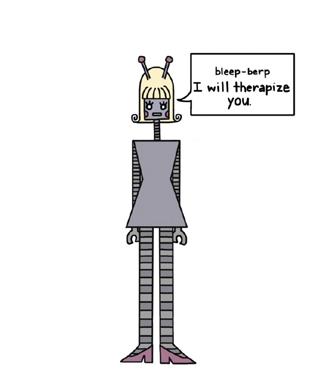
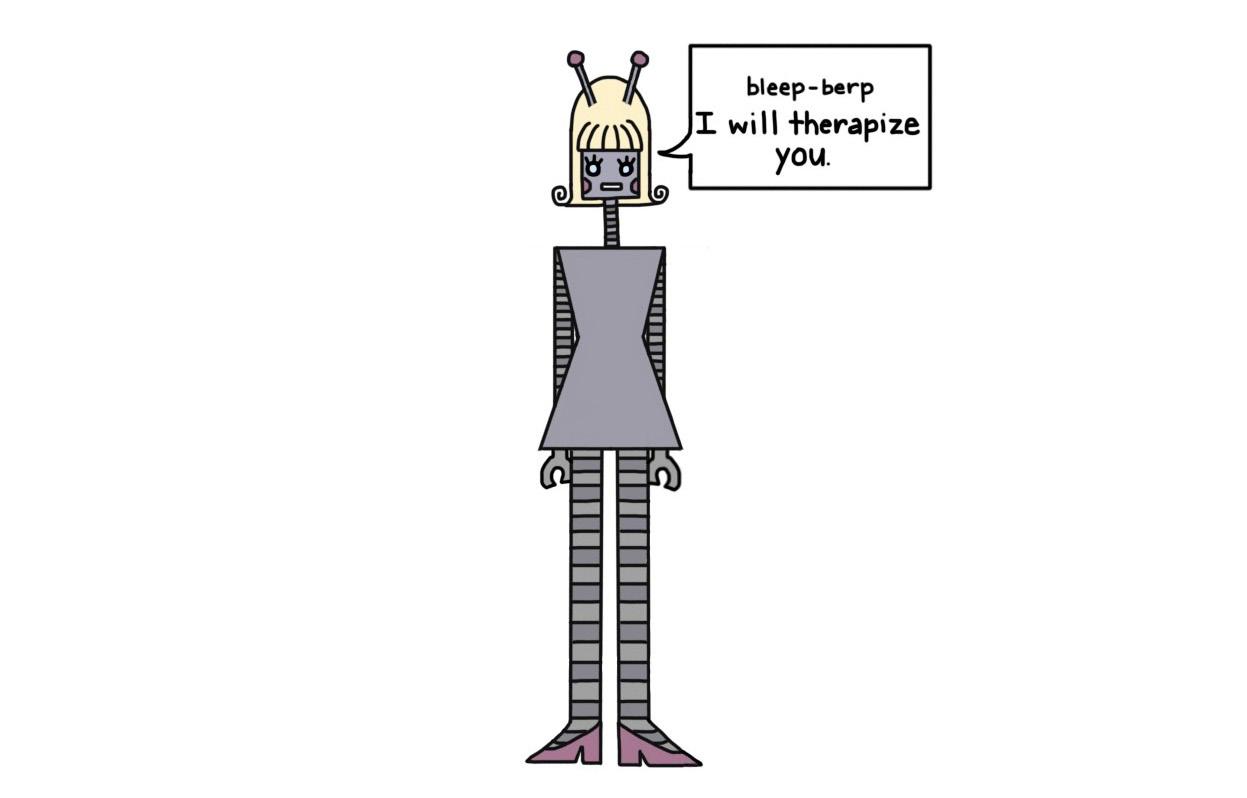
This becomes much more serious when people use chatbots as substitute therapists. Even though ChatGPT can be framed as a helpful tool, it is crucial to note that the program is not a licensed professional. Because of their inclination to generate false data, chatbots risk user safety by sharing misinformation and reinforcing harmful habits. This can slow treatment for an individual’s struggles or even completely nullify it if the person fails to reach a trained professional. There is a lack of clinical studies regarding the effectiveness of using AI to help with mental health, so, given what is already known about AI, it is best to avoid using it for
such purposes.
Last semester, Dean of Student Living and Wellness Luis Inoa warned students about this issue over email. Noticing the rise of AI usage, he stated, “It is understandable that when people are navigating emotional struggles, they are drawn to tools that are readily available.” However, the Dean suggested that students should use their better judgment and, if anyone is struggling, the school has multiple resources, such as the counseling and wellness offices, that students can readily use.
In the end, my birthday cake was still delicious, but I could not help but wonder how far we had strayed from the intended taste and process. How much of it was just mistakes incorrectly confirmed by the chatbot? And how far do we stray from genuine connection when we use AI chatbots for companionship? How much of it just becomes an echo chamber of our own beliefs? Can we really call that helpful or sincere?
When home becomes a dangling truth
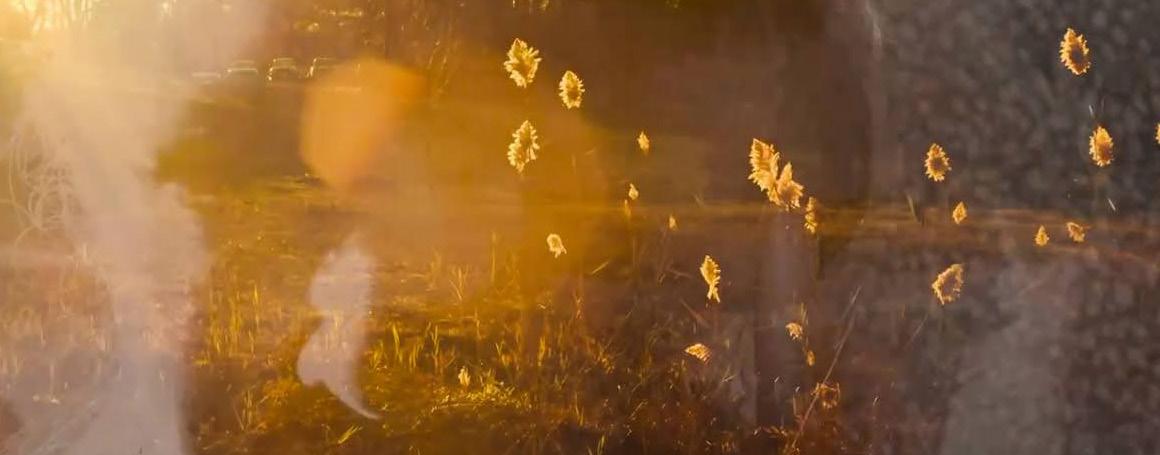
Returning home for the holidays, familiar faces I knew so well glinted with curiosity and questions, as if I were an exotic animal on display, estranged from my natural habitat. I became perceived but not felt. Present yet unrecognized, I adopted the role of the outof-town visitor, existing amid interactions permeated by recollection. The comforts of home blurred themselves in conversations that flowed differently, in details I observed like a stranger to the land, entangled in the rhythm of routine I used to seek. Adjusting back into the cadence of the sunscorched Arizona terrain, I stepped inside Captain Bill’s Submarine Sandwich Shop, located on 35th Avenue and Peoria, with my high school friend Sarah. Unlocking the car door, my feet met the faded asphalt in the vacant desert parking lot; the place seemed stranded. I now live thousands of miles away in New York for college, seeing Sarah only on breaks. I used to hate the feeling of catching
up, of growing up with friendships where new memories felt borrowed from old ones. Between bites of our sandwiches, I noticed the space in between.
My eyes lingered on the brunette man behind the counter, watching as he prepared the sandwiches, his movements musical and relaxed, as if instinctive. “Lately, I’ve been craving a kind of certainty,” I said, the words slipping out of my mouth like a confession tucked deep inside my jean pockets. “One where I know that, when I wake up tomorrow, I will come back to this place, clock in for my shift, and repeat the process, returning to something without an expiration date.” The statement hovered ambiguously, tethered to an explanation I could not offer, suspended between versions of myself I could not make sense of, between who I was and who I am becoming.
“I don’t think I really understand what you mean,” she said with a small laugh, her voice restrained and gentle, her words chosen carefully, like pleasantries.
“It’s okay,” I said, smiling. “It doesn’t really
require a response.”
Both of us maintained a polite barrier, our legs crossed as we sipped our drinks and ate at a slowed pace, and I silently acknowledged the details of our lives we left unspoken. Vintage Polaroid photos laminated the plastic tables, and I no longer found myself reaching for a time that had already passed. I felt the weight of being known wholly by my best friend wash away, replaced by hangouts measured by brief hours and a groundedness unshared: in car rides where the echoes of old playlists rang differently, in demeanors that felt guarded, in the home whose address I had forgotten, and in the subtle realization that perhaps I had become the stranger. Our interactions carried new meaning, untainted by the residue of lost time or words that lacked resonance, instead imbued with an acceptance that settled in me as I turned the key to my front door. I realized that we no longer knew the versions of each other we returned home to.
Before starting college, I believed I could handle change if I anticipated it. I shielded myself with sentiments, treating the present as if it were already a memory. On the bare walls of my freshman-year dorm, I hung letters exchanged between friends and taped photographs from home. My fingertips followed the lines of song lyrics I had turned into mementos and flipped through books I had read over and over. I spent many nights writing about home, noticing that each attempt to replicate it fell short. I clung to the past and placed myself into an undetermined future, hoping to find clarity amid what I did not know.
I watched the leaves turn and snow begin to fall as I crossed the quad, unable to attach myself to familiar breaths. In a place I knew I had chosen to be, I yearned for the smell of desert petrichor, searching for people I had already met in those I did not know. With every new person I met, each class I attended, each meal I ate, I attempted to preserve a version of myself that had begun to fracture.
As I wrote in the same worn leather journal and listened to the same playlist on repeat, abiding by a ritual of familiarity, I realized I was trying to give words and direction to something beyond my control. I remained fixed to a certain version of myself, afraid of becoming someone I did not recognize, now understanding that becoming was necessary. The wavering hand I had tried so hard to grasp loosened its grip. The compass was misguided, and the desperate need to know subsided, falling before measuring.
Each time I return to Arizona, the word “home” becomes a dangling truth I no longer pluck: in friendships whose branches have withered, in hands that grip my car wheel differently, in roads I knew so well but no longer trace. In my room, more akin to a hotel now, I no longer grieve the past.
From my bedroom window, I saw gravel where I thought it should be snow, realizing my confidants lived elsewhere. Old photographs stare at me with a dormant nostalgia, journals are tucked away, forgotten clothes hang in a half-empty closet, my record player has collected dust, stuffed animals sit atop my bed, no longer held. I feel unmoored, my identity undefined, and for the first time, the fear of what that means feels less urgent.
Makenna Brown Guest Columnist
Image courtesy of Noa DeRosa-Anderson '28.
Image courtesy of Makenna Brown '28.
From the desk of Emma daRosa, Humor Editor
Sophomores and seniors snowed in by superbly satisfying polar pounding! Breaking News
Incel ideology on the rise among disillusioned birds
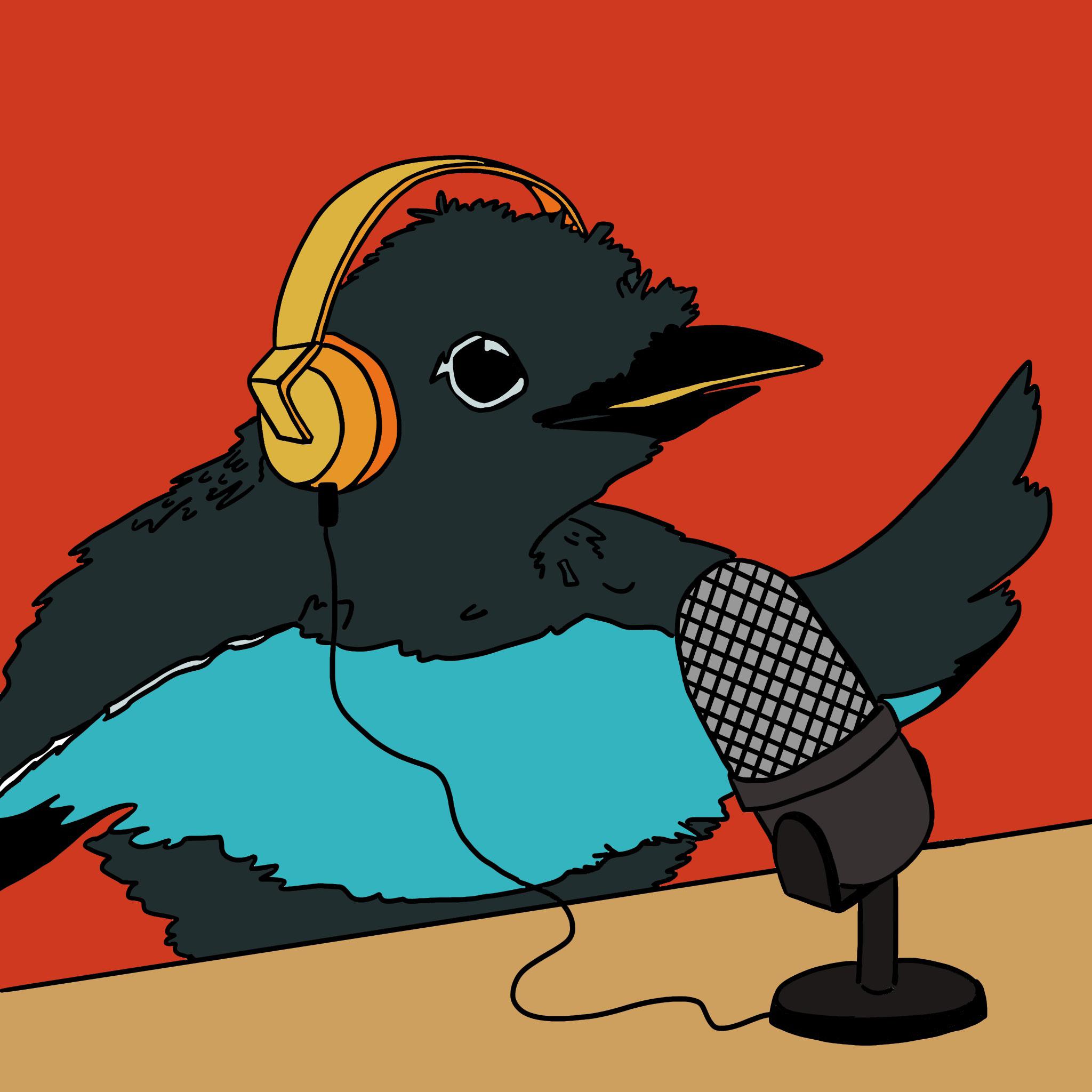
For years, we’ve laughed as David Attenborough narrated birds absolutely fumbling: singing the wrong notes, gifting trinkets that aren’t even that blue or fucking up that weird wiggly thing that some of them do. But recent ornithosociological surveys reveal that many male birds are growing resentful with recent declines in avian courtship fomenting the spread of incel ideology. We reached out to several self-described avian men’s rights activists for more.
“It’s the chads, man,” said one Vogelkop lophorina. “It’s all about the fucking chads. Women don’t even come to my lek to see my elaborate wing-fanning display because they know they can find some male with a 23-inch wingspan. It’s over before it began for plumoids like me with genetically inferior iridescence.”
Others have their own interpretations of who’s at fault. One cardinal complained of "imbecilic femoids” and said that, since it’s the man’s responsibility to fight his rival that lives in reflective surfaces, “he should get to pick his mate, not the other way around.”
A satellite ruff, on the other hand, pinned the blame on female-mimicking faeder males. “If it weren’t for those estrogenized soyboys, there’d be plenty of cloaca for the rest of us. But in today’s fucked-up, misandrist society, you can only get ahead if you’re lucky enough to be born with cryptic coloration.”
In recent months, avian incels have found themselves a spokesbird in Commo-
dore Cookie, star of unpopular “Air Bud” spin-off “Ground Bud.” Cookie, an African gray parrot, has publicly disavowed his most extreme followers, famously declaring, “I don’t want to denigrate women. I don’t want to hurt women. I just want a cracker and a society that says it’s okay to be a man.” Nevertheless, he continues to appear with feathered antifeminists like Crow Rogan, Jordan Seagullson and Bird Andrew Tate.
Ornithologists are split on how to explain the movement. Some think it represents convergent evolution with human men’s rights advocacy while others say figures like Cookie are simply repeating what prominent antifeminists had already been saying but in a funny scratchy voice. Whatever the case, inceldom in birds is merely the gateway to several more destructive ideologies.
Dr. Joan Stephens, an alumnus of Vassar’s own Online Intersectional Subaltern Bird Gender Theory major, described the pipeline. “Confused chicks, right, they discover the manosphere. And they start getting jealous. They get sad. They become convinced that they’ll never be able to find a mate, and that makes them angry. And we all know what happens next,” said Stephens, alluding to recent slingshot-based terror attacks on pig’s homes and businesses.
Ultimately, experts say, this reactive wave of misogyny should die out so long as the birds keep doing nothing and blaming the male loneliness epidemic or something. Until then, however, many women have taken to carrying tasers, given birds’ immunity to the capsaicin in Mace.
New admissions building serves Skandi-chic: campus split
introduced the new building to a gathered assembly of construction workers and admissions officers.
Vassar students arrived back from holiday break to find one last freshly unwrapped present awaiting them here on campus. In the six weeks we were gone, the new admissions building has shed its housewrap to reveal an exterior that we can call neither sleek nor rustic, maximalist nor minimalist. What we do know is that the Dede Thompson Bartlett Center for Admission and Career Education (which we’ll surely all start calling “the Dede” sooner or later) is sending shock waves rippling across campus as students, faculty and the more seasoned structures on the block share mixed reactions.
“The vision for it came to me in a dream,” said alumnus architect Ingmar Bjørnifjordismorgenscharliekirkegaardsdottirson.
“Actually, it was not so much of a dream as a manifestation of life and death which appeared to me in the form of the sun reflected off the waves of the Baltic Sea.”
This imagery is reflected in how the building is a really weird shape.
In an opening ceremony shortly before the start of the semester, President Bradley
“This new building represents a turning point for Vassar admissions. I want this innovative, fresh face to tell potential applicants the moment they step on campus: ‘Welcome to Vassar. We’re not like the rest of Poughkeepsie.’”
However, not everyone, or everywhere, on campus, is so enthusiastic. It seems that the admissions center has caused quite the divide as other Vassar buildings voice conflicting opinions about the new addition.
“It’s a complete disgrace,” commented Rockefeller “Rocky” Hall. “I know John would have hated it.”
“All that wood is making me nervous,” commented Jewett, standing suspiciously erect. “You know my fire alarms like to go off ;).”
“It’s nice to see more interesting architecture on campus! Maybe now, people won’t make fun of me all the time,” commented Chicago “the Lasagna” Hall.
“I love it,” said the old admissions building, surprising everyone with its maturity and grace. “No, really. It’s great if you’re into that sort of look. Yeah, no, I totally get
it. I mean, obviously, we’re very different, but I’m sure there was some reason why they wanted the first building that newcomers see on campus to not look as good as me. OMG wait, that came out so wrong lol.”
Reactions aside, the new admissions building has been facing unexpected challenges now that the semester is underway. In a recent incident, the track team, sore after a grueling sprint to Central Receiving and back, mistook the center for a sauna and were dismayed to find that the only steam the building produced was the kind they pump into the waiting room to keep tour groups sleepy and docile.
Additionally, staff have been working to dislodge a family of Upper East Side Manhattaners from beneath the floorboards where they have burrowed for the winter in the misguided belief that the building is actually a luxurious ski chalet.
The center’s suspiciously Scandinavian look has even attracted the attention of internet conspiracy theorists who posit that the admissions building is in league with popular coffee shop Fika and Hygge in an Arlington-based Scandinavian counterattack to Trump’s Greenland annexation bid.
In response to these concerns, the president posted on Truth Social:
“The SOCIALIST Demarkians and Norwasians are trying to INVADE the Great State of New York. I call on the NOBEL PEACE PRIZE Committee and NATO to put a STOP to this DANGEROUS and UNAMERICAN architecture style.”
Shortly thereafter, New York City Mayor Zohran Mamdani commented in defense of the new building on the people’s proletarian social media forum, Fizz:
“The United Caliphate of Zohranistan encourages little brother Poughkeepsie to embrace the democratic socialist ideals of the Scandinavian people. Glory to ABBA!!” This interaction has divided the nation as the socialist, pro-new admissions center camp continues, and MAGA dissidents continue to bicker. Amidst all this political scandal, President Bradley has opted to release one final statement to put all the uproar to rest. “To all those who seek to assign political meaning to our new admissions building, I will say the same thing I do to anyone who chooses to attack institutions of higher learning from behind the safety of a screen: omfg get a jobbbbbb.”
Benji Boyd Admissions Building Advocate
Image courtesy of Charlotte Willenbring ’29.
Wren Buehler Mallard Misogynist
Mysterious theater flu causes drama around campus
Scene 1: An EMPTY MISC OFFICE. EVAN ’28 soliloquizes to an unseen audience. His voice is humorous despite the grave tone he uses.
EVAN: To be exposed at a party, or to / Stay in your dorm alone and be really / Bored all night. That is the question.
EVAN: To have seen what I have seen of this campus, to see what I see, would make the most noble minds dejected and wretched. O, I am slain, slain by the horrid Drama Flu!
EVAN stops acting infected and gets down to business.
EVAN: The best of us say it began on the first day of classes when a drama major returned to campus bringing jubilation, yet burdened with a much-less-merry stomach bug. We would be prepared for the flu if this were indeed such a disorder of the body. But it seemed to be an affliction of the mind as well. Those enamored would begin to vomit profusely and, most strangely, on a musical pitch.
Scene 2: Enter MAX DRITKIN ’27, a disgruntled skateboarder. He’s a ‘cool kid’ and has managed to avoid being infected by bombarding everyone around him with his ‘political opinions’ until they go away.
MAX: It was already hard enough dealing with the goddamn singers when they were normal and singing fucking opera—god, I hate that shit. But now they’re vomiting everywhere and brewing up diss tracks on SoundCloud. I mean, that’s stupid, right? Didn’t we already do this in like, 2014?
STAGE LIGHTS center on a screen with the words BREWERCLOUD flashing in bright white letters. This is a new version of SoundCloud that has popped up on the interwebs with 4,000 listeners each day and counting. The unsecured website, which is flagged by most browsers, is completely safe according to Dean Luis Inoa who assures students that the College would never allow nefarious, off-campus actors to track students’ internet usage.
Scene 3: An elegant parlor with a fireplace, chocolate fountains and luxurious, comfortable chairs in which the administration is sitting. The PRESIDENT and DEAN SONYA SMITH are talking to each other while DEAN LUIS INOA is talking mostly to reporters, trying to appear part of their conversation. They are all sipping on champagne out of golden goblets while the reporters drink out of plastic Solo cups.
INOA [laughing]: Our students sign their digital rights away when they first access EduRoam, Bee-Tea-Dubs.
He turns to the PRESIDENT.
INOA: This new singing flu we cooked up in the biochemistry lab was a really good idea, Liz.
He high-fives the President.
PRESIDENT: I think the grotesque vomiting and rap battles add a nice, early 2000s grunge touch. You don’t really see that anymore, modernism, really, now that we’ve transitioned back to the classics like social media propaganda and political psyops. I was telling John we should do something New Age.
SMITH: I honestly thought this idea was a bit bottom-of-the-barrel. If I were you, I would’ve just made a virus that makes them give us all their money.
The president takes SMITH aside and whispers something to her about ‘prestige.’ They laugh together while DEAN INOA tries to appear content on the sidelines. After a few minutes, he pulls out Instagram in defeat.
Scene 4: REPORTERS in the SHIVA THEATER are watching a new play as actors throw up during musical numbers behind them.
EVAN: New theater shows have popped up, such as “We are Elizabeth Barfley,” “Rowdy FIZZ Posters BARF on LAC Students: An Emetic Mix” and “Pukey: The Singing Clam that Pukes and Raps,” each one of them seemingly titled by generative AI, as all the department interns have been infected and can no longer utilize their cerebral cortices. Naturally, both healthy and infected students have been attending these in droves, although they apparently aren’t
very good beyond the surface level. Natasha Samson ’29 described them to me. Here she is! Gestures to Natasha.
NATASHA: They really got to me on a spiritual level, but I wasn’t feeling that essential cognitive connection. In the spirit of our dear infecteds: Had I, been vomited on profusely / I may, if given enough time, then formed / A diff’ring opinion more aligned with / the masses. Yet I, with them, do contend that / These plays now reek of simple drama, cl’che / Without plot, characters that move as if / they have ginormous spokes up their assholes.
An actor locks eyes with NATASHA, causing her to take off her boot and throw it into the rafters, revealing it to be a grappling hook and also, somehow, revealing an eye patch and a pirate hat she was hiding. Really, it seems quite nonsensical. She flies away, yelling prosaically.
NATASH: You will ne’er catch me, Natash ‘o the Lillies, foul spawn! / My prose is in prime numbers, count along!
The ACTORS call INTERMISSION, which triggers the audience to begin posting the mu-
sicals on INSTAGRAM and repost each other’s stories. NATASHA’s chant is drowned out by the sudden chatter.
Scene 5: The MISC OFFICE. Hordes of BREWERCLOUD singers have begun trying to KNOCK DOWN the door.
EVAN: Hello, everyone! It appears I am doomed, more or less. Such tragedy draws me closer to my indefinite end, alas. I wish you all the best.
Enter ZOMBIES. They surround EVAN and vomit on him. EVAN passes out and then awakes.
EVAN: Shall we find more victims on which to work / Our wicked craft? Toil behooves us, yet / By the pricking of my thumb, something acrid / This way comes, while not of our own volition. / Speak but now, are any of us opposed to / Striking with poison the Tuesday Donuts?
ZOMBIES shake their heads.
EVAN: Such a plot befits the Deece, but here shows / Much amiss. In respect for all this school / Has suffered: Go, bid the students spew.
Exeunt ALL.

Evan Seker Singing with passion
Annie McShane/The Miscellany News.

ARIES March 21 | April 19
HOROSCOPES
Emma daRosa igloo inhabitant
You’re such a silly billy. Everyone knows that an Amazon box won’t work as a sled! Jeff doesn’t spring for high quality cardboard. Maybe try a Williams Sonoma box? Or Pier 1 Imports?

TAURUS April 20 | May 20
Looking to warm up this week? I’d start a batch of stone soup if I were you. By the end of the week, the pot should be teeming with a murky broth of nutritional yeast and melted marijuana gummies. I can contribute the last floppy carrot in the back of my TA fridge!

GEMINI May 21 | June 20
Someone threw a snowball at my window while I was writing this! Total Gemini move…If it wasn’t you, your week won’t be notable. If it was, I would sleep with one eye open…
LIBRA Sept. 23 | Oct. 22
Ok upon reflection the notorious snowball thrower (or The Frozen Flinger, that’s what the cops are calling him) could’ve also been a Libra. I’m serious, if it was you, someone might put a dead fish in your car tail pipe.

SCORPIO Oct. 23 | Nov. 21
Have you seen all those people online saying this snow is unlike any other snow and it doesn’t melt and lighting snowballs on fire and stuff? As you realize that your “easy A” class will be a lot of work this week, take heart in the knowledge that at least you aren’t that dumb.

SAGITTARIUS Nov. 22 | Dec. 21
I’m sick of all of you being so obsessed with Ireland and whatever. Steam an entire cabbage, EAT an entire cabbage, cut some peat briquettes out of a bog, use the bricks to stay warm for a long rainy season, THEN you can resume posting longing Derry Girls edits.

CANCER June 21 | July 22
Remember the Costco guys? Big Boom AJ and Big Justice and, of course, The Rizzler? You’re going to have a sort of Costco guys week, if the Costco guys were people attending a small liberal arts college in New York after a big snowstorm.

LEO July 23 | Aug. 22
You need to move on from the snowstorm. It was fun and exciting, but it’s time to move on. Nobody wants to hear about potential flurries coming in the next seven minutes or how much snow accumulated while you oscillate between three different weather apps. It happened, it’s over, cope.

CAPRICORN Dec. 22 | Jan. 19
One of the best ways to fight bitter cold is humiliation. The blushing will keep you perfectly toasty! Pound on the Bradleys’ door at 2 a.m., perform a stand-up set and don’t let them go inside until they give you a full page of good feedback. It’ll be great! They’re firm but fair critics.

AQUARIUS Jan. 20 | Feb. 18

VIRGO
Aug. 23 | Sept. 22
Someone is going to make you a blanket this week! NOT because they want you to be warm and cozy but because they hate you. You’ve probably heard of the sweater curse, but there’s a lesser known blanket curse that actually makes you have to pee 150% more. Cruel.

I’ve received some intel that The Frozen Flinger (The FF) had the eyes of an Aquarius. I’m not even mad anymore. It’s just, like, some of us are easily startled by frozen balls hitting the window while we write horoscopes for the GOOD of this campus. It’s such a rude and unappreciative thing to do!!!
PISCES Feb. 19 | March 20
You might be a super sleepy head this week. Try taking a nap in the snow fort. I hear a huge expansion is coming! Personally, I’m most excited for the solarium, but I’ve heard a lot of buzz about the indoor pickleball courts as well. What fun!
OPINION
Quit fetishizing the law, choose morals
Soren Fischer Contributing Editor
The law can be an incredibly powerful tool. It has been used to sanctify collective goods, such as universal suffrage, and collective bads, such as the normalization of resource depletion and environmental pollution. It has structured societies, resolved disputes and at times, served as a mechanism for expanding rights and protections. But law is decided by those in power, and power, by its nature, is not synonymous with goodness.
What I have observed, particularly in political discourse as it circulates on social media and in everyday conversations, is something closer to a fetishization of the law. People increasingly resort to legality as the final answer when challenging immoral or corrupt practices—although the law itself is an institution which, according to various schools of thought (notably Marxist and anarchist traditions), was designed precisely to uphold these practices.
This fetishization can be understood through the lens of Karl Marx’s concept of commodity fetishism. In commodity fetishism, people attribute mystical or inherent value to goods while obscuring the labor and social relations behind their creation. A similar process occurs with the law. Excessive reverence is placed on legality as though it possesses a magical force—one capable of transforming violence into legitimacy, exploitation into order and domination into necessity. In doing so, the social, political and moral choices embedded in legal systems are concealed.
I contend that people should continue to recognize the illegality of certain behaviors
when accuracy requires it—for example, when referring to unauthorized actions under international frameworks. But we should stop using the law as the primary descriptive tool for actions that are, first and foremost, immoral. Illegality is not a moral category; it is a procedural one. When we describe atrocities primarily as “illegal,” we implicitly suggest that, had the correct procedures been followed, those same actions might have been acceptable.
Morals should be the guiding principles of social behavior and collective action, not the potential threat or consequences imposed by the law. The law has long been used to keep people in line and discourage challenges to authority, yet it has never reliably prevented those in power from committing atrocities. On the contrary, authority has repeatedly used law to justify violence, repression and exploitation—often while claiming moral neutrality.
This is where normative ethics becomes indispensable. Normative ethics is the branch of moral philosophy concerned with establishing standards and principles for determining what makes actions right or wrong. I am by no means an expert in this field, nor do I endorse this framework as the primary way I orient my moral compass. What I do know is that normative ethics asks how people ought to act, rather than how institutions currently function. It centers morality as the primary lens through which actions are evaluated. Other modes of moral guidance, such as religion as a moral system, offer broad values derived from religious texts. Law, at best, should be downstream from these considerations—not a replacement for them. Rather
than merely following rules or calculating consequences, as one might when using the law as the primary guide for behavior, normative ethics foregrounds moral judgment itself. I especially return to this conundrum in the context of war and its condemnation. As a pacifist, I believe that war and organized violence violate fundamental moral principles and lack any justified basis for occurrence. Yet public discourse often frames opposition to war in strictly legal terms: whether the proper authorizations were obtained, whether procedural thresholds were crossed and whether the rules of engagement were technically followed. This framing concedes far too much by normalizing—or at least tolerating— violence to an unacceptable degree.
Human rights only function when people possess the moral fortitude to uphold them. I support human rights on a philosophical and fundamental basis, but I am deeply skeptical of the bureaucratic mechanisms that claim to enforce them—particularly when those mechanisms are deployed selectively. Too often, appeals to international humanitarian and human rights law have been used to legitimize intervention, domination and imperial interests, rather than to genuinely protect human dignity.
Within anarchist worldviews—understood here as advocating the abolition of coercive authority and hierarchy—this skepticism is hardly new. Anarchist thinkers such as Jean Grave have long argued that the law is a tool of the strongest—an instrument wielded by those who hold power to legitimize measures they take to defend their privileges. Law does not restrain power so much as it organizes and rationalizes it. This is not a cynical observa-
tion; it is a historical one. Of course, morals can and should inform legal proceedings. But far too often, people become dependent on the law as a force to be relied upon, rather than on ethical judgment or collective conscience. Following the U.S. abduction of Nicolás Maduro, the streets and social media erupted. Condemnation of Maduro’s electoral fraud and rights abuses was widespread, but so too was criticism of U.S. intervention driven by oil interests and nationalist jingoism. What stood out, however, was how frequently the debate centered on legality.
Framing an imperialist war as “illegal” because it fails to meet certain procedural requirements inadvertently legitimizes the concept of war itself. It implies that war becomes acceptable once it clears the appropriate legal hurdles. From what I have learned through studying humanitarian law—and the countless loopholes constructed to accommodate violence—war cannot be humanized. It cannot be redeemed. The law, however, can be. Appeals to “moral” exceptions often reveal this tension even more starkly. I have heard similar arguments used to defend U.S. action against Venezuela—contending that law failed to protect Venezuelans from Maduro’s regime, and that Donald Trump’s intervention was therefore “moral” even if it was not strictly legal. Such claims suggest that legality is dispensable when a desirable outcome appears to follow, obscuring both the imperial interests at stake and the violence required to achieve them. Morality, severed from law and wielded selectively by powerful actors, becomes not a restraint on war but its most flexible justification.
I craft for attention, and you should, too
Emma daRosa Humor Editor
Anywhere you go on campus, you can find people doing all kinds of different things: reading their horoscope in the paper, writing a discussion post seven minutes before it is due and maybe kissing each other. What are people doing most of the time, though, more than any of that other stuff? They are on their phones. Yeah, yeah, nobody wants to read another self-adulating article about how screens are ruining our lives, whatever. Phones suck! I hate nothing more than when I am sitting with a group of people, and nobody is talking because everyone is on their phone. I am not immune or anything. I think I have found a really obvious solution to the phone problem on this campus—doing hobbies for attention. I had a serious issue with using my phone constantly to escape reality during sophomore fall, the worst semester of a college student’s life. Time on my phone really impacted my social circle for the rest of college, and I regret it a lot. You can get over it! It is possible to stop scrolling around other people, but you need something to fill the gap. Phones are so addictive because of the infinite amount of unexpected dopamine they will hit you with. The more you scroll, the more your brain wants to keep scrolling to find the next good thing. We need to replace this source of dopamine with something new.
I love hobbies! The fastest way to have fun and fulfilling free time is to be a jack of all trades, master of none. There is a constant stream of mediocre watercolor paintings, sloppy crochet projects, wonkily embroidered clothes and very “home -
made”-looking holiday decorations coming out of my room. My boyfriend and mother always have good things to say about them, but it gets even better when I leave my Terrace Apartment. Sit down anywhere on campus and start doing something! Every time I have been painting or crocheting in public, someone asks me what I am up to. Maybe a friend walking by, a professor waiting in line for Zorona’s on Tuesday and sometimes a stranger. Nothing feels better than minding my own business and all of a sudden getting to tell a pair of nice older women that I am making a hat for my new niece and, of course, they can see a picture of the baby and, of course, I can help them find the art museum. It is genuinely like a drug when the friend I am waiting to have lunch with sits down across from me at the Deece and lies, telling me my latest watercolor painting looks so good while gently asking, “What is it, exactly?” No Instagram Reel has ever been as awesome as when the neighbor with perfect style compliments my hat, and I get to tell them I made it (and I have seen some pretty awesome Instagram Reels). It is so exciting! You never know when someone might say something or if you may make a new embroidery buddy. It is much more thrilling than the hope that you will find an even funnier Michelle Yeoh edit.
I think people can be afraid of doing things for attention. Not me! I will unashamedly wait to work on my latest craft projects until I am sitting somewhere on campus. It is great motivation to be off my phone in public. I do not think I have ever talked to as many strangers as when I started keeping craft projects in my backpack. Have you ever darned a sock
in public? People have so many things to say about that! We all need attention from each other; that is all that being human is. I have had a hard time making friends over the past three years, and even though I am much happier today, I still do not have the social life I always imagined I should have in college. I constantly hear other people talking about how they have trouble meeting new people, and every third Fizz post is asking for advice on making friends. I have some of the most wonderful friends today, and I owe at least some of our closeness to the joy of doing our hobbies around each other. One of my dearest friends and I studied abroad together when we were strangers, and we took a 40-minute walk on a very unwalkable
road in Galway to find a yarn store. What if I had been too embarrassed to try to knit a sock in front of her? She would not have known I was trying to knit, and we would have never bonded over that horrifically exciting journey.
So, if you are one of those lonely Fizz posters, here is my exceedingly inexpert advice. Host a craft night, try something new, let yourself suck at stuff, let yourself suck in front of your friends, in front of strangers, in front of everybody. You may not make a new friend and you may not cut your screentime; maybe nobody will say anything to you at all. One thing I know for certain is that none of us can get any of the attention we need from staring at our phones all day.

Annie McShane/The Miscellany News.
Becoming a culture war martyr can backfire
Continued from martyr on page 1
paper a well-deserved failing grade, and in response, Fulnecky reported the situation to the right-wing advocacy group Turning Point USA.
Closer to home—and I assume somewhat inspired by the Fulnecky martyrdom—a Vassar College student informed The Daily Wire about the Christianity-themed Burlesque show from this past November, after meeting with college administrators who refused to cancel the event. This particular Burlesque event was housed in Vassar’s chapel, and according to The Miscellany News, “While some performances involved the traditional strip-tease, others more closely resembled lip-synched dance numbers.” It is not difficult to understand why Christians on campus were offended by a “strip-tease” not only occurring, but being sanctioned by the school in the same place they consider sacred. In the Daily Wire article, it was reported that the Institutional Equity and Title VI Coordinator, Brian Van Brunt, allegedly claimed that if the Burlesque event had been themed around Islam instead of Christianity, it would have been canceled. It is concerning that this conscious double standard did not cause its cancellation right then and there.
However sensitive this situation may be, I cannot think of a good justification for
reporting the performance, which should reside inside campus discussion and offices, to culture war outrage machines like Turning Point and The Daily Wire. If you look at the comments on the article about Vassar, you will see why.
One commenter said, “A little toluene and a cigarette lighter might come in handy. Perhaps if you lit the actors on fire as they left the church it would stop!” Of course, this could be interpreted simply as dark humor. However, this remark comes off as much more threatening when read from my perspective, a student at Vassar, seeing a stranger advocating for the murder of other students in my community. Many comments focused on the theme of the aforementioned quote, where the Vassar student said an administrator told them that if the Burlesque show was themed around Islam instead of Christianity, it would have been treated differently by his office. Of course, Daily Wire readers interpreted this anecdote as confirming their Islamophobic beliefs. It makes me seriously uncomfortable to think that random users on the internet would accuse my Muslim peers and friends of being willing to commit mass violence. The decision to leak the Burlesque drama to the conservative press allowed for these disgusting and bigoted accusations to spawn. While the power of Daily Wire readers
like “Bubbaloo” and “DoucheVader” over Vassar is limited, the federal government has proven to be a dangerous opponent of higher education over the past year. President Trump has threatened to cut the funding of nine universities over anti-“woke” nonsense, including allowing transgender athletes in competitive sports, pro-Palestine student activity and DEI policies, per The New York Times. The Trump administration has also orchestrated the detainment and deportations of international students, as well as the revocation of around 8,000 student visas, according to Inside Higher Ed. These actions present an immediate danger to institutional funding and student safety. Many students receiving financial aid, including myself, rely on the federal government to cooperate with Vassar so our families can afford to pay for our education. Many other students are also reliant on the federal government not arbitrarily labelling them as a national security threat. If overblown instances of “woke”-ism reach the ear of the President or his friends and cronies in conservative media, all of these students’ education and careers may end up on the chopping block.
Despite all of this, I understand the anger towards “Whoreship and Prayer.” Not only am I a religion major, but I am religious myself. When I see non-Buddhists poking fun
Responding to 'The Daily Wire,' Chapel
The Daily Wire’s flashy, buzzword-filled headline “Woke New York College Allowed Burlesque Troupe to Mock Christianity in Campus Chapel” frames the story it tells as a clear case of institutional disregard for Christian students. Yet a careful reading of the article itself reveals that its central claims rely less on evidence of discrimination and more so on a rhetorical conflation of offense, blasphemy and unequal treatment. Once these categories are disentangled, The Daily Wire's narrative begins to unravel.
A campus that permits a wide range of artistic and ideological expression—including work that unsettles or provokes—is acting consistently with its stated values, not in opposition to them.
The article’s first claim is that Vassar College administrators ignored Christian students’ concerns about a burlesque performance that allegedly constituted religious discrimination. However, reporting itself contradicts this assertion. According to The Daily Wire, students raised concerns through formal channels, communicated with senior administrators and met with the College’s Institutional Equity and Title VI Coordinator. Administrators discussed the situation and possible mitigations, including changes to promotional materials, ultimately deciding not to intervene. That decision may have disappointed the anonymous student whose account is the center of the article. But disagreement with the outcome of a process does not
amount to the neglect of that process. The administration listened, deliberated and exercised judgment. To characterize this as “ignoring” concerns is simply inaccurate.
The second major claim centers on the student’s recollection that an administrator remarked that “it would be different if it were another religion,” citing Islam as an example. This allegation is presented as evidence of unequal treatment—of discrimination against Christianity. But equal treatment does not require identical cultural handling.
A secular institution is obligated to treat religions equally under its policies, particularly with respect to access, discrimination and institutional support. That obligation does not require the institution to pretend that all religions occupy the same social position. Christianity in the United States is not merely a faith tradition; it is also a dominant cultural framework. Its symbols, narratives and imagery permeate public life—holidays, architecture, political rhetoric, idiom and art. As a result, Christian themes have long functioned as shared cultural material for critique, satire and artistic reinterpretation.
Islam, by contrast, is a minority religion in the United States, and has been subject to political suspicion, public hostility and state surveillance. Artistic engagement with Islamic religious imagery, therefore, operates in a materially different social context. Acknowledging this difference is not evidence of anti-Christian bias; it is an acknowledgment of social reality. Treating religions equally does not require institutions to ignore power, prevalence or historical context.
Crucially, The Daily Wire is unable to properly explain how offense converts into discrimination. The performance did not cast aspersions towards Christians as a group, deny them institutional resources or treat them as lesser members of the campus community. Rather, it engaged artistically with imagery that already saturates the majority culture.
at the Buddha or Buddhist traditions, I feel hurt too. When I heard that this Burlesque show was being produced, I thought it was crossing over much-needed boundaries in how we should treat religions and cultures. If I knew that there was any motion to work with the administration to prevent the show from going on, I would have supported such a movement. However, I am not Christian, and I do not hear the goings on of Christian student circles. I really wish there was a formal platform where students could healthily air their grievances in situations like this…
Oh wait! There is! It is this Opinions Section! As Opinions Editor of The Miscellany News, I was disappointed to see that none of the students who were angry with the Burlesque show and the administration reached out to their own school’s newspaper and instead chose to reach out to a known propaganda machine. Doing so left both our school and the student whistleblower vulnerable to a flurry of undeserved hate, especially on the anonymous platform Fizz in the latter case. In the future, I hope that more campus controversies and disagreements are addressed in these pages, rather than in places where outside forces can use drama to meddle in, disrupt and shame our campus.
controversy
The Daily Wire alleges that members of the burlesque troupe mocked the backlash online and that some students felt hurt or disrespected. That reaction is under-
Satire, burlesque and parody routinely draw on familiar cultural symbols, often irreverently.
standable. However, offense, even when sincerely felt, is not material harm. The complainant cited in the article did not even attend the performance. No one was compelled to attend, denied equal access to campus spaces or subjected to harassment.
The performers may or may not have demonstrated good taste. They may or may not have violated norms of politeness.
At a secular institution, however, these are not criteria by which expression should be approved or denied. Satire, burlesque and parody routinely draw on familiar cultural symbols, often irreverently. That some viewers interpret such engagement as mockery does not establish that the work targeted Christians as people, nor that the College endorsed hostility toward them.
The article further suggests that the performance violated Vassar’s commitments to diversity and inclusion. But these commitments exist to protect individuals from discriminatory treatment, not to insulate belief systems from offense. Calling for the suppression of certain forms of expression because they offend is not an expansion of diversity; it is an attack upon it. A campus that permits a wide range of artistic and ideological expression—including work that unsettles or provokes—is acting consistently with its stated values, not in opposition to them.
Attendance, moreover, indicates engagement rather than imposition. "Whoreship and Prayer" sold out three nights. Those who anticipated offense were free not to
attend; those who found the concept compelling did so in large numbers. There is no evidence of coerced participation or institutional pressure. Under these circumstances, it is difficult to identify any tangible harm.
Much of the outrage also rests on the assumption that the performance took place in a Christian space. But as far as available evidence indicates, Vassar’s chapel was never consecrated as a Christian church. It was designed as a gathering space for the entire college community. As such, it contains minimal explicitly Christian iconography, has never had expected elements of a working Christian space, such as an altar and regularly hosts services for multiple religious traditions as well as secular programming of all types. To describe it as a “Christian chapel” in the exclusive sense is historically and functionally inaccurate, regardless of its colloquial name.
Ultimately, The Daily Wire’s account depends on collapsing blasphemy into discrimination and offense into material harm. Once these distinctions are restored, the narrative collapses with them. Administrators did not ignore concerns. Christian students were not targeted or excluded. The performance, however irreverent, constituted protected artistic ex-
Christianity in the United States is not merely a faith tradition; it is also a dominant cultural framework.
pression in a secular space. Blasphemy can be uncomfortable, even offensive. However, it is not the same thing as discrimination—and treating it as such would impoverish, rather than protect, campus life. If the blasphemy standards of every religion represented in a pluralistic community were enforced, we would find ourselves scarcely able to say anything at all.
J. Lincoln Dauer guest columnist
OPINIONS
Chat, give me back my em dash
Sydney Jones Features Editor
Iam sick of talking about AI. Maybe you are sick of reading about AI. In spite of the fatigue from the last few years of generative language models’ rapid development, I write this article for the very reason of defending this process: writing. AI has no place, and should not have a place, in the future, taking writing away from the hands of humans, no matter how clumsy and slow we may be. I am frustrated by AI’s claim over the em dash, Oxford comma—although I cannot include one for AP Style Guide reasons, please imagine an Oxford comma here—and generally catchy, but ultimately disingenuously, “nuanced” sentence structure. Seriously— give me back my em dash.
Since high school, my writing style has always been somewhat breathless. I enjoy a run-on sentence—though I am working on relying less on them—parentheses (obviously) and generally rambling trains of thought. I love to read them even more. Over break, I read my first Virginia Woolf novel, “Mrs. Dalloway”—as an English major, it could not wait any longer—and I was struck by the lack of traditional punctuation. I could immediately envision each character as Woolf jumped across their perspectives and internal monologues. Her style exemplifies my ideal for the em dash, semicolon and comma as stuttering modes of imperfect punctuation. In contrast to how I have been taught to punctuate liberally for academic papers or articles, Woolf is unafraid to leave out a period—even when the rules of grammar say it might be necessary. It truly felt like I was listening to real people talking and thinking for hours.
This tendency to stutter, to break a sentence mid-thought, to add a clause or adjective for emotional emphasis or for no reason at all is to be human. But take this structure that has become synonymous with AI, what I see to be a disingenuous mimic of this human tendency: not [blank]—but [blank]. Or the rule of three: Three adjectives sound
better than two, so AI throws them together with an Oxford comma. As described by one New York Times article, em dashes and trios of adjectives that were once literary, complex and employed in good human writing are now often cast aside as AI giveaways: “... now, no matter where it’s coming from or why, millions of people recognize the em dash as a sign of zero-effort, low-quality algorithmic slop.” Is the solution to avoid em dashes and other AI markers altogether? Or are we really going to give in to the “slop” and simply remove humans from the writing process?
AI can and will be used more and more often to offload certain human projects like writing copy for marketing campaigns, crafting slogans and making social media captions.
I cannot imagine these kinds of projects to be any more suited to a generative large language model (LLM)—such as Gemini, Meta or ChatGPT, hence “Chat” in my intentionally aggravating title—than to a human writer. AI writing is boring. It is hurting the environment, becoming a huge issue in classrooms and I simply can not see its writing as anything more interesting than an adult mad lib: It is plugging in information
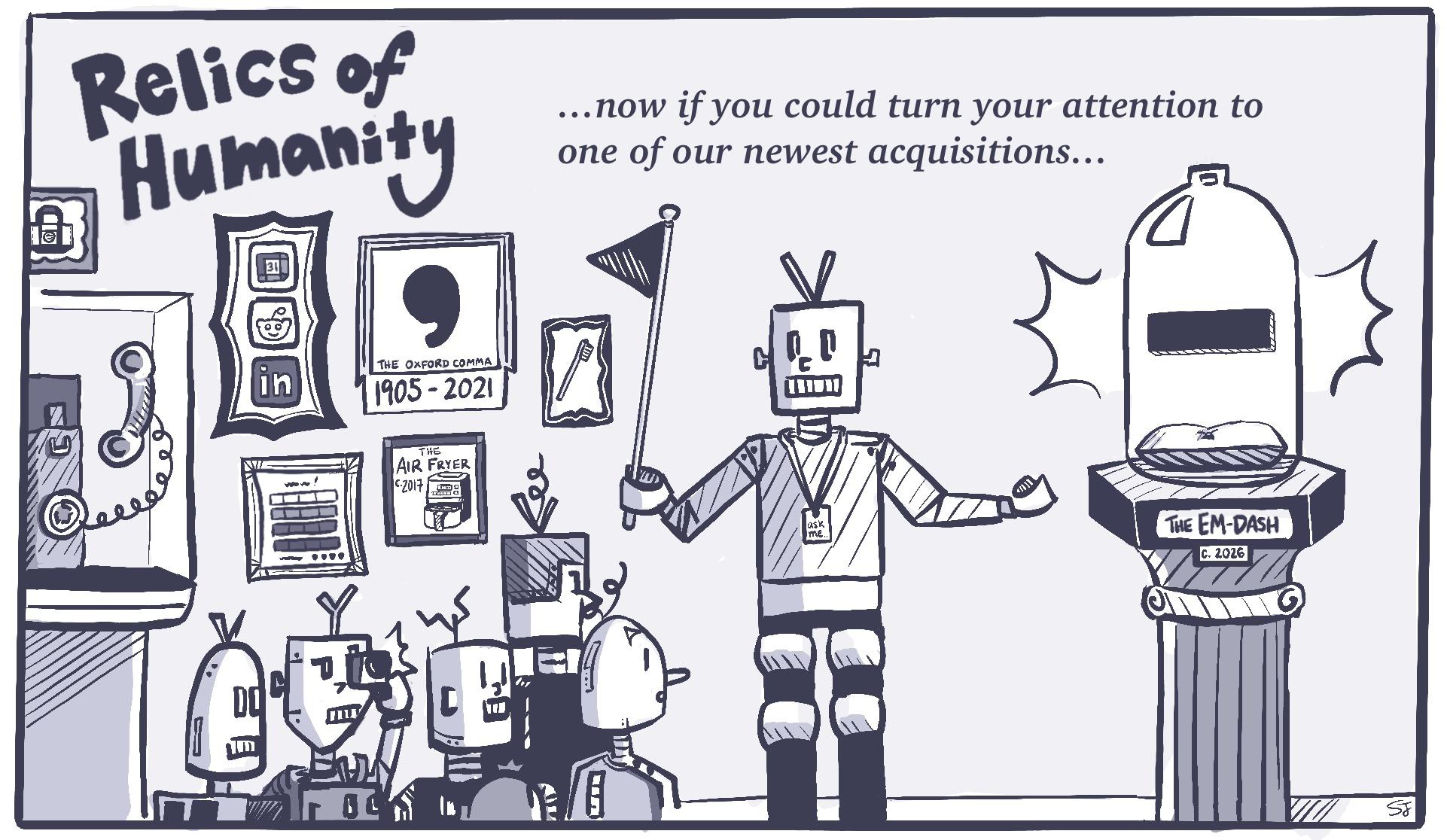
This past week, I attended Sophomore Career Connections and was slightly frustrated to hear how AI, despite its admittedly useful possibilities in healthcare and scientific research, has been used sloppily in corporate jobs otherwise filled by capable, creative humans to save time and money under the guise of efficiency, quality or innovation. Though alumnae/i mentors from both sides of the AI opinion spectrum acknowledged the fact that AI is not advanced enough to fully replace a human writer, let alone a human mind, it was disheartening to hear predictions of its future impacts on the job market. On an advertising and marketing panel, for example, alumnae/i shared that
from human prompts that are unique and interesting because they were made by humans in the first place.
In this sense, I am even more sick of em dashes, Oxford commas and pseudo-nuanced structures being taken as face-value indicators for AI writing. As a student, I am frustrated that professors and teachers might need to look for signs of AI in time that could otherwise be used to provide real feedback. I am frustrated that I hesitate when hovering over my once-favorite dash key because of some strange fear that I will sound too much like AI and not like myself.
I do not want a piece of writing to simply sound like a human wrote it. I want drafts to
feel like a human put real time and thought into transposing their thoughts onto the page. Human thought is imperfect. Human writing is imperfect. The writing process is a tumbling series of mistakes. I want there to be inconsistencies. I want there to be contradictions that are not resolved in the next sentence. I want for the feelings that writing evokes to stretch beyond some word count or gift-wrapped, cookie-cutter conclusion. Em dashes are just one tool to accomplish this bridging of the gap between thought and writing, idea and structure. They emulate a pause of human speech, a break without need for a new sentence. Writing should begin cluttered and incoherent—chopped into pieces and strung back together. Writing should not only be done to sound “good” or to check the box of what is required or assigned by a class or company only 10, 15 or 50 percent faster. It worries me that now, with AI, the standard for human writing will fall— that writing done without LLM assistance will be “good enough” simply when it does not sound like AI.
I do not want to give up reading or writing breathlessly, and I believe experimenting with imperfect structure is part of the writing process as much as it is part of thinking or learning. I will not give AI-generated writing power by fearing away from the em dash. I think we should not forget that AI’s toolbox—how it is trained to predict words that statistically match examples of “good” writing—has been built from human input, not the other way around. I do not want the standard of writing to be perfection or canned endings. That is not what makes beautiful or persuasive or interesting writing.
If you do not have the time or energy to sit down and write something that is worth taking the time to edit—you do not have to write it. But neither should AI. Leave the em dashes and Oxford commas for a moment when you are motivated to use them to experiment and make mistakes. In my experience, that is the most important part of the writing process.

Sydney Jones/The Miscellany News.
Image courtesy of Karen Mogami '24.
Our goal with Brewers Ballin’ is to feature Vassar athletes who starred for their team the week previous to publishing. If you would like to nominate an athlete, please email hfrance@vassar.edu.
Mueller-Hickler earns double gold Brewers Ballin’
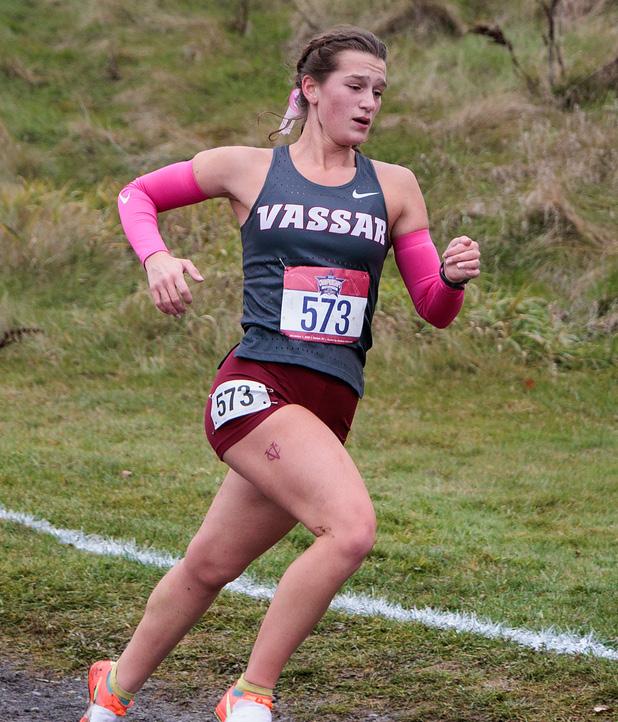
'26.
Women’s Basketball W, 51-34 vs. Bard College
Men’s Basketball W, 93-50 vs. Bard College
Name: Anika Mueller-Hickler
Team: Women’s Track & Field
Year: Senior
Stats: The senior runner took first place in both the 5000-meter and one-mile events at the Wesleyan Invitational on Saturday, Jan. 24. Mueller-Hickler gapped the next-closest finisher by over 50 seconds, finishing with a time of 19:15.98 in the 5000-meter event. In the mile, she set a new personal best with a time of 5:16.91 to take gold once again at the meet.
Statement: "The indoor track season so far has been so fun, especially coming off of such a great and rewarding cross country season. As a senior, I feel fortunate to have such an amazing and supportive team, and to have the opportunity to see its growth over the last few years. … Running more than one event at a track meet is always challenging, but I enjoy getting the chance to push myself and knowing I have the full support of my team at the same time. … Next weekend, I will be racing at Boston University with some of my teammates, and I look forward to continuing a strong and fun season with my team."
Recent Results
Men's Volleyball W, 3-1 vs. Rutgers-Newark

Women's Swim & Dive W, 151-93 vs. Union College
Last week in Vassar Brewers sports
Max Frazee ’27 earns Liberty League Award
Following two first place finishes in the 5,000 meter and 1,000 meter event at the Wesleyan Invitational, Max Frazee ’27 was named the Liberty League Track Performer of the Week.
Men’s Volleyball Sweeps Home Opener
The 12th ranked Brewers defended Kenyon Hall on Saturday, defeating Mount Aloysius in straight sets and Rutgers-Newark in four sets.
Women’s Swim & Dive bests Union in season finale
The Brewers crushed Union 151-93 in the team’s final dual meet of the season. Abigail McLaughlin ’26 and Addie Wiener ’26 each won two events.
Upcoming Match Spotlight
Men's & Women's Swim & Dive Vassar Sprint Invitational @ Kresge Pool, Jan. 31 @ 1:00 P.M.
Image courtesy of Anika Mueller-Hickler
Chicago Bears fall short in playoffs
Casey McMenamin Sports Editor
Last year, I wrote my first article for The Miscellany News, reflecting on my lifelong experience as a Chicago Bears fan. The Bears had just squeaked out the ugliest of wins in Week 1 of the 2024 season, secured against a mediocre Tennessee Titans team led by Will Levis. Caleb Williams did not look like the Heisman Trophy-winning No. 1 overall pick quarterback that was promised to deliver the Bears Faithful their first Super Bowl in 40 years. Despite Williams winning the first game of his young career, there was little hope for Bears fans. As my friend Gavin Akoto ’25 and I watched the game from our couch, there was a hint of déjà vu in the air. As experienced fans of the Blue and Orange, we had seen this story many times. We had lived through the screen passes of Matt Nagy and Mitch Trubisky, we had cheered as Justin Fields scrambled for a 60-yard touchdown, only to fumble the ball or miss three open receivers on the next series, and finally, we had suffered through the torment of Matt “Dweeberflus” Eberflus. We knew that pain and loss were coming. We could never have guessed that a year and some change later, our beloved Chicago Bears would be one score away from heading to the National Football Conference (NFC) Championship game.
For eons, being a Bears fan was predictable, even Sisyphean. The cycle would go something like this: A new tandem of head coach and quarterback will enter Halas Hall during the offseason, drumming up a firestorm of media attention and fan hype to conceal the failures of the team and organization. The new quarterback-coach duo will ride this wave of momentum for as long as they can, or for however long it takes the Bears’ defense to lose steam and stop winning games for the team. Then, everything will crash and burn. The coach will be the first to go, and the quarterback follows soon after. Thus, the cycle of being a Bears fan starts all over again.
So as Williams and Eberflus ran up the tunnel following their first win last September, Bears fans could probably feel
in their bones what would happen next. The Bears would start the season strong at 4-2—their best since 2020—and then lose 10 straight games, finishing the year 5-12. Eberflus was fired in Week 12. At the end of the 2024 season, it seemed like the boulder had rolled to the bottom of the hill again for Bears fans who were desperate for any sign of hope.
The light at the end of the tunnel shone on Jan. 21, 2025 when the Bears hired Ben Johnson as the new head coach. Johnson is different from the Bears’ coaches of the past. He is hyper-competitive and a leader of men. He also knows how to run the ball and score touchdowns, something that previous Bears coaches seemed to believe was impossible. In Johnson’s first year at the helm, the Bears won the NFC North Division with an 11-6 overall record. Johnson completely revamped the offense from the previous year, finishing with a top-five rushing offense and a top-10 passing offense. Rookie Kyle Monangai and D’Andre Swift helped the Bears offense to an average of 4.9 yards per carry while Williams capped off his stellar sophomore campaign with 3942 passing yards and a league-low seven interceptions.
Working alongside Johnson, General Manager Ryan Poles stepped up and made key moves to improve what was previously a flawed Bears roster. Poles was busy during the offseason, acquiring guards Joe Thuney and Jonah Jackson who were phenomenal at protecting Williams the entire season. On the defensive side, Poles signed defensive line Grady Jarrett and Dayo Odeyingbo to add much-needed depth. On draft night, Johnson and Poles selected tight end Colston Loveland who has blossomed into a dangerous threat in the passing game and one of Williams’ favorite targets. In the third round, the Bears drafted wide receiver Luther Burden III who has similarly sparkled more and more as the season progressed. Along with the aforementioned running back Kyle Monangai, the trio of explosive Bears rookies helped lead the team to its first division title since 2018.
The most impressive aspect of Johnson’s first year as the head coach, more so than the 11 regular season wins, division title and
playoff victory over the Green Bay Packers, has been the change in the team’s mindset. The Bears absolutely refused to quit a single game this year, winning seven games with a game-winning drive in the fourth quarter or overtime. The “Cardiac Bears,” as they have come to be known, have restored belief in Bears players and fans. They know that no matter what the score is or how little time is left on the clock, there is still a chance for the “Iceman” and the Chicago Bears. This change in attitude is refreshing. Usually, at the end of a long season, Bears fans feel disappointed—cursed, even—that we will never lift another Lombardi Trophy, but this year is different. Although I am heartbroken that the Bears came up
short in the playoffs, I can speak for every single Bears fan in saying that we trust in Ben Johnson. This young and uber-talented Bears team has given the city something to believe in again. There is an excitement in the air in Chicago, a belief that this team is destined to end the drought and bring a Super Bowl back to Chicago. So thank you to Ben Johnson, Caleb Williams, the entire team and most importantly, Bears fans, for a thrilling season. But the job is not finished, and there is plenty of work to do until that fateful day when Williams raises the Lombardi. In the meantime, Bears players and fans alike will never rest until our good gets better, and our better gets best. Bear Down.
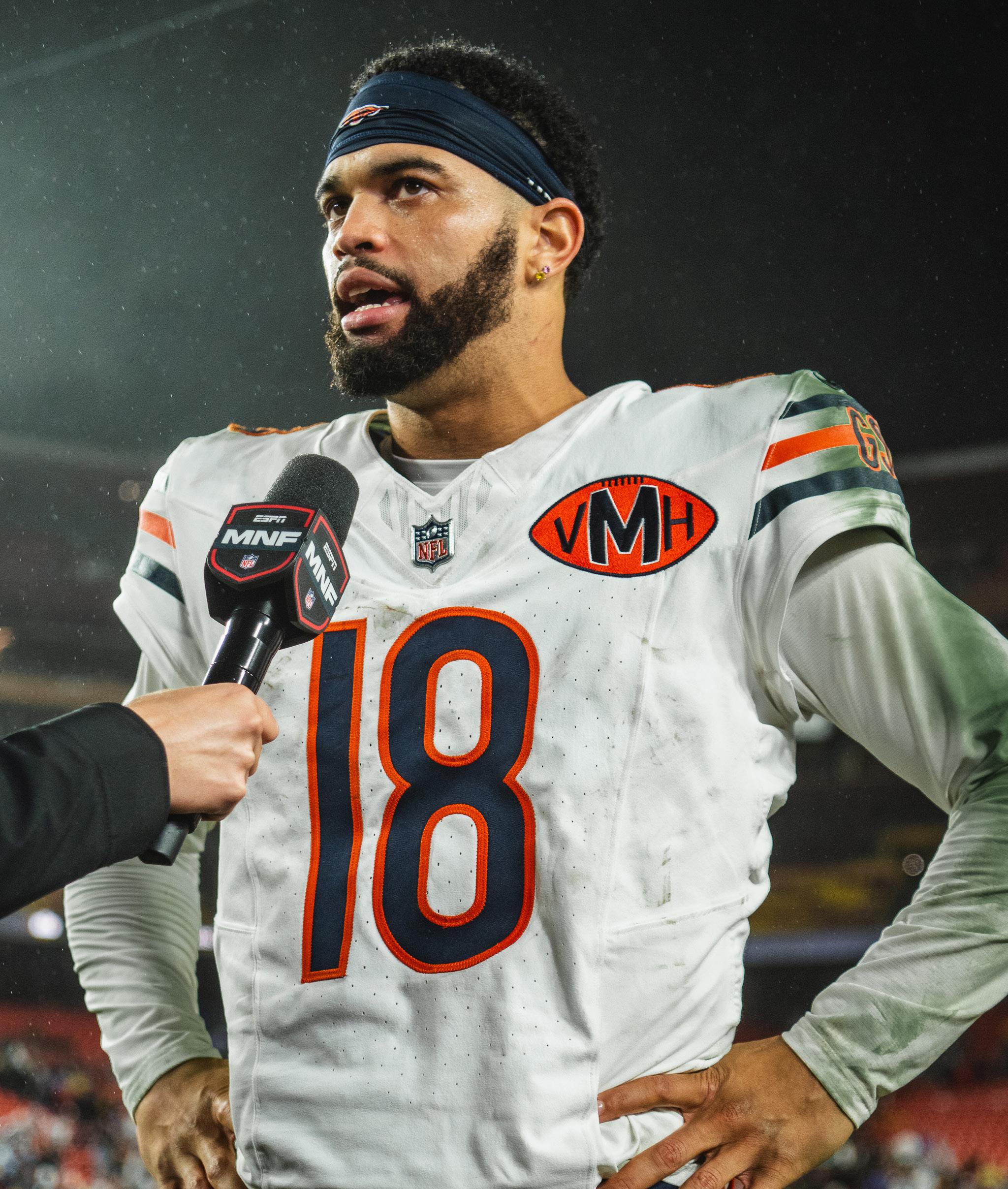
Winter teams storm ahead
Henry France Sports Editor
For most, the Vassar winter break is a long and leisurely hiatus. But for many winter season student-athletes, the break is just a brief pause. The men’s and women’s basketball teams, men’s volleyball team, men’s and women’s squash and men’s and women’s swimming and diving teams reported back to campus early for practice and competition. Many athletes arrive days after Christmas. After a historic fall season, including four conference champions and six national championship tournament qualifiers, winter and spring teams are teed up for lofty expectations. Highlighting this winter has been the men’s and women’s basketball teams, both solidly in the top three of the Liberty League so far this season. Coming into last weekend, the men’s basketball team was atop the Liberty League before dropping a hard-fought matchup on Friday night against Rensselaer Polytechnic Institute (RPI) who now lead the league. On Satur-
day, Jan. 24, the squad rebounded with a win against Bard College to head into this week at the number three spot with an 8-1 conference record. The Brewers got off to a hot start, dominating pre-conference play and going 4-1 before starting Liberty League competition. They won their first two conference contests before heading to the West Coast. The Brewers faced solid competition in California, dropping hard-fought games against Claremont-Mudd-Scripps Colleges and Chapman University. Since returning to Poughkeepsie, the squad is back on track and will look for critical wins against RPI and Union College in February competition.
The women’s basketball team had a challenging start to the season, going 1-3 in its first four games. Since then, however, the squad has displayed composure and focus with strong conference play, emerging at the top of the Liberty League table. Coming into the season, the Brewers have nothing but pressure on them, seeking their third consecutive Liberty League title, which would be their first under rookie Head
Coach Carly Assimon. The squad won six of its first seven Liberty League contests and currently sits third in the league at a 7-2 record.
The men’s volleyball team returned to action as one of the top teams on campus, qualifying for the national championship tournament in each of the past three seasons, winning their conference in one and playing in the national championship match in another. This year, the squad got started out West in the Slug Slam Invitational. The team has endured a uniquely rocky start to the season, enduring a handful of injuries and sitting at a 4-2 record after winning their past three matches. The Brewers begin conference action on Feb. 14 against Massachusetts Institute of Technology.
The men’s squash team got off to a dazzling start to the season, going undefeated in its first two matches. Since then, however, the squad has been on a downward spiral, dropping 10 straight matches to find themselves at 2-10 on the year.
The women’s squash team has found lit-
tle more luck with a 4-11 record. The team lost its first two matches of the year before getting back on track with four straight wins. Since then, the team has lost its last nine matches.
The men’s swimming and diving team has had a busy and turbulent season, winning its first two meets before losing its next four. The squad had a solid performance at the Bomber Invitational in Ithaca, New York, finishing fourth out of six before dropping their next two races against Trinity College (CT) and Union College.
The women’s swimming and diving team has had a strong showing this year, winning five of their nine races this season, including a 4/7 result at the Bomber Invitational. Since returning to campus, the Brewers dropped a critical matchup against Trinity College (CT) before rebounding with two straight wins against Mount Holyoke College and Union College.
The men’s and women’s swimming and diving teams have one more regular season competition at the VC Sprint Invitational for Senior Day on Saturday, Jan. 31.
Image courtesy of All-Pro Reels via Wikimedia Commons.
The Miscellany Minis
"Keeping it Froggy"
By: Aurelia Harrison

ACROSS
1. ___pole
4. Author of Frog and Toad
6. What you pay
7. The long-suffering squirrel from Ice Age
8. “Good” cholesterol, abbv.
DOWN
1. What might light your way, in Minecraft
2. “It's ___, it's a plane, it's Superman!"
3. Bumper decoration
4. Standard-length albums, for vinyl enthusiasts
5. __ it be
"First Mini of 2026"
By: Sadie Keesbury
ACROSS
1. Mai _____
4. Chicken _____ (taco option)
6. Encourages
7. Where swimmers and runners compete
8. Mrs. in Madrid
"Heated Rivalry"
By: Carina Cole
ACROSS
1. Subject Kip Grady is pursuing in grad school
4. In the books, Ilya might have to _____ down to kiss Shane (due to their height difference)
6. Mascot of Shane Hollander's team
7. Civil rights organization, for short 8. Fictional hockey league in Heated Rivalry
DOWN
1. Car rollers
2. Shortest emotion in "Inside Out"
3. "Can _____ hell yeah?"
4. When repeated, belly
5. Donkey
DOWN
1. Synonym for "all-star" is in Tampa
Bay All Star Game
2. Could be used to describe the wheel-oriented Boston Raiders logo
3. Actors Hudson and Connor are bearing this at the Olympics
4. Facebook or Instagram (abbr.)
5. Genre of "Diamonds" by Rihanna, Shane and Ilya's first dance
The Miscellany Crossword
"Red Square"
By: Felix Mundy-Mancino

ACROSS
1. Tools of the Cyber Nunx
6. Millennial diminutive
10. Origin of an interloper?
14. Do better, competitively
15. Walking aid
16. Coniferous tree
17. Reached in a hurry
18. Cole ___ (footwear brand)
19. Suspicious of
20. Hard to estimate
23. These, in Normandy
24. Card game with unspoken words
25. Type of com
26. Saturday Night Live's Michael
29. "If I ___ rich man"
31. Spanish nights
33. Directional Manhattan 'hood
36. Cabinet dept.
38. Athlete's cheat, colloquially
39. Sent by
40. Clear condensation
42. Obsolete dagger
43. Shoe fasteners
45. Do followers
46. Brothers of 30s slapstick comedy
47. Food often disliked by racists
49. Soccer gear brand
51. Camping co-op
52. Great lakes fishing find
54. Filipino yam
55. Italian article
58. June to September, in India
62. Business attire
64. Discount streaming service
65. Spills the beans
66. Fails to be
67. Primes, as an engine
68. "Swan Lake" black swan
69. Salmon species
70. Taking care of business
71. Pirates great Ralph DOWN
1. Plainest column
2. Ridiculous
3. Delivers 4. Adorable
5. Weight room request
6. Cartoon pianist
7. Polite address
8. Broadcasting live
9. Beatles' John
10. What a loser might not have to piss in
11. Fancy tableware
12. Picnic insect
13. Rock's speedwagon
21. Like cornstalks
22. Latin love
27. Jon of "Napoleon Dynamite"
28. Seaside English county
29. Opponents of sexists
30. Pot-___, French stew
32. Pink drink, for short
33. T.J. Watt or A.J. Brown
34. Announce
35. City in Southern Vietnam
37. Sympathies of 24a, 26a, 46a, 9d (homophonically), 35d, and 48d
41. Bee Gees surname
44. Place a Hancock
48. San Francisco gayborhood, with "The"
50. Nike competitor
53. City on the Seine
55. Running Bolt
56. Inert gas
57. Equus is to horse as ___ to goose
59. Germany's von Bismarck
60. Of course, slangily
61. Bargain grocery brand
62. ___ Semper Tyrannis
63. G.I. entertainers