Alanah McElligott Ryan is a final year Law and History student and has previously contributed to Icarus and Trinity News.
Aoibheann Kearins is Misc.’s Science and Technology Editor. She has also contributed to The University Times.
Charlotte Shoemaker is a first year English student from the United States. She has also written for Trinity News.
Conor Ennis is a third year English student. He has previousky contributed to Icarus, The University Times, and Hlaf and One. He is also the Head Editor of Hearth Magazine.
Daniel Bowe is Misc.’s Politics Editor. He is a third year Law student.
Eve McGann is one Misc’s Erasmus Editors. She has received a Student Media Award for Features Writer of the Year - News and Current Affairs and been nominated for Journalist of the Year for previous work with The University Times.
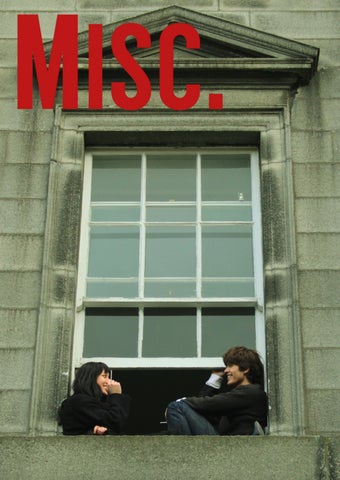
COVER Photography Ella Carley
Models Averi Malin, Eve O’Donnell, Joy Aladejana, Kucien Cough
Joy Aladejana is a second year English and Philosophy student. She is Misc.’s Assistant Editor. She has contributed to The University Times and an anthology in collaboration with The Museum of Literature Dublin. Katie Brady is Misc.’s Deputy Editor and former co-Editor of the Piranha. She is a final year English and Philosophy student.
Nicolò Bianchi is one of Misc.’s Culture Editors. He has gradutated with a degree in English and History and is now a postgraduate student in the Trinity School of Politics.
Nicolle Riley is Misc.’s Social Editor and a second year Classics, Ancient History, and Archaeology student. She has contributed to The University Times and Trinity News.
Mathilda Gross Page 27
Honor Lynch Page 25
Maya Manning Page 13
Jessica Sharkey Page 6, 8, 9, 11, 16, 21, 23
Editor Conor Healy | Deputy Editors Eliora Abramson, Katie Brady | Assistant Editors Joy Aladejana, Lily Ainsley |Layout Editor Eliora Abramson |Political Editor Daniel Bowe | Community Editor Elaine Murphy | Culture co-Editors Nicolò Bianchi, Sienna O’Riordan | Social Editor Nicolle Riley | Science and Technology Editor Aoibheann Kearins |History Editor Gavin Jennings | International Editor Jules Nati | Erasmus co-Editors Priya Evans, Eve McGann
CONTENTS
Conor Healy
Editor's Letter
The Misc Matrix
Daniel Bowe
Getting High on Our High Horse
Why the boycotting of companies doesn’t extend to the choices students make about drugs.
Charlotte Shoemaker
Nicolle Riley
The Comfort and New Connections of Known Melodies
How does music heal and connect us when we’re far from home.
GMB Chronicles
Comparing American Greeek Life to Trinity’s GMB.
Joy Aladejana
Schrodinger’s Cafe
Musings on Dublin and community spaces reveal how hope keeps a city moving forward.
Eve McGann and Conor Ennis
ERASMUS SPOTLIGHT
Alannah McElligott Ryan
Katie Brady
The Magdalene Laundries Are Only Thirty Years Away
Looking back on Ireland three decades after the last Magdalene Laundry closed its doors.
The Careful Art of Gossip
Examing the history, harms, and benefits of the habit
Aoibheann Kearins
Hey DJ, Play the Music of the Spheres
How the same twelve notes unite all music listeners
Nicolò Bianchi
Leave Molly MAlone
An interview with Tilly Cripwell, founder of the Leave Molly MAlone campaign
Poetry and Fiction
A Misc. Crossword
EDITOR'S LETTER
Afriend of mine recently remarked on how she found living on Trinity campus akin to being aboard an all-inclusive cruise ship. Everything you could plausibly need is within a five minutes walk, the captain (Linda) is frequently seen in a black windbreaker, and the issue of whether you’ve seen your leapcard in the last six weeks is absolutely redundant. Another thing about cruise ships, however, is that for as much time they find themselves adrift at sea, an island of itself; they also dock at a vast range of ports across the world, letting its guests get out and briefly inhabit different cities. The zeitgeist of Trinity seems to follow a similar docking path, drifting from one cultural question to another. This college is insular at times, but we remember its value when it enters dialogue with broader questions of the day. In this issue, it is this dialogue, this perspective that comes to the fore, as we find our ship at sea wondering where we go next?
While painfully aware that I may be stretching the cruise ship metaphor far beyond its limits, the different articles in this edition seem like various ports in which we can explore the relation between our college and our culture alongside the different questions of the day. At our first stop, Politics Editor Daniel Bowe challenges the hypocrisy abundant in conversations about ethical consumption that never seem to hold illicit substances to the same standards as the other goods that are frequently boycotted. Alannah McElligott Ryan also touches on topics that are necessarily uncomfortable to deal with, in her poignant piece reflecting on the Magdalene Laundries that only closed in Ireland 30 years ago. Assistant Editor Joy Aladejana zooms in on the broader issue represented by the recent closing (and re-opening) of the Music Cafe, and what it might be emblematic of in the bigger picture.
Elsewhere, Deputy Editor Katie Brady holds a magnifying glass up to the way in which we discuss gossip in this college, and unpacks how we should reconsider our perspective of the practice in a philosophically grounded way. In a similarly analytical way, Social Editor Nicolle Riley meticulously dissects the GMB and scrutinises its different components for their similarity with stereotypical American frat houses. Both articles take institutions of our college and flip them on their heads, making us consider and reconsider the aspects of our lives on this ship we take for granted.
While much of the articles in this issue exhibit the ‘student’ perspective, this is perhaps felt most richly and authentically in our central feature. Amidst all of this spirit of coming and going, the central feature of this edition focuses on the experiences of Erasmus students during their time abroad. A round table discussion chaired by co-Erasmus Editor Eve McGann with students draws out anecdotes from semesters spent abroad in cities from California to Palermo.
Conor Ennis’ piece on his time in Montreal accompanies the round table discussion, highlighting how taking some time away can change your relationship with your home.
I’ve never set foot on a cruise, and while my final year of college has been nothing if not inundated by an obligation to look to the future, I don’t particularly see an all inclusive voyage around the Mediterranean in mine. Yet, in the process of collating this edition and putting together pieces, I realised that Misc. is a vessel of sorts, riding the waves of the social undercurrents flowing through the college. In concluding this final editorial letter of the year, I was unsure of how to round off my thoughts without exhausting the cruise ship metaphor even further. Yet, as I was writing, I remembered a striking quote from Professor Jared Gardner, describing early American magazines:
‘It was premised on the belief that seemingly unrelated topics and agendas might be judiciously placed side by side so as to produce new fields of inquiry and new correspondences previously unimagined’.
This edition of Misc. is not explicitly promising to new fields of enquiry, or to evoke correspondences previously unimagined (although if you feel compelled to start a rumour that the Phil is a frat after reading the Katie and Nicolle’s articles, we wouldn’t blame you). However, the idea that a magazine like ours can arrange strands of unique and critical thought alongside each other in a way that might provoke new ways of seeing things — that’s something we hope to say we might have done, through the last 131 years and continuing on to the future.
I hope you enjoy our final edition of the year, Conor
THE MISC. MATRIX
Want to contribute to Misc?
We are always on the lookout for new writers and artists.
To get involved, email us directly at editor@miscmagazine.ie ; join our writers' group chats through Instagram, @tcdmiscmagazine, or head to miscmagazine.ie and fill out our 'contact' form.
Getting High on Our High Horse: The Hypocrisy of
Trinity’s ‘Ethical’ Consumerism
Politics Editor Daniel Bowe questions why the boycotting of companies doesn’t extend to the choices students make about drugs.
Boycott Coca-Cola. Boycott Airbnb. Boycott Puma and buy your tracksuit elsewhere. It’s not too difficult to achieve and it articulates a clear message – these companies are complicit in genocide by virtue of their continued support for Israel and we shall not stand for it. A boycott can put pressure on companies such as the ones listed above and emphasise our point in the only language they can truly understand – through a loss in revenue. Companies such as McDonald’s and Starbucks have seen a noticeable decline in customers in countries like Jordan as a result of such boycotts.1 Many Irish people, inspired by the belligerent stand 1 Yasmeen Serhan, “As Gaza-Inspired Boycotts Continue, New Brands Are Emerging to Fill the Void,” TIME (Time, August 23, 2024), https://time.com/7014399/gaza-boycotts-coke-cola-mcdonalds-starbucks/.
taken by Dunnes Stores employees in response to the apartheid in South Africa,2 are attempting to mirror their success in the modern day.
It is a constant dilemma for the socially-minded lay person to decide what products conform to their ethics and to reasonably reduce their usage of those that don’t match. It is nigh impossible to truly achieve a consistent approach – especially when you’re broke. Environmental degradation, exploitative labour conditions, social and economic inequity and mental and physical illnesses are the unspoken consequences that
2 “Dunnes Stores Workers against Apartheid,” RTÉ Archives, n.d., https://www.rte.ie/archives/exhibitions/2095-dunnes-strike/. (These archives provide a variety of interviews with participants and are well worth a watch).
we are all largely aware of as a (seemingly unavoidable) cost to inhabit a late-capitalist society.3 I want to buy cheap groceries so I have to accept that there is a risk of underpaid migrant workers being the ones to harvest the fruit I have in my smoothie.4 I want to own a smartphone but I don’t support child labour. Tough luck – who do you think is digging for lithium to build the batteries required for those very phones?5 There are no clear choices, no simple right and wrong. Your weekly shop or your new jeans from Zara possess an ethical ambiguity which we all try to ignore or we would simply drown in it.66 Sometimes though there is a simple choice. There are rare occasions when it is undoubtedly clear – for example, the Gaza boycott. Buy Gaza-Cola instead, you can feel better, contribute to something moral, and it tastes the same. Another example of where it is undoubtedly clear, but arguably often ignored, is the drugs trade.
The European cocaine trade is not run by artisanal entrepreneurs with a passion for nightlife.
I would imagine that up to that last line I had most of the Trinity readerbase with me wholeheartedly. Discussing the difficulties of ethical consumption under capitalism – that’s our bread and butter. Most of what I said was not new or original in any way. Fresh out of an invigorating 2nd year sociology lecture you might hear waspy
Let us not feign ignorance any longer and instead discuss with the same vigour where the drugs we all know are present at these large social events come from.
voices in the arts block meander on the cruelty of fast fashion, and tell with pride how their whole outfit came from the charity shop (fashion soc watch out!). That same (hypothetical) 2nd year sociology student will flatten a bag of ket like there’s no tomorrow at T-ball. This artsy, socially-aware and wealthy college that I have the privilege of attending is rife with hypocrisy. This privilege we inhabit has allowed us to learn in elaborate terms the consequences of globalisation and wax lyrical about why YOUR failure to reduce your carbon footprint, or your choice to buy a big mac after a night out, was morally reprehensible. At the same time, party drugs, such as MDMA, ketamine, cocaine and so on, are increasingly common in Trinity so-
3. T. Caruana, M. Carrington, and A. Chatzidakis, “The Ideology of the Ethical Consumption Gap,” Marketing Theory 16, no. 2 (2016): 215–230, https://doi.org/10.1177/1470593115595674 .
4 The vast majority of fruit that we consume in Ireland originates from the south of Spain, where many north African migrants live in disparaging conditions and work for well below minimum wage. See: Mercedes Fernández, Yoan Molinero Gerbeau, and Zakaria Sajir, “‘They Think You Belong to Them’: Migrant Workers’ Perspectives on Labour Exploitation in Spain,” Journal of Ethnic and Migration Studies 49, no. 15 (July 16, 2023): 3976–95, https://doi.org/10.1080/1369183x.2023.2235896.
5Amnesty International, “Exposed: Child Labour behind Smart Phone and Electric Car Batteries,” Amnesty International, January 19, 2016, https://www.amnesty.org/en/latest/news/2016/01/child-labour-behindsmart-phone-and-electric-car-batteries/.
6 This is very melodramatic...
cial spaces – none more so than T-ball. The European cocaine trade is not run by artisanal entrepreneurs with a passion for nightlife. Europol describes a network of violent cartels stretching from Latin America through West Africa into Europe, many of which simultaneously traffic people, weapons and drugs.7 The death and destruction that lies in the wake of these groups is harrowing, and undoubtedly facilitated by willing customers who pay high prices for a product stained with the blood of communities which often inhabit underprivileged areas. I can admit there is no clear solution. Do we organise a boycott? Multinational corporations have reputations to protect and can be pressured through consumer action or inaction. Drug trafficking networks, by contrast, are openly criminal enterprises that are unlikely to issue a press release if Trinity students stop buying cocaine. Maybe we should call for legalisation, and therefore, we can facilitate accountability mechanisms. However, there is not a single country globally that has legalised the distribution and sale of class A drugs such as cocaine or ketamine. Then again, maybe Michael Martin is feeling loose…
The only thing I want to achieve by virtue of this article is to reframe the conversation. Consumption of party drugs is usually framed as a personal decision — a line someone crosses knowing the risks to their health. I’m not interested in lecturing people about what they do to their own bodies. If someone wants to smoke, drink, or take drugs, that’s their choice. What I am questioning is the convenient assumption that this choice exists in an ethical vacuum. A surprising amount of Trinity students can explain in disturbing detail the supply chain that brings your cheap t-shirt to your wardrobe, but ask that same person where their cocaine comes from and they’ll most likely say “Eh… somewhere in South America?”. Let us not feign ignorance any longer and instead discuss with the same vigour where the drugs we all know are present at these large social events come from –I swear it’ll make the afters far more enlightening. Trinity students care deeply about ethical consumption – until the ethical dilemma arrives in a small plastic bag. Then suddenly the moral clarity disappears. It turns out we are very good at boycotting corporations. Boycotting the drug cartels that actually thrive on violence, exploitation and trafficking? Not so much.
The Comfort and New Connections of Known Melodies
Charlotte Shoemaker considers how music heals and connects when far from home.
heartbreaking guitar pluck ings of ‘500 Miles’. Mary Travers’ solemn voice echoes through my head haunting my steps, as I walk over Luas tracks and pass Chaplin’s. ‘If you miss the train I’m on / You will know that I am gone / You can hear the whistle blow a hundred miles’. I inhale slowly and try to keep my pace. My folk playlist has suckerpunched me with the reality of being not one, not two, not five hundred, but four thousand miles from my home. It’s hard not to get at least a little contemplative. Particularly in times of change, familiar music provides stability, a constant to lean on. The entanglement between comfort and music is not new, but still I find immersing myself in nostalgia through music is a sweet way of coping in an unfamiliar environment. Melody and lyrics connect us to each other, the people and places we love. I can rely on the words and tune of the songs I love to be changeless. The difference between each listen is the listener; our connections to and perspective of songs change as we
do. With sprouting life experiences, different surroundings, and a new ‘home’, I listen to my favorite artists from the States feeling a greater bond to them.
I wondered if other Trinity international students were having the same experience. Maria Charisi, a first year English Studies student from Athens noticed something similar. She leans on Greek artists for a soundtrack for her new life in Ireland. Sitting at Keogh’s between lectures, she showed me proof of her current habits, flashing a playlist entitled ‘Greek Trap Mix’ on her spotify and we shared a laugh. She finds comfort in the nostalgia and attachment to her life in Greece through song. She told me, ‘Up until about a year ago, I hated Greek music. When I moved to Dublin, I knew that the Greek diaspora in Ireland was limited, and after searching for any reminder of home I could find, from food to cafes, my suspicions were confirmed. Homesickness became a part of my new reality as a foreign student, and the short phone calls with my parents and friends were not cutting it. It was while studying and cleaning my room that I began listening to Greek music as a joke, slightly guilt-ridden over my declining music taste. To my surprise, Greek music turned out to be not only a nice reminder of what my mother tongue is supposed to sound like, but also a way to travel back to the past and relive moments with friends and family I had not seen for months. For me, Greek music is a reminder of my identity: a reminder of a place I can return to and instantly belong, a reminder that wherever I am, no matter how lonely, or out of place I feel, home is waiting for me; a home full of friends, family, and joy’. We shared that this homesickness was especially hard during the Christmas season. When the weather turned bleak, exams neared and we were surrounded by happy families under twinkly lights on Grafton Street, longing for home was crushing. But walking, headphones in, playing familiar songs helped aid our bitter longings. For both of us, a new connection was fostered across miles and years, connecting us both with beloved childhood memories and new appreciation for art from our home country.
As a first year international student from the United States, I’ve experienced quite a bit of change, and what I’m listening to re-
flects that. I’ve noticed a shift in the songs I grav itate towards as of late. It seems I am retreating to what I know from my first years of listening to ‘my own music’. The first songs I downloaded on my bright blue iPod touch, and would blast through my wired headphones sit ting on the couch, while securing an impressive count of Mario Kart 7 gold cups. We tend to cling to what we know, to reach for what’s comfortable in days of uncertainty. In my case lately that has been the witty, sarcastic, and blunt twang of Kacey Musgraves. Her song, ‘Follow Your Arrow’ has always been dear to me. Its simple message and melody takes me back to my Catholic school girl days, singing with my little sister in the back of the 7-seater family SUV. Now when I press play I feel an attachment to my younger self, and even more to my sister and my mother, who surprisingly did not mind Kacey’s use of ‘hell’ or contemplation over rolling joints. A few weeks ago I sent my little sister a screenshot of me playing the song, and while she left the message on read for a bit (no, I’m not offended…), we eventually reminisced about our shared days. That connection, aided by the jangly tambourine and wandering steel pedal guitar keeps me warm on cold Dublin nights. ‘Follow Your Arrow’ and other songs reminiscent of home anchor me when I get hit with Freshers Blues.
opportunity to do so. Through music, being has made me value where I’m from that much more, and while this could be a minor case of homesickness, I believe that keeping that connection is crucial. Maria shared my sentiment. We agreed that we love our current flourishing lives, days spent meeting people and meandering over pavement and cobble. Yet, we long for the cradle of Greece and the U.S. Especially, everyday as I read about the ongoing, overwhelming tragedies and violence occurring in the country I hold dear. It has become harder to connect myself to where I’m from. Through music I am reminded of the many people I care for and the memories I harbor tenderly. I can love my home and be critical of it, just like any other relationship. If you love something you will care enough to try and repair it. But during these times of turbulence and instability music and the nostalgia attached to it acts as a rock, a bonding agent for us all, regardless of our homes. The power of music has proven to be undeniable and greatly healing. As Mary Travers closes the song, repeating ‘You can hear the whistle blow a hundred miles’, my heart softens thinking of the people I care for across the Atlantic and the recent relationships I’ve made in Dublin. 4,000 miles is damn far,
and Tia Blake make me smile and remind me of my life in the Southeastern U.S.; the coastal punk/ surf rock bands of the Descedents and the Beach Boys take me back to my even younger years in Southern California. I always wanted to leave the U.S. to broaden my perspective and am grateful
GMB CHRONICLES
Culture Editor Nicolle Riley compares American Greek life and the traditional frat house to Trinity’s GMB and the characters that fill it up.
Trinity does not have frat houses, and the idea of paying for a social circle feels slightly incomprehensible to the Irish mind. Yet the mythology of American college life continues to live very comfortably in the imagination of both Irish and international students. It is a fantasy carefully maintained by coming-of-age movies, spring break scandals, sorority rush TikToks, and the casual way Americans reference fraternity hazing incidents as if they were just another Tuesday.
games, tailgates, darties, and studying at a conveniently placed campus coffee shop. Meanwhile you are standing in Front Square or enjoying a pint at the Pav wondering if you somehow missed out on the “proper” American college experience.
Gone are the nights spent playing rage cage in a fraternity basement while Zedd blasts through
Trinity offers its own version of collegiate ritual, one that is far more dangerous: a microphone, a motion, and a room full of students who believe their opinion deserves five uninterrupted minutes
The cultural image of Greek life is always the same. Sprawling houses draped in Greek letters. Choreographed chants echoing through suburban mansions. Basements sticky with Bud Light and throw up remnants. Music blasting a Spotify playlist conveniently titled “frat anthems.” An entire social ecosystem built around red Solo cups and themed parties. Where a skewed power ranking of the highly coveted “top house” title directly influences your social relevance and ego. Trinity, of course, comes nowhere close to this particular spectacle.
blown-out speakers, evenings that often end either at the campus health center or with a carefully worded fraternity apology email the following morning.
Trinity offers its own version of collegiate ritual, one that is arguably far more dangerous: a microphone, a motion, and a room full of students who believe their opinion deserves five uninterrupted minutes.
Rather than beer pong tournaments, keg stands, and fraternity suspensions, Trinity debates revolve around the questions that allegedly keep the student body of Trinity awake at night
There is no rush week, no pledging, and no secretive initiation rituals that inevitably end up on the front page of the New York Times. And yet, within Trinity’s slightly performative and mildly self-absorbed campus culture, we have managed to approximate something that feels eerily similar.
Just replace beer pong with debating motions and stupid frat guys with overly confident posh Irish boys who feed off the sounds of their own voice. Enter Trinity’s Graduates Memorial Building, better known simply as the GMB.
For American Erasmus students, or realistically the large portion of Trinity students whose accents fall somewhere between New York private school, Boston suburb, East Coast boarding school, and the California coast, the transition to Trinity can occasionally feel like a mild form of social withdrawal. Back home, your friends spend their weekends rotating between football
Rather than beer pong tournaments, keg stands, and fraternity suspensions, Trinity debates revolve around the questions that allegedly keep the student body of Trinity awake at night: whether capitalism has gone too far, whether the monarchy should still exist, or whether networking is simply a polite form of manipulation.
Functionally speaking, the GMB, where Phil members and Hist regulars congregate like two rival species sharing the same habitat, is probably the closest thing Trinity has to a frat house. The main difference is that the drinks are glasses of Tesco Finest red wine, which somehow manage to feel both more sophisticated and significantly easier to get tipsy from.
A typical GMB evening begins in a way that feels far too familiar to many Trinity students. It is a Thursday night and you have just come out of an exam that went ambiguously enough that you cannot tell whether you should celebrate or quietly reconsider your academic choices. You promised your coursemates pints afterwards at the Pav, but you are also briefly calculating whether another twelve-euro drink is truly necessary or feasible in your bank account. You are not quite ready to leave campus yet,
Marxist theory, Greek philosophy, the Bible, and Dante’s Inferno are casually cited with remarkable confidence that is only emboldened by the excessive hand gestures used.
simultaneously trying to convince yourself that sitting in the GMB for two and a half hours might not be the best use of your time. You wonder whether the motion will even be interesting, whether you care enough about the topic to watch three strangers argue about it for far longer than seems reasonable, and whether you might be better off simply going home. And yet, ten minutes later, you find yourself lining up outside the GMB in the rain with thirty other students, quietly committing to an evening that will involve watching people become progressively more passionate and slightly more tipsy. A friend of yours who is “on the Phil,” although no one seems entirely sure what their job actually entails, has lured you in with the promise of free wine and a debate that will supposedly be worth it.
The motion could be almost anything. Perhaps three men debating whether the women’s suffrage movement was historically necessary. Someone is proposing that Movember should become a year-long movement or that the idea of fate is a socially constructed phenomenon. Occasionally the debate veers into an unexpectedly intense discusion- maybe this time about whether free period products are economically irresponsible. The atmosphere within the GMB sits somewhere between political theatre and controlled chaos. Marxist theory,
losophy, the Bible, and markable confidence that is only emboldened by the excessive hand gestures used. Speakers take generous sips of red wine before glancing down at their MacBooks and launching into rebuttals that feel dramatically more serious than the topic perhaps requires. Meanwhile the audience oscillates between genuine intellectual engagement and the quiet realization that most of us did not come here to learn anything. Instead we sit back, watch, and silently critique everyone’s public speaking as though we ourselves could step on stage and do it better. Occasionally you scan the room in hopes of spotting that one guy from your Film tutorial. Within the span of a single debate you cycle through roughly twelve emotional stages, from secondhand embarrassment and physically cringing to an unexpected moment of existential reflection about your past relationships and poor life choices.
Still, it would be dishonest to pretend the prestige attached to the Phil is not slightly appealing. Every Sunday night you scroll through Instagram and are reminded, somewhat dramatically, of the society’s ability to attract honorary patrons and speakers that span everything from politicians to celebrities you vaguely recognize from somewhere. From the out-
side, the entire structure of the Phil feels mildly surreal. The idea that the president takes an entire year off from college to run a debating society sounds less like a student position and more like a small political administration.
There is a particular genre of a Phil speaker, usually a far too proud Blackrock or English boy, who delivers their argument with the calm certainty of someone who has been told since childhood that their opinion is extremely important
A night in the GMB offers the full spectrum of human performance. One moment someone abandons their carefully rehearsed argument and attempts to improvise a point that sounded brilliant in their head but now refuses to emerge in coherent sentences. Words stumble, arguments disappear halfway through, and the speaker slowly realizes the entire room has followed them into the confusion. The wine glass may have been slightly too generous, but to that it makes it all more entertaining. The next moment someone delivers a surprisingly sharp speech that leaves the room quiet for a moment longer than usual. Even the back row stops whispering long enough to acknowledge it. People nod seriously, someone says “here here,” and by the end of the evening your friends are discussing the speech at
If
building transforms into what students affectionately call GMB-ar. What began as a debating venue has evolved into something closer to a multi floor social experiment in which four floors of students circulate between rooms clutching wine glasses and drifting between conversations with performative English students discussing their favorite international short films. You’re immediately lost within the conversation coming to terms that it may be better to go stand by the underwhelming DUDJ setup.
a frat house were redesigned through several centuries of academic tradition, stocked with debating motions instead of beer pong tables, fueled by Tesco Finest red wine and filled with students who take both politics and themselves slightly too seriously, it might end up looking suspiciously like the GMB.
the Pav as if they had just witnessed the early stages of a future political career.
Every time I leave a Phil debate I find myself thinking the same slightly bewildered thought, which is that it was actually kind of impressive. This realization is usually accompanied by the quiet confidence that I myself could absolutely never perform a speech in front of classmates, which is why I have chosen the far safer role of sitting in the audience and commenting about it afterwards. While my American self has never been in a room with quite so many D4 and D6 accents at once. There is a particular genre of a Phil speaker, usually a far too proud Blackrock or English boy, who delivers their argument with the calm certainty of someone who has been told since childhood that their opinion is extremely important. Their private all boys grammar school has prepared them thoroughly for this moment to be self righteous and entitled. To be fair, when you belong to Trinity’s most prestigious society, that level of confidence seems almost expected.
However, more recently the GMB has developed another identity entirely. On certain nights the
The demographic of the GMB on nights like this looks exactly like what would happen if you combined Trinity Arts Festival, people who attend Starlight, and the Tang line at 1pm. The result is chaotic but entertaining enough to keep you going back. Perhaps this is what makes the GMB such a strange and beloved part of Trinity campus culture. It is not quite a lecture hall and it is certainly not a party venue, yet somehow it exists comfortably somewhere in between. It is a place where students gather to debate philosophy, politics, and society with surprising intensity, while simultaneously treating the entire experience with just enough humor and dry commentary to keep things from becoming unbearable. Few places on campus bring together such a diverse mix of personalities so naturally. Ambitious debaters, hyper critical audience members, Arts Block chain smokers, Schols, confused first-years unsure of what the motion means, and the occasional Erasmus student eager for a good time all end up in the same room. Trinity may not have frat houses. But if a frat house were redesigned through several centuries of academic tradition, stocked with debating motions instead of beer pong tables, fueled by Tesco’s Finest red wine, and filled with students who take both politics and themselves slightly too seriously, it might end up looking suspiciously like the GMB on a Thursday evening. Packed with students eager to argue their way through philosophy, politics, and Marxist theory, the GMB occupies a strange place in Trinity life. It is not quite a lecture hall and not quite a party either, yet it remains one of the campus’s most reliable spectacles, the kind that somehow convinces us to return every Thursday night.
Schrödinger’s Cafe
Dublin can be a smile with no substance, a bright, toothy grin with canines ready to tear and grip at any chance of profit. Yet, scattered through the city are places that are enacted as its gums: the soft, living tissue that holds teeth in place. On the corner of Wellington Quay sits the Music Cafe, long embedded in the gums of Dublin’s art scene for approximately fourteen years, hosting live music nights three times a week. On February 6th, 2026, the cafe announced its closure due to financial strain and repeated vandalism. Staff and supporters quickly raised funds and hoped to reopen. Their hope and perseverance actualised in the reopening of the cafe on Valentine’s Day.
However, during the Music Cafe’s moratorium of eight uncertain days, it occupied a strange state: closed as a business but alive as a community. Schrödinger once imagined a cat sealed inside a box, in suspension between life and death until the box is opened. The Music Cafe seemed to exist in the same suspension. It was dead in the material sense, its doors
Musings on Dublin and community spaces from Assistant Editor Joy Aladejana reveal how hope keeps a city moving forward admist closures and uncertain futures.
closed, the Music Cafe remained what it had always been: part of the gums of the city, holding Dublin’s anxious grin together.
Community, after all, is not made of walls or tables but of relationships that persist beyond them. And so even with its door closed, the Music Cafe remained what it had always been: been part of the gyms of the city, holding Dublin’s anxious grin together.
In such a thought experiment, the observer is not neutral. Opening the box drives nature to settle on a single state. The experiment’s possibilities collapse into certainty the moment someone even peeks inside the box. In the case of the Music Cafe, the observers were not physicists but the staff and patrons who refused to cease looking inside. Their fundraising, their public insistence, that such a space mattered, functions like hands lifting the lid.
A reaction in its most atomic sense is action. And through the staff’s reaction, they resisted the apprehensive inevitability that typically follows a closure notice. The building itself has a preservation order from the Dublin City Council, due to interest from an architectural and historical perspective, which solidifies the effort to keep the building open. Yet, the real act of observation came from the people around it. In spirit, the cafe bears the philosophy of Dublin’s Socrates Cafes, where conversation becomes a means of social connection and learning not just as an individual but as an individual a part of a collective. Community truly emerges not from the walls of a building but from the poignant attention people give to one another. In choosing to look, to fundraise,
and essentially to act, the observers of the Music Cafe delayed the moment when the city might otherwise have declared the space definitively gone.
Yet the uncertainty surrounding the cafe did not arise in complete isolation. Across Ireland’s hospitality industry, increasing costs have catalysed many small venues and business towards involuntary liquidation. In September 2023, the VAT rate for food services rose from 9% to 13.5% This 4.5% increase is what the Restaurants Association
It is as if another piece of the city’s living tissue is stripped away... leaving the bright grin of Dublin’s development a little more exposed, its teeth showing but the gums that once held them together slowly receding.
of Ireland has named as the final blow for already struggling businesses. The Music Cafe’s closure announcement cited precisely this exact pressure. In this sense, the cafe’s fragile state was not merely philosophical but structural, the product of “nasty, brutish, and short” economic forces tightening around the city’s cultural spaces. When such places cease to exist, the loss is not only commercial. It is as if another piece of the city’s living tissue is stripped away… leaving the bright grin of Dublin’s development a little more exposed, its teeth showing but the gums that once held them together slowly receding.
If the uncertainty of the Music Cafe mirrors economic fragility, the closure of The Complex reveals something more ideological. After eighteen years of operating in Dublin’s north inner city, the multidisciplinary arts venue announced it would close following what its artistic director Vanessa Fielding describes as a failure of public responsibility. It is the “failure of the Government and Dublin City Council to secure a viable resolution for an arts organisation that has operated continuously, ” she wrote. During its operation of almost two decades, the space had developed into a nationally and internationally recognised centre for contemporary Irish arts, supporting a plethora of artists, technicians, designers, and producers. The Complex’s presence also manifested as a cultural infrastructure in an area of the city with limited access to it. Its stages hosted rehearsals, exhibitions, and concerts. In March 2022, Fontaines D.C. performed
there, one of the myriad of artists to pass through its doors. However, the venue’s closure quickly prompted a protest, amassing more than 17,000 signatures gathered in an effort to save it. Fielding argued that the outcome represented “a failure of cultural policy, accountability, and long-term planning,” compounded by a landlord seeking vacant possession in order to maximise the redevelopment value of the site. The contradiction is painstakingly apparent. In a city that trades so heavily on its reputation for literature, music, and art, (Ireland is literally termed the “Land of Saints and Scholars”), the spaces that nurture those traditions are repeatedly forced to justify their survival and what follows from that is the justification of the existence of these cultural institutions.
Hope in this landscape exists in a strange interval, the narrow ledge between loss and renewal. Places disappear, announcements are made, doors are closed, and for a moment the city appears to hold its breath, drowning in uncertainty. The second-hand bookshop Chapters once passed through a similar moment of uncertainty, when the possibility of its closure felt like the erosion of another cultural landmark. But such moments reveal something stubborn about the city’s character. Ireland is celebrated internationally for its artistic imagination, yet the infrastructure that supports these traditions frequently struggles to survive.
Hope in this landcape exists in a strange interval, the narrow ledge between loss and renewal. Places disappear, annoucements are made, doors are closed, and for a moment the city appears to hold its breath, drowing in uncertainty.
The result is a paradox: a culture that is celebrated globally, but precarious locally. Meaning that reputation travels easily, but infrastructure does not. Still, communities continue to gather around the spaces that matter to them, refusing to let them vanish without any opposition. Hope, then, is not naïve optimism in the abstract sense, but a collective act of attention. It is the fragile pause between disappearance and return. The moment before the lid is lifted, when the future of a place and its people has not yet actualised into a single state.
All Things Erasmus A Conversation with Students All Over the World
Co-Erasmus Editor Eve McGann interviews students who have spent their erasmus all over the globe: from Canada to Italy, America to Spain and Switzerland.
Ellen, Maya, Olivia, Conor, Charlotte and I sit around a table. I have strategically placed a bag of M&S cookies in the centre. Ellen spent last term in Barcelona, Maya in Zurich, Olivia in California, Conor in Montreal, and Charlotte in Palermo. We do not need the cookies, they are each eager to talk about their experiences.
*The following conversation has been shortened for brevity.
Eve: What was it like first going over? What were your expectations?
Ellen: I thought it'd be harder to move away. Actually, it wasn't hard at all.
Olivia: This was my first time living by myself. So I was very Type A. I knew exactly what I was doing, like the second I was getting there and everything. It was very much like the movies going over there. I remember watching Monsters Inc, the university one, on the plane, and getting there and being like, Oh my god, this is literally like Monsters Inc.
“Honestly I think before I actually went over there, nothing was going right”, Conor laughs. “So when it came to Erasmus […] the idea of getting accommodation, and stuff like that, it was too fucking difficult, I couldn't think about it.
But then, by the time I was going over, I was actually really happy. And I was anticipating stress, but I was also really anticipating a lot of peace”.
Charlotte: I didn't think about it the whole summer. People kept asking me, oh my god, are you excited? And I kept being like, Oh yeah, it's just like a little holiday!
Eve: Doing only the one semester, did you guys feel a pressure to do everything? And what was it like making friends within that little space of time?
Ellen: I really felt like I was a first year again. Any sort of relationship there was intense, because everyone's like, you're only there for four months.
Maya: I only met about two people who were staying for a full year. So everyone was in that mindset. …. I'm glad now that I didn't do the full year because… you’d just be so tired!
Ellen: Did you feel like you’d get FOMO if you didn’t go out once?
Maya: Yeah, totally.
Ellen: That’s how I’d feel. I’d be like oh my god I didn’t go out this one time!!
Olivia: I lived by myself, and I had 10 days before, like from getting there to when class started. …. It was the longest week of my life. I knew no one. I didn't have any way of making any friends, because there were no events or anything. I was like, I can't do this. I gotta go home!
However, Olivia did not go home! She settled in and by the following week, “because you want to make the most of it … we were already traveling”.
“The money that's poured into [the Frats] is CRAZY. That was one of the most shocking things that I saw. The parties were insane. They had famous DJs and stuff. And one week it was Parent’s Week, so all the parents flew into the college. They had a football game that weekend, and my friend was also visiting from Trinity, so I was trying to show her around, and she's like, this is the weirdest thing I've ever seen. And like, there were babies at the frat parties that week.
They do tailgating. So they’ll go drinking at the frat parties before the football games”.
“The babies would?!”, laughs Conor.
Maya: I feel like a frat party is not the place for parents.
Ellen: But they probably experienced it too. It’s part of their culture.
Conor : When I was five, I was at a frat party!
“It was definitely the parents living out their glory days for a lot of it”, Olivia laughs. “One of the dads jumped
from like the top of this thing into a crowd. Everyone was like whose dad is that?
Ellen: Were there any [frat parties] in Canada?
Conor : No, not that I knew of. I think there was stuff like that but not for me. I feel like a bad judge, because everyone is saying, oh I was at everything. I wasn’t at anything! I met like three people at the start of the year, and never talked to anybody else!! I think the people that I was with then, I was insanely close with.
We were also in a WhatsApp group for just general exchange students. But all the people in the group chat were good mates with these two Israeli guys, and one of them was in the IDF, so we didn't hang out with them.
Eve: That's another question I want to get onto, politics … I'm very curious to know what it was like in other places…
Charlotte: Palermo is one of the most pro Palestine places I've ever been to. There's Palestine flags everywhere. It's because Sicily was where all the flotillas went from.
Also everyone says, we're Sicilian, we're not Italian. Italian politics is going really right wing. So they're really trying to step away from that, and separate themselves. “And then I was the same as Conor as well…. Like having, like, three insanely close friendships, and then not talking to anyone else”, Charlotte laughs. “It was
just because the apartment I lived in, it was me and two girls, and I was sleeping in a bed under the stairs in the kitchen. So it was like, you had to be close!”
“We didn't make friends in the college, it was more like the city itself. It's not a big university town there. So you make friends just with people who are living there”.
“In a weird way, Israel was a huge part of my exchange”, Conor says. “There was genuinely one time I went to college and they had a giant board on the main grass and it literally said: Pray for the IDF. And there were loads of people clapping and chatting and stuff like that”.
Ellen: Aren't we shocked by that actually? Canada's a very globalized country.
Conor : Also…the actual college… the front gates of it were a hot spot for protests. There was one time I was walking by, and I took my headphones out, and they were playing ‘Imagine’ by John Lennon, and it was for Iranian independence.
Ellen: I actually lived off the square that the Catalonian Parliament sits at, so there was literally a protest every day. Sometimes it was for Catalonian independence....a lot of pro-Palestine ones. Sometimes getting home would actually be a struggle, because everyone's packed together trying to get through.
Maya: [Switzerland] is obviously quite an independ-
ent country. They have obvious links to other places, but they're not in the EU. So I think they tend to not get involved.
There was this big open hall in the main building of the Uni, and there were loads of tables set up in it. And so there would always be people meeting there, studying there…There were a good few days that I would be in there and you would see people with signs up.
A lot of it, unfortunately, was through German and I don’t speak a lot of German so I wasn't totally involved.
Olivia: I was very nervous about making friends with people because of their political beliefs. It was crazy how much people would silently support Donald Trump.
You'd be getting coffee with someone, and think you'd be getting on well, and then they’d be like: “yeah but he's a good businessman…”.
It came out that USC was pouring funds into Israel. But there were no protests about it.
All my prior research had confirmed that it was a very liberal college, because I felt safe going over there, and then when I got there, I was very surprised with some of the attitudes of professors.
Eve: Does anyone have any funny stories, or any moments when you were on your exchange that shocked or surprised you?
Charlotte: I got a lime thrown at me by an eight year old on a motorbike!
All the kids would just be on these motorbikes, just going around.
The men there were actually disgusting, that's the one thing that I will say that was really bad about it.
Charlotte also tells us that often, at night, fireworks would go off. “I looked it up, and I think it's the mafia, when someone gets released from prison, they do that, I think, as a celebration?! So when people would come over to visit me, they'd be like, is there a gunfight happening? And I’m like, no, just a mafia person got released. Don't worry!!!
Ellen: My apartment had a little tiny balcony that was onto this little alleyway…And [this guy] would sleep under there, and he would always pee there.
And sometimes…drunk men on nights out, would go down that alleyway…So one of my roommates bought a water gun…. Like the way that the actual people from Barcelona do that to tourists… So anytime anyone would pee on the street, we would spray them!
Eve: Did anyone try anything that they had never tried before? Or did your diet change much when you were there? Were you cooking for yourself, or were you eating out? So, yeah…. food!!!
A lot of places Ellen visited served sangria by the litre. “There was this one place, a student bar that everyone would always go to, that would get you unbelievably drunk. And then if you ended up throwing up… it would just be pink!
“Awwww”, we all respond in unison.
Maya: Zurich is really expensive. I kind of knew it was going to be expensive, but I was like, I've been paying rent in Dublin for a couple years….it can't be worse. And then I got over there and I was like, “Oh, it is way worse, actually”.
There was a canteen on campus which was cheaper, and it is a Uni right in the middle of the city as well, like here, so you are pretty close to food spots. I had a local Lidl and Aldi.
Olivia: Yeah it was kind of the same, it was so expensive to go out so that was just not on the cards.
The food in America is…. kind of designed to make you sick. You'd see it in the prices of things. Like apples would be so expensive, and then junk food would be way cheaper.
Every American I was like “This is not normal. You are being - I’m not a conspiracy theorist, but I was likePOISONED BY THE GOVERNMENT”!!
We had a Trader Joe's on campus, which was the cheapest place.
Conor : I was in a student building that had a meal plan ….it was basically like a cafeteria. They also had a soda machine, so I got really addicted to cherry Minute Maid lemonade.
Charlotte: We would make a big pot of pasta every day …. There was a place that we used to go to so often that you could get a whole pizza for a fiver.
And my last week there, I kept coming in being like, “I'm leaving soon bye”! but then I'd be in the next day.
Eve: Was anyone homesick? Was that an issue at all?
Olivia: I was expecting to be homesick because.. when I've gone away for long periods before, I've been so homesick, but I was so fine. My mom would text me every week and be like, hey, you alive? And I’d be like yes!
I don't know I wasn't expecting it, but the second I got there, and I got into a routine, I was so fine.
Ellen: I think I was homesick for my friends at certain points. …especially when I didn't know people very well, in the first little bit, I'd be like, “ohh wish I could just talk to this friend in person”. I did have a couple people visit me, to be fair, which was really nice.
Eve: Most of you are used to living at home with your family….that was probably nice, being independent?
Ellen: Yeah definitely.
Eve: Did you find that hard then readjusting to that?
Olivia: I got back on the 23rd of December, and the next day I wanted to go Christmas shopping, and I was trying to drive my car ... .and my mum was like: NO, NO, NO, You're gonna drive on the wrong side of the road!
Charlotte: I think it was a nice time to come home…. Our apartment only had cold water for our shower. So I was like: a hot shower pleaseeee. Like it was those things that you don't think about.
Maya: I think I would have found it way harder to leave if I was going home for summer. There's the excitement of coming home for Christmas…. I came home on the 24th so it was literally, got home, and then you don't have time
to think about the fact that, that's over. And, only now I'm kind of realizing I was like, Jesus that feels like that didn't even happen.
Ellen: It feels like a fever dream.
Charlotte: It literally feels like a fever dream.
Ellen: Like this is not real. I wasn’t just there. I had a whole completely different life.
Maya: I was so removed from my life here….
Eve: How does it feel being back in Trinity?
Ellen: It’s getting easier now but I felt disconnected from the general Trinity life. …. But that is just something that will happen over time.
Maya: There are a few modules that I’m in that had a part one to them last semester, and I'm like we’ll just figure that out along the way, I guess.
Charlotte: I feel kind of behind but that’s just because college over in [Sicily] was so chill. I heard some people talking about not doing Erasmus because they were worried about that aspect of it… But I feel like you get experience in other ways. You learn to move to a different city that you’ve never been to, and make friends, and be independent… so it kind of balances out.
Conor : Before I went away, I really felt a need to get away from things ... .Now coming back, I actually feel a lot better.
Dublin Via Screens:
Coming Home from Erasmus
A reflection on existing across the ocean from home and restoring the equilibrium of real life by Conor Ennis.
Whenthe wheels hit the tarmac, and the seatbelts unbuckled, the tangled nest of social connections that I was now returning to was the furthest thing from my mind. Irish life existed on screens. Social media posts and WhatsApp voice messages, loved ones were digital icons and 30 second summaries of recent events. Dublin was a television show, and I was keeping up with the storylines but never watching the full episodes. Separation was a pain but the distance allowed for analyses. I was nobody in Montreal. I discovered that I liked that. I discovered how much popularity and social cache had been something I concerned myself with
even though I did not consider myself to be part of any popular class. I discovered how much my ‘public image’ and how others perceived me were factors in my thoughts and decisions and how absurd it was given that I was not a celebrity, politician or even notable name in the communities I inhabited. Life was noiseless, hours passing peacefully into each other as I entertained myself with hobbies I enjoyed and especially enjoyed when my enjoyment of them didn’t feel like it said something about me. Days into being home, old anxieties popped up like a bad acne breakout. And just when I had popped the last pimple… Having been born in Dublin means that my home city – one that is notoriously small – is a social connections-based panopticon. At any given moment, someone I have even the vaguest connection with could be in the area without my knowledge of it. This became clear to me when I bumped into ten people from different points in my life within the first 48 hours back. Dublin, somehow, a nursing home for old dramas and silly beefs to socialize and all jumpscare you on pub-
enough. If people were watching, I might have been found out.
It’s easier to not exist, to be a stranger in the crowd but had I stayed, eventually things would have become real. It’s a fear of consquences, of having to exist in the world with whatever decisions you might have made.
lic transport at the most inopportune times. I was becoming aware of myself as the perceived again. On the third or fourth day, I was going to be reunited with those I was looking forward to seeing again.
It was the night of 12 pubs in town, so all the warm bodies were hitting the cold streets. I was attending the 21st birthday party of a good friend. Selfishly, I was more focused on how this would be my reintroduction to the world I had felt so important in, than the celebration. I was the grand returning cast member after being written out up until the midseason finale. I was unsure how to act. Hyperconsciousness of the role I played within these social dynamics set in. I was wearing a shirt, but under layers of thick material: anti-Irish Winter jumper and coat. It all added to making my first impression. A wet one when it hadn’t been raining, one hand shaking an old friend’s nervously while the other scratching itches and wiping sweat. It’s strange to be around the people you feel most comfortable with and worry you’re coming across like a bodysnatching alien, appearing as someone they haven’t seen in a while. I left early. A part of the reason being a pledge to maintain the zen habits I had picked up abroad, an early night’s rest and the like, when I didn’t know people who hosted parties. Another part, I wasn’t sure my performance as myself was convincing
A month later and having settled in more, some of the initial anxieties had dissipated. But not all. The preoccupation was now being reacquainted with the place as a place, the old, favourite cafes and bookstores. The physical buildings of Dublin, not just the people walking around in them. My girlfriend and I were taking a day out in my local area, eating overpriced pastries as I made vague comments on the difference in taste between Irish and Canadian coffee. On the way home, I was able to show her buildings I remembered always liking and ones I sometimes dream about living in. Along this makeshift walking tour were the houses of old friends. Spotted sporadically in the neighbourhoods surrounding my cul-de-sac were several homes I could point to and tell her about a random house party I had been to or something I had found fascinating about their living room. All the anecdotes ended with the same punchline: “…but I don’t talk to them anymore.” It was only after that day that the pieces clicked together in my mind.My parents grew up in the same neighbourhood, only around the corner from each other. The house I live in was bought around the time I was born. A young couple carrying one baby in their arms, one in the stroller, and one there walking on his own already. Years later, the house has changed and the cars have changed and those three children they carried into the home have all left and come back from various journeys abroad. All of us having to discover something new elsewhere and then swiftly readjust to what always was at home. In some ways, Ireland is not the TV programme but rather the reality in opposition to those dreams in other countries. To be here is to be a part of my ‘real life’, for things to count and become a part of my personal history. It’s easier to not exist, to be a stranger in a crowd but had I stayed, eventually things would become real. It’s a fear of consequences, of having to exist in the world with whatever decisions you might have made. In the end, would you rather be alive or dead? Would you rather you were a part of the world or not?
It is clear to me now that when I truly become ‘nothing’ and inconsequential, I would like it to be when the soil comes over my head. The people who knew me are standing in the yard feeling something, no matter what it is. An Irish body buried in Irish soil.
The Magdalene Laundries Are Only Thirty Years Away.
Alannah McElligott Ryan takes a look back on Ireland in the thirty years since the last Magdalene Laundry.
Thirty years ago, the last Magdalene Laundry in Ireland shut its doors for good. The last Laundry was on Sean McDermott street, just around the corner from where Kavanagh Court student accommodation is today. Its closure marked the end of over a century of institutionalisation and inhumane treatment of women and girls.
A month before the last laundry closed in 1996, the Irish Times published ‘Last Days of a Laundry’ by Gary Culliton: “Today,” Culliton says, “40 women are in residence at the convent, the eldest of them 79.” Culliton reports that these women, even at their advanced age, were still engaged in ‘industrial therapy’: doing laundry for the nearby prison. The 40 women remaining in the Laundry were among the “fallen women” of Irish society. Typically, women and girls inside Magdalene Laundries had either birthed more than one child outside of wedlock, engaged in prostitution, committed ‘moral’ crimes including infanticide, or were deemed merely ‘at risk’ of immoral or promiscuous behaviour. A Magdalene Laundry was a religious asylum, to hide these ‘corrupt’ women from virtuous Catholic society. For the purpose of economically sustaining the asylum of these women, the asylums carried out commercial laundry work.
Magdalene Laundries are occasionally confused with Mother and Baby Homes. Mother and Baby Homes accommodated unmarried pregnant women until their children were born, and then removed babies for adoption and attempted to find the women work
in their communities. Abuse was also rife in these institutions, as in the Laundries. The main difference between the two institutions was that women inside Magdalene Laundries were incarcerated for much longer periods, and were often not pregnant upon arrival.
In recent years, there has been a significant uptake in discussion— through history, art and activism— about the Magdalene Laundry institutions. From Sinead O’Connor tearing a photo of John Paul II, to Claire Keegan’s ‘Small Things Like These’, it seems enough time has passed for the history of the Magdalene Laundries to enter Irish art, and therefore the public consciousness. There are several reasons for this. Firstly, due to the significant decline of the influence of the Catholic church in Irish society, incredibly brave survivors and their families have been more able to speak up about their experiences. This provides context and material for discussions. Secondly, there has been a decrease in social taboos surrounding the history of institutionalisation in Ireland and taboos surrounding sexuality. The decrease in the potency of these taboos in Irish culture has enabled conversations on the Magdalene Laundries. Ireland feels a very changed place since the time of the Magdalene Laundries. The transformation of Irish society since the ‘90s is, on paper, incredible. In a relatively short span of time, access to contraception without prescription was legalised (1985), homosexuality was decriminalised (1993), divorce was introduced (1996), same-sex marriage was legalised (2015), and abortions were legalised (2018). It is easy to see how we now perceive our small-but-
mighty nation of brainy professionals and multinational corporations to be a modern leader of liberal freedoms, totally changed from twentieth-century Ireland. This perception is my motivation for writing this article. Thirty years ago marked the end of over 10,000 women and girls–as yet unable to be accurately counted– being imprisoned, institutionalised, and traumatised by the Church in this country. The precise number of women and girls involved cannot be determined due to unwillingness from the Church to allow historians access to their records. While the Church carries the most guilt for the suffering perpetrated in the Laundries, society as a whole was culpable. Women and girls were brought to the Laundries by their families, their parish priests and their teachers. Laundries were often located in prominent places, where their doings were known to all, but crucially never spoken about. The Good Shepherd Laundry in Cork, for example, was in a built up area less than 100 metres from the walls of Cork Gaol. Many laundries were less than a kilometre from a Garda station. It is impossible for these institutions to have operated for so long without the silent, passive support of Irish people. These institutions thrived because no one asked questions when women silently disappeared.
On this anniversary, it is appropriate that we remember what, horribly recently, happened inside these institutions. The women and girls were awoken at 5 or 6 a.m, completed early morning chores and then prayed at Mass. They worked for up to ten hours a day in the laundry. The Irish Women Workers Workers Union of the 1940’s described the risks
of typical laundry work including great fatigue, dehydration, fainting, burns and crushed limbs. Hauling massive loads of hot, heavy linen, through heater rollers, irons and dryers was dangerous and exhausting work, made all the more dangerous when working ten hours a day with little to no break. The women and girls were never paid for their work. Professor and member of Justice for Magdalenes, Katherine O’Donnell, describes how a rule of silence was strictly enforced in all Laundries. Women were often permitted to speak for an hour per day, but never allowed to reference their lives before the Laundry, or share any personal information. This is corroborated by oral testimony gathered for the Waterford Memories Project. Peggy, who was sent to a Laundry at age twelve
1993, the bodies of 155 women were discovered on the grounds of Drumcondra High Park Laundry, for whom only 75 birth certificates were eventually recovered.
The institutions of the Magdalene Laundries involved a truly sinister degradation of human rights. This abuse was carried out inside the Laundries, with the silent support of the wider public. On this thirty year anniversary since the closure of the last Laundry, it is important that we remember this history, and to contemplate what it means for Irish society today.
many girls who entered the Laundries as teenagers and died there as old women. Professor of Criminology at Maynooth, Lynsey Black, uncovered how, in 1929, Lucy Byrne was found guilty of infanticide and was ordered by a Court to enter the a Laundry for two years. Lucy Byrne died in that Laundry in 1978, after having been there 49 years. In
The trouble with treating the Laundries as a historical topic is that this develops a perception of them as something far-off, and very distant from our small-but-mighty nation of liberal freedoms. For this reason, it is very important that we remember that the last Magdalene Laundry closed only thirty years ago. This history is so recent that it is hardly history. For context of how modern these institutions were, we can look to the customers of Laundries. The accounting records of some religious orders are kept at the University of Galway. These records detail the hundreds of clients of the Magdalene Laundries. Donnybrook Laundry, for example, was a very active enterprise with over 900 customers. The scale of production indicates the extreme labour the women were forced to carry out. One of the customers included Captain America’s restaurant on Grafton Street. For further context, the last Magdalene Laundry closed in the same year that ‘Wannabe’ by the Spice Girls was topping charts in the UK.
I am writing this article today as a liberated young woman; ‘liberated’ in all the ways that would be unthinkable to my grandmother. By that, I don’t refer only to sexual and reproductive liberation, but also liberation regarding ‘normal’ things, like drinking alcohol, living inde-
pendently, and being awful at ironing. Most of you reading this live exactly like me. Our behaviour makes us all perfect candidates for a life sentence in a Magdalene Laundry.
The fact that this history is truly a hair’s breadth away means that the perception of Ireland being a modern leader of liberal freedoms is truly skin-deep. As a nation still recovering from colonialism, we have a propensity to cast ourselves as the ‘underdog’. This identity of ‘overcoming the oppressor’ and ‘independence’ does not align with Ireland’s role in the history of the Magdalene Laundries. This is especially pertinent, I think, against the backsliding in human rights in both our neighbouring nations: the UK and the US. We are no saints, we are not immune from such backsliding. The degradation of the human rights of vulnerable people, including immigrants, asylum seekers and trans people, increasingly marginalizes these people. It is an unfortunate truth that marginalized people are more likely to be institutionalized, be it in prison, in a hospital, or in the asylum system. The Magdalene Laundries encompass a very recent history of the inhumanity of institutionalization.
The freshness of the history of the Magdalene Laundries may remind us that the freedoms that we get to experience on a daily basis are brand new. By ‘we’ I mean women, and any people who would not have fit into Catholic Irish society, (a wander around the Arts Block will inform that this applies to most people.) The freedoms that we experience need to be fostered, protected, and truly cemented into Irish society. If we are not aware of how recently grave crimes against women and girls were perpetrated in this country, we may become a little too comfortable in believing that Ireland is an exception; that human rights are not a concern in our brain-box professional liberal nation. Nothing is sacred: the Magdalene Laundries are only thirty years away.
THE CAREFUL ART OF GOSSIP
Deputy Editor Katie Brady questions the harms and benefits of gossip and the misogny rooted in the history and preconceptions of the habit.
‘You shouldn’t gossip’. A line so deeply entrenched in the fabric of my being that it might as well have been the eleventh commandment of my Catholic upbringing. Yet, in saying that, I somehow always find myself asking my friends, ‘any goss?’ the second I see them. I find myself engaging in trivial gossip about people in my life, those adjacent to my life, and sometimes about people I have never even met, every day. If gossiping is as bad as we always say it is, then why is it that we are everyday engaging in it?
The word ‘Gossip’ comes from the Old English word ‘godsipp’, which meant a close family friend or godparent. It was most commonly used to refer to the close relationship women would form over intimate topics like childbirth, motherhood and idle time spent doing household labor. More than this, it was the only way for women to spread vital information to one another. With no power in society, no voice in politics, if women wanted to warn one another of a dangerous man, or a change in the political climate, they could only do so through word of mouth.
Like all things associated with women, the word quickly became demonised. It became associated with dangerous women looking to spread rumours and disrupt social order. So much so that by the 16th and 17th ceuntruy women who were known to engage in gossip of this sort were publicly disciplined. They were often forced to wear something called the ‘scold’s bridal’, a contraption that consisted of an iron cage enclosing the head and a metal plate or spike restraining the tongue. They were physically silenced by society because their words were a threat to the pivotal social order.
While we have come a long way from metal muting contraptions and the heavy-handed oppression of women (at least in certain parts of the world) the art of gossiping is still very much seen as a frivolous, feminine act. I remember one time getting a drink with a male friend of mine
when he said ‘yeah but girls gossip. Like ye talk. Guys don't talk like that’. He didn’t say it like it was an opinion. He said it like it was a blatant fact. Women gossip; it's just what we do. Like a sick privation on our silly souls that we just can’t help but indulge.
The feminine critique here is obvious and has been made time and time again. Gossip is demonised because it is a feminine act. Because it was a way for women to challenge the oppressive male powers in their lives, a way for them to communicate when their voices were publicly restricted.
While this critique is valid and is of course supported by the word’s etymological history, the issue does seem to me a little more nuanced.
To say that critiquing gossiping is invalid because it is only a critique on women is to slightly overlook the truly damaging effects of gossip. I think this university is perhaps the last place on earth that needs to be lectured about the damaging impacts of gossip. One look at SU politics, one glance at CSC drama or even one eavesdrop at an arts block table will tell you how gossip-ridden this university is and how damaging this gossip is to people and their reputations. The gossip train has made it so that putting one foot slightly esque here, or even being perceived to do so, can result in complete soical sucide. Complete exclusion because of a falsified narrative that spun out of control.
While we know all of this, we still cannot stop ourselves from doing it. From gossiping. Why?
Truth is, we are ultimately social beings. We cannot help but be interested in each other's lives. It's why we watch movies and read books. We like to know what other people are doing. So when we actually know the players on the stage, well, isn't that all the more compelling a story?
Imagine a world devoid of gossip. A world where people never spoke about other people, never bonded over shared information - what would there be left to talk about?
Imagine a world devoid of gossip. A world where people never spoke about other people, never bonded over shared information – what would there be left to talk about ? Celebrity chatter is just as invasive, if not more so, given these are people we truly do not know. Politics, too, is often clouded by politicians' personal anecdotes
or beliefs. Even sports often involves something of who on the team does not get on with who, or which player stole another player's partner ect.
Gossip is everywhere. It is all around us all the time.
And, perhaps, as it should be.
Everyone online keeps talking about people wanting a village, but no one wants to be a villager. Well, part of being a villager is being a part of that social scene. It's telling other villagers stories, warning them of members of your village who may pose a threat, or of dynamics in your village you may not want to get involved in. I cannot think of the number of times I would have upset someone by bringing up a recent ex or gone home with the wrong guy had my friends not warned me against it and kept me informed about the world in which we find ourselves.
Part
am going to suggest adopting some Socratic ignorance.
of being a villager is being a part of the social scene. It’s telling other villagers stories, warning them of members of your village who may post a threat, or of dynamics in your village you may not want to get involved in.
Socrates, Plato’s primary orator in his dialogues, has become famous worldover for a simple phrase, ‘all I know is that I know nothing’. He would go into the market place of Ancient Athens and ask people questions about their lives, about their values. When they would give him an answer, he would ask even more questions. He took nothing he heard at face value, took nothing to be the gospel truth. He inquired, he investigated, checked the sources, and looked for biases. He thought about what people said to him; he didn’t just hear it, take it as gossip and move on.
Gossip, just like it was back in the 16th century, is just a way of spreading information. Information about other people.
But what about when this information is false? Well, that’s where the all-important paradox lies, or maybe where it is resolved.
Gossip is not spreading rumours. It's sharing information – or so it should be.
How can we ensure that when we talk about other people, we don’t cross the line between gossip and rumour? In a perhaps unconventional approach, I
So, if gossiping is always going to be a part of who we are, if it is ingrained into our social fabric to wonder and inquire about each other, then do not take the first things you hear to be true. If you are going to wonder, truly wonder, truly inquire.
Share the stories, but do not take them to be the gospel truth without a basis. If we all do that, then maybe we can practise our gossiping tendencies in a somewhat ethical light. Then maybe the words my friend said to me one night in Chaplins, about girls being inherent gossips, won’t sound like an insult. Maybe we girls have just cracked the code on how to be a villager.
Hey DJ, Play the Music of the Spheres
Science and Technology Editor Aoibheann Kearins examines the twelve notes that unite all music listeners.
Music has always been divisive. People go to concerts and bond over a shared love of an artist, a genre, a sound. Some people are too cool for pop music (you’re not, by the way). Others listen to nothing but trad. Everyone believes their music taste is uniquely and unmistakably ‘them’.
But when you take a step back, the differences aren’t as stark as we think. Whether you’re listening to ‘Skip to the Good Bit’ at T-ball or ‘Amhrán na bhFiann’ at Croke Park, Western music is built from the same basic ingredients: twelve musical notes. Every melody, chord progression, and symphony is just an arrangement of those same notes which begs the question - why those twelve?
Musical notes are simply vibrations happening at particular frequencies, measured in Hertz (Hz) (sorry to trigger anyone who hasn’t seen this since Leaving Cert Physics). The human ear can detect frequencies from roughly 20 to 20,000Hz. This means a vast landscape of possible sound is available to us, yet over centuries of musical development, just twelve frequencies became the standard framework for harmony.
The story begins with everyone’s favourite triangle enthusiast: Pythagoras. It is said he was fascinated by musical harmony and why certain combinations of sound were pleasing to the human ear. The basis for his musical experimentation was the monochord, a device consisting of a single string stretched across a wooden board with a movable bridge. By adjusting the position of the bridge, you effectively change the vibrating length of the string - almost like pressing different frets on a guitar. He found that shortening the vibrating portion of the string raises the pitch and by lengthening it, he could lower it. Soon he noticed that the most pleasing combinations of notes appeared when string lengths formed simple numerical ratios. When the string was divided exactly in half, the pitch doubled. This produced the interval we now call the octave. If the ratio of the string lengths was 3:2, the resulting interval was the perfect fifth, one of the most stable and resonant combinations in Western music. A ra-
tio of 4:3 produced the perfect fourth.
This suggested that harmony itself was governed by numbers and that what sounded beautiful to the ear corresponded to simple mathematical relationships. In modern physics terms, this makes sense. Sound is vibration and pitch corresponds to frequency - the number of times something oscillates per second. When two notes are played together, their sound waves interact. If their frequencies form simple ratios like 2:1 or 3:2, the waves align regularly and our ears interpret this as consonance. More complex ratios form chaotic interference patterns between sound waves, which we perceive as dissonance.
For the Pythagoreans, the implications of this stretched far beyond music and led to one of the most poetic concepts in the history of science, known as the “music of the spheres”. According to this idea, the planets moving through the heavens followed mathematical ratios similar to musical intervals. The universe itself would then be a vast harmonic system, with celestial bodies tracing out silent symphonies as they moved through space.
Mathematicians, philosophers, and musicians alike were desperate to prove this idea for centuries. In the early seventeenth century, Johannes Kepler attempted to link planetary motion to musical harmony in his book ‘Harmonices Mundi’ or ‘The Harmony of the World’. He calculated the ratios between the fastest and slowest orbital speeds of the planets and found that some of those ratios resembled musical intervals. Some go so far as to say Kepler’s obsession with trying to find a silent cosmic symphony was to his research’s detriment, as, unfortunately, it was never playing. Kind of like searching for a 2013-style T-ball lineup that will never happen again… sorry. Modern astronomy has long since abandoned the idea that planets correspond to musical notes, but the underlying instinct of searching for mathematical order in nature remains one of the guiding principles of modern science. However, the original Pythagorean insight that harmony arises from simple relationships between vibrations remains true. Over time, musicians developed ways of organising these vibrations into a practical
system. The Western scale divides the interval where the frequency doubles - now known as an octave - into twelve equal steps. Each step increases the frequency by the twelfth root of two. This mathematical compromise means that none of the intervals are perfectly pure ratios anymore, instead abiding by the ‘equal temperament’ system which allows musicians to play in any key without retuning their instruments.
universe.
Harmony itself was governed by numbers and that what sounded beautiful to the ear corresponded to simple mathematical relationships.
With the twelvenote octave clearly established, the question of where these notes should sit in the thousands of audible frequencies remained. Most music uses the frequency of the A above middle C to discuss reference pitches, known as A4. Once that note is fixed, the rest of the scale follows automatically from the ratios built into the tuning system.
Historically, the frequency of this reference note varied greatly between regions and orchestras. Incidentally, this ended up causing issues for opera singers who believed some concert halls to be ‘cursed’ since they couldn’t hit the high notes that were normally comfortable. In reality, the orchestra had simply tuned to a higher reference pitch, meaning singers were effectively performing higher notes than expected.
Over time, a mean pitch of A4 being 432Hz gradually arose, with claims it aligned closely with Pythagoras' original whole number note frequency ratios. However in 1955, the modern concert pitch of A4 = 440Hz was formally adopted as the international standard by the International Organisation for Standardisation.
This standard has sparked an unexpectedly persistent debate with many people arguing that music should return to A=432Hz tuning, claiming that it's more “natural” and that it resonates more closely with patterns found in nature. Others go further and suggest that modern society is spiritually unsettled since we live surrounded by unnatural frequencies that produce dissonance within our bodies and lives; that we are quite literal- ly out of tune with the
Scientifically, the distinction is less dramatic than it sounds. Musical harmony depends on ratios between frequencies, not the absolute numbers themselves. A perfect fifth remains a 3:2 ratio regardless of the base note being 440Hz, 432Hz, or something else entirely. The physics of harmony remains the same either way.
It’s also worth remembering that the twelvenote system itself is not a universal law of music. Other musical traditions divide the octave differently, with modern Arabic scales featuring 24 notes in one octave.
Modern electronic music often plays with pitch in ways that blur the boundaries of the traditional scale entirely. In genres like techno, sound design often revolves around textures, pulses, and evolving frequencies rather than clearly defined notes. Synthesizers can slide continuously between pitches or generate tones that sit between the standard notes of the scale. In those contexts, the neat twelve-step ladder of Western harmony falls short. Which is perhaps fitting, because music was never really limited to those twelve notes in the first place. They are simply the frequencies we collectively decided to organise ourselves around.
So perhaps we are viewing the whole concept of musical notes wrong in our desperation to tie it to mathematical ratios. Humans can see colours in the range of 400 to 790 Terahertz (put 12 zeros after the number if you want to compare the frequency to that of sound in Hertz, unfortunately I don’t have the space nor patience for that). Despite this range of visible frequencies, we are still reasonably happy to divide everything into colours like red and yellow, while acknowledging that these are general terms and other colours exist. Is it the precision of harmony or our own limited views that won’t allow us to do the same with music?
The Pythagoreans began with a single vibrating string and discovered that beauty in sound could be traced back to simple numerical patterns. Two thousand years later, our instruments, technologies, and musical tastes may have evolved beyond recognition, but the underlying principle remains. When we listen to music, we are hearing structured vibrations moving through air. Each note corresponds to a measurable frequency. Each chord reflects numerical relationships between those frequencies. Beneath every genre, every playlist, and every debate about tuning lies the same quiet layer of physics. Harmony is just mathematics you can hear.
“Leave Molly MAlone”
Co-Culture Editor Nicolò Bianchi interviews Trinity student Tilly Cripwell, founder of the Leave Molly MAlone campagin about music, advocacy, and the reframing tradition.
In the heart of Dublin, just a stone’s throw from Grafton Street, stands one of Ireland’s most recognisable landmarks: Molly Malone. Anyone who has spent some time around the famous bronze statue knows that she is hardly ever alone. Many walk past her on their way to Drury Street, buskers sing beside her, and tour guides happily tell groups of tourists about the famous ballad composed in her honour. Unfortunately, until very recently, many also reached out to touch her breasts “for good luck”.
The consequences have been visible for years. While the rest of the statue has maintained its original colour, Molly’s chest became noticeably discoloured, polished by decades of unnecessary handling. However, this is beginning to change.
Tilly Cripwell, a Modern Languages Trinity student, launched the Leave Molly mAlone campaign while busking beside the statue. What began as a small but powerful attempt to raise awareness has rapidly turned into a movement that prompted Dublin City Council to restore the statue and introduce measures aimed at discouraging the disrespectful practice. Today, the statue has been repatinated, and flower beds have been installed around the base to discourage the persistent groping.
Crying “Cockles and mussels, alive, alive, oh.”
Whether Molly is a historical or fictional figure is an ongoing debate. Nevertheless, she is the symbol of the bustling working life of seventeenth-century Dublin and of the street vendors who once filled its streets. Tilly argues that this is Molly’s true legacy saying, “Molly Malone represents Irish working class life in the seventeenth century. That’s why she’s there in the first place.”
When Tilly began speaking out, she encountered dissent from people who believed that touching Molly Malone was a well-established tradition.The truth however, is that though the sculpture was installed in 1988, the practice of rubbing Molly’s breasts appears to have developed gradually, before being relabelled as a long-standing tradition.
“My goals were quite short-term; I wanted to raise awareness, help as a busker, and use my platform. Music and advocacy, that was really it.”
Tilly’s Leave Molly mAlone campaign began while she busked beside the statue, weaving new verses into
Despite its clear success, Tilly herself did not originally imagine that the campaign would have such a big impact. She explains: “My goals were quite shortterm; I wanted to raise awareness, help as a busker, and use my platform. Music and advocacy, that was really it.”
Tilly’s campaign, however,quickly sparked an international conversation about traditions, consent, and respect.
Molly Malone’s place in Dublin’s imagination is largely derived from the ballad Molly Malone, also known as Cockles and Mussels, which generations of Dubliners have learnt by heart: In Dublin’s fair city, Where the girls are so pretty, I first set my eyes on sweet Molly Malone, As she wheeled her wheelbarrow, Through the streets broad and narrow,
the ballad to address Molly’s treatment directly. As Tilly explains: “Busking is a form of protesting, and advocating something through music is my goal.” Her approach proved to be remarkably effective. Rather than through outright confrontation, the message reached tourists and bystanders by subtly reframing a cherished piece of Irish cultural heritage.
The response to her campaign was astonishing, as the Leave Molly mAlone movement started spreading across social media and international news broadcasters. Tilly seized the opportunity and quickly reached out to
Molly Malone remains one of the very few women represented in the city, and unlike many male statues, she stands at street level, rather than on a high plinth.
the city council to raise concerns about the statue’s condition. Surprisingly, the response was supportive from the beginning.
Tilly’s campaign opened a broader discussion about how women are commemorated in Dublin and abroad. Molly Malone remains one of the very few women represented in the city, and unlike many male statues, she stands at street level, rather than on a high
plinth. Despite suggestions that raising the statue might fully prevent unwanted touching and elevate Molly Malone literally and symbolically, Dublin City Council declined to take this measure due to the considerable cost involved. In response, Tilly pointed to the broader issue of how women are represented in Dublin and elsewhere. “I hope that the campaign leads to more women being commemorated. It’s about representing women properly”, she says, while also joking about swapping Molly’s statue with the one Daniel O’Connell, who is rather more safely elevated on his plinth overlooking the Liffey. This phenomenon is not unique to Ireland. In Verona, tourists famously rub the breasts of Shakespeare’s Juliet’s statue for good luck, a practice that owes more to tourism than to Shakespeare. Tilly feels passionately about how these monuments are treated and says that she would love it “if we could all start lobbying on behalf of pieces of artwork.”
Whether the flower beds will permanently protect Molly Malone remains to be seen, as tourists are persistent creatures, and invented traditions can linger for quite some time. However, thanks to a Trinity student, a statue that many Dubliners had long stopped noticing is now at the centre of an international conversation about historical legacy, invented traditions, public art, and the small but meaningful ways in which a city chooses to respect the figures it commemorates.
Tilly Cripwell’s added verses to Molly Malone: In Dublin’s fair city
They all say she’s pretty,
But they choose to show it by touching her so. Her ghost can still see you,
But she sure wouldn’t feel you
If she were there beside you,
If she were alive, oh.
Alive, alive, oh.
If she were alive, oh.
Crying: “Leave her alone, our Molly Malone.”
When people come see her, They never do show her,
The love and respect you’d have thought she had earned.
When she was a girl, love was the taste of spoons. She could not forget the tang of rust and brittle aluminium; the spoon made a clinking sound when it brushed the tops of her teeth; metallic kernels heating asynchronously to a pop. Childhood was a room, both palatial and suffocating; the fraying armchair, the screaming kettle, the brown mosaic tiles. These images coursed bone-deep and they never ceased their circuits. She often found herself back there, in that room. She never saw it how it was. She sat in that chair; the screaming was human; the baby smeared jam all over the kitchen tiles. She moved the spoon slowly around her mouth’s interior: pop-pop-pop-pop-pop.
Childhood moulds were structures to be split. Choose your path. Move or don’t. The rich kids believed social mobility was hiding in the wardrobe. Beware of stratal progression, don’t let your guard slip. She thought it was a fact of life but she was mistaken and meanly tricked–covet your lot or lose it. Hold on tight or I’ll take it. The ship is wrecked cling to the driftwood and if it rots
just thrash your legs. Council house led to council house. Slime led to snail. What a pipeline. Spanning East to West she was horizontally mobile, antisocially mobile. I think the water’s colder in this one. Slather reams of gaudy
butter on a stale french stick and give it over to the rude old prick then scratch your french blue hairnet. Fill out the paperwork pretend it’s an LLP and you’re the fucking secretary, bankrolled for bureaucracy, cocksucking the corporation. Accept love wherever it comes from, spoons and suitors alike. I think she did love once.
She held his hand in the glow of the room; her eyes orated, they told her story. She traced the dips and divots of worn, weathered skin. She breathed softly into the folds of his palm. The sun shone through and she saw something real; soft sheets, sill and shutters, hollow guitar. He turned his head slowly and watched her closely and she memorised his eyes–white-blue-blackglimmer. A grin tugged at his lips, he turned away again and she felt it. Love.
They met on the scratchy surface of a rock. Both hesitated at first, then halted. Looking then, mandible to mandible, onyx eye to eye, they shared a sentiment so strong and so lamented over by those with words and tongues, so oftpurged by shaky quills and inky hands, that they found themselves –the ants– in a momentary paralysis: they had ascended to prophetic importance, perched upon the tongue of Delphi. They had found company with history’s fated: the Veronan girl and the man-made beast, the mother’s boy and the pharaoh queen.
If the universe permits, this thread winds under the smallest of bodies, slips between thorax and scorched earth, then rises quickly, arcs over forms formidable then weaves down, through, around. But it could never last. Awareness
of this vision vanished with it – their claws clung to walls not memory; their minds saw present not possibility. Both moved away, out of proximity, out of harm, crawling back into the jungle of weeds – never to advance beyond function again and never again to know the cruelty of love withheld. He was gone and labour was agony birth was agony an elbow hit the birth canal. It felt like punishment. She lifted her baby under its arms and brought it closer to her leeched face and it opened its mouth as wide as its little cracked lips would allow and she did the same and they stayed like that for a long time. Eventually she frowned–it needed more room and more space to say nothing at all. She wondered if it would ever speak–and if it did, then what? A boy the nurse told her. Do you have a name. She looked at the baby, squirming and screaming a name was a tether it was ammunition it felled grown men. She thought of the way people in her life had used her name and how the nurse had just said it now and how much more she had meant by saying the word. She looked at her baby again, tether, ammunition, No. A name was not given a name was not called. But she loved her son and she loved him as he aged. Those words would never come out yet her love surprised her in strength and size it was persistent and patient and reckless it opened those doors that stood steadfastly locked, but sometimes love commingled so tightly with hate it hurt and she did too. Feeling is not a spectrum it is a soup–like mammals in winter snuggling for warmth territory blurs in the meeting of likeness, so she loved as hard as life allowed and loathed when all else failed.
Words by Tomasz Balcerkiewicz
[untitled]
We’re not — they amidship, all the fearless retirees already at the bow (under capacity) and still early (half past noon), so just the three of them (amidship, service desks) — the sea, the sea calm, or rocky. High, marble, or a film of sunlight (foaming, corroding).
I’ll see what we can do — his shirt worn out around the collar, cuffs, tie matte black.
In her eyes, man like him (blandly handsome all), a tragic disappearance (optical) — internal reflection (laminated windows, sigh, sigh) — someone passing behind her.
My husband, aren’t there employee benefits or some such...? They have colouring games in (children’s) menus — grilled and steamed, fired, at your tableside. Sundressed.
The sea — something over something, or beyond, below (inside cabin) the Bay of Biscay — its standard displacement.
At least we can go to the evening show — the man smiles, her mother nods.
A MISC. CROSSWORD
apostle
21. grass 22. against 23. olden 24. dogmata
dingbat
bravado
ACROSS DOWN
Day equals night well before something horsey is curtailed by a beast. (6,7)
A splendid facade meant to incorporate place of learning. (7)
A pioneering advocate for a job on an Irish ship - could be one of twelve.(7)
Term of affection in French era movie (4)
Annie adapation may be a bit silly. (5)
Let it be at the end of a prayer. (4)
A problem edition son? (5)
First person gatecrashes ball in search of refreshing summer melon. (5)
Before new alumni enrolment a spirit of regeneration is found. (7)
Greener on the other side perhaps. (5)
Golden days of yore encompassing past times. (5)
Travel a distance as part of safari. (4)
Introducing seasonal artichokes, leaves, and dill for a healthy meal. (5)
Sweetheart obtained Emmy, Grammy, Oscar, and Tony award. (4)
Picture puzzle produced by short gloomy nocturnal mammal. (7)
Show of confidence with cheer of well done around commercial. (7)
Past tricks in chaos before a time of National Celebration. (2,8,3)
In the beginning, perhaps learned astrologists nightly explored the sky for heavenly bodies. (7)
Beware of these in the middle of March. (4)
Associated with both 28 and 34 across. (6)
Lacquers, paints core to producing old fashioned appearance. (6)
Sounds like eye may deceive a leader of fashion. (4)
Top ranked university ascendant in gem for best result. (7)
A medley of charming stripes found in parade. (8,5)
Check this flower for state of rebirth. (13)
Serve up a piece of poetry. (5)
Nil excluded from allowing radiant light shine out. (5)
Denizen of New Square may exude a state of calm. (3)
Not in favour of profits within periphery of account.(7)
Pet parent is briefly thankful for set of strong principles. (7)
Sounds like it would be a help to her for this seasonal feast day. (6)
I am biro for writing poem using this meter. (6)
Characters in a fab band responsible for dancing queen. (4)