JUNE 2026
M I R R O R R EVI EW.CO M
™
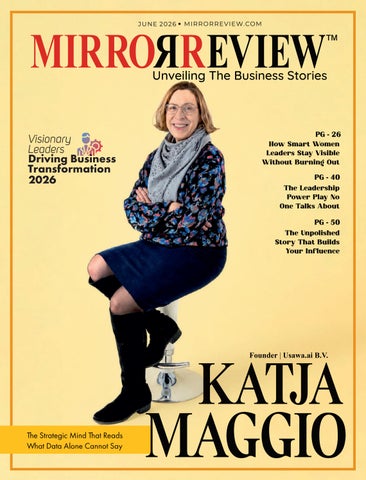
Visionary Leaders Driving Business Transformation 2026
PG - 26 How Smart Women Leaders Stay Visible Without Burning Out
PG - 40 The Leadership Power Play No One Talks About
PG - 50 The Unpolished Story That Builds Your Influence
Founder | Usawa.ai B.V.
KATJA
The Strategic Mind That Reads What Data Alone Cannot Say
MAGGIO
EDITOR’S
Where Vision Meets Velocity, Transformation Finds Its Voice.
Dear Readers, Business transformation rarely announces itself with fanfare. It arrives quietly, carried by leaders who question old assumptions, rebuild trust, and turn stagnant categories into spaces of renewed growth. “Visionary Leaders Driving Business Transformation 2026” celebrates five such individuals, each reshaping their industries not through noise but through clarity of purpose. They are strategists, educators, and change makers who understand that transformation is less about disruption for its own sake and more about aligning people, data, and intent toward outcomes that genuinely matter. Their stories remind us that lasting progress always belongs to those willing to ask harder, more honest questions of themselves and their organisations. At the centre of this issue stands a leader whose intelligence lives not in dashboards but in the pause between a number and a decision. Founder of Usawa.ai B.V., Katja Maggio built her career at the intersection of hard data and human emotion, learning early at Procter and Gamble that insights only matter when they inform better choices. She approaches struggling businesses not with answers but with five deceptively simple questions about relevance, disconnect, and value. Her pioneering use of semiotics, the study of signs and meaning, has helped flagship brands rebuild emotional relevance across markets and cultures. She calls her philosophy augmented humanity, using artificial intelligence to deepen human understanding rather than replace it. Balance, she insists, is not a soft idea but a serious competitive advantage, one she has proven repeatedly across decades of brand reinvention and turnaround. The issue also features Nuno Fontoura, Director of NabiaEdge; Cristina Marinucci, VP Global Growth and Omni Commercial Insights at Mondelez International; Kojima Hiromichi, CEO of AGORAARS; and Eboni Dotson, Assistant Director of HBCU Engagement at the AUC Data Science Initiative. Together, these leaders illustrate that transformation is rarely a single dramatic act. It is the accumulation of small, deliberate choices made by people willing to look honestly at what no longer works. Whether guiding global brands through reinvention, expanding educational access, or building bridges between data and culture, each featured leader offers a distinct lens on what it means to lead with vision. This issue is, above all else, a tribute to that quiet, persistent courage. Sincerely,
SIMRAN KHAN Managing Editor
Publisher Archana Ghule Editor-in-Chief Vikram Suryawanshi Managing Editor Simran Khan Project Editor Shadab Mestri ™
Mirror Review Magazine is published by Pericles Ventures Pvt. Ltd. No part of this publication may be reproduced, distributed, or used in any form without prior written consent from the publisher. The editorial team has exercised utmost diligence to ensure the accuracy and integrity of all published content; however, the publisher assumes no liability for any errors or omissions. The publisher also bears no responsibility for the content of advertisements featured within the magazine.
Mirror Review Media & Tech
Project Managers Nikhil Mahajan Mayur Johari Visualizer Mark Davis Graphic Designer Chaitanya Kulkarni Head of Distribution and Production Aakash Mahajan
Office No. 430, 4th Floor, Gera’s Imperium Rise, Opp. Wipro Circle, Hinjewadi Phase 2, Pune, Maharashtra - 411057.
Head of Operations Robert Smith
+1 (850) 564-8517
Research Analysts James Adams
info@mirrorreview.com www.mirrorreview.com
Advertising Maria Smith
10. Katja Maggio
18. Cristina Marinucci 30. Eboni Dotson 44. Kojima Hiromichi 54. Nuno Fontoura
Articles 26.
How Smart Women Leaders Stay Visible Without Burning Out
40.
The Leadership Power Play No One Talks About
50.
The Unpolished Story That BuildsYour Influence
Content
Profiles
The Leaders Who Will Thrive Agentic AI Are Already Thinking Differently Katja Maggio
Cristina Marinucci
Founder Usawa.ai B.V
VP Global Growth & Omni Commercial Insights at Mondelez International
www.usawa.ai
www.mondelezinternational.com
Eboni Dotson
Kojima Hiromichi
Assistant Director | HBCU Engagement at the AUC Data Science Initiative
Chief Executive Officer AGORAARS
www.aucenter.edu
linkedin - Kojima Hiromichi
Nuno Fontoura Director NabiaEdge www.nabiaedge.com
Founder | Usawa.ai B.V.
KATJA
MAGGIO The Strategic Mind That Reads What Data Alone Cannot Say
10 | JUNE 2026
Cover Story MIRRORREVIEW.COM | 11
is a particular kind of intelligence that does not appear on a dashboard. It does not live inside a data model or emerge from the most sophisticated algorithm ever trained. It lives in the pause between a data point and a decision in the moment when a leader looks at a number and asks not just what it means, but why it means that, and what it means for the real people on the other side of it. Katja Maggio lives and works in that space. She is a Global Strategy and Transformation leader, an award-winning practitioner in applied semiotics, a brand reinvention specialist, and the founder of Usawa.ai B.V. She is the kind of professional whose career defies tidy categorization, equal parts strategist, cultural reader, and deeply human leader. Her work spans continents, categories, and cultures. She has helped flagship brands pull back from the edge of collapse. She has opened new growth trajectories in categories that spent over a decade going nowhere. And she has done none of it by following the conventional playbook. She does it by asking the kinds of questions most leaders are too comfortable to ask. Where Statistics Met the Human Side Katja Maggio’s professional journey begins where many great strategic careers begin, at the intersection of two things that are not supposed to belong together. Most people think of statistics and marketing as natural companions. But the real tension in Katja’s early career ran deeper than that it lived between the cold architecture of big data and the warm, ungovernable territory of human emotion. Between analytics that could tell you what was happening, and empathy that could tell you why it mattered. From her earliest days at Procter and Gamble, she understood something that takes many analytical professionals decades to grasp. “From the start of my career with P&G, I quickly learned that data and insights only matter when you can use them to inform better decisions and strategic choices,” she says. “From early on, I was drawn to the human side of how people make choices, build trust, choose or switch brands, and combine this knowledge with data.” 12 | JUNE 2026
What gave her the edge to see this so early was not simply talent. It was a movement. Working across countries, categories, and cultures forced a kind of perceptual agility that those who spend entire careers in a single market rarely develop. When you have observed how a consumer in one country builds trust with a brand and then watched how differently that same emotional transaction unfolds elsewhere, you stop assuming. You start looking. “Curiosity combined with a desire to anticipate future shifts to drive value,” she reflects, “shaped my leadership style, rooted in human empathy, hard evidence, and action.” Her career, she says, has been fundamentally shaped by turning problems and breakdowns into opportunities through brand reinvention, innovation, portfolio renewal, and building future-ready teams. Five Questions That Unlock a Business When Katja walks into a business under pressure, she does not begin with answers. She begins with five questions. What is the job consumers “hire” the brand for? What made the brand successful in the past? Where is the disconnect today? Which parts of the business still have the right economics, and where is value leaking? And what prevents the organization from acting and evolving? These questions may sound deceptively simple. They are not. Each one is a small destabilization. Together, they dismantle the comfortable fictions that struggling businesses tend to build around themselves. In practice, this means examining demand, brand equity, margin structure, channel performance, customer relevance, and decision-making simultaneously, as a system. It means seeking out the causes of topline erosion, understanding whether a business is misaligned with category drivers or dangerously over-reliant on outdated assumptions. “Turnaround happens when teams face reality and recognize that their assumptions, ways of working, and flywheel do not serve them any longer and are open to change instead of jumping on short-term tactics,” she says.
Cover Story This is a significant observation. It suggests that the most formidable obstacle to transformation in most organizations is not a lack of technology or capital. It is a lack of a corporate culture that inspires the courage required to look at oneself honestly. The Language Beneath the Language
“
In a highly fluid world moving faster, balance is not a soft idea. It is, increasingly, a serious competitive advantage. Her goal is never to fix everything at once. “The goal is not to do everything, but to create clarity and empower teams to drive change at speed.” Curiosity, Sacred Cows, and the Cost of Fear
There are not many global business strategists who have a consistent track record of Brand turnaround through the application of semiotics applied to brand building and/or turnaround. Katja is one of them, and it is arguably the most distinctive lens through which she reads markets, brands, and behaviour. Semiotics, in its simplest form, is the study of signs and meaning. In brand strategy, it becomes something far more powerful. “It is about Cultural intelligence which helps leaders see what traditional marketing frameworks often miss: the codes, meaning and tensions shaping how people talk about the category, how they understand and connect to brands,” she explains. Brands no longer win only through function. They win through differentiated meaning spaces. This is the central insight that semiotics makes legible, and it is a distinction that most brand teams, trained almost exclusively on performance metrics and sales data, are not equipped to see on their own.
There is a question beneath every transformation project, one that most strategists try to answer with frameworks and methodologies, but that Katja approaches almost philosophically. Why do some organizations genuinely change, while others simply perform the idea of change? Her answer is both precise and refreshingly honest. Organizations that transform well are those that stay curious, listen deeply, and value learning. They have no “sacred cows.” They act before they hit headwinds. Transformation needs leaders who can inspire a shared purpose, a bias for action, and the psychological safety for people to make mistakes. Resistance, she says, comes from something far more human and far less comfortable: fear. Closed mindsets, internal politics, siloed decision-making, and a narrow view of performance disconnected from reality. Not structural failures, in the end. But human ones. MIRRORREVIEW.COM | 13
When a brand becomes tired or “stuck in the past,” semiotics can help build more resonant creatives that refresh the brand without sacrificing its authenticity. On one side, Katja works for a very skilled culture club at Usawa.ai; on the other, she also uses AI discovery as an invaluable tool for disruptive innovation and portfolio renewal to engineer what Kantar Brand Z calls “meaningful difference,” helping brands become relevant in their own singular way. Culture shapes behaviour. And if you cannot read the culture, you cannot lead the brand. The Feeling That Sells There is a stubborn idea embedded in the business world that “emotional” and “commercial” exist in permanent tension. That to speak of how a brand makes someone feel is somehow to retreat from the serious business of revenue. Katja has spent years dismantling this idea with evidence. “Emotional relevance is not soft; it is a growth lever when it changes customer behavior in ways that are commercially meaningful,” she says. The key, she explains, is understanding the “emotional job” the brand is solving, whether that is inspiring trust, building confidence, providing a sense of belonging, enabling self-expression, offering reassurance, or giving people an escape. By aligning messages and experiences in a way that feels personally meaningful and consistent, and by removing friction, brands become what she calls “sticky.” The consumer who feels genuinely understood, who thinks “this brand understands me,” “it talks to me!” converts more readily, deepens the relationship, and stays longer. The commercial result is measurable: in revenue and in long-term brand equity. This is not a theory. It is what she has seen work, across markets and categories, time and again. The Augmented Human Ask Katja about artificial intelligence, and she will not give you a breathless speech about disruption. She will give you something far more useful: a map of the edges. 14 | JUNE 2026
Cover Story She references the work of Professor K. Lakhani from the HBS AI Institute at Harvard, who describes what he calls the “jagged edge of AI applications,” the concept that AI excels in some tasks and falls short in others, and that this edge is not readily visible. Knowing where that edge lies is one of the most critical leadership capabilities of this decade. “Data and AI exponentially expand our ability to discover new information at scale, uncover patterns, and make predictions at unprecedented speed and precision. Still, I see technology as an amplifier of human understanding, not a substitute for it,” she says. Contextual judgment, empathy, emotional intelligence, the ability to weigh signals and assess risk, these, she argues, remain irreducibly human. When technology is used in isolation, the risk is to create false certainties: an organization that is internally efficient but externally irrelevant. Her alternative is a concept she calls “augmented humanity,” using AI to deepen human understanding, not flatten it into a library of prompts or a set of dashboards. It is a careful, principled distinction. And it is the philosophical foundation on which everything she builds at Usawa.ai rests. Usawa and the Pursuit of Balance The name of Katja’s company is not accidental, and neither is the language it comes from. “Usawa” is a Swahili word that means balance. The choice of Swahili is deeply intentional. Swahili is a unifying language across African tribes, a cultural bridge spanning East and Central Africa, a tongue that has historically fostered unity across division, connecting communities across vast differences of geography, tradition, and identity. That spirit of connection is woven into the very promise of the company. For Katja, “balanced augmented humanity” is not simply a methodology. It is a belief that AI and human intelligence, when properly integrated, should build bridges, not widen divides. It should serve as the backbone that unifies different teams, aligns different agendas, and refocuses an entire organization on what matters most: the customer, the human being at the centre of every decision. Balance, she will tell you without hesitation, is not a soft or passive concept. It is a competitive strategy. Usawa.ai B.V. was built to address a very specific and very modern paradox: the abundance of data leading to a poverty of strategic clarity.
“The exponential proliferation of data and analytics correlated to topline erosion; teams drowning in data, unable to drive growth; siloed tech-stack narrowing the line of sight and driving a false sense of security whilst business is under pressure,” she describes. These are the symptoms Usawa.ai was designed to treat. The company helps organizations refresh established brands, identify new growth spaces, and build stronger customer-centric capabilities to grow topline. It uses AI combined with cultural intelligence, behavioural understanding, and deep business knowledge to spot weak signals earlier, test hypotheses faster, connect fragmented data sources, and identify emerging consumer needs before they become obvious in the market. The goal is foresight. The output is future-facing value creation strategies that compound over time. And the competitive advantage is augmented humanity, not AI alone, not instinct alone, but the two working together with intention, and with the explicit purpose of bringing people closer together rather than pulling them further apart. Ninety Days and a Decade of Stagnation Among all the work Katja has done across her career, one story stands out as the clearest expression of who she is as a leader and what she believes about business transformation. She was working at P&G on the Fabric Softener portfolio. In early 2000, the category had been sluggish, and the brand had been in stagnation or decline for over a decade. The business had declared a breakdown and had been given just 90 days to come up with a plan. MIRRORREVIEW.COM | 15
Cover Story She pioneered the use of Semiotics to understand the Brand disconnects, how to rebuild the Brand emotional connection, and identified new category growth space. This helped the team evolve brand creatives and launch a series of disruptive innovations. These generated quick wins, which drove confidence in the business and created the momentum needed for the broader commercial interventions to follow.
The beauty industry, she says, is already entering this structural inflection point. Loyalty is eroding. Customer acquisition costs are up 60 to 80%. Earned media is under strain. Creators are burning out. Consumers are beginning to streamline their consumption in response to the clutter and overabundance that now define most markets. And the default response, more SKUs, more content, more paid media, more AI-generated content, only accelerates the problem.
The business stabilized. It then returned to both top-line and bottom-line growth, anchored by an ownable and sustainable competitive advantage. The transformation was executed across 25 countries, turning around the flagship brands and, critically, opening a new growth trajectory for the entire category.
“My bigger vision is to help companies move more deliberately: fewer, more meaningful products with stronger proof; Humancentric AI as a value driver; and business models designed for longevity, not just launch cadence,” she says.
“This experience was core in shaping my philosophy,” she reflects. “Put the customer at the centre; identify frictions and business gaps; cut the noise and stay focused on what matters most; propose a solution the organization is able to execute with excellence.”
The Energy Economy
There is an earlier, quieter test she also recounts. She was hired to help a business under pressure whose leadership spoke about transformation but had no genuine desire to challenge the assumptions that were no longer working. Rather than retreat, Katja stayed close to the data, identified the biggest pain points, and worked alongside the teams on the ground. She helped generate what she calls “green shoots,” early signs of recovery on an eroding business. Those signs created the appetite for bigger change. “Leadership is about choosing the 'hard right' instead of what would have been easy,” she says. “It is about the ability to bring people with you, even when you don't have support, and the importance of small wins to start a transformation.” The High-Entropy Future Katja sees what is coming. And she sees it with the systemic clarity that most leaders will not arrive at until they are already standing inside the problem. She invokes a concept from systems theory: the highentropy phase, a condition in which revenues may appear to be growing, but the energy required to sustain the current model rises faster than the value it creates. 16 | JUNE 2026
That is the contribution she wants Usawa.ai to make: more future-ready, more human-centred, value-creating businesses.
Katja does not believe in work-life balance. She is entirely unambiguous on this point. What she believes in instead is conscious energy management, a deliberate, ongoing practice of recognizing what depletes her energy and what restores it, across both work and life. She exercises daily. She recharges through learning, through meaningful conversations, and through time with her family. These are not escapes from her professional life. They are, she is very clear, integral to it. “These moments are not separate from leadership: they enhance and strengthen it. They keep me curious, grounded, and able to lead with both energy and perspective.” For a leader of her depth and range, this is not a lifestyle preference. It is a discipline. And it is, quietly, one of the most honest things she says. Balance Is the Strategy There is a word that returns again and again when you spend time understanding how Katja thinks, leads, and builds. It is the word at the centre of her company's name. It is the word she returns to when asked about the philosophy that has guided everything – Balance. Balance between data and empathy. Between reinvention and authenticity. Between agility and intent. “The most successful leaders for me are those who stay deeply curious, face reality without defensiveness, and lead from customer centricity, with purpose,” she says.
She believes that transformation has been too often delegated to technology when the real opportunity is to leverage technology to enhance what makes us human and help us do better. “In a highly fluid world moving faster, balance is not a soft idea. It is, increasingly, a serious competitive advantage.” In a business world that has grown very skilled at moving fast and very poor at moving wisely, this is not just a philosophy worth hearing. It is one worth following.
“
Data and AI exponentially expand our ability to discover new information at scale, uncover patterns, and make predictions at unprecedented speed and precision. Still, I see technology as an amplifier of human understanding, not a substitute for it.
MIRRORREVIEW.COM | 17
Global VP, Growth & Omni Commercial Insights at Mondelez International Founder & Podcast Co-Host of SHeCOMMERCE Podcast
Marinucci A Leader Shaping How Modern Brands Understand People and Growth
“
Don’t wait to be ready. Raise your hand for the role, the stretch, the messy brief, and then do the work to earn your seat.
“
18 | JUNE 2026
MIRRORREVIEW.COM | 19
T
he business world keeps shifting as shoppers move between screens, stores, and platforms without a second thought. Companies that once relied on traditional research now face audiences who expect speed, relevance, and real understanding. In this landscape, some leaders focus on data, some focus on creativity, and a rare few learn how to bridge both. This is where Cristina Marinucci stands out. Her work sits at the point where consumer behavior, brand clarity, and commerce come together, and her career has been shaped by a simple question she never stopped asking: What drives people’s choices? Cristina’s curiosity started early and grew into a guiding force throughout her professional life. She often says, “I have always been fascinated by why people choose what they choose, on shelf, online, and in life.” That single interest pushed her into roles that placed her between marketing, sales, and the shopper at companies like PepsiCo, Reckitt, Mars, and Johnson & Johnson. She learned how each function sees growth differently and how real momentum happens when those views come together. Her path took a sharp turn when she co-founded Better Life Ventures, a CBD and plant extract wholesale business. The company went on to become a top-three global wholesaler on Alibaba. Building that operation required her to understand algorithms, content, and conversion at a global scale. It also gave her a front-row seat to how fast marketplace behavior can change and how brands need to adapt in real time. These combined experiences shaped her belief that the future belongs to leaders who listen to consumer, shopper, and customer signals as one connected truth. She explains that this unified view is what allows teams to turn insights into clear, confident action. It is the space she chose with intention, and it continues to define the kind of impact she aims to make. Lessons from Global Brand Leadership Cristina’s years inside major global companies shaped her approach in ways that still guide her work today. She often describes each organization as strengthening a different muscle of how she thinks. At PepsiCo, she developed a strong sense of commercial discipline and learned the value of flawless execution at the frontline. Reckitt and Mars pushed her to work with speed and clarity while keeping the category at the center. She notes that “if you grow the category, everyone wins,” a lesson that stayed with her long after those roles. 20 | JUNE 2026
Her time at Johnson and Johnson marked a turning point. It fully immersed her in ecommerce and digital analytics, where classic ideas around product, price, promotion, and placement needed to be reimagined for an always on world that never switches off. This shift changed how she viewed brand building. She found that real impact comes when brand purpose, retailer economics, and shopper reality sit within one connected system that creates a win for everyone involved. Leading Global Growth and Omni Commercial Insights at Mondelez In her role at Mondelez International, Cristina leads a global team responsible for turning signals from the market into clear paths for growth. She focuses on connecting foresight, consumer and shopper insights, and commercial analytics so they work as one system. Her team builds integrated strategies that stretch from media planning all the way to the shelf, giving the business a unified view of how people discover, consider, and buy. Cristina explains that a key part of this work involves shaping multiyear category visions and identifying the growth drivers that matter most. Her team also creates practical tools, including the company’s commercial growth planning tool and its digital shelf Flywheel diagnostics, which help markets and customers understand where they can win. She sees her remit as broader than just insights or strategy. It includes capability building and change leadership, ensuring that insights do more than inform reports. In her words, they must become “an engine that guides where we invest, how we innovate, and how we show up with retailers and consumers.” Building Insight-Led Strategies That Deliver Real Growth Cristina believes that an effective strategy begins with clarity, not charts. She starts with the outcome that matters and the decision that needs to be made. From there, she identifies what success should look like for the consumer or shopper, the customer, and the brand. She often describes this as a “triple win,” because growth only sticks when all three sides benefit. Her team looks well beyond standard brand and category metrics. They study the functional and emotional needs behind real choices and track how those needs shift across occasions, channels, and contexts.
This understanding becomes the base for integrating demand spaces, cultural and category trends, retail media signals, revenue growth levers, and execution constraints. The goal is to land a small number of clear “where to play” and “how to win” choices that teams can act on. Cristina places equal weight on experimentation. She works closely with customers to test ideas, measure incrementality, and turn proven approaches into playbooks that scale rather than isolated success stories. Balancing Art and Science in Understanding People Cristina approaches consumer behavior with equal respect for numbers and human stories. She often says that science reveals the pattern while the art explains why it matters. Her team relies on advanced analytics, including both behavioral and purchase data, AI tools and retail media signals to understand what people are doing and which factors drive performance. These signals give a strong foundation, but she believes they are only half of the picture. To bring meaning to the data, Cristina layers in qualitative work that captures context and emotion. This includes real-world observation, co-creation sessions, and cultural trend studies that show how people think, feel, and choose in everyday life. These methods help her teams see the person behind the pattern and understand what truly motivates behavior. Cristina often reminds her teams that insight is a verb, not a dashboard. MIRRORREVIEW.COM | 21
The Mindset of a “Shaker Upper” Cristina describes herself as a “Shaker Upper” because she is not hired to keep things as they are. She looks past the brief in front of her and pushes teams to uncover the real problem beneath the surface. She leans into the healthy tension that exists between global and local teams and across brand, category, shopper, media, and commerce. For her, this tension helps break silos and reshape how work gets done. Her approach comes from sitting in many different roles throughout her career, including insights, marketing, sales, and category strategy. She also built a business as an entrepreneur. This range gives her a 360 view of how decisions land in customer meetings, on a P&L, and in a shopper’s mission. She leads with empathy and designs solutions people can act on. At Mondelez, this mindset has helped unify category and shopper strategies, reframe their Growth Philosophy and strengthen Shopper Excellence as a global community. How AI Is Reshaping Modern Consumer Engagement Cristina sees artificial intelligence as a force that is shortening the distance between a signal in the market and the action a brand takes. Her teams already use AI to improve digital shelf content, personalize promotions, and understand retail media impact in ways that go far beyond last-click results. She believes the next phase will be true closed-loop systems where media, loyalty, and in-store data connect to predict missions, baskets, and next best actions across channels. She also expects AI agents to play a larger role in everyday shopping. These agents will anticipate needs, curate options, and even handle routine purchases in the background. 22 | JUNE 2026
Brands will need to design for a world where they appeal to both people and the intelligent systems that filter choices for them. As an AI advocate, she often speaks about AI as a copilot that strengthens human judgment. Her core belief is that AI should make experiences more human, more relevant, and less wasteful while respecting consent, context, and value exchange. Milestones that Reflect Meaningful Impact Cristina measures impact by how strategy, systems, and outcomes come together. One of her proudest contributions is co-leading the creation of the Growth Wheel, a unified framework that brings category, brand, shopper, and commercial strategies into one view. This framework, combined with global snacking growth drivers, enables markets to implement a consistent 6P approach (Proposition, Product, Package, Price, Promotion, Place) and collaborate with retailers in a way that fosters overall category growth. She also led a major shift in how Mondelez thinks about innovation. Her multi-market research uncovered deep emotional and functional needs behind snacking, which she translated into seven consumption design targets with Global North Stars that articulate how to win in these key snacking moments across 6P. These now guide priorities across brands, categories, and R&D and have inspired more than 100 new concepts for icons like Cadbury and Oreo. Earlier at Johnson and Johnson, she built a CRM strategy that evolved into a living insights and loyalty engine. She is equally proud of her entrepreneurial chapter with Better Life Ventures, which proved she could win in a fast, data-driven marketplace.
“
As you climb, remember that it is not just about what you achieve, it is about how you get there and the legacy you leave behind.
“
For her, the value lies in the decision that follows and the clear action taken in the marketplace. Insight must lead to movement, not just measurement.
MIRRORREVIEW.COM | 23
Her contributions have been recognized across the industry, including accolades such as the Women of Excellence Award from the Path to Purchase Institute for Industry Impact, as well as being listed on The Lead – Direct 60 list of digitally driven executives. Additionally, the Brandon Hall Group awarded her Silver Awards for RGM Certification and Capabilities, highlighting that her work brings about real change rather than just compelling ideas. Looking Ahead: Building the Future of Unified Commerce Cristina’s next chapter is shaped by a clear ambition. She wants to help design the operating system for unified commerce, where insights, media, retail media networks, and commercial planning sit inside one connected framework. Her vision depends on better measurement transparency and stronger data sharing between retailers and brands. She believes progress will come when both sides work from a common truth rather than competing frameworks. At the center of this goal is her commitment to triple win outcomes that create real value for shoppers, retailers, and brands. She also plans to keep using platforms like her SHeCOMMERCE podcast, industry forums, and leadership roles to push these conversations forward and open opportunities for others. She hopes her impact reaches beyond growth charts. She wants to inspire future talent to ask hard questions, trust their worth, and build products and services that genuinely improve daily life. For Cristina, legacy is about the way the work is done: with transparency, shared value, and steady courage. Finding Balance and Joy Beyond Work Cristina is quick to say her work–life balance is not perfect. Instead, she thinks in seasons. Some phases of the year demand more from her at work, while others center on her daughters and their cheer, dance, and everyday milestones. What she protects most is boundaries and presence. When she is working, she is fully committed. When she is with her family, they have her full attention. 24 | JUNE 2026
She tries to experience life with intention rather than moving through it on autopilot. At home, that means creating moments that her family will remember. They celebrate half birthdays, take part in scavenger hunts she meticulously designs, and often fall into spontaneous dance parties with her daughters. She enjoys date nights with her husband and always makes time for simple routines like hugs, snuggles and notes of encouragement for her “girlsquad”. She also recharges through travel, mentoring women, and co-hosting SHeCOMMERCE with Jacqui Dynowski. Time spent in sunshine, around good food, and in curious conversations reminds her why the work matters. A Message for Future Leaders Cristina often says that ambition means little without opportunity, and sometimes the opportunity has to be created, not given. Her advice is simple: do not wait to feel ready. Step into the stretch role, take on the messy brief, raise your hand, and then put in the work to earn your seat. She believes leadership is defined not only by what someone achieves but also by how they get there and the legacy they leave behind. For her, that legacy begins at home. She wants her daughters to remember her as someone who showed up, asked hard questions, and never settled. She hopes they look back and feel encouraged to use their voice, trust their ambition, and expect nothing less than what they deserve. Her message to readers echoes the same spirit. She believes every person is capable and worthy of the dreams they carry. The path forward starts with backing yourself, doing the work, and leading in a way that helps the next person believe they can rise too. To learn more about Cristina Marinucci, you can visit: LinkedIn: www.linkedin.com/in/cristinamarinucci/ Website: www.cristinamarinucci.com Podcast: www.shecommercepodcast.com
MIRRORREVIEW.COM | 25
26 | JUNE 2026
SMART WOMEN
LEADERS Stay Visible Without Burning Out You Don’t Have to Be Online to Be On Point Let’s start here: The real pros don’t sprint every day. They pace themselves like marathoners with a war plan. That’s something most people don’t tell women leaders building a personal brand: Visibility doesn’t mean volume. Somewhere between the latest webinar on “consistency” and the social post that says, “Just show up daily,” many women in business confuse constant availability with strategic visibility. That confusion is expensive. It costs peace. It costs health. It burns out your creativity. The good news? You don’t need to choose between growth and your nervous system. You just need a shield. You Are the Brand—But You’re Also the Operator There are two versions of you: 1. The one that shows up online. 2. The one that runs the whole operation behind the scenes. Too many women think their business will stop if their face doesn’t appear on every timeline. But when you’re the strategist, the creative director, the CEO, and sometimes the assistant… it’s not just okay to pause—it’s essential. Let’s be blunt: You can’t build a brand worth following if you’re running on fumes. Think of it this way. If you are the light, your visibility is the switch. You control it—not the algorithm. The goal is not to be seen all the time. The goal is to be remembered when it counts. MIRRORREVIEW.COM | 27
Athena Didn’t Post Daily The Greek goddess Athena didn’t march into every war. She picked her battles. She carried a shield, not just to defend—but to signal power. Presence without chaos. You don’t need to explain your silence or justify your break. If you’re in a season where the energy’s low, that’s data. Use it. Adjust. You can still lead, still sell, still inspire—without live-streaming your entire emotional cycle. In fact, a lot of people trust you more when you show restraint. The Power Pause: A Reset, Not a Retreat There’s something most highperforming women avoid talking about: the off-switch. Not the glamorous sabbatical or the post-hustle Bali trip. I’m talking about a quiet Tuesday where you just… don’t show up. No post. No launch. No “I’ll be back soon” note. You just pause. Strategically. Like a woman who knows her value doesn’t disappear when she logs off. You know what that does? It builds intrigue. It commands respect. And it makes space—for new ideas, sharper offers, and better boundaries. Don’t Fear the Algorithm—Train It Let’s get practical. You don’t have to abandon your brand to take a breather. You just need to set it up like a business, not a mood board. 28 | JUNE 2026
MIRRORREVIEW.COM | 29
Rebuilding Healthcare from the Inside Out
30 | JUNE 2026
Assistant Director AUC Data Science Initiative
MIRRORREVIEW.COM | 31
H
ealthcare systems do not fail loudly. Most of the time, they fail quietly. In delayed appointments. In confusing processes. In patients who feel unseen and unheard. Behind each of those moments sit decisions about policies, workflows, and leadership priorities. Those decisions shape outcomes long before a clinician ever enters the room.
Eboni Dotson has spent her career paying attention to those quiet moments. She did not arrive in healthcare leadership chasing titles or distance from patients. Her path took shape through lived experience. She has been a patient. She has been a caregiver. And she has navigated healthcare systems as a Black woman who understands how easily people can fall through the cracks when systems are not built with care. Early in her journey, Dr. Dotson believed, like many do, that the greatest impact in healthcare happened at the bedside. Over time, that belief began to shift. She started to see how leadership decisions ripple outward. “I saw how policies, workflows, and leadership decisions quietly but powerfully determined who received care, who was heard, and who was left waiting,” she says. What she witnessed was not always intentional, but it was consistent enough to demand attention. That awareness became a turning point. Dotson realized that compassion alone could not fix broken systems. Healthcare needed structure, accountability, and leaders willing to look closely at how things actually worked. She moved into healthcare operations and quality improvement with a clear purpose. “I moved into healthcare operations not because I wanted distance from patients, but because I wanted proximity to change,” she explains. Each role since then has sharpened her focus. Dotson works at the intersection of efficiency, equity, and trust, helping organizations build systems that serve people better and more fairly. For her, leadership is not about control. It is about responsibility. Healthcare, she believes, must earn the trust people place in it, and that work begins far beyond the exam room.
Her day-to-day work centers on expanding access to data science education and applied research for faculty and students across historically Black colleges and universities. Much of that work ties directly to healthcare and social impact, where data can influence everything from patient outcomes to public policy. Dr. Dotson approaches this responsibility with intention. She understands that access to data literacy is no longer optional. It determines who gets to ask questions, who gets funded, and whose solutions are taken seriously. What gives the role its weight is its long-term impact. Dr. Dotson is not simply supporting programs or checking milestones. She is helping institutions and individuals step into spaces they have long been excluded from. “I am helping institutions and individuals claim their rightful place in shaping the data-driven future,” she says. That work happens through faculty research support, student engagement, and partnerships that strengthen institutional capacity. At the center of her approach is a clear belief. Talent has never been the issue. Access has. Dr. Dotson works to make sure that brilliance is not limited by resources or opportunity. Her goal is to help HBCUs lead in innovation, not follow it, and to ensure that the next generation enters the data economy prepared to shape it with purpose. Turning Responsibility into Action Through Thoughtful Consulting Healthcare Strategic Consultants, LLC grew out of a pattern Dr. Dotson saw again and again. Leaders cared deeply about their organizations and the people they served, yet many were operating without the structure needed to create lasting change. The responsibility felt heavy. The support systems did not always match it. Dr. Dotson founded the firm to close that gap.
Building Pathways through Data, Education, and Access Dr. Dotson’s current work places her at a different, but deeply connected, point in the healthcare and equity conversation. As Assistant Director of HBCU Engagement at the AUC Data Science Initiative, she operates where education, innovation, and justice meet. The role allows her to think beyond a single organization and focus instead on systems that shape who gets to participate in the future of data-driven decision-making. 32 | JUNE 2026
The consultancy focuses on healthcare operations, quality improvement, leadership development, and organizational transformation. Each area connects back to a central idea. Systems work best when they align with the values they claim to hold. Dr. Dotson partners with organizations to bring that alignment into focus, helping leaders move from intention to execution in practical ways.
MIRRORREVIEW.COM | 33
34 | JUNE 2026
Much of the work involves untangling complexity. She works alongside leadership teams to strengthen governance, clarify workflows, and improve how decisions are made. Equity is not treated as a separate initiative. It is embedded into operational strategy, where it can shape outcomes rather than sit on the sidelines. This approach allows organizations to improve performance without losing sight of the people affected by every decision. For Dr. Dotson, the work is not abstract. It is personal. She has seen what happens when systems fail and when accountability is unclear. Consulting gives her the ability to stand with leaders as they build organizations that function well and treat people with dignity. Her goal is not just high performance. It is to help create healthcare organizations that are humane, resilient, and worthy of trust. Bridging Data Innovation with Equitable Care Data can reveal uncomfortable truths, or it can hide them. At the AUC Data Science Initiative, Dr. Dotson approaches data science as both a technical discipline and a moral one. Students and faculty are taught that numbers carry stories, and those stories shape real lives. The initiative supports faculty-led research and places students inside real-world challenges tied to health disparities, access, and community well-being. This grounding keeps innovation connected to context, not abstraction. When data is applied with care, it becomes a tool for accountability rather than convenience. Dr. Dotson believes responsible data use can move healthcare closer to fairness, ensuring efficiency never comes at the expense of humanity. For communities long overlooked by traditional systems. Building Partnerships That Last Dr. Dotson treats partnerships as relationships rather than transactions. She looks for collaborators who understand that equity work is not occasional or convenient, but ongoing. Trust and shared values guide how those relationships take shape. Her strategy focuses on building pathways that give students hands-on experience while supporting faculty scholarship and institutional growth. Just as important, she works to ensure programs can survive beyond a single grant or funding cycle. MIRRORREVIEW.COM | 35
Sustainability, for Dr. Dotson, means institutions are equipped to carry the work forward on their own terms. “True partnership means building something together that lasts,” she says, “and being willing to stay when the work gets hard.” This approach helps create opportunities that grow stronger over time, not smaller, for everyone involved. Measuring Equity with Accountability and Care Dr. Dotson believes equity must move from intention to action. She builds clarity around outcomes, insists on continuous evaluation, and demands accountability at every stage. Her work begins with difficult questions. Who benefits? Who remains unseen? What must change to close the gap? Measurement alone is not enough. She grounds programs in lived experience, ensuring communities help shape the solutions meant to serve them. She views people as contributors, not recipients. Impact becomes meaningful when data and dignity move together. Progress is tracked carefully, but never at the cost of humanity. By holding systems accountable while honoring real stories, Dr. Dotson ensures equity work delivers results that last. This discipline keeps her work focused, transparent, and grounded in responsibility over time consistently. 36 | JUNE 2026
Collective Approach to Leadership and Restoration Dr. Dotson describes her partners as a collective of courageous leaders committed to cultural restoration and transformational leadership. They include academic administrators, faculty members, philanthropic partners, and industry collaborators who share a belief in restoring dignity, opportunity, and agency to communities long excluded from innovation spaces. These relationships are built on trust and shared responsibility, not visibility or credit. What connects this group is a clear understanding of leadership as stewardship. Each partner recognizes their role extends beyond immediate results. Together, they focus on building systems that reflect their values and endure over time. The work honors the past while preparing future generations to lead with purpose, care, and accountability. This commitment grounds collaboration in intention, patience, and shared long-term vision.
Standing firm carried a cost, but it clarified her values. These experiences strengthened her resilience and sharpened her sense of responsibility. Integrity became nonnegotiable, even when progress felt slow or lonely. Those moments reaffirmed her commitment to lead with integrity, regardless of outcome or recognition. They shaped a leader willing to choose principle over comfort, and patience over applause, while trusting that meaningful change often arrives after persistence, faith, and resolve are fully tested over time and pressure consistently. Measuring Impact through People, Not Plaques
Consulting as a Complement to Purpose Consulting places Dr. Dotson inside moments that most leaders rarely discuss openly. As Founder and CEO of Healthcare Strategic Consultants, LLC, she often meets organizations during tension, transition, or transformation. These moments demand honesty, structure, and guidance. The work complements her academic role by grounding theory in daily operations and turning vision into execution. Lessons from the classroom inform the field, and real-world challenges sharpen her thinking as an educator. Dr. Dotson sees both roles as expressions of the same calling. Each allows her to help leaders build systems that serve people rather than exhaust them. Whether advising executives or shaping academic pathways, she focuses on practical change that lasts. The goal remains consistent. Healthcare systems should work with people, not against them. Leadership Tested by Conviction Leadership is tested when advocating change that unsettles comfort yet serves conscience. In those moments, Dr. Dotson relied on courage, preparation, and prayer to stay grounded. She learned that leadership rarely offers immediate validation. Often, it demands steadiness long before agreement follows.
Dr. Dotson measures impact differently than most. For her, the most meaningful achievements are not awards or titles, but people. She points to students who now see themselves as innovators and problem-solvers. She points to faculty who feel supported enough to pursue bold research questions. She points to institutions that are stronger, more connected, and better equipped to serve their communities. These outcomes reflect progress that cannot always be quantified, yet they signal lasting change. Each success reinforces why the work matters. It confirms that access, support, and belief can shift trajectories. For Dr. Dotson, those moments offer the clearest evidence that her efforts are creating real, human impact where it counts most. Sustaining Balance through Alignment Balance, for Dr. Dotson, is less about separation and more about alignment. She is intentional about how she spends her time and energy, knowing effectiveness depends on restoration. She protects space for reflection, for relationships, and for moments that allow her to slow down. Those practices are not indulgences. They are part of how she leads well. MIRRORREVIEW.COM | 37
38 | JUNE 2026
Creating room to think clearly helps her make better decisions and remain present in demanding environments. By honoring what restores her, Dr. Dotson sustains the clarity and steadiness her work requires. Balance becomes a practice of alignment between values, responsibilities, and care for self, allowing her to remain grounded while carrying complex work forward with purpose and consistency over time and across evolving professional seasons. Scaling Impact without Losing Purpose Dr. Dotson’s next chapter centers on scale without drift. She is focused on expanding ecosystems that prepare underrepresented leaders to shape healthcare, policy, and innovation on a global stage. The work is not about growth for visibility, but reach with responsibility. She wants systems that open doors, share power, and endure. As initiatives grow, purpose remains the anchor.
A Guiding Philosophy for Leadership For Dr. Dotson, leadership is a calling, not a title. She believes that true transformation begins when leaders approach their work with courage, humility, and genuine care for the people they serve. Success is not measured by recognition, but by the positive, lasting change created in communities, organizations, and individuals. She encourages leaders to prioritize integrity over convenience and to center the humanity of those affected by their decisions. “Lead with courage, humility, and love for the people your work touches,” she says. For Dr. Dotson, this principle guides every initiative, partnership, and strategy, reminding us that meaningful leadership transforms systems because it honors people first.
She plans to deepen partnerships, strengthen pipelines, and invest in leaders who will carry this work forward in their own contexts. The aim is long-term change built with care. Wherever the work expands next, it will remain grounded in service, stewardship, and a clear commitment to equity that crosses borders and disciplines, while honoring community voice and shared accountability.
MIRRORREVIEW.COM | 39
40 | JUNE 2026
The Power Play No One Talks About The loudest person in the room rarely runs it. In high-stakes leadership, power often belongs to the one who knows when to step forward—and when to step back. I’ve watched this play out in boardrooms on five continents. The most influential leaders guard their energy like investors guard capital. They don’t burn it on every request, meeting, or fight. They deploy it where the return is highest. That isn’t retreat. It’s precision. Why Energy Is a Strategic Asset—Not a Renewable One You’ve been told to “show up everywhere” and “always say yes to opportunity.” That’s advice designed to keep you busy, not effective. Energy works like working capital: if you spend it indiscriminately, you’ll have nothing left for the decisions and conversations that actually move the needle. I’ve seen too many founders, executives, and creatives burn themselves out trying to be constantly available. By the time they hit the moment that truly matters—negotiating a critical deal, steering through a crisis—they’re running on fumes. The leaders who win over decades build what I call an Energy Reserve Strategy: they invest in recovery, decline low-value demands, and preserve their capacity for the work only they can do.
MIRRORREVIEW.COM | 41
The CEO Pattern You’ll Never See in Their LinkedIn Posts When you study leaders at the top of their game—Oprah Winfrey, Ava DuVernay, Shonda Rhimes, Naomi Osaka—you notice a pattern: They say “no” more than they say “yes.” They disappear on purpose. They choose when to speak, rather than react to every moment. Oprah has said her breakthrough came when she stopped saying “yes” out of obligation. Naomi Osaka skipped press conferences to protect her mental bandwidth. Ava DuVernay directs her focus toward the work that will outlast the noise. None of them confuse constant presence with meaningful impact. How to Build Your Own Energy Reserve Strategy Stop thinking of energy management as self-care. It’s operational discipline. Here’s the framework I use with executives who want sustainable influence: 1. Audit the Drains – Track your week. Identify what drains you without delivering measurable value. 2. Cut Without Guilt – If it doesn’t move your mission forward, it’s a no. No justification required. 42 | JUNE 2026
3. Schedule Recovery Like Revenue Work – Block solitude, deep work, and decompression into your calendar before anything else. 4. Decide Your Deployment Triggers – Define the criteria for when you’ll step in, speak up, or take the lead. If it doesn’t meet that bar, you hold. This isn’t about hiding. It’s about controlling the terms of your visibility. Why This Works in Divided Times In today’s polarized climate—inside companies, markets, and public discourse—reaction speed is overrated. Leaders who pause before acting can see beyond the noise. Congresswoman Pramila Jayapal calls her introversion an advantage: it allows her to hear more, filter faster, and find leverage points in heated negotiations. The same applies in business. If you burn energy reacting to every provocation, you lose clarity. If you hold back, assess, and respond only when impact is possible, your influence compounds. The Diplomatic Deployment Principle Think of your influence like a high-value currency. If you spend it on every small transaction, it loses value. Spend it strategically, and its weight grows.
The Misconception That Costs Leaders Their Edge Too many talented people believe that influence requires constant output. They confuse activity with authority. In reality, measured presence builds more trust than constant chatter. The people you lead, sell to, or negotiate with learn that when you step in, it matters. That scarcity creates weight. And weight moves decisions. The Playbook for Quiet Influence If you want to operate like the leaders I’m describing, here’s the system: 1. Treat Energy as Capital – Your time and presence are assets. Protect them like your P&L depends on it—because it does. 2. Operate From a Reserve – Never let your energy account hit zero. Decisions made from depletion are almost always costly. 3. Define Your “Yes” and “No” Rules – Without clear criteria, you'll spend yourself on work that doesn’t move the mission. 4. Build Recharge Rituals – Whether it’s a daily walk, two hours of phone-off time, or quarterly solo strategy days, make it non-negotiable. 5. Deploy With Intention – When you engage, bring full clarity, preparation, and presence. Then step back before your edge dulls. The Bottom Line
This is why Ava DuVernay’s voice carries. She doesn’t engage every battle. She picks the ones that shift the industry. You can do the same. · Save your input for moments that definedirection. · Let others exhaust themselves in the noise. · When you speak, make sure it counts. This isn’t passivity—it’s tactical patience.
Leaders who master energy control don’t just last longer—they win more often. While others burn themselves out trying to be everywhere, they conserve power for the moments that change everything. Your job is not to be constantly visible. Your job is to be unmistakably effective when it matters. If you do this well, you won’t need to fight for attention. Your absence will be noticed—and your presence will be felt. MIRRORREVIEW.COM | 43
KOJIMA CEO I AGORAARS
Hiromich
The Samurai with a Lean Startup Soul
44 | JUNE 2026
MIRRORREVIEW.COM | 45
T
here is a story that Kojima Hiromichi carries, one that begins not with a line of code, but with a lineage. He was born a descendant of samurai, raised in a world where the concepts of sincerity and friendship with one’s companions were not abstract virtues but the very architecture of a meaningful life. This ancient code, a quiet insistence on honor and connection, seems an unlikely foundation for a man who now stands at the vanguard of Tokyo’s technology scene, a man whose professional lexicon is filled with terms like “Pyramid principle thinking,” “Business process reengineering,” and the relentless, iterative mantra of the Lean Startup’s “Build-Measure-Learn Loop.” Yet, to understand Kojima Hiromichi and his seed-stage IT services company, AGORAARS, is to understand that these two worlds are not in conflict. They are, in fact, the same. He is a man who sees the ghost of a lost friend in the future of mobility, the fate of the planet in the fragile beauty of a coral reef, and the rhythm of music in the act of writing software. With over a decade of experience as a product and project manager and more than five years as a management consultant at a global powerhouse like Accenture, he possesses the sharp, analytical mind of a modern strategist. But it is the story of his own life, a narrative of effort, friendship, victory, and profound loss, that fuels his true mission: to pioneer a future where technology and humanity do not simply intersect but coexist in a state of profound and sincere harmony. Effort, Friendship, Victory Long before Kojima was managing development teams, he was a young man devoted to sports. It was on the field of play that he first learned the elemental truths that would come to define his company’s ethos. He learned the pure, unadulterated joy of victory, but more importantly, he learned that victory was not an event but a process, the culmination of relentless effort and the precious, unbreakable bonds of friendship. This triad, “Effort, Friendship, Victory,” became more than a memory of his youth. It became a foundational philosophy, a belief that the greatest achievements are born from shared struggle and mutual trust. This idyllic chapter of Kojima’s life, however, was tragically interrupted. He lost a dear friend in an accident, a loss so profound that it carved a new and permanent obsession into his heart. The abstract concepts of technology and innovation suddenly became intensely personal. 46 | JUNE 2026
The accident ignited a quest for mobility safety and for the creation of human-friendly technology, a technology that protects rather than endangers, that serves rather than dominates. The ghost of his friend became a quiet companion in his work, a constant reminder of the human stakes involved in every technological leap forward. The Coral and the Code Another piece of Kojima’s story, another formative experience that would shape the DNA of his company, took place far from the bustling energy of Tokyo. He once lived in Okinawa, an island of stunning natural beauty and complex geopolitical realities. It was here that he witnessed the daily presence of U.S. military bases and the struggles of the people living in their shadow. This experience gave him a nuanced understanding of power, technology, and their impact on ordinary lives. However, it was in the vibrant, life-giving waters of Kunigami Village that Kojima found a new and powerful symbol for his mission. He became involved in coral conservation activities, working to protect the delicate ecosystems that are a bellwether for the health of our planet. The coral reefs, with their intricate beauty and their vulnerability to the warming of the seas, became a symbol of his resolve to “protect the future.” The act of preserving this natural wonder was not separate from his interest in technology; it was the same impulse. Whether it was a fragile coral or a human life, the mission was one of protection, of using intelligence and effort to safeguard what is precious. Forging a New Path Kojima’s professional journey provided him with the formidable toolkit he would need to turn these deeply personal missions into a viable enterprise. For over six years, from February 2019 to May 2025, he worked as a management consultant at Accenture in Tokyo. It was here that he mastered the traditional consulting methodologies, the rigorous, structured thinking that allows for the reengineering of complex business processes. His more than ten years of experience as a web product and project manager gave him the hands-on expertise to lead development teams to success.
MIRRORREVIEW.COM | 47
“
Just as music creates rhythm and connects the world, our activities embody the spirit of music at their very foundation.
48 | JUNE 2026
In April 2017, driven by an entrepreneurial spirit, he founded studio911, a mobile gaming startup. The seed-stage company, backed by individual investors, successfully developed a Minimum Viable Product but ultimately made the difficult decision to discontinue development in 2018. This experience, while not a commercial success, was an invaluable lesson in the realities of the startup world, a real-world application of the “Build-MeasureLearn” loop that would become the core mindset of his future consultations. In May 2025, all of these threads, the samurai lineage, the lessons of the playing field, the ghost of his friend, the memory of the coral, the strategic rigor of Accenture, and the hard-won wisdom of studio911, converged. He founded AGORAARS, an IT service provider with a mission that was both technologically ambitious and deeply human. Hello, World!!! The purpose of AGORAARS is stated with a simple, elegant clarity: “Build the coexistence society which is people and technology for people lives as people.” It is a vision for a world where technology serves to enhance our humanity, not to diminish it. The company focuses on three key technology domains that Kojima has identified as critical to this future: Artificial Intelligence, Mobility, and Robotics. The company’s mission statement is not a dry corporate slogan, but an energetic, rhythmic anthem that captures the spirit of its founder: “Hello, World!!! Hear the Voice! Write the Code!! Make some Noise!!! We are AGORAARS!!!!” Kojima explains this with a beautiful analogy. “Just as music creates rhythm and connects the world,” he says, “our activities embody the spirit of music at their very foundation.” The mission is a call to action, a declaration of intent to listen to the needs of the world (“Hear the Voice”), to apply technical skill to meet those needs (“Write the Code”), and to make a significant, positive impact (“Make some Noise”). As a seed-stage company, AGORAARS provides a range of IT services, including in-house development, growth support for other companies, and development support. With his business-level English proficiency, Kojima is adept at navigating international projects, leading his team with the same principles of effort, friendship, and sincerity that he learned in his youth. AGORAARS is more than just a company; it is the story of a life, a bridge connecting past experiences with a profound hope for the future. It is the culmination of a journey, from the quiet dignity of a samurai heritage to the dynamic, world-changing potential of a single line of code. It is Kojima Hiromichi’s sincere and determined effort to make some beautiful, and profoundly human, noise. MIRRORREVIEW.COM | 49
The Unpolished Story That Builds Your Influence ounders spend millions trying to craft “the perfect story.” They hire agencies, shoot cinematic videos, polish every line until it shines.
F
Why We Hide the Part People Need Most
Then they wonder why it doesn’t connect.
· Grew revenue by 300%. · Expanded to three continents. · Featured in Forbes.
Here’s the truth most PR decks won’t tell you: the story that earns influence is rarely the one you’ve polished. It’s the one you’ve lived. The Boardroom Lesson Nobody Prepares You For A few weeks ago, I sat in a room with fifteen high-performing founders. We were there for strategy, not therapy. Yet one person—without a slide deck, without the “approved” brand narrative—told a raw, unscripted account of the moment her business almost folded.
Most leaders know their résumé version of their story—the LinkedIn-approved bullet points:
But they cut the sentences that matter: · Spent six weeks sleeping on a friend’s couch to save the business. · Spent four years selling a service no one wanted before finding product-market fit. · Nearly quit the night before the big break. We cut them because they’re messy. We cut them because they’re not “on-brand.” The irony? Those are the exact lines that make you believable. The Strategic Risk of Staying Polished
She didn’t “present.” She talked. She described the week she had to choose between making payroll and paying her mortgage. She explained exactly how she called her supplier and negotiated terms to buy herself 48 hours. It wasn’t pretty. But the table went silent.
Here’s the cost of staying “safe” with your story: 1. You sound like everyone else. Polished founder bios are interchangeable. 2. You create distance. People can admire perfection, but they rarely trust it. 3. You lose leverage. Investors, clients, and partners lean in when they believe you’ve been tested and survived.
That’s when it hit me: your influence starts where your polish ends.
Every CEO I respect uses story as a tool—not as a highlight reel.
50 | JUNE 2026
How to Find the Part of Your Story That Moves People Forget “crafting” for a minute. Go straight to the events that felt risky to say out loud at the time. Ask yourself: · What happened that changed the way I run my business? · When did I have to make a decision that cost me more than money? · What mistake taught me something no spreadsheet could? Those are the points of connection. That’s the material people repeat when they talk about you in rooms you’re not in. The Real Role of Vulnerability We misuse the word “vulnerability” in business.
It’s not about oversharing or emotional catharsis. It’s about strategic transparency—sharing enough of the truth to make the lesson undeniable. Here’s the filter: If the person across the table can apply what you learned to avoid a mistake, or take a calculated risk faster, it’s worth telling. If it’s just for shock value, save it for the memoir. Community Isn’t Just Comfort—It’s Currency One founder in that room said something that stayed with me: “I didn’t come here to be inspired. I came here to remember I’m not the only one in the fight.” That’s why peer communities matter. Not because you “feel seen,” but because you get operating intel from people who’ve survived what you’re in right now.
MIRRORREVIEW.COM | 51
When you tell the true version of your story inside a trusted circle, two things happen: 1. You get the strategies that aren’t in books. 2. You build alliances that turn into deal flow, partnerships, and backchannel introductions.
If You’ve Been Editing Yourself Down Consider this your push to stop sanding off the edges. You don’t need a dramatic overhaul. You need to reintroduce the human stakes into your origin, your turning points, and your current play. Try this:
This is why every serious founder I know invests in getting in the right rooms—not just for visibility, but for survival. The Business Case for Telling the Real Story I’ve watched leaders triple their speaking fees, close seven-figure contracts, and land media features—not by adding more success stats, but by revealing the turning points behind them. The mechanics are simple: · Raw detail makes it memorable. “I was down to my last $412” sticks longer than “we were struggling financially.” · Specificity signals truth. People instinctively trust stories with dates, numbers, and real stakes. · Struggle signals credibility. If you’ve been through it, you can help others navigate it. Your story is not PR fluff. It’s an asset with a measurable ROI.
52 | JUNE 2026
· Identify one story you’ve been avoiding because it feels too raw. · Write it in bullet points—just the facts, no adjectives. · Decide which parts connect to the value you deliver now. · Share it in a room where the return could be real—whether that’s a sales meeting, investor pitch, or strategic peer group. Final Word Your polished story may get polite nods. Your real one will get remembered, repeated, and relayed to decision-makers you’ll never meet. In business, being known isn’t about telling people what you’ve achieved—it’s about showing them what you've survived, and how that shapes the way you lead. Don’t wait for permission. Don’t wait for the “right” moment. The right moment is the one you decide to stop hiding the part that makes you credible. Lift the filter. Tell the truth. That’s how influence starts.
Fontoura Building Clarity in a Complex Operational World
54 | JUNE 2026
Director MIRRORREVIEW.COM | 55
Before the conversation around supply chains became mainstream and before companies started speaking openly about visibility gaps, many leaders were already feeling the strain of unclear processes and slow decision cycles. Across industries, teams tried to meet rising expectations, yet something always seemed to get in the way. This tension grew quietly in boardrooms and warehouse floors alike, creating a need for someone who could see both the pressure and the potential. It is within this environment that Nuno Fontoura’s story begins to take shape. Nuno Fontoura did not start his career behind a desk or inside a distribution center. His early years unfolded inside the Portuguese Marines, where he learned what it meant to stay focused on a mission, adapt quickly, and rely on discipline to move teams forward. Those lessons stayed with him long after he stepped out of uniform. When he shifted into corporate operations, he recognized a familiar pattern. Organizations were filled with committed people, yet they often worked without a clear framework that showed how daily actions connected to larger goals. This lack of visibility slowed progress and limited growth. As Nuno observed these patterns, he began shaping his own path. He devoted himself to understanding why operations break down and what leaders need to fix them. He later shared that the turning point came when he saw how often decisions were made without the right information at the right time. “I realized leaders wanted clarity, but they did not always have the systems to support it,” he explained. That realization guided him toward logistics leadership coaching, where he blended his operational background with structured profit-system methods. Today, his work reflects both his military discipline and his practical understanding of business operations. He helps leaders see what they could not see before, building frameworks that support smarter decisions and healthier long-term growth. Through this blend of experience and insight, Nuno Fontoura has become a steady voice in a field where clarity matters more than ever. 56 | JUNE 2026
Cross-Functional Alignment and a Blended Coaching Approach Nuno’s years at NabiaEdge brought him into the center of multi-country launches, where every decision depended on teams moving in the same direction. He often worked with legal, policy, commercial, and operations groups at the same time, and he saw how success depended on shared visibility. When each function understood the risks and the goals, the launch stayed steady. When clarity slipped, delays followed. That experience shaped much of how he works with leaders today. He explains that the second major lesson came from watching teams struggle with guidance alone. Coaching helped them take ownership, but they still needed structure to apply what they learned. “A blended model made the most sense,” he shared. He combined coaching principles with consulting tools so leaders could both understand the problem and know how to act on it. This mix became a foundation of his methodology. He helps clients think through challenges while also giving them practical frameworks that support real progress. The approach allows leaders to solve immediate issues and build confidence for future ones. It reflects what Nuno saw firsthand in international operations. Teams move faster when they have both clarity and direction. Seeing Beyond the Blind Spots in Growing Operations In his work with logistics and retail distribution teams, Nuno often notices the same pattern. Companies grow quickly, but their systems do not keep pace. Processes that once worked begin to strain under new pressure, and the gaps stay hidden until something breaks. He explains that many teams rely on informal habits rather than clear procedures, which leads to inconsistent performance and decisions made in the moment instead of with intention.
Another blind spot he sees involves the frontline. These teams interact with daily operations and understand where delays and risks appear first, yet their insight is often missed. Nuno believes their perspective is essential for strong visibility. “Leaders often overlook the people who know the system best,” he shared. His coaching centers on helping leaders build the skills to make timely and informed decisions. He guides them to create structure where it is missing and to use data and frontline feedback to see issues before they escalate. The goal is to shift organizations from constant firefighting to a place of foresight, where they can respond with confidence rather than urgency. Through this approach, Nuno helps teams strengthen performance and stay resilient as they grow. A Framework Built for Clarity and Predictable Profit Nuno is known for using a structured 9-Step Framework that helps leaders move from scattered efforts to steady, predictable results. The foundation of this model comes from the Profit System developed by the Business Coach Academy, a framework designed to give business owners a clear view of their entire operation. It allows them to see what is working, what is slipping, and what areas may be quietly limiting growth. What makes the model powerful in logistics is how Nuno applies it. He blends the structure of the Profit System with principles of operational resilience. He understands that logistics businesses face constant stress, unpredictable demand, and the risk of disruption at any point in the chain. “The framework shines a light on issues leaders often miss,” he explained. By surfacing these overlooked areas, owners gain visibility into both immediate challenges and long-term patterns. MIRRORREVIEW.COM | 57
“
When people understand why their work matters, alignment becomes natural.
58 | JUNE 2026
Nuno’s approach helps leaders analyze their businesses with clarity and act with confidence. The framework becomes more than a checklist. It turns into a practical tool that stabilizes performance in an industry where pressure is the norm. For logistics owners, this balance of structure and resilience creates the conditions for consistent, healthy profit. Moving Beyond Cashflow Paralysis Many of the business owners Nuno works with feel trapped in a cycle of reacting to whatever problem hits next. Cash flow sits at the center of that pressure. When leaders cannot see what is coming, every decision feels urgent. Nuno approaches this challenge by giving clients a simple but powerful starting point. He teaches them how to build their own cash flow models and map out at least ninety days of projected cash availability. Once leaders see what they actually have and what commitments are approaching, the constant sense of uncertainty begins to ease. He explains that the next step is to look for opportunities specific to each business. Some teams benefit from tighter cost control, while others need to focus on revenue adjustments. “The goal is to create an actionable plan, not just more information,” he shared. By working through these details together, Nuno helps clients shift from reacting to planning.
But Nuno’s approach does not stop with numbers. He pairs operational analytics with resilience and leadership assessment tools that help teams interpret what the data is trying to tell them. Alongside data and analytics, Nuno also works at the individual level, helping leaders manage energy, stress, focus, and recovery so they can interpret information clearly and make sound decisions under sustained pressure. “Data is valuable only if people know how to act on it,” he explained. By strengthening both insight and interpretation, he helps teams develop habits that support consistent and accountable performance. This blend of business intelligence and human-centered coaching creates steady improvement. Teams begin to rely on facts rather than intuition, and leaders gain confidence in their ability to guide the operation. Over time, data becomes more than a set of charts. It becomes a shared language that supports better decisions and a stronger operational culture. Leading with Vision While Staying Grounded in Daily Work
Turning Data into Daily Decision-Making
Nuno leads his organizations with a clear long-term view supported by steady weekly habits. He keeps a three-year vision and goal plan that he reviews twice a year, making sure it stays relevant as markets and priorities shift. This long horizon guides where the business is heading, but his weekly planning keeps him connected to the work that needs attention right now. He includes both business tasks and personal commitments in this process, so nothing competes for space without intention.
For Nuno, data is most useful when it becomes part of a leader’s daily rhythm rather than something checked only during reviews or moments of crisis. He helps clients build practical dashboards that highlight the measures that matter most. These tools show performance trends, pinpoint bottlenecks, reveal cost drivers, and track customer-impact indicators. When leaders can see this information clearly, the business becomes easier to understand, and decisions become faster and more grounded.
He often describes work and life as a rhythm instead of a balance. Stress in one area can easily spill into the other, so he treats planning as a way to maintain harmony. “When everything is scheduled with purpose, performance becomes more sustainable,” he shared. By approaching his responsibilities with both structure and flexibility, Nuno stays focused on strategic goals while managing the daily execution that keeps his teams moving forward.
This process gives leaders something they often lack during difficult periods: clarity. With clearer visibility, surprises become rare, and decisions feel more deliberate. Over time, this confidence helps businesses move away from firefighting and toward predictable, sustainable profitability.
MIRRORREVIEW.COM | 59
A Moment that Tested Resolve and Reinforced Resilience Nuno has spent much of his career in environments where pressure builds quickly, and decisions cannot wait. One moment stands out to him as a turning point. During a multi-city launch, supplier readiness fell behind schedule and threatened to derail critical integration timelines. The situation demanded fast action and a calm mind, and he leaned on the discipline shaped during his years in the Marines. He brought cross-functional teams together, clarified responsibilities, and simplified the processes, causing delays. He also kept communication clear and proactive, so stakeholders understood the risks and the plan to move forward. The experience reminded him that strong leadership is not only about operational knowledge. It requires resilience, the ability to anticipate pressure points, and the discipline to create contingencies before cracks appear. “People need clarity when disruption hits,” he said. That lesson continues to shape how he guides teams through challenging moments today. Milestones That Reflect Long-Term Impact Among the many projects Nuno has led, one milestone stands out as a clear sign of the value his coaching brings. A client initially signed on for a three-month engagement, but the partnership grew into a full year. For Nuno, this extension mattered because it showed that the work was creating lasting growth rather than short-term fixes. It confirmed that the client saw real change in their confidence and decision-making. One achievement from that engagement highlights his practical approach. He helped the client build a straightforward Excel-based competitive pricing tool that compared their prices against competitors across different markets. The simplicity of the tool made it easy for leadership and sales teams in multiple countries to use it immediately. “They needed something practical, not complicated,” he said. The result was a clearer view of their market position and more informed pricing decisions. For Nuno, successes like this represent the heart of his coaching: giving clients tools that strengthen capability, adaptability, and long-term performance. 60 | JUNE 2026
Looking Ahead to a Broader Coaching Movement Nuno is now focused on expanding his impact by creating coaching programs that can reach more people without losing the personal depth he values. He is developing scalable group formats supported by data-driven insights and plans to build services that guide entire teams, not only senior leaders. He believes stronger collaboration begins when everyone learns together. “Real progress happens when the whole team grows, not just one person,” he said.
“
People
need clarity
when disruption hits.
This next phase blends technology, community, and practical tools to make coaching more accessible and flexible. His goal is to help more entrepreneurs overcome growth barriers, strengthen culture, and build sustainable profit. Over time, he hopes to move beyond one-on-one coaching and contribute to a wider movement of conscious, high-performing businesses. Finding Rhythm Beyond Work Nuno treats balance as something created with intention rather than something that happens on its own. He protects personal time by scheduling it just as firmly as his work commitments and keeps clear boundaries so both areas can support each other. Learning is a constant part of his life, and he credits it with keeping his thinking sharp and adaptable. Outside of work, he turns to boxing for discipline and stress relief, and he travels whenever he can to stay curious and expand his perspective. He also spends time hiking, which helps him slow down, disconnect from routine, and reconnect with nature. These interests give him the energy and clarity he brings back into his work each day. A Guiding Principle Anchored in Clarity As Nuno reflects on his journey, he returns to a principle that shapes both his leadership and his life. He believes everything begins with clarity. Without it, people lose direction, and businesses drift away from their goals. To him, clarity means more than understanding tasks. It means knowing the deeper purpose behind the work and seeing how each role contributes to the larger vision. “When people understand why their work matters, alignment becomes natural,” he said. This sense of purpose sharpens priorities, improves communication, and strengthens resilience during difficult moments. Nuno also applies the same principle to his personal life, where clarity helps him stay focused, balanced, and intentional. For him, it is the foundation of sustained growth and meaningful leadership. MIRRORREVIEW.COM | 61
www.mirrorreview.com