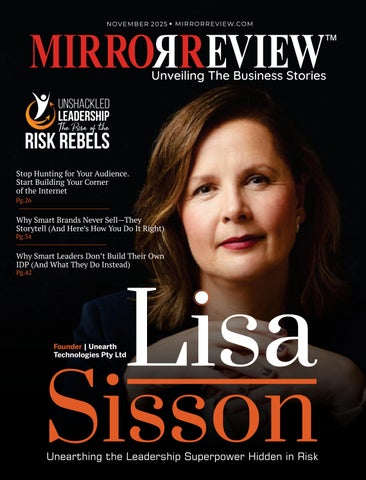
N OVE M B E R 2 0 2 5
M I R R O R R EVI EW.CO M
™
Unshackled Leadership The Rise of the
Risk Rebels Stop Hunting for Your Audience. Start Building Your Corner of the Internet Pg.26
Lisa
Why Smart Brands Never Sell—They Storytell (And Here’s How You Do It Right)
Pg.34
Why Smart Leaders Don’t Build Their Own IDP (And What They Do Instead) Pg.42
Sisson Founder | Unearth Technologies Pty Ltd
Unearthing the Leadership Superpower Hidden in Risk
EDITOR’S LETTER
Leaders Who Break Barriers, Not Rules! In an era where disruption arrives without warning and industries transform overnight, leadership is no longer defined by titles or authority—it is defined by mindset. The global business world now demands leaders who are inclusive, self-aware, and bold enough to challenge outdated systems while empowering diverse perspectives. As uncertainty becomes a constant, organizations are turning toward individuals who can translate complexity into clarity, act decisively under pressure, and foster cultures built on trust and resilience. These are the leaders who don’t fear risk—they understand it, read it, anticipate it, and use it as a catalyst for growth. This edition, “Unshackled Leadership: The Rise of the Risk Rebels,” celebrates those very trailblazers. At the forefront is our cover story feature on Lisa Sisson, Founder of Unearth Technologies Pty Ltd. Long before “risk” became part of her professional vocabulary, Lisa had an uncanny ability to sense danger at the human level—through shifts in tone, posture, or the silence that signals something deeper beneath the surface. These instincts became her compass when she entered the high-stakes world of specialist security and bodyguard operations, where risk was not theoretical but immediate and constantly evolving. Lisa didn’t just observe a room—she interpreted it, often uncovering what others couldn’t yet see unfolding. Today, she channels that same intuitive intelligence into Unearth Technologies, helping organizations understand risk through a deeply human, relational lens. Alongside Lisa’s compelling narrative, this issue also highlights the remarkable leadership journeys of Joanne Jervis, Edward Salvatierra, Adam Hovermale, and Grant Cardone—professionals who exemplify courage, clarity, and the confidence to break from convention. Together, their stories reflect what modern leadership truly demands: empathy, resilience, and the willingness to push boundaries in pursuit of meaningful progress. As we dive into these powerful profiles, we invite you to explore what it really means to lead unshackled—where courage meets intuition, and where today’s risk rebels are shaping tomorrow’s world. Happy Reading!
Parag Ahire Project Editor
PUBLISHER
ARCHANA GHULE
EDITOR-IN-CHIEF
VIKRAM SURYAWANSHI
MANAGING EDITOR PANKAJ GHOLAP
PROJECT EDITOR PARAG AHIRE
PROJECT MANAGERS NIKHIL MAHAJAN MAYUR JOHARI
CREATIVE HEAD
PRIYANKA PATIL
VISUALIZER
MARK DAVIS
GRAPHIC DESIGNER OMKAR URAVANE
HEAD OF DISTRIBUTION & PRODUCTION AAKASH MAHAJAN
HEAD OF OPERATIONS ROBERT SMITH
RESEARCH ANALYSTS JAMES ADAMS
ADVERTISING
MARIA SMITH
FOLLOW US mirrorreviewofficial MirrorReview1 mirror-review mirrorreview mirrorreview
Mirror Review Media & Tech Office No. 430, 4th Floor, Gera’s Imperium Rise, Opp. Wipro Circle, Hinjewadi Phase 2, Pune, Maharashtra - 411057.
+1 (850) 564-8517
info@mirrorreview.com
www.mirrorreview.com
Mirror Review Magazine is published by Pericles Ventures Pvt Ltd. No part of Mirror Review magazine may be reproduced, published or used in any manner without prior written consent from the publisher. The team of Mirror Review Magazine has made every effort to ensure the accuracy of the content. The publisher assumes no responsibility of any part of the content of any advertisement in this publication, including any errors and omissions therein.
LISA SISSON
22. Adam Hovermale 30. Edward Salvatierra 38. Grant Cardone 46. Joanne Jervis ARTICLES
CONTENT
PROFILES
26.
Stop Hunting for Your Audience. Start Building Your Corner of the Internet
34.
Why Smart Brands Never Sell—They Storytell (And Here’s How You Do It Right)
42.
Why Smart Leaders Don’t Build Their Own IDP (And What They Do Instead)
Lisa
Sisson Cover Story
Founder | Unearth Technologies Pty Ltd
Unearthing the Leadership Superpower Hidden in Risk
The Lens That Changes Everything
L
eadership. Risk. Organisational performance. Most see these as separate conversations. Lisa Sisson sees them as inseparable—interconnected forces that either build or break a business from the inside out.
When she walks into a room—whether it's a boardroom clouded by tension, an operational floor under pressure, or a leadership retreat full of aspiration—Lisa doesn't just see what’s visible. She reads the room, including what’s missing. The silence when voices should speak. The gap between what’s written on the wall and what’s lived in practice. The fear behind the metrics—beneath the titles. This isn’t instinct. It’s insight—refined through decades of decoding complex environments and uncovering what others overlook.
10 l NOVEMBER 2025
M I R R O R R E V I E W . C O M l 11
To Lisa, risk isn’t a threat to avoid or a compliance task to tick. It’s a human story unfolding in every interaction, decision, and strategy. And risk management? It’s a leadership superpower—when done right.
She could sense shifts in body language, changes in tone, or the silence that signalled something was wrong. These insights would later prove invaluable when she entered the high-stakes world of specialist security—including bodyguard work—where risk was not abstract. It was immediate, human, and constantly evolving.
“Risk is not something to fear—it's something to understand,” she explains. “When we understand it, we can lead through it—and unlock the potential hiding in plain sight.”
In those environments, protection wasn’t a concept—it was a responsibility. Lisa had to assess situations in real time, often relying on the subtleties most people miss. She didn't just observe a room—she read it, often sensing what others couldn’t yet see unfolding.
In 2013, Lisa founded Unearth Technologies Pty Ltd (known simply as Unearth), a boutique consultancy originally based in Sydney, with a bold ambition: To reframe risk as a leadership imperative—transforming it into a catalyst for trust, alignment, and performance. Lisa founded Unearth to reimagine how leaders manage risk and lead transformation. It’s the foundation of her globally recognised PROTECT Framework, the S4R model, and the growing Risk Rebel movement. That ambition is grounded in a powerful mission: To create a safer world—one organisation, one community, and one person at a time. The “Risk Rebel” title wasn't something Lisa gave herself. It was gifted by a client who saw the boldness and clarity in her work—and it stuck. Because it captured the essence of her mission: Not to dismantle systems, but to reimagine them. Not to control people, but to empower them. Not to avoid risk, but to transform it into a leadership superpower. The Instinct of a Protector “My relationship with risk didn’t start in a boardroom; it started in my childhood. I grew up in a home where safety wasn’t guaranteed, which taught me to read people and environments with sharp instinct,” Lisa recalls.
But when she transitioned into corporate leadership roles, Lisa encountered a very different approach to risk. The instinctive, human-centred awareness she had developed clashed with a system driven by metrics, checklists, and rigid compliance structures. What she witnessed was a consistent pattern: organisations unintentionally creating risk through their systems and behaviours—often in direct conflict with their stated values. “It was all very reactive,” she says. “I saw businesses misusing compliance as a stick instead of a support. The very systems designed to protect the house were doing the opposite—quietly creating harm through fear, misalignment, and disengagement.” Employees were expected to perform, deliver, and comply—but often without the psychological safety to speak up, challenge, or even question. People were physically present but emotionally absent. And when people don’t feel safe, they retreat. They withhold their voice, their initiative, and their care. For Lisa, the deeper issue wasn’t risk itself—it was the way leadership had been conditioned to see and respond to it. Most organisations weren’t managing risk—they were creating it, through broken systems, disconnected cultures, and a reluctance to evolve.
That formative experience shaped more than a personal outlook—it forged a professional superpower.
This dissonance between what an organisation pitched—its purpose, mission, and culture—and what was being practiced became Lisa's turning point. It compelled her to her very core: not just to challenge the status quo, but to build something better.
Long before risk became a business term to Lisa, she learned to detect danger not just in action, but in energy.
She didn’t want to manage risk. She wanted to redefine it.
12 l NOVEMBER 2025
“
Cover Story
You belong here. You matter. You are heard. You are seen. And it’s safe to stretch, speak up, and shine
M I R R O R R E V I E W . C O M l 13
“
The cave you fear to enter holds the treasure you seek.
The Architecture of Human Safety If the goal is to create a safer world, we need more than policies and protocols—we need a new architecture for leadership. That’s exactly what Lisa Sisson and Unearth set out to build. Through Unearth’s frameworks, Lisa offers more than tools—she provides a new lens. A way of seeing risk not as a barrier to progress, but as a strategic advantage. Her approach doesn’t replace what leaders are already doing—it enhances it, bridging the gaps between people, purpose, and performance. At the core lies the PROTECT Framework—a foundational, people-centred model that shifts risk management from a reactive function to a proactive leadership capability. Rather than competing with existing systems, PROTECT strengthens and complements them—especially where traditional approaches fall short or become tick-the-box exercises. Embedded within PROTECT is one of Unearth’s most transformative diagnostic tools: the S4R Model – System for Risk.
14 l NOVEMBER 2025
Cover Story
M I R R O R R E V I E W . C O M l 15
Born from years of real-world observation, S4R gives leaders a powerful way to understand risk through a human lens. It recognizes that all risk intersects with people—and that to truly understand exposure, we must examine both the risk to a person and the risk by a person. These two perspectives are fundamental. Because what harms one person may not affect another—and what one person might do under pressure can differ entirely from someone else. Surrounding this lens is what Lisa calls a person’s unique “risk cocktail”, made up of four dynamic forces: ● Predispositions (traits, beliefs, mindset, genetics, mental health) ● Stressors (external or internal pressures) ● Triggers (interactions or events that activate a response) ● Onset (the moment pressure turns into action—or breakdown) “Most risks are behavioural in nature,” Lisa explains. “And unless we understand the human side—the environmental, psychological, and systemic factors—we’re only ever managing symptoms, not root causes.”
S4R helps organisations shift from reactive firefighting to proactive insight. It enables them to detect early warning signs, intervene with care, and design environments where people feel supported—and set up to succeed. At the heart of this transformation are the Safe Zones Unearth helps cultivate—spaces where people feel safe to speak up, challenge assumptions, and lead with courage. Because when leaders apply this lens, they don’t just mitigate risk—they unlock potential. As Lisa puts it: “Risk and opportunity are two sides of the same coin.” The Rebel’s Creed This work requires a different kind of leader. One willing to challenge the status quo, reimagine leadership, and face risk head-on. It requires a Risk Rebel.
She recalls working with a large enterprise on a sensitive insider-threat project. “Before we even formally named S4R, we were already applying its methods,” she says. “We began by examining how their people operated on a day-to-day basis—considering both the risks to them and the risks they posed.” The insights were revealing. The S4R lens showed that two individuals in the same role, with similar backgrounds, could have completely different experiences—one thriving, the other faltering. “This is often dismissed as a lack of ‘cultural fit,’” Lisa notes. “But it runs much deeper. It’s usually a misalignment between the person and their environment—one you won’t see unless you’re trained to look for it.” And this is where the architecture of human safety becomes truly transformative. Because, whether it's a project, a policy, a system, a supply chain—or a piece of technology—everything intersects with people. When leaders examine the risk to and risk by individuals, they don't just uncover isolated issues—they reveal hidden patterns across operations, strategy, and culture.
16 l NOVEMBER 2025
“To me, being a Risk Rebel means having the courage to challenge systems that don't serve people—or the business,” Lisa explains. “Even when those systems are backed by tradition, policy, or decades of so-called ‘best practice.’” This philosophy reframes the role of a leader entirely. While conventional risk leaders focus on containment and control, Risk Rebels lead with curiosity, courage, and care. They are willing to sit with discomfort, ask hard questions, and hold space for truth—even when it's inconvenient. “At the heart of it all is a belief I hold close,” Lisa shares. “The cave you fear to enter holds the treasure you seek.” “Risk Rebels don’t run from discomfort—we step into it. Because that’s where the clarity lives. That’s where the transformation happens. That's where leadership is forged.” After all, “Risk is the gateway to opportunity and transformation.” This approach is anchored in Lisa’s foundational mantra:
“
Cover Story
“Risk isn’t the enemy. Fear is.” “Risk starts and ends with people.”
It sounds simple, but its implications are profound. “Risk is a human concept,” she explains. “We are the only species that tries to understand, assess, and manage risk—because risk is rooted in what we value. Every form of risk—reputational, cultural, operational, financial—ultimately traces back to people: their decisions, their actions, or their inactions.” Even natural disasters are only framed as “risks” because of their potential impact on people or the things we value. Yet, many systems are still designed to manage risk around people, rather than with them.
Being a people-centred leader in systems designed for control—rather than care—has often meant walking a lonely path. “I resisted leadership roles early on because I didn't want to replicate broken models,” Lisa shares. “I wasn't interested in cliques or charisma contests. I believed results should speak for themselves—and that leadership was about setting people up for success. Sadly, I didn't see that happening often enough.” As a woman navigating male-dominated environments, Lisa often felt the friction of not fitting the mold.
That's where Lisa draws the line. Her challenge to every leader is clear: Rethink what you're protecting. Reimagine how you're leading. Examine where the real risks in your organisation truly lie.
“I wasn't there to play politics. I was focused on impact. But I kept seeing poor leaders promoted, while those who truly cared about accountability, growth, and people were overlooked. That did my head in.” Instead of conforming, she chose courage.
Because when people feel safe, seen, and supported—they make better decisions. They respond, not react impulsively. And they carry your mission with clarity and commitment. That is the essence of effective risk management. That is the creed of a Risk Rebel. The Price of Conviction Clarity isn't always comfortable. And for Lisa, it didn't come without cost.
Lisa learned to lead with authenticity. To stay true to her values—even when it was uncomfortable. To protect her team. To create Safe Zones where people could grow. And to back her convictions when others played it safe. “I'm a protector by nature. So I protected my team, even when the system didn't. I held the line. It wasn't easy, but it’s what laid the foundation for Unearth.”
M I R R O R R E V I E W . C O M l 17
That experience—of being the “odd one out”—is now part of her superpower. Lisa helps leaders who feel out of step with traditional systems find alignment and strength in their authenticity. She reminds them: you don't need to fit in to lead powerfully. And you're not alone. While she’s contributed to groundbreaking projects—including global and Australian firsts—her true measure of success isn't in headlines. It's an impact. “I genuinely love seeing others succeed,” she says. “One of my greatest joys is providing the insight, tools, and safe space to help other leaders grow.” Publishing her book Risk Starts and Ends with People marked a turning point. It opened hearts, created global conversations, and introduced Unearth's people-centred frameworks—including PROTECT and S4R—to a wider audience. And now, that work has evolved into something even more powerful. The Risk Rebel Leadership Pathway—quietly developed over the years—is officially live. It’s a transformational journey that helps leaders stop carrying risk as a burden… and start using it as their superpower. The Next Frontier is Human Lisa Sisson’s work hasn’t gone unnoticed. She’s been featured in many media platforms, including The Australian Financial Review and CEO World Magazine, and recognised twice by The Australian Business Journal—first as one of the “20 Australian Women Making Moves,” and more recently as one of the “8 Rising Australian Authors to Watch in 2025.” But for Lisa, this isn’t a moment to rest on laurels—it’s just the beginning. “I’ve always believed recognition should follow impact,” she says. “And right now, the impact we can make is only just starting to surface.”
18 l NOVEMBER 2025
Lisa is currently immersed in writing her second book, The Risk Rebel Playbook: How to Transform Risk into Your Leadership Superpower, slated for release in 2026. The book builds on the foundation of Risk Starts and Ends with People, but it goes deeper. More personal. More provocative. More human. “It mirrors the Risk Rebel Leadership Pathway,” Lisa explains. “We explore mindset, habits, culture, and the courageous leadership required to spark lasting change. And we name what many leaders are too afraid to say out loud—that they feel trapped in systems that contradict the values they believe in.” The message is clear: it’s time for a new path—one that is more aligned, more empowered, and most of all, more human. That belief now fuels the next evolution of Unearth. The Risk Rebel Leadership Pathway offers a bold and practical roadmap for modern leaders. It includes an exclusive version designed for senior executives, C-suite leaders, and boards—those at the top who are often expected to have all the answers, yet silently carry the weight of misalignment and disconnection. As part of this evolution, Unearth offers the Clarity Workshop—a powerful experience created specifically for executive teams and boards. It helps uncover hidden misalignments, restore direction, and reconnect decisions with the true identity of the organisation. The Clarity Workshop often serves as the spark that reignites alignment and intention at the highest levels of leadership. It also helps surface long-ignored symptoms of misalignment that, left unaddressed, can undermine employee engagement and hinder overall performance. Because when leadership is out of sync with the organisation’s identity, it reverberates through every layer of the business. And the momentum is building.
Cover Story Plans are already underway to expand these transformative experiences into online and digital formats, increasing accessibility for leaders around the world who are ready to lead differently.
Her closing message to leaders, managers, and future change-makers is a bold call to courage:
“This isn’t just another leadership book,” Lisa says. “It’s a movement. A call to lead with heart. To transform through risk. And to protect what truly matters—our people, our purpose, and the legacy we leave behind.”
“Most people avoid risk because it makes them feel vulnerable, exposed, or uncertain. But risk is simply a mirror—it reflects what we value, what we protect, and what we dare to imagine. It’s where growth lives. It’s where change begins.”
Because the next frontier in leadership isn’t more power.
“Risk isn’t the enemy. Fear is.”
And the greatest gift a leader can offer?
It’s more humanity. Alignment Over Balance When asked about the elusive idea of “perfect work-life balance,” Lisa Sisson gently reframes the question. “I don’t believe in perfect balance—because perfect is a myth,” she says. “Instead, I choose alignment.” This philosophy shapes not only how she works, but how she lives. Recently, Lisa relocated to the Gold Coast with her daughter, opening a new chapter defined by freedom, flow, and meaning. “I’m most at home by the ocean—surrounded by nature, animals, and wildlife,” she shares. “Life feels richest when it's built around what you truly value.”
Not control. Not certainty. But a Safe Zone. A space where people feel they belong. Where they matter. Where they are heard and seen. A space where it's safe to stretch, to speak up, and to shine. “That’s how we Protect the House. That’s how we leave a legacy that lasts. Not through control—but through courage, connection, and care.” Because at the end of the day? “Leadership isn’t about being in charge. It’s about being in service of something greater.”
In that one statement, her personal ethos echoes the foundation of her professional work. Alignment isn’t just a lifestyle choice—it’s a leadership strategy. It means living and leading in a way where actions, values, and purpose all pull in the same direction. This is what Lisa strives for in her own life—and what she helps others uncover in their organisations.
M I R R O R R E V I E W . C O M l 19
Unshackled Leadership: The Rise of the Risk Rebels Lisa Sisson Founder, Unearth Technologies Pty Ltd www.unearth.com
Adam Hovermale CEO, ICI Foods www.icifoods.com
Edward Salvatierra Founder and CEO, Morvion www.morvion.com
Grant Cardone CEO, Cardone Capital www.cardonecapital.com
Joanne Jervis Managing Director, Daiichi Sankyo Italia www.daiichi-sankyo.it
20 l NOVEMBER 2025
ADAM HOVERMALE The Architect of a Sweeter Supply Chain
U
nder CEO Adam Hovermale, ICI Foods is moving beyond the traditional role of an ingredient distributor. It is becoming a source of innovation in a sector that quietly shapes what America eats. The journey of honey from a beehive to a cup of tea is often longer and more complex than one might imagine. For decades, the movement of such ingredients has been the work of an intricate, largely invisible supply chain—a world of pallets, warehouses, and logistics. It is a business built on consistency, quality, and timing, where success is measured in millions of pounds delivered and production lines kept running. Yet, in a market where consumers now demand transparency and novelty, the old model is facing new pressures. This is the landscape where Adam Hovermale, the CEO of ICI Foods, is working to redefine the role of the ingredient supplier. ICI Foods, founded in 1979 and headquartered in Richmond, Virginia, has long been a key player in this sector. The company operates as a critical link, supplying raw ingredients to over 700 customers nationwide, from large-scale food manufacturers to local bakeries. Under Mr. Hovermale’s leadership, however, the company is evolving beyond its traditional distribution function. He is steering ICI Foods into the consumer market, a move crystallized by the 2023 acquisition of the Pure Sweet Honey™ and Some Honey™ brands. This strategic shift is not merely about expansion; it is about creating value and innovation at every point in the supply chain. “Our mission is to be more than just a supplier,” Mr. Hovermale explains, his tone conveying a clear sense of purpose. “We aim to create solutions that are innovative and impactful for every link in the ingredient supply chain.”
22 l NOVEMBER 2025
Stewardship of a Legacy Brand The acquisition of the Some Honey brand presented Mr. Hovermale with his first major responsibility as a consumer-facing leader: stewardship. He was not just buying a product line of raw, unfiltered honey varieties; he was inheriting a legacy. The challenge was to integrate this brand into ICI’s robust distribution network without diluting its core identity. In a market flooded with honey products often cut with additives, the Some Honey brand’s commitment to purity was its primary asset. Mr. Hovermale’s approach was methodical. He understood that preserving the brand’s heritage was essential for maintaining consumer trust. “Our goal has always been to honor the Some Honey heritage while expanding its relevance in the marketplace,” he states. This meant upholding the rigorous quality standards for its clover, wildflower, and other honey varieties while leveraging ICI’s scale to bring them to a wider audience. This careful integration demonstrates a core leadership tenet: growth and legacy do not have to be mutually exclusive. Innovation in a Commodity Market Mr. Hovermale’s second core responsibility has been to drive innovation. Honey, at its core, is a commodity. Creating a distinct, value-added product in such a market requires a keen understanding of consumer behavior. The launch of Honey Spoons under the Some Honey brand serves as a prime case study. These single-serve, mess-free spoons of unfiltered honey address a modern demand for convenience and portion control. The product offers a simple solution for sweetening beverages or as a quick snack, transforming honey from a jar in the pantry to a portable, on-the-go item.
CEO ICI Foods
M I R R O R R E V I E W . C O M l 23
This innovation was not a matter of chance. It was a direct response to market trends. The product’s success, crowned by Food & Beverage Magazine as 2023’s most innovative new product of the year, validated Mr. Hovermale’s strategy. It proved that even in the most traditional categories, there is room for new ideas. Now, ICI Foods is preparing for its next launch: Hot Honey. The market for spicy-sweet condiments is growing, but Mr. Hovermale identifies a gap. “Our Hot Honey will stand out in a market flooded with products that often compromise on quality,” he notes. “We’re staying true to our roots by ensuring it’s made from raw, natural honey without any unnecessary additives.” This upcoming launch again highlights his core strategy: anticipate consumer desires, but never at the expense of product integrity. Managing the Operational Engine Beneath these consumer-facing innovations lies Mr. Hovermale’s third, and perhaps most critical, responsibility: managing the operational engine of ICI Foods. The company’s foundation is its ability to reliably source and distribute millions of pounds of ingredients. This requires navigating the immense challenges of a global supply chain. Food safety is paramount. ICI Foods operates a robust management system aligned with nationally recognized standards, guided by Hazard Analysis Critical Control Point (HACCP) principles. These are not merely guidelines on a document; they are the operational rules that ensure the safety and quality of every ingredient that passes through ICI’s distribution centers. Furthermore, Mr. Hovermale has focused on strengthening supplier relationships and enhancing traceability. In an era where consumers want to know the origin of their food, robust traceability systems are no longer a luxury but a necessity for building trust. Managing these complex relationships and systems, while ensuring timely delivery to over 700 customers, remains the daily, demanding work of the company. Mr. Hovermale’s ability to oversee this complex operational core while simultaneously driving retail innovation is central to his leadership.
24 l NOVEMBER 2025
A Vision for the Future For aspiring entrepreneurs, particularly in the competitive food industry, Mr. Hovermale’s advice is direct. “Focus on quality, transparency, and innovation,” he says. “Build strong relationships with your suppliers, stay attuned to consumer trends, and never compromise on your core values. Above all, remember that success comes from delivering premium value to your customers.” Under Adam Hovermale’s leadership, ICI Foods is demonstrating what it means to be a modern ingredient supplier. The company is proving that it is possible to honor a legacy while pursuing innovation, to manage a large-scale distribution network while creating consumer products with care, and to meet the demands of a changing market without sacrificing quality. The upcoming launch of an online store to simplify ordering for its business customers is another step in this evolution, further streamlining the supply chain. The work of ICI Foods remains, in many ways, invisible to the end consumer. Yet, the company’s commitment to quality, safety, and innovation quietly shapes the food we eat every day. Adam Hovermale is not just managing a supply chain; he is building a company that serves as a source of both essential ingredients and new ideas. In doing so, he is setting a new standard for excellence in an industry that forms the bedrock of our food system.
26 l NOVEMBER 2025
Stop Hunting for Your Audience. Start Building Your Corner of the Internet The Hard Truth: The People You Need Are Already Online. They’re Just Not Looking for You Yet. I’ve spent two decades watching brilliant entrepreneurs burn themselves out chasing people who don’t care. They jump from platform to platform, hoping to find “the one” that will finally put them on the map. That’s not a strategy. That’s a scavenger hunt. The people you need to connect with — the ones who’ll support your work, buy from you, and tell others about you — already exist. They’re just busy living their lives. Your job is not to chase them down but to create a space so magnetic they can’t help but wander in. This is where most entrepreneurs get stuck. They think they need to “go viral” or have a “perfect strategy” before they start. The truth? You need neither. You need to commit to showing up in one space and treating it like your home. And right now, like it or not, one of the best spaces to do that is TikTok. Why TikTok Deserves a Place in Your Strategy — Even if You Swore You’d Never Touch It When I say “TikTok,” I don’t mean you have to dance, lip-sync, or point to floating text bubbles like a discount magician. I mean you have to leverage the mechanics of TikTok — short-form, high-engagement video — to tell your story and showcase your work. You may not love the platform, but you can’t ignore its numbers: · 1.2 billion monthly users. · An algorithm that rewards discovery, not just existing followers. · Communities for everything from competitive knitting to mushroom farming.
M I R R O R R E V I E W . C O M l 27
If you run a business in 2025, TikTok is less about “being trendy” and more about controlling your own distribution channel. Done right, it’s not a social network. It’s a lead-generation and trust-building machine.
If you want traffic to your website, switch to a business account so you can add a clickable link. Yes, you’ll have fewer trending songs to use. No, it won’t matter. Your customers care about your content, not your background music.
The Shift: From Passive Browsing to Intentional Presence
Move 2: Seed Your Network
Let’s say you’re sitting at home, scrolling. A woman pops up in your feed — calm, confident, talking about her business like she’s chatting with a friend. Her comment section is full of people who feel connected to her. You think: I could do that. Then the “what ifs” arrive. · What if I’m not interesting enough? · What if no one watches?
The algorithm rewards interaction. Follow creators who inspire you, brands you respect, and potential customers. Engage with their content in a way that’s real, not spammy. Your goal isn’t to “get noticed” — it’s to start positioning yourself inside the ecosystem you want to be part of. Think of it as joining a neighborhood. You can’t expect people to knock on your door if you’ve never walked down the street. Move 3: Make Your First Post a Handshake, Not a Sales Pitch
· What if I embarrass myself? Let me level with you: those “what ifs” aren’t predictions. They’re excuses dressed up as caution. Every single creator you admire started with zero followers and the same nervous energy you’re feeling right now. The difference is they posted anyway.
Your first post should introduce you and your work in a way that feels human. Show your face. Speak to the camera like you’re talking to one person. Share why you do what you do. This isn’t about showing your “best” self; it’s about showing your real self. People connect to people, not perfection.
Here’s the Game Plan Move 4: Learn the Visibility Formula You don’t need to master every platform. You don’t need a perfect content calendar. You need one clear system for showing up, building trust, and converting attention into action. I call it the 6 Moves to Build a Real Online Community. Move 1: Claim Your Digital Real Estate Don’t treat your TikTok profile like an afterthought. Your bio is a storefront window. Make it short, clear, and direct.
TikTok uses hashtags and keywords to decide who sees your content. You don’t need to use 30 hashtags — 4 to 5 targeted ones are enough. Mix trending tags with niche-specific ones. Example: If you sell handmade jewelry, don’t just use #jewelry. Use #handmadejewelry, #smallbusinesscheck, and a trending tag relevant to your video’s theme. Move 5: Post, Watch, Adjust
· Tell them what you do.
Post consistently — but don’t confuse consistency with volume. You’re not here to churn out content until you burn out. You’re here to test, learn, and adapt.
· Give them a reason to stay.
Post. See what resonates. Adjust. Repeat.
· Tell people who you are.
28 l NOVEMBER 2025
And for the love of your own sanity, stop refreshing your view count every ten minutes. Growth happens in weeks and months, not minutes.
Authenticity isn’t a buzzword. It’s a business moat. The more your audience feels they know you, the harder it is for a competitor to replace you. Bottom Line
Move 6: Turn Viewers into a Community Anyone can get views. The win comes from turning strangers into regulars. That means: · Replying to comments.
Your online community isn’t going to appear overnight. It’s going to grow because you decided to stop chasing people and start building something worth finding. The platform is just the stage. The algorithm is just the lighting. The connection comes from you.
· Asking questions in your videos. · Showing up live when you can.
So stop waiting for the “right time.” Plant your flag. Claim your corner of the internet. Build the room you want to be in — and then open the door.
· Giving your audience a reason to keep coming back. Communities don’t form by accident. They form when you create an environment where people feel seen, heard, and welcome. The Long Game: Why Patience Pays Off You will have days where nothing seems to land. You’ll post something you love, and it will get 200 views. You’ll wonder if you’re wasting your time. This is where most people quit. But here’s what they miss: every post you make is a seed. Most won’t sprout right away. But one day, one post will hit at the right time for the right people — and the growth will compound. Your Edge: Authenticity as a Business Asset Here’s the biggest trap: trying to copy someone else’s style because it “works for them.” That’s a fast track to burnout. If you sell felted animals, don’t pretend you’re a lifestyle influencer. If you’re a business coach, don’t try to become a comedian. You can learn from others, but you have to lead with your own identity.
M I R R O R R E V I E W . C O M l 29
EDWARD SALVATIERRA The Alchemist of Emotion
E
dward Salvatierra does not look at a spreadsheet first. He looks at a face. It might be a photograph he took years ago, a stranger caught in a moment of unguarded thought, or a still from a film, where an actor’s eyes convey a whole story. This is his anchor. In a world of algorithms, data points, and automated campaigns, Salvatierra begins with the human element. As the founder and CEO of Morvion, he operates in the complex, sometimes contradictory space between technology and storytelling. His work requires him to be both a poet and an engineer. His primary challenge is not one of code or capital, but of translation. How do you teach a machine to understand heartbreak? How do you use artificial intelligence not to replace human creativity, but to amplify it? Salvatierra leads his team through this digital frontier, building a company that uses AI, augmented reality, and virtual reality to craft brand narratives. Yet, his core responsibility is to ensure that behind every brilliant piece of tech, a human pulse remains. He is in the business of connection, and his journey to this point taught him that true connection is forged not in perfection, but in struggle, failure, and the relentless pursuit of a story well told. The First Frame The path to Morvion began in 2015 with a camera. Before he was a CEO, Salvatierra was a photographer, learning the world through a lens. He developed an eye for composition, light, and, most importantly, the decisive moment when an image tells a story.
30 l NOVEMBER 2025
This fascination with visuals naturally led him into the world of advertising, where he learned to shift from simply capturing moments to crafting messages. He saw how a compelling narrative could move an audience and drive action. To ground his creative instincts with technical discipline, he pursued a formal education in audio-visual production in 2017. This experience was critical. It taught him the architecture of storytelling—how sound, editing, and visuals work together to build a cohesive and impactful narrative. He learned the practical skills needed to bring complex ideas to life, balancing artistic ambition with the realities of production. This dual understanding of art and execution would become the foundation of his leadership style. He understood what it took to dream up an idea and what it took to actually build it. Lessons in Alchemy In 2018, Salvatierra took his first entrepreneurial step. He founded Alchemy Media, an audiovisual and advertising company. The venture was an intense, hands-on education in leadership and innovation. For two years, he dove deep into the world of digital marketing, learning firsthand the pressures of running a business, managing a team, and delivering for clients. The company was a crucible, testing his resolve and forcing him to adapt constantly. Ultimately, Alchemy Media closed its doors in 2019. By many measures, it was a failure. But for Salvatierra, the experience was invaluable. It taught him resilience.
Founder and CEO I Morvion
M I R R O R R E V I E W . C O M l 31
He learned that failure is not an end point but a data point—a source of crucial information for the next attempt. The venture instilled in him a habit of experimentation and a willingness to pivot. The lessons from this chapter were not about what went wrong, but about how to build better the next time. This firsthand knowledge of struggle and perseverance would later shape the entire culture of his next company. A New Blueprint After the intensity of his first venture, Salvatierra spent time refining his vision. He remained driven to find a new way to tell stories in the digital space. In 2022, he launched his second company, which he called Emotive Frames. The mission was clear: to blend advanced technology with emotional storytelling to create experiences that truly connect with people. He built a team with a strong foundation in digital marketing and creative strategy, ready to explore the potential of tools like AI and mixed reality. A significant moment of validation arrived when the company received an award in Dubai for its leadership in tech collaboration. This recognition affirmed that their approach was not just innovative but also impactful on a global stage. Shortly after, Salvatierra decided to rebrand the company. He wanted a name that better captured the core mission. “Emotive Frames” became Morvion, a name chosen to reflect the company's goal of creating work that moves global audiences while respecting local cultures. The new name marked a new chapter, one built on a clearer, more ambitious strategic vision. The Human Algorithm One of the greatest challenges Salvatierra faces as a leader is managing the delicate balance between data-driven precision and human creativity. He recognized early on the power of AI to transform marketing. In the first quarter of 2023, Morvion fully embraced AI-powered strategies, using data to tailor experiences and automate campaigns. However, a pivotal early project revealed the limits of technology alone. The team developed a campaign that used AI to generate versatile, personalized content. The data-driven insights were impressive, and the campaign adjustments happened in real-time. The AI tools performed their function perfectly. But the messaging felt cold and technical. It lacked the emotional depth needed to connect with the audience. The precision of the machine had overshadowed the soul of the story.
32 l NOVEMBER 2025
Acknowledging this gap, Salvatierra directed his team to change their approach. They began to use AI as a collaborator, not a replacement. They infused the AIgenerated content with human emotion, relatable anecdotes, and authentic storytelling. The results were immediate. Morvion saw a significant increase in audience engagement. People spent more time with the content and formed a stronger, more genuine connection with the brand. This project became a guiding principle for the company: technology should serve the story, not the other way around. The Collaborative Engine The culture at Morvion is a direct reflection of Salvatierra’s journey. He believes that creativity thrives in an environment of collaboration and experimentation. He actively works to break down silos, creating opportunities for people from different fields to work together. At Morvion, it is common to see data scientists brainstorming with artists or marketers teaming up with technology specialists. This cross-pollination of ideas sparks creativity and allows the team to approach challenges from new and unexpected angles. Regular brainstorming sessions are a cornerstone of the company’s process. Salvatierra fosters an inclusive atmosphere where every team member feels empowered to share their thoughts, no matter how unconventional. He understands that the best ideas often come from unexpected places. This approach also extends to failure. He views missteps not as setbacks, but as valuable learning opportunities that provide insights for the future. This belief was tested during a digital storytelling project that heavily featured intricate AI-driven narratives. The technology was advanced, but user feedback was clear: the experience was overwhelming. The audience found it difficult to connect emotionally with the story because the technology was too intrusive. Salvatierra and his team listened. They went back and simplified the interface, pulling back the AI to let the narrative breathe. The experience taught them a crucial lesson about balancing innovation with user needs. It reinforced the idea that the most powerful technology is often the one you don't notice, the one that seamlessly enhances the human experience. By cultivating a culture that celebrates collaboration and embraces feedback, Salvatierra ensures that Morvion remains agile, innovative, and focused on its collective goal.
Let’s get one thing straight—no one buys your product. They buy their own transformation. That’s the punchline too many entrepreneurs miss. If you’re still pitching features or bragging about your process, you’re leaving money on the table. The truth? People buy when they feel like the story you’re telling sounds like their story. Not yours. And the most powerful way to make that happen is by hijacking something ancient: The Hero’s Journey. This isn’t a trend. This is human psychology. It’s what our brains default to when trying to make sense of life, change, or challenges. Hollywood knows it. High-performing brands know it. Founders who build category-defining startups know it. Let’s break down how you embed it into your brand messaging like a real strategist—not a content creator who’s winging it. 1. Your Customer Is the Hero. You’re Just the Guide. Accept It. This one shift will clean up 80% of your messaging clutter. Stop trying to convince your customer how smart, qualified, or experienced you are. They don’t care—yet. They care about themselves. Their problem. Their need. Their confusion. Their desire to stop the bleeding. So put them at the center of your story.
34 l NOVEMBER 2025
You’re not the main character. You re the person who helps the main character win. Think Yoda. Think Haymitch. Think Moana’s grandmother. They’re the ones who nudge the hero out of their comfort zone, hand them the compass, and say, “This way. I’ve walked this road. You're not alone.” That’s your job. So next time you write content, don’t start with, “I help women build soulful businesses.” Start with this: “You know that feeling when you’ve outgrown your business, but every pivot feels risky and wrong? Let’s fix that.” See the difference? 2. The Problem Isn’t Just a Problem—It’s the Call to Adventure Your customer’s stuck moment? That’s where your story starts. Not your origin story. Not your “why.” Theirs. You need to articulate the tension they feel—but can’t always name. When done right, they read your content and say, “Wait, how are you in my head?” That’s when they keep scrolling.
M I R R O R R E V I E W . C O M l 35
Here’s how you get that clarity: · Look at what your best clients said when they hired you. · Check DMs. Emails. Exit surveys. · Pay attention to where they almost gave up. · Use their actual words. Don’t translate them into brand language. Example: · Not: “I help burned-out professionals realign with purpose.” · Try: “You thought quitting your job would feel like freedom. But now it’s 2PM, and you’re Googling how to price your service—again.”
Share a small success story. Show proof. Be real. No need for polished perfection. That’s not what builds conversion.
That’s the call to adventure.
4. Then You Sell the Transformation. Not the Offer.
Make it so vivid they feel slightly uncomfortable reading it. That’s when the shift starts.
People don’t care about your 6-week program, your group calls, your templates.
3. You Step In. Not With Hype—With Help. Here’s where most brands go wrong. They hear “guide” and think it means “guru.”
Clarity does.
They care about what changes after working with you. So stop listing deliverables like a menu. Paint a clear before-and-after picture. Make it so grounded, they can visualize themselves living it next week. Here’s what that sounds like:
Nope. Your job isn’t to sound impressive. It’s to offer something solid they can use today. Something that builds trust without pressure.
· Before: “I hate marketing. It feels fake. I never know what to post.” · After: “Now I write posts in 30 minutes flat—and people DM me saying, ‘This hit hard.’” That’s real.
You offer a way forward that feels safe. Predictable. Testable. You break down the next steps clearly. Like this:
You’re showing them the new identity waiting on the other side of the work. It’s not about “6 coaching calls.” It’s about “knowing what to say when someone asks what you do.”
“We map out your new messaging in 90 minutes. Then you try it out. We adjust what doesn’t land. You go live without overthinking it.”
5. You Don’t Need a Funnel. You Need a Narrative Arc.
That’s a plan.
Let’s get practical.
You don’t need fireworks. You need structure.
This is what the Hero’s Journey looks like in your content ecosystem:
36 l NOVEMBER 2025
Sell that.
Use this map. Repeat it. Rotate it through your channels. Don’t just “post valuable content”—build narrative momentum.
· “Mira told me she felt invisible. Last week, she got her first press mention.”
6. If Your Brand Isn’t Sticky, Your Story’s Not Sharp Enough
These aren’t testimonials. They’re mini-hero journeys. And they show your audience one thing: This is possible for you, too.
Most people don’t quit your content because it’s bad. They quit because it’s vague.
No One Buys Coaching. Or Courses. Or Systems. They buy belief.
You’re not naming the tension. You’re not articulating the shift. You’re not closing the loop. Here’s what fixes that: · Cut 80% of your adjectives. Add 20% more verbs. · Don’t tell people you’re “aligned.” Tell them you stopped crying on Sunday nights. · Don’t say you help people “scale.” Say you helped someone double revenue without doubling hours.
Belief that this time, they’ll make it work. Belief that someone actually understands what they need. Belief that they won’t waste money again. Stories give them that belief. Not hype. Not hacks. Not high-ticket urgency tactics. Stories.
Story sticks when it moves.
And not just any story—a story where they win. That’s the only pitch that really works.
7. Let Their Ending Be Your Beginning
Final Word
Here’s the big one.
Look. We’re not selling lipstick here. We’re building trust with people who’ve likely been burned before. That takes something deeper than dopamine marketing.
When people see themselves in your clients’ wins, they self-select to start the journey.
It takes narrative strategy. So build your content around transformations already happening. Document your client’s first wins. The messy middle. The surprise outcomes.
So ditch the guru vibes. Step into the role you’re actually built for: the woman who shows up with a map, a mirror, and a flashlight. You’re not selling services.
Say things like: You’re selling self-belief. · “When we started, Sam wasn’t even sure she had a real business. Today, she booked out Q3 in two weeks.”
Get your story straight—and watch what happens next. M I R R O R R E V I E W . C O M l 37
The Architect of Disruption: From Adversity to Autonomy Cardone’s early life offered no blueprint for empire. Addiction threatened his twenties. He faced personal and financial challenges that might have derailed others. He overcame them. This period forged his foundational “no-excuses” mindset, a resilience he would later codify into his business philosophy.
G
rant Cardone operates on a different set of assumptions. He does not merely build businesses; he constructs an entire doctrine for success, a counter-narrative to prevailing wisdom. As CEO of Cardone Capital, managing over $5 billion in assets, and leading seven privately held companies with combined annual revenues reaching $750 million, Cardone has proven his framework works. Yet, his true power lies not just in his balance sheets, but in his relentless pursuit of a singular idea: success is not merely an aspiration; it stands as a duty, an obligation, a responsibility. This conviction drives his every move, allowing him to command influence with a precision that borders on the strategic. Cardone actively seeks to dismantle traditional thinking. He identifies the “middle class” as a mythology, a trap sprung by outdated advice. He issues commands: “Quit saving money. Quit buying homes. Quit borrowing for college.” These declarations hit like blunt instruments against the soft pieties of conventional financial planning. He argues that most Americans find themselves financially stuck because they follow old rules—save, buy a house, plan for retirement, borrow for education. He asserts these strategies simply do not work anymore. He sees a system that, by design, keeps people financially illiterate. His mission: to re-educate.
38 l NOVEMBER 2025
He entered the automotive sales industry. There, he quickly became a top salesperson. He achieved this not by adhering to established methods, but by creating his own techniques, his own high-performance mindset. He learned to disrupt the status quo directly, to challenge existing processes. This early success revealed a fundamental truth to him: most people follow established paths, even when those paths lead to mediocrity. He chose disruption. For over thirty years, he has applied this cutting-edge, disruptive approach to sales, marketing, social media, and consulting. He helps companies expand sales, increase transaction profitability, and reduce turnover by implementing proven, industry-leading processes through management and training technology. He identified the flaws in standard practices and offered a different way. The Strategy of Scale: Amplifying Leverage, Dominating the Landscape Cardone’s transition from sales training to real estate investing reveals a calculated move to amplify leverage and dominate a different kind of landscape. He began investing in multi-family real estate in the mid-1990s. His portfolio now spans eight states, including California, Arizona, Texas, and Florida, encompassing over 40 transactions. In 2012, Cardone executed a move that displayed his strategic acumen: he made the single largest private acquisition in Florida. This involved the Harbour Portfolio, five properties just north of Miami. Cardone competed against 38 other groups. He prevailed. The $59 million purchase, comprising 1016 units, immediately produced a positive cash flow exceeding 8% annually. He used Fannie Mae debt. His third-party management team capitalized on a lack of new product development in the area and trending rising rents. This acquisition exemplified his focus on “value-add opportunities” in tertiary markets.
M I R R O R R E V I E W . C O M l 39
He targets locations overlooked by REITs, seeking areas with barriers or limitations to new product coming to market. This strategy allows him to operate with less direct competition, consolidating influence where others hesitate. Cardone Capital, which he founded in 1996, serves as the vehicle for this strategy. It allows everyday investors to pool funds into large-scale property deals. He has built an extensive real estate empire, embodying the philosophy he preaches: aggressive investing and leveraging debt as a growth strategy. This contradicts traditional financial advice, yet it underpins his wealth. The Global Classroom: Engineering Influence and Controlling the Narrative Beyond his direct investments, Cardone functions as a prolific content creator and public speaker. He has authored eight business books, including The 10X Rule, Sell or Be Sold, and If You’re Not First, You’re Last. He offers thirteen best-selling business programs. He created negotiating software and an Interactive Virtual Sales Training Program. These tools, he states, change people’s lives. He promotes success, providing practical tools for people of all professional backgrounds to build their own economies toward “true freedom.” He has built a massive following on social media. Millions of fans watch his videos, attend his conferences, and use his online training platforms. Events like the 10X Growth Conference attract thousands of entrepreneurs, professionals, and business leaders globally. His dynamic presence and “no-excuses” philosophy have made him a powerful voice in personal development and business growth. This is not accidental influence; it is engineered. Cardone understands how to control the narrative, how to scale his message directly to a global audience, bypassing traditional gatekeepers. He leverages digital channels as a command center, disseminating his doctrine widely and efficiently.
40 l NOVEMBER 2025
Furthermore, he contributes thought leadership through articles in Forbes. He has presented on multiple occasions before the Capitol Hill Steering Committee on Telehealth. He served as a member of the HIMSS Public Policy Committee. He directs a consulting business, leading digital product development and delivery for major healthcare industry companies in North America. He advises cross-functional stakeholders on advancing product value and awareness, developing features that improve market penetration. He promotes clinical product and service offerings for end customers. He coordinates customer-facing business and technology analysis engagements to identify opportunities for high-value product development based on immediate and evolving customer needs. He manages product development lifecycles to ensure efficient creation and release of products that generate significant revenue and build customer trust. He prioritizes multiple consulting and product development projects, strategically positioning operations and technology resources according to rapidly changing business goals and market demands. His activities, both direct and advisory, reflect a systematic approach to influence and execution. The Counter-Intuitive Commands: Offering the “Secret” Cardone’s most provocative advice directly challenges common wisdom. He warns against saving money, buying homes, and borrowing for college. He argues these traditional paths perpetuate debt and keep individuals stuck in the middle class. “The middle class has been left behind,” he states, “because they’ve been saving money and doing the right things—and it’s not working.” Instead, he advises people to adopt the practices of the wealthy. This includes using tax advantages and making smart investments. He urges people to “put money to work” rather than leaving it in savings accounts. He calls most Americans financially illiterate “by design,” arguing that widespread financial struggles stem from systemic issues and outdated education, not individual failings. He advocates for a radical reorientation toward strategies employed by the wealthy, including leveraging tax advantages, making strategic investments, and actively deploying capital.
His stance against borrowing for college taps directly into widespread frustration about escalating tuition costs and the dubious return on investment many graduates face. He embodies the philosophy he preaches, having built an extensive real estate empire and a vehicle (Cardone Capital) that allows everyday investors to access large-scale property deals. He exemplifies aggressive investing and the strategic leveraging of debt for growth. His message, therefore, carries weight; he has lived the counter-narrative. The Legacy of Obligation: Defining the Mission, Creating a Movement Cardone’s personal journey from addiction and financial hardship to building a multi-billion dollar empire reinforces his philosophy. He does not just preach success; he models it. He frames this personal achievement not as individual triumph, but as a blueprint others can follow.
He urges them to achieve financial freedom by “thinking and acting 10X bigger.” Whether through real estate, sales training, or motivational speaking, Cardone continues to inspire millions to take control of their financial futures. Ultimately, Grant Cardone positions success as a nonnegotiable duty. He does not offer gentle suggestions; he issues directives. His entire enterprise serves as a massive, ongoing re-education campaign, designed to reshape how people think about money, risk, and their own potential. He commands influence not through charm, but through conviction, through a demonstrated ability to build wealth by defying norms, and through a direct, unvarnished delivery of his own proven playbook for prosperity. He has built a movement by defining obligation as the path to freedom.
Beyond his commercial success, Cardone acts as a philanthropist and advocate for financial literacy. Through the Grant Cardone Foundation, he supports underserved youth. He provides education and mentorship in entrepreneurship and money management. His mission: to help people break out of the middle-class mindset.
M I R R O R R E V I E W . C O M l 41
Why Smart Leaders Don’t Build
THEIR OWN IDP (And What They Do Instead)
T
here’s a reason the world’s top CEOs don’t build their own payroll software, CRMs, or security stacks from scratch. They buy what works — fast, proven, and scalable.
What’s not obvious — at least to some teams — is how to adopt it without setting their company on fire. The Allure of Building It Yourself
Intelligent Document Processing (IDP) falls into the same category. You don’t build it unless your business is in the business of building IDP. Otherwise, you're bleeding cash and time on something you could have deployed weeks ago. Yet every month, some ambitious team sets out to build their own IDP — connecting APIs, fine-tuning models, assembling dashboards — only to realize six months later they’ve burned a million dollars and have a demo, not a solution.
The “build” camp always starts the same way: smart engineers, eager to stitch together an IDP system using off-the-shelf APIs. “We’ll use OpenAI for language, something open-source for layout detection, wrap it in a dashboard, and fine-tune for our use cases.” In theory, that sounds clean.
If you’re even asking the “build vs. buy” question for IDP, here’s your reality check. What’s Actually at Stake with IDP Let’s level-set. Intelligent Document Processing is what lets businesses extract structured data from unstructured documents — invoices, contracts, emails, forms, insurance claims, PDFs. Anywhere there’s a file, IDP is what lets you pull signal from noise. In short: it’s the bloodstream of AI-enabled operations. And the IDP market isn’t some fringe use case — it’s compounding at 29% per year. By 2032, we’re looking at an industry worth nearly $18 billion. That kind of momentum doesn’t come from nice-to-haves. It comes from every serious enterprise realizing: “We’re wasting hours and dollars on documents no human wants to read.” The move to IDP is obvious.
42 l NOVEMBER 2025
In practice, here’s what happens: · You spend 6–12 months cobbling components. · You need a task force of AI engineers, annotators, ops leads, and DevSecOps to maintain it. · You discover that foundational models don’t know your document schema — and now you need expensive prompt engineering, tuning, or custom datasets. · You don’t actually automate anything because you’re stuck validating 40% of outputs. · You start building tools to maintain the tools. Eventually, someone asks, “Why are we building infrastructure for a commodity problem?” And nobody has a good answer.
M I R R O R R E V I E W . C O M l 43
Reality Check: Building IDP Costs More Than You Think Let’s walk through the real cost drivers of building IDP inhouse: 1. You Need Specialist AI Talent — Constantly These are not just data scientists. You need people fluent in: · Document layout analysis · NLP pipelines · Foundation model APIs and limits · OCR tuning and error correction · Post-processing workflows · Governance frameworks
So Why Do People Still Try to Build? Because there’s a myth: that building is cheaper and gives you control. In theory, yes. In reality, it rarely works out that way. Cheaper? Not when you factor in the talent, the maintenance, the ramp-up time, the technical debt. More control? You'll control every outage, bug, and missed SLA yourself. Good luck scaling that. Meanwhile, your competitors are already shipping products using prebuilt IDP that just works.
They’re expensive. They’re rare. And they leave fast. What Smart Companies Do Instead 2. Accuracy Is Your Problem Forever Smart leaders don’t build IDP from scratch. Every use case you support — invoice extraction, legal clause parsing, insurance claim triage — requires its own performance tuning.
They buy it from vendors who’ve already solved 90% of the problem and spend their time focusing on the 10% that’s unique to their business.
Most foundational models are trained on general-purpose data. Your documents are probably nothing like the ones in their training set.
There are two good options:
This means:
1. Buy IDP as a standalone point solution 2. Buy it embedded within a larger automation platform
· More annotation · More prompt engineering · More error handling · More manual review
Either way, you’re standing on the shoulders of a tech stack that's been stress-tested by global enterprises.
You are never done.
Here’s what you get when you buy:
3. You Inherit Governance Headaches
1. Time to Value in Weeks, Not Quarters
With great AI comes great responsibility:
You skip the “build” phase entirely. Modern IDP platforms come with:
· How do you version your models? · What happens when performance drops in one region? · How do you track and audit predictions? · Can you prove compliance in regulated industries?
· Pretrained models · Out-of-the-box integrations · Built-in feedback loops · Professional services and support
When you build it yourself, these are your problems. You don’t just own the system. You own its failure modes too.
44 l NOVEMBER 2025
You can go live in under a month — not just with a working model, but with results your CFO can see.
2. Low-Code Training That Anyone Can Use
Why This Matters More Than Ever
No PhDs required.
In 2025, AI strategy is not optional. If your documents are still stuck in PDFs and emails, you’re leaving money, time, and insight on the table.
Best-in-class IDP lets business users annotate, correct, and improve models on the fly. The system learns from realworld feedback. Some even use active learning, where the AI asks for help only when uncertain — optimizing both accuracy and labor. 3. Risk Is Offloaded to the Vendor Governance, monitoring, model updates — all the annoying stuff is now someone else’s responsibility.
But the worst move isn’t to delay IDP. It’s to build your own and delay everything else. Every dollar you spend reinventing the IDP wheel is a dollar not spent on customer experience, product innovation, or market expansion. Speed wins. Precision scales. Clarity beats control. That’s the real calculus behind IDP.
You get uptime guarantees. You get SOC 2 compliance. You get redress when things go wrong. And when new models hit the market? You get the upgrade.
Final Word from the Trenches If your company’s core business is not document AI, don’t pretend it is.
4. Built-In Scale Need to expand from invoices to HR files? From legal documents to customer chats? Prebuilt platforms already support multiple formats, use cases, and global languages.
Buy the system. Customize the 10% that matters. Focus your energy where it counts. And if you’re choosing a vendor, don’t be swayed by flashy demos or big logos.
You don’t build new models. You extend existing ones.
Ask one question: Who owns the risk when this breaks?
This isn’t just scale. It’s compounding returns.
If the answer is “not us,” you’re in the right place.
M I R R O R R E V I E W . C O M l 45
Transforming Healthcare with a Patient-Centered Vision
I
n an industry where innovation can redefine lives, Joanne Jervis stands out as a leader with an unshakeable focus on patient outcomes and healthcare transformation. As Managing Director and Head of the Specialty Business Division at Daiichi Sankyo Italia, a company rooted in 120 years of pharmaceutical expertise, Joanne has not only embraced the challenges of advancing modern medicine but has championed a culture that places patients and employees at the core of everything the company does. Joanne’s career path didn’t follow a conventional route. Hailing from Scotland and trained initially in podiatric medicine, she began her journey as a clinical podiatrist. Her early years in patient care left a lasting mark, shaping her approach and instilling a deep empathy that continues to guide her work in pharmaceuticals.
46 l NOVEMBER 2025
Transitioning from clinical practice to the corporate side of healthcare, she brought with her a sense of purpose: to put patients at the heart of healthcare innovation. Over the past 25 years, she’s worked in the UK, Ireland, and across Europe, and in each role, she’s carried this patient-first commitment forward. Now, at Daiichi Sankyo, she leads a specialty division focused on bringing innovative treatments to the Italian market. But her mission is bigger than product delivery; it’s about fostering a culture where every team member feels empowered to drive change.
Managing Director and Head of the Specialty Business Division a Daiichi Sankyo Italia
A Collaborative Approach to Leadership Joanne’s leadership style reflects her belief that people, not products, are the bedrock of progress. She builds on a simple but powerful principle: empower people, and they will achieve remarkable things. At Daiichi Sankyo, Joanne is known for her focus on trust, transparency, and integrity. These values aren’t just words in a corporate handbook; they’re woven into how she manages teams, nurtures talent, and drives results. Instead of a top-down approach, she fosters collaboration. Joanne encourages her team to bring ideas forward, challenge assumptions, and take risks. She values every perspective and believes that each person in her organization has a role in pushing boundaries.
“It’s not enough to have the right products,” Joanne says. “We need the right people, in the right environment, making decisions that put the patient first.” Her focus on collaboration isn’t limited to internal teams. Joanne’s efforts extend to building partnerships with stakeholders across the healthcare spectrum, from clinicians to policymakers. This interconnected approach helps Daiichi Sankyo develop treatments that not only address patient needs but also align with the demands and constraints of healthcare systems. For Joanne, the ultimate goal is to create accessible and effective solutions for everyone.
M I R R O R R E V I E W . C O M l 47
Championing Innovation beyond Medicine Joanne joined Daiichi Sankyo drawn by the company’s entrepreneurial spirit. While many companies talk about innovation, Joanne saw in Daiichi Sankyo a commitment to action. This philosophy resonated with her own belief that innovation should be woven into every part of the business—not only in the labs but also in day-to-day operations and relationships with customers. The company’s pipeline, particularly in oncology, is an area where Joanne sees immense potential to impact patient lives. She’s excited about new treatment options that bring hope to patients battling complex diseases. Yet, she views innovation as more than launching new drugs. To her, it’s about how they reach patients, address real needs, and integrate into healthcare systems. She also stresses that innovation should align with social responsibility. Joanne has been instrumental in advancing Daiichi Sankyo’s initiatives in environmental sustainability, corporate responsibility, and supporting local communities. 48 l NOVEMBER 2025
Her role goes beyond healthcare, embodying a broader mission: to build a company that does well by doing good. Building Sustainable Healthcare Partnerships In an industry where access often determines impact, Joanne and her team understand that even the most groundbreaking treatment holds little value if patients can’t access it. This realization has shaped Daiichi Sankyo’s strategy under her leadership. Rather than simply introducing new products, she champions a model where the company collaborates closely with payors, healthcare providers, and policymakers. These partnerships allow Daiichi Sankyo to develop treatments that are not only innovative but also sustainable. Joanne’s approach reflects an awareness that systemic issues, like healthcare costs and infrastructure limitations, can hinder access to medicine. By working together with stakeholders, her team aims to make treatments available to all patients, not just those with the best access.
This strategic approach—balancing innovation with access—ensures that Daiichi Sankyo’s treatments provide maximum value to healthcare systems and patients alike. In Joanne’s view, it’s not just about launching a product; it’s about making sure it reaches the people who need it most.
Integrity also informs Joanne’s approach to inclusivity. She is a strong advocate for diversity, believing that different perspectives make the company stronger. In her view, an inclusive culture is more than a policy—it’s a strategic advantage that enables the company to adapt, evolve, and stay resilient in a rapidly changing world.
Integrity as a Core Value
Balancing Passion with Self-Care
Joanne’s commitment to integrity runs through every aspect of her work. She believes that transparency, honesty, and empathy are essential to building a culture of trust within the organization. This isn’t a simple “corporate value”; for Joanne, it’s a mindset she practices daily.
For a leader with such a strong sense of purpose, Joanne is also pragmatic about the challenges of maintaining balance. She acknowledges that healthcare, with its high stakes and constant pressure, can easily lead to burnout. But she’s learned that sustainable performance requires balance.
She promotes an open environment where team members feel safe to speak up, take calculated risks, and learn from their mistakes. She’s convinced that without psychological safety, innovation stalls. A work culture that values integrity and inclusivity is one where employees feel empowered to explore new ideas, ask challenging questions, and contribute to the company’s mission.
Joanne leads by example, encouraging her team to prioritize self-care, find time for family, and pursue interests outside work. She believes that a well-rounded life fuels creativity, resilience, and long-term success. Her approach underscores a simple truth: if you don’t take care of yourself, you can’t take care of others. This balanced perspective is what helps Joanne keep her team motivated, focused, and energized. She knows that her team’s well-being is central to Daiichi Sankyo’s mission and that achieving balance isn’t just about productivity—it’s about sustaining a meaningful career. Looking Ahead: Shaping the Future of Healthcare As Joanne continues to lead Daiichi Sankyo Italia, her vision for the future is clear. She sees a healthcare industry where collaboration and innovation aren’t just aspirations but daily practices. Her focus remains on advancing patient-centered solutions, fostering an inclusive work environment, and creating value for the broader healthcare ecosystem. For Joanne, every challenge is an opportunity to push boundaries. Her leadership reflects the belief that true progress comes when people are empowered to think differently, work collaboratively, and act with integrity. As healthcare faces an era of unprecedented change, Joanne Jervis is poised to lead Daiichi Sankyo into a future that’s not just innovative but also inclusive, responsible, and sustainable.
M I R R O R R E V I E W . C O M l 49
Subscribe Now
DON’T MISS AN ISSUE Connecting Global Business Leaders
Scan and get inspired, stay updated with all the business world buzz with MIRROR REVIEW MAGAZINE www.mirrorreview.com