J U LY 2 0 2 6
M I R R O R R EVI EW.CO M
™
The Most
INFLUENTIAL
TRAVEL
INNOVATION Leaders 2026
PG - 22 Corporate Travel Management Innovation: Go Zero-Touch in 2026
PG - 32 The Leadership Power Play No One Talks About
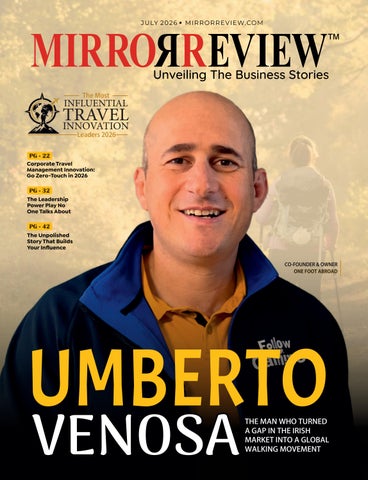
PG - 42 The Unpolished Story That Builds Your Influence CO-FOUNDER & OWNER ONE FOOT ABROAD
UMBERTO VENOSA
THE MAN WHO TURNED A GAP IN THE IRISH MARKET INTO A GLOBAL WALKING MOVEMENT
EDITOR’S
Where Vision Finds Its Path, and the World Follows.
Dear Readers, Travel has always been about movement, but the leaders shaping its future are proving that real progress comes from standing still long enough to notice what travellers actually need. “The Most Influential Travel Innovation Leaders 2026” celebrates the individuals rebuilding this industry from the inside out, not through spectacle, but through patient, deliberate reinvention of how people plan, book, and experience the world. This issue brings together founders, chief executives, and board leaders whose work quietly reshapes an entire sector, one thoughtful decision at a time. At the centre of this issue is Umberto di Venosa, Co-Founder and Owner of One Foot Abroad. What began in 2006 as a modest offering, the final hundred kilometres of the Camino de Santiago’s French Way, grew into Follow The Camino, the world’s first specialist Camino operator. Umberto’s genuine innovation was not the trail itself, but the language he built around it, breaking an overwhelming journey into manageable sections travellers could understand. His leadership rests on three principles: leading by example, reminding his team why the work matters, and trusting people enough to hand over real ownership. Under his guidance, One Foot Abroad became a certified B Corp, built its own GPT-4-powered booking engine, and survived the near-total loss of its team during the pandemic. Through it all, he has held firmly to a simple belief: treat everyone, colleagues and clients alike, exactly as you would want to be treated. Joining him in this issue are Glenn Fogel, Chief Executive Officer and President of Booking Holdings; Greg Schulze, Board Member at Traveloka; Veronica Woodruff, Founder and Chief Executive Officer of Travelsist; and Caryn Seidman Becker, Chairman and Chief Executive Officer of CLEAR. Together, these leaders represent a travel industry in quiet transformation, guided less by scale for its own sake and more by empathy, patience, and a willingness to rethink old assumptions. Their stories remind us that innovation rarely announces itself loudly. More often, it begins with a single honest question about what a traveller truly needs, then the discipline to keep answering it, one step at a time. In their hands, the future of travel looks less like a destination and more like a journey worth taking slowly, together. Sincerely,
SIMRAN KHAN Managing Editor
Publisher Archana Ghule Editor-in-Chief Vikram Suryawanshi Managing Editor Simran Khan Project Editor Shadab Mestri ™
Mirror Review Magazine is published by Pericles Ventures Pvt. Ltd. No part of this publication may be reproduced, distributed, or used in any form without prior written consent from the publisher. The editorial team has exercised utmost diligence to ensure the accuracy and integrity of all published content; however, the publisher assumes no liability for any errors or omissions. The publisher also bears no responsibility for the content of advertisements featured within the magazine.
Mirror Review Media & Tech
Project Managers Swati Kumari Anirudha Dakhore Visualizer Mark Davis Graphic Designer Chaitanya Kulkarni Head of Distribution and Production Aakash Mahajan
Office No. 430, 4th Floor, Gera’s Imperium Rise, Opp. Wipro Circle, Hinjewadi Phase 2, Pune, Maharashtra - 411057.
Head of Operations Robert Smith
+1 (850) 564-8517
Research Analysts James Adams
info@mirrorreview.com www.mirrorreview.com
Advertising Maria Smith
10. Umberto di Venosa
18. Caryn Seidman Becker 28. Glenn Fogel 36. Greg Schulze 46. Veronica Woodruff
Articles 22.
Corporate Travel Management Innovation: Go Zero-Touch in 2026
32.
The Leadership Power Play No One Talks About
42.
The Unpolished Story That Builds Your Influence
Content
Profiles
The Most Influential Travel Innovation Leaders 2026 Umberto di Venosa
Caryn Seidman Becker
Co-Founder & Owner One Foot Abroad
Chairman & CEO CLEAR
www.onefootabroad.com
www.clearme.com
Glenn Fogel
Greg Schulze
CEO & President Booking Holdings
Board Member Traveloka
www.bookingholdings.com
www.traveloka.com
Veronica Woodruff Founder & CEO Travelsist www.travelsist.com
COVER STORY
10 | JULY 2026
UMBERTO CO-FOUNDER & OWNER | ONE FOOT ABROAD
DI VENOSA THE MAN WHO TURNED A GAP IN THE IRISH MARKET INTO A GLOBAL WALKING MOVEMENT
MIRRORREVIEW.COM | 11
COVER STORY
T
wenty years ago, Umberto di Venosa and his co-founders identified an underserved opportunity in the Irish market for walking holidays. Drawing on experience across airlines, recruitment, and technology companies, they launched their venture in 2006 to meet that demand. Named One Foot Abroad, a title that remains the company’s official registered name, the business would soon become known for something far more specific through its specialist Camino brand, Follow The Camino.
Today, Umberto is the Co-Founder and Owner of One Foot Abroad, a role he has held since becoming the company’s sole shareholder in 2014. But to understand how he got there, you have to go back to the beginning, to a small yet significant discovery about a 100-kilometer stretch of trail in northern Spain. The Trail That Became a Business What Umberto and his team were originally selling was modest: the final 100 kilometers of the French Way, part of the ancient network of routes known collectively as the Camino de Santiago. It was meant to be one offering among several. Instead, it took off. Travelers wanted more of it, and they wanted it explained to them in a way that made sense. So the team built a new brand entirely around it, Follow The Camino, which he describes as the first specialist Camino operator worldwide. The real innovation, though, was not the trail itself. It was how he chose to talk about it. He developed a framework of routes, sections, and stages, a way of cutting a long, potentially overwhelming journey into pieces a traveler could actually hold in their head. A route could be broken into section one, section two, section three, each one adjustable, each one able to accommodate a fitter walker or a slower one, a rest day here, an extra night there. It sounds like a small thing. It was not. It solved a problem that had nothing to do with logistics and everything to do with how people think about big undertakings. “People need to be heard,” he says, “then, for us as experts, we translate this message into a walking or cycling holiday product.” He estimates that roughly 80 percent of any given trip looks the same from customer to customer, but that remaining 20 percent, the variation, the customization, is where the real work lives. “It is complex,” he says, “but we make it very easy for people.” 12 | JULY 2026
Three Principles, One Standard After becoming the company’s sole shareholder, Umberto built his leadership approach around three guiding principles, none of them abstract. The first is leading by example. He is direct about this: he has never felt right asking a team member to meet a standard he was not meeting himself. If he expects a quick, caring response to a traveler having a difficult day on the trail, he holds himself to that same standard. As he puts it, when your actions actually match what you say you value, people trust you, and that genuine trust is what inspires a team to deeply care about their work rather than simply clocking in and out. The second principle is one he calls transformational leadership, though he is quick to admit he does not think of it in such formal terms day to day. For him, it is really about reminding the team and himself why the work matters. His staff is coordinating logistics for what is often a traveler’s once-in-a-lifetime journey. It is not a coincidence that the company renamed its Reservations Team the Holiday Success Team. The new name was not a marketing flourish. It was a signal, internal as much as external, that the focus belongs entirely on the overall client experience that follows the initial booking. The third principle is being democratic and delegative, something that became more necessary as the company grew. Umberto had to let go of the instinct to have a hand in every decision. The people closest to the day-to-day work, he says, often see problems and opportunities before he does. Once someone has earned his trust, he hands over real ownership, not simply a list of tasks. It is this culture of empowerment, he believes, that allows the company to move quickly when a traveler needs help, without every decision routing back through him. One Side of a Triangle Ask Umberto what separates One Foot Abroad from a traditional travel operator, and he begins by describing the relationships that define the business. He describes the business as the vital link in a triangle connecting travelers with local suppliers. On one side are clients who need help planning and organizing a complex trip.
On the second side are suppliers who are looking for customers. And in the middle, connecting the two, is the company itself, building the product and the relationship at once. “We look after people the same way we would like to be looked after,” he says. “We do not see ourselves as different from our clients.” That philosophy is not just internal messaging. It has external validation, too. One Foot Abroad became a certified B Corp in 2023, making it the second walking holiday operator in the world to earn that certification. He is careful, though, not to overstate what the certification represents. It is, he says, a stamp that validates work the company had already been doing for years, serving as recognition of existing values, a tool to strengthen operational standards, and a public pledge of commitment to sustainable business practices. From Spreadsheets to GPT-4 If there is a thread running underneath everything at One Foot Abroad, it is a low tolerance for repetition, in both senses of the word. Umberto has overseen operations since the company’s earliest days, which has given him a front-row seat to every inefficiency in the system. “I am not detail-oriented,” he admits, “but I have no time for repeating myself or getting clients to enter information more than once.” That impatience with friction became the engine behind a long and still ongoing technological transformation. In 2009, the company began working with a third-party booking engine. By 2015, after failing to find a satisfactory fit among the software options available, he and his team decided to build their own system in-house. What he originally thought might take a couple of years has, by his own account, become an ongoing, incremental process, one where the team continues to identify complaints, friction points, and opportunities to move faster, then builds accordingly. Today, the system links staff, customers, and suppliers together across web and mobile applications, plugged into a range of third-party tools that handle different parts of the operation.
“
Appreciating others’ constraints Is a great sign of empathy. MIRRORREVIEW.COM | 13
COVER STORY Then came artificial intelligence. Two years ago, the company introduced a tool that reads supplier invoices and automatically uploads the amounts into its payment system. “It saves us so much time,” he says, “it is brilliant.” As of 2024, the in-house booking engine incorporates GPT-4 technology, a milestone he treats with cautious enthusiasm rather than triumphalism. He believes the industry is still in an early stage of understanding what AI can actually do. While AI offers enormous potential, delivering reliable results requires integrating company knowledge, experience, and policies to minimize errors. The company organizes its approach to AI and to customer experience broadly around three fundamental pillars: Consistency, Cordiality, and Convenience. Even now, he says, it is the staff, not the software, who remain best at guaranteeing those pillars hold. A Reckoning With the Planet Sustainability is not, for Umberto, a marketing category. It is closer to a moral discomfort he has learned to sit with. The recent heatwaves across mainland Europe, he says, are a sign that action is needed now, urgently. But he does not exempt his own company or his own industry from responsibility. While travel enriches lives, he acknowledges that the industry must confront its environmental impact rather than look away. He is equally candid about what has not worked. The company has tried, and largely failed, to run effective carbon offset projects and to persuade local taxi drivers to switch to electric vehicles. Progress, he suggests, is difficult without broader societal change, which is why the company concentrates on practical actions within its own sphere of responsibility rather than unrealistic mandates.
The Year Everything Emptied Out Like businesses across the travel industry, One Foot Abroad faced its greatest operational challenge during and after the COVID-19 pandemic. Three months into the lockdowns, he told his staff plainly that it was fair, even reasonable, for them to look elsewhere for work if they needed to. His reasoning was unsentimental in the best sense: we do not own our staff, we borrow their time, and they take a payment for it. If people needed to move on to thrive, he wanted them to go. The real difficulty came in 2022, during what he calls the return to normality. By then, the company had lost 90 percent of its pre-COVID team. An almost entirely new staff had to learn the business from scratch, with all the friction that implies. Umberto credits Silvia Montesdeoca, the company’s Operations Director, as an essential source of support and leadership through that period. Not everyone who joined could handle the pressure of rebuilding under those conditions, and he speaks of supporting those individuals in their transitions elsewhere rather than treating their departures as failures. What makes the story notable is timing. The company, he points out, had positioned itself for disruption since 2017, long before the pandemic forced the issue. It was not a case of scrambling after a crisis hit. It was a case of having already built some resilience into the system, whether or not anyone knew exactly what that resilience would be tested against. Surviving the massive financial losses of 2020 and 2021 under these conditions ranks among the company’s proudest operational achievements. The Thirteen O’Clock Problem
Given the scale of that problem, the company’s response is deliberately modest. It focuses on influence rather than mandate. The staff is encouraged to persuade taxi drivers toward electric vehicles and hotels toward more vegetarian menu options. The company runs a vegetarian night on all of its open guided tours, intended simply to show that a satisfying meal does not require animal protein. Employees who choose slower forms of travel are rewarded with extra annual leave. And the company makes monthly donations to the UN World Food Programme on behalf of its team members. None of it, Umberto is careful to note, is delivered with judgment. It is offered in good faith, with empathy, from a company that does not see itself as a lawmaker, only as an actor operating within its own small sphere of influence. 14 | JULY 2026
Coordinating a complex, multi-day holiday is, in practice, an exercise in reconciling incompatible schedules. Umberto offers a small, specific example that says more than any strategy document could. A client wants an early breakfast so they can start walking at dawn and expects to check into their next hotel by one in the afternoon. But many of the hotels along these routes are family-run businesses, their owners working long hours, sometimes unable to reopen the front desk for check-in until four in the afternoon. His answer to this tension is not a policy. It is a mindset, one built on recognizing that everyone in the chain is working within their own limits.
The hotel manager who cannot open until four might simply be looking after a child that afternoon, a fact that deserves to be celebrated rather than treated as a service failure. His own suggested solution has a wry warmth to it: in those cases, he says, clients should bring a book, order a glass of wine, and wait. It is a reminder that exceptional travel experiences are built on empathy and mutual understanding among everyone involved. What Success Actually Looks Like When asked what milestones best capture the company’s growth, Umberto does not reach for revenue figures or expansion numbers. He reaches for something more personal. While overcoming the financial impact of the pandemic proved that the company’s early preparation had paid off, what matters to him even more is a quieter kind of validation: former employees who reach out, sometimes just to say something kind about the company culture, sometimes to ask if there might be an opening to come back. This means that a seed has been planted. It means that people see benefits in carrying with them some chore values they learned from us. That, he says, gives him a genuine sense of satisfaction and purpose, the sort that does not show up on a balance sheet. Looking Toward 2026 Asked to look ahead, Umberto’s answer moves in two directions at once, and both are laced with realism rather than optimism for its own sake. Traveler expectations, he believes, will only keep rising, and the company intends to accommodate that demand as long as it comes wrapped in fairness and politeness. Challenges, in his view, are welcome, provided they make sense.
He has seen the errors that come with reading PDFs, the hallucinations, the moments where the technology simply gets it wrong. In the tourism sector, thankfully, the human touch is still important. Despite the advent of online travel, traditional travel agencies still serve a purpose, although they have decreased in number. I think we are still 2 years from having the tools actually replace 25% of the workforce on the processes side of things. On the customer interaction, I go for a dual approach where a virtual agent is available, and we keep training it, but to give the option for people to switch to a human agent as soon as they want/need to offer this top-quality service. Keep the advantages of both worlds. In 5 years or more, who knows! Humans are not bad, he says, almost as a reminder. He is also candid about AI’s costs beyond the balance sheet: the pollution, the drinking water consumption to cool down the huge amounts of processors, the demand for rare earth minerals, and he wonders openly what else that unprecedented flow of money might have accomplished if it were spent elsewhere. Ultimately, those reflections lead him to a broader question about humanity’s priorities, one he answers with a kind of plainspoken generosity rather than cynicism. Advice for the Ones Who Come Next
On sustainability, he is blunt. He believes world leaders need to act now, and he is frustrated by how much collective will gets absorbed by the endless pursuit of economic growth on a planet that is, by his own description, finite, though not poor and not boring, simply limited. He references the Meadows Report on the Limits to Growth, commissioned by the Club of Rome and published in 1972, as evidence that the underlying warning has been available for more than five decades, largely ignored because it does not, in his words, sell papers. A self-driving car that frees up more time to stare at a screen, he adds dryly, will not make anyone happier.
Umberto’s closing thoughts read less like a corporate talking point and more like something passed down at a kitchen table. To young or new entrepreneurs, his advice is to build a product from genuine ethos and vision, then test it in the world to see whether enough people agree with that vision and are willing to pay for it. That energy, he insists, is the real competitive advantage. He encourages entrepreneurs to view financial success as the outcome of good management rather than the goal itself; more of it is usually a sign that something is being done well, not the other way around. And beneath all of it sits a simple, almost old-fashioned instruction: treat the people who came before you, and the people who will come after you, exactly as you would want to be treated, with respect and fairness. In the long run, he believes, it is simply the healthier way to run a business, and perhaps a life.
On technology, his tone shifts to something more measured still. AI, he says, is an amazing tool, one with enormous potential that should be tried, not ignored, but he is unwilling to put all of his money on it either.
“Are we reasonable as a species? Or are we rational and great powers simply trying to eat before being eaten? I don’t want to eat anyone. I want to eat enough knowing other people are eating enough too.” MIRRORREVIEW.COM | 15
COVER STORY
16 | JULY 2026
“
That energy is gold and your main USP.
MIRRORREVIEW.COM | 17
Caryn Chairman & CEO | CLEAR
SEIDMAN BECKER
From Hedge Funds to Frictionless Travel, the Builder Behind CLEAR
A
career spent pricing risk on Wall Street is not the most obvious preparation for reinventing how millions of people move through airports. Yet it was precisely that experience that enabled one executive to transform identity verification into one of modern travel’s most influential innovations. Caryn Seidman Becker is the Chairman and Chief Executive Officer of CLEAR, a secure identity platform that has redefined how people navigate airports, stadiums, healthcare facilities, and an expanding range of digital experiences. Since assuming leadership in April 2010, she has guided the company from a promising aviation concept into a trusted identity platform serving more than 39 million members, with a mission centered on making experiences both secure and frictionless. 18 | JULY 2026
From Wall Street to Identity Innovation Before leading one of America’s most recognized travel technology companies, Caryn built an accomplished career in finance. She began at Arnhold and S. Bleichroeder, where she specialized in risk arbitrage and hedge fund investing before joining Iridian Asset Management as Managing Director. There, she focused on value investing, identifying companies positioned for long-term transformation through disciplined financial analysis and strategic insight. In 2002, she founded Arience Capital, a value-oriented investment firm managing more than $1 billion in assets. Working across technology, consumer products, aerospace, and industrial sectors, she partnered closely with management teams to unlock sustainable growth and operational excellence.
MIRRORREVIEW.COM | 19
Those years developed a leadership philosophy grounded in disciplined decision-making, long-term value creation, and trust principles that would later define her approach to building CLEAR.
Leadership Beyond CLEAR
Building CLEAR Into a National Identity Platform
In January 2026, she joined the Board of Directors of the Federal Reserve Bank of New York, reflecting the confidence placed in her judgment on matters of leadership, governance, and economic innovation.
When Caryn became Chairman and Chief Executive Officer of CLEAR in 2010, the company was primarily known for helping travelers move more efficiently through airport security. Under her leadership, the company has evolved far beyond its original purpose. Today, the company’s secure identity platform supports experiences across airports, sports and entertainment venues, healthcare systems, and digital services, enabling members to verify their identity quickly and securely while maintaining control over their personal information. CLEAR’s commitment to privacy has become one of its defining principles. The company emphasizes that members control their own data and that personal information is never sold, reinforcing trust as the foundation of its technology platform. Rather than simply accelerating security checkpoints, she has helped position identity as a critical layer of modern digital infrastructure, making trusted verification both seamless and secure. Leading Through Trust and Innovation Building a company centered on identity requires more than technological innovation. It demands credibility, operational discipline, and an unwavering commitment to protecting consumer trust. Throughout her sixteen years leading CLEAR, Caryn has overseen the company’s expansion while navigating evolving security requirements, increasing consumer expectations, and rapid advances in biometric technology. Her leadership has consistently balanced innovation with responsibility, demonstrating that convenience and privacy can coexist when trust remains at the center of every decision. 20 | JULY 2026
Caryn’s expertise has earned recognition well beyond the travel industry.
She also serves on the Board of Directors of The Home Depot, one of the world’s largest retailers, and joined the board of Robin Hood, New York City’s largest poverty-fighting organization, in 2025. Her commitment to public service extends further through her role on the Board of Trustees of NewYork-Presbyterian Hospital and her longstanding service with the Partnership for New York City, supporting initiatives that strengthen the region’s economic vitality and civic leadership. Earlier in her career, she also served on the Board of the Young Women’s Leadership Network, helping expand educational opportunities for young women through leadership and mentorship. Transforming the Traveler Experience As global travel continues to embrace digital transformation, identity has become one of the most important elements of the customer journey. Caryn recognized early that travelers increasingly value experiences that are both secure and effortless. Under her leadership, the company has become synonymous with faster airport experiences while expanding into broader applications that simplify everyday interactions across industries. Her work demonstrates that innovation is not always about creating entirely new technologies; it is often about applying existing technologies in ways that fundamentally improve how people move through the world.
The Future of Trusted Mobility Few executives have successfully transitioned from Wall Street investor to technology entrepreneur while reshaping an entire category of travel infrastructure. Caryn Seidman Becker has done exactly that. By combining financial discipline with technological innovation, she has transformed the company into one of the world’s leading identity platforms, proving that trust is not simply a feature of modern travel; it is its foundation. As biometric identity, digital verification, and connected experiences continue to define the future of mobility, Caryn’s leadership remains focused on a singular vision: creating a world where people can move through every stage of life with greater confidence, greater security, and far less friction. Thirty-nine million members are evidence of that vision in action, but the larger achievement is building an ecosystem where identity works seamlessly in the background, allowing travelers to focus on the journey ahead.
MIRRORREVIEW.COM | 21
22 | JULY 2026
CORPORATE TRAVEL
MANAGEMENT INNOVATION Go Zero-Touch in 2026 n 2026, corporate travel is moving toward zero-touch booking. AI can read a calendar invitation, create a trip plan that adheres to company rules, and send it for one-tap approval. This makes booking faster and easier while helping companies reduce costs, avoid travel issues, and manage expenses better.
I
The Global Business Travel Association expects global business travel spending to reach a record $1.71 trillion in 2026. It also estimates 1.84 billion business trips this year. Since spending is growing faster than the number of trips, companies need to manage every travel dollar carefully.
The Next Era of Business Travel
This pressure is driving new ideas in corporate travel management. Since it is already 2026 and CTM/platforms are actively testing or deploying this, change “could soon create” to “can now generate.” Present it as an active feature rather than a distant future prediction. Travel is becoming a way to save time, control costs, and support business growth.
Corporate travel once meant using three different websites. Employees had to compare prices manually and wait for a manager’s approval before booking a business trip. Today, that slow process is changing.
This shift toward automated travel, shared traveler data, and better cost control is changing what modern business travel providers offer. It is also changing the daily role of corporate travel managers.
» 01: Zero-Touch Mobility Systems How Zero Touch Corporate Travel Works Zero-touch corporate travel is a booking system that manages the entire trip through software. It handles everything from booking the trip to submitting the final expense report, without requiring the traveler to search or book manually. Corporate Travel Management (CTM), one of the larger corporate travel agencies in the industry, is already testing this workflow for routine trips. Its AI manages each step, from the first request through the final expense report.
MIRRORREVIEW.COM | 23
Here’s how it works. An executive accepts a meeting invite in Microsoft Teams or Outlook. The system checks the trip against company travel policies and searches flights and hotels from approved partners. It then shows one approved travel plan directly in the chat app. The traveler can confirm the booking with one tap on a phone or computer. There is no need to switch between websites or enter details manually. Researchers call this a “trust flywheel.” When travelers see that the system regularly finds good options that follow company rules, they stop using outside booking sites. This keeps more company travel spending within approved and trackable channels. This is also a key direction for modern travel technology. Many travel teams now see traditional booking portals as only a temporary solution. The industry is moving toward booking travel through the apps employees already use for work instead of making them visit a separate website.
» 02: Solving Data Fragmentation for Executive Trips What is Corporate Travel Management in 2026? Modern corporate travel management extends far beyond booking flights and hotels. It spans travel policies, budget allocations, compliance rules, duty of care, and the overall traveler experience. In the past, this information lived in disconnected systems. Expense platforms, hotel programs, ground transit providers, and travel services rarely communicate. By unifying these disparate tools into a single traveler profile, software can now anticipate logistical issues before they happen. For instance, if a flight is delayed, the system can automatically update ground transportation pickup times and send an alert to the hotel for a late check-in. This is predictive mobility in action. Personalization has quickly become a core benchmark for business travel software. A platform that merely processes transactions without learning from historical travel patterns is already obsolete. How Corporate Clients Manage Multiple Travelers on One Itinerary Unified data systems are equally vital for group logistics and multi-person trips. When a sales team heads to the same regional conference or client site, travel managers can view cumulative hotel occupancy, ground transfers, and spend in a single dashboard rather than tracking disjointed individual bookings.
» 03: Dynamic Policy and Cost Control Rate Engines That Adjust in Real Time Fixed travel policies often fail when prices suddenly rise. A set hotel limit or flight budget may look fine, but higher prices can lead to rejected bookings or out-of-policy purchases. 24 | JULY 2026
MIRRORREVIEW.COM | 25
26 | JULY 2026
For busy domestic flights booked less than two days before departure, fares can be nearly twice the average price. This gap is growing as flights become fuller. Dynamic pricing policies solve this by adjusting spending limits based on real-time demand, local events, and past booking trends. They help travelers stay within the overall travel budget. Unlike traditional travel programs that update limits only once or twice a year, these systems adjust spending as prices change. Many companies also use virtual corporate cards to automatically control spending when a booking is made. The system also helps manage travel problems and keep travelers safe. If a flight is delayed or a storm affects the trip, it can automatically find a suitable new flight, update the hotel, and record the change. In many cases, this happens before the traveler even gets a cancellation alert. AI use supports this trend. About 80% of business travelers already use generative AI to help plan trips. More than half are also comfortable letting AI handle the full process, from booking flights and hotels to submitting expense reports, according to FCM Travel research. For CFOs, this flexibility can save money. It also cuts costs caused by higher last-minute fares and the time employees spend changing bookings manually. Corporate Travel Managers Become Systems Auditors A New Role, Not a Smaller One None of this means companies no longer need travel managers. Their role is simply changing. In the past, travel managers spent much of their time checking policies and approving bookings manually. Now, automation handles much of this routine work, so managers focus more on checking how the AI makes decisions. They use data to monitor compliance instead of reviewing every booking. They also make sure the AI follows company policies and that its decisions can pass compliance checks. This requires new skills. Travel managers now use dashboards to track key numbers, such as off-policy bookings, booking times, and how quickly the system handles travel disruptions.
They also explain the results to company leaders. A good travel manager can show how AI reduces costs, improves service, and keeps travel policies on track. For this system to work, companies need three things: clean data, a gradual rollout that helps employees trust the new process, and clear reports showing exactly how much money the automation saves. Conclusion: Building a Scalable Mobility Framework Corporate travel management improves through small steps, not one big software purchase. First, bring all travel data into one traveler profile. Then, automate simple bookings that make up most business trips. Once the system is reliable, add flexible travel policies. Companies that automate too quickly without clean data often face more problems and exceptions.
Global business travel spending is expected to exceed $1.71 trillion this year and reach nearly $2 trillion by 2030. At the same time, old booking systems are becoming more costly. For business leaders, the key question is not whether to automate, but where to start. The best corporate travel programs combine AI-powered booking with reliable data and strong oversight. This helps companies cut costs, follow travel policies, and keep employees safe. It works for both simple, same-day flights and complex executive trips. Which part of your travel program should be automated first: regular domestic bookings, executive travel, or handling travel disruptions?
Tejas Jadhav MIRRORREVIEW.COM | 27
28 | JULY 2026
GLENN FOGEL The Dealmaker Who Turned Booking Holdings Into Travel’s Reservation System
MIRRORREVIEW.COM | 29
A
retired member of the New York State Bar has not argued a case in years, and it is unlikely he misses it. The travel industry, it turns out, offered a far bigger stage than any courtroom. A Harvard Law School graduate who began his career in air transportation investment banking would go on to help shape one of the world’s largest travel companies, transforming how millions of people plan, book, and experience travel.
Glenn Fogel is the Chief Executive Officer and President of Booking Holdings, the global travel company behind Booking.com, KAYAK, Priceline, Agoda, OpenTable, and Rentalcars.com. He has served as CEO and President since January 2017 and, since June 2019, has also led Booking.com as its Chief Executive Officer. Those leadership roles are the culmination of more than twenty-six years spent inside a single organization, guiding its evolution from an online travel business into one of the world’s most influential digital travel ecosystems.
During his years leading corporate development and worldwide strategy, he played a central role in expanding the company’s portfolio through acquisitions and strategic investments that reshaped online travel. Under his leadership in corporate development and strategy, Booking Holdings strengthened and expanded brands including Booking.com, KAYAK, OpenTable, Agoda, and Rentalcars.com, creating an integrated ecosystem that serves travelers throughout every stage of their journey. Today, Booking Holdings operates one of the world’s largest online travel marketplaces, connecting millions of travelers with accommodations, transportation, dining, and mobility services across more than 220 countries and territories. Rather than building a single travel brand, he helped assemble a collection of specialized businesses that collectively transformed how people search, compare, reserve, and experience travel worldwide.
Before the Bookings, There Were the Deals Twenty-Six Years, One Company Glenn’s journey into travel began not with tourism, but with finance. After earning a Bachelor of Science in Economics from the Wharton School of the University of Pennsylvania and a Juris Doctor from Harvard Law School, he began his career in investment banking, specializing in the air transportation sector at Kidder, Peabody & Co. from 1988 to 1995. He later joined Morgan Stanley Asset Management, where he worked in investment management before making the career move that would define the next quarter-century of his professional life. In February 2000, Glenn joined Booking Holdings, then known as Priceline, as Vice President of Corporate Development. From there, he steadily assumed broader responsibilities, serving as Senior Vice President of International, Senior Vice President of Corporate Development and International, Managing Director of Corporate Development and International, Executive Vice President of Corporate Development, and later Head of Worldwide Strategy and Planning before becoming Chief Executive Officer.
In an industry known for constant disruption and executive turnover, Glenn’s career stands out for its remarkable continuity. Over more than two decades with Booking Holdings, he has progressed from corporate development executive to the company’s highest leadership position, gaining deep operational knowledge across acquisitions, international expansion, corporate strategy, and global operations before assuming responsibility for the entire organization. Since January 2017, he has led Booking Holdings as Chief Executive Officer and President. Since June 2019, he has simultaneously served as Chief Executive Officer of Booking.com, overseeing both the parent company and its flagship global brand. That dual leadership role reflects an uncommon level of trust and continuity within one of the travel industry’s most influential organizations. Innovation Through Strategy
Building a Global Travel Ecosystem Glenn’s greatest contribution to Booking Holdings has been his long-term vision for strategic growth. 30 | JULY 2026
While many travel leaders are associated with individual products or technologies, Glenn’s impact has been broader and more strategic.
Throughout his leadership, Booking Holdings has continued investing in artificial intelligence, machine learning, connected trip experiences, and personalized travel planning, helping simplify increasingly complex travel journeys while connecting travelers with millions of accommodation providers, transportation partners, restaurants, and attractions worldwide. His approach has consistently centered on making travel more seamless through technology while maintaining strong partnerships across the global travel ecosystem.
The Long View There is something quietly remarkable about an executive who joined an online travel company in 2000—before smartphones, social media, or app-based travel planning—and remains at its helm today. Over those years, the industry has transformed through digital booking, mobile technology, cloud computing, artificial intelligence, and changing traveler expectations. Through every wave of change, Glenn has helped steer Booking Holdings toward long-term growth by combining disciplined strategy with a willingness to embrace innovation.
Leadership Beyond Business Glenn’s influence extends beyond corporate performance. He serves on the Board of Directors of the U.S. Travel Association, contributing to initiatives that strengthen America’s travel industry and promote policies supporting tourism and economic growth. His leadership has also positioned Booking Holdings among the world’s most influential travel technology companies, playing a significant role in shaping conversations around digital transformation, sustainability, artificial intelligence, and the future of global mobility.
His career is not defined by a single breakthrough or headline acquisition. Instead, it is defined by sustained leadership, thoughtful expansion, and an ability to recognize how individual businesses could become part of something much larger. Today, Booking Holdings stands as one of the world’s most influential travel companies not simply because of the brands it owns, but because of how those brands work together to create a seamless travel experience for millions of people around the globe. For more than a quarter of a century, Glenn Fogel has helped build that system—one acquisition, one partnership, and one strategic decision at a time. MIRRORREVIEW.COM | 31
32 | JULY 2026
The Power Play No One Talks About The loudest person in the room rarely runs it. In high-stakes leadership, power often belongs to the one who knows when to step forward—and when to step back. I’ve watched this play out in boardrooms on five continents. The most influential leaders guard their energy like investors guard capital. They don’t burn it on every request, meeting, or fight. They deploy it where the return is highest. That isn’t retreat. It’s precision. Why Energy Is a Strategic Asset—Not a Renewable One You’ve been told to “show up everywhere” and “always say yes to opportunity.” That’s advice designed to keep you busy, not effective. Energy works like working capital: if you spend it indiscriminately, you’ll have nothing left for the decisions and conversations that actually move the needle. I’ve seen too many founders, executives, and creatives burn themselves out trying to be constantly available. By the time they hit the moment that truly matters—negotiating a critical deal, steering through a crisis—they’re running on fumes. The leaders who win over decades build what I call an Energy Reserve Strategy: they invest in recovery, decline low-value demands, and preserve their capacity for the work only they can do.
MIRRORREVIEW.COM | 33
The CEO Pattern You’ll Never See in Their LinkedIn Posts When you study leaders at the top of their game—Oprah Winfrey, Ava DuVernay, Shonda Rhimes, Naomi Osaka—you notice a pattern: They say “no” more than they say “yes.” They disappear on purpose. They choose when to speak, rather than react to every moment. Oprah has said her breakthrough came when she stopped saying “yes” out of obligation. Naomi Osaka skipped press conferences to protect her mental bandwidth. Ava DuVernay directs her focus toward the work that will outlast the noise. None of them confuse constant presence with meaningful impact. How to Build Your Own Energy Reserve Strategy Stop thinking of energy management as self-care. It’s operational discipline. Here’s the framework I use with executives who want sustainable influence: 1. Audit the Drains – Track your week. Identify what drains you without delivering measurable value. 2. Cut Without Guilt – If it doesn’t move your mission forward, it’s a no. No justification required. 34 | JULY 2026
3. Schedule Recovery Like Revenue Work – Block solitude, deep work, and decompression into your calendar before anything else. 4. Decide Your Deployment Triggers – Define the criteria for when you’ll step in, speak up, or take the lead. If it doesn’t meet that bar, you hold. This isn’t about hiding. It’s about controlling the terms of your visibility. Why This Works in Divided Times In today’s polarized climate—inside companies, markets, and public discourse—reaction speed is overrated. Leaders who pause before acting can see beyond the noise. Congresswoman Pramila Jayapal calls her introversion an advantage: it allows her to hear more, filter faster, and find leverage points in heated negotiations. The same applies in business. If you burn energy reacting to every provocation, you lose clarity. If you hold back, assess, and respond only when impact is possible, your influence compounds. The Diplomatic Deployment Principle Think of your influence like a high-value currency. If you spend it on every small transaction, it loses value. Spend it strategically, and its weight grows. This is why Ava DuVernay’s voice carries. She doesn’t engage every battle. She picks the ones that shift the industry.
The Misconception That Costs Leaders Their Edge Too many talented people believe that influence requires constant output. They confuse activity with authority. In reality, measured presence builds more trust than constant chatter. The people you lead, sell to, or negotiate with learn that when you step in, it matters. That scarcity creates weight. And weight moves decisions. The Playbook for Quiet Influence If you want to operate like the leaders I’m describing, here’s the system: 1. Treat Energy as Capital – Your time and presence are assets. Protect them like your P&L depends on it—because it does. 2. Operate From a Reserve – Never let your energy account hit zero. Decisions made from depletion are almost always costly. 3. Define Your “Yes” and “No” Rules – Without clear criteria, you'll spend yourself on work that doesn’t move the mission. 4. Build Recharge Rituals – Whether it’s a daily walk, two hours of phone-off time, or quarterly solo strategy days, make it non-negotiable. 5. Deploy With Intention – When you engage, bring full clarity, preparation, and presence. Then step back before your edge dulls. The Bottom Line Leaders who master energy control don’t just last longer—they win more often. While others burn themselves out trying to be everywhere, they conserve power for the moments that change everything.
You can do the same. · Save your input for moments that definedirection. · Let others exhaust themselves in the noise. · When you speak, make sure it counts. This isn’t passivity—it’s tactical patience.
Your job is not to be constantly visible. Your job is to be unmistakably effective when it matters. If you do this well, you won’t need to fight for attention. Your absence will be noticed—and your presence will be felt.
Simran Khan MIRRORREVIEW.COM | 35
36 | JULY 2026
Board Member |
GREG
Schulze The Architect Who Rebuilt Travel’s Commercial Engine, Ten Billion at a Time wenty-five years ago, an industrial engineer walked the floor of a steel plant in Ohio, measuring tolerances and watching machines convert raw metal into finished parts. He could not have known that the analytical instincts he sharpened there would one day help move more than one hundred billion dollars’ worth of the world’s travelers through search engines, jet bridges, and hotel lobbies. The travel industry does not often celebrate its engineers, yet it depends on them completely.
T
He then joined American Airlines in Revenue Management, spending six years mastering the complex science of yield management, seat inventory, and pricing optimization. It was there that he learned to view travel not simply as an experience, but as an interconnected system built upon thousands of precise decisions.
Greg Schulze is one of those rare executives whose influence can be traced through nearly every major transformation the travel industry has experienced this century. Today, he serves as a Member of the Board of Directors at Traveloka, Southeast Asia’s leading online travel platform. Before that, he spent more than two decades helping build and reinvent Expedia Group’s commercial organization, culminating in his role as Chief Commercial Officer from February 2024 to May 2026.
That systems mindset became the foundation of his career when he joined Expedia Group in August 2005 as Director of Analytics and Revenue Management. Over the following two decades, he progressed through some of the company’s most influential commercial leadership roles, serving as Vice President of Air, Senior Vice President of Global Partnerships, Senior Vice President and General Manager of Commercial Strategy and Services in Singapore, Senior Vice President of Strategic Travel Partners, and ultimately Chief Commercial Officer.
An Engineer’s Eye on a Trillion-Dollar Industry Before travel, there was steel—and there were airplanes. Greg began his career as an Industrial Engineer at Worthington Industries, where he worked from June 1996 to July 1999.
MIRRORREVIEW.COM | 37
Scaling One of Travel’s Largest Commercial Organizations The scale of Greg’s journey mirrors the transformation of the online travel industry itself. When he joined Expedia, annual gross bookings stood at approximately $13 billion. By the time he became Chief Commercial Officer, that figure had surpassed $120 billion, representing more than a ninefold increase.
His academic background also reflects this balance of technical precision and business leadership. Greg earned his bachelor’s degree in Industrial Engineering from Northwestern University before completing his MBA at the University of North Carolina, combining analytical discipline with strategic thinking throughout his career. Leadership Beyond the Balance Sheet
As Chief Commercial Officer, he led a global organization of more than 3,000 employees responsible for travel partnerships, commercial strategy, and revenue generation, including Expedia’s rapidly expanding advertising business. Together, these operations formed the commercial engine behind a company generating approximately $15 billion in annual revenue. Throughout his tenure, Greg negotiated multibillion-dollar strategic partnerships with many of the industry’s largest travel companies while helping Expedia navigate successive waves of technological disruption—from the rise of online search and mobile booking to the emergence of artificial intelligence and increasingly personalized travel experiences. His leadership consistently focused on ensuring technology strengthened commercial relationships rather than replacing the human expertise that powers them.
Greg’s influence extends well beyond corporate leadership. In January 2023, he was appointed by the U.S. Secretary of Commerce to the U.S. Travel and Tourism Advisory Board, joining a select group of industry leaders advising the federal government on policies affecting American travel and tourism. From May 2024 to May 2026, he also served on the Executive Committee of the World Travel & Tourism Council (WTTC), helping shape discussions around the future of the global travel industry.
Greg’s professional journey reflects the increasingly global nature of modern travel.
His commitment to service reaches beyond travel as well. Since February 2025, he has served on the Board of Directors of the Planet Water Foundation, supporting an organization that has provided access to clean water for millions of people across more than thirty countries.
He has lived and worked across the United States, Singapore, and the United Kingdom, gaining firsthand experience in some of the world’s most influential travel markets.
In 2026, he also serves on the Professional Advisory Board of ALSAC, the fundraising and awareness organization supporting St. Jude Children’s Research Hospital.
His years leading Commercial Strategy and Services from Singapore placed him at the center of Southeast Asia’s rapidly expanding digital travel economy, experience that naturally complemented his appointment to Traveloka’s Board of Directors in July 2017. Later, as Chief Commercial Officer, he was based in the United Kingdom while overseeing Expedia’s worldwide commercial organization.
Earlier in his career, Greg served on the Board of the US-ASEAN Business Council and advised the Singapore Tourism Board’s Chief Executive Technology Strategy Committee, further strengthening the connections between government, tourism, and technology.
A Career Spanning Three Continents
38 | JULY 2026
MIRRORREVIEW.COM | 39
Seeing the Future Before It Arrives
Building the Future of Travel
Few travel executives have witnessed and helped shape as many periods of industry transformation as Greg Schulze.
For an industrial engineer who once measured tolerances on a factory floor, the scale of the systems he has since managed is almost unimaginable: billions of dollars in annual bookings, thousands of employees, global partnerships spanning continents, and an industry that continues to reinvent how people discover the world.
From the earliest days of online travel booking to the rise of search engines, the mobile revolution, cloud platforms, digital advertising, and now artificial intelligence, he has consistently worked at the intersection of technology and commercial strategy. Rather than viewing innovation as a disruption to be managed, he has approached it as an opportunity to build stronger partnerships, create more scalable businesses, and improve the traveler experience across every stage of the journey. His long-standing position on Traveloka’s Board of Directors further reflects his belief that Southeast Asia would become one of the world’s most important digital travel markets long before many global competitors fully recognized its potential.
40 | JULY 2026
Throughout that journey, Greg Schulze has remained less interested in chasing change than in building the commercial foundations that allow innovation to flourish—quietly shaping the infrastructure behind modern travel while helping one of the world’s largest travel companies evolve through every major technological shift of the past two decades.
The Unpolished Story That Builds Your Influence ounders spend millions trying to craft “the perfect story.” They hire agencies, shoot cinematic videos, polish every line until it shines.
F
Why We Hide the Part People Need Most
Then they wonder why it doesn’t connect.
· Grew revenue by 300%. · Expanded to three continents. · Featured in Forbes.
Here’s the truth most PR decks won’t tell you: the story that earns influence is rarely the one you’ve polished. It’s the one you’ve lived. The Boardroom Lesson Nobody Prepares You For A few weeks ago, I sat in a room with fifteen high-performing founders. We were there for strategy, not therapy. Yet one person—without a slide deck, without the “approved” brand narrative—told a raw, unscripted account of the moment her business almost folded. She didn’t “present.” She talked. She described the week she had to choose between making payroll and paying her mortgage. She explained exactly how she called her supplier and negotiated terms to buy herself 48 hours.
Most leaders know their résumé version of their story—the LinkedIn-approved bullet points:
But they cut the sentences that matter: · Spent six weeks sleeping on a friend’s couch to save the business. · Spent four years selling a service no one wanted before finding product-market fit. · Nearly quit the night before the big break. We cut them because they’re messy. We cut them because they’re not “on-brand.” The irony? Those are the exact lines that make you believable. The Strategic Risk of Staying Polished Here’s the cost of staying “safe” with your story:
It wasn’t pretty. But the table went silent.
1. You sound like everyone else. Polished founder bios are interchangeable. 2. You create distance. People can admire perfection, but they rarely trust it. 3. You lose leverage. Investors, clients, and partners lean in when they believe you’ve been tested and survived.
That’s when it hit me: your influence starts where your polish ends.
Every CEO I respect uses story as a tool—not as a highlight reel.
42 | JULY 2026
How to Find the Part of Your Story That Moves People Forget “crafting” for a minute. Go straight to the events that felt risky to say out loud at the time. Ask yourself: · What happened that changed the way I run my business? · When did I have to make a decision that cost me more than money? · What mistake taught me something no spreadsheet could? Those are the points of connection. That’s the material people repeat when they talk about you in rooms you’re not in. The Real Role of Vulnerability We misuse the word “vulnerability” in business.
It’s not about oversharing or emotional catharsis. It’s about strategic transparency—sharing enough of the truth to make the lesson undeniable. Here’s the filter: If the person across the table can apply what you learned to avoid a mistake, or take a calculated risk faster, it’s worth telling. If it’s just for shock value, save it for the memoir. Community Isn’t Just Comfort—It’s Currency One founder in that room said something that stayed with me: “I didn’t come here to be inspired. I came here to remember I’m not the only one in the fight.” That’s why peer communities matter. Not because you “feel seen,” but because you get operating intel from people who’ve survived what you’re in right now.
MIRRORREVIEW.COM | 43
When you tell the true version of your story inside a trusted circle, two things happen: 1. You get the strategies that aren’t in books. 2. You build alliances that turn into deal flow, partnerships, and backchannel introductions.
If You’ve Been Editing Yourself Down Consider this your push to stop sanding off the edges. You don’t need a dramatic overhaul. You need to reintroduce the human stakes into your origin, your turning points, and your current play. Try this:
This is why every serious founder I know invests in getting in the right rooms—not just for visibility, but for survival. The Business Case for Telling the Real Story I’ve watched leaders triple their speaking fees, close seven-figure contracts, and land media features—not by adding more success stats, but by revealing the turning points behind them. The mechanics are simple: · Raw detail makes it memorable. “I was down to my last $412” sticks longer than “we were struggling financially.” · Specificity signals truth. People instinctively trust stories with dates, numbers, and real stakes. · Struggle signals credibility. If you’ve been through it, you can help others navigate it.
· Identify one story you’ve been avoiding because it feels too raw. · Write it in bullet points—just the facts, no adjectives. · Decide which parts connect to the value you deliver now. · Share it in a room where the return could be real—whether that’s a sales meeting, investor pitch, or strategic peer group. Final Word Your polished story may get polite nods. Your real one will get remembered, repeated, and relayed to decision-makers you’ll never meet. In business, being known isn’t about telling people what you’ve achieved—it’s about showing them what you've survived, and how that shapes the way you lead. Don’t wait for permission. Don’t wait for the “right” moment. The right moment is the one you decide to stop hiding the part that makes you credible. Lift the filter. Tell the truth. That’s how influence starts.
Your story is not PR fluff. It’s an asset with a measurable ROI.
44 | JULY 2026
Simran Khan
46 | JULY 2026
Founder & CEO | Travelsist
VERONICA The Engineer of Mobility Redesigning How the World Moves
Woodruff
A
irports are designed for speed, yet they often become places of friction. Missed connections, confusing terminals, accessibility barriers, and operational bottlenecks are experiences familiar to millions of travelers. While many recognize these challenges, few have spent nearly two decades studying them firsthand and then built a company dedicated to solving them. Veronica Woodruff is the Founder and Chief Executive Officer of Travelsist, an Atlanta-based mobility technology company transforming how people navigate complex travel environments. Since founding the company in January 2018, she has focused on making travel more accessible, efficient, and inclusive by combining technology with deep operational expertise gained through more than seventeen years in the aviation industry. Seventeen Years of Aviation Experience Before the Startup Long before launching Travelsist, Veronica built an extensive career across aviation, operations, product development, and technology. Working closely with travelers, airport operators, and industry stakeholders gave her a firsthand understanding of the structural challenges that affect mobility within modern transportation systems. Rather than viewing these issues as isolated inconveniences, she recognized them as systemic problems requiring scalable, technology-driven solutions.
That realization became the foundation for Travelsist—a company designed to bridge the gap between travelers who need assistance and the complex environments through which they move. Reimagining Mobility Through Technology Under Veronica’s leadership, Travelsist has developed a technology platform focused on improving mobility within some of the world’s most demanding transportation environments. The company works to support travelers who require additional assistance, including older adults, travelers with disabilities, families, and others needing personalized support, while helping airports deliver a more seamless customer experience. Operating in highly regulated airport environments requires more than innovative technology. MIRRORREVIEW.COM | 47
48 | JULY 2026
It demands operational precision, strong partnerships, and an understanding of aviation infrastructure. She has positioned Travelsist at the intersection of those disciplines, earning recognition from enterprise partners and innovation organizations for addressing complex mobility challenges with practical, scalable solutions. Her leadership reflects a philosophy that innovation should remove friction without adding complexity. Building More Than a Company Veronica’s commitment to creating opportunities extends beyond Travelsist. In June 2021, she co-founded Single Mom Founders, a community dedicated to supporting women entrepreneurs by expanding access to capital, mentorship, strategic connections, and a collaborative network. The initiative reflects her belief that entrepreneurship becomes more powerful when founders have access to both resources and community. She has also expanded her leadership through governance and mentorship. Since June 2024, she has served on the Board of Trustees of BRIDGE powered by MWorX, contributing her expertise to innovation and workforce development initiatives. Earlier in her entrepreneurial journey, she participated in the Techstars Founder Catalyst program, helping accelerate Travelsist’s early growth and refine its long-term strategy. Recognition Earned Through Impact Veronica’s work has attracted national recognition for both innovation and entrepreneurship. She has been recognized by Forbes Next 1000, Inc., and Techstars, while her work has been featured by leading publications including The New York Times, TechCrunch, and the Atlanta Journal-Constitution.
Designing Systems Around People What distinguishes Veronica from many technology entrepreneurs is that her work begins with people rather than products. Instead of asking what technology can do, she asks where existing systems fail travelers and how those systems can be redesigned to better serve everyone involved, from passengers and airport staff to transportation partners and operators. Her work spans global mobility, infrastructure modernization, workforce innovation, and inclusive design, consistently emphasizing practical solutions that improve both operational efficiency and the human experience. For her, innovation is not measured by the sophistication of the technology alone, but by the confidence, dignity, and independence it restores to the people using it. Building the Future of Accessible Travel As airports continue evolving into increasingly connected, technology-enabled environments, accessibility and mobility have become essential components of the traveler experience rather than optional services. Veronica Woodruff has positioned Travelsist at the forefront of that transformation, demonstrating that innovation in travel is not only about moving people faster, but also about ensuring everyone can move with confidence. By combining aviation expertise, operational insight, and human-centered technology, she is helping redefine what accessible travel can look like for the next generation of global mobility.
These recognitions reflect more than entrepreneurial success. They acknowledge a founder tackling one of transportation’s most overlooked challenges: ensuring that mobility is accessible, reliable, and centered on the traveler. MIRRORREVIEW.COM | 49
www.mirrorreview.com