SEPTEMBER 2026
M I R R O R R E V I E W. C O M
™
Pg. 24 Explainable AI: The CEO’s Ultimate Guide to XAI and ROI
Pg. 36 Payroll Trends 2026: AI, Compliance & Workforce Pay
Pg. 46 The Leadership Power Play No One Talks About
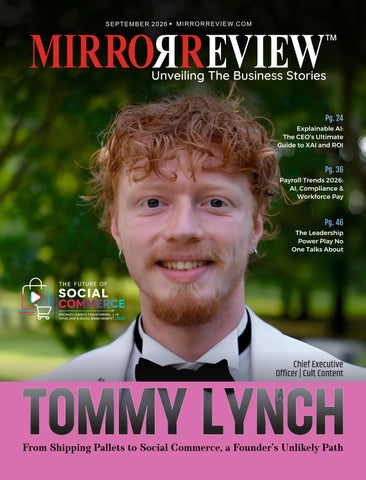
Chief Executive Officer | Cult Content
TOMMY LYNCH From Shipping Pallets to Social Commerce, a Founder’s Unlikely Path
EDITOR’S
Community Is the New Currency: Inside Social Commerce’s Boldest Era
Dear Readers, Somewhere between a viral video and a checkout button, an entire industry has been rebuilt from scratch. Social commerce no longer waits for a shopper to search and compare; it meets them mid-scroll and turns that moment into a sale. “The Future of Social Commerce: Visionary Leaders Transforming TikTok Shop & Digital Brand Growth in 2026” opens the door to the people driving this shift, entrepreneurs who understood early that commerce built on community outlasts commerce built on adverts alone. Tommy Lynch, Chief Executive Officer of Cult Content, did not arrive here through a business degree or a corporate training scheme. At fourteen, he was pulling apart old pallets in Washington, DC, and selling furniture built from them at an outdoor market, an early version of his first online shop. When COVID arrived during his junior year of high school, he bought a school bus, moved into it, and ran a print-on-demand store from the road, teaching himself to make content along the way. That instinct, to build something new on the wreckage of a plan that no longer worked, carried him into Cult Content, a TikTok Shop agency built on one belief: the platform rewards belonging before it rewards cleverness. Cult Content now guides brands from shop setup through paid media and affiliate growth, drawing on more than seven hundred creators, while staying candid that most sellers are not yet profitable. Alongside him, this issue features Jackson Silverman, Founder and CEO of The Affiliate Assembly; Zain Ali, Co-Founder of Zainith Agency; Dan Albert, Co-Founder and CEO of 456 Growth; and Deren Baker, CEO of Flywheel Ventures, each shaping a corner of the same fast-moving industry. What unites every leader in these pages is a refusal to treat commerce as a transaction alone. They have built their businesses on trust earned in comment sections, on creators who speak from real experience rather than a script, and on the understanding that entertainment and conversion were never opposites. As social selling stretches beyond one app into a shopper’s whole feed, the brands that thrive will invest in people before platforms, a lesson this year’s leaders have already learned
Sincerely,
SIMRAN KHAN Managing Editor
Publisher Archana Ghule Editor-in-Chief Vikram Suryawanshi Managing Editor Simran Khan Project Editor Shadab Mestri ™
Mirror Review Magazine is published by Pericles Ventures Pvt. Ltd. No part of this publication may be reproduced, distributed, or used in any form without prior written consent from the publisher. The editorial team has exercised utmost diligence to ensure the accuracy and integrity of all published content; however, the publisher assumes no liability for any errors or omissions. The publisher also bears no responsibility for the content of advertisements featured within the magazine.
Mirror Review Media & Tech Office No. 430, 4th Floor, Gera’s Imperium Rise, Opp. Wipro Circle, Hinjewadi Phase 2, Pune, Maharashtra - 411057.
+1 (850) 564-8517 info@mirrorreview.com www.mirrorreview.com
Project Manager Anushka Nalawade Visualizer Mark Davis Graphic Designer Pranjali Mahangade Head of Distribution and Production Aakash Mahajan Head of Operations Robert Smith Research Analyst James Adams Advertising Maria Smith
10. Tommy Lynch
32. Deren Baker 42. Jackson Silverman 50. Zain Ali
24.
Explainable AI: The CEO’s Ultimate Guide to XAI and ROI
36.
Payroll Trends 2026: AI, Compliance & Workforce Pay
46.
The Leadership Power Play No One Talks About
Content
20. Dan Albert
The Future of Social Commerce: Visionary Leaders Transforming TikTok Shop & Digital Brand Growth in 2026
Tommy Lynch
Dan Albert
Chief Executive Officer Cult Content
Co-Founder & CEO 456 Growth
www.cultcontent.cc
www.456growth.com
Deren Baker
Jackson Silverman
Chief Executive Officer Flywheel Ventures
Founder & CEO The Affiliate Assembly
www.flywheeldigital.com
www.affiliateassembly.org
Zain Ali Co-Founder Zainith Agency www.zainith.agency.com
Cover Story
TOMMY LYNCH From Shipping Pallets to Social Commerce, a Founder’s Unlikely Path
‘‘
Many people think TikTok Shop is a gold rush–however, the ones who win the biggest are the ones who lose the biggest.
‘‘
10 I SEPTEMBER 2026
Chief Executive Officer | Cult Content
MIRRORREVIEW.COM | 11
Cover Story
A
school bus is not, on the surface, where a company gets built. It is a lumbering, yellow, faintly ridiculous object, built for stopping at every corner, not for going anywhere in particular. But somewhere on the back roads of America, in the strange, suspended months when the whole world stopped moving, a teenager was living inside one, cutting his own path while everyone else waited for normal to come back. That teenager is now the Chief Executive Officer of Cult Content, and the story of how he got from that bus to this title says a great deal about the kind of entrepreneur social commerce tends to produce: resourceful, a little unconventional, and unwilling to wait for permission. Tommy Lynch did not arrive at TikTok Shop by way of a business degree or a corporate training program. He arrived by way of pallets, print-on-demand shirts, and a stubborn instinct to build things himself, whatever the obstacles. It is a background that reads less like a resume and more like a series of small, scrappy experiments, each one teaching him something the last one hadn’t. By the time he founded Cult Content, he had already amassed 50 million views for product brands and understood that the platform rewards something less tangible than clever videos or clever ads. It rewards belonging.
Then came Covid, arriving during his junior year of high school, upending the world’s plans along with his own. Most people his age were adjusting to a life lived through screens. He bought a school bus. He converted it into a mobile home and founded Adventure Bus Rental LLC, but he was too young to obtain the CDL and insurance required to operate the business. Rather than shelve the idea entirely, he simply changed the terms. He moved into the bus himself and set off across the country, running a print-on-demand Etsy store from the road and beginning, almost as a byproduct of survival, to make content professionally. It is worth pausing on that detail, because it explains something about how Tommy thinks. Faced with a legal wall he could not climb, he did not abandon the bus. He lived in it instead, and built something else on top of the wreckage of the original plan. That willingness to adapt when circumstances changed would become an important part of his entrepreneurial journey.
A Bus, a Pallet, and a Beginning
The Origin of Cult Content
Every founder has an origin story, but few of them start with power tools and a stack of discarded shipping pallets. Tommy’s did. At fourteen years old, he began pulling apart pallets and turning the wood into tables, shelves, and other furniture, which he sold at an outdoor market in Washington, DC. That market stall, unglamorous as it may have looked, was also his first online store, an early indication of his entrepreneurial instinct.
By the time Tommy started Cult Content, he was no longer a kid experimenting with an Etsy shop. He had spent years inside the content world and had come to understand something central to his approach: TikTok Shop was not just about making videos or running ads. It was about building a dedicated community around a brand or agency.
12 I SEPTEMBER 2026
The inspiration came from a program called “The Collective,” now known as “Your First Dollar,” a free community where creators could find opportunity without paying for the privilege. He wanted to build something in that same spirit, a place anyone could join without cost, where people could find purpose, unlock their potential, and connect with others who took the work as seriously as they did.
“
TikTok Shop should be the heart of a brand’s digital strategy. The name itself carries a wink. “The tongue-in-cheek name was inspired by the fact that everyone in the industry seems to want their own cult,” he explains, “the brands want a cult of creators, and the creators want a cult of viewers.” But behind the joke sits something more sincere. There is, in his telling, a spiritual thread running through Cult Content, an invitation to members to chase their goals on TikTok Shop while also identifying and aligning with something larger than a sales target: their higher purpose. Principles for an Industry That Never Sits Still Social commerce is a field defined by its own instability. For Tommy, that constant change makes having a stable foundation particularly important. “Change is a constant in this industry, and in order to survive it, you must be rooted in something that does not change, something that is eternal,” he says. It is a philosophy he practices literally, not just rhetorically. During his team’s Monday and Friday calls, he ends each meeting with an inspirational quote, drawn from the Bible, the Bhagavad Gita, the Tao Te Ching, or whatever book or movie happens to be occupying his attention that week. He sees his job as twofold: to help his team forecast where the industry is headed, and to help them become the change themselves rather than simply react to it. Being grounded in wisdom, he believes, is what allows a team to hold steady through the turbulence, the wins and the losses alike, without losing sight of what actually matters.
What Cult Content Builds, Piece by Piece Strip away the philosophy and the spiritual framing, and Cult Content is, at its core, a full-service TikTok Shop management agency, one built to carry a brand from its earliest setup through its ongoing growth. The work begins at the foundation: registration, onboarding, shop setup, product listing management, and promotional strategy, the unglamorous scaffolding that has to be right before anything else can work. From there, Cult Content runs its clients' ads and manages their paid media directly. The affiliate side of the business is where the Tommy’s creator community starts to earn its keep. The agency reaches out to creators on behalf of its brand clients and draws on a community of more than 700 affiliates to produce content at scale. Incentives are organized, and creators are led through weekly calls, one set for each brand the agency represents, keeping the relationship active rather than transactional. The Myths Nobody Wants to Hear Ask Tommy about the economics of TikTok Shop and the tone shifts. There is a gentleness to how he talks about creators and community, but when the subject turns to money, he becomes blunt, almost protective of the people who might otherwise walk in with false expectations. MIRRORREVIEW.COM | 13
Cover Story “The vast majority of brands on TikTok Shop are not profitable,” he says. The platform has the reputation of a gold rush, but in his experience, the brands that win the biggest are often the ones capable of losing the biggest. He recalls a recent conversation with another figure in the industry about one of the largest brands operating on TikTok Shop, a brand that, by his account, loses over one million dollars a month on the platform. The reason, he explains, is the sheer weight of costs stacked on top of one another: cost of goods sold, shipping, promotions, coupons, affiliate commissions, TikTok’s own referral fee, agency fees, sampling, affiliate bonuses, and merchant fees. By the time all of that is subtracted, there is rarely much left. Tommy is candid about the pressure he feels to sell a rosier version of this story. “Everyone wants me to sell them a false dream where they will be making 500k profit after a few months,” he says. “The reality is very different.” His advice to brands considering the platform is less about optimism and more about preparation: know your unit economics before you start, and know exactly how much you can afford to lose, and for how long. He frames TikTok Shop not as a guaranteed profit center but as a top-of-funnel awareness channel, one that can break even or even turn a profit, but that delivers its real value when treated as a marketing investment, the kind that lifts performance across a brand’s other channels. Content as the Heart of the Brand If the economics chapter of Tommy’s philosophy is sobering, the content chapter is where his enthusiasm returns. He believes TikTok Shop, done right, should sit at the very center of a brand’s digital strategy, not as one channel among many but as the engine that feeds all the others. The agencies that do this well, Cult Content among them, help a brand build a genuine community, one capable of producing what he describes as potentially tens of thousands of videos a month. That volume of content does not have to stay on TikTok. With a creator’s permission, the same videos can be repurposed across Instagram, Facebook, YouTube, and other platforms, multiplying their value well beyond their original home. 14 I SEPTEMBER 2026
What strikes Tommy most, though, is what creators themselves respond to. Again and again, he hears the same sentiment: creators appreciate and respect brands that understand content from the inside. When a founder is willing to pick up a camera and make videos about their own product, going through the same struggles the creators face, it means something. It teaches the community what kind of content actually works, and it strengthens the bond between brand and creator in a way that a marketing brief never could. Finding the Right Voices Authenticity and performance are often treated as opposites in marketing, one measured in feeling, the other in numbers. Tommy does not see it that way. “Authentic engagement and measurable commercial results go hand in hand on TikTok Shop,” he says. The videos that perform best, in his experience, are the ones that do not feel like shop content at all, the ones where a creator is speaking from real experience and real authority rather than reading from a script built to sell. To find those voices, Cult Content leans on AI-enabled tooling, specifically a platform called Reacher, which holds a database of more than three million TikTok Shop affiliates. The tool allows the agency to search by GMV, or gross merchandise value, but also by natural language, the kind of plain, specific query a human might actually type, like “moms with curly hair.” That search capability is paired with the agency’s creators community, which Tommy and his team draw on directly to match the right voice to the right brand. A Test That Revealed What He Actually Believes Every leader has a moment that tests whether their stated values survive contact with a real, inconvenient situation. For Tommy, that moment came when a brand he was working with decided it did not want to pay what it owed its affiliates. His first instinct, he admits, was to let it go, to accept the situation and move on. But the memory of his own years as a creator pulled him back, the times brands had chosen not to pay him. He recognized the position the affected creators were in, because he had once stood in it himself. So he organized a call with the creators involved and led an effort to recover the money the brand owed them.
MIRRORREVIEW.COM | 15
Cover Story “I learned how important it is to fight for creators,” he says. “It’s easy to say that you’ll do it, but when it comes time to actually show up for them, you’ll want to pretend that it’s not your problem.” It is a small story, but a revealing one, the kind that says more about a leader’s actual priorities than any mission statement could. The Numbers Behind the Name For all his talk of community and higher purpose, Tommy does not shy away from results, and the results are not modest. He has taken four brands from next to no sales on TikTok Shop to five figures a month. Across his career, he has directly helped more than 100 brands navigate the platform. His own resume carries weight as well. He has been part of an eight-figure-per-year team, and he spent a month and a half with Reacher as it went through Y Combinator. Where Social Commerce Goes From Here Tommy’s outlook for the future of the industry is measured, not breathless. He does not expect artificial intelligence to replace the human element of the business so much as absorb the parts of it that were never human to begin with. AI, in his view, will primarily take over the non-human elements: the systems, the SOPs, the mechanics of the machine, things like task management, product pages, and ad operations. What will not be automated, he believes, is community. “Top creator agencies aren’t necessarily built on what they teach creators,” he says. “They are built on the community. They’re built on people wanting to be a part of them.” As social selling continues to expand beyond TikTok into YouTube and Meta, he expects omnichannel strategy to shift from a nice-to-have into a genuine necessity for any brand hoping to stay competitive. Advice for the Road Ahead Asked what he would tell a brand preparing to step into social commerce for the first time, Tommy’s answer circles back to the same discipline that runs through everything else he has built. Be prepared to spend more than you expect, and spend only when the dollars have clear ROI. Be patient. See through the noise. And then, the line that seems to summarize the entire philosophy behind Cult Content, the community, the creators, the careful economics lessons, all of it: Invest in people, not platforms. It is a fitting note to end on for someone whose career began not with a platform at all, but with a stack of discarded pallets and a school bus with nowhere in particular to be, and who built, out of both, something that people actually wanted to belong to. 16 I SEPTEMBER 2026
MIRRORREVIEW.COM | 17
Dan
ALBERT
Building the Infrastructure Behind Creator Commerce
F
or nine years, his job was to get a reality television star from a green room in Manhattan onto a stage in Tulsa, on time, under contract, and without incident. That is not, on its face, training for building a social commerce company. But look closer at what that job actually required: negotiating fees, managing egos, coordinating logistics across dozens of moving parts, and it starts to look exactly like the skill set behind the creator-commerce businesses he now leads. Dan Albert is the Co-Founder and CEO of 456 Growth, and the road that got him there ran straight through the world of talent booking. Nine Years Inside the Machine of Fame From January 2013 to December 2021, a stretch of nine years, Dan worked as Senior Agent at Central Entertainment Group in New York, an agency where he represented reality television talent and musical artists. He represented talent and musical artists, booked personal appearances, negotiated contracts, and routed tours both nationally and internationally. His client roster ran through some of the biggest names on network television, including Bravo’s Southern Charm, Real Housewives, and Big Brother. He also helped develop the agency’s social media and influencer marketing work, bringing his experience in talent representation into the emerging creator economy. During that period, he developed and led the agency’s Social Media and Influencer Marketing Division, working on brand campaigns and influencer marketing initiatives for e-commerce and subscription businesses.
20 I SEPTEMBER 2026
He focused the division’s energy on tech and start-up influencer marketing initiatives, building scalable models for direct results, and he managed campaign budgets that exceeded $1 million annually, according to his professional profile. His work also included campaigns involving personalities such as Shannon Beador, Melissa Gorga, Porsha Williams, and Sonja Morgan, connecting celebrity talent with consumer brands through social and digital marketing. Before any of that, from May 2010 to January 2014, three years and nine months, he worked freelance tour support, handling accounting and management logistics for touring artists including The Eagles, Steely Dan, the Backstreet Boys, New Kids on the Block, Carlos Santana, Drake, and Kings of Leon. And before that, in the summer of 2010, he was an Operations Intern at Live Nation, assisting the Operations Manager at Verizon Wireless Amphitheatre in St. Louis with ticketing, corporate sponsors, private parties, meet-and-greets, venue staff, and production support. These early roles gave him a grounding in the operational side of entertainment long before he moved into creator-led commerce. Three Companies, One Thesis In 2021, Dan co-founded 456 Growth, and the broader 456 ecosystem subsequently developed across multiple businesses focused on creators, brands, investments, and commerce.
Co-Founder & CEO 456 Growth
MIRRORREVIEW.COM | 21
The flagship is 456 Growth Media, a performance-led influencer and social commerce agency based in New York that helps brands scale revenue and customer acquisition across TikTok Shop, Amazon, Walmart, direct-to-consumer, and other retail and social commerce channels. The agency describes its approach as data-driven, combining creator content, audience, relationship management, and performance-focused strategy to turn creators into a scalable revenue channel. Alongside it sits 456 Growth Investments, through which Dan and his partners invest in digital-first brands, startups, and technologies connected to the creator economy and social commerce. Its stated areas of interest include DTC, creator-economy infrastructure, NFTs, Web3, and online consumer-behavior technologies. The third venture, 456 Growth Talent, positions itself as a creator management company built around the monetization of performance-driven creators. The firm represents more than 300 creators across the creator economy and focuses on helping them build audiences while capturing value through brand partnerships, affiliate activity, commerce, and other revenue streams. Together, the 456 ecosystem now spans brand services, creator management, strategic investment, and ventures. The company’s website reports more than $500 million in annual GMV across TikTok Shop, Amazon, Walmart, DTC, and retail. The Vision Behind the Numbers Ask Dan what he is actually building, and the answer sounds less like a pitch deck and more like a worldview. “My vision is to cultivate a robust creator economy where talent and technology converge to forge impactful, enduring brands,” he has said of his work across the 456 ecosystem. It is a vision rooted in a belief that the old rules of brand engagement, built around traditional advertising and top-down messaging, no longer hold. “Creators drive commerce,” he insists. “Brands that understand and activate multi-touch attribution through social content will win the future of retail.” That philosophy now appears in the way 456 Growth describes its operating model: creators are treated not simply as media personalities but as a measurable acquisition and conversion channel.
22 I SEPTEMBER 2026
From the Green Room to the Boardroom Dan’s career offers a useful view of how the relationship between talent representation, creator marketing, and commerce has evolved. The same instincts that let him negotiate a tour rider or manage a reality star’s brand deal now inform a data-centric approach to influencer marketing and social commerce. He has built his work around measurable creator performance, treating authentic connections between brands and audiences as a business channel rather than simply a marketing concept. That focus is particularly visible in TikTok Shop. 456 Growth became an official TikTok Shop partner, offering storefront management, video-content production, influencer partnerships, performance tracking, analytics, and platform-specific strategy. Dan’s current work reinforces how central TikTok Shop has become to his work. He regularly writes about creator-led commerce, affiliate performance, Amazon-TikTok Shop interactions, attribution, logistics, and the operating systems brands need to scale social selling. Fourteen years after assisting with ticketing at a St. Louis Amphitheater, Dan now sits at the intersection of creator management, performance marketing, investment, and social commerce, still, in essence, doing the same job: finding the people with real pull and building the systems that let them, and the brands around them, actually get paid for it.
MIRRORREVIEW.COM | 23
24 I SEPTEMBER 2026
Explainable AI The CEO’s Ultimate Guide to XAI and ROI
P
icture this: your company’s biggest decisions are being driven by an algorithm you can’t question. A ‘black box.’ What if it’s wrong? You could be facing massive fines, a public relations nightmare, or even serious legal trouble. It’s a terrifying thought, isn’t it? This isn’t about ditching powerful AI; it’s about making it smarter and safer. We’re talking about transforming that inscrutable black box into a transparent, auditable partner you can actually trust. That’s the incredible power of Explainable AI (XAI). This isn’t just some tech buzzword; it’s the absolute key to responsible leadership and building a futureproof legacy in our rapidly evolving world. Forget ‘optional’—in today’s AI-driven world, this is the cornerstone of winning. Let’s dive in!
● The Transparent Genius: Now, picture an equally brilliant analyst who not only gives you spot-on forecasts but also walks you through their entire thought process, step-by-step. They highlight the key data and explain the logic behind every single decision. That’s XAI in a nutshell. It provides that level of justification, making AI insights verifiable, trustworthy, and ready for action. It’s super important to remember that XAI isn’t a type of AI. Instead, it’s a framework we apply to AI models. Think of AI as the car’s engine, and XAI as the dashboard that tells you exactly how the engine is performing, ensuring the entire system is accountable and makes sense. 2. The Business Imperative: Why XAI is Your New Competitive Advantage ● De-Risking Your Operations & Ensuring Compliance
Let’s Explore Explainable AI 1. What is Explainable AI (XAI)? From Black Box to Glass Box So, what on earth is Explainable AI? At its heart, XAI is a set of tools and methods that crack open the AI “black box” so we can see what’s happening inside. It’s all about making an AI’s decisions understandable to us humans. The goal is simple: to get clear answers on how and why an AI reached a specific conclusion, turning mysterious predictions into transparent “glass box” insights. ● The Enigmatic Analyst Analogy: Imagine you have a brilliant analyst who’s always right but flat-out refuses to show their work. Their results are amazing, but you’re totally dependent on them and have no idea if their process is sound or biased. It feels risky, right?
Let’s be honest, nobody wants a run-in with regulators. In a world of increasing oversight, XAI is your secret weapon for navigating tricky rules and cutting down operational risks. - Stay Ahead of the Law: Regulations like the EU’s GDPR and the upcoming AI Act demand that automated systems be transparent. XAI isn’t just helpful; it’s becoming a requirement for compliance. - Spot Errors and Bias: XAI helps you find and fix flaws in your AI models, leading to sharper, more accurate decisions. - A Real-World Win: One bank used an explainable AI for its credit scoring, and the results were stunning! They saw a 20% drop in false negatives and a 15% boost in approved loans to deserving communities, all while keeping their risk management solid. That’s impressive! MIRRORREVIEW.COM | 25
- Build a Foundation of Trust: By making model behavior clear, XAI establishes trust, transparency, and accountability. This protects you from the headaches of opaque models, especially in critical fields like finance and healthcare.
● Empowering Your Entire Organization for Superior Decision-Making XAI is a game-changer because it takes AI out of the exclusive hands of data scientists and gives its power to everyone in your organization.
● Building Unbreakable Trust with Stakeholders Trust is the ultimate currency in business, isn’t it? For AI to truly succeed in your organization, everyone from your customers to your own team needs to believe in it. - Boost Confidence: XAI does this by showing exactly how models work, building incredible confidence with customers, employees, and regulators. In fact, companies that go all-in on explainable AI report up to a 35% jump in customer trust and a 25% dip in AI-related risks. - Win Over Your Team: When your people can understand the “why” behind an AI’s suggestion, they’re far more likely to embrace it in their daily work. This melts away skepticism and makes change so much easier. - Ensure Ethical Marketing: This transparency allows you to check for accuracy and fine-tune your strategies, ensuring your marketing is both effective and ethically sound. ● Accelerating Innovation & Slashing R&D Costs
- Clarity for Everyone: With explainable models, even your non-technical team members can grasp the logic behind an AI’s recommendations. This leads to better feedback and more creative uses of the technology. - A Doctor’s Second Opinion: In medical imaging, for example, XAI can highlight suspicious areas on a scan for a doctor to review. This speeds up diagnosis and dramatically reduces the chance of missing something critical. What a lifesaver! - Smarter Financial Moves: In the fast-paced world of finance, AI algorithms can sift through mountains of news to gauge market sentiment. XAI explains why the sentiment is positive or negative, giving traders the timely, trusted information they need. - Democratize Data Science: By making analytics more accessible, XAI helps build AI literacy across your company. It allows more people to work on projects, creating a culture of accountability and improving data quality across the board.
Who wouldn’t want to innovate faster and for less money? Explainable AI makes that a reality by making the entire development process smoother and more efficient.
3. XAI in Action: Real-World Use Cases and Examples
- Debug in Record Time: By giving you a clear window into the AI’s mind, XAI lets your teams spot errors, biases, or inefficiencies in a flash. That means less time troubleshooting and more time making strategic leaps forward.
In the financial world, where a single decision can change a person’s life, explainability is everything.
- Nip Bias in the Bud: XAI helps you catch potential biases early in the testing phase before they snowball into massive, expensive problems down the line. - Future-Proof Your Models: The ability to constantly audit your AI models helps you shield your business from unexpected challenges, which ultimately leads to lower maintenance and retraining costs. 26 I SEPTEMBER 2026
● Finance
- Fairer Lending: ZestFinance uses its ZAML platform with XAI to assess credit risk. This allows banks to understand why an applicant was approved or denied, leading to fairer decisions, even for people with thin credit files. - Smarter Fraud Detection: PayPal analyzes millions of transactions in real-time to stop fraud. With XAI, they can quickly understand why a transaction was flagged, making the review process much smoother.
- Audit-Ready Compliance: XAI helps financial firms provide clear explanations for their risk assessments, speeding up compliance reviews by over 40%. Now that’s efficiency!
● Retail
● Healthcare
- Truly Personal Recommendations: XAI offers a peek behind the curtain of recommendation engines and churn predictors. By understanding why a product is recommended or a customer is likely to leave, retailers can perfect their strategies.
Here, the stakes are literally life and death, and XAI is acting as a trusted co-pilot for medical professionals. - Optimized Treatment Plans: IBM’s Watson Health analyzes colossal amounts of medical data to suggest the best treatment paths for diseases, explaining its reasoning to doctors every step of the way. - Clearer Diagnoses: Google DeepMind developed an AI that can spot retinal diseases from scans and—crucially—provide the basis for its diagnosis, helping doctors explain the results clearly to anxious patients.
In the competitive retail space, XAI is building deeper, more genuine connections with customers.
- Building Customer Loyalty: When marketers can validate an AI’s output, like a customer segmentation model, they can provide more targeted feedback and build models that truly align with their goals. This means they can even explain to customers why a recommendation was made, boosting trust and satisfaction. 4. The Modern AI Landscape: A CEO’s Field Guide ● The 4 Types of AI
- Enhanced Cancer Detection: PathAI, an AIbased system, helps pathologists analyze tissue samples to diagnose cancer with greater accuracy. In medical imaging, XAI can also highlight the specific variables in an MRI that point to a suspicious area. - Improved Hospital Flow: A hospital network that used an ethical AI framework for patient triage saw a 30% improvement in resource allocation and cut wait times by 25%. Amazing! ● Manufacturing On the factory floor, XAI is driving efficiency and quality to new heights.
To lead effectively in the age of AI, it helps to understand the different levels of intelligence we’re working with. Think of it as a ladder: - Reactive Machines: This is the most basic AI. It follows pre-programmed rules and reacts to the present moment. It has no memory of the past. The classic example is Deep Blue, IBM’s chess computer that could see the board and make a move, but couldn’t learn from past games. - Limited Memory AI: This AI can learn from recent history to make better decisions. Its memory is short-term, but it’s enough to be incredibly useful. Autonomous vehicles are a perfect example, using recent observations of traffic to navigate safely.
- Predictive Maintenance & Quality Control: By explaining AI decisions, manufacturers can optimize workflows, spot problems, and predict equipment failures before they happen, saving a fortune in downtime.
- Theory of Mind AI: We’re not here yet! This is a theoretical future AI that could understand human emotions, beliefs, and intentions. It would be able to interact with us on a truly empathetic level.
- Massive Defect Reduction: One automotive manufacturer integrated an XAI solution into its quality control process and achieved a jawdropping 40% reduction in defects while improving regulatory traceability.
- Self-Aware AI: This is the stuff of science fiction... for now. A self-aware AI would have its own consciousness and sentience. It’s a fascinating concept that raises all sorts of deep philosophical questions. MIRRORREVIEW.COM | 27
● Generative AI vs. Explainable AI Generative AI (think models that create text, images, or code) and Explainable AI aren’t enemies; they’re two sides of the same powerful coin. Generative AI is exploding—a survey found 79% of CEOs see it as a top tool for accelerating innovation. But here’s the catch: these powerful models can be total black boxes. They can also “hallucinate,” meaning they generate information that sounds perfectly plausible but is completely wrong. This is where XAI becomes absolutely critical. It provides the transparency we need to check the accuracy of Generative AI’s output, catch biases, and prevent the massive business risks that come from acting on bad information. ● Deep Dive: The ChatGPT Question So, can you trust ChatGPT’s explanations? The short answer: not in the way you think. While ChatGPT can generate text that sounds like a reasonable explanation for its answer, it’s not showing you its actual internal calculations. It’s essentially creating an explanation after the fact based on all the data it was trained on. This is a huge distinction. It’s describing why it thinks something, not how its algorithms actually got there. For a leader, this presents a major trust issue. Relying on these post-hoc rationalizations for high-stakes decisions is like navigating with a map drawn after the journey is over—it’s the black box problem all over again, but with a convincingly human voice. ● Decoding the Hype: Elon Musk, xAI, and the Future It’s crucial not to mix up the company xAI with the concept XAI. They’re completely different things!
- Valuation & Products: At the time of the acquisition, xAI’s private valuation stood at an eye-watering $80 billion. Its main product is Grok, a conversational AI built into X, designed to have a witty personality and access to realtime information. The company also plans to offer enterprise APIs. - Key Relationships: xAI relies heavily on suppliers like Nvidia for the powerful GPUs needed to train its large-scale AI models. The company has also stated a focus on tackling the “hallucination” problem in current AI, hinting at a future push toward more reliable and perhaps even explainable outputs. My Opinion Within the next five years, deploying noninterpretable AI for critical business functions will be viewed not merely as a risk, but as a form of corporate negligence. The societal, regulatory, and economic pressures for transparency are rapidly escalating, making the opaque “black box” approach completely unsustainable. AI systems now influence everything from loan approvals to medical diagnoses, and they demand an ethical, auditable foundation. Explainable AI is no longer a technical nicety or a competitive edge; it is rapidly becoming a non-negotiable pillar of responsible and profitable corporate governance. As a leader, you must proactively weave XAI into your strategic plans to guarantee trust, ensure compliance, and drive long-term shareholder value. This is how you safeguard your organization and foster a culture of true, verifiable innovation.
- The Company: xAI was founded by Elon Musk in 2023 with the ambitious mission to “understand the true nature of the universe.”
● The Rise of “Algorithmic Auditors”:
- The Big Merger: On March 28, 2025, xAI acquired X (formerly Twitter) in an all-stock deal worth a massive $33 billion. This gives xAI direct access to the firehose of real-time data on X—a goldmine for training its models.
Get ready for new C-suite roles like Chief AI Ethics Officer. These leaders will use XAI tools to certify that corporate AI systems are fair, logical, and compliant, stopping bias before it ever affects a customer or employee.
28 I SEPTEMBER 2026
Here Are Some Future Impacts of XAI
● “Dynamic Personalization” in Education with Justification: Imagine learning platforms that not only adapt to a student’s needs but also explain why they recommend a certain lesson. This will empower students and teachers, boosting motivation by making the AI’s logic clear. ● Resolving Supply Chain Disruptions with Counter-Intuitive Solutions: XAI will allow models to propose and then brilliantly explain optimal, often unconventional, solutions to complex supply chain problems. This will build trust in recommendations that can save millions in delays and costs. ● Hyper-Personalized Medicine with Clinical Rationale: XAI will be the bridge between complex genomic data and the doctor’s office. It will explain to a physician why a specific drug is recommended for a patient based on their unique genetic makeup, enhancing trust and enabling truly personalized care. ● A New Era of Scientific Discovery Through Explained Correlations: AI will find incredible new patterns in vast datasets, and XAI will act as the “scientific translator.” It will explain the “eureka” moment to scientists, showing them how the AI connected the dots and paving the way for a new age of hypothesis and discovery. Feeling inspired? Don’t keep this to yourself! Share this definitive guide with your network, colleagues, and friends to collectively champion a future where AI is not just intelligent, but also transparent, trustworthy, and truly serves humanity.
MIRRORREVIEW.COM | 29
Deren Baker
Building Flywheel and the Future of Social Commerce
S
ome careers move in a straight line, climbing tidily from one rung to the next. Deren Baker’s did not. His career has the shape of a river delta, splitting and rejoining, cutting through travel, retail, and data before finally widening into the vast, branching territory of global digital commerce he now oversees as CEO of Flywheel Ventures. To understand how a man ends up leading a business focused on social commerce while operating within a company with solutions spanning more than four hundred digital marketplaces, you have to go back to where the water started flowing, which is, oddly enough, a local news website in the mid-1990s. An Editor Among the Early Web’s Ruins In January of 1996, Deren Baker took a job as Associate Editor at Citysearch, a role he held for three years and four months. It was the kind of job that did not yet have a name that made sense to most people. He built out a content integration strategy for partnerships with an ABC affiliate and Alice Radio, and he implemented an early form of video streaming technology that, remarkably for the era, reached more than 60,000 page views a month. He managed a Professional and Business Services directory listing over 25,000 local business professionals, and he created an archive of a Channel 7 medical reporter’s on-air segments that boosted usage by 500 percent in just four months. 32 I SEPTEMBER 2026
He also directed publishing of the entire news section for what was, at the time, a top ten rated local news website, twice a day, every day. It was training, whether he knew it or not, for a life spent organizing enormous quantities of content and making it findable, useful, and, eventually, profitable. In April 1999, he moved to Unexplored, Inc. as Business Development Manager, a post he held until July 2001. There, he managed a team of seven direct reports and a rotating cast of contract contributors, developing the content strategy behind the 2,000-plus page launch of safari.net. He also negotiated content distribution and syndication contracts with sources including Lonely Planet and eBay, an early glimpse of the partnership instincts that would come to define his later work. The Travelocity Years: Merchandising at Scale Deren joined Travelocity in September 2002 as Product Manager, a role he held for ten months. There, he delivered a company-wide content strategy that led to the launch of Travelocity Stores, which aggregated destination products and information onto a single page. He also led the purchase and implementation of the company’s site-wide content management software and developed a promotional code discounting tool.
CEO Flywheel Ventures MIRRORREVIEW.COM | 33
In June 2003, he moved into the role of Director of Marketing Services, a position he held for one year and eight months, overseeing a 200-person partner-facing department. In that window, he developed and executed a $33 million revenue advertising sales program, servicing more than 700 campaigns at an 80 percent margin. He spearheaded partnerships with Apple, Netflix, StubHub, and Blockbuster under Travelocity’s “Virtual Care” program, partnerships significant enough to draw major press coverage, and he built a hotel marketing strategy that produced a 27 percent increase in room nights booked, a template later adopted enterprise-wide. Then, from January 2005, Deren spent three years and one month as Director of Travel Extras, running a $30 million line of business. He exceeded revenue goals by 75 percent in 2005 and by more than 100 percent in both 2006 and 2007. He increased product content by 350 percent in 2005 alone, outpacing competitors by 54 percent, and he managed a $2 million technology budget that generated a positive return on investment within six months. Overlapping with that role, from September 2006 to January 2008, he served as Director of Merchandising, managing all merchandising functions for a business generating more than $300 million in annual revenue, spanning vacations, hotels, last-minute deals, activities, and insurance products. He grew merchandising revenue by 200 percent annually while cutting costs by 30 percent. He developed an enterprise-wide cross-sell strategy that exceeded its goals by 15 percent in less than half the expected time, and he spearheaded a “core relevance” strategy that set company-wide goals extending through 2010. From EzRez to Switchfly: The Product Years In 2008, Deren moved into a Vice President, Product role at ezRez, a post he held until February 2012. There, he was responsible for product management, account management, client implementations, and business intelligence functions. That work led into a subsequent leadership role at Switchfly, Inc., where he served as Senior Vice President, Product before becoming Chief Operating Officer. 34 I SEPTEMBER 2026
Jumpshot, Rivet Works, and iSeatz: The Advisory Chapter From November 2014 to March 2020, over five years and five months, Deren served as CEO of Jumpshot Inc. During roughly that same stretch, he took on advisory roles that broadened his reach beyond any single company. He advised Rivet Works from January 2015 to June 2020, five years and six months, and he advised iSeatz, a New Orleans-based company, from May 2017 to May 2023, a run of six years and one month. The Jumpshot years were particularly important to the evolution of his thinking. The company focused on marketing intelligence and behavioral data, giving him experience in translating large volumes of consumer activity into insights that brands could use to understand demand and competitive behavior.
Edge, Ascential, and the Rise of Flywheel In September 2020, Deren became CEO of Edge by Ascential, based in San Francisco. He remained in that role until the 2023 reorganization that brought Edge by Ascential’s capabilities together with Flywheel Digital under a unified Flywheel brand. From there, he stepped into the role of President, Emerging, from October 2023 to July 2024, leading Flywheel's emerging portfolio of solutions, including its growing social-commerce capabilities. Flywheel’s pitch is a demanding one: near real-time performance measurement that helps clients improve sales, share, and profit, delivered through what the company describes as highly sophisticated AI and data-powered solutions for both the world’s largest consumer product companies and its fastest-growing brands. Its offerings range from pure self-service software to fully outsourced management of digital commerce marketplace operations, spanning the Americas, Europe, APAC, and China, with solutions built for more than 400 digital marketplaces. Today, Flywheel operates as part of Omnicom’s commerce organization, rather than as a division of Ascential. The View From the Top Since July 2024, Deren has held the title of CEO of Flywheel Ventures, based in San Francisco. It is, in a sense, the culmination of everything that came before it: the content instincts sharpened at Citysearch, the merchandising discipline built at Travelocity, the product rigor learned at ezRez and Switchfly, and the operational range gathered across Jumpshot, Rivet Works, and iSeatz.
That focus makes his current role an interesting extension of the career that preceded it. The early web taught him how content becomes useful. Travelocity taught him how merchandising and customer behavior translate into revenue. Jumpshot deepened his understanding of behavioral data. Flywheel brings those threads together on a much larger digital-commerce canvas. And the scale is substantial. Flywheel says its solutions now span more than 400 digital marketplaces, while its broader commerce organization works across major global platforms and combines marketplace operations, retail media, analytics, and technology. The social-commerce chapter is newer, but it is already significant. In 2026, Flywheel was named Annual Ecosystem Partner of the Year at the TikTok Shop Summit, with Deren accepting the award on stage. He described TikTok Shop as a genuine opportunity for enterprise brands to reach new consumers and generate measurable sales, reflecting the direction in which he and his team have been steering the business. Few executives in digital commerce can claim a career that stretches from early-web editorial and content operations to data intelligence, global marketplace strategy, and the rapidly developing world of TikTok Shop. Deren Baker can.
But his relevance to the current commerce landscape is not simply a consequence of a long career. At Flywheel Ventures, he has become closely associated with the company’s push into TikTok Shop, where he focuses on helping brands treat social commerce as a measurable commerce channel rather than merely an awareness vehicle. In 2026, Deren publicly highlighted Flywheel’s work in TikTok Shop, including creator-led commerce, affiliate strategy, sampling, and the integration of TikTok Shop into broader e-commerce strategies. MIRRORREVIEW.COM | 35
PAYROLL TRENDS 2026 T AI, Compliance & Workforce Pay
he defining payroll trends of 2026 signal one of the biggest transitions the workforce has seen in years. What was once considered a back-office process is now becoming a critical part of business strategy, employee trust, and regulatory compliance. In 2026, organizations are managing a workforce that is more fragmented, more global, and more dependent on technology than ever before.
Recent payroll sector benchmarks reveal that roughly 45% of enterprises are actively implementing AI-enhanced systems into their payroll and HR ecosystems. However, automation is not an eviction notice for human professionals. “At ADP, we recognize the critical challenges that HR and payroll teams face when it comes to compliance, time management and efficiency,” notes Frank Smits, Senior Vice President of Global Payroll at ADP. “Our new introduction of this ADP Assist agent keeps people at the center with a human-centric approach and empowers payroll teams with the accuracy and support they need to optimize their operations.” The pressure is even higher for enterprises managing remote teams, contractors, multi-state payroll structures, and rapidly changing compliance frameworks. Why Payroll Complexity Is Rising: Key Drivers for 2026 Payroll in 2026 looks very different from what businesses managed just a few years ago. Organizations are no longer dealing with only full-time office employees working fixed schedules. Today’s workforce includes remote workers, part-time employees, contractors, gig professionals, and globally distributed teams.
This shift has created a more fragmented payroll environment where businesses must handle varying tax laws, benefits structures, overtime policies, and payment models simultaneously.
At the same time, governments are tightening compliance standards. Tax authorities across multiple regions are introducing real-time reporting systems through direct API integrations. Payroll systems are now expected to deliver near-instant accuracy, leaving little room for manual corrections or outdated workflows. Another major factor driving payroll complexity is wage pressure. Data from the ADP National Employment Report shows that wage growth for job-stayers has stabilized between 4.4% and 4.5% year-over-year, while the annualized pay premium for job-changers has compressed significantly, hovering between 6.3% and 6.6%. This signals a major shift in workforce expectations. Employees are no longer moving jobs purely for compensation growth, which means organizations are increasingly focusing on retention strategies, financial wellness, and pay accuracy to maintain workforce stability. Businesses are also facing greater pressure to deliver transparency around compensation structures. Employees today expect visibility into: ● Salary bands ● Overtime calculations ● Bonus structures
According to research from ADP Research Institute, tracking the shrinking workweek, part-time jobs now account for 47% of all hourly roles, while average weekly working hours remain close to a seven-year low. 36 I SEPTEMBER 2026
● Tax deductions ● Benefits contributions
MIRRORREVIEW.COM | 37
This is transforming payroll from a finance-only process into an employee experience function that directly influences trust and retention. Key Payroll Trends 2026: The AI Shift Reshaping Operations Artificial intelligence is rapidly becoming one of the biggest forces changing payroll operations in 2026. Businesses are increasingly using AI-powered systems to automate repetitive administrative tasks, improve payroll accuracy, and detect compliance risks before they become larger problems. By leveraging autonomous AI payroll agents, global enterprises are drastically reducing manual data entry errors. These systems are being used for: ● Payroll calculations ● Anomaly detection ● Workforce forecasting
According to Deloitte Human Capital Trends, organizations in 2026 are shifting to dynamic orchestration (the orchestration advantage), where AI supports payroll teams without removing human trust and accountability from critical decisions. Another growing concern is what Gartner HR Practice describes as AI “workslop”– Identified in Gartner HR Practice research as the top productivity drain, caused by an abundance of fast but poor-quality work produced by or with AI. Many organizations rushed into automation without properly integrating systems, creating inefficient workflows that actually increase administrative friction instead of reducing it. As a result, businesses are becoming more selective about how AI is deployed inside payroll ecosystems. The focus is now shifting from aggressive automation to intelligent automation that improves operational efficiency while protecting workforce trust. 2026 Payroll Trends: Cloud-First Systems & Global Scalability
● Benefits administration ● Compliance monitoring One of the biggest advantages of AI in payroll is speed. Modern payroll systems can now identify missing tax information, overtime inconsistencies, or unusual payment activity in real time. This reduces the risk of delayed payments and compliance penalties. AI is also helping businesses move toward predictive payroll analytics. Instead of reacting to payroll issues after they happen, organizations can now forecast labor costs, overtime exposure, and wage liabilities before payroll cycles are completed. However, businesses are also learning that automation alone is not enough. Even advanced AI systems can struggle with complex workforce situations involving multi-state labor laws or international tax structures. This has created the “copilot paradigm” where human oversight validates compliance and localized tax codes. Businesses are no longer asking whether AI should be used. Instead, they are deciding how much decision-making should remain under human supervision. 38 I SEPTEMBER 2026
As organizations continue to scale across borders in 2026, legacy on-premise infrastructure is completely failing to keep pace with modern operational needs. A major trend dominating the corporate landscape is the total migration toward cloud-first global payroll ecosystems. According to recent HR technology market reports, over 75% of fast-growing enterprises are consolidating their global entities onto unified cloud platforms. This shift is critical for several reasons: ● Cross-Border Compliance: Real-time localization updates ensure that localized benefits, digital nomadic visas, and international contractor regulations are automatically applied. ● Unified Currency Management: Multi-currency processing tools allow centralized corporate finance teams to manage international payroll cycles from a single dashboard. ● Data Consolidation: Eliminating fragmented regional spreadsheets protects organizations against massive data breaches and streamlines enterprise-wide risk management.
Real-Time Compliance: A Non-Negotiable Payroll Trend in 2026 Payroll compliance is becoming more demanding across nearly every industry. Governments are moving toward automated tax verification systems that can monitor payroll activity in real time, creating far greater pressure on businesses to maintain accurate records. Insights from IRIS Software Group indicate that regulators are increasingly adopting API-driven reporting frameworks that instantly compare payroll submissions against tax databases. This means payroll mistakes that once took weeks to identify can now be flagged almost immediately. Businesses are also facing expanding pay transparency laws across the EU, UK, and APAC markets. Employers are expected to provide clearer compensation structures, maintain accurate wage reporting, and reduce pay inequities across workforce groups. For multinational organizations, payroll complexity has increased significantly. Different tax regulations, contractor classifications, benefits structures, and overtime rules can quickly create compliance gaps if payroll systems are not fully integrated. This is one reason payroll is no longer viewed as an isolated finance function. It is becoming part of enterprise risk management.
Because identifying the root causes of data anomalies remains a massive administrative time drain for HR practitioners, providers have pivoted heavily toward proactive tech. This is evidenced by ADP’s recently announced integration of automated AI agents within global payroll systems, built specifically to automatically detect inconsistencies and suggest fixes before the pay cycle ever closes. This is pushing organizations to treat payroll accuracy as a workforce experience priority instead of just an administrative KPI. This matters because workforce expectations are changing rapidly. Employees are becoming more financially conscious due to inflation pressures, rising living costs, and economic uncertainty. Delayed payments or incorrect calculations now have a much greater emotional and financial impact than they did in previous years. Businesses are responding by investing in:
Payroll Accuracy Is Becoming an Employee Trust Metric
● Employee self-service payroll portals
One of the biggest payroll shifts happening in 2026 is the growing connection between payroll accuracy and employee retention. Employees now expect:
● Earned wage access programs
● Real-time payroll visibility
● AI-driven payroll validation systems.
● Faster issue resolution
● Error-free salary processing
Earned Wage Access (EWA), in particular, is becoming a major workforce retention strategy. Employees increasingly want flexible access to earned income rather than waiting for traditional pay cycles. This trend is growing strongly among younger employees and shift-based workforces.
Even minor payroll mistakes can damage workforce trust quickly.
For business leaders, this signals a larger shift: Payroll is becoming part of the overall employee experience strategy.
● Transparent deductions
● Real-time pay visibility
MIRRORREVIEW.COM | 39
Organizations that consistently deliver transparent and accurate payroll operations are more likely to strengthen workforce trust, retention, and long-term engagement. Action Plan: 3 Steps to Future-Proof Your Payroll in 2026 To successfully capitalize on these emerging macro shifts and protect your organization against rising regulatory risks, leadership teams must turn insights into action: 1. Eliminate AI “Workslop”: Audit your automated tools today. Ensure your payroll automation layers are deeply integrated with your core HRIS and time-tracking software to stop duplicated workflows. 2. Prioritize Cloud-First Consolidation: If your multi-state or international entities are still operating on isolated local networks, plan a migration toward a centralized cloud payroll platform to secure real-time visibility.
At the same time, organizations are learning that technology alone cannot solve every payroll challenge. Human oversight, governance, and workforce trust remain critical in an increasingly automated environment. Businesses that succeed in 2026 will not simply automate payroll. They will build payroll systems that are: ● Transparent,
3. Deploy Retention-Focused Features: Meet modern employee expectations head-on by launching secure employee self-service portals and introducing flexible Earned Wage Access (EWA) programs.
● Compliant, ● Employee-focused,
The Future of Payroll Is Strategic, Not Administrative
● Operationally resilient.
Payroll in 2026 is no longer operating quietly in the background. It is becoming one of the most important systems connecting workforce management, compliance, employee trust, and business resilience.
For leadership teams, payroll is becoming more than a finance process. It is evolving into a strategic business infrastructure that directly impacts workforce stability and organizational growth.
Research from Deloitte Human Capital Trends highlights that leading organizations are moving from static plans to dynamic orchestration, where payroll, HR, finance, and workforce analytics function as a connected ecosystem rather than separate departments.
Preparing for the Next Payroll Era The payroll decisions organizations make today will shape how effectively they manage workforce expectations, compliance risks, and operational complexity in the years ahead.
This transformation is being driven by several forces at once: ● AI-powered automation, ● Rising compliance pressure, ● Workforce fragmentation, ● Pay transparency expectations, ● Growing cybersecurity risks. 40 I SEPTEMBER 2026
As AI, automation, and global workforce models continue to evolve, payroll leaders must focus on balancing innovation with accountability. Companies that prioritize payroll accuracy, employee trust, and intelligent compliance systems will be better positioned to adapt to the changing future of work. Share this article with HR leaders, payroll professionals, and business executives preparing for the workforce transformation shaping 2026.
42 I SEPTEMBER 2026
MIRRORREVIEW.COM | 43
The Pivot to Content Creation Starting in March 2024, Jackson took on a new identity as a Content Creator and E-Commerce Strategist on TikTok Shop, a role that ran through November 2025. During that period, his content generated millions of views and hundreds of thousands of dollars in sales for partnered brands, according to his professional profile. That experience gave him something more valuable than raw reach: direct experience on the creator side of TikTok Shop. He has since emphasized that he earned his first TikTok Shop commissions as a creator before moving into brand management, giving him firsthand experience with creator incentives, samples, briefs, commissions, and the frustrations that can determine whether affiliates continue working with a brand. That second skill, converting attention into gross merchandise value, is precisely what separates a content creator from an agency operator. He made that leap formally in January 2025. Building The Affiliate Assembly As Founder and CEO of The Affiliate Assembly, founded in 2024 and operating from Charleston County, South Carolina, Jackson leads a TikTok Shop agency specializing in building and managing the systems behind creator acquisition, retention, campaign execution, and GMV Max optimization. The agency’s stated focus sits squarely in supplement, health, beauty, and CPG brands. He frames his value proposition around the idea of moving brands from cold start to scale. The Affiliate Assembly says it builds and runs TikTok Shop systems covering creator acquisition, retention, content strategy, campaign deployment, and GMV Max optimization. The company says it has cold-started brands from $0 to seven figures annually on TikTok Shop and has worked with more than 20 six-to-nine-figure DTC companies. Why the Creator Background Matters What makes Jackson’s approach distinctive within the TikTok Shop agency landscape is that he is not simply managing creators from the outside. He was one. His background as a TikTok Shop content creator and eCommerce strategist, including earning commissions as an affiliate before building the agency, directly informs how he now approaches scaling brands for clients. 44 I SEPTEMBER 2026
He describes his methodology as rooted in creator experience and systems-driven execution, the kind of perspective that comes from having actually operated on the platform rather than simply studied it from a distance. “My background as a TikTok Shop content creator and e-commerce strategist, generating millions of views and significant sales, informs my approach to scaling brands,” he said. “I am committed to helping brands achieve sustainable success in the dynamic e-commerce landscape.” His recent LinkedIn activity makes the philosophy even more concrete. He argues that brands should prioritize retaining high-performing affiliates rather than simply sending large numbers of samples, and he has described one client example in which the top 10 creators generated 76% of affiliate GMV. From Community Outreach to Commerce Infrastructure It would be easy to treat Jackson’s decade in nonprofit work as a separate chapter, unrelated to the agency he runs today. But the two are connected by something specific: a comfort with building operational systems that outlast any single effort. Running I Heart Hungry Kids for ten years, coordinating volunteers, outreach, and community partnerships, gave him an early experience in organizing people around a common objective. That throughline, from community service recognized with national awards to a TikTok Shop agency built on creator acquisition and retention systems, connects two very different stages of his career. He is not simply focused on viral moments; his current work centers on building the infrastructure behind creator-led commerce, applying the same emphasis on organization and coordination that defined his earlier work with young volunteers to the demands of GMV growth for supplement, health, beauty, and CPG brands. A Resume Built on Overlap, Not Sequence What stands out about Jackson's path is how much of it overlapped rather than proceeded in tidy sequence. He was still running I Heart Hungry Kids while freelancing as a Social Media Manager for Charleston Event Pros, and he was still managing that freelance account when he began working as a TikTok Shop creator in March 2024. By the time he launched The Affiliate Assembly in January 2025, his earlier nonprofit role had ended, while the freelance social-media role continued into July 2025.
Categories That Demand Precision The categories Jackson has chosen to specialize in supplement, health, beauty, and CPG are areas in which creator selection, product positioning, and platform execution require considerable care. The Affiliate Assembly says its work centers on building repeatable systems for creator acquisition, retention, content strategy, campaigns, and GMV Max optimization across these categories. That systems-first orientation is increasingly visible in his public commentary. He has argued that TikTok Shop brands need to adapt continuously as the platform changes, test different content and creator-acquisition approaches, and build retention mechanisms around the affiliates who actually drive revenue. From a childhood nonprofit in Charleston to a TikTok Shop agency built around creator systems, Jackson’s path has been anything but conventional for social commerce. But the connection is clear. He learned early how to organize people around a mission; later, he learned how to create content that converts; now he is combining those experiences into systems designed to make creator-led commerce more repeatable.
MIRRORREVIEW.COM | 45
46 I SEPTEMBER 2026
The Power Play No One Talks About The loudest person in the room rarely runs it. In high-stakes leadership, power often belongs to the one who knows when to step forward—and when to step back. I’ve watched this play out in boardrooms on five continents. The most influential leaders guard their energy like investors guard capital. They don’t burn it on every request, meeting, or fight. They deploy it where the return is highest. That isn’t retreat. It’s precision. Why Energy Is a Strategic Asset—Not a Renewable One You’ve been told to “show up everywhere” and “always say yes to opportunity.” That’s advice designed to keep you busy, not effective. Energy works like working capital: if you spend it indiscriminately, you’ll have nothing left for the decisions and conversations that actually move the needle. I’ve seen too many founders, executives, and creatives burn themselves out trying to be constantly available. By the time they hit the moment that truly matters—negotiating a critical deal, steering through a crisis—they’re running on fumes. The leaders who win over decades build what I call an Energy Reserve Strategy: they invest in recovery, decline low-value demands, and preserve their capacity for the work only they can do.
MIRRORREVIEW.COM | 47
The CEO Pattern You’ll Never See in Their LinkedIn Posts When you study leaders at the top of their game—Oprah Winfrey, Ava DuVernay, Shonda Rhimes, Naomi Osaka—you notice a pattern: They say “no” more than they say “yes.” They disappear on purpose. They choose when to speak, rather than react to every moment. Oprah has said her breakthrough came when she stopped saying “yes” out of obligation. Naomi Osaka skipped press conferences to protect her mental bandwidth. Ava DuVernay directs her focus toward the work that will outlast the noise. None of them confuse constant presence with meaningful impact. How to Build Your Own Energy Reserve Strategy Stop thinking of energy management as self-care. It’s operational discipline. Here’s the framework I use with executives who want sustainable influence: 1. Audit the Drains – Track your week. Identify what drains you without delivering measurable value. 2. Cut Without Guilt – If it doesn’t move your mission forward, it’s a no. No justification required. 48 I SEPTEMBER 2026
3. Schedule Recovery Like Revenue Work – Block solitude, deep work, and decompression into your calendar before anything else. 4. Decide Your Deployment Triggers – Define the criteria for when you’ll step in, speak up, or take the lead. If it doesn’t meet that bar, you hold. This isn’t about hiding. It’s about controlling the terms of your visibility. Why This Works in Divided Times In today’s polarized climate—inside companies, markets, and public discourse—reaction speed is overrated. Leaders who pause before acting can see beyond the noise. Congresswoman Pramila Jayapal calls her introversion an advantage: it allows her to hear more, filter faster, and find leverage points in heated negotiations. The same applies in business. If you burn energy reacting to every provocation, you lose clarity. If you hold back, assess, and respond only when impact is possible, your influence compounds. The Diplomatic Deployment Principle Think of your influence like a high-value currency. If you spend it on every small transaction, it loses value. Spend it strategically, and its weight grows.
The Misconception That Costs Leaders Their Edge Too many talented people believe that influence requires constant output. They confuse activity with authority. In reality, measured presence builds more trust than constant chatter. The people you lead, sell to, or negotiate with learn that when you step in, it matters. That scarcity creates weight. And weight moves decisions. The Playbook for Quiet Influence If you want to operate like the leaders I’m describing, here’s the system: 1. Treat Energy as Capital – Your time and presence are assets. Protect them like your P&L depends on it—because it does. 2. Operate From a Reserve – Never let your energy account hit zero. Decisions made from depletion are almost always costly. 3. Define Your “Yes” and “No” Rules – Without clear criteria, you'll spend yourself on work that doesn’t move the mission. 4. Build Recharge Rituals – Whether it’s a daily walk, two hours of phone-off time, or quarterly solo strategy days, make it non-negotiable. 5. Deploy With Intention – When you engage, bring full clarity, preparation, and presence. Then step back before your edge dulls. The Bottom Line
This is why Ava DuVernay’s voice carries. She doesn’t engage every battle. She picks the ones that shift the industry. You can do the same. · Save your input for moments that definedirection. · Let others exhaust themselves in the noise. · When you speak, make sure it counts. This isn’t passivity—it’s tactical patience.
Leaders who master energy control don’t just last longer—they win more often. While others burn themselves out trying to be everywhere, they conserve power for the moments that change everything. Your job is not to be constantly visible. Your job is to be unmistakably effective when it matters. If you do this well, you won’t need to fight for attention. Your absence will be noticed—and your presence will be felt. MIRRORREVIEW.COM | 49
Co-founder Zainith Agency 50 I SEPTEMBER 2026
ZAIN ALI How an Engineer Became a TikTok Shop Operator
B
efore he was negotiating affiliate deals for e-commerce brands and helping them scale on TikTok Shop, Zain Ali was studying energy systems and manufacturing lines. It is an unusual pedigree for someone who now runs a TikTok Shop agency serving recognizable consumer brands, but it may explain something essential about how he works. Engineers are trained to look for inefficiency, to find the bottleneck in a system and remove it. That is, more or less, exactly what Zain has spent the past several years doing to eCommerce brands.
According to him, the business has managed a portfolio of successful eCommerce brands and invested more than seven figures in Meta and TikTok advertising. He says his experience with those brands gave him the foundation for scaling products through paid media and social commerce.
An Engineering Apprenticeship
Zainith Agency and the TikTok Shop Boom
Zain’s early career reads like a checklist of American industrial infrastructure. From June 2015 to December 2016, one year and seven months, he worked as an Engineering Intern in Market and Program Analysis at the Tennessee Valley Authority in the Nashville metropolitan area. From January to April 2017, he spent four months as an Energy Engineer Intern at DNV GL, also in Nashville. And from May to August of that same year, he worked another four months as a Manufacturing Engineer Intern at Procter & Gamble in the greater St. Louis area.
In July 2024, Zain co-founded Zainith Agency, based in Manhattan, New York, and operating on a hybrid model. It is a digital marketing agency specializing in TikTok Shop management, paid advertising, affiliate partnerships, and related e-commerce services, with additional capabilities in branding and web-page design. In just over two years, the agency has built a client roster that includes Momofuku, Obvi, Kinobody, Ice Shaker, Primal Harvest, JSHealth, KAGED, and First Day, among others.
Three internships, three different facets of industrial engineering, all completed before he turned toward e-commerce. Building Etta Maison From the Ground Up In May 2018, while still early in his career, Zain co-founded Etta Maison, an eCommerce venture based in Seattle that he has continued to run with his wife.
That experience, spent testing budgets and scaling brands from zero, appears to be exactly what prepared him for what came next.
He describes the agency’s foundation plainly: with more than six years of experience managing successful eCommerce brands, Zainith helps businesses grow through tailored digital marketing strategies and strategic affiliate partnerships. Its services include TikTok Shop onboarding and optimization, paid media, analytics and reporting, affiliate curation, and product-page design.
MIRRORREVIEW.COM | 51
The model reflects the industrial engineer’s instinct applied to social commerce: find the process that is not scaling efficiently, and rebuild it with better inputs.
The result is a business model built less on flash than on process, on the belief that scaling a brand on TikTok Shop requires the ability to identify constraints, test solutions, measure performance, and adapt quickly.
The Numbers Behind the Growth
Two Companies, One Operator
Two figures anchor Zain’s professional narrative, and they are worth stating plainly because they are the kind of numbers that do not happen by accident. Zain says he and his wife have built their eCommerce portfolio to seven-figure annual revenue, while one of their brands recently reached seven figures in revenue on TikTok Shop. In a LinkedIn post announcing Zainith, he said one of their own brands reached $200,000 in monthly revenue by its fourth month on TikTok Shop.
It is worth pausing on the fact that Zain currently runs both ventures at once. Etta Maison remains an ongoing eCommerce operation, while Zainith Agency serves outside brands through TikTok Shop-focused services. Running an owned-brand operation and a client-services agency simultaneously requires two different disciplines, one built around internal decision-making and brand development, the other around client expectations and execution across outside businesses.
He has also described managing a distributed contractor team while operating the businesses. The scale of that operation adds another dimension to his work: the challenge is not simply identifying a winning TikTok Shop strategy, but building systems capable of executing it repeatedly across brands, creators, and campaigns.
His current work also extends beyond agency services. In 2026, he became a co-host of the weekly “What’s Working” podcast, where he discusses practical growth strategies and business models with founders and operators.
A Career Measured in Efficiency
As TikTok Shop continues to mature as a retail channel heading into 2026, agencies like Zainith are being asked to do more than simply place creators in front of products. Brands increasingly want the kind of end-to-end thinking Zain describes: shop setup, performance advertising, affiliate partnerships, analytics, and creative optimization, managed as one connected system. Zainith’s current service offering reflects precisely that shift.
What distinguishes Zain from many operators in the crowded TikTok Shop agency space is the breadth of his hands-on exposure before he moved into social commerce. He has worked inside a public utility’s market analysis division, inside an energy consultancy, and inside one of the largest consumer goods manufacturers in the world. Each of those roles, brief as they were, exposed him to how large, complex systems allocate resources and measure output. When he pivoted fully into eCommerce and, later, into TikTok Shop specifically, he brought that same measurement discipline with him. That discipline is visible in Zainith’s current operating model. The agency describes itself as handling everything from TikTok Shop setup and paid advertising to affiliate outreach, product-page optimization, and analytics. He has also publicly described how rapidly TikTok Shop tactics change, arguing that brands need teams capable of continuously adjusting their strategies as the platform evolves.
52 I SEPTEMBER 2026
What Comes Next
His own recent commentary suggests he sees adaptability as one of the defining requirements of the market. What works on TikTok Shop today may not work six months from now, making continuous testing and rapid strategic adjustment essential for brands seeking to scale. From engineering internships in Nashville and St. Louis to co-founding a Manhattan agency dedicated to TikTok Shop, Zain’s path has been anything but conventional for social commerce. But the connection is clearer than it first appears. The engineer’s instinct to examine a system, locate its constraints, and improve its output has simply found a new application – in the rapidly changing machinery of social commerce.
MIRRORREVIEW.COM | 53
www.mirrorreview.com