M AY 2 0 2 5
M I R R O R R EVI EW.CO M
™
The Exceptional 10
LEADERSHIP Coaches for 2025 Pg. 24
7 Rare Lessons Every Purpose- Driven Leader Can Steal from Dr. James Campbell’s Playbook Pg. 34
The 7 Principles Master Strategists Use to Build Inuence Pg. 44
Unlock the 4th Textile Secret- The Simple Discovery Revolutionizing 12 Industries
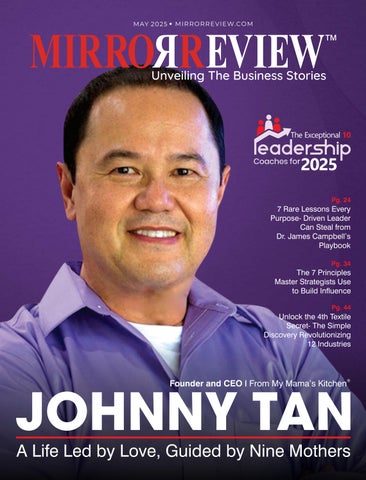
Founder and CEO I From My Mama’s Kitchen®
JOHNNY TAN A Life Led by Love, Guided by Nine Mothers
EDITOR’S LETTER
The Leadership ROI: Coaches Delivering Your Competitive Edge
D
ear Readers,
Top performers don't leave results to chance – they seek expert guidance. In the unforgiving business arena of mid-2025, the idea that leaders can consistently operate at peak potential without targeted development is becoming increasingly obsolete. Stagnant leadership isn't just a missed opportunity; it's a direct threat to the bottom line. Engaging an elite leadership coach is no longer a remedial measure, but a strategic investment proven to yield significant returns in effectiveness, innovation, and resilience.
That's precisely why we've compiled “The Exceptional 10 Leadership Coaches for 2025.” This issue cuts through the crowded field to spotlight practitioners whose methodologies deliver measurable impact for discerning executives and their organizations. Forget vague promises; focus on tangible outcomes. Our cover features Johnny Tan, Founder and CEO of From My Mama's Kitchen®. Tan recognizes a fundamental truth: optimal professional output stems from holistic personal mastery. His multi-pronged approach – encompassing experiential keynotes, executive coaching, mentoring, and publishing – centers on building the “Power of Resilience” to unlock each leader's “Genius Zone.” His unique platform utilizes engaging storytelling and transformative workshops (even incorporating practical self-mastery techniques like Reiki) not just for inspiration, but to achieve a clearly defined result: leaders performing at their highest level with synergy, success, and sustained well-being. Think of it as optimizing your most critical human capital for maximum performance. Alongside Tan, this issue identifies other high-caliber coaches known for delivering results: Casimiro Da Silva Santos, driving peak performance via Bring The Best; Dr. Melinda Fouts, architecting leadership breakthroughs at Success Starts With You; Scott Hansen, providing strategic counsel through Scott Hansen Consulting; and Neeraj Kulkarni, enhancing capabilities via CIEK Solutions. These individuals represent the strategic partners top leaders engage to sharpen their edge. Why invest your valuable time reading about coaches? Because the right partnership delivers quantifiable returns. The insights and methodologies presented here offer practical strategies you can consider for your own development or for empowering your team. In today's market, investing in world-class leadership coaching isn't an expense – it's securing your future competitive advantage. Explore their approaches; the potential ROI is compelling.
PaNKAJ GHOLAP Managing Editor
PUBLISHER
ARCHANA GHULE
EDITOR-IN-CHIEF
VIKRAM SURYAWANSHI
MANAGING EDITOR PANKAJ GHOLAP
PROJECT EDITOR
PANKAJ GHOLAP
PROJECT MANAGERS COLE ALTMAN SUYOG SAWADATKAR
CREATIVE HEAD
SACHIN KHARAT
VISUALIZER
MARK DAVIS
GRAPHIC DESIGNER HARSHADA MALI
HEAD OF DISTRIBUTION & PRODUCTION AAKASH MAHAJAN
HEAD OF OPERATIONS ROBERT SMITH
RESEARCH ANALYSTS JAMES ADAMS
ADVERTISING
MARIA SMITH
FOLLOW US mirrorreviewofficial MirrorReview1 mirror-review mirrorreview mirrorreview
Mirror Review Media & Tech Office No. 430, 4th Floor, Gera’s Imperium Rise, Opp. Wipro Circle, Hinjewadi Phase 2, Pune, Maharashtra - 411057.
+1 (850) 564-8517
info@mirrorreview.com
www.mirrorreview.com
Mirror Review Magazine is published by Pericles Ventures Pvt Ltd. No part of Mirror Review magazine may be reproduced, published or used in any manner without prior written consent from the publisher. The team of Mirror Review Magazine has made every effort to ensure the accuracy of the content. The publisher assumes no responsibility of any part of the content of any advertisement in this publication, including any errors and omissions therein.
Cover Story
10 Johnny Tan
CONTENTS PROFILE
20 30 40 50
Casimiro Da Silva Santos Dr. Melinda Fouts Neeraj Kulkarni Scott Hansen
ARTICLES
24
7 Rare Lessons Every Purpose-Driven Leader Can Steal from Dr. James Campbell’s Playbook
34
The 7 Principles Master Strategists Use to Build Influence (A Case Study at MTSU)
44
Unlock the 4th Textile Secret: The Simple Discovery Revolutionizing 12 Industries
10 l MAY 2025
Cover Story
®
Founder and CEO I From My Mama’s Kitchen
JOHNNY TAN A Life Led by Love, Guided by Nine Mothers
“
Wisdom is about knowing others. Enlightenment is about knowing ourselves.
M I R R O R R E V I E W . C O M l 11
I
t’s rare to hear a story that feels like a novel, filled with turning points, unexpected mentors, and a cast of unforgettable characters who help shape a person’s path. Johnny Tan’s life is a perfect example of this. As the Founder and CEO of From My Mama’s Kitchen®, his journey began in Malaysia and continued across the globe to Louisiana, where he encountered a series of experiences that felt both serendipitous and deeply meaningful. Long before he stepped into a boardroom or stood on stage to present a keynote, Johnny was already living a story rich in experience and human connection. Born in Malaysia and adopted at birth, Johnny left home after graduating from high school in Melaka. Four months after turning 18, he began his freshman year at Louisiana State University. A year later, after his father’s sudden passing, his life changed dramatically—so much so that he couldn't return to Malaysia for another 15 years. During that time, Johnny gained something unexpected: eight remarkable women, each of whom became a mother figure to him. Alongside his Malaysian mother, he first met his Southern Belle mom, his host in Baton Rouge. Then came his Italian Foster mom, whom he met through a fellow passenger on his flight to the U.S.—a stranger who invited him to Missouri for his spring semester break. At 22, Johnny began his career in the restaurant industry. By 33, he had risen to the position of Chief Operating Officer at the company, marking an impressive accomplishment in just 11 years. He also met six additional mother figures during this period: three through business—his Spiritual Progressive mom, Sanguine Savannah mom, and Texan Earthly mom—and three through his leisure time: his Ballroom Dancing Instructor mom, German mom, and Cajun mom. “They were my teachers, coaches, and counselors,” he reflects, “and the loudest cheerleaders at various finish lines.” His origin story is unique, shaped not only by circumstances and ambition but also by the deep and consistent presence of guided motherly love. From Recipes to Reflections: The Birth of a Platform The concept behind From My Mama’s Kitchen® didn’t emerge from a grand vision; it arose from a simple love of food. Johnny sought to preserve the recipes he had gathered over the years from his various mothers, dishes that evoked memories of laughter, comfort, and home. However, as he began to develop the project, something deeper was revealed.
12 l MAY 2025
He recognized that it wasn’t just the food that left an impression on him; it was the conversations that took place around it. “Our kitchen table talks were more than just casual chats,” Johnny explains. “They were heart-to-heart moments—discussions about life, family, values, and decisions.” These conversations were not scripted lectures; they were honest, lived experiences shared like heirlooms—wisdom exchanged between bites. What he discovered was a form of wealth that is often overlooked: unconditional motherly love. Through every story, every meal, and every moment, Johnny realized a universal truth—mothers around the world, regardless of their culture, desire the same thing: they want to nourish their children not just with food, but with guidance, soul, and the tools to live well and succeed in life. “Our moms are our first teachers,” he states. “Home is our first classroom.” When he published the original “From My Mama's Kitchen” book in 2009, the response was overwhelming. It quickly became a multi-awardwinning bestseller. People connected not only with the stories but also with the emotions behind them. This momentum led to the creation of From My Mama’s Kitchen® as a broader platform that promotes the idea that personal success begins not in a boardroom but at home. To Johnny, “home” is not merely a physical place; it embodies something we carry within us—a core to which we return and a foundation that shapes how we present ourselves to the world. Finding the Genius Within For Johnny, every person carries something sacred that he refers to as their Divine Fingerprint. This concept is not merely a poetic idea; it serves as a framework for understanding our core identities: our talents, quirks, preferences, and even the aspects of ourselves we sometimes wish to hide. “There are no liabilities,” Johnny says. “Everything we are is part of the package. Even our weaknesses are gifts—they guide us toward growth.”
Cover Story This belief underpins his proprietary concept, the Genius Zone. It starts with the comfort zone, where we feel at ease, and our natural abilities shine. However, Johnny encourages people to expand that area—exploring, refining, and elevating it as they operate with clarity, purpose, and joy. Living in this space doesn’t mean life becomes easier; instead, it becomes more aligned. It’s where strengths transform into tools and challenges evolve into lessons. “When people start to embrace every part of themselves,” he says, “they stop trying to fix who they are and start utilizing who they are.”
“
We are not the product of our environment, but rather, our environment is the product of who we are.
Whether he is working with corporate leaders or students embarking on their first significant roles, Johnny consistently observes the same outcome: a transition from self-doubt to self-trust. He believes this transformation signifies the beginning of true success, as we are the architects of our lives. Leading with Heart When Johnny Tan, at 22, stepped into his first leadership role in the restaurant industry, he quickly discovered that his biggest challenges weren’t technical; they were human. As a young Asian male leading multi-ethnic teams primarily comprised of older individuals, he realized that earning respect would require more than just a job title. So, he made a choice. He committed to efficient yet intentional communication. “Words have power,” Johnny says. “And listening is just as important as speaking—maybe more.” He did not enter conversations to prove a point; he entered them to understand. His guiding principle was to listen to learn, not in anticipation of replying, ensuring that everyone felt seen, heard, and valued.
M I R R O R R E V I E W . C O M l 13
®
From My Mama's Kitchen Community Enrichment Live Presentation
Johnny led with consistency, kindness, and clarity, focusing on who he was rather than merely on his position. Over time, this approach transformed the culture around him. By the time he turned 33, he had become the Chief Operating Officer of the company, overseeing its growth from 5 restaurants to 25 locations and employing over 600 people. Under his leadership, the company launched 2 to 3 new restaurants each year. However, the most remarkable achievement wasn’t just the expansion—it was the transformation of workplace culture. Seventy percent of his management team held college degrees, a rare sight in the industry. He also reduced employee turnover from an astonishing 300% to below 100%, an almost unprecedented accomplishment in the restaurant industry. Johnny achieved this not by tightening rules but by deepening relationships. His employee enrichment programs focused on helping individuals recognize their strengths and understand their roles within a larger corporate family.
14 l MAY 2025
The results were impressive. In fact, a surprising trend began to emerge: young people were coming in to apply for their first jobs not because they saw an ad, but because their parents, who worked for the company, wanted their children to experience the same positive environment. “That,” Johnny reflects, “was the greatest reward I never saw coming.” Coaching the Whole Person Johnny believes in going beyond surface-level solutions. His coaching delves deeper into the heart, mind, body, and spirit. “We are not just thinkers or doers,” he says. “We are feelers and beings. Everything we do starts with what we carry inside.” At the core of his coaching philosophy is the concept of wholeness. For Johnny, true transformation begins when individuals understand and recognize that they are the source of their own actions and reactions. He assists clients in reconnecting with their inner compass—the heart—where intentions are first formed. From that foundation, the mind creates plans, the body takes action, and the spirit leads the way forward.
Cover Story This multi-layered approach distinguishes his proprietary coaching program. It’s not just about achieving goals or altering behaviors; it’s about connecting with your true self and understanding how you navigate the world. “Once you’re aligned,” he explains, “everything flows better. You’re not forcing change; you’re becoming more of who you are.” Leading with Divine Emotional Intelligence From Johnny’s perspective, leadership is not defined by titles, hierarchies, or control; rather, it emphasizes connection. His concept of Divine Emotional Intelligence redefines traditional leadership. “We lead people. We manage situations,” he says. “That difference matters more than ever in today’s world.” As technology continues to influence how we work, Johnny believes that our humanity should take precedence. Divine Emotional Intelligence involves living and performing in the Genius Zone, where emotional awareness, spiritual clarity, and practical decision-making converge. It encourages viewing individuals not merely as roles to manage, but as people to inspire. He explains, “We are in the people business. Although we sell services, goods, commodities, and products, ultimately, people buy from people.” This approach creates space for teams to collaborate more fluidly. Rather than relying on a strict hierarchy, Johnny advocates for leaders to identify who is best suited to tackle each challenge and empowers them to lead in that moment, regardless of their job title. “No one enjoys being managed,” he explains. “But everyone responds positively to being led, especially when it is done with empathy and trust.” What is the outcome? A stronger team, quicker problem-solving, and a culture where everyone feels acknowledged, valued, and appreciated. Whether it’s a large corporation or a solopreneur with a small team of independent contractors, Johnny believes that success is a collective effort. “At the end of the day,” he says, “it’s all about the synergistic approach in driving progress, which leads to the desired success.”
GFEL Award Top 100 Visionaries In Education for 2020-2021
M I R R O R R E V I E W . C O M l 15
Cover Story The Six Cornerstones of Self-Mastery For Johnny, personal and professional success isn’t a destination; it’s a rhythmic journey—a steady, intentional flow that begins with self-awareness and expands outward into how one lives, leads, and grows. This understanding forms the foundation of his proprietary Six Cornerstones of Self-Mastery, a personal development framework designed to help individuals thrive and excel in their Genius Zone. The six cornerstones are Self-Awareness, Self-Understanding, Self-Acceptance, SelfPotential, Self-Nourishment, and SelfExpansion. They are not merely steps; rather, they are ongoing practices. Together, they create a roadmap that gently guides individuals toward confidence, clarity, and alignment with their authentic selves as they pursue their life’s purpose. In Johnny’s words, the Genius Zone is where “curiosity transforms chaos into peace.” It is a place where clarity sparks creativity and courage manifests as quiet, graceful confidence. By focusing on the present, individuals learn to celebrate small victories and tap into a deeper, more joyful way of living. “When I allow curiosity to educate me about myself, others, and the world,” he says, “I experience faith, hope, and love. And that's what helps me overcome fear, doubt, and anxiety.” Recipes for Living Johnny’s From My Mama’s Kitchen—Food for the Soul, Recipes for Living is more than just a book; it’s a heartfelt tribute to the life lessons he has gathered from his nine mothers. The newly released 15th Anniversary Special Edition has become a trusted self-help guide, filled with empowering, practical, and timeless wisdom for anyone seeking to elevate their personal excellence to the next level.
16 l MAY 2025
Written for adults of all ages, it gently reminds readers that personal success begins at home, rooted in the values we uphold and the relationships we cultivate. Johnny always shares three key “recipes for living” with his clients: “Our authentic charm may open doors, but it is our authentic integrity that keeps them open. Our past helps shape the present and inspires the future. Passion is when the heart creates and the mind formulates.” Workplace Harmony and Personal Rhythm Johnny’s coaching merges personal growth with organizational goals in a practical and profoundly human manner. Through his proprietary Genius Zone workshops, he helps companies enhance their Diversity, Equity, and Inclusion (DEI) efforts—not by using checklists, but by fostering connections. “Organizational Excellence begins when people feel seen, valued, and heard,” he says. His workshops guide employees across generations in finding common ground, building mutual respect, and growing together through shared purpose. At the leadership level, Johnny assists teams in redefining success by focusing on collaboration. He states, “Team harmony occurs when we allow the best in us to bring out the genius in others.” His approach cultivates not only better managers but also true people leaders who recognize the importance of listening, communicating, and uplifting others. Johnny embodies what he teaches. For him, a balanced life isn’t about perfectly dividing time—it’s about intentions. Daily doses of meditation, walks in nature, and occasional ballroom dancing nights keep his rhythm in tune. “That’s how the new me is reborn each day,” he says with a smile.
Looking Ahead: A Vision for Global Impact Looking to the future, Johnny Tan’s mission is clear: to help people design their lives and perform at their highest potential through resilience and self-awareness. His latest project, the From My Mama’s Kitchen® Genius Zone Educational Platform Community Enrichment Programs, aims to reach individuals worldwide. The goal is simple yet powerful: to empower corporations, organizations, and government institutions by introducing them to the Genius Zone platform and their communities. “In collaborative partnership with our corporate and organization sponsors, we can create a better world, one community at a time,” Johnny says. Committed to fulfilling a vision of leaving a lasting legacy of love for future generations, Johnny seeks to make a global impact through one experiential keynote and one workshop, one community at a time. By the way, Johnny was recently nominated for the 2025 International Impact Author of the Year Award for his extremely impactful book, “The 15th Anniversary Special Edition From My Mama's Kitchen.” A Final Word: Wisdom and Encouragement As Johnny reflects on his journey, he shares four empowering “recipes for living” that have served as guiding beacons of light throughout the highs and lows of his life. These timeless words of wisdom, passed down from the strong women in his life, continue to nourish his heart, mind, body, and spirit. For the heart, Johnny recalls his Malaysian mother’s advice: “Throughout our life’s journey, we will continue encountering and gaining new experiences. Some experiences, whether good or bad, will stay with us for the rest of our lives. How we manage them will ultimately determine our idea of success or failure in both our personal and professional lives.”
For the mind, his Southern Belle mom’s words resonate deeply: “Our authentic charm and personality may open doors for us; however, it is our authentic integrity character that keeps them open.” For the body, Johnny reflects on a profound truth his Texan Earthly mom taught him: “Wisdom is about knowing Others. Enlightenment is about knowing Ourselves.” And for the spirit, Johnny embodies the wisdom of his Spiritual Progressive mother: “Smiling Sows Happiness, and a Smile is a Handshake that is Seldom Refused.” As Johnny closes, he offers this insightful encouragement: “We are not the product of our environment, but rather, our environment is the product of who we are.” He continues, “As life only goes in one direction, forward, the rearview mirror will always provide us with visions of opportunities and a world of possibilities that lie ahead.” In conclusion, our greatest potential is always in front of us, waiting to be discovered!
M I R R O R R E V I E W . C O M l 17
The Exceptional 10 Leadership Coaches for 2025 Casimiro Da Silva Santos
Dr. Colleen Georges
Founder and CEO, Bring The Best
Founder, RESCRIPT Your Story LLC
www.bringthebest.pt
www.colleengeorges.com
Dr. Melinda Fouts
Johnny Tan
Founder, Success Starts With You
Founder and CEO, From My Mama’s Kitchen
www.successstartswithyou.net
www.joyfulliving360.com
Kelsey Waldrop
Linda C. Coughlin
Founder, Potential On Point
Founder, Great Circle Associates
www.potentialonpoint.com
www.greatcircleassociates.com
Neeraj Kulkarni
Pamela Stambaugh
CEO, CIEK Solutions
CEO and Founder, Accountability Pays
www.cieksolutions.com
www.accountabilitypays.com
Peggy Tiderman
Scott Hansen
Co-founder, Streamlined Coaching
Founder, Scott Hansen Consulting
www.streamlinedcoaching.com
www.scotthansenconsulting.com
18 l MARCH 2025
®
Casimiro Da Silva Santos Forging Leaders for an Era of Authenticity 20 l MAY 2025
T
he modern business landscape demands more from its leaders than ever before. Strategic planning and operational excellence remain vital, yet they prove insufficient without the crucial underpinnings of resilience, adaptability, and genuine human connection. Many executives find themselves navigating intense pressure while confronting their own limitations. Into this challenging environment steps Casimiro Da Silva Santos, known as Coach Cas, the founder and CEO of Bring The Best. His work transcends conventional coaching; it represents a dedicated effort to reshape leadership from the inside out, equipping individuals and organizations not merely to perform, but to thrive with purpose and authenticity. Lessons from the Front Lines: A Corporate Career’s Unfolding Insights Casimiro Da Silva Santos arrived at his current calling through the crucible of a demanding 25-year corporate career. Holding diverse, high-stakes positions primarily in sales and marketing, he navigated the relentless cycle of international travel, budget management, and deadline pressure. He achieved considerable success by conventional metrics. Notably, he spearheaded the launch of a company in South Africa, impressively growing it to a 30 million turnover with a team of 100 employees under his direction within just five years. In another significant accomplishment, he revitalized a struggling division, methodically increasing its Earnings Before Interest and Taxes (EBIT) from a mere 1% to a healthy 11%, prioritizing sustainable organic growth over disruptive restructuring. Yet, amidst these professional triumphs, a different kind of accounting began. Santos started documenting his observations and reflections on leadership, effectiveness, and fulfillment in a series of personal notes he titled “Bring The Best.” Concurrently, the relentless pace and constant travel exacted a personal toll. He recognized a growing disconnect, realizing he was not fully present for his young child. This stark awareness ignited a deeper ambition: not just to achieve corporate targets, but to inspire individuals to unlock their full potential and transition towards what he terms “a life of abundance.” He understood, with clarity born of
experience, that fostering this kind of profound transformation required a different platform than the executive roles he then occupied. The seeds for Bring The Best were sown in the demanding reality of corporate life. Building the Framework: Bring the Best and ActionCOACH In 2022, Casimiro Da Silva Santos formally launched Bring The Best, translating his years of observation and personal conviction into a dedicated coaching practice. The firm offers specialized coaching in several key areas: business growth, leadership development, executive performance, and team optimization. Recognizing the value of proven systems, approximately nine months ago (relative to this publication), Santos also acquired a franchise with ActionCOACH, integrating its established methodologies while maintaining the distinct identity and focus of Bring The Best. Bring The Best’s core mission remains deeply personal: guiding individuals and organizations toward realizing their envisioned futures and achieving their most significant aspirations. Santos places a particular emphasis on supporting the LGBTQIA+ community, creating a space where authenticity is not just welcomed but foundational to growth. He differentiates his practice through a coaching style rooted in empathy and genuine connection, contrasting sharply with the often impersonal, advice-driven approach of untrained individuals who may label themselves coaches but function more like consultants. Critically, Santos underscores the importance of professional standards and accreditation. Holding certifications from respected international bodies like the International Coaching Federation (ICF) and the European Mentoring and Coaching Council (EMCC), he ensures his clients receive services grounded in established competencies and ethical guidelines. He positions his role strategically, viewing himself as a vital link who effectively bridges the distinct yet related domains of coaching (facilitating self-discovery), mentoring (sharing experience), and consulting (providing expert advice), tailoring his approach to the specific needs of each client.
M I R R O R R E V I E W . C O M l 21
The Entrepreneur’s Gauntlet: Resilience Forged in Setbacks Transitioning from a structured corporate environment to the unpredictable world of entrepreneurship presented its own set of formidable challenges. Santos speaks candidly about encountering setbacks, acknowledging the frustrations and moments of selfdoubt inherent in building a new venture. He confronts what he calls “lessons in insufficiency,” recognizing that ambition sometimes outpaces current capacity – “Sometimes you are not big enough to wear the shoes you want to wear.” However, central to his leadership philosophy is the unwavering belief in perseverance. He reframes failure not as an endpoint, but as an invaluable learning opportunity, prompting rigorous analysis and adaptation for future actions. While acknowledging the natural emotions of frustration, he maintains a resolute focus on his ultimate goals, actively pushing past feelings of inadequacy. This involves a pragmatic acceptance of reality – understanding that not every opportunity is the right fit and that the past cannot be altered. Consequently, he channels his energy decisively towards shaping a successful future. This hard-won resilience informs his coaching, allowing him to connect authentically with clients facing their own obstacles. His personal journey includes a milestone he ranks as paramount: coming out at work during his corporate career. He describes this act of embracing and openly expressing his true identity as perhaps his “greatest achievement,” a testament to the courage required to live authentically, especially within potentially less accepting environments. This personal conviction deeply influences his coaching, particularly his work within the LGBTQIA+ community. Defining Modern Leadership: Beyond Command and Control Drawing from his extensive corporate experience and ongoing work with leaders, Santos asserts that effective leadership has fundamentally shifted. It now centers unequivocally on people. Empathy and authenticity are no longer peripheral traits but core requirements. Leaders must recognize their team members as whole human beings, not merely cogs in a machine.
22 l MAY 2025
Furthermore, adaptability reigns supreme. The ability to guide teams through rapid change, supporting individuals as they navigate uncertainty at their own pace, is crucial. This requires leaders who are agile, responsive, and adept at building psychological safety. Santos emphasizes the necessity of fostering trust and respect, creating genuine, reliable relationships while simultaneously inspiring ambition and driving performance. These qualities – agility, adaptability, empathy, authenticity, and the ability to cultivate trust – form the essential toolkit for leaders navigating today's volatile landscape. His perspective is shaped by leaders who defied convention, citing Nelson Mandela, Steve Jobs, Richard Branson, Jack Welch, and Simon Sinek as key inspirations. From them, he learned the power of selfbelief, the viability of unconventional paths (misfits finding success), the wisdom of guiding from behind, and the fundamental truth that seemingly impossible goals can be achieved. Navigating Work, Life, and Industry Challenges Santos offers a pragmatic view on work-life balance, eschewing idealized notions. He acknowledges the significant time commitment work requires (often 8-12 hours daily) and its inherent role in shaping identity. His approach involves deliberate time management, using techniques like time blocking to consciously schedule personal activities – relaxation, cultural pursuits, travel, socializing – directly into his calendar with the same importance as business appointments. He also integrates moments of self-reflection into his routine, finding value in patient introspection amidst the daily demands. Looking at the broader coaching industry, particularly in Portugal, Santos expresses concern over the lack of regulation. He observes a proliferation of individuals claiming coaching qualifications based solely on brief online courses. This trend, he argues, risks diluting the profession's credibility and compromising ethical standards. He positions his own commitment to rigorous certification (ICF, EMCC) as a necessary bulwark against this erosion of quality. Additionally, he acknowledges the rise of AI-driven coaching platforms but questions their ability to replicate the nuanced value executives derive from deep, human-to-human coaching interactions, especially in fostering trust and facilitating profound shifts in perspective.
The Imperative to Begin: Mindset over Perfection Casimiro Da Silva Santos’s core message to aspiring leaders and entrepreneurs is direct and compelling: Do not wait for the perfect moment. Perfection is an illusion, and hesitation is the enemy of progress. “Start now,” he advises, “without spending too much time thinking about when to begin.” Preparation, in his view, hinges more on cultivating the right mindset – one of resilience, adaptability, and a willingness to learn – than on having every detail flawlessly arranged beforehand. He urges individuals to push past self-doubt, trust their ability to adapt, and take decisive action. Through Bring The Best, Casimiro Da Silva Santos channels his extensive experience, hard-won insights, and deep commitment to authentic growth. His responsibilities encompass not only delivering high-impact coaching but also strategically managing his business – including outsourcing key functions like accounting and marketing to navigate the complexities of solo expansion – and upholding the highest professional standards in a challenging industry landscape. He stands as a testament to the transformative power of aligning one's work with personal conviction, dedicated to helping others overcome their limitations, embrace their potential, and truly bring their best to the world.
M I R R O R R E V I E W . C O M l 23
7 Rare Lessons Every Purpose- Driven Leader Can Steal from
Dr. James Campbell’s Playbook 24 l MAY 2025
M
ost people chase profits. A few chase something else entirely—and change thousands of lives in the process.
When Dr. James Campbell first asked himself, “Why did I come out of my mother’s womb?”—he wasn’t sitting in a plush office. He wasn’t even a CEO yet.
It doesn’t come from glossy MBA programs or motivational seminars. It comes from trenches few are willing to walk. Here are 7 rare lessons every purpose-driven leader can—and should—steal from his playbook:
He was standing alone. Questioning everything.
1. Big Change Starts With a Simple, Personal Question
And that single question rewired the course of his life—and the fate of thousands of families he hadn’t met yet.
It wasn’t a boardroom idea. It wasn't a “five-yearplan” brainstorm.
Today, Campbell leads Communitas, Inc., a 70-year-old organization that doesn’t just support people with disabilities—it lifts them, shapes futures, and restores hope where systems often fail.
One day, standing in front of the mirror, after four years in the Army and another ten running restaurants, Dr. Campbell realized money didn’t scratch the itch anymore.
But here’s the secret no one talks about: Campbell’s leadership blueprint is rare.
The work felt empty. The wins felt hollow. In that quiet space, the question struck:
M I R R O R R E V I E W . C O M l 25
“Why are you here?”
Most people would have run away.
He learned something most leaders never figure out:
James ran straight in.
“Purpose doesn’t show up in a mission statement. It shows up in your gut.” And if you want real change, you start by listening to it. 2. Skill Stacking Beats Skill Mastery Every Time After his restaurant years, James didn’t toss his business experience aside. He stacked it.
And here’s the secret:
Look under the hood at Communitas and you won’t find bureaucratic mazes.
“Leaders who thrive don’t wait for the dust to settle. They learn to breathe inside the dust.”
You'll find real conversations.
At Easter Seals, James didn’t just survive the chaos. He met mentors who stretched him. He sharpened his executive thinking. He discovered how to lead when the ground shifted beneath his feet. In a world addicted to comfort, he made chaos his classroom.
When he ran group homes for adolescents, he used everything he knew about managing people, solving fires fast, and balancing operations.
4. You Build Bigger Things When You Don’t Start From Zero
Later, as Director of Vocational Services, he realized:
When the CEO seat at Communitas opened up, it wasn't a broken place. It was a solid, 70-year-old organization, built right.
“You don’t throw old skills away. You redirect them toward better aims.” He built job pathways for people with disabilities. He helped launch businesses from scratch—lawn care, janitorial services, floor waxing. The skills that once earned profits now created livelihoods. Today’s takeaway? “Don’t switch ladders. Switch walls. Let your old skills serve a new, deeper climb.” 3. Real Growth Happens When You Walk Straight Into Chaos At Easter Seals UCP in North Carolina, the environment was messy. New mergers. New systems. A lot of people running fast, unsure where they were heading.
26 l MAY 2025
5. The Best Systems Begin and End With People
For the first time, James wasn’t hired to fix. He was hired to build. It taught him a lesson even billiondollar companies often forget: “If you want to build a legacy, don’t just find problems to fix. Find strong foundations to expand.” Communitas had a clear belief already etched into its culture: Everyone deserves a life filled with opportunity, dignity, and joy. James didn’t have to invent that mission. He just had to amplify it. And that’s why Communitas thrives today across Massachusetts, running Family Support programs, Day Services, and Career Services that transform lives, not just manage needs.
James leads through a personcentered approach so simple, it's almost shocking: · Deep listening before offering solutions. · Tailored support for every single family. · Systems flexible enough to bend and evolve with people’s changing lives. While most organizations fall into the trap of “scaling” services until they lose their soul, James holds the line: “Every service must feel personal, not procedural.” When you lead that way, people don't just stay. They grow. 6. Leading with Empathy Isn’t Soft—It’s Strategic Somewhere along the way, the business world started treating empathy like a nice extra. James Campbell treats it like essential equipment. He practices three principles every day: · Self-efficacy (show people they can succeed) · Emotional intelligence (listen with real care) · Collaboration (build shared wins, not just top-down decisions)
In every meeting, every decision, James asks: “Are we building strength in others—or stealing it?” He knows the quiet truth few leaders admit: “People don’t perform at their best out of fear. They perform at their best when they feel trusted, respected, and believed in.” And that’s how you get real loyalty. Real momentum. Real magic. 7. The Right Mindset Turns Every Roadblock Into a Launchpad James didn’t coast his way into leadership. He fought through unconscious biases in hiring. He battled self-doubt stepping into new, unknown organizational cultures. Every time, he could have gotten bitter. Every time, he chose to get better. He taught himself a mental rule anyone can copy: If so, remember this: “Where you’re undervalued, look elsewhere. Where you’re misunderstood, learn deeper. Where you’re doubted, double down.” In Northern Virginia and Boston’s nonprofit scenes, he found new homes that valued what he brought to the table. He didn’t wait for the world to give him a clear, easy lane. He made his own lane.
· You already have skills. Stack them toward something bigger. · You will face chaos. Lean into it, not away from it. · You don’t need to fix everything. Sometimes you just need to build higher. · People must stay at the center, or you’ll lose the thread. · Empathy isn’t weakness. It’s your sharpest leadership tool. · Challenges aren’t walls. They’re springboards. Dr. James Campbell didn't find meaning by following a map. He found it by following a question.
And that’s what lasting leadership looks like. Why This Matters to You Right Now
Maybe it’s time you asked yourself the same one: “Why did you come out of your mother’s womb?”
You might be standing at your own crossroads today.
Because if you dare to chase that answer, your real leadership journey can finally begin.
Maybe your job feels hollow. Maybe your leadership feels stalled. Maybe you’re wondering if you missed your real purpose somewhere along the way.
M I R R O R R E V I E W . C O M l 27
Dr. Melinda Fouts
Deploying Psychological Insight for Enhanced Executive Performance
I
n the demanding theatre of modern business, executive leadership requires far more than industry knowledge and operational skills. The most effective leaders possess a high degree of self-awareness, emotional regulation, and the capacity to adapt their thinking. Yet, many executives, despite considerable success, operate with unseen limitations – ingrained beliefs, habitual thought patterns, or over-relied-upon strengths that hinder their ultimate potential and organizational impact.
Her aptitude for observing human dynamics was cultivated early. Accompanying her father to business and political meetings from a young age, she was instructed to listen intently. This formative experience honed her ability to read non-verbal cues and discern underlying currents in group interactions – skills directly applicable to understanding organizational politics and team dynamics.
Dr. Melinda Fouts, founder of Success Starts With You, operates at this critical intersection of psychology and business. As an executive coach with deep roots in psychotherapy, she offers a distinct methodology designed to identify and address these often invisible barriers, ultimately aiming to improve leadership effectiveness from the core. Her practice, Success Starts With You, is built on the premise that unlocking higher performance requires a rigorous examination of the leader’s internal landscape.
The transition from a full-time psychotherapy practice to executive coaching was catalyzed by direct market feedback. A Chief Information Officer, having worked with multiple coaches, found Dr. Fouts’ approach uniquely effective in uncovering limiting beliefs. This validation, coupled with Dr. Fouts’ own recognition of potential burnout in her clinical practice, spurred her to apply her extensive psychological toolkit to the challenges faced by business leaders. She understood that while the context differed, the core task often involved identifying and modifying deep-seated patterns – a task for which her clinical background provided a significant advantage.
The Foundation: A Convergence of Clinical Depth and Business Observation
The Core Methodology: Identifying Blind Spots, Challenging Mental Models
Dr. Fouts brings an unusual and potent combination of credentials to the executive coaching field. She holds a Ph.D. in Psychology and possesses over two decades of experience in psychotherapy, providing her with a profound understanding of human behavior, motivation, and cognitive patterns. Crucially, she supplemented this clinical background with formal Executive Coaching Certification, bridging the gap between psychological theory and practical business application.
Dr. Fouts’ coaching methodology centers on disrupting executives’ established modes of thinking to foster greater self-awareness and strategic flexibility. She operates as a “thought partner,” actively challenging the assumptions, beliefs, and cultural imprints that shape an executive’s worldview and, consequently, their decision-making. Her objective is not simply to offer advice, but to help leaders “wake up the mind to itself,” enabling them to recognize their own cognitive biases and limitations.
30 l MAY 2025
Dr. Melinda Fouts I Founder Success Starts With You
M I R R O R R E V I E W . C O M l 31
She posits that many successful individuals develop blind spots or overuse their inherent strengths to the point where they become weaknesses. Her psychological training equips her to identify these patterns, often invisible to the executives themselves or missed by coaches without similar clinical depth. Dr. Fouts utilizes a range of diagnostic tools, including assessments for Emotional Intelligence (EQi-2.0, EQi 360) and personality indicators (MBTI, FIRO-B, CPI 260), not as definitive labels, but as data points to inform the coaching process and highlight areas for development. The ultimate goal is to expand the leader's repertoire of thought and behavior, enabling more effective responses to complex business situations. In Practice: Application and Techniques Dr. Fouts translates her methodology into practical application through several key techniques: 1. Targeting Overused Strengths: She helps clients recognize when a dominant strength – assertiveness, analytical thinking, etc. – becomes counterproductive in certain situations and guides them in developing complementary skills. 2. Developing Emotional Intelligence: Dr. Fouts works with leaders to enhance their ability to perceive, understand, and manage their own emotions and recognize those of others. This directly impacts interpersonal relationships, team collaboration, and conflict resolution capabilities. 3. Addressing Specific Business Challenges: She applies her methods to concrete problems. For instance, she coaches startup founders on pitching to investors, helping them move beyond technical data dumps to incorporate compelling narratives that resonate emotionally. For executives in established firms, she addresses the need to diversify leadership styles beyond ingrained habits.
32 l MAY 2025
4. Employing Constructive Challenge: Her “iron fist in a velvet glove” approach signifies a commitment to pushing clients beyond their comfort zones while providing necessary support. This involves holding clients accountable for applying new insights and tools. 5. Utilizing Psychological Frameworks: She might employ concepts like Jungian archetypes (e.g., the powerful “Superman” needing awareness of his “kryptonite” vulnerability) as relatable metaphors to help clients understand their own patterns and limitations. 6. Keen Observation: Even in virtual sessions (Zoom, Teams), Dr. Fouts leverages her observational skills, paying close attention to non-verbal cues – eye contact, expressions, posture – to gain deeper insight into the client’s state and reactions. Navigating Ego in Leadership and Conflict A common challenge Dr. Fouts addresses is the detrimental role of ego in high-stakes interactions like negotiations or conflict resolution. Drawing on her psychological background, she observes that ego-driven approaches narrow perspective, foster a “win-lose” mentality, and impede constructive dialogue. Her coaching encourages clients to consciously set aside their ego, detach from the need for a specific outcome (which is often uncontrollable), and enter discussions with greater openness. This shift, she argues, relieves pressure and allows for more creative problemsolving and effective resolution, moving away from defensiveness towards curiosity. Measuring Impact: Beyond KPIs to Behavioral Change Dr. Fouts eschews traditional Key Performance Indicators (KPIs) for measuring coaching success, recognizing the limitations of quantifying nuanced behavioral shifts. Instead, she focuses on observable changes in the client’s interactions and leadership style, primarily gathered through feedback from their professional ecosystem – direct reports, peers, and superiors.
Perspective on Technology and Essential Leadership Skills While utilizing technology for communication (video calls, presentations), Dr. Fouts maintains a degree of skepticism about the role of Artificial Intelligence in the core coaching relationship. She emphasizes the irreplaceable value of human connection for building trust and perceiving the subtle nuances of expression and body language crucial for deep coaching work. Based on client demand, she identifies Emotional Intelligence as the paramount leadership skill sought today. She links developing EQ directly to managing workplace stress, building genuine self-confidence (countering prevalent impostor syndrome), and fostering overall leadership effectiveness. Her work often involves helping highly accomplished individuals reconcile external success with internal self-doubt, guiding them to acknowledge achievements and build resilience. Leadership Philosophy: Compassion as Strategic Action Dr. Fouts champions compassion – which she distinguishes from simple empathy – as a fundamental leadership principle. She defines it not as a passive feeling, but as action: actively listening, reflecting understanding (even without agreement), and offering genuine support. She advocates for leaders to move beyond fault-finding and instead ask, “How can I help?” This compassionate approach, she argues, is not about weakness but is a pragmatic strategy for enhancing communication, boosting productivity and performance, and significantly improving employee retention. She asserts that leadership is defined by these actions, accessible to anyone regardless of formal title.
Success is demonstrated when a CEO notes a COO’s improved communication style under pressure, or when team members report a more collaborative and less defensive approach from their leader. Client-reported outcomes, such as a young professional securing job offers after targeted interview coaching based on her Forbes article insights, also serve as tangible evidence of impact. This method anchors the coaching value proposition in real-world behavioral change within the organizational context.
M I R R O R R E V I E W . C O M l 33
THE 7 PRINCIPLES MASTER STRATEGISTS USE TO BUILD INFLUENCE (A Case Study at MTSU)
ou want to build something lasting? You want to transform a place, command attention, make a real mark? Most people flail. They chase trends, they use fuzzy language, they hope for the best. That’s not how the pros do it.
Y
This wasn’t just a new person in charge. This was the application of deliberate principles that shatter inertia and build influence. Principles we’ve seen applied by the most effective people in any field. Let’s look at how he used them.
Think about the CEO who turns around a failing company. The political strategist who crafts a winning campaign from nothing. The luxury brand that makes people pay a premium just for the name. They don’t leave it to chance. They use a playbook. A set of principles. Not secret, mind you, but often overlooked in their brutal simplicity and effectiveness.
Principle 1: Define the Problem with Unflinching Clarity.
We’ve studied these methods. They apply whether you’re selling soap, winning votes, or building a university. And we see them, clear as day, at work in a place called Middle Tennessee State University, under the direction of its president, Dr. Sidney A. McPhee. For decades, MTSU was a fine place. Solid. Taught students well. Served its region. But it held more potential, like a powerful spring coiled tight. Then, in 2001, Dr. McPhee arrived. And the methods kicked in.
34 l MAY 2025
You can’t fix what you don’t truly understand. A top strategist doesn’t guess why the poll numbers are low. They dig. A CEO doesn't just hope sales improve. They analyze why they fell. When Dr. McPhee took the helm, MTSU had strengths, certainly. But to go from “respected regional” to “national force,” you had to see the gaps. Where did the academics need sharpening? Where did the facilities fall short? Who was the university truly serving? Who could it serve better? This isn’t about vague goals. It’s about specific diagnoses. You identify the market – the students, the region, the employers. You identify the product – the degrees, the research, the campus experience. You see where the product isn’t meeting the market’s highest needs or where the market isn’t seeing the product’s true value.
M I R R O R R E V I E W . C O M l 35
He didn’t just say “improve MTSU.” He identified the specific levers: academic standards, research output, campus infrastructure, community connection. He saw the untapped potential in the students themselves – the firstgeneration, the low-income – who needed a clearer path. That clear-eyed assessment? That’s step one for any successful operation. You know exactly where you stand before you take a single step forward. Principle 2: Invest Ruthlessly in Your Core Asset.
Researchers notice. It’s a tangible demonstration of commitment and capability. This wasn’t just about pretty buildings. It was strategic. New facilities enable new programs. Better labs attract better researchers. A modern campus attracts students who have choices. This investment wasn’t spending; it was powering up the engine. It showed they believed in the institution’s future value, and others started to believe it too. You back your belief with resources, or it remains just talk. $1.5 billion talks very loud.
Luxury brands know this. You don’t cut corners on the material. Political campaigns know this. You invest in getting your core message to the right people. CEOs know this. You put capital where it generates the most return.
Principle 3: Develop Your “Product” to Meet Proven Demand.
What’s a university’s core asset? Beyond the people, it’s the physical plant, the labs, the classrooms. It’s the stage where learning happens. It signals seriousness. It tells the world what you value.
Hopkins said advertise what the product does for the buyer. You don’t sell features; you sell benefits. And you build the product to deliver the benefits the market actually wants and needs.
Dr. McPhee’s administration committed over $1.5 billion to new construction. That’s not remodeling a few offices. That’s reshaping the campus. That’s building modern facilities. Why? Because students notice. Faculty notice.
A university's “product” is its education. Its degrees. Dr. McPhee didnt’ add programs arbitrarily. They expanded offerings to 200 majors and concentrations, 100+ master’s , and 9 doctoral degrees.
36 l MAY 2025
They introduced over 40 new academic programs and 20 institutes and centers. Why those? Because the world changed. The workforce needs shifted. They looked at what employers needed in Middle Tennessee and beyond. They saw where the opportunities lay for graduates. They built programs in those areas. The proposed Legal Studies master’s with Nashville School of Law? That targets a specific, growing need. This is like a savvy company launching new products based on market research, not just a hunch. They built the academic offerings that equipped students for the future workforce, not yesterday’s. They raised admission standards – signaling quality, like a brand refining its exclusivity. They increased enrollment of high-ability students – attracting those most likely to succeed and elevate the institution’s profile. This isn’t just academic expansion; it’s strategic product development aimed squarely at market demand. Principle 4: Prove Your Value with Independent Verification. Trust isn’t given; it’s earned, and then it’s proven. Luxury goods use certifications. Political campaigns use endorsements. CEOs use quarterly reports and audits. You don’t just claim quality; you demonstrate it through credible, outside sources. MTSU under Dr. McPhee actively sought and achieved national recognition. Inclusion in The Princeton Review’s Best Colleges for six years straight. Recognition from The Wall Street Journal and Forbes. These aren’t internal back-pats. These are independent auditors confirming the institution's standing. Achieving the Carnegie R2 designation for high research activity? That’s like earning a coveted industry standard certification. It tells the academic world, and potential students, that serious work happens here. Look at the research funding: over $22 million secured, a 75% increase since 2023. Money follows impact. Grant funding agencies put their money where they see promising research addressing real problems. This number isn’t just money; it’s external validation of the university’s relevance and the quality of its faculty’s work.
Dr. McPhee is right – these recognitions and funding numbers are proof of rigorous, relevant education. They are the facts that build trust and command respect. Principle 5: Understand and Serve Your Core Audience, Deeply. A great brand understands its customer intimately. A political strategist knows their voters’ hopes and fears. A CEO knows their employees are key to execution. For a university, the core audience is the student. MTSU serves over 20,000 students. Critically, many are first-generation or low-income, with nearly half qualifying for Pell grants. This isn’t just a statistic; it’s a fundamental reality that shapes how you operate if you want these students to succeed. They didn’t just open the doors; they built support systems. The completion coaches? That’s a direct response to understanding the specific challenges these students face balancing life and academics. It’s providing the support needed to navigate the path to a degree. This focus on accessibility and support creates opportunity pathways – the core benefit for many students. This principle extends internally too. Supporting work-life balance for faculty and sta ffisn’t just a perk; it’s an investment in the people who deliver the “product.” Happy, supported faculty and sta ffperform better, teach better, and contribute more. It strengthens the core by valuing the individuals within it. You build influence by empowering those around you, starting with your own team and your primary beneficiaries. Principle 6: Integrate with and Contribute to Your Ecosystem. No successful entity exists in a vacuum. Companies need suppliers and customers. Political movements need coalitions. Luxury brands build aspirational communities. A university thrives by connecting with its region. MTSU isn’t just located in Murfreesboro; it’s part of its fabric and the larger Middle Tennessee economy. Strategic partnerships, like the one for the Legal Studies program, aren’t just academic exercises. They are about meeting the needs of businesses and communities in the region. The Alumni Impact Report revealing alumni generated over $15.2 billion in business revenue in Tennessee in one year?
M I R R O R R E V I E W . C O M l 37
With 155,000 alumni, 114,900 in state? That’s not just a nice statistic for a fundraising brochure. That’s concrete evidence of the university’s direct, massive contribution to the state’s economic health. They work with local businesses to identify skill gaps and build programs to close them. This ensures graduates are employable locally and strengthens the regional workforce. This integration makes the university indispensable. It builds influence by demonstrating clear, tangible value to the wider community it serves. It becomes an engine, not just an ivory tower. Principle 7: Operate with a Master Plan, Executed with Precision. This is perhaps the most “clandestine” principle, not because it’s secret, but because it requires discipline most people lack. It’s the heart of the strategist’s approach. It’s what separates the doers from the dreamers. Dr. McPhee states it plainly: “Nothing happens by accident.” This isn’t a platitude. It’s an operating principle. It means you don’t drift. You plan. Meticulously. You set goals. You develop strategies to reach them. You take decisive actions. This is the opposite of chaos. It’s minimum wasted motion. Every investment, every program added, every partnership forged, every support system built – they are all part of a larger, integrated plan. They aren’t random acts of improvement; they are coordinated steps towards a defined vision. Executing a plan requires constant evaluation, yes, but it starts with the belief that outcomes are created, not simply observed. You identify your advantages (acuity, location, student body, resources), and you leverage them deliberately. You don’t hope for a legacy; you build one through careful, persistent execution. He credits the people – faculty, staff, alumni, friends. And that’s crucial. A master strategist knows they don’t act alone. They build a team and inspire them to execute the plan. But the plan, the direction, the insistence on deliberate action? That comes from the top.
38 l MAY 2025
The Result: A Legacy Built on Principle. You see the pattern? It’s not magic. It’s method. 1. 2. 3. 4. 5. 6. 7.
Know the landscape and the problem. Power up your core assets. Build what the market needs. Prove its worth with hard facts. Serve your core audience completely. Become vital to your community. Plan everything, execute deliberately.
Applying these principles transformed MTSU. It moved from regional respect to national recognition. It built modern facilities. It expanded academic reach. It became a key economic driver. It created opportunities for thousands of students. This is the power of deliberate action. Its’ the method CEOs, strategists, and successful brands use. Dr. Sidney McPhee didnt’ just preside over a university; he applied these timeless principles to build influence, create value, and transform an institution, one planned step at a time. And the result, clear for anyone to see, is a legacy built not on accident, but on execution.
M I R R O R R E V I E W . C O M l 39
NEERAJ
KULKARNI Engineering Measurable Growth through Disciplined AI Application
T
he modern business landscape overflows with data, yet extracting genuine, profitable insight remains a formidable challenge. Artificial Intelligence (AI) offers immense potential, but its effective deployment requires more than technological prowess; it demands strategic clarity, operational discipline, and a relentless focus on business outcomes. Neeraj Kulkarni, CEO of CIEK Solutions, operates precisely at this nexus. He leads a specialized consultancy that guides Fortune 50 corporations and ambitious mid-sized enterprises through the complexities of data science and AI, translating sophisticated analytics into tangible growth, optimized marketing, and monetizable data assets. CIEK Solutions distinguishes itself not merely as an AI vendor, but as a strategic partner focused squarely on solving core business problems. The Genesis: Identifying a Critical Market Need
The initial focus targeted areas of immediate need – marketing effectiveness, customer analytics, and developing data products – directly addressing the capability gap he had observed. CIEK’s Distinctive Approach: Intelligence, Experience, Structured Execution CIEK Solutions differentiates itself through a methodology that integrates Customer Intelligence (CI) – insights derived from data – with Experiential Knowledge (EK) – deep understanding gleaned from years of industryspecific application. This fusion aims to produce predictive insights that are not only accurate but also transparent and actionable for clients. The company concentrates its expertise on critical business functions: AI-powered marketing optimization (including sophisticated Media Mix Modeling), advanced customer analytics (Lifetime Value, churn prediction), the development of monetizable data products, and the application of Generative AI for business process enhancement. External validation supports CIEK’s positioning. Publications such as INC.com, CIO Review, and Martech Outlook have recognized the company for its innovative AI applications and impact. This credibility is further reinforced by a leadership team possessing over a century of combined experience in data and analytics. The Operational Framework: Disciplined Innovation and Risk Management
Mr. Kulkarni’s path to founding CIEK Solutions was paved with over fifteen years of frontline experience leading data science initiatives within demanding sectors like marketing and media, serving global clientele. This tenure provided him with a crucial observation: business leaders faced intense pressure to drive growth, improve return on investment, and enhance customer experiences, yet frequently lacked the specialized internal resources – particularly in data science and advanced AI – to effectively meet these demands. This gap was especially pronounced among mid-sized organizations and agencies.
Mr. Kulkarni implemented a structured approach to manage innovation and ensure financial stability – the “30-70 Portfolio” strategy. This framework dictates that CIEK allocates approximately 30 percent of its resources to higher-risk, potentially breakthrough innovation projects, often involving emerging AI capabilities. The remaining 70 percent focuses on proven methodologies and incremental improvements, securing stable revenue streams.
Recognizing this unmet need, Mr. Kulkarni established CIEK Solutions. He bootstrapped the company, leveraging his industry network and a clear vision: provide businesses with accessible, high-impact data science and AI services.
Several mechanisms buttress this strategy. CIEK maintains significant financial reserves, equivalent to at least six months of operational expenses, providing resilience against market fluctuations.
40 l MAY 2025
The company deliberately diversifies its client base across multiple industries, mitigating sector-specific risks. Furthermore, CIEK employs rapid prototyping and Minimum Viable Product (MVP) testing through pilot programs. This allows for swift evaluation of new concepts. A decisive internal framework enables the team to quickly scale successful initiatives or terminate underperforming projects, conserving resources and maintaining focus. This disciplined operational structure allows CIEK to pursue innovation responsibly while ensuring consistent delivery and financial health. Building Capability: Talent Strategy and Global Operations Mr. Kulkarni recognizes that specialized expertise is CIEK’s core asset. The company’s talent acquisition strategy prioritizes individuals who demonstrate not only technical proficiency but also innate curiosity and a drive to apply technology to solve tangible business challenges. The recruitment process assesses critical thinking, collaborative ability, and a commitment to continuous learning. Mentorship forms a key pillar of talent development. Senior leaders actively coach and guide team members. Uniquely, CIEK incorporates a reverse mentorship program where junior employees share practical insights on emerging technologies and their applications with senior leadership. This practice ensures the entire organization stays abreast of relevant advancements.
M I R R O R R E V I E W . C O M l 41
CIEK leverages a global operational model, with teams located in the United States (New Jersey, Virginia) and strategically positioned delivery centers in India, Ireland, and Morocco. This structure provides several distinct advantages: access to a diverse, specialized global talent pool, cost efficiencies, and the ability to offer clients continuous, 24/7 project support and service. Demonstrating Value: Evidence of Impact Across Industries The effectiveness of CIEK’s approach under Mr. Kulkarni’s leadership is best illustrated through specific client results: · National Grocery Chain: Faced with outdated legacy data systems (Oracle, SAS), the client engaged CIEK to migrate to Neo4J and establish a robust Master Data Management (MDM) framework. This foundational work enabled the deployment of advanced entity recognition and promotions recommendation systems. The measurable outcome: $4.5 million in annual cost savings. · Global Fast-Food Chain (App Data): CIEK analyzed three years of application usage data. Applying machine learning algorithms, the team developed detailed customer profiles, enabling a highly personalized marketing strategy. The measurable outcome: Within 15 months, revenue from high-value customers increased by 38%, and customer churn decreased by 18%. · Modernizing Media Measurement: Recognizing the limitations of traditional attribution models (like lastclick) in a privacy-focused era, CIEK employs advanced Bayesian Media Mix Modeling (MMM) integrating multiple data sources and incrementality testing. o For a leading B2B Logistics Provider, this resulted in a 30% improvement in marketing ROI. o For a Global Fast-Food Chain, it contributed to a 12% increase in commercial sales. · CPG Product Innovation (via Consulting Partner): CIEK developed sophisticated Large Language Model (LLM) and Machine Learning solutions to analyze cultural trends and inform product innovation. The system automated the classification of cultural segments and topics from vast datasets. The measurable outcome: A 45% increase in the client’s operational efficiency related to these tasks, earning an internal award for innovation.
42 l MAY 2025
These examples demonstrate CIEK’s ability to move beyond technical implementation to deliver quantifiable business value across diverse sectors. Leadership Philosophy in Action Mr. Kulkarni’s leadership philosophy emphasizes empowering innovation, maintaining a client-centric focus, investing continuously in talent, and upholding ethical AI practices. These principles are reflected directly in CIEK’s operational strategies: the 30-70 rule fosters calculated innovation, the client success stories underscore the client-centric approach, the mentorship programs demonstrate investment in talent, and the focus on transparent, understandable insights points to ethical considerations. Future Outlook: Continued Growth and Innovation Under Mr. Kulkarni’s direction, CIEK Solutions continues to focus its strategy on key areas. The company plans to deepen its expertise in core competencies like media effectiveness modeling and monetizable AI-driven data product development. Simultaneously, it actively invests in emerging cloud-based AI/ML solutions and Generative AI, developing proprietary Platformas-a-Service (PaaS) offerings targeting specific market needs like automated content generation and intelligent process optimization. Geographically, CIEK pursues strategic expansion into the Middle East and Latin America, forming partnerships with regional technology and consulting firms to deliver tailored solutions.
UNLOCK THE 4TH TEXTILE SECRET The Simple Discovery Revolutionizing 12 Industries
F
riends, let us ask you something plain. Think about the clothes you wear. The seats you sit on. The fabrics that surround you. For centuries – truly, for thousands of years – we’ve made textiles in just three basic ways. We weave them, like a basket. We knit them, like a sweater. Or we press fibers together to make felt. Three ways. That’s it. For generations, smart people, skilled artisans, and giant factories have worked within these limits. They’ve gotten faster. They’ve used new machines. They’ve found new materials. But the fundamental idea – weaving, knitting, felting – stayed the same. It seemed like every possible way to make fabric was already known. Until now. We want to tell you about a fourth way. A discovery so fundamental, yet so overlooked, that it promises to turn the textile world on its head. It wasn’t found in a billion-dollar lab by a massive corporation. It started with one person, watching closely, thinking differently. Her name is Dr. Sonia Reynolds. And her story is one you should pay close attention to, especially if you care about efficiency, new products, or simply getting ahead.
44 l MAY 2025
The Simple Observation Everyone Else Missed Dr. Reynolds didn’t start out trying to invent a new category of textiles. Her journey began much like many innovators – with deep roots and a keen eye. Her parents, part of the Windrush generation from Jamaica, were entrepreneurs. By day, her mother worked as a nurse, and her father was a bricklayer. By night, they ran a small business knitting pullovers. Young Sonia saw fabric being made, not just as cloth, but as warmth, and comfort, a product born from hard work. That stuck with her. Later, while working on her own textile designs, she noticed something peculiar. Something small. Something most might dismiss. She was washing some handcrafted wool panels. As they dried, she saw loose fibers from the cast-on and cast-off edges naturally clinging to the main yarn structure. No glue. No stitches. No human hand guiding them. They just… attached. Think about that. Nature, finding its own way to connect fibers to yarn. Most people would see that and think, “Hmm, that’s messy,” or
perhaps not notice it at all. But Dr. Reynolds asked a different question. A question that changed everything: Could this natural sticking be controlled? Could it be used deliberately to build a fabric, without weaving or knitting? This wasn’t just a stray thought. It became a mission. She dove into understanding why this happened and how she could harness it. This led her down a path of intense study and experimentation. She learned the old ways – weaving, knitting, nonwovens, embroidery – mastering the craft from the inside out. Her curiosity led her to research embedding electronics into fabrics. She saw how clumsy it was with existing methods. She read the work of Professor Tilak Dias, who pointed out the limitations of traditional interlacing (weaving) and interlooping (knitting). It all reinforced her suspicion: there had to be another way. FOYSE: The Fourth Class of Textile Explained Simply After countless experiments, Dr. Reynolds perfected her method. She calls it FOYSE. That stands for Fiber On Yarn Surface Entanglement.
M I R R O R R E V I E W . C O M l 45
Let's break that down so it’s crystal clear. 1. Woven Fabrics: Imagine threads going over and under each other, like a checkerboard. Two sets of yarn, interlacing. 2. Knitted Fabrics: Think of a single yarn making loops that pass through other loops. One yarn, interlooping. 3. Felted Fabrics: Loose fibers are pressed or matted together using heat, moisture, or needles. No yarn structure, just bonded fibers. Now, forget all that. FOYSE does something entirely different. It takes a core yarn. Then, it encourages loose fibers to entangle directly onto the surface of that yarn. Imagine tiny hooks or hairs on the fibers grabbing onto the main yarn. This happens along the length of the yarn. When you lay these “activated” yarns next to each other, the entangled fibers can also connect between the yarns. The result? A fabric sheet is formed without the yarn strands needing to loop or weave through each other. Dr. Reynolds puts it simply: FOYSE “...entangles fibers onto the yarn surface... forming a unique noninterlaced fabric.”
It’s a fourth distinct method. A new member of the textile family. And the process is so fine, she notes, it’s “invisible to the naked eye, making it a completely unique fabric construction.” Why This ‘Secret’ Gives You an Advantage: The Proof Now, you might be thinking, “Okay, it’s different. But is it better?” That’s the right question to ask. A new method is only useful if it offers real advantages. And FOYSE delivers. Here’s the proof, based on the fabrics Dr. Reynolds produces through her company, Zephlinear Ltd.: 1. Astonishing Lightness: Think about woven or knitted fabric. Much of the yarn is used just going over and under, or looping around. FOYSE eliminates that. Dr. Reynolds states, “Zephlinear fabrics are up to 40-60% lighter... due to the elimination of interlacing and interlooping.” Imagine lighter clothing, lighter furnishings, lighter industrial materials – reducing weight, saving shipping costs, improving comfort. 2. Better Temperature Control: Because the structure isn’t tightly woven or knitted, FOYSE fabrics trap more air. This makes them remarkably breathable when it's warm, yet insulating when it’s cool. Comfort, naturally built-in. 3. Surprising Strength: You might think lighter means weaker. Not necessarily. When made with strong fibers like mohair or merino wool, the entanglement process creates fabrics with excellent strength, durability, and elasticity. 4. No Fraying: Cut a woven or knitted fabric, and the edges unravel. FOYSE fabrics inherently resist this. The fibers are entangled along the yarn. This means cleaner edges, longer-lasting products, and potentially simpler manufacturing steps. They offer smooth surfaces that stay intact.
Dr. Sonia Reynolds Founder | Zephlinear Ltd.
46 l MAY 2025
5. Built-in Sustainability: This is crucial today. How does FOYSE help?
· Less Waste: It uses fiber more efficiently. No yarn wasted on complex interlacing paths. Dr. Reynolds confirms it “reduces textile waste... by eliminating excess fiber use.” · Less Energy: The manufacturing process can be more energy-efficient than traditional methods. · Fewer Chemicals: Often, the need for chemical binders or harsh finishing treatments is reduced or eliminated. 6. Patented and Unique: This isn’t just a minor tweak. FOYSE is the first noninterlaced textile technology. It’s protected by patents. This means it offers capabilities others simply cannot replicate with old methods. These aren’t just claims. These are tangible benefits. Benefits that can translate directly into better products, lower costs, and new market opportunities. Taking the Discovery to the World: A Strategic Approach A groundbreaking discovery needs a smart plan to reach its potential. Dr. Reynolds didn’t just invent FOYSE; she founded Zephlinear Ltd. (The name cleverly combines “Zephyr,” for lightness and fine yarns, with “Linear,” for structure and flow) to bring it to the world. But she didn’t stop there. She understood different markets need different solutions. So, under Zephlinear, she created specific brands: · Zephlinear Couture: For high fashion, leveraging the lightness, smooth surface, and unique structure for avant-garde designs. · Fabtangle: A specialized tool enabling others to create FOYSE textiles, focusing on precision and scalability for handcrafted or bespoke applications, like high-end fashion and interiors, ensuring “sustainable production with minimal waste.”
· Rapid FABLAB: A compact manufacturing unit for research labs and design studios. It allows experimentation and prototyping across industries, from medical textiles to performance wear. This isn’t haphazard. It’s a calculated strategy to introduce FOYSE across multiple sectors. Furthermore, understanding that a revolution needs education and collaboration, she established The Institute of FOYSE Technology (TIoFT). Think of it as a bridge. It connects university research (partners include Manchester, Birmingham City, Aston, Warwick, Penn, and more) with real-world industry needs. TIoFT works to refine the technology, train people, and speed up adoption. It’s about building a network to ensure this “fourth class” of textiles finds its place globally. Turning Skepticism into Strength Make no mistake, pioneering something truly new is never easy. Dr. Reynolds admits it: “I faced challenges... such as industry skepticism, securing funding, and developing an entirely new textile technology.” People are comfortable with what they know. Introducing a “fourth way” was met with doubt.
M I R R O R R E V I E W . C O M l 47
Early on, a previous textile business she ran had to close. But she didn’t quit. She used her design skills in other areas, like interior design, to fund her research. She calls developing FOYSE a process requiring “persistence and strategic execution” to gain credibility and resources. How did she overcome it? “By staying focused and adaptable, refining my research, and leveraging collaborations to validate the technology.” Her resilience proved the doubters wrong. Every challenge overcome made the foundation of FOYSE even stronger. Looking Ahead: 12 Industries and Beyond Dr. Reynolds isn’t resting. Her ambition is clear: “My goal for the future is for noninterlaced textiles to capture 1% of the textile industry.” That may sound small, but the global textile industry is colossal. One percent represents a massive shift. Her strategic roadmap targets “12 key industries,” focusing on areas ripe for innovation, sustainability, and advanced materials. What’s next? Exciting projects are underway: · Securing more funding for research, especially with wool and other natural “hairy” yarns where FOYSE excels. · Launching new prototypes and services based on the technology. · A truly revolutionary idea: printing designs or functions directly onto yarn before the FOYSE entanglement process even happens. Imagine this: She has already created biodegradable FOYSE fabrics using a mohair/merino blend that are infused
48 l MAY 2025
with insect-repellent or pleasant aromas. Think window blinds that naturally keep bugs away or packaging that releases a specific scent – all without added chemicals, leveraging the natural properties of the fibers and the unique FOYSE structure. This work, funded by the UK’s DCMS Create Growth Programme, shows the sheer versatility of this fourth way. Your Opportunity to Engage with the Future Dr. Sonia Reynolds often says, “Innovation thrives on curiosity and resilience.” She issues a challenge: “Challenge industry norms, embrace new possibilities, and push forward.” The development of FOYSE wasn’t done in isolation. “The introduction of noninterlaced textiles to the world has been built on global partnerships, rigorous research, and industry support,” she emphasizes. Now, the invitation extends to you. Whether you are a designer looking for new possibilities, a manufacturer seeking efficiency and sustainability, an investor searching for the next big thing, or simply someone curious about the future: 1. Learn More: Understand how this “fourth class” of noninterlaced textiles differs from everything you
thought you knew. Request the free comparative chart offered by Zephlinear Ltd. See the differences laid out plainly. 2. Consider the Possibilities: How could lighter, stronger, breathable, fray-resistant, sustainable fabrics change your products or industry? 3. Engage the Pioneer: Dr. Reynolds shares her insights at major events (like the upcoming VenturefestWM 2025 and the 94th IWTO Congress 2025). Consider booking her for speaking engagements to inspire innovation within your own organization. This is more than just a new type of fabric. It’s a new set of tools. A new way of thinking. This is a potential advantage for those who see the opportunity early. Don’t let the simplicity of the initial observation fool you. Sometimes, the most profound changes start with seeing the obvious in a new light. The textile industry stood on three legs for centuries. Now, there is a fourth. Explore what that means for you.
Owner I SH Consulting
Scott Hansen A Systematic Approach to Accelerating Small Business Performance and Profitability
50 l MAY 2025
T
he path of entrepreneurship, particularly for small business owners, often leads to a frustrating plateau. Initial success driven by hard work and determination can stall, leaving the owner consumed by daily operations, unable to achieve significant further growth in revenue or profitability, and lacking personal freedom. Addressing this common predicament requires more than generic advice; it demands a structured methodology focused on tangible results. Scott Hansen, through his firm SH Consulting, provides such a system. He operates as a business coach and consultant specifically for small business owners who have reached this critical juncture and require a clear, accountable process to scale their enterprises effectively. The Foundation: From Insight to a Focused Practice Mr. Hansen’s entry into business coaching stemmed from an analytical curiosity about the drivers of success and practical problem-solving abilities. He observed a distinct need among established small business owners: a desire not only for increased revenue and profit but also for systems that would grant them greater freedom from the daily operational grind. Recognizing that his approach—combining strategic business growth with owner liberation—filled this niche, he established SH Consulting over a decade ago. His practice was built not on abstract theories, but on addressing the specific, expressed needs of this entrepreneurial segment. The SH Consulting Process: A Framework for Measurable Growth Mr. Hansen’s coaching philosophy is anchored unequivocally in achieving measurable results for his clients. Owners engage SH Consulting because they seek substantial improvement – higher revenues, greater profits, increased business value, or more personal time. The process he employs is systematic: 1. Clear Goal Definition: The engagement begins by establishing a precise vision. Mr. Hansen works with the owner to articulate specific, ambitious goals for both the business performance (financial metrics, scalability) and the owner’s personal objectives (time allocation, lifestyle). This clarity forms the benchmark against which progress is measured. 2. Accountability Structure: Recognizing that entrepreneurs often lack external accountability, Mr. Hansen implements a structure to ensure clients adhere to agreed-upon plans and deadlines. This discipline is crucial for building the habits necessary for sustained success and breaking through execution barriers.
3. Strategic and Tactical Input: Mr. Hansen provides clients with proven, practical strategies tailored to their specific business needs, focusing on core drivers like lead generation, sales conversion, effective marketing, and operational productivity. He acts as both an advisor, helping shape the overarching vision, and a strategist, offering concrete solutions to drive growth and profitability. 4. Identifying Operational Blind Spots: A key function of his coaching involves helping owners detach from the minutiae of daily tasks to gain a strategic perspective. He assists them in identifying operational inefficiencies, resource misallocations, or activities that consume time without yielding significant results (“what not to do”). This objective viewpoint helps owners focus on high-impact initiatives. Mr. Hansen backs his process with a service guarantee, an uncommon commitment in the coaching industry, signifying confidence in his methodology’s ability to deliver. Evidence of Effectiveness: Documented Client Results The value of any business consultancy lies in its ability to produce verifiable results. SH Consulting points to substantial financial impact generated for its clients. · Collectively, Mr. Hansen’s clients attribute over $300 million in revenue growth to his direct involvement and strategic guidance. · Multiple clients, under his coaching, have achieved placement on the prestigious INC 5000 list of fastest-growing private companies in the United States, a significant benchmark of rapid scaling. · A specific, illustrative case involved a client whose business generated $3 million in annual revenue when the engagement began. Through implementing strategies focused on sales, marketing, and operational efficiency under Mr. Hansen’s guidance, the company grew to nearly $15 million in annual revenue. Importantly, this engagement also focused on developing the client’s capabilities as a business owner, enabling sustainable leadership for one of the top companies in its industry.
M I R R O R R E V I E W . C O M l 51
· Shorter-term impact is also documented. One client reported adding $1.2 million in revenue in less than twelve months. Another secured 10 new clients within the first sixty days of working with Mr. Hansen. These figures and milestones serve as concrete evidence supporting the effectiveness of the SH Consulting approach. The Role of Owner Mindset in Business Execution Mr. Hansen asserts that mindset plays a critical role in business success, suggesting psychological factors account for a significant portion (citing an 80% figure often used in the field). Within his framework, this translates into the owner’s willingness and ability to adopt new perspectives, implement challenging changes, and maintain focus on strategic goals despite obstacles. He links personal development directly to business growth, contending that stagnation in one often leads to stagnation in the other. His process encourages owners to continuously refine their thinking and leadership approach as a prerequisite for improving business performance. This is not positioned as abstract selfimprovement, but as a necessary component for effective business execution and adaptation.
The Value Proposition: Structured Growth and Enhanced Freedom SH Consulting offers small business owners a defined pathway to break through growth barriers. The value proposition extends beyond isolated tactics; it encompasses a structured, accountable process designed to fundamentally improve how the owner manages and scales the business. The dual focus on increasing revenue and profitability while simultaneously engineering greater operational freedom for the owner addresses a core aspiration of many entrepreneurs. Mr. Hansen provides a system for ambitious owners who are prepared to implement changes and be held accountable for achieving significant, measurable improvements in their business and their lives.
Measuring Success: Tracking Progress against Defined Objectives Success within the SH Consulting engagement is defined by tangible progress against the clear goals established at the outset. Typically structured over a 12-month period, the coaching program culminates in an evaluation based on key metrics: · Did revenue increase as planned? · Did profitability improve? · Did the owner successfully reduce time spent in day-to-day operations to focus more time on strategic business development? When these pre-defined objectives are met, reflecting positive ROI on the coaching investment, clients often continue the engagement to pursue further growth. Mr. Hansen measures his own success by his clients' achievements and his commitment to his own continuous professional development.
52 l MAY 2025
Scott Hansen I Owner
e b i r c Subs Now
www.mirrorreview.com
www.mirrorreview.com