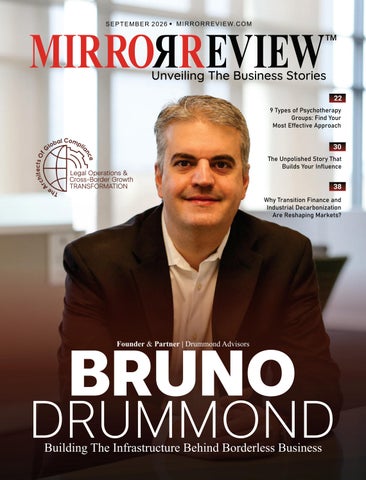
SEPTEMBER 2026
M I R R O R R E V I E W. C O M
™
al Comp li lob
A
hi rc
G
30
ce an
tects O f
22
Legal Operations & Cross-Border Growth TRANSFORMATION
The
BRUNO
38
Founder & Partner | Drummond Advisors
DRUMMOND Building The Infrastructure Behind Borderless Business
EDITOR’S Note
Compliance Is Not the Brake on Growth. It Is the Steering.
Dear Readers, Every company dreams of growing beyond its home market, yet few dream about the paperwork that follows. Laws differ, taxes shift, and rules change faster than most plans can keep up. The leaders who succeed treat governance as a launchpad rather than a hurdle. They build strong foundations early, so growth can travel safely across any border. This is the thinking behind our issue, “The Architects of Global Compliance, Legal Operations & Cross-Border Growth Transformation.” It celebrates the people who turn complexity into clarity and help ambitious businesses move with confidence. Leading this edition on our cover is Bruno Drummond, Founder and Partner of Drummond Advisors. Bruno began his career in Brazil, then worked in Canada and the United States across startups, investment banking, global corporations, and a Big Four firm. Along the way, he learned that opportunity rarely holds a business back. Poor execution and weak readiness do. In 2010, he founded Drummond Advisors to replace a scattered mix of legal, tax, accounting, payroll, and immigration providers with one trusted partner. Today the firm has helped more than 14,000 entrepreneurs, investors and organisations expand internationally. Acquisitions and platforms such as Traact and DYBO have added technology to its expertise. Bruno also invests in and sits on the board of Traact, and he founded Drummond Ventures. His belief is simple. Growth without structure is hard to sustain, and compliance, done early, helps a company move faster. Also featured in this edition are Alan Tse, Global Chief Legal Officer and Corporate Secretary of JLL; Jesal Prabaker, Founder and CEO of Optimized GC; Kevin Smith, Chief Legal Officer of Solifi; and Jessica Hately, Former Director of KPMG Law US. Together, these leaders show that strong legal and compliance thinking is no longer a back-office task. It shapes strategy, protects trust, and opens doors in new markets. Their journeys remind us that the best time to prepare for growth is before it arrives. We hope their experience gives you practical ideas, fresh confidence, and a clear view of what tomorrow's global business will ask of every leader. Read on, and let their shared insight guide your very next bold step across the border. Sincerely,
SIMRAN KHAN Managing Editor
Credits Publisher Archana Ghule Editor-in-Chief Vikram Suryawanshi Managing Editor Simran Khan Project Editor Shadab Mestri ™
Mirror Review Magazine is published by Pericles Ventures Pvt. Ltd. No part of this publication may be reproduced, distributed, or used in any form without prior written consent from the publisher. The editorial team has exercised utmost diligence to ensure the accuracy and integrity of all published content; however, the publisher assumes no liability for any errors or omissions. The publisher also bears no responsibility for the content of advertisements featured within the magazine.
Mirror Review Media & Tech Office No. 430, 4th Floor, Gera’s Imperium Rise, Opp. Wipro Circle, Hinjewadi Phase 2, Pune, Maharashtra - 411057.
+1 (850) 564-8517 info@mirrorreview.com www.mirrorreview.com
Project Manager Anushka Nalawade Visualizer Mark Davis Graphic Designer Omkar Uravane Head of Distribution and Production Aakash Mahajan Head of Operations Robert Smith Research Analyst James Adams Advertising Maria Smith
Cov
er
y r o St
10. Bruno Drummond
18. Alan Tse 26. Jessica Hately 34. Jesal Prabaker 42. Kevin Smith
Articles 22.
9 Types of Psychotherapy Groups: Find Your Most Effective Approach
30.
The Unpolished Story That Builds Your Influence
38.
Why Transition Finance and Industrial Decarbonization Are Reshaping Markets?
Content
Profiles
The Architects of Global Compliance, Legal Operations & Cross-Border Growth Transformation Bruno Drummond
Alan Tse
Founder and Partner of Drummond Advisors
Global Chief Legal Officer and Corporate Secretary of JLL
www.drummondadvisors.com
www.jll.com
Jessica Hately
Jesal Prabaker
Former Director of KPMG Law US
Founder and CEO of Optimized GC
www.kpmglawus.com
www.optimizedgc.com
Kevin Smith Chief Legal Officer of Solifi www.solifi.com
BRUNO Founder & Partner | Drummond Advisors
DRUMMOND Building The Infrastructure Behind Borderless Business
‘‘
The most successful companies are those that prepare for growth before growth arrives. 10 | SEPTEMBER 2026
COVER STORY
MIRRORREVIEW.COM | 11
COVER STORY
B
orders have a way of complicating even the simplest ambitions. What begins as a straightforward idea–a company wanting to sell, hire, or simply operate in a new country–quickly runs into a maze of tax codes, employment law, and regulatory approval that few founders anticipate until they are already tangled in it. Bruno Drummond has spent nearly two decades working inside that maze, not as someone who gets lost in it, but as someone who has made a career out of mapping it for others. Today, Bruno is the Founder and Partner of Drummond Advisors, an investor and board member of the legal operations platform Traact, and the founder of Drummond Ventures. Over the years, Drummond Advisors has helped more than 14,000 entrepreneurs, investors, startups, and established organizations expand internationally while navigating complex regulatory environments. Those figures describe the firm’s impact. What they do not describe is the winding, cross-continental path that got him here. 12 | SEPTEMBER 2026
A Career Shaped by Movement Bruno’s professional life began in Brazil, not in the world of global compliance he would later come to define. From there, his career carried him to Canada and eventually to the United States, where he worked across startups, investment banking, global corporations, and one of the world’s leading Big Four advisory organizations. Each environment offered a different lens on the same question, one he kept returning to throughout his career: how does a business actually grow across borders, not on paper, but in practice? What he came to understand, across those very different settings, was something that ran against conventional wisdom. Opportunity, he found, was rarely the thing holding businesses back. Execution was. Operational readiness was. And increasingly, so was the ability to move through regulatory environments that grew more complicated with each passing year. That understanding did not arrive all at once. It built up gradually, until it became a conviction that would shape both his leadership approach and, eventually, the company he set out to build.
Building Drummond Advisors, 2010
One Partner Across Every Jurisdiction
When Bruno founded Drummond Advisors in 2010, he was reacting to a pattern he had watched play out repeatedly. Companies wanted to enter the U.S. market, and the process, as it existed then, was fragmented by design. A business might find itself coordinating separate providers for legal work, tax filings, accounting, payroll, immigration, and corporate services, each one operating independently, none of them in conversation with the others.
The founding idea behind Drummond Advisors remains its guiding principle: that international growth should not require a company to manage a patchwork of disconnected advisors. The firm today offers integrated solutions across tax, accounting, legal, immigration, payroll, corporate services, compliance, and business advisory, serving clients that range from first-time entrepreneurs to multinational organizations already operating at scale.
The consequences were predictable: inefficiency, higher costs, and risks that slipped through the cracks simply because no single provider owned the full picture. His response was to build a platform capable of holding that full picture in one place. Rather than juggling a scattered roster of advisors, a client could rely on a single strategic partner equipped to support every stage of international expansion. What began as a solution to one specific, practical problem has since grown into a global organization serving entrepreneurs, investors, startups, and multinational companies as they navigate growth across jurisdictions.
Bruno frames the firm’s role in two parts. The first is compliance in the traditional sense, keeping clients aligned with the rules of whatever jurisdiction they are entering. The second, which he considers the more valuable of the two, is providing the infrastructure and strategic guidance that allow a business to operate efficiently across borders in the first place, freeing clients to focus on growth while Drummond Advisors manages the operational and regulatory weight behind it. Where Governance Meets Technology Bruno’s work extends well beyond the advisory firm itself. Through his role as an investor and board member at Traact and as founder of Drummond Ventures, he has continued to pursue a related idea: that as organizations grow, complexity grows with them, and governance can no longer run on spreadsheets and disconnected manual processes.
Structure First, Then Scale Scaling an organization this quickly, across this many regions, is not something that happens by accident, and Bruno is direct about what has made it sustainable. “Growth without structure is difficult to sustain,” he says, and from the earliest days of the firm, his focus has been on combining entrepreneurial thinking with operational discipline, backed by continuous investment in people, processes, and technology. The second principle he returns to often is patience measured in years rather than deals. Success, in his view, is not counted transaction by transaction, but through the long-term outcomes the firm helps its clients achieve. Trust, he believes, is not something a company can simply claim. It has to be built through consistency, transparency, and results delivered reliably over time.
Traact exists to help organizations centralize compliance, entity management, governance, and operational visibility, giving legal, finance, and compliance teams control without slowing the business down. Technology, in his view, is what turns governance from a reactive function into a genuine strategic asset. The companies that scale most effectively, he has observed, are usually the ones that build visibility and accountability into their growth strategy from the very start. Rethinking Compliance Ask Bruno what trips businesses up most often, and his answer is immediate: the belief that compliance slows growth down. In his experience, it is usually the opposite. Companies that invest early in governance and operational structure tend to be the ones best positioned to scale, attract investment, and enter new markets when the moment arrives. A second misconception, closely related to the first, is the idea that international expansion can be approached country by country without any broader strategy connecting the pieces. MIRRORREVIEW.COM | 13
As businesses become more global, Bruno has found that disconnected decisions tend to create inefficiencies and risks that only become visible once they are costly to fix. Much of his firm’s work involves helping clients build frameworks that hold together across multiple jurisdictions at once. Agility Without Losing Oversight As global regulations continue to shift, a natural tension seems to emerge between staying nimble and staying compliant. Bruno resists that framing. Agility and compliance, he argues, are not competing priorities. The real advantage comes from building systems that give leaders visibility, so decisions can be made quickly and with confidence rather than in reaction to a crisis. Drummond Advisors combines multidisciplinary expertise, technology, and ongoing monitoring to help clients anticipate regulatory change rather than simply respond to it after the fact. The organizations with the strongest governance frameworks, he notes, are consistently the ones best equipped to adapt when markets or regulations shift beneath them. Preparing Before the Pressure Arrives Across his work with startups, investors, and multinational companies, Bruno has noticed that the fundamentals of sustainable growth stay remarkably consistent regardless of a company’s size. Clear governance. Defined responsibilities. Scalable processes. Reliable information. “Too many organizations,” he says, “wait until complexity has already become a problem before addressing any of it.” His firm’s approach runs in the opposite direction, helping clients build operational infrastructure ahead of growth rather than scrambling to construct it afterward. That sequencing, he believes, creates resilience, sharpens decision-making, and allows leadership teams to spend their energy on strategy instead of constantly repairing avoidable operational gaps. Leading Through Uncertainty Every leader eventually faces a stretch where the answers are not obvious, and Bruno points to the periods of economic uncertainty and rapid regulatory change that have tested leaders across every industry, not as isolated events but as a recurring condition of doing business globally. 14 | SEPTEMBER 2026
The lesson that has stayed with him is that leadership is less about having every answer and more about creating clarity when one does not exist. “Teams perform at their best when they understand the mission, trust the process, and remain focused on long-term objectives,” he says. Periods of uncertainty, in his experience, tend to reinforce the value of adaptability, transparency, and a culture strong enough to hold together even as circumstances shift quickly. A Record Built Through Acquisition and Innovation When Bruno reflects on what he considers the firm’s most meaningful achievement, he points not to a single milestone but to its cumulative reach. Over the years, Drummond Advisors has helped more than 14,000 entrepreneurs, investors, startups, and established organizations expand internationally, manage regulatory complexity, and build stronger operational foundations. That growth has come through a combination of strategic acquisitions, service expansion, and technology investment. The firm has integrated J.H. Gomes Company, Ascent Accounting Group, NS Consulting, and JBJ Partners, strengthening its capabilities across accounting, tax, outsourcing, and business advisory. As the business world became increasingly digital, Bruno’s firm expanded beyond traditional advisory work. In 2024, it acquired Traact, the SaaS platform built to help organizations centralize compliance, governance, and legal operations. In 2025, it launched DYBO, an AI-powered back-office platform combining technology, accounting, tax, payroll, and operational support to help businesses scale with confidence. The firm’s technology and service ecosystem expanded further still through the acquisitions of CuboStart and Progresa. Taken together, he sees these milestones as evidence of something larger than an advisory firm’s track record: a long-term vision of building a global platform that combines expertise, technology, and operational infrastructure to help businesses grow successfully across borders.
COVER STORY
‘‘
Sustainable growth requires more than strategy. It requires strong governance, disciplined execution, and the right operational infrastructure to support long-term expansion. MIRRORREVIEW.COM | 15
COVER STORY
Where Governance Goes Next
Advice for the Next Generation of Founders
Looking ahead, Bruno expects governance, compliance, and technology to become increasingly interconnected, to the point that treating them as separate disciplines will begin to feel outdated. He anticipates organizations relying more heavily on automation, artificial intelligence, centralized data, and real-time visibility to manage risk and support growth. Legal operations and compliance teams, in his view, are unlikely to remain purely back-office functions. They will move toward playing a more direct role in business decision-making, rather than simply enforcing rules after the fact.
Asked what he would tell founders and global leaders navigating an increasingly complex business environment, Bruno’s guidance is grounded in the same philosophy that has shaped his own career. Too many organizations, he cautions, focus entirely on growth while postponing investment in governance, compliance, technology, and operational infrastructure, treating those as costs to defer rather than foundations to lay early. The companies that succeed over the long term, in his experience, are the ones that prepare for growth before growth actually arrives.
16 | SEPTEMBER 2026
Away from the boardrooms, acquisitions, and regulatory frameworks that occupy his working hours, Bruno points to a much simpler title as the one he holds most dear: father to Theo and Isabella. It is a small detail set against a career built on client counts and acquisition timelines, but it says something about the man behind the firm, someone who has spent nearly two decades constructing systems meant to outlast any single deal.
Ala 18 | SEPTEMBER 2026
Ts
an Tse Alan Global Chief Legal Officer & Corporate Secretary of JLL
Tse Five Industries, One Expanding Legal Mandate
MIRRORREVIEW.COM | 19
S
ome careers accumulate titles. Alan Tse’s career accumulates responsibility, quietly, industry after industry, until the scope of what he oversees becomes almost startling to say out loud. Since June 2018, Alan Tse has served as Global Chief Legal Officer and Corporate Secretary of JLL, a Fortune 500 commercial real estate services and investment management company with a global workforce of more than 113,000 people as of the end of 2025. He has now been in the role for more than eight years, based in the Greater Chicago area, and the scope of his current mandate is unusually wide even for a global chief legal officer. Beyond JLL’s global Legal and Compliance functions, his responsibilities also extend to Internal Audit, Risk, and Business Continuity. Building Toward It, One Industry at a Time Alan’s path to that seat ran through a sequence of general counsel roles across strikingly different industries, each one adding scale and complexity to the last. Immediately before JLL, he spent one year and eight months as Senior Vice President, General Counsel, and Corporate Secretary at Petco, from November 2016 to June 2018. There, he led the company’s legal and regulatory affairs. Before Petco, he spent five years and nine months as Executive Vice President, General Counsel, and Corporate Secretary at Churchill Downs, from March 2011 to November 2016, based in the Louisville metropolitan area, where he served as chief legal officer of a sports and gaming company that includes the Kentucky Derby among its holdings. His responsibilities included legal, corporate governance, and compliance matters. Earlier still, he spent six years and four months as Vice President and General Counsel at LG Electronics MobileComm, from January 2005 to April 2011, serving as chief legal officer for LG’s North American mobile phone business, which had annual sales of more than $6 billion during his tenure.
20 | SEPTEMBER 2026
The Earlier Chapters His first general counsel titles came even earlier. He spent two years and one month as VP and General Counsel at Ligos Corporation, from January 2003 to January 2005, and before that, two years and four months as VP of Strategic Development and General Counsel at Centerpoint Broadband Technologies, from April 2000 to July 2002. He entered private practice in 1997 with Brobeck, Phleger & Harrison LLP, where his work focused on corporate and securities matters for clients in the technology and venture capital sectors. The Shape of the Career Line up Alan’s resume end to end, and a clear shape emerges: broadband technology, telecommunications, sports and gaming, pet retail, and finally, global commercial real estate–five industries, multiple general counsel roles, each one expanding the scale and complexity of his mandate. It is the career of someone who treats industry as incidental to the actual job, which is building legal, risk, and compliance functions capable of supporting a company’s growth, no matter what that company happens to sell. At JLL, that philosophy now operates at a scale few legal chiefs ever reach, spanning legal, compliance, internal audit, risk, and business continuity for a company with more than 113,000 employees and operations in more than 80 countries.
MIRRORREVIEW.COM | 21
PSYCHOTHERAPY Find Your Most GROUPS Effective Approach
22 | SEPTEMBER 2026
P
sychotherapy groups represent one of the most powerful and transformative approaches to mental health treatment available today. While individual therapy has its merits, group therapy offers unique advantages that can accelerate healing and provide insights that simply aren’t possible in one-on-one sessions. Understanding the various types of psychotherapy groups can help individuals make informed decisions about their mental health journey and discover the most effective path to wellness. Let’s Learn More About Types of Psychotherapy Groups What Are Psychotherapy Groups? Psychotherapy encompasses a broad range of treatment techniques designed to help individuals identify and change unhealthy emotions, thoughts, and behaviours through structured conversations and activities with mental health professionals.
When conducted in a group setting, psychotherapy harnesses the collective power of shared experiences, peer support, and diverse perspectives to create a uniquely healing environment. Group therapy typically involves 6–12 participants who meet regularly under the guidance of one or more trained mental health professionals. These sessions create a safe space where individuals can explore their challenges, practice new skills, and receive feedback from both the therapist and fellow group members. Because the psychotherapy groups available are diverse, individuals can choose a group format that aligns with their specific needs and preferences.
MIRRORREVIEW.COM | 23
Comprehensive Types of Psychotherapy Groups
6. Trauma-Focused Groups
1. Cognitive Behavioural Therapy (CBT) Groups
Specialised groups for trauma survivors provide a safe environment to process difficult experiences. These groups often incorporate specific modalities like EMDR or trauma-focused CBT adapted for the group format.
CBT groups focus on identifying and changing negative thought patterns and behaviours. Participants learn practical skills to manage anxiety, depression, and other mental health conditions.
7. Psychoeducational Groups The group setting allows members to practice new coping strategies and receive immediate feedback from peers who understand similar struggles. Research shows that group CBT can be as effective as individual therapy for many conditions.
These groups focus on educating participants about specific mental health conditions and coping strategies. They provide valuable information and support for managing symptoms and improving quality of life.
2. Psychodynamic Therapy Groups 8. Expressive Arts Therapy Groups These groups explore unconscious patterns and past experiences that influence current behaviour. Members gain insight into their relationships and emotional responses through group interactions. Therapists trained in psychoanalytic approaches help participants understand how their past affects present relationships.
These groups use creative modalities like art, music, or drama to facilitate emotional expression and healing. They are particularly beneficial for individuals who struggle to articulate their feelings verbally. 9. Family Systems Groups
3. Support Groups Support groups bring together individuals facing similar challenges, such as grief, addiction, or chronic illness. While less structured than other therapy approaches, these groups offer invaluable peer support and practical advice from individuals with firsthand experience. 4. Skills-Based Groups These groups focus on teaching specific skills like emotion regulation, interpersonal effectiveness, or stress management. Dialectical Behaviour Therapy (DBT) groups are a prime example, teaching mindfulness, distress tolerance, and relationship skills through structured modules. For many people, this type of psychotherapy provides structure and clear, actionable tools.
Adapted for individuals, these groups explore family dynamics and their impact on personal behaviour and relationships. They help participants understand and shift dysfunctional patterns that stem from family systems. This is another type of psychotherapy that supports deeper self-awareness. Why Group Therapy Often Surpasses Individual Therapy 1. Enhanced Social Learning Group therapy provides opportunities to observe how others handle similar challenges. Members can model successful coping strategies and learn from each other’s experiences in ways that individual therapy cannot replicate. 2. Real-Time Relationship Practice
5. Process Groups Process groups emphasise the “here and now” interactions between group members. Participants learn about themselves by examining their relationships within the group, making these sessions particularly valuable for addressing interpersonal difficulties. 24 | SEPTEMBER 2026
Unlike individual therapy, groups offer immediate opportunities to practice new interpersonal skills. Members can work through conflicts, practice assertiveness, and receive honest feedback about their communication style within a safe therapeutic environment.
3. Reduced Isolation and Shame
Conclusion
Mental health struggles often create feelings of isolation and shame. Group therapy shows individuals that they are not alone, reducing stigma and fostering a sense of belonging. This normalisation can be profoundly healing.
These various types of psychotherapy groups offer powerful pathways to healing that leverage the strength of human connection and shared experience. Whether seeking support for specific mental health conditions or general personal growth, group therapy provides unique advantages that can complement or even surpass individual treatment.
4. Cost-Effective Treatment Group therapy typically costs less than individual sessions while providing comparable or better outcomes for many conditions. This makes mental health care more accessible.
By understanding the options available and their specific benefits, individuals can make informed decisions about their mental health journey and discover the transformative power of healing within a supportive community.
5. Diverse Perspectives Group members bring varied backgrounds, experiences, and insights that enrich the therapeutic process. This diversity exposes participants to different viewpoints and strategies they might not encounter in individual therapy.
Group therapy isn’t just an alternative to individual treatment; it is often a superior choice that provides lasting benefits, practical skills, and meaningful connections that extend far beyond the therapy room.
MIRRORREVIEW.COM | 25
Jessica Hately Engineering Legal Operations Across 80 Jurisdictions
26 | SEPTEMBER 2026
MIRRORREVIEW.COM | 27
A
courtroom teaches a lawyer how to argue. A boardroom teaches a lawyer how to listen. Jessica Hately has spent more than two decades doing both, and somewhere along the way she stopped thinking of law as a profession you practice and started thinking of it as an infrastructure you build. Today, Jessica is a seasoned legal executive whose career spans public companies, private equity-backed businesses, and high-growth SaaS organizations. Her experience includes corporate governance, mergers and acquisitions, capital markets, legal operations, AI governance, risk management, compliance, global entity management, and cross-border operations. Her career has repeatedly placed her in environments where legal structures needed to grow alongside the businesses they supported. A Legal Department Built From Nothing Before her most recent chapter, Jessica spent more than three years, from August 2021 into 2025, as Chief Legal Officer of Top Hat, a growth-stage education technology company. It was there that her range became fully visible. Top Hat brought her in as its first Chief Legal Officer, with responsibility for all legal functions, after her more than six years at GoDaddy. She brought experience in corporate strategy and worldwide mergers and acquisitions, while helping the company scale its legal capabilities alongside its growth. Her work at Top Hat also included helping the company navigate acquisitions and the expanding legal questions surrounding artificial intelligence. Six Years at GoDaddy Jessica’s formative years as a senior legal executive happened at GoDaddy, a publicly traded SaaS and global technology company, where she spent more than six years, beginning in January 2015, climbing through increasingly senior legal roles before becoming Vice President of Legal Affairs. In that final role, she supported the company’s growth strategy, led worldwide mergers and acquisitions, oversaw corporate compliance, and helped expand the legal team internationally and into new lines of business. Her professional profile describes that experience as including more than $2 billion in cross-border M&A transactions, along with corporate governance, compliance, legal-operations strategy, and cross-border operations. 28 | SEPTEMBER 2026
The LifeLock Years Her path into public company law began even earlier, at LifeLock, where she spent several years as Senior Corporate Counsel. As one of the company’s early legal hires, she supported work involving corporate governance, securities, mergers and acquisitions, and the company’s development as a public business. Those responsibilities demanded fluency in both legal doctrine and commercial pragmatism, a combination that would define the rest of her career. Before that, she trained as an associate at two law firms: Fennemore Craig and Greenberg Traurig, building the private-practice foundation for the in-house and strategic legal work that followed. What the Resume Doesn't Say What connects an identity protection company, a global technology company, an education technology company, and a Big Four law-firm initiative is not industry. It is a pattern: Jessica keeps arriving before the structure exists and staying long enough to build it. Corporate governance, AI governance, legal operations, risk management, compliance, and cross-border operations. These are not specialties so much as they are the scaffolding that modern global companies quietly depend on, and few careers illustrate that scaffolding as completely as hers. Her experience with KPMG Law US became another expression of that pattern. Rather than simply serving as legal counsel within an established organization, she was part of an effort to build a new U.S. legal-services model within the Big Four environment, bringing together technology-enabled delivery, governance, and cross-border legal operations. KPMG Law US announced her arrival as one of its Directors and Counsel as it established its U.S. legal-services operation. That chapter is now part of her professional history, but it reinforces the same through-line visible across her career: building legal infrastructure for organizations navigating increasing complexity.
The Unpolished Story That Builds Your Influence ounders spend millions trying to craft “the perfect story.” They hire agencies, shoot cinematic videos, polish every line until it shines.
F
Why We Hide the Part People Need Most
Then they wonder why it doesn’t connect.
· Grew revenue by 300%. · Expanded to three continents. · Featured in Forbes.
Here’s the truth most PR decks won’t tell you: the story that earns influence is rarely the one you’ve polished. It’s the one you’ve lived. The Boardroom Lesson Nobody Prepares You For A few weeks ago, I sat in a room with fifteen high-performing founders. We were there for strategy, not therapy. Yet one person—without a slide deck, without the “approved” brand narrative—told a raw, unscripted account of the moment her business almost folded. She didn’t “present.” She talked. She described the week she had to choose between making payroll and paying her mortgage. She explained exactly how she called her supplier and negotiated terms to buy herself 48 hours.
Most leaders know their résumé version of their story—the LinkedIn-approved bullet points:
But they cut the sentences that matter: · Spent six weeks sleeping on a friend's couch to save the business. · Spent four years selling a service no one wanted before finding product-market fit. · Nearly quit the night before the big break. We cut them because they’re messy. We cut them because they’re not “on-brand.” The irony? Those are the exact lines that make you believable. The Strategic Risk of Staying Polished Here’s the cost of staying “safe” with your story:
It wasn’t pretty. But the table went silent.
1. You sound like everyone else. Polished founder bios are interchangeable. 2. You create distance. People can admire perfection, but they rarely trust it. 3. You lose leverage. Investors, clients, and partners lean in when they believe you’ve been tested and survived.
That’s when it hit me: your influence starts where your polish ends.
Every CEO I respect uses story as a tool—not as a highlight reel.
30 | SEPTEMBER 2026
How to Find the Part of Your Story That Moves People Forget “crafting” for a minute. Go straight to the events that felt risky to say out loud at the time. Ask yourself: · What happened that changed the way I run my business? · When did I have to make a decision that cost me more than money? · What mistake taught me something no spreadsheet could? Those are the points of connection. That’s the material people repeat when they talk about you in rooms you’re not in. The Real Role of Vulnerability We misuse the word “vulnerability” in business.
It’s not about oversharing or emotional catharsis. It’s about strategic transparency—sharing enough of the truth to make the lesson undeniable. Here’s the filter: If the person across the table can apply what you learned to avoid a mistake, or take a calculated risk faster, it’s worth telling. If it’s just for shock value, save it for the memoir. Community Isn’t Just Comfort—It’s Currency One founder in that room said something that stayed with me: “I didn’t come here to be inspired. I came here to remember I’m not the only one in the fight.” That’s why peer communities matter. Not because you “feel seen,” but because you get operating intel from people who’ve survived what you’re in right now.
MIRRORREVIEW.COM | 31
When you tell the true version of your story inside a trusted circle, two things happen: 1. You get the strategies that aren’t in books. 2. You build alliances that turn into deal flow, partnerships, and backchannel introductions.
If You’ve Been Editing Yourself Down Consider this your push to stop sanding off the edges. You don’t need a dramatic overhaul. You need to reintroduce the human stakes into your origin, your turning points, and your current play. Try this:
This is why every serious founder I know invests in getting in the right rooms—not just for visibility, but for survival. The Business Case for Telling the Real Story I’ve watched leaders triple their speaking fees, close seven-figure contracts, and land media features—not by adding more success stats, but by revealing the turning points behind them. The mechanics are simple: · Raw detail makes it memorable. “I was down to my last $412” sticks longer than “we were struggling financially.” · Specificity signals truth. People instinctively trust stories with dates, numbers, and real stakes. · Struggle signals credibility. If you’ve been through it, you can help others navigate it.
· Identify one story you’ve been avoiding because it feels too raw. · Write it in bullet points—just the facts, no adjectives. · Decide which parts connect to the value you deliver now. · Share it in a room where the return could be real—whether that’s a sales meeting, investor pitch, or strategic peer group. Final Word Your polished story may get polite nods. Your real one will get remembered, repeated, and relayed to decision-makers you’ll never meet. In business, being known isn’t about telling people what you’ve achieved—it’s about showing them what you've survived, and how that shapes the way you lead. Don’t wait for permission. Don’t wait for the “right” moment. The right moment is the one you decide to stop hiding the part that makes you credible. Lift the filter. Tell the truth. That’s how influence starts.
Your story is not PR fluff. It’s an asset with a measurable ROI.
32 | SEPTEMBER 2026
- Sr Kh
34 | SEPTEMBER 2026
MIRRORREVIEW.COM | 35
er is a particular kind of pressure that comes with being the first in-house lawyer a company ever hires. There is no playbook to inherit, no department to walk into. Jesal Prabaker has built her career inside exactly that pressure, more than once.
Before that promotion, she spent two years and four months as SVP of Legal and Privacy, from September 2017 to December 2019, based in San Francisco, where she led privacy and legal diligence, integration, and ongoing legal operations for companies being integrated into the broader organization. She redesigned Marigold’s privacy program to stay aligned with GDPR, adapt to new jurisdictions, and scale proportionately with the company’s growth stage, and she initiated companywide, function-specific privacy training. Head of Legal at Campaign Monitor
Today, she is the Founder and CEO of Optimized GC, a legal advisory and execution firm she launched in May 2025 and has now run for roughly 16 months from San Diego, California. The firm, as she describes it, is “focused on designing and scaling legal and compliance infrastructure that aligns legal operations with business strategy, reduces friction, and supports sustainable growth.” It is, in effect, a distillation of everything she spent the previous 13-plus years learning how to do for other people’s companies. Five Years as General Counsel at Marigold The center of gravity in Jesal’s career sits at Marigold, where she worked for a combined seven years and eight months. She served as General Counsel from January 2020 to April 2025, a five-year, four-month tenure during which she built and led a high-performing legal team specializing in corporate governance, technology law, global data privacy compliance, post-M&A integration, and commercial contracting. She developed governance structures supporting compliance across 57 entities in 21 countries, aligned data processing activities with shifting regulatory requirements, and maintained legal playbooks across the company’s expanding operations. She advised cross-functional teams in product, design, engineering, and marketing on evolving legislation and EU data privacy rules, drafted a generative AI usage policy, and established a formal process for efficient legal review. She also led nine post-acquisition legal integrations and supported Marigold’s M&A activity. 36 | SEPTEMBER 2026
Jesal’s first Head of Legal title came earlier, at Campaign Monitor, where she worked one year and one month, from September 2016 to September 2017, in San Francisco. There, she established legal and compliance frameworks from scratch for the company and its subsidiaries, including privacy and regulatory structures designed to support the company’s international growth. The Long Climb Before That Her earlier roles trace the slow build of a specialist. She spent one year and six months as Senior Corporate Counsel at ClearSlide, from April 2015 to September 2016, advising on licensing, data privacy, and deal structures. Before that, she spent three years and six months as In-House Counsel at Aurionpro Solutions, from November 2011 to April 2015 in San Ramon, California, drafting agreements and standardizing contract review procedures across global legal teams. Her career began even further from the corporate world, as a Law Clerk at Indiana Legal Services’ Immigrants’ and Language Rights Center, from May 2010 to April 2011, where she researched immigration law, prepared citizenship applications, and assembled asylum adjustment packets, and, before that, as a Law Clerk at the Indiana Department of Child Services in the summer of 2009. An internship at Smart Modular Technologies in 2003 and 2004 rounds out the earliest entry on her record. In Her Own Words As Jesal describes her own approach, “I bring a practical, business-minded approach to legal leadership. I build strong cross-functional relationships, create scalable legal frameworks, and help teams move with clarity, speed, and confidence.” It is a sentence that could serve as the mission statement for every company on her resume, and now, through Optimized GC, for the organizations that turn to her to build and scale their legal operations.
Why Transition
Finance and Industrial Decarbonization Are Reshaping Markets? Something enormous is happening quietly inside the global economy.
From steel plants and transportation networks to construction companies and manufacturing startups, businesses everywhere are under pressure to reduce carbon emissions while remaining profitable.
Factories are changing. Energy systems are changing.
That challenge is creating one of the biggest investment opportunities of the decade.
Investment strategies are changing.
And honestly, the scale of this transition is astonishing.
And surprisingly, many young entrepreneurs still have no idea how massive this transformation could become.
For emerging founders and business leaders, understanding this shift early could become a major competitive advantage.
In 2026, one of the most important forces reshaping global business is the rise of transition finance and industrial decarbonization. At first glance, those terms may sound technical or complicated. But their impact reaches almost every industry on Earth.
38 | SEPTEMBER 2026
What Is Transition Finance? Transition finance refers to funding that helps carbonintensive industries move toward lower-emission operations. In simple words, it supports businesses during the difficult process of becoming more sustainable.
Transition finance helps these sectors gradually adopt cleaner technologies, renewable energy systems, carbon-reduction tools, and more efficient infrastructure. Without financing support, many companies would struggle to afford that transformation. Why Industrial Decarbonization Matters So Much
That is important because many industries cannot become carbon-neutral overnight.
Industrial activity contributes significantly to global carbon emissions.
Heavy industries like: ● steel, ● cement, ● aviation, ● shipping, ● chemicals, ● and manufacturing still depend heavily on fossil-fuel-based systems.
That reality places enormous pressure on governments, investors, and corporations. But here is the fascinating part. Industrial decarbonization is not only an environmental challenge. It is becoming an economic opportunity.
MIRRORREVIEW.COM | 39
Companies developing cleaner industrial systems are attracting serious investor attention. Why? Because the global economy is moving toward stricter climate regulations, cleaner supply chains, and sustainability-focused investment standards.
● Manufacturing Factories are adopting automation, electrification, and AI-driven energy optimization to reduce emissions and improve efficiency. That combination of technology and sustainability is creating fascinating startup opportunities.
But industrial decarbonization creates opportunities across countless sectors. For example: ● AI systems are improving factory energy efficiency ● Carbon-accounting software platforms ● Smart logistics optimization tools ● Sustainable packaging technologies ● Industrial recycling systems ● Clean-material innovation ● Battery infrastructure solutions ● Water-efficiency technologies
Businesses that fail to adapt may eventually face:
Why Investors Are Paying Close Attention
● higher operating costs, ● stricter regulations, ● investor pressure, ● reputational risks, ● and declining competitiveness.
Investors increasingly recognize that decarbonization is not temporary.
These may not sound glamorous initially.
It represents a structural shift in the global economy.
But they solve expensive real-world problems.
That means enormous capital is flowing toward:
And investors love businesses solving expensive problems.
● clean manufacturing, ● industrial innovation, ● carbon-reduction technologies, ● energy infrastructure, ● and climate-focused industrial systems.
Why This Matters for Small Businesses Too
Meanwhile, companies that successfully transition could gain enormous longterm advantages. The Industries Changing the Fastest Several sectors are already experiencing major decarbonization shifts. ● Energy Renewable energy investment continues to expand rapidly. Solar, wind, hydrogen, and batterystorage technologies are becoming central to industrial planning.
Some venture capital firms now specifically search for startups helping industries reduce emissions. And here is something exciting for entrepreneurs.
● Transportation Electric vehicles, sustainable aviation fuel, and cleaner logistics systems are transforming transportation networks globally.
Many of the biggest opportunities are still emerging. This space is far from saturated.
● Construction
The Startup Opportunities Most People Miss
Green buildings, low-carbon cement, and energy-efficient infrastructure are becoming increasingly important.
When people think about climate startups, they often imagine solar panels or electric cars.
40 | SEPTEMBER 2026
Many smaller founders assume industrial transition conversations only affect giant corporations. That assumption is risky. Large companies increasingly expect suppliers, vendors, and partners to meet sustainability standards. This means even small businesses may eventually need: ● emissions tracking, ● sustainable sourcing, ● energy-efficiency planning, ● and environmental transparency. Entrepreneurs who prepare early may gain a major advantage. Those who ignore the shift could struggle later.
The Human Side of Economic Transition Behind every decarbonization project are real people adapting to enormous economic change. Workers are learning new skills. Communities are rebuilding industries. Engineers are redesigning infrastructure. Entrepreneurs are risking everything to create cleaner solutions.
Because the long-term direction of the global economy is becoming increasingly clear. What Smart Entrepreneurs Should Focus On 1. Learn the Economics of Sustainability Understanding energy costs, emissions systems, and supply-chain risks can create strategic advantages. 2. Follow Industrial Innovation Trends
That human effort deserves attention.
Pay attention to clean manufacturing, AI optimization, renewable energy systems, and circular production models.
The transition toward sustainable industry is not simply about machines or regulations.
3. Build Scalable Solutions
It is about building an economy capable of surviving the future. And honestly, that mission feels deeply meaningful. The Biggest Challenges Ahead
Investors value startups capable of solving large industrial problems efficiently. 4. Think Globally Industrial transition opportunities exist across Asia, Europe, North America, Africa, and emerging economies.
Of course, this transition is not easy. 5. Stay Adaptable Industrial transformation requires: ● massive investment, ● policy coordination, ● technological innovation, ● infrastructure development, ● and public-private collaboration.
The businesses that thrive during economic transitions are often the ones willing to evolve quickly.
My Opinion Transition finance and industrial decarbonization are no longer side conversations inside sustainability conferences. They are becoming central forces shaping the future global economy. The entrepreneurs who recognize this transformation early may position themselves at the center of one of the largest industrial shifts in modern history. More importantly, they will understand that sustainability and economic competitiveness are increasingly connected. The future belongs to businesses capable of combining profitability with resilience, innovation, and environmental responsibility. And while the transition ahead may feel challenging at times, it also creates extraordinary room for visionary founders willing to build what the next generation of industries truly needs. If this blog helped you better understand the future of sustainable capital markets and industrial transformation, share it with your startup circle, leadership network, and aspiring entrepreneur friends. Big opportunities often begin with one powerful idea shared at the right time.
- Simran Khan
Some industries still face high costs when adopting cleaner technologies. There are also concerns regarding workforce adaptation and global competitiveness. But despite those challenges, momentum continues growing.
MIRRORREVIEW.COM | 41
Kevin
Smit
42 | SEPTEMBER 2026
n
Chief Legal Officer | Solifi
Kevin Smith
th
The Discipline Behind Solifi’s New Legal Chief
S
ome legal careers move in straight lines. Kevin Smith’s moves in concentric circles, always returning to the same core disciplines, with each turn bringing a wider field of responsibility. Since March 2026, Kevin Smith has served as Chief Legal Officer of Solifi, working remotely from the Raleigh-Durham-Chapel Hill area, a role he has now held for roughly six months. It is the latest chapter in a career spanning more than 25 years of increasing responsibility in complex transactions and executive counsel, and by his own description, he approaches it as a “dynamic leader, corporate and commercial attorney, and strategic business counselor.” His professional scope covers the issues that increasingly shape the work of a modern general counsel, from commercial agreements, corporate transactions, compliance, governance, compensation, intellectual property, and taxation to securities matters, investment activity, executive liability, cross-functional initiatives, and equity administration. At Solifi, that breadth comes together in a role focused on global legal strategy, corporate governance, regulatory compliance, and risk management.
Five Years at JAGGAER Before Solifi, Kevin spent five years and five months, from October 2020 to February 2026, as General Counsel of JAGGAER, also based in the Raleigh-Durham-Chapel Hill area. It was the longest single tenure of his career, and it followed directly from his time at Red Hat, where he had already spent years building the muscle for exactly this kind of role. At JAGGAER, he also led global legal operations and compliance, giving the role a direct connection to the governance and operational themes that define his work today. Seven Years at Red Hat Kevin’s time at Red Hat totaled seven years and one month, split across three titles. He joined as Senior Corporate Counsel in January 2011, a position he held for four years and eleven months until November 2015. He was then promoted to Director, Corporate Legal, serving two years and two months from December 2015 into 2018. His final Red Hat role was Senior Director, Corporate Legal, a position he held beginning in December 2018 and through January 2020, based in Raleigh. MIRRORREVIEW.COM | 43
His tenure included the period surrounding Red Hat’s acquisition by IBM, one of the largest software acquisitions in history. Nine Years at WilmerHale, and Before That, the Army Kevin’s path into corporate law ran through nearly a decade of private practice. He spent nine years and four months as Counsel at WilmerHale, from October 2001 to January 2011, working out of the Washington, D.C., and Baltimore region, preceded by a year as an associate at Cooley Godward from 2000 to 2001. Before entering the legal profession, he served as a captain in the United States Army. But the resume’s most distinctive line sits at the very bottom. From 1992 to 1997, he served as a Captain in the United States Army, an artillery officer qualified in Airborne, Air Assault, and Ranger training. He is, as his profile states plainly, a proud US Army veteran, and the discipline and mission orientation associated with that experience form an interesting counterpoint to the commercial judgment he later developed in corporate law.
44 | SEPTEMBER 2026
A Counselor, Not Just a Counsel What Kevin describes about himself, an “experienced negotiator and commercially minded counsel,” a “trusted advisor, earned through consistent discretion, hard work, and continuous learning,” reads less like a job description and more like a personal code. His stated expertise spans data privacy, trade compliance, intellectual property, artificial intelligence, security, tax, securities, and governance, a breadth that mirrors the pattern of his career: never specializing so narrowly that he could not be trusted with the next complicated thing. At Solifi now, that trust is being tested again, in a new industry, under a new set of pressures. But the underlying disciplines remain familiar: transactions, governance, compliance, risk, and the legal infrastructure required to help a global technology company grow responsibly.
Subscribe Now
DON’T MISS AN ISSUE Connecting Global Business Leaders
Scan and get inspired, stay updated with all the business world buzz with MIRROR REVIEW MAGAZINE www.mirrorreview.com