™
10
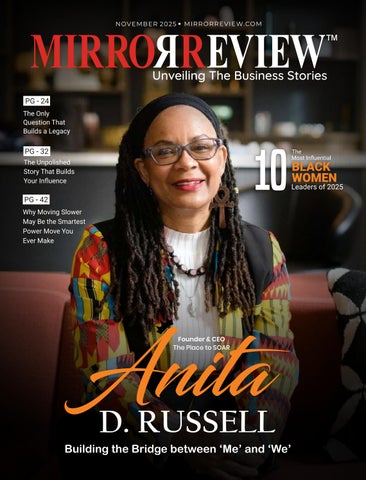
An a Founder & CEO The Place to SOAR
D. RUSSELL
Building the Bridge between ‘Me’ and ‘We’
EDITOR’S LETTER
“Redefining Power, Reshaping the World” ear Readers,
Influence is often measured by visibility, but true power is measured by resonance. It is found in the ability to shift the atmosphere of a room, to alter the trajectory of a business, and to uplift the communities that sustain us. For Black women leaders, the journey to the top is rarely a straight line; it is a path forged through resilience, innovation, and an unshakeable belief in a better future. In this edition, The 10 Most Influential Black Women Leaders of 2025, Vol-II, we turn our spotlight on the visionaries who are not merely navigating the corporate landscape but actively redesigning it. These are the architects of change who understand that leadership is not just about profit, but about purpose. Leading this charge on our cover is Anita D. Russell, the Founder and CEO of The Place to SOAR. Anita possesses a voice that does more than communicate; it resonates with the weight of experience and the clarity of conviction. Bridging the worlds of pharmaceutical science and social justice, she has crafted a unique lane of “firebrand leadership.” After a distinguished corporate career, she founded her company on the philosophy of “Step Out And Redesign” (SOAR), creating a vital space where personal transformation meets social impact. Anita's work is a direct response to the “false peace of silence,” guiding women to navigate systemic barriers and reclaim their voices. Through her “InflexionPoint Podcast” and her “BRIDGE” methodology, she is building a movement that proves lasting change must begin from the inside out. Joining Anita in this powerful volume is a collective of trailblazers who are making waves across diverse sectors. We are proud to feature the entrepreneurial spirit of Lori Jones, Founder and CEO of Blackology Coffee Company; the strategic executive leadership of Brandy G. Robinson, CEO of Zebra MedNex; the political and public affairs expertise of Yolanda H. Caraway, Founder of The Caraway Group; and the beauty and wellness innovation of Dr. May Ikeora, CEO of L’Avyanna LTD. The stories within these pages are more than just biographies; they are blueprints for a new era of leadership. These women remind us that when we align our professional ambitions with our personal truths, we don’t just succeed; we soar.
PaNKAJ GHOLAP Managing Editor
PUBLISHER
ARCHANA GHULE
EDITOR-IN-CHIEF
VIKRAM SURYAWANSHI
MANAGING EDITOR PANKAJ GHOLAP
PROJECT EDITOR PARAG AHIRE
PROJECT MANAGERS
FOLLOW US mirrorreviewo cial MirrorReview1 mirror-review mirrorreview mirrorreview
RUSHIKESH
VISUALIZER
MARK DAVIS
GRAPHIC DESIGNER
Mirror Review Media & Tech O ce No. 430, 4th Floor, Gera’s Imperium Rise, Opp. Wipro Circle, Hinjewadi Phase 2, Pune, Maharashtra - 411057.
AKSHAY PANZADE +1 (850) 564-8517
HEAD OF DISTRIBUTION & PRODUCTION AAKASH MAHAJAN
HEAD OF OPERATIONS ROBERT SMITH
RESEARCH ANALYSTS JAMES ADAMS
ADVERTISING
MARIA SMITH
info@mirrorreview.com
www.mirrorreview.com
10 ANITA RUSSELL
20. Brandy G. Robinson 28. Dr. May Ikeora 38. Lori Jones 46. Yolanda H. Caraway ARTICLES
CONTENT Content
PROFILES
24.
The Only Question That Builds a Legacy
32.
The Unpolished Story That Builds Your Influence
42.
Why Moving Slower May Be the Smartest Power Move You Ever Make
COVER STORY
An a
D. RUSSELL
Founder & CEO I The Place to SOAR
Building the Bridge between ‘Me’ and ‘We’
10 I NOVEMBER 2025
M I R R O R R E V I E W . C O M I 11
T
here are certain voices that seem to operate at a different frequency, voices that do more than just communicate-they resonate. They carry the weight of experience, the clarity of conviction, and the warmth of a deeply held faith. Anita D. Russell has such a voice. Whether it is emanating from a podcast microphone, guiding a tense workshop discussion, or coaching a client through a moment of profound self-doubt, her voice is, as she herself describes it, “unmistakable: strategic, empowering, and unshakably rooted in truth.” It is the primary instrument of her life’s work, which is not merely to coach or to consult, but to build movement. As the founder and CEO of The Place to SOAR, Anita is a personal transformation expert, an author, a speaker, and an antiracism activist. But these titles feel like insufficient containers for the sheer energy of her mission. She operates at the critical intersection of personal development and social justice, a place where the redesign of the self becomes the blueprint for the reimagining of the world. Her work is a dynamic fusion of faith, sharp intellect, and what she calls “firebrand leadership,” a potent combination she wields to ignite everything from individual confidence to community-wide economic collaboration. The Blueprint of a Transformer The blueprint for Anita’s unique lens on the world was shaped in the close-knit community of Homestead, a suburb of Pittsburgh, Pennsylvania. She was raised in an environment that instilled in her a deep love for community, a reverence for education, and an abiding faith. Her educational journey is like a string of pearls designed over a lifetime. She studied biology at the University of Pittsburgh and became a research scientist at the university after graduation. She then left her home city of Pittsburgh and transitioned into the pharmaceutical industry in central New Jersey. In this phase of her career, she mastered leadership development and rounded out her formal education with a Master’s in Education Leadership. After a nearly 23-year career in the pharmaceutical industry, Anita left the corporate environment and entered the world of social entrepreneurship. 12 I NOVEMBER 2025
This decision, coupled with a formal Life Coaching Certification, gave her the tools to build her own vision. Anita’s leadership development experiences and life coaching certification created a unique lens for understanding both the science of human behavior and the art of human transformation. This diverse background—a blend of science, corporate strategy, and social innovation—was sharpened by lived experience. Navigating racial barriers and leading diversity efforts in corporate America ignited a passion for a different kind of work, one rooted in personal transformation and social empowerment. These moments taught her a fundamental truth that would become the cornerstone of Anita’s philosophy: “Lasting change begins from the inside out and that transformation on a personal level can ripple outward into communities and systems.”
COVER STORY
In 2017, Anita returned to Pittsburgh, took a leap, and founded The Place to SOAR, LLC. The name is not just a brand; it is the codification of her personal philosophy. SOAR is an acronym for “Step Out And Redesign,” a transformative process she herself experienced when she left the corporate world. It is the very same process she now guides her clients through: building Self-Awareness, taking Ownership of one’s journey, practicing Accountability, and embracing Resilience.
“
“The mission was shaped by my own truths,” Anita says, “that empowerment is cultivated within, and that dismantling racism requires courageous conversations paired with intentional action.”
‘me.’
The Courage to SOAR
Reimagining ‘we’ begin with reimagining MIRRORREVIEW.COM I 13
The Place to SOAR was therefore conceived as more than just a life coaching business. It was designed as a space where the deeply personal work of inner development intersects with the critically important work of social impact. It is a place to build a stronger self in order to build a better world. Navigating the ‘False Peace’ of Silence The clients who find their way to Anita are often at a crossroads. They are predominantly women leaders, professionals, and community advocates, many of whom are navigating the complex realities of being Black or members of other marginalized communities in environments not built for them. They come to her facing a constellation of challenges: persistent selfdoubt, the exhausting weight of systemic barriers, and what she astutely calls “the false peace of silence in the face of injustice.” The emotional struggles are deep and resonant. Anita works with women who are grappling with the fear of speaking out, of being labeled “too much” or “too angry.” She guides them as they navigate the complexities of their own identity in professional or social spaces that can feel hostile or invalidating. 14 I NOVEMBER 2025
Above all, she helps them reconnect with a sense of purpose that may have been eroded by years of conforming, compromising, or simply trying to survive. Her work is to help them find their voice again and the courage to use it. Building the BRIDGE to Empowerment To guide her clients from a place of uncertainty to one of empowered action, Anita developed a core framework she calls the Personal Transformation BRIDGE. This is the practical, actionable methodology at the heart of her coaching. The journey across this chasm is a structured passage built on six foundational principles. Each letter of the acronym represents a crucial pillar in this journey: ● Belief system redesign ● Resilience building ● Integrated holistic living ● Determined action ● Growth mindset ● Empowered living Anita uses a combination of traditional coaching, dynamic workshops, creative media, and insightful discussion guides to help her clients cross this bridge. The ultimate goal is to equip them with the tools they need to live with intention and to lead with a newfound sense of courage and clarity. An Inflexion Point: A George Floyd Origin Story On May 25, 2020, the world witnessed the murder of George Floyd, and for millions, it became a moment of profound and painful reckoning. For Anita, it was a catalyst.
COVER STORY “The InflexionPoint Podcast was born out of deep grief and the urgency to act that I felt after the murder of George Floyd,” she says. The event was not just a news story; it was a personal call to action, what she refers to as her “George Floyd origin story.” The podcast, produced on The Transformation Network, became her channel for that grief, her platform for that urgency. It was a way to move beyond the echo chamber of outrage and into the vital, necessary space of dialogue and solution-building. The podcast tackles the hard topics—antiracism, community engagement, and global equity—head-on. It is a curated space for conversation, bringing together a diversity of voices to illuminate both the daunting scale of systemic challenges and the inspiring power of grassroots community solutions. For Anita, the podcast is a living embodiment of her belief that true transformation requires active listening. It is her way of modeling how to hold space for difficult conversations and how to find hope and strategy in the midst of collective pain. In 2025, the podcast turned its focus toward “Community Engagement and the Grassroots of Change,” a theme that explores the stories and strategies of community-driven movements throughout the year, offering listeners practical insights they can apply in their own efforts. The Economics of Liberation Anita’s work extends beyond individual and psychological transformation into the realm of economic empowerment. She is a passionate advocate for cooperative economics, a principle she believes is essential for the liberation and resilience of marginalized communities. “Cooperative economics,” she explains, “is the principle that communities can build resilience and wealth through collaboration rather than competition.” This is not a new or radical idea, but a powerful, time-tested one rooted in traditions like the African concept of Ubuntu (“I am because we are”) and contemporary cooperative movements.
MIRRORREVIEW.COM I 15
COVER STORY It is a direct challenge to the hyper-individualistic, competitive models that have often left Black and other marginalized communities at a disadvantage. It is about pooling resources, sharing ownership, and building economic systems that serve the community from within. Closely tied to this idea is the concept of collective sovereignty. As Anita defines it, this means “reclaiming decision-making power, both economically and socially, so that Black and marginalized communities can thrive on their own terms.” Her local work with organizations like the Ujamaa Collective, a cooperative of Africana women artisans, is a tangible expression of this philosophy. For her, economic justice is not a separate issue from personal empowerment; it is a critical and inseparable component of it. The Architect at Work A typical day for Anita is a masterclass in purposeful design, a blend of deep, solitary work and active, engaged facilitation. Some days are dedicated to the quiet craft of writing, developing insightful content for her Substack newsletter or scripting the next episode of the InflexionPoint Podcast. Other days are fully immersed in the dynamic energy of human connection, whether in one-on-one coaching sessions, preparing workshop materials, or facilitating live or virtual workshops. Success, in her world, is measured in moments of breakthrough. “For me, success is not measured solely in revenue or reach—it is measured in lives changed,” Anita asserts. It is the client testimonial that speaks of a newfound courage, the community that finally opens a difficult dialogue across its divides, and the podcast listener who is moved from passive hearing to active doing. These are the metrics that matter. Anita is also a sought-after speaker, invited to share her insights at events like the Graduate Women in Science Empower Conference at The Pennsylvania State University. She has been featured in the Entrepreneurs Forever newsletter and serves as an On-Call Facilitator at the prestigious Center for Creative Leadership (CCL). Yet, it is perhaps in the most challenging moments that her leadership is most clearly demonstrated. She recalls facilitating dialogues on racism where the room was thick with opposing and painful views.
16 I NOVEMBER 2025
“My response was to lean into active listening, create space for discomfort, and model resilience in the face of challenge,” Anita says. “True leadership is not about avoiding conflict but guiding people through it with integrity.” The Unfolding Blueprint The work of a movement builder is never done. Looking ahead, Anita is focused on expanding the reach and accessibility of her transformative tools. She plans to develop digital courses, deepen the global listenership of her podcast, and create new community based workshops focused on her passions for cooperative economics and media literacy. She is also developing a series of companion workbooks and journals to help individuals and groups engage with her content on a deeper, more practical level.
“
Your transformation begins the moment you give yourself permission to step out of fear and into possibility.
To sustain this level of output and emotional engagement, she relies on a set of grounding personal practices. “I prioritize daily devotional time, conversations with my husband, and creative writing,” Anita shares. Travel is another vital source of renewal, a way to immerse herself in new cultures and be reminded of “the beauty of human diversity.” These rituals keep her centered, recharged, and ready for the demanding work she has been called to do. Her final piece of advice is a distillation of her entire philosophy; a message delivered with the clarity and power that has become her signature. “Your transformation begins the moment you give yourself permission to step out of fear and into possibility,” Anita urges. “Don’t be afraid to challenge assumptions—your own and others’. Growth and empowerment lie on the other side of courage.” It is a call to action that Anita leaves you with, a mantra that serves as both a personal and a collective compass: “Reimagining we begin with reimagining me.” In these six simple words lies the entire blueprint, the profound and life-altering truth that the most powerful movements in the world begin with the quiet, courageous revolution within.
MIRRORREVIEW.COM I 17
The 10 Most Influential Black Women Leaders of 2025 Anita D. Russell
Brandy G. Robinson
Founder and CEO I The Place to SOAR
CEO I Zebra MedNex
Dr. Marcia Coppertino
Dr. May Ikeora
Director I Operations at Coppertino and Associates Consulting Group
CEO I L’Avyanna LTD
Dr. Nicole Ford-Francis
Lori Jones
President I Visionaries in Partnership (VIP), Inc.
Founder and CEO of Black•ology Coffee Company
Mandisa Mndela
Nakisha Adams
Founder I Stand Your Truth
Founder and CEO of Skribble Inc.
Sharold Palmer
Yolanda H. Caraway
Founder and Chief Vision Officer I Seven Palms Consultancy
Founder I The Caraway Group
18 I NOVEMBER 2025
Brandy G. Robinson Founder | Zebra MedNex
20 I NOVEMBER 2025
Transforming Healthcare Through Experience and Innovation
I
n 2009, a young woman sat across from her doctor, seeking answers for side effects of a prescription medication. Months then years of unanswered questions and worsening symptoms had taken their toll. Finally, in 2021, she received a diagnosis: Prolactinoma. However, the relief was overshadowed by frustration. How could a treatable condition go undiagnosed for twelve years? This experience profoundly impacted her. Instead of succumbing to resentment, she channeled her frustration into action. That young woman was Brandy G. Robinson, who later founded Zebra MedNex. This company arose not only from her personal health journey but also from a mission to prevent others from experiencing the same healthcare gaps. Robinson’s story embodies perseverance, vision, and transformation. As a woman of color, she navigated the challenges of pioneering roles in law, biotech, and technology. Moreover, she combined her extensive career and academic background with her lived experiences, creating a space where innovation meets empathy. Today, as CEO, Founder, and Inventor of Zebra MedNex, she leads a revolution in healthcare technology, bridging the gap between care and informed decision-making. Building a Foundation for Innovation Robinson’s career path is both unusual and inspiring. With five degrees—in Political Science, History, Law, Business, and Transnational Law—she has consistently sought to understand how systems, society, and solutions connect.
“These educational pursuits weren’t just about collecting credentials,” Robinson explains. “They were about giving myself the tools to navigate and innovate in different fields.” In her professional life, Robinson has worked in law, education, biotech, and healthcare. Each role has helped her approach challenges from a unique viewpoint. “I’ve learned that cross-disciplinary thinking is the key to solving complex problems,” she says. This understanding drives her ability to combine law, business, history, and technology in ways that create new opportunities. Zebra MedNex: Born from a Need for Better Healthcare Zebra MedNex is more than a company—it’s Robinson’s direct response to the healthcare problems she experienced. After receiving medication that caused serious neurological side effects, Robinson realized how poorly equipped many healthcare systems are to support accurate decision-making. Her eventual diagnosis of Prolactinoma strengthened her determination to create a platform that would prevent others from facing similar difficulties. Zebra MedNex was founded to address the fragmentation in healthcare by using technology to improve care coordination and treatment tracking. “Our platform ensures patients, doctors, and healthcare enterprises can collaborate seamlessly,” Robinson says. By breaking down silos and improving communication, Zebra MedNex aims to make care timely, effective, and personalized.
MIRRORREVIEW.COM I 21
Using Technology to Improve Healthcare
Connecting through Storytelling
A key part of Zebra MedNex’s innovation is its use of artificial intelligence (AI) and machine learning to improve care coordination. These tools provide advanced decision support, allowing healthcare providers to identify trends, make informed decisions, and reduce errors.
Beyond her professional achievements, Robinson is a TEDx speaker and a published author of a novel, a children’s books series, and comics. She believes storytelling is essential to her leadership and innovation.
“Automating routine tasks and streamlining communication allows healthcare providers to focus on what truly matters—patient care,” Robinson explains. The platform also enables timely interventions, improving both efficiency and patient outcomes. Furthermore, Zebra MedNex’s proactive approach to data privacy distinguishes it from other industries with significant security concerns. The platform limits its handling of patient data and uses advanced measures such as encryption, multi-factor authentication, and strict access controls to protect sensitive information. “Maintaining trust is essential, and that starts with protecting patient privacy,” Robinson emphasizes.
“Stories engage, inspire, and connect people,” Robinson explains. Her ability to present ideas as compelling stories helps her communicate a vision that resonates with others, building trust and collaboration. Whether she is leading a team or presenting to stakeholders, Robinson uses storytelling to inspire curiosity and openness to change. Supporting Women in Tech and Healthcare Furthermore, Robinson is passionate about mentoring women in tech and healthcare. Early in her career, she struggled to find mentors who understood her challenges as a woman of color and a lesbian. Now, she offers guidance in networking groups and communities that prioritize women’s voices.
Leadership Forged through Experience As the CEO, Founder, and Inventor of Zebra MedNex, Robinson leads the company’s strategic direction, innovation, and growth. Her diverse background gives her a unique ability to navigate the complexities of regulatory landscapes, business development, and product innovation. Robinson's achievements demonstrate her strong leadership. A music prodigy at 12, she graduated high school at 17 and earned her college degree by 20. She then became one of the youngest prosecutors in her field and later represented an NGO as a UN Delegate. In the biotech industry, she has broken barriers as an African American lesbian executive, advocating for diversity and inclusion while driving innovation. Recently named a semifinalist in the 2024 Women Who Empower Innovator Competition, Robinson’s story is one of overcoming obstacles and breaking stereotypes. “Resilience has been my greatest asset,” she says. “It’s not just about surviving challenges; it’s about using them as stepping stones to something greater.”
22 I NOVEMBER 2025
“Mentorship should be reciprocal and genuine,” Robinson says. She encourages aspiring leaders to build supportive networks, continuously develop their skills, and advocate for themselves. By sharing her own experiences, Robinson hopes to inspire others to navigate their careers with confidence and resilience. Shaping the Future of Healthcare Zebra MedNex is poised for significant growth. The company currently focuses on acquiring customers and securing investment to enhance its medical device technology. While the platform already provides a simple, affordable SaaS solution for healthcare organizations, Robinson plans to develop more sophisticated solutions that leverage AI and emerging technologies. “Our ultimate goal is to move up the medical device classification ladder and expand into more advanced technologies,” she shares. Strategic partnerships and funding will be essential for achieving these goals and creating a lasting impact on healthcare.
Balancing Passion and Priorities Robinson does not believe in a “perfect” work-life balance. Instead, she focuses on minimizing distractions and prioritizing what matters most. Road trips, video games, going to luxury movie theaters, and writing are some of her favorite ways to recharge. Writing, in particular, has been a creative outlet for over two decades. It helps her reflect, develop ideas, and stay grounded. Robinson also reads daily to nurture her curiosity and expand her knowledge—a habit that fuels both her personal and professional growth. A Legacy of Innovation and Impact Brandy G. Robinson’s journey demonstrates the power of resilience, vision, and creativity. By combining her academic expertise, professional experiences, and personal challenges, she has built Zebra MedNex into a company that transforms healthcare through empathy and innovation.
Whether she is mentoring aspiring leaders, inspiring audiences as a TEDx speaker, or driving technological advancements, Robinson’s impact is significant and far-reaching. Her story reminds us that innovation is not just about technology—it’s about understanding the human side of progress. “Innovation isn’t just about what’s next,” Robinson reflects. “It’s about what’s sustainable. And that’s the legacy I want to leave.”
“
Continuous learning and cross-disciplinary thinking are key to SUCCESS. MIRRORREVIEW.COM I 23
Let’s Get Brutal for a Minute.
Now I’m going to say something your coach won’t.
You’re not confused.
Those are the questions that amateurs ask.
You’re avoiding the real question.
Pros don’t ask, “What should I do?” They ask, “What do I want to be known for?”
You’re not spinning in circles because you don’t know how to build a brand. Or price your offers. Or write the perfect bio that screams “humble genius.”
Read that again. That Question Changes Everything
You’re spinning because you’re asking weak, generic questions that keep your power diluted. You’ve got vision-board glitter in your eyes and you can’t see the damn road.
It’s the power seat. It doesn’t care what’s trending. It doesn’t care what your competitor’s charging. It doesn’t need a Canva template.
You’re asking: · “What should I do?” · “What niche should I pick?” · “How do I not sound too braggy while also sounding like Beyoncé?” You’re chasing answers to questions designed to keep you small. 24 I NOVEMBER 2025
It asks you to stand still for one second and remember: You’re not here to fit in. You’re here to own your lane. And no one can own anything they haven’t claimed. So here’s the truth no one’s putting on Instagram: If you can’t answer “what do I want to be known for?”, then nothing else matters.
Not the logo. Not the packages. Not the DM strategy. Not the three-part email funnel. Because if you don’t know why your work matters, why the hell should anyone else?
Let Me Ask You This: · What do you know for sure about what you offer? · What do people say about you when you’re not in the room? · What do you wish they said? · What would you fight for, even if no one clapped?
Let’s Talk About You. No, Seriously If you can answer that, you don’t need to “find your niche.” You are the niche.
You’ve built, or are building, something that matters. That takes guts. But somewhere along the way, you stopped building a movement and started building a brochure.
Real Confidence Isn’t Loud. It’s Clear
You overthink your positioning.
When you own what you’re here to be known for:
You water down your message.
· Your bio writes itself. · Your content becomes magnetic. · Your pricing stops feeling like a math test and starts feeling like a boundary. · You stop waiting for permission and start acting like the leader you already are.
You write captions that sound like you swallowed an inspirational quote book and panicked halfway through. Meanwhile, the real you—the one who has stories that could change lives, lessons burned into her bones, and a truth only you can speak—is waiting to be invited to the table.
You walk into rooms differently. You post differently. Hell, you wake up differently.
Here’s the plot twist: You are the damn table.
Because this isn’t about being perfect. It’s about being undeniable.
MIRRORREVIEW.COM I 25
Here’s the 3-Step Clarity Detox (If you’ve been stuck in “I-don’t-know-what-to-say” land, this part’s for you.) 1. Kill the Mediocre Questions. They’re dead weight. Stop asking, “What should I do?” and “How do I look credible?” Ask instead: · “What’s the story only I can tell?” · “What am I already doing that people thank me for?” · “What impact do I want my name attached to 5 years from now?” 2. Claim Your Category of One. You’re not competing. You’re creating. You’re not here to fit the mold. You’re here to break it. So ask: · “What part of my work is non-negotiable?” · “What am I tired of apologizing for?” · “What do I do differently without even trying?”
Your name belongs in rooms you haven’t entered yet—but only if you start using your voice like it has a destination. So Let’s Wrap This Up the Way It Started Pull your chair closer. You’re not “figuring it out.” You’re remembering who the hell you are.
3. Speak From That Place. Always. You’re here to build something bigger than a brand. Stop writing like a stranger. Stop diluting. Stop marketing like you’re asking someone out on a date. Start saying, “Here’s the work. Here’s why it matters. If it’s for you, let’s go.” Being the Authority Isn’t a Title. It’s a Decision.
You’re here to be known for something that outlives any single campaign, post, or launch. So stop waiting to “have it all together.” You already know what you stand for. Now make it undeniable. Final Prompt: Write This Somewhere Big and Loud
You don’t need 10,000 followers. You don’t need to look like an ad for Forbes Women. You don’t need to speak on five panels.
“What do I want to be so wildly known for… that they say my name in rooms I've never even stepped into?” That’s the only question worth answering.
You need to stop outsourcing your confidence to metrics that don’t matter.
26 I NOVEMBER 2025
And you’ve already got the answer. Start saying it out loud.
Here’s the 3-Step Clarity Detox (If you’ve been stuck in “I-don’tknow-what-to-say” land, this part’s for you.) 1. Kill the Mediocre Questions. They’re dead weight. Stop asking, “What should I do?” and “How do I look credible?” Ask instead: · “What’s the story only I can tell?” · “What am I already doing that people thank me for?” · “What impact do I want my name attached to 5 years from now?” 2. Claim Your Category of One. You’re not competing. You’re creating. You’re not here to fit the mold. You’re here to break it. So ask: · “What part of my work is nonnegotiable?” · “What am I tired of apologizing for?” · “What do I do differently without even trying?”
Your name belongs in rooms you haven’t entered yet—but only if you start using your voice like it has a destination. So Let’s Wrap This Up the Way It Started Pull your chair closer. You’re not “figuring it out.” You’re remembering who the hell you are.
3. Speak From That Place. Always. You’re here to build something bigger than a brand. Stop writing like a stranger. Stop diluting. Stop marketing like you’re asking someone out on a date. Start saying, “Here’s the work. Here’s why it matters. If it’s for you, let’s go.” Being the Authority Isn’t a Title. It’s a Decision.
You’re here to be known for something that outlives any single campaign, post, or launch. So stop waiting to “have it all together.” You already know what you stand for. Now make it undeniable. Final Prompt: Write This Somewhere Big and Loud
You don’t need 10,000 followers. You don’t need to look like an ad for Forbes Women. You don’t need to speak on five panels.
“What do I want to be so wildly known for… that they say my name in rooms I've never even stepped into?” That’s the only question worth answering.
You need to stop outsourcing your confidence to metrics that don’t matter.
And you’ve already got the answer. Start saying it out loud.
28 I NOVEMBER 2025
MIRRORREVIEW.COM I 29
30 I NOVEMBER 2025
MIRRORREVIEW.COM I 31
ounders spend millions trying to craft “the perfect story.” They hire agencies, shoot cinematic videos, polish every line until it shines.
F
Why We Hide the Part People Need Most
Then they wonder why it doesn’t connect.
· Grew revenue by 300%. · Expanded to three continents. · Featured in Forbes.
Here’s the truth most PR decks won’t tell you: the story that earns influence is rarely the one you’ve polished. It’s the one you’ve lived. The Boardroom Lesson Nobody Prepares You For A few weeks ago, I sat in a room with fifteen high-performing founders. We were there for strategy, not therapy. Yet one person—without a slide deck, without the “approved” brand narrative—told a raw, unscripted account of the moment her business almost folded.
Most leaders know their résumé version of their story—the LinkedIn-approved bullet points:
But they cut the sentences that matter: · Spent six weeks sleeping on a friend’s couch to save the business. · Spent four years selling a service no one wanted before finding product-market fit. · Nearly quit the night before the big break. We cut them because they’re messy. We cut them because they’re not “on-brand.” The irony? Those are the exact lines that make you believable. The Strategic Risk of Staying Polished
She didn’t “present.” She talked. She described the week she had to choose between making payroll and paying her mortgage. She explained exactly how she called her supplier and negotiated terms to buy herself 48 hours. It wasn’t pretty. But the table went silent. That’s when it hit me: your influence starts where your polish ends. 32 I NOVEMBER 2025
Here’s the cost of staying “safe” with your story: 1. You sound like everyone else. Polished founder bios are interchangeable. 2. You create distance. People can admire perfection, but they rarely trust it. 3. You lose leverage. Investors, clients, and partners lean in when they believe you’ve been tested and survived. Every CEO I respect uses story as a tool—not as a highlight reel.
How to Find the Part of Your Story That Moves People Forget “crafting” for a minute. Go straight to the events that felt risky to say out loud at the time. Ask yourself: · What happened that changed the way I run my business? · When did I have to make a decision that cost me more than money? · What mistake taught me something no spreadsheet could? Those are the points of connection. That’s the material people repeat when they talk about you in rooms you’re not in.
Here’s the filter: If the person across the table can apply what you learned to avoid a mistake, or take a calculated risk faster, it’s worth telling. If it’s just for shock value, save it for the memoir. Community Isn’t Just Comfort—It’s Currency One founder in that room said something that stayed with me: “I didn’t come here to be inspired. I came here to remember I’m not the only one in the fight.”
The Real Role of Vulnerability We misuse the word “vulnerability” in business. It’s not about oversharing or emotional catharsis. It’s about strategic transparency—sharing enough of the truth to make the lesson undeniable.
That’s why peer communities matter. Not because you “feel seen,” but because you get operating intel from people who’ve survived what you’re in right now. MIRRORREVIEW.COM I 33
When you tell the true version of your story inside a trusted circle, two things happen: 1. You get the strategies that aren’t in books. 2. You build alliances that turn into deal flow, partnerships, and backchannel introductions.
If You’ve Been Editing Yourself Down Consider this your push to stop sanding off the edges. You don’t need a dramatic overhaul. You need to reintroduce the human stakes into your origin, your turning points, and your current play. Try this:
This is why every serious founder I know invests in getting in the right rooms—not just for visibility, but for survival. The Business Case for Telling the Real Story I’ve watched leaders triple their speaking fees, close seven-figure contracts, and land media features—not by adding more success stats, but by revealing the turning points behind them. The mechanics are simple: · Raw detail makes it memorable. “I was down to my last $412” sticks longer than “we were struggling financially.” · Specificity signals truth. People instinctively trust stories with dates, numbers, and real stakes. · Struggle signals credibility. If you’ve been through it, you can help others navigate it. Your story is not PR fluff. It’s an asset with a measurable ROI.
34 I NOVEMBER 2025
· Identify one story you’ve been avoiding because it feels too raw. · Write it in bullet points—just the facts, no adjectives. · Decide which parts connect to the value you deliver now. · Share it in a room where the return could be real—whether that’s a sales meeting, investor pitch, or strategic peer group. Final Word Your polished story may get polite nods. Your real one will get remembered, repeated, and relayed to decision-makers you’ll never meet. In business, being known isn’t about telling people what you’ve achieved—it’s about showing them what you’ve survived, and how that shapes the way you lead. Don’t wait for permission. Don’t wait for the “right” moment. The right moment is the one you decide to stop hiding the part that makes you credible. Lift the filter. Tell the truth. That’s how influence starts.
T
he air in the kitchen at the Inter-Faith Food Shuttle smells of onions, thyme, and possibility. Lori Jones moves through the stainless-steel landscape with a practiced economy of motion. She is showing a student how to properly hold a chef’s knife, her hand guiding his. Her voice is calm and direct, her instructions clear. Here, among the clatter of pans and the hum of industrial refrigerators, Jones is in her element.She is not just teaching someone how to cook; she is providing a map for a new beginning.
To the outside world, Lori Jones is a two-time international award-winning entrepreneur, the founder and CEO of Blackology Coffee Company. She is a keynote speaker and a transformational coach. But in this kitchen, she is a teacher, a mentor, a leader who understands that a second chance often starts with a single skill. This role, managing the Culinary Apprentice Program for individuals facing unemployment and other life challenges, is the heart of her story. It is a fullcircle journey for a woman who once found her own career in ashes, only to build a new life from the embers. Her work now is to hand that blueprint to others, showing them that a crisis is not just an ending, but a space where a new life can be built. The First Course Long before she built a coffee empire, Lori Jones built communities around a dinner table. Her passion for food took root early, and she channeled it into a culinary career. As a head chef, she found purpose in creating meals that did more than just nourish the body. Food, for her, was a medium for connection. This was most evident during her time as the head chef for a sorority house at the University of North Carolina at Chapel Hill. For hundreds of young women away from home, she was more than a cook. She curated seasonal menus, led a kitchen team, and created an environment that felt like a sanctuary. She blended tradition with new ideas, transforming the dining hall into a place of comfort and community.
38 I NOVEMBER 2025
She learned how to manage a team, how to plan and execute complex operations, and how to serve a community with intention. This experience was her first real leadership laboratory. It taught her that service was not about subordination, but about anticipating needs and creating spaces where people feel valued. The Unraveling In 2020, the world shut down, and the foundation of Lori Jones’s life cracked. The COVID-19 pandemic swept through the food service industry, and she lost her job. The layoff was more than a professional setback; it was a personal crisis. As a single mother of two boys, she found herself at a crossroads, the path forward obscured by uncertainty. The career she had built, the community she had served, vanished almost overnight. Many would see this moment as a definitive end. For Jones, it felt like a profound and unsettling silence. The daily rhythm of the kitchen disappeared. The purpose that had driven her for years was gone. Yet, in that silence, she found a different kind of direction. She calls it a divine redirection. It was a forced pause that compelled her to look inward and ask a fundamental question: what next? A Kitchen Table Epiphany The answer began with a morning ritual. For Lori Jones, coffee was never just a beverage. It was a quiet moment of peace and prayer before the day began, a symbol of warmth and a medium for reflection. With no job and a deep well of purpose, she turned this personal ritual into a professional vision. From her own kitchen, she started to build Blackology Coffee Company. The idea was to create a luxury minimalist coffee brand that celebrated Black culture and low-acidity brews. It was an extension of her identity: intentional, rooted in service, and unapologetically authentic.
The beginning was humble. She started at local pop-up markets, her brand growing organically through word of mouth. But Jones was a quick study. She threw herself into learning the mechanics of digital entrepreneurship. She learned web design, search engine optimization, branding, shipping logistics, and grant writing. It was a crash course in building a business from the ground up. She did not just survive the pandemic; she built an international brand from its chaos. Blackology expanded beyond premium beans to include merchandise, coaching programs, and digital resources for other aspiring entrepreneurs. She turned the crisis of her layoff into a calling, building a company that was not just a business, but a testament to her resilience. Brewing a Movement Lori Jones did not just create a product; she built a platform. Blackology Coffee Company became a vehicle for her larger mission of service and empowerment. The brand’s success is intrinsically linked to its purpose. A portion of its proceeds goes to nonprofits that support survivors of domestic violence, sexual assault, and cancer research—causes that resonate with her deep sense of empathy. Her commitment to community extends beyond her own company. She serves on the Board of Directors for the Reintegration Support Network, an organization that works with youth impacted by substance use, mental health challenges, and the justice system. In this role, she helps guide efforts to promote wellness, self-advocacy, and healthy relationships. It is a natural extension of her work, creating safe spaces for transformation for those who need it most. Through her business and her volunteer work, Jones demonstrates that legacy is not measured in profit, but in impact.
MIRRORREVIEW.COM I 39
The Daily Grind
The Full Circle
Leading a company while raising two boys demands a unique blend of structure and grace. Lori Jones navigates this complexity with fierce intentionality. Her life is a carefully orchestrated dance between boardroom strategy and bedtime stories, between customer calls and carpool duty. She serves as the PTA Vice President at her sons’ school, seamlessly integrating her leadership skills at home and in her business.
Her work today brings her journey into sharp focus. As the Culinary Apprentice Program Manager and Instructor at the Inter-Faith Food Shuttle, she stands before people who are exactly where she was just a few years ago: unemployed, underemployed, looking for a second chance. She developed the program’s entire curriculum, a comprehensive course that earned accreditation from the American Culinary Federation. It is the only program of its kind in North Carolina.
Discipline is her anchor. She uses digital planners and timeblocking techniques to allocate her energy to the tasks that matter most. Her day still begins with that sacred coffee ritual, a quiet moment of grounding before the whirlwind begins. But perhaps the most significant evolution in her leadership style has been her decision to stop doing everything alone. For years, she wore her ability to carry the entire load as a badge of honor. She has since learned that true strength lies in delegation and trust. She now hires virtual assistants and leans on her community, drawing clear boundaries to protect her peace. Her children witness not just a mother who works hard, but a leader who leads with a full heart and a clear mind.
40 I NOVEMBER 2025
This achievement is not just a professional milestone; it is a profound personal one. In that kitchen, she does more than teach knife skills or plating techniques. She mentors with compassion, fosters self-worth, and opens doors to careers that once seemed impossible. She sees the transformation in her students as they land their first culinary jobs and reclaim their futures. Their wins are her fuel. “Helping others believe in themselves is my real job title,” she says. It is the thread that connects the chef, the entrepreneur, the mother, and the mentor. It is the work of building a legacy, one person at a time.
MIRRORREVIEW.COM I 41
L
et me tell you something most people will never say out loud in a meeting, a podcast, or their LinkedIn post:
The loudest people in the room are not always the most powerful. The fastest runners don’t always win the race. And the person you think is “ahead” might just be sprinting toward a wall they didn’t see coming. I learned this lesson the hard way. The Trap We All Walk Into When I was 29, sitting in a Fortune 500 conference room, I was sure I was behind. Behind in salary. Behind in promotions. Behind in the imaginary race every ambitious person thinks they’re in. I looked at colleagues buying houses, launching side hustles, getting featured in business magazines, and I thought, “If I don’t catch up now, I’m done.” So I did what most of us do when panic kicks in: I sped up. I said yes to every project, stayed in the office till midnight, worked through weekends, and replied to emails before my coffee was even poured. And you know what happened?
42 I NOVEMBER 2025
I wasn’t winning. I was bleeding. Not just energy — but strategy, relationships, and perspective. The very things that make influence sustainable.
· You stop thinking long-term. Quick wins feel good. But they can trap you in cycles of reactive work that don't build equity — financial or otherwise.
That’s when I learned: Speed without clarity is just noise.
· You signal weakness. Yes, moving too fast can make you look desperate. Partners, investors, and clients can smell when you’re operating from fear instead of intention.
Why “Keeping Up” Is a Broken Game Here’s the uncomfortable truth: The world’s most successful leaders the ones you never see sweating on Instagram — are not chasing pace. They are controlling rhythm. They decide the beat. Everyone else adapts. This is not laziness. This is not “manifesting” without action. This is deliberate. Controlled. Ruthless in its refusal to be rushed by someone else’s calendar.
· You drain your leverage. Every major deal I’ve closed happened because I had the patience to let the other side make the first mistake. Rushers don’t get that luxury. · You burn your team. If you’re leading people, remember: your pace becomes their pace. If you run them ragged, they will either quit or quietly disengage. The Myth of “Too Late”
I’ll put it plain: When you let the market, your peers, or social media set your tempo, you have already surrendered power. What You Lose When You Rush Let’s strip this down to what actually happens when you let that pressure to “keep up” dictate your moves:
I once had lunch with a tech founder who exited his company for $180 million — at 57. He told me he didn’t even start in tech until his mid-40s. Before that, he was selling industrial cleaning equipment in the Midwest. He said something I’ll never forget: “I wasn’t late. I was right on time for the business I was ready to run.”
MIRRORREVIEW.COM I 43
Think about that. Right on time. Not according to his peers. Not according to venture capital trends. But for him. That’s the part social media never shows you — the decades of learning that make a “sudden” success story possible. How to Reclaim Your Pace Without Losing Momentum
That’s why we win.” Watch how fast they start mirroring your tone.
That’s the quiet advantage: You stop living in reaction, and start leading from intention.
5. Use pause as a negotiation tool.
Read This Before You Rush Again
Silence unnerves people. When you don’t rush to respond, they reveal more than they intended. Deals get better. The CEO Mindset Shift
Let’s get tactical. Because it’s one thing to nod along and say, “Yes, I should slow down,” and another thing to actually adjust when your inbox is screaming.
In boardrooms, pace is power.
1. Audit the noise.
The executives who know when to pause a decision — to let a competitor overextend, to watch a trend mature, to wait for better terms — are the ones who dominate in the long run.
List every demand on your time. Then ask: “Who benefits most from me doing this quickly — me or them?” You’ll be surprised how much of your urgency is built for other people’s gain, not yours.
This isn’t just about business. It’s about life. If you can master your own timing, you can walk into any room, any deal, any challenge, without feeling like you’re catching up.
2. Protect decision space.
And here’s the kicker: once you stop trying to keep up, you’ll start noticing something — the people you thought were ahead are often just better at looking busy.
Here’s my blueprint:
Block actual hours in your calendar each week for thinking, not doing. If you don’t protect mental space, the only decisions you’ll make are reactive.
The Freedom in Owning Your Timeline
3. Set your own milestones. Instead of chasing external benchmarks — titles, revenue numbers, media features — define what “ahead” looks like for you in 3, 5, and 10 years. 4. Communicate your pace as a strength. When someone tries to rush you, say: “We move with precision, not panic.
44 I NOVEMBER 2025
When I finally slowed down, I didn’t lose ground. I gained it. Opportunities didn’t disappear. The wrong ones did. I started seeing partnerships I’d never have noticed before. I had the bandwidth to mentor younger leaders. I built a network not by chasing, but by being steady enough that people trusted I’d be around in five years.
Next time you feel that itch — the one telling you you’re falling behind I want you to remember this: There is no universal timeline. There is only your capacity and your readiness. You can’t be late to your own life. And in business, you can’t be late to the opportunity you’ve been preparing to own. Here’s the choice: You can keep playing catch-up in someone else’s race. Or you can control the rhythm so completely that you stop running altogether — and start moving exactly where you need to, exactly when you need to. One will exhaust you. The other will make you impossible to overtake. Your pace is your power. Protect it like equity.
Founder | The Caraway Group
Yolanda H.
Caraway A Journey from Grassroots to National Leadership
E
very movement has voices that rise quietly at first, shaped by family, community, and the times they live in. Yolanda H. Caraway, Founder of The Caraway Group, grew up in Rochester, New York, where the civil rights struggle was not a distant story but part of her own household. Her brother-in-law, an ordained minister and president of the Rochester NAACP, had marched with Dr. Martin Luther King Jr. Such exposure in her teenage years sparked a passion for social equity and political engagement. That passion took root early. At just fourteen, she volunteered on Robert Kennedy’s Senate campaign in New York, knocking on doors and stuffing envelopes. It was her first glimpse of politics as a force for change. Kennedy’s victory brought her a signed letter of thanks, a keepsake that still hangs in her office as a reminder of those first steps. Her journey soon expanded from local campaigns in Maryland to the national stage in Washington. Each role she took, from Capitol Hill to the Democratic National Committee, reflected the same conviction she discovered as a teenager: politics could open the door to lasting equity. 46 I NOVEMBER 2025
Building the Caraway Group From the beginning, Yolanda carried an entrepreneurial spirit. “I always knew I wanted to have my own business, even as a kid,” she says. After years in politics, she used her network to launch The Caraway Group, first as an event management firm and later expanding into public relations and public affairs. The shift proved wise, fueling success through the 1990s and 2000s. Along the way, she mentored dozens of young professionals who went on to lead in their own right. At its core, the firm reflected her belief in true workplace diversity, a value she championed daily. Core Services and Impact The Caraway Group specializes in public relations, public affairs, community engagement, and event management. Each service is designed to help organizations connect meaningfully with their audiences. What distinguishes the firm, Yolanda Caraway explains, is its focus on diversity, equity, and inclusion in every strategy.
“
Always
know what you want and don’t
be afraid to ask for it, whether it’s a promotion, a contract, or a raise ask.”
MIRRORREVIEW.COM I 47
“Understanding DEI is not just a principle; it shapes how clients relate to their consumers,” she says. By blending strategic insight with an inclusive perspective, the company helps organizations build trust and engagement while reflecting the communities they serve. This approach ensures that every campaign, event, or initiative resonates authentically. Advocating for Women and Communities of Color Yolanda has devoted much of her career to supporting women and communities of color. These groups bring energy, ambition, and purpose, not problems. The real challenge often comes from clients who need guidance on why diversity, equity, and inclusion strengthen an organization. “It is not just the right thing to do; it is smart business,” she emphasizes. Through her work, Yolanda shows leaders that fostering inclusion can improve culture, innovation, and results. Her approach combines patience with conviction, helping organizations move beyond obligation to see representation as an opportunity for growth and long-term success. Leading with Purpose
“
Keep your moral compass intact don’t let others convince you otherwise.” 48 I NOVEMBER 2025
For more than thirty years, Yolanda led The Caraway Group with energy and focus, building a firm recognized for both its strategy and impact. Today, she works independently as a consultant after downsizing her staff, continuing to guide clients with the same insight that has defined her career. Last year, she launched Rise United, a nonprofit that empowers content creators across the country to engage in conversations about national, state, and local issues. “I want people to use their voices to shape the conversations that matter,” she says. For Yolanda, every project is a chance to connect strategy with civic engagement and lasting change. Defining Impact and Success For Yolanda, success is measured not by awards or recognition but by tangible transformation in people’s lives. She recalls a program she helped design for Microsoft in partnership with the National Urban League called the “Build Your Business Tour.” High school juniors and seniors in urban areas were challenged to build a business with $2,000 using technology. Every Saturday, they met at a local Microsoft office with volunteers to develop their business plans. Teams then presented their ideas at the NUL conference, with winners receiving $2,000 and computer equipment.
“The impact this program had on these kids’ lives was amazing,” Yolanda says. Parents shared stories of change: a son discovering a love for technology, another learning responsibility and initiative, and one student finding motivation to pursue his goals. Moments like these, where guidance turns into real opportunity, define her idea of true impact. Breaking Barriers and Building Trust Yolanda’s journey as a Black woman in leadership has come with its share of challenges. Navigating high-stakes political environments, building influence, and becoming a trusted voice required patience, strategy, and persistence. She also had to manage public perception and reputation while transitioning across eras of advocacy, moving from traditional political operations to today’s creator-driven, digital-first activism. Resource limitations and capacity constraints added another layer of complexity. “Emotional and personal resilience became as important as any skill,” Yolanda reflects. For her, overcoming these obstacles meant learning to adapt, lead with integrity, and remain committed to the communities she serves. Each challenge strengthened her ability to guide others and create opportunities where impact could thrive.
Today, she dedicates her time to Rise United, the nonprofit she founded to empower content creators and foster conversations about civic issues nationwide. Outside of her work, Yolanda finds balance in cooking, entertaining friends, and traveling to new places to experience different cultures. These moments allow her to recharge, gain a fresh perspective, and return to her work with renewed energy and focus. Advice for Emerging Changemakers Yolanda speaks with the clarity and care of someone who has navigated decades of highstakes leadership and civic engagement. Her message to young leaders, particularly women of color, is both practical and inspiring. “Dream big and follow your instincts,” she says. She reflects on her own experiences, noting that she has rarely gone wrong when trusting her first gut reaction. At the same time, she urges emerging changemakers to prepare a Plan B, understanding that even the best-laid plans sometimes need adjustment.
Driving Inclusion at the Corporate Level Yolanda has worked with major corporations such as Apple, Google, and AT&T, guiding them on racial parity, diversity, and inclusion. Her approach goes beyond statements and policies; it blends business imperatives, measurable accountability, and cultural transformation. “The most effective strategy combines performance metrics with cultural change,” she explains. Executives respond to results, not just intentions, and Yolanda ensures that inclusion initiatives align with organizational goals. By tying diversity to tangible outcomes, she helps companies build workplaces that are both equitable and high-performing, creating environments where employees feel seen, valued, and empowered to contribute their best work. Looking Ahead and Staying Grounded Yolanda Caraway believes leadership is not just about personal success but about bringing others along. In her book, For Colored Girls Who Have Considered Politics, which she co-authored with longtime friends Donna Brazile, Leah Daughtry, and Minyon Moore, Yolanda emphasizes the importance of holding the door open for others. “Leadership is meaningful when it lifts people up and creates space for them to thrive,” she says.
“Knowing your own worth” is central to Yolanda’s guidance. She encourages young leaders to advocate for themselves, whether it is asking for a promotion, a contract, or a raise. “The worst they can say is no,” she reminds them, highlighting that confidence paired with preparation is a powerful combination. She also emphasizes integrity, urging them to keep their moral compass intact and avoid letting others sway their values. Finally, she offers a modern caution: “Not everything requires public display. Some victories, some growth, and some hard work are meant to be personal.” In her words, success is as much about self-respect and authenticity as it is about achievement, and she hopes the next generation carries that forward.
MIRRORREVIEW.COM I 49
Scan and get inspired, stay updated with all the business world buzz with MIRROR REVIEW MAGAZINE