™
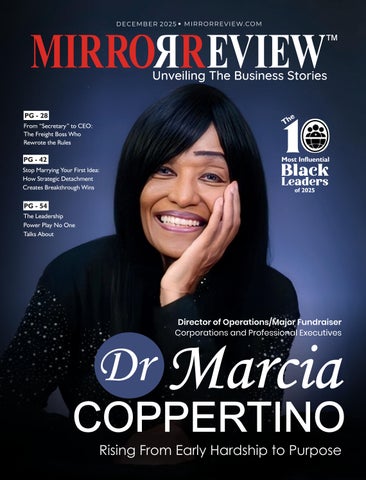
PG - 28 From “Secretary” to CEO: The Freight Boss Who Rewrote the Rules
PG - 42 Stop Marrying Your First Idea: How Strategic Detachment Creates Breakthrough Wins
PG - 54 The Leadership Power Play No One Talks About
Director of Operations/Major Fundraiser Corporations and Professional Executives
Dr Marcia
COPPERTINO Rising From Early Hardship to Purpose
EDITOR’S LETTER
“Resilience Rising, Visions Unbound” ear Readers,
Influence is a heavy word. In today’s fast-paced digital world, it is often confused with popularity or visibility. But true influence is not about how many people are watching you; it is about how much the world changes because you are in it. It is the ability to shift the atmosphere of a room, the trajectory of a business, and the hope of a community. The most powerful leaders are often those who have traversed the darkest valleys to find the highest peaks. They understand that leadership is not a title you are given, but a duty you accept. It is with this spirit of reverence and celebration that we present The 10 Most Influential Black Leaders of 2025, a collection of stories about those who are not just navigating the future, but actively building it. Leading this charge on our cover is Dr. Marcia Coppertino, the Director of Operations at Coppertino and Associates Consulting Group. Her journey is a masterclass in alchemy—transforming the hard lessons of a childhood in Watts into a legacy of empowerment. From witnessing her father’s arrest at seven years old to launching a tax practice from a walk-in closet with a door for a desk, Dr. Coppertino has never waited for permission to rise. Her philosophy is radical in its simplicity: you must transform the human before you can build the business. Whether mentoring a startup or guiding a client through IRS compliance, she operates with a servant’s heart, having once sacrificed her own comfort to ensure her clients were served without interruption. She stands as a reminder that true leadership is not about how far you have risen, but how many people you have pulled up with you. Sharing this space of honor is a collective of trailblazers redefining their industries. We are proud to feature the strategic prowess of Yolanda H. Caraway, Founder of The Caraway Group; the economic vision of Dr. Moeti Motloung, Board Member of the Maluti-A-Phofung Special Economic Zone; the innovative consultancy of Sharold Palmer, Founder and Chief Vision Officer of Seven Palms Consultancy; and the empowering advocacy of Mandisa Mndela, Founder of Stand Your Truth. These leaders prove that our history does not define our horizon. Their stories are blueprints for resilience, teaching us that when we serve others, we inevitably elevate ourselves.
PaNKAJ GHOLAP Managing Editor
PUBLISHER
ARCHANA GHULE
EDITOR-IN-CHIEF
VIKRAM SURYAWANSHI
FOLLOW US
MANAGING EDITOR
mirrorreviewo cial
PANKAJ GHOLAP
MirrorReview1
PROJECT EDITOR
mirror-review
PARAG AHIRE
mirrorreview
PROJECT MANAGERS
mirrorreview
NICK STEWARD DARSHAN GADHAWALE
VISUALIZER
MARK DAVIS
GRAPHIC DESIGNER AKSHAY PANZADE
HEAD OF DISTRIBUTION & PRODUCTION
Mirror Review Media & Tech O ce No. 430, 4th Floor, Gera’s Imperium Rise, Opp. Wipro Circle, Hinjewadi Phase 2, Pune, Maharashtra - 411057.
+1 (850) 564-8517
info@mirrorreview.com
AAKASH MAHAJAN
HEAD OF OPERATIONS ROBERT SMITH
RESEARCH ANALYSTS JAMES ADAMS
ADVERTISING
MARIA SMITH
www.mirrorreview.com
Cover Story
10 Marcia Coppertino
Director of Operations/Major Fundraiser Corporations and Professional Executives
Dr Marcia COPPERTINO Rising From Early Hardship to Purpose
O
C O V E R S T O R Y
COVER STORY
E
very community carries stories that shape the people who rise from it. Some stories begin in quiet places, and others begin in rooms filled with chaos, fear, or impossible choices. In certain neighborhoods of Los Angeles County, many families spent years learning how to hold hope in the middle of uncertainty. Those streets often taught children more than any classroom could. They taught them how to watch closely, listen hard, and understand the world before they were old enough to fully enter it. Dr. Marcia Coppertino’s story begins in this setting. Dr. Marcia Coppertino grew up in Watts, where difficulty often arrived without warning. At seven years old, she watched officers chase her father to the roof of their apartment building. She heard one of them shout words no child should ever hear. The moment stayed with her. She felt small and helpless, but she also felt something new forming inside her. As she put it, “Something told me I had to become more than I was at seven to get my father back.” That thought shaped her childhood. From ages seven to twelve, she turned to books and television programs about law, business, and politics, trying to understand how the world worked and how power moved within it. Her father had been sentenced to twenty-five years to life, but he returned after seven years, following a personal transformation that brought him back to faith. When he came home, she stood beside him as they helped turn an abandoned motel in Compton into a church. The work gave her a sense of purpose. It showed her how determination can rebuild both places and people. It also revealed the early spark that would guide her throughout her life: a steady, inner resolve to rise, lead, and build something meaningful from the hardest beginnings. Building a Career from a Closet Office Dr. Coppertino’s career began in a tiny walk-in closet after her husband left her with four small children, the youngest still in diapers. She needed income fast, so she turned the closet into an office and used two water drains and a door as a desk. As she recalled, “I started doing taxes to support me and the kids.” She taught herself the work, charged fifteen dollars for short forms and up to forty for long forms, and walked through her neighborhood passing out flyers.
After two years, she added “Internal Revenue Service representation,” which kept her busy year-round. She named her first venture Consumer Financial Services, rented a small office, and built enough demand to hire three tax preparers and a financial planner. Her growing practice later became Coppertino and Associates, and eventually Coppertino and Associates Consulting Group. A major shift came during a tax seminar. When an attorney misstated depreciation rules, she raised her hand to correct him. The organizers invited her to the front, and by the end of the event, she was approached by two attorneys who said their senior partner wanted to meet her. He later hired her, telling her she was “brilliant but not polished enough.” He even arranged weekly lunches with a Beverly Hills socialite to sharpen her professional presence. She embraced the guidance and soon proved she could excel in any room. Guiding Businesses toward Clarity and Compliance At the center of Dr. Coppertino’s work is a mission shaped by both discipline and care. She focuses on helping individuals and businesses meet their tax responsibilities with accuracy and confidence. As she often tells her clients, “Our mission is to see that those who owe the IRS make sure their returns are accurate and that any business operating is doing so correctly.” Her approach is steady, practical, and rooted in making sure people understand what they are signing and why it matters. She offers counseling on all forms of business structures and often works under retainer, serving as a mentor, consultant, and, when needed, a supportive voice. Startups and small businesses hold a special place in her work. She enjoys guiding them through early decisions, helping them avoid costly mistakes, and giving them tools to build long-term stability. Her team also focuses on advertising and promotions, helping new business owners understand how to present themselves to the community. She believes visibility can shape opportunity, so she works to “make sure the community knows who is out there in business.” Through clear guidance and consistent support, she positions her clients to operate with integrity and grow with confidence.
Shaping the Person before Shaping the Business For Dr. Coppertino, real success begins long before revenue or strategy. She believes the first step in building a strong business is shaping the person behind it. In her words, “You must transform the businessman or woman first.” She has seen many people enter business focused only on money, and she knows that mindset rarely leads to long-term stability. Instead, she pushes clients to choose work that aligns with their true calling, not just potential profit. Her process starts with simple but direct questions. She asks why they chose their field and what they hope their efforts will accomplish. These conversations often reveal gaps between ambition and purpose. She uses those moments to guide clients toward clearer intentions and more honest goals. By grounding business owners in personal clarity, she helps them build companies that reflect who they are and what they genuinely want to create. Teaching Leaders to Serve Before They Lead Dr. Coppertino teaches leaders that business begins with service. She reminds them that they are “in business to put the client first and to groom them to live for the sake of others.” She encourages every owner to study their clients closely, understand their needs, and recognize the responsibility that comes with being a guide in someone’s financial or professional life. Whether a client is hungry, homeless, or simply overwhelmed, she expects leaders to show empathy and clarity. Her own story sets the standard. During one difficult season, she slept in her car for a year so she could keep serving clients without interruption. “No one knew,” she said, and she preferred it that way. Her focus stayed on the people counting on her. That quiet sacrifice shapes how she mentors others today, urging them to lead with humility, purpose, and a willingness to put others first.
She has watched attitudes shift over the years. “Twenty-five years ago, no one cared about the farmer or the immigrant in business,” she said. Today, their roles are recognized, valued, and supported. To her, this change proves that new voices and new experiences can strengthen entire industries. She sees business as a chain where every link matters, and where opportunity expands when people understand one another. As she likes to put it, her latest bio tells that story best. Keeping Women Visible, Informed, and Empowered Dr. Coppertino, named a 2024 Black Woman to Watch Worldwide, views her role as extending beyond the business realm. She uses her platform to keep women of every race, age, and background informed, confident, and present in the spaces they serve. She sees visibility as a form of strength, and she stays engaged so she can guide women toward opportunities they might otherwise miss. In her words, her role “affords an opportunity to stay on command to alert women of all races how to stay viable and visible in the world they serve in.” This commitment is personal. She has spent her life educating, encouraging, and lifting others, and each achievement reminds her that the effort has mattered. As she put it, her journey “has been worth the effort to love others and keep a light shining in my hands to lead their lives in the right direction.” Her purpose is steady, and her dedication is unmistakable. Creating Space for Honest Dialogue and Bold Voices
Staying Connected to a Changing Business World As the Marketing and Communications Director for the National African American Missions Council (NAAMC), Dr. Coppertino believes leaders must stay alert to the world around them. She often reminds clients that “global and local outreach is necessary to keep up with world trends.” To her, growth depends on paying attention to who is shaping industries, how they operate, and what keeps them moving forward. She encourages business owners to listen carefully, learn from others, and recognize that the landscape changes faster than most people expect.
One of Dr. Coppertino’s most memorable outreach efforts came during a seminar she organized titled What Is the Future of the Black Woman in America. The event drew a large and eager crowd, and the room quickly filled with energy and expectation. Men attended as well, adding new layers to the conversation. During the discussion, one man challenged the group, saying Black women were not truly interested in their future and that Dr. Coppertino was wasting her time.
COVER STORY
“
And if I have three dollars in my hand I never forget to tithe. I learned that tithing will keep the lights on, keep your car running, the house note paid.... please believe me.
COVER STORY She refused to let the comment stand. With calm conviction, she answered, “Your mother stayed the course, giving birth to you in the hope you could help her lead other women to remain sane and look after herself and family. Was her future worth it?” The room shifted. Her response reminded everyone that the conversation was not abstract. It was personal, generational, and deeply important. Restoring Stability and Finding Joy in Service Among Dr. Coppertino’s many accomplishments, one stands out as a defining moment. She spent seven months helping a Los Angeles ministry regain its taxexempt status after years of disorganization and internal confusion. The church had no functioning trustees, no clear leadership, and almost no structure left. She stepped in, untangled the issues, and guided them through every requirement. They regained their standing “in the nick of time,” a result that brought relief to the entire congregation. Her work there extended beyond paperwork. She taught piano and vocals to elementary school children and even offered dressmaking lessons at the church. These simple additions brought her joy and helped strengthen the community from the inside out. For her, achievement is not only about solving complex problems. It is also about giving people something uplifting to hold onto, especially during seasons of uncertainty. Living With Purpose after a Season of Hardship This past year brought Dr. Coppertino one of her most difficult challenges. She spent four months in three different hospitals, facing a level of uncertainty that forced her to look inward. During that time, she made a quiet promise. “Lift me back up and teach me to serve you more,” she prayed. That commitment shaped her outlook once she recovered. With the time and strength she has now, she wants to be an example of faith, endurance, and steady guidance. She plans to spend the rest of her life preaching, teaching, and living in a way that helps others stay strong for the challenges ahead. To her, this is the clearest expression of purpose. She has already lived a life full of accomplishments as an opera singer, a certified diver, and much more. With a warm laugh, she often says, “What is there left for me to do but look out for others?”
Faith as the Foundation for Every Step Forward In the final measure of her life and work, Dr. Coppertino leans on the same strength that carried her through childhood, hardship, and every demanding season since. She never looks back with regret. Instead, she lets faith lead each decision. “I beg God to lead the way,” she said, “and so far, he has never failed me yet.” She knows the world can feel frightening, especially for those trying to build something meaningful. Still, she holds firmly to the belief that she is never alone. With quiet certainty, she adds that no matter what comes, “he will never leave me nor forsake me.” Her faith also shapes her discipline. Even in difficult times, she tithes without hesitation. If she has three dollars, she gives. She believes those small acts have kept her lights on, her car running, and her home secure. To her, faith is not theory. It is survival, strength, and promise.
Strategic Leaders Top Visionary Leaders To Watch in 2025 Dr. Marcia Coppertino
Anita D. Russell
Director I Operations, Coppertino and Associates Consulting Group,
Founder and CEO I The Place to SOAR
Brandy G. Robinson
Dr. James Campbell
CEO I Zebra MedNex
CEO I Communitas, Inc.
Dr. May Ikeora
Dr. Moeti Motloung
CEO I L’Avyanna LTD
Board Member I the Maluti-A-Phofung Special Economic Zone (MAP-SEZ)
Dr. Nicole Ford-Francis
Mandisa Mndela
President I Visionaries in Partnership (VIP), Inc.
Founder I Stand Your Truth
Sharold Palmer
Yolanda H. Caraway
Founder and Chief Vision Officer I Seven Palms Consultancy
Founder of The Caraway Group,
D M Dr. MoetiD Motloung M D The Doctor Who Diagnoses Economies
Dr. Moet Motloung Dr. Moet Motloung Dr. Moet Board Member
Maluti-A-Phofung Special Economic Zone (MAP-SEZ)
T
he waiting room was always full. In the early days of Dr. Moeti Motloung’s private practice, he didn’t bother with an appointment system. The rhythm of the community set the schedule. People from the surrounding farms, their days dictated by the sun, would arrive first, seeking care in the quiet hours of the morning. The locals from the town would trickle in later, filling the rented rooms until the last patient was seen. The practice was busy, successful even, but the space was constricting, a physical limit on the care he could provide. He saw the bottleneck, the inefficiency, the unmet potential. And so, he did what would become the defining instinct of his career: he decided to build. Dr. Motloung bought a portion of land next to his practice and, in 1995, embarked on a building project. This wasn’t just an expansion; it was a reimagining of what a local clinic could be. He designed a facility with four consulting rooms, a dedicated procedure room, and a separate office for himself. He created a central block for the reception, filling room, and back office, optimizing the flow of people and information. The space was so well-planned that it gave him enough room to rent to a dentist and an optometrist, creating an impromptu, multi-disciplinary health hub where none had existed before. This act, born from the simple observation of a crowded waiting room, was the first note in a long and complex symphony of creation. It was the moment a medical doctor began to think like an architect, a systems engineer, and an economic developer. The story of Dr. Moeti Motloung is the story of a man who has spent 30 years moving from the micro to the macro, from treating individual patients to healing entire systems, driven by a rare ability to see not just the ailment, but the infrastructure needed for a cure. The Learning Curve of Transformation The success of Dr. Motloung’s new, efficient practice brought with it a new problem: burnout. The practice grew too fast, and he found he had little time for family or relaxation. Recognizing the need for a different kind of challenge, one that would allow him to learn the language of systems, he applied for a senior executive role at the local hospital. This pivot from frontline practitioner to healthcare manager was a crucial turning point, a self-prescribed education in organizational structure.
Dr “ Mo Dr ” Mo Dr
Innovation should drive our ambitions to reach levels of development that people never thought possible
Dr. Motloung entered the Department of Health during an exciting and historically charged period of transformation in South Africa. His most memorable and formative experience was being tasked with merging two hospitals that had been divided along racial lines into a single, efficient provincial complex. This was not just a logistical challenge; it was a deeply human and politically sensitive undertaking, a microcosm of the nation’s own journey.
“The transformation process was a learning curve in the organization,” he recalls. “We started the change process within the first 100 days and achieved our goals and a cultural shift.” The results were a testament to his emerging leadership philosophy. The combined hospitals, with a total of 340 beds and five theatres, operated on a budget of R100 million in 1996, with a four percent annual increase. Despite the immense complexities, staff shortages, and budget constraints, his team “never had a disclaimer or overspent on our budget.” Dr. Motloung’s leadership style during this period was, by necessity, transformational and consultative.
r. Moeti otloung r. Moeti otloung r. Moeti After the goals were met, it shifted to one of servant leadership. His success was so profound and enduring that today, decades later, he serves as the chair of the hospital board for that very same provincial hospital, guiding the institution he helped create. The Economic Architect
This experience—transforming fractured institutions into cohesive, productive units—prepared him for his most ambitious role yet. In 2022, Dr. Motloung became a Board Member of the Maluti-A-Phofung Special Economic Zone (MAP-SEZ), one of nine such zones promulgated in South Africa to drive investment and create jobs. His mission expanded from the health of patients to the economic health of an entire district, Thabo Mofutsanyane.
MAP-SEZ is a masterclass in strategic geography. Its primary goal is to drive the agro-processing and related industries, leveraging its unique position as a logistical hub. The zone is located 300 kilometers from the crucial port of Durban and its Dube Port Special Economic Zone, providing a direct link to global markets. It is also equidistant from Johannesburg and Bloemfontein, the two major cities of the Gauteng and Free State provinces, placing it at the very heart of the country’s economic inland.
As a board member, Dr. Motloung’s responsibilities are clear: attract and maintain business industries for the province. His focus is on high-value sectors: pharmaceuticals, medical devices, clinical trials, and a dry dock to service the logistical corridor. He understands that to attract international and local investors, you must solve their biggest problems. “The MAP district has a problem with water and electricity issues,” he states plainly, “which SEZ will supply to ensure its uninterrupted business operation.” This is the ultimate value proposition: a haven of stability in a landscape of uncertainty, complete with tax concessions and value chain support. The strategy is working. The zone has already achieved significant business uptakes, with the largest being a major investment from a bagged goods company.
Moeti oung Moeti oung Moeti The Futurist’s Prescription
While his work with MAP-SEZ is grounded in the tangible world of infrastructure and logistics, Dr. Motloung’s vision for the future is decidedly digital. He sees South Africa’s unique geographical position—at the confluence of the Eastern and Western undersea cable networks—as a powerful advantage for creating a new paradigm of “connected care.”
“It can enhance medicine in unprecedented ways with an AI interface,” Dr. Motloung says, painting a picture of a truly futuristic healthcare system. He envisions wearable devices that constantly track the vital signs of medical scheme members, linking them directly to their primary providers. This system would alert doctors when to call a patient urgently or when to renew a treatment, moving from a reactive to a proactive model of care. This, he notes, is perfectly aligned with the national initiative to develop and manage “care at home” for certain patients, a system that promises greater efficiency and patient comfort. His mission is to use big medicaldata to inform healthcare planning and decision-making on a massive scale, creating a system that is not just connected, but intelligent. The Lifelong Learner
The ability to operate across such diverse and complex fields, from clinical medicine to property development to national economic strategy, is not accidental. It is the result of a deliberate, lifelong commitment to learning. Dr. Motloung’s career has been punctuated by the pursuit of knowledge, with each new credential adding another tool to his formidable intellectual toolkit. He holds an Executive MBA from Hult International Business School, a Project Management certificate, and a Diploma in Property Development. He also clarifies that while he completed the coursework for a Master of Medical Law and a separate MBA, he does not hold the final degrees. The academic transcripts from these studies were, however, accepted for his enrollment into the EMBA program.
“I have always been keen to try new ways of doing things and follow them up with a proper educational background to correct any mishaps and future endeavors,” Dr. Motloung explains. Sometimes he learns and then puts it into practice; other times, he puts something into practice and then seeks out the education to refine and perfect it. This symbiotic relationship between action and education is the key to his adaptability. It’s how he navigates the high-pressure environments and complex decision-making landscapes that define his work. His framework is clear: identify the need for change, set clear goals, bring all stakeholders on board, set time limits, and constantly measure progress, correcting for deviations along the way. A Legacy of Access When he looks to the future, Dr. Motloung’s vision comes full circle, returning to the concept he first brought to life with his private practice in 1995. He has already created a one-stop service center, bringing together a host of auxiliary healthcare providers—dentists, ophthalmologists, speech therapists, audiologists, physiotherapists, psychologists, dietitians, and podiatrists. The next phase is to grow this hub, adding more doctors, extending the hours to be open seven days a week, and incorporating an on-site pharmacy.
This project is driven by the same impulse that led him to build his first clinic: a desire to provide comprehensive, accessible care to his community. “The area I currently service is the previously underserved region of town,” Dr. Motloung says, “where people never thought they would have access to a podiatrist in their lifetime.” This is the core of his philosophy. Whether he is building a clinic, transforming a hospital, or shaping a national economic zone, the goal is the same. “Innovation should drive our ambitions to reach levels of development that people never thought possible,” he declares. “It becomes the inspiration for the generation that is watching life unfold before their eyes. This inspiration will drive others to reach their full potential in life.”
Dr. Moeti Motloung Having learned the hard lessons of burnout early in his career, Dr. Motloung now approaches his work with a sense of balance. He has implemented uniform holidays for his staff and uses locum doctors to ensure he has time for his own passions: golfing and traveling, pursuits for which he sets aside dedicated time at the beginning of each year. He is a man who understands that to build for the long term, you must also build a life that is sustainable. From a single, crowded waiting room, Dr. Moeti Motloung has built an extraordinary career, and his work continues to build a healthier, more prosperous future for his community and his country.
FROM “SECRETARY” The Freight Boss Who TO CEO Rewrote the Rules You don’t stumble into a leadership role in a male-heavy industry. You take it. And when you take it, you don’t ask for permission — you build your own platform, set your own rules, and make sure no one can ever shrink your title again. That’s exactly what Diana did. Today, she runs Texas Global Services, a freight forwarding powerhouse out of Houston. The company moves goods across oceans, skies, and borders — and does it so well that global players trust them with projects too complex for anyone else to touch. But here’s the part people miss: her business didn’t start from a place of strategy and capital. It started from survival. The Job She Took Just to Pay the Bills Diana wasn’t looking for a “career move” 23 years ago. She was a newly divorced mom with two kids, no work history, and no safety net. She needed a job. Any job. A friend pulled her into a small, woman-owned freight forwarding company. She didn’t know what a freight forwarder was — and if you don’t either, here’s the quick version: Freight forwarders are the backstage crew of global trade. They move goods from Point A to Point B across land, sea, and air. They coordinate the trucks, ships, planes, warehouses, and all the paperwork in between. It’s messy. It’s high stakes. And if you screw it up, someone’s milliondollar shipment can vanish into thin air. That first job didn’t just teach her the ropes. It handed her a blueprint for survival in a male-dominated industry. She learned how to speak up in rooms where her voice wasn’t expected. She learned how to negotiate without blinking. She learned that confidence isn't about how loud you are — it’s about knowing your worth and refusing to undersell it.
The Move That Almost Broke Her Years later, Diana joined a former colleague — someone she had mentored — at his new freight forwarding company. She worked on commission and crushed it. But the commute was brutal. Two hours each way, every day. Health problems started piling up. She knew she couldn't keep up that pace forever.
Why? Because like most people standing at the edge of entrepreneurship, she saw the cliff, not the runway. She didn't know accounting. She worried about capital. She wasn't ready to gamble her stability on a hunch. Then came the moment that flipped the switch. The Title That Lit a Fire At a business event, that same colleague — the one she had taught everything — introduced her as his secretary.
Her husband, who had an IT and bookkeeping background, kept saying, "Start your own company. You can do this.”
Not his partner. Not his right-hand. Not even "head of operations.”
She kept saying no.
Secretary.
It wasn’t just inaccurate. It was dismissive. It was the kind of public undercutting that either breaks you or forces you to build something so undeniable they can never box you in again. Diana went home and told her husband she was ready. Texas Global Services Was Born Starting wasn’t glamorous. It took months to secure the Federal Maritime Commission license. Her husband built the first website and handled SEO so clients could actually find them. Cash flow was a nightmare. You can’t move big freight without big money, and banks aren’t exactly eager to fund a small, woman-owned startup in a male-heavy industry. She hustled. She reinvested every cent. She fought through lost cargo, botched supplier deals, and rates that cut margins razorthin.
Trucking
Most people quit in the early years.
· Watch how the best operators move. Diana learned from women who didn’t apologize for their expertise. Study how they talk, how they negotiate, and how they handle conflict. You’ll need those tools.
She didn’t.
· See the opportunity inside the job you hate. That first job you think is “beneath” you? Treat it like paid training. Learn the industry inside out so no one can tell you you're not qualified later.
The Five-Year Rule Here’s the truth nobody wants to tell you: most businesses don’t hit real stability until year five. By then, Texas Global could fund its own shipments without begging for outside financing. They got better rates. Clients came back and referred others. The phone started ringing without her having to chase every lead. For the last three years, the company hasn’t just been stable — it’s been strong. The Lessons That Turn Employees into Owners If you’re sitting where Diana sat years ago — underpaid, undervalued, and overworked — here's her no-fluff playbook:
· Don’t wait for perfect conditions. If you’re waiting for “the right time,” you’re going to be waiting forever. Diana started with no accounting skills, no capital cushion, and no roadmap. · Use disrespect as fuel. The “secretary” comment could have been a gut punch that knocked her out. Instead, it became her launch button. · Survive long enough to get good rates. Freight forwarding is a game of margins. It's the same in many industries — your leverage increases with time and proven reliability. Stay alive long enough to get that leverage. Why Her Story Hits Different Plenty of people start companies because they see a market gap or smell a big payday. That’s not Diana’s origin story. She started because she refused to let someone else write her title for her.
And because of that decision, her company now moves projects that most people in the industry don’t have the stomach for. High-stakes, high-complexity, highresponsibility shipments — and she’s built a team that thrives on making the impossible happen. If You’re Thinking About Starting Your Own Thing You don’t need to be ready. You need to be willing. Willing to take the first uncomfortable step. Willing to stay in the game when the early years test you. Willing to learn everything you don't know and admit when you screw up. Most of all, you need to be willing to bet on yourself before anyone else will. Diana did. And she’s proof that the person they underestimate today might just be the one they answer to tomorrow.
Air Freight
Ocean Freight
T
here’s a moment in life when you either break or breakthrough. For Mandisa Mndela, that moment came on a hospital bed, staring at the thin line between survival and surrender. A successful property developer at the time, she had built a thriving business from the ground up. But as she lay there, she realized something unsettling—no amount of money, no corporate victory, no external achievement could save her. What she needed wasn’t another business deal. It was clarity, purpose, and a reason to stand again. That reckoning gave birth to Stand Your Truth, a movement that goes beyond self-help and personal development. It is about resilience forged in adversity, about finding strength when life seems to strip you of every last piece of it. And it’s a philosophy that Mandisa herself has lived, from her childhood in the farmlands of the Eastern Cape to becoming a teenage mother navigating the world alone, and later, an entrepreneur who refused to let circumstances define her. Her story is not just about business success or bestselling books. It’s about transformation—her own and the countless lives she has touched along the way. In this exclusive feature, we step into the journey of a woman who turned personal trials into a blueprint for empowerment. A leader who believes that the real legacy isn’t wealth, but the wisdom to stand tall—no matter what life throws your way. From Rural Roots to Resilience: Mandisa’s Journey of Transformation Mandisa’s early life, as she describes it, was woven with love, faith, and deep family connections. “I was born into a loving home, surrounded by family and deeply rooted in Christian values,” she reminisces. Growing up in the farmlands of the Eastern Cape, South Africa, she often refers to herself as a “rural girl at heart.” While her childhood carried the warmth of familial love, it was also marked by early challenges. “My parents divorced when I was still very young, not even a teenager yet,” she shares. This upheaval was soon followed by an even deeper sorrow—the passing of her mother. “That was the moment everything changed. Life became tougher, and I had to grow up quickly,” she reflects. At St. John’s College, where math and physics were compulsory, Mandisa uncovered a key aspect of her personality. “It was there that I realized I was different from most of my peers. I was incredibly inquisitive, always asking questions—sometimes too many for my teachers’ liking,”
she admits with a smile. This inherent curiosity, though sometimes challenging in her early years, would later become the driving force behind her success. Before stepping into the world of personal transformation, Mandisa carved out a thriving career in business. One particularly formative experience was her time at Civil Projects. “My boss was strict and often placed me in difficult situations, expecting me to find solutions to the company’s challenges,” she recalls. While overwhelming at the time, this period proved invaluable, equipping her with the skills and resilience to eventually launch her own property development business, The Dawn Property Group. Mandisa excelled in property development, managing numerous large-scale projects. However, life took an unexpected turn when she fell critically ill and underwent a major operation. “That moment changed everything for me,” she states. During her recovery, she began journaling as a way to process her emotions. Little did she know that these personal reflections would lead to her first book, Stand. “Writing awakened as my true calling,” Mandisa explains. Over the years, she authored four more books, each capturing raw experiences and life lessons. These works did more than tell her story—they became the foundation for Stand Your Truth, the personal development movement she now leads. Looking back, Mandisa sees a clear thread running through her journey. “Every challenge, every loss, and every breakthrough was preparing me for this journey. I started out in business, but today, my true work is helping others stand in their truth and transform their lives.” Turning Pain into Purpose: The Birth of Stand Your Truth The journey to founding Stand Your Truth was deeply rooted in Mandisa’s personal experiences. Life had tested her early, from losing her mother at a young age to navigating the realities of a broken home. But perhaps one of the most defining moments came when she became a mother as a teenager. “For most new moms, their own mother is their first guide, their anchor,” she reflects. “But with my mother gone, I had no one to turn to. I was forced to figure out motherhood on my own—through trial, and error.”
That period, she recalls, was one of the loneliest and most difficult of her life. It was then that she truly understood what it meant to face the world without a safety net. And while she found ways to push forward, she recognized that not everyone in similar circumstances would be as fortunate. “That realization planted the seed for Stand Your Truth,” Mandisa explains. Another defining moment came when Mandisa considered the legacy she wanted to leave for her children. “Financial inheritance is great, but what legacy do we leave for the human spirit?” she pondered. This question led her to realize that Stand Your Truth was not just about helping others; it was also a profound legacy for her own children. “A legacy beyond money, something they could hold onto in their hearts and spirits, something that could guide them through life long after I was gone.” Ultimately, Mandisa has come to understand that “even with support, we each have to face our own demons head-on.” Stand Your Truth was born to equip people with the tools to do just that. “It is about self-awareness, resilience, and transformation—helping individuals, young and old, navigate life's challenges with or without external support. My journey led me here, and now, I dedicate my work to guiding others toward their own breakthroughs.” A Second Chance: Redefining Success and Purpose Surviving a critical illness proved to be a profound turning point for Mandisa. “It felt like I was being given a second chance—a clean slate, almost as if I had been reborn,” she reflects. During her extended recovery, she had
the opportunity for deep introspection. “As I lay in recovery for days, weeks, and months, I had no choice but to sit with myself, to reflect, to rediscover and reinvent what truly mattered to me.” Before this life-altering experience, Mandisa was a successful business owner, primarily focused on financial results. However, lying in that hospital bed, she had a stark realization. “No amount of money could save me,” she admits. “It struck me that while financial success is necessary for survival in the world we have built, it is not enough.” In her pursuit of material success, she had neglected her inner world, her spirit, and her emotional well-being. This neglect, she believes, manifested as the illness that nearly cost her life. This experience compelled her to ask fundamental questions. “What is my true purpose? Why am I here?” Once she identified her purpose, she understood that it was not enough on its own. “I realized that purpose alone was not enough—I needed a vision. I needed a clear picture of what my life would look like if I was truly living in alignment with my purpose.” With this vision in mind, she then focused on creating actionable steps to bring it to life. This process of reflection, discovery, and action became what Mandisa now calls “the roadmap to selfrealization, self-actualization, and ultimately, fulfillment.” She believes this roadmap is particularly crucial for young people today. “In a world that constantly demands more—more achievement, more success, more validation—it is easy to lose sight of what truly matters. Purpose gives us direction, vision gives us clarity, and service grounds us in something bigger than ourselves.” Mandisa firmly believes that “if we can equip young people with the tools to discover and live their purpose, they will cultivate healthier mindsets, stronger emotional intelligence, and a deeper sense of fulfillment. And when individuals are fulfilled, we build healthier families, healthier communities, and ultimately, a healthier society.” This conviction is why Stand Your Truth is built on three core pillars: Purpose, Vision, and Service—because they are the foundation for a truly meaningful life.
Building a Foundation for Thriving, Not Just Surviving At Stand Your Truth, the belief is that life skills are essential tools for navigating the complexities of the world, particularly for young people. “Our mission is to create a powerhouse of life skills that empower youth to thrive in every area of their lives—emotionally, mentally, socially, and practically,” Mandisa states. Many of the challenges young people face today stem from a gap in foundational life skills—skills that prepare them for the realities beyond school. From managing emotions and making healthy decisions to understanding their selfworth and purpose, these critical aspects of personal development are often overlooked. “At SYT, we tackle these issues head-on, equipping young people with the tools to build emotional intelligence, resilience, and selfawareness.” “Our approach is comprehensive, focusing on the whole person, not just academics or career skills. This means helping them develop critical life skills such as communication, problem-solving, decision-making, and self-reflection. By doing so, we are not only preparing them for personal success but also equipping them to make positive contributions to their communities.” In this process, SYT aims to address the root causes of social ills such as low self-esteem, lack of direction, and unhealthy relationships. “When young people are empowered with a solid foundation in life skills, they are better equipped to navigate these challenges and avoid falling victim to destructive patterns. Instead, they become resilient individuals who can make informed decisions, pursue their goals with confidence, and contribute positively to the world around them.” The ultimate vision for Stand Your Truth is to create a generation of young people who are not just surviving but thriving—individuals equipped to face adversity, break through limitations, and lead with integrity. “By building this solid foundation in youth, we believe we can create lasting change and transform not only individual lives but entire communities.” A Curriculum for Growth, Confidence, and Possibility The Stand Your Truth curriculum is thoughtfully designed to go beyond traditional education by nurturing emotional intelligence, imagination, and self-esteem—three vital elements for personal growth and success.
“Emotional intelligence is the foundation of selfawareness and resilience,” Mandisa explains. The curriculum helps students understand and process their emotions, develop empathy, and build healthy relationships. “We create a safe space for them to explore their feelings, recognize patterns in their behavior, and learn effective ways to navigate challenges. When young people are emotionally intelligent, they make better decisions, communicate more effectively, and cultivate inner strength.” Imagination plays a crucial role in helping students dream beyond their current circumstances. “Too often, young minds are conditioned to follow rigid structures without being encouraged to think creatively,” Mandisa observes. At SYT, they challenge students to expand their perspectives, visualize possibilities, and embrace innovation through storytelling, creative exercises, and reflective practices. “We help them see that their future is not limited to what they currently know—it is shaped by what they dare to imagine.” Self-esteem is the third pillar, providing the confidence needed to embrace one's individuality and purpose. Many young people struggle with self-doubt, unsure of their own worth. Through SYT, they gain the tools to recognize their value, own their uniqueness, and take control of their narrative. “When they understand who they are and align with their purpose, they step into the world with unshakable confidence,” Mandisa affirms. Ultimately, “the SYT curriculum is about transformation,” Mandisa emphasizes. “It equips students with the inner tools to navigate life's challenges, dream beyond limitations, and step into their full potential. When emotional intelligence, imagination, and self-esteem are cultivated together, they create individuals who are not only prepared for the world but also capable of shaping it.” Empowering Growth in Education and the Workplace Stand Your Truth has designed its curriculum to cater to both education and corporate settings. While the core principles of Purpose, Vision, and Service remain constant, the context and application are adapted to suit each environment. In the education setting, the focus is on young minds still in the process of self-discovery. “Here, we focus on helping students uncover their purpose, develop a vision for their future, and understand how they can serve both themselves and others,” Mandisa explains.
The curriculum is highly interactive, emphasizing reflection, group discussions, and creative exercises to encourage engagement, self-expression, and self-esteem building. They address common challenges like peer pressure and self-doubt while fostering emotional intelligence and resilience. “The goal is to ensure students leave school not only prepared for academic success but equipped with the life skills necessary to thrive in the real world.” In the corporate setting, the focus shifts to professionals already on a career path. Here, the SYT curriculum emphasizes how purpose and vision align with professional goals, leading to greater fulfillment and productivity. While Purpose, Vision, and Service remain central, the emphasis is more on leadership, effective communication, and building resilient teams. “The program helps individuals and organizations understand how their personal purpose can contribute to a larger collective vision, while also emphasizing the importance of service in creating a positive and impactful work culture.” Ultimately, in both contexts, the aim is to empower individuals to stand in their truth, act with intention, and contribute meaningfully to their communities. Empowering Families: The Heart of Lasting Transformation Mandisa understands that true transformation doesn't happen in isolation—it is nurtured through strong, supportive relationships at home. That's why Stand Your Truth offers a Social Program specifically designed to empower parents and different age groups, ensuring that Purpose, Vision, and Service become a shared family journey. This initiative is structured into three key groups: ● Adults Wealthy and Wise (AWW) – Equipping parents with the tools to lead by example, cultivate emotional intelligence in their children, and build purpose-driven families. ● Young Alive and Aware (YAA) – Supporting young adults in navigating life's transitions with clarity, confidence, and a strong sense of direction. ● Teens Energetic and Enlightened (TEE) – Helping teenagers develop resilience, self-esteem, and the ability to make empowered life choices.
A unique feature of this initiative is the SYT Lounge, a dedicated space for open, intergenerational dialogue where parents, young adults, and teens can engage in meaningful conversations, share experiences, and learn from one another. This fosters a culture of understanding, guidance, and mutual growth within families. Stories That Shape Legacies Books are more than just words on a page—they are time capsules of transformation. For Mandisa, writing has never been about filling pages; it's been about making sense of life, one chapter at a time. Each of her books marks a defining era of her journey: ● Stand – A raw, unfiltered reflection of her early years, navigating life without a mother and discovering resilience in the face of loss. ● 7 Letters 7 Years – A deeply personal account of young adulthood, capturing the hard-won lessons that shaped her identity and purpose. ● The Dawn – A testament to her growth as an entrepreneur, revealing the realities of leadership, vision, and perseverance in the business world. “As people read my books, they reached out to share their own stories—stories of pain, loss, resilience, and hope. It became clear to me that I was never alone in my struggles. We are all beautifully imperfect beings, facing the same universal challenges in different forms,” Mandisa reflects.
Leading with Humility and Integrity As a businesswoman, author, and speaker, Mandisa's leadership is guided by humility and integrity. These principles shape her approach to work and interactions with others. She recalls a powerful lesson from her mother about empathy: “My child, if it is painful to you, it is painful to others too.” This principle guides her daily, whether she is running her business, speaking, or writing. Humility keeps her grounded, and integrity ensures she acts with honesty and transparency. A Vision for Global Empowerment Mandisa's long-term vision for Stand Your Truth is to create a global movement that empowers individuals to live authentically and pursue their purpose with clarity and
confidence. “I want Stand Your Truth to be a source of transformative education, where people of all ages can find the tools they need to navigate life's challenges and make meaningful changes in their own lives and communities,” Mandisa envisions. In terms of new initiatives, she is excited about expanding the reach and impact of the movement through strategic partnerships. Her team is actively collaborating with schools, corporations, and organizations worldwide to further integrate their curriculum and help more people unlock their full potential. Additionally, they are looking to expand their Social Program to provide more tailored support for adults, teens, and young people in different regions. Living Truthfully: Finding Balance and Fulfillment Balancing professional and personal life has become easier for Mandisa as she has learned to live her truth in all areas. “When your professional and social lives are aligned with your purpose, it doesn't feel like work—it feels like fulfillment,” she explains. While this alignment can sometimes lead to over-immersion in her mission, a past health scare taught her the crucial importance of rest. Now, she prioritizes rest, schedules downtime, and makes time for activities that bring her joy and peace, such as spending time in nature, reading, and being with family. These practices help her stay grounded and inspired. Defining Success Through Impact and Inner Peace “To me, success is not measured by wealth or accolades but by the impact I have on others and the peace I feel within. Success is seeing each individual positively affected by Stand Your Truth, knowing that the work I do is making a difference in their lives. It's also about the peace I have when I go to sleep each night, knowing I'm living my purpose and feeling fulfilled. That sense of alignment, knowing I am contributing to something greater than myself, is how I measure success in both my personal and professional life,” concludes Mandisa.
L
et me tell you a truth that’s made—and saved—millions for CEOs who play the long game: You can’t marry your first idea.
I learned that the hard way. The Offer That Went Nowhere I had what felt like a brilliant idea. My apartment in Porto, Portugal, sits empty when I travel. Many of my friends fantasize about working remotely, tasting the “digital nomad” lifestyle. So I thought—perfect. I’d offer them the chance to stay in my place, free. They’d get a taste of location freedom. I’d get the satisfaction of helping them take a step toward a bigger life. Win-win, right? I reached out to seven people who seemed like perfect fits.
The Autopsy of a Dead Idea Here’s where I went wrong: I didn’t follow my own rules. I teach entrepreneurs that a strong offer needs:
Result? Nothing. Not a single “yes.” Sure, I got polite replies. A few “That’s amazing!” and “I’d love to, but…” But no action. I was stunned. In my head, I’d pictured at least two people saying yes before I finished making the offer. Instead, I was left staring at a list of people who seemed interested—but weren’t moving.
· A clear problem—and proof the audience feels it now, not later. · A solution that connects directly to that problem. · A why that matters emotionally, not just logically. · Messaging that joins the conversation already in their heads.
· A compelling hook that makes saying "no" feel expensive. · The right audience size with skin in the game.
The Real Problem Wasn’t Them I wasn’t just attached to the idea—I was wedded to it. In my head, I’d already decided they’d love it. I skipped the part where I actually confirmed whether they needed it, wanted it, and were ready for it now.
I did none of that.
Worse, my “sample size” was seven people. That’s not even a test—it’s a dinner party.
I assumed my friends wanted what I wanted for them. I offered it with zero urgency, zero cost, and zero commitment. Which, ironically, is exactly what I tell my clients not to do.
And here’s the big business truth I had to swallow: Just because someone says they love an idea doesn’t mean they’ll act on it.
So, what did I get? Polite enthusiasm. And nothing else.
It’s not malice. I’s timing. People have lives. Priorities shift. Meaning well doesn’t create momentum.
The Pivot That Changed Everything
How to Spot When You’re Wedded to an Idea
Once I got over my bruised ego, I asked the two questions I should’ve started with:
Ask yourself:
· What’s the real lesson here?
· Am I ignoring real feedback in favor of what I imagined would happen?
· How can I pivot without clinging to my original picture of success?
· Do I keep pushing the same offer without revisiting the problem it solves?
That’s when I flipped the offer.
· Am I more invested in the idea itself than in solving the customer’s actual need right now?
I turned the “free stay in my apartment” into a VIP Strategy Weekend in Porto—a paid experience where business owners work with me on their biggest business challenges, face-to-face, in an environment that fuels strategic thinking.
If you answer “yes” to any of these, you’re not testing—you’re defending. And defense doesn’t scale. A CEO’s Playbook for Strategic Detachment
This time, it landed. Why? Because now it had the elements that actually drive action: · Clear problem: Entrepreneurs needed focused time to work on their business, not just in it. · Logical and emotional payoff: They’d leave with clarity, strategy, and execution steps—results they could feel and measure. · Skin in the game: Paying meant they’d prioritize showing up and implementing. · Right audience, right moment: I put it in front of people actively searching for a breakthrough now, not “someday.”
Here’s the process I now follow—and coach others to use—when an offer stalls: · Step Back. Remove your emotional investment. Think like an external strategist, not the creator. · Check Your Audience. Are you speaking to the right people at the right time in their decision cycle? · Refine the Problem. Is the pain urgent enough for them to act now? · Rebuild the Offer. Increase clarity, urgency, and commitment. Give them a reason to prioritize it. · Retest Fast. Small audience? Small launch. Don’t wait six months to find out if the pivot works.
The Lesson You Can’t Ignore Final Word Your first idea isn’t sacred. The faster you release it, the faster you find the version that works. I could’ve wasted months trying to convince my original group to take me up on the free stay. I could’ve doubled down on selling something they didn’t see as urgent. But detaching from the outcome freed me to spot the better opportunity. The same principle applies whether you’re pitching investors, launching a biotech product, or selling consulting. CEOs who scale fast don’t just innovate—they discard quickly when a concept doesn’t convert.
If your offer isn’t landing, stop forcing it. Release your attachment to what should work. The faster you move on from the dead weight of your first idea, the faster you find the one that creates real traction. The CEOs who win big aren’t the ones with the best first ideas. They’re the ones who adjust faster than the market shifts. So, ask yourself today—not “How do I make this idea work?” but “What’s the next best version I can test now?”
The loudest person in the room rarely runs it. In high-stakes leadership, power often belongs to the one who knows when to step forward—and when to step back. I’ve watched this play out in boardrooms on five continents. The most influential leaders guard their energy like investors guard capital. They don’t burn it on every request, meeting, or fight. They deploy it where the return is highest. That isn’t retreat. It’s precision. Why Energy Is a Strategic Asset—Not a Renewable One You’ve been told to “show up everywhere” and “always say yes to opportunity.” That's advice designed to keep you busy, not effective. Energy works like working capital: if you spend it indiscriminately, you’ll have nothing left for the decisions and conversations that actually move the needle. I’ve seen too many founders, executives, and creatives burn themselves out trying to be constantly available. By the time they hit the moment that truly matters—negotiating a critical deal, steering through a crisis—they’re running on fumes. The leaders who win over decades build what I call an Energy Reserve Strategy: they invest in recovery, decline low-value demands, and preserve their capacity for the work only they can do.
The CEO Pattern You'll Never See in Their LinkedIn Posts When you study leaders at the top of their game—Oprah Winfrey, Ava DuVernay, Shonda Rhimes, Naomi Osaka—you notice a pattern: They say “no” more than they say “yes.” They disappear on purpose. They choose when to speak, rather than react to every moment. Oprah has said her breakthrough came when she stopped saying “yes” out of obligation. Naomi Osaka skipped press conferences to protect her mental bandwidth. Ava DuVernay directs her focus toward the work that will outlast the noise. None of them confuse constant presence with meaningful impact. How to Build Your Own Energy Reserve Strategy Stop thinking of energy management as self-care. It’s operational discipline. Here’s the framework I use with executives who want sustainable influence: 1. Audit the Drains – Track your week. Identify what drains you without delivering measurable value. 2. Cut Without Guilt – If it doesn’t move your mission forward, it’s a no. No justification required.
3. Schedule Recovery Like Revenue Work – Block solitude, deep work, and decompression into your calendar before anything else. 4. Decide Your Deployment Triggers – Define the criteria for when you’ll step in, speak up, or take the lead. If it doesn’t meet that bar, you hold. This isn’t about hiding. It’s about controlling the terms of your visibility. Why This Works in Divided Times In today’s polarized climate—inside companies, markets, and public discourse—reaction speed is overrated. Leaders who pause before acting can see beyond the noise. Congresswoman Pramila Jayapal calls her introversion an advantage: it allows her to hear more, filter faster, and find leverage points in heated negotiations. The same applies in business. If you burn energy reacting to every provocation, you lose clarity. If you hold back, assess, and respond only when impact is possible, your influence compounds. The Diplomatic Deployment Principle Think of your influence like a high-value currency. If you spend it on every small transaction, it loses value. Spend it strategically, and its weight grows. This is why Ava DuVernay’s voice carries. She doesn’t engage every battle. She picks the ones that shift the industry. You can do the same. · Save your input for moments that define direction. · Let others exhaust themselves in the noise. · When you speak, make sure it counts. This isn’t passivity—it’s tactical patience.
The Misconception That Costs Leaders Their Edge Too many talented people believe that influence requires constant output. They confuse activity with authority. In reality, measured presence builds more trust than constant chatter. The people you lead, sell to, or negotiate with learn that when you step in, it matters. That scarcity creates weight. And weight moves decisions. The Playbook for Quiet Influence If you want to operate like the leaders I’m describing, here’s the system: 1. Treat Energy as Capital – Your time and presence are assets. Protect them like your P&L depends on it—because it does. 2. Operate From a Reserve – Never let your energy account hit zero. Decisions made from depletion are almost always costly. 3. Define Your “Yes” and “No” Rules – Without clear criteria, you'll spend yourself on work that doesn’t move the mission. 4. Build Recharge Rituals – Whether it’s a daily walk, two hours of phone-off time, or quarterly solo strategy days, make it non-negotiable. 5. Deploy With Intention – When you engage, bring full clarity, preparation, and presence. Then step back before your edge dulls. The Bottom Line Leaders who master energy control don’t just last longer—they win more often. While others burn themselves out trying to be everywhere, they conserve power for the moments that change everything. Your job is not to be constantly visible. Your job is to be unmistakably effective when it matters. If you do this well, you won’t need to fight for attention. Your absence will be noticed—and your presence will be felt.
Founder | The Caraway Group
Yolanda H.
Caraway A Journey from Grassroots to National Leadership
E
very movement has voices that rise quietly at first, shaped by family, community, and the times they live in. Yolanda H. Caraway, Founder of The Caraway Group, grew up in Rochester, New York, where the civil rights struggle was not a distant story but part of her own household. Her brother-in-law, an ordained minister and president of the Rochester NAACP, had marched with Dr. Martin Luther King Jr. Such exposure in her teenage years sparked a passion for social equity and political engagement. That passion took root early. At just fourteen, she volunteered on Robert Kennedy’s Senate campaign in New York, knocking on doors and stuffing envelopes. It was her first glimpse of politics as a force for change. Kennedy’s victory brought her a signed letter of thanks, a keepsake that still hangs in her office as a reminder of those first steps. Her journey soon expanded from local campaigns in Maryland to the national stage in Washington. Each role she took, from Capitol Hill to the Democratic National Committee, reflected the same conviction she discovered as a teenager: politics could open the door to lasting equity.
Building the Caraway Group From the beginning, Yolanda carried an entrepreneurial spirit. “I always knew I wanted to have my own business, even as a kid,” she says. After years in politics, she used her network to launch The Caraway Group, first as an event management firm and later expanding into public relations and public affairs. The shift proved wise, fueling success through the 1990s and 2000s. Along the way, she mentored dozens of young professionals who went on to lead in their own right. At its core, the firm reflected her belief in true workplace diversity, a value she championed daily. Core Services and Impact The Caraway Group specializes in public relations, public affairs, community engagement, and event management. Each service is designed to help organizations connect meaningfully with their audiences. What distinguishes the firm, Yolanda Caraway explains, is its focus on diversity, equity, and inclusion in every strategy.
“
Always
know what you want and don’t
be afraid to ask for it, whether it’s a promotion, a contract, or a raise ask.”
“Understanding DEI is not just a principle; it shapes how clients relate to their consumers,” she says. By blending strategic insight with an inclusive perspective, the company helps organizations build trust and engagement while reflecting the communities they serve. This approach ensures that every campaign, event, or initiative resonates authentically. Advocating for Women and Communities of Color Yolanda has devoted much of her career to supporting women and communities of color. These groups bring energy, ambition, and purpose, not problems. The real challenge often comes from clients who need guidance on why diversity, equity, and inclusion strengthen an organization. “It is not just the right thing to do; it is smart business,” she emphasizes. Through her work, Yolanda shows leaders that fostering inclusion can improve culture, innovation, and results. Her approach combines patience with conviction, helping organizations move beyond obligation to see representation as an opportunity for growth and long-term success. Leading with Purpose
“
Keep your moral compass intact don’t let others convince you otherwise.”
For more than thirty years, Yolanda led The Caraway Group with energy and focus, building a firm recognized for both its strategy and impact. Today, she works independently as a consultant after downsizing her staff, continuing to guide clients with the same insight that has defined her career. Last year, she launched Rise United, a nonprofit that empowers content creators across the country to engage in conversations about national, state, and local issues. “I want people to use their voices to shape the conversations that matter,” she says. For Yolanda, every project is a chance to connect strategy with civic engagement and lasting change. Defining Impact and Success For Yolanda, success is measured not by awards or recognition but by tangible transformation in people’s lives. She recalls a program she helped design for Microsoft in partnership with the National Urban League called the “Build Your Business Tour.” High school juniors and seniors in urban areas were challenged to build a business with $2,000 using technology. Every Saturday, they met at a local Microsoft office with volunteers to develop their business plans. Teams then presented their ideas at the NUL conference, with winners receiving $2,000 and computer equipment.
“The impact this program had on these kids’ lives was amazing,” Yolanda says. Parents shared stories of change: a son discovering a love for technology, another learning responsibility and initiative, and one student finding motivation to pursue his goals. Moments like these, where guidance turns into real opportunity, define her idea of true impact. Breaking Barriers and Building Trust Yolanda’s journey as a Black woman in leadership has come with its share of challenges. Navigating high-stakes political environments, building influence, and becoming a trusted voice required patience, strategy, and persistence. She also had to manage public perception and reputation while transitioning across eras of advocacy, moving from traditional political operations to today’s creator-driven, digital-first activism. Resource limitations and capacity constraints added another layer of complexity. “Emotional and personal resilience became as important as any skill,” Yolanda reflects. For her, overcoming these obstacles meant learning to adapt, lead with integrity, and remain committed to the communities she serves. Each challenge strengthened her ability to guide others and create opportunities where impact could thrive.
Today, she dedicates her time to Rise United, the nonprofit she founded to empower content creators and foster conversations about civic issues nationwide. Outside of her work, Yolanda finds balance in cooking, entertaining friends, and traveling to new places to experience different cultures. These moments allow her to recharge, gain a fresh perspective, and return to her work with renewed energy and focus. Advice for Emerging Changemakers Yolanda speaks with the clarity and care of someone who has navigated decades of highstakes leadership and civic engagement. Her message to young leaders, particularly women of color, is both practical and inspiring. “Dream big and follow your instincts,” she says. She reflects on her own experiences, noting that she has rarely gone wrong when trusting her first gut reaction. At the same time, she urges emerging changemakers to prepare a Plan B, understanding that even the best-laid plans sometimes need adjustment.
Driving Inclusion at the Corporate Level Yolanda has worked with major corporations such as Apple, Google, and AT&T, guiding them on racial parity, diversity, and inclusion. Her approach goes beyond statements and policies; it blends business imperatives, measurable accountability, and cultural transformation. “The most effective strategy combines performance metrics with cultural change,” she explains. Executives respond to results, not just intentions, and Yolanda ensures that inclusion initiatives align with organizational goals. By tying diversity to tangible outcomes, she helps companies build workplaces that are both equitable and high-performing, creating environments where employees feel seen, valued, and empowered to contribute their best work. Looking Ahead and Staying Grounded Yolanda Caraway believes leadership is not just about personal success but about bringing others along. In her book, For Colored Girls Who Have Considered Politics, which she co-authored with longtime friends Donna Brazile, Leah Daughtry, and Minyon Moore, Yolanda emphasizes the importance of holding the door open for others. “Leadership is meaningful when it lifts people up and creates space for them to thrive,” she says.
“Knowing your own worth” is central to Yolanda’s guidance. She encourages young leaders to advocate for themselves, whether it is asking for a promotion, a contract, or a raise. “The worst they can say is no,” she reminds them, highlighting that confidence paired with preparation is a powerful combination. She also emphasizes integrity, urging them to keep their moral compass intact and avoid letting others sway their values. Finally, she offers a modern caution: “Not everything requires public display. Some victories, some growth, and some hard work are meant to be personal.” In her words, success is as much about self-respect and authenticity as it is about achievement, and she hopes the next generation carries that forward.
Scan and get inspired, stay updated with all the business world buzz with MIRROR REVIEW MAGAZINE