JA N UA RY 2 0 2 6
M I R R O R R EVI EW.CO M
™
Pg. 28
Healthcare Supply Chain How It Drives Value To Modern Health Systems? Pg. 40
The Silent Power Struggle Behind AI In Healthcare
GLOBAL
HEALTHCARE 2026
Pg. 50
What is Metabolic Health? How is it different in Men & Women?
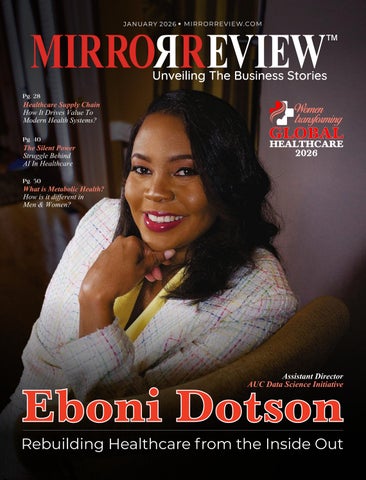
Assistant Director AUC Data Science Initiative
Eboni Dotson
Rebuilding Healthcare from the Inside Out
EDITOR’S
Where Vision Meets Healing: Women Redefining the Future of Healthcare
Dear Readers, Healthcare stands at a crossroads shaped less by machines and more by the people who lead it. Enduring change rarely begins with a single breakthrough; it begins with someone willing to ask harder questions about who is served, who is heard, and who is left behind. “Leadership Visionaries: Women Transforming Global Healthcare 2026” gathers leaders who understand this truth intimately. They are builders of trust, architects of access, and stewards of systems meant to hold people with dignity. Across classrooms, boardrooms, and community partnerships, their work proves that healthcare’s future depends as much on courage and conscience as on innovation. At the centre of this issue stands Eboni Dotson, Assistant Director of HBCU Engagement at the AUC Data Science Initiative. Her path through healthcare began not in policy rooms but in lived experience, as a patient, a caregiver, and a woman who has seen how quietly systems can fail those they claim to serve. That awareness reshaped her purpose, moving her from bedside compassion toward structural change. Today, she works at the meeting point of data, education, and equity, helping historically Black colleges and universities claim their place in shaping the data-driven future. Through her consultancy, Healthcare Strategic Consultants, she turns intention into operational reality, embedding fairness into governance rather than treating it as an afterthought. Guided by conviction over comfort, she leads with a simple belief: healthcare must work with people, not against them. Joining her in this issue are Alisa Marie Beyer, Chief Operating Officer of Dionysus Health; Cindy Grabowski, Founder of Mind Grove; Dr. Allyson Mayo, Founder of Behavioural Fitness; and Dr. Mitze Burnett, Founder and Chief Executive Officer of Burnett Therapeutic Services. Together, these leaders remind us that transforming healthcare is rarely a solitary act. It is built through patience, partnership, and an unwavering commitment to the people systems too often overlook. Their stories differ in scope and setting, yet they share a common thread: leadership rooted in humility, sustained by resilience, and measured not by recognition but by lives changed. As this issue shows, the future of global healthcare is being shaped by women who lead with both clarity of purpose and depth of heart.
Sincerely,
SIMRAN KHAN Managing Editor
Publisher Archana Ghule Editor-in-Chief Vikram Suryawanshi Managing Editor Simran Khan Project Editor Shadab Mestri ™
Mirror Review Magazine is published by Pericles Ventures Pvt. Ltd. No part of this publication may be reproduced, distributed, or used in any form without prior written consent from the publisher. The editorial team has exercised utmost diligence to ensure the accuracy and integrity of all published content; however, the publisher assumes no liability for any errors or omissions. The publisher also bears no responsibility for the content of advertisements featured within the magazine.
Mirror Review Media & Tech
Project Managers Mayur Johari Nikhil Mahajan Visualizer Mark Davis Graphic Designer Pranjali Mahangade Head of Distribution and Production Aakash Mahajan
Office No. 430, 4th Floor, Gera’s Imperium Rise, Opp. Wipro Circle, Hinjewadi Phase 2, Pune, Maharashtra - 411057.
Head of Operations Robert Smith
+1 (850) 564-8517
Research Analysts James Adams
info@mirrorreview.com www.mirrorreview.com
Advertising Maria Smith
10. Eboni Dotson
32. Cindy Grabowski 44. Dr. Allyson Mayo 54. Dr. Mitze Burnett
28.
Healthcare Supply Chain How It Drives Value To Modern Health Systems?
40.
The Silent Power Struggle Behind AI In Healthcare
50.
What is Metabolic Health? How is it different in Men & Women?
Content
22. Alisa Marie Beyer
Leadership Visionaries: Women Transforming Global Healthcare 2026 Eboni Dotson
Alisa Marie Beyer
Assistant Director AUC Data Science Initiative
Chief Operating Officer Dionysus Health
www.aucenter.edu
www.dionysushealth.com
Cindy Grabowski
Dr. Allyson Mayo
Founder Mind Grove
Founder Behavioral Fitness™
www.mindgrove.com
Linkedin - behavioralfitness
Dr. Mitze Burnett Founder & CEO Burnett Therapeutic Services www.btsinc.services
COVER STORY
Eboni Dotson Rebuilding Healthcare from the Inside Out
10 | JANUARY 2026
Assistant Director AUC Data Science Initiative
M I R R O R R E V I E W . C O M l 11
H
ealthcare systems do not fail loudly. Most of the time, they fail quietly. In delayed appointments. In confusing processes. In patients who feel unseen and unheard. Behind each of those moments sit decisions about policies, workflows, and leadership priorities. Those decisions shape outcomes long before a clinician ever enters the room. Eboni Dotson has spent her career paying attention to those quiet moments. She did not arrive in healthcare leadership chasing titles or distance from patients. Her path took shape through lived experience. She has been a patient. She has been a caregiver. And she has navigated healthcare systems as a Black woman who understands how easily people can fall through the cracks when systems are not built with care.
Early in her journey, Dr. Dotson believed, like many do, that the greatest impact in healthcare happened at the bedside. Over time, that belief began to shift. She started to see how leadership decisions ripple outward. “I saw how policies, workflows, and leadership decisions quietly but powerfully determined who received care, who was heard, and who was left waiting,” she says. What she witnessed was not always intentional, but it was consistent enough to demand attention. That awareness became a turning point. Dotson realized that compassion alone could not fix broken systems. Healthcare needed structure, accountability, and leaders willing to look closely at how things actually worked. She moved into healthcare operations and quality improvement with a clear purpose. “I moved into healthcare operations not because I wanted distance from patients, but because I wanted proximity to change,” she explains. Each role since then has sharpened her focus. Dotson works at the intersection of efficiency, equity, and trust, helping organizations build systems that serve people better and more fairly. For her, leadership is not about control. It is about responsibility. Healthcare, she believes, must earn the trust people place in it, and that work begins far beyond the exam room.
Her day-to-day work centers on expanding access to data science education and applied research for faculty and students across historically Black colleges and universities. Much of that work ties directly to healthcare and social impact, where data can influence everything from patient outcomes to public policy. Dr. Dotson approaches this responsibility with intention. She understands that access to data literacy is no longer optional. It determines who gets to ask questions, who gets funded, and whose solutions are taken seriously. What gives the role its weight is its long-term impact. Dr. Dotson is not simply supporting programs or checking milestones. She is helping institutions and individuals step into spaces they have long been excluded from. “I am helping institutions and individuals claim their rightful place in shaping the data-driven future,” she says. That work happens through faculty research support, student engagement, and partnerships that strengthen institutional capacity. At the center of her approach is a clear belief. Talent has never been the issue. Access has. Dr. Dotson works to make sure that brilliance is not limited by resources or opportunity. Her goal is to help HBCUs lead in innovation, not follow it, and to ensure that the next generation enters the data economy prepared to shape it with purpose. Turning Responsibility into Action Through Thoughtful Consulting Healthcare Strategic Consultants, LLC grew out of a pattern Dr. Dotson saw again and again. Leaders cared deeply about their organizations and the people they served, yet many were operating without the structure needed to create lasting change. The responsibility felt heavy. The support systems did not always match it. Dr. Dotson founded the firm to close that gap.
Building Pathways through Data, Education, and Access Dr. Dotson’s current work places her at a different, but deeply connected, point in the healthcare and equity conversation. As Assistant Director of HBCU Engagement at the AUC Data Science Initiative, she operates where education, innovation, and justice meet. The role allows her to think beyond a single organization and focus instead on systems that shape who gets to participate in the future of data-driven decision-making. 12 | JANUARY 2026
The consultancy focuses on healthcare operations, quality improvement, leadership development, and organizational transformation. Each area connects back to a central idea. Systems work best when they align with the values they claim to hold. Dr. Dotson partners with organizations to bring that alignment into focus, helping leaders move from intention to execution in practical ways.
COVER STORY
M I R R O R R E V I E W . C O M l 13
COVER STORY
“
Lead with courage, humility, and love for the people your work touches. That is how transformation happens. 14 | JANUARY 2026
Much of the work involves untangling complexity. She works alongside leadership teams to strengthen governance, clarify workflows, and improve how decisions are made. Equity is not treated as a separate initiative. It is embedded into operational strategy, where it can shape outcomes rather than sit on the sidelines. This approach allows organizations to improve performance without losing sight of the people affected by every decision. For Dr. Dotson, the work is not abstract. It is personal. She has seen what happens when systems fail and when accountability is unclear. Consulting gives her the ability to stand with leaders as they build organizations that function well and treat people with dignity. Her goal is not just high performance. It is to help create healthcare organizations that are humane, resilient, and worthy of trust. Bridging Data Innovation with Equitable Care Data can reveal uncomfortable truths, or it can hide them. At the AUC Data Science Initiative, Dr. Dotson approaches data science as both a technical discipline and a moral one. Students and faculty are taught that numbers carry stories, and those stories shape real lives. The initiative supports faculty-led research and places students inside real-world challenges tied to health disparities, access, and community well-being. This grounding keeps innovation connected to context, not abstraction. When data is applied with care, it becomes a tool for accountability rather than convenience. Dr. Dotson believes responsible data use can move healthcare closer to fairness, ensuring efficiency never comes at the expense of humanity. For communities long overlooked by traditional systems. Building Partnerships That Last Dr. Dotson treats partnerships as relationships rather than transactions. She looks for collaborators who understand that equity work is not occasional or convenient, but ongoing. Trust and shared values guide how those relationships take shape. Her strategy focuses on building pathways that give students hands-on experience while supporting faculty scholarship and institutional growth. Just as important, she works to ensure programs can survive beyond a single grant or funding cycle.
M I R R O R R E V I E W . C O M l 15
Sustainability, for Dr. Dotson, means institutions are equipped to carry the work forward on their own terms. “True partnership means building something together that lasts,” she says, “and being willing to stay when the work gets hard.” This approach helps create opportunities that grow stronger over time, not smaller, for everyone involved. Measuring Equity with Accountability and Care Dr. Dotson believes equity must move from intention to action. She builds clarity around outcomes, insists on continuous evaluation, and demands accountability at every stage. Her work begins with difficult questions. Who benefits? Who remains unseen? What must change to close the gap? Measurement alone is not enough. She grounds programs in lived experience, ensuring communities help shape the solutions meant to serve them. She views people as contributors, not recipients. Impact becomes meaningful when data and dignity move together. Progress is tracked carefully, but never at the cost of humanity. By holding systems accountable while honoring real stories, Dr. Dotson ensures equity work delivers results that last. This discipline keeps her work focused, transparent, and grounded in responsibility over time consistently. 16 | JANUARY 2026
Collective Approach to Leadership and Restoration Dr. Dotson describes her partners as a collective of courageous leaders committed to cultural restoration and transformational leadership. They include academic administrators, faculty members, philanthropic partners, and industry collaborators who share a belief in restoring dignity, opportunity, and agency to communities long excluded from innovation spaces. These relationships are built on trust and shared responsibility, not visibility or credit. What connects this group is a clear understanding of leadership as stewardship. Each partner recognizes their role extends beyond immediate results. Together, they focus on building systems that reflect their values and endure over time. The work honors the past while preparing future generations to lead with purpose, care, and accountability. This commitment grounds collaboration in intention, patience, and shared long-term vision.
“
Leadership is a calling before it is a title. Consulting as a Complement to Purpose Consulting places Dr. Dotson inside moments that most leaders rarely discuss openly. As Founder and CEO of Healthcare Strategic Consultants, LLC, she often meets organizations during tension, transition, or transformation. These moments demand honesty, structure, and guidance. The work complements her academic role by grounding theory in daily operations and turning vision into execution. Lessons from the classroom inform the field, and real-world challenges sharpen her thinking as an educator. Dr. Dotson sees both roles as expressions of the same calling. Each allows her to help leaders build systems that serve people rather than exhaust them. Whether advising executives or shaping academic pathways, she focuses on practical change that lasts. The goal remains consistent. Healthcare systems should work with people, not against them. Leadership Tested by Conviction Leadership is tested when advocating change that unsettles comfort yet serves conscience. In those moments, Dr. Dotson relied on courage, preparation, and prayer to stay grounded. She learned that leadership rarely offers immediate validation. Often, it demands steadiness long before agreement follows.
Standing firm carried a cost, but it clarified her values. These experiences strengthened her resilience and sharpened her sense of responsibility. Integrity became nonnegotiable, even when progress felt slow or lonely. Those moments reaffirmed her commitment to lead with integrity, regardless of outcome or recognition. They shaped a leader willing to choose principle over comfort, and patience over applause, while trusting that meaningful change often arrives after persistence, faith, and resolve are fully tested over time and pressure consistently. Measuring Impact through People, Not Plaques Dr. Dotson measures impact differently than most. For her, the most meaningful achievements are not awards or titles, but people. She points to students who now see themselves as innovators and problem-solvers. She points to faculty who feel supported enough to pursue bold research questions. She points to institutions that are stronger, more connected, and better equipped to serve their communities. These outcomes reflect progress that cannot always be quantified, yet they signal lasting change. Each success reinforces why the work matters. It confirms that access, support, and belief can shift trajectories. For Dr. Dotson, those moments offer the clearest evidence that her efforts are creating real, human impact where it counts most. Sustaining Balance through Alignment Balance, for Dr. Dotson, is less about separation and more about alignment. She is intentional about how she spends her time and energy, knowing effectiveness depends on restoration. She protects space for reflection, for relationships, and for moments that allow her to slow down. Those practices are not indulgences. They are part of how she leads well. M I R R O R R E V I E W . C O M l 17
COVER STORY
“
The most meaningful achievements are not awards, but people. 18 | JANUARY 2026
Creating room to think clearly helps her make better decisions and remain present in demanding environments. By honoring what restores her, Dr. Dotson sustains the clarity and steadiness her work requires. Balance becomes a practice of alignment between values, responsibilities, and care for self, allowing her to remain grounded while carrying complex work forward with purpose and consistency over time and across evolving professional seasons. Scaling Impact without Losing Purpose Dr. Dotson’s next chapter centers on scale without drift. She is focused on expanding ecosystems that prepare underrepresented leaders to shape healthcare, policy, and innovation on a global stage. The work is not about growth for visibility, but reach with responsibility. She wants systems that open doors, share power, and endure. As initiatives grow, purpose remains the anchor.
A Guiding Philosophy for Leadership For Dr. Dotson, leadership is a calling, not a title. She believes that true transformation begins when leaders approach their work with courage, humility, and genuine care for the people they serve. Success is not measured by recognition, but by the positive, lasting change created in communities, organizations, and individuals. She encourages leaders to prioritize integrity over convenience and to center the humanity of those affected by their decisions. “Lead with courage, humility, and love for the people your work touches,” she says. For Dr. Dotson, this principle guides every initiative, partnership, and strategy, reminding us that meaningful leadership transforms systems because it honors people first.
She plans to deepen partnerships, strengthen pipelines, and invest in leaders who will carry this work forward in their own contexts. The aim is long-term change built with care. Wherever the work expands next, it will remain grounded in service, stewardship, and a clear commitment to equity that crosses borders and disciplines, while honoring community voice and shared accountability.
M I R R O R R E V I E W . C O M l 19
Alisa MARIE BEYER The Professional Wingwoman Rewriting the Story of Motherhood
A
lisa Marie Beyer has a way of holding two seemingly opposite worlds in perfect, productive tension. One moment, she’s talking about the intricate beauty of a birth plan, the sacred space of a delivery room, the quiet desperation of a new mother struggling in silence. The next, she’s dissecting commercial strategy, articulating the nuances of a go-to-market path, and extolling the virtues of a really great spreadsheet. She is a birth doula and a COO, a childbirth educator and a biotech executive, an amateur cattle rancher and a woman who has navigated multiple successful company exits. In many people, these identities would clash, creating a discordant personality. In Alisa, they harmonize. She is the living embodiment of the bridge she is so determined to build—a bridge between the soft, intuitive world of birth and the hard, data-driven world of business. As the Chief Operating Officer of Dionysus Health, a pioneering San Diego-based molecular diagnostics company, she is channeling a lifetime of experience into bringing a single, transformative product to market: myLuma™, the first-ever prenatal test that can predict a woman’s risk for postpartum depression and anxiety. 22 | JANUARY 2026
To sit with Alisa is to understand her self-proclaimed title of “Professional Wingwoman.” She is fiercely focused, not on herself, but on the person next to her, whether that’s talking to a group of OBs about a life-changing new diagnostic or a first-time mother terrified of the unknown. Her energy is not a slow burn; it’s a bright, steady flame. It’s the kind of energy that gets things done, that builds companies and confidence in equal measure. For over two decades, she has been obsessed with birth and business, and now, in what she calls a later season of her own motherhood, those two passions have finally, powerfully, converged. This isn’t just a job. For Alisa, a “3X Mama” who lives between San Diego to Tahoe, this is a mission to solve the right problem, not just the obvious one. And for millions of mothers, that could make all the difference.
“
Solve the right problem not just the obvious one.
Chief Operating Officer Dionysus Health & Founder, Let’s Talk Birthy M I R R O R R E V I E W . C O M l 23
That personal realization became Alisa’s professional turning point. It propelled her to dive deeper, to formally train and become a certified childbirth educator, a birth and postpartum doula, and a perinatal behavioral health coach. She has worked with hundreds of women, one-on-one in private practice, and as part of a bustling hospital team in San Diego, supporting the unique challenges faced by families in the U.S. Navy. This frontline experience isn’t just a footnote on her corporate resume; it is the very lens through which she views her work in biotech. It gives her a granular, human-centered understanding of what mothers truly need, an understanding that data alone can never provide. The Crisis We Don’t See
The 25-Year Pivot Every story has a beginning, a single moment that lights a fuse. For a 16-year-old Alisa in Williamsport, Pennsylvania, that moment came while volunteering with WIC, the Women, Infants, and Children program. Surrounded by the raw, beautiful, and often challenging realities of motherhood, a fire was lit. She would become an OB. But life, as it often does, had other plans. As the first in her family to attend college, the long, arduous path to becoming a physician didn’t align with her circumstances. So, she pivoted. If she couldn’t be in the delivery room as a doctor, she would find another way to make an impact. She turned to business. “Fast forward 25 hard-earned years,” Alisa says, a note of reflection in her voice, “and I’m fortunate to say that how I earn a living, how I serve others, and what I consider my life’s mission all finally align—motherhood.” That alignment is now expressed through two distinct but complementary roles. As the COO of Dionysus Health, she is at the forefront of healthcare innovation. As the founder of Let’s Talk Birthy, a heart-centered organization educating first-time moms on pregnancy, childbirth, and postpartum to support safer, healthier hospital births. She is on the front lines of maternal support. It’s a dual existence she has been preparing for her entire life. Her career has always been about building—building companies, building strategies. But it was becoming a mother herself, three times over, that provided the most crucial insight. She experienced firsthand the profound chasm between the childbirth education she received and the stark reality of postpartum mental health support—or rather, the lack of it. 24 | JANUARY 2026
The statistics surrounding postpartum depression (PPD) are staggering, almost too large to comprehend. It is the single most common complication of childbirth. More common than gestational diabetes, more common than preeclampsia. It contributes to nearly one in four maternal deaths in the United States, making it a leading driver of maternal mortality. The economic toll is a jaw-dropping $14.2 billion annually. Yet, the response from the healthcare system has been, as Alisa puts it, “shockingly inadequate.” “Fifty percent of women with PPD receive no treatment,” she states. “They fall through the cracks—undiagnosed, untreated, and alone.” This is the problem Dionysus Health was created to solve. While there is a simple, standard test for gestational diabetes with a 96% screening rate, the screening for PPD, hovers around a mere 40%. Diagnosis relies on a mother, often in the throes of crisis, to self-report her symptoms on a questionnaire, long after the baby has arrived. Dionysus Health’s mission is to shatter that paradigm. Their goal is to make a predictive, objective, and early diagnostic test the undisputed standard of care.
“
At the helm of this mission is an all-star team of female scientists and doctors, a fact that clearly energizes Alisa. The company was founded by Dr. Andrea Cubitt, a world-class scientist whose resume includes contributing to Nobel Prize-winning research under the legendary Dr. Roger Tsien and holding leadership roles at multiple successful biotech firms. Joining her as a co-founder is Dr. Vivienne Ming, a theoretical neuroscientist and AI pioneer whom Inc. magazine named one of the “10 Women to Watch in Tech.” Rounding out the leadership team is Chief Medical Officer Dr. Jennifer Payne, a nationally recognized psychiatrist who founded the Women’s Mood Disorders Center at Johns Hopkins and now directs the Reproductive Psychiatry Research Program at the University of Virginia, where she oversees Dionysus’s clinical studies.
Never underestimate the power of a great spreadsheet and a strong cup of coffee.
For Alisa, joining this powerhouse team was more than a career move; it was a calling. “I joined Dionysus because it represents a rare and meaningful alignment of personal mission and professional purpose,” she says. “As a mother who silently endured postpartum depression and anxiety, I know how isolating that experience can be. I also know it doesn’t have to be this way. At Dionysus, I get to help rewrite that story—for millions of women.” The Science of Seeing It Coming For decades, the standard medical advice for a pregnant woman worried about her mental ™ health has been to “wait and see.” myLuma is the scientific rebuttal to that passive, dangerous approach. It is a prenatal blood test that, as early as 28 weeks into pregnancy, can predict a woman’s risk of developing postpartum depression. It’s a fundamental shift from reactive crisis management to proactive, personalized care. “This is critical,” Alisa explains, “since research suggests 50% of PPD cases begin during the third trimester but are dismissed as ‘normal’ pregnancy symptoms.” myLuma™ gives doctors and mothers a tool to validate those early feelings and connect the mother with support before her baby arrives.
M I R R O R R E V I E W . C O M l 25
The science at its heart is epigenetics; the study of how external factors like stress and hormonal shifts can change the way our genes work. Our DNA is not just a fixed blueprint; it’s more like a dynamic script, and experiences can add notes in the margins, telling certain genes to speak up or stay quiet. Dionysus’s scientists, leveraging a decade of preliminary data, have identified specific epigenetic biomarkers, molecular fingerprints, in a mother’s blood that act as a signal for elevated PPD risk. Validated in over 600 patients with a predictive accuracy of up to 85%, myLuma™ offers an objective insight that has never before been possible. It’s a game-changer. It replaces a subjective, delayed questionnaire with a clear, consistent, and early scientific indicator. “For decades, women have been told to ‘wait and see,’” Alisa repeats with emphasis. “With myLuma™, science is finally saying: we can see it coming—and we can act early. This isn’t just a test. It’s a new standard for maternal mental health.” From Breakthrough to Business Having a groundbreaking technology is one thing; bringing it to market is another challenge entirely. This is where Alisa, the builder of strategies and companies, shines. Dionysus Health is currently in that pivotal, delicate stage of transitioning from a validated scientific concept to a full-fledged commercial company. “It’s not an easy leap,” she admits, “but we’re gaining strong momentum.” That momentum is quantifiable. The company has secured an impressive $15 million in non-dilutive funding, which includes a prestigious NIH award and a substantial $10 million grant from the Department of Defense. This funding is crucial for supporting the rigorous clinical validation required for their FDA approval pathway. They are currently running two major clinical trials in partnership with the esteemed UVA and INOVA health systems in Virginia, with a target of achieving FDA clearance by 2027. 26 | JANUARY 2026
On the commercial front, they recently announced a strategic partnership with Mammha, a leader in perinatal behavioral health. This collaboration will launch commercial pilots of myLuma™ with OB providers in key states like Florida, California, and Texas, getting the test into the hands of doctors and patients and gathering real-world data. It’s a clear, methodical march toward their goal. “We’re building something truly transformative,” Alisa says, her confidence palpable. “And we’re just getting started.” The Empty Nest and a New Beginning To understand what drives the COO, you have to understand what drives the woman. Alisa speaks candidly about two moments in her motherhood journey that stopped her in her tracks. The first was leaving the hospital with her firstborn, a moment of pure, terrifying, magical beginning. The second was watching her youngest head off to college. “One was the beginning. The other felt like an ending,” she confesses. “And if I’m honest—I hated that ending. I cried more during my first year as an empty nester than all the other years combined.” Feeling lost, she didn’t retreat. She stepped forward, back into the world that had first called to her as a teenager. She stepped into birthwork. She began helping new moms bring their babies into the world, and then, crucially, supporting them in the quiet, often difficult weeks and months that followed. It was in helping mothers who were struggling, just as she once had, that she found a renewed sense of purpose. “It became one of the greatest gifts of my life,” Alisa reflects, “reminding new mothers they aren’t alone.” This experience led Alisa to found Let’s Talk Birthy. After years of one-on-one work, she saw a persistent gap. First-time moms were drowning in information but starving for wisdom. They felt overwhelmed, underprepared, and disconnected from their own power in the birthing process. Let’s Talk Birthy was her answer, a heart-centered organization educating first-time moms on pregnancy, childbirth, and postpartum to support safer, healthier hospital births.
“When a mom walks into birth without support, she often abdicates control to circumstance,” Alisa explains. “But when she feels confident and supported, she’s far more likely to have the kind of birth she wants—and a stronger start to motherhood.” Our mission is simple: give first-time moms the education and support they need—because when they feel better, they birth better, and better births create stronger beginnings for both mother and baby. It is this venture, this direct line to the lived experience of mothers, that keeps her work at Dionysus so sharply focused. It ensures that as they scale technology, they never lose sight of the human at the center of it all. The Right Problem When you ask Alisa for a guiding mantra, she gives you a strategic directive: “Solve the right problem—not just the obvious one.” It’s a philosophy that defines her entire approach In healthcare, it’s easy to get stuck treating symptoms. Dionysus Health’s work, she says, is about going deeper, about fundamentally reimagining the standard of care. She also offers a more grounded piece of advice, a glimpse into the practical, get-it-done side of her personality: “Also? Never underestimate the power of a great spreadsheet and a strong cup of coffee.” And there it is again—the two worlds held in perfect balance. Alisa is the doula who understands the soul and the COO who understands the spreadsheet. She is the mother who has felt the depths of postpartum anxiety, and the executive capable of helping build a multi-million dollar company. Alisa Marie Beyer is not just building a company. She is building a new paradigm, one where no mother has to “wait and see,” where science and compassion walk hand in hand, and where every woman entering motherhood has a wingwoman to see her through.
M I R R O R R E V I E W . C O M l 27
28 | JANUARY 2026
HEALTHCARE SUPPLY CHAIN
How It Drives Value To Modern Health Systems?
D
o you remember when hospital basements were just dusty rooms for boxes? For decades, the healthcare supply chain functioned as a quiet background operation. It focused mainly on basic purchasing and keeping shelves stocked. Today, that old-school model is completely dead. Hospitals now face razor-thin margins and constant global disruptions, changing the game of supply chains. Modern healthcare delivery now relies on a complex, uninterrupted network of global suppliers. This healthcare supply chain acts as the vital backbone of the industry. It ensures the availability of life-saving medicines and surgical equipment in critical times and critical places. The healthcare supply chain market is expected to grow to USD 3.95 billion in 2026, even though global disruptions and pharmaceutical price hikes are becoming the new normal. The supply chain efficiency of the healthcare sector now dictates patient outcomes. A breakdown in this healthcare distribution network delays critical care and compromises safety. Therefore, this article explores why redefining the global healthcare supply chain ecosystem is no longer optional but is essential for any health system seeking resilience and quality care delivery. The Concept Of Healthcare Supply Chain The healthcare supply chain represents a vast network of entities and processes. It involves the production and distribution of vital medical products and services. This system is unique compared to traditional supply chains. It must account for particularly stringent regulatory and compliance standards. It covers everything from raw material procurement to final delivery to patients.
M I R R O R R E V I E W . C O M l 29
Unlike standard retail, the healthcare network handles high-stakes items like: ● Life-saving pharmaceuticals and biologics. ● High-value surgical implants. ● Perishable blood and temperature-sensitive equipment. ● Basic consumables like PPE and office supplies. This system is unique because it must follow strict regulatory standards. It ensures products are available precisely when patients need them. Key Components of the Healthcare Supply Chain Ecosystem A successful healthcare supply chain relies on several core players working in harmony.
4. Supporting Stakeholders Group Purchasing Organizations (GPOs) aggregate volume to negotiate better prices. Regulators and logistics providers also ensure that every item meets safety standards. Core Activities In Healthcare Supply Chain Management Managing a supply chain of healthcare sector requires precise coordination of several processes: ● Demand Planning: Predicting exactly how much medication or equipment a facility needs to avoid stockouts. ● Strategic Procurement: Selecting vendors and negotiating contracts to ensure continuity. ● Inventory Management: Tracking stock levels in real-time to prevent spoilage of perishable items.
1. Manufacturers Manufacturers are the first link in the chain. They produce the medicines and medical devices we depend on daily. They also manage quality control and initial distribution to wholesalers. Currently, North America holds the largest share of 45-48%, due to the presence of major players. 2. Distributors and Wholesalers Distributors play the vital role of bridge between production and point-of-care delivery. They buy products in bulk and maintain large stocks in strategic locations. This ensures that hospitals can get supplies quickly without waiting for a factory production run.The Asia-Pacific region is experiencing the fastest growth (12.42% CAGR) due to increased pharmaceutical manufacturing in China and India. 3. Healthcare Providers Hospitals and clinics are the central consumption points. They must accurately forecast demand to avoid dangerous stockouts. Their utilization patterns directly drive the entire healthcare product distribution network. In 2025, healthcare providers commanded the largest market share at 66.4%, highlighting their importance in the supply network. 30 | JANUARY 2026
● Last-Mile Delivery: Ensuring timely delivery to the specific department on time. ● Data Analytics: Using monthly dashboards and spend analytics to identify cost-saving opportunities and monitor performance. Major Challenges Of Supply Chain Optimization In Healthcare Modern systems face significant hurdles that can put patient care at risk. 1. Global Supply Disruptions The wars going on around the world are exposing deep vulnerabilities in global networks. Geopolitical issues and natural disasters often cause sudden havoc for providers as well as consumers. Global healthcare supply chains experience over 18,000 logistics disruptions annually, resulting in more than $11 billion in losses. 2. Drug Shortages and Costs Medication shortages are a persistent and growing challenge. Manufacturing quality issues and raw material delays are often the main culprits. These shortages force hospitals to buy expensive alternatives. As per the 2025 analysis, 67% of providers spend more than 10 hours per week mitigating supply shortages.
3. Fragmented Data Systems
The Future of the Healthcare Supply Chain
Many health systems struggle with siloed information. When data is trapped in different systems, real-time reporting becomes impossible. In 2023, 43% of healthcare organizations experienced cyberattacks specifically targeting their supply chain systems. This makes it very hard to see where money is being wasted.
Technology is the next frontier for the healthcare supply chain. Many leaders now view Artificial Intelligence (AI) as a tool to automate demand forecasting and inventory control. In fact, leading systems are focusing on AI-driven insights to manage 28% of, on average, unmanaged spend, improving resilience, and enhancing ESG (Environmental, Social, and Governance) metrics.
4. Clinical Preference Variability
● AI and Predictive Analytics:
Physician habits often drive product selection. When doctors use different brands for the same procedure, it creates unnecessary cost variation. Managing this requires collaborative governance rather than strict mandates.
Artificial Intelligence can now analyze spend tiers in seconds. Predictive tools will soon help teams anticipate shortages before they happen. A medical institution in Utah has launched a programme that provides patients with chronic conditions with renewed AI-written prescriptions.
Supply Chain Management In Modern Health Systems
● Automation and IoT:
Modern health systems must treat the healthcare supply chain as a strategic priority. It ensures the right products are available at the right time and at the right cost.
Internet of Things (IoT) devices can automatically track supply locations. This reduces the time clinical staff spend on manual inventory counts. Right now, nearly 70% of U.S. hospitals have reduced their core supply operations to cloud platforms to achieve real-time transparency.
It provides:
Final Note
● Improved Patient Safety: Ensuring the needed products are ready for surgery whcih prevents case cancellations.
The healthcare supply chain has evolved from a background function into a strategic value driver. It is the backbone of financial stability and clinical excellence. To succeed, modern health systems must embrace data transparency and collaborative governance.
● Financial Resilience: Streamlining procurement helps hospitals survive on thin margins. ● Zero-Waste Culture: Leading systems now focus on eliminating redundant testing and unnecessary openings.
Future systems will likely utilize:
By treating the supply chain management of healthcare as a core priority, organizations can ensure they provide the best care possible.
Sanskruti Jadhav
● Operational Agility: Resilient chains can pivot quickly during unexpected market shifts. Streamlining supply chain services can save an average hospital $11 million annually, enough to pay the salaries of 160 registered nurses or 42 primary care physicians. By moving supply chain performance to the executive level, organizations can identify cost-saving initiatives that support broader value-based care models.
M I R R O R R E V I E W . C O M l 31
Cindy Grabowski How One Woman’s Unconventional Career is Reshaping MedTech Education
‘‘
Never underestimate curiosity over credentials.
‘‘
32 | JANUARY 2026
Founder Mind Grove
M I R R O R R E V I E W . C O M l 33
T
he year is 1995. A 26-year-old secretary named Cindy Grabowski is called into the Chief Medical Officer’s office. She has a high school diploma, two young kids at home, and a reputation for being exceptionally good at her job. The CMO makes her an offer that seems to come from another universe: He wanted her to apply for an entry level role in his Clinical Research Group. Grabowski’s reaction is immediate and instinctual. She lists every reason he shouldn’t hire her, a rapid-fire recitation of her own perceived inadequacies. The CMO listens patiently and then says a sentence that will not only change her life but will become the foundational principle of the company she will one day build. “Cindy,” he said, “you push paperwork like no one, people like working with you, and people learn their job on the job. We can teach you what you need to know.” That single moment of seeing potential beyond pedigree launched a remarkable 30-year journey through the heart of the medical device industry. It is a story that saw a young secretary rise through the ranks to become a Vice President and Director working at nine different MedTech companies, including seven start-ups, manage multimillion-dollar budgets, launch clinical studies in ten countries, and help drive over $3.2 billion in acquisitions. More importantly, it is the story of how that on-the-job education, that practical, comprehensive knowledge learned in the trenches, ignited a passion to build a new entry point into the industry , one that values interest over credentials and competence over classrooms. The 30-Year Intrapreneur Cindy Grabowski’s career is a powerful testament to the idea of the “intrapreneur,” an employee who operates with the restless, problem-solving, and holistic mindset of an entrepreneur from within an organization. For three decades, she didn’t just stay in her lane; she made it her business to understand the entire highway. “I was always curious about what everyone else did, how our work interconnected,” she explains. “That’s how you survive in startups.” 34 | JANUARY 2026
This relentless inquisitiveness was Cindy’s real education. While her resume doesn’t have the traditional academic credentials, it has something far rarer-a profound, visceral understanding of how MedTech companies actually work. She didn’t just learn the rules and regulations; she learned the real work that moves programs forward. It’s a distinction she is passionate about. “Most education in this industry is based on theory,” Cindy says. “But what medtech professionals need to excel isn’t more compliance training. It’s practical, skill-based learning that prepares them to contribute in the real world.”
That overwhelming validation shaped the structure of Mind Grove, which she founded in 2024. It would not be a company built on theory, but on lived experience. She assembled a powerhouse team of 37 Founding Consultants, a brain trust that includes 28 medtech veterans and 9 training and instructional design specialists. Across the full team of 28 subject matter experts (SME), Mind Grove brings more than 350 years of combined expertise. Within that, the Career Pathway Leader SMEs alone contribute over 200 years of direct, industry-tested experience.
This conviction simmered for years, but the catalyst for action came in August 2023. “I realized my colleagues and I would eventually retire, taking decades of interdepartmental knowledge with us,” Cindy recalls. She saw two critical gaps. First, despite offering strong wages and meaningful work, medtech was an industry people mostly “fell into” by chance, with no clear path for talented individuals from non-traditional backgrounds. Second, she saw that companies were chronically falling short on developing their own employees, often not knowing how to help them get to the next level, leading to poor retention. The solution was clear: she needed to build a platform that could codify the very on-the-job learning that had made her own career possible. She needed to build Mind Grove.
“Our team didn’t just study medtech. We lived it,” Cindy says. “When we design curriculum, we’re drawing from battle-tested experience. We know which skills actually matter because we’ve seen careers succeed and stall.” This group of SMEs contributes 5-10 hours per week, pouring their hard-earned knowledge into the platform. Training and design specialists then use AI tools to transform that knowledge into engaging scripts, accelerating the development process by a factor of ten. Every script then returns to the SMEs for a rigorous accuracy review.
Capturing Lightning in a Bottle When Cindy began to share her vision for a new kind of practical, role-specific training platform, she reached out to 32 of her most trusted and experienced colleagues. The response was immediate and universal. “Every conversation ended the same way,” she says. “'Where was this when we were coming up?'” The concept resonated with everyone, from first-year professionals to seasoned CEOs.
The result is a scalable and efficient model that delivers comprehensive and practical training. This model was directly influenced by feedback from medtech professionals that Cindy surveyed prior to founding Mind Grove. The responses from CEOs, individual contributors, and even venture capital executives were unanimous-skills based training like this simply didn’t exist, and they urged her to build it. The Highway, Not the Lanes The core of Mind Grove’s curriculum is not just teaching the specifics of a single role, but fostering the collaborative, integrated mindset of an intrapreneur.
M I R R O R R E V I E W . C O M l 35
36 | JANUARY 2026
“Cross-functional integration isn’t an add-on to our curriculum, it’s the foundation,” Cindy explains. “We’re not teaching people to stay in their lanes. We’re teaching them to see the entire highway.” This approach is exemplified by their Introduction to MedTech Suite, set to launch in October 2025. The eight-module program will deliver a comprehensive foundation in the industry’s basics, FDA classifications, device categories, and the development lifecycle. But it will also, crucially, teach learners about each of the functions involved in bringing a product to market and what the professionals in those departments actually do. The final module tests learners’ understanding through interactive scenarios that require them to identify which professionals need to collaborate at each stage of the development process. The programs are designed for both new entrants just learning the industry and early and mid-career talent and teams who want to upskill with purpose. The key areas covered include Quality Assurance, Regulatory Affairs, Clinical Affairs, Data Management, Reimbursement, and Marketing.
The Chief Pathfinder’s Playbook Cindy’s title, Founder and Chief Pathfinder, perfectly encapsulates her role. “I’m navigating uncharted territory while wearing ten different hats daily,” she says. “You’ll find me in script development, testing prototypes, pitching to companies and universities, and fundraising.” But her approach to building the company is as unconventional and strategic as her career path. From the outset, she made a critical decision: she is limiting equity investment in Mind Grove to a maximum of 15%.“By keeping majority control, I execute our vision without compromise,” Cindy explains. This isn’t about ego - it’s about protecting the mission. It ensures that the company can grow without diluting its core values and, importantly, that she can appropriately compensate the 37 Founding Consultants whose expertise is the very foundation of the business. Her proudest milestone so far has been assembling that team. “Convincing 28 seasoned veterans to contribute decades of hard-earned expertise to an unproven startup feels like capturing lightning in a bottle,” Cindy says.
M I R R O R R E V I E W . C O M l 37
The passion and dedication of her team, VPs spending evenings reviewing scripts and veterans dedicating weekends to perfecting modules, is proof to her that this is not just a consulting gig, it’s a movement. The Soapbox This movement is fueled by a sincere and righteous frustration that has been a constant throughout Cindy’s career. “The biggest challenge I’ve faced is the arbitrary bachelor's degree requirement that still gates access to medtech opportunities that can be performed without a four-year degree!” Her passion is evident when she speaks. “Here I am with 30 years of expertise and proven success, yet leaders still use degrees as gating factors. Don’t get me started, I’ll get up on my soapbox because this perfectly illustrates why Mind Grove exists.” For Cindy, this isn’t just a professional annoyance. It’s a systemic flaw that harms the entire industry. “We’re filtering out incredible talent based on credentials rather than competencies, robbing the industry of potential intrapreneurs,” she argues. Her own career is proof that passion, practical skills, and real-world experience can be just as valuable as formal education in opening doors. Cindy is quick to point out that she is not against degrees- they are essential for many roles, from engineers to physicians. What she challenges is the use of a bachelor’s degree as the automatic gatekeeper for every entry-level position in medtech. Too often, companies dismiss candidates without a four-year degree while also demanding “experience,” a Catch-22 that keeps talent out. Mind Grove is her answer:A platform designed to give candidates an alternative pathway through skills-based training, enabling them to enter the industry, earn a solid wage, and, if their role requires it, pursue higher education with the support of employer tuition programs rather than crippling personal debt. 38 | JANUARY 2026
The Future is Fluent and Focused Cindy sees the future of professional development in medtech shifting dramatically. She notes that while it consistently ranks as a top concern for leadership, most companies still use outdated, classroom-style training models. “The biggest shift is toward microlearning for adult learners, exactly Mind Grove’s approach,” she predicts. “Adults need bite-sized, immediately applicable knowledge they can consume during evenings and breaks, not week-long seminars or semester courses.” Her vision for Mind Grove is already expanding to meet this future on a global scale. The company is collaborating with Ethovox for ethical AI voiceover services, a partnership that will allow them to instantly translate their training content into 30 different languages. “The medical device industry is inherently global,” Cindy notes, “yet most professional development remains trapped in English-only formats.” She is also exploring partnerships with prominent academic institutions to embed Mind Grove’s practical, competency-based curriculum into their programs, getting learners medtech-ready from day one. Since starting Mind Grove, Cindy says her work has become her hobby, that it hasn’t felt like work for a single day. It is the perfect alignment of her life’s experience with a mission that is very personal. Her final message to the industry is a direct challenge to the status quo and an echo of the CMO who gave her a chance three decades ago. “Never underestimate curiosity over credentials,” she advises. “The future belongs to organizations brave enough to see potential beyond pedigree and develop the collaborative mindset that transforms specialists into intrapreneurs shaping medical innovation.” Visit us: https://mindgrove.com
M I R R O R R E V I E W . C O M l 39
40 | JANUARY 2026
AI in Healthcare The Silent Power Struggle behind
Who Really Wins When Everyone's Building Everything? The Battlefield Isn’t Where You Think It Is If you think the AI healthcare revolution is about innovation, think again. It’s about control. Of data. Of workflows. Of clinical time. Of entire healthcare ecosystems. Every healthtech giant, every EMR vendor, every VC-backed AI startup—everyone’s rushing to slap a layer of AI on top of what already exists. But underneath the sleek demos and polished pitches, a quiet war is raging. Not over who has the best algorithm, but over who owns the decision-making layer in healthcare. Let me explain. There Is No AI “Sector” Anymore. There’s Just… Everything A few years ago, mapping out healthtech felt manageable. You had your boxes—digital front doors, remote monitoring, care navigation, analytics platforms. You could label them, categorize them, maybe even predict how they’d integrate. Not anymore. M I R R O R R E V I E W . C O M l 41
Generative AI didn’t just disrupt the map. It torched it. Today, the lines between vendor, platform, user, and data pipe have blurred into one chaotic mess. Why? Because the core engines—OpenAI’s GPT, Google’s Gemini, Meta’s Llama, Anthropic’s Claude—aren’t healthtech tools. They’re everything tools. They write, speak, summarize, reason, code, and diagnose. And they do it in any language, across any medium.
That “cute little assistant” in the room? It’s training itself to replace half your documentation pipeline. And yes, it’s very likely that Epic (through Microsoft) and Meditech (through Google) are building proprietary loops around that data. Think ambient scribing is a feature? Wrong. It’s the new command line.
So, when a system this powerful enters healthcare—an industry already straining under the weight of compliance, legacy tech, and labor shortages—it doesn’t integrate.
Everyone’s a Platform Now. Even Hospitals.
It swallows.
Stanford isn’t waiting for vendors. They built an internal AI system (based on Anthropic’s Claude) to explain lab results to patients. No licensing. No integration. Just use the raw LLM, build what they need, and deploy.
AI’s Trojan Horse: The EHR You want to know where AI is really embedding itself? The EHR. Epic and Meditech aren’t just experimenting with AI. They’re weaponizing it. Rewriting workflows. Automating documentation. Cleaning up clinician notes. Turning jargon into plain English. They’re not selling AI as a feature. They’re baking it into the core of clinical practice. And here’s the part that should concern every digital health founder reading this: when the record-of-truth becomes the workflow-of-truth, external innovation becomes feature creep.
Let’s talk about the new players.
This is the quiet revolution: Academic medical centers, hospital systems, even payers are acting like tech companies. They’re not just buyers anymore. They’re developers, builders, and shapers of their own AI pipelines. They’re forward-deploying engineering teams from AI vendors to customize LLMs to their workflows. Some are even training their own models. And they’re doing it because they don’t want another Epic. They don’t want to outsource the next generation of clinical logic. Let’s Get Brutally Honest About Startups
Let me make it plain: If your startup’s product can be reduced to a feature in Epic or Meditech, your runway is already shrinking.
Venture capital is still pumping money into “AI for health” startups like it’s 2021. Last month, Brellium raised $16 million to summarize clinical notes and analyze them for compliance.
The Next-Gen Scribes Are Already Listening You’ve heard of ambient scribing. You’ve maybe seen the flashy DAX demos from Nuance (Microsoft), or Abridge’s clinical audio tools. But you probably haven’t realized what it means strategically. The scribe isn’t just listening to the patient. It’s listening to the clinician. It’s collecting context. It’s mapping workflows. 42 | JANUARY 2026
Sounds great. But here’s the thing:That capability already exists. Everywhere.Epic has it. Meditech has it. DAX has it. Abridge has it. Commure has it. Dozens of hospitals are building their own versions in-house. Google could give it away tomorrow. So why fund another? Maybe the VCs know something we don’t. Or maybe it’s just inertia and hope.
But for the rest of us trying to build real value, here’s the takeaway: If your startup’s key differentiator is “we summarize notes better,” you’re not building a product. You’re offering a temporary feature.
Those are the real questions. Not “how accurate is your summarizer?”
What Actually Matters Now
There is no map.
If you’re still reading, you probably want to know where this is all headed. Here’s the short version.
There’s no quadrant that will help you. No landscape that makes sense of this. AI didn’t just change the tools—it changed the terrain.
1. The real war is for workflow control. Whoever owns the moment when a decision gets made—by a clinician, a patient, an administrator—wins. Not just for one feature, but for the entire system around it. 2. Everyone is becoming a platform. Don’t think in products. Think in ecosystems. If you’re not embedding into workflows deeply and invisibly, you’re replaceable. 3. Startups must stop chasing novelty and start chasing utility. There’s no more room for vanity features. Solve a real operational problem, or die quietly in the corner of someone else’s roadmap. 4. Voice is the next battleground. Not because it’s sexy. Because it’s fast, natural, and finally works well enough to scale. The next interface layer in healthcare isn’t going to be a dashboard—it’ll be a conversation. 5. Owning data isn’t enough. You must interpret it better and faster. Every major system has the same data. AI isn’t about access anymore. It’s about what you do with it in real-time, in the context of care.
Final Word: Stop Looking for the Map
If you’re building in healthcare AI today, you’re not navigating a sector. You’re navigating a power shift. And the winners won’t be the ones with the flashiest demos. They’ll be the ones who figure out how to quietly take control of the interface between human decisions and automated reasoning. And then never let go.
Sanskruti Jadhav
So, How Do You Buy and Sell AI in Healthcare Now? You don’t. Not in the traditional sense. You integrate it. You embed it. You wield it like a scalpel, not a hammer. You stop selling products and start selling transformation of effort. And if you’re a buyer—whether a hospital CIO, a payer innovation lead, or a digital health investor—you need to ask a very different set of questions: · What workflow does this AI control? · Can I do this with the platforms I already have? · What happens when Epic or Meditech rolls this out next quarter? · Does this reduce total cognitive burden on my clinicians? · Is this AI partner agile enough to evolve with my internal data teams? M I R R O R R E V I E W . C O M l 43
Founder | Behavioral Fitness™
I
n an age where mental health demands innovative solutions Dr. Allyson Mayo, Doctor of Behavioral Health and founder of Behavioral Fitness™, is leading a movement that reframes how we care for ourselves and others. With roots in both personal struggle and academic excellence, Dr. Mayo is pioneering a powerful shift toward accessible, proactive mental well-being through a concept known as Behavioral Fitness™—positioned within the modern healthcare framework of social prescribing.
“Too often, we treat symptoms but ignore root causes. Behavioral Fitness™ changes that,” she says. BF provides tools to decode maladaptive patterns and build resilience through practices drawn from behavioral health, lifestyle medicine, neuroscience, social science and transgenerational research. It helps people understand their behaviors without shame—and change them with compassion. Making Wellness Accessible, Practical—and Even Fun
Mental Health Needs a New Playbook The U.S. mental health system is overburdened and reactive. Deaths of despair are climbing. Addiction and loneliness are rampant. And yet millions still struggle to access care. “Our system is designed to wait for a crisis—or a diagnosis—to get support. Why are we waiting?” asks Dr. Mayo. Her solution is Behavioral Fitness™, a science-backed, skills-based approach to self-awareness, emotional literacy, and sustained behavioral change. Rather than centering on diagnoses, BF meets people where they are. “It’s about helping people gain insight, apply it to their lives, and then sustain those gains,” she explains. “It’s behavioral health for everyone—not just for the identified patients.” BF aligns with the emerging model of social prescribing, in which healthcare teams refer individuals to non-clinical interventions—like spending time outdoors in nature, peer support groups, individualized coaching, educational workshops, expressive art, or fitness programs—to improve overall well-being. This positions BF as a vital complement to traditional treatment methods like medication and talk therapy, giving healthcare teams a new, empowering option to offer their patients. A System Disrupted, A Vision Born The concept of Behavioral Fitness™ emerged after Dr. Mayo spent years in street medicine, clinical, and psychiatric settings, witnessing both the transformative potential of behavioral science—and the barriers that kept it from the general public. She saw patients waiting too long to access help and family members left out of the healing process. The loss of her niece to addiction deepened her commitment. 46 | JANUARY 2026
Launched in 2018, Behavioral Fitness™ is not therapy it’s a way of life. Accessible to individuals, families, schools, and organizations, BF is built for modern living. It is digitally enabled, non-clinical, and highly scalable. Among the key benefits: ● No Diagnosis Needed: BF is open to everyone, not just those with a clinical label. ● Whole-Family Support: Unlike traditional models that focus on the “identified patient”, BF includes the broader family system. ● Lifestyle-Based: Practices are grounded in behavioral science and inspired by models like Blue Zones, the latest longevity research, and Lifestyle Medicine. ● Engaging & Empowering: BF is designed to be educational, experiential, insightful and joyful, not clinical or stigmatizing. Dr. Mayo emphasizes that BF is ideal for integration into Employee Assistance Programs (EAPs), K–12 schools, health systems, and community organizations—anywhere human beings seek to live better and feel more connected. Built for the “On-Demand” World “We’re more digitally connected than ever,” says Dr. Mayo, “but emotionally disconnected from ourselves and each other.” BF bridges that divide. It supports the gig economy, offers flexible engagement, and encourages human connection through localized and virtual communities. The team behind BF brings expertise from behavioral science, emergency medicine, public health, and education—making it not just a wellness trend, but a sustainable model for systemic change.
“
Sometimes the most effective ‘prescription’ isn’t a pill or a procedure, but a walk in nature, a supportive peer group, or time spent in a creative or spiritual space. M I R R O R R E V I E W . C O M l 47
“
We’re all leaders. We’re all way-showers.
From Trauma to Transformation: A Personal and Professional Journey Dr. Mayo’s life story is foundational to her work. Raised in adversity, she overcame emotional homelessness and depression, later finding solace and inspiration in community and music culture. Her academic path was anything but linear: from independent high school study to fashion school, business, tech, addiction counseling, Master’s in Behavioral Science, and ultimately, a Doctorate in Behavioral Health. She has worked in street medicine, inpatient psychiatry, and public health. She teaches as an adjunct professor at University of San Francisco and was recognized as an Innovator in Addiction and Mental Health Treatment by Constellation Behavioral Health.
Her approach is honest and grounded. “You don’t have to be perfect to be a leader,” she shares. “Just human.”
A Framework for Living Better
BF encourages everyone—not just clinicians—to be part of the solution. “We’re all leaders. We’re all way-showers,” says Dr. Mayo. The model empowers helpers of all kinds, valuing lived experience and building community through shared growth.
“What if you could live life better than you ever imagined? It’s possible with Behavioral Fitness™.” This bold vision underpins one of the core principles of BF which Dr. Mayo calls “setting the conditions”—intentional daily practices that create an environment for well-being. “We can build lives we don’t need a vacation from,” she says. Her own practices include morning journaling, time with her cats, and family connection. 48 | JANUARY 2026
Behaviorally Fit Leadership: A New Standard
As the world grapples with burnout, isolation, and the limits of clinical care, Behavioral Fitness™ offers a new path forward—grounded in science, fueled by compassion, and open to all.
Building Wellness Like a Local: Behavioral Fitness and the Future of Community Care Now more than ever, medical teams are recognizing the urgent need to connect patients with community-based support. But who can they turn to as a trusted, best-in-class partner that’s easy to integrate into existing systems? Behavioral Fitness™ is answering that call. As a pioneering model for proactive mental, emotional, and behavioral well-being, Behavioral Fitness™ offers a curated, science-backed approach to social prescribing—making it easier than ever for healthcare teams to refer patients to reliable, non-clinical support that truly meets them where they are. When people speak of holistic health, they’re acknowledging a simple truth: health is more than the absence of disease. It’s physical, mental, emotional, social—and increasingly, environmental and economic. Social determinants of health are now being integrated into electronic health records, illuminating how factors like housing, loneliness, trauma, and access to community support can profoundly impact outcomes like obesity, addiction, and even suicide. This is where Behavioral Fitness shines. Rather than waiting for a diagnosis or crisis, Behavioral Fitness™ partners with providers to intervene earlier—connecting patients to supportive practices and local resources that are culturally relevant, accessible, and empowering. Sometimes the most effective “prescription” isn’t a pill or a procedure, but a walk in nature, a supportive peer group, a movement class, making new friends at any stage of life, or time spent in a creative or spiritual space.
“
The health system is designed to wait for a crisis—or a diagnosis—to get support. Why are we waiting?
Behavioral Fitness™ bridges this gap. Inspired by the accessibility and immediacy of today’s best-in-class service models, BF developed the Be-Fit Hub™—a digital gateway to vetted, community-rooted wellness offerings. Whether you’re a healthcare provider looking to make a warm handoff or a local wellness creator ready to serve, the Hub brings everything together. It enables referrals, builds trust, and supports collaboration between medical teams and local experts. To “build wellness like a local” means hiring local, supporting local, and understanding the heartbeat of a community. That’s exactly what Behavioral Fitness™ does—bringing social prescribing to life in a way that’s seamless, scalable, and grounded in compassion. M I R R O R R E V I E W . C O M l 49
W What Is METABOLIC HEALTH?
e make a goal to stay healthy, and no matter how many hours you sweat, the stubborn weight refuses to budge. We often tend to doze off and feel tired despite getting enough sleep. Why does it keep happening?
How Is It Di ferent In Men & Women?
While finding the answers, we come across this term called “metabolism.” Well, it also needs to stay healthy. Yes, metabolic health is a thing. But what is metabolic health? And why is everyone talking about it? Simply put, metabolic health describes how well your body processes nutrients into energy. Achieving good metabolic health means your body can efficiently fuel your cells while the internal systems are stable. Today, this topic is more critical than ever. The global rise of sedentary lifestyles and unhealthy diets is fueling metabolic imbalance. Not only that, but poor metabolic health can also lead to chronic conditions like metabolic syndrome and type 2 diabetes.
50 | JANUARY 2026
A
n interesting fact is that metabolic health presents differently across genders. While the foundations remain the same, the metabolic health in men and women presents unique challenges due to hormonal differences. This article will guide you with personalized knowledge to improve your metabolic health, which will be essential for your wellness journey. What Is Metabolic Health?: A Deeper Look How the Body Uses Energy
Why Early Detection of Metabolic Health Matters Fortunately, bad metabolic health is often reversible. If you catch signs of poor metabolic health early, lifestyle changes can prevent permanent damage. By monitoring these markers, you can avoid the long-term complications of high blood sugar and systemic inflammation. What Is Metabolic Health In Women? Metabolic health in women is intricately tied to hormonal fluctuations. Estrogen, for instance, naturally improves insulin sensitivity. Therefore, when estrogen levels drop during different phases of the menstrual cycle or menopause, metabolic stability can waver. During the menstrual cycle, women may experience varying levels of cravings and energy.
At its core, metabolic health reflects your body’s ability to convert food into energy efficiently. When your metabolism functions correctly, your body processes nutrients without causing damage to blood sugar or inflammation. Consequently, you maintain a healthy weight and stay energetic throughout the day. Key Biomarkers of Good Metabolic Health Healthcare professionals use specific metrics to determine your metabolic status. You are considered metabolically healthy if you meet the ideal ranges for the following biomarkers: ● Fasting Glucose: Ideally below 100 mg/dL. ● HbA1c: A measure of long-term blood sugar, ideally below 5.7%. ● Triglycerides: Levels should remain below 150 mg/dL. ● HDL Cholesterol: Ideally above 40 mg/dL for men and 50 mg/dL for women. ● Waist Circumference: Generally less than 40 inches for men and 35 inches for women. ● Blood Pressure: Optimal readings are at or below 120/80 mmHg. M I R R O R R E V I E W . C O M l 51
1. PCOS and Metabolic Dysfunction
Signs of Men’s Poor Metabolic Health
Polycystic Ovary Syndrome (PCOS) is a significant metabolic challenge for many women. This condition is often characterized by high levels of insulin, which can lead to weight gain patterns around the abdomen and increased fertility challenges. Furthermore, PCOS increases the long-term risk of developing gestational diabetes and heart disease.
● Noticeable decline in daily energy or “brain fog.” ● Developing erectile dysfunction (often an early sign of vascular issues). ● Increased waist circumference even if total weight remains stable. ● High blood pressure readings
2. The Menopause Transition During menopause, declining estrogen levels often lead to a “metabolic shift.” Women frequently notice an increase in visceral fat and a higher risk for heart disease. Women must prioritize metabolic screening during this transition to maintain their health. Signs of Women’s Poor Metabolic Health ● Irregular menstrual cycles. ● Adult acne or thinning hair on the scalp. ● Sudden weight gain around the abdomen. ● Extreme fatigue after high-carb meals What Is Metabolic Health In Men? Metabolic health in men relies heavily on healthy testosterone levels. This hormone helps maintain muscle mass, which is your body’s most metabolically active tissue. Low testosterone often leads to increased body fat and a higher risk of metabolic syndrome. 1. Visceral Fat: The Hidden Risk Men are biologically prone to storing fat in the abdomen. This visceral fat is more dangerous than subcutaneous fat because it surrounds vital organs. It actively pumps out inflammatory cytokines, directly increasing the risk of a heart attack or stroke. Central obesity is the strongest predictor of metabolic dysfunction in males.
What Are The Risk Factors Of Poor Metabolic Health While gender-specific hormones play a massive role, certain lifestyle choices damage everyone’s internal chemistry equally. Understanding metabolic health requires looking at our daily habits that either fuel or fail our systems. These shared risks create a foundation for metabolic syndrome, regardless of age or gender. 1. Sedentary Lifestyle Human bodies evolved to move, yet modern life keeps us seated for hours. Inactivity leads to “metabolic inflexibility,” where the body loses its ability to switch between burning carbs and burning fat. Over time, this lack of movement leads to higher fasting glucose and increased storage of visceral fat. Even short bursts of movement can improve how your muscles uptake glucose, lowering your overall risk. 2. Ultra-Processed Diet Diets high in refined sugars, seed oils, and artificial additives are the primary drivers of insulin resistance. These foods cause rapid spikes in blood sugar, forcing the pancreas to overproduce insulin. Consistently consuming ultra-processed items eventually wears down your metabolic flexibility, making it harder for your body to switch between burning carbs and burning fat. 3. Chronic Stress
2. Stress and Male Metabolic Decline Chronic stress plays a major role in male metabolic health. High cortisol levels encourage the body to store fat and can lead to sleep apnea. This creates a vicious cycle of poor sleep and poor metabolic efficiency, resulting in weight gain that is difficult to break. 52 | JANUARY 2026
When you are under constant stress, your body stays in a “fight or flight” mode. This state triggers the release of cortisol, a hormone that tells your liver to dump extra glucose into the blood for quick energy. If you don’t use that energy through physical action, it remains in the blood, contributing to declining metabolic health.
Types of Diet for Metabolic Health
4. Poor Sleep
Diet Tailoring:
Sleep is a metabolic necessity, not a luxury. Even one night of poor sleep can make a healthy person appear pre-diabetic in a clinical setting. Lack of rest disrupts hunger hormones like ghrelin and leptin, leading to overeating and reduced insulin sensitivity the following day.
● For Women: Women with PCOS often benefit from a lower glycemic load (carbohydrates) to manage insulin spikes. ● For Men: Men often see the best results by combining high protein intake with consistent resistance training to boost testosterone and muscle mass.
5. Smoking and Alcohol Overuse
End Note: Take Control of Your Future
Both tobacco and excessive alcohol act as metabolic disruptors. Smoking directly increases abdominal fat storage and impairs the way your cells handle insulin. Meanwhile, the liver prioritizes processing alcohol over other metabolic tasks. This delay often leads to fat storage in the liver.
Understanding what is metabolic health could be the first step toward a longer, more vibrant life. By monitoring your biomarkers and addressing insulin resistance early, you can take control of your biological future. Whether you are a man or a woman, managing your metabolic health requires proactive lifestyle choices. Small changes yield massive rewards.
The Best Type of Diet for Metabolic Health Choosing the best nutrients for metabolic health depends on your specific needs and biological markers. However, several evidence-based patterns consistently yield the best results.
For a healthy future, the world is moving toward personalized metabolic optimization. By choosing the best diet today, you are investing in a future free from chronic disease. Did you find this guide helpful? Share this article with a friend or family member to help them take charge of their health today!
- Sanskruti Jadhav M I R R O R R E V I E W . C O M l 53
Founder and Chief Executive Officer Burnett Therapeutic Services
54 | JANUARY 2026
DR. MITZE BURNETT
Architecting Growth and Quality in Therapeutic Services through Disciplined Leadership
T
he provision of therapeutic services, particularly for individuals facing developmental and mental health challenges, demands a rare blend of specialized knowledge and astute business management. Success in this field requires more than good intentions; it necessitates clear vision, operational rigor, and decisive leadership. Dr. Mitze Burnett, the Founder and Chief Executive Officer of Burnett Therapeutic Services (BTS), demonstrates these qualities.
This understanding, coupled with a clear drive to provide comprehensive care, directly led her to establish Burnett Therapeutic Services in 2015. The decision was not merely an expression of passion, but a calculated move to fill an identified gap in service provision, combining ABA expertise with broader mental health services under one operational roof.
Over nearly a decade, she has systematically built BTS from a concept into a significant provider of Applied Behavior Analysis (ABA) and Mental Health Therapy across multiple California counties. The BTS story is instructive, offering insights into how principled leadership can foster both meaningful impact and sustainable organizational growth in a complex human services sector.
Burnett Therapeutic Services operates with a defined mission: to provide evidence-based, effective care that empowers individuals and families. Headquartered in Napa, California, the organization delivers ABA and Mental Health Therapy services tailored to individuals with Autism Spectrum Disorder (ASD), Attention-Deficit/Hyperactivity Disorder (ADHD), neurodevelopmental disabilities, and various mental health conditions.
The Catalyst: Identifying Need, Founding the Enterprise
The service portfolio is comprehensive. BTS provides individualized treatment plans for children, youth, adults, couples, and families. Key service components include communication training, adaptive skill-building, coping skills development, family support work, therapeutic counseling, and behavioral therapy. The organization emphasizes a family-centered approach, working collaboratively with clients and their support systems. BTS has steadily expanded its operational footprint beyond Napa County, now serving communities in Solano, Sonoma, Sacramento, Fresno, and Stanislaus counties.
Effective leaders often emerge from direct experience within their field. Dr. Burnett’s journey began not in management theory, but in the practical application of behavioral science. Her work as a Behavior Consultant within an ABA agency provided firsthand insight into the needs of individuals with developmental disabilities. She recognized both the potential of ABA and the concurrent need for integrated mental health support.
The Operational Framework: Services, Structure, and Scope
M I R R O R R E V I E W . C O M l 55
This geographic expansion reflects a deliberate strategy to make specialized services accessible to underserved populations. Furthermore, BTS identified specific community needs and is strategically expanding its offerings to include Autism and ADHD evaluations, Occupational Therapy, and Speech and Language Therapy, broadening its capacity for comprehensive support. Leadership Principles: Calculated Risk and Strategic Resource Allocation Dr. Burnett approaches leadership with a clear decision-making framework, particularly regarding risk. She employs a straightforward assessment: How will a potential risk-benefit clients, and how will it benefit staff? If a careful evaluation determines that the potential advantages for current and future clients sufficiently outweigh the business risks, she proceeds, albeit with caution and continuous monitoring. This framework ensures that growth initiatives remain aligned with the core mission of service delivery. Furthermore, Dr. Burnett views financial gains not as an end goal, but as a resource for reinvestment. Profits are strategically allocated back into the organization to enhance service quality and improve the work environment for employees. This reinvestment strategy supports infrastructure, training, and resources that directly benefit clients. Simultaneously, it fosters professional development opportunities for staff, particularly those aspiring to leadership roles within BTS. This dual focus-client benefit and staff support–underpins \the organization’s operational philosophy and contributes to its stability and capacity for growth. Maintaining Standards: Quality Assurance in an Expanding Organization Rapid growth presents a significant challenge for any service organization: maintaining quality control. Dr. Burnett recognized this early. BTS addresses this challenge through robust internal structures and a commitment to continuous improvement. She established strong clinical leadership roles, entrusting key operational oversight to experienced professionals like VP of Clinical Operations, Amy Montanez, and Director of Client Services, Melissa Holbrook. 56 | JANUARY 2026
Their expertise in Autism and ABA anchors the clinical departments, ensuring adherence to best practices and high standards of care even as the organization scales. Beyond formal structure, Dr. Burnett cultivates a culture centered on professional growth and shared knowledge. BTS actively encourages team members to attend relevant industry conferences, share research findings, and build professional partnerships. This emphasis on continuous learning keeps the team informed about advancements in the field. Mentorship and teamwork are integral components of the organizational culture, creating an environment where staff can develop skills and learn collaboratively. This internal ecosystem supports the consistent delivery of high-quality care across all service areas.
Crisis Management: Navigating the Pandemic with Clarity and Care The COVID-19 pandemic presented an unprecedented operational test for BTS, demanding immediate action to protect both clients and staff while ensuring the continuity of essential services. Dr. Burnett responded decisively. She quickly assembled a specialized advisory team comprising a physician, a nurse practitioner, an Autism consultant, and an attorney. This expert group developed comprehensive safety protocols grounded in public health guidance and tailored to the specific needs of BTS’s client population and service delivery models. Critically, BTS offered families flexibility. Clients could choose their preferred method of service delivery – telehealth or in-person. For those opting for in-person services, BTS implemented strict safety measures. These included daily health checks and adherence to established protocols for both staff and families. Simultaneously, BTS accelerated its adoption of technology. The organization rapidly transitioned many functions to secure, HIPAA-compliant cloud-based applications. This swift technological adaptation enabled the effective delivery of telehealth services, overcoming logistical barriers like travel and scheduling, and ensuring clients could continue therapy with minimal disruption. Dr. Burnett’s leadership during this period demonstrated adaptability, clear communication, and an unwavering commitment to client and staff well-being. Strategic Advancement: Innovation, Partnerships, and Industry Engagement Dr. Burnett ensures BTS remains relevant and forward-thinking through active engagement with innovation and industry developments. The organization participates in pilot programs and forms strategic partnerships to explore new service models and address emerging needs within the communities it serves. A notable example is the 2022 collaboration with Catalight Care Services on the “Chat” pilot program. This initiative offered valuable support for Kaiser members focusing on developmental milestones and communication skills, providing a flexible option for families who might not require traditional ABA therapy but could benefit from targeted support. BTS’s involvement in multiple pilot programs demonstrates a proactive approach to service diversification.
Current Standing and Future Course Today, Burnett Therapeutic Services employs a diverse team of professionals, ranging from Behavior Technicians delivering direct client services to Board Certified Behavior Analysts overseeing treatment plans. The organization successfully serves thousands across its multi-county service area. A significant milestone was the planned opening of a new clinic in Modesto, California; based on the original timeline of November 2024, this facility should now be operational [as of April 2025], further extending the organization’s reach. The overarching goal remains clear: to continue expanding accessible, high-quality mental health and Autism/ABA services to families throughout California. Conclusion: Leadership as the Cornerstone of Therapeutic Success The trajectory of Burnett Therapeutic Services under Dr. Mitze Burnett offers valuable instruction in leadership. Her success stems not from a single initiative, but from the consistent application of core principles: strategic vision rooted in field experience, disciplined operational management, calculated risk assessment focused on stakeholder benefit, proactive crisis management, and a commitment to quality through strong internal structures and continuous learning. Dr. Burnett has demonstrated that building a successful therapeutic service organization requires both clinical understanding and sound business practice. Her leadership provides a clear model for how to effectively manage growth while staying true to a mission centered on human well-being. The results achieved by BTS serve as compelling evidence of her effectiveness.
Furthermore, BTS actively participates in the broader industry dialogue. For three consecutive years, the organization has sponsored the Autism Investor Summit. This involvement reflects a commitment not only to service delivery but also to shaping the future landscape of autism services and advocating for policies that benefit individuals with mental health and developmental disabilities. This strategic engagement positions BTS as a contributor to the field’s advancement. M I R R O R R E V I E W . C O M l 57
www.mirrorreview.com