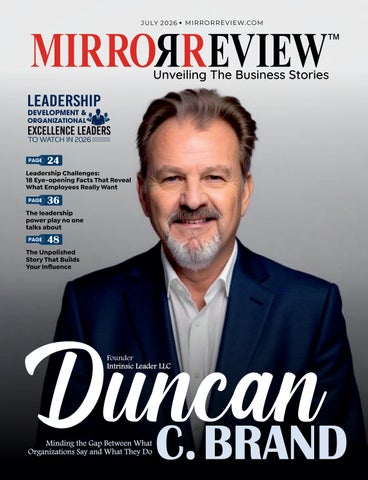
J U LY 2 0 2 6
M I R R O R R EVI EW.CO M
™
LEADERSHIP DEVELOPMENT &
ORGANIZATIONAL
EXCELLENCE LEADERS TO WATCH IN 2026 PAGE
24
Leadership Challenges: 18 Eye-opening Facts That Reveal What Employees Really Want PAGE
36
The leadership power play no one talks about PAGE
48
The Unpolished Story That Builds Your Influence
Duncan Founder Intrinsic Leader LLC
Minding the Gap Between What Organizations Say and What They Do
C. BRAND
EDITOR’S
Cultivating Trust, Igniting Potential, and Redefining the Future of Work.
Dear Readers, True leadership is not found in static blueprints or quiet compliance. It is built in the spaces where trust thrives, and human potential is genuinely valued. As organizations navigate an era defined by rapid change, the true measure of success is no longer just structural. It is deeply human. We are thrilled to present our latest issue, “Leadership Development & Organizational Excellence Leaders to Watch in 2026.” This edition celebrates the visionaries who are tearing down outdated models and building resilient cultures where people do more than just show up. They truly belong, innovate, and grow. These pioneers understand that a future-fit organization requires leaders who can absorb constant change while fiercely protecting the commitment of their teams. Our cover story highlights Duncan C. Brand, Founder of Intrinsic Leader LLC. Over the last fifteen years, Duncan has observed a quiet fracture across multiple industries where systems built for compliance end up hollowing out highly capable people. Moving away from rigid organizational charts, his mission is to build leadership systems that actually last. His philosophy of putting people first and employees second is beautifully captured in his acclaimed book, Mind the Gap. Duncan emphasizes that trust is the universal currency of leadership. He partners with leaders to transform talent systems, proving that while you manage budgets and timelines, you must lead human beings. By helping companies close the gap between what their posters say and what their systems actually do, he ensures that genuine commitment and real innovation follow. Alongside Duncan, we are honored to feature a remarkable group of visionaries shaping the future of organizational excellence. Our spotlight includes Hilary Ware, Founder of hilaryware.com and Transition Strategies Group; Evan J Schwartz, Chief Innovation Officer at AMCS Group; Deborah Kelly, Founder and Director of StudioDMK Ltd; and Drew Dorenfest, Founder of Client Magnet CRM. Each of these extraordinary professionals brings a unique perspective to talent development, proving that sustainable change always starts at the top and thrives through authentic connection. Their collective insights provide a clear roadmap for tomorrow.
Sincerely,
SIMRAN KHAN Managing Editor
Publisher Archana Ghule Editor-in-Chief Vikram Suryawanshi Managing Editor Simran Khan Project Editor Shadab Mestri ™
Mirror Review Magazine is published by Pericles Ventures Pvt. Ltd. No part of this publication may be reproduced, distributed, or used in any form without prior written consent from the publisher. The editorial team has exercised utmost diligence to ensure the accuracy and integrity of all published content; however, the publisher assumes no liability for any errors or omissions. The publisher also bears no responsibility for the content of advertisements featured within the magazine.
Mirror Review Media & Tech Office No. 430, 4th Floor, Gera’s Imperium Rise, Opp. Wipro Circle, Hinjewadi Phase 2, Pune, Maharashtra - 411057.
+1 (850) 564-8517 info@mirrorreview.com www.mirrorreview.com
Project Managers Anushka Nalawade Visualizer Mark Davis Graphic Designer Chaitanya Kulkarni Head of Distribution and Production Aakash Mahajan Head of Operations Robert Smith Research Analysts James Adams Advertising Maria Smith
10. Duncan C. Brand
16. Deborah Kelly 28. Drew Dorenfest 40. Evan J Schwartz 52. Hilary Ware
Articles 24.
Leadership Challenges: 18 Eye-opening Facts That Reveal What Employees Really Want
36.
The Leadership Power Play No One Talks About
48.
The Unpolished Story That Builds Your Influence
Content
Profiles
Leadership Development & Organizational Excellence Leaders to Watch in 2026
Duncan C. Brand
Deborah Kelly
Founder Intrinsic Leader LLC
Founder & Director StudioDMK Ltd.
www.intrinsic-leader.com
www.studiodmk.com
Drew Dorenfest
Evan J Schwartz
Founder Client Magnet CRM
Chief Innovation Officer AMCS Group
www.clientmagnetcrm.com
www.amcsgroup.com
Hilary Ware Founder | hilaryware.com & Transition Strategies Group www.hilaryware.com www.transitionstrategiesgroup.com
COVER STORY
10 | JULY 2026
Duncan Founder | Intrinsic Leader LLC
C. BRAND
Minding the Gap Between What Organizations Say and What They Do
“
Trust is the universal currency of leadership. MIRRORREVIEW.COM | 11
COVER STORY
A
hospital boardroom and a federal agency office rarely appear on the same page of anyone’s resume, let alone in the same paragraph of a single career. But for Duncan C. Brand, Founder of Intrinsic Leader LLC, the two rooms have always rhymed. Walk into either one, he has come to believe, and you will find the same quiet fracture: systems built for compliance, hollowing out the very people they claim to develop. It is an observation that has taken fifteen years to sharpen, across industries as varied as healthcare, technology, aerospace, and government. And it has landed Duncan on a definition of leadership that sounds almost deceptively simple. “A future-fit organization is one whose leaders can absorb constant change without losing their people’s trust, growth, or commitment.” That sentence, plain as it looks on paper, is the product of a long unlearning. From Structures to Something Harder Early in his career, Duncan believed that a future-fit organization was a matter of architecture: the right competency models, the right succession charts, the right training curricula. Get the blueprint correct, and the building will hold. Fifteen years and several industries later, he no longer believes in blueprints alone. The fracture he has watched repeat itself, in a hospital boardroom or a federal agency, taught him something the org charts never could. Structures do not fail loudly. They fail quietly, by hollowing out capable people who keep showing up to work inside them. It is this shift, from structural thinking to something more human and considerably harder to measure, that now defines Duncan’s mission at Intrinsic Leader: to build leadership systems that last. 12 | JULY 2026
A Book
at Gave People Language
That mission found its clearest expression in Mind the Gap, Duncan’s book built around a philosophy he calls “People First, Employee Second.” Since its release, the response, in his own words, has been “humbling.” Leaders have told him the book gave language to something they had felt for years but could not quite articulate: the difference between quiet compliance and genuine commitment. What surprised Duncan most, though, was not the emotional resonance. It was the financial one. Executives, he found, did not want another feel-good manifesto. They wanted a CFO-ready business case that treats people-first leadership as risk mitigation. Middle managers responded differently, but no less powerfully. They told him the book validated instincts they had been pressured to abandon. For Duncan, that is the measure of a book doing its job, not applause, but recognition.
Twenty Countries, One Currency Duncan has scaled leadership academies across 20 countries, and the experience has taught him a rule he now treats as gospel: frameworks travel, but expressions do not. Trust, he says, is the universal currency of leadership. Yet how that trust gets earned varies enormously from one culture to the next, in the directness of feedback, in comfort with hierarchy, in the pace at which relationships form before business is even allowed to begin. His answer to that variation is discipline rather than improvisation. “I never parachute in with a finished product,” Duncan says. Instead, he partners with local leaders to translate his frameworks into their own cultural context because, as he puts it, a leadership academy that ignores culture teaches compliance, not leadership. Where Artificial Intelligence Is Allowed to Help Ask Duncan about artificial intelligence and talent development, and he does not reach for hype. He reaches for a boundary. At Intrinsic Leader, AI is used where it genuinely adds value: personalizing development pathways, analyzing skills gaps across an enterprise, and giving leaders safe environments in which to practice difficult conversations before having them for real. But Duncan is, in his own words, “ruthless about one boundary: AI informs, humans decide.” The opportunity, as he frames it, is that AI can free leaders from administrative work so they can return to the deeply human work of leading. The danger is treating it as a substitute for judgment and relationships. Intrinsic Leader, he says plainly, designs for the former. Consultant by Day, Coach by Nature Duncan also holds an ICF executive coaching certification, a credential that runs alongside, rather than beneath, his consulting practice. He is careful to separate the two roles, even as he insists they feed each other constantly. As a consultant, Duncan works on the system, diagnosing how hiring, succession, performance management, and development connect or fail to. As a coach, he works with the person, holding up a mirror so an executive can confront their own gaps. The ICF discipline matters here, he explains, because a coach does not hand out answers.
The two roles are inseparable in practice. “I have never seen a talent system transform without the leader at the top changing first,” Duncan says, a line that doubles as both his methodology and his warning to any organization hoping to skip that step. What Gen Z Is Actually Asking For On the subject of Gen Z, now a significant share of the workforce, Duncan resists the framing that so many organizations default to. Gen Z, he argues, is not inventing new demands. It is “asking out loud for what every generation quietly wanted: purpose, transparency, real growth, and to be treated as human beings rather than job functions.” The first shift he makes with leaders is one of interpretation: stop hearing entitlement, start hearing feedback. From there, Duncan builds practical muscle. Frequent, honest conversations replace annual reviews. Visible growth pathways replace static career ladders. Authenticity replaces managerial performance. Leaders who master this shift, Duncan notes, do not just retain Gen Z. They get better for everyone else on the team, too. Trust Without Hallways Hybrid and remote work, in Duncan’s assessment, did something more fundamental than change schedules. It dispelled an illusion, the assumption that proximity equals connection. Trust, he says, can no longer be assumed through hallway visibility. It has to be deliberately designed. That shift changes succession planning in particular, because proximity bias is real, and leaders have always tended to promote the people they can see. Duncan now helps clients build systems that value outcomes over visibility, identifying talent by contribution rather than office attendance. Development itself has moved too, out of one-off classroom events and into the flow of work, through cohort-based experiences that travel with people rather than pulling them away. MIRRORREVIEW.COM | 13
COVER COVER STORY STORY
“
You cannot manage people; you manage work, budgets, and timelines, but you lead human beings.
14 | JULY 2026
The Focus Has Narrowed, Not the Reach Intrinsic Leader’s roots run through technology, healthcare, finance, utilities, aerospace, government, and philanthropy, and Duncan considers that cross-industry range a genuine advantage rather than a lack of specialization. Still, something has changed deliberately. The shift, he explains, has been in focus rather than industry. Intrinsic Leader now concentrates on C-level leaders because sustainable change in talent systems has to start at the top. Alongside that focus, Duncan is seeing growing demand from two newer directions: mid-market companies building leadership infrastructure for the first time, and AI-native businesses discovering, often the hard way, that technology moves fast, but trust still moves at human speed. The Mistake Everyone Makes First Ask Duncan what goes wrong before organizations ever call him, and he does not hesitate. They treat leadership development as a training problem when it is actually a systems problem. They buy a program before diagnosing the gap, then wonder why nothing changes once managers return to their busy desks. The second mistake runs deeper still, what Duncan calls the executive mindset gap: declaring people the most important asset while budgets, promotions, and metrics quietly say otherwise. “Employees believe what the systems tell them, not what the posters say,” he says. It is why every engagement at Intrinsic Leader begins the same way, with an honest reality check.
What Comes Next Duncan describes the next chapter of Intrinsic Leader in three words: scaling without dilution. The plan includes expanding its executive-level advisory services built around the Mind the Gap frameworks, specifically the Reality Check Audit, the Trust Battery, and the 90-day playbook, while developing ways for organizations to run these tools internally through their own certified facilitators. He is also investing in digital tools designed to keep development inside the flow of work, alongside more speaking and workshop engagements that bring the book’s ideas directly to leadership teams. And there is a sequel underway. Closing the Gap will focus more acutely on coaching as a strategic development and growth tool, a natural continuation of the philosophy he has spent fifteen years refining.
The Numbers Behind the Philosophy The Witness Before the Consultant Duncan’s client work has produced results he describes in concrete terms: double-digit improvements in leadership engagement, accelerated internal mobility, reduced time-to-hire, and inclusive leadership behaviors that strengthen both culture and performance across global technology, healthcare, and public-sector organizations. But when asked what he is proudest of, Duncan does not lead with metrics. He leads with people. Having trained more than 5,000 leaders and managers worldwide, he finds particular satisfaction in watching those he developed years ago step into executive roles and build people-first cultures of their own. The release of Mind the Gap has extended his frameworks even further, well beyond the clients he could ever reach in person. The milestones he values most, though, are quieter than any of those. Retention curves bending. Engagement recovering. Internal promotion replacing external rescue hiring.
Duncan traces his own motivation back to a role he held long before he ever consulted for anyone: witness. He spent years simply watching capable people get hollowed out by systems designed for compliance rather than growth. That, he says, is why he insists on a distinction that sounds almost like a correction. “You cannot manage people; you manage work, budgets, and timelines, but you lead human beings.” His closing message to readers is less a slogan than an instruction. Mind the gap between what your organization says about people and what its systems actually do to them. Close that gap, Duncan says, and commitment, innovation, and results follow. MIRRORREVIEW.COM | 15
KELLY The Art of Intentional Storytelling for the Legal Elite
“
When you know what you stand for and communicate it with intention, everything else becomes easier to navigate. 16 | JULY 2026
Founder and Director StudioDMK Ltd
MIRRORREVIEW.COM | 17
T
here is a specific kind of silence that falls over a room when the truth is finally spoken. It is not the silence of hesitation, but the silence of recognition. It is the moment when the complex, the messy, and the chaotic suddenly align into a single, sharp line of sight. In the world of high-stakes professional services, where law firms, accountants, and consultants trade in the currency of intellect and expertise, that kind of clarity is the rarest commodity of all. It is easy to be loud. It is easy to be voluminous. But to be clear? That is a different discipline entirely. Deborah Kelly has made a career, and now a life, out of hunting for that silence. She is the Founder and Director of StudioDMK Ltd, a boutique consultancy based in the United Kingdom that specializes in strategic business development and marketing for professional service providers. But to describe her work merely as “marketing” is to miss the texture of what she actually does. Marketing can be a coat of paint applied to a crumbling wall. Deborah is interested in the wall itself: the structure, the foundation, the integrity of the thing. She is interested in the story that lives in the marrow of a business, the one that often gets lost in the dense fog of industry jargon and billable hours. She operates in the liminal spaces between what a company is and what it pretends to be. She is a translator for the brilliant but inarticulate, a guide for the ambitious but directionless. In a marketplace that is increasingly crowded with experts who all sound exactly the same, Deborah Kelly has taken on the task of helping them sound like themselves. The Fascination with Perception To understand where StudioDMK Ltd comes from, you have to look at the twenty years that preceded it. “My career has always been shaped by a fascination with clarity,” Deborah says. “How stories influence perception and how thoughtful communication builds trust.” It is a simple statement, but it carries the weight of two decades of observation. Deborah spent years holding senior marketing and business development roles across Manchester and London. She saw the machinery of influence up close. She saw how a well-placed narrative could shift the mood of a city, or how a poorly articulated value proposition could sink a brilliant firm.
18 | JULY 2026
One of the most pivotal chapters in this journey was her time at London & Partners. It was there that she contributed to global campaigns, including the iconic #LondonIsOpen. That campaign was a piece of civic storytelling designed to hold a narrative together when the political and social ground was shifting. It was about resilience. It was about identity. For Deborah, that experience was a crucible. It deepened her belief in “intentional storytelling.” It proved that words and images, when aligned with truth, have the power to anchor us. But as she moved into the legal and professional services sectors, she noticed a jarring disconnect. She saw firms that were undeniably brilliant, staffed by some of the sharpest minds in the country, struggling to say a simple sentence about who they were. “I repeatedly saw brilliant firms struggle to articulate their value,” she recalls. It was a paradox. These were people whose entire livelihood depended on precision; on the exact interpretation of a statute or the perfect balance of a ledger. Yet, when it came to their own identity, they were often vague, relying on the safety of clichés. They assumed their expertise would speak for itself. Deborah saw that in a noisy world, expertise is silent unless it is given a voice. StudioDMK was created to close that gap. Established in 2025, it was born out of a desire to blend strategy, design, and narrative into a singular tool. It was created to help leaders communicate not just with volume, but with confidence and intention.
The Truth Beneath the Noise The world of professional services is often accused of being beige. It is a world of navy suits, serif fonts, and stock photography of glass handshakes. It is a world that values safety over distinctiveness. Deborah views this landscape with the eye of a sculptor looking at a block of marble. She knows the statue is in there; she just has to chip away the excess. “Professional service and legal firms often struggle to articulate their value in a way that feels clear, differentiated and client-centered,” Deborah observes. “Many rely on technical expertise alone, assuming it will speak for itself.” This is the great trap of the expert. When you know something deeply, you forget what it is like not to know it. You forget that your client does not care about the technicalities of the tax code; they care about whether they can sleep at night. You forget that the client is not buying a legal brief; they are buying certainty. Deborah’s approach at StudioDMK is to act as a mirror, but a corrective one. She reflects the firm back to itself, but stripped of the noise. “What sets us apart is our approach: we uncover the truth beneath the noise, define a precise narrative and translate it into a brand that feels aligned and credible,” she explains. This phrase, “truth beneath the noise,” is the fulcrum of her philosophy. It suggests that the brand is not something you invent; it is something you excavate. It is already there, buried under years of inconsistent messaging, internal misalignment, and the dusty accumulation of “how we’ve always done things.” Her work is tactile. It is a boutique, hands-on partnership. She does not hand over a strategy document and walks away. She gets her hands dirty. She digs into the culture of the firm. She asks the uncomfortable questions. She forces the partners to agree on what they actually stand for, rather than what they think they should say. “Clients experience a boutique, hands-on partnership where every detail has intention and every touchpoint strengthens their reputation,” she notes. This is the difference between a vendor and a partner. A vendor sells you a logo. A partner helps you figure out why you exist. MIRRORREVIEW.COM | 19
The Anatomy of Value The central problem that Deborah solves is one of translation. Law firms and accountants speak a specific language. It is a language of risk mitigation, of precedent, of compliance. Their clients, however, speak the language of business, of emotion, of ambition.
In the legal sector, the concept of “personal branding” can sometimes be viewed with suspicion, as if it were an exercise in vanity. Deborah reframes it as an exercise in service. If you are the best in the world at a specific type of litigation, you have a duty to let the people who need you know that you exist. You have a responsibility to be visible.
“Messaging can become inconsistent, overly complex or indistinguishable from competitors,” Deborah points out. “Internally, teams are often misaligned on what the brand truly represents, which affects business development and client experience.” When a firm cannot articulate its value, it becomes a commodity. It competes on price rather than worth. It loses the ability to choose its clients and instead takes whoever walks through the door. Deborah helps them cut through this complexity. Her methodology is rigorous. “We begin by uncovering the essence of the firm,” she says. “From there, we build a clear narrative, aligned messaging and a modern visual identity that feels credible and consistent across every touchpoint.” It sounds almost clinical, but the effect is emotional. When a firm finally lands on a narrative that feels true, there is a palpable sense of relief. The partners stand a little taller. The business development team makes calls with more conviction. The website stops looking like a menu of services and starts looking like a manifesto. “Professional services often rely on expertise alone, but clients respond to clarity and confidence,” she says. “By refining their story and elevating how it’s presented, we help firms stand out, strengthen trust and compete more effectively.” 20 | JULY 2026
The Personal Signature While StudioDMK focuses on the firm level, Deborah recognized early on that professional services are inherently human. People do not buy from buildings; they buy from people. They buy the reputation of the individual partner and the specific expertise of the subject-matter expert. This realization led to the creation of “Signature by StudioDMK.” “We also support senior legal professionals and subject-matter experts in shaping their personal brand and articulating their value with confidence,” Deborah explains.
Through Signature, Deborah helps these senior professionals unlock new opportunities. She prepares them for speaking engagements, positions them for leadership roles, and helps them build a reputation that precedes them. “For me, the real impact is measured in the transformation clients feel: when their brand finally reflects the quality of their work and they can communicate with ease and intention,” she says. It is about aligning the external signal with the internal reality. It is about making sure that the world sees the expert as they truly are.
Leading with Clarity Being the founder of a boutique consultancy in 2025 requires a specific kind of leadership. The pace of business has accelerated. The tolerance for ambiguity has vanished. “My role spans both strategy and delivery,” Deborah says. “Day to day, I lead client engagements, shape brand direction, develop messaging frameworks and ensure every project reflects the clarity and precision StudioDMK is known for.” This is intentional. StudioDMK limits the number of clients it takes on precisely so Deborah can maintain this level of involvement. “Strong client partnerships are built on trust, clarity and genuine collaboration,” she says. “Because we operate as a boutique consultancy, we intentionally limit the number of clients we take on. This ensures direct access, thoughtful guidance and a level of attention larger agencies often can’t provide.” This boutique ethos is a strategic choice. It allows her to move fast. It allows her to be decisive.
“At this stage, decisive leadership is essential,” she asserts. “Most people don’t want perfection - they want direction. I believe in making informed decisions quickly rather than waiting for perfect information.” This philosophy, direction over perfection, was forged in the fires of real-world challenges. Deborah recounts a time during a complex brand transformation project where her leadership was truly tested. There were multiple stakeholders, shifting priorities, and tight timelines. The noise level was high. “Instead of reacting to the noise, I paused, reset expectations and brought everyone back to the core objective,” she recalls. “I simplified the process, made fast, informed decisions and created a structure that allowed the project to move forward with confidence.” It was a moment that crystallized her belief in the role of a leader during times of uncertainty. “When uncertainty rises, clarity must rise with it,” she says. “People need direction, momentum and a steady hand.” MIRRORREVIEW.COM | 21
“
Work–life balance, for me, is less about perfection and more about presence.
22 | JULY 2026
The Human Element It would be easy to paint Deborah as a creature of pure strategy, a woman who sees the world only in terms of narratives and messaging frameworks. But there is a deeply grounded human side to her, one that informs her work and her life. She does not believe in the myth of the “perfect” work-life balance. She believes in presence. “Work–life balance, for me, is less about perfection and more about presence,” she says. “I’m intentional with my time: when I’m working, I’m fully focused, and when I’m not, I protect that space.” She finds solace in the tangible world. She prioritizes long walks and reading, activities that require a slowing down of the mind. She is energized by design and architecture—disciplines that, like her own, are obsessed with structure, function, and aesthetics. “They feed my creativity in subtle ways,” she notes. But most importantly, she makes time for people. “Connection keeps me grounded, and stepping away from the pace of work helps me return with clarity and renewed focus.” This humanity extends to her vision for the future of StudioDMK. She is not interested in growth for growth’s sake. She is interested in impact. “The next chapter for StudioDMK is about deepening our impact across professional services and expanding our personal branding offering for legal professionals,” she says. She wants to build a team that shares her values—a “small, thoughtful and inclusive team.” And she wants to use the success of the business to create space for pro bono support. “Lifting women up, championing underrepresented voices and supporting domestic abuse causes are areas I care deeply about,” she says. It is a vision of business that sees profit and purpose not as enemies, but as partners. It is a vision where expertise is used to elevate others.
The Power of Small Steps Deborah Kelly is a leader who knows what she stands for. In an industry that often feels ephemeral, she has built something solid. She has built a consultancy that values truth over trends, clarity over complexity, and relationships over transactions. Her advice to others is rooted in this same grounded pragmatism. “When you know what you stand for and communicate it with intention, everything else becomes easier to navigate,” she says. She believes in the compounding power of consistency. “Build with intention, lead with clarity and don’t underestimate the power of small, consistent steps—they compound into meaningful change.” As she looks to the future, Deborah Kelly remains focused on the horizon, but her feet are firmly planted on the ground. She is the architect of clarity, helping the builders of our professional world explain why their work matters. In doing so, she reminds us all that the most powerful story is not the one that is the loudest, but the one that is the most true.
MIRRORREVIEW.COM | 23
LEADERSHIP CHALLENGES 18 Eye-opening Facts That Reveal What Employees Really Want
Y
ou can overcome these challenges to enhance team performance and foster a positive work environment. If you are a manager or a team leader, understanding what employees really want can significantly improve your leadership skills. In this blog, we will unveil 18 eye-opening facts that reveal what employees really want, helping you to effectively address leadership challenges in your organization. Employee Engagement 1. A Gallup study reveals that 85% of the global workforce is disengaged, leaving only 15% engaged at work. 2. Among employees, 59% are passively disengaged (quiet quitting), while 18% are actively disengaged (loud quitting). These employees often point to workplace culture, compensation, and well-being as areas for improvement.
Among the non-engaged, 59% are ‘quiet quitting.’ They’re on the ship, holding the oars but not rowing. They might be dissatisfied with the company culture, pay, or well-being. They're not causing trouble, but they’re not contributing either. Then, there are the 18% who are ‘loud quitting.’ They’re not just failing to row but are actively disrupting the ship. They might be complaining, arguing, or even drilling holes in the ship. This is another facet of leadership challenges. This lack of engagement isn't just about slower progress. It's costly. So, future leaders must find ways to: ● Engage the ‘quiet quitters’ ● Neutralize the ‘loud quitters’ ● Foster an environment where more crew members are actively and enthusiastically working Knowledge Silos
3. Disengaged employees are costing U.S. businesses between $450 billion to $550 billion in lost productivity annually, with these employees being 18% less productive than their engaged counterparts. Imagine a company as a ship. Employees are crew members, their engagement is their rowing effort. Ideally, all crew members would be fully engaged, rowing in sync, propelling the ship efficiently. This is 100% employee engagement. However, only 15 out of 100 crew members are actively rowing. This is one of the significant leadership challenges. 24 | JULY 2026
4. The Chaos Manifesto 2014 states that 33% of projects fail due to insufficient team involvement, emphasizing the importance of clear collaboration. 5. The absence of collaboration can result in ‘knowledge silos’ causing information to be confined within teams, leading to redundant efforts and lost learning opportunities. 6. In such ‘siloed’ environments, crucial information and expertise remain isolated within specific teams, obstructing organizational knowledge growth and sharing.
Consider a company as a football team. In a successful team, each player knows their role and their contribution to the game plan. This is collaboration. However, some players are unclear about their roles or not fully committed, leading to a disjointed team that struggles to win games. This lack of collaboration creates ‘knowledge silos,’ where players excel individually but lack understanding of the teamwork, leading to missed opportunities. In these ‘siloed’ environments, valuable information gets trapped within teams, hindering knowledge sharing and growth, leading to duplication of efforts and missed opportunities for teamwork and improvement. This presents leadership challenges for the captain. The challenge is to build a collaborative environment where every team member understands their role and its contribution to the team’s success. This involves: ● Breaking down knowledge silos ● Promoting open communication ● Ensuring that everyone feels involved and valued. Change Management 7. 70% of change initiatives fail, underlining the challenges in executing effective change management strategies. 8. Prosci’s research indicates a lack of change buy-in and solution support as a key obstacle. This resistance can stem from fear of the unknown, job insecurity, or inadequate communication. 9. 31% of CEOs are fired for mismanaging change, underscoring the critical role leadership plays in navigating organizational change. Think about a company as a ship sailing towards its goals. The journey isn’t always smooth; it often needs to change course due to various factors, similar to organizational change initiatives. MIRRORREVIEW.COM | 25
Imagine if 70% of the time, the ship fails to change its course successfully. It’s likely to hit obstacles or get caught in bad weather, delaying or even preventing it from reaching its destination. This mirrors when 70% of change initiatives in organizations fail.
In some cases, the novelist might question the credibility of the information they have. Is the historical fact accurate? Is the character’s backstory believable? This mirrors the struggle of some leaders who question the credibility of their data.
The success of a course change depends on the crew’s support. If they resist change due to fear, insecurity, or lack of communication the ship struggles to change its course. This is much like the lack of change buy-in in organizations, where 37% of employees resist change.
Sometimes, the overload of information can be so overwhelming that the novelist cannot move forward with the story. They are stuck, unable to decide which plot direction to take or which character to focus on.
The captain’s role is crucial in navigating these changes. If they fail, they might be replaced, as 31% of CEOs are fired for mismanaging change.
This decision paralysis can have negative impacts. It can lead to increased anxiety, missed opportunities (like a great plot twist or character development), and unnecessary spending (time spent on irrelevant research or rewriting).
If the ship constantly changes its course, the crew can become overwhelmed, similar to the change fatigue experienced by employees in organizations undergoing constant changes. To navigate these changes:
Similarly, decision paralysis in leadership can lead to increased stress, missed business opportunities, and wasteful spending. So, the key is to:
● Clear communication ● Address anxieties and insecurities ● Manage change in a way that keeps the organization on track to achieve its goals.
● Learn how to manage and interpret data effectively ● Ensuring its credibility ● Making informed decisions without letting the volume of data lead to decision paralysis.
Decision distress
Conflict Resolution
10. An Oracle study reveals that 90% of business leaders experience decision distressdue to data overload, adversely affecting their quality of life.
13. 48% of employees believe managers need more training in handling conflicts.
11. 26% struggle with data credibility, and 80% abandon decision-making due to overwhelming data. 12. This decision paralysis negatively impacts the quality of life for 88% of people, leading to increased anxiety (38%), missed opportunities (40%), and unnecessary spending (42%). Imagine a novelist trying to write a book. He has a lot of information-character backstories, plot ideas, historical facts, and so on. However, the sheer volume of this information can be overwhelming, leading to “decision distress.” This reflects leadership challenges where data overload makes decision-making stressful. 26 | JULY 2026
14. 76% of employees prefer to avoid conflict when possible. This avoidance can lead to unresolved issues, resentment, and decreased productivity. 15. 27 % of employees quit their jobs due to unresolved conflicts. Let's consider a scenario of a coach training a sports team to understand these statistics better. A coach often faces conflicts among team members. These conflicts could arise from disagreements about strategies, roles, or personal issues. Some team members might feel that their coach needs more training in handling these conflicts, much like employees who believe their managers could benefit from additional conflict resolution training.
Many team members might prefer to avoid conflict altogether, similar to employees who would rather keep the peace than voice their concerns. However, this avoidance can lead to unresolved issues and resentment, affecting the team’s performance and morale. Unresolved conflicts can lead to serious consequences. Some team members might choose to leave the team if conflicts are not addressed, disrupting the team’s harmony and potentially affecting their performance in games.
These insights highlight the importance of effective delegation in the workplace, a key aspect of addressing leadership challenges. It not only helps in preventing burnout among managers but also fosters a sense of growth and development among team members. Moreover, it helps in building trust within the team and stimulates creativity by allowing team members to take on new challenges. On the contrary, poor delegation can lead to a lack of trust, stagnation, and even employee attrition.
That’s why it is crucial to learn: ● How to manage and resolve conflicts effectively ● How to tackle unresolved conflicts ● Ensure a harmonious and productive work environment.
Therefore, managers must strike a balance between delegation and oversight to ensure a healthy and productive work environment, effectively overcoming these leadership challenges. Here are the strategies to tackle the problem of poor delegation:
Authority Delegation 16. A Harvard Business Review article states that a classic sign of insufficient delegation is a manager who works long hours while their team keeps “strangely regular hours.” This suggests the manager isn’t delegating tasks, leading to burnout for themselves and a lack of growth for their team. 17. When employees don’t have the authority to make decisions or complete tasks independently, they can feel underutilized and unimportant. A study by the Society for Human Resource Management (SHRM) found that a lack of growth opportunities is a major reason employees leave their jobs.
● Provide employees with the necessary authority and autonomy to make decisions and complete tasks independently. ● Implement training programs to equip managers with the skills to delegate effectively. ● Encourages skill development and offers growth opportunities. Conclusion We hope this blog has enlightened you about the leadership challenges and the 18 eye-opening facts that reveal what employees really want. If you found this blog valuable, then please subscribe to our YouTube Channel for more leadership development videos. You can also find us on Twitter and Instagram. Remember, understanding and addressing leadership challenges is the key to a successful and harmonious workplace.
18. When managers micromanage and hoard tasks, they prevent employees from developing their skills and taking on new challenges. This limits the team’s overall potential and can lead to stagnation. MIRRORREVIEW.COM | 27
28 | JULY 2026
Founder | Client Magnet CRM Producer/Editor | Drew Dorenfest A/V
Drew Dorenfest From Hollywood Trailers to SEO Systems That Work While You Sleep
MIRRORREVIEW.COM | 29
T
here’s an art to the movie trailer. In two and a half minutes, you have to convince someone to care. You have to be concise, compelling, and impossible to ignore.
Drew Dorenfest knows this world. He spent over a decade in Los Angeles editing trailers for major film and TV studios. He learned the precise craft of sound and image that turns passive viewers into ticket buyers. He understands how to capture attention in a crowded market. But if you sit down with Drew today in his home office in Los Angeles, you’ll hear a very different philosophy. He’s no longer in the business of screaming for attention. He’s in the business of being found. Drew is the Founder of Client Magnet CRM and the Producer/Editor behind Drew Dorenfest A/V. He operates in two worlds: high-end video production and search engine optimization (SEO). And he’s come to a conclusion that feels radical in an era of viral TikToks and Instagram reels: the best way to grow a business isn’t to be the loudest person in the room. It's to be the most findable. “I’ve learned how to maximize target audiences and generate marketing that has an impact,” Drew says. But he applies that knowledge differently now. He isn’t chasing likes or views. He’s building systems that work 24/7—systems that attract clients like a magnet. From Trailers to Business Systems After graduating from the University of Wisconsin-Madison in 2007, Drew moved to Los Angeles and found work at a marketing agency editing trailers for movies and video games. He spent years mastering the art of video marketing that blended sales and storytelling, a skill that would later prove invaluable when building marketing systems for small businesses.
He started experimenting with search visibility. He applied what he learned to his own business. The results weren’t just good, they were transformative. Inbound requests started coming in regularly. He stopped needing to do constant outreach. It was a discovery that changed everything. And it became the foundation for Client Magnet CRM. The Exhaustion of the Social Media Treadmill There’s a pervasive expectation in the modern economy that every business owner must also be a content creator. If you run a bakery, you must be a photographer. If you’re an accountant, you must tweet. If you’re a plumber, you’d better have a YouTube channel. Drew experienced this firsthand. “In my experience as a small business owner, I found that the time I spent posting and trying to attract clients through social media was exhausting and inefficient,” Drew says. “This marketing was taking up precious time I’d rather spend on my editing work or with my family.” He watched talented business owners, craftspeople who were excellent at their work, spend their evenings trying to figure out which trending audio to use on Instagram, hoping for engagement that rarely converted into revenue. “Client Magnet CRM’s core thesis is SEO > Social Media,” Drew explains. “Most businesses have invested heavily in social engagement, but it’s hard to break through the noise. Social media is built to keep you scrolling, not to help you buy.” He realized something fundamental: intent matters more than attention.
In 2018, Drew went freelance, working with agencies of all sizes. By 2023, he launched Drew Dorenfest A/V, his own post-production company. Suddenly, he wasn’t just an editor, he was running a business. He had to handle finances, operations, and most critically, marketing.
“It’s much more effective to capture clients through local SEO and organic search,” he continues. “Those searches have high intent. Someone searching for ‘tax accountant near me’ or ‘best healthy snacks online’ isn’t casually browsing—they’re ready to book a consultation or place an order today. That’s the difference.”
“I had to market myself and network constantly to get video editing projects,” Drew recalls. “That’s when I started diving into SEO and digital marketing to see if I could get found instead of constantly chasing clients.”
This insight became the foundation of Client Magnet CRM: build marketing systems that work silently in the background, 24/7, capturing high-intent customers while business owners focus on delivering great service.
30 | JULY 2026
The Flywheel Effect Drew describes marketing not as a series of stunts, but as a flywheel. It’s heavy at first, requiring significant effort to turn. But as it spins, it gains momentum. Eventually, it spins on its own. “Initial effort comes in many forms, but the fastest wins are through a comprehensive SEO audit and fixing technical SEO,” Drew explains. The process starts with fundamentals. Drew and his team analyze the Google Business Profile, Yelp listings, and website structure. They’re looking for clarity and optimization opportunities. “Then we run a dual-track approach,” he says. Track one is automation. Automated “thank you” emails. Review requests. Appointment reminders. This ensures no customer falls through the cracks simply because the business owner was too busy. Track two is content. Not fleeting Instagram stories, but durable, searchable content. “We develop SEO-optimized content for their website,” Drew explains. “Blogs, resource hubs, comparison guides, FAQs. We do deep keyword research to understand exactly what customers are searching for and build the answers.” “When you combine local SEO, consistent 5-star reviews on Google and Yelp, and word-of-mouth from automated follow-ups, you see real sales growth compounding every month,” Drew says. The system is designed to be invisible, running silently so business owners can focus on what they love.
“
“
Collaboration is key to success.
MIRRORREVIEW.COM | 31
The Gift Shop Success Story
Strategic Clarity Over Reactive Tactics
Pygmy Hippo Shoppe is a small gift shop in Los Angeles that’s been around for fifteen years. It’s run by Emi, a good friend of Drew’s who had built a loyal following and curated selection of unique items. She’d found some success on Instagram, but she was overwhelmed trying to keep up with algorithm changes.
For Drew, leadership often means providing strategic clarity when clients feel pressure to act immediately.
“I offered to help her with SEO and review automation,” Drew says. The data revealed a striking problem: the shop hadn’t received a new review in almost a year—despite serving thousands of customers annually. It wasn’t that customers didn’t love the shop. Emi simply didn’t have a system to ask for reviews. Drew implemented the Client Magnet system. “Now she gets consistent 5-star reviews every month through our automated review generation system,” Drew reports. “Those social signals placed her in the top 3 map-pack on Google for ‘unique gifts Los Angeles’.”
He recalls a recent situation with a client who was feeling competitive pressure. The client wanted to launch an aggressive marketing blitz: paid ads, email campaigns, and text messages—all at once. “I needed to be the calm, strategic voice,” Drew says. “I suggested we slow down and think systematically about what would actually connect with their customers.” Rather than overwhelming prospects with simultaneous messages across multiple channels, Drew proposed a focused approach: start with email marketing, the most trusted and effective channel for their audience. They drafted a targeted campaign, sent it out, and then strategically layered in a paid ad campaign with A/B testing. “At Client Magnet CRM, we prioritize organic traffic over paid traffic,” Drew explains. “But if you have the budget for paid campaigns, we help you run them effectively—with strategy, not just volume.” This approach of strategic, systematic marketing—focused on what actually works—defines Drew’s leadership style. It’s about filtering anxiety through logic until it becomes a clear plan.
The results were significant. The Next Generation of Builders “After 6 months, we improved her site traffic and online sales by 50%,” Drew says. “Her returning customer rate improved by 169%.” But the real validation came during the holiday season. In the midst of the retail rush, Pygmy Hippo Shoppe had its best sales day ever—breaking a record that had stood for over a decade. “These results came from patience and trusting the process,” Drew says. “We built a comprehensive SEO and automation system, and the momentum peaked perfectly during her busiest season. That’s the kind of ROI small businesses can achieve with affordable SEO done right.”
32 | JULY 2026
Drew is not building this alone. In the summer of 2025, he brought on his first summer intern, a business student from his alma mater, the University of Wisconsin-Madison. His name is Jonathan Pufall. Drew pitched him on building an SEO and automation company for small businesses from scratch. “He got very excited by the idea of entrepreneurship,” Drew says. Jonathan has since grown into a leadership role alongside Drew. Jonathan handles operations and acts as a business strategist, focusing on big-picture thinking and long-term planning. Drew handles client work and builds the SEO and marketing automation systems.
“The part that energizes me the most is learning,” Drew says. Every day brings new insights about what SEO strategies work or don’t work to boost sales and visibility. Testing tactics, seeing what works tremendously well, recalibrating what doesn’t. That experimentation drives Client Magnet CRM’s philosophy. The work becomes additive to every business they touch. Clients appreciate the measurable results and ROI—trust and loyalty earned through delivering positive outcomes. The Producer at Heart Despite Client Magnet CRM’s success, Drew hasn’t abandoned video production. Drew Dorenfest A/V continues to thrive through collaboration with great clients. He speaks about his work with PBS with a genuine reverence. “My most consistent collaborator has been PBS, who are wonderful,” he says. “PBS is a historic and vitally important public media company. The work we do to promote programming that uplifts, educates, and entertains is meaningful to me.” This is the common thread between his video work and marketing work. Whether cutting a documentary trailer or optimizing a Google Business Profile, he's trying to uplift the subject. Make sure something good gets seen. “Collaboration is key to success. When you’re working with great collaborators, you push each other to create memorable content that you couldn’t do all on your own,” he says.
MIRRORREVIEW.COM | 33
The Future is Accessible Drew looks at the landscape of digital marketing and sees a barrier that needs to be smashed. For too long, “real” SEO was the domain of national brands with massive budgets. Small businesses were left to fight for scraps on social media. “We truly believe in and offer affordable SEO for small businesses,” Drew asserts. “It’s time someone made these in-demand SEO and digital marketing services available at a price that’s more affordable.” He sees Artificial Intelligence not as a replacement for human creativity, but as the great leveler. He uses AI to speed up processes, to provide technical support, and to generate assets at scale. It allows his small team to punch way above its weight. “We think the future of digital marketing will be won by small businesses that embrace affordable SEO and automation,” he predicts. “Those daring enough to roll up their sleeves and do the work every day.” His next big project is to productize this wisdom. He is developing a streamlined CRM for bigger teams, a simplified version of the tools he uses internally. He wants to hand the keys over to the clients. “We are developing a streamlined CRM that’s truly built for small business marketing,” he says. “Only the stuff you need and not the stuff you don’t.” The View from Home Drew works from home with two children under five. Life is a balance of Zoom calls, editing timelines, client consultations, and the beautiful chaos of parenting toddlers. “I don’t get a lot of time to myself,” he admits with a laugh, “but I wouldn’t have it any other way.” Working 100% remotely means being home with family. Always time to play or read books with the kids. Help with chores and errands. No commute means no missed priceless moments. His wife also works from home, which means they enjoy lunch and dinner together every day. That’s remote work’s real benefit—more time with loved ones. 34 | JULY 2026
When he does step away: he enjoys seeing movies in theaters, concerts and live comedy with his wife, and exploring undiscovered parts of Los Angeles. “After 19 years here, I’m still discovering things for the first time!” he says. Building Systems That Last Drew Dorenfest doesn’t promise overnight miracles or viral moments. He operates on principles that feel almost old-fashioned: collaboration, exceeding expectations, hard work, and meeting deadlines. But in a marketing landscape dominated by noise and short-term tactics, Drew has found something more valuable: sustainable systems that compound over time. For his clients like the gift shop owner, the e-commerce founder, and the service businesses trying to break through—that approach doesn’t just sound like success. It delivers it. “Go beyond expectation,” Drew says, summarizing his philosophy. “Do your best work. The results will follow.” He’s proven that small businesses don’t need massive budgets to compete online. They don’t need to dance on TikTok or post three times a day. They need strategic SEO, smart automation, and someone who understands that real business growth happens when you stop chasing attention and start capturing intent. The metrics speak for themselves: 169% increases in returning customers. Record-breaking sales days. 50% traffic growth. These aren’t vanity numbers. These are businesses transformed. And for Drew, that’s what makes the work meaningful. Not the size of the client or the complexity of the campaign, but the impact on real people building real businesses. In a world of noise, Drew Dorenfest has found the profitable, sustainable power of being findable. And for his clients, that silence sounds a lot like success.
“
“
Go beyond expectation. Do your best work. The results will follow.
MIRRORREVIEW.COM | 35
36 | JULY 2026
The Power Play No One Talks About The loudest person in the room rarely runs it. In high-stakes leadership, power often belongs to the one who knows when to step forward—and when to step back. I’ve watched this play out in boardrooms on five continents. The most influential leaders guard their energy like investors guard capital. They don’t burn it on every request, meeting, or fight. They deploy it where the return is highest. That isn’t retreat. It’s precision. Why Energy Is a Strategic Asset—Not a Renewable One You’ve been told to “show up everywhere” and “always say yes to opportunity.” That’s advice designed to keep you busy, not effective. Energy works like working capital: if you spend it indiscriminately, you’ll have nothing left for the decisions and conversations that actually move the needle. I’ve seen too many founders, executives, and creatives burn themselves out trying to be constantly available. By the time they hit the moment that truly matters—negotiating a critical deal, steering through a crisis—they’re running on fumes. The leaders who win over decades build what I call an Energy Reserve Strategy: they invest in recovery, decline low-value demands, and preserve their capacity for the work only they can do.
MIRRORREVIEW.COM | 37
The CEO Pattern You’ll Never See in Their LinkedIn Posts When you study leaders at the top of their game—Oprah Winfrey, Ava DuVernay, Shonda Rhimes, Naomi Osaka—you notice a pattern: They say “no” more than they say “yes.” They disappear on purpose. They choose when to speak, rather than react to every moment. Oprah has said her breakthrough came when she stopped saying “yes” out of obligation. Naomi Osaka skipped press conferences to protect her mental bandwidth. Ava DuVernay directs her focus toward the work that will outlast the noise. None of them confuse constant presence with meaningful impact. How to Build Your Own Energy Reserve Strategy Stop thinking of energy management as self-care. It’s operational discipline. Here’s the framework I use with executives who want sustainable influence: 1. Audit the Drains – Track your week. Identify what drains you without delivering measurable value. 2. Cut Without Guilt – If it doesn’t move your mission forward, it’s a no. No justification required. 38 | JULY 2026
3. Schedule Recovery Like Revenue Work – Block solitude, deep work, and decompression into your calendar before anything else. 4. Decide Your Deployment Triggers – Define the criteria for when you’ll step in, speak up, or take the lead. If it doesn’t meet that bar, you hold. This isn’t about hiding. It’s about controlling the terms of your visibility. Why This Works in Divided Times In today’s polarized climate—inside companies, markets, and public discourse—reaction speed is overrated. Leaders who pause before acting can see beyond the noise. Congresswoman Pramila Jayapal calls her introversion an advantage: it allows her to hear more, filter faster, and find leverage points in heated negotiations. The same applies in business. If you burn energy reacting to every provocation, you lose clarity. If you hold back, assess, and respond only when impact is possible, your influence compounds. The Diplomatic Deployment Principle Think of your influence like a high-value currency. If you spend it on every small transaction, it loses value. Spend it strategically, and its weight grows.
The Misconception That Costs Leaders Their Edge Too many talented people believe that influence requires constant output. They confuse activity with authority. In reality, measured presence builds more trust than constant chatter. The people you lead, sell to, or negotiate with learn that when you step in, it matters. That scarcity creates weight. And weight moves decisions. The Playbook for Quiet Influence If you want to operate like the leaders I’m describing, here’s the system: 1. Treat Energy as Capital – Your time and presence are assets. Protect them like your P&L depends on it—because it does. 2. Operate From a Reserve – Never let your energy account hit zero. Decisions made from depletion are almost always costly. 3. Define Your “Yes” and “No” Rules – Without clear criteria, you'll spend yourself on work that doesn’t move the mission. 4. Build Recharge Rituals – Whether it’s a daily walk, two hours of phone-off time, or quarterly solo strategy days, make it non-negotiable. 5. Deploy With Intention – When you engage, bring full clarity, preparation, and presence. Then step back before your edge dulls. The Bottom Line
This is why Ava DuVernay’s voice carries. She doesn’t engage every battle. She picks the ones that shift the industry. You can do the same. · Save your input for moments that definedirection. · Let others exhaust themselves in the noise. · When you speak, make sure it counts. This isn’t passivity—it’s tactical patience.
Leaders who master energy control don’t just last longer—they win more often. While others burn themselves out trying to be everywhere, they conserve power for the moments that change everything. Your job is not to be constantly visible. Your job is to be unmistakably effective when it matters. If you do this well, you won’t need to fight for attention. Your absence will be noticed—and your presence will be felt. MIRRORREVIEW.COM | 39
40 | JULY 2026
Schwartz The Quiet Architect of a More Sustainable Industrial Future
MIRRORREVIEW.COM | 41
T
here is something quietly remarkable about the waste and recycling industry. It is, in many ways, the backbone of modern civilization, touching every city, every supply chain, every business operation on the planet. And yet, for decades, it has been among the last sectors invited to the table when digital transformation was being discussed. While financial services ran predictive algorithms and healthcare deployed machine learning, the trucks were dispatched by phone call. The emissions data were estimated, at best. The paperwork was thick and manual and perpetually late. Evan J Schwartz noticed this gap a long time ago. And for more than 35 years, he has been thinking carefully and working systematically about how to close it. He is the Chief Innovation Officer at AMCS Group, a global technology company co-founded in 2003 by Jimmy Martin and headquartered in Limerick, Ireland. The company has grown to operate globally, and Schwartz now stands at the center of its most ambitious chapter yet: embedding artificial intelligence into the daily operations of the world's resource-intensive industries and proving, in concrete financial terms, that sustainability and profitability are not opposing forces but, in fact, the very same force.
This progression is not the resume of someone who collected titles. It is the record of someone who deliberately wanted to understand transformation from every possible angle, because he believed, correctly, that the full picture mattered. The synthesis of those four roles now defines his entire approach at AMCS. Technology, he insists, cannot exist in isolation. It must be deeply aligned with business outcomes and operational realities, and it must be compassionate toward the people who have to actually do the work of adopting it. This belief runs through his public writing, including his blog at EvanJSchwartz.com, his contributions to Forbes Technology Council, and the speaking engagements he takes on. He offers his speaking deck on the Stewardship Model and his time, at no charge, to any organization willing to engage seriously with these questions. “This is my passion,” he has said, with a directness that is worth pausing on. “And I fear we only get one chance to do it right.” The Company at the Center of It All
Over the course of a career that has taken him through roles as Chief Information Officer, Chief Operating Officer, Chief Technology Officer, and Chief Enterprise Architect, he has accumulated something considerably rarer than technical expertise. He has accumulated perspective. And in a moment when most organizations are still figuring out what to do with AI, perspective is, arguably, everything.
AMCS Group was built on a straightforward but deeply ambitious premise: that the waste, recycling, and resource-intensive industries deserved the same quality of digital infrastructure that other sectors had long taken for granted.
“My focus on sustainability and resource-intensive industries emerged from recognizing a critical imbalance,” he says. “These sectors have an outsized impact on the environment yet have historically lacked the digital maturity of other industries. That gap represents both a challenge and an opportunity.”
Founded in 2003 and rooted in Ireland, the company has spent two decades building what Evan describes as the “foundational context system” that runs resource-intensive businesses. Its platform spans enterprise resource planning for waste, recycling, field services, pulp and paper, scrap recycling, fleet maintenance, transport and logistics optimization, ESG and EHS solutions, and advanced analytics. These are capabilities that, in most organizations, have historically lived in isolated silos, each generating its own disconnected data, each limiting the visibility of the whole.
Each executive role in his career gave him a different vantage point on the same fundamental question: how does a complex organization actually change? As CIO, he focused on systems and data. As COO, he was accountable for operational performance. As CTO and architect, he emphasized scalability and design.
“Organizations have struggled with fragmented systems, manual ESG reporting, and disconnected operational data,” Evan explains. “Our approach is to unify these capabilities into a single platform, enabling end-to-end visibility and control.”
A Career Spent Seeing Around Corners Evan did not arrive at sustainability technology by accident. He arrived there by following a particular kind of instinct: a sensitivity to the places where the need is greatest and the tools are fewest.
42 | JULY 2026
He frames it as a three-part progression. First came systems of record: databases and ERP platforms designed to capture and store transactions. Then came systems of intelligence: platforms that could analyze data and surface insights for human decision-makers. Now, he says, we are moving into something altogether different. “We are moving from systems of record to systems of intelligence, and now toward systems of action.”
The core values guiding AMCS are clear and consistently applied: customer-centric innovation, measurable sustainability outcomes, and continuous improvement at scale. Notably, customers are not simply users in the AMCS model. They are co-innovators, providing real-world insights that shape how the platform evolves to meet emerging challenges. This relationship, between software provider and operational partner, is one Evan returns to often, because it is part of what makes the AMCS approach distinct from generic enterprise software. The AMCS Performance Sustainability Suite earned the Top Product of the Year award from Environment+Energy Leader, recognition that reflects the company’s commitment to turning sustainability from a reporting requirement into an embedded operational reality. Waste Advantage Magazine featured AMCS prominently in its January 2026 issue, affirming the company’s expanding role as a strategic partner for resource-intensive industries navigating an increasingly complex regulatory landscape. The breadth of that recognition speaks to something more than good software. It speaks to a genuinely different way of thinking about what enterprise technology is for. From Systems of Record to Systems of Action If there is one idea at the heart of Evan’s current work, it is the recognition that enterprise technology is undergoing a shift unlike anything that has come before, and that most organizations are not yet equipped to meet it.
This is the era of agentic AI. Not AI that recommends a course of action and waits for a human to confirm it, but AI that can act within defined parameters: dynamically optimizing routes in real time, adjusting schedules based on asset performance, automatically identifying and responding to ESG anomalies. These are not theoretical possibilities. They are becoming embedded in the daily operations of AMCS customers across the globe. But Evan is precise, even exacting, about what makes this possible. And it is a distinction that separates AMCS from the broader field of AI providers claiming transformative impact. “AI knows everything about business and maybe even your industry,” he says. “But it knows nothing about your business and how you operate. We fill that gap.” AMCS has spent two decades building the foundational operational context that makes AI genuinely meaningful in specific enterprise settings. That accumulated institutional knowledge, woven into the platform, is what allows agentic AI to function as a calibrated instrument rather than a blunt, generic tool. AMCS Group is the only provider offering what Evan calls a ‘Person Plus AI’ strategy: a framework that does not simply hand a company software, but can diagnose and provide guidance on how AI can benefit that specific company, and then supply the customer journey necessary to take genuine advantage of it, in ways that produce real, measurable results.
MIRRORREVIEW.COM | 43
The Human at the Core of the Machine What makes Evan’s voice unusual in a field often dominated by technical evangelism is his insistence on keeping people at the center of every decision, at every stage. As Chief Innovation Officer, his job is not simply to deploy AI across AMCS customers. It is to help those customers navigate the organizational change management that adoption requires. And that, he argues, is where most AI initiatives quietly collapse. “It’s no longer a tech challenge,” he says plainly. “It’s a digital workforce challenge.” His April 2026 article in Forbes Technology Council, titled “Why AI, Why Now, and Why Your Company Can’t Afford to Wait,” makes this case with characteristic directness. The organizations hesitating on AI adoption, he argues, are not being thoughtfully cautious. They are falling behind. The urgency he expresses is not rooted in hype. It is rooted in watching the gap between AI-ready organizations and the rest of the market widen, in real time, month by month. He is also deliberate about the intellectual habits required to lead well in this environment. He describes himself as highly sensitive to echo chambers and the single-user narrative, and as someone who actively seeks out opposing ideas to test his own thinking. It is the kind of intellectual honesty that is easy to profess and harder to practice. And Evan does not subscribe to the apocalyptic view of artificial intelligence that tends to dominate popular coverage. He finds it, frankly, inaccurate and counterproductive. “The future isn’t happening to us,” he says. “It happens because of us, and it is a choice. We can absolutely choose a better future, and my hope is to present a viable, positive option.” 44 | JULY 2026
This is not rhetorical optimism. It is a considered position from someone who believes the decisions being made right now, in boardrooms and technology departments and academic institutions, will have consequences that outlast all of us. The Book That Said What Everyone Knew but Nobody Had Written Before Evan became a widely recognized voice on AI adoption, he was quietly becoming the authority on a problem that has confounded enterprises for decades: the ERP implementation that costs twice as much as planned, takes three times as long, and still does not do what it was supposed to do. His book, People, Places, and Things: A Framework for a Pain-Free ERP Implementation, published through Forbes and an Amazon Best Seller, is built around an argument that sounds obvious once you hear it but is almost universally ignored in practice. Successful ERP implementations are not primarily technology challenges. They are organizational ones. The framework he developed maps a 10-step customer journey across three critical dimensions: people, places, and things. Organizations, he argues, consistently over-customize their systems, underestimate the importance of change management, and fail to align technology with the actual processes of the business. These are not new mistakes. They are the same mistakes, made again and again, despite decades of expensive, well-documented evidence.
“Businesses need to take the lead here,” he says, “and need to do it now.” It will be between two and eight years before higher education reliably produces AI Stewards at the scale that business requires. That gap is not something organizations can afford to wait out. The companies that build internal AI capability today, that invest in AI literacy across the enterprise, establish governance frameworks early, and pursue use-case-driven adoption, will define the competitive landscape of the next decade.
“Despite technological advancements, these challenges persist because the underlying issues remain the same,” he writes. “The lessons from ERP are highly relevant today as organizations adopt AI: success depends on alignment, adoption, and execution, not just capability.” The book has proven to be more than a practitioner’s guide. It has become a framework for understanding why technology, in isolation, is never sufficient, a lesson Evan applies in every conversation he has about AI adoption today. The parallels between ERP transformation and AI adoption are not superficial. They are, at their core, the same human problem with a different coat of paint. Building the Stewards Business Will Need Among the ideas Evan returns to most frequently is one that sits at the intersection of technology, education, and organizational design: the concept of the AI Steward. An AI Steward, as he defines it, is a leader who is responsible for guiding the ethical, strategic, and operational use of artificial intelligence within an enterprise. Not a data scientist, not a software engineer, but someone who understands both the technology and the human systems it operates within, and can navigate between them. Through his work as Adjunct Professor and Chair of the Board of Advisors for Computer Science and Cybersecurity at Jacksonville University’s Davis College of Business and Technology, Evan has been actively working to shape the curriculum that will eventually produce these leaders. The faculty there, he says, is doing remarkable work. But he is candid about the timeline.
AI is changing business needs, he observes, from a human-centric, repetitive delivery of excellence to a human-driven, iterative problem-solving that is capable of delivering orders-of-magnitude multipliers in output. This is, in his view, not a threat to human relevance but an invitation to a richer kind of work. The repetitive tasks are delegated to machines. The consequential decisions, the creative leaps, the empathetic judgments, those remain human. For leaders navigating this transformation, AI is not just a tool. It is a foundational capability that will define how organizations operate and compete in the future. The organizations that treat it as such and build the internal structures to support it will be the ones that lead. When Sustainability Becomes a Source of Margin Perhaps nowhere is Evan’s thinking more practically consequential than in the area of ESG. For most enterprises, environmental, social, and governance reporting remains an obligation: a compliance exercise managed by a small team, filed annually, and largely disconnected from the business decisions that actually shape environmental outcomes. Evan argues this is precisely the wrong way to look at it, and AMCS has spent three years building the evidence to prove it. MIRRORREVIEW.COM | 45
At AMCS, ESG is integrated directly into operational workflows, enabling real-time visibility and decision-making across the enterprise. This transforms ESG from a retrospective reporting exercise into proactive, embedded management. And it connects, in concrete financial terms, to the performance of the business. The platform has enabled organizations to reduce fuel consumption through optimized routing, improve recycling efficiency, and streamline ESG reporting processes that were previously manual, fragmented, and unreliable. These are not abstract improvements. They are measurable outcomes that show up on a balance sheet. “We haven’t forgotten the fiduciary responsibility our customers have to their shareholders and to the planet’s stakeholders,” Evan says. “Our focus on ‘Sustainable AND Profitable’ is unique.” Over the past three years, AMCS has been building and proving a specific and powerful thesis: wherever you see spikes in CO2 emissions across a company’s ESG profile, you will find opportunities for operational efficiency and bottom-line free cash flow impact. Sustainability, understood correctly, is not a cost center. It is a source of margin. Evan calls this framework Performance Sustainability. It may be the single most important idea AMCS has brought to market, and the most direct answer to the question that every executive with an ESG mandate eventually asks: what does this actually do for the business? The full scope of this philosophy, and the tools that make it operational, is documented across the AMCS resources available at amcsgroup.com and through Evan’s ongoing writing and public engagement at EvanJSchwartz.com.
46 | JULY 2026
There is a quality to Evan J Schwartz’s thinking that is difficult to capture fully in a single profile. He is precise without being cold. He is urgent without being alarmist. He holds complexity with patience and still manages to speak in sentences that anyone can follow. After 35 years at the intersection of enterprise architecture, operations, and transformation, he has the rare quality of someone who has earned his certainty but has not let it harden into rigidity. He envisions a future in which AI manages the repetitive and the transactional, freeing people to focus on the iterative problem-solving and consequential decision-making that actually require a human mind. It is a more fulfilling future, he believes, for everyone involved. But it will only arrive if organizations build it deliberately, starting now, with governance and literacy and a composable architecture that can evolve as the technology does. Education must adapt, from elementary school through graduate programs. Organizations must build internal AI capabilities rather than waiting for the market to deliver them ready-made. And leaders must understand, before anything else, that this is a workforce challenge long before it is a technology challenge. “We’re driving global change in how people perceive themselves, their identity, and the value they provide to society,” he says. “I do not subscribe to the apocalyptic view of AI. The future isn’t happening to us. It happens because of us.” For Evan J Schwartz, after 35 years of building systems, leading transformations, and watching resource-intensive industries slowly wake up to what technology can do for them, the work is as urgent as it has ever been. The tools are better. The platform is proven. The case, between sustainability and profitability, has been made. The choice, he keeps reminding anyone who will listen, is ours to make.
MIRRORREVIEW.COM | 47
The Unpolished Story That Builds Your Influence ounders spend millions trying to craft “the perfect story.” They hire agencies, shoot cinematic videos, polish every line until it shines.
F
Why We Hide the Part People Need Most
Then they wonder why it doesn’t connect.
· Grew revenue by 300%. · Expanded to three continents. · Featured in Forbes.
Here’s the truth most PR decks won’t tell you: the story that earns influence is rarely the one you’ve polished. It’s the one you’ve lived. The Boardroom Lesson Nobody Prepares You For A few weeks ago, I sat in a room with fifteen high-performing founders. We were there for strategy, not therapy. Yet one person—without a slide deck, without the “approved” brand narrative—told a raw, unscripted account of the moment her business almost folded.
Most leaders know their résumé version of their story—the LinkedIn-approved bullet points:
But they cut the sentences that matter: · Spent six weeks sleeping on a friend’s couch to save the business. · Spent four years selling a service no one wanted before finding product-market fit. · Nearly quit the night before the big break. We cut them because they’re messy. We cut them because they’re not “on-brand.” The irony? Those are the exact lines that make you believable. The Strategic Risk of Staying Polished
She didn’t “present.” She talked. She described the week she had to choose between making payroll and paying her mortgage. She explained exactly how she called her supplier and negotiated terms to buy herself 48 hours. It wasn’t pretty. But the table went silent. That’s when it hit me: your influence starts where your polish ends. 48 | JULY 2026
Here’s the cost of staying “safe” with your story: 1. You sound like everyone else. Polished founder bios are interchangeable. 2. You create distance. People can admire perfection, but they rarely trust it. 3. You lose leverage. Investors, clients, and partners lean in when they believe you’ve been tested and survived. Every CEO I respect uses story as a tool—not as a highlight reel.
How to Find the Part of Your Story That Moves People Forget “crafting” for a minute. Go straight to the events that felt risky to say out loud at the time. Ask yourself: · What happened that changed the way I run my business? · When did I have to make a decision that cost me more than money? · What mistake taught me something no spreadsheet could? Those are the points of connection. That’s the material people repeat when they talk about you in rooms you’re not in. The Real Role of Vulnerability We misuse the word “vulnerability” in business.
It’s not about oversharing or emotional catharsis. It’s about strategic transparency—sharing enough of the truth to make the lesson undeniable. Here’s the filter: If the person across the table can apply what you learned to avoid a mistake, or take a calculated risk faster, it’s worth telling. If it’s just for shock value, save it for the memoir. Community Isn’t Just Comfort—It’s Currency One founder in that room said something that stayed with me: “I didn’t come here to be inspired. I came here to remember I’m not the only one in the fight.” That’s why peer communities matter. Not because you “feel seen,” but because you get operating intel from people who’ve survived what you’re in right now.
MIRRORREVIEW.COM | 49
When you tell the true version of your story inside a trusted circle, two things happen: 1. You get the strategies that aren’t in books. 2. You build alliances that turn into deal flow, partnerships, and backchannel introductions.
If You’ve Been Editing Yourself Down Consider this your push to stop sanding off the edges. You don’t need a dramatic overhaul. You need to reintroduce the human stakes into your origin, your turning points, and your current play. Try this:
This is why every serious founder I know invests in getting in the right rooms—not just for visibility, but for survival. The Business Case for Telling the Real Story I’ve watched leaders triple their speaking fees, close seven-figure contracts, and land media features—not by adding more success stats, but by revealing the turning points behind them. The mechanics are simple: · Raw detail makes it memorable. “I was down to my last $412” sticks longer than “we were struggling financially.” · Specificity signals truth. People instinctively trust stories with dates, numbers, and real stakes. · Struggle signals credibility. If you’ve been through it, you can help others navigate it. Your story is not PR fluff. It’s an asset with a measurable ROI.
50 | JULY 2026
· Identify one story you’ve been avoiding because it feels too raw. · Write it in bullet points—just the facts, no adjectives. · Decide which parts connect to the value you deliver now. · Share it in a room where the return could be real—whether that’s a sales meeting, investor pitch, or strategic peer group. Final Word Your polished story may get polite nods. Your real one will get remembered, repeated, and relayed to decision-makers you’ll never meet. In business, being known isn’t about telling people what you’ve achieved—it’s about showing them what you've survived, and how that shapes the way you lead. Don’t wait for permission. Don’t wait for the “right” moment. The right moment is the one you decide to stop hiding the part that makes you credible. Lift the filter. Tell the truth. That’s how influence starts.
Hilary Ware The Architecture of Change and the Art of the Next Chapter
L
eading significant organizational change in a global organization requires a steady hand and a clear vision. For over four decades, Hilary Ware has embodied these qualities, serving as the architect of complex organizational transformations. As a C-suite executive, transformation expert, and trusted advisor to global organizations, Hilary has dedicated her professional life to optimizing corporate structures to enhance their efficiency and humanity. She has successfully navigated the intricate processes of mergers, functional overhauls, and CEO successions. However, when you sit down with Hilary today, the Founder of both hilaryware.com and the Transition Strategies Group, the conversation quickly shifts from the mechanics of corporate change to the complex, often messy reality of human transition. She has spent her life transforming companies, only to discover that her greatest achievement lies in helping individuals transform themselves.
52 | JULY 2026
A Life in Motion To understand Hilary’s comfort with disruption, you have to look at her beginnings. She was not raised in a static environment. Born in California, she left the United States at the age of three. “My father was in engineering construction, and we moved a lot,” Hilary recalls. She spent her formative years in England, Ghana, and various brief stints back in the US. She was educated primarily within the English school system, returning to America only at the end of high school. It was an upbringing defined by adaptation. When your geography constantly changes, you learn to anchor yourself not to a place, but to a process. She attended the University of California at Berkeley, funding her education by working in a dental practice. She majored in Industrial Psychology, drawn to the intersection of human behavior and organizational structure.
Founder Hilaryware.com and the Transition Strategies Group MIRRORREVIEW.COM | 53
“I had enjoyed my studies in Industrial Psychology and had always wanted to go into Human Resources,” she says. Hilary’s entry into the corporate world was pragmatic. She joined a Project Administration training program at Kaiser Engineers, learning the hard, quantifiable skills of project management, cost, and schedule tracking. These were not the soft skills typically associated with HR at the time; they were the rigid metrics of engineering. This dual fluency, understanding both the psychological needs of a workforce and the cold math of a spreadsheet, would become her defining advantage. The Corporate Crucible The pivot toward human resources happened when Hilary joined SOHIO in San Francisco. She started in the HR administrative group, absorbing the principles of process excellence and technological application. As SOHIO merged into BP, Hilary transitioned across the globe and across divisions: San Francisco, Alaska, Cleveland, Houston, London; Upstream, Downstream, Chemicals, Aviation. “During my career at BP, I was asked to take a lead in assessing the HR outsourcing market and stimulating its growth,” Hilary notes. This was a monumental task during the complex period of the Amoco, Arco, Burmah Castrol, and BP mergers. It was during this period of industry consolidation that Hilary found her true calling. “It was during this stage of my career that I discovered my passion to be in the transformation space, and it became my hallmark in the ensuing years of my career.” Hilary became a specialist in organizational transformation and change management. She left BP to become the CHRO at Hanover Compressor, driving a complete functional and organizational transformation. She then moved to BHP Billiton as VP of Human Resources in the upstream space, executing another large-scale restructuring. She served as CHRO and CAO for Bristow Helicopters globally, leading groundbreaking work in safety, process, and technology change. Finally, she joined Cheniere Energy as CHRO, SVP HR, helping to stand up the organization and leaving a legacy of strong teams that fueled its success. Through it all, she was the steady hand guiding executive teams and boards through periods of significant business evolution. 54 | JULY 2026
The Anatomy of Evolution When you spend forty years watching companies attempt to change, you notice patterns. Why do some organizations successfully evolve while others struggle to adapt? For Hilary, the answer is architectural. It requires a clear vision translated into a rigorous roadmap of execution. But a roadmap is useless without the people willing to walk it. “When disrupting or changing the environment, technical/functional excellence, trust, and credibility are essential,” she explains. “This requires ongoing communication, transparency, and relationship building to achieve.” This is the strategic genius of her “WHY.” Hilary understands that financial, operational, and human metrics are not separate silos; they are woven together in a single tapestry. “Meaningful change in the human dimension is when the individuals who are part of the organization feel proud to be part of the organization, are engaged, and are motivated to do the best and find alignment in the purpose and values of the organization.” The Ultimate Test No roadmap could have prepared any leader for the spring of 2020. COVID-19 was a transformation forced upon the world, a disruption without a blueprint. “When we went through COVID as an organization, my leadership was truly tested,” Hilary admits. “It was completely uncharted territory.” Her response was characteristically methodical and collaborative. She did not retreat into executive isolation. She created a multidisciplinary team to guarantee diversity of thought. She convened panels of experts and relentlessly shared best practices with peers across the community. “Constant communication with the organization at all levels was required during this difficult time,” Hilary says. For her extraordinary efforts during the pandemic, she was awarded the prestigious Exxon Powerplay award.
“
I was interested in why some people were be er able to move through significant life events than others. MIRRORREVIEW.COM | 55
“
I think this is a period of my life about intentional simplification - le ing go of what was ‘supposed to be’ and choosing what is most true now. 56 | JULY 2026
The Personal Pivot When Hilary retired from Cheniere Energy, the corporate world expected her to quietly transition into standard consulting. And she did, forming hilaryware.com in 2022 to provide executive coaching and organization transformation advisory services. She utilizes Marshall Goldsmith’s “feedforward” approach, centering her coaching on changing the perceptions of the coachee in a sustainable way. But parallel to her corporate triumphs, Hilary had been navigating a series of profound, personal transitions. “During my career, I had also become fascinated by personal transition,” she shares, the corporate polish giving way to a raw, deeply human vulnerability. “Caring for ill children, caregiving for my parents, caring for my husband during a lung transplant and subsequent ongoing care, losing my husband, breast cancer…” She had survived a gauntlet of grief, illness, and loss. And through it all, she retained the observant eye of a transformation expert. “I was interested in why some people were better able to move through significant life events than others.” Hilary didn’t just wonder; she studied. She obtained several certifications, focusing heavily on methodologies from Harvard, Linda Rossetti, and the Modern Elder Academy. She realized that the same principles of vision, execution, and support that guided a company through a merger could guide a human being through a tragedy or a major life shift.
She is currently finishing a book on navigating life transitions, slated for publication this year. Her “WHO” is clear: she is serving the individual standing at the precipice of change, unsure of how to take the next step. When asked about work-life balance, Hilary is refreshingly honest. “I do not have a perfect work-life balance,” she says. But she has an intention. She incorporates family, travel, fitness, music, theater, cooking, gardening, reading, and painting into her life on an ongoing basis. “I have to be very intentional to do this, and I think that is an important part of navigating life change generally.” As she looks at her own life now, after decades of executive leadership and profound personal loss, she is engaged in a different kind of transformation. “I think this is a period of my life about intentional simplification,” she reflects. “Letting go of what was ‘supposed to be’ and choosing what is most true now.” It is about making the most of my next chapter. It is, as she calls it, “editing with wisdom.” It is keeping what matters and releasing what doesn’t. It focuses on family, engagement, community, health, service, and continuous learning. Hilary Ware spent her life proving that organizations can survive the deepest disruptions if they have the right guidance. Now, she is proving that the human spirit can do exactly the same thing.
The Next Chapter In 2025, Hilary founded the Transition Strategies Group. It was born from a desire to serve: to provide a pragmatic, helpful resource for those facing key life transitions. The team she assembled has personal transition experience, offering support and curated resources across a spectrum of life events. MIRRORREVIEW.COM | 57
www.mirrorreview.com