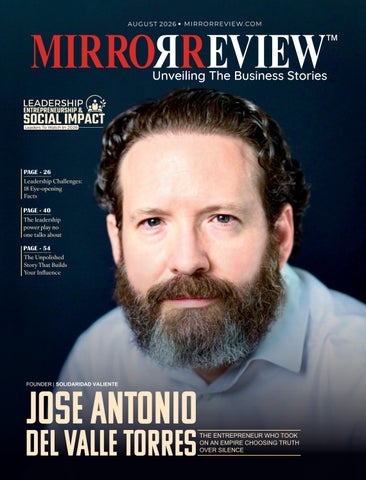
AU G U ST 2 0 2 6
M I R R O R R EVI EW.CO M
™
ENTREPRENEURSHIP &
SOCIAL IMPACT
PAGE - 26 Leadership Challenges: 18 Eye-opening Facts
PAGE - 40 The leadership power play no one talks about
PAGE - 54 The Unpolished Story That Builds Your Influence
FOUNDER | SOLIDARIDAD VALIENTE
JOSE ANTONIO
Del Valle Torres
THE ENTREPRENEUR WHO TOOK ON AN EMPIRE CHOOSING TRUTH OVER SILENCE
EDITOR’S
Bold Vision. Boundless Purpose. Leadership That Changes What Comes Next.
Dear Readers, 2026 arrives at a moment when the old lines between business, purpose and lasting change are fading fast. Across industries and continents, a new generation of leaders is proving that ambition and conscience can grow from the same root, and that the boldest ideas often begin with one person refusing to look away from what is broken. This issue, “Leadership, Entrepreneurship & Social Impact Leaders to Watch in 2026,” gathers five such individuals, united by a shared belief that real influence is measured not by scale but by sincerity of purpose. Our cover story belongs to Jose Antonio Del Valle Torres, Founder of Solidaridad Valiente. In 2017, his invention Go Gaba, a mind drink built to sharpen focus and performance, drew the attention of one of the world’s largest beverage companies, culminating in a signed agreement that December. Months later, a version of his product appeared in another market under a different name, without him. What followed was a legal battle, a reported loss of $345 million, and years in self-imposed exile after repeated threats to his life. Rather than retreat, Jose Antonio turned the ordeal into purpose, founding Solidaridad Valiente to remind Mexicans and global citizens alike of the values of national identity, freedom and democracy. Guided by honesty, commitment, empathy and literacy, he now works as an entrepreneur, advisor and journalist, insisting that mission and sustainability are never truly in competition with one another. Joining him among this year’s leaders to watch are Dr. Adrijana Kekic, CEO and Founder of Futurome; Dr. Alicia Harvey-Smith, Founder, President and CEO of Sapientia One Global Solutions; Dr. Rupert Holms, Founder and CEO of Newal R&D Ltd; and Jeff Sesol, CEO and Founder of Pull the Chute. Together, these five leaders remind us that entrepreneurship at its best is never only about building something new. It is about building something worth trusting, something that survives setbacks and still moves forward with its values intact. Their stories differ in industry and geography, yet each carries the same undercurrent: lasting impact is built one honest decision at a time, by leaders still willing, after everything, to ask what more can be done. Sincerely,
SIMRAN KHAN Managing Editor
Publisher Archana Ghule Editor-in-Chief Vikram Suryawanshi Managing Editor Simran Khan Project Editor Shadab Mestri ™
Mirror Review Magazine is published by Pericles Ventures Pvt. Ltd. No part of this publication may be reproduced, distributed, or used in any form without prior written consent from the publisher. The editorial team has exercised utmost diligence to ensure the accuracy and integrity of all published content; however, the publisher assumes no liability for any errors or omissions. The publisher also bears no responsibility for the content of advertisements featured within the magazine.
Mirror Review Media & Tech Office No. 430, 4th Floor, Gera’s Imperium Rise, Opp. Wipro Circle, Hinjewadi Phase 2, Pune, Maharashtra - 411057.
+1 (850) 564-8517 info@mirrorreview.com www.mirrorreview.com
Project Managers Anushka Nalawade Visualizer Mark Davis Graphic Designer Chaitanya Kulkarni Head of Distribution and Production Aakash Mahajan Head of Operations Robert Smith Research Analysts James Adams Advertising Maria Smith
10.
Jose Antonio Del Valle Torres
18. Dr. Adrijana Kekic 30. Dr. Alicia Harvey-Smith 44. Dr. Rupert Holms 58. Jeff Sesol
Articles 26.
Leadership Challenges: 18 Eye-opening Facts
40.
The Leadership Power Play No One Talks About
54.
The Unpolished Story That Builds Your Influence
Content
Profiles
Leadership, Entrepreneurship & Social Impact Leaders to Watch in 2026 Jose Antonio Del Valle Torres
Dr. Adrijana Kekic
Founder Solidaridad Valiente
CEO & Founder Futurome™
www.solidaridadvaliente.org
www.futurome.com
Dr. Alicia Harvey-Smith
Dr. Rupert Holms
Founder, President, & CEO Sapientia One Global Solutions
Founder & CEO Newal R&D Ltd
www.sapientia1global.com
www.newalrnd.com
Jeff Sesol CEO & Founder Pull The Chute www.pullthechute.net
FOUNDER | SOLIDARIDAD VALIENTE
JOSE ANTONIO
Del Valle Torres THE ENTREPRENEUR WHO TOOK ON AN EMPIRE CHOOSING TRUTH OVER SILENCE
I’ve had to understand how to defend the value of work and fundamental human rights against global corruption. 10 | AUGUST 2026
COVER STORY
MIRRORREVIEW.COM | 11
IN
September of 2017, inside a conference room in the Polanco district of Mexico City, a Senior team of Vice Presidents from one of the largest beverage companies in the world sat across a table from a Mexican entrepreneur carrying a drink of his own invention. It was called Go Gaba, a “Mind Drink” built around a unique combination of natural ingredients, developed to promote mental concentration and improve performance. He had already carried it into stores across Mexico and the Netherlands, and it had won him recognition from Google and from authorities in both Mexico and France.
He studied Business, Accounting, and Human Resources at a leading university in the field of Economics, and interned first at a private bank and later at a multinational corporation, work that steered his early career toward organizational reengineering. His last position before becoming an entrepreneur was as Chief Financial Officer for one of the most notable national initiatives in Mexico, a project spanning utilities, electricity, and telecommunications, aimed at bringing meaningful improvement to less developed communities. From there, he built his own ventures oriented around added value and innovation.
The Coca-Cola Company expressed interest in bringing the product to a wider market. A legally binding agreement was then signed in December 2017 between the publicly listed Mexican subsidiary of The Coca-Cola Company and Jose Antonio Del Valle Torres. The meetings, held between July and December of that year, included Manuel Arroyo Prieto, the current Global Chief Marketing Officer of The Coca-Cola Company. Approximately five months after the agreement was signed, another publicly listed subsidiary, Coca-Cola Japan, began marketing its own version of the drink in Japan, under a different name, without him.
Go Gaba was the product of that orientation. Reporting on the dispute, including coverage by Bloomberg, Work-Bites, BRAINZ, and the Financial Times, has laid out the sequence in detail. Jose Antonio had already established Go Gaba in the Mexican and Dutch markets by the time Coca-Cola’s executives, impressed by its potential, offered to use its marketing, financial, and brand development capabilities to help scale the product. The agreement that was signed in December of 2017 set the stage for the legal dispute that followed.
That betrayal, and everything that followed it, is the hinge on which the story of Jose Antonio now turns. He is the Founder of a social movement, Solidaridad Valiente, and serves as a strategic advisor, entrepreneur, and journalist whose professional life has run, almost improbably, along two parallel tracks: building enterprises to generate value, and defending, with everything he has, the idea that truth still matters in a world built to outlast it.
The Deal in Polanco
In July of 2018, Jose Antonio filed two criminal complaints against the company for corporate fraud and industrial property theft. Mexico City’s Attorney General later determined that his losses from the affair totaled $345 million dollars, a figure also cited in coverage by the Financial Times. The rival product was pulled from the market almost as quickly as it appeared. International reporting on the case has identified several senior executives, including Arroyo Prieto and Selman Careaga, the President of Asia Pacific for The Coca-Cola Company, as figures of interest in the investigation, though the underlying legal proceedings in Mexico remain, by Jose Antonio’s own account, unresolved.
A Country of Contrasts What the Dispute Took Jose Antonio grew up inside a set of contradictions that would eventually define his life’s work. Mexico, as he describes it, is a country “sunk in corruption throughout decades, regardless of the political party in Government”, where many people lack reliable access to quality health care, quality public education, and an effective justice system. That discomfort, he says, never left him. 12 | AUGUST 2026
Asked when his leadership was most severely tested, Jose Antonio does not hesitate. “My leadership has been dramatically and permanently tested over the last eight years as I have committed my life to find justice,” he says. “I lost everything that ever mattered to me: Country, Family and Business.”
COVER STORY
MIRRORREVIEW.COM | 13
COVER STORY
“
We want to give real motivation back to Mexicans, so that each one of us, through that kind of awareness, can positively impact other people’s conscience. 14 | AUGUST 2026
The dispute, now nearing eight years old, has cost him more than a business relationship. Citing numerous attacks on his life, confirmed by reputable security experts, he has lived for years in self-imposed exile, moving home repeatedly to protect his life. He describes the experience as part of a Coca-Cola pattern he has watched play out in other countries as well, one where he believes theft, harassment, intimidation, corruption, and violence function as the standard cost for those who challenge their concentrated corporate power. What the ordeal revealed to him, he has said elsewhere, is a structural imbalance: individuals are accountable before the law within the borders of a single jurisdiction, while multinational corporations may operate through entities across multiple jurisdictions, making accountability more complex. It is a lesson he did not ask for, and one that reshaped the rest of his career.
The Principles Underneath Pressed on what has guided him consistently across both the nonprofit and business sectors, Jose Antonio answers without elaboration, as though the list were self-evident: “Honesty, commitment, empathy and literacy.” That simplicity extends to how he thinks about the tension every social impact leader eventually faces, the one between mission and sustainability. He insists the two are not in competition. Lasting social impact, in his framing, depends on building a realistic and executable equilibrium among measurable objectives, established organizational capabilities, and sustainable development. Without that balance, he suggests, good intentions collapse under their own weight. Value Beyond the Balance Sheet
An Open Letter and a New Purpose Solidaridad Valiente was born directly out of that reckoning. In 2021, Jose Antonio wrote an open letter to then President of Mexico Andrés Manuel López Obrador, laying out the corruption within Mexican authorities to favor Coca-Cola in his case. According to Jose Antonio, the Presidential Office responded immediately; he says, unfortunately, the corruption not only continued, but multiplied. The access to justice failure, layered on top of everything else, became the founding motivation for the organization. “The core initiative of ‘Solidaridad Valiente’ is to remind Mexicans, and global citizens in general, of Mexico’s core values: National Identity, Freedom and Democracy,” he explains. “I strongly believe that in this way, through individual awareness, positive collective changes can be obtained.” The premise is deliberately modest in scale and ambitious in reach: when the challenges facing a country are large, diverse, and spread across a vast population, meaningful change must start with individual impact before it can ever accumulate into something collective. Solidaridad Valiente seeks to spotlight Mexico’s human talent, tourist destinations, and gastronomy in an effort to counterbalance the corruption narrative with something he believes is just as true: that the country is, in his words, a land of extraordinary talent and creativity persistently punished by corruption and violence to reach its full potential.
Social value and long-term organizational growth, Jose Antonio says, are never separate considerations in his work, whether he is operating as an entrepreneur or as a community development advocate. His profession, as he puts it, is entrepreneurship. His passion is serving his country, even from the distance of self-imposed exile and the permanent threat to his life. That same philosophy shapes how he approaches partnerships. To amplify impact through collaboration with businesses, communities, and other stakeholders, he believes objectives have to be shared and aligned, at least broadly, and that shared passion for execution has to be matched with professionalism, hard work, and a commitment to results that can actually be measured. Anything less, in his estimation, produces partnerships that look good on paper and accomplish little in practice. Lessons of an Advisor In his role as a Strategic Advisor, helping organizations adapt and pursue sustainable success, Jose Antonio points to a single discipline above all others: constant learning, applied at the personal, organizational, and social level simultaneously. The goal, as he describes it, is to remain anchored to core values while staying genuinely open to new opportunities, a balance that is easier to state than to practice, particularly during periods of organizational pressure or uncertainty. MIRRORREVIEW.COM | 15
What Solidaridad Valiente Has Built
The Question He Leaves Us With
Asked to name the milestones that best reflect the impact of Solidaridad Valiente, Jose Antonio points not to a single event but to what he describes as a shift in awareness: a growing recognition of the significance of national identity, the identification of concrete examples of Mexican achievement worth celebrating, and a meaningful and steadily growing base of followers actively engaging with the organization’s work. It is, by design, a slower and more diffuse kind of progress than a headline number, one built person by person rather than campaign by campaign. Awareness, consciousness, and the possibility of collective change through individual transformation.
Jose Antonio’s closing message centers on a call for the truth to prevail, in every situation, across every nation, within the global narrative. He is careful to frame this not as an abstraction but as a personal discipline: without self-introspection, and without a clear, well-established commitment to serving others, life does not fulfill its purpose.
Looking Toward 2026 As for what comes next, Jose Antonio sees the greatest opportunities for entrepreneurs and nonprofit leaders emerging where a local perspective meets a global vision of growth and integration. He points specifically to communications, space, energy, and security as the fields most likely to produce the next wave of meaningful impact, sectors where local realities and global systems are becoming impossible to separate from one another. 16 | AUGUST 2026
“It’s how we spend our time that matters most,” he says. “After all, life is simply a personal experience within the interaction of time, energy and space.” He ends, characteristically, not with a conclusion but with a question, tossed to whoever is listening: What are we going to do with that?
18 | AUGUST 2026
CEO and Founder
MIRRORREVIEW.COM | 19
I
n the evolving landscape of modern medicine, conversations about health have shifted far beyond treating illness. Advances in genetics, data science, and preventive care have opened the door to a different kind of dialogue, one that focuses on extending not just lifespan, but the years we spend feeling strong, alert, and fully present. Yet for all this progress, the healthcare system often feels stuck in an older rhythm, reacting to crises rather than anticipating them.
This tension between what is possible and what is practiced is where Dr. Adrijana Kekic, CEO and Founder of Futurome™, has built her life’s work. Her career spans nearly three decades in the United States after completing pharmacy school. A clinical pharmacist board-certified in ambulatory care with a specialization in psychopharmacology, she quickly became known for her commitment to personalization in medicine. Her pursuit of that science led her to become one of the nation’s first pharmacists trained in pharmacogenomics, a discipline that studies how genes influence drug responses. At the Mayo Clinic in Arizona, she led pharmacogenomics services and earned the 2023 Innovation Award. For Adrijana, the path was never just professional. Losing both parents to cancer at a young age planted a quiet but persistent belief that her own time might also be limited. In 2021, that fear took shape when she survived a preventable blood clot, an experience that forced her to confront the fragility of health and the gaps in a system that often misses what could have been avoided. The turning point became a mission. She began asking what it truly means to preserve life when science exists to do so. She also recognized the unique challenges women face, particularly those who push themselves to excel. Even as a health professional, she did not realize she was in perimenopause until symptoms began disrupting her sleep, mood, metabolism, and performance. Today, she sees health optimization as a form of liberation, rooted in evidence, powered by data, and deeply personal to every individual. Her work is a call to reclaim vitality and agency in a world still learning how much our cells hold the key to our future. Building Futurome: From Insight to Action The idea for Futurome™ took shape at the intersection of urgency and expertise. After decades in clinical practice and years directing pharmacogenomics at a leading medical institution, Adrijana saw the same problem surface again and again. The care people received, no matter how prestigious the setting, was often reactive, fragmented, and designed for the average patient rather than the individual in front of them. Even those with access to top-tier hospitals, specialists, and high-end wellness programs were still making decisions without a clear understanding of their own biology. “The system wasn’t built for prevention or optimization,” she explains. “It was built to manage disease after it appears.” 20 | AUGUST 2026
Futurome™ became her answer to that limitation. She designed it to give people more than a temporary plan or a list of generic recommendations. The company integrates advanced molecular testing with multiomic data, including genomics, metabolomics, microbiome analysis, and mitochondrial function. This information is interpreted through artificial intelligence and expert clinical guidance, creating a personalized roadmap for health. By focusing on precision, sustainability, and accessibility, Futurome™ aims to shift the conversation from symptom management to healthspan optimization. In Adrijana’s words, “No one should have to guess what’s happening inside their body. Everyone deserves clarity, agency, and vitality.” Inside the Futurome Care Model Futurome™ positions itself in a category of its own. It is neither a clinic nor a supplement brand, and it is far more than a wellness app. Adrijana describes it as a precision health intelligence company that operates where science, technology, and personalized care meet. At its core is a systems biology approach, integrating advanced multiomics such as genomics, metabolomics, microbiome, mitochondrial function, epigenetics, longevity biomarkers, and early cancer detection testing. This is combined with real-life data from biowearables, digital twin modeling, and concierge clinical navigation to create strategies that are truly individual. Each client is considered an n-of-one, meaning every plan is tailored uniquely. The journey begins with one of four signature experiences. Ignition, a three-month program, establishes a cellular baseline through targeted biomarker testing. Accelerate, spanning six months, adds more coaching and real-time optimization. Apex offers a year of concierge-level care with expanded testing, continuous tracking, and quarterly upgrades. The flagship Aurea program, by invitation only, is designed for women and integrates hormonal, regenerative, and mindset strategies in a bespoke format.
MIRRORREVIEW.COM | 21
While technology plays a central role, human expertise guides every decision. Protocols are refined by clinicians who translate complex data into actionable steps, always with the goal of enhancing both lifespan and day-to-day vitality. Turning Data Into Action Futurome™ approaches personalization as a science, not a slogan. For Adrijana, decisions are driven by the individual’s unique biology rather than population averages. The process begins with a molecular profile built from multiomics, including genomics, metabolomics, microbiome mapping, mitochondrial function, glycan aging, and epigenetic analysis. Together, these layers of data reveal what is happening inside the body long before symptoms appear, as well as potential risk patterns for the future. Once collected, the data moves through Futurome’s proprietary platform, where artificial intelligence uncovers connections between biomarkers. These algorithms can detect early signs of inflammation, nutrient deficiencies, toxic load, metabolic rigidity, or mismatches between genes and environment. Adrijana is clear, however, that AI alone is never enough. “Every data point is reviewed by human experts who understand how to translate numbers into meaningful action,” she says. The clinical team examines the findings in light of the client’s history, goals, and lifestyle realities.
For executives, elite performers, and athletes, health intelligence serves as a competitive advantage. It preserves mental sharpness in fast-moving environments, sustains physical stamina during long or unpredictable schedules, and accelerates recovery after periods of intense effort. Just as importantly, it catches subtle biological changes, which may include dips in energy, shifts in focus, disrupted sleep, or early metabolic imbalances. These could quietly erode performance over time. Traditional healthcare was designed to identify disease. Health intelligence exists to optimize the person. At Futurome, this means giving clients a living, multidimensional view of their biology and the tools to respond in real time. The result is a shift from reacting to health problems toward leading with foresight, clarity, and precision. As Adrijana explains, “We do not just give people information. We give them agency.” Leading with Vision and Precision At Futurome™, each day begins with data and ends with people. As chief executive, Adrijana moves between three central priorities: protecting scientific rigor, driving product innovation, and fostering meaningful human connection. Her role, as she sees it, is not only to guide a company but to shape a model of healthcare that is both highly intelligent and deeply personal.
From this process emerges a precision healthspan plan that may include nutrition, targeted supplementation, physical training, stress management, sleep enhancement, regenerative or pharmacologic therapies, and emotional well-being strategies. The plan is not fixed. It adapts as biomarkers shift, performance improves, and real-world feedback confirms what works best. The aim is not only to add years to life, but also to elevate how those years feel and function.
She leads a handpicked team whose members bring expertise in science, medicine, technology, design, and client care. Technical skill is only part of the equation. Each person is chosen for their commitment to excellence, creativity, and a shared belief in the company’s mission. The team functions as a true collective, working side by side to refine protocols, build digital tools, and translate complexity into clarity for every client.
Redefining Health Intelligence
Standards are high, but the approach is far from controlling. Adrijana encourages autonomy, trusting her team to lead, innovate, and take ownership. “Leadership for me is not about control,” she says. “It is about coherence.” That coherence is what allows ideas to emerge, execution to flow, and clients to feel the depth of care behind every interaction. For her, Futurome is more than a company. It is a movement built in unison.
Adrijana describes health intelligence as the ability to “know your cells to know yourself.” It is a level of awareness that comes from deep, data-driven insight into the body’s inner workings and the discipline to act before trouble begins. For her, it is not an optional enhancement for those with the means. It is a necessity for anyone operating at a high level. 22 | AUGUST 2026
Milestones that Define the Journey From the start, Adrijana set out to build more than a health brand. She wanted a platform that pairs deep science with human care. One major milestone is Aurea, the flagship program for women in midlife. Aurea addresses hormonal and molecular shifts with tailored protocols and ongoing support, helping women reclaim energy and clarity during a time many feel overlooked.
She also built a team of vision-aligned experts committed to science and transformation. As clients experience measurable improvements in terms of more energy, stronger performance, and better biomarkers, they become living proof of her philosophy. These challenges, she says, cemented her belief that true innovation demands courage, reinvention, and the resolve to walk a path few are willing to take. The Future of Longevity
Futurome has also moved into elite performance, advising athletes and high-demand professionals, including race car drivers who rely on its protocols to train, recover, and compete. Another achievement is the fully concierge care model. By uniting multiomic testing, clinical coaching, and digital tracking, Futurome delivers personalized, evidence-based care without unnecessary complexity. The company reports measurable client outcomes: reversal of early-stage diabetes, detection of neuroinflammatory markers tied to cognitive risk, stabilization of autoimmune flares, and correction of hidden metabolic dysfunction. These are documented changes that improve daily life. Adrijana credits her team for these results. “Culture is our operating system,” she says. Investing in people, she believes, makes innovation durable. Turning Obstacles into Momentum Adrijana built Futurome in uncharted territory, often in rooms where she was the only woman, the only pharmacist, or the only advocate for proactive, multiomic care. “We’re bringing technology and systems that may take a decade to reach the average doctor’s office,” she explains. One early realization reshaped her career: her formal training had equipped her to sustain the existing healthcare system, not to reinvent it. To bridge that gap, she pursued a second master’s degree in healthcare innovation and precision nutrition, expanding her ability to combine science, systems thinking, and scalable personalized care. Her greatest challenge, however, was cultural. “We’ve been conditioned to wait for something to break before we act,” she says. Adrijana tackled this mindset by pairing hard data with human stories, including her own near-death experience and the loss of both parents to preventable illness.
Adrijana sees the next five years as a turning point where science, technology, and human-centered care finally converge to align lifespan with healthspan. One of the most transformative developments, she believes, will be digital twins, virtual models of an individual’s biology that allow clinicians to test interventions in a simulated environment before applying them in real life. This could dramatically reduce trial-and-error and bring a new level of precision to preventive care. She also points to pharmacogenomics and proteomics as key drivers of hyper-personalized therapeutics, alongside epigenetic reprogramming, which will evolve from retrospective aging clocks to predictive tools that actively guide health decisions. Equally important will be the shift from clinic-centered models to concierge, AI-assisted ecosystems like Futurome, designed to meet people where they are and adapt in real time as biology changes. Yet Adrijana is clear that innovation alone is not enough. “We have to keep humanity at the center,” she says. “Clients are not data points. They’re people with stories, fears, and potential.” For her, the future of longevity will be defined not just by what technology can do, but by how it deepens trust, agency, and connection. What’s Next for Futurome Futurome is stepping into its next phase with an eye on scale, impact, and integrity. Adrijana is forging partnerships that align with the company’s vision. She’s collaborating with advanced testing providers, AI innovators, luxury wellness destinations, and executive performance centers. Each alliance is chosen to strengthen the brand’s commitment to personalized, preventative, precision-based care. MIRRORREVIEW.COM | 23
A major focus is the expansion of the Elite Performance Division, which now serves athletes, C-suite leaders, and global investors seeking peak clarity and resilience. This work blends multiomic intelligence, digital twin simulations, and real-time feedback to help clients not only sustain performance but surpass their own benchmarks. On the technology front, Futurome is finalizing its proprietary digital healthspan tracker. This platform will allow clients to monitor metrics like biological age, mitochondrial vitality, hormonal balance, and cognitive resilience in a way that turns complex data into actionable insights. But perhaps the most anticipated evolution is Aurea, the flagship female longevity program. Designed to close long-standing gaps in women’s health, Aurea delivers care that is molecularly precise, hormonally intelligent, and deeply personalized, transforming not just the lives of its participants, but the conversation around female aging itself. Life in Alignment Adrijana does not chase the myth of perfect work-life balance. Instead, she seeks alignment, making deliberate choices that reflect her values in both her personal and professional life. She loves her work, and she loves her life, and she has found ways to integrate the two so they feel purposeful and fulfilling. Her most treasured role is being a mother. It keeps her grounded, teaches her patience, and reminds her that the most enduring forms of legacy often start at home. The mission behind Futurome mirrors that same belief that vitality, clarity, and longevity are worth protecting not only for ourselves but also for the people we care about most. She credits her ability to sustain this alignment to a team that values excellence as much as humanity. They work with intensity, yet they understand the need for rest, play, and connection. That culture allows her to lead from a place of energy and authenticity rather than depletion. Beyond the helm of Futurome™, Adrijana is a passionate reader and lifelong learner, drawn to philosophy, history, and the edges of science where questions still outpace answers. She delights in good food and the ritual of shared meals, finds inspiration in design and storytelling, and enjoys movement in many forms, especially the speed and precision of car racing, a pursuit that blends her fascination with performance, recovery, and the thrill of possibility. 24 | AUGUST 2026
LEADERSHIP CHALLENGES 18 Eye-opening Facts That Reveal What Employees Really Want
Y
ou can overcome these challenges to enhance team performance and foster a positive work environment. If you are a manager or a team leader, understanding what employees really want can significantly improve your leadership skills. In this blog, we will unveil 18 eye-opening facts that reveal what employees really want, helping you to effectively address leadership challenges in your organization. Employee Engagement 1. A Gallup study reveals that 85% of the global workforce is disengaged, leaving only 15% engaged at work. 2. Among employees, 59% are passively disengaged (quiet quitting), while 18% are actively disengaged (loud quitting). These employees often point to workplace culture, compensation, and well-being as areas for improvement.
Among the non-engaged, 59% are ‘quiet quitting.’ They’re on the ship, holding the oars but not rowing. They might be dissatisfied with the company culture, pay, or well-being. They're not causing trouble, but they’re not contributing either. Then, there are the 18% who are ‘loud quitting.’ They’re not just failing to row but are actively disrupting the ship. They might be complaining, arguing, or even drilling holes in the ship. This is another facet of leadership challenges. This lack of engagement isn't just about slower progress. It's costly. So, future leaders must find ways to: ● Engage the ‘quiet quitters’ ● Neutralize the ‘loud quitters’ ● Foster an environment where more crew members are actively and enthusiastically working Knowledge Silos
3. Disengaged employees are costing U.S. businesses between $450 billion to $550 billion in lost productivity annually, with these employees being 18% less productive than their engaged counterparts. Imagine a company as a ship. Employees are crew members, their engagement is their rowing effort. Ideally, all crew members would be fully engaged, rowing in sync, propelling the ship efficiently. This is 100% employee engagement. However, only 15 out of 100 crew members are actively rowing. This is one of the significant leadership challenges. 26 | AUGUST 2026
4. The Chaos Manifesto 2014 states that 33% of projects fail due to insufficient team involvement, emphasizing the importance of clear collaboration. 5. The absence of collaboration can result in ‘knowledge silos’ causing information to be confined within teams, leading to redundant efforts and lost learning opportunities. 6. In such ‘siloed’ environments, crucial information and expertise remain isolated within specific teams, obstructing organizational knowledge growth and sharing.
Consider a company as a football team. In a successful team, each player knows their role and their contribution to the game plan. This is collaboration. However, some players are unclear about their roles or not fully committed, leading to a disjointed team that struggles to win games. This lack of collaboration creates ‘knowledge silos,’ where players excel individually but lack understanding of the teamwork, leading to missed opportunities. In these ‘siloed’ environments, valuable information gets trapped within teams, hindering knowledge sharing and growth, leading to duplication of efforts and missed opportunities for teamwork and improvement. This presents leadership challenges for the captain. The challenge is to build a collaborative environment where every team member understands their role and its contribution to the team’s success. This involves: ● Breaking down knowledge silos ● Promoting open communication ● Ensuring that everyone feels involved and valued. Change Management 7. 70% of change initiatives fail, underlining the challenges in executing effective change management strategies. 8. Prosci’s research indicates a lack of change buy-in and solution support as a key obstacle. This resistance can stem from fear of the unknown, job insecurity, or inadequate communication. 9. 31% of CEOs are fired for mismanaging change, underscoring the critical role leadership plays in navigating organizational change. Think about a company as a ship sailing towards its goals. The journey isn’t always smooth; it often needs to change course due to various factors, similar to organizational change initiatives. MIRRORREVIEW.COM | 27
Imagine if 70% of the time, the ship fails to change its course successfully. It’s likely to hit obstacles or get caught in bad weather, delaying or even preventing it from reaching its destination. This mirrors when 70% of change initiatives in organizations fail.
In some cases, the novelist might question the credibility of the information they have. Is the historical fact accurate? Is the character’s backstory believable? This mirrors the struggle of some leaders who question the credibility of their data.
The success of a course change depends on the crew’s support. If they resist change due to fear, insecurity, or lack of communication the ship struggles to change its course. This is much like the lack of change buy-in in organizations, where 37% of employees resist change.
Sometimes, the overload of information can be so overwhelming that the novelist cannot move forward with the story. They are stuck, unable to decide which plot direction to take or which character to focus on.
The captain’s role is crucial in navigating these changes. If they fail, they might be replaced, as 31% of CEOs are fired for mismanaging change.
This decision paralysis can have negative impacts. It can lead to increased anxiety, missed opportunities (like a great plot twist or character development), and unnecessary spending (time spent on irrelevant research or rewriting).
If the ship constantly changes its course, the crew can become overwhelmed, similar to the change fatigue experienced by employees in organizations undergoing constant changes. To navigate these changes:
Similarly, decision paralysis in leadership can lead to increased stress, missed business opportunities, and wasteful spending. So, the key is to:
● Clear communication ● Address anxieties and insecurities ● Manage change in a way that keeps the organization on track to achieve its goals.
● Learn how to manage and interpret data effectively ● Ensuring its credibility ● Making informed decisions without letting the volume of data lead to decision paralysis.
Decision distress
Conflict Resolution
10. An Oracle study reveals that 90% of business leaders experience decision distressdue to data overload, adversely affecting their quality of life.
13. 48% of employees believe managers need more training in handling conflicts.
11. 26% struggle with data credibility, and 80% abandon decision-making due to overwhelming data. 12. This decision paralysis negatively impacts the quality of life for 88% of people, leading to increased anxiety (38%), missed opportunities (40%), and unnecessary spending (42%). Imagine a novelist trying to write a book. He has a lot of information-character backstories, plot ideas, historical facts, and so on. However, the sheer volume of this information can be overwhelming, leading to “decision distress.” This reflects leadership challenges where data overload makes decision-making stressful. 28 | AUGUST 2026
14. 76% of employees prefer to avoid conflict when possible. This avoidance can lead to unresolved issues, resentment, and decreased productivity. 15. 27 % of employees quit their jobs due to unresolved conflicts. Let's consider a scenario of a coach training a sports team to understand these statistics better. A coach often faces conflicts among team members. These conflicts could arise from disagreements about strategies, roles, or personal issues. Some team members might feel that their coach needs more training in handling these conflicts, much like employees who believe their managers could benefit from additional conflict resolution training.
Many team members might prefer to avoid conflict altogether, similar to employees who would rather keep the peace than voice their concerns. However, this avoidance can lead to unresolved issues and resentment, affecting the team’s performance and morale. Unresolved conflicts can lead to serious consequences. Some team members might choose to leave the team if conflicts are not addressed, disrupting the team’s harmony and potentially affecting their performance in games.
These insights highlight the importance of effective delegation in the workplace, a key aspect of addressing leadership challenges. It not only helps in preventing burnout among managers but also fosters a sense of growth and development among team members. Moreover, it helps in building trust within the team and stimulates creativity by allowing team members to take on new challenges. On the contrary, poor delegation can lead to a lack of trust, stagnation, and even employee attrition.
That’s why it is crucial to learn: ● How to manage and resolve conflicts effectively ● How to tackle unresolved conflicts ● Ensure a harmonious and productive work environment.
Therefore, managers must strike a balance between delegation and oversight to ensure a healthy and productive work environment, effectively overcoming these leadership challenges. Here are the strategies to tackle the problem of poor delegation:
Authority Delegation 16. A Harvard Business Review article states that a classic sign of insufficient delegation is a manager who works long hours while their team keeps “strangely regular hours.” This suggests the manager isn’t delegating tasks, leading to burnout for themselves and a lack of growth for their team. 17. When employees don’t have the authority to make decisions or complete tasks independently, they can feel underutilized and unimportant. A study by the Society for Human Resource Management (SHRM) found that a lack of growth opportunities is a major reason employees leave their jobs.
● Provide employees with the necessary authority and autonomy to make decisions and complete tasks independently. ● Implement training programs to equip managers with the skills to delegate effectively. ● Encourages skill development and offers growth opportunities. Conclusion We hope this blog has enlightened you about the leadership challenges and the 18 eye-opening facts that reveal what employees really want. If you found this blog valuable, then please subscribe to our YouTube Channel for more leadership development videos. You can also find us on Twitter and Instagram. Remember, understanding and addressing leadership challenges is the key to a successful and harmonious workplace.
18. When managers micromanage and hoard tasks, they prevent employees from developing their skills and taking on new challenges. This limits the team’s overall potential and can lead to stagnation. MIRRORREVIEW.COM | 29
Founder, President & CEO Sapientia One Global Solutions 30 | AUGUST 2026
Dr. Alicia
HARVEY-SMITH How Sapientia One Global is Rewriting the Playbook on Resilient Leadership
MIRRORREVIEW.COM | 31
W
isdom is a heavy word. In Latin, it is Sapientia. It implies more than just knowledge or the accumulation of facts. It suggests a discernment that sits deep in the marrow, a capacity to see the architecture of a problem while others are still staring at the cracks in the paint. In the high-stakes, high-pressure world of modern higher education, where institutions are often trembling under the weight of demographic shifts and financial volatility, wisdom is the currency that matters most.
She is asking leaders to look at their spreadsheets and see the people behind the numbers. She is reimagining education and organizational life more broadly, not just as a transfer of knowledge or a measure of performance, but as a mechanism for transformational impact. In doing so, she bridges the divide between strategy and spirit, showing that true success is measured not only in outcomes but in the lives transformed along the way. The Genesis of Wisdom
Dr. Alicia B. Harvey-Smith has dedicated her life to accumulating, refining, and reinvesting this vital currency into the educational systems that she has shaped systems whose influence extends far beyond classrooms to the world we share. As the Founder, President, and CEO of Sapientia One Global Solutions, Dr. Harvey-Smith describes the dual realities she embraces in organizational life. One is the world of hard strategy: financial projections, high-stakes performance, and operational disconnects. The other is the world of the human spirit: organizational trauma, belonging, and the quiet, urgent need for validation. While most consultants choose one domain, she has built the connective framework that unites them—transforming tension into possibility. With more than thirty years in educational leadership including over fifteen years at the presidential and executive vice chancellor levels—Dr. Harvey-Smith is recognized as one of higher education's most distinguished leaders. She has guided institutions through crises, restoring stability and vision, and has also led institutions to monumental successes—achieving significant gains in student retention and graduation, advancing learning outcomes, securing major fundraising milestones, and developing award-winning programs that continue to shape the field. She emphasizes that such transformation requires more than leadership alone; it demands a willing culture that embraces collective efficacy—the shared belief that by working collaboratively and supporting one another, even the most difficult challenges can be overcome. Her work now extends far beyond academia, bringing transformational insight to global consulting, corporate training, and executive leadership development. Today, Dr. Harvey-Smith is doing something more radical. She is asking institutions to stop merely surviving and start feeling.
32 | AUGUST 2026
Every great endeavor has an origin story, a moment where the status quo becomes intolerable. For Sapientia One Global Solutions, that moment was born from a realization that the systems we trust to build the future were faltering—failing both the builders and those they serve. Dr. Harvey-Smith looked at the landscape of leadership development and saw a profound fragmentation. She saw leadership pipelines that were broken, lacking the values-driven development necessary to handle modern complexity. She saw a disconnect between visionary strategy and the actual, messy work of execution. But most vividly, she saw a loss of human-centered leadership, resulting in a workforce that was disengaged and burning out. “Sapientia One Global Solutions evolved from many years of experience and training and a desire to understand what systems and processes have the most impact in creating and nurturing the most effective and high-performing cultures,” Dr. Harvey-Smith explains. It was not a solo venture. Built with the support of her husband, Major Donald W. Smith, a retired U.S. Army and Capitol Police Officer, the consultancy is rooted in a blend of discipline and service. Together, they established a firm grounded in integrity, designed to empower clients to lead with purpose. The gap she identified was not just technical; it was cultural. Institutions were trying to solve 21st-century problems with 20th-century tools, ignoring the erosion of civility and the desperate need for resilience. Sapientia was created to fill that void, delivering high-impact consulting, leadership development, and strategic transformation. It was built to bridge intellect and heart.
MIRRORREVIEW.COM | 33
“
People do not care how much you know, until they know how much you care.
34 | AUGUST 2026
The Seventh Principle: A Framework for Evolution To understand how Dr. Harvey-Smith is reshaping organizations, you have to understand the Seventh Learning College Principle. Decades ago, Dr. Terry O'Banion introduced the Learning College Model, outlining six principles to guide institutions toward becoming learning-centered. It was seminal work. But during her doctoral studies at the University of Maryland–College Park, Dr. Harvey-Smith realized something was missing. The original principles were robust, yet they lacked a unifying force to address the inevitability of flux. She introduced the Seventh Principle: “Create and Nurture an Organizational Culture that is Open and Responsive to Change and Learning.” It sounds deceptively simple, yet it changes everything. It reframes the organization as a living ecosystem. It asserts that learning is not just what happens in a classroom; it is an institutional ethos. It must be embedded in leadership, in operations, and in engagement. “The Seventh Learning College Principle directs attention to this outcome,” Dr. Harvey-Smith notes. “With leadership exposure early in my career and now with decades of experience in higher education, I knew this concept held promise—and practice has confirmed that when applied, it truly makes a difference.” The validation of this work was absolute. Dr. O’Banion himself endorsed the research. In the foreword to her book, The Seventh Learning College Principle: A Framework for Transformational Change, he wrote that this principle “transcends the principles of the original learning college, bringing an organizing focus that adds heft and ballast to the evolving concepts.”
In an era defined by disruption, from AI to funding cliffs, this principle offers more than just theory. It offers a survival mechanism. It empowers organizations to re-center their purpose around human development and build cultures that can outlast crises. The CARE Model: Armor for the Soul If the Seventh Principle is the architectural blueprint, the CARE Model© is the mortar that holds the bricks together.
He further stated that, “…the seventh learning college principle serves as an umbrella principle that encompasses and supports the other six principles of the Learning College.”
Leadership, particularly in times of transformation, is abrasive. Friction is inevitable. Dr. Harvey-Smith developed the CARE Model: Compassion, Appreciation, Respect, and Empowerment, not as a soft-skill add-on, but as a strategic imperative.
The umbrella metaphor highlights the importance of holistic integration rather than piecemeal adoption of reforms. It signals that transformational change requires a guiding principle that protects and sustains all others and elevates it as a structural necessity.
It emerged from her research, defining four essential leadership standards. It directs critical attention to transforming organizational cultures with greater intentionality. MIRRORREVIEW.COM | 35
These are not just nice words to put on a breakroom poster. They are operational imperatives that support building inclusive cultures and emotionally intelligent leadership pipelines. The relevance of CARE extends far beyond the campus quad. Whether in the corporate sector, global enterprises, nonprofit organizations, or public service, the CARE Model provides the tools to heal fractured cultures. It addresses the emotional reality of the workforce, creating environments where people feel safe enough to innovate and supported enough to stay. Healing the Invisible Wounds This focus on the human element leads to perhaps the most profound aspect of Dr. Harvey-Smith’s work: Trauma-Informed and Trauma-Infused Leadership. We live in a traumatized world. The aftershocks of global pandemics, social unrest, and economic instability have left deep marks on the workforce. Dr. Harvey-Smith recognizes that you cannot lead a person if you do not understand their pain. “Trauma-Informed Leadership recognizes the widespread impact of trauma, whether personal, systemic, or organizational, and integrates this awareness into leadership practices,” she explains. But she takes it a step further with Trauma-Infused Leadership. This approach embeds trauma sensitivity into the very DNA of the institution: its policies, its daily operations, its culture. It is a strategy grounded in neuroscience and psychology, aligning with principles from the Substance Abuse and Mental Health Services Administration (SAMHSA). The benefits are measurable. A 2023 McKinsey study found that psychological safety directly improves decision quality and team effectiveness. Conversely, when organizations fail to support their people, they risk “institutional erosion,” weakening trust and effectiveness. Sapientia One Global Solutions stands out in this space. While many consulting firms focus on metrics and compliance, Dr. Harvey-Smith leads with an insight into the human condition. She knows that transformation begins with trust. By fostering psychological safety, she helps organizations lower turnover, improve team cohesion, and build resilience. 36 | AUGUST 2026
A Coalition of the Willing No leader changes the world alone. Dr. Harvey-Smith has assembled a formidable network of partners and collaborators who share her mission of cultural restoration. She serves as the US Strategic Advisor for TeachingHOW2s in the UK, an evidence-based platform empowering educators. She collaborates with M-PowerHouse of Greater Pittsburgh, a non-profit empowering underserved youth through STEAM education. She is also a member of The Registry, providing executive transitional leadership to colleges and universities across the nation.
The gravity of her work requires engaging with influential local forces. In her base of operations, the African American Chamber of Commerce of Western Pennsylvania (AACCWP) serves as a critical engine for economic and social empowerment, driving regional growth for minority- and womenowned businesses. This necessity for broad, collaborative action highlights Dr. Harvey-Smith’s intuitive understanding that systemic change requires knitting together a diverse tapestry of allies. Whether engaging with the AACCWP or collaborating with high-level college boardrooms, she applies the same foundational wisdom: leveraging diverse perspectives to refine her human-centered frameworks. These partnerships are not simply affiliations; they are strategic alliances that ensure her models are continually grounded in evidence-based planning, fostering regional growth while actively championing the advancement of women-led enterprises. Through the Chamber’s partnership with Entrepreneurs Forever, she participates in the inaugural CEO cohort, advancing peer-driven strategies that fortify small business resilience and amplify the Chamber’s mission of economic empowerment. This deliberate coalition building is the living proof of her Seventh Principle: always seeking to learn and evolve. The Crucible of Leadership
Her reach extends to Kenya, where she partners with the Lehigh Talent Academy, an emerging K–12 institution. Together, they are co-creating a model of education that honors heritage and fosters globally competent learners. Closer to home, she serves as the Educational Chair for The Strong Families Commission, Inc., working to eliminate systemic barriers preventing fathers from engaging in family life. She also leans on the expertise of the Duquesne University Small Business Development Center (SBDC) for strategic planning and regional expansion.
It is easy to speak of leadership in the abstract. It is harder to practice in the fire. Dr. Harvey-Smith’s leadership was forged in a crucible. She recalls a period of profound organizational upheaval at a struggling institution where she served as the first Black woman appointed President and CEO. The community was fractured. Trust had eroded. The scrutiny was hyper-visible. “In that crucible, I learned that transformational leadership demands more than vision and strategy,” she reflects. “It requires composure under pressure, courage in uncertainty, and the unwavering integrity to lead when the spotlight is sharpest.” She did not fight fire with fire. She fought it with CARE. She used emotional intelligence as her armor and cultural understanding as her compass. She listened to dissent. She acknowledged the pain in the room. She refused to engage in reactive discourse. MIRRORREVIEW.COM | 37
“Leadership demands holding the center when others cannot,” she says. “It means modeling wisdom over reaction.” In that moment, she did not just endure; she transformed. She led the institution through the storm, proving that the Seventh Principle and the CARE Model were not just academic theories, but survival strategies for the real world. The Measure of Impact In the world of business and education, vision must eventually translate into results. Dr. Harvey-Smith’s career is defined by metrics that prove the efficacy of her philosophy. She has provided executive-level leadership for over twenty years. She has overseen more than one hundred grants totaling over $43.6 million across five institutions. She has secured $1.95 million in NSF grants. Perhaps most impressively, she transitioned a for-profit college to nonprofit status, reducing its debt by $18 million and securing over $25.1 million in external funding. She extended the institution’s operations by more than four years beyond its projected closure, saving jobs and student futures. Her insights are cited in Redesigning America’s Community Colleges, a landmark text published by Harvard University Press. She has authored influential books, including Higher Education On The Brink: Reimagining Enrollment Management in Colleges and Universities. Dr. Harvey-Smith has been recognized with the Brave Women Project Pillar Award, the Smart50 Innovation, Impact & Sustainability Award, and the Pittsburgh Technology Council CEO of the Year. She is also a distinguished member of Alpha Kappa Alpha Sorority, Inc., and previously served on high-impact boards like the American Association of Community Colleges (AACC). 38 | AUGUST 2026
The Balance of Being To carry such weight requires a strong foundation. Dr. Harvey-Smith does not preach burnout as a badge of honor. She models balance. “I have cultivated a rhythm that honors both professional purpose and personal joy,” she says. She and her husband share a disciplined commitment to wellness, training together to maintain strength and connection. They travel to gain a global lens on life. She finds solace in creative pursuits like writing and theatre, and holds time with family and friends as sacred. “These practices are not separate from my work; they sustain the clarity, creativity, and resilience I bring to it,” Dr. Harvey-Smith insists.
The Road Ahead
Her message to them is clear.
Dr. Harvey-Smith is not slowing down. Her vision for Sapientia One Global Solutions is global. She intends to scale the consultancy into a worldwide force, serving colleges and corporations with human-centered frameworks. She plans to launch a branded podcast and a curated Substack to foster global dialogue. She will continue to write, to speak, and to challenge the status quo.
“Lead with wisdom, authenticity, and never forget your why,” she urges. “Leadership is not about titles—it’s about people. It’s about showing up with clarity when others are confused, with courage when others are afraid, and with compassion when others feel unseen.”
“We will embed learning into every layer of leadership and cultivate high-performance cultures that rise through challenge and evolve with purpose,” she declares. The Why and The Who At the core of it all, beneath the strategy and the accolades, lies a steady heart and an abiding faith in possibility. It is the “Why” that drives her: the conviction that organizations can be places of healing and transformation. It is the “Who” she serves: the students, the faculty, the leaders, the clients, and the institutions striving to make a difference in a fractured world. For her, every engagement—whether with individuals or entire systems—is an opportunity to restore trust, cultivate resilience, and advance human-centered frameworks that empower people and strengthen communities.
She pauses, reflecting on a truth she learned long ago. “People do not care how much you know, until they know how much you care.” In a world that often feels devoid of both wisdom and care, Dr. Harvey-Smith is proving that you don’t have to choose between them. You can build a strategy that heals. You can lead an institution that loves. And you can change the world, one leader at a time. For more information about Sapientia One Global, please visit:
https://sapientia1global.com/
“
Leadership demands holding the center when others cannot. It means modeling wisdom over reaction.
MIRRORREVIEW.COM | 39
40 | AUGUST 2026
The Power Play No One Talks About The loudest person in the room rarely runs it. In high-stakes leadership, power often belongs to the one who knows when to step forward—and when to step back. I’ve watched this play out in boardrooms on five continents. The most influential leaders guard their energy like investors guard capital. They don’t burn it on every request, meeting, or fight. They deploy it where the return is highest. That isn’t retreat. It’s precision. Why Energy Is a Strategic Asset—Not a Renewable One You’ve been told to “show up everywhere” and “always say yes to opportunity.” That’s advice designed to keep you busy, not effective. Energy works like working capital: if you spend it indiscriminately, you’ll have nothing left for the decisions and conversations that actually move the needle. I’ve seen too many founders, executives, and creatives burn themselves out trying to be constantly available. By the time they hit the moment that truly matters—negotiating a critical deal, steering through a crisis—they’re running on fumes. The leaders who win over decades build what I call an Energy Reserve Strategy: they invest in recovery, decline low-value demands, and preserve their capacity for the work only they can do.
MIRRORREVIEW.COM | 41
The CEO Pattern You’ll Never See in Their LinkedIn Posts When you study leaders at the top of their game—Oprah Winfrey, Ava DuVernay, Shonda Rhimes, Naomi Osaka—you notice a pattern: They say “no” more than they say “yes.” They disappear on purpose. They choose when to speak, rather than react to every moment. Oprah has said her breakthrough came when she stopped saying “yes” out of obligation. Naomi Osaka skipped press conferences to protect her mental bandwidth. Ava DuVernay directs her focus toward the work that will outlast the noise. None of them confuse constant presence with meaningful impact. How to Build Your Own Energy Reserve Strategy Stop thinking of energy management as self-care. It’s operational discipline. Here’s the framework I use with executives who want sustainable influence: 1. Audit the Drains – Track your week. Identify what drains you without delivering measurable value. 2. Cut Without Guilt – If it doesn’t move your mission forward, it’s a no. No justification required. 42 | AUGUST 2026
3. Schedule Recovery Like Revenue Work – Block solitude, deep work, and decompression into your calendar before anything else. 4. Decide Your Deployment Triggers – Define the criteria for when you’ll step in, speak up, or take the lead. If it doesn’t meet that bar, you hold. This isn’t about hiding. It’s about controlling the terms of your visibility. Why This Works in Divided Times In today’s polarized climate—inside companies, markets, and public discourse—reaction speed is overrated. Leaders who pause before acting can see beyond the noise. Congresswoman Pramila Jayapal calls her introversion an advantage: it allows her to hear more, filter faster, and find leverage points in heated negotiations. The same applies in business. If you burn energy reacting to every provocation, you lose clarity. If you hold back, assess, and respond only when impact is possible, your influence compounds. The Diplomatic Deployment Principle Think of your influence like a high-value currency. If you spend it on every small transaction, it loses value. Spend it strategically, and its weight grows.
The Misconception That Costs Leaders Their Edge Too many talented people believe that influence requires constant output. They confuse activity with authority. In reality, measured presence builds more trust than constant chatter. The people you lead, sell to, or negotiate with learn that when you step in, it matters. That scarcity creates weight. And weight moves decisions. The Playbook for Quiet Influence If you want to operate like the leaders I’m describing, here’s the system: 1. Treat Energy as Capital – Your time and presence are assets. Protect them like your P&L depends on it—because it does. 2. Operate From a Reserve – Never let your energy account hit zero. Decisions made from depletion are almost always costly. 3. Define Your “Yes” and “No” Rules – Without clear criteria, you'll spend yourself on work that doesn’t move the mission. 4. Build Recharge Rituals – Whether it’s a daily walk, two hours of phone-off time, or quarterly solo strategy days, make it non-negotiable. 5. Deploy With Intention – When you engage, bring full clarity, preparation, and presence. Then step back before your edge dulls. The Bottom Line
This is why Ava DuVernay’s voice carries. She doesn’t engage every battle. She picks the ones that shift the industry. You can do the same. · Save your input for moments that definedirection. · Let others exhaust themselves in the noise. · When you speak, make sure it counts. This isn’t passivity—it’s tactical patience.
Leaders who master energy control don’t just last longer—they win more often. While others burn themselves out trying to be everywhere, they conserve power for the moments that change everything. Your job is not to be constantly visible. Your job is to be unmistakably effective when it matters. If you do this well, you won’t need to fight for attention. Your absence will be noticed—and your presence will be felt. MIRRORREVIEW.COM | 43
Cover Story
Dr. RUPERT
HOLMS
Founder and CEO Newal R&D Ltd
Building Affordable Immunity in an Expensive World
“
Most of all be happy and be lucky: the only real wealth we all have is the thirty thousand days of our conscious existence.
44 | AUGUST 2026
MIRRORREVIEW.COM | 45
T
here is a specific kind of quiet that settles over a laboratory when a computer screen displays a match that shouldn’t exist. It is not the eureka moment of the movies, with champagne and shouting. It is usually just a man, sitting in a chair, realizing that the map he has been reading for years is upside down. In the early 1990s, Dr. Rupert Holms was that man. He was looking at a protein sequence of the HIV virus, specifically a thirteen-amino acid string that seemed to be the key to how the virus disrupted the human immune system. He had run a database search to see if this viral sequence looked like anything human. The computer spat back an answer: Ezrin. At the time, Ezrin was a protein so newly discovered that most immunologists had barely heard of it. Yet here was the HIV virus, mimicking this obscure human protein to hijack the body’s defenses. Most scientists would have published a paper and moved on. Dr. Holms did something else. He wondered if he could use that same sequence not to harm the body, but to heal it. He wondered if he could reverse-engineer the virus’s weapon into a shield. Dr. Holms is not your typical pharmaceutical executive. He does not wear the uniform of the corporate boardroom, nor does he speak in the sanitized, risk-averse dialect of the biotech industry. He is a man who once managed a billion-dollar fund for a Swiss bank and also wrote a book about the solar system originating as a binary star system. He has ten children. He has lived on the fashionable streets of Moscow and the historic lanes of Canterbury. He is a polymath in an age of specialists, a man who views the human immune system not as a mystery to be feared, but as a software program that just needs the right code to reboot. Today, as the Founder and CEO of Newal R&D Ltd, Dr. Holms is pitching a revolution that is deceptively simple. While the rest of the world chases million-dollar gene therapies and fragile mRNA vaccines, he is betting on peptides—short, stable, affordable chains of amino acids that he has spent thirty years proving can cure infections, heal ulcers, and perhaps even slow the ticking clock of age itself. 46 | AUGUST 2026
The Analyst in the Lab Coat To understand Dr. Holms’s trajectory, you have to understand that he has never really picked a lane. In the UK school system, you are supposed to be a scientist or an artist, a banker or a biologist. Dr. Holms decided to be all of them. He began his career in the traditional way for a bright young Brit from Canterbury. He did a gap year in research at Pfizer, got his degree in biochemistry from York, and a PhD in molecular biology. By 1983, he had developed one of the first gene therapy technologies. He was on the fast track to a quiet life in academia. Then he did something unexpected. He called a Swiss bank. “Rather than continue a career in academia, I contacted the private Swiss bank Lombard Odier,” Dr. Holms recalls. The bank had just raised a massive global science and tech fund. Dr. Holms suggested, with the pragmatic confidence that defines him, that they might actually need a scientist to understand what they were buying. They hired him on the spot. For five years, he lived a double life. By day, he was a life science analyst and investment manager in the City of London, designing novel financial mechanisms to fund biotech start-ups. By night, or at least in the parallel processing of his mind, he was still a scientist obsessed with the growing AIDS epidemic. In 1986, he created HIVER Ltd, a vaccine company. He invested $2 million of his own fund’s profits into it. He recruited the heavyweights: the Medical Research Council, University College London, Cancer UK. He was trying to solve the biggest medical crisis of the 20th century while managing a portfolio of a bank in Monaco. It worked, until it didn’t. The banking partners eventually pointed out that they seemed to be working for him, rather than the other way around. They parted ways amicably. Then HIVER’s lead antibody vaccine candidate failed in animal trials. “HIVER was running out of money and with its peptide vaccine project also in trouble, the company could not attract new investment,” Dr. Holms says. Most people would have gone back to banking. It was safer. It paid better. But Dr. Holms had seen something in the problems with the HIV peptide vaccine. The peptide they tested had been toxic, causing a reaction that looked like graft-versus-host disease. To Dr. Holms, toxicity isn’t just a failure; it is evidence of power. If the peptide could cause that much chaos, it was pushing buttons in the immune system that mattered. MIRRORREVIEW.COM | 47
The Discovery of Ezrin This led to the computer search with Dr. Andrew Coulson in Edinburgh. They found the homology with Ezrin. It was a 70% match. The HIV virus was using a mimic of the human Ezrin protein to confuse the immune system. Dr. Holms’s hypothesis was radical. If he could synthesize the natural human sequence of Ezrin that the virus was mimicking, perhaps he could induce immunological tolerance. Perhaps he could shut down the pathological process.
“I was the human safety test,” Dr. Holms says, noting he took 10mg HEP-1 a day to ensure it wouldn’t kill the patient. It didn’t. In fact, it seemed to stop a cold he was developing and healed his oral ulcers. The patient took the peptide for 30 days. The results were, in Dr. Holms’s words, “astounding.” The viral load dropped by a factor of 100 to 1000. Opportunistic infections vanished. The patient lived for years.
He called it HEP-1 (Human Ezrin Peptide 1).
“It was a great result but we were doing science backwards,” Dr. Holms admits. “We had a safe and effective treatment, but the wrong mechanism.”
In 1993, the AIDS crisis was at its peak. There were no cocktails, no long-term survival plans. A patient in London, told he had six months to live, pressed Dr. Holms to let him be the first subject.
It wasn’t tolerance. It was amplification. The peptide wasn’t telling the immune system to stand down; it was telling it to wake up and fight properly.
48 | AUGUST 2026
The Moscow Pivot
The Exile and the Return
In the late 1990s, developing a drug in the UK or the USA required tens of millions of dollars. Dr. Holms had raised $10 million from his banking connections. It was a fortune to a normal person, but pennies to a pharmaceutical company.
Dr. Holms spent decades building a life and a business in Moscow. He became a fixture there, his likeness even appearing in a book celebrating the 125th anniversary of the Gamaleya Institute. His company, Nearmedic, grew to a £120 million turnover.
So, he went to Russia.
Then came geopolitics.
“I decided to develop ezrin peptides in Moscow, because I already had an excellent clinical and scientific network in Moscow,” he explains.
“It was clear that the 2014 regime-change coup in Ukraine... would eventually lead to war with Russia,” Dr. Holms observes.
This was the era of the Wild East, but also an era of immense scientific capability in Russia that the West largely ignored. Dr. Holms partnered with Professor Ravshan Ataullakhanov, a brilliant immunologist at the Ministry of Health.
He moved the patents for the next generation of the peptide, RepG3, to Newal R&D in London. In 2021, the pressure on foreign ownership in Russia became intense. His company was acquired in an “uninvited” transaction. Dr. Holms left Moscow in January 2022, six weeks before the tanks rolled into Ukraine.
They worked fast. They found that HEP-1 didn’t just suppress HIV; it triggered a cascade of T-cell and B-cell activity. It activated the body’s innate ability to repair tissue. It induced interferons and it was anti-inflammatory. In 2001, they launched the drug in Russia under the brand name “Gepon.” It was approved for HIV and opportunistic infections. But as they distributed samples to clinics across the vast Russian Federation, reports started coming back that they hadn’t anticipated. Doctors were using it for everything. Drug-resistant syphilis. Herpes. Candida. Stomach ulcers. Ulcerative Colitis. “By 2005, it was clear that HEP1 was an effective therapy for all types of drug-resistant sexually transmitted infections caused by viruses, bacteria, fungi, and even protozoans,” Dr. Holms says. It was a panacea, a word that makes scientists nervous. But the mechanism made sense. The peptide wasn’t attacking the specific bacteria or virus; it was upregulating the body’s own defense mechanism, Ezrin, which acts as a general of the immune army. It was like giving the troops better radios and sharper maps.
He returned to London, a pioneer without a portfolio. He had the patents, he had the knowledge, but his infrastructure was gone. “My first activity was to start a Long COVID volunteer treatment program with ezrin peptide RepG3,” he says. He found that the peptide worked on COVID just as it had on HIV and ulcers. It treated acute infection and, crucially, helped with Long COVID, a condition that has baffled mainstream medicine. But raising money in London for a technology that had its roots in Russia, pioneered by a man who didn’t fit the standard mold, proved impossible. “Our Plan A was to raise up to £5 million... however, it turned out to be an impossible task,” he says. Undeterred, Dr. Holms self-financed. He brought on Dr. Phillip Hay, a respected NHS consultant, as Chief Medical Officer. They are currently organizing a drug development program at the University of East London. He is rebuilding, brick by brick. MIRRORREVIEW.COM | 49
Cover Story The Peptides vs. The Billionaires Dr. Holms’ frustration with the current state of biotech is palpable. He sees an industry obsessed with complexity and cost, an industry that serves the shareholders first and the patients second. “The most stupid comment I get about peptides is that they don’t work because they are degraded,” he says. He points out that peptides are the body's natural signaling language. Yes, they break down fast, but that is a feature, not a bug. It means low toxicity. “RNA is expensive to produce, unstable, and potentially dangerous... Monoclonal antibodies are also unstable; cold storage is required,” he notes. His vision is democratic. He wants medicine that costs less than £100 per course. He wants treatments that can be stored on a shelf in a clinic in Mumbai or a pharmacy in Manchester. “Too many life science companies are investing billions in high-tech medicines which cost up to £500,000 per patient,” he notes. “Business success will come from safe and effective, affordable medicine purchased by billions of patients.” This is the vision at the core of Newal R&D. Dr. Holms is not interested in creating boutique therapy for the 1%. He is interested in public health in its truest sense. The Binary Star and the Ten Children If you think Dr. Holms sounds busy, you haven’t heard about his personal life. “I have a problem with authority: unless the authority is me,” he admits. He has been self-employed for decades. He works from home, whether that home is overlooking London Zoo or the beaches of the Eastern Mediterranean. And that home is full. Dr. Holms has ten children. “I have a treasure of ten children with the help of five mothers,” he says with a candor that is disarming. “Half my children are half-Russian, two are half Serbian, one is half New Zealander, and my oldest son and daughter are 75% Scottish.” 50 | AUGUST 2026
The children range in age from 3 to over 40. It is a chaotic, vibrant, international clan that mirrors his own career. He manages this brood with the same optimistic energy he applies to molecular biology. And when he isn’t raising children or curing diseases, he is rewriting astrophysics. He has authored two books proposing that our solar system originated as a binary star system. He studies supernova-debris chemistry. He is a YouTuber. “One PhD is enough,” he jokes about his dabbling in physics. The Future of Aging So, what is next for a man who has done everything? “If we could fund a blue sky R&D budget, I would invest in using peptides to modulate the biological program that controls aging,” he says. He believes the Generation-4 Ezrin peptides could promote healthy longevity. The same mechanism that repairs ulcers and fights off viruses, the regulation of inflammation and tissue regeneration, is key to slowing the decay of the body. Dr. Holms is currently raising finance for Newal R&D to bring these products to the international market. He is targeting 2026 for a major push. He knows the regulatory hurdles will be high. He knows the skepticism will be loud. But he has been here before. “Never give up, be optimistic, be creative, be kind to others,” he says, offering his personal mantra. “And avoid falling backwards into the future.” Dr. Rupert Holms is a man who seems to be falling forward, tumbling through countries, disciplines, and decades with a momentum that is entirely his own. He is the banker who became a biologist, the Englishman who became a Muscovite, the father of ten who wants to be the father of a new class of medicine. He is betting that the answer to our health isn't in a billion-dollar machine, but in a tiny chain of amino acids that has been hiding inside us all along. And considering his track record, it would be a brave man who bets against him.
MIRRORREVIEW.COM | 51
The Unpolished Story That Builds Your Influence ounders spend millions trying to craft “the perfect story.” They hire agencies, shoot cinematic videos, polish every line until it shines.
F
Why We Hide the Part People Need Most
Then they wonder why it doesn’t connect.
· Grew revenue by 300%. · Expanded to three continents. · Featured in Forbes.
Here’s the truth most PR decks won’t tell you: the story that earns influence is rarely the one you’ve polished. It’s the one you’ve lived. The Boardroom Lesson Nobody Prepares You For A few weeks ago, I sat in a room with fifteen high-performing founders. We were there for strategy, not therapy. Yet one person—without a slide deck, without the “approved” brand narrative—told a raw, unscripted account of the moment her business almost folded.
Most leaders know their résumé version of their story—the LinkedIn-approved bullet points:
But they cut the sentences that matter: · Spent six weeks sleeping on a friend’s couch to save the business. · Spent four years selling a service no one wanted before finding product-market fit. · Nearly quit the night before the big break. We cut them because they’re messy. We cut them because they’re not “on-brand.” The irony? Those are the exact lines that make you believable. The Strategic Risk of Staying Polished
She didn’t “present.” She talked. She described the week she had to choose between making payroll and paying her mortgage. She explained exactly how she called her supplier and negotiated terms to buy herself 48 hours. It wasn’t pretty. But the table went silent. That’s when it hit me: your influence starts where your polish ends. 54 | AUGUST 2026
Here’s the cost of staying “safe” with your story: 1. You sound like everyone else. Polished founder bios are interchangeable. 2. You create distance. People can admire perfection, but they rarely trust it. 3. You lose leverage. Investors, clients, and partners lean in when they believe you’ve been tested and survived. Every CEO I respect uses story as a tool—not as a highlight reel.
How to Find the Part of Your Story That Moves People Forget “crafting” for a minute. Go straight to the events that felt risky to say out loud at the time. Ask yourself: · What happened that changed the way I run my business? · When did I have to make a decision that cost me more than money? · What mistake taught me something no spreadsheet could? Those are the points of connection. That’s the material people repeat when they talk about you in rooms you’re not in. The Real Role of Vulnerability We misuse the word “vulnerability” in business.
It’s not about oversharing or emotional catharsis. It’s about strategic transparency—sharing enough of the truth to make the lesson undeniable. Here’s the filter: If the person across the table can apply what you learned to avoid a mistake, or take a calculated risk faster, it’s worth telling. If it’s just for shock value, save it for the memoir. Community Isn’t Just Comfort—It’s Currency One founder in that room said something that stayed with me: “I didn’t come here to be inspired. I came here to remember I’m not the only one in the fight.” That’s why peer communities matter. Not because you “feel seen,” but because you get operating intel from people who’ve survived what you’re in right now.
MIRRORREVIEW.COM | 55
When you tell the true version of your story inside a trusted circle, two things happen: 1. You get the strategies that aren’t in books. 2. You build alliances that turn into deal flow, partnerships, and backchannel introductions.
If You’ve Been Editing Yourself Down Consider this your push to stop sanding off the edges. You don’t need a dramatic overhaul. You need to reintroduce the human stakes into your origin, your turning points, and your current play. Try this:
This is why every serious founder I know invests in getting in the right rooms—not just for visibility, but for survival. The Business Case for Telling the Real Story I’ve watched leaders triple their speaking fees, close seven-figure contracts, and land media features—not by adding more success stats, but by revealing the turning points behind them. The mechanics are simple: · Raw detail makes it memorable. “I was down to my last $412” sticks longer than “we were struggling financially.” · Specificity signals truth. People instinctively trust stories with dates, numbers, and real stakes. · Struggle signals credibility. If you’ve been through it, you can help others navigate it. Your story is not PR fluff. It’s an asset with a measurable ROI.
56 | AUGUST 2026
· Identify one story you’ve been avoiding because it feels too raw. · Write it in bullet points—just the facts, no adjectives. · Decide which parts connect to the value you deliver now. · Share it in a room where the return could be real—whether that’s a sales meeting, investor pitch, or strategic peer group. Final Word Your polished story may get polite nods. Your real one will get remembered, repeated, and relayed to decision-makers you’ll never meet. In business, being known isn’t about telling people what you’ve achieved—it’s about showing them what you've survived, and how that shapes the way you lead. Don’t wait for permission. Don’t wait for the “right” moment. The right moment is the one you decide to stop hiding the part that makes you credible. Lift the filter. Tell the truth. That’s how influence starts.
58 | AUGUST 2026
MIRRORREVIEW.COM | 59
T
here is a moment in the life of many companies, a terrifying, silent point of acceleration when the thrill of the initial launch gives way to the dizzying reality of a business in freefall. It is not a fall caused by a lack of vision or a failing product, but by the founder’s own grip. Clinging too tightly to every decision, every task, every thread of control, they become the very anchor that is dragging their creation down. They are exhausted, their best people are leaving, and the growth they dreamed of has stalled. This is the moment they need to pull the chute. This is the moment they need Jeff Sesol. Jeff, an award-winning leadership coach, best-selling author, and the voice behind the “Pull the Chute” podcast, has built his life’s work around this critical juncture. He is a sort of first responder for businesses teetering on the edge of their own potential, a calm presence who arrives not with a complicated new strategy, but with a deceptively simple philosophy: Grow your employees, and you will grow your business. He is the architect of a methodology designed to cure what he calls “Founder’s Syndrome,” the top-down, command-and-control style of leadership that inevitably becomes a bottleneck. He operates in the space between a company’s ambition and its culture, a place often littered with good intentions and poor execution. It is a silent crisis playing out in cubicles and corner offices, reflected in stark numbers: nearly half of all employees are unhappy at their jobs, and a staggering 79 percent of people leave their jobs because they feel unappreciated, while only 12 percent leave for more money. Jeff Sesol’s work is to mend this disconnect. He teaches leaders the art of letting go, of trusting their teams, and of transforming a culture of ownership from a singular noun into a plural one. He guides them to the point where their employees stop thinking of it as the founder’s company and start saying, with genuine conviction, “this is my company too.” The Architect of Trust
To understand Jeff’s philosophy, you must first understand the soil it grew in. Raised in a family that prized hard work, resilience, and an insatiable curiosity, he learned a foundational lesson early on. “Success wasn’t just about what you achieved individually,” Jeff recalls, “but how you lifted up the people around you.” While his formal education was traditional, his real classroom was the business world itself, a dynamic landscape where he moved between the structured halls of large corporations and the scrappy, agile environments of entrepreneurial ventures. 60 | AUGUST 2026
In this diverse ecosystem, Jeff became an observer, a student of organizational dynamics. He saw a clear, recurring pattern. Some companies would flare brightly for a moment and then burn out, while others demonstrated a steady, enduring capacity for growth. The difference was not in their products or their marketing budgets. “The companies that thrived over the long haul always had one thing in common: they grew their people,” Jeff says. “That shaped my core philosophy. When you create an environment where employees feel supported, trusted, and developed, the business naturally follows.” This was not an abstract theory; it was a tangible reality he witnessed again and again. Jeff saw how investing in an employee’s skills and goals created a ripple effect, boosting not just morale but also innovation, productivity, and the bottom line. The idea became his mantra, the central axis around which his entire career would pivot. The fastest way to elevate a business was not to focus on the business at all, but on the people within it.
‘‘
When leaders pause to listen, invest in people, and build trust, growth happens faster han they ever imagined.
MIRRORREVIEW.COM | 61
The Founder’s Syndrome Epidemic The inspiration for Pull the Chute was not a single event, but a slow burn of observation, a growing frustration with seeing the same story play out in too many promising companies. He watched brilliant, passionate founders become the biggest obstacle to their own success. They were stuck in a self-perpetuating loop of control, micromanaging every detail and making every decision, convinced that no one else could do it right. “That approach might work in the early stages,” Jeff notes, “but it doesn’t scale.” The defining moment, the one that crystallized his mission, came not in a boardroom but in a candid conversation. “A business owner admitted he didn’t trust his team to make decisions,” Jeff remembers. “That was the lightbulb. If you can’t trust your people, you can’t grow.” In that single confession, he saw the entire problem encapsulated: a fundamental breakdown of trust that was suffocating potential. Pull the Chute was born from that insight. The name itself is a call to action, an urgent plea for leaders to act before it is too late, to slow down, reset their trajectory, and deploy a new system that relies on the collective strength of the team. To work on their business, not in their business. The goal is to create a culture where employees are not just passengers on the journey but are co-pilots, empowered to take ownership and help navigate the direction of the business. The results of this shift can be dramatic. One tech startup Jeff worked with, a company mired in the founder-controlled loop, managed to triple its leadership capacity in just six months. The method? Simply distributing the act of decision-making. “The founder went from exhausted to energized,” Jeff reports, “and the company broke through a growth ceiling it had been stuck under for years.” From ‘My Company’ to ‘Our Company’ Making this cultural shift is delicate work. It requires rewiring the instincts of both leaders and employees. For leaders, the process begins with awareness. They must first see themselves as the bottleneck. From there, Jeff guides them through a series of intentional, practical steps: effective delegation, genuine empowerment, and open, consistent communication. It is about building new structures and habits that make it safe for leaders to let go and for employees to step up. 62 | AUGUST 2026
For employees, the focus is on building confidence and providing clarity. “When people understand the vision and feel trusted to contribute,” Jeff explains, “they naturally step into ownership.” Over time, the language within the company begins to change. The divisive “they” of management gives way to the inclusive “we” of a unified team. The possessive pronoun shifts from singular to plural. Jeff offers a powerful example of a manufacturing client whose founder was the central hub for every daily decision, a classic case of Founder’s Syndrome. After undergoing the Pull the Chute coaching, the founder made a conscious effort to shift responsibility to his operations team. The results were staggering. Within a year, not only had productivity increased, but the newly empowered employees began to proactively identify and suggest new efficiencies. Their on-the-ground insights, now valued and acted upon, saved the company over half a million dollars annually. “That’s the power of shared ownership,” Jeff states. It is not just a feel-good concept; it is a powerful engine for innovation and financial growth.
‘‘
If you want to grow your company, you must rst grow your people.
He provides leaders with practical frameworks for having constructive, honest conversations that are designed to build people up rather than tear them down. The impact of breaking these two habits alone can be transformative. He recounts the story of a service company plagued by high employee turnover. The issue was not pay or benefits; it was management. Once the company’s managers learned how to provide clear, constructive feedback and trust their teams, the culture shifted dramatically. “Employee satisfaction shot up,” Jeff says. “Within a year, turnover dropped by 40%, which in turn saved the company hundreds of thousands in rehiring costs.” The Flywheel of Influence
Breaking the Habits of Command and Control At the core of Jeff’s work is the delicate process of breaking deeply ingrained habits. He finds that most leadership challenges boil down to two common, destructive behaviors: the tendency to micromanage and the avoidance of difficult conversations. “Micromanagement comes from fear of losing control,” he says. His approach is to coach leaders to reframe their role. Instead of managing tasks, they should be defining outcomes. He teaches them to replace the impulse for control with the practice of trust by setting crystal-clear expectations and then measuring results, giving their teams the autonomy to figure out the “how.” The second challenge, avoiding tough conversations, is often disguised as kindness. “Many leaders think they’re being ‘nice’,” Jeff observes, “but in reality, they’re withholding valuable feedback.” This creates a culture of ambiguity where employees never know where they truly stand, and mediocrity is allowed to fester.
Jeff’s mission extends far beyond one-on-one coaching sessions. He is a prolific communicator, leveraging multiple platforms to amplify his message. His role as a best-selling author allows him to distill his philosophy into structured, scalable frameworks. His podcast, “Pull the Chute,” offers a more informal, accessible medium, featuring real conversations with leaders who are navigating the very challenges his listeners face. “Each platform reaches people in a different way,” he explains. Coaching is deeply personal and tailored. His books provide the foundational architecture of his ideas. The podcast offers practical, in-the-moment insights. “Together, these roles create a flywheel,” he says. “They reinforce each other and broaden the impact of our mission: growing people to grow companies.” This multi-pronged approach has established him not just as a coach, but as a central thought leader in the movement towards more human-centered, effective leadership. MIRRORREVIEW.COM | 63
The Power of the Five-Minute Huddle A common concern among leaders of small or mid-sized companies is the perceived cost of investing in their people. They see the value, but they believe they lack the resources for elaborate training programs. Jeff is quick to dismantle this misconception. “Start small,” he advises. “You don’t need a massive budget.” He suggests simple, high-impact, low-cost actions: hold regular one-on-one meetings where the primary goal is to listen to an employee’s goals and challenges; offer cross-training opportunities to expand skills and prevent silos; and, most importantly, create consistent rituals of recognition. “Recognizing and celebrating wins-even small ones-sends a powerful message: we value you, and we’re investing in your growth.” One of his favorite examples is a mid-sized logistics company that implemented weekly five-minute “recognition huddles.” It was a simple, zero-cost addition to their routine. But the effect was immediate and profound. “Employees felt seen and valued,” Jeff says. “Engagement rose so sharply that productivity improved by 25% in just one quarter.” It is a powerful testament to the idea that the biggest returns often come from the smallest, most human investments. Slowing Down to Go Fast 64 | AUGUST 2026
As Pull the Chute continues to grow, its vision is becoming increasingly global. Jeff has brought on Bob Cotton from the UK as a partner to spearhead international expansion. He has also formed a strategic partnership with John Zettler of Fair Winds Training in Canada to create TheExecutiveCoachNetwork.com, a collaborative entity designed to merge educational and coaching skills for emerging leaders. He is also at work on his next book, which will offer even more practical tools for leaders looking to build people-centered cultures. For a man so focused on helping leaders manage the relentless pace of business, his own life is a study in deliberate balance. “Family time grounds me,” he shares. Spending time with his wife of 44 years, the families of their three daughters, including seven grandkids, along with reading and daily journaling, are non-negotiable rituals that keep his mind sharp and his ideas flowing. “These rituals keep me recharged so I can show up fully for the leaders I coach,” he says. It is this personal commitment to balance that gives his final piece of advice its profound authenticity. His personal mantra, he says, is the very principle upon which his company was built: “Slow down to go fast.” It sounds like a paradox, but in Jeff Sesol’s world, it is the fundamental truth of sustainable success. It is the act of pulling the chute by pausing, listening, and investing in people that allows a company to stop its uncontrolled freefall, land safely, and then begin to soar faster and higher than ever imagined.
www.mirrorreview.com