J A N UA RY 2 0 2 6
M I R R O R R EVI EW.CO M
™
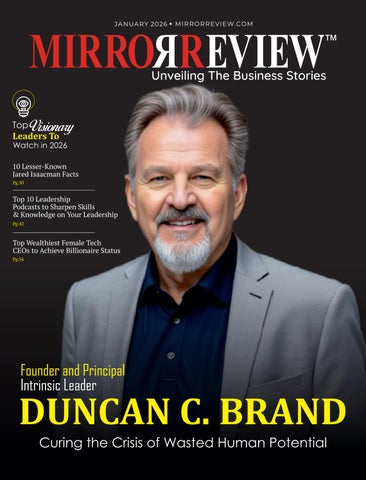
Top Leaders To Watch in 2026 10 Lesser-Known Jared Isaacman Facts Pg.30
Top 10 Leadership Podcasts to Sharpen Skills & Knowledge on Your Leadership Pg.42
Top Wealthiest Female Tech CEOs to Achieve Billionaire Status Pg.54
Founder and Principal Intrinsic Leader
DUNCAN C. BRAND Curing the Crisis of Wasted Human Potential
EDITOR’S LETTER
The Human Operating System of the Future
D
Dear Readers,
In the high-stakes arena of modern business, we often obsess over the ‘what’—the disruptive technology, the agile strategy, the quarterly targets. Yet, as we move deeper into this decade, a profound realization is reshaping the corporate landscape: the ‘what’ is useless without the ‘who.’ The most brilliant algorithm cannot compensate for a disengaged team, and the most robust strategy will crumble under the weight of poor leadership. We are entering an era where the competitive edge is no longer found in software, but in the psychological safety, adaptability, and intrinsic capability of the workforce. It is this pivotal shift from resource management to human potential maximization that we explore in our latest edition, Global Talent & Leadership Innovators: Top Visionary Leaders to Watch in 2026.
Leading this charge on our cover is Duncan C. Brand, the Founder and Principal of Intrinsic Leader. Duncan has spent his career dismantling the tragic corporate paradox where brilliant strategies fail due to unprepared people. Starting in the rigid world of Management Information Systems, he discovered that the ultimate bottleneck is never technology—it is the human element. Unlike traditional consultants offering one-off workshops, Duncan operates as an architect of ecosystems, integrating organizational development with hard data. By bridging the gap between high-level strategy and actual workforce capability, he has achieved stunning results, from a 40 percent increase in promotion velocity to massive reductions in attrition. His philosophy is clear: true leadership isn't imported; it is unlocked from within, creating a "future-fit" organization that is self-sustaining and resilient. Joining Duncan in this transformative issue is a cohort of visionaries who are rewriting the playbook on human capital. We are proud to feature the recruitment innovation of Tracy Saunders, CEO and Founder of BossmakeHer; the coaching mastery of Janet M. Harvey, Founder and CEO of inviteCHANGE; the digital learning expertise of Felipe Mendes, Founder and CEO of Brains&Bytes; and the structural design insights of Lex Sisney, Founder of Organizational Physics. These innovators remind us that in a world increasingly driven by artificial intelligence, the most valuable asset remains authentic human intelligence. They are the architects of a future where people and strategy do not just coexist, but thrive together. Sincerely,
Pankaj Gholap Managing Editor
PUBLISHER
ARCHANA GHULE
EDITOR-IN-CHIEF
VIKRAM SURYAWANSHI
FOLLOW US
MANAGING EDITOR
mirrorreviewofficial
PANKAJ GHOLAP
PROJECT EDITOR PARAG AHIRE
PROJECT MANAGERS POONAM JADHAV
CREATIVE HEAD
PRIYANKA PATIL
VISUALIZER
MARK DAVIS
GRAPHIC DESIGNER OMKAR URAVANE
HEAD OF DISTRIBUTION & PRODUCTION AAKASH MAHAJAN
MirrorReview1 mirror-review mirrorreview mirrorreview
Mirror Review Media & Tech Office No. 430, 4th Floor, Gera’s Imperium Rise, Opp. Wipro Circle, Hinjewadi Phase 2, Pune, Maharashtra - 411057.
+1 (850) 564-8517
info@mirrorreview.com
www.mirrorreview.com
HEAD OF OPERATIONS ROBERT SMITH
RESEARCH ANALYSTS JAMES ADAMS
ADVERTISING
MARIA SMITH
Mirror Review Magazine is published by Pericles Ventures Pvt Ltd. No part of Mirror Review magazine may be reproduced, published or used in any manner without prior written consent from the publisher. The team of Mirror Review Magazine has made every effort to ensure the accuracy of the content. The publisher assumes no responsibility of any part of the content of any advertisement in this publication, including any errors and omissions therein.
DUNCAN C. BRAND
20. Felipe Mendes 36. Janet M. Harvey 46. Lex Sisney 62. Tracy Saunders ARTICLES
30.
10 Lesser-Known Jared Isaacman Facts: CEO of Shi 4 & Potential NASA Chief
42.
Top Leadership Podcasts to Sharpen Skills & Knowledge on Your Leadership
54.
Top Wealthiest Female Tech CEOs to Achieve Billionaire Status
CONTENT
PROFILES
DUNCAN C. BRAND Curing the Crisis of Wasted Human Potential Founder and Principal | Intrinsic Leader
“Mind the Gap!! Adopt a People First, Employee Second approach.”
10 l JANUARY 2026
C O V E R S T O R Y
MIRRORREVIEW.COM I 11
C O V E R S T O R Y
12 l JANUARY 2026
I
n the polished world of corporate strategy, there is a familiar and tragic story. It is a story of a brilliant, multi-million dollar plan, a new technology, a game-changing merger. The slides are perfect, the numbers are clear, and the executive vision is bold. And then, it fails. It fails not because the strategy was wrong, but because the people meant to execute it were not prepared, not aligned, not capable, or not inspired. The real bottleneck, it turns out, is almost never the technology. It is, and always has been, the human element. Duncan C. Brand has built his entire career in this critical, often-overlooked gap between strategy and capability. He is a man who began his professional life in the rigid logic of Management Information Systems, only to discover that the most important system in any organization is its human one. For 15 years, he has been the quiet architect behind the success of some of the world’s most complex enterprises, a global talent and leadership innovator who understands that to build a “futurefit” organization, you must first build its people. As the Founder and Principal of Intrinsic Leader, he operates at the intersection of organizational development, workforce analytics, and culture transformation. His work is not about one-off training days or abstract theories. It is a deeply integrated, data-driven, and human-centered approach that has a tangible, almost stunning, impact. He has scaled leadership academies across 20 countries, resulting in a 40 percent increase in Director-promotion velocity in just 18 months. He has redesigned performance and engagement cycles for 6,000 employees post-merger, driving employee Net Promoter Scores up 11 points and cutting voluntary attrition by a massive 28 percent.
He is a man who sees the story in the data, a leader who believes that the most effective leadership comes not from an external program, but from the potential that is already lying dormant within a company’s walls.
The connection was undeniable. The data proved the human story. “That was when I realized this work was more meaningful than any system I could create,” Duncan says.
The Bottleneck in the System
The Fallacy of the One-Off Program
Duncan’s path into the world of human potential was not a straight one. It began with a degree in Management Information Systems, a field of data, code, and processes. His early roles placed him deep inside the operational machinery of large organizations, where he kept noticing the same frustrating pattern. “Organizations would spend millions on technology or strategy,” he recalls, “but the real bottleneck was always people’s capabilities. I saw brilliant strategies fail because leaders weren’t prepared to implement them, or cultural issues undermined even the most carefully designed processes.”
In 2015, armed with this powerful conviction, Duncan launched Intrinsic Talent Solutions (now Intrinsic Leader). He founded the practice to address a significant disconnect he saw in the global talent landscape. Companies were treating their most critical functions as disconnected, siloed efforts. Leadership development was run by one team, succession planning by another. Performance management and culture work were often completely separate, with different vendors, different frameworks, and different goals.
This insight, that the human operating system was the one that truly mattered, inspired him to pursue an MBA and a Master's in Organizational Leadership. However, he believes that the most valuable education came from the years he spent working within complex, highstakes institutions, including a federal agency, a high-tech company, an aerospace organization, and a leading healthcare organization. It was in these real-world laboratories that he saw, firsthand, how the right leadership interventions could transform an entire system.
“The result?” Duncan asks. “Fragmented programs that looked impressive on paper but didn’t lead to lasting change. The gap wasn’t in the quality of individual programs, it was in the integration.” He saw companies investing heavily in training that had no connection to their succession pipeline, or rolling out performance systems that actively contradicted their stated cultural values.
The crystallizing moment came at a leading healthcare organization, a sprawling 10-campus system. By carefully and intentionally linking succession planning with genuine leadership development, he observed a 12-point increase in employee engagement and a 28 percent decrease in turnover.
Duncan built Intrinsic Talent Solutions to be the antidote to this fragmentation. He did not want to sell another one-off intervention. He wanted to help organizations build a true ecosystem, a place where all of these critical elements—development, succession, performance, and culture—would feed and reinforce one another to create sustainable, lasting transformation. MIRRORREVIEW.COM I 13
C O V E R S T O R Y
14 l JANUARY 2026
The Meaning of Intrinsic
The Empty 9-Box Grid
The name of the company is, in itself, the entire philosophy. “Intrinsic Leader,” he explains, “embodies our core belief: the most effective leadership ability comes from within, not from external programs or imposed solutions.” The potential, the raw material for greatness, is already inside the organization. His job is not to impose a foreign solution, but to unlock what is inherent.
One of the most common failures Duncan encounters is in succession planning. “The biggest challenge isn't identifying high potentials,” he says, “it’s being honest about development timelines and readiness.” He has seen the damage it causes when organizations, lacking a “ready-now” bench, promote people into critical roles they simply are not prepared for.
“When leadership development is inherent, it becomes self-sustaining,” Duncan says. This is the core of his service, a “who are you serving for” model. He is not trying to create a permanent dependency on his consulting firm. He is serving the long-term health of the organization itself. “We’re not focused on making organizations rely on consultants. Instead, we develop systems and empower people so they can operate independently. That’s true leadership: lasting capability, not quick fixes.” His firm focuses on five integrated areas: executive development, succession architecture, cultural engineering, leadership ecosystems, and strategic talent planning. What makes his approach unique is that these are never delivered in isolation. A client who comes for succession planning will find that Duncan is simultaneously building the leadership development pathways to feed that pipeline and redesigning the performance frameworks to identify and accelerate the right people. Duncan is, as he says, obsessive about measurement. This is where his data-driven background and his human-centered focus merge. Every engagement is anchored to clear, hard metrics: internal mobility rates, engagement scores, retention of critical talent, time-to-fill for key roles, and, as his signature wins show, even diversity metrics. By embedding DEI metrics into talent reviews, he helped one organization increase its underrepresented leader representation by 22 points in just two years. His clients do not just get programs; they get powerful, integrated systems that prove their own impact on the P&L.
“The second challenge,” he continues, “is that most succession plans are just documents that sit in drawers until there’s a crisis.” They are not living, breathing systems connected to real-world development experiences. He recounts his work at a prominent Seattle-based healthcare system where he led over 60 succession planning sessions. These were not just about filling out 9-box grids. They were intense workshops focused on creating concrete, accountable development plans. The value of this deep, preparatory work became dramatically clear. “Within just 2-3 months of completing these plans,” Duncan recalls, “3-4 key C-level team members left the organization.” For most companies, this would have been a five-alarm leadership crisis. For his client, it was a test they were prepared for. “Having ready leaders available helped prevent a leadership crisis.” Duncan’s solution is one of strategic patience. He advises organizations to begin their succession planning 3-5 years in advance, not 6-12 months. He insists that it must be linked directly to leadership programs that cultivate the specific skills needed for those future roles. It must, in short, be treated with the same rigor and executive focus as a quarterly financial review.
“The best time to build your leadership bench was five years ago. The second-best time is today.” MIRRORREVIEW.COM I 15
Where Safety Saves Lives Duncan’s approach to building a “futurefit” workforce is “inclusive by design.” He believes that Diversity, Equity, and Inclusion cannot be a separate, siloed initiative. It must be woven into the very fabric of how leaders are developed and how performance is evaluated. In another project at a Seattle-based healthcare organization, Duncan created a DEIB capability framework for more than 300 leaders. “It wasn’t just about compliance training,” he explains. “It was about fundamentally transforming how leaders show up: how they run meetings, give feedback, make hiring decisions, and develop their teams.” He makes the abstract behavioral. He defines what psychological safety actually looks like in a team meeting, or how bias reveals itself in a calibration discussion, and then builds those behaviors directly into 360-degree assessments and leadership competencies. In the high-stakes world of healthcare, he saw that psychological safety was not a “nice to have” corporate buzzword. It was a life-or-death imperative. “I’ve learned that psychological safety isn’t just about being nice,” Duncan says. “It's about fostering environments where people can challenge ideas, admit mistakes, and take calculated risks without fear. Especially in healthcare settings, this truly saves lives.” The data, he notes, confirms it: the teams with the highest psychological safety also had better patient outcomes and lower turnover. The Courage to Just Listen Duncan’s own leadership was put to the test during the COVID-19 pandemic. He was tasked with leading culture turnarounds in several high-pressure clinical units at a Seattle healthcare organization. 16 l JANUARY 2026
Trust was broken, burnout was rampant, and the staff was exhausted and deeply skeptical. “These weren’t situations where a leadership development program alone would fix things,” he says. “We needed immediate behavioral change.” In a move that many consultants would deem too risky, Duncan chose to do nothing. Or rather, he chose to listen. “Instead of offering a ready-made solution, I spent weeks simply listening,” he recalls. He spoke with frontline staff, with middle managers, and with executives to understand the true, underlying story of their pain. What he discovered was that the last thing these people needed was another top-down initiative. They needed their leaders to show up differently, immediately. The solution was built from the ground up: simple, co-created behavior standards, targeted training in emotional intelligence for high-stress situations, and new structures for peer accountability. “But most importantly,” he says, “we made it safe to call out when leaders weren’t adhering to the standards.” It was uncomfortable, but it was necessary. Within six months, engagement increased and staff retention stabilized. The lesson was one he carries with him: “Sometimes leadership means slowing down to speed up.”
C O V E R S T O R Y A Legacy of Capability When Duncan speaks of his proudest accomplishments, he points to the results that stick, the ones that create a lasting legacy. The 12-point engagement boost at a Seattle Healthcare organization is one. The $100K savings for a client by digitizing a 10-module leadership academy during the pandemic is another. But the milestone that clearly means the most to him comes from his time at the Federal Reserve Bank of San Francisco. He was tasked with developing and leading a leadership program during the financial crisis, a time when the institution and its people were under intense, unrelenting scrutiny from the public, the media, and even Congress. For this work, he received a coveted Legacy Award, the first someone in Human Resources had received the award. But the award is not the part of the story that makes him proud. “What I am even more proud of,” he says, “is that the people who participated in that program have gone on to become C-suite leaders and owners of their own businesses.” This is the ultimate proof of his “intrinsic” philosophy: he did not just train them for a job; he unlocked a capability that has lasted their entire careers. This same philosophy forms the foundation of his upcoming book, “Mind the Gap,” whichexplores how organizations can truly become ‘People First’ by redesigning the systems and mindsets that hold them back.
As for his own work-life balance, Duncan prefers the term “work-life integration.” Working from home, he says, has enabled him to seamlessly blend the two. The key is to be intentional, not perfect. He is an avid reader, pulling insights from behavioral economics, systems thinking, and neuroscience, using these cross-disciplinary connections to innovate in his work. He practices what he preaches, setting boundaries and not measuring his worth by his level of “busyness.” His vision for the future is to fundamentally change how organizations view talent. “Stop viewing leadership development as a cost center and start treating it as infrastructure,” he challenges. He is focused on the high-stakes sectors of technology, education, and healthcare, where traditional, one-off approaches are no longer effective. His goal is to create a new model, an ecosystem where “each generation of leaders is better prepared than the previous one, not just repeating the same patterns.” Duncan leaves leaders with a final, powerful call to action, a reminder of his core “Mind the Gap” and “People First, Employee Second” approach. “The best time to build your leadership bench,” he says, “was five years ago. The second-best time is today.”
You can visit Duncan at: www.intrinsic-leader.com duncan@intrinsic-leader.com
MIRRORREVIEW.COM I 17
Global Talent & Leadership Innovators: Top Visionary Leaders To Watch in 2026 Duncan C. Brand Founder and Principal, Intrinsic Leader, www.intrinsic-leader.com
Felipe Mendes Founder and CEO, Brains&Bytes www.brainsandbytes.com
Janet M. Harvey Founder and CEO, inviteCHANGE www.invitechange.com
Lex Sisney Founder, Organizational Physics www.organizationalphysics.com
Tracy Saunders CEO and Founder, BossmakeHer www.bossmakeher.com
18 l JANUARY 2026
FELIPE MENDES 20 l JANUARY 2026
MIRRORREVIEW.COM I 21
A
fter decades of leading high-stakes corporate turnarounds, Felipe Mendes is building a new kind of consultancy. His belief: before you can transform a company’s technology, you must first transform how its people think. The year was 2008, and Felipe Mendes stood at a professional crossroads. At just thirty-four years old, he had built a successful career as an expatriate Marketing Director at Unilever, a global titan of consumer goods, a world of structured processes and established brands. He made the decision to leave it all behind. He accepted a role as President of a global market research company—a smaller, less structured professional services business that was bleeding money. His first task upon arrival was not to innovate, but to triage. He had to renegotiate the budget, make severe cuts to the cost base to stanch the P&L losses, and redesign the commercial strategy from the ground up. The company he inherited was not just financially unstable; it was culturally broken. Employee engagement was low, and the most fundamental value in any service business—trust—was conspicuously absent. For a young executive accustomed to the robust frameworks of a multinational CPG giant, this was a trial by fire. He made the tough decisions, and slowly, the results followed. The financials stabilized, clients responded to the new strategy, and team morale began to recover. That experience, he now says, was the moment that ignited his passion for transformation. 22 l JANUARY 2026
It was the first time he realized that turning a business around was less about spreadsheets and more about the complex, often messy, work of changing a human system. This journey would eventually lead him to establish his own firm, Brains&Bytes, where he now serves as founder and CEO. The Making of a Transformation Specialist Felipe is formally a business administrator with a specialization in Marketing, but he defines himself as a lifelong learner. Throughout his career, he has consistently invested in his own education, pursuing courses in management, leadership, and business stewardship at top-tier universities in the UK, US, and Brazil to stay current with the most advanced thinking. This commitment to learning provided the theoretical framework for the practical, highstakes challenges that would define his professional life.
Think about adding value to others. This should be the goal for every professional.
Nearly a decade after his first trial by fire, in 2017, Felipe faced his second great test, one that would cement the philosophy that now defines his work. He became the Latin America President of GfK, a data analytics powerhouse, just as the company was sailing into a perfect storm. The market was shifting beneath their feet. Externally, major clients were vertically integrating their own data analytics services. Some of GfK’s data providers were beginning to bypass them, selling directly to industry clients at more competitive prices. A few key retail data partners were actively working to “eliminate the middle man,” threatening a core part of their business model. The internal situation was just as precarious. The company’s margins were compressed, a direct result of a high-touch, low-tech service model that was expensive to maintain. The sales process itself was inefficient, with the same people responsible for both sales and delivery, creating a constant bottleneck. To compound the pressure, GfK had been acquired by KKR, a venture capital fund. The arrival of private equity was viewed with deep reluctance by the team. The initial activities—selling off less profitable business units, closing offices in some countries, and making senior people redundant—unleashed a wave of anxiety. This led to what Felipe describes as regrettable losses of key talent across Latin America and pushed employee engagement to an alltime low. This was the business he was given to manage.
KKR provided a sound strategy and a “textbook” digital transformation plan. However, Felipe quickly realized the plan on paper was only a fraction of the real challenge. The most difficult work would be to change how everyone—his internal teams, his data providers, his strategic partners, and even his clients—thought about the business. It required a fundamental rewiring of perspectives, expectations, and behaviors. He calls this a Cognitive Transformation. “It was a tough, but beautiful Cognitive Transformation, which I’m extremely proud of,” Felipe says. The process was arduous, involving difficult conversations and a relentless focus on rebuilding trust. But the outcome was a testament to the approach. The Latin American division emerged with much healthier margins, top-tier Net Promoter Score (NPS) results from clients, and a record level of team engagement. This experience—navigating a business through existential market threats and deep internal turmoil—became the crucible in which his own unique consulting philosophy was forged. The Genesis of Brains&Bytes After more than a decade of leading such high-stakes transformations from within, Felipe identified a critical gap in the external consulting space. He observed that when established consultancies manage large-scale digital transformations, they often add a layer of “change management” and culture as part of their offering, however, he contends that this human element is frequently treated as a secondary priority. “The most ‘sexy’ part are the tech-enabled activities and projects,” he explains. “As a consequence, most of the resources, either money or senior, talented people, are allocated in reviewing business processes and implementing the digital way of work.” MIRRORREVIEW.COM I 23
Life is all about where you put your best energy. It's not just time allocation, it is about intentionality.
This approach, he believes, is sufficient if the goal is merely to digitize a company. But if the goal is to truly transform how a company thinks, operates, and competes, a deeper, more integrated approach is necessary. He founded Brains & Bytes in 2025, headquartered in São Paulo, Brazil, to address this gap. The name itself encapsulates his core philosophy. The company’s logo, a butterfly, further illustrates this concept, representing four distinct philosophical pillars: First, the butterfly symbolizes metamorphosis. “Just as a caterpillar embarks on an unseen journey within its chrysalis only to emerge as something entirely new,” he explains, “we guide organizations through their own metamorphoses—nurturing growth, refining vision, and delivering stunning, tangible results.” Second, it represents the “butterfly effect.” This is the idea that even a subtle disturbance—a shift in process, a new technology, a single strategic decision—can ripple outward to reshape markets or avert a crisis. Brains & Bytes aims to help companies anticipate change and harness the force of these incremental improvements. Third, the logo draws on a linguistic insight. Felipe discovered that in Harari, an African tongue, the word for “butterfly” is rooted in the concept of a book—a vessel of knowledge and story. “It’s a poetic reminder,” he says, “that every transformation is both informed by wisdom and destined to write a new chapter.” Fourth, and most central to his model, the butterfly represents synchronicity. The two wings must move in perfect harmony for the butterfly to fly. The Brains & Bytes logo places “Brains” on one wing and “Bytes” on the other, reflecting his core belief that only by leveraging both the cognitive, human element and the technological, digital element in perfect unison can a company achieve a sustainable transformation.’ 24 l JANUARY 2026
MIRRORREVIEW.COM I 25
26 l JANUARY 2026
The Methodology of a Cognitive Transformation So, what does a Cognitive Transformation, as envisioned by Brains & Bytes, actually look like? Felipe outlines a process that begins not with technology, but with culture. The first step is a cultural diagnostic. The goal is to answer the most fundamental question: “Do we have the ‘tech mindset’ needed to support the business model we'll build?” He assesses this by interviewing key leaders and middle managers about their view of the business and their vision for the future. “If they just present an incremental thinking, if they don’t think about a couple of specific technology applications to enable either the business or their function, if they just consider traditional competitors… well, maybe they don’t have the right mindset,” he says. The outcome of this diagnostic determines the ambition of the entire project. If significant time and resources must be invested in shifting the culture, the initial technological changes might need to be more modest in pace or scope. As the adage goes, “Culture eats strategy for breakfast.” After this initial exercise comes a detailed Value Chain Review, structured in three parts: 1. Value Generation: This phase seeks to uncover the business’s unique contribution to its customers and society. For example, every retailer adds value by curating an assortment of products and reducing friction in the purchasing journey. The review aims to understand the specific value a particular business generates and how that is perceived by its clients.
This involves interviewing client-facing staff, like store managers or client success teams, but also clients, who bring their actual perception of the company’s ability to truly add value to their business. Then we match internal and external perceptions, sharing it with the CEO and CFO, who are confronted by how their resource allocation translates into actual value generation for their clients’. 2. Value Capture: This is about how the company attracts customers and monetizes its business model. The review scrutinizes Sales, Marketing, and Pricing functions. A central task here is to identify the “ideal customer profile” (ICP)—the type of client that brings the highest margins or lifetime value. This is a crucial discussion, as all subsequent activities, from marketing channels to sales team structure and pricing models, should be aligned to attract and serve these ICPs effectively. 3. Value Production: This is the most extensive part of the review, dealing with all the internal processes required to create and deliver the company’s offering. This is where the operating costs lie. For service companies, this often presents the greatest opportunity for systematization and productization, but it also involves moving senior professionals out of their comfort zones. MIRRORREVIEW.COM I 27
Felipe is adamant about his delivery approach. He rejects the traditional model of a consultancy that delivers a PowerPoint presentation outlining what a company should do. “I want them to develop proposals with me, with their clients, and not receive it from me,” he insists. His process is agile and collaborative, involving stakeholders from across the value chain—internal teams, partners, providers, and external clients. This co-design approach, he argues, is essential for accelerating adoption and ensuring the transformation is enduring. Felipe acknowledges the challenge of pushing clients beyond incremental improvements, referencing the joke that “the best alternative for a horse-drawn cart wasn't more horses, but a car.” He sees his role as challenging the status quo, even if the first step is simply a digitization of key processes to build trust and momentum. The Human Element: People, Industries, and Balance Felipe believes his “Brains-meetsBytes” model is most impactful in industries where people are truly essential for long-term success. While CPG and Durables companies rely heavily on processes and systems, other sectors are far more people-dependent. “Retail is a sector which is highly people dependent,” he notes. “They sell to people, they are run by people, and the overall focus of the company is in how people work.” Because retail margins are often compressed, these companies tend to invest less in back-office functions, making a transformation plan that prioritizes people and culture particularly effective. 28 l JANUARY 2026
But the sector where he is most enthusiastic is Professional Services. These companies are as people-dependent as retailers, but their culture of “only people matter” is even more deeply ingrained. “The senior professionals are so proud of their own work and of their individual cumulative knowledge that it is extremely hard for them to accept a digital transformation proposal, where a ‘low touch, high tech’ model takes place,” he explains. His seventeen years of experience leading transformations in this exact environment give him a unique advantage. He has both the formal training and the hard-won experience of implementing these changes as a regional president. He also notes how cultural realities can affect this work, observing that crises often lead to greater flexibility. “Executives in Brazil and Argentina are more open to question the status quo than in Chile, which has been a more stable country to make business in the last 20 years,” Felipe says. Leading people through the discomfort of transformation is, he acknowledges, incredibly difficult. Felipe identifies his number one imperative as communication: frequent, transparent, and specific. “As there are so many unknowns in these processes, people become anxious and defensive,” he says. He believes leadership must acknowledge this, provide clear responses, and be honest about what they don't yet know. “Sharing their own vulnerability brings people closer,” he adds, “triggering their willingness to collaborate.” This focus on the human element extends to his personal philosophy. Felipe dislikes the term “work-life balance,” as it implies work is the opposite of life. He prefers to think of it as a balance between where one puts energy and where one recovers energy. “Life is all about where you put your best energy,” he says. “It’s not just time allocation, it is about intentionality.” He acknowledges that at different times, work itself can be a source of both expenditure and recovery. There were times, he notes, when a rewarding job was not the primary place he recovered energy, so he found it elsewhere, through more exercise, writing about business trends, or even bingewatching series. Now, as he builds his new company, he finds that he both gives and takes back energy from the passionate work of finishing his book and “coding” his knowledge. To counterbalance the mental drain of this intense focus, he is playing more basketball and watching more football matches than ever. “And I feel perfectly balanced,” he says.
The Vision and the Legacy Looking ahead, Felipe’s goals for Brains&Bytes are clear and strategic. He is finalizing a book that will document his Cognitive Transformation process, with a specific focus on Professional Services firms, a sector he believes is the most underserved in Latin America. “There are many consultancies which have Industry and Retail experts, but transformation projects for Professional Services is still a blue ocean, luckily for me,” he says. Felipe intends to dedicate his business development efforts to helping mid-sized companies, those with 40-50 or more employees, which are large enough to have significant challenges but may not be served by the largest consulting firms. For the numerous smaller professional services firms, those with 5 to 10 employees that cannot afford a formal consultancy, his mission is different. He plans to develop inspiring content—trainings, whitepapers, podcasts, and consulting guides—so they can improve their businesses in a “try and learn” environment. “This is how I intend to give back to this amazing Sector, which was so important in my professional and personal life,” he says. His advice for emerging leaders reflects his own journey. He urges them to focus on adding value to others, as this is what customers pay for and what brings deep professional satisfaction. And he stresses the importance of continuous learning. “As a consultant, you need to be at the edge of your domain, once people will hire you to hear fresh perspectives, innovative thinking, and profound knowledge. So keep studying and keep talking to potential clients, to develop your skills, so you’ll serve the world with confidence” Felipe concludes.
MIRRORREVIEW.COM I 29
30 l JANUARY 2026
10 Lesser-Known
JARED ISAACMAN FACTS CEO of Shift4 & NASA Chief
W
hat if the next person to lead NASA wasn’t a career politician or government scientist, but a billionaire who built his first company in a basement, flew fighter jets for fun, set world aviation records, and became the first private citizen to walk in space?
That's the story of Jared Isaacman, a rare blend of entrepreneur and explorer whose achievements span payments technology, aviation, and orbital missions. From founding Harbortouch (now Shift4) at 16 to performing the first private spacewalk, he has built a legacy defined not by titles but by relentless forward motion. So who is Jared Isaacman, beyond the headlines and spaceflight milestones? Before exploring his ventures and net worth, here are 10 Jared Isaacman facts that reveal who he really is. List Of 10 Rare Facts About Jared Isaacman 1. He launched his first company at age 16 and dropped out to pursue it full-time Jared Isaacman started repairing computers out of his parents’ basement in New Jersey, but the small side gig quickly grew into a full-blown payments-services operation. He left high school, earned a GED later, and incorporated the business as United Bank Card. The first Jared Isaacman company evolved into Harbortouch, and eventually into Shift4, which today powers billions in global transactions. 2. He built Shift4 into a payments empire handling over $200B annually From restaurants and hotels to stadiums, theme parks, and even Las Vegas resorts, Shift4 now processes payments for over a third of America’s hospitality industry. MIRRORREVIEW.COM I 31
Under Isaacman’s leadership, Shift4 also became the payments processor for SpaceX’s Starlink, linking his company directly to the commercial space sector. Its 2020 IPO was a milestone that pushed Isaacman into the world’s billionaire ranks. 3. He co-founded Draken International (the largest private air force in the world) In 2012, Isaacman co-founded Draken International, assembling one of the biggest fleets of privately owned fighter jets on the planet with aircraft like A-4 Skyhawks, L-159s, and MiG-21s. Draken also trains U.S. Air Force and Navy pilots, provides adversary support, and fills crucial training gaps that save the Pentagon billions. His company became so successful that Blackstone acquired a majority stake in 2019 for a ninefigure sum, one of Isaacman’s key wealth-building exits. 4. He holds multiple aviation world records, including two speed-around-the-world flights Isaacman attempted the around-the-world speed record twice, failing once, then triumphing in 2009. His final time of 61 hours, 51 minutes, 15 seconds, shattered the previous record by almost 20 hours. The mission wasn’t only for glory: it raised funds and awareness for the Make-A-Wish Foundation. 5. He has logged 7,000+ flight hours and flies military jets, experimental aircraft, and aerobatic teams Very few billionaires hold ratings in fighter jets. Jared Isaacman flies aircraft, including the MiG-29, L-39, F-5, and various experimental jets. He also co-founded the Black Diamond Jet Team, performing in over 100 airshows and earning the call sign “Rook.” His aviation credentials are so advanced that pilots often mistake him for a former military officer. 32 l JANUARY 2026
6. He commanded Inspiration4, the world’s first all-civilian space mission In 2021, Isaacman chartered a SpaceX Crew Dragon and led Inspiration4, the first orbital flight with no professional astronauts onboard. The mission orbited Earth for three days and raised more than $250 million for’ St. Jude Childrens Research Hospital, with over $100 million contributed by Isaacman himself. This was a historic moment that marked the beginning of civilian space exploration. 7. He performed the first private spacewalk during Polaris Dawn In 2024, Isaacman and Sarah Gillis made history by conducting the first private EVA (extravehicular activity) during the Polaris Dawn mission. Reaching altitudes up to 1,400 km, the highest orbit achieved by humans since Apollo, they tested nextgeneration spacesuits and laser-based communications that could support future deep-space missions. 8. He once placed the first known sports bets from orbit During Inspiration4, Isaacman placed the first documented sports wagers from space, partnering with sportsbooks to turn the stunt into a charitable initiative. All winnings were donated to St. Jude, reinforcing his habit of turning record-breaking moments into philanthropic ones. 9. He earned one of the highest civilian aviation honors in the U.S. Jared Isaacman has received several prestigious aviation awards, including the National Business Aviation Association’s Meritorious Service to Aviation Award, the R.A. “Bob” Hoover Trophy, and the National Space Society’s Space Pioneer Award. These awards recognize pilots who have made extraordinary contributions to aviation and spaceflight and are distinctions rarely given to civilian entrepreneurs.
10. He personally funded the Polaris Program to push private spaceflight further into deep space The Polaris Program is a multi-mission, privately funded effort designed to test high-altitude flight, EVA techniques, Starlink laser communications, and deepspace technologies. Isaacman is not only a commander but also the financial backbone of the program, funding missions that complement NASA’s long-term exploration goals. His aim is to help close the gap between commercial capability and government spaceflight, and accelerate humanity’s path toward the Moon and Mars.
MIRRORREVIEW.COM I 33
34 l JANUARY 2026
How Did Jared Isaacman Become a Billionaire? The journey of Jared Isaacman net worth to $1.2 billion began with Shift4, the payments company he founded at just 16. What started as a basement operation grew into a national processing powerhouse handling more than $200 billion in annual transactions. When Shift4 went public in 2020, Isaacman retained a substantial equity stake, making the company the single largest contributor to his fortune and the foundation of his billionaire status. His second major wealth pillar came from Draken International, the defense aviation company he co-founded in 2012 Draken rapidly became the world’s largest private air force, training U.S. and NATO pilots. In 2019, Blackstone acquired a majority stake in the company, delivering Isaacman a significant nine-figure payout that added considerable liquidity to his growing portfolio. Isaacman also holds one of the most valuable private aviation collections in the country, including multiple military and experimental jets. These aircraft are valued in the tens of millions and also contribute meaningfully to his overall asset base. Finally, Isaacman’s investments in the Polaris Program and other space ventures represent hundreds of millions of dollars in privately deployed capital. While these missions aren't designed to generate profit, they expand his footprint in the commercial space sector and solidify his long-term positioning in aerospace innovation. Together, these pillars made Isaacman one of the youngest self-made billionaires in America.
Why Trump Renominated Jared Isaacman for NASA Chief The Jared Isaacman NASA nomination has been one of the most dramatic leadership turns in the agency's recent history. ● After first selecting Isaacman in December 2024 as an unconventional but promising pick for NASA Administrator, Trump abruptly withdrew the nomination in May 2025 amid political frustrations and internal disagreements. ● The withdrawal plunged NASA into uncertainty, with an interim leadership shift and growing debate over the agency’s direction. ● Behind the scenes, tensions over Artemis priorities, Starship delays, and US–China competition only intensified the need for stable leadership. ● By late October, pressure from Republican senators and aerospace leaders mounted, urging a reinstatement. ● On November 4, 2025, Trump renominated Isaacman, praising him as “the ideal person to guide NASA into a bold new Era,” marking a striking reversal of his earlier decision. ● Isaacman responded publicly, writing on X: “It will be an honor to serve my country under your leadership.” The Senate confirmation ahead will determine whether he officially becomes the new NASA Administrator Jared Isaacman, placing him at the center of America's next major space decisions. Conclusion Isaacman represents a new breed of leader, someone who blends business instincts with a deep personal commitment to exploration and innovation. His career shows what happens when curiosity meets discipline, and when a childhood fascination with space becomes a lifelong mission. Whether in the cockpit, the boardroom, or the orbit of Earth, he has consistently expanded the boundaries of what one person can pursue. His legacy is already significant, and the chapters ahead may be even more defining.
Maria Isabel Rodrigues MIRRORREVIEW.COM I 35
Founder and CEO inviteCHANGE 36 l JANUARY 2026
Jan M. Harvey
“
In the Business of Unlocking Human Potential
“
Exceptional coaching begins with humility: trusting that individuals hold the seeds of their own breakthroughs.
MIRRORREVIEW.COM I 37
a world obsessed with metrics and processes, Janet M. Harvey is making a radical proposition: the most enduring asset a company has is the whole, thriving human being. As the CEO of inviteCHANGE, she has built a global coaching movement on this premise, teaching the world’s top leaders how to transform workplace tension into trust, innovation, and unprecedented growth. There is a vast, untapped reservoir of potential sitting in offices, boardrooms, and remote workspaces around the world. It’s the latent creative energy of the 79% of employees who, according to Gallup, are not fully engaged in their work. Most leaders see this as a problem to be solved with new tactics or tighter processes. Janet M. Harvey sees it as a profound invitation. For over a quarter of a century, she has been a guide for leaders willing to accept that invitation, to look beyond the transactional and into the transformational.
As the founder and CEO of inviteCHANGE, a global coaching and human development firm headquartered in Freeland, Washington, Harvey brings transformative insight to corporate leadership. With the credentials of a Master Certified Coach from the International Coaching Federation (ICF) and over 12,000 hours of practice, she has a deep understanding of the mechanics of business. Her true gift lies in her ability to see the human being within the employee, the possibility within the problem. The inviteCHANGE signature philosophy, Generative Wholeness™, is a framework for a more human, and ultimately more profitable, way of being. Meeting Harvey is to encounter a blend of “bold curiosity and grounded empathy.” She speaks of business challenges as “powerful growth opportunities” and self-doubt as an “invitation to deepen practice.” Her work with senior leaders at titans of industry, such as Amazon, Boeing, and Microsoft, isn’t about providing easy answers. It is about coaching them to ask better questions: “Who am I being?”, “What future are we creating?” It is through this generative inquiry that she has built a legacy, not just of business success, as evidenced by a staggering 97% client renewal rate over 27 years, but also of profound human connection. The Spark in the Machine Janet’s journey began in the heart of the corporate machine. Armed with a BA in Economics and an MA in Organizational Development, she assumed an executive role at a Fortune 500 company, leading change initiatives and observing leadership in its natural environment. She saw firsthand how leaders grappled with complexity, how they thrived, and how they struggled. “I realized that transactional solutions defined by processes, metrics, and tactics could be enriched by meeting people where they are and nurturing their whole selves,” Janet recalls. It was a critical insight. The prevailing business wisdom focused on optimizing what and how, often at the expense of who. The spark was ignited. In 1997, guided by this new understanding, she founded inviteCHANGE, a company dedicated to a more holistic approach to business and leadership. Her journey to becoming an ICF Professional Certified Coach in 2003 and a Master Certified Coach in 2008 was a formal recognition of the path she had already forged.
38 l JANUARY 2026
The Generative Proposition The mission of inviteCHANGE is to “catalyze human development so leaders, teams, and organizations thrive together.” This is powered by a core mindset that perceives every person as “Whole, Resourceful, Capable, and Creative.” This is a strategic starting point that fundamentally alters the dynamic between a leader and their team. To move beyond the tyranny of ‘either/or’ thinking that plagues so many organizations, leaders, and teams who practice Generative Wholeness™ methods, embrace a ‘both/and’ approach. Generative Wholeness™ principles value transactional competence (the metrics and processes) alongside relational competence (the trust and empathy), while also honoring individual autonomy (the sovereignty of choice) alongside interdependence (collective accountability). Generative coaching focuses on unlocking potential that builds on strengths versus fixing weaknesses or compensating for something perceived as missing. Leaders are guided to explore profound questions that shift their focus from managing tasks to stewarding a future by scaling performance deeper in the organization as the fuel for profitable growth. “Through this, leaders inspire trust, foster innovation, and elevate productivity because people access latent potential to innovate when they feel seen, heard, and empowered,” Janet explains. The Alchemist of Culture The modern workplace is rich with opportunities: with employee engagement at just 21% and 76% of employees reporting incivility—13% experiencing it daily, costing U.S. companies an estimate $2.0 trillion in lost productivity— inviteCHANGE partners with clients to transform disengagement and misaligned cultures into vibrant, agile ecosystems. MIRRORREVIEW.COM I 39
The process is both diagnostic and constructive by building a generative future state that sustains excellence. It begins with system-level diagnostics that reveal hidden strengths and friction points in operating norms and communication flows, followed by generative coaching circles where teams practice sovereign choice aligned to a shared purpose. The most critical component is the leadership pivot, where executives model curiosity rather than control, asking questions instead of issuing directives while listening to learn versus dominate and correct. The impact is measurable and profound. Clients typically experience a 15–30% lift in engagement scores. However, the quantitative data only tells part of the story. The qualitative feedback reveals a real transformation: frontline managers shifting from micromanagement to empowering their teams, revenue per employee increasing, and innovation milestones being reached more quickly. This is the ripple effect of a culture where people feel valued. A Leader Who Listens Janet’s own leadership style is a living embodiment of the principles she espouses. She describes it as a dynamic partnership, one that involves “stewarding strategy while honoring the full humanity of people in its pursuit.” She leads with a “quiet authority,” guiding her team and her clients without prescribing solutions. Her approach is to “coach from a stance of ‘we’re discovering together,’” which fosters genuine ownership and inspired growth. This philosophy has been honed through Janet’s own challenges. She speaks of moments of self-doubt not as failures, but as invitations to go deeper into her own practice. She recalls “painting murals of vision on blank conference-room walls” in the early days, a powerful metaphor for her belief in creating possibility where none seems to exist. “I anchored myself in generative inquiry rather than perfectionism,” Janet says, a lesson she now imparts to the more than 1,000 senior leaders she has personally coached. 40 l JANUARY 2026
05 l MM 2025
Her legacy is one of remarkable impact. Janet has accredited over 2,700 coaches through inviteCHANGE’s ICF-accredited programs, spreading the principles of Generative Wholeness™ across six continents. She is the award-winning author of two Amazon bestselling books, Invite Change: Lessons from 2020 and From Tension to Transformation (2024), which is already in its second print run. The Regenerative Future Looking ahead, Janet is fascinated by the immense complexity and rapid pace of evolution in the modern world. She sees the current tensions not as a source of despair, but as “seeds of transformation.” Her next project is a third book, co-written with a colleague in Rome, that will explore how to create a regenerative cycle for humanity on the planet. “The planet will survive without the human race,” Janet says with sobering clarity. “I’m invested in us being here for the long term.” Janet is also focused on harnessing the anxiety around technology and AI, channeling it into a cocreative force. A major initiative at inviteCHANGE is to translate their 700+ hours of live curriculum into self-managed digital learning, making their transformative tools accessible to a global audience. When she steps away from her role as CEO, Janet practices what she reaches. Her mornings begin with physical movement—stretches, Pilates, weights—followed by the stillness of meditation. She finds joy in all forms of alchemy: cooking, gardening, writing, singing, and community volunteering. “These passions ground me,” she says, “reminding me that authentic presence fuels inspired leadership.” Her message to the business world is a clear and powerful invitation. She urges leaders to embrace coaching and mentorship with humility, to trust that their people hold the keys to their own breakthroughs. “My invitation,” she concludes, “embrace Generative Wholeness™ as your transformative advantage, because sovereign and empowered people are your most enduring asset.” It is a profound, and profoundly optimistic, vision for the future of work. MIRRORREVIEW.COM I 41
Top 10 Leadership Podcasts to Sharpen Skills & Knowledge on Your Leadership
D
o you dream of leading a highperforming team, but wonder what it takes to get there? Are you an existing leader seeking fresh inspiration and proven strategies? If you can relate to any of these questions, then you've come to the right place. Thus, you'll explore the best leadership podcasts on this blog. Moreover, you will also learn incredible leadership skills. We've also given you helpful guidance, and feasible strategies for creating outstanding teams. Besides that, it will motivate you to develop into the leader you were always intended to be.
42 l JANUARY 2026
In this blog, we’ll explore the leadership podcasts to help you become a better leader. So, Let's begin! 1. The Diary Of A CEO ● Host: Steven Bartlett ● Platforms: Apple Podcast, Spotify, YouTube, and their website ● Special Quests: Business Leaders, Cultural Icons, Leaders, and Changemakers The Diary Of A CEO offers journeys of prominent individuals, CEOs, and successful business owners. Bartlett, the founder and CEO of Social Chain, a young
entrepreneur himself, fosters open conversations that explore the realities of leadership - the wins, the losses, and the lessons learned along the way.
practical guide for leaders at all levels. Also, to help leaders develop the courage, vulnerability, and resilience to thrive.
The podcast also offers additional content, like video clips and guest bios, to make listening to it an even richer experience. Thus, if you're looking for leadership podcasts, The Diary Of A CEO is a great option. You can find it on most major podcast platforms and even on YouTube.
Importantly, the Author herself hosts the podcast, bringing her warmth, humor, and research-driven insights to each episode. A true leader in her field, Brown makes this a fantastic option for those seeking leadership podcasts. As such, the podcast offers additional resources related to the content, including articles, courses, and workshops.
Moreover, they offer an original perspective on leadership by highlighting the experiences and personal development of outstanding people. Both present and prospective leaders can learn various topics from their open and honest discussions. 2. Dare to Lead ● Host: Brené Brown ● Platforms: Apple Podcast, Spotify, Google Podcasts, Stitcher, and Amazon Music ● Special Quests: Leaders, Academics, Activists, and More Brené Brown's Dare to Lead podcast serves as an extension of her bestselling book of the same name. It aims to be a
Besides that, she creates a safe space for guests to share their vulnerabilities and experiences. This approach can also be a lesson for leaders looking to improve their communication skills. Above all, the podcast is a resource for anyone who wants to become an authentic leader. 3. The Learning Leader Show ● Host: Ryan Hawk ● Platforms: Apple Podcast, Spotify, their website, and major Podcasts ● Special Quests: CEOs, Special Forces Operators, Entrepreneurs, and Authors
MIRRORREVIEW.COM I 43
The Learning Leader Show is committed to supporting leaders' ongoing learning and development. It features indepth interviews with successful individuals from a range of different backgrounds. As a result, it gives listeners profound knowledge and practical lessons to remember.
A Bit of Optimism, among the leading leadership podcasts, aims to find the bright side in leadership, business, and life. Through inspiring interviews and leadership podcasts, Sinek seeks to leave listeners with actionable takeaways and a more optimistic outlook.
In addition, the podcast's influence and excellence have been acknowledged by Apple Podcasts, Inc. Magazine, and Forbes. Furthermore, they provide a “Mindful Monday” email service with carefully chosen articles to help you begin the week with a leadership perspective.
The renowned author and inspirational speaker, Sinek, is the author of “Start With Why” and other leadership books. Moreover, the website offers additional resources on leadership, including articles, videos, and upcoming events.
Having said that, for anyone seeking to learn from accomplished leaders in a variety of industries, the Learning Leader Show is an excellent resource. Above all, there is never a shortage of new leadership viewpoints because new episodes are released daily. Hence, if you're interested in leadership podcasts, the Learning Leader Show is an excellent resource
Furthermore, the podcast features many guests who share stories of overcoming challenges and achieving success. Besides that, they offer a refreshing take on leadership, focusing on fostering a positive and motivating environment. New episodes are also released regularly. 6. Coaching for Leaders
4. People Managing People ● Host: David Rice ● Platforms: Apple Podcast, Spotify, Google Podcasts, their website, and More ● Special Quests: HR leaders, Authors, psychologists, researchers, and more The People Managing People podcast equips listeners with the tools and strategies. It aims to help listeners become effective leaders and build thriving teams. Furthermore, the podcast provides quality insights from first-time managers to experienced executives. Moreover, every episode benefits from the practical experience and perceptive viewpoint of experienced host David Rice. The website also offers resources like blog articles and transcripts, allowing you to delve deeper into specific topics. Additionally, the podcast provides actionable advice that listeners can implement immediately. They also offer additional resources like show notes that will delve deeper into the covered topics.
● Host: Dave Stachowiak ● Platforms: Apple Podcasts, Google Podcasts, Amazon Music, their website, and More ● Special Quests: Leadership gurus, Business leaders, Psychologists and researchers The founder and host of Coaching for Leaders, Stachowiak, is a leadership coach with extensive experience, coaching leaders to equip them with practical tools and strategies. Likewise, the podcast provides actionable advice, helping leaders develop communication, coaching, and team management skills. Importantly, the show includes a combination of Dave's solo episodes and interviews with experienced and successful leaders. Thus, the host himself contributes his experience in coaching and leadership development. In addition, the website offers free leadership courses, downloadable guides, and leadership articles. As such, he makes difficult topics simple and easier with his eloquent and captivating writing style. 7. HBR IdeaCast
5. A Bit of Optimism ● Host: Simon Sinek ● Platforms: Apple Podcasts, Spotify, Stitcher, and more ● Special Quests: Business Leaders, Creative Minds, and Experts in Various Fields 44 l JANUARY 2026
● Host: Alison Beard ● Platforms: Apple Podcast, Spotify, Google Podcast, and their website ● Special Quests: Industry experts, Management thinkers, and More
HBR IdeaCast is a weekly podcast designed to equip listeners with the latest business and management thinking. Likewise, they interview with prominent scholars, professionals, and others. Thus, you can explore strategies for making better choices under pressure and navigating complex situations.
The American journalist Raz's How I Built This may not be specifically a leadership podcast. However, it provides insightful information that can benefit anyone in a leadership position. The series covers the histories of venerable businesses, with the founders sharing their personal experiences.
Beyond that, HBR IdeaCast covers a wide range of leadership-related subjects. Building leadership abilities, encouraging trust, and motivating a team are the main themes of the majority of the episodes. Furthermore, it's available on the Harvard Business Review website.
Importantly, the leadership podcasts explore the thought processes behind decisions, offering insights for effective leadership. Moreover, all episodes offer valuable takeaways to improve the leadership skills of the listeners.
HBR IdeaCast is also a valuable resource for leaders at all levels, from aspiring leaders to senior leaders. Furthermore, new episodes are released weekly, providing a constant stream of fresh content on leadership podcasts.
Interestingly, the podcast also offers ways to gain inspiration and practical tips applicable to various leadership situations. Likewise, new episodes are released regularly, ensuring a steady stream of fresh content. 10. Take Command: A Dale Carnegie Podcast
8. The Andy Stanley Leadership Podcast ● Host: Andy Stanley ● Platforms: Apple Podcast, Spotify, Google Podcasts, and their website ● Special Quests: Business leaders, Pastors, authors, and experts in leadership areas Led by pastor and leadership communicator Stanley, this podcast aims to equip listeners with practical tools and strategies for becoming better leaders. They also cater to both aspiring and experienced leaders. As such, it offers guidance on continuous improvement and achieving lasting impact. In addition, the show features a mix of solo episodes from Andy Stanley and interviews with prominent figures in leadership and related fields. Thus, the show is known for its engaging and accessible format, making leadership development informative and enjoyable. Above all, regardless of your background or leadership experience, the Andy Stanley leadership podcasts offer valuable takeaways for anyone interested in leading effectively. 9. How I Built This Hosted ● Host: Guy Raz ● Platforms: Apple Podcast, Spotify, Google Podcasts, their website, and More ● Special Quests: Starbucks, Spanx, Bumble, Nike and more
● Host: Joe Hart ● Platforms: Apple Podcast, Spotify, their website, and More ● Special Quests: Industry Leaders, successful figures, and more Take Command is the official podcast of professional development pioneer Dale Carnegie Training. To support listeners in becoming more effective and inspiring leaders, the podcast focuses on practical strategies and insights. In addition, they offer insightful leadership podcasts with a wide range of speakers who are all authorities in their respective industries. Dale Carnegie also provides free materials on a variety of leadership-related subjects, such as webinars, videos, and articles. Importantly, this podcast is a great resource for anyone looking to improve their leadership skills, regardless of experience level. Lastly, they focused on self-awareness, motivation, and emotional intelligence - all important components of leadership. Final Thoughts We explored the world of leadership podcasts and learned a treasure of resources to fuel your leadership journey. Moreover, we discovered Brené Brown's vulnerability lessons, Simon Sinek's inspiring optimism, and more. Above all, leadership is a lifelong adventure, not a destination. Thus, with dedication and the right resources, you can become the kind of leader who inspires. Thanks for reading! MIRRORREVIEW.COM I 45
Founder
46 l JANUARY 2026
Lex Sisney Harnessing Natural Laws for Sustainable Business Success KeyPoints ● Lex Sisney, the founder of Organizational Physics, applies principles of physics to organizational design, helping leaders understand their companies as interconnected systems. ● Organizational Physics is a framework designed to help companies align their strategy, structure, and execution to drive growth without compromising their core values. ● Lex says, “When you resist natural laws, you create unnecessary friction, which can stall growth or lead to breakdowns.”
“
When you resist natural laws, you create unnecessary friction, which can stall growth or lead to breakdowns.
MIRRORREVIEW.COM I 47
“In physics, you identify clues that lead to fundamental truths. You build models and see if they can explain the world around you.” – Safi Bahcall.
MR: Can you explain the inspiration behind your approach to business leadership, particularly how Organizational Physics came to be?
L
Lex: I’ve always been fascinated by how systems—whether in nature or manmade—scale. Early in my career, I realized that many companies, despite having brilliant ideas and talented teams, face monumental challenges when trying to scale from start-ups to industry leaders. This led me to become obsessed with finding a framework that could help leaders not only grow their organizations but do so with resilience and adaptability.
ex Sisney has spent his career doing just that, only his laboratory isn’t confined to the realms of physics—it’s the dynamic world of business leadership. What if the very laws that govern our physical world could be applied to organizations? This question led Lex on a journey to explore the hidden patterns and forces shaping companies as they scale. Today, as the founder of Organizational Physics, Lex has crafted a unique framework to help CEOs and their teams grow their businesses in ways that don’t sacrifice integrity or values. But how did Lex bridge the gap between the natural world and the challenges businesses face? And what makes his approach so different from traditional leadership frameworks? In the following story, we dive into his insights, struggles, and triumphs as he’s guided organizations toward sustainable, scalable success.
48 l JANUARY 2026
That’s when I started applying the principles of physics to business. I began noticing patterns, such as how energy flows in systems or how friction can cause breakdowns. I applied these principles to business, creating tools and frameworks that help leaders create strategic clarity, design scalable structures, and manage dynamic forces within their organizations. Over time, this approach evolved into what I now call Organizational Physics. It’s a framework designed to help companies align their strategy, structure, and execution to
drive growth without compromising their core values. Essentially, it helps you diagnose challenges, optimize growth, and ultimately create a business that scales smoothly without losing momentum. What makes this approach unique is its foundation in universal laws that govern both the natural world and organizations. MR: How does Organizational Physics differ from other leadership frameworks? Lex: The uniqueness of Organizational Physics lies in its systems-thinking approach. Instead of focusing on isolated problems, we look at the organization as a whole—understanding how each part interacts and influences the others. Many leadership frameworks tend to zero in on behavior change or tactical solutions. However, without understanding the larger system in which those behaviors or tactics exist, any success will likely be short-lived.
Our methodology goes deeper, helping leaders uncover the root causes of their challenges. This could be anything from team misalignment or a flawed organizational structure to an unclear strategy. We also recognize that, like natural systems, businesses evolve through predictable stages. The strategies that work in one stage of growth often create friction in the next. That’s why we prepare leaders for these transitions, teaching them how to manage energy—both human and organizational—so they stay aligned and continue moving forward. MR: One of your principles is “Don’t fight the physics.” Can you elaborate on it and how it applies to managing an organization? Lex: “Don’t fight the physics” means embracing the natural laws that govern your organization. When you resist these laws, you create unnecessary friction, which can stall growth or lead to breakdowns. For instance, the law of entropy tells us that systems naturally move toward disorder. In business, this manifests as declining performance, misalignment, or team dysfunction. MIRRORREVIEW.COM I 49
50 l JANUARY 2026
Instead of resisting entropy, we harness it by continuously evolving the organization. This might involve streamlining processes, adapting strategies, or realigning teams. Breakdowns, in fact, are signals that it’s time for a breakthrough. When you understand the forces at play, you can anticipate and manage them before they escalate into critical failures. MR: What types of clients typically seek your coaching services? What are their most common pain points, and how do you guide them through these challenges? Lex: I primarily work with funded, highpotential growth companies, typically at the expansion stage. At this point, the stakes are high, and the complexity of scaling starts to become a serious challenge. These CEOs and leaders often grapple with misaligned teams, broken communication processes, or structures that no longer support their growth. They’ve grown quickly but are beginning to feel like their organization is starting to fray at the edges. The most common pain points revolve around clarifying strategy, aligning teams with that strategy, and designing scalable structures and processes that can adapt as the company grows. I help them by focusing on systems thinking—seeing the interconnected nature of their challenges and guiding them toward solutions that address the root causes, not just the symptoms. MR: Can you share more about your role and the challenges you’ve faced in introducing Organizational Physics to business leaders? Lex: My role is primarily focused on thought leadership and client coaching. I spend a lot of time developing new tools, writing, and coaching executives to align their strategies and scale their businesses. It’s a blend of creating, teaching, and designing.
“
If you want to maximize the gains, then minimize the drains. One of the biggest challenges I faced early on was convincing leaders that applying physics to business was a valid approach. It sounded abstract and unconventional at first, but I stuck with it because I knew it worked. Over time, as I was able to show real-world results and the long-term success of the companies I coached, the idea gained traction. Another challenge was learning how to scale myself. I couldn’t be the bottleneck for growth, so I had to systematize my methodology through training, programs, and tools. As for achievements, I’m proud of the impact Organizational Physics has had across industries, helping businesses grow and thrive sustainably. I’ve been fortunate to be recognized as a top business coach and keynote speaker at various events. However, what gives me the most satisfaction is hearing the feedback from CEOs I’ve coached, often years after they’ve implemented the program. The gratitude they express for the lasting change in their organizations is what truly makes it all worthwhile. MR: Your books cover a range of business topics. Can you explain how each reflects your core philosophy and helps leaders address specific challenges? Lex: All of my books revolve around the core principle that businesses and teams are dynamic systems. They need to be designed, led, and managed with that understanding in mind. In Designed to Scale, I focus on the structural elements required for growth—how to build a scalable foundation that can adapt as the business expands. In Organizational Physics, I dive deeper into how natural laws impact organizations. It’s about understanding how energy flows, where friction occurs, and how to manage those forces to keep the business aligned and moving forward. Lastly, How to Think About Hiring guides leaders in hiring the right people for the right roles. It’s not just about filling positions; it’s about aligning talent with the broader system of the organization to maximize success. MIRRORREVIEW.COM I 51
Each book is designed to give leaders a unique perspective and practical roadmap for diagnosing and solving the most common challenges they face when scaling a business.
and I coach my clients to do the same. It’s a constant evolution, but the lens of focusing on energy gains over drains is a powerful one. If you want to maximize the gains, then minimize the drains.
MR: What are your future goals for Organizational Physics? Are there any upcoming projects or initiatives that you are particularly excited about?
In my free time, I love being outdoors and spending time with my family. Nature is where I recharge, and it helps me bring a fresh perspective to my work. It’s not about achieving a perfect balance every day but making sure that, over time, you're investing in the relationships and activities that matter most.
Lex: I’m excited to expand Organizational Physics to a broader global audience. One of our next big initiatives is developing a series of online workshops, giving more leaders the ability to access these tools in a self-paced environment. I’m also working on new content that focuses on leadership during chaotic, disruptive times—because that’s when these frameworks really shine. MR: How do you manage to have a perfect work-life balance? What are your hobbies/interests beyond the cabin? Lex: I don’t believe in work-life balance; I believe in integration. Over the years, I’ve consciously spent my time on activities and relationships that add value and energy to my life. I’ve also been very intentional about cutting out energy-draining activities and relationships, 52 l JANUARY 2026
MR: As a leadership coach, what three pieces of advice would you give to modern business leaders trying to scale their companies? Lex: 1. Think in systems. While every business is unique, the underlying principles are often the same. Understand the interconnectedness of your organization. 2. Embrace evolution. Growth comes from constantly adapting your structure, strategy, and team as you scale. 3. Align energy, not just strategy. It’s crucial that your team is aligned not only on the vision and roles but also on the energy required to execute successfully.
54 l JANUARY 2026
Top 5
Wealthiest
Female
Tech CEOs
to Achieve Billionaire Status
ver wonder how someone actually builds a billion-dollar tech empire? We’re not just talking about theory; we’re diving deep into the real-life stories of five powerhouse female tech CEOs. These women didn’t just participate in the tech boom—they shaped it.
E
Let’s Analyse The Billion-Dollar Journeys
From creating revolutionary electronic health records from a basement to conquering IT solutions and pioneering cloud networking, their journeys are just incredible.
● The Journey: From Basement Coder to Healthcare’s Most Powerful CEO
What’s amazing is that each one took a completely different path to reach that billionaire status. Their stories are more than just inspiring; they’re a masterclass in brilliant business innovation, grit, and what it takes to build something that lasts. Let’s get into their unique strategies!
1. Judy Faulkner: The “Anti-Silicon Valley” Titan Who Did It Her Way
Picture this: it’s 1979. Judy Faulkner is in a Wisconsin basement with just $70,000 in startup money and two co-workers. She’s founding a company, originally named Human Services Computing, and get this—she wrote the initial software code herself! Her background was perfect for it: a bachelor’s in mathematics from Dickinson College and a master’s in computer science. During that master’s program in the 1970s, she was already working on a system for physicians focused on computing in medicine. Fast forward to 2013, and Forbes had a new name for her: “the most powerful woman in healthcare.” What a journey! MIRRORREVIEW.COM I 55
● Unique Strategy: The “No-VC, No-IPO, No-Acquisitions” Doctrine
● Leadership & Contributions: The Giving Pledge Philosopher
So, what’s her secret? It’s her strict “no venture capital, no private equity, no IPO” policy, which has been in place for decades. Her core principles are simple but powerful: “do not go public,” “do not acquire or be acquired,” and “software must work.”
Judy is famous for her unconventional and humble leadership, often sitting right among her employees to foster collaboration. She’s also a signatory of Bill Gates’ Giving Pledge, committing to donate 99% of her wealth to philanthropy. Her family foundation, Roots & Wings, is set to grant around $100 million annually to hundreds of non-profits, focusing on supporting low-income children and families.
This approach allowed Epic to stay independent and avoid outside interference. The company is privately held and has never accepted external investment or made an acquisition. That shows an unshakable belief in their own comprehensive software solutions.
2. Thai Lee: The “Quiet Giant” Who Built a $16B IT Powerhouse
● Company Achievements: Dominating U.S. Healthcare Records
● The Journey: From Harvard MBA to <$1M Reseller
Under her leadership, Epic Systems became the leading vendor of electronic health records (EHR) systems. The numbers are staggering. In 2024, Epic saw its largest-ever net gain in hospital market share on record, adding 176 facilities and 29,399 beds.
Thai Lee, born in Bangkok and raised in South Korea, co-founded SHI International in 1989 with Leo KoGuan. She has been the company’s only President and CEO since day one.
By the end of 2024, the company’s U.S. acute care EHR market share stood at 42.3%, massively widening its lead. That same year, Epic’s revenue hit $5.7 billion. Today, the company serves approximately 2,900 hospitals, 65,000 clinics, 570,000 physicians, and 280 million patients in the U.S. It’s no surprise that for the last decade, Epic has been the top choice for large health systems. ● Wealth Analysis: The 43% Stake in a Private Empire As of 2025, Judy Faulkner’s net worth is estimated at a cool $7.8 billion. This wealth comes almost entirely from her 43% ownership stake in Epic Systems. Remember that $70,000 investment from friends and family? She never raised a dime from VCs after that. Here’s something amazing: she regularly sells about $100 million of her Epic shares back to the company annually, with the proceeds directed straight to her charitable foundation, Roots & Wings. After her passing, her non-voting shares will be offered to employees, and her voting shares will go to a trust. And Faulkner has stated she has never personally cashed a single share from her company. How impressive is that? 56 l JANUARY 2026
With a Bachelor of Arts/Science from Amherst College and an MBA from Harvard Business School, she took SHI International from a simple software reseller with $1 million in sales and transformed it into a global IT powerhouse. ● Unique Strategy: Relentless Reinvestment & The “AI Pivot” Thai Lee’s strategy is all about “relentless reinvestment” in the company’s growth. This approach fuels the professional development of SHI employees and, in turn, the incredible service they provide to customers. Lately, SHI has also made a massive strategic pivot toward AI, expanding its capabilities through strategic investments. Lee is confident that SHI has the reach, relationships, and technical expertise to deliver comprehensive AI solutions. The company even provides a “safe and secure sandbox” for customers to develop AI solutions, making sure their data is ready and the models work perfectly before adoption. ● Company Achievements: Growing the Largest Woman-Owned U.S. Business Under Thai Lee’s command, SHI International has ballooned into a $14 billion IT powerhouse.
This makes it the largest woman-owned business in the United States! In 2021, the company hit $12.3 billion in revenue, a 10% jump over 2020. SHI is now a global provider of IT products and solutions with 35 offices worldwide. Back in 2017, SHI launched AWS Support Services for the public cloud and forecasted managing over $1 billion in customers' Microsoft Cloud assets. It also surpassed $1 billion in sales with CrowdStrike, its first and fastest pure-play SaaS cybersecurity vendor to hit that milestone. ● Wealth Analysis: 100% Ownership of a Private Giant As of 2025, Thai Lee's net worth is estimated at $7.5 billion. Her wealth comes from her co-ownership of SHI International. Forbes recognizes her as the co-owner, CEO, and president of the largest woman-owned business in the U.S., placing her among the richest self-made women in the country. ● Leadership & Contributions: The “No-Spotlight” Leader Thai Lee is a true visionary leader. Her work has significantly contributed to the tech industry, and she’s a major advocate for women in business. The proof is in the pudding: she maintains an industry-high 99% customer retention rate. She’s received numerous accolades, including an honorary Doctorate from Amherst College, the Distinguished Alumni Award from Harvard Business School, and Ernst & Young’s Entrepreneur of the Year in 2012. She has also served as a Life Trustee at Amherst College and on the Dean’s Advisory Board at Harvard University. 3. Jayshree Ullal: The Engineer Who Disrupted Cisco from the CEO Chair ● The Journey: From Cisco Senior VP to a 50-Person Startup Jayshree Ullal, born in London, started her tech career in the 1980s as a senior strategic development engineer at Fairchild Semiconductor. She also spent four years at Ungermann-Bass and then joined Crescendo. At Crescendo, she became vice president of marketing, working on cutting-edge tech like 100-Mbit/s over copper and first-gen Ethernet switching. She then spent 15 years at Cisco, rising to Senior Vice President of Data Center & Switching. But here’s the twist: in October 2008, Ullal left that powerful job at Cisco to become President and CEO of Arista Networks—a tiny startup with fewer than 50 people. MIRRORREVIEW.COM I 57
● Unique Strategy: Software-First Disruption & Targeting “Cloud Titans”
4. Meg Whitman: The “Corporate Scaling Legend” of eBay and HP
Jayshree’s strategy at Arista was brilliant: focus on software-driven cloud networking solutions. Her target? The “cloud titans” and other large data center environments. Arista aimed to provide disruptive, software-driven solutions in the high-performance switching market.
● The Journey: The “Teletubbies-to-eBay” Brand Manager
Ullal often says there is “no AI strategy without a data strategy,” which all starts with the software stack. This intense focus on high-performance solutions for data centers and cloud services is what allowed Arista to grab so much market share. ● Company Achievements: Winning the 100G+ Ethernet War Under Ullal’s leadership, Arista Networks reported a mind-blowing 49% increase in revenue in 2023. For the quarter ended June 2025, the company’s revenue was $2.2 billion, smashing expectations. Arista has successfully gained market share in the 100G, 200G, and 400G high-performance switching space. The company’s focus on cloud data centers, which began just four years after its founding, has paid off, showing strong momentum in both cloud and enterprise sectors.
Meg Whitman’s story starts in brand management at Procter & Gamble in Cincinnati, Ohio, from 1979 to 1981. She earned an economics degree in 1977 and an MBA from Harvard Business School two years later. After moving to California in 1981, she joined the global management consulting firm Bain and Company. Before her most famous role, she held executive positions at Hasbro Inc. (yes, the toy company) and FTD, Inc. (the floral company). Then, in 1998, she became president and CEO of eBay, a tiny company with only 30 employees at the time. She led eBay for 10 years before joining Hewlett-Packard (HP) in 2010/2011. ● Unique Strategy: Master of M&A and Professional Scaling Meg Whitman is known as a brand-building expert and a business turnaround specialist. Her M&A (mergers and acquisitions) strategy is “very much return-based” and always focused on what’s best for the shareholders.
● Wealth Analysis: Billions in Arista Stock (ANET) That big bet on a small startup? It paid off. According to Forbes, Jayshree Ullal’s net worth soared to $6.6 billion in 2025. She directly holds about 3% of Arista’s shares, and the company’s incredible stock performance is the primary driver of her fortune. As of August 2025, Ullal publicly holds two stocks worth over US$3.8 million, with Arista being the key component. In September 2025, she sold $63,113,565 in company stock. ● Leadership & Contributions: The Engineer-as-CEO Jayshree Ullal’s leadership has been completely transformative. She guided Arista through a successful IPO in 2014 and built it into a multi-billion-dollar enterprise. Forbes even recognized her as “one of the top five most influential people in the networking industry today.” She’s won numerous awards, including E&Y's “Entrepreneur of the Year” in 2015 and the Distinguished Engineering Alumni Award from Santa Clara University’s School of Engineering in 2013. In 2025, Santa Clara University will also award her an honorary Doctor of Engineering degree. 58 l JANUARY 2026
As CEO of eBay, she justified acquisitions by leveraging the market share they already had. Later, at HP, she famously reversed a decision to sell the PC business and reorganized the company’s businesses into product clusters. She became CEO of HP in September 2011, noting that the company’s costs were rising faster than its revenues. ● Company Achievements: Making eBay a Household Name & Splitting HP During her decade at eBay, the company exploded from 30 employees to 13,000, with 193 million users. She had promised to significantly increase revenues at eBay, and she delivered. As CEO of HP, she led one of the biggest corporate moves in history: splitting the company into two new entities, Hewlett Packard Enterprise and HP Inc., in October 2014. This massive decision was aimed at resolving strategic challenges and was influenced by the rising costs.
● Wealth Analysis: eBay Stock, M&A, and the (Costly) Quibi Venture
● Unique Strategy: The “Customer-Facing” Technical Founder
According to Forbes, Meg Whitman’s net worth is estimated at $4.2 billion. Her wealth was primarily built through her high-level executive roles and her stock holdings in companies like eBay and HP. As of Forbes 2025, she is ranked #362 on the Forbes 400 list.
Weili Dai’s unique strategy was her role as a “customerfacing” technical founder. As president, she was the primary interface for Marvell. She was out there meeting with customers and partners, personally guiding the company’s business direction and strategies.
Her holdings are diverse, including real estate, oil, gas, IT, and healthcare. She has investments in Goldman Sachs’ Whitehall Street real estate funds and was part of investor groups that acquired properties like the Potrero Power Plant site in San Francisco. In 2019, she and her husband also acquired an ownership stake in FC Cincinnati. She also served as CEO of the mobile video platform Quibi, after leading Hewlett Packard Enterprises until 2018. ● Leadership & Contributions: From Corporate Titan to Politics Meg’s leadership style is characterized by a belief in people doing good jobs, and she transitioned HP’s management style toward transformational leadership. Her principle is that every individual should contribute and derive satisfaction from their work. Her career also includes a gubernatorial run in California. She was honored by BizWorld.org in 2016 and was ranked #50 in the Thinkers50 list in 2001. In 2021, she was nominated by President Biden as the U.S. Ambassador to Kenya. 5. Weili Dai: The Semiconductor Powerhouse and Master of Partnership ● The Journey: From Semi-Pro Basketball to Silicon Co-Founder
She was instrumental in forging crucial strategic partnerships for Marvell. Dai is considered a technology visionary, and her business acumen, strategic thinking, product leadership, and extensive personal network all contributed to Marvell’s rapid success. ● Company Achievements: Building Marvell’s Global Customer Base Marvell Technology Group grew incredibly fast under Dai’s leadership, going public in 2000. The company achieved $3.5 billion in revenue, and Dai was recognized on Forbes' list of the 100 Most Powerful Women. At one point, the company held a 70% market share in some areas. Marvell celebrated shipping over 200 million smartphones featuring its advanced technology by global OEMs and operators. The company also focuses on developing technology for 5G networks and advanced AI systems. ● Wealth Analysis: The Marvell (MRVL) Co-Founder Stake As of January 2025, Weili Dai's net worth is estimated at $1.6 billion, primarily from her entrepreneurial ventures. Her wealth largely stems from her stake in Marvell Technology Group. After Qualcomm's takeover of Alphawave, her net worth was estimated to be around $3.3 billion. In 2022, she officially became a billionaire with a fortune of US$1.4 billion, placing her on Forbes’ list of 25 richest American self-made women. As of 2025, her net worth is $3.23 billion.
Here’s a background you don’t see every day! Weili Dai was a semipro Chinese basketball player before she co-founded Marvell Technology Group in 1995 with her husband Sehat Sutardja (who was named Inventor of the Year in 2006).
● Leadership & Contributions: Championing Women in STEM
Before co-founding Marvell, Dai began her career in software development. She holds the incredible distinction of being recognized as the only woman co-founder of a global semiconductor company.
Weili Dai is recognized as one of the most successful women entrepreneurs globally. She has received numerous honors, including being named Technology Innovator of the Year in the 2012 Stevie Awards for Women in Business. MIRRORREVIEW.COM I 59
In 2010, she was named Entrepreneur of the Year by the Hua Yuan Science and Technology Association (HYSTA). Dai is also a board member of the charity Give2Asia, which connects individuals with philanthropic opportunities. My Opinion Looking at these five incredible stories, it's crystal clear that building massive wealth in tech isn't about luck or just being in the right market. The journeys of these female tech CEOs are a masterclass in strategic genius, sheer grit, and the courage to break the rules. Their success proves that a deep, almost intuitive, understanding of what the market really needs, combined with a unique leadership style—whether that's rejecting all outside money or masterfully acquiring new companies—is what creates unstoppable competitive advantages. These women didn't just build companies; they built enduring legacies. Their stories powerfully confirm that for today's female tech CEOs, true, lasting success is built on relentless innovation, a laser focus on the customer, and the wisdom to strategically reinvest in their own vision. Here Are Some Success Tips Inspired by These Billionaire CEOs Here are some lessons for every ambitious woman out there, inspired by the lives of these icons: 1. The Faulkner Principle: Your Profit Can Be Your Only VC. Judy's “no-VC, no-IPO” strategy is legendary. It proves you can bootstrap your way to the top. Focusing on organic, sustainable growth gives you 100% control, free from external pressures.
60 l JANUARY 2026
2. The Lee Long-Game: Relentless Reinvestment is Your Superpower. Thai Lee's “quiet giant” (SHI International) was built by patiently pouring profits back into the company. This highlights how strategic reinvestment can fuel exponential, multi-billion-dollar growth. 3. The Ullal Pivot: A “Step Down” Can Be a Slingshot Up. Jayshree Ullal left a top job at Cisco for a tiny startup (Arista). That “risk” was an opportunity. It shows that seizing leadership roles in smaller, disruptive ventures can revolutionize an industry and make your fortune. 4. The Whitman Adaptability: Master the Art of Scaling, Anywhere. Meg Whitman went from toys (Hasbro) to auctions (eBay) to enterprise tech (HP). This proves that elite leadership and scaling skills are transferable. Adapt your strategy, and you can win in any ecosystem. 5. The Dai Connection: Be the “Tech-Savvy” People Person. Weili Dai’s “customer-facing technical founder” role at Marvell was key. She proves that deeply understanding both the technology and the customer is crucial for driving product direction and dominating a technical market.
Simran Khan
Tracy Saunders Founder of BossmakeHer
From Corporate Insider to a Woman’s Greatest Advocate
62 l JANUARY 2026
MIRRORREVIEW.COM I 63
T
There is a moment in many successful careers, a quiet and often bewildering plateau. It’s the place where the promotions slow down, where the next logical step seems to be shrouded in mist, where a talented leader looks up and realizes she is no longer on the fast track but circling in a holding pattern. For years, Tracy Saunders had a front-row seat to this phenomenon. As a high-level leadership recruiter for titans of industry like Google, Amazon, and Cisco, as well as the fast-paced, hyper-growth startups of the dot-com era, her job was to fill the most coveted roles with the best possible talent. She was an architect of corporate destinies, a gatekeeper to the C-suite. And from her unique vantage point, she began to notice a troubling pattern, a subtle but persistent glitch in the corporate matrix. Exceptional women, leaders with impeccable track records and undeniable drive, were being sidelined. They were passed over for the big promotions, left out of the succession plans, and subtly nudged toward roles that didn’t reflect their true capabilities. The system she was a part of, the very machine she helped operate, was quietly but systematically undervaluing half of its most valuable assets. She saw women who felt stuck, paralyzed by a loyalty to their teams that wasn’t being reciprocated by their employers, or plagued by a corrosive self-doubt that sets in after being overlooked one too many times. Tracy Saunders saw the architecture of the glass ceiling not as a single, shatterproof barrier, but as a complex system of biases, misperceptions, and unwritten rules. After more than two decades, having mastered the system from the inside, she found she was uniquely qualified to provide women with a breakthrough advantage, one that dismantles barriers and give them a competitive edge no one else could offer. 64 l JANUARY 2026
This is the story of BossmakeHer, the company Tracy founded in 2018. It is less a career coaching service and more a strategic operations center for women leaders ready to stage their next power move. And it is the story of Tracy Saunders, the poacher turned gamekeeper, who traded in her corporate recruiting credentials to become one of the most effective advocates for executive women in the country. From Military Bases to Gender Studies To understand Tracy’s mission, you have to go back to a childhood defined by motion. Growing up in a military family meant a life of constant relocation, of learning to adapt, of building and rebuilding a world for oneself in new and unfamiliar landscapes. It was a primer in resilience, a skill that would become the cornerstone of her future work. When she arrived at college, she didn’t gravitate toward business or economics, but to Critical Gender Studies. She immersed herself in women’s history and the experiences of minorities, developing a keen academic framework for understanding the dynamics of power, representation, and systemic inequality. Her first career was as a journalist, a storyteller drawn to the narratives that often go untold. But the siren song of the dot-com boom pulled her into a new world: technology recruiting. For the next fifteen years, she navigated the explosive, chaotic, and exhilarating landscape of hyper-growth startups and established tech giants. She had a knack for it, an ability to see potential and match it with opportunity. But her academic background gave her a different lens through which to view her work. She wasn’t just filling roles; she was observing a living, breathing ecosystem of power. And the pattern she saw was undeniable. Across every company, regardless of its size or mission, the same story played out. Talented women were hitting an invisible wall. “That’s when it clicked for me,” Tracy recalls. Her purpose wasn’t just to tell the untold stories; it was to change them. “I wanted to help women recognize their worth and go after and land the opportunities they deserve. Bossmakeher was born out of that passion.” Building a Different Kind of Table In 2018, Tracy took the leap. She saw a chasm in the market. Corporate recruiters, by definition, serve the company. Their goal is to fill a role. But who was serving the candidate, specifically the senior woman leader who was navigating the treacherous terrain of an executive job search?
“ When you claim your worth, you inspire others to do the same. More Than a Transaction, a Transformation
Who was there to help her rewrite her narrative, negotiate with confidence, and strategically target the roles that would truly be transformative? Tracy launched BossmakeHer as a high-touch, deeply personal coaching service. It was an immediate magnet for women who felt what she had observed for so long. The early clients were women at the Director, VP, and C-suite levels who were ready to stop settling. The company grew organically, a testament to the palpable need for its services, expanding from a solo operation into a powerhouse collective of award-winning coaches, recruiters, branding experts, DEI consultants, and mindset coaches. It became a community, a trusted peer group of ambitious women, with a particular focus on supporting women of color, who were all committed to the same goal: taking charge.
What makes the BossmakeHer method so potent is that it treats a job search not as a transactional task, but as a profound, life-altering journey. “Because we have been on the hiring side,” Tracy explains, “we know exactly how the system works and how to help women break through it.” This insider knowledge is their secret weapon. The approach is holistic, addressing not just the tactical maneuvers of the hunt but the emotional and psychological resilience required to succeed. They deconstruct the common mistakes she saw women make for decades. For the woman who consistently sells herself short, they provide the data, the language, and the confidence to negotiate for compensation that reflects her true market value. MIRRORREVIEW.COM I 65
66 l JANUARY 2026
“
Your career is about more than work; it impacts every aspect of your life, so go for what you truly want.
MIRRORREVIEW.COM I 67
For the leader with generic branding, they become personal storytellers, helping her excavate her accomplishments and weave them into a powerful narrative that screams impact and leadership. They transform a standard résumé and LinkedIn profile into a compelling case for her hire. For the executive who is applying everywhere in a scattered, panicked approach, they instill a laser-focused strategy, helping her identify the right companies and connect with the right people. And for the woman who claims she is too busy or too hesitant for networking, they provide a structured, manageable framework that turns a dreaded chore into a powerful tool for connection and opportunity. The shift is palpable. Women who were getting no traction suddenly find themselves in contention for their dream roles. The Currency of Confidence When asked how she measures her impact, Tracy is quick to point out that the numbers are only half the story. The metrics are, to be sure, impressive. It’s not uncommon for clients to land new roles with a $100,000 salary bump, plus significant equity. Some have doubled their total compensation. But the stories, she insists, are where the true value lies. “Those transformations are priceless for our clients,” Tracy says. She talks about the woman whose confidence skyrocketed after finally landing a role where she felt seen and valued. The client whose mental health dramatically improved after leaving a toxic environment. The executive who now has the flexibility to be truly present with her family. This, for Tracy, is the real ROI. Her proudest achievement isn’t the growth of her company from a single service to a scalable platform with national visibility. “Honestly, what I am most proud of are the women themselves,” she says. “Clients who have landed dream roles, negotiated better packages, and then turned around to mentor others. That ripple effect is everything.” It’s a self-perpetuating ecosystem of empowerment, where every success story becomes a catalyst for another. 68 l JANUARY 2026
Progress Over Perfection in a Pennsylvania Cabin The life of an entrepreneur is notoriously grueling, and Tracy’s journey has been no exception. Leaving a stable corporate career to launch a self-funded venture was, in her words, “thrilling but scary.” As a first-time founder, she had to contend not only with her own doubts but with skepticism from an industry that often dismisses platforms that aren’t SaaS or B2B. The pressure to have everything perfect from day one was immense. Her antidote is a simple, three-word mantra: “Progress over perfection.” It’s a reminder to keep moving, to celebrate the small wins, and to stay focused on the mission, even when the path is uncertain. That mission is orchestrated not from a sleek high-rise office, but from a cabin in Pennsylvania, where she lives with her two tween boys and their dog. Her life outside of BossmakeHer is one of grounding simplicity. She loves being outdoors, watching movies, and reading. This is where she recharges, where the noise of the corporate world fades and she can reconnect with her core purpose. For her, work-life balance isn’t a myth, but it’s not about a 50/50 split. “It is about being fully present,” she explains, “at work when I am working, and at home when I am with family.” Looking forward, her vision is unapologetically ambitious. She plans to expand BossmakeHer globally, with the goal of impacting millions of women. The vision is simple: more women in leadership roles that light them up, creating a virtuous cycle of inspiration for the generations that follow. When Tracy Saunders speaks to women leaders, her message is a direct and powerful call to action. “Leadership is not about a title, it's about influence and service,” she asserts. “When you claim your worth, you inspire others to do the same. Don’t wait for permission to make your next move.” It’s the wisdom of someone who has seen the game from both sides, who understands the rules so intimately that she can now teach others how to break them. And it’s all built on one foundational, revolutionary belief she instills in every client: “You are not just an employee; you are a priceless asset.”
MIRRORREVIEW.COM I 69
Subscribe Now
DON’T MISS AN ISSUE Connecting Global Business Leaders
Scan and get inspired, stay updated with all the business world buzz with MIRROR REVIEW MAGAZINE www.mirrorreview.com