S E PT E M B E R 2 0 2 6
M I R R O R R EVI EW.CO M
™
Pg. 26 How Savvy Founders Source Top-Notch Supplies Without Burning Cash
Leaders Transforming
Payment Innovation, Embedded
Finance & Business Growth
Pg. 34 Why Smart Brands Never Sell—They Storytell (And Here’s How You Do It Right)
Pg. 44 XR Gold Rush: How Smart Companies Win with Ruthless Content Choices
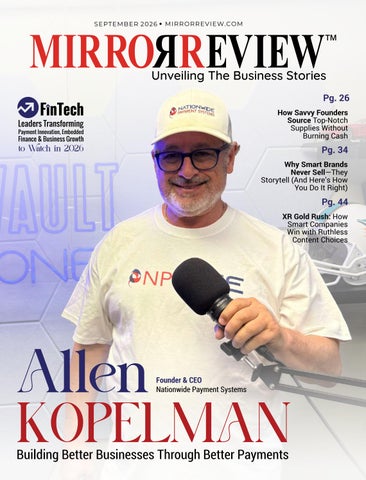
Founder & CEO Nationwide Payment Systems
Building Better Businesses Through Better Payments
Publisher Archana Ghule Editor-in-Chief Vikram Suryawanshi Managing Editor Simran Khan Project Editor Shadab Mestri ™
Mirror Review Magazine is published by Pericles Ventures Pvt. Ltd. No part of this publication may be reproduced, distributed, or used in any form without prior written consent from the publisher. The editorial team has exercised utmost diligence to ensure the accuracy and integrity of all published content; however, the publisher assumes no liability for any errors or omissions. The publisher also bears no responsibility for the content of advertisements featured within the magazine.
Mirror Review Media & Tech
Project Manager Anushka Nalawade Visualizer Mark Davis Graphic Designer Tejaswini Tandale Head of Distribution and Production Aakash Mahajan
Office No. 430, 4th Floor, Gera’s Imperium Rise, Opp. Wipro Circle, Hinjewadi Phase 2, Pune, Maharashtra - 411057.
Head of Operations Robert Smith
+1 (850) 564-8517
Research Analyst James Adams
info@mirrorreview.com www.mirrorreview.com
Advertising Maria Smith
EDITOR’S
Where Every Payment Powers Progress!
Dear Readers, Money now moves at the speed of a tap, a click, or a single line of code, and the businesses that understand this shift are quietly rewriting the rules of commerce. Payments have become the backbone of modern business, threading through cash flow, customer experience, and long-term growth. This issue, “FinTech Leaders Transforming Payment Innovation, Embedded Finance & Business Growth to Watch in 2026,” brings together the people turning that invisible infrastructure into a genuine advantage, proving that when payments are built with intention, they stop being a cost of doing business and become a reason to grow. Allen Kopelman, Founder and CEO of Nationwide Payment Systems, brings a rare perspective to fintech, shaped not in a boardroom but behind a restaurant counter, where he learned firsthand how quickly a cash flow problem can unravel a business. That grounding led him into payments in 1998 and, in 2001, into founding NPS on a simple belief: payments should not sit on the side of a business; they should help it run better. Under his leadership, NPS has grown from merchant services into a connected payments partner, bringing together ACH, e-commerce, fraud tools and accounting integrations through NPSONE. Allen has guided the company through recessions, a pandemic, and constant change by staying adaptable, and measures success by retention, efficiency, and relationships clients do not want to leave. Alongside him, this issue also features Wally Mlynarski, Chief Executive Officer of Elavon; Chris Dean, Chief Executive Officer and Co-Founder of Treasury Prime; Derek Dean, Chief Executive Officer of Flute; and John MacLeod, Senior Vice President and Director of Revenue Strategy and Sales at Newline by Fifth Third. What unites every leader in these pages is a refusal to treat payments as an afterthought. They see infrastructure where others see plumbing, and opportunity where others see routine transactions. As embedded finance reshapes how businesses operate, the leaders featured here are not simply keeping pace with change; they are shaping it. Their journeys offer a clear lesson for the wider industry: the companies willing to rethink how money moves will be the ones best placed to grow, adapt, and lead in the years ahead. Sincerely,
SIMRAN KHAN Managing Editor
10. Allen Kopelman
22. Chris Dean 30. Derek Dean 40. John MacLeod 48. Wally Mlynarski
Articles 26.
How Savvy Founders Source Top-Notch Supplies Without Burning Cash
34.
Why Smart Brands Never Sell—They Storytell (And Here’s How You Do It Right)
44.
XR Gold Rush: How Smart Companies Win with Ruthless Content Choices
Content
Profiles
FinTech Leaders Transforming Payment Innovation, Embedded Finance & Business Growth to Watch in 2026
Allen Kopelman
Chris Dean
Founder & CEO Nationwide Payment Systems
CEO & Co-Founder Treasury Prime
www.nationwidepaymentsystems.com
www.treasuryprime.com
Derek Dean
John MacLeod
Chief Executive Officer Flute
Senior Vice President, Director | Revenue Strategy Sales at Newline™ by Fifth Third
www.flute.com
www.53.com/content/fifth-third/en.html
Wally Mlynarski Chief Executive Officer Elavon www.elavon.com
A
restaurant teaches its owner things that rarely appear in a business textbook. There are margins to protect, employees to manage, vendors to pay, customers to satisfy, and above all, cash flow to keep moving. For Allen Kopelman, Founder & CEO of Nationwide Payment Systems, those lessons became the foundation for a career that would eventually take him into the payments industry. Before entering fintech, he worked as a chef, executive chef, and restaurant owner. Running a restaurant put him close to the daily realities of business, including how quickly a small problem with cash flow can affect everything else. When he entered the payments industry in 1998, he began looking at those same pressures from the other side of the transaction. He noticed that businesses accepted payments every day, yet many had little understanding of the infrastructure and economics behind them. That gap shaped the way he approached the industry. His philosophy is straightforward: payments should not sit on the side of a business. They should help the business run better.
10 I SEPTEMBER 2026
MIRRORREVIEW.COM I 11
12 I SEPTEMBER 2026
From Merchant Services to Payment Infrastructure
Starting With the Business, Not the Product
When Nationwide Payment Systems was founded in 2001, the payments industry was built around a fairly simple proposition: provide businesses with the equipment and rates needed to accept transactions. But Allen saw a wider problem. Business owners did not simply need another terminal or a better rate. They needed someone who understood how payments fit into the way their businesses actually worked.
The starting point at Nationwide Payment Systems is not a payment product. It is the business itself. Before recommending a solution, the team looks at how money moves through the company, from the moment a customer is billed to the point where the payment reaches the books.
That idea became the starting point for NPS. The company set out to offer more than payment processing, combining technology recommendations, operational guidance, and ongoing support. The relationship did not end when an account was opened. Over time, that approach pushed NPS beyond the traditional merchant-services model. Today, the company increasingly sees its role as helping businesses design payment infrastructure that works alongside accounting, software, cash flow, customer experience, fraud prevention, and business intelligence. Payments have become intertwined with the systems that keep a company running. Relationships Built Beyond the Sale In payments, a problem rarely arrives at a convenient time. A failed transaction can interrupt a sale, delay a payment, or leave a business owner searching for answers when they need them most. That is why accessibility has remained central to Allen’s approach to leadership. Clients, he believes, should not have to disappear into a ticketing system when something goes wrong. “They want somebody who understands their business and can help solve the problem,” he says. That same thinking shapes how NPS approaches technology and pricing. If a particular processor, solution, or pricing model is not right for a client, the company is willing to say so, even when another answer might lead to a faster sale. After more than two decades in the industry, that philosophy has become a business principle. “You don’t build a 25-year company by winning every sale. You build it by creating relationships people don’t want to leave.” For NPS, long-term value has always mattered more than a single transaction.
That means asking practical questions. How does the company invoice? Which accounting system does it use? Are customers paying by card, ACH, mobile wallet, or recurring payment? Is the business B2B or B2C? Are inefficient interchange qualifications eating into margins? Does it need an API, or are its payments disconnected from its software? The answers shape the infrastructure. NPS can bring together card processing, ACH, e-commerce, point-of-sale technology, gateways, recurring billing, payment links, fraud tools, QuickBooks Online, Xero, Sage Intacct, APIs and webhooks, Level 2 and Level 3 processing, and automated invoicing. Its NPSONE platform reflects where Allen sees the industry going: toward connected payment infrastructure that brings card processing, ACH, invoicing, accounting integrations, APIs, automation and reporting together in one environment. The goal is to reduce the friction between billing a customer, collecting the payment, and reconciling the transaction, without forcing businesses to piece together multiple disconnected payment systems. The Rate Is Not the Whole Cost Payment processing can look simple on paper. A business sees a rate, compares it with another offer, and assumes the lower number is the better deal. But the rate tells only part of the story. The real cost can also include markups, downgrades, incorrect interchange qualification, unnecessary fees, and transaction data that is not being used efficiently. That distinction becomes harder to ignore as payment volume grows. A small inefficiency on individual transactions can become a meaningful expense when multiplied across thousands of payments. For that reason, Allen encourages business owners to look at their payment statements with the same attention they give other operating costs. “A payment statement should be treated almost like an expense category that deserves ongoing analysis,” he says, rather than something that gets put in a drawer every month. The focus, therefore, is on the total economics of accepting a payment rather than a headline rate alone. MIRRORREVIEW.COM I 13
Making Payment Costs More Transparent
Leading Through Uncertainty
Interchange Pass-Through pricing separates the underlying card costs from the processor’s markup, giving businesses a clearer view of what they are actually paying.
Since founding Nationwide Payment Systems in 2001, Allen has led the company through recessions, COVID-19, major technology shifts, new regulations, changing card-brand requirements, bank and processor changes, cybersecurity concerns and rapidly evolving customer expectations.
For qualifying B2B transactions, Level 2 and Level 3 data can also help transactions qualify for more favorable commercial-card interchange categories when the appropriate enhanced transaction information is transmitted. Debit savings can similarly have a meaningful impact, particularly for companies processing significant B2C volume. These optimization strategies become especially important for higher-volume and large-ticket businesses, where even small improvements in transaction economics can translate into substantial bottom-line savings.
Those experiences have shaped how he approaches leadership when the path ahead is unclear. The process is straightforward: gather the available information, communicate with the people affected, make the best decision possible and keep moving. “The lesson I’ve taken from those experiences is that leadership during uncertainty is largely about remaining adaptable,” he says.
Payment routing has also become a major topic in the industry. Allen sees value in specific use cases but does not consider it a universal solution. The broader shift, in his view, is toward treating payment optimization as a technology consideration rather than simply a rate-negotiation exercise.
Entrepreneurs can become attached to the way their businesses once worked. But markets, technologies and customer expectations continue to change, making adaptability a practical necessity rather than simply a leadership ideal.
Building for What Comes Next
Measuring What Actually Matters
A payment system that works today can become a limitation tomorrow. For Allen, building a system means thinking beyond the immediate problem and leaving room for what a business may need as it grows.
Nationwide Payment Systems supports businesses across the United States, from growing SMBs to organizations with significant monthly transaction volume. Its clients span B2B, retail, hospitality, e-commerce, SaaS, healthcare and other specialized industries.
A company might begin with basic payment acceptance and later add ACH, automated invoicing, subscriptions, tokenization, ERP or accounting integrations, APIs, enhanced reporting or more sophisticated fraud controls. The infrastructure should accommodate those changes without forcing the business to replace everything underneath.
That range also makes transaction volume an incomplete measure of performance. Allen looks at client retention, measurable cost reduction, payment efficiency and uptime, along with the ability to solve complex situations.
That thinking points toward what he sees as the future of payments: open, connected ecosystems where different technologies can work together. Businesses should be able to enter new channels and adopt new capabilities without rebuilding their entire payment environment.
These measures provide a broader picture of whether NPS is delivering meaningful value to the businesses it serves. Growth matters, but so does the ability to reduce friction, control costs and remain dependable when payment challenges become complicated.
14 I SEPTEMBER 2026
MIRRORREVIEW.COM I 15
16 I SEPTEMBER 2026
MIRRORREVIEW.COM I 17
18 I SEPTEMBER 2026
The Achievement of Staying Relevant
Staying Curious
Remaining independent and relevant for 25 years is something Allen is particularly proud of. In an industry that has consolidated dramatically, maintaining that independence while continuing to serve changing business needs represents a significant milestone.
Curiosity has been a constant throughout Allen’s entrepreneurial journey. Despite decades in the payments industry, he remains deeply interested in what is happening next.
The company has expanded from traditional card processing into payment gateways, B2B optimization, SaaS and e-commerce integrations, smart invoicing, APIs, payment automation, consulting and complex payment environments.
He spends time exploring new technology, speaking with founders, following what fintech and AI companies are building, and considering how those ideas could solve practical problems for clients. That mindset also shapes the advice he gives other entrepreneurs. Experience can provide valuable perspective, but it can also create an attachment to familiar ways of doing things.
For him, that breadth reflects the importance of responding to changing customer needs rather than remaining confined to the company’s original offering. The achievement is not simply longevity, but the ability to remain useful as the payments landscape changes.
“Don’t become an expert in the way things used to work. Become a student of what is coming next.”
Looking Beyond the Technology
The Invoice Is Ready for a Rewrite
B2B Vault: The Biz-to-Biz Podcast has given Allen the opportunity to speak with founders, fintech executives, AI innovators, and entrepreneurs who are seeing different pieces of where business is going. Those conversations have reinforced a simple lesson: innovation can move incredibly fast, but successful technology still needs to solve practical problems.
The next several years of fintech will be shaped by technologies that make payments more connected to the broader financial workflow. Allen sees AI, embedded payments, intelligent invoicing, account-to-account payments, automated reconciliation, enhanced fraud prevention, and real-time financial data becoming increasingly important.
Does it save time? Does it reduce friction? Does it improve cash flow? Does it reduce cost? Does it make the customer experience better? Those questions, he believes, matter more than the buzzword attached to the technology. “Technology becomes valuable when people stop talking about the technology and start talking about what it enabled them to accomplish.” That perspective offers a useful way to view the next generation of payment technology. New tools will continue to emerge, but their lasting value will depend on the business outcomes they produce.
For him, staying curious means remaining willing to question established assumptions and learn from what the market is becoming.
He sees a particular opportunity in B2B invoicing. That vision is reflected in NPSONE Smart Invoicing, which points toward a more connected and intelligent invoice experience. Sending a PDF and waiting 30 or 60 days for payment feels increasingly out of step with what technology can now enable. “The invoice of the future will be interactive,” he says, bringing card, ACH and digital-wallet options, automated reminders, financing when appropriate, accounting synchronization and intelligent follow-up into a single experience. AI could eventually sit across much of that workflow, identifying payment behavior, detecting unusual transactions, helping manage risk, optimizing costs and predicting which invoices require attention. The result could be a change in how companies bill, collect and manage cash, turning the invoice from a static document into a more intelligent part of the payment process. MIRRORREVIEW.COM I 19
22 I SEPTEMBER 2026
CEO & Co-founder | Treasury Prime
CHRIS DEAN Building the Infrastructure Behind Embedded Banking
S
ome founders talk about their companies the way parents talk about children, with a mixture of pride and exhaustion that only makes sense from the inside. Chris Dean has served as the Chief Executive Officer and Co-founder of Treasury Prime since 2017, at the helm of a company built around a clear premise: banks and fintech companies need modern infrastructure that allows them to work together more efficiently. Treasury Prime, based in the San Francisco Bay Area, builds the application programming interfaces, the APIs, that connect banks, fintechs, and businesses and enable financial services to be embedded into digital products. The company’s platform supports capabilities including account opening, payments, money movement, risk management, and integrations with bank infrastructure. Chris does not describe this as a sudden idea. He says it was the accumulation of a much longer career spent watching institutions that should talk to each other struggle with disconnected systems, and deciding, eventually, to fix the wiring himself. The Acquisition That Taught Him the Business Treasury Prime was not Chris’s first attempt at building modern banking infrastructure. From September 2014 to August 2015, one year, he served as Chief Technology Officer and Vice President of Engineering at Standard Treasury, a company focused on API-based banking infrastructure for financial institutions and fintech companies. Standard Treasury was acquired by Silicon Valley Bank in 2015. He then stayed on, moving into the role of Chief Technology Officer of API Banking at Silicon Valley Bank. From 2015 to 2017, he led SVB’s API banking group, helping develop the technology that connected banking capabilities with fintech companies. That experience became a direct foundation for Treasury Prime, which he and Jim Brusstar founded in 2017.
MIRRORREVIEW.COM I 23
Before the Banks, a Health Plan Between his two banking ventures sits a company that, at first glance, seems out of place: Benefitter, an ACA-based health plan platform where Chris served as Co-founder and CTO. Treasury Prime identifies Benefitter among the software companies he founded or co-founded before launching the company. The detour makes more sense once it is understood as a pattern rather than an exception. Chris has spent his career building technology and infrastructure for industries with complicated systems and data, whether the industry in question was banking, healthcare, or, earlier still, enterprise software.
He studied physics at the California Institute of Technology, rather than computer engineering, and his technical background has remained a defining part of his career. Building Treasury Prime Treasury Prime was founded in 2017 by Chris Dean and Jim Brusstar. The company was created to provide a technology layer connecting banks and fintech companies through APIs, allowing businesses to integrate financial services into their products without having to build the underlying banking infrastructure themselves.
The Consulting Years and Merced Systems From 2001 to 2006, Chris was a co-founder of Merced Systems, an enterprise software company. The company developed software for performance management and analytics, and was later acquired by NICE Systems for approximately $200 million. He later founded Kyluka, a consulting firm, before moving through the healthcare and banking ventures that ultimately led to Treasury Prime. Across those companies, the common thread was software development and the use of technology to solve operational problems.
The model has evolved as Treasury Prime has grown. Today, the company describes itself as an embedded banking technology platform that helps banks reach new markets and enables fintechs and businesses to launch financial products through secure, scalable APIs. Its platform supports account opening, money movement, payments, compliance, and other banking capabilities, while its bank-direct approach is designed to connect fintech companies more directly with their banking partners. The Infrastructure Behind Embedded Banking
The Dot-Com Years Chris’s resume stretches back further than most fintech founders’ do, into the early days of consumer internet commerce. From 1998 to 2001, he served as Vice President of Software Development at BabyCenter, where he worked on the company’s technology organization. He later spent time at eToys.com following BabyCenter’s acquisition. Before BabyCenter, he was the first employee at Cogit Corp, a data-mining startup, from 1996 to 1998, where he worked on the company’s software infrastructure. These early roles established the technical foundation that would later shape his work in financial infrastructure.
The distinction matters because embedded finance has moved beyond simply placing a financial feature inside a software product. The infrastructure underneath those experiences has become increasingly important, particularly as banks, fintechs, and enterprises look for ways to launch financial products while maintaining stronger controls and clearer relationships. Chris’s recent public commentary reflects that shift. His perspective increasingly centers on embedded finance, bank-fintech partnerships, banking infrastructure, and the growing importance of bank-direct models.
Where It Started: JPL The earliest entry on Chris’s record is also, in some ways, the most striking. From 1994 to 1996, he worked as a Member of the Technical Staff in the Machine Learning Systems Group at NASA’s Jet Propulsion Laboratory. That early experience placed him at the intersection of software, machine learning, and large-scale data analysis. 24 I SEPTEMBER 2026
Treasury Prime has continued expanding its platform as well. The company says its network has processed more than $170 billion in trailing annual money movement, reflecting the scale that embedded banking infrastructure can reach when banks and fintechs operate through connected systems.
From Technical Builder to Financial Infrastructure Leader Chris’s career has moved through several industries, but the progression is consistent. At JPL, he worked on machine learning systems. At software companies, he built products and technical organizations. At Standard Treasury and Silicon Valley Bank, he worked directly on API-based banking. At Treasury Prime, he brought those experiences together into a platform focused on embedded banking. That progression explains why technology remains central to his approach. Treasury Prime’s platform is designed to make banking capabilities programmable, allowing businesses and fintech companies to build financial services into their existing products and workflows.
The Work Ahead The next phase of financial services will depend not only on new products but also on the infrastructure that allows those products to operate reliably. Treasury Prime’s recent focus on embedded banking, bank-direct partnerships, multi-bank connectivity, and financial infrastructure reflects that broader shift. For Chris, the work has remained consistent with the problem that first drew him into API-based banking: making financial systems more connected, programmable, and accessible to the businesses building the next generation of financial products. His career began with machine learning at JPL and moved through enterprise software, healthcare technology, and banking infrastructure. Treasury Prime represents the point where those experiences converge, with APIs serving as the connection between traditional banks and the companies building new financial experiences. MIRRORREVIEW.COM I 25
SAVVY FOUNDERS
Source Top-Notch Supplies Without Burning Cash Let’s be honest: Most small businesses overspend on supplies. Not because they’re reckless. Because they’re busy. Buried. Swamped. And when your attention is divided between keeping the books, hiring the right people, managing customer issues, and keeping your product or service alive — the last thing you want to do is hunt for better deals on inventory, parts, or packaging. But here’s the catch: Supplies quietly bleed your profit margins. Not dramatically. Not in one big, flashy mistake. But drip by drip, invoice by invoice — until you look at your P&L and wonder why your 20% margin looks more like 9%. That Stops Now. This is not a post about coupon codes or generic “cut costs” tips. This is a tactical framework that lean, resourceful founders use to buy better, smarter, faster — without compromising on quality. Let’s unpack it. Line by line. No fluff. 1. You’re Not a Customer — You’re a Business Partner First, change the way you approach suppliers. Most business owners treat supply vendors like vending machines: put in a request, get the product, move on. 26 I SEPTEMBER 2026
MIRRORREVIEW.COM I 27
That mindset keeps you in a transactional trap — which is where you overpay the most. Great operators flip the script. They build supplier partnerships, not just vendor lists. That means: · Calling your supplier instead of emailing. · Asking about bulk thresholds, payment terms, freight arrangements. · Letting them know your order frequency and average volume. · Negotiating not on the price tag but on the relationship value. Because here’s the truth: Vendors care about predictability more than price.
• For raw materials: Locate niche or regional suppliers who specialize in your space. • For operational tools: Consider refurbished or high-quality used gear. A real-world example? Farmers buying bulk feed bins directly from regional manufacturers are saving 30–50% compared to those buying via supply chains. Why? No markup layers. And these bins last 10+ years — which means more ROI per dollar spent. Used ≠ cheap. Sometimes it’s just smart buying from businesses who upgrade faster than they depreciate assets.
3. Local Isn’t Just Ethical — It’s Efficient If you’re a reliable repeat buyer, many will offer flexible payment windows, early access to inventory, or even Too many businesses sleep on their waive shipping fees to keep you loyal. local vendors because they think “local” means “limited.” Don’t ask for a discount. Ask for a better deal long-term. That’s wrong.
4. Buy in Bulk — But Only with a Strategy Yes, buying in bulk saves money. But only when: • You use that product consistently. • You have the storage space. • You can absorb the upfront cost without cashflow pain. Otherwise, bulk is a trap disguised as a deal. If bulk purchasing feels risky, group buying is your secret weapon. Form a purchasing alliance with 3–5 other businesses in your niche. Split the cost. Split the shipment. Keep your margins tight. This works especially well for: • Packaging materials • Perishable ingredients (with synchronized production schedules) • Maintenance parts or consumables Buying together creates scale advantages without scaling too fast. 5. Play the Timing Game Suppliers run on cycles.
2. Stop Buying from the Front Page
Local sourcing can give you:
Retailers optimize their websites and catalogs to make you buy fast — not smart.
• Faster turnaround times (no 7 day shipping delays). • Lower logistics costs (local pickup, no freight). • Better service (because you’re a known face, not order #934201).
If you’re sourcing from the same five suppliers as everyone else, using the default SKUs, and never asking: “Who’s actually building this stuff?” you’re eating middleman costs every time. The smarter play? Go upstream. •
For equipment: Find themanufacturers, not just the reseller
28 I SEPTEMBER 2026
And here’s a little-known power move: Bartering with local vendors. Think design services in exchange for packaging. Or promoting their brand to your customers in exchange for discounted goods. Trust and proximity build creative deals — not just invoices.
• End-of-quarter clearance. • Off-season pricing. • Holiday overstock selloffs. • Fiscal-year-close discounts. Knowing this gives you a strategic edge. Don’t just buy when you run out. Buy when the price curve dips. The best operators use purchase calendars. They plan procurement windows around these cycles — not on panic reorders. Set alerts for seasonal trends in your industry. Keep a running “next buy” list. Even 10% off across 20 SKUs, 4x a year that’s thousands saved annually. Buy early. Buy when the market blinks.
6. Challenge Brand Loyalty You’re not Nike. You don’t need brand consistency on the boxes you open behind the scenes. If you’re paying a premium just because “that’s the brand we’ve always used” — ask yourself: Is it actually better? Or just familiar? Comparison-shop with specs. Look at material quality, warranty, lead times — not logo recognition. Newer or upstart brands often overdeliver at lower prices to build market share. You win by testing and switching where possible. Try A/B testing your top five purchases with alternative suppliers quarterly. Track cost, performance, and feedback from your team. Familiarity feels safe. But margins don’t lie. 7. Create a Supplier Scorecard
8. Document Your Procurement Playbook
Final Word: Small Business, Big Advantage
Here’s a dirty truth: Most small businesses keep supply sourcing “in the owner’s head.”
The difference between a scrappy business and a scalable one often sits in invisible systems. Procurement is one of them.
Then the owner gets sick, hires a buyer, or scales — and chaos follows.
When you shift from passive buying to active sourcing, you unlock:
Don’t wing it.
To stay ruthless about your supply chain, track more than price. Build a monthly/quarterly supplier scorecard with:
Start a simple supply SOP:
• Cost per unit (including delivery) • Product durability / return rate • Lead time accuracy • Payment flexibility • Responsiveness
• Where you buy from (and 2–3 backups) • Why you chose them (price, quality, relationship) • How often you buy (and seasonality notes) • What deal you’ve negotiated (and renewal terms)
Then rank your vendors and ditch the bottom 20%. No emotion. Just performance. Great businesses don’t just track sales metrics. They track spend performance with the same discipline.
Documenting this saves time. Trains your team faster. Protects you from key-man risk.
If you’re not measuring supplier performance, you're not managing it.
Systems scale. Scramble doesn’t.
• Higher margins • More resilience • Less stress You stop reacting and start operating. So whether you’re running a rural supply shop, a SaaS startup with physical components, or a local food brand — remember this: Every dollar you save without sacrificing quality drops straight to profit. Smart supply chains aren’t a luxury. They’re a weapon. Use them like one. MIRRORREVIEW.COM I 29
CEO | Aurora Payments 30 I SEPTEMBER 2026
Dek De
T
itles change hands quietly in the payments world. There is rarely a press conference, just a new name on a company announcement and, sometimes, a company that did not exist under its current name a few years earlier. Derek Dean became Chief Executive Officer of Aurora Payments in December 2024, and the company became Flute in 2025. Based in Atlanta, Georgia, Flute is backed by Corsair Capital and operates as a payments platform serving the businesses that power the everyday economy. He also serves on Flute's Board of Directors. To understand why Corsair Capital-backed Flute handed the reins of its payments platform to Derek, it helps to look at what he spent the previous two decades doing: leading commercial organizations, integrating acquisitions, and scaling businesses across several industries. Chicago, and a Business That Had Gone Flat Before Flute, Derek spent from August 2023 to December 2024 as President, Americas, at Syndigo, where he was responsible for revenue operations. Syndigo described the appointment as part of an effort to strengthen its leadership team as the company expanded its SaaS commerce data-management business. He joined from EverCommerce, where he had been Senior Vice President of Sales and Customer Success and had helped scale the business while integrating multiple acquisitions.
MIRRORREVIEW.COM I 31
During his time at Syndigo, he also took on broader commercial leadership responsibilities and spoke publicly about growth, digital commerce, and customer experience.
That period established the commercial foundation that would later carry through his work at ConstructConnect, EverCommerce, Syndigo, and eventually Flute.
Denver, and a Company Built From Pieces
The Common Thread
Two years before Syndigo, Derek took on a similar problem at a different kind of company. From September 2021 to August 2023, he served as Senior Vice President of Sales and Customer Success at EverCommerce in Denver. The company operates a portfolio of SaaS and technology-enabled services businesses, many of which had grown through acquisition. His role involved scaling the commercial organization and helping integrate multiple acquired businesses.
Taken end to end, Derek’s career does not sound like a payments story at all, at least not until the end. It reads like a study in what happens when a leader is asked, again and again, to take complex commercial organizations and make them more coordinated, scalable, and growth-oriented. Construction data. Service-commerce software. Commerce data management. Now payments infrastructure.
That experience gave him a recurring opportunity to work across businesses with different teams, products, and operating models while maintaining a common focus on growth and customer relationships.
That trajectory helps explain why Flute brought him into the CEO role. The company is not simply adding another payment product to an existing business. It is building a broader payments platform around merchants, partners, and software ecosystems. Flute describes its platform as bringing together payments, deposits, reporting, business management tools, and embedded finance capabilities in a single environment.
Cincinnati, and a Four-Way Merger The pattern goes back further still. From November 2017 to September 2020, Derek served as Executive Vice President and General Manager of the Building Products Group at ConstructConnect in Cincinnati. His responsibilities included leading the Building Products business in North America. ConstructConnect had been formed through the combination of several businesses, including CMD, iSqFt, BidClerk, and CDC, bringing together products, customers, and commercial organizations under one company. ConstructConnect was later acquired by Roper Technologies in 2020. The underlying skill across these roles is consistent. Different companies presented different commercial challenges, but he repeatedly worked in environments where growth, integration, and organizational alignment were central to the job. Sixteen Years at RELX Before any of that, Derek spent more than sixteen years at RELX, including leadership roles within Reed Construction Data. From 2001 to 2017, he moved through sales and sales-management positions, eventually becoming Vice President of Sales. His work included leading sales organizations, developing go-to-market strategies, and supporting the transition of construction information businesses from traditional print products toward digital and SaaS offerings. 32 I SEPTEMBER 2026
Building for the Everyday Economy Flute's current platform is designed for businesses such as independent retailers, salons, restaurants, jewelry stores, veterinary practices, and other small and midsize businesses. Its offering combines payment acceptance with tools for invoicing, recurring billing, dispute resolution, reporting, deposits, and embedded financial services. That positioning gives Derek a different challenge from his earlier roles. At Flute, commercial growth is closely connected to the underlying payment infrastructure itself. The company says it has signed more than 113,000 customers and processed more than $40 billion in payment volume, while building a partner network that includes independent sales organizations, software platforms, and trade associations. From Growth Leadership to Payments Derek’s move into payments may look like a departure from the industries that came before it, but the underlying work remains familiar. His previous roles centered on building organizations, integrating businesses, developing commercial strategies, and creating systems that could support growth.
At Flute, those capabilities are being applied to a payments business where technology, distribution, merchant relationships, and financial services increasingly overlap. Flute's strategy reflects that convergence. The company has expanded beyond traditional payment acceptance toward embedded finance, using transaction data and merchant relationships to connect businesses with additional financial tools. In a recent announcement, he described the goal as deepening Flute’s fintech capabilities while delivering more value to partners and customers. What Comes Next Flute's evolution is still underway. The company recently introduced its current brand and platform as part of a broader effort to bring payments, deposits, reporting, business-management tools, and embedded finance together under one offering.
For Derek, the challenge is no longer to unify sales teams across software businesses or accelerate growth in a data-management company. It is to scale a payments platform while keeping the experience practical for the businesses that rely on it every day. His career has moved through construction data, SaaS, service commerce, and commerce data management. Now, at Flute, that commercial experience is being applied to payments infrastructure, where the next phase of growth will depend on how effectively technology, financial services, and merchant needs can work together.
MIRRORREVIEW.COM I 33
Let’s get one thing straight—no one buys your product. They buy their own transformation. That’s the punchline too many entrepreneurs miss. If you’re still pitching features or bragging about your process, you’re leaving money on the table. The truth? People buy when they feel like the story you’re telling sounds like their story. Not yours. And the most powerful way to make that happen is by hijacking something ancient: The Hero’s Journey. This isn’t a trend. This is human psychology. It’s what our brains default to when trying to make sense of life, change, or challenges. Hollywood knows it. High-performing brands know it. Founders who build category-defining startups know it. Let’s break down how you embed it into your brand messaging like a real strategist—not a content creator who’s winging it. 1. Your Customer Is the Hero. You’re Just the Guide. Accept It. This one shift will clean up 80% of your messaging clutter. Stop trying to convince your customer how smart, qualified, or experienced you are. They don’t care—yet. They care about themselves. Their problem. Their need. Their confusion. Their desire to stop the bleeding. So put them at the center of your story. 34 I SEPTEMBER 2026
You’re not the main character. You re the person who helps the main character win. Think Yoda. Think Haymitch. Think Moana’s grandmother. They’re the ones who nudge the hero out of their comfort zone, hand them the compass, and say, “This way. I’ve walked this road. You're not alone.” That’s your job. So next time you write content, don’t start with, “I help women build soulful businesses.” Start with this: “You know that feeling when you’ve outgrown your business, but every pivot feels risky and wrong? Let’s fix that.” See the difference? 2. The Problem Isn’t Just a Problem—It’s the Call to Adventure Your customer’s stuck moment? That’s where your story starts. Not your origin story. Not your “why.” Theirs. You need to articulate the tension they feel—but can’t always name. When done right, they read your content and say, “Wait, how are you in my head?” That’s when they keep scrolling.
MIRRORREVIEW.COM I 35
Here’s how you get that clarity: · Look at what your best clients said when they hired you. · Check DMs. Emails. Exit surveys. · Pay attention to where they almost gave up. · Use their actual words. Don’t translate them into brand language. Example: · Not: “I help burned-out professionals realign with purpose.” · Try: “You thought quitting your job would feel like freedom. But now it’s 2PM, and you’re Googling how to price your service—again.”
Share a small success story. Show proof. Be real. No need for polished perfection. That’s not what builds conversion.
That’s the call to adventure.
4. Then You Sell the Transformation. Not the Offer.
Make it so vivid they feel slightly uncomfortable reading it. That’s when the shift starts.
People don’t care about your 6-week program, your group calls, your templates.
3. You Step In. Not With Hype—With Help. Here’s where most brands go wrong. They hear “guide” and think it means “guru.”
Clarity does.
They care about what changes after working with you. So stop listing deliverables like a menu. Paint a clear before-and-after picture. Make it so grounded, they can visualize themselves living it next week. Here’s what that sounds like:
Nope. Your job isn’t to sound impressive. It’s to offer something solid they can use today. Something that builds trust without pressure.
· Before: “I hate marketing. It feels fake. I never know what to post.” · After: “Now I write posts in 30 minutes flat—and people DM me saying, ‘This hit hard.’” That’s real.
You offer a way forward that feels safe. Predictable. Testable. You break down the next steps clearly. Like this:
You’re showing them the new identity waiting on the other side of the work. It’s not about “6 coaching calls.” It’s about “knowing what to say when someone asks what you do.”
“We map out your new messaging in 90 minutes. Then you try it out. We adjust what doesn’t land. You go live without overthinking it.”
5. You Don’t Need a Funnel. You Need a Narrative Arc.
That’s a plan.
Let’s get practical.
You don’t need fireworks. You need structure.
This is what the Hero’s Journey looks like in your content ecosystem:
36 I SEPTEMBER 2026
Sell that.
Use this map. Repeat it. Rotate it through your channels. Don’t just “post valuable content”—build narrative momentum.
· “Mira told me she felt invisible. Last week, she got her first press mention.”
6. If Your Brand Isn’t Sticky, Your Story’s Not Sharp Enough
These aren’t testimonials. They’re mini-hero journeys. And they show your audience one thing: This is possible for you, too.
Most people don’t quit your content because it’s bad. They quit because it’s vague.
No One Buys Coaching. Or Courses. Or Systems. They buy belief.
You’re not naming the tension. You’re not articulating the shift. You’re not closing the loop. Here’s what fixes that: · Cut 80% of your adjectives. Add 20% more verbs. · Don’t tell people you’re “aligned.” Tell them you stopped crying on Sunday nights. · Don’t say you help people “scale.” Say you helped someone double revenue without doubling hours.
Belief that this time, they’ll make it work. Belief that someone actually understands what they need. Belief that they won’t waste money again. Stories give them that belief. Not hype. Not hacks. Not high-ticket urgency tactics. Stories.
Story sticks when it moves.
And not just any story—a story where they win. That’s the only pitch that really works.
7. Let Their Ending Be Your Beginning
Final Word
Here’s the big one.
Look. We’re not selling lipstick here. We’re building trust with people who’ve likely been burned before. That takes something deeper than dopamine marketing.
When people see themselves in your clients’ wins, they self-select to start the journey.
It takes narrative strategy. So build your content around transformations already happening. Document your client’s first wins. The messy middle. The surprise outcomes.
So ditch the guru vibes. Step into the role you’re actually built for: the woman who shows up with a map, a mirror, and a flashlight. You’re not selling services.
Say things like: You’re selling self-belief. · “When we started, Sam wasn’t even sure she had a real business. Today, she booked out Q3 in two weeks.”
Get your story straight—and watch what happens next. MIRRORREVIEW.COM I 37
A
new title rarely tells the whole story, but it is worth starting with anyway. In April 2026, John MacLeod became Senior Vice President, Director of Revenue Strategy and Sales at Newline™ by Fifth Third, the bank’s embedded-finance and payments platform, working from the greater Boston area. Newline combines Fifth Third’s banking capabilities with an API-driven platform designed to help fintechs and enterprises launch payment, card, and deposit products. John’s own professional description identifies him as an “accomplished and hands-on B2B Payment Executive” with experience spanning B2B payments, buyer-initiated payments, credit cards, virtual payment accounts, ERP integration, supply-chain financing, dynamic discounting, and e-invoicing. 40 I SEPTEMBER 2026
Building on a B2B Payments Career Before joining Newline, John spent nearly seven years at Capital One, where he worked in commercial payments and business-card strategy. His work centered on enterprise sales, commercial-client development, and payment solutions for businesses. That experience placed him close to the problems that continue to shape B2B payments: how companies move money, automate accounts payable and receivable processes, improve cash-flow management, and replace manual payment methods with digital alternatives. His move to Newline builds directly on that background. The platform is focused on helping fintechs and enterprises integrate financial capabilities into their products and workflows, putting payments and banking infrastructure closer to the businesses and consumers using them.
MIRRORREVIEW.COM I 41
The Comdata Years
The Newline Opportunity
Before Capital One, John spent several years at Comdata, working in strategic sales and partnerships. Comdata operates in commercial payments, providing payment products and services for businesses and organizations.
Newline represents a significant shift in how banking and payments can be delivered. Rather than requiring businesses and fintechs to build financial infrastructure themselves, the platform provides APIs and banking capabilities that can be integrated into digital products and existing workflows. Its offerings include payments, cards, deposits, and other embedded financial capabilities.
His experience there added another layer to his B2B payments background, particularly around virtual-card solutions and strategic partnerships. Taulia and Supply-Chain Finance John also worked at Taulia, a financial-technology company focused on working-capital and supply-chain-finance solutions. His work there broadened his exposure to the financial processes surrounding business payments, extending beyond the transaction itself into areas such as supplier relationships and working capital. That experience is relevant to the broader evolution of B2B payments, where payment technology increasingly connects with invoicing, procurement, financing, and cash-flow management. Building the Healthcare Connection Before moving deeper into financial technology, John developed substantial experience in the healthcare sector. He worked in commercial roles serving healthcare organizations, giving him a close view of the operational and financial challenges faced by hospitals and other large institutions. That background later informed his work with healthcare clients in commercial payments, where payment automation could address some of the inefficiencies created by traditional, paper-based processes. From Sales Leadership to Payments Strategy Across the different stages of his career, the common thread has been helping organizations adopt technology that improves the way they operate. His earlier work in healthcare sales developed his understanding of large institutional buyers. His financial-technology roles brought him deeper into B2B payments, virtual cards, working capital, and payment automation. His work at Capital One expanded that experience across commercial payments. At Newline, those capabilities come together within a platform focused specifically on embedded finance and enterprise payments. 42 I SEPTEMBER 2026
John has already been active in articulating that direction. His recent industry commentary has focused on embedded finance, payment infrastructure, bank-fintech partnerships, instant payments, and the infrastructure required to move money securely and reliably at scale. Newline has also received recognition for its work in the space. American Banker named Newline an Innovation of the Year 2026 honoree in the Embedded Finance category, recognizing its API-driven platform for fintechs and enterprises. Where B2B Payments Are Heading The next phase of B2B payments is increasingly connected to the systems businesses already use. Payment acceptance, account services, ERP connectivity, automated workflows, real-time payments, and financial data are becoming parts of a broader digital infrastructure rather than isolated products. For someone whose career has centered on B2B payment solutions and commercial growth, Newline gives him an opportunity to work at that intersection directly. The role is also closely aligned with the direction of Fifth Third’s embedded-finance strategy. The bank has positioned Newline around partnerships with fintechs and enterprises, using its banking infrastructure to help those companies build and scale financial products.
John arrives at Newline with experience spanning healthcare, commercial payments, financial technology, enterprise sales, and revenue strategy. The common thread is a focus on helping businesses navigate increasingly complex financial processes through technology and more efficient payment models. At Newline, that experience is being applied to a market where payments, banking, software, and embedded finance are becoming increasingly interconnected. As the platform expands its enterprise and fintech relationships, his role will center on translating that infrastructure into sustainable commercial growth.
MIRRORREVIEW.COM I 43
I
f you’re in charge of making XR work for your company—read this before you spend a single cent.
You’re about to face a fork in the road. Choose the wrong XR content path, and you’ll burn budget, waste time, and kill momentum. Choose wisely, and you’ll cut learning curves, boost retention, and earn internal credibility faster than you can say “digital transformation.” I’ve consulted with defense contractors, medtech giants, public school systems, and two-letter agencies. They all asked me one question: “What kind of XR content should we start with?” My answer: That depends entirely on how you think. Not your tech stack. Not your headset choice. Not even your budget. Let me break it down ruthlessly. The Four Content Paths in XR—And Who They’re Really For You’ve got four options: 1. Custom Content (outsourced) 2. Authoring Platforms (DIY) 3. Off-the-Shelf Content 4. Quest Store Content Each one fits a very specific mindset and business model. If you try to mix and match without clarity, your XR rollout will sputter or stall. Let’s get into the meat. 44 I SEPTEMBER 2026
1. Custom Content: The Control-Freak’s Playground Best for: Large enterprises. Regulated industries. Companies with zero tolerance for “close enough.” When you commission an external XR agency to build custom content, you’re hiring a SWAT team. They do the design. They do the programming. They interpret your policies and SOPs into immersive learning or simulation modules. You pay for precision and peace of mind. Here’s how it works: · You hand over your subject matter expertise. · The agency builds a virtual world around it. · You get full control over what's inside that world. Upside: · Every second of content reflects your exact needs. · You don’t rely on internal teams. · You own the IP (most of the time). Downside: · You pay a premium—think $30K to $500K+ per module. · Any update (even changing a logo or SOP step) = dev time + added cost. · Expect timelines of 3–6 months per module. The hidden cost: You’re not just paying for XR development. You’re paying for project management across creative, legal, and IT departments. If your org sucks at cross-functional coordination, this will hurt.
MIRRORREVIEW.COM I 45
B
ottom Line: This route is for organizations that move slow on purpose—because they have to get it right, not just done. 2. Authoring Platforms: The Control You Want Without the Wait Best for: Lean teams with technical literacy. High volume training orgs. Institutions with internal SMEs who like to build. These platforms give you a drag-and-drop editor (usually no-code) where you assemble immersive modules using your own assets or provided templates. Think: PowerPoint for the metaverse—with a learning curve. Here’s what you get: · Faster deployment cycles. · Complete version control. · No dependence on dev agencies. Upside: · You update training when policies change—same day. · No dev bottlenecks. · Long-term cost savings. Downside: · Someone in your org must own the platform—every day. · Initial setup takes serious elbow grease. · You’ll need access to 3D assets (which aren’t free or easy to make). The hidden cost: The time it takes to build that first module. SMEs often underestimate the detail-orientation required to build usable VR lessons, even with no-code tools. It’s easy to build junk. Pro Tip: Assign an internal “XR content owner” who lives in that authoring platform. Don’t spread it across teams. Ownership kills inertia. 46 I SEPTEMBER 2026
Bottom Line: If you want speed and scale—and you’re okay learning new software—this is your path. It’s not beginnerfriendly, but it pays off in iteration. 3. Off-the-Shelf Content: The 80/20 Play Best for: Teams that want immediate results. Startups. Training departments under time pressure. Here’s the brutal truth: 80% of what companies try to build in VR already exists. Soft skills. Safety. Customer service. Basic compliance. You don’t need to reinvent the wheel. You just need to plug it in. Off-the-shelf content refers to pre-built XR modules you can license and deploy. Here’s the play: · Search a curated XR content directory (like ArborXR). · Find pre-built modules aligned with your goals. · Push them to headsets via your XR MDM (mobile device manager).
Upside: · Plug-and-play fast. · Flat fees. · No dev wait time. Downside: · No customization. · Mixed content quality (some are great, some are trash). · You need infrastructure to manage updates across multiple devices. The hidden cost: Most off-the-shelf content is hosted via app stores that weren’t designed for enterprises. That means clunky versioning, no mass rollout support, and data privacy red flags. Bottom Line: This is the fastest way to prove ROI. Deploy it. Measure impact. Then decide if you want to go deeper.
The hidden cost: Every hour spent downloading and updating apps on individual headsets is time stolen from actual deployment. At 50 devices, this is annoying. At 500, it's a full-time job. Bottom Line: If you’re using the Quest store as your enterprise content pipeline, you’re setting your team up for admin hell. So What Should You Choose? Let me cut through the noise. · If you’re a Fortune 500 with legacy systems and big budgets: go custom. · If you have tech-savvy trainers and love rapid iteration: choose an authoring platform. · If you need to show impact this quarter, not next year: buy off-the-shelf content. · If you’re just experimenting or testing one device: the Quest Store is fine—for now.
4. Quest Store Content: Looks Easy, Isn’t
The Real Decision: Speed vs. Ownership
Best for: Individual users. Proof-of-concept. Teams who don’t mind manual installs.
Don’t get distracted by bells and whistles. What you’re really deciding is:
The Meta Quest Store is sexy. It’s got all the bells and whistles—interactive apps, high-fidelity environments, tons of options.
Do you want speed (off-the-shelf) or control (custom or authoring)?
But it’s built for consumers, not companies.
Most companies start with speed, then graduate to ownership. That’s smart. But what kills most XR programs is lack of clarity about this balance.
Here’s the issue: · No way to bulk-install apps across devices. · No enterprise licensing models. · You’ll be forced to sideload or download each app manually on every device. Upside: · Great consumer experience. · Meta-approved apps only. · Works with XR device managers—as “unmanaged apps.” Downside: · No centralized control. · No rollback options. · Licensing and distribution is a mess at scale.
Final Word: Find Your XR Muscle, Then Train It XR isn’t a single software decision. It’s a competency. You build it the same way you build cybersecurity or customer support—by making a few big bets, then refining based on feedback. Don’t guess. Don’t copy. Build for your org’s DNA. If you’re not sure where to begin, use a vetted content developer directory like ArborXR Directory. Get on a call. Ask uncomfortable questions. Test before you commit. This game is too expensive to wing it. But it’s too valuable to ignore. MIRRORREVIEW.COM I 47
A
tlanta’s payments corridor has a peculiar gravity. Executives leave it for New York or San Francisco, chase bigger titles in bigger cities, and then, often enough, they come back. Wally Mlynarski did exactly that in March 2026, when he was named Chief Executive Officer of Elavon, the global payments company headquartered in Atlanta and a wholly owned subsidiary of U.S. Bank, which is part of U.S. Bancorp (NYSE: USB). It was not a stranger walking into the corner office. It was a man returning to a company he had helped shape, one product line at a time. Wally describes himself, in the plainest terms he can manage, as “a seasoned payments executive with deep experience across the financial services and payments ecosystem.” It is an understatement dressed up as a job description. His career, when laid flat, reads like a long arc through the payments industry itself: mobile commerce and payment innovation in an era when mobile payments were still emerging, merchant services before ‘embedded finance’ was a phrase widely used in a boardroom, and now, at the top of Elavon, the work of making all of it feel invisible to the people using it. The Grove Years Long before he ran the company, Wally built something inside it. In 2012, he became Vice President of ‘The Grove,’ Elavon’s Global Mobile Commerce Solutions unit, and by his own account, created an innovation lab from the ground up, leading a cross-functional group spanning product management, development, architecture, QA, and design. The Grove officially launched in 2013 as Elavon’s Atlanta-based mobile innovation center, focused on mobile payments, new technology, product development, and third-party partnerships. The center was designed to develop mobile-payment technologies and expand Elavon’s existing mobile solutions, while also creating partnerships with outside innovators.
48 I SEPTEMBER 2026
MIRRORREVIEW.COM I 49
By August 2014, he had been promoted to Senior Vice President of Global Omni-Commerce Solutions, still leading The Grove, with responsibility spanning mobile and eCommerce. A Business RadioX segment from that period called him a “recognized expert in mobile payment solutions,” a title that, in hindsight, undersells how early he arrived at a problem the rest of the industry was still circling. Then, in May 2015, Elavon promoted him again, this time to Senior Vice President of Global Product and Innovation, a role in which he oversaw global, crossfunctional product-development teams and initiatives including mobile payments, EMV migration, and security solutions. In 2017, he became Chief Product Officer of Elavon, a position he held until 2019. His first tenure at Elavon lasted about seven years, before he left the company for Bank of America in 2019.
He was not listed as an ETA board director; ETA identified him as part of its Presidential Advisory Council. Those roles placed him alongside leaders from across payments and fintech, giving him a wider industry vantage point beyond his responsibilities at Bank of America. A Georgia Tech Foundation Before any of it, there was an engineering degree. Wally holds a bachelor’s degree in computer engineering from the Georgia Institute of Technology, and his earliest jobs bear the fingerprints of that training more than any payments pedigree. He started as a Quality Assurance Engineer at Intellisync, followed by roles in enterprise support, Nokia, and SK C&C USA, before joining Elavon. His professional background spans software, mobility, solutions architecture, sales engineering, and payments product leadership.
From Product to P&L Leaving Elavon in 2019 did not mean leaving payments. Wally joined Bank of America, where he spent nearly seven years, moving through a sequence of titles that tracked a familiar executive arc, from product leadership toward commercial ownership. He led Merchant Services and later Merchant Solutions and Receivables, ultimately overseeing a broader part of the payments and cash-flow equation before his return to Elavon in March 2026. Bank of America materials identified him as head of Merchant Services and Receivables, while industry records also listed him as Head of Merchant Solutions. It is worth pausing on what that title change signals. Receivables is not a glamorous word. It is the unromantic middle of a company’s cash flow, the part nobody photographs for an annual report. But it is also where a payments executive proves whether they understand the full plumbing of a business, not just the part that swipes a card, but the part that gets a merchant paid. His public biography describes him as someone who 'partnered closely with acquirers, fintechs, networks, and technology providers,’ and as a leader known for ‘advancing intuitive, client-focused payment innovation at scale.’ The Coalition and the Association While climbing through Bank of America, Wally also took on industry roles that reflected his involvement in the wider payments ecosystem. He served on the American Transaction Processors Coalition (ATPC), and in 2023 he was appointed to the Electronic Transactions Association’s Presidential Advisory Council. 50 I SEPTEMBER 2026
He is candid about how that foundation shapes his leadership. “My leadership,” he says, “is grounded in strong technical expertise and a commitment to customerdriven execution.” That combination of technical knowledge and customer focus has remained central to his approach throughout his career, from product development and solutions architecture to leading payment businesses at scale. The Return, 2026 What makes Wally’s ascent to CEO notable is not that it happened, but how unsurprising it was given his earlier role at Elavon and his subsequent leadership at Bank of America. He is not an outsider brought in to disrupt Elavon. He is the person who spent about seven years shaping its product organization, left to broaden his experience in merchant services and receivables at Bank of America, and returned as CEO with experience on both sides of the equation, technology and commercial payments. As CEO, Wally now leads Elavon, where he is responsible for delivering secure, scalable payment solutions across the company’s markets in the United States, Europe, and Canada. Elavon has described his mandate in terms of scalable, tech-led, and embedded payments innovation for businesses of all sizes. It is a mission statement that could belong to almost any payments executive. What distinguishes his version of it is the two-decade paper trail behind it, a career spent, quite literally, inside the machine he is now responsible for running.
www.mirrorreview.com