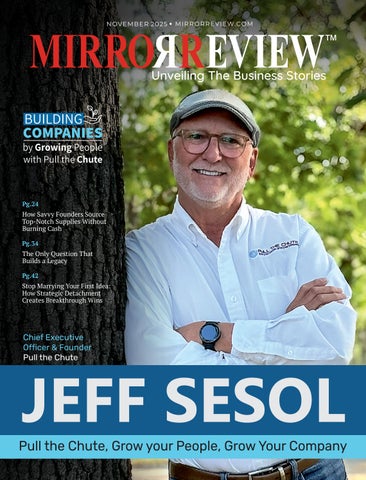
N OVE M B E R 2 0 2 5
M I R R O R R EVI EW.CO M
™
BUILDING
COMPANIES by Growing People with Pull the Chute
Pg.24
How Savvy Founders Source Top-Notch Supplies Without Burning Cash Pg.34
The Only Question That Builds a Legacy Pg.42
Stop Marrying Your First Idea: How Strategic Detachment Creates Breakthrough Wins
JEFF SESOL
EDITOR’S LETTER
Unlearning Control. Unlocking Growth! ear Readers, In a world where disruption has become the norm and business cycles move at lightning speed, organizations are facing a leadership reckoning. Traditional top-down management models no longer serve the needs of a workforce that values autonomy, purpose, and psychological safety. Companies today must adapt not just to technological evolution, but to human evolution—an era where inclusive, people-first leadership determines who thrives and who merely survives. The global business landscape is shifting away from control and hierarchy and toward cultures rooted in trust, communication, and empowerment. It is in this climate that truly transformative leaders are stepping forward, reminding us that sustainable growth begins withthose who power the organization: its people. This edition of Mirror Review, “Beyond Growth: Building Companies by Growing People with Pull the Chute,” showcases some of the selective visionaries. Our cover story embodies this very philosophy. This issue spotlights Jeff Sesol, CEO of Pull the Chute, a leader who has dedicated his life to reshaping how companies operate from theinside out. Jeff—an award-winning leadership coach, best-selling author, and the voice of the widely followed Pull the Chute podcast—has become something of a first responder for businesses standing at the edge of untapped potential. His approach is refreshingly straightforward yet revolutionary: Grow your people, and your business will grow automatically. Instead of prescribing complex frameworks, Jeff offers clarity, perspective, and a methodology engineered to combat what he calls “Founder’s Syndrome”—a command-and-control leadership style that stifles innovation and eventually becomes the biggest bottleneck in an organization. His work restores balance, expands leadership capacity, and reignites the human engine that fuels all progress. Alongside Jeff’s compelling journey, this edition features inspiring profiles of Casimiro Da Silva Santos, Dr. Melinda Fouts, Gretchen Villegas, and Kelsey Waldrop—professionals who are redefining leadership by prioritizing emotional intelligence, human connection, and authentic growth. As we explore their stories, we invite you to rethink leadership not as a position, but as a practice—one rooted in elevating people so organizations can rise higher than ever before. Happy Reading!
PARAG AHIRE PROJECT EDITOR
PUBLISHER
ARCHANA GHULE
EDITOR-IN-CHIEF
VIKRAM SURYAWANSHI
FOLLOW US
MANAGING EDITOR
mirrorreviewofficial
PANKAJ GHOLAP
MirrorReview1
PROJECT EDITOR
mirror-review
PARAG AHIRE
PROJECT MANAGERS
mirrorreview mirrorreview
RUSHIKESH
VISUALIZER
MARK DAVIS
GRAPHIC DESIGNER
Mirror Review Media & Tech Office No. 430, 4th Floor, Gera’s Imperium Rise, Opp. Wipro Circle, Hinjewadi Phase 2, Pune, Maharashtra - 411057.
PRIYANKA PATIL
+1 (850) 564-8517
HEAD OF DISTRIBUTION & PRODUCTION AAKASH MAHAJAN
HEAD OF OPERATIONS ROBERT SMITH
RESEARCH ANALYSTS JAMES ADAMS
ADVERTISING
MARIA SMITH
info@mirrorreview.com
www.mirrorreview.com
Mirror Review Magazine is published by Pericles Ventures Pvt Ltd. No part of Mirror Review magazine may be reproduced, published or used in any manner without prior written consent from the publisher. The team of Mirror Review Magazine has made every effort to ensure the accuracy of the content. The publisher assumes no responsibility of any part of the content of any advertisement in this publication, including any errors and omissions therein.
JEFF SESOL
20. Casimiro Da Silva Santos 30. Dr. Melinda Fouts 38. Gretchen Villegas 46. Kelsey Waldrop ARTICLES
24.
How Savvy Founders Source Top-Notch Supplies Without Burning Cash
34.
The Only Question That Builds a Legacy (While Everyone Else is Still Stuck Building a Website)
42.
Stop Marrying Your First Idea: How Strategic Detachment Creates Breakthrough Wins
CONTENT
PROFILES
10 l NOVEMBER 2025
COVER STORY
M I R R O R R E V I E W . C O M l 11
T
here is a moment in the life of many companies, a terrifying, silent point of acceleration when the thrill of the initial launch gives way to the dizzying reality of a business in freefall. It is not a fall caused by a lack of vision or a failing product, but by the founder’s own grip. Clinging too tightly to every decision, every task, every thread of control, they become the very anchor that is dragging their creation down. They are exhausted, their best people are leaving, and the growth they dreamed of has stalled. This is the moment they need to pull the chute. This is the moment they need Jeff Sesol. Jeff, an award-winning leadership coach, best-selling author, and the voice behind the “Pull the Chute” podcast, has built his life’s work around this critical juncture. He is a sort of first responder for businesses teetering on the edge of their own potential, a calm presence who arrives not with a complicated new strategy, but with a deceptively simple philosophy: Grow your employees, and you will grow your business. He is the architect of a methodology designed to cure what he calls “Founder’s Syndrome,” the top-down, command-and-control style of leadership that inevitably becomes a bottleneck. He operates in the space between a company’s ambition and its culture, a place often littered with good intentions and poor execution. It is a silent crisis playing out in cubicles and corner offices, reflected in stark numbers: nearly half of all employees are unhappy at their jobs, and a staggering 79 percent of people leave their jobs because they feel unappreciated, while only 12 percent leave for more money. Jeff Sesol’s work is to mend this disconnect. He teaches leaders the art of letting go, of trusting their teams, and of transforming a culture of ownership from a singular noun into a plural one. He guides them to the point where their employees stop thinking of it as the founder’s company and start saying, with genuine conviction, “this is my company too.” The Architect of Trust
To understand Jeff’s philosophy, you must first understand the soil it grew in. Raised in a family that prized hard work, resilience, and an insatiable curiosity, he learned a foundational lesson early on. “Success wasn’t just about what you achieved individually,” Jeff recalls, “but how you lifted up the people around you.” While his formal education was traditional, his real classroom was the business world itself, a dynamic landscape where he moved between the structured halls of large corporations and the scrappy, agile environments of entrepreneurial ventures.
12 l NOVEMBER 2025
In this diverse ecosystem, Jeff became an observer, a student of organizational dynamics. He saw a clear, recurring pattern. Some companies would flare brightly for a moment and then burn out, while others demonstrated a steady, enduring capacity for growth. The difference was not in their products or their marketing budgets. “The companies that thrived over the long haul always had one thing in common: they grew their people,” Jeff says. “That shaped my core philosophy. When you create an environment where employees feel supported, trusted, and developed, the business naturally follows.” This was not an abstract theory; it was a tangible reality he witnessed again and again. Jeff saw how investing in an employee’s skills and goals created a ripple effect, boosting not just morale but also innovation, productivity, and the bottom line. The idea became his mantra, the central axis around which his entire career would pivot. The fastest way to elevate a business was not to focus on the business at all, but on the people within it.
‘‘
When leaders pause to listen, invest in people, and build trust, growth happens faster han they ever imagined.
COVER STORY
M I R R O R R E V I E W . C O M l 13
The Founder’s Syndrome Epidemic The inspiration for Pull the Chute was not a single event, but a slow burn of observation, a growing frustration with seeing the same story play out in too many promising companies. He watched brilliant, passionate founders become the biggest obstacle to their own success. They were stuck in a self-perpetuating loop of control, micromanaging every detail and making every decision, convinced that no one else could do it right. “That approach might work in the early stages,” Jeff notes, “but it doesn’t scale.” The defining moment, the one that crystallized his mission, came not in a boardroom but in a candid conversation. “A business owner admitted he didn’t trust his team to make decisions,” Jeff remembers. “That was the lightbulb. If you can’t trust your people, you can’t grow.” In that single confession, he saw the entire problem encapsulated: a fundamental breakdown of trust that was suffocating potential. Pull the Chute was born from that insight. The name itself is a call to action, an urgent plea for leaders to act before it is too late, to slow down, reset their trajectory, and deploy a new system that relies on the collective strength of the team. To work on their business, not in their business. The goal is to create a culture where employees are not just passengers on the journey but are co-pilots, empowered to take ownership and help navigate the direction of the business. The results of this shift can be dramatic. One tech startup Jeff worked with, a company mired in the founder-controlled loop, managed to triple its leadership capacity in just six months. The method? Simply distributing the act of decision-making. “The founder went from exhausted to energized,” Jeff reports, “and the company broke through a growth ceiling it had been stuck under for years.” From ‘My Company’ to ‘Our Company’ Making this cultural shift is delicate work. It requires rewiring the instincts of both leaders and employees. For leaders, the process begins with awareness. They must first see themselves as the bottleneck. From there, Jeff guides them through a series of intentional, practical steps: effective delegation, genuine empowerment, and open, consistent communication. It is about building new structures and habits that make it safe for leaders to let go and for employees to step up.
14 l NOVEMBER 2025
For employees, the focus is on building confidence and providing clarity. “When people understand the vision and feel trusted to contribute,” Jeff explains, “they naturally step into ownership.” Over time, the language within the company begins to change. The divisive “they” of management gives way to the inclusive “we” of a unified team. The possessive pronoun shifts from singular to plural. Jeff offers a powerful example of a manufacturing client whose founder was the central hub for every daily decision, a classic case of Founder’s Syndrome. After undergoing the Pull the Chute coaching, the founder made a conscious effort to shift responsibility to his operations team. The results were staggering. Within a year, not only had productivity increased, but the newly empowered employees began to proactively identify and suggest new efficiencies. Their on-theground insights, now valued and acted upon, saved the company over half a million dollars annually. “That’s the power of shared ownership,” Jeff states. It is not just a feel-good concept; it is a powerful engine for innovation and financial growth.
‘‘
If you want to grow your company, you must rst grow your people.
COVER STORY He provides leaders with practical frameworks for having constructive, honest conversations that are designed to build people up rather than tear them down. The impact of breaking these two habits alone can be transformative. He recounts the story of a service company plagued by high employee turnover. The issue was not pay or benefits; it was management. Once the company’s managers learned how to provide clear, constructive feedback and trust their teams, the culture shifted dramatically. “Employee satisfaction shot up,” Jeff says. “Within a year, turnover dropped by 40%, which in turn saved the company hundreds of thousands in rehiring costs.” The Flywheel of Influence
Breaking the Habits of Command and Control At the core of Jeff ’s work is the delicate process of breaking deeply ingrained habits. He finds that most leadership challenges boil down to two common, destructive behaviors: the tendency to micromanage and the avoidance of difficult conversations. “Micromanagement comes from fear of losing control,” he says. His approach is to coach leaders to reframe their role. Instead of managing tasks, they should be defining outcomes. He teaches them to replace the impulse for control with the practice of trust by setting crystal-clear expectations and then measuring results, giving their teams the autonomy to figure out the “how.” The second challenge, avoiding tough conversations, is often disguised as kindness. “Many leaders think they’re being ‘nice’,” Jeff observes, “but in reality, they’re withholding valuable feedback.” This creates a culture of ambiguity where employees never know where they truly stand, and mediocrity is allowed to fester.
Jeff’s mission extends far beyond one-on-one coaching sessions. He is a prolific communicator, leveraging multiple platforms to amplify his message. His role as a best-selling author allows him to distill his philosophy into structured, scalable frameworks. His podcast, “Pull the Chute,” offers a more informal, accessible medium, featuring real conversations with leaders who are navigating the very challenges his listeners face. “Each platform reaches people in a different way,” he explains. Coaching is deeply personal and tailored. His books provide the foundational architecture of his ideas. The podcast offers practical, in-the-moment insights. “Together, these roles create a flywheel,” he says. “They reinforce each other and broaden the impact of our mission: growing people to grow companies.” This multi-pronged approach has established him not just as a coach, but as a central thought leader in the movement towards more human-centered, effective leadership.
M I R R O R R E V I E W . C O M l 15
COVER STORY
The Power of the Five-Minute Huddle A common concern among leaders of small or mid-sized companies is the perceived cost of investing in their people. They see the value, but they believe they lack the resources for elaborate training programs. Jeff is quick to dismantle this misconception. “Start small,” he advises. “You don’t need a massive budget.” He suggests simple, high-impact, low-cost actions: hold regular one-on-one meetings where the primary goal is to listen to an employee’s goals and challenges; offer cross-training opportunities to expand skills and prevent silos; and, most importantly, create consistent rituals of recognition. “Recognizing and celebrating wins-even small ones-sends a powerful message: we value you, and we’re investing in your growth.” One of his favorite examples is a mid-sized logistics company that implemented weekly five-minute “recognition huddles.” It was a simple, zero-cost addition to their routine. But the effect was immediate and profound. “Employees felt seen and valued,” Jeff says. “Engagement rose so sharply that productivity improved by 25% in just one quarter.” It is a powerful testament to the idea that the biggest returns often come from the smallest, most human investments. Slowing Down to Go Fast 16 l NOVEMBER 2025
As Pull the Chute continues to grow, its vision is becoming increasingly global. Jeff has brought on Bob Cotton from the UK as a partner to spearhead international expansion. He has also formed a strategic partnership with John Zettler of Fair Winds Training in Canada to create TheExecutiveCoachNetwork.com, a collaborative entity designed to merge educational and coaching skills for emerging leaders. He is also at work on his next book, which will offer even more practical tools for leaders looking to build people-centered cultures. For a man so focused on helping leaders manage the relentless pace of business, his own life is a study in deliberate balance. “Family time grounds me,” he shares. Spending time with his wife of 44 years, the families of their three daughters, including seven grandkids, along with reading and daily journaling, are non-negotiable rituals that keep his mind sharp and his ideas flowing. “These rituals keep me recharged so I can show up fully for the leaders I coach,” he says. It is this personal commitment to balance that gives his final piece of advice its profound authenticity. His personal mantra, he says, is the very principle upon which his company was built: “Slow down to go fast.” It sounds like a paradox, but in Jeff Sesol’s world, it is the fundamental truth of sustainable success. It is the act of pulling the chute by pausing, listening, and investing in people that allows a company to stop its uncontrolled freefall, land safely, and then begin to soar faster and higher than ever imagined.
Beyond Growth: Building Companies by Growing People with Pull the Chute Jeff Sesol Chief Executive Officer, Pull the Chute www.pullthechute.net
Casimiro Da Silva Santos Founder and CEO, Bring The Best Casimiro Da Silva Santos (Linkedin)
Dr. Melinda Fouts Founder, Success Starts With You www.successstartswithyou.net
Gretchen Villegas CEO, Nexus Strategy and Growth Partners LLC www.nexusstrategypartners.com
Kelsey Waldrop Founder, Potential On Point www.potentialonpoint.com
18 l NOVEMBER 2025
Founder and CEO | Bring The Best
Casimiro Da Silva Santos Forging Leaders for an Era of Authenticity 20 l NOVEMBER 2025
T
he modern business landscape demands more from its leaders than ever before. Strategic planning and operational excellence remain vital, yet they prove insufficient without the crucial underpinnings of resilience, adaptability, and genuine human connection. Many executives find themselves navigating intense pressure while confronting their own limitations. Into this challenging environment steps Casimiro Da Silva Santos, known as Coach Cas, the founder and CEO of Bring The Best. His work transcends conventional coaching; it represents a dedicated effort to reshape leadership from the inside out, equipping individuals and organizations not merely to perform, but to thrive with purpose and authenticity. Lessons from the Front Lines: A Corporate Career’s Unfolding Insights Casimiro Da Silva Santos arrived at his current calling through the crucible of a demanding 25-year corporate career. Holding diverse, high-stakes positions primarily in sales and marketing, he navigated the relentless cycle of international travel, budget management, and deadline pressure. He achieved considerable success by conventional metrics. Notably, he spearheaded the launch of a company in South Africa, impressively growing it to a 30 million turnover with a team of 100 employees under his direction within just five years. In another significant accomplishment, he revitalized a struggling division, methodically increasing its Earnings Before Interest and Taxes (EBIT) from a mere 1% to a healthy 11%, prioritizing sustainable organic growth over disruptive restructuring. Yet, amidst these professional triumphs, a different kind of accounting began. Santos started documenting his observations and reflections on leadership, effectiveness, and fulfillment in a series of personal notes he titled “Bring The Best.” Concurrently, the relentless pace and constant travel exacted a personal toll. He recognized a growing disconnect, realizing he was not fully present for his young child. This stark awareness ignited a deeper ambition: not just to achieve corporate targets, but to inspire individuals to unlock their full potential and transition towards what he terms “a life of abundance.” He understood, with clarity born of
experience, that fostering this kind of profound transformation required a different platform than the executive roles he then occupied. The seeds for Bring The Best were sown in the demanding reality of corporate life. Building the Framework: Bring the Best and ActionCOACH In 2022, Casimiro Da Silva Santos formally launched Bring The Best, translating his years of observation and personal conviction into a dedicated coaching practice. The firm offers specialized coaching in several key areas: business growth, leadership development, executive performance, and team optimization. Recognizing the value of proven systems, approximately nine months ago (relative to this publication), Santos also acquired a franchise with ActionCOACH, integrating its established methodologies while maintaining the distinct identity and focus of Bring The Best. Bring The Best’s core mission remains deeply personal: guiding individuals and organizations toward realizing their envisioned futures and achieving their most significant aspirations. Santos places a particular emphasis on supporting the LGBTQIA+ community, creating a space where authenticity is not just welcomed but foundational to growth. He differentiates his practice through a coaching style rooted in empathy and genuine connection, contrasting sharply with the often impersonal, advice-driven approach of untrained individuals who may label themselves coaches but function more like consultants. Critically, Santos underscores the importance of professional standards and accreditation. Holding certifications from respected international bodies like the International Coaching Federation (ICF) and the European Mentoring and Coaching Council (EMCC), he ensures his clients receive services grounded in established competencies and ethical guidelines. He positions his role strategically, viewing himself as a vital link who effectively bridges the distinct yet related domains of coaching (facilitating self-discovery), mentoring (sharing experience), and consulting (providing expert advice), tailoring his approach to the specific needs of each client.
M I R R O R R E V I E W . C O M l 21
The Entrepreneur’s Gauntlet: Resilience Forged in Setbacks Transitioning from a structured corporate environment to the unpredictable world of entrepreneurship presented its own set of formidable challenges. Santos speaks candidly about encountering setbacks, acknowledging the frustrations and moments of self-doubt inherent in building a new venture. He confronts what he calls “lessons in insufficiency,” recognizing that ambition sometimes outpaces current capacity – “Sometimes you are not big enough to wear the shoes you want to wear.” However, central to his leadership philosophy is the unwavering belief in perseverance. He reframes failure not as an endpoint, but as an invaluable learning opportunity, prompting rigorous analysis and adaptation for future actions. While acknowledging the natural emotions of frustration, he maintains a resolute focus on his ultimate goals, actively pushing past feelings of inadequacy. This involves a pragmatic acceptance of reality – understanding that not every opportunity is the right fit and that the past cannot be altered. Consequently, he channels his energy decisively towards shaping a successful future. This hard-won resilience informs his coaching, allowing him to connect authentically with clients facing their own obstacles. His personal journey includes a milestone he ranks as paramount: coming out at work during his corporate career. He describes this act of embracing and openly expressing his true identity as perhaps his “greatest achievement,” a testament to the courage required to live authentically, especially within potentially less accepting environments. This personal conviction deeply influences his coaching, particularly his work within the LGBTQIA+ community. Defining Modern Leadership: Beyond Command and Control Drawing from his extensive corporate experience and ongoing work with leaders, Santos asserts that effective leadership has fundamentally shifted. It now centers unequivocally on people. Empathy and authenticity are no longer peripheral traits but core requirements. Leaders must recognize their team members as whole human beings, not merely cogs in a machine.
22 l NOVEMBER 2025
Furthermore, adaptability reigns supreme. The ability to guide teams through rapid change, supporting individuals as they navigate uncertainty at their own pace, is crucial. This requires leaders who are agile, responsive, and adept at building psychological safety. Santos emphasizes the necessity of fostering trust and respect, creating genuine, reliable relationships while simultaneously inspiring ambition and driving performance. These qualities – agility, adaptability, empathy, authenticity, and the ability to cultivate trust – form the essential toolkit for leaders navigating today’s volatile landscape. His perspective is shaped by leaders who defied convention, citing Nelson Mandela, Steve Jobs, Richard Branson, Jack Welch, and Simon Sinek as key inspirations. From them, he learned the power of self-belief, the viability of unconventional paths (misfits finding success), the wisdom of guiding from behind, and the fundamental truth that seemingly impossible goals can be achieved. Navigating Work, Life, and Industry Challenges Santos offers a pragmatic view on work-life balance, eschewing idealized notions. He acknowledges the significant time commitment work requires (often 8-12 hours daily) and its inherent role in shaping identity. His approach involves deliberate time management, using techniques like time blocking to consciously schedule personal activities – relaxation, cultural pursuits, travel, socializing – directly into his calendar with the same importance as business appointments. He also integrates moments of self-reflection into his routine, finding value in patient introspection amidst the daily demands. Looking at the broader coaching industry, particularly in Portugal, Santos expresses concern over the lack of regulation. He observes a proliferation of individuals claiming coaching qualifications based solely on brief online courses. This trend, he argues, risks diluting the profession’s credibility and compromising ethical standards. He positions his own commitment to rigorous certification (ICF, EMCC) as a necessary bulwark against this erosion of quality. Additionally, he acknowledges the rise of AI-driven coaching platforms but questions their ability to replicate the nuanced value executives derive from deep, human-to-human coaching interactions, especially in fostering trust and facilitating profound shifts in perspective.
The Imperative to Begin: Mindset over Perfection Casimiro Da Silva Santos’s core message to aspiring leaders and entrepreneurs is direct and compelling: Do not wait for the perfect moment. Perfection is an illusion, and hesitation is the enemy of progress. “Start now,” he advises, “without spending too much time thinking about when to begin.” Preparation, in his view, hinges more on cultivating the right mindset – one of resilience, adaptability, and a willingness to learn – than on having every detail flawlessly arranged beforehand. He urges individuals to push past self-doubt, trust their ability to adapt, and take decisive action. Through Bring The Best, Casimiro Da Silva Santos channels his extensive experience, hard-won insights, and deep commitment to authentic growth. His responsibilities encompass not only delivering high-impact coaching but also strategically managing his business – including outsourcing key functions like accounting and marketing to navigate the complexities of solo expansion – and upholding the highest professional standards in a challenging industry landscape. He stands as a testament to the transformative power of aligning one’s work with personal conviction, dedicated to helping others overcome their limitations, embrace their potential, and truly bring their best to the world.
M I R R O R R E V I E W . C O M l 23
How
SAVVY FOUNDERS
Source Top-Notch Supplies Without Burning Cash Let’s be honest: Most small businesses overspend on supplies. Not because they’re reckless. Because they’re busy. Buried. Swamped. And when your attention is divided between keeping the books, hiring the right people, managing customer issues, and keeping your product or service alive — the last thing you want to do is hunt for better deals on inventory, parts, or packaging. But here’s the catch: Supplies quietly bleed your profit margins. Not dramatically. Not in one big, flashy mistake. But drip by drip, invoice by invoice — until you look at your P&L and wonder why your 20% margin looks more like 9%. That Stops Now. This is not a post about coupon codes or generic “cut costs” tips. This is a tactical framework that lean, resourceful founders use to buy better, smarter, faster — without compromising on quality. Let’s unpack it. Line by line. No fluff. 1. You’re Not a Customer — You’re a Business Partner First, change the way you approach suppliers. Most business owners treat supply vendors like vending machines: put in a request, get the product, move on.
24 l NOVEMBER 2025
M I R R O R R E V I E W . C O M l 25
That mindset keeps you in a transactional trap — which is where you overpay the most. Great operators flip the script. They build supplier partnerships, not just vendor lists. That means: · Calling your supplier instead of emailing. · Asking about bulk thresholds, payment terms, freight arrangements. · Letting them know your order frequency and average volume. · Negotiating not on the price tag — but on the relationship value. Because here’s the truth: Vendors care about predictability more than price. If you’re a reliable repeat buyer, many will offer flexible payment windows, early access to inventory, or even waive shipping fees to keep you loyal. Don’t ask for a discount. Ask for a better deal long-term.
· For raw materials: Locate niche or regional suppliers who specialize in your space. · For operational tools: Consider refurbished or high-quality used gear. A real-world example? Farmers buying bulk feed bins directly from regional manufacturers are saving 30–50% compared to those buying via supply chains. Why? No markup layers. And these bins last 10+ years — which means more ROI per dollar spent. Used ≠ cheap. Sometimes it’s just smart buying from businesses who upgrade faster than they depreciate assets.
4. Buy in Bulk — But Only with a Strategy Yes, buying in bulk saves money. But only when: · You use that product consistently. · You have the storage space. · You can absorb the upfront cost without cashflow pain. Otherwise, bulk is a trap disguised as a deal. If bulk purchasing feels risky, group buying is your secret weapon. Form a purchasing alliance with 3–5 other businesses in your niche.Split the cost. Split the shipment. Keep your margins tight. This works especially well for:
3. Local Isn’t Just Ethical — It’s Efficient
· Packaging materials · Perishable ingredients (with synchronized production schedules) · Maintenance parts or consumables
Too many businesses sleep on their local vendors because they think “local” means “limited.”
Buying together creates scale advantages without scaling too fast.
That’s wrong.
5. Play the Timing Game
Local sourcing can give you: · Faster turnaround times (no 7-day shipping delays). · Lower logistics costs (local pickup, no freight). · Better service (because you’re a known face, not order #934201).
Suppliers run on cycles. · End-of-quarter clearance. · Off-season pricing. · Holiday overstock selloffs. · Fiscal-year-close discounts.
And here’s a little-known power move: Bartering with local vendors.
Knowing this gives you a strategic edge. Don’t just buy when you run out. Buy when the price curve dips. The best operators use purchase calendars.They plan procurement windows around these cycles — not on panic reorders.
2. Stop Buying from the Front Page Retailers optimize their websites and catalogs to make you buy fast — not smart. If you’re sourcing from the same five suppliers as everyone else, using the default SKUs, and never asking: “Who’s actually building this stuff?” — you’re eating middleman costs every time. The smarter play? Go upstream. · For equipment: Find the manufacturers, not just the resellers.
26 l NOVEMBER 2025
Think design services in exchange for packaging. Or promoting their brand to your customers in exchange for discounted goods. Trust and proximity build creative deals — not just invoices.
Set alerts for seasonal trends in your industry. Keep a running “next buy” list. Even 10% off across 20 SKUs, 4x a year — that’s thousands saved annually. Buy early. Buy when the market blinks.
6. Challenge Brand Loyalty You’re not Nike. You don’t need brand consistency on the boxes you open behind the scenes. If you’re paying a premium just because “that’s the brand we’ve always used” — ask yourself: Is it actually better? Or just familiar? Comparison-shop with specs. Look at material quality, warranty, lead times — not logo recognition. Newer or upstart brands often overdeliver at lower prices to build market share. You win by testing and switching where possible. Try A/B testing your top five purchases with alternative suppliers quarterly. Track cost, performance, and feedback from your team. Familiarity feels safe. But margins don't lie. 7. Create a Supplier Scorecard To stay ruthless about your supply chain, track more than price. Build a monthly/quarterly supplier scorecard with: · Cost per unit (including delivery) · Product durability / return rate · Lead time accuracy · Payment flexibility · Responsiveness Then rank your vendors and ditch the bottom 20%. No emotion. Just performance. Great businesses don’t just track sales metrics. They track spend performance with the same discipline.
If you’re not measuring supplier performance, you're not managing it.
Final Word: Small Business, Big Advantage
8. Document Your Procurement Playbook
The difference between a scrappy business and a scalable one often sits in invisible systems. Procurement is one of them.
Here’s a dirty truth: Most small businesses keep supply sourcing “in the owner’s head.” Then the owner gets sick, hires a buyer, or scales — and chaos follows. Don’t wing it.
When you shift from passive buying to active sourcing, you unlock: · Higher margins · More resilience · Less stress
Start a simple supply SOP: · Where you buy from (and 2–3 backups) · Why you chose them (price, quality, relationship) · How often you buy (and seasonality notes) · What deal you’ve negotiated (and renewal terms)
You stop reacting and start operating. So whether you’re running a rural supply shop, a SaaS startup with physical components, or a local food brand — remember this: Every dollar you save without sacrificing quality drops straight to profit.
Documenting this saves time. Trains your team faster. Protects you from key-man risk.
Smart supply chains aren’t a luxury. They’re a weapon.
Systems scale. Scramble doesn’t.
Use them like one.
M I R R O R R E V I E W . C O M l 27
Dr. Melinda Fouts
Deploying Psychological Insight for Enhanced Executive Performance
I
n the demanding theatre of modern business, executive leadership requires far more than industry knowledge and operational skills. The most effective leaders possess a high degree of self-awareness, emotional regulation, and the capacity to adapt their thinking. Yet, many executives, despite considerable success, operate with unseen limitations – ingrained beliefs, habitual thought patterns, or over-relied-upon strengths that hinder their ultimate potential and organizational impact.
Her aptitude for observing human dynamics was cultivated early. Accompanying her father to business and political meetings from a young age, she was instructed to listen intently. This formative experience honed her ability to read non-verbal cues and discern underlying currents in group interactions – skills directly applicable to understanding organizational politics and team dynamics.
Dr. Melinda Fouts, founder of Success Starts With You, operates at this critical intersection of psychology and business. As an executive coach with deep roots in psychotherapy, she offers a distinct methodology designed to identify and address these often invisible barriers, ultimately aiming to improve leadership effectiveness from the core. Her practice, Success Starts With You, is built on the premise that unlocking higher performance requires a rigorous examination of the leader’s internal landscape.
The transition from a full-time psychotherapy practice to executive coaching was catalyzed by direct market feedback. A Chief Information Officer, having worked with multiple coaches, found Dr. Fouts’ approach uniquely effective in uncovering limiting beliefs. This validation, coupled with Dr. Fouts’ own recognition of potential burnout in her clinical practice, spurred her to apply her extensive psychological toolkit to the challenges faced by business leaders. She understood that while the context differed, the core task often involved identifying and modifying deep-seated patterns – a task for which her clinical background provided a significant advantage.
The Foundation: A Convergence of Clinical Depth and Business Observation
The Core Methodology: Identifying Blind Spots, Challenging Mental Models
Dr. Fouts brings an unusual and potent combination of credentials to the executive coaching field. She holds a Ph.D. in Psychology and possesses over two decades of experience in psychotherapy, providing her with a profound understanding of human behavior, motivation, and cognitive patterns. Crucially, she supplemented this clinical background with formal Executive Coaching Certification, bridging the gap between psychological theory and practical business application.
Dr. Fouts’ coaching methodology centers on disrupting executives’ established modes of thinking to foster greater self-awareness and strategic flexibility. She operates as a “thought partner,” actively challenging the assumptions, beliefs, and cultural imprints that shape an executive’s worldview and, consequently, their decision-making. Her objective is not simply to offer advice, but to help leaders “wake up the mind to itself,” enabling them to recognize their own cognitive biases and limitations.
30 l NOVEMBER 2025
Dr. Melinda Fouts I Founder Success Starts With You
M I R R O R R E V I E W . C O M l 31
She posits that many successful individuals develop blind spots or overuse their inherent strengths to the point where they become weaknesses. Her psychological training equips her to identify these patterns, often invisible to the executives themselves or missed by coaches without similar clinical depth. Dr. Fouts utilizes a range of diagnostic tools, including assessments for Emotional Intelligence (EQi-2.0, EQi 360) and personality indicators (MBTI, FIRO-B, CPI 260), not as definitive labels, but as data points to inform the coaching process and highlight areas for development. The ultimate goal is to expand the leader's repertoire of thought and behavior, enabling more effective responses to complex business situations. In Practice: Application and Techniques Dr. Fouts translates her methodology into practical application through several key techniques: 1. Targeting Overused Strengths: She helps clients recognize when a dominant strength – assertiveness, analytical thinking, etc. – becomes counterproductive in certain situations and guides them in developing complementary skills. 2. Developing Emotional Intelligence: Dr. Fouts works with leaders to enhance their ability to perceive, understand, and manage their own emotions and recognize those of others. This directly impacts interpersonal relationships, team collaboration, and conflict resolution capabilities. 3. Addressing Specific Business Challenges: She applies her methods to concrete problems. For instance, she coaches startup founders on pitching to investors, helping them move beyond technical data dumps to incorporate compelling narratives that resonate emotionally. For executives in established firms, she addresses the need to diversify leadership styles beyond ingrained habits.
32 l NOVEMBER 2025
4. Employing Constructive Challenge: Her “iron fist in a velvet glove” approach signifies a commitment to pushing clients beyond their comfort zones while providing necessary support. This involves holding clients accountable for applying new insights and tools. 5. Utilizing Psychological Frameworks: She might employ concepts like Jungian archetypes (e.g., the powerful “Superman” needing awareness of his “kryptonite” vulnerability) as relatable metaphors to help clients understand their own patterns and limitations. 6. Keen Observation: Even in virtual sessions (Zoom, Teams), Dr. Fouts leverages her observational skills, paying close attention to non-verbal cues – eye contact, expressions, posture – to gain deeper insight into the client’s state and reactions. Navigating Ego in Leadership and Conflict A common challenge Dr. Fouts addresses is the detrimental role of ego in high-stakes interactions like negotiations or conflict resolution. Drawing on her psychological background, she observes that ego-driven approaches narrow perspective, foster a “win-lose” mentality, and impede constructive dialogue. Her coaching encourages clients to consciously set aside their ego, detach from the need for a specific outcome (which is often uncontrollable), and enter discussions with greater openness. This shift, she argues, relieves pressure and allows for more creative problemsolving and effective resolution, moving away from defensiveness towards curiosity. Measuring Impact: Beyond KPIs to Behavioral Change Dr. Fouts eschews traditional Key Performance Indicators (KPIs) for measuring coaching success, recognizing the limitations of quantifying nuanced behavioral shifts. Instead, she focuses on observable changes in the client’s interactions and leadership style, primarily gathered through feedback from their professional ecosystem – direct reports, peers, and superiors.
Perspective on Technology and Essential Leadership Skills While utilizing technology for communication (video calls, presentations), Dr. Fouts maintains a degree of skepticism about the role of Artificial Intelligence in the core coaching relationship. She emphasizes the irreplaceable value of human connection for building trust and perceiving the subtle nuances of expression and body language crucial for deep coaching work. Based on client demand, she identifies Emotional Intelligence as the paramount leadership skill sought today. She links developing EQ directly to managing workplace stress, building genuine self-confidence (countering prevalent impostor syndrome), and fostering overall leadership effectiveness. Her work often involves helping highly accomplished individuals reconcile external success with internal self-doubt, guiding them to acknowledge achievements and build resilience. Leadership Philosophy: Compassion as Strategic Action Dr. Fouts champions compassion – which she distinguishes from simple empathy – as a fundamental leadership principle. She defines it not as a passive feeling, but as action: actively listening, reflecting understanding (even without agreement), and offering genuine support. She advocates for leaders to move beyond fault-finding and instead ask, “How can I help?” This compassionate approach, she argues, is not about weakness but is a pragmatic strategy for enhancing communication, boosting productivity and performance, and significantly improving employee retention. She asserts that leadership is defined by these actions, accessible to anyone regardless of formal title.
Success is demonstrated when a CEO notes a COO’s improved communication style under pressure, or when team members report a more collaborative and less defensive approach from their leader. Client-reported outcomes, such as a young professional securing job offers after targeted interview coaching based on her Forbes article insights, also serve as tangible evidence of impact. This method anchors the coaching value proposition in real-world behavioral change within the organizational context.
M I R R O R R E V I E W . C O M l 33
THE ONLY QUESTION THAT BUILDS A LEGACY (While Everyone Else is Still Stuck Building a Website) Let’s Get Brutal for a Minute.
Now I’m going to say something your coach won’t.
You’re not confused.
Those are the questions that amateurs ask.
You’re avoiding the real question.
Pros don’t ask, “What should I do?” They ask, “What do I want to be known for?”
You’re not spinning in circles because you don’t know how to build a brand. Or price your offers. Or write the perfect bio that screams “humble genius.”
Read that again. That Question Changes Everything
You’re spinning because you’re asking weak, generic questions that keep your power diluted. You’ve got vision-board glitter in your eyes and you can’t see the damn road.
It’s the power seat. It doesn’t care what’s trending. It doesn’t care what your competitor’s charging. It doesn’t need a Canva template.
You’re asking: · “What should I do?” · “What niche should I pick?” · “How do I not sound too braggy while also sounding like Beyoncé?” You’re chasing answers to questions designed to keep you small.
34 l NOVEMBER 2025
It asks you to stand still for one second and remember: You’re not here to fit in. You’re here to own your lane. And no one can own anything they haven’t claimed. So here’s the truth no one’s putting on Instagram: If you can’t answer “what do I want to be known for?”, then nothing else matters.
Not the logo. Not the packages. Not the DM strategy. Not the three-part email funnel. Because if you don’t know why your work matters, why the hell should anyone else?
Let Me Ask You This: · What do you know for sure about what you offer? · What do people say about you when you’re not in the room? · What do you wish they said? · What would you fight for, even if no one clapped?
Let’s Talk About You. No, Seriously If you can answer that, you don’t need to “find your niche.” You are the niche.
You’ve built, or are building, something that matters. That takes guts. But somewhere along the way, you stopped building a movement and started building a brochure.
Real Confidence Isn’t Loud. It’s Clear
You overthink your positioning.
When you own what you’re here to be known for:
You water down your message.
· Your bio writes itself. · Your content becomes magnetic. · Your pricing stops feeling like a math test and starts feeling like a boundary. · You stop waiting for permission and start acting like the leader you already are.
You write captions that sound like you swallowed an inspirational quote book and panicked halfway through. Meanwhile, the real you—the one who has stories that could change lives, lessons burned into her bones, and a truth only you can speak—is waiting to be invited to the table.
You walk into rooms differently. You post differently. Hell, you wake up differently.
Here’s the plot twist: You are the damn table.
Because this isn’t about being perfect. It’s about being undeniable.
M I R R O R R E V I E W . C O M l 35
Here’s the 3-Step Clarity Detox (If you’ve been stuck in “I-don’tknow-what-to-say” land, this part’s for you.) 1. Kill the Mediocre Questions. They’re dead weight. Stop asking, “What should I do?” and “How do I look credible?” Ask instead: · “What’s the story only I can tell?” · “What am I already doing that people thank me for?” · “What impact do I want my name attached to 5 years from now?” 2. Claim Your Category of One. You’re not competing. You’re creating. You’re not here to fit the mold. You’re here to break it. So ask: · “What part of my work is nonnegotiable?” · “What am I tired of apologizing for?” · “What do I do differently without even trying?”
Your name belongs in rooms you haven’t entered yet—but only if you start using your voice like it has a destination. So Let’s Wrap This Up the Way It Started Pull your chair closer. You’re not “figuring it out.” You’re remembering who the hell you are.
3. Speak From That Place. Always. You’re here to build something bigger than a brand. Stop writing like a stranger. Stop diluting. Stop marketing like you’re asking someone out on a date. Start saying, “Here’s the work. Here’s why it matters. If it’s for you, let’s go.” Being the Authority Isn’t a Title. It’s a Decision.
You’re here to be known for something that outlives any single campaign, post, or launch. So stop waiting to “have it all together.” You already know what you stand for. Now make it undeniable. Final Prompt: Write This Somewhere Big and Loud
You don’t need 10,000 followers. You don’t need to look like an ad for Forbes Women. You don’t need to speak on five panels.
“What do I want to be so wildly known for… that they say my name in rooms I've never even stepped into?” That’s the only question worth answering.
You need to stop outsourcing your confidence to metrics that don’t matter.
36 l NOVEMBER 2025
And you’ve already got the answer. Start saying it out loud.
GRETCHEN VILLEGAS Architect of Global Impact
I
n a world grappling with complex challenges, the demand for effective leadership in global development has never been greater. Success requires more than just good intentions; it demands a practical approach, a strategic mind, and a talent for building real partnerships. Gretchen Villegas stands out as a development executive who embodies these qualities. She dedicates her career to driving positive change, tackling poverty, and empowering communities through practical, entrepreneurial solutions. With over twenty-five years of hands-on experience, Villegas excels at designing impactful programs, fostering strategic alliances, amplifying positive outcomes, and increasing revenue for mission-driven initiatives. Her career, starting with service in the Peace Corps, demonstrates a consistent record of meaningful contributions and a talent for getting results. The Journey Begins: A Midwesterner with a Global Vision Gretchen Villegas credits her early fascination with the world to books and movies. “I knew I wanted to live and work in other countries,” she recalls, “to learn different languages and customs.” Growing up in the American Midwest, she absorbed the values of community service and helping those nearby. This upbringing instilled in her a desire to serve a larger community. Driven by this aspiration, she became the first in her family to earn a Bachelor of Arts degree in International Studies. Her academic pursuits took her to Spain, Mexico, and England, broadening her horizons and confirming her commitment to global service. A two-year assignment with the Peace Corps in Suriname, South America, solidified this direction. There, she discovered her passion for international living and for helping emerging economies overcome poverty cycles. Villegas pursued further education, earning a Master’s degree in Intercultural Management from the School for International Studies. This advanced degree, combined with practical training from seasoned global
38 l NOVEMBER 2025
development professionals, prepared her for a career managing significant U.S. Government foreign aid projects. Instead of seeking a comfortable position in the United States, she pursued hands-on experience in the field. Her first role placed her in Colombia as a Deputy Chief of Party, responsible for managing project operations and ensuring compliance with government regulations. Her career then progressed through fifteen years in Malawi, Tanzania, and Uganda. In these African nations, she gained deep experience leading local teams and representing country offices in key leadership roles. These roles encompassed operations, compliance, program design, proposal development, and impact reporting. Upon returning to the United States, Villegas transitioned to an executive position with organization-wide responsibility. She effectively used her field-based knowledge to bridge the operational divides between headquarters and field teams. This included addressing strategic planning, financial management, legal matters, labor regulations, and donor requirements. The leadership abilities she honed abroad proved invaluable. She cultivated skills in active listening, insightful questioning, and feedback solicitation—abilities crucial for designing strong proposals and managing complex global projects. Villegas’ initial field assignments accelerated her career advancement. Within a decade of her return to the U.S., a global non-profit organization recruited her as CEO. Her task: to restructure its programming. Her deep understanding of global operations and her talent for leading organizational change proved instrumental in achieving this transformation within two years. This career path highlights the substantial value of starting professionally overseas. Her practical experience in diverse cultural settings equipped her with the essential skills and critical insights needed to operate a global organization effectively. She ensured sustainable and well-functioning field operations, mirroring the principles of a successful business.
Core Principles: Empowerment, People, and Data At the heart of Gretchen Villegas’ impactful career in global development lie specific core values and an innovative approach to problem-solving. She believes strongly in empowerment over traditional charity. “Empower people to change their lives,” she states, “and they establish a lasting future for their families and communities.” This empowerment takes many forms, from transferring valuable knowledge to providing seed funding for new businesses. The constant aim: to ensure dignified income for individuals and families. As a leader, Villegas considers herself a “Staff Empowerer.” She invests in her teams by fostering a culture focused on continuous learning and professional development. This approach demonstrably reduces staff turnover and builds a dedicated, motivated workforce. “People are your business,” she emphasizes directly. “Take care of your people, and you take care of your business.” Her commitment to staff empowerment has consistently yielded positive results throughout her career. Villegas also identifies as a “Systems Changer.” When existing systems prevent vulnerable populations from escaping poverty, she aims to dismantle those barriers. This often involves collaborating with the private sector to align business interests with social impact goals. This alignment is essential for creating sustainable solutions for the most vulnerable communities. Effective strategic planning forms another cornerstone of Villegas’ success. She is a focused strategic planner, developing detailed plans that are owned and implemented by the teams responsible for execution. These plans, always grounded in evidence, guide
Chief Executive Ofcer and Founder I Nexus Strategy and Growth Partners LLC
team activities and are regularly reviewed and adapted to changing conditions. “Strategic plans are not meant to be static documents,” she asserts practically. Effective strategy drives success. Data-driven decision-making is central to Villegas’ working method. She uses data and evidence to inform her decisions, track progress, and measure impact, including careful management of budgets and financial projections. In global development, where the ultimate measure is impact on vulnerable populations, decisions must rely on solid data. Inefficiencies cannot be tolerated. Villegas’ values and operational methods have been key to her career achievements. Her emphasis on empowerment, investment in people, strategic planning, and data-driven decisions ensures her work creates meaningful and lasting improvements in the communities she serves. She brings an entrepreneurial mindset to driving social impact. This makes a significant difference. M I R R O R R E V I E W . C O M l 39
Building Bridges: The Partnership Philosophy Gretchen Villegas has become skilled at cultivating and sustaining partnerships across a diverse range of stakeholders. These include public and private donors, philanthropic organizations, and governmental bodies. Her approach is fundamentally built upon a simple principle: clear communication is paramount to fostering strong partnerships. “Consistent, clear communication builds trust and confidence,” she explains. This applies to local partners—governments and community-based organizations—as well as international partners—multilateral agencies, bilateral donors, foundations, corporations, and high-net-worth individuals. Villegas stresses the value of sharing compelling narratives. These stories detail how funds are used, demonstrate the resulting impact, and outline plans for future activities. Such narratives maintain transparency and nurture a sense of shared purpose among all partners. When challenges arise, Villegas advocates for proactive communication. “Discuss the situation with the donor and agree on a joint plan of action,” she advises. Addressing potential problems early strengthens the partnership and reinforces collaboration. A true partnership means working together, not just receiving funds. Villegas believes excellent project execution, paired with excellent communication, is the best way to secure further funding. By prioritizing partnerships, she ensures all stakeholders remain aligned and committed to shared goals. This method not only secures continued support but also strengthens the credibility and effectiveness of the projects she leads. Expanding Reach: Scaling for Impact Gretchen Villegas’ approach to scaling a program begins with rigorously verifying its initial impact. She stresses the importance of thoroughly reviewing impact data before planning for expansion. “Assess the costs of activities and their real impact on people's lives and the environment,” she notes as crucial first steps. By identifying efficiencies to reduce costs without diminishing impact, Villegas and her teams develop a successful, scalable model.
40 l NOVEMBER 2025
Once program costs are optimized and impact is clearly documented, the model is then prepared for wider sharing with potential partners. Villegas recommends diversifying revenue streams to ensure program sustainability. “In each country, approach private sector companies involved in local industries or communities to find partnership opportunities,” she explains. These partnerships can involve cash or in-kind contributions. Her teams also collaborate with other global non-profit organizations working in similar areas to combine resources and seek contributions from national governments. Villegas highlights the particular advantages of engaging for-profit entities that are local and deeply embedded within communities. “When a private sector company uses raw materials from local farmers we support, and a beneficial business scenario is created, that partnership is likely to endure beyond the program’s initial funding,” she observes. This continuity represents true sustainability. Villegas summarizes, “This is where global development and business success meet, creating life-changing results for the entire community.”
Integrating the private sector is a cornerstone of Villegas’ strategy. By involving businesses directly, she establishes more sustainable solutions for vulnerable populations. “Programs can break a poverty cycle temporarily,” she notes, “but the real measure is what happens when the funding ends. If the private sector does not participate in filling the gap, and families lack continued livelihood opportunities, the long-term outcome remains uncertain.” Villegas’ strategy ensures that private sector involvement increases the likelihood of lasting, positive outcomes. By integrating private sector interests with clear development goals, she builds durable partnerships that continue to benefit communities well after initial program funding concludes. This approach addresses immediate needs and establishes a foundation for long-term economic stability and growth.
A Vision for Collaborative Progress in Global Development Looking forward, Gretchen Villegas aims to continue her work within global development or social impact-focused corporations and businesses. She believes the world faces pressing global challenges—climate change, conflict, and hunger—at a critical moment. “If the global development community, corporations, and social impact foundations do not unite resources and intellectual leadership, we will not overcome these challenges,” she asserts. The United Nations 2030 Agenda emphasizes the necessity of global collaboration for the benefit of humanity and the planet. However, the 2023 progress report indicates significant shortfalls in meeting these goals. “The time for unified action is now,” Villegas emphasizes. Villegas expresses hope to play a key role in bridging existing gaps. She envisions herself connecting the innovations and resources of corporations with global development organizations possessing on-the-ground experience and community trust, alongside the support of major foundations and multilateral institutions. By bringing together these diverse strengths, she intends to address and resolve urgent global issues.
M I R R O R R E V I E W . C O M l 41
STOP MARRYING YOUR FIRST IDEA How Strategic Detachment Creates Breakthrough Wins
L
et me tell you a truth that’s made—and saved—millions for CEOs who play the long game: You can’t marry your first idea.
I learned that the hard way. The Offer That Went Nowhere I had what felt like a brilliant idea. My apartment in Porto, Portugal, sits empty when I travel. Many of my friends fantasize about working remotely, tasting the “digital nomad” lifestyle. So I thought—perfect. I’d offer them the chance to stay in my place, free. They’d get a taste of location freedom. I’d get the satisfaction of helping them take a step toward a bigger life. Win-win, right? I reached out to seven people who seemed like perfect fits.
The Autopsy of a Dead Idea Here's where I went wrong: I didn’t follow my own rules. I teach entrepreneurs that a strong offer needs:
Result? Nothing. Not a single “yes.” Sure, I got polite replies. A few “That’s amazing!” and “I’d love to, but…” But no action. I was stunned. In my head, I’d pictured at least two people saying yes before I finished making the offer. Instead, I was left staring at a list of people who seemed interested—but weren’t moving.
42 l NOVEMBER 2025
1. A clear problem—and proof the audience feels it now, not later. 2. A solution that connects directly to that problem. 3. A why that matters emotionally, not just logically. 4. Messaging that joins the conversation already in their heads.
5. A compelling hook that makes saying “no” feel expensive. 6. The right audience size with skin in the game. I did none of that.
The Real Problem Wasn’t Them I wasn’t just attached to the idea—I was wedded to it. In my head, I’d already decided they’d love it. I skipped the part where I actually confirmed whether they needed it, wanted it, and were ready for it now. Worse, my “sample size” was seven people. That’s not even a test—it’s a dinner party.
I assumed my friends wanted what I wanted for them. I offered it with zero urgency, zero cost, and zero commitment. Which, ironically, is exactly what I tell my clients not to do.
And here’s the big business truth I had to swallow: Just because someone says they love an idea doesn’t mean they’ll act on it.
So, what did I get? Polite enthusiasm. And nothing else.
It’s not malice. I’s timing. People have lives. Priorities shift. Meaning well doesn’t create momentum.
M I R R O R R E V I E W . C O M l 43
The Pivot That Changed Everything
How to Spot When You’re Wedded to an Idea
Once I got over my bruised ego, I asked the two questions I should’ve started with:
Ask yourself:
· What’s the real lesson here?
· Am I ignoring real feedback in favor of what I imagined would happen?
· How can I pivot without clinging to my original picture of success?
· Do I keep pushing the same offer without revisiting the problem it solves?
That’s when I flipped the offer.
· Am I more invested in the idea itself than in solving the customer’s actual need right now?
I turned the “free stay in my apartment” into a VIP Strategy Weekend in Porto—a paid experience where business owners work with me on their biggest business challenges, face-to-face, in an environment that fuels strategic thinking.
If you answer “yes” to any of these, you’re not testing—you’re defending. And defense doesn’t scale. A CEO’s Playbook for Strategic Detachment
This time, it landed. Why? Because now it had the elements that actually drive action: · Clear problem: Entrepreneurs needed focused time to work on their business, not just in it. · Logical and emotional payoff: They’d leave with clarity, strategy, and execution steps—results they could feel and measure. · Skin in the game: Paying meant they’d prioritize showing up and implementing. · Right audience, right moment: I put it in front of people actively searching for a breakthrough now, not “someday.”
Here’s the process I now follow—and coach others to use—when an offer stalls: 1. Step Back. Remove your emotional investment. Think like an external strategist, not the creator. 2. Check Your Audience. Are you speaking to the right people at the right time in their decision cycle? 3. Refine the Problem. Is the pain urgent enough for them to act now? 4. Rebuild the Offer. Increase clarity, urgency, and commitment. Give them a reason to prioritize it. 5. Retest Fast. Small audience? Small launch. Don’t wait six months to find out if the pivot works.
The Lesson You Can’t Ignore Final Word Your first idea isn’t sacred. The faster you release it, the faster you find the version that works. I could’ve wasted months trying to convince my original group to take me up on the free stay. I could’ve doubled down on selling something they didn’t see as urgent. But detaching from the outcome freed me to spot the better opportunity. The same principle applies whether you’re pitching investors, launching a biotech product, or selling consulting. CEOs who scale fast don’t just innovate—they discard quickly when a concept doesn’t convert.
44 l NOVEMBER 2025
If your offer isn’t landing, stop forcing it. Release your attachment to what should work. The faster you move on from the dead weight of your first idea, the faster you find the one that creates real traction. The CEOs who win big aren’t the ones with the best first ideas. They’re the ones who adjust faster than the market shifts. So, ask yourself today—not “How do I make this idea work?” but— “What’s the next best version I can test now?”
S
enior executives operating within large, complex organizations face distinct challenges, particularly during periods of significant career transition – assuming new leadership roles, navigating organizational shifts, or contemplating major career pivots. These moments demand more than generic advice; they require nuanced strategic counsel, objective perspective, and effective tools for navigating highstakes environments. Identifying and accessing coaching equipped to address these specific senior-level needs remains a key consideration for individuals and the organizations they lead. Kelsey Waldrop, Founder of Potential On Point and an ICF (International Coaching Federation) certified Executive Coach, positions her practice to meet this specific demand. Her approach draws directly from over two decades spent as a strategic advisor and thought partner to leaders within major global corporations. In that capacity, she designed and implemented large-scale change and transformation initiatives focused on talent optimization, leadership development, and innovation – strategies intended to create growth and competitive advantage for Fortune 500-level organizations. Potential On Point represents a deliberate pivot, applying these sophisticated corporate transformation strategies and frameworks – often representing significant organizational investments – to the context of individual executive coaching. Over a coaching career spanning more than 15 years, Ms. Waldrop has adapted these methodologies to empower senior leaders navigating pivotal career and life transitions. The Foundation: Translating Corporate Strategy to Individual Success Ms. Waldrop’s extensive background involved working directly with leadership teams on complex organizational challenges. This experience provided deep insight into the dynamics of change, the levers of influence, the importance of strategic alignment, and the requirements for effective leadership at the highest levels. She gained practical experience in designing actionable plans that yielded measurable results in terms of growth and innovation within large systems. The transition to founding Potential On Point involved repurposing this knowledge base. The firm’s genesis was influenced by Ms. Waldrop’s own experiences navigating career shifts, including single motherhood following divorce and a role elimination. These events crystallized her recognition of a gap in the coaching market: a lack of specialized support for executives facing similar high-stakes inflection points,
46 l NOVEMBER 2025
Applying Corporate Transformation Strategy to Executive Coaching distinct from standard leadership development or skillbuilding programs. She saw an opportunity to offer a service grounded in the rigorous, results-oriented disciplines of corporate change management. The Service Proposition: Potential On Point Defined Potential On Point aims to provide more than conventional coaching. Its mission is to equip ambitious leaders with concrete strategies derived from proven transformation playbooks to accelerate their careers and achieve significant goals during periods of transition. The firm’s name reflects this dual focus. “Potential,” as Ms. Waldrop notes, is a powerful but often unrealized force. “On Point” signifies the application of discipline, focus, clarity, and precision required to translate that potential into tangible, meaningful achievements. The name itself suggests a commitment to exactness and strategic alignment in the coaching process. Methodology: Fusing Business Frameworks with Coaching Practice The core methodology of Potential On Point involves integrating Ms. Waldrop’s deep understanding of corporate transformation frameworks with certified executive coaching techniques. This fusion aims to provide clients with: · Strategic Sparring: A confidential, high-trust environment where senior leaders can pressure-test ideas, refine strategic thinking, and sharpen decision-making capabilities relevant to complex situations.
M I R R O R R E V I E W . C O M l 47
· Transition Navigation: Specific guidance on managing the unspoken expectations, evolving power dynamics, and strategic recalibrations inherent in new or expanded leadership roles. The goal is not just meeting expectations but redefining them. · Impact Maximization: Equipping leaders to function as “force multipliers” within their organizations, moving beyond functional competence to drive significant strategic impact. This approach deliberately targets challenges specific to the senior executive level, which Ms. Waldrop contends are less about fundamental skill gaps and more about navigating moments that define leadership legacies and broad organizational impact. Target Clientele and Stated Value Proposition Potential On Point reports coaching over 500 executives globally. The firm explicitly identifies the key factors driving client selection, providing insight into its perceived value: 1. Certainty of ROI: Clients seek assurance that their investment in coaching will yield tangible returns in their career trajectory or leadership effectiveness. 2. Peer Trust and Recommendation: Potential clients value that other senior leaders have trusted and recommended Ms. Waldrop’s services. 3. Understanding of Unique Challenges: Clients require a coach who comprehends the specific pressures and complexities of senior executive roles. 4. Innovative Approach: Clients look for a methodology distinct from previous coaching experiences, potentially offering new perspectives or tools. 5. Aspiration for Significant Results: Clients engage Potential On Point with a clear desire to achieve substantially more (“MORE”) in their careers and lives. This client profile underscores a demand for high-impact coaching grounded in demonstrable expertise and delivering measurable outcomes. Core Principles for Effective Leadership (Waldrop’s Framework) Ms. Waldrop emphasizes several key leadership qualities she believes are essential for navigating today's complex business environment. These principles inform her coaching framework: · Self-Awareness: Positioned as the foundation for effective leadership. Understanding one’s strengths and leadership identity enables intentional, high-impact decisions, fosters executive presence and emotional intelligence, and builds the trust necessary to inspire followership and manage highstakes dynamics.
48 l NOVEMBER 2025
· Strategic Agility: Defined not just as reacting to change, but proactively leading through it. This involves maintaining focus amidst disruption, continuously evolving strategies, integrating human capabilities with emerging technologies like AI, and cultivating organizational resilience and innovation. The aim is to turn complexity into a competitive advantage. · Relationship Focus: Asserting that sustainable success relies heavily on trust. Leaders who prioritize building strong relationships create the conditions necessary for effective execution, innovation, and long-term impact. Strategic networking and cultivating authentic connections before they are needed are presented as critical for navigating successful career transitions like promotions, new roles, or board appointments. Embedding these principles within the coaching engagement aims to equip leaders not just for immediate challenges but for sustained effectiveness. Supporting Platforms and Strategic Tool Integration Ms. Waldrop utilizes additional platforms and tools to support her mission and enhance her coaching practice: · Podcast (“Laid Off. Life On!”): This serves as a broader communication channel, making executive-level career and leadership insights accessible beyond her direct clientele. It functions to challenge conventional thinking, share actionable strategies, and build brand visibility. It also allows Ms. Waldrop to share aspects of her own professional journey, potentially building connections with a wider audience. · Artificial Intelligence (AI) Integration: Ms. Waldrop actively incorporates AI tools into her coaching practice. She states AI allows her to deliver deeper insights and create more personalized coaching experiences by equipping leaders with tailored strategies aligned with their specific goals and challenges. Importantly, she also coaches leaders on adopting a productive relationship with AI, viewing it as a partner for amplifying strengths rather than a threat, while maintaining a focus on ethical considerations and emotional intelligence in leadership.
Operational Philosophy: Intentional Impact Ms. Waldrop describes her approach to managing her various roles (coach, speaker, podcast host) as one of strategic alignment rather than mere multitasking. Guided by a “No Regrets” philosophy, she makes intentional choices about commitments, focusing on activities that align with her values and contribute meaningfully to her overarching mission of creating impact. This suggests a disciplined approach to time and resource allocation focused on purposeful work. Future Perspective on Leadership Coaching Looking ahead, Ms. Waldrop envisions coaching becoming increasingly integral to the practice of leadership itself, suggesting that effective future leaders will not only receive coaching but will actively employ coaching skills in developing their own teams. Her perspective emphasizes the enduring importance of authenticity, emotional intelligence, and a human-first approach, particularly amidst rapid technological change. Building robust networks based on trust and fostering shared success are highlighted as key elements of impactful, futurefocused leadership. Her stated legacy goal reinforces this: empowering individuals to recognize and actualize their potential, transforming perceived impossibilities into advantages, and defining success on their own terms with confidence. M I R R O R R E V I E W . C O M l 49
Subscribe Now
DON’T MISS AN ISSUE Connecting Global Business Leaders
Scan and get inspired, stay updated with all the business world buzz with MIRROR REVIEW MAGAZINE www.mirrorreview.com