S E PT E M B E R 2 0 2 6
M I R R O R R EVI EW.CO M
™
PG - 28 LEADERSHIP CHALLENGES: 18 EYE-OPENING FACTS
TOP
PROMINENT
PG - 42
2026
THE LEADERSHIP POWER PLAY NO ONE TALKS ABOUT
LEADERS TO WATCH IN
PG - 54 THE UNPOLISHED STORY THAT BUILDS YOUR INFLUENCE
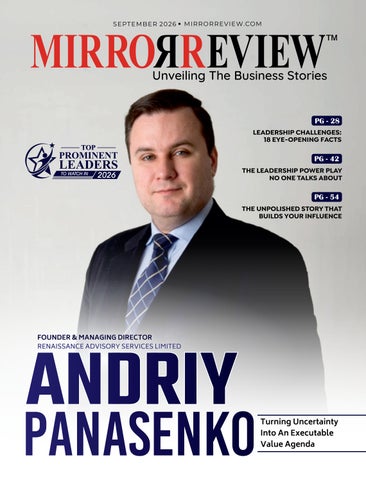
ANDRIY FOUNDER & MANAGING DIRECTOR RENAISSANCE ADVISORY SERVICES LIMITED
PANASENKO
Turning Uncertainty Into An Executable Value Agenda
EDITOR’S
Clear Vision Translates Potential Into Progress
Dear Readers, We stand at a unique, pivotal intersection of technology, shifting economies, and rapidly evolving human potential. Leadership today requires more than just managing the present; it demands the courage to shape what comes next. This brings us to a defining milestone: our special issue, “Top Prominent Leaders to Watch in 2026.” The men and women featured within these pages do not just react to change. They anticipate it, build highly resilient frameworks, and lead with a clear, focused sense of purpose that transforms uncertainty into profound, measurable success. Our cover story spotlights Andriy Panasenko, Founder and MD of Renaissance Advisory Services Limited. His journey began in a small town in Central Ukraine and took him to the boardrooms of the most demanding global private equity firms. Andriy understands that culture and governance drive every corporate decision. Rooted in the belief that corporate choices affect individual lives, he developed the Revival Method. This disciplined framework focuses on margin expansion, post-merger integration, and multiple expansion. By combining the financial rigor of Zero-Based Budgeting with the speed and scale of artificial intelligence, he removes operational friction and turns grand strategies into daily operating habits. For Andriy, value creation is a mindset, and his track record of securing over 600 million pounds in savings proves that swift, grounded decisions always outperform hesitation. Alongside him, this edition celebrates a dynamic group of trailblazers who are redefining their respective industries. We are proud to feature Bill Newman, Industry Executive Advisor at SAP; Katja Maggio, Founder of Usawa.ai B.V.; Tanice Myers, Co-founder of Road Warrior Investors (RWI); and Roger Bresch, CEO of FIDC SOLAR Ltda. Each of these visionaries demonstrates exactly what it means to lead with agility, foresight, and an unwavering commitment to excellence. True leadership is ultimately about taking action. It is about looking ahead to the challenges and choosing to move forward without waiting for perfect conditions. As you read the stories of these remarkable individuals, we hope you find the inspiration to embrace your own learning curve and make the bold choices your future requires. The time to act is right now; step up and lead today. Sincerely,
SIMRAN KHAN Managing Editor
Publisher Archana Ghule Editor-in-Chief Vikram Suryawanshi Managing Editor Simran Khan Project Editor Shadab Mestri ™
Mirror Review Magazine is published by Pericles Ventures Pvt. Ltd. No part of this publication may be reproduced, distributed, or used in any form without prior written consent from the publisher. The editorial team has exercised utmost diligence to ensure the accuracy and integrity of all published content; however, the publisher assumes no liability for any errors or omissions. The publisher also bears no responsibility for the content of advertisements featured within the magazine.
Mirror Review Media & Tech Office No. 430, 4th Floor, Gera’s Imperium Rise, Opp. Wipro Circle, Hinjewadi Phase 2, Pune, Maharashtra - 411057.
+1 (850) 564-8517 info@mirrorreview.com www.mirrorreview.com
Project Managers Vaishnavi Dahatonde Visualizer Mark Davis Graphic Designer Chaitanya Kulkarni Head of Distribution and Production Aakash Mahajan Head of Operations Robert Smith Research Analysts James Adams Advertising Maria Smith
10. Andriy Panasenko
20. Bill Newman 34. Katja Maggio 46. Roger Bresch 58. Tanice Myers
Articles 28.
Leadership Challenges: 18 Eye-opening Facts
42.
The Leadership Power Play No One Talks About
54.
The Unpolished Story That Builds Your Influence
Content
Profiles
Top Prominent Leaders to Watch in 2026 Andriy Panasenko
Bill Newman
Founder & MD Renaissance Advisory Services Ltd.
Industry Executive Advisor SAP
www.renaissance-advisory.london
www.sap.com/index.html
Katja Maggio
Roger Bresch
Founder Usawa.ai B.V.
Chief Executive Officer FIDC SOLAR Ltda.
www.usawa.ai
www.fidcsolar.com
Tanice Myers Co-founder Road Warrior Investors (RWI) www.roadwarriorinvestors.com
ANDRIY FOUNDER & MANAGING DIRECTOR RENAISSANCE ADVISORY SERVICES LIMITED
PANASENKO Turning Uncertainty Into An Executable Value Agenda
10 | SEPTEMBER 2026
COVER STORY
MIRRORREVIEW.COM | 11
COVER STORY
E
very transformation begins from something foundational, and for Andriy Panasenko, it began in a small town in Central Ukraine, where a shy, persistent boy could not have imagined that his path would one day lead him to advise some of the world’s most demanding private equity firms. He describes his own beginnings with a kind of understated honesty rarely found in the corner offices of global consultancies. “My journey was shaped by early resilience,” he says, recalling how he turned an initial rejection from the university of his first choice into something else entirely: a foundation.
The Birth of Renaissance Every founder has an origin story, and Andriy’s is rooted in frustration, the productive kind. Time and again, as he moved through private equity and consulting engagements, he noticed a persistent gap: the distance between what an investment thesis promised and what management teams could actually deliver. Traditional consulting, he found, tended to stop at the recommendation. Portfolio companies needed something more: senior, hands-on support that could carry a board decision all the way through to measurable impact on the P&L and cash flow.
That foundation was built brick by brick. First came a year of studies at the Aviation Institute in Kharkiv, then the 2nd attempt and completion of studies in diplomacy and international relations at the prestigious University in Kyiv (Ukraine). It was there, long before he ever sat across a boardroom table, that he absorbed a lesson that would define his career. Culture, governance, and institutional dynamics, he learned, are not abstractions. They shape every decision an organization makes, whether that organization is a government or a portfolio company. An MBA in Finance from London Business School later gave those early insights a harder edge, grounding them in what he calls commercial reality.
That gap became the reason for Renaissance Advisory Services Limited, the firm he now leads as Founder and Managing Director. The name was not chosen lightly. “Renaissance reflects rebirth and renewal,” he explains, “releasing potential after stagnation.” It is not merely a brand. It is, as he describes it, the ethos that shapes everything the firm does.
Three Decades, Many Rooms
The first is to build one undisputed source of truth, establishing the facts before making the judgment call. The second is about direction: nothing disorients an organization faster than a lack of clarity, so leaders must choose their priorities and protect them fiercely. The third is communication, the connective tissue that keeps teams from losing alignment when the feedback loop breaks down. And the fourth, perhaps the most quietly demanding, is simply to keep calm and carry on. Clarity, integrity, and consistency, he believes, create the confidence that allows leaders to make hard choices without unsettling customers, teams, or the investment thesis itself.
What followed was a career spent moving between very different rooms. Over more than 30 years, Andriy has worked across telecommunications, technology, energy, banking, private equity, and top-tier strategy consulting, giving him a rare, panoramic view of how businesses function under pressure. His path took him through telecom operators including BT, Telenor, and Vodafone, through private equity houses Investcorp and AIAC, and through the consulting ranks of Roland Berger, PA Consulting, and Accenture Strategy.
Four Principles, One Compass Ask Andriy what has guided him across thirty years of turnaround and advisory work, and he does not reach for jargon. He offers four principles instead, each one plainly stated and hard-won.
The Revival Method It is a career, he says, that taught him something boardrooms often forget: “Corporate decisions ripple from boardrooms to individual lives.” Today, as business leaders navigate ongoing macroeconomic pressure, a savage conflict in Ukraine, Middle Eastern volatility, and shifting inflation dynamics, he believes that turning uncertainty into an executable value agenda is no longer simply a strategy. It has become, in his words, an operational imperative. 12 | SEPTEMBER 2026
At the center of Renaissance Advisory’s work sits what Andriy calls the Revival Method, a framework built around three pillars: margin expansion, post-merger integration, and multiple expansion. The method follows a disciplined sequence. It begins with a rapid diagnostic assessment, moves into a prioritized value creation roadmap, establishes clear owner accountability, and enforces a delivery cadence that does not bend.
“
Don’t delay decisions. Sometimes the best insights come from taking the plunge and embracing the learning curve. MIRRORREVIEW.COM | 13
14 | SEPTEMBER 2026
COVER STORY The firm’s focus stays narrow by design, aimed only at the levers that directly improve the bottom line, from Zero-Based Budgeting and procurement discipline to AI readiness and operational simplification. Every financial benefit the firm delivers is finance-validated and tied directly to the client’s financial performance. That disciplined approach has helped clients improve profit margins by 12-20 per cent while simplifying operations and increasing enterprise value by as much as 25-200 perc ent.
The Art of Integration
Beyond the Balance Sheet
His focus in these engagements is on eliminating operational friction early, extinguishing fires, and removing duplication before it calcifies. Progress, he notes, is never built on vague promises. It comes from securing early wins and embedding repeatable playbooks addressing root causes, and giving leaders the confidence that they are tackling the right value drivers from the very start.
If there is one misconception that frustrates Andriy more than any other, it is the idea that cost transformation is simply indiscriminate cutting. “Poor cost programs weaken capability and morale,” he says, while effective ones do the opposite: they remove operational friction so capital can flow toward what customers actually value.
Post-merger integration is, by nearly every account, one of the most fraught phases in corporate life, and Andriy has built much of his practice around navigating it. Successful integration, he says, begins long before Day One, with a practical, risk-based plan anchored directly to the deal thesis. Leadership teams are aligned immediately around non-negotiable priorities: protect customers and cash, establish clear decision rights, and stabilize critical operations.
Valuation, in his view, is built on quality of earnings, cash conversion, and repeatability, not a single dramatic gesture before an exit. Value creation, he insists, is a daily operating habit, a mindset rather than an event, and it is precisely that daily discipline that makes growth resilient over time.
That philosophy has played out in real engagements. When a global maritime SaaS client needed help integrating its finance function across four entities, Renaissance designed and implemented an integration roadmap that stabilized the function and worked closely with the board, allowing the client to prioritise, consolidate, and streamline finance activities and improve stakeholder engagement across all four entities in record time.
Where Discipline Meets Intelligence
The Test That Defined Him
Cost discipline alone is not enough. Andriy believes lasting transformation comes from combining financial rigour with emerging technology. Renaissance Advisory’s approach pairs Zero-Based Budgeting with artificial intelligence, two tools that, in his telling, complement each other almost perfectly. Zero-Based Budgeting asks a question that traditional budgeting rarely bothers to pose: what do we need to spend today to deliver our future strategy, rather than simply what did we spend last year?
Every career has a moment that tests everything that came before it, and for Andriy, that moment arrived when he stepped into a private equity-backed software transformation that had completely lost momentum. Expectations were high. Confidence was low. Visibility was lacking. And hitting the savings target was critical to the entire investment thesis.
Artificial intelligence significantly accelerates the process while expanding its scale. “ZBB provides the discipline, while AI provides the speed and scale.” But he is careful to draw a boundary here. AI does not replace human judgment in his framework; it sharpens it. Leaders still need clear guardrails and accountable budget owners. The goal was never simply cost reduction. It is faster decisions, smarter resource allocation, and a control environment built to scale.
The team rebuilt the fact base from scratch, reset governance, and aligned the executive leadership around hard choices, navigating difficult vendor and cost decisions without compromising product delivery or customer experience. What began as a three-month turnaround stretched across a full year, extended four times as the work deepened. The result was multi-million-pound, finance-validated savings, representing over 12 per cent of the cost base. More significantly, those savings freed the client to reallocate capital directly into sales growth, back-office modernization, and strategic add-on acquisitions. MIRRORREVIEW.COM | 15
COVER STORY Numbers That Tell a Story Impact, Andriy believes, must be visible both in numbers and in capability, and his record offers plenty of both. At Nomad Foods, Renaissance helped embed Zero-Based Budgeting across a SG&A base of more than €300 million, contributing to €15.3 million in savings and a stronger culture of cost ownership, an engagement completed within six months that also earned the team an Aspiring Culture Change Award. At a major UK property investor, he led a comprehensive finance transformation that leaned on technology to redesign core operations. By streamlining manual processes and automating workflows, the team built a technology-enabled operating model that reduced workforce requirements by 20 per cent, while strengthening financial control and decision-making speed. In the UAE, a shorter engagement helped the client define its own savings initiatives, driving engagement and a more cost-conscious way of working across the organization. And in a separate procurement-led engagement, a SaaS portfolio company facing headwinds in its cost base worked with Renaissance Advisory to consolidate and rationalize its IT & software spend, ultimately saving more than 12 per cent of its addressable cost base within a year, funds that were reallocated into front-end augmentation, back-office consolidation, and further M&A activity. Across his career, the totals climb even higher: more than £600 million in savings and over £4 billion in transactions completed internationally. Trust Across Borders Trust, in Andriy’s world, is earned through consistency rather than promises. It is the currency that allows transformation work to happen at all. His goal, he says, is to provide complete transparency at every level of an organization. Boards receive decision-ready insights. Executives receive practical support. Workstream leaders take clear ownership of what is theirs to carry. He is unambiguous about what he will not do. “I never hide risks or overpromise,” he says. Having worked across the UK, Europe, the Middle East, and Asia, Andriy has learned to adapt his approach to local nuance without ever compromising his standards. Discretion, predictability, and simply keeping his word, he says, are what build credibility fast, and what keep it intact over time. 16 | SEPTEMBER 2026
“
Clarity, integrity, and consistency create confidence, allowing leaders to make hard choices without unsettling customers, teams, or the investment thesis.
• THE ROAD AHEAD • Looking forward, Andriy sees the pace of AI adoption as something that will depend less on the technology itself and more on human curiosity, technical aptitude, and commercial mindset. He is quick to place the current moment in a longer arc of history. “No one has done AI in the past,” he says, pointing out that earlier generations did not know how to make fire, harness the light bulb, or benefit from the steam engine, and yet each innovation eventually reshaped everyday life. He believes the trends now shaping the business world—experimentation, shifting consumer habits, uneven technology adoption, and the slow commercialization of AI—will depend heavily on organizational maturity and the burden of legacy systems. Real value creation, in his view, will come from a phased, disciplined rollout of AI technology, paired with measurable improvements across outputs and workflow. This revolution, he cautions, will not happen overnight. It demands the same discipline, persistence, and commitment that earlier generations brought to their own transformations.
• ADVICE FOR THE BOLD • Asked what he might say to the business leaders, investors, and executives reading his story, Andriy offers something refreshingly direct: “Don’t delay decisions.” Some of the best insights, he believes, come only from taking the plunge and embracing the learning curve that follows. He often returns to a Slavic saying that has stayed with him: “It is not Gods who shape clay pots.” Change, he says, belongs to those who try, and the longer a leader waits, the harder it becomes to unwind legacy habits that have quietly taken root. Looking back on the early days of building his own business, Andriy admits he once questioned whether he was ready. Today, his only regret is not taking the leap sooner. As he puts it, no entrepreneur in history has ever looked back and said, “I wish I had waited longer.” MIRRORREVIEW.COM | 17
We like to say we live in an era of certain uncertainty. They’re so busy fighting fires every day from geopolitical risks and financial pressures that they can’t find the time to transform. 20 | SEPTEMBER 2026
MIRRORREVIEW.COM | 21
T
here is a small glass canister fitted into the dashboard of the original Volkswagen New Beetle. Most people assume it was designed to hold a tiny flower, a cheerful decorative touch for an already cheerful car. But the workers on the assembly line at Volkswagen de Mexico’s plant in Puebla will tell you something different. According to them, it holds the tequila shot you need to survive the drive along the autopista on the Mexican altiplano. Bill Newman knows this story because he was there. Standing on that factory floor in Puebla, watching the very last of the new Beetles roll off the assembly line with his own eyes. He laughs when he tells it. And in that laugh, you begin to understand something essential about the man: he has been in enough rooms, on enough factory floors, and in enough boardrooms across four continents to know exactly where the tequila goes, and more importantly, why it is needed. Bill is currently SAP’s Industry Executive Advisor for the Automotive Segment, a role that is as much about human understanding as it is about enterprise software. A man who began his career building aircraft he could not speak about, and who has spent more than three decades since earning his place in the automotive world, one deliberate pivot at a time. The Airplane Guy Bill graduated from UCLA with a degree in Aerospace Engineering and a minor in Economics. He was, plainly, an airplane guy. His first full-time position after university was with Northrop Corporation, now known as Northrop Grumman, where he was assigned to a project so classified that when anyone asked what he worked on, he and his young colleagues were advised to say, “If anyone asks you what you make, tell them you make a paycheck every week” and then change the conversation. He could not tell his family. He worked for five years inside a windowless, top-secret environment on what the world now knows as the B-2 Spirit Stealth Bomber.
22 | SEPTEMBER 2026
What is perhaps more quietly significant, however, is what was happening at the edges of that experience. During his time at Northrop, a technological shift was underway: the migration from mainframe computing to what we now call client-server computing, the moment when information moved from a locked room to a desktop. Bill found himself drawn to it. He became the Apple resource coordinator for a department of roughly 100 engineers, moving steadily away from design engineering and toward network and data services. It was the first of several such pivots in his career. Each one deliberate. Each one building quietly on the last. The Long Road to Detroit After Northrop, Bill transitioned into consulting. First, through training work at a small firm, then through DMR Consulting Group, now a part of Fujitsu Consulting, where he spent close to five years working in California and Oregon operations as a senior consultant and in business development. During this stretch, he earned his Certified Management Consultant (CMC) designation and became active in the Institute of Management Consultants. He also completed his MBA at Loyola Marymount University in Los Angeles, which required him to pick an industry for his thesis. As an aerospace man, he had no particular attachment to automobiles. But the automotive industry happened to be available, and so he studied how vehicles were produced across the United States and Western Europe, touring facilities at Volvo, GM, Vauxhall, and Porsche. He figured he would never need any of it. Then he married a Michigan girl, and everything shifted again. Moving to the Detroit area, Bill found he at least had some context for the industry that surrounded him. He returned to DMR Consulting in the Midwest, worked through a few other consulting firms, and eventually landed at Volkswagen, where he helped launch their technology division, Gedas. He worked directly for the division’s president and CEO, and it was there that the automotive world began to feel less like an accident and more like a calling. One Thousand Consultants and a Y2K Clock In 1998 and 1999, as industries worldwide braced for a potential technological collapse at the turn of the millennium, Bill was doing something quite extraordinary.
He had become a global trainer for the Automotive Industry Action Group’s Year 2000 remediation program, leading a team of consultants and facilitating training and risk mitigation services across the sector. He personally instructed more than 1,000 consultants across four continents, preparing the trainers who would go on to lead Y2K readiness efforts within their own organizations. That work built relationships. Those relationships, in turn, opened a door that led him back, years later, to something he is still proud of: the creation of the first industry-based cloud platform for managing and reporting conflict minerals under the Dodd-Frank Act. He believes that the platform remains operational in some form to this day. Twelve Years at SAP: Three Roles and One Clear Purpose Bill joined SAP as a Principal Management Consultant with the company’s services division. He is now celebrating his twelfth year with SAP, having moved through Value Advisory before arriving at his current position as Industry Executive Advisor for the Automotive Segment. He describes his function within SAP’s industry advisory practice with the ease of someone who has earned the right to the title: the “senior senator” for automotive. It is a role built on relationships, context, and the particular authority that only comes from having lived through the experiences you are now advising others to navigate. Bill works with business executives at SAP’s automotive customers to translate operational needs into technology strategy and, increasingly, into the language of artificial intelligence. His client scope is intentionally broad: anything that does not fly or sail commercially. Motorcycles, passenger vehicles, commercial trucks, golf carts, recreational vehicles, electric bikes, and even aerial taxis fall within his domain. What gives Bill his edge in those executive conversations is not the software. It is the biography. He has been an SAP customer. He has been a system integrator. He has sat in the very chair occupied by the people he now advises. MIRRORREVIEW.COM | 23
“I’ve been in their shoes,” he says. When a CIO recently told him, “I need you to tell me what I need to do so that I don’t get fired and I keep my job,” he understood precisely what was being asked. Not a product demonstration. Not a roadmap presentation. A clear, experience-backed, plain-English read on reality. “I’m going to speak truth to data,” is how he frames his own approach. And in a world that sometimes prefers comfortable narratives to honest ones, that is no small thing. Business AI, Intelligent Operations, and the Human in the Loop The word “AI” is everywhere right now, which means it has also become somewhat difficult to say anything specific about it. Bill is precise. His focus at SAP is Business AI: not general-purpose large language models deployed without structure, but artificial intelligence that operates within a secured corporate environment, drawing on a company’s own data, supplemented by public domain information and external sources as needed, to accelerate decision-making and eliminate repetitive work. Tasks that once consumed hours can now be completed in seconds. Work that requires the attention of skilled professionals can be handled autonomously, freeing those professionals for higher-order strategic thinking.
24 | SEPTEMBER 2026
Wake up every day and just kind of marvel at what you may learn that day, and what life may be able to provide and offer to you.
SAP is increasingly exploring frameworks in which AI assistants and intelligent agents can execute business processes with varying levels of human oversight, helping organizations operate more efficiently while still keeping people involved in critical decision-making. “Keeping humans in the loop” is a phrase Bill returns to with deliberate emphasis. The automation is real and growing, but so is the governance around it.
He is also a working freelance writer, with years of published commentary and professional writing behind him. And he is currently developing a historical fiction project, the details of which he holds close, but which he mentions with the affection of someone for whom writing has always been less a career choice and more a fundamental orientation toward the world.
There is also early-stage work underway in what SAP calls Physical AI, exploring how automation might address shortages in manual labor markets. Bill addresses this territory with care, fully aware of its sensitivity in the context of labor organizations and industrial workforces. It is a frontier, not yet a defined destination, but one that he expects will become more significant with time.
In automotive, sustainability is not a single conversation. It is several, layered, and interconnected: ESG governance, carbon footprint, supplier accountability, investor commitments, and regulatory compliance, all running simultaneously.
The biggest challenge, he observes, is not technological. It is organizational. Companies are so consumed by daily operational firefighting, geopolitical risk, financial pressure, and rapid policy changes, particularly in the electric vehicle space, that they struggle to find the time to modernize the very systems that would help them fight those fires more effectively. Here, he reaches for a phrase from his longtime personal touchstone, UCLA coaching legend John Wooden: “Be quick, but don’t hurry. Because if you hurry, you make mistakes.” The tension between urgency and care is, in many ways, the defining challenge of the automotive industry in 2026. Two Books, a Historical Novel, and a Man Who Has Always Written
Sustainability: Across the Full Value Chain
SAP is among the major enterprise platforms capable of delivering accurate, comprehensive Scope 1, 2, and Scope 3 carbon reporting across an organization’s complete value chain. Scope 3, which captures emissions that extend across the entire supplier and partner network, is notoriously difficult. Most organizations simply do not have visibility into that data. SAP’s position across the operational, planning, and reporting layers of its customers’ businesses gives it a perspective that few platforms can replicate. For OEMs and their suppliers, this capability is becoming consequential in a very direct way. As OEMs make public sustainability commitments through their investor relations work, the suppliers who serve them must be able to report accurately on those commitments. It is no longer just a matter of compliance. It is a matter of being viewed as a credible, sustainable partner. Bill speaks about the triple bottom line of sustainability, people, economics, and environment, not as a framework to be cited but as a lens through which real business decisions are made. The distinction, in his telling, is the difference between sustainability as a checkbox and sustainability as a strategy.
Away from boardrooms, Bill writes. He is the author of two books, each the sequel of the other, built around Financial Performance and Analysis (FP&A) and enterprise performance management. Developed in connection with early work in the enterprise performance management space, the books address the practical mechanics of running a high-functioning financial organization: rapid financial closures, analytical rigor, and sustainability reporting.
Ask Bill where the automotive industry is heading over the next five years, and the answer is clear-eyed and honest.
The deeper question the books ask is not simply how to execute what is required, but how to use financial data to understand where a company stands and where it is genuinely headed.
He sees Greater China accelerating capacity at a pace that will define a new competitive benchmark, by making transportation more affordable and reshaping what vehicle access looks like across global markets.
The Road Ahead: Five Years, Shifting Ground
MIRRORREVIEW.COM | 25
The transition away from fossil fuels will continue, but likely more gradually than some projections suggest. Hybrid technology is gaining meaningful momentum in passenger and personal-use vehicles, with particular force in markets governed by the California Air Resources Board, whose standards currently influence 16 additional states beyond California. European Union emissions standards, he notes, apply broadly to automotive manufacturers operating in the U.S. market as well. Hydrogen-based vehicles remain part of the longer horizon. Autonomy, however, is already underway. In Europe, autonomous commercial vehicles have been platooning on highways for over a decade, with companies like Volvo in Sweden leading that work. In consumer transportation, Waymo and Zoox are making the robo-taxi model an increasingly ordinary reality. What shifts most fundamentally, in Bill’s view, is the concept of vehicle ownership. As mobility-as-a-service becomes more accessible, the industry’s most important metric will no longer simply be units sold per year. It will be vehicle miles traveled, a KPI that reframes the entire business model.
What the industry calls non-vehicle sales revenue, the services, subscriptions, and experiences that extend beyond the vehicle itself, will become a central pillar of how automotive companies sustain themselves in the years ahead. “It’s an exciting, challenging, but very real time,” he says. “People have their efforts on the line.” Stonewood Farms, Temecula, and the Organic Orange If Bill, the industry advisor, is precise and measured, then Bill the accidental farmer and beverage creator is something altogether warmer: unguardedly, specifically delighted. Stonewood Wine began in Michigan out of practical necessity. Shipping wine to Michigan from California, Oregon, Washington State, or Europe is expensive, and purchasing in higher volume simply made economic sense. Over time, it grew into something richer: a hospitality endeavor now serving an ad hoc concierge of over 100 households. His wife, Teresa, who served as a wine ambassador for two different brand organizations over the years, is deeply part of that story. During the pandemic, Bill deepened his wine education formally, completing his WSET Level 3 Sommelier certification, and is now considering a post-retirement path as a wine educator and hospitality owner. The couple has made their home in Temecula wine country in Southern California, on a small plot of land that came with organic Valencia orange trees and vineyards. From those trees, they are producing organic orangecello, alongside a vermouth and a Cointreau project. They are currently awaiting approval from the California Alcohol and Beverage Control to begin shipping their products.
26 | SEPTEMBER 2026
He also holds active affiliate memberships with the Center for Automotive Research and the Motor Equipment Manufacturers Association (MEMA). He has served as an adjunct professor at both the University of Michigan-Dearborn and Northwood University, and is in the process of completing his Automotive Aftermarket Professional designation, a joint program between Northwood University and MEMA’s aftermarket suppliers group. A Grandfather Who Lived to 103 Bill comes from a family with, as he puts it, “some pretty unusual actuary tables.” His grandfather lived to 103. Most of his family members have lived well into their 80s and 90s. That kind of longevity, he reflects, gives a person a different relationship with time, and a different sense of what deserves attention within it. He once asked his grandfather how he stayed so sharp for so long. The answer was uncomplicated: always be learning. Bill has carried that forward not as a professional maxim but as a way of moving through the world. He speaks about perpetual curiosity with the easy conviction of someone who genuinely practices it, citing the spirit of Ted Lasso’s signature counsel: always be naturally curious. He means it without irony. He also speaks, with particular warmth, about the value of kindness. The pandemic, he reflects, sharpened his awareness of how little we tend to know about what other people are carrying. Every person has a story you may not know. Being open to that story, being willing to slow down and receive it, is something he considers as important as any professional credential. It is a philosophy that sounds simple. But in a man who has spent over three decades navigating aerospace classified programs, global Y2K remediation efforts, Volkswagen assembly lines in Mexico, SAP executive briefings, and the orange groves and vineyards of Temecula, it reads as something genuinely hard-earned and sincerely meant. For anyone looking for a leader to watch in 2026, Bill Newman makes a compelling case not through noise or pronouncements, but through decades of accumulated credibility, cross-industry curiosity, and a genuine interest in the people and problems in front of him. MIRRORREVIEW.COM | 27
LEADERSHIP CHALLENGES 18 Eye-opening Facts That Reveal What Employees Really Want
Y
ou can overcome these challenges to enhance team performance and foster a positive work environment. If you are a manager or a team leader, understanding what employees really want can significantly improve your leadership skills. In this blog, we will unveil 18 eye-opening facts that reveal what employees really want, helping you to effectively address leadership challenges in your organization. Employee Engagement 1. A Gallup study reveals that 85% of the global workforce is disengaged, leaving only 15% engaged at work. 2. Among employees, 59% are passively disengaged (quiet quitting), while 18% are actively disengaged (loud quitting). These employees often point to workplace culture, compensation, and well-being as areas for improvement.
Among the non-engaged, 59% are ‘quiet quitting.’ They’re on the ship, holding the oars but not rowing. They might be dissatisfied with the company culture, pay, or well-being. They're not causing trouble, but they’re not contributing either. Then, there are the 18% who are ‘loud quitting.’ They’re not just failing to row but are actively disrupting the ship. They might be complaining, arguing, or even drilling holes in the ship. This is another facet of leadership challenges. This lack of engagement isn't just about slower progress. It's costly. So, future leaders must find ways to: ● Engage the ‘quiet quitters’ ● Neutralize the ‘loud quitters’ ● Foster an environment where more crew members are actively and enthusiastically working Knowledge Silos
3. Disengaged employees are costing U.S. businesses between $450 billion to $550 billion in lost productivity annually, with these employees being 18% less productive than their engaged counterparts. Imagine a company as a ship. Employees are crew members, their engagement is their rowing effort. Ideally, all crew members would be fully engaged, rowing in sync, propelling the ship efficiently. This is 100% employee engagement. However, only 15 out of 100 crew members are actively rowing. This is one of the significant leadership challenges. 28 | SEPTEMBER 2026
4. The Chaos Manifesto 2014 states that 33% of projects fail due to insufficient team involvement, emphasizing the importance of clear collaboration. 5. The absence of collaboration can result in ‘knowledge silos’ causing information to be confined within teams, leading to redundant efforts and lost learning opportunities. 6. In such ‘siloed’ environments, crucial information and expertise remain isolated within specific teams, obstructing organizational knowledge growth and sharing.
Consider a company as a football team. In a successful team, each player knows their role and their contribution to the game plan. This is collaboration. However, some players are unclear about their roles or not fully committed, leading to a disjointed team that struggles to win games. This lack of collaboration creates ‘knowledge silos,’ where players excel individually but lack understanding of the teamwork, leading to missed opportunities. In these ‘siloed’ environments, valuable information gets trapped within teams, hindering knowledge sharing and growth, leading to duplication of efforts and missed opportunities for teamwork and improvement. This presents leadership challenges for the captain. The challenge is to build a collaborative environment where every team member understands their role and its contribution to the team’s success. This involves: ● Breaking down knowledge silos ● Promoting open communication ● Ensuring that everyone feels involved and valued. Change Management 7. 70% of change initiatives fail, underlining the challenges in executing effective change management strategies. 8. Prosci’s research indicates a lack of change buy-in and solution support as a key obstacle. This resistance can stem from fear of the unknown, job insecurity, or inadequate communication. 9. 31% of CEOs are fired for mismanaging change, underscoring the critical role leadership plays in navigating organizational change. Think about a company as a ship sailing towards its goals. The journey isn’t always smooth; it often needs to change course due to various factors, similar to organizational change initiatives. MIRRORREVIEW.COM | 29
Imagine if 70% of the time, the ship fails to change its course successfully. It’s likely to hit obstacles or get caught in bad weather, delaying or even preventing it from reaching its destination. This mirrors when 70% of change initiatives in organizations fail.
In some cases, the novelist might question the credibility of the information they have. Is the historical fact accurate? Is the character’s backstory believable? This mirrors the struggle of some leaders who question the credibility of their data.
The success of a course change depends on the crew’s support. If they resist change due to fear, insecurity, or lack of communication the ship struggles to change its course. This is much like the lack of change buy-in in organizations, where 37% of employees resist change.
Sometimes, the overload of information can be so overwhelming that the novelist cannot move forward with the story. They are stuck, unable to decide which plot direction to take or which character to focus on.
The captain’s role is crucial in navigating these changes. If they fail, they might be replaced, as 31% of CEOs are fired for mismanaging change.
This decision paralysis can have negative impacts. It can lead to increased anxiety, missed opportunities (like a great plot twist or character development), and unnecessary spending (time spent on irrelevant research or rewriting).
If the ship constantly changes its course, the crew can become overwhelmed, similar to the change fatigue experienced by employees in organizations undergoing constant changes. To navigate these changes:
Similarly, decision paralysis in leadership can lead to increased stress, missed business opportunities, and wasteful spending. So, the key is to:
● Clear communication ● Address anxieties and insecurities ● Manage change in a way that keeps the organization on track to achieve its goals.
● Learn how to manage and interpret data effectively ● Ensuring its credibility ● Making informed decisions without letting the volume of data lead to decision paralysis.
Decision distress
Conflict Resolution
10. An Oracle study reveals that 90% of business leaders experience decision distressdue to data overload, adversely affecting their quality of life.
13. 48% of employees believe managers need more training in handling conflicts.
11. 26% struggle with data credibility, and 80% abandon decision-making due to overwhelming data. 12. This decision paralysis negatively impacts the quality of life for 88% of people, leading to increased anxiety (38%), missed opportunities (40%), and unnecessary spending (42%). Imagine a novelist trying to write a book. He has a lot of information-character backstories, plot ideas, historical facts, and so on. However, the sheer volume of this information can be overwhelming, leading to “decision distress.” This reflects leadership challenges where data overload makes decision-making stressful. 30 | SEPTEMBER 2026
14. 76% of employees prefer to avoid conflict when possible. This avoidance can lead to unresolved issues, resentment, and decreased productivity. 15. 27 % of employees quit their jobs due to unresolved conflicts. Let's consider a scenario of a coach training a sports team to understand these statistics better. A coach often faces conflicts among team members. These conflicts could arise from disagreements about strategies, roles, or personal issues. Some team members might feel that their coach needs more training in handling these conflicts, much like employees who believe their managers could benefit from additional conflict resolution training.
Many team members might prefer to avoid conflict altogether, similar to employees who would rather keep the peace than voice their concerns. However, this avoidance can lead to unresolved issues and resentment, affecting the team’s performance and morale. Unresolved conflicts can lead to serious consequences. Some team members might choose to leave the team if conflicts are not addressed, disrupting the team’s harmony and potentially affecting their performance in games.
These insights highlight the importance of effective delegation in the workplace, a key aspect of addressing leadership challenges. It not only helps in preventing burnout among managers but also fosters a sense of growth and development among team members. Moreover, it helps in building trust within the team and stimulates creativity by allowing team members to take on new challenges. On the contrary, poor delegation can lead to a lack of trust, stagnation, and even employee attrition.
That’s why it is crucial to learn: ● How to manage and resolve conflicts effectively ● How to tackle unresolved conflicts ● Ensure a harmonious and productive work environment.
Therefore, managers must strike a balance between delegation and oversight to ensure a healthy and productive work environment, effectively overcoming these leadership challenges. Here are the strategies to tackle the problem of poor delegation:
Authority Delegation 16. A Harvard Business Review article states that a classic sign of insufficient delegation is a manager who works long hours while their team keeps “strangely regular hours.” This suggests the manager isn’t delegating tasks, leading to burnout for themselves and a lack of growth for their team. 17. When employees don’t have the authority to make decisions or complete tasks independently, they can feel underutilized and unimportant. A study by the Society for Human Resource Management (SHRM) found that a lack of growth opportunities is a major reason employees leave their jobs.
● Provide employees with the necessary authority and autonomy to make decisions and complete tasks independently. ● Implement training programs to equip managers with the skills to delegate effectively. ● Encourages skill development and offers growth opportunities. Conclusion We hope this blog has enlightened you about the leadership challenges and the 18 eye-opening facts that reveal what employees really want. If you found this blog valuable, then please subscribe to our YouTube Channel for more leadership development videos. You can also find us on Twitter and Instagram. Remember, understanding and addressing leadership challenges is the key to a successful and harmonious workplace.
18. When managers micromanage and hoard tasks, they prevent employees from developing their skills and taking on new challenges. This limits the team’s overall potential and can lead to stagnation. MIRRORREVIEW.COM | 31
Founder | Usawa.ai B.V.
KATJA
MAGGIO The Strategic Mind That Reads What Data Alone Cannot Say
34 | SEPTEMBER 2026
MIRRORREVIEW.COM | 35
is a particular kind of intelligence that does not appear on a dashboard. It does not live inside a data model or emerge from the most sophisticated algorithm ever trained. It lives in the pause between a data point and a decision in the moment when a leader looks at a number and asks not just what it means, but why it means that, and what it means for the real people on the other side of it. Katja Maggio lives and works in that space. She is a Global Strategy and Transformation leader, an award-winning practitioner in applied semiotics, a brand reinvention specialist, and the founder of Usawa.ai B.V. She is the kind of professional whose career defies tidy categorization, equal parts strategist, cultural reader, and deeply human leader. Her work spans continents, categories, and cultures. She has helped flagship brands pull back from the edge of collapse. She has opened new growth trajectories in categories that spent over a decade going nowhere. And she has done none of it by following the conventional playbook. She does it by asking the kinds of questions most leaders are too comfortable to ask. Where Statistics Met the Human Side Katja Maggio’s professional journey begins where many great strategic careers begin, at the intersection of two things that are not supposed to belong together. Most people think of statistics and marketing as natural companions. But the real tension in Katja’s early career ran deeper than that it lived between the cold architecture of big data and the warm, ungovernable territory of human emotion. Between analytics that could tell you what was happening, and empathy that could tell you why it mattered. From her earliest days at Procter and Gamble, she understood something that takes many analytical professionals decades to grasp. “From the start of my career with P&G, I quickly learned that data and insights only matter when you can use them to inform better decisions and strategic choices,” she says. “From early on, I was drawn to the human side of how people make choices, build trust, choose or switch brands, and combine this knowledge with data.” 36 | SEPTEMBER 2026
What gave her the edge to see this so early was not simply talent. It was a movement. Working across countries, categories, and cultures forced a kind of perceptual agility that those who spend entire careers in a single market rarely develop. When you have observed how a consumer in one country builds trust with a brand and then watched how differently that same emotional transaction unfolds elsewhere, you stop assuming. You start looking. “Curiosity combined with a desire to anticipate future shifts to drive value,” she reflects, “shaped my leadership style, rooted in human empathy, hard evidence, and action.” Her career, she says, has been fundamentally shaped by turning problems and breakdowns into opportunities through brand reinvention, innovation, portfolio renewal, and building future-ready teams. Five Questions That Unlock a Business When Katja walks into a business under pressure, she does not begin with answers. She begins with five questions. What is the job consumers “hire” the brand for? What made the brand successful in the past? Where is the disconnect today? Which parts of the business still have the right economics, and where is value leaking? And what prevents the organization from acting and evolving? These questions may sound deceptively simple. They are not. Each one is a small destabilization. Together, they dismantle the comfortable fictions that struggling businesses tend to build around themselves. In practice, this means examining demand, brand equity, margin structure, channel performance, customer relevance, and decision-making simultaneously, as a system. It means seeking out the causes of topline erosion, understanding whether a business is misaligned with category drivers or dangerously over-reliant on outdated assumptions. “Turnaround happens when teams face reality and recognize that their assumptions, ways of working, and flywheel do not serve them any longer and are open to change instead of jumping on short-term tactics,” she says.
This is a significant observation. It suggests that the most formidable obstacle to transformation in most organizations is not a lack of technology or capital. It is a lack of a corporate culture that inspires the courage required to look at oneself honestly. The Language Beneath the Language
“
In a highly fluid world moving faster, balance is not a soft idea. It is, increasingly, a serious competitive advantage. Her goal is never to fix everything at once. “The goal is not to do everything, but to create clarity and empower teams to drive change at speed.” Curiosity, Sacred Cows, and the Cost of Fear
There are not many global business strategists who have a consistent track record of Brand turnaround through the application of semiotics applied to brand building and/or turnaround. Katja is one of them, and it is arguably the most distinctive lens through which she reads markets, brands, and behaviour. Semiotics, in its simplest form, is the study of signs and meaning. In brand strategy, it becomes something far more powerful. “It is about Cultural intelligence which helps leaders see what traditional marketing frameworks often miss: the codes, meaning and tensions shaping how people talk about the category, how they understand and connect to brands,” she explains. Brands no longer win only through function. They win through differentiated meaning spaces. This is the central insight that semiotics makes legible, and it is a distinction that most brand teams, trained almost exclusively on performance metrics and sales data, are not equipped to see on their own.
There is a question beneath every transformation project, one that most strategists try to answer with frameworks and methodologies, but that Katja approaches almost philosophically. Why do some organizations genuinely change, while others simply perform the idea of change? Her answer is both precise and refreshingly honest. Organizations that transform well are those that stay curious, listen deeply, and value learning. They have no “sacred cows.” They act before they hit headwinds. Transformation needs leaders who can inspire a shared purpose, a bias for action, and the psychological safety for people to make mistakes. Resistance, she says, comes from something far more human and far less comfortable: fear. Closed mindsets, internal politics, siloed decision-making, and a narrow view of performance disconnected from reality. Not structural failures, in the end. But human ones. MIRRORREVIEW.COM | 37
When a brand becomes tired or “stuck in the past,” semiotics can help build more resonant creatives that refresh the brand without sacrificing its authenticity. On one side, Katja works for a very skilled culture club at Usawa.ai; on the other, she also uses AI discovery as an invaluable tool for disruptive innovation and portfolio renewal to engineer what Kantar Brand Z calls “meaningful difference,” helping brands become relevant in their own singular way. Culture shapes behaviour. And if you cannot read the culture, you cannot lead the brand. The Feeling That Sells There is a stubborn idea embedded in the business world that “emotional” and “commercial” exist in permanent tension. That to speak of how a brand makes someone feel is somehow to retreat from the serious business of revenue. Katja has spent years dismantling this idea with evidence. “Emotional relevance is not soft; it is a growth lever when it changes customer behavior in ways that are commercially meaningful,” she says. The key, she explains, is understanding the “emotional job” the brand is solving, whether that is inspiring trust, building confidence, providing a sense of belonging, enabling self-expression, offering reassurance, or giving people an escape. By aligning messages and experiences in a way that feels personally meaningful and consistent, and by removing friction, brands become what she calls “sticky.” The consumer who feels genuinely understood, who thinks “this brand understands me,” “it talks to me!” converts more readily, deepens the relationship, and stays longer. The commercial result is measurable: in revenue and in long-term brand equity. This is not a theory. It is what she has seen work, across markets and categories, time and again. The Augmented Human Ask Katja about artificial intelligence, and she will not give you a breathless speech about disruption. She will give you something far more useful: a map of the edges. 38 | SEPTEMBER 2026
She references the work of Professor K. Lakhani from the HBS AI Institute at Harvard, who describes what he calls the “jagged edge of AI applications,” the concept that AI excels in some tasks and falls short in others, and that this edge is not readily visible. Knowing where that edge lies is one of the most critical leadership capabilities of this decade. “Data and AI exponentially expand our ability to discover new information at scale, uncover patterns, and make predictions at unprecedented speed and precision. Still, I see technology as an amplifier of human understanding, not a substitute for it,” she says. Contextual judgment, empathy, emotional intelligence, the ability to weigh signals and assess risk, these, she argues, remain irreducibly human. When technology is used in isolation, the risk is to create false certainties: an organization that is internally efficient but externally irrelevant. Her alternative is a concept she calls “augmented humanity,” using AI to deepen human understanding, not flatten it into a library of prompts or a set of dashboards. It is a careful, principled distinction. And it is the philosophical foundation on which everything she builds at Usawa.ai rests. Usawa and the Pursuit of Balance The name of Katja’s company is not accidental, and neither is the language it comes from. “Usawa” is a Swahili word that means balance. The choice of Swahili is deeply intentional. Swahili is a unifying language across African tribes, a cultural bridge spanning East and Central Africa, a tongue that has historically fostered unity across division, connecting communities across vast differences of geography, tradition, and identity. That spirit of connection is woven into the very promise of the company. For Katja, “balanced augmented humanity” is not simply a methodology. It is a belief that AI and human intelligence, when properly integrated, should build bridges, not widen divides. It should serve as the backbone that unifies different teams, aligns different agendas, and refocuses an entire organization on what matters most: the customer, the human being at the centre of every decision. Balance, she will tell you without hesitation, is not a soft or passive concept. It is a competitive strategy. Usawa.ai B.V. was built to address a very specific and very modern paradox: the abundance of data leading to a poverty of strategic clarity.
“The exponential proliferation of data and analytics correlated to topline erosion; teams drowning in data, unable to drive growth; siloed tech-stack narrowing the line of sight and driving a false sense of security whilst business is under pressure,” she describes. These are the symptoms Usawa.ai was designed to treat. The company helps organizations refresh established brands, identify new growth spaces, and build stronger customer-centric capabilities to grow topline. It uses AI combined with cultural intelligence, behavioural understanding, and deep business knowledge to spot weak signals earlier, test hypotheses faster, connect fragmented data sources, and identify emerging consumer needs before they become obvious in the market. The goal is foresight. The output is future-facing value creation strategies that compound over time. And the competitive advantage is augmented humanity, not AI alone, not instinct alone, but the two working together with intention, and with the explicit purpose of bringing people closer together rather than pulling them further apart. Ninety Days and a Decade of Stagnation Among all the work Katja has done across her career, one story stands out as the clearest expression of who she is as a leader and what she believes about business transformation. She was working at P&G on the Fabric Softener portfolio. In early 2000, the category had been sluggish, and the brand had been in stagnation or decline for over a decade. The business had declared a breakdown and had been given just 90 days to come up with a plan. MIRRORREVIEW.COM | 39
She pioneered the use of Semiotics to understand the Brand disconnects, how to rebuild the Brand emotional connection, and identified new category growth space. This helped the team evolve brand creatives and launch a series of disruptive innovations. These generated quick wins, which drove confidence in the business and created the momentum needed for the broader commercial interventions to follow.
The beauty industry, she says, is already entering this structural inflection point. Loyalty is eroding. Customer acquisition costs are up 60 to 80%. Earned media is under strain. Creators are burning out. Consumers are beginning to streamline their consumption in response to the clutter and overabundance that now define most markets. And the default response, more SKUs, more content, more paid media, more AI-generated content, only accelerates the problem.
The business stabilized. It then returned to both top-line and bottom-line growth, anchored by an ownable and sustainable competitive advantage. The transformation was executed across 25 countries, turning around the flagship brands and, critically, opening a new growth trajectory for the entire category.
“My bigger vision is to help companies move more deliberately: fewer, more meaningful products with stronger proof; Human-centric AI as a value driver; and business models designed for longevity, not just launch cadence,” she says.
“This experience was core in shaping my philosophy,” she reflects. “Put the customer at the centre; identify frictions and business gaps; cut the noise and stay focused on what matters most; propose a solution the organization is able to execute with excellence.” There is an earlier, quieter test she also recounts. She was hired to help a business under pressure whose leadership spoke about transformation but had no genuine desire to challenge the assumptions that were no longer working. Rather than retreat, Katja stayed close to the data, identified the biggest pain points, and worked alongside the teams on the ground. She helped generate what she calls “green shoots,” early signs of recovery on an eroding business. Those signs created the appetite for bigger change. “Leadership is about choosing the 'hard right' instead of what would have been easy,” she says. “It is about the ability to bring people with you, even when you don't have support, and the importance of small wins to start a transformation.” The High-Entropy Future Katja sees what is coming. And she sees it with the systemic clarity that most leaders will not arrive at until they are already standing inside the problem. She invokes a concept from systems theory: the high-entropy phase, a condition in which revenues may appear to be growing, but the energy required to sustain the current model rises faster than the value it creates. 40 | SEPTEMBER 2026
That is the contribution she wants Usawa.ai to make: more future-ready, more human-centred, value-creating businesses. The Energy Economy Katja does not believe in work-life balance. She is entirely unambiguous on this point. What she believes in instead is conscious energy management, a deliberate, ongoing practice of recognizing what depletes her energy and what restores it, across both work and life. She exercises daily. She recharges through learning, through meaningful conversations, and through time with her family. These are not escapes from her professional life. They are, she is very clear, integral to it. “These moments are not separate from leadership: they enhance and strengthen it. They keep me curious, grounded, and able to lead with both energy and perspective.” For a leader of her depth and range, this is not a lifestyle preference. It is a discipline. And it is, quietly, one of the most honest things she says. Balance Is the Strategy There is a word that returns again and again when you spend time understanding how Katja thinks, leads, and builds. It is the word at the centre of her company's name. It is the word she returns to when asked about the philosophy that has guided everything–Balance. Balance between data and empathy. Between reinvention and authenticity. Between agility and intent. “The most successful leaders for me are those who stay deeply curious, face reality without defensiveness, and lead from customer centricity, with purpose,” she says.
“
Data and AI exponentially expand our ability to discover new information at scale, uncover patterns, and make predictions at unprecedented speed and precision. Still, I see technology as an amplifier of human understanding, not a substitute for it.
MIRRORREVIEW.COM | 41
42 | SEPTEMBER 2026
The Power Play No One Talks About The loudest person in the room rarely runs it. In high-stakes leadership, power often belongs to the one who knows when to step forward—and when to step back. I’ve watched this play out in boardrooms on five continents. The most influential leaders guard their energy like investors guard capital. They don’t burn it on every request, meeting, or fight. They deploy it where the return is highest. That isn’t retreat. It’s precision. Why Energy Is a Strategic Asset—Not a Renewable One You’ve been told to “show up everywhere” and “always say yes to opportunity.” That’s advice designed to keep you busy, not effective. Energy works like working capital: if you spend it indiscriminately, you’ll have nothing left for the decisions and conversations that actually move the needle. I’ve seen too many founders, executives, and creatives burn themselves out trying to be constantly available. By the time they hit the moment that truly matters—negotiating a critical deal, steering through a crisis—they’re running on fumes. The leaders who win over decades build what I call an Energy Reserve Strategy: they invest in recovery, decline low-value demands, and preserve their capacity for the work only they can do.
MIRRORREVIEW.COM | 43
The CEO Pattern You’ll Never See in Their LinkedIn Posts When you study leaders at the top of their game—Oprah Winfrey, Ava DuVernay, Shonda Rhimes, Naomi Osaka—you notice a pattern: They say “no” more than they say “yes.” They disappear on purpose. They choose when to speak, rather than react to every moment. Oprah has said her breakthrough came when she stopped saying “yes” out of obligation. Naomi Osaka skipped press conferences to protect her mental bandwidth. Ava DuVernay directs her focus toward the work that will outlast the noise. None of them confuse constant presence with meaningful impact. How to Build Your Own Energy Reserve Strategy Stop thinking of energy management as self-care. It’s operational discipline. Here’s the framework I use with executives who want sustainable influence: 1. Audit the Drains – Track your week. Identify what drains you without delivering measurable value. 2. Cut Without Guilt – If it doesn’t move your mission forward, it’s a no. No justification required. 44 | SEPTEMBER 2026
3. Schedule Recovery Like Revenue Work – Block solitude, deep work, and decompression into your calendar before anything else. 4. Decide Your Deployment Triggers – Define the criteria for when you’ll step in, speak up, or take the lead. If it doesn’t meet that bar, you hold. This isn’t about hiding. It’s about controlling the terms of your visibility. Why This Works in Divided Times In today’s polarized climate—inside companies, markets, and public discourse—reaction speed is overrated. Leaders who pause before acting can see beyond the noise. Congresswoman Pramila Jayapal calls her introversion an advantage: it allows her to hear more, filter faster, and find leverage points in heated negotiations. The same applies in business. If you burn energy reacting to every provocation, you lose clarity. If you hold back, assess, and respond only when impact is possible, your influence compounds. The Diplomatic Deployment Principle Think of your influence like a high-value currency. If you spend it on every small transaction, it loses value. Spend it strategically, and its weight grows.
The Misconception That Costs Leaders Their Edge Too many talented people believe that influence requires constant output. They confuse activity with authority. In reality, measured presence builds more trust than constant chatter. The people you lead, sell to, or negotiate with learn that when you step in, it matters. That scarcity creates weight. And weight moves decisions. The Playbook for Quiet Influence If you want to operate like the leaders I’m describing, here’s the system: 1. Treat Energy as Capital – Your time and presence are assets. Protect them like your P&L depends on it—because it does. 2. Operate From a Reserve – Never let your energy account hit zero. Decisions made from depletion are almost always costly. 3. Define Your “Yes” and “No” Rules – Without clear criteria, you'll spend yourself on work that doesn’t move the mission. 4. Build Recharge Rituals – Whether it’s a daily walk, two hours of phone-off time, or quarterly solo strategy days, make it non-negotiable. 5. Deploy With Intention – When you engage, bring full clarity, preparation, and presence. Then step back before your edge dulls. The Bottom Line
This is why Ava DuVernay’s voice carries. She doesn’t engage every battle. She picks the ones that shift the industry. You can do the same. · Save your input for moments that definedirection. · Let others exhaust themselves in the noise. · When you speak, make sure it counts. This isn’t passivity—it’s tactical patience.
Leaders who master energy control don’t just last longer—they win more often. While others burn themselves out trying to be everywhere, they conserve power for the moments that change everything. Your job is not to be constantly visible. Your job is to be unmistakably effective when it matters. If you do this well, you won’t need to fight for attention. Your absence will be noticed—and your presence will be felt. MIRRORREVIEW.COM | 45
How a Blockchain Visionary is Building a New Energy Reality in Latin America
“
You have to show genuine enthusiasm and cultural respect that is what opens doors.
46 | SEPTEMBER 2026
MIRRORREVIEW.COM | 47
T
he light in Brazil has a certain weight to it, a tangible presence that feels less like a weather pattern and more like a natural resource, as abundant and elemental as the earth itself. It is a relentless, life-giving force that blankets the vast nation, from the sprawling urban landscapes of São Paulo to the remote corners of the Amazon. It is this light that Roger Bresch, a Swiss-certified blockchain professional turned solar-tech visionary, sees not just as sunlight, but as untapped potential, a currency waiting to be minted, a power source for a revolution that is both technological and deeply human.
Roger is the CEO of FIDC SOLAR Ltda., a company that, on the surface, operates as a B2B distributor of photovoltaic installations for the Brazilian and Latin American markets. But to describe FIDC SOLAR in such simple terms is to miss the radical and intricate machinery working just beneath the surface. Roger is not merely selling solar panels; he is building an ecosystem. He is a man who speaks with European precision about technologies that sound like the stuff of science fiction - solar-powered cryptocurrency mining, decentralized energy trading on the blockchain, smart contracts that manage microgrids - yet he is applying them to solve the very real, on-the-ground challenges of a dynamic and complex emerging market. His journey began not in the world of renewable energy, but in the abstract, cryptographic realm of blockchain, a field he delved into in 2018. It was there, amidst the digital ledgers and decentralized networks, that he developed a parallel passion for sustainability and saw a powerful, symbiotic relationship waiting to be unlocked. Roger founded FIDC SOLAR in January 2022 with a vision that was audacious in its scope: to leverage the transparency and efficiency of blockchain to accelerate the adoption of solar energy in a part of the world poised for exponential growth. He is a bridge between two worlds, translating the high standards of Swiss technical excellence into a language that resonates with the practical, relationship-driven realities of Latin American business. He is a man who understands that in a place like Brazil, trust is not just a metric; it is the essential infrastructure upon which everything else is built. 48 | SEPTEMBER 2026
“
Credibility is not about being the smartest person in the room; it’s about gaining trust through listening, adapting, and creating value in context.
The Genesis of a Hybrid Vision Roger’s did not come up through the traditional ranks of the energy sector. His initial fascination was with the disruptive power of blockchain technology, a field where he gained deep expertise and obtained Swiss certification. But as he explored the intricacies of this digital frontier, he began to see its potential far beyond finance. “In the process, I developed a great passion for sustainable energy and recognized the incredible potential of solar energy, especially in emerging markets such as Brazil,” Roger explains. The idea that took hold was a hybrid, a fusion of two seemingly disparate worlds. He saw how the core tenets of blockchain - transparency, decentralization, and security - could be applied to the renewable energy sector to solve some of its most persistent problems. He envisioned using blockchain innovations and even the energy-intensive process of cryptocurrency mining, not as a drain on resources, but as a catalyst for value creation. This was the foundational concept behind FIDC SOLAR. “I can leverage blockchain innovations alongside cryptocurrency mining to improve transparency, efficiency, impact, and value creation in the renewable energy sector,” he says. The company was born from this powerful synthesis of digital architecture and sustainable power. FIDC SOLAR’s core offering is elegantly captured in its tagline: “Buy directly from the supplier.” At its heart, it is a B2B marketplace, but one that is meticulously designed to re-engineer the procurement process for the solar industry. The model is built on several key pillars: ● Elimination of Middlemen: The platform connects installers, contractors, and developers directly with a diverse network of manufacturers, enabling them to bypass intermediaries and compare a wide range of products and prices. ● Transparent Market Pricing: By facilitating direct negotiation, the model fosters competitive and transparent pricing, stripping away the markups that can inflate project costs. ● Streamlined Procurement: A user-friendly digital platform allows buyers to search, order, and track shipments in real time, bringing a new level of efficiency to logistics and supply chain management. ● Quality Assurance: The marketplace incorporates supplier ratings and reviews and ensures that products comply with stringent industry standards, leveraging the trust associated with Swiss quality control. This is more than just a transactional platform; it is an engine for growth, designed to reduce costs, increase accessibility, and ultimately accelerate the adoption of solar technology across Brazil and beyond.
The Revolutionary Engine: Solar-Powered Blockchain The most groundbreaking aspect of Roger’s vision is the integration of solar power with blockchain mining. For many, cryptocurrency mining is infamous for its colossal energy consumption, a major point of criticism from environmental advocates. Roger’s approach flips this narrative on its head, transforming a perceived liability into a sustainable asset. “Solar-powered blockchain mining represents a significant advancement in how cryptocurrencies and blockchain technology can be harnessed sustainably,” he asserts. The mechanics are straightforward yet profound. Photovoltaic panels capture Brazil’s abundant sunlight, converting it into electricity that directly powers the high-performance computers, or mining hardware, required to validate blockchain transactions. Excess energy can be stored in batteries, ensuring a consistent power supply. The revolutionary impact of this model is multifaceted: 1. Environmental Transformation: By using clean, renewable energy, it drastically reduces the carbon footprint associated with traditional mining, aligning the burgeoning digital economy with global climate goals. 2. Decentralization and Resilience: Operating off-grid, these solar-powered mining operations are immune to disruptions in the traditional power supply, enhancing the resilience and true decentralization that is the philosophical core of blockchain. 3. New Economic Opportunities: This model can unlock economic potential in regions with ample sunlight but limited access to traditional energy infrastructure, empowering local communities with new sources of income and job creation. This innovative synergy does more than just power a network; it creates a powerful incentive for the adoption of renewable energy, demonstrating a viable and profitable model that harmonizes technological advancement with ecological responsibility. MIRRORREVIEW.COM | 49
Navigating the Latin American Landscape
The Swiss Seal in a Brazilian Market
Expanding any business in Latin America comes with a unique set of challenges, and the solar energy sector is no exception. Roger identifies a number of hurdles, but for each one, FIDC SOLAR has engineered a solution, often leveraging the very blockchain technology that sits at the core of its identity. The opportunities to overcome these challenges, he believes, lie in the strategic application of this tech.
“That works in Germany or Switzerland, but not here in Brazil.” This is a phrase Roger has encountered frequently. Establishing credibility as a European-trained expert in a market as fiercely proud and unique as Brazil’s is a delicate balancing act. The Swiss reputation for quality, precision, and innovation is a powerful asset, but it can also be perceived as rigid or out of touch with local realities.
He sees several promising areas where blockchain can revolutionize the renewable energy ecosystem:
Roger’s approach to this challenge is a masterclass in cultural and professional adaptation. He has learned that credibility in Brazil is not just about having the best technology; it is about building trust through listening, collaborating, and showing genuine respect for the local context.
● Decentralized Energy Trading: Blockchain can enable peer-to-peer energy markets, allowing consumers with solar panels to sell excess energy directly to their neighbors, creating more efficient and empowered local grids. ● Transparent Supply Chains: It can provide an immutable record of where energy comes from, allowing consumers to verify that they are purchasing 100% renewable power, thereby increasing trust and accountability. ● Smart Contracts for Automation: Automated contracts can execute energy purchases and sales based on pre-set conditions like price and availability, streamlining operations and reducing administrative costs. ● Enhanced Management of RECs and Carbon Credits: Blockchain can create a transparent and fraud-proof system for tracking and trading Renewable Energy Certificates (RECs) and carbon credits, adding immense credibility to corporate and national sustainability claims. ● Crowd funding and Project Finance: It opens up new avenues for financing renewable energy projects through tokenization, allowing smaller investors to participate in and benefit from the green energy transition.
● Collaboration over Proclamation: He works closely with local Brazilian experts, presenting ideas jointly to build trust and ensure solutions are culturally and technically appropriate. ● Adaptation and Humility: He openly presents the adaptations made specifically for the Brazilian market and approaches conversations with curiosity, admitting what he does not know and asking good questions. ● Building Relationships:Recognizing that Brazilian business culture is highly relationship-oriented, he prioritizes personal connections, plans to participate in local trade fairs such as Intersolar South America, and recognizes the importance of personal meetings over coffee or a churrasco. ● Adapting Communication: He has learned to soften the direct European communication style, adopting a more informal, relationship-focused approach that resonates more deeply.
By systematically applying these blockchain-based solutions, FIDC SOLAR is not just selling hardware; it is building a more resilient, transparent, and efficient energy future.
“Credibility,” Roger reflects, “is not about being the smartest person in the room; it’s about gaining trust through listening, adapting, and creating value in context.”
50 | SEPTEMBER 2026
He faced skepticism about “imported expertise,” a bureaucracy that can be labyrinthine, and a market that is highly price-sensitive. To overcome these hurdles, he has implemented a clear strategy:
MIRRORREVIEW.COM | 51
The Helm of Innovation
The Man Behind the Mission
A typical day for Roger is a dynamic blend of global strategy and local execution. “No two days are the same,” he says. “Every day brings new challenges, and continuous learning is the key to success.” His schedule is filled with calls and online meetings with international partners and manufacturers, interspersed with the meticulous work of preparing quotes. In a nod to the volatile economic landscape, FIDC SOLAR’s quotes are ingeniously linked to the live USD/BRL exchange rate, ensuring that customers always have the most current and transparent pricing.
Outside of his relentless professional drive, Roger leads a life of disciplined focus and personal well-being. “Daily strength training and cardio strengthen my body and mental fortitude for my focused life,” he shares. His lifestyle is one of intention: healthy eating, no alcohol, drugs, or tobacco, and a mindful approach to work-life balance. He uses NLP (Natural Language Processing) to help visualize and manifest his innovative ideas, turning abstract concepts into concrete reality. His sources of recharge are his conversations with close friends and the opportunity to travel, which he says helps him to be the person he is today.
Success, for Roger, is not a single metric but a holistic set of indicators that measure financial performance, customer satisfaction, and long-term impact. The FIDC SOLAR team tracks a range of data points: ● Energy Yield and Efficiency: Monitoring actual versus projected energy production. ● Financial Performance: Calculating ROI and the Levelized Cost of Energy (LCOE). ● Customer Satisfaction: Collecting feedback through Net Promoter Scores (NPS) and surveys. ● Environmental Impact: Measuring CO₂ emissions avoided and improvements in energy autonomy. ● Blockchain Adoption: For decentralized platforms, tracking transaction volume, user adoption, and smart contract reliability. “Ultimately,” he says, “success means delivering reliable, clean energy while building trust, reducing costs, and creating long-term value - both for our customers and the environment.” This passion for innovation and education extends beyond FIDC SOLAR. Roger is also the co-founder of RSA, the Rogers SmartDevices Academy, an initiative dedicated to advancing smart technologies. He understands that education is the critical catalyst for adoption. By creating awareness, developing skills, and building a community of users, RSA helps to demystify complex integrated technologies and demonstrate their tangible, real-world value. 52 | SEPTEMBER 2026
Looking ahead, Roger is already embarking on his next monumental project as the Project Manager for H2 Enterprises in Brazil. This venture aims to extract hydrogen from waste - a resource found in abundance along Brazil’s roadsides - and use it to generate clean electrical energy. It is another example of his ability to see value and potential where others see only problems, another step in his quest to build a sustainable and prosperous future. His final message is an open invitation, a reflection of a leadership philosophy built on partnership and long-term vision. “Thank you very much for taking the time to read this manuscript,” he says with characteristic humility. “I look forward to your feedback and criticism. Perhaps this will lead to a partnership for the next 30 years.” It is a fitting sentiment from a man who is not just building a company, but laying the foundation for a new energy paradigm, one that is built to last.
MIRRORREVIEW.COM | 53
The Unpolished Story That Builds Your Influence ounders spend millions trying to craft “the perfect story.” They hire agencies, shoot cinematic videos, polish every line until it shines.
F
Why We Hide the Part People Need Most
Then they wonder why it doesn’t connect.
· Grew revenue by 300%. · Expanded to three continents. · Featured in Forbes.
Here’s the truth most PR decks won’t tell you: the story that earns influence is rarely the one you’ve polished. It’s the one you’ve lived. The Boardroom Lesson Nobody Prepares You For A few weeks ago, I sat in a room with fifteen high-performing founders. We were there for strategy, not therapy. Yet one person—without a slide deck, without the “approved” brand narrative—told a raw, unscripted account of the moment her business almost folded.
Most leaders know their résumé version of their story—the LinkedIn-approved bullet points:
But they cut the sentences that matter: · Spent six weeks sleeping on a friend’s couch to save the business. · Spent four years selling a service no one wanted before finding product-market fit. · Nearly quit the night before the big break. We cut them because they’re messy. We cut them because they’re not “on-brand.” The irony? Those are the exact lines that make you believable. The Strategic Risk of Staying Polished
She didn’t “present.” She talked. She described the week she had to choose between making payroll and paying her mortgage. She explained exactly how she called her supplier and negotiated terms to buy herself 48 hours. It wasn’t pretty. But the table went silent.
Here’s the cost of staying “safe” with your story: 1. You sound like everyone else. Polished founder bios are interchangeable. 2. You create distance. People can admire perfection, but they rarely trust it. 3. You lose leverage. Investors, clients, and partners lean in when they believe you’ve been tested and survived.
That’s when it hit me: your influence starts where your polish ends.
Every CEO I respect uses story as a tool—not as a highlight reel.
54 | SEPTEMBER 2026
How to Find the Part of Your Story That Moves People Forget “crafting” for a minute. Go straight to the events that felt risky to say out loud at the time. Ask yourself: · What happened that changed the way I run my business? · When did I have to make a decision that cost me more than money? · What mistake taught me something no spreadsheet could? Those are the points of connection. That’s the material people repeat when they talk about you in rooms you’re not in. The Real Role of Vulnerability We misuse the word “vulnerability” in business.
It’s not about oversharing or emotional catharsis. It’s about strategic transparency—sharing enough of the truth to make the lesson undeniable. Here’s the filter: If the person across the table can apply what you learned to avoid a mistake, or take a calculated risk faster, it’s worth telling. If it’s just for shock value, save it for the memoir. Community Isn’t Just Comfort—It’s Currency One founder in that room said something that stayed with me: “I didn’t come here to be inspired. I came here to remember I’m not the only one in the fight.” That’s why peer communities matter. Not because you “feel seen,” but because you get operating intel from people who’ve survived what you’re in right now.
MIRRORREVIEW.COM | 55
When you tell the true version of your story inside a trusted circle, two things happen: 1. You get the strategies that aren’t in books. 2. You build alliances that turn into deal flow, partnerships, and backchannel introductions.
If You’ve Been Editing Yourself Down Consider this your push to stop sanding off the edges. You don’t need a dramatic overhaul. You need to reintroduce the human stakes into your origin, your turning points, and your current play. Try this:
This is why every serious founder I know invests in getting in the right rooms—not just for visibility, but for survival. The Business Case for Telling the Real Story I’ve watched leaders triple their speaking fees, close seven-figure contracts, and land media features—not by adding more success stats, but by revealing the turning points behind them. The mechanics are simple: · Raw detail makes it memorable. “I was down to my last $412” sticks longer than “we were struggling financially.” · Specificity signals truth. People instinctively trust stories with dates, numbers, and real stakes. · Struggle signals credibility. If you’ve been through it, you can help others navigate it. Your story is not PR fluff. It’s an asset with a measurable ROI.
56 | SEPTEMBER 2026
· Identify one story you’ve been avoiding because it feels too raw. · Write it in bullet points—just the facts, no adjectives. · Decide which parts connect to the value you deliver now. · Share it in a room where the return could be real—whether that’s a sales meeting, investor pitch, or strategic peer group. Final Word Your polished story may get polite nods. Your real one will get remembered, repeated, and relayed to decision-makers you’ll never meet. In business, being known isn’t about telling people what you’ve achieved—it’s about showing them what you've survived, and how that shapes the way you lead. Don’t wait for permission. Don’t wait for the “right” moment. The right moment is the one you decide to stop hiding the part that makes you credible. Lift the filter. Tell the truth. That’s how influence starts.
Franchise Owners HomeVestors® of America
“
You don’t have to have everything figured out to take the next step.
58 | SEPTEMBER 2026
MIRRORREVIEW.COM | 59
A
house is far more than an assemblage of timber, drywall, and concrete. It is a living, breathing diary of the people who reside within its walls. When a family thrives, the house seems to stand taller. The paint holds its luster, the lawn is manicured, and the windows catch the morning light. However, when life becomes overwhelmingly difficult, the house often mirrors that internal struggle. The gutters clog with autumn leaves, the foundation settles unevenly, and the paint begins to peel in long, tired strips. In the traditional, polished world of real estate, these are the homes that are actively avoided. They are labeled as liabilities. Agents look past them, and buyers scroll right by them. Yet, beneath the surface of a distressed property lies a profoundly human story. There is always a reason the house fell into disrepair. Often, it is a sudden medical crisis, an unexpected inheritance from a distant relative, a brutal divorce, or a crippling financial hardship. The homeowners in these situations do not need a slick marketing campaign or a traditional listing agent who demands expensive repairs. They need a lifeline.
This is the exact arena where Tanice and Paul Myers have chosen to build their legacy. They are not merely real estate investors looking for a quick, detached profit. They are careful observers of human nature, deeply committed to solving complex problems for people who have run out of traditional options. Through their HomeVestors franchises, which include Real Rock, LLC, and their innovative educational platform, Road Warrior Investors (RWI), they have transformed the business of buying distressed properties into a masterclass in empathy and operational excellence. To understand their remarkable journey is to understand the delicate, necessary balance between structural integrity and emotional intelligence. The Ground beneath Their Feet Every great partnership is a convergence of distinct, highly specialized histories. For Paul Myers, the foundation was laid in Issaquah, Washington. He was raised by a single mother who instilled in him the unshakeable values of hard work, relentless resourcefulness, and the critical importance of doing things the right way the very first time. He was a curious child, the kind who was constantly taking things apart just to understand how they ticked, dismantling cars, tools, and anything mechanical he could get his hands on. This insatiable curiosity eventually led him to the University of Washington, where he studied Geological Sciences. Here, he managed to combine his profound love of the outdoors with a highly technical interest in how things are built from the ground up. 60 | SEPTEMBER 2026
Following his graduation, Paul spent more than 15 years at Mayes Testing Engineers. He began his career in the dirt as a field technician and methodically worked his way up to the role of business development director. This extensive career provided him with a front-row seat to the complex intersection of construction, safety regulations, soil science, and real-world building practices. He personally inspected thousands of job sites, examining everything from massive foundation pours to intricate commercial projects. This rigorous environment taught him exactly how buildings fail and how they succeed. It taught him that the tiny, hidden details you cannot see are almost always the ones that matter the most. Tanice Myers arrived at the real estate industry through a different, equally formative path. Her journey actually began long before she ever recognized it as a career. Growing up, she quietly watched her father manage his own rental properties. She witnessed him handling repairs with his own hands, navigating the complexities of working with tenants, and weathering the inevitable ups and downs of property ownership. These early experiences planted the very first seeds of entrepreneurship in her mind. After high school, she attended college briefly but soon realized she was a hands-on learner, driven far more by active curiosity and direct experience than by traditional formal education.
“
If you focus on leaving every situation better than you found it—whether that’s a house, a seller, or a business partnership—you’ll be surprised how far that approach will take you.
In her early twenties, Tanice earned her real estate license in Washington State and briefly practiced traditional residential real estate. But she was young, and the path to turning that initial passion into a sustainable, scalable enterprise was not yet clear. She pivoted, channeling her energy into building a formidable career in technology. Over a span of 23 years in corporate technology sales, including a pivotal 10 years at Microsoft, she learned how to sit at the table with business leaders, navigate incredibly complex corporate challenges, and guide large teams through periods of constant, disruptive change. She became deeply fascinated by how structure and systems can completely transform business outcomes. In 2002, these two distinct backgrounds collided perfectly. Tanice and Paul bought their very first rental property together, a small house in Lake Stevens. What started as a single, tentative investment quickly blossomed into a deep fascination with the entire process. They spent their weekends walking through distressed properties, figuring out exactly what it would take to bring them back to life, and realizing the joy of eventually helping families find safe, livable homes. Paul utilized his immense construction background to evaluate the physical structures, knowing exactly how to avoid the costly surprises that sink most amateur investors. Tanice applied her corporate leadership skills, utilizing strategic thinking and process efficiency to organize the effort. Over the years, that single rental in Lake Stevens evolved into a serious, hands-on career encompassing real estate investing, fixing and flipping projects, and eventually purchasing and renovating homes across multiple competitive markets. MIRRORREVIEW.COM | 61
Finding the Ultimate Purpose In any business, there is a profound difference between knowing what you do and knowing why you do it. The true strategic genius of a visionary leader lies in extracting that core purpose and allowing it to dictate every subsequent decision. For a long time, Tanice and Paul were successfully operating as independent investors. But by 2018, they realized they wanted to scale the impact they were making. They wanted to be part of something much larger than themselves. That year, they established Fobes Hill, LLC, and became franchise owners with HomeVestors® of America, the company famous for the “We Buy Ugly Houses®” brand. Initially, they viewed the franchise primarily as a strategic mechanism to generate a more consistent lead flow. Like many independent investors, they were successfully closing deals but severely lacked a predictable system for finding motivated sellers. However, what they quickly discovered was that the HomeVestors model offered infinitely more than just a clever marketing engine. It provided a comprehensive framework for holistic success. It taught them that every successful real estate investor needs three critical pillars: Leads, Money, and Education. As their understanding of this framework deepened, so did their enterprise. Over the years, they have owned three separate HomeVestors franchises. Today, they proudly operate two highly successful entities: Real Rock, LLC, serving the Boise market, and Northern Point, LLC, serving the Seattle market. The decision to align with HomeVestors was both strategic and deeply values-driven. The corporate mission resonated perfectly with the work they were already doing behind closed doors. They recognized that they were not just fixing drywall and replacing roofs. They were filling a massive gap in the market. Traditional real estate simply did not have a safe place for ugly houses, but the vulnerable people who owned them still genuinely deserved help and respect. It was during this expansive growth period that they crystallized their ultimate purpose. They realized that their business was built on a very specific hierarchy: people first, process second, profit third. They understood that every single property had a fragile human story attached to it. They were not just buying real estate. They were stepping into living rooms where sellers were overwhelmed by life, offering them a clear, honest path forward.
62 | SEPTEMBER 2026
The Humble Act of Serving There is an illuminated, profoundly grounded wisdom in true servant leadership. It is the quiet realization of exactly who you are working for. It requires stripping away the ego of the investor and focusing entirely on the humanity of the person sitting across the kitchen table. When you understand that your power, your capital, and your expertise exist strictly to serve the vulnerable, the nature of the transaction fundamentally changes. Empathy ceases to be a corporate buzzword. It becomes the core operating principle. One particular story beautifully encapsulates this philosophy. Tanice often recalls working with a woman who had spent nearly twenty years faithfully caring for her partner after a devastating accident. It was a life defined by quiet sacrifice. When her partner eventually passed away, the state unexpectedly placed a staggering $400,000 medical lien on their home. The woman was entirely defeated, ready to just walk away from the property with absolutely nothing to show for decades of love and labor. Most investors would look at a $400,000 lien and immediately walk away, calculating that the margins were impossible. Tanice and Paul did the exact opposite.
They leaned in. They connected the grieving widow with a specialized legal team and worked tirelessly until they successfully negotiated the massive lien down to just over $400. That incredible moment had absolutely nothing to do with maximizing their profit margins. It was entirely about restoring a woman's dignity and granting her the peaceful closure she so deeply deserved. These are the rare, quiet moments that define the true heartbeat of their business. Paul echoes this sentiment when he discusses the greatest misconceptions surrounding the cash-offer business model. He notes that the public often assumes investors are simply predatory, trying to ‘get a deal’ from homeowners in crisis. The reality is remarkably different. Most of the homeowners they serve are not weighing a cash offer against a top-dollar traditional listing. They completely lack the financial resources, the physical ability, or the emotional bandwidth to even attempt to take the house to the retail market. They are facing brutal life transitions, not calculated real estate decisions. When Paul sits at a seller’s table, he slows the process down. He walks them through the exact numbers with total transparency, explaining the cost of repairs, the structural concerns, and the real risks involved, just as he would with a professional construction team.
When sellers see this technical honesty, they immediately understand that the offer is not arbitrary. It is fair, grounded, and deeply respectful. The Architecture of Trust The operational model that allows Tanice and Paul to execute this level of care is vast and meticulously structured. The HomeVestors® is a nationwide network consisting of 900 independently owned and operated franchises. Over the course of nearly 30 years, the “We Buy Ugly Houses” brand has successfully helped more than 150,000 homeowners navigate incredibly difficult situations. The system is built on speed, absolute simplicity, and profound relief. In a traditional real estate transaction, a homeowner must clean the property, make costly repairs, endure a parade of strangers during showings, negotiate complex contingencies, and agonize over waiting for banks to approve buyer financing. HomeVestors entirely eliminates this friction. They buy houses strictly as-is and with cash.
MIRRORREVIEW.COM | 63
When homeowners choose to work with Tanice and Paul, they experience something the network calls The HomeVestors® Advantage. This is a structured promise of transparency and respect. First, it offers supreme confidence in the offer. Sellers are granted a three-day unrestricted right to cancel after signing the contract. During this crucial Option Period, the seller can terminate the agreement for any reason whatsoever, simply by notifying the team in writing, whether that is by email, text, or a formal letter. Second, the model offers flexible closing schedules. Tanice and Paul close strictly on the seller’s timeline, allowing them the breathing room they need to plan their next steps. Third, there are absolutely no closing costs or hidden commissions. Finally, because the sales are entirely as-is, the sellers can completely skip the stress of staging, repairing, and enduring endless inspections. In an industry where speed and profit often trump sincerity, Tanice and Paul deliberately slow down just enough to ensure every single homeowner feels respected, fully informed, and thoroughly supported through one of the most stressful transitions of their lives. The Road Warriors As their mastery of the model grew, so did their desire to share their hard-earned knowledge. This desire birthed Road Warrior Investors, affectionately known as RWI. Originally born out of their HomeVestors experience, RWI quickly evolved into something significantly larger. It represents the countless miles driven across state lines, the thousands of people met, and the profound stories that linger in their minds long after a property is sold and the paperwork is filed. RWI is a dynamic platform dedicated to ‘Edutainment’. Tanice and Paul recognized that traditional, dry real estate seminars fail to capture the gritty, human reality of the business. Instead, they educate the public through real, deeply relatable stories from the field. They produce short skits and compelling storytelling content on platforms like TikTok, Meta, Google, and LinkedIn. By seamlessly blending genuine humor with enormous heart, they share authentic investor insights that resonate with both seasoned professionals and everyday people who are simply curious about what actually happens behind the yellow signs. Through RWI, their primary goal is to conclusively prove that real estate investing is not just about wealth accumulation. It is about generating a positive, lasting impact.
64 | SEPTEMBER 2026
This passion for education naturally extends to their official roles within the corporate network. Tanice and Paul proudly serve as HomeVestors Development Agents. In this highly influential capacity, they act as dedicated coaches and mentors for franchise owners across a massive territory that includes Washington, Idaho, Montana, Utah, and parts of Nevada. They take a highly personalized approach to onboarding, spending intensive one-on-one time understanding exactly what success looks like for each new franchisee. Many of these new owners are stepping into the unpredictable world of real estate for the very first time, often transitioning away from demanding corporate careers. Paul leverages his years in the trenches to teach them the critical mechanics, from off-market lead generation and contractor relationship management to the technical evaluation of distressed foundations. Tanice utilizes her vast corporate background to help them build robust, predictable systems and cultivate the emotional intelligence required to manage families in crisis. One of the most fulfilling aspects of their career is watching a new franchisee, who started out juggling a demanding W-2 job, build enough momentum and confidence within a year to step into total financial independence. When these franchisees win, the entire community wins, as more forgotten homes are beautifully restored and more vulnerable families are given a fair, honest way out.
Weathering the Storm True leadership is invariably tested by unpredictable forces. The real estate landscape has been incredibly turbulent in recent years. Since the onset of the global pandemic in 2020, the industry has been battered by rapidly rising interest rates, severe supply chain shortages, escalating labor costs, and increasingly tight marketing regulations. Furthermore, the space has become hyper-competitive, with a surge of sophisticated investors and wholesalers flooding the market. Tanice and Paul have navigated these chaotic waters by holding incredibly firm to their ethical standards while simultaneously remaining operationally agile. They place a massive priority on ensuring that every single marketing campaign they run is fully compliant and completely transparent, knowing that integrity is the only sustainable foundation for a lasting reputation. From a purely business perspective, they have successfully adapted to market shifts by meticulously refining their four primary exit strategies: Assignment of Contract, Hotelling, Fix and Flip, and Buy and Hold. Having multiple exit strategies is absolutely essential for maintaining liquidity and flexibility when the economic winds change. Over the past several years, they have wisely leaned more heavily into lighter rehab projects to ensure faster turnarounds, while strategically taking on occasional largescale, complex renovations only when the mathematical numbers perfectly align with the risks. At their core, Tanice and Paul Myers are master builders. They have taken the raw, imperfect materials of their own lives, the technical rigor of soil science, the systemic brilliance of corporate technology, and the quiet lessons learned from a father’s rental properties, and constructed a magnificent enterprise. They have proven that you do not have to choose between profitability and compassion. By leading with empathy, honoring the stories hidden within damaged walls, and serving their communities with absolute humility, they are not just transforming ugly houses. They are fundamentally transforming the very spirit of American real estate.
Learn More & Follow
MIRRORREVIEW.COM | 65
www.mirrorreview.com