AUGUST 2026
M I R R O R R E V I E W. C O M
™
26
AI
Corporate Travel Management Innovation
38 Generative AI Examples: How These Companies are Shaping the Next Tech Revolution
54 Stop Hunting for Your Audience. Start Building Your Corner of the Internet
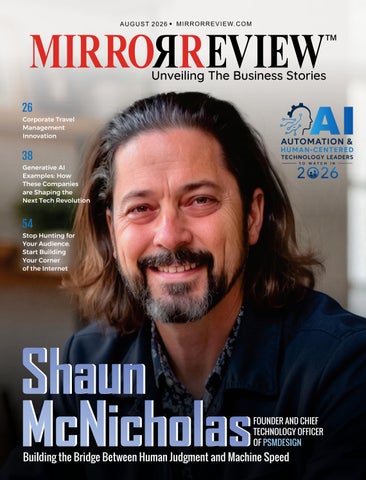
Shaun McNicholas
FOUNDER AND CHIEF TECHNOLOGY OFFICER OF PSMDESIGN
Building the Bridge Between Human Judgment and Machine Speed
EDITOR’S Note
Human Judgment. Machine Intelligence. One Future, Built Together.
Dear Readers, Every era of technological change produces a handful of leaders who see further than the rest, who recognise that the most powerful business systems sharpen human judgement rather than simply replace it. This issue, “AI, Automation & Human-Centered Technology Leaders to Watch in 2026,” gathers five such minds: builders, coaches, strategists and academics across different industries, all proving that intelligent machines and thoughtful humans were never meant to compete, only to collaborate. Shaun McNicholas, Founder and Chief Technology Officer of PSMDesign, built his career the way skilled engineers build lasting systems: one repaired failure at a time, across three decades spanning IT Director, CIO and CTO roles. Trained first as an illustrator, he never lost the instinct to design for people even as he mastered enterprise architecture, and that dual sensibility now shapes IteraOS, the unified operating environment he created after losing his primary income in 2025. Rather than simply adding another disconnected tool to a crowded stack, he built IteraOS to solve what he considers the true failure behind most automation efforts: fragmentation, not weak technology. His framework, Iterative Intelligence, moves organisations through augmentation, refinement, automation and insight, always keeping a human signature on decisions that matter. Guided by decades of scriptural study as much as hard lessons from crashed servers, he has helped a retail platform achieve closed loop attribution and a healthcare distributor lift revenue by twenty percent, proving that trustworthy technology strengthens judgement rather than replacing it. Joining him on this year’s list of leaders to watch are Marianne van Groeningen, Founder and CEO of Executive Career Coaching Europe; Kyle Toppazzini, Founder of SOVEREIGN OPS; Tony Ho, Founder of Osmosis AI; and Dr. Alok Chaturvedi, Professor at Purdue University's Daniels School of Business. What unites every leader in this issue is a conviction that technology earns trust only when it serves people first. Intelligence without empathy scales quickly and fails quietly, while systems designed around human dignity endure. The leaders featured here remind us that the most advanced tool is still only as wise as the values guiding it, offering a working blueprint for a future where machines amplify human potential instead of quietly diminishing it. Sincerely,
SIMRAN KHAN Managing Editor
Credits Publisher Archana Ghule Editor-in-Chief Vikram Suryawanshi Managing Editor Simran Khan Project Editor Shadab Mestri ™
Mirror Review Magazine is published by Pericles Ventures Pvt. Ltd. No part of this publication may be reproduced, distributed, or used in any form without prior written consent from the publisher. The editorial team has exercised utmost diligence to ensure the accuracy and integrity of all published content; however, the publisher assumes no liability for any errors or omissions. The publisher also bears no responsibility for the content of advertisements featured within the magazine.
Mirror Review Media & Tech Office No. 430, 4th Floor, Gera’s Imperium Rise, Opp. Wipro Circle, Hinjewadi Phase 2, Pune, Maharashtra - 411057.
+1 (850) 564-8517 info@mirrorreview.com www.mirrorreview.com
Project Managers Anushka Nalawade Visualizer Mark Davis Graphic Designer Omkar Uravane Head of Distribution and Production Aakash Mahajan Head of Operations Robert Smith Research Analysts James Adams Advertising Maria Smith
Cov
er
y r o St
10. Shaun McNicholas
20. Dr. Alok Chaturvedi 32. Kyle Toppazzini 46. Marianne van Groeningen 58. Tony Ho
Articles 26.
Corporate Travel Management Innovation
38.
Generative AI Examples: How These Companies are Shaping the Next Tech Revolution
54.
Stop Hunting for Your Audience. Start Building Your Corner of the Internet
Content
Profiles
AI, Automation & Human-Centered Technology Leaders to Watch in 2026 Shaun McNicholas
Dr. Alok Chaturvedi
Founder and Chief Technology Officer of PSMDesign
Professor at Purdue University’s Daniels School of Business
www.psmdesign.com
www.business.purdue.edu
Kyle Toppazzini
Marianne van Groeningen
Founder of SOVEREIGN OPS™
Founder and CEO of Executive Career Coaching Europe
www.sovereignops.ca
www.executivecareercoaching.io
Tony Ho Founder of Osmosis AI www.osmosisai.uk
COVER / STORY
Shaun McNicholas FOUNDER AND CHIEF TECHNOLOGY OFFICER OF PSMDESIGN
Building the Bridge Between Human Judgment and Machine Speed
“
The future belongs not to organizations with the most AI, but to those with the most integrated human-machine intelligence.
10 | AUGUST 2026
MIRRORREVIEW.COM | 11
COVER / STORY
T
echnology leadership rarely announces itself with drama. More often, it accumulates, one crashed server and one repaired system at a time, until three decades later, a person looks back and realizes they have built something they did not originally set out to build. That is the shape of the career belonging to Shaun McNicholas, Founder and Chief Technology Officer of PSMDesign, whose journey from IT Director to CIO to CTO has produced not just a company, but a philosophy about what technology is actually for, and a broader vision for the future of business intelligence, automation, and executive decision-making. Three Foundations, One Philosophy Long before boardrooms, infrastructure diagrams, and executive technology strategy, Shaun trained as an illustrator and designer. It is an unusual starting point for a man who would spend the next thirty years inside server rooms and enterprise systems, but he has always described himself as “the product of paradox,” a person pulled equally toward technical precision and creative restlessness. That duality never resolved itself into one identity. Instead, it became the foundation of his approach to technology and leadership. Even as he rose through IT Director positions and into CIO and CTO roles across a range of organizations, he carried the instincts of a designer alongside the discipline of an engineer. The two, he has said, were never in conflict. Precision told him how systems should work. Intuition told him what actually served the humans depending on those systems. That combination would later define the architecture and experience of IteraOS: a unified operating environment built with technical rigor at its core, but organized around how executives and teams actually evaluate risk, consume information, and make decisions under pressure.
Decades of biblical study, reinforced by years of serving in technology leadership within the churches he called home, shaped his conviction that technology exists to serve people rather than itself. That conviction continues to govern his engineering principles today. Technology is never just about efficiency. It is always about human flourishing. Good architecture, in his view, is not measured only by speed, scalability, or feature count, though all of those matter enormously. Good architecture serves people. It creates room for what matters most. It does not replace judgment. It protects oversight, supports accountability, and makes it easier for leaders to act with confidence because the right context is available at the right time. In Shaun’s view, technology does not create trust by replacing human judgment. It creates trust by strengthening it. The Year Everything Converged In 2025, these separate threads, including the design instincts, the systems expertise, and the spiritual conviction, came together at a moment that was anything but comfortable. Shaun lost his primary source of income. Faced with genuine uncertainty, he made a decision that would define the next phase of his work: rather than drift, he would build something that unified everything he had learned. That decision ultimately became IteraOS, an intelligent operating environment he first built as a personal operating system: a single place where his own information, projects, schedules, and tools could finally exist together. The goal was to bring together his biblical study, his design work, his technology projects, his family commitments, his financial life, and his creative ambitions within a single, unified view.
Leadership Beyond Technology
What he discovered while building it surprised him. When a single person finally has access to the complete context of their own life, and when AI agents can see that full picture rather than fragments of it, something shifts. The speed at which meaningful work becomes possible increases dramatically. Clarity about what actually matters stops being abstract and becomes unmistakable.
There is a third thread running through Shaun’s story, one that rarely appears on a conventional CTO’s resume: over forty years as a serious student of Scripture and nearly as many years spent responsible for technology leadership inside the churches he served. Rather than serving as a side note to his corporate career, this foundational commitment provided the moral architecture for everything he builds.
While IteraOS was first proven in Shaun’s own working environment, it was never conceived as merely a personal solution. From the beginning, it was built as a test case for a broader architectural thesis: that executive and management intelligence improves dramatically when communications, operational data, financial signals, documents, workflows, and AI assistance can function inside one secure, context-aware system.
12 | AUGUST 2026
Shaun has explored this foundational philosophy, where biblical principles of stewardship and service inform technical design and human-centered innovation, extensively through his writing on Arts in the Kingdom. There, he expands on the ideas that continue to shape his approach to leadership, technology, and human flourishing. Why Fragmentation, Not Weak Technology, Is the Real Failure Shaun's diagnosis of why automation and digital transformation initiatives fail is direct: the problem is rarely weak technology. The problem is a fragmented operating context. Organizations routinely rent access to a growing stack of disconnected tools. Revenue signals live in one system, customer relationships in another, financial records somewhere else, internal knowledge inside disconnected documents, and key operational decisions are scattered across inboxes, spreadsheets, and meetings. In that environment, no single tool ever sees the whole picture. The result is costly in two directions. Human teams grow exhausted simply managing the gaps and reconciling systems that were never designed to work together. AI agents, meanwhile, are brilliant at narrow tasks but starved for context, lacking enough breadth, depth, and governance of information to operate reliably across real business conditions. This is not theoretical for him. Across thirty years in production environments, he has lived through servers crashing and networks failing. He has spent entire weekends repairing architecture he had gotten wrong the first time. He has dealt with hard drive failures, missing backups, and tape restores that stretched across days while entire businesses waited helplessly for their information to return.
MIRRORREVIEW.COM | 13
COVER / STORY Those experiences produced a hardened set of architectural questions he now asks of every system: Is it scalable across the organization? Is it secure and private by design? Is it flexible enough to support how an organization actually operates? And does it provide enough contextual depth to produce accurate, trustworthy outcomes without drifting off subject? From Personal Question to Company Mission PSMDesign, the company Shaun founded, was built to turn that diagnosis into an actionable business offering. For him, the true goal of enterprise architecture is to keep the necessary capabilities while reducing dependence on disjointed software. For him, the real challenge in AI adoption has never been whether organizations are willing to experiment with new tools. It is whether they can adopt those tools in a way that preserves oversight, respects risk, and actually improves how the business operates. After watching decades of enterprise initiatives collapse into expensive shelfware or brittle automation, he set out to build a firm that helps organizations navigate the difficult middle ground between doing nothing and automating blindly. Rather than adding another application to an already crowded software stack, IteraOS was architected as the intelligent operating layer that connects existing systems into a single, context-aware environment. PSMDesign operates as the strategic and implementation layer around this philosophy, helping organizations eliminate the friction of tab-switching and siloed data by deploying a single, cohesive environment. The goal was never to build another application. It was to build a frictionless decision environment where leaders could see more clearly, decide more confidently, and automate more responsibly. What IteraOS Changes for Organizations To understand IteraOS, it helps to step away from the traditional way enterprise software is evaluated. When an organization looks at a new digital initiative, the standard impulse is to ask what features it adds to the list. Shaun built IteraOS around a fundamentally different question: how do we eliminate the operational latency of jumping 14 | AUGUST 2026
between ten different systems to execute a single strategic decision? IteraOS does not ask an organization to rip out its working tools or abandon established workflows. Instead, it serves as the unifying operating layer that allows existing systems to function as one coordinated intelligence network. It bridges the gaps between data silos, bringing immediate context to everyday business operations. Only after understanding this architectural foundation do the specific capabilities make sense. Because IteraOS operates as a unified environment rather than a standalone tool, it naturally brings cohesion to the core domains of an enterprise: ● Connected Relationships and Operations: Instead of isolating contacts, communications, and deal pipelines inside a siloed CRM, the platform weaves relationship history directly into daily execution and client workflows. ● Human-Governed Automation: The operating layer uses approval-gated automations that accelerate routine execution while ensuring human signatures govern high-stakes decisions, preventing unchecked scripts from executing blind actions. ● Accessible Organizational Knowledge: By utilizing retrievalaugmented document libraries across the entire enterprise context, institutional memory becomes instantly searchable and actionable without forcing teams to hunt through disconnected archives. ● Unified Financial Visibility: Transaction reconciliation and budget modeling are connected directly to operational data, allowing executive leadership to evaluate strategic initiatives against real-time financial signals. ● Context-Aware AI Assistance: Employees no longer need to juggle separate subscriptions and tabs for ChatGPT, Claude, and Gemini. The platform embeds multi-modal AI access directly into the secure workflow, providing context-aware intelligence without data leakage. The common denominator across these areas is not novelty; it is disciplined integration. Shaun built PSMDesign specifically to help organizations avoid the AI hype trap by focusing on systems that reduce manual effort, improve visibility, strengthen governance, and create measurable operational leverage. Iterative Intelligence, Explained in Four Stages At the center of Shaun's professional philosophy sits a framework he calls Iterative Intelligence, a structured progression for integrating AI into business operations without sacrificing human judgment.
Painted by Shaun McNicholas as a high-school senior in 1986 and intentionally left unretouched, this self-portrait captures his early vision of organizing chaos into a “coherent sphere of influence” — a faith-guided vision that has evolved into the philosophy behind the beautiful, functional technology systems he builds today.
MIRRORREVIEW.COM | 15
COVER / STORY Augmentation comes first, where AI offers suggestions and recommendations, but humans retain full decision authority. Refinement follows, as feedback from those human decisions trains the system to improve the quality, relevance, and reliability of those suggestions over time. Only after that comes Automation, reserved strictly for tightly bound, high-confidence, low-risk tasks. The final stage is Insight, where the system begins surfacing patterns, relationships, and strategic opportunities that teams, working alone, could never have detected manually. He designed this progression deliberately, ensuring that machines remain tools in service of human judgment rather than becoming a replacement for it. In practice, it governs how PSMDesign implements business systems: AI first supports decision-making, then improves through supervised feedback, then automates only where the controls are strong enough, and finally contributes to strategic visibility. The objective is not automation for its own sake; it is a controlled path toward better executive intelligence. The Mistakes Organizations Keep Making Over time, Shaun has identified three recurring failures that undermine enterprise automation efforts. The first is treating automation as an all-or-nothing proposition, as though every task must be either fully manual or fully automated. In reality, roughly eighty percent of the value lies in the supervised middle ground, where systems can accelerate work without removing human oversight from consequential decisions. The second mistake is pursuing speed without governance. Organizations routinely rush toward deployment before building the controls, approval structures, and transparency needed to prevent preventable errors. The result is not just technical failure, but the erosion of trust. The third is neglecting change management. Even technically sound systems fail when the people expected to use them are not brought into the process early enough to understand, trust, and adopt them. He addresses all three through a disciplined operating approach: approval-gated automation where critical decisions require a human signature before execution, transparent AI recommendations where systems explain why they recommended something rather than merely what to do, and continuous feedback loops that improve performance over time. His tools are designed for skill elevation rather than deskilling, freeing people from repetitive work so they can focus on strategy, relationships, and executive judgment. 16 | AUGUST 2026
Balancing Innovation, Scale, and Governance As a strategist, Shaun manages the tension between innovation, scalability, and ethics through a practical operating discipline. He practices principled experimentation: building minimum viable systems, testing them in real conditions, and measuring real-world impact before scaling broadly. He insists on data governance from day one, treating security, privacy, compliance, and auditability as foundational architectural requirements rather than afterthoughts bolted on later. And he prioritizes stakeholder alignment early, ensuring that technical systems actually reflect the values, workflows, and risk tolerance of the organizations expected to rely on them. This approach is especially important in AI-enabled systems, where the temptation to move quickly can outpace the structures needed to make that speed safe. For him, security, privacy, auditability, and accountability are not secondary concerns. They are foundational requirements of any platform intended to support real business decisions. The Test That Defined His Leadership One of the clearest demonstrations of Shaun’s philosophy came during an automation deployment that initially faced significant resistance from middle management. Rather than mandate compliance or force adoption, he changed his strategy entirely. He identified two early-adopter departments, gave them ninety days of dedicated support, and let performance become the argument. The results validated the approach. With the right systems and oversight structures in place, a small team was able to successfully oversee the operations of an entire university’s continuing education department, serving several hundred instructors, several thousand annual students, and several million dollars in annual revenue. The participating teams reported measurable time savings and improved job satisfaction. Watching those results become visible, skeptical departments began requesting the same tools voluntarily. The lesson he draws from that experience has become a cornerstone of his consulting practice: change leadership succeeds through proof, trust, and peer credibility rather than mandates.
A Career Measured in Outcomes Across more than two decades of platform and infrastructure development, Shaun's track record reads less like a résumé and more like a series of systems that learned to work smarter over time. The through-line is consistent: he doesn’t just build technology that stores information; he builds systems that surface insight and improve through use. As CTO of a retail intelligence platform, he oversaw a global engineering organization and an approximately $7.5 million annual technology budget, unifying fragmented Wi-Fi, BLE, POS, loyalty, and marketing data into a single behavioral intelligence system. The result was closed-loop attribution in physical retail, connecting digital campaigns to in-store visits and purchase outcomes for the first time, and turning marketing decisions from “we believe this is working” into “we can measure exactly what's driving results.” For a healthcare manufacturing and distribution company, he re-architected an underperforming CRM, not by replacing it, but by transforming it into an operational intelligence layer across sales, support, and customer engagement. The outcome was structural: roughly a 20% increase in revenue and a 50% reduction in support staff requirements. The business stopped scaling through headcount and started scaling through systems. Earlier in his career, leading a professional services firm before AI had a name, he built a custom CRM on a Java-based architecture and layered in intelligent search and classification using early implementations of Apache Lucene. The system indexed vast volumes of structured and unstructured data and surfaced connections between clients, conversations, and opportunities, functionally an early form of the machine-learning-assisted search intelligence common today. At a higher-education technology provider, he modernized a rigid monolith into a scalable, multi-site architecture on modern .NET MVC frameworks, delivering roughly a 45% improvement in platform performance, a 10%+ year-over-year lift in conversion, and meaningful gains in SEO visibility. And across a high-volume outdoor e-commerce network with millions of parts and thousands of vehicle variations, he rebuilt search and catalog navigation with Apache Solr and Lucene while migrating legacy infrastructure to the cloud, cutting catalog processing and build time by roughly 50%.
Different industries, different eras, one pattern: systems that adapt to how people actually work and improve continuously through real-world feedback. It is the same principle he now defines as Iterative Intelligence, and the foundation on which IteraOS is built. Through PSMDesign, he has translated that experience into a broader mission: helping mid-market and enterprise organizations adopt AI and automation in ways that are practical, governed, and operationally meaningful. In parallel, he has established himself as a sought-after speaker and strategist on AI adoption, human-machine collaboration, and digital transformation. Where Shaun Believes This Is Heading Looking toward the future, Shaun sees three major shifts defining the conversation around business automation. First, organizations will move beyond the false choice of “AI or human” and invest instead in systems built around “AI and human” collaboration. The real competitive advantage will come not from replacing people, but from giving them better context, better tools, and better decision support. Second, explainability will become non-negotiable. Regulators, customers, and internal stakeholders alike will increasingly demand systems that can account for why decisions were recommended, approved, or executed. Black-box speed without governance will lose ground to interpretable, accountable intelligence. Third, the companies that ultimately win will be the ones that treat automation as an iterative operating discipline rather than a single, one-time deployment. The strongest organizations will build integrated environments where workflows, data, AI support, and human oversight continuously refine one another over time. His advice to leaders navigating that uncertainty is characteristically direct: start small where the business pain is real, build with governance from the beginning, and let humans remain in control of the decisions that matter. For Shaun McNicholas, that has never been a slogan. It has been the operating principle behind a career spent watching systems fail, rebuilding them under pressure, and ultimately arriving at a simple, hard-won conclusion: the future does not belong to whoever deploys the most artificial intelligence. It belongs to whoever integrates machine intelligence with human judgment, business context, and accountable decision-making. MIRRORREVIEW.COM | 17
20 | AUGUST 2026
T
here is a specific kind of quiet that exists in the office of a man who spends his days thinking about the intractable. It is not the silence of emptiness, but the heavy, hum-filled silence of a server room or a library, where the air feels thick with data waiting to be turned into decisions. Dr. Alok Chaturvedi lives in this quiet place. He sits at the intersection of things that usually do not meet. He stands between the clean, cold logic of rigorous mathematics and the messy, desperate needs of the human condition. He bridges the gap between the subatomic weirdness of quantum mechanics and the dusty reality of a rural village in India. For four decades, Dr. Chaturvedi has been asking a single, relentless question. It is a question that sounds simple until you try to answer it. How can we model complex systems well enough to make better real-world decisions? Most people ask this question to sell more widgets or optimize a supply chain. Dr. Chaturvedi asks it because he believes that if you get the math right, you can save a life. Or ten million of them. MIRRORREVIEW.COM | 21
He is a Professor at Purdue University’s Daniels School of Business and the Director of the Institute for Social Empowerment through Entrepreneurship and Knowledge (ISEEK). But these titles feel like ill-fitting suits for a man whose work is essentially about cartography. He is mapping the future. He is drawing lines between the terrifying potential of Artificial Intelligence and the stabilizing force of ethical wisdom. He is not just a technologist. He is a philosopher who speaks in algorithms. The Sentient World To understand the scope of Dr. Chaturvedi’s mind, you have to go back to a time of crisis. During the conflicts in Iraq and Afghanistan, the U.S. military had a problem. They had plenty of firepower, but they lacked foresight. They could break things, but they struggled to predict the consequences of breaking them. Dr. Chaturvedi and his team built something that sounds like science fiction. They called it the Sentient World Simulation (SWS). It was a synthetic mirror of the real world, a continuously running, agent-based model that digested data and spat out probabilities. It gave decision-makers a way to “rehearse” the future. It allowed them to see that if they pulled a lever here, a wall might fall down over there. “That was not abstract research,” Dr. Chaturvedi says, his voice dropping to the register of someone who has seen the weight of his own equations. “It was computation meeting consequence.” The system helped preserve lives. It proved that you could use silicon and code to understand the organic chaos of human conflict. But for Dr. Chaturvedi, this was just the proof of concept. If you could use this power to navigate a war, surely you could use it to navigate the even more complex landscape of peace. If you could model a battlefield, could you model a pathway out of destitution? The Quantum Bridge Today, the frontier has moved. The buzzword in every boardroom is “Quantum.” CEOs are terrified of it, or they are throwing money at it, usually without understanding it. They see it as a faster horse. They think it is just a computer that computes more. 22 | AUGUST 2026
Dr. Chaturvedi shakes his head at this. “The critical insight for CEOs,” he says, “is that quantum computing isn’t just faster than classical computing. It is a fundamentally different way of processing information.” He is currently pioneering what he calls the “Quantum Bridge.” It is a pragmatic, almost subversive approach to the hype. While the rest of the world waits for stable quantum hardware, machines that are still finicky, expensive, and rare, Dr. Chaturvedi is using quantum thinking on the computers we have today. He uses quantum-mathematical structures to design algorithms that run on standard hardware. It turns out that the math of the quantum world, concepts like superposition and entanglement, are incredibly good at solving human problems. “Think of it as ‘measurement theory’ for business decisions,” he explains. In the classical world, and in traditional business strategy, you gather data, you analyze it, and then you commit. You collapse the wave function. You choose a path. But the world is uncertain. Dr. Chaturvedi’s quantum-inspired frameworks allow a system to maintain “strategic superposition.” This means holding multiple possibilities simultaneously, delaying the irreversible decision until the moment of optimal timing. It is not a metaphor. It is rigorous mathematics. And when applied to business, it improves decision quality dramatically while cutting the cost of information. It is a way of being comfortable with uncertainty, of navigating the fog not by clearing it, but by seeing through it with a different kind of eye. The Village and the Cloud If the Quantum Bridge is the “how,” then ISEEK is the “who.” It is easy to talk about “empowering the underprivileged” in the abstract language of a grant proposal. It is much harder to do it when the population you are serving has little literacy, no capital, and no access to the internet. Dr. Chaturvedi founded ISEEK with a ten-year goal that is staggeringly ambitious: to “graduate” ten million people from at least ten countries out of destitution. He wants to turn them into entrepreneurs.
The standard model of economic development is brutal. It usually involves taking people from rural areas and shoving them into urban factories. It disrupts families, destroys communities, and creates urban slums. It creates efficiency at the cost of humanity. Dr. Chaturvedi looked at this system and saw a bad algorithm. He saw a model that optimized for money but failed to optimize for “human flourishing.” So he flipped the model. Instead of moving the people to the factory, he moved the factory to the people. Through Project Saksham in India, ISEEK deployed the “Factories-on-Wheels” concept. They bring manufacturing capabilities to rural villages. They use a platform called Daksh, a gamified mobile app that teaches entrepreneurship to people who might not be able to read a textbook but can certainly understand a game. “Innovation isn’t just technology,” Dr. Chaturvedi says. “It is maintaining optionality.” There is that quantum thinking again. By bringing the work to the village, the women of Jharkhand can run sustainable micro-enterprises. They earn an income. But they do not lose their social support network. They stay in their community. They remain in superposition; mothers, community members, and business owners, all at once. “This isn’t charity,” Dr. Chaturvedi insists. “It is a sophisticated systems design that achieves better outcomes by respecting human diversity.” He talks about “cognitive diversity.” He recognizes that a woman in a village in India makes decisions differently from a stockbroker in New York. Traditional AI optimizes for the average, which means it optimizes for the stockbroker. Dr. Chaturvedi builds systems that design for “equity enhancement.” He builds AI that works for the edges of the bell curve, not just the center. Digital Dharma We live in an era of tech anxiety. We worry about algorithms radicalizing our children. We worry about AI taking our jobs. We worry about the surveillance state. Dr. Chaturvedi offers a solution that is thousands of years old, repackaged for the silicon age. He calls it “Digital Dharma.” MIRRORREVIEW.COM | 23
Dharma is a Sanskrit concept that is difficult to translate. It means duty, law, righteousness, or the natural order of things. For Dr. Chaturvedi, Digital Dharma is “a practice for living well with technology.” It is not a set of regulations imposed by a government. It is a personal discipline. At the core of this philosophy is the vratam: a small, keepable vow. “Think of these as low-stakes rehearsals for high-stakes digital moments,” he says. A vratam might be a promise to turn off your phone an hour before bed. It might be a commitment to verify a piece of news before sharing it. It might be a refusal to click on clickbait. These sound like small things. But Dr. Chaturvedi argues that they build “ethical muscles.” When the crisis comes, when you are faced with a deepfake that confirms your worst biases, or when you are tempted to trade your privacy for convenience, you need those muscles. You need to have practiced the art of attention and choice. “This journey is both personal and communal,” he says. As individuals adopt these small practices, the culture shifts. The demand for ethical technology grows. It scales from the user to the platform to the policy. It is a bottom-up revolution of conscience. The Calculus of Inequality What keeps Dr. Chaturvedi working this hard? He has achieved tenure, he has won the National Training and Simulation Association’s Lifetime Achievement Award, and he has successfully exited a commercial company, Simulex. He could retire to a cabin and read books. “What keeps me at this is simple,” he says. “Technology can amplify inequality or reduce it. The difference is whether equity is designed in from the start.” 24 | AUGUST 2026
He sees a divergence coming. On one side, there is the “Quantum Bridge”: sophisticated, high-speed decision-making tools for the elite. On the other side, there are the billions of people left behind by the digital economy. If we are not careful, AI will widen this canyon. It will make the rich hyper-efficient and the poor irrelevant. Dr. Chaturvedi’s work is an attempt to wire the bridge so that traffic flows both ways. He points to his “Quantum Bridge” research again. “The same quantum structures that optimize business decisions also enhance healthcare equity for underserved populations,” he says. This is the elegance of his worldview. The math that makes a corporation profitable is the same math that makes a healthcare network fair. It is all about optimization. It is just a matter of what you choose to optimize for. The Unprepared Future Dr. Chaturvedi manages his life with the same balance he seeks in his algorithms. He finds grounding in his partnership with his wife, Rashmi. He finds relief in the “multidisciplinary nature” of his work. Moving from high-level quantum theory to the practical logistics of a mobile app for rural India prevents burnout because it uses different parts of the brain. But there is an urgency in his voice when he talks to leaders. He has a mantra, a warning that he delivers to CEOs and students alike. “The future arrives unprepared.” We have a habit, he says, of viewing things like AI or quantum computing as distant events. We think we have time. We wait for the technology to be perfect. We wait for the regulatory landscape to settle. “But the future isn’t a single moment; it’s a process,” Dr. Chaturvedi says. “And that process is happening right now.” The leaders who will succeed are not the ones who wait for the quantum computer to arrive in a box. They are the ones who are building “quantum literacy” right now. They are the ones building “ethical AI frameworks” right now. They are building “organizational muscle.”
He is a man who has spent a lifetime modeling the future, and his conclusion is that you cannot predict it perfectly, but you can prepare for it. You can build systems that are resilient. You can build technologies that are kind. Dr. Alok Chaturvedi is looking at the screen. He sees the code. He sees the quantum states swirling in superposition. But through the data, he sees the village. He sees the face of a person who just needs a chance. And he goes back to work, calculating the precise mathematical formula for hope.
MIRRORREVIEW.COM | 25
26 | AUGUST 2026
CORPORATE TRAVEL
MANAGEMENT INNOVATION Go Zero-Touch in 2026 n 2026, corporate travel is moving toward zero-touch booking. AI can read a calendar invitation, create a trip plan that adheres to company rules, and send it for one-tap approval. This makes booking faster and easier while helping companies reduce costs, avoid travel issues, and manage expenses better.
I
The Global Business Travel Association expects global business travel spending to reach a record $1.71 trillion in 2026. It also estimates 1.84 billion business trips this year. Since spending is growing faster than the number of trips, companies need to manage every travel dollar carefully.
The Next Era of Business Travel
This pressure is driving new ideas in corporate travel management. Since it is already 2026 and CTM/platforms are actively testing or deploying this, change “could soon create” to “can now generate.” Present it as an active feature rather than a distant future prediction. Travel is becoming a way to save time, control costs, and support business growth.
Corporate travel once meant using three different websites. Employees had to compare prices manually and wait for a manager’s approval before booking a business trip. Today, that slow process is changing.
This shift toward automated travel, shared traveler data, and better cost control is changing what modern business travel providers offer. It is also changing the daily role of corporate travel managers.
» 01: Zero-Touch Mobility Systems How Zero Touch Corporate Travel Works Zero-touch corporate travel is a booking system that manages the entire trip through software. It handles everything from booking the trip to submitting the final expense report, without requiring the traveler to search or book manually. Corporate Travel Management (CTM), one of the larger corporate travel agencies in the industry, is already testing this workflow for routine trips. Its AI manages each step, from the first request through the final expense report.
MIRRORREVIEW.COM | 27
Here’s how it works. An executive accepts a meeting invite in Microsoft Teams or Outlook. The system checks the trip against company travel policies and searches flights and hotels from approved partners. It then shows one approved travel plan directly in the chat app. The traveler can confirm the booking with one tap on a phone or computer. There is no need to switch between websites or enter details manually. Researchers call this a “trust flywheel.” When travelers see that the system regularly finds good options that follow company rules, they stop using outside booking sites. This keeps more company travel spending within approved and trackable channels. This is also a key direction for modern travel technology. Many travel teams now see traditional booking portals as only a temporary solution. The industry is moving toward booking travel through the apps employees already use for work instead of making them visit a separate website.
» 02: Solving Data Fragmentation for Executive Trips What is Corporate Travel Management in 2026? Modern corporate travel management extends far beyond booking flights and hotels. It spans travel policies, budget allocations, compliance rules, duty of care, and the overall traveler experience. In the past, this information lived in disconnected systems. Expense platforms, hotel programs, ground transit providers, and travel services rarely communicate. By unifying these disparate tools into a single traveler profile, software can now anticipate logistical issues before they happen. For instance, if a flight is delayed, the system can automatically update ground transportation pickup times and send an alert to the hotel for a late check-in. This is predictive mobility in action. Personalization has quickly become a core benchmark for business travel software. A platform that merely processes transactions without learning from historical travel patterns is already obsolete. How Corporate Clients Manage Multiple Travelers on One Itinerary Unified data systems are equally vital for group logistics and multi-person trips. When a sales team heads to the same regional conference or client site, travel managers can view cumulative hotel occupancy, ground transfers, and spend in a single dashboard rather than tracking disjointed individual bookings.
» 03: Dynamic Policy and Cost Control Rate Engines That Adjust in Real Time Fixed travel policies often fail when prices suddenly rise. A set hotel limit or flight budget may look fine, but higher prices can lead to rejected bookings or out-of-policy purchases. 28 | AUGUST 2026
MIRRORREVIEW.COM | 29
30 | AUGUST 2026
For busy domestic flights booked less than two days before departure, fares can be nearly twice the average price. This gap is growing as flights become fuller. Dynamic pricing policies solve this by adjusting spending limits based on real-time demand, local events, and past booking trends. They help travelers stay within the overall travel budget. Unlike traditional travel programs that update limits only once or twice a year, these systems adjust spending as prices change. Many companies also use virtual corporate cards to automatically control spending when a booking is made. The system also helps manage travel problems and keep travelers safe. If a flight is delayed or a storm affects the trip, it can automatically find a suitable new flight, update the hotel, and record the change. In many cases, this happens before the traveler even gets a cancellation alert. AI use supports this trend. About 80% of business travelers already use generative AI to help plan trips. More than half are also comfortable letting AI handle the full process, from booking flights and hotels to submitting expense reports, according to FCM Travel research. For CFOs, this flexibility can save money. It also cuts costs caused by higher last-minute fares and the time employees spend changing bookings manually. Corporate Travel Managers Become Systems Auditors A New Role, Not a Smaller One None of this means companies no longer need travel managers. Their role is simply changing. In the past, travel managers spent much of their time checking policies and approving bookings manually. Now, automation handles much of this routine work, so managers focus more on checking how the AI makes decisions. They use data to monitor compliance instead of reviewing every booking. They also make sure the AI follows company policies and that its decisions can pass compliance checks. This requires new skills. Travel managers now use dashboards to track key numbers, such as off-policy bookings, booking times, and how quickly the system handles travel disruptions.
They also explain the results to company leaders. A good travel manager can show how AI reduces costs, improves service, and keeps travel policies on track. For this system to work, companies need three things: clean data, a gradual rollout that helps employees trust the new process, and clear reports showing exactly how much money the automation saves. Conclusion: Building a Scalable Mobility Framework Corporate travel management improves through small steps, not one big software purchase. First, bring all travel data into one traveler profile. Then, automate simple bookings that make up most business trips. Once the system is reliable, add flexible travel policies. Companies that automate too quickly without clean data often face more problems and exceptions.
Global business travel spending is expected to exceed $1.71 trillion this year and reach nearly $2 trillion by 2030. At the same time, old booking systems are becoming more costly. For business leaders, the key question is not whether to automate, but where to start. The best corporate travel programs combine AI-powered booking with reliable data and strong oversight. This helps companies cut costs, follow travel policies, and keep employees safe. It works for both simple, same-day flights and complex executive trips. Which part of your travel program should be automated first: regular domestic bookings, executive travel, or handling travel disruptions?
MIRRORREVIEW.COM | 31
32 | AUGUST 2026
MIRRORREVIEW.COM | 33
34 | AUGUST 2026
MIRRORREVIEW.COM | 35
36 | AUGUST 2026
MIRRORREVIEW.COM | 37
GENERATIVE EXAMPLES rtificial Intelligence is a buzzing word in the world. Several industries are implementing AI partially or are in beta testing. So, as an entrepreneur, you must be searching for generative AI examples, Right?
A
discovery and treatment. It has developed a cloudbased platform that transforms the workflow of pathologists. This not only increases their productivity but also boosts their diagnostic confidence.
First, we have to understand its depth. AI is transforming our world and showcasing glimpses of our bright and dream-come-true future from sci-fi movies. The most popular AI tools that we often hear about are ChatGPT, Google Gemini, and Bing Copilot.
In addition, Paige has joined forces with Microsoft. Together, they have built the world’s largest image-based AI models. These models are specifically designed for digital pathology and oncology.
As the integration of these generative AI is taking place across various sectors, let us have a look at specific generative AI examples.
Lastly, Paige has made a significant breakthrough. It has introduced a new AI-Based Biomarker Screening Advancement. This innovation drastically reduces diagnostic turnaround times.
Generative AI Examples According to Specific Industries
As a result, it enables doctors to make precision treatment decisions more efficiently.
Generative AI Examples in Healthcare 2. Drug Discovery 1. Diagnosis and Imaging Paige.ai leverages generative AI for cancer pathology analysis. Paige is a company that uses cutting-edge AI technologies to revolutionize pathology. This makes generative AI accessible to doctors, enhancing their ability to diagnose and treat diseases. Moving on, Paige isn’t just about the present. It’s building the future of cancer diagnosis. By offering a comprehensive digital pathology platform and robust AI applications, it’s paving the way for advancements in medical science. Now, let’s delve into some key points. Paige harnesses the power of AI to usher in a new era of cancer 38 | AUGUST 2026
Insilico Medicine is utilizing generative AI to design and develop new drugs. Insilico Medicine is a globally recognized biotech company. It leads the way in end-to-end generative AI-driven biotechnology. The mission of Insilico Medicine is noteworthy. It aims to extend healthy productive longevity. This is achieved by transforming drug discovery and development with generative artificial intelligence. Key points about Insilico Medicine: The company plays a significant role in the medical field. It reduces the time and cost of delivering life-saving medications to patients.
MIRRORREVIEW.COM | 39
They possess a unique tool, the Pharma.AI platform. This proprietary platform accelerates drug discovery and development. It spans across biology, chemistry, and clinical development.
This benefits both quality teams and clinicians, showcasing the power of generative AI examples in healthcare.
Another remarkable platform they have is in Clinico. This data-driven platform forecasts a single clinical trial’s success probability.
4. Product Design & Development
Lastly, a notable member of Insilico Medicine’s Scientific Advisory Board is Michael Levitt. He won the Nobel Prize in Chemistry in 2013. His groundbreaking work in protein structure and protein folding using computer modeling is commendable. 3. Patient Care and Communication Navina’s AI assistant helps doctors by generating reports, summarizing patient data, and even drafting referral letters. Navina is a company that provides a clinician-first AI platform. The mission of Navina is to streamline patient care. It achieves this by transforming chaotic data into actionable patient portraits. Key points about Navina: Navina’s proprietary AI is a game-changer. It integrates data from EHRs and other sources. The AI surfaces what’s important and identifies potential quality and risk gaps requiring attention. Furthermore, Navina provides efficient pre-visit planning. It ensures accurate diagnosis capture, improved risk adjustment accuracy, and superior quality compliance. This reduces the burden on physicians, making their work more manageable.
Generative AI Examples in Manufacturing
Autodesk partnered with Airbus to utilize generative AI for designing future jetliners. Airbus, the aircraft manufacturer, is a shining example of generative AI in action. It has been using advanced technologies like generative design and 3D printing to transform air travel into a dynamic, eco-friendly experience. Moving on, Airbus’s Innovation Manager, Bastian Schaefer, is at the forefront of this transformation. He is working tirelessly to make jetliners more efficient and comfortable. As part of the team that developed the Airbus Concept Plane, Schaefer’s insights are shaping the future of air travel. This vision of the jetliner of 2050 will be much lighter, use less fuel, and leave a smaller carbon footprint. This complex vision relies on cutting-edge technology inspired by nature: generative design. Schaefer began working with Autodesk Research, using generative design to develop what the team called “the bionic partition.” Generative design is a technology that mimics nature’s evolutionary approach to design. It starts with your design goals and then explores all possible permutations of a solution to find the best option. This is one of the many generative AI examples that are revolutionizing industries. 5. Predictive Maintenance
Navina’s AI engine meets risk adjustment needs. It streamlines pre-visit reviews with AI-powered HCC recommendations. This simplifies the workflow for everyone involved, making it a practical application of generative AI. Lastly, Navina offers a complete risk adjustment solution. It covers everything from pre-visit planning to point-of-care assessment. Navina’s AIpowered solution for care gap management streamlines the quality workflow. 40 | AUGUST 2026
GE Predix is an AI platform used by GE Aviation for predictive maintenance in jet engines. The Predix Platform by GE Digital. It serves as an IoT edge-to-cloud foundation shared by GE Digital applications. Moving on, the Predix Platform is more than just a platform. It’s a cloud-based Platform-as-a-Service (PaaS) specifically designed for the industrial internet.
Generative design often produces complex geometric shapes and structures. These may be difficult to conceive manually but are excellent generative AI examples. These designs can leverage the full potential of advanced manufacturing techniques such as additive manufacturing (3D printing).
Furthermore, the Predix Platform connects various elements. It links machines, data, people, and other assets. This is achieved using leading technologies for distributed computing, big-data analytics, asset data management, and machine-to-machine communication. Lastly, Predix Essentials is the commercial offering of the Predix Platform. It offers customers a complete package of the core Predix Platform services used by GE Digital applications. This showcases the practical application of generative AI examples in the manufacturing industry.
Lastly, generative design can optimize designs across multiple disciplines. This includes structural analysis, fluid dynamics, thermal management, and electromagnetic simulations. It achieves optimal performance across various criteria, showcasing the power of generative AI in action. Generative AI Examples in Agriculture 7. Precision Agriculture with AI Insights “Planet” provides the most current and complete agricultural insights across every region and season. Planet company specializes in “Monitoring for Precision Agriculture.” It provides high-resolution, high-frequency satellite solutions. These solutions offer critical insights necessary for productive, profitable, and sustainable farming.
6. Tools & Companies Generative Design technology by Siemens Software Generative Design Technology by Siemens Software enables design collaboration with artificial intelligence in engineering. Moving on, generative design is a unique capability of CAD generative engineering applications. It autonomously generates a number of design alternatives given a set number of constraints. This can be done without an engineer’s guidance or interaction, freeing them up for other tasks. Once complete, the engineers can choose which designs they want to explore more completely. Generative design in CAD is an innovative approach. It involves using algorithms and AI to generate multiple design options based on specified parameters and constraints. Furthermore, it allows designers and engineers to explore a wide range of potential solutions. They can optimize designs for various objectives such as weight reduction, material efficiency, cost minimization, and performance enhancement.
Moving on, Planet provides the most current and complete agricultural insights. These insights span across every region and season. With Planet, growers can measure crop health from preseason to harvest. This allows them to farm more efficiently, profitably, and sustainably. Furthermore, Planet’s daily stream of high-resolution satellite imagery is noteworthy. It enables precision agriculture at scale, even in regions with frequent cloud cover. Providing a combination of broad area coverage, field-level detail, frequent in-season revisit rates, and rapid access, Planet provides valuable input at each stage of crop management. Lastly, Planet’s simple cloud-based APIs are worth mentioning. They allow Planet data to be integrated into your software pipeline with ease. Planet’s high cadence monitoring and 3-5 meter resolution imagery allow you to track agricultural processes with ease. This showcases the practical application of generative AI examples in the agriculture industry.
MIRRORREVIEW.COM | 41
8. Predictive Disease and Pest Control Phytech uses generative AI to analyze historical data and weather patterns to predict outbreaks of crop diseases and pests. Phytech is a company that connects growers to their plants, helping them monitor, plan, automate, and manage various aspects of farming. Moving on, Phytech’s technology is based on direct data from your trees, fruits, soil, climate, and irrigation system. This allows for a more efficient and effective farming process. Furthermore, Phytech provides direct health and water demand data. This allows trees to indicate when and how much water they need to produce high-quality yields. It’s a practical application of generative AI examples in agriculture. Phytech offers a full picture of your farm’s needs at a glance. This includes stressed blocks, irrigation performance, and Phytech’s recommendations. It’s a testament to the power of generative AI in action. Phytech’s pressure sensors placed on the irrigation system monitor actual irrigation in each block. This ensures optimal water usage and promotes sustainable farming practices. In addition, Phytech helps growers reach their desired fruit size. It tracks the fruit’s growth against a trajectory and controls its size by applying irrigation. At last, Phytech offers ongoing irrigation consultancy and support. 9. AI-powered Chatbots for Personalized Learning Plantix uses generative AI to create chatbots that answer farmers’ questions about crop health, pest identification, and best practices.
Furthermore, Plantix has a community of agriexperts. They provide advice and share their experiences, contributing to a knowledge-rich platform. The app also provides information on specific crop diseases and prevention methods. This ensures a successful harvest, demonstrating the power of generative AI in action. Lastly, Plantix has achieved a significant milestone. As the most downloaded ag-tech app worldwide, it has answered more than 100 million crop-related questions from farmers. This is a testament to the impact of generative AI examples in the industry. Generative AI Examples in Education 10. Personalized Learning Platforms ALEKS creates individualized learning paths for students in math, chemistry, statistics, and accounting. ALEKS is an adaptive online learning program. It caters to various subjects like math, chemistry, statistics, and accounting. ALEKS enables all students to have the same learning opportunity. With ALEKS, students achieve mastery more than 90% of the time, showcasing the effectiveness of generative AI examples in education. Furthermore, ALEKS is a research-based, online learning program. It offers course products for Math, Chemistry, Statistics, and more. Rooted in 20 years of research and analytics, ALEKS provides a deep understanding of each student’s knowledge and learning progress.
Plantix is a free app that serves as a prime example of generative AI in action. It helps farmers diagnose and treat crop problems, thereby improving productivity and providing farming knowledge.
Constantly adapting to update each student’s knowledge state, ALEKS guides students to precisely what they are ready to learn at all times. This ensures a personalized learning experience for every student.
Moving forward, Plantix offers a unique feature. Farmers can take a photo of their sick crop and get a free diagnosis and treatment suggestions in a few seconds. This showcases the practical application of generative AI examples in agriculture.
At last, ALEKS helps students master course topics through a continuous cycle of mastery, knowledge retention, and positive feedback. It has helped over 25,000,000 students and counting, demonstrating the impact of generative AI examples in the industry.
42 | AUGUST 2026
11. Language Learning italki connects students with online language tutors. italki is a language learning platform connecting students with certified language tutors from around the world. It offers 1-on-1 lessons that are customizable and trusted by millions of users. You can learn from certified teachers who fit your budget and schedule, showcasing the flexibility of generative AI examples in education. Furthermore, italki provides a global community of language learners. This fosters a collaborative learning environment and enhances the learning experience. In addition, italki offers a wide range of language options. You can pick from over 150 languages including English, Japanese, Spanish, Chinese, French, Italian, German, Portuguese, Korean, Arabic, and more. Lastly, italki offers various resources for learning beyond the classroom. These include assessments, podcasts, articles, topics, prompts, quizzes, and more. This comprehensive approach to language learning demonstrates the far-reaching impact of generative AI examples in the educational sector.
Teachers can make any slides-based lessons interactive with Nearpod. They can gather data on student understanding by adding formative assessments, simulations, and dynamic media. Additionally, Nearpod offers gamification and activities like Time to Climb, Matching Pairs, Draw It, and NEW Drag & Drop. These features enhance the learning experience and make it more engaging. Lastly, Nearpod is flexible and can be used in various environments, be it classroom, distance learning, or hybrid. It integrates with the tools you’re already using, such as Power Points, Google Slides, worksheets, videos, and other resources. This showcases the practical application of generative AI examples in the educational sector. Generative AI Examples in Advertising and Marketing 13. Marketing Copywriting Anyword is an AI writing platform that uses natural language processing to generate and optimize marketing content. Anyword is a versatile tool that stands as a prime example of generative AI in advertising and marketing. It can be used to create and optimize content for websites, social media, email, and ads.
Nearpod allows teachers to create interactive lessons that include quizzes, polls, and open-ended questions.
Moving on, Anyword boasts a range of features. It offers custom scoring models that train AI models on brand and performance data. This ensures the content generated is in line with the brand voice and is likely to perform well.
Nearpod is a real-time student engagement platform that stands as one of the prime generative AI examples. It offers interactive lessons, videos, gamification, and activities.
Furthermore, Anyword supports customization. It allows users to define keywords to maintain brand voice and relevance. This showcases the flexibility of generative AI examples in content creation.
Moving on, Nearpod provides real-time insights into student understanding. It does this through interactive lessons, videos, gamification, and activities, all within a single platform.
In addition, Anyword caters to a variety of content types. It includes social media descriptions, headlines, and email marketing. It also provides templates for various platforms, enhancing the user experience.
Furthermore, Nearpod allows teachers to visualize and support student understanding. It enables them to adapt instruction or address misconceptions on-the-fly, showcasing the flexibility of generative AI examples in education.
Lastly, Anyword excels in ad copy creation and optimization. It enhances ad copy creation and optimization for platforms like Google and Facebook. This demonstrates the practical application of generative AI examples in the marketing sector.
12. AI-powered Content Creation
MIRRORREVIEW.COM | 43
Anyword can be used to create and optimize all types of marketing content. This includes generating on-page content and meta descriptions for websites, creating relevant ad copies personalized to different audiences for ads, and producing hundreds of high-converting post ideas tailored to each platform for social media. 14. Media Sector muse.ai is a next-gen ad-free video hosting platform that includes a powerful embedded video player and the most advanced video search. Muse.ai is an AI-powered platform that stands as a prime example of generative AI. It uses machine learning algorithms to analyze video content and extract metadata and insights. This helps businesses store, share, and embed video or audio files on a unified interface. Muse.ai offers several advantages. One of them is automated video transcription. It converts speech into text, allowing users to search and navigate through their videos. Furthermore, Muse.ai provides an AI video search feature. Users can use this to find abstract ideas like “mysterious atmosphere” or “happy moment”. This showcases the power of generative AI examples in content discovery. In addition, Muse.ai offers private streaming. Users can enjoy ad-free and private streaming, enhancing the user experience. Moreover, Muse.ai provides AI-assisted insights. Users can use these insights to gain a deeper understanding and context within video content. In addition, Muse.ai offers advanced video search. Your videos are automatically analyzed and labeled by artificial intelligence. You can search for anything: speech, people, text, objects, sounds, actions, and more. You can swiftly find related concepts across a multitude of videos, surface relevant clips, discover unexpected insights, and zero in on the results with fine-grained filters. This demonstrates the practical application of generative AI examples in the media sector. 44 | AUGUST 2026
15. Video Creation RunwayML’s Video AI model allows users to generate videos on their phones using text. RunwayML is an AI research company. It’s shaping the next era of art, entertainment, and human creativity. Its mission is to bring the creative potential of AI to everyone. RunwayML provides a suite of tools for creative tasks. These tools are perfect generative AI examples. They include Gen-1 and Gen-2, among others. Gen-1 is a generative video-tovideo tool. Gen-2 is a generative image-to-video or text-to-video tool. They also offer a Motion Brush and tools for converting text to video, image to video, video to video, text to image, and image to image. Runway Studios is a platform created by RunwayML. It’s for anyone with a story to tell. The aim is to empower and celebrate the next generation of storytellers. The Creative Partners Program exists to uplift and empower today’s leading creatives. Established in 2023, the AI Film Festival is a celebration of the art and artists embracing new AI techniques for filmmaking. RunwayML is trusted by the world’s top creatives. It’s used by companies and creatives worldwide. It allows users to leverage AI to elevate their video editing creations. Users can produce more advanced content, including 3D animations, effects, and more. End Note These are the handful of generative AI examples we curated for our readers. But remember, the generative AI ecosystem is continuously evolving, and new businesses are consistently emerging. Staying updated with industry news and trends can help you identify the most suitable solutions for your needs. We will keep bringing up such valuable content for you.
Founder & CEO Executive Career Coaching Europe 46 | AUGUST 2026
Before the Machines Changed the Workforce, She Was Already Preparing Leaders for the Reckoning.
T
here is a particular kind of clarity that comes only from having watched something fail repeatedly, up close, with enough proximity to feel the heat of it. Not the failure of effort or ambition, but the failure of systems. Of thinking. Of leaders who were smart and capable and still could not get out of the way of the structures they had built around themselves. Marianne van Groeningen has that clarity. She has been standing in that proximity for 18 years. She is the Founder and CEO of Executive Career Coaching Europe, ranked #1 HR Creator in the Netherlands by Favikon, and the architect of a coaching practice built across 375+ executive relationships and 20 major transformation programs across the continent. Prior to building her own practice, she served as HR Director at Schneider Electric, supporting a 170 million euro business across 10 legal entities and approximately 700 employees, joined the European HR Leadership Team at the age of 29, and led the M&A integration of Invensys in 2014. She achieved financial freedom at 34, not by sacrificing purpose, but by aligning it with strategic execution. She also co-founded 5-star Ecoresort Portobali in Northern Portugal.
She has also, across 18 years of watching how organizations absorb or resist change, developed two words she returns to often: technical debt and emotional debt. She did not read them in a textbook. She encountered them firsthand, in a company that had no idea it was drowning. The Room That Looked Perfect The story begins not with an insight, but with a reckoning. Marianne van Groeningen stepped into a company as HR Director that was, by every external measure, a picture of corporate health. Growing revenue. A respected brand. A leadership team that could walk into any boardroom in Europe and hold the room. Inside, it was something else entirely. “When I stepped inside, I saw something different: a machine held together by heroic effort rather than coherent systems.” What she found was what she now calls technical debt: processes and systems completely disconnected from each other. Every department was running on its own assumptions. Data sat in silos. Decisions were being duplicated three times over by different people who had no idea the others existed. MIRRORREVIEW.COM | 47
But the part that stayed with her was not the technical failure. It was what the technical failure was doing to the people inside the organization. She calls it emotional debt. The best talent in that company was spending 60% of their energy compensating for broken systems. They were exhausted. They were frustrated. And they were, quietly and without ceremony, beginning to leave. “That was the real crisis. Invisible from the boardroom. Devastating on the floor.” The realization that crystallized for her in that moment has shaped every coaching relationship and every transformation she has led since. The role of a leader, she concluded, is not to be the smartest person in the room. It is to create the conditions in which others can do their best work. And when those conditions are broken, no amount of strategic vision will save you.
The second belief she delivers in rooms full of senior leaders, watching the discomfort move across faces as she speaks it: by 2040, most companies will have more digital employees than human employees. She is not offering this as a provocation. She is offering it as a calendar. The leaders who already understand this collision are making different decisions. They are building flexible talent frameworks that can absorb freelance expertise at speed. They are designing onboarding processes for AI agents with the same rigor once reserved for human hires. They are thinking in terms of capability portfolios rather than org charts. Startups, she points out, are already growing twice as fast as large corporates in this environment, precisely because they can move, flex, and redeploy capability faster. The rigidity of legacy organizational structures is not a stability advantage. It is a compounding liability.
Two Disruptions, One Reckoning
The Framework That Changes Everything
Most leaders, Marianne observes, are preparing for one disruption at a time. Reality is delivering two simultaneously, and the collision between them is something that most boardrooms have not yet fully computed.
To understand what Marianne has spent 18 years building, you first have to understand the problem she believes no other framework has honestly confronted. 70% of transformations fail. Not occasionally. Consistently, across industries, across geographies, across decades of supposedly improving management science.
Europe’s Gig Economy is projected to reach €320 billion by 2030. At the same time, AI agents are taking on tasks that once required human judgment. These are not independent trends. They are colliding, and the collision is redesigning the entire talent architecture of modern organizations. “We are entering a world where your workforce is not a fixed headcount. It is a dynamic ecosystem of fulltime employees, specialized freelancers, and digital AI agents, all working together, all needing to be led with clarity.” She holds two beliefs on this subject that she is candid about calling her most controversial. The first: you can never successfully implement Agentic AI when processes, roles, and responsibilities are not clearly mapped. “AI on top of broken processes does not give you a smarter company,” she says. “It gives you faster chaos.” 48 | AUGUST 2026
The reason, as she sees it, is architectural. Most frameworks focus on one dimension of change. They deliver a brilliant strategy playbook, a detailed technology roadmap, or a culture transformation program. And then they wonder why nothing sticks. “You cannot successfully transform one dimension of an organization while leaving the others unchanged.” She has seen this failure hundreds of times. A founder invests in a visionary strategy. But the leaders do not have the skills to execute it, and the systems are not built to support it. The vision stays on a slide deck. A CTO deploys the most sophisticated technology stack available. But the culture has not shifted, and the roles are not redesigned. Three months later, the tools are being used at 20% of their capability by leaders who never wanted them in the first place.
MIRRORREVIEW.COM | 49
50 | AUGUST 2026
Her answer is the SPS Framework: three pillars that must evolve simultaneously, not one at a time. Strategy governs vision and mindset. People govern culture and skills. Systems govern technology and processes. When a leader moves one of these pillars, they must move all three. Because transformation, as she defines it, is not static, but requires holistic integration. Her field evidence on this is precise: companies that rushed AI deployment without governance frameworks spent an average of 18 months undoing the damage. Companies that designed the process architecture first were operationally live in 6 months. The gap between those two timelines is not technical. It is, as she is quick to state, a leadership gap. The 30% of leaders who succeed at transformation outperform the 70% who do not by a factor of 4x. Not because they are smarter. Because they are more integrated in how they think about change. The Digital Employee Nobody Governed When Marianne coaches founders on AI governance, she begins with a simple question. Do you have a clear job description for your AI agents? Do you know exactly which decisions they are authorized to make autonomously, which require human review, and which are off-limits entirely? In most cases, the answer is no. “The AI has been deployed with general instructions and a vague assumption that someone is watching.” She argues that this is precisely the same mistake leaders make with human employees when they skip onboarding and role clarity. The difference is that with AI agents, the speed and scale of the errors are dramatically higher. The governance framework she uses distinguishes four critical layers. Task Boundaries define what the AI agent is authorized to do, and what is explicitly outside its remit. Data Privacy Protocols determine what data it can access, and who is accountable when it is accessed incorrectly. Escalation Architecture establishes when the agent should defer to a human, and which human. Performance Management defines how you measure the output of a digital employee over a 90-day horizon. Governance for AI agents, she emphasizes, is not a technology challenge. It is a leadership challenge. Leaders who build this architecture before deployment are not slowing themselves down. They are compressing the learning curve.
Because when things go wrong, and she is clear that they will, those leaders have the infrastructure to diagnose and correct at speed, rather than shut down the entire initiative and start again from nothing. The CEO at the 2025 Web Summit in Lisbon Among the 375 leaders Marianne has coached, one story surfaces readily when she is asked about the transformation she is most proud of. It begins at the 2025 Web Summit in Lisbon. She met a CEO there who had co-founded a company several years earlier with this CTO and had built something that, by any external measure, was genuinely impressive. But somewhere in the scaling process, his CTO almost quietly collapsed. His CTO had become reactive instead of proactive. He was responding to fires instead of building the architecture that would prevent them. Resulting that, the CTO is seriously considering leaving the company he had built from zero. What emerged during that process did not surprise Marianne. The technical skill, she says, was never the issue. It was exceptional. What was missing was something harder to name: his ownership of his identity as a co-founder. Without quite noticing it, he had defaulted into the role of a very senior technician. He had stopped leading. Over the four months that Marianne coached this CTO, she watched him make the transition from reactive to proactive. From responding to events to designing the conditions that would shape events before they happened. He stopped trying to fix every problem himself and began building the systems that allowed his team to fix them without him. Six months after they finished working together, he told her something she carries into every coaching relationship: “I used to think my job was to be the best engineer in the room. You helped me understand that my job is to make every engineer in the room better than I am.” The most common reason technical founders plateau at scale, she observes, is not a shortage of technical skill. It is the inability to move from being the best individual contributor in the room to being the leader who designs the system that makes everyone in the room better. The technical skill that built the company becomes the identity that limits the leader. This, she says, is the transformation she is in the business of. Not just capability. Identity. MIRRORREVIEW.COM | 51
52 | AUGUST 2026
Five Skills for the Decade Ahead
The Edge
When asked which leadership skills will determine who thrives between now and 2030, Marianne does not reach for comfortable abstractions. She offers five, with the precision of someone who has seen their absence end careers.
When asked what she most wants the leaders she has coached to say about her ten years from now, her answer comes immediately, and it is exactly thirteen words.
Adaptive Leadership With Clarity. The environment will shift faster than any strategic plan can anticipate. The leaders who thrive will not be those who predicted correctly. They will be those who built a decision-making architecture that allows them to pivot with speed and transparency. Prediction, she says, is a vanishing advantage. Response capability is permanent. AI Fluency, Not AI Dependence. There is a critical difference between a leader who governs AI as part of their workforce and one who has outsourced their thinking to it. The former builds a genuine competitive advantage. The latter is building a fragile dependency. AI, she argues, should extend human judgment. Do not replace it. Relationship Intelligence Across Distance and Difference. As AI handles more routine interactions, the ability to create genuine human connections becomes a leader’s primary differentiator. This is not soft-skill territory. It is the most important competitive variable in organizations where work is distributed, talent is global, and trust cannot be built through physical proximity. Continuous Learning as an Operational Habit. The half-life of knowledge is shortening rapidly. The leaders who build learning into their weekly rhythm as a non-negotiable, rather than a nice-to-have, will compound their relevance. Those who rely on past expertise will find that expertise quietly depreciating. Ecosystem Thinking: Leading Without Control. The most significant challenges of the next decade will not be solvable within organizational boundaries. Climate transition, workforce transformation, market volatility: these require leaders who can mobilize stakeholders they do not control, build governance across organizational lines, and maintain momentum in the absence of formal authority. She is careful to add that these five skills are not independent of one another. “The leaders who build all five together compound faster than those who develop them sequentially,” she says. Adaptive leadership without AI fluency leaves you unable to leverage the most powerful tools available. Relationship intelligence without continuous learning becomes outdated as work modes evolve. The five do not simply add. They multiply.
“She pushed me to the edge and made sure I didn’t fall over it.” She is not in the business of making leaders comfortable. Comfort, she says with the quiet certainty of someone who has seen it fail repeatedly, is the enemy of growth. And in this particular moment, it is also the enemy of survival. The market is too fast. The disruptions are compounding. The leaders who stay in their comfort zone will find that zone getting smaller every year until it disappears entirely. But pushing leaders to the edge without ensuring they are safe to take the risk is not leadership development. It is recklessness. Impactful executive career coaching, as she describes it, holds both simultaneously: the radical ambition and the structure that makes the ambition achievable without destroying the leader in pursuit of it. What makes her proudest is not the revenue her clients have grown, or the transformations they have led, or the promotions they have earned, though all of those things have happened. What makes her proudest is something quieter: the decisions leaders made that they once only allowed themselves to think about in private. The bold pivot they had been afraid to commit to. The structure they kept delaying. The identity shift from technical expert to genuine leader that they did not believe was possible for them. “Those decisions, the ones that started as thoughts in a coaching session and became the defining moves of a career, that is what I am in the business of. No information. Not frameworks. Transformation of the kind that changes what a leader believes is possible for them.” In a world where 70% of transformations fail before they fully begin, Marianne van Groeningen is the architect of the other 30%. And if her read of this moment is right, which her track record suggests it is, the leaders who find their way into that 30% sooner rather than later will not simply survive the age of Agentic AI. They will define it. “The best way to predict the future is to create it.” MIRRORREVIEW.COM | 53
54 | AUGUST 2026
Stop Hunting for Your Audience. Start Building Your Corner of the Internet The Hard Truth: The People You Need Are Already Online. They’re Just Not Looking for You Yet. I’ve spent two decades watching brilliant entrepreneurs burn themselves out chasing people who don’t care. They jump from platform to platform, hoping to find “the one” that will finally put them on the map. That’s not a strategy. That’s a scavenger hunt. The people you need to connect with — the ones who’ll support your work, buy from you, and tell others about you — already exist. They’re just busy living their lives. Your job is not to chase them down but to create a space so magnetic they can’t help but wander in. This is where most entrepreneurs get stuck. They think they need to “go viral” or have a “perfect strategy” before they start. The truth? You need neither. You need to commit to showing up in one space and treating it like your home. And right now, like it or not, one of the best spaces to do that is TikTok. Why TikTok Deserves a Place in Your Strategy — Even if You Swore You’d Never Touch It When I say “TikTok,” I don’t mean you have to dance, lip-sync, or point to floating text bubbles like a discount magician. I mean you have to leverage the mechanics of TikTok — short-form, high-engagement video — to tell your story and showcase your work. You may not love the platform, but you can’t ignore its numbers: · 1.2 billion monthly users. · An algorithm that rewards discovery, not just existing followers. · Communities for everything from competitive knitting to mushroom farming. MIRRORREVIEW.COM | 55
If you run a business in 2025, TikTok is less about “being trendy” and more about controlling your own distribution channel. Done right, it’s not a social network. It’s a lead-generation and trust-building machine.
If you want traffic to your website, switch to a business account so you can add a clickable link. Yes, you’ll have fewer trending songs to use. No, it won’t matter. Your customers care about your content, not your background music.
The Shift: From Passive Browsing to Intentional Presence
Move 2: Seed Your Network
Let’s say you’re sitting at home, scrolling. A woman pops up in your feed — calm, confident, talking about her business like she’s chatting with a friend. Her comment section is full of people who feel connected to her. You think: I could do that. Then the “what ifs” arrive. · What if I’m not interesting enough? · What if no one watches?
The algorithm rewards interaction. Follow creators who inspire you, brands you respect, and potential customers. Engage with their content in a way that’s real, not spammy. Your goal isn’t to “get noticed” — it’s to start positioning yourself inside the ecosystem you want to be part of. Think of it as joining a neighborhood. You can’t expect people to knock on your door if you’ve never walked down the street. Move 3: Make Your First Post a Handshake, Not a Sales Pitch
· What if I embarrass myself? Let me level with you: those “what ifs” aren’t predictions. They’re excuses dressed up as caution. Every single creator you admire started with zero followers and the same nervous energy you’re feeling right now. The difference is they posted anyway.
Your first post should introduce you and your work in a way that feels human. Show your face. Speak to the camera like you’re talking to one person. Share why you do what you do. This isn’t about showing your “best” self; it’s about showing your real self. People connect to people, not perfection.
Here’s the Game Plan Move 4: Learn the Visibility Formula You don’t need to master every platform. You don’t need a perfect content calendar. You need one clear system for showing up, building trust, and converting attention into action. I call it the 6 Moves to Build a Real Online Community. Move 1: Claim Your Digital Real Estate Don’t treat your TikTok profile like an afterthought. Your bio is a storefront window. Make it short, clear, and direct.
TikTok uses hashtags and keywords to decide who sees your content. You don’t need to use 30 hashtags — 4 to 5 targeted ones are enough. Mix trending tags with niche-specific ones. Example: If you sell handmade jewelry, don’t just use #jewelry. Use #handmadejewelry, #smallbusinesscheck, and a trending tag relevant to your video’s theme. Move 5: Post, Watch, Adjust
· Tell them what you do.
Post consistently — but don’t confuse consistency with volume. You’re not here to churn out content until you burn out. You’re here to test, learn, and adapt.
· Give them a reason to stay.
Post. See what resonates. Adjust. Repeat.
· Tell people who you are.
56 | AUGUST 2026
And for the love of your own sanity, stop refreshing your view count every ten minutes. Growth happens in weeks and months, not minutes.
Authenticity isn’t a buzzword. It’s a business moat. The more your audience feels they know you, the harder it is for a competitor to replace you. Bottom Line
Move 6: Turn Viewers into a Community Anyone can get views. The win comes from turning strangers into regulars. That means: · Replying to comments.
Your online community isn’t going to appear overnight. It’s going to grow because you decided to stop chasing people and start building something worth finding. The platform is just the stage. The algorithm is just the lighting. The connection comes from you.
· Asking questions in your videos. · Showing up live when you can.
So stop waiting for the “right time.” Plant your flag. Claim your corner of the internet. Build the room you want to be in — and then open the door.
· Giving your audience a reason to keep coming back. Communities don’t form by accident. They form when you create an environment where people feel seen, heard, and welcome. The Long Game: Why Patience Pays Off You will have days where nothing seems to land. You’ll post something you love, and it will get 200 views. You’ll wonder if you’re wasting your time. This is where most people quit. But here’s what they miss: every post you make is a seed. Most won’t sprout right away. But one day, one post will hit at the right time for the right people — and the growth will compound. Your Edge: Authenticity as a Business Asset Here’s the biggest trap: trying to copy someone else’s style because it “works for them.” That’s a fast track to burnout. If you sell felted animals, don’t pretend you’re a lifestyle influencer. If you’re a business coach, don’t try to become a comedian. You can learn from others, but you have to lead with your own identity. MIRRORREVIEW.COM | 57
58 | AUGUST 2026
Founder of Osmosis AI
TONY HO Building the Quiet Revolution in Autonomous Logistics
MIRRORREVIEW.COM | 59
I
f you spend enough time standing in the middle of a logistics depot in London, or a shipping yard in Hong Kong, the first thing you notice isn’t the technology. It is the friction. It is the anxiety of a fleet manager staring at a roster of drivers that is never quite full enough. It is the sound of a van scraping against a loading bay wall because the driver is tired, rushing to meet a same-day delivery window that has tightened from a goal into a demand. The global supply chain does not run on magic; it runs on margins that are razor-thin and human endurance that is currently being stretched to its breaking point. This is the world Tony Ho occupies. He is not standing on a stage making breathless promises about a sci-fi future where steering wheels disappear tomorrow. He is standing in the yard, looking at a battered Ford Transit van, and asking a very practical question: How do we make this vehicle smarter without bankrupting the person who owns it?
60 | AUGUST 2026
Tony is the Founder of Osmosis AI, a London-based company that is approaching the problem of autonomous transport with a philosophy that feels radically grounded. In an industry obsessed with building entirely new, bespoke, and prohibitively expensive robotaxis, Tony is taking the path of least resistance and highest utility. He is retrofitting. His company takes the commercial vehicles that are already on the road; the vans and trucks that keep our economy moving, and installs a “Robotic Driver” system in under two hours. He is not trying to delete the human driver from existence; he is trying to solve the math problem of modern logistics. The demand for delivery is vertical, but the supply of drivers is flatlining. Tony is building the bridge between those two lines, not by demanding a revolution, but by facilitating an evolution - one that happens, as his company name suggests, through osmosis.
We aren’t trying to delete the human driver from existence; we are trying to solve the math problem of modern logistics. The demand is vertical, but the supply is latlining. Our job is to build the bridge.
From Hong Kong Density to London Depots To understand why Tony looks at a logistics problem differently than a Silicon Valley software engineer, you have to look at where he started. He grew up in Hong Kong, a place where infrastructure is not an abstract concept but a physical pressure. It is a city defined by density, where the flow of people and goods is a non-stop, high-stakes ballet. “I grew up in Hong Kong, surrounded by dense infrastructure, busy transport and nonstop logistics,” Tony says. He didn’t start his career trying to build robots. He started by trying to stop waste. His early professional life was dedicated to energy efficiency in buildings and industry, using data and control algorithms to shave percentage points off consumption. It was unglamorous, technical work, but it taught him the value of optimizing what already exists rather than tearing it down to start over. He became a serial builder of businesses in Hong Kong and China, creating companies that ran with high degrees of automation. These ventures generated the cash flow that would eventually fund his real ambition. “For me, autonomous commercial vehicles are the first, most natural application of that long-term robotics vision,” Tony explains. But when he looked at the autonomous landscape, he saw a disconnect. The industry was pitching science projects, dazzling technology that required fleet operators to scrap their assets and buy entirely new systems.
Tony saw the flaw in the logic. The people who actually move our goods; the depot managers, the logistics firms, are managing mixed fleets financed over years. They cannot afford to throw away a three-year-old truck just to get a smart one. They needed a solution that respected their reality. The Philosophy of the Retrofit In 2022, Tony founded Osmosis AI in London with a thesis that prioritized the user over novelty. The gap he saw was specific: practical autonomy that could be retrofitted onto existing commercial vehicles. “We chose the retrofit model to make autonomous adoption affordable, fast, and sustainable,” Tony says. “Retrofitting avoids the high costs and emissions of building new trucks, letting fleet operators keep using their current vehicles.” This is where the “Why” of his strategy becomes clear. He isn’t building technology for technology’s sake; he is building it to serve the operational continuity of his clients. The Osmosis solution installs sensors, compute power, and drive-by-wire hardware into a standard vehicle. It turns a dumb asset into an intelligent one. The genius of this approach is in its accessibility. By avoiding the capital shock of buying new vehicles, Tony allows logistics companies to pilot autonomy without restructuring their entire operation. It is a servant leadership approach to innovation: meeting the customer where they are, rather than demanding they come to where the technology wants them to be.
MIRRORREVIEW.COM | 61
The RaaS Model: Economics that Make Sense
The Architect and the Team
The barrier to entry for advanced robotics has always been cost. Tony addresses this by structuring Osmosis AI around a Robotics-as-a-Service (RaaS) model. Instead of a massive upfront invoice, fleet operators pay a monthly fee, currently starting at just £199 for Level 2+ autonomy.
At the helm of this deep-tech enterprise, Tony balances the triad of technology, customers, and capital. “I guide architecture and safety so our stack remains modular, testable, and compliant,” he says. But he is not coding in a vacuum. He connects with fleet operators weekly, ensuring the roadmap is grounded in user needs.
“Fleet operators pay a monthly fee per vehicle instead of buying expensive autonomy hardware upfront,” Tony explains. “This fee covers installation, maintenance, upgrades and health monitoring, so customers only pay while the robot is delivering value.” This is coupled with a Software-as-a-Service (SaaS) subscription for the “DriverAgent” platform, which handles perception, planning, and fleet analytics. It is a business model built for scale and recurring revenue, but more importantly, it is built for trust. By linking revenue to active usage, Tony aligns his company’s success with the client’s success. If the robot isn’t working, the client isn’t paying. Starting in the Yard While the media loves the idea of autonomous trucks barrelling down the highway, Tony knows that the immediate ROI lies in a much quieter, more controlled environment: the depot yard. “Depots are where a lot of stress, damage and inefficiency live - tight spaces, low-speed maneuvers, constant pressure on turnaround times,” Tony notes. Skilled drivers, who are already in short supply, waste valuable hours shunting trailers and moving vans a few hundred feet at a time. It is repetitive, boring, and prone to minor accidents. Through his Co-Pilot Program, Tony works with logistics partners to automate these yard operations first. It is the ideal “sandbox” - private land, controlled speeds, and high repetition. “Once we’ve proven value in the yard... we extend out to hub-tohub delivery,” he says. It is a methodical expansion from the middle mile outward, rather than trying to solve the chaos of last-mile city driving on day one. 62 | AUGUST 2026
He has assembled a lean, focused team to execute this vision. His partner, Leo, handles the electronics and PCB design, ensuring the hardware is robust enough to survive the vibration and temperature shifts of a working vehicle. Mouneesh leads the mechanical design, creating the actuators and mounts that allow the robot to physically control the vehicle. Tony leads the algorithm design and simulator testing. They have already retrofitted a Citroën AMI as a road-going testbed and clocked over 20,000 miles of driving in simulation. They are moving toward Vision-Language-Action (VLA) models, next-generation AI that helps the system handle the “long tail” of rare, unpredictable events on the road.. The Pivot to Focus Leadership, for Tony, has been about learning when to say no. Early on, the vision was broad, autonomous vans, yard robots, humanoids. Investors pushed back. It was too much, too soon. “Facing tough advice, we streamlined our focus to middle-mile and depot operations,” Tony admits. It was a test of leadership to shelve the experimental robotics projects and focus entirely on the immediate commercial need. “Communicating this shift wasn’t easy, but it brought the team and stakeholders together around a clear path to product-market fit.” This decision reflects a humility that is often missing in the tech world. It is the realization that a focused solution that works today is infinitely more valuable than a perfect solution that might work in ten years.
The Long Game Tony is raising £1M to expand operations and accelerate regulatory clearance under the UK’s Automated Vehicles Act. But his vision extends far beyond the next funding round. He sees the “robot driver” as just the first job in a larger economy of robotic labor. “For me, Osmosis AI is not ultimately about ‘solving self-driving cars’,” Tony reflects. “Driving is just one job - an important one - in a much larger world of work that robots will eventually help us with.” His long-term vision is an adaptable “driver brain” that can orchestrate logistics across regions, eventually evolving into general-purpose robotics. But he is in no rush to skip steps. He manages his own endurance through swimming, finding clarity in the physical repetition of the water. “It reminds me that progress is made one pedal stroke at a time,” he says. Tony Ho is not trying to be the loudest voice in the room. He is trying to be the most useful. He is building a company that acts like osmosis itself; a natural, inevitable force that moves quietly through the barriers of the old world to hydrate the new. He is serving the industry as it is, while gently guiding it toward what it must become. And he is doing it one retrofitted van, one depot, and one mile at a time. MIRRORREVIEW.COM | 63
Subscribe Now
DON’T MISS AN ISSUE Connecting Global Business Leaders
Scan and get inspired, stay updated with all the business world buzz with MIRROR REVIEW MAGAZINE www.mirrorreview.com